
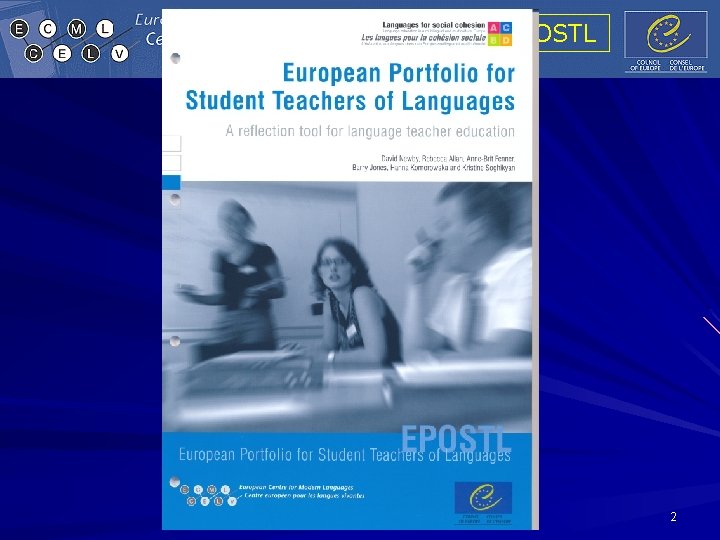
EPOSTL European Portfolio for Student Teachers of Languages
- Slides: 52
EPOSTL European Portfolio for Student Teachers of Languages (EPOSTL) - a framework for reflection Le Portfolio européen des enseignants de langues en formation (PELF) - un cadre de référence
EPOSTL 2
EPOSTL Governing Board. . . “Harmonising teacher education” ECML Project: Framework for Teacher Education (FTE) ‘Student teacher portfolio’ 3
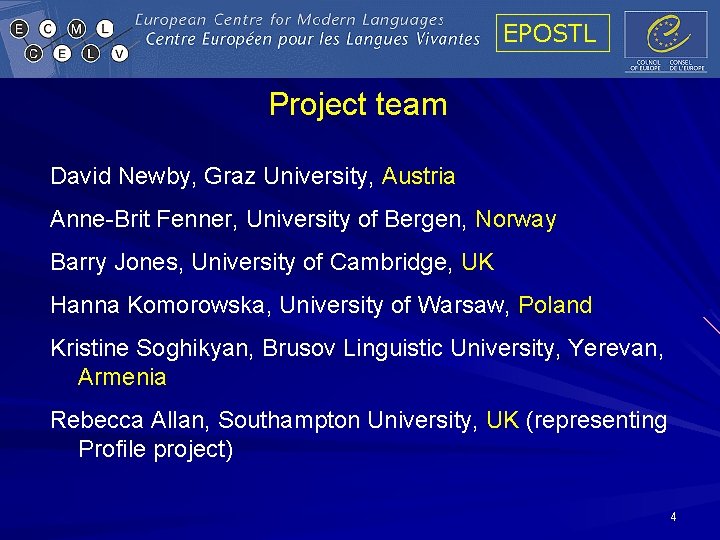
EPOSTL Project team David Newby, Graz University, Austria Anne-Brit Fenner, University of Bergen, Norway Barry Jones, University of Cambridge, UK Hanna Komorowska, University of Warsaw, Poland Kristine Soghikyan, Brusov Linguistic University, Yerevan, Armenia Rebecca Allan, Southampton University, UK (representing Profile project) 4
EPOSTL Project Tasks Address content of teacher education core competences Develop a Portfolio to help student teachers reflect on their knowledge, skills and values To formulate didactic competence descriptors (I can…) relating to language teaching 5
EPOSTL Target group Student teachers in initial teacher education Training to teach in secondary education Teachers of ‘general’ languages 6
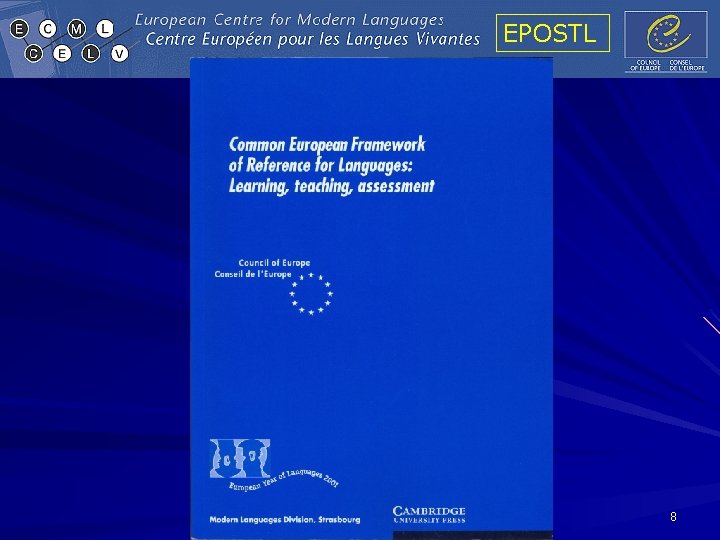
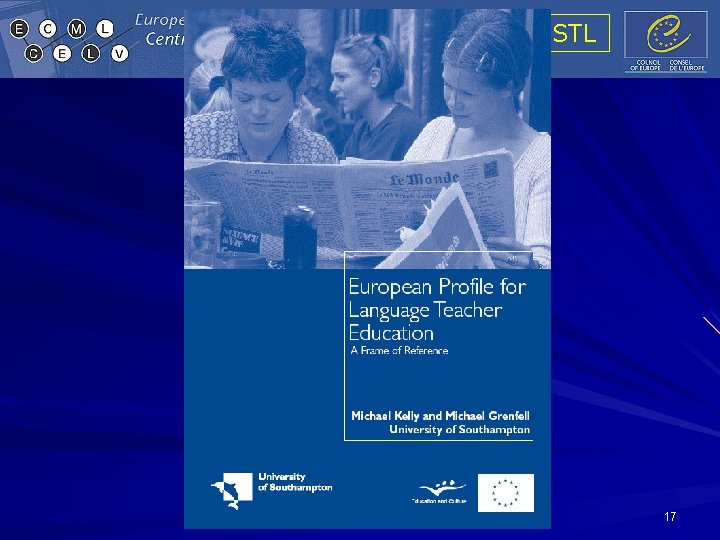
EPOSTL Existing work/documents Council of Europe – Common European Framework of Reference – European Language Portfolio European Commission/Univ. of Southampton – European Profile for Language Teacher Education – a frame of reference 7
EPOSTL 8
EPOSTL CEF EPOSTL The Common European Framework provides a common basis for the elaboration of language syllabuses, curriculum guidelines, examinations, textbooks etc. across Europe. The EPOSTL provides a common basis for the specification and discussion of didactic competences and curricula across Europe. 9
EPOSTL CEF EPOSTL The Common European Framework (…) describes in a comprehensive way what language learners have to learn to do in order to use a language for communication and what knowledge and skills they have to develop so as to be able to act effectively. The EPOSTL describes in a comprehensive way what language teachers have to learn to do in order to teach learners to use a language for communication and what knowledge and skills they have to help learners to develop so as to be able to act effectively. 10
EPOSTL Principles shared with CEFR Reflection ‘Can do’ competence descriptors Terminology (glossary) 11
EPOSTL Aims shared with CEFR Enhance transparency of aims, syllabuses etc. Support learner autonomy and life-long learning Promoting international cooperation 12
EPOSTL 13
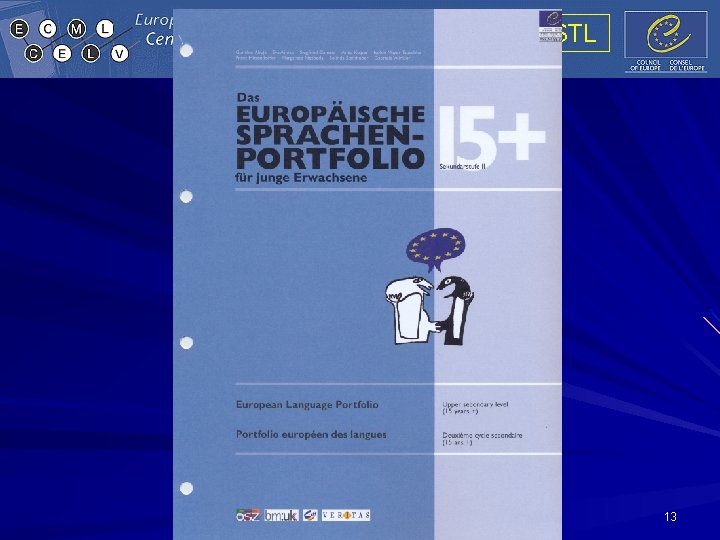
EPOSTL European Language Portfolio Reflection Self-assessment descriptors 3 -part structure: passport, biography, dossier (categories later to be changed in EPOSTL) 14
EPOSTL Structure of EPOSTL ELP: – – – Passport Biography Dossier EPOSTL: – – – Personal statement Self-assessment Dossier 15
EPOSTL Language and didactic descriptors European Language Portfolio Language/learner-based: I can understand short simple texts written in common everyday language EPOSTL Didactic/teacher-based: I can select texts appropriate to the needs and language level of the learners 16
EPOSTL 17
EPOSTL What is the Profile? The Profile presents a toolkit of 40 items which could be included in a teacher education programme to equip language teachers with the necessary skills and knowledge, as well as other professional competencies, to enhance their professional development and to lead to greater transparency and portability of qualifications. 18
EPOSTL Organisation of the Profile Structure – different constituent parts of language teacher education Knowledge and understanding – what trainees should know and understand Strategies and skills – what trainee language teachers should know how to do in teaching situations Values – that language teachers should be taught to promote 19
EPOSTL Profile and Portfolio interrelation Profile item 28: Training in the practical application of curricula and syllabuses. Portfolio: I can identify curriculum requirements and set learning aims and objectives suited to my learners needs 20
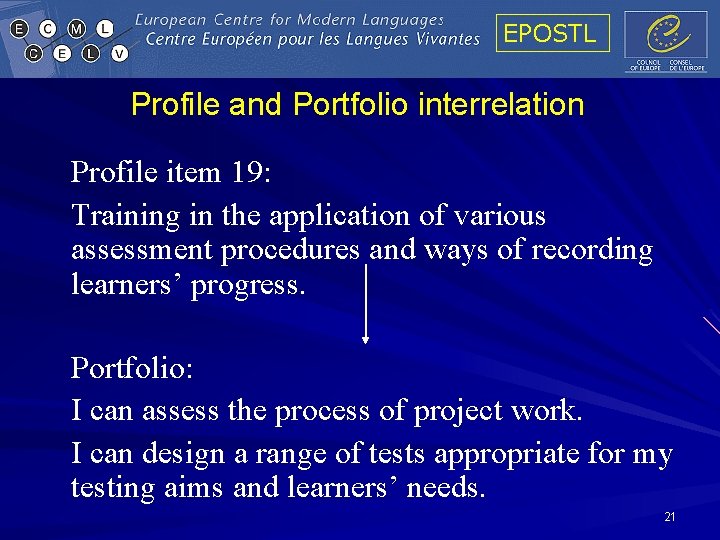
EPOSTL Profile and Portfolio interrelation Profile item 19: Training in the application of various assessment procedures and ways of recording learners’ progress. Portfolio: I can assess the process of project work. I can design a range of tests appropriate for my testing aims and learners’ needs. 21
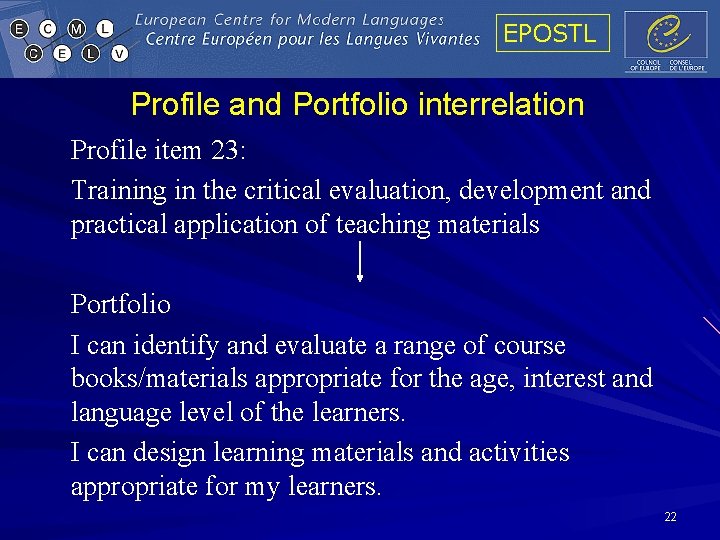
EPOSTL Profile and Portfolio interrelation Profile item 23: Training in the critical evaluation, development and practical application of teaching materials Portfolio I can identify and evaluate a range of course books/materials appropriate for the age, interest and language level of the learners. I can design learning materials and activities appropriate for my learners. 22
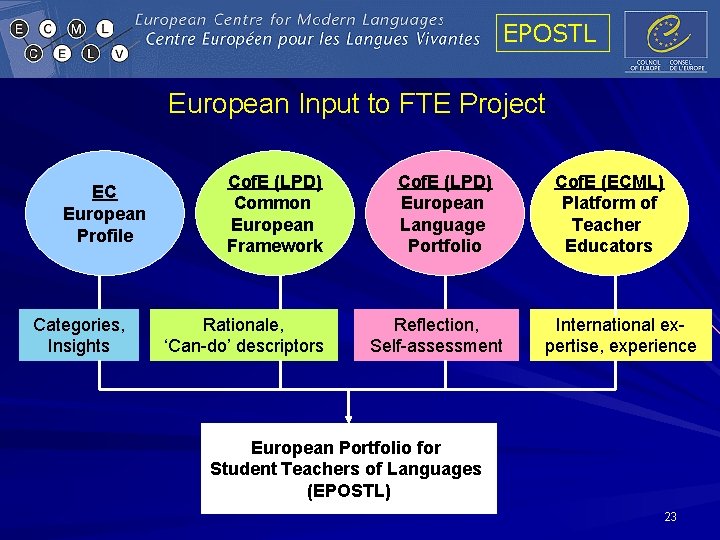
EPOSTL European Input to FTE Project EC European Profile Categories, Insights Cof. E (LPD) Common European Framework Rationale, ‘Can-do’ descriptors Cof. E (LPD) European Language Portfolio Reflection, Self-assessment Cof. E (ECML) Platform of Teacher Educators International expertise, experience European Portfolio for Student Teachers of Languages (EPOSTL) 23
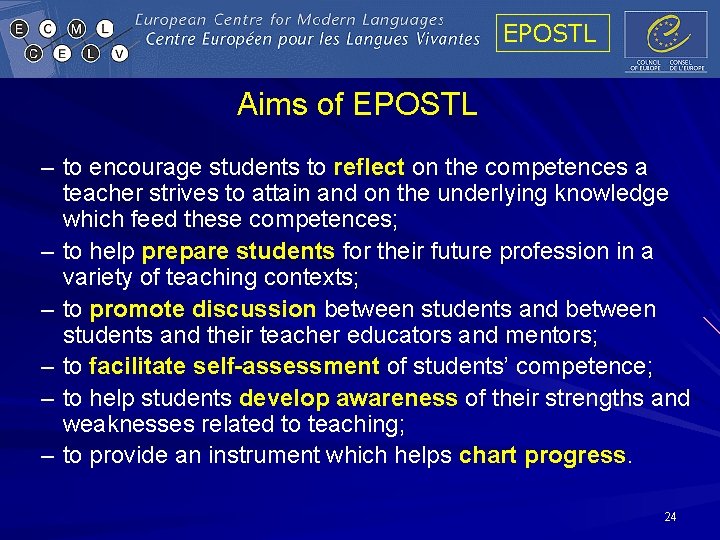
EPOSTL Aims of EPOSTL – to encourage students to reflect on the competences a teacher strives to attain and on the underlying knowledge which feed these competences; – to help prepare students for their future profession in a variety of teaching contexts; – to promote discussion between students and their teacher educators and mentors; – to facilitate self-assessment of students’ competence; – to help students develop awareness of their strengths and weaknesses related to teaching; – to provide an instrument which helps chart progress. 24
EPOSTL Structure of EPOSTL Introduction PERSONAL STATEMENT SELF-ASSESSMENT DOSSIER Glossary of terms Index User’s Guide 25
EPOSTL Personal statement 3. ‘Being able to explain grammar’ personal reflection: you have considered what the statement means on your own; dialogic reflection: you have discussed and perhaps modified your view by working with others. 26
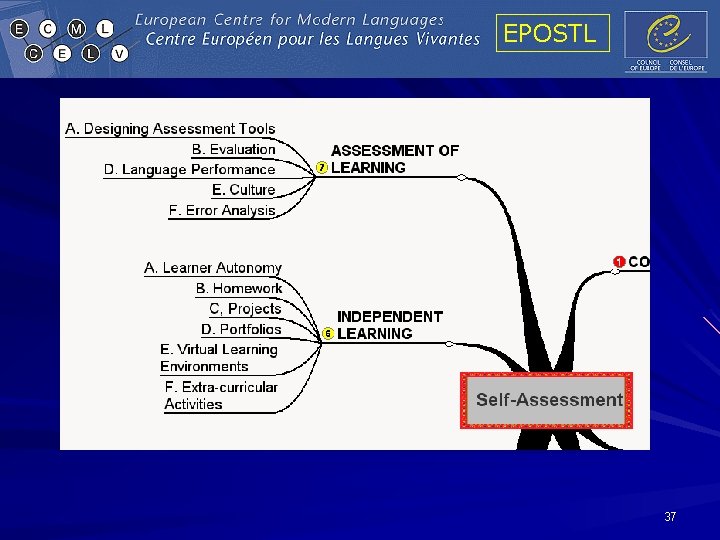
EPOSTL Self-assessment descriptors A. Curriculum 1. I can understand the requirements set in national and local curricula. A. Speaking/Spoken Interaction 1. I can create a supportive atmosphere that invites learners to take part in speaking activities. 27
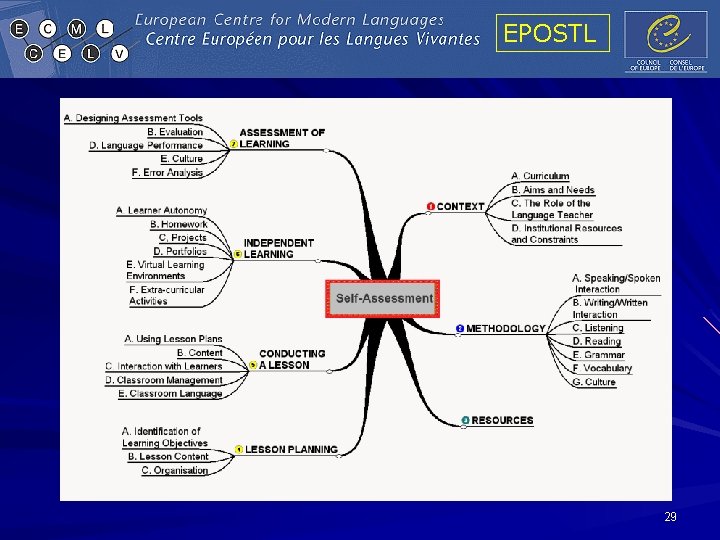
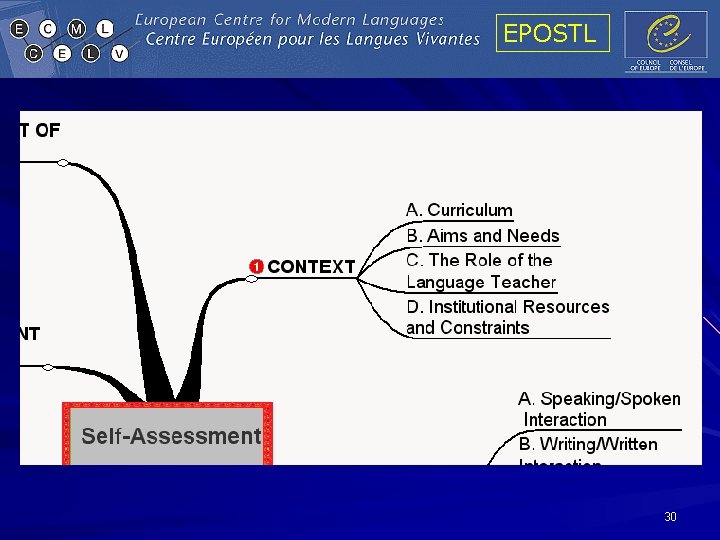
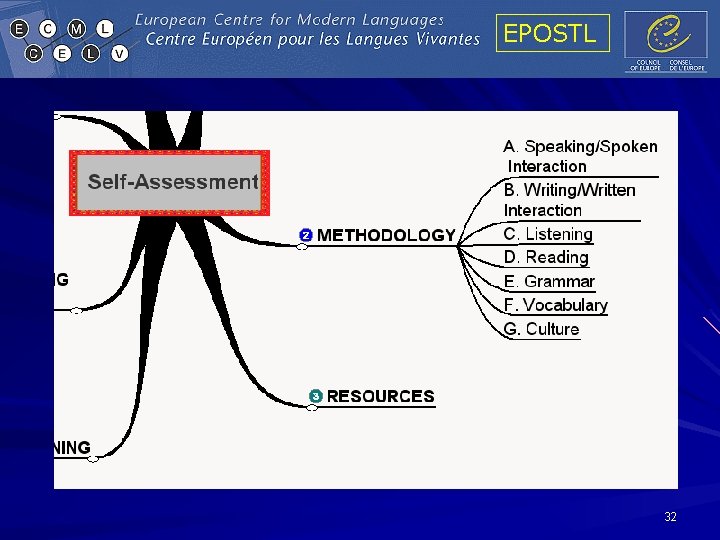
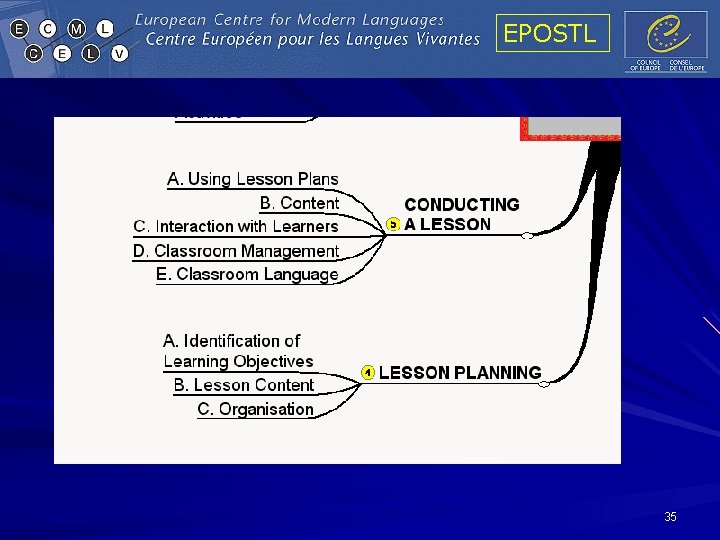
EPOSTL Categorisation of descriptors 1. Context 5. Conducting a lesson 2. Methodology 6. Independent 3. Resources Learning 7. Assessment of learning 4. Lesson planning 28
EPOSTL 29
EPOSTL 30
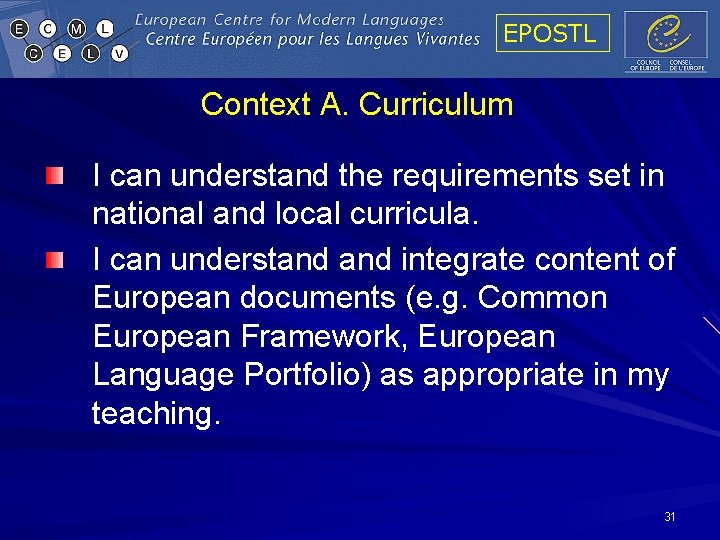
EPOSTL Context A. Curriculum I can understand the requirements set in national and local curricula. I can understand integrate content of European documents (e. g. Common European Framework, European Language Portfolio) as appropriate in my teaching. 31
EPOSTL 32
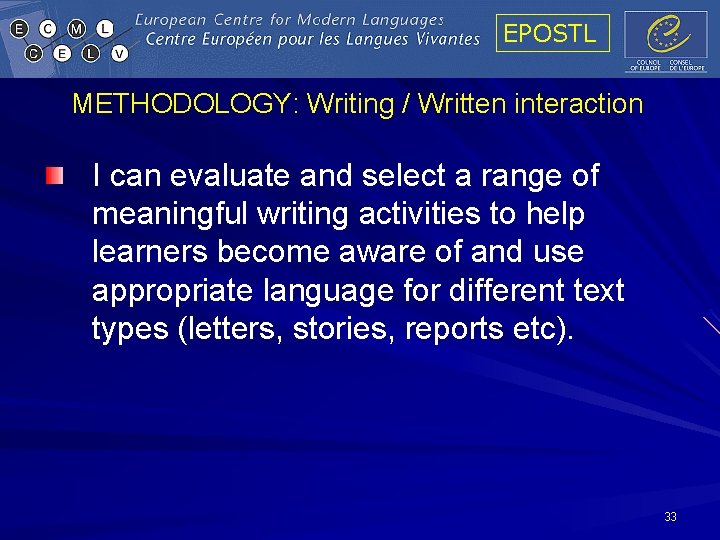
EPOSTL METHODOLOGY: Writing / Written interaction I can evaluate and select a range of meaningful writing activities to help learners become aware of and use appropriate language for different text types (letters, stories, reports etc). 33
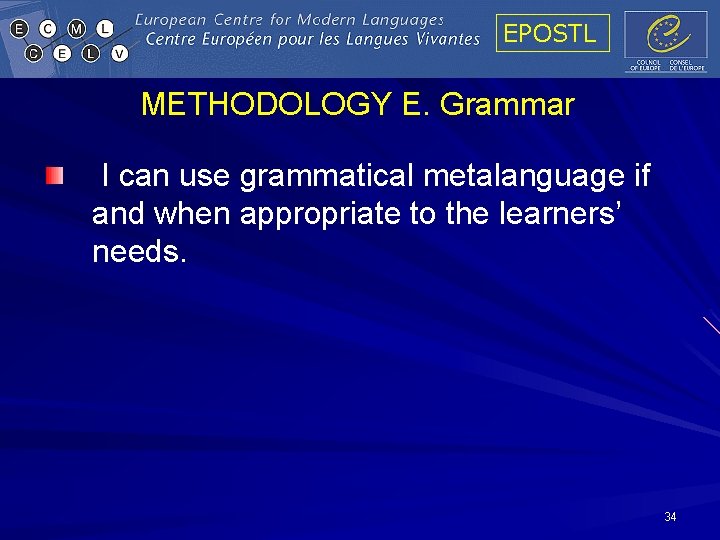
EPOSTL METHODOLOGY E. Grammar I can use grammatical metalanguage if and when appropriate to the learners’ needs. 34
EPOSTL 35
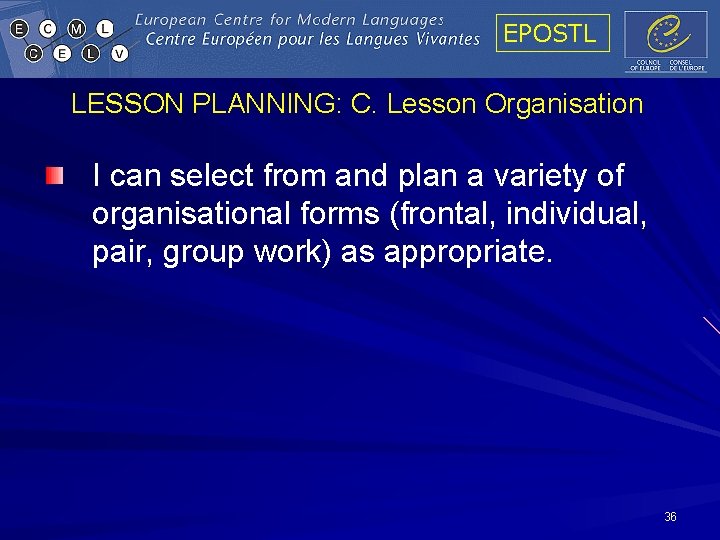
EPOSTL LESSON PLANNING: C. Lesson Organisation I can select from and plan a variety of organisational forms (frontal, individual, pair, group work) as appropriate. 36
EPOSTL 37
EPOSTL INDEPENDENT LEARNING A: Learner autonomy I can help learners to reflect on and evaluate their own learning processes and evaluate the outcomes. 38
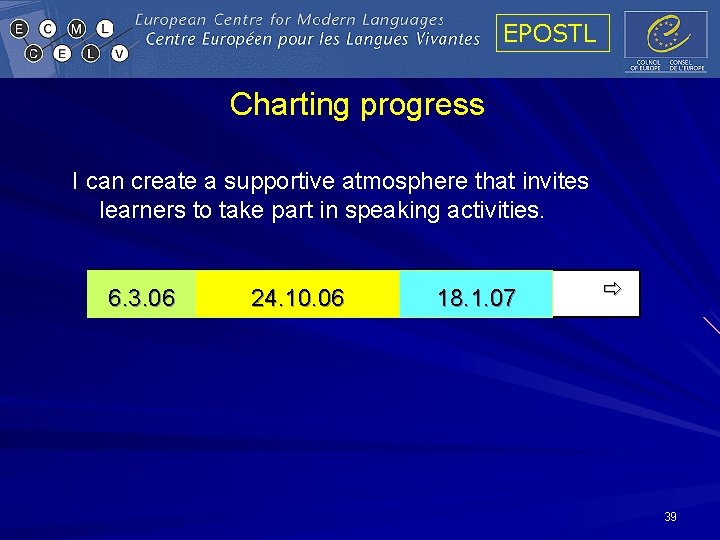
EPOSTL Charting progress I can create a supportive atmosphere that invites learners to take part in speaking activities. 6. 3. 06 24. 10. 06 18. 1. 07 39
EPOSTL Self-assessment descriptors – what they are NOT Merely a checklist to tick off A fixed qualification profile A way of testing students 40
EPOSTL Self-assessment descriptors – what they ARE an aid for reflection a way of charting progress a coherent basis for discussion, e. g. with teacher educators and mentors 41
EPOSTL Issues & problems 1. Scope of EPOSTL 2. Is it to be used as external evidence of qualifications, competence etc. (passport)? 3. How many descriptors? How detailed? 4. Whether to reflect any particular approaches? 5. What terminology to use? 6. Should descriptors be skill-based or relate to underlying knowledge and values? 42
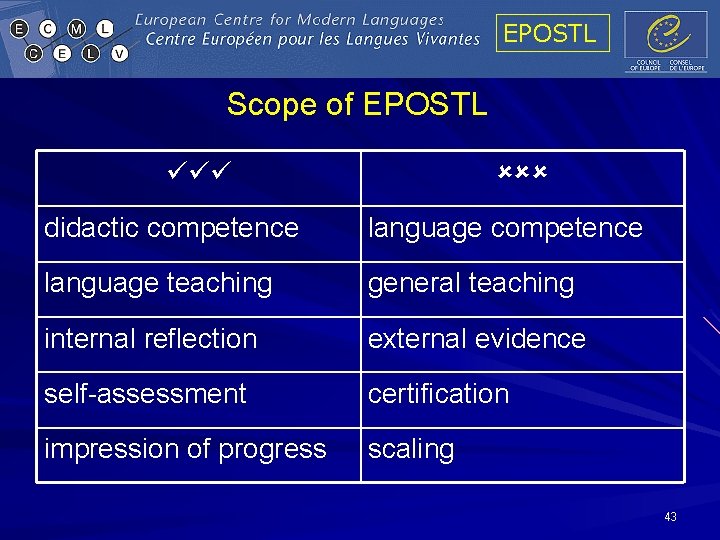
EPOSTL Scope of EPOSTL didactic competence language teaching general teaching internal reflection external evidence self-assessment certification impression of progress scaling 43
EPOSTL Knowledge, skills and values Knowledge: Savoir – – I can critically assess my teaching in relation to theoretical principles. I can understand the principles formulated in relevant European documents (e. g. Common European Framework of Reference, European Language Portfolio). Skills: Savoir faire – I can identify and investigate specific pedagogical/ didactic issues related to my learners or my teaching in the form of action research. Values: Savoir être – – I can understand the personal, intellectual and cultural value of learning other languages. I can appreciate and make use of the value added to the classroom environment by learners with diverse cultural backgrounds. 44
EPOSTL Dossier The primary function of the student teacher dossier is to help support claims that the ‘can do’ statements are an accurate reflection of your specific skills and abilities. You can do this by building up a ‘dossier’ of evidence. It is for you to decide what to include since you are the best - and sometimes only – judge of what evidence supports your ‘can do’ statements convincingly. 45
EPOSTL Dossier evidence from lessons you have given lesson plans, completed by yourself and/or with others, for a single or a series of lessons lesson observation notes written by teachers / mentors / tutors small-scale action research projects either for yourself or to share with others for discussion, reflection, analysis samples of assignments written by you and/or in collaboration with others linking theoretical to practical considerations 46
EPOSTL Uses of EPOSTL It should be incorporated into existing course structures and relate to what is being taught and learned. It should be used over a period of time, if possible throughout the teacher education programme. This will help to chart progress and growth. It can provide support to teaching practice and assist in discussions with mentors. This will help mentors to provide systematic feedback. It serves as a springboard for discussions, topics for term papers, research projects etc. 47
EPOSTL ASSESSMENT? Is it to be used for assessing students? – Examinations during teacher education – Teaching practice etc. 48
EPOSTL CURRICULUM DESIGN Is it useful for curriculum design in teacher education? 49
EPOSTL Prescriptivism through the back door? Prescriptive or descriptive – Is EPOSTL indirectly imposing a curriculum or standard on teacher education? 50
EPOSTL Expected outcomes Provide greater transparency of aims and didactic competences in teacher education for both students and educators Support a reflective mode of teacher education Aid harmonisation of bottom-up, need-based objectives and top-town curriculum planning Aid comparison of teacher education programmes 51
EPOSTL References, links, contacts EPOSTL/ECML Further information on EPOSTL: dnewby@aon. at ECML: www. ecml. at; information@ecml. at EPOSTL download: www. ecml. at/epostl Information on the EPOSTL project: http: //www. ecml. at/mtp 2/FTE/ CEFR/ELP Council of Europe (2001) Common European Framework of Reference for Languages: Learning, teaching, assessment. Strasbourg: Council of Europe, Modern Languages Division/Cambridge: Cambridge University Press Information on CEF and ELP: http: //www. coe. int/T/E/Cultural_Cooperation/education/Languages/Language_Policy/ EUROPEAN PROFILE Kelly, M. & Grenfell, M. , European Profile for Language Teacher Education – A Frame of Reference, Information at: http: //www. lang. soton. ac. uk/profile/index. html 52