Overview of Languages in the Victorian Curriculum Primary


- Slides: 39
Overview of Languages in the Victorian Curriculum Primary teachers
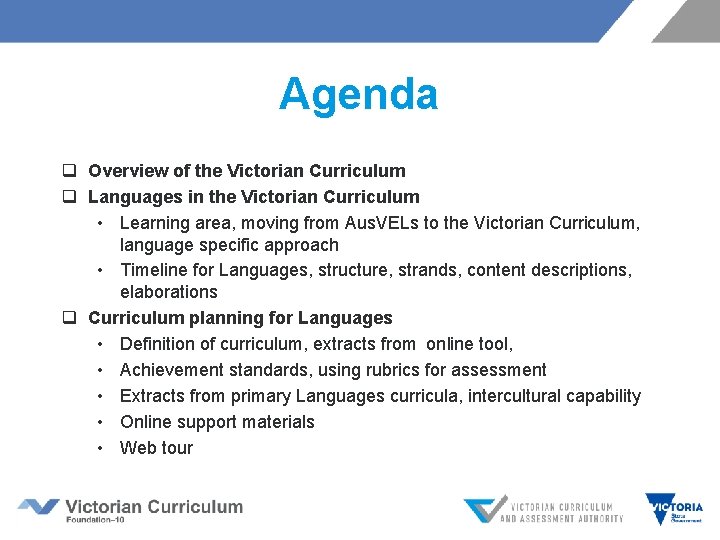
Agenda q Overview of the Victorian Curriculum q Languages in the Victorian Curriculum • Learning area, moving from Aus. VELs to the Victorian Curriculum, language specific approach • Timeline for Languages, structure, strands, content descriptions, elaborations q Curriculum planning for Languages • Definition of curriculum, extracts from online tool, • Achievement standards, using rubrics for assessment • Extracts from primary Languages curricula, intercultural capability • Online support materials • Web tour
Victorian Curriculum F-10 • released in September 2015 as a central component of Education State, Victorian Curriculum F-10 • provides a stable foundation for whole school curriculum planning • incorporates the Australian Curriculum • builds on VELS and Aus. VELS • reflects Victorian standards and priorities
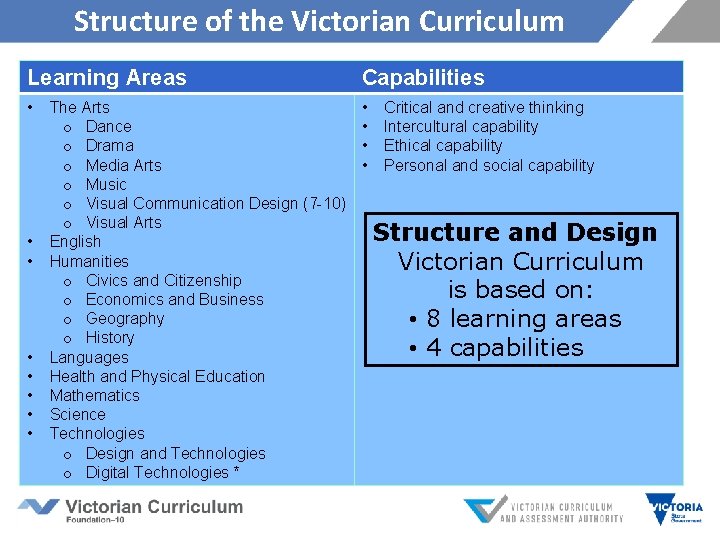
Structure of the Victorian Curriculum Learning Areas Capabilities • • • The Arts o Dance o Drama o Media Arts o Music o Visual Communication Design (7 -10) o Visual Arts English Humanities o Civics and Citizenship o Economics and Business o Geography o History Languages Health and Physical Education Mathematics Science Technologies o Design and Technologies o Digital Technologies * Critical and creative thinking Intercultural capability Ethical capability Personal and social capability Structure and Design Victorian Curriculum is based on: • 8 learning areas • 4 capabilities
The Victorian Curriculum: Languages The Languages curriculum focuses on both language and culture, and students • learn to communicate across linguistic and cultural systems • develop language awareness and intercultural skills and understandings • develop openness to different experiences and perspectives • develop skills in negotiating experiences and meanings across languages and cultures • reflect on language use and language learning
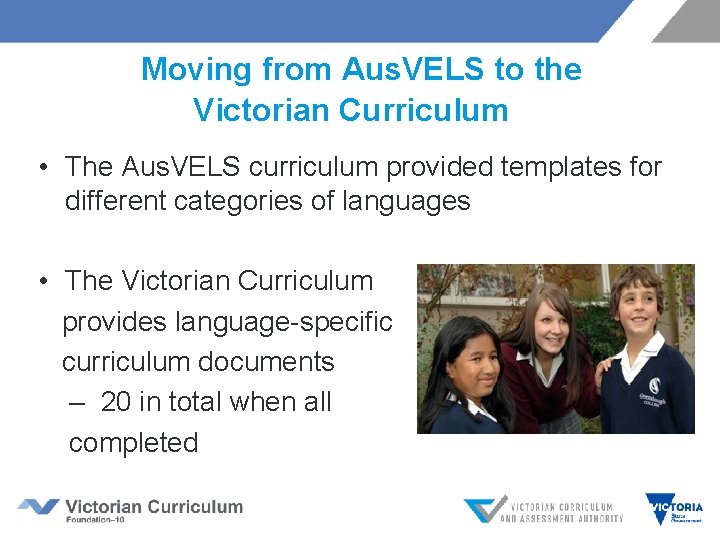
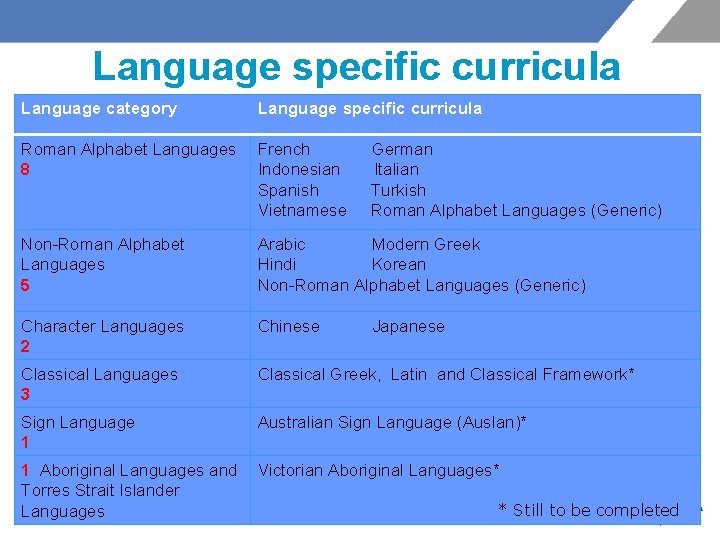
Moving from Aus. VELS to the Victorian Curriculum • The Aus. VELS curriculum provided templates for different categories of languages • The Victorian Curriculum provides language-specific curriculum documents – 20 in total when all completed
Language specific curricula Language category Language specific curricula Roman Alphabet Languages 8 French German Indonesian Italian Spanish Turkish Vietnamese Roman Alphabet Languages (Generic) Non-Roman Alphabet Languages 5 Arabic Modern Greek Hindi Korean Non-Roman Alphabet Languages (Generic) Character Languages 2 Chinese Japanese Classical Languages 3 Classical Greek, Latin and Classical Framework* Sign Language 1 Australian Sign Language (Auslan)* 1 Aboriginal Languages and Victorian Aboriginal Languages* Torres Strait Islander * Still to be completed Languages
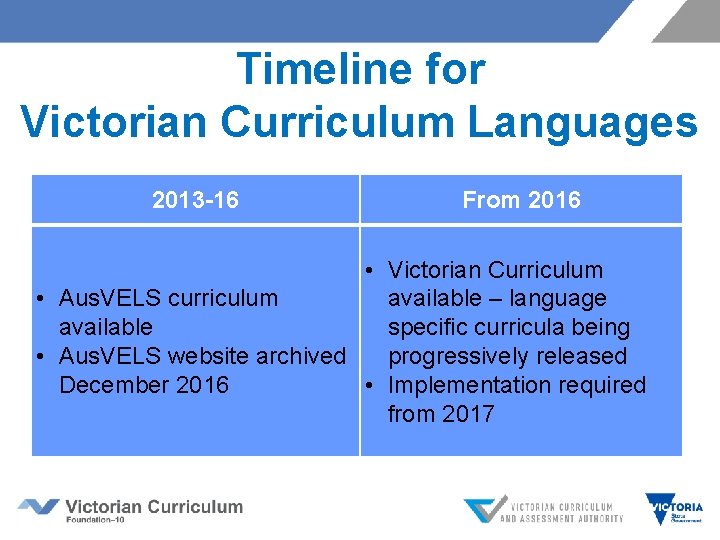
Timeline for Victorian Curriculum Languages 2013 -16 From 2016 • Victorian Curriculum available – language • Aus. VELS curriculum specific curricula being available • Aus. VELS website archived progressively released December 2016 • Implementation required from 2017
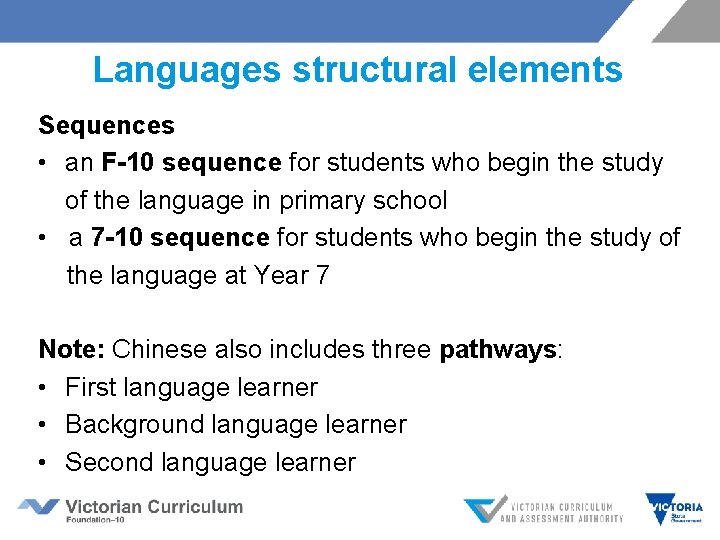
Languages structural elements Sequences • an F-10 sequence for students who begin the study of the language in primary school • a 7 -10 sequence for students who begin the study of the language at Year 7 Note: Chinese also includes three pathways: • First language learner • Background language learner • Second language learner
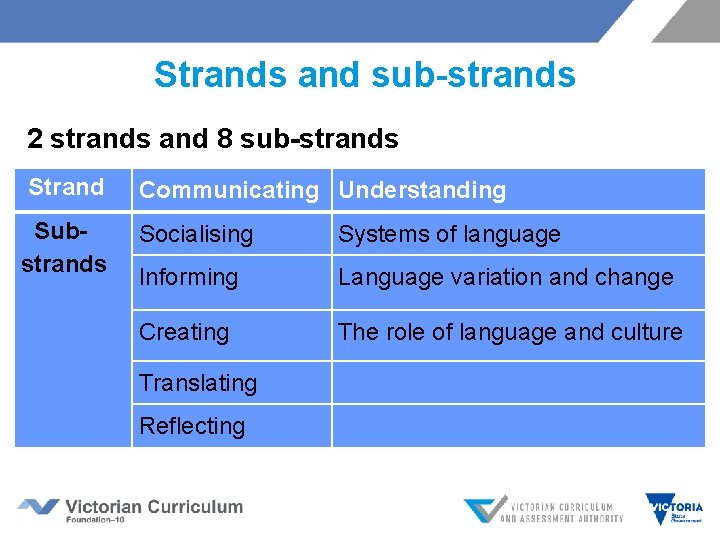
Strands and sub-strands 2 strands and 8 sub-strands Strand Sub strands Communicating Understanding Socialising Systems of language Informing Language variation and change Creating The role of language and culture Translating Reflecting
Content descriptions and elaborations Content descriptions are: • specific and discrete information identifying what teachers are expected to teach and students are expected to learn • found within each sub-strand • not a checklist Elaborations are: • non-mandated, advisory examples that provide guidance on how the curriculum may be transformed into a classroom activity or learning opportunity
Using the content descriptions The aim is for the teaching and learning program to integrate the content descriptions into ‘topics’/units of work. A thematic approach across a range of learning areas will provide valuable contexts for student learning.
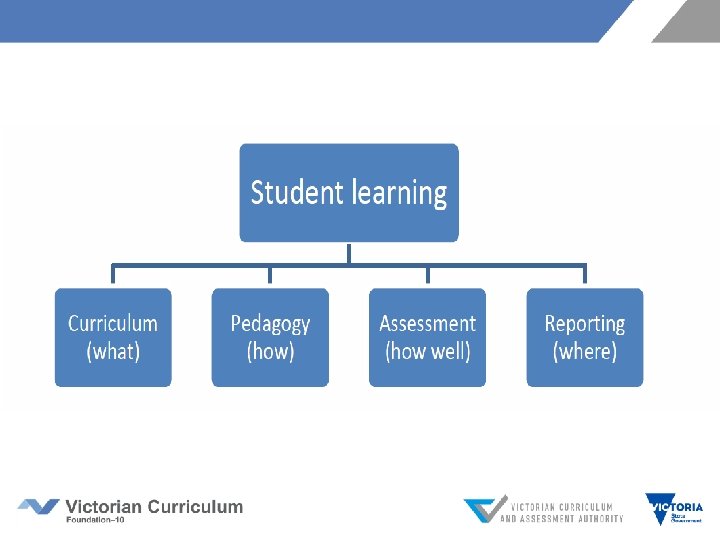
Curriculum • defines what it is that all students have the opportunity to learn • is represented as a continuum defining increasingly complex knowledge, skills and concepts • each school develops the teaching and learning program - how the curriculum is delivered
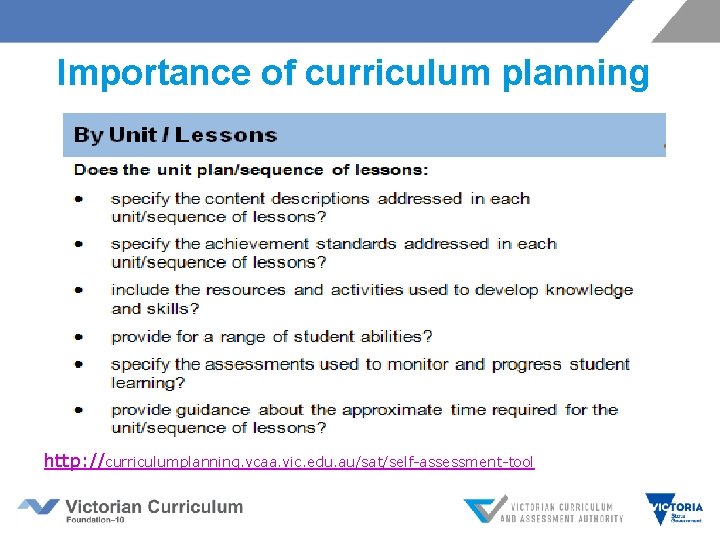
Importance of curriculum planning http: //curriculumplanning. vcaa. vic. edu. au/sat/self-assessment-tool
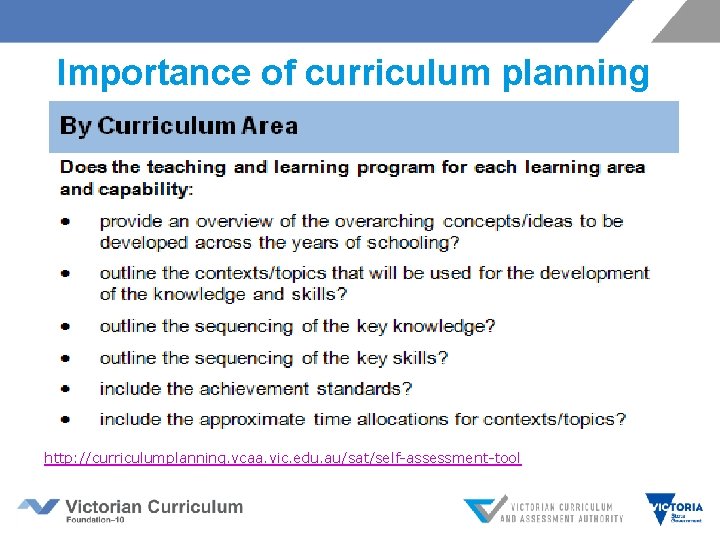
Importance of curriculum planning http: //curriculumplanning. vcaa. vic. edu. au/sat/self-assessment-tool
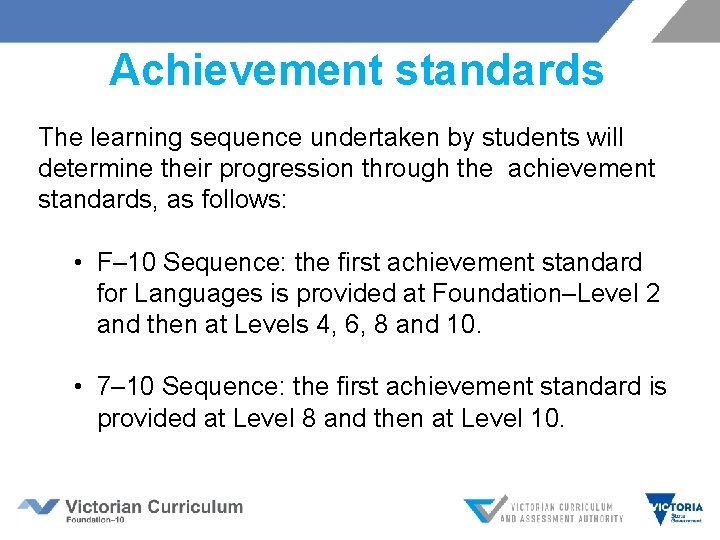
Achievement standards The learning sequence undertaken by students will determine their progression through the achievement standards, as follows: • F– 10 Sequence: the first achievement standard for Languages is provided at Foundation–Level 2 and then at Levels 4, 6, 8 and 10. • 7– 10 Sequence: the first achievement standard is provided at Level 8 and then at Level 10.
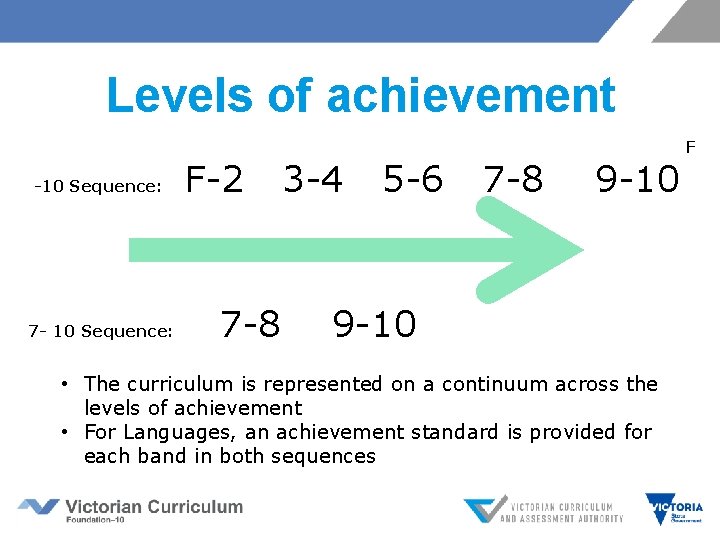
Levels of achievement -10 Sequence: 7 - 10 Sequence: F-2 7 -8 3 -4 5 -6 7 -8 9 -10 • The curriculum is represented on a continuum across the levels of achievement • For Languages, an achievement standard is provided for each band in both sequences F
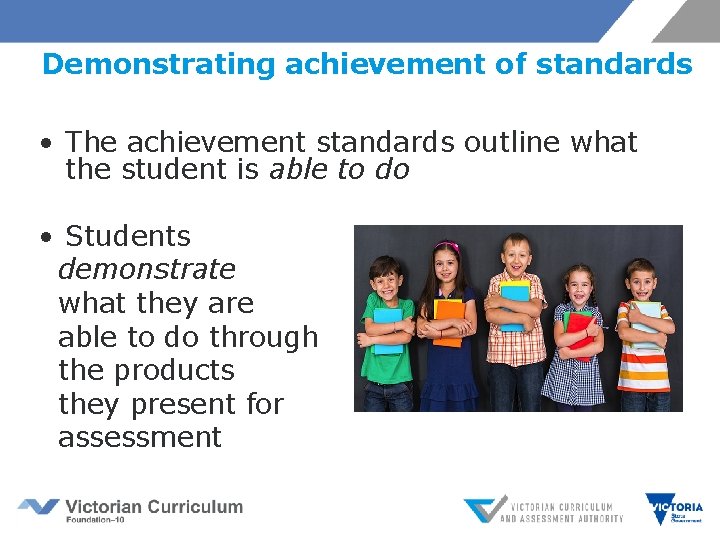
Demonstrating achievement of standards • The achievement standards outline what the student is able to do • Students demonstrate what they are able to do through the products they present for assessment
Assessment and reporting • Achievement standards as a continuum of language learning, not an agedetermined set of expectations • Reporting in Victoria to be against the achievement standards • At times using assessment to adjust teaching
Assessment “…performances on assessment tasks should be recorded using one or more task ‘rubrics’. ”(Masters) Rubrics: • provide descriptions of observable characteristics of performance in an assessment task • make explicit what is being looked for and valued as evidence of successful learning
Demonstrating achievement of the standards • Rubrics or assessment criteria can be developed from the achievement standards • Units of work will probably address a number of aspects of the standard at any given level
Assessing progress in the language • Make assessment part of program design • Have clear criteria (rubrics) • Students discuss assessment criteria • Collect evidence over term
Creating a teaching and learning program Challenge: Turning the curriculum (what students should know) into teaching and learning programs that will engage and extend students learning in languages Possible action: Could begin by mapping the current school languages program against the new Victorian Curriculum
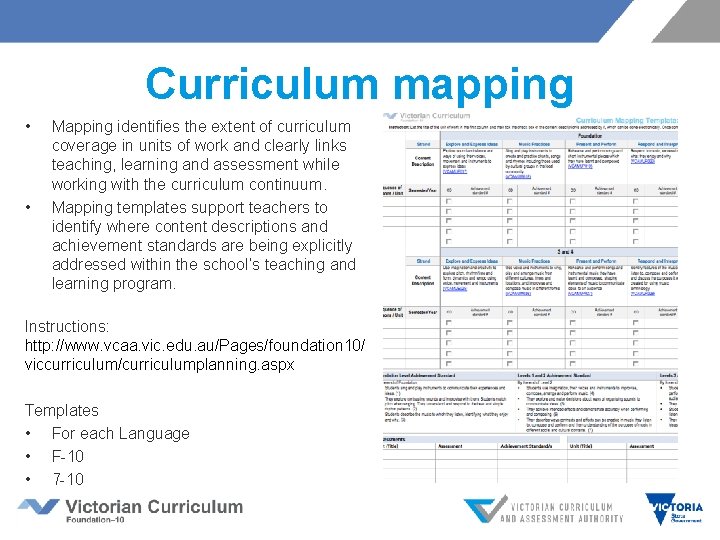
Curriculum mapping • • Mapping identifies the extent of curriculum coverage in units of work and clearly links teaching, learning and assessment while working with the curriculum continuum. Mapping templates support teachers to identify where content descriptions and achievement standards are being explicitly addressed within the school’s teaching and learning program. Instructions: http: //www. vcaa. vic. edu. au/Pages/foundation 10/ viccurriculum/curriculumplanning. aspx Templates • For each Language • F-10 • 7 -10
Reporting • Schools will not be constrained by a one-size-fits-all approach • Schools have the flexibility to determine, in partnership with students, parents and the local community, the timing and format of their reports.
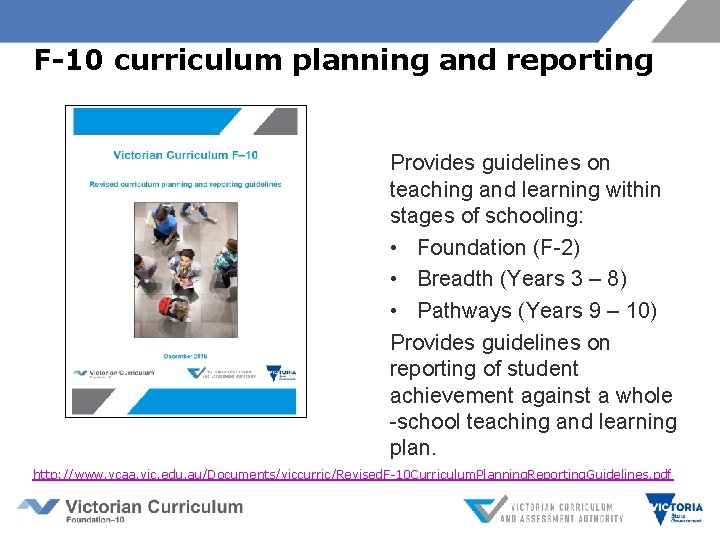
F-10 curriculum planning and reporting guidelines Provides guidelines on teaching and learning within stages of schooling: • Foundation (F-2) • Breadth (Years 3 – 8) • Pathways (Years 9 – 10) Provides guidelines on reporting of student achievement against a whole -school teaching and learning plan. http: //www. vcaa. vic. edu. au/Documents/viccurric/Revised. F-10 Curriculum. Planning. Reporting. Guidelines. pdf
Use of English • Students are encouraged to use the language being studied as much as possible for classroom routines, social interactions, structured learning tasks, and language experimentation and practice. • Students will have opportunities to engage with members of the community who speak the language being studied, which in some cases will be facilitated via digital technologies. • English is used, where appropriate, for discussion and reflection, enabling students to share complex ideas about language and culture.
Victorian Curriculum - Chinese Levels 3 -4 Communicating Content description Socialising Interact with teachers and peers in social and class activities, exchanging ideas and opinions, using correct tones (VCZHC 017) Elaborations Socialising • giving personal information, facts and opinions in response to questions about people and aspects of daily life such as pets (我的狗很可� ), interests, routines and activities • expressing opinions and commenting on personal experience using familiar expressions (for example, 很棒。 太好了。我不喜� …), and turn-taking (�你了 ) in class games • contributing to class activities by asking for (我可以…�? ) and giving permission (可以), apologising and excusing (� 不起), raising hand using phrases such as 老�,我不 懂 to request assistance in learning activities • initiating conversations in familiar social contexts by greeting participants and introducing themselves (for example, 你好,我叫James,我八�,我住在悉尼 ), displaying appropriate social manners to enhance communication
Extract from Levels 3/4 Chinese Achievement Standard: F- 10 sequence Communicating strand By the end of Level 4, students ……… use spoken and written Chinese in simple personal interactions with familiar participants about self, family, people, places, routine, school life, and their own interests and preferences, for example, 你叫什么名字? 你上几年� ? 你有狗�? 你喜�什么运�? They use appropriate pronunciation, tone, gesture and movement and some formulaic expressions. They use modelled questions to develop responses, for example, 你的哥哥几�?, 他是�?, 你住在哪里?, �是什么? ………………
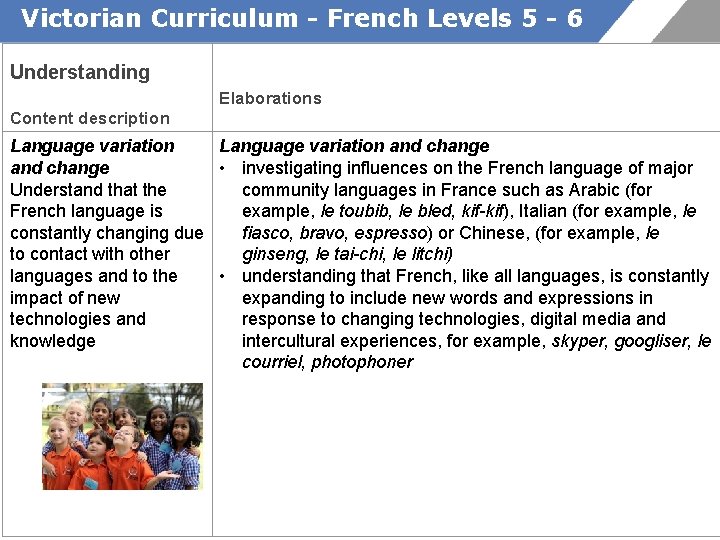
Victorian Curriculum - French Levels 5 - 6 Understanding Elaborations Content description Language variation and change • investigating influences on the French language of major Understand that the community languages in France such as Arabic (for French language is example, le toubib, le bled, kif-kif), Italian (for example, le constantly changing due fiasco, bravo, espresso) or Chinese, (for example, le to contact with other ginseng, le tai-chi, le litchi) languages and to the • understanding that French, like all languages, is constantly impact of new expanding to include new words and expressions in technologies and response to changing technologies, digital media and knowledge intercultural experiences, for example, skyper, googliser, le courriel, photophoner
Extract from Levels 5/6 French Achievement Standard Understanding strand By the end of Level 6, students ……. . recognise relationships between parts of words (suffixes, prefixes) and stems of words (préparer, préparation; le marché, le supermarché, l’hypermarché). Students make comparisons between French and their own language and culture, drawing from texts which relate to familiar routines and daily life (la vie scolaire, la famille, les courses, les loisirs, la cuisine). They explain to others French terms and expressions that reflect cultural practices (bon appétit, bonne fête). They reflect on their own cultural identity in light of their experience of learning French, noticing how their ideas and ways of communicating are influenced by their membership of cultural groups.
Intercultural Capability Intercultural capability aims to develop knowledge, understandings and skills to enable students to: • demonstrate an awareness of and respect for cultural diversity within the community • reflect on how intercultural experiences influence attitudes, values and beliefs • recognise the importance of acceptance and appreciation of cultural diversity for a cohesive community. There are opportunities for teachers of Languages to support other teachers to work in this area of the curriculum.
Locating information
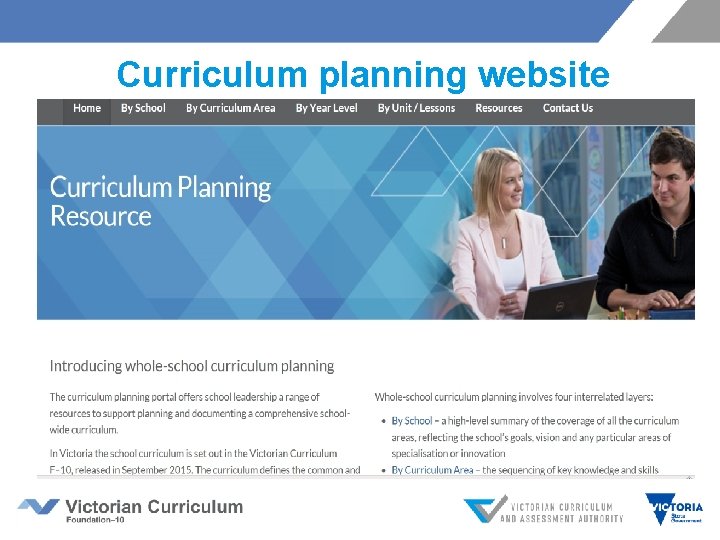
VCAA Curriculum Planning website • The Curriculum Planning website offers a range of resources to support planning and documenting the curriculum. • It includes a self-assessment tool and a suite of curriculum planning examples for both primary and secondary schools.
Curriculum planning website
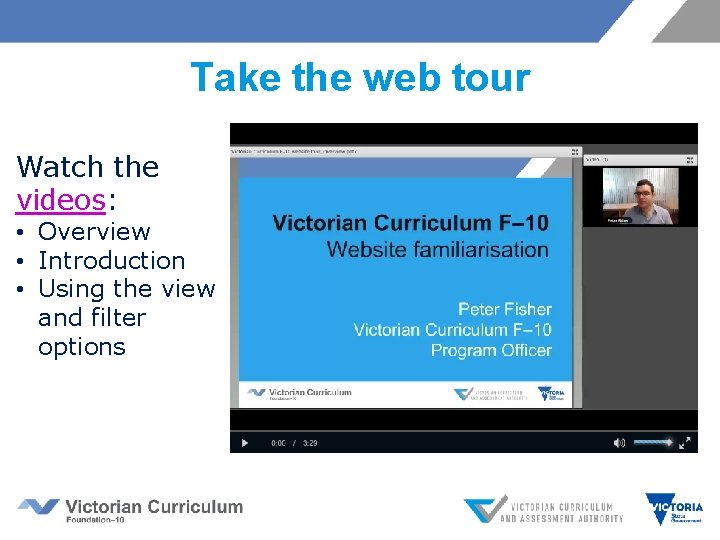
Take the web tour Watch the videos: • Overview • Introduction • Using the view and filter options
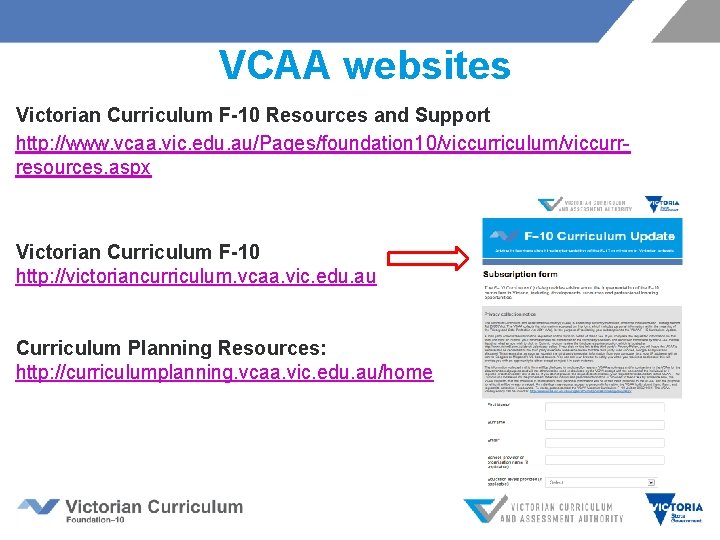
VCAA websites Victorian Curriculum F-10 Resources and Support http: //www. vcaa. vic. edu. au/Pages/foundation 10/viccurriculum/viccurrresources. aspx Victorian Curriculum F-10 http: //victoriancurriculum. vcaa. vic. edu. au Curriculum Planning Resources: http: //curriculumplanning. vcaa. vic. edu. au/home
Contact Details: Maree Dellora Languages Manager dellora. maree. r@edumail. vic. gov. au Tel: 9032 1692