Using Victorian Curriculum to plan F6 Dance and

- Slides: 19
Using Victorian Curriculum to plan F-6 Dance and Drama learning Helen Champion Webinar, 8 November 2016
Session overview • Victorian Curriculum: The Arts • Design assumptions • Content • Organisation • Adapting and adopting existing learning materials • Connecting to the Arts learning areas • Connecting to capabilities etc.
Workshop materials Before the session starts, please make sure that you have • An existing unit of work or sequence of learning And, if possible, • a copy of your school’s curriculum planning template • open these web pages Dance: Structure Scope and sequence Drama: Structure Scope and sequence And … you’ll probably want to take some notes as you complete the workshop activities – either paper or digital is fine.
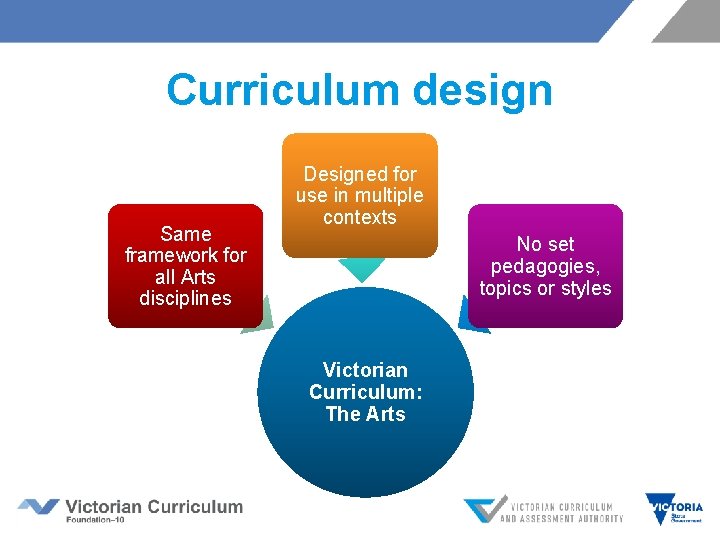
Curriculum design Same framework for all Arts disciplines Designed for use in multiple contexts No set pedagogies, topics or styles Victorian Curriculum: The Arts
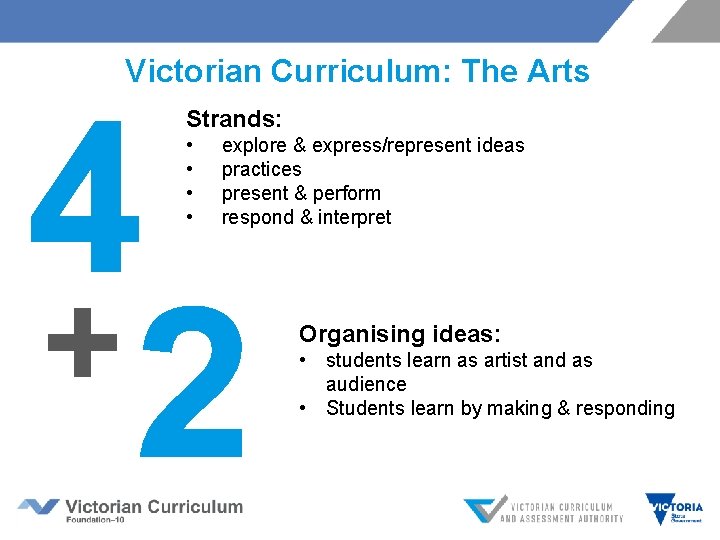
Victorian Curriculum: The Arts 4 +2 Strands: • • explore & express/represent ideas practices present & perform respond & interpret Organising ideas: • students learn as artist and as audience • Students learn by making & responding
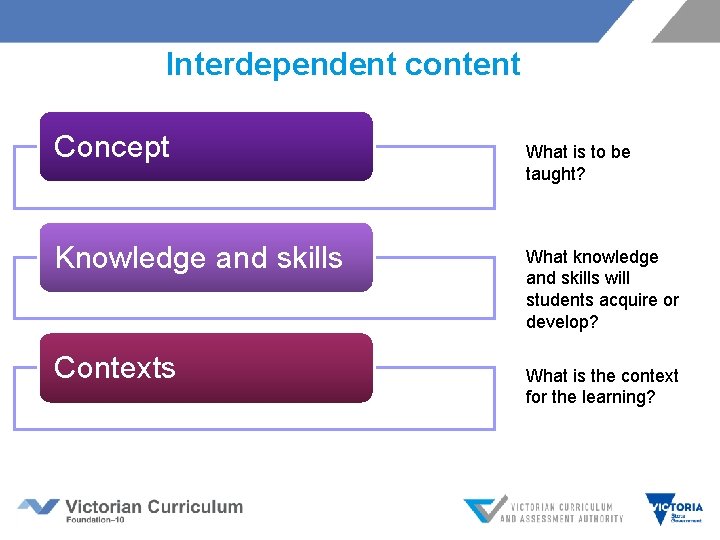
Interdependent content Concept Knowledge and skills Contexts What is to be taught? What knowledge and skills will students acquire or develop? What is the context for the learning?
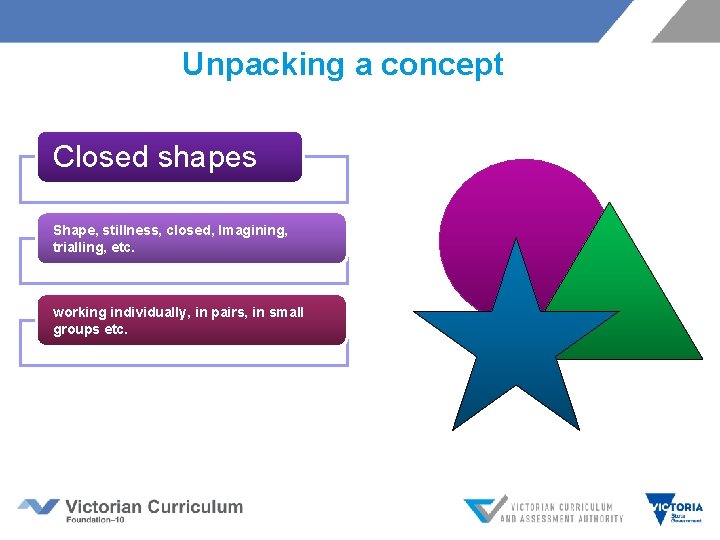
Unpacking a concept Closed shapes Shape, stillness, closed, Imagining, trialling, etc. working individually, in pairs, in small groups etc.
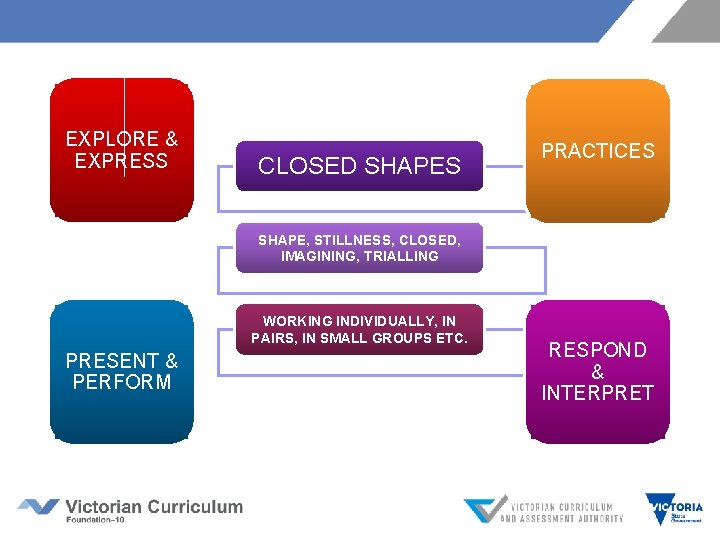
EXPLORE & EXPRESS CLOSED SHAPES PRACTICES SHAPE, STILLNESS, CLOSED, IMAGINING, TRIALLING WORKING INDIVIDUALLY, IN PAIRS, IN SMALL GROUPS ETC. PRESENT & PERFORM RESPOND & INTERPRET
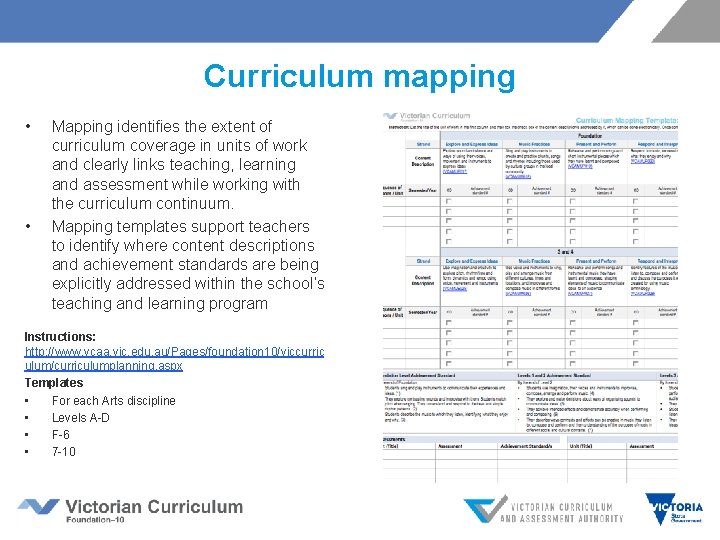
Curriculum mapping • • Mapping identifies the extent of curriculum coverage in units of work and clearly links teaching, learning and assessment while working with the curriculum continuum. Mapping templates support teachers to identify where content descriptions and achievement standards are being explicitly addressed within the school’s teaching and learning program Instructions: http: //www. vcaa. vic. edu. au/Pages/foundation 10/viccurric ulum/curriculumplanning. aspx Templates • For each Arts discipline • Levels A-D • F-6 • 7 -10
Activity #1: The big idea What is the purpose of the unit? (The big, central idea) Describe the unit/sequence of learning in 20 words or less Exploring the meaning of ‘closed’ through movement Who is the target ‘audience’? F-2 EXPLORE & EXPRESS PRACTICES PRESENT & PERFORM RESPOND & INTERPRET
Activity #2: unpacking • why is this activity in the unit/sequence learning plan for this level? Using imagination to explore ideas and translate into movement multiple possibilities – accessibility links to multiple curriculum strands can be repeated a few times with variations, for example, connecting to Science learning to explore concepts of force and flow connect to Mathematics EXPLORE & EXPRESS PRACTICES PRESENT & PERFORM RESPOND & INTERPRET
Activity #2 b: more unpacking • how is the activity • • introduced? taught? aligned to prior learning? varied to cater for different levels of knowledge and skill? • how does the activity connect to the rest of the unit/sequence? • What opportunities are there formative assessment? • • • self-assessment peer-assessment teacher observation EXPLORE & EXPRESS PRACTICES PRESENT & PERFORM RESPOND & INTERPRET
Activity #3: identifying possible connections Thinking about the same activity or aspect of the unit/sequence, • when students are ‘exploring’ or ‘expressing’ what dance or drama practices are they using? • are they also ‘responding’ or ‘interpreting’? • does this activity contribute to - presentation of a performance? - an actual performance • how are digital technologies used for learning and teaching in this activity? How could they be used? EXPLORE & EXPRESS PRACTICES PRESENT & PERFORM RESPOND & INTERPRET
Activity #3 a: making connections Explore and express: Use fundamental locomotor and non-locomotor movements, body parts, bases and zones to explore safe movement possibilities and dance ideas(VCADAE 017) Practice: Use choreographic devices to organise movement ideas and create dance sequences (VCADAD 018) • explore ideas of a ‘closed’ non-locomotor shape • respond to/interpret stimulus showing ‘closed shapes’ • improvise ways of creating a ‘closed’ shape using whole body, body parts/zones/regions • trial movement possibilities while holding the shape • work with a partner to create a sequence based on two shapes • document and describe the shapes they have created, write a definition of a closed shape. EXPLORE & EXPRESS PRACTICES PRESENT & PERFORM RESPOND & INTERPRET
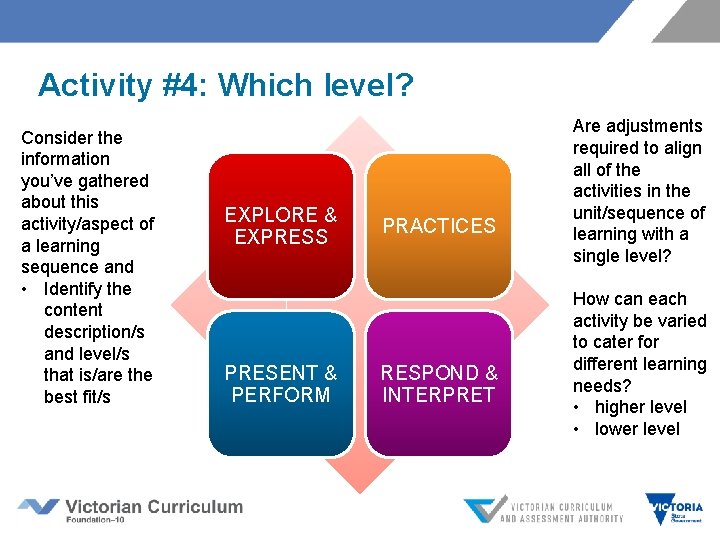
Activity #4: Which level? Consider the information you’ve gathered about this activity/aspect of a learning sequence and • Identify the content description/s and level/s that is/are the best fit/s EXPLORE & EXPRESS PRESENT & PERFORM PRACTICES RESPOND & INTERPRET Are adjustments required to align all of the activities in the unit/sequence of learning with a single level? How can each activity be varied to cater for different learning needs? • higher level • lower level
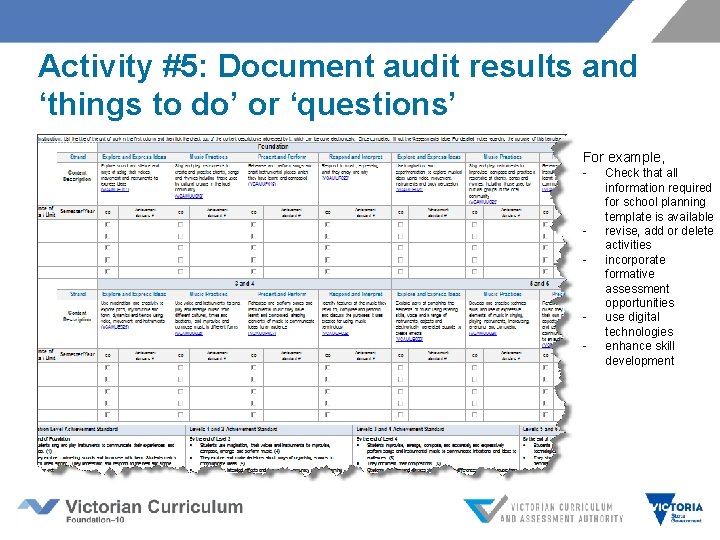
Activity #5: Document audit results and ‘things to do’ or ‘questions’ For example, - - - Check that all information required for school planning template is available revise, add or delete activities incorporate formative assessment opportunities use digital technologies enhance skill development
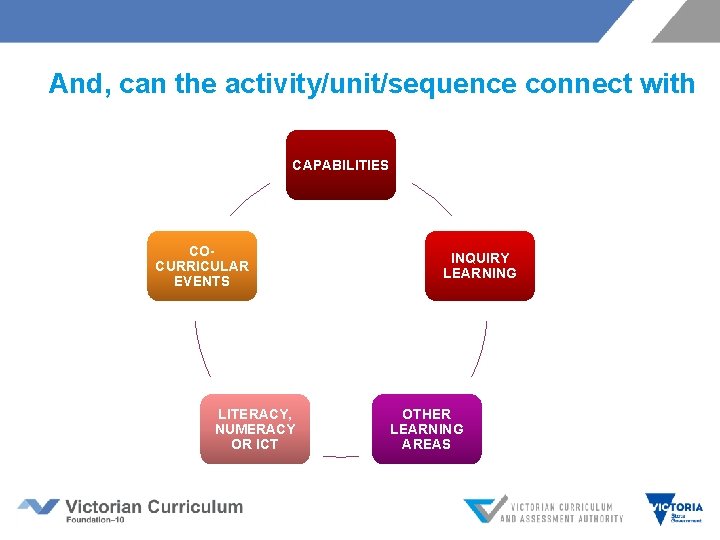
And, can the activity/unit/sequence connect with CAPABILITIES COCURRICULAR EVENTS LITERACY, NUMERACY OR ICT INQUIRY LEARNING OTHER LEARNING AREAS
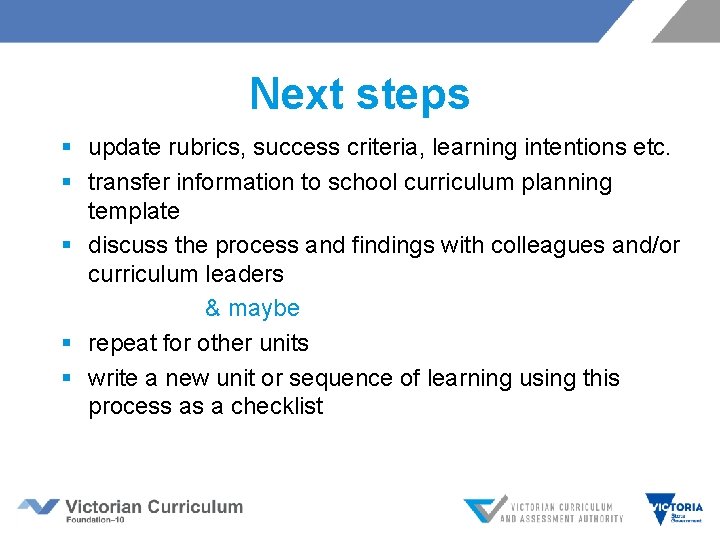
Next steps § update rubrics, success criteria, learning intentions etc. § transfer information to school curriculum planning template § discuss the process and findings with colleagues and/or curriculum leaders & maybe § repeat for other units § write a new unit or sequence of learning using this process as a checklist
Feedback Please complete the survey the F-10 unit will email to you so that I get your feedback about the relevance of this presentation for your work and whether it met your expectations. You can also email me directly: Helen Champion Curriculum Manager: Performing Arts phone: 61 3 9032 1723 email: champion. helen. h@edumail. vic. gov. au