IDEL Training Administration and Scoring of Fluidez en
![7. At the end of 1 minute place a bracket (]) after the last](https://slidetodoc.com/presentation_image_h/23ccace382f962c34c8fca263c6c675c/image-12.jpg "7. At the end of 1 minute place a bracket (]) after the last")

- Slides: 54
IDEL™ Training: Administration and Scoring of “Fluidez en las Palabras sin Sentido” (FPS) Dynamic Measurement Group Supporting School Success One Step at a Time © 2005, Dynamic Measurement Group
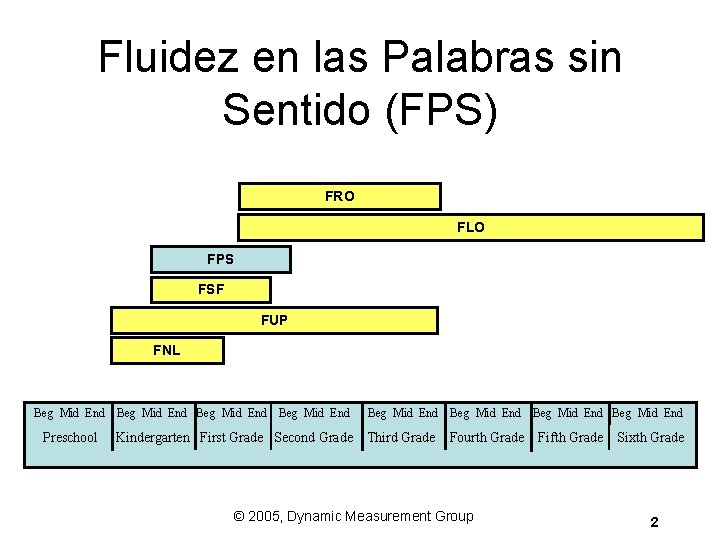
Fluidez en las Palabras sin Sentido (FPS) FRO FLO FPS FSF FUP FNL Beg Mid End Preschool Beg Mid End Beg Mid End Kindergarten First Grade Second Grade Third Grade Fourth Grade © 2005, Dynamic Measurement Group Beg Mid End Fifth Grade Sixth Grade 2
Fluidez en las Palabras sin Sentido (FPS) • Big Idea: • Alphabetic Principle • Benchmark Goal: • 70 by middle of First Grade • Assessment Times: • Kindergarten: Winter, Spring First Grade: Fall, Winter, Spring © 2005, Dynamic Measurement Group 3
IDEL™ Fluidez en las Palabras sin Sentido (FPS) Examiner shows page of nonsense words to student. Student reads the words. Score: Number of correct letter sounds student reads in 1 minute. © 2005, Dynamic Measurement Group 4
Materials • Benchmark or progress monitoring test booklet • Student materials, i. e. , page of nonsense words • Clipboard • Stopwatch • Pen or pencil © 2005, Dynamic Measurement Group 5
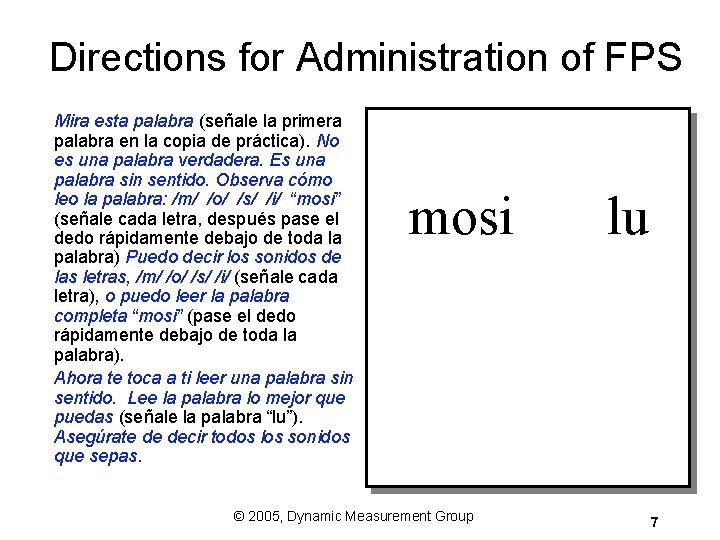
Directions for Administration 1. Place the page of practice words “mosi” “lu” (student materials) in front of the student. 2. Place the scoring booklet on clipboard and position so that student cannot see what you record. 3. Say these specific directions to the student: © 2005, Dynamic Measurement Group 6
Directions for Administration of FPS Mira esta palabra (señale la primera palabra en la copia de práctica). No es una palabra verdadera. Es una palabra sin sentido. Observa cómo leo la palabra: /m/ /o/ /s/ /i/ “mosi” (señale cada letra, después pase el dedo rápidamente debajo de toda la palabra) Puedo decir los sonidos de las letras, /m/ /o/ /s/ /i/ (señale cada letra), o puedo leer la palabra completa “mosi” (pase el dedo rápidamente debajo de toda la palabra). Ahora te toca a ti leer una palabra sin sentido. Lee la palabra lo mejor que puedas (señale la palabra “lu”). Asegúrate de decir todos los sonidos que sepas. mosi © 2005, Dynamic Measurement Group lu 7
Correction Procedure © 2005, Dynamic Measurement Group 8
Student Copy Aquí hay más palabras sin sentido (señale la copia no numerada del alumno). Comienza aquí (señale la primera palabra) y continúa a través de la página (demuéstrelo con el dedo). Cuando yo diga ‘empieza’, lee las palabras lo mejor que puedas. Toca cada letra y dime el sonido de la letra o dime toda la palabra. Pon el dedo en la primera palabra. ¿Estás listo/a? Empieza. © 2005, Dynamic Measurement Group 9
Benchmark Booklet: FPS Scoring Page © 2005, Dynamic Measurement Group 10
Fluidez en las Palabras sin Sentido Examiner Copy 15 6. Follow along on the examiner copy of the probe and underline each phoneme the student provides correctly, either in isolation or in the context of the nonsense word. Put a slash (/) over each phoneme read incorrectly or omitted. © 2005, Dynamic Measurement Group 11
7. At the end of 1 minute place a bracket (]) after the last letter sound, say “para” and stop your stopwatch. © 2005, Dynamic Measurement Group 12
Timing Rule for FPS Continuous for 1 Minute • Start the stopwatch after you say, empieza. • At the end of 1 minute place a bracket (]) after the last letter sound, say “para” and stop your stopwatch. © 2005, Dynamic Measurement Group 13
Wait Rule for FPS 3 Seconds • The maximum time per letter sound is 3 seconds. • If the student hesitates for 3 seconds on a letter sound or word, score the letter sound/word incorrect. Tell the child the correct sound/word, and, if necessary, point to the next letter/word, and say, “¿Qué sonido? ¿Qué palabra? ” • This response to hesitation may be repeated as often as necessary. © 2005, Dynamic Measurement Group 14
Discontinue Rule First 5 Words If the student does not get any sounds correct in the first 5 words, discontinue the task and record a score of zero (0). © 2005, Dynamic Measurement Group 15
Prompting Rule • If the student provides the letter name rather than the letter sound, say, “Recuerda decirme los sonidos de las letras, no el nombre de las letras. ” • This prompt can be provided once. © 2005, Dynamic Measurement Group 16
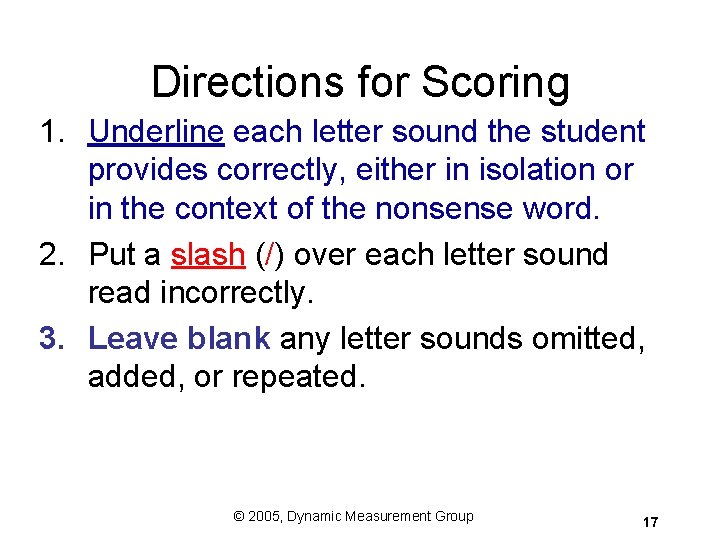
Directions for Scoring 1. Underline each letter sound the student provides correctly, either in isolation or in the context of the nonsense word. 2. Put a slash (/) over each letter sound read incorrectly. 3. Leave blank any letter sounds omitted, added, or repeated. © 2005, Dynamic Measurement Group 17
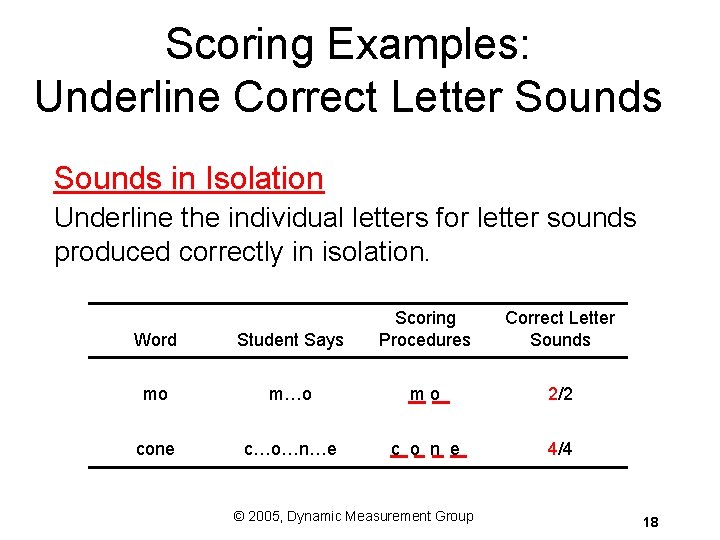
Scoring Examples: Underline Correct Letter Sounds in Isolation Underline the individual letters for letter sounds produced correctly in isolation. Word Student Says Scoring Procedures mo m…o mo 2/2 cone c…o…n…e c o n e 4/4 © 2005, Dynamic Measurement Group Correct Letter Sounds 18
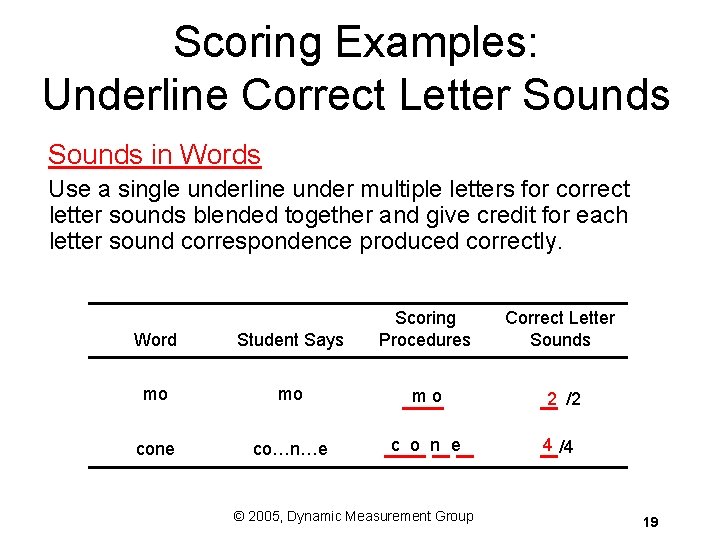
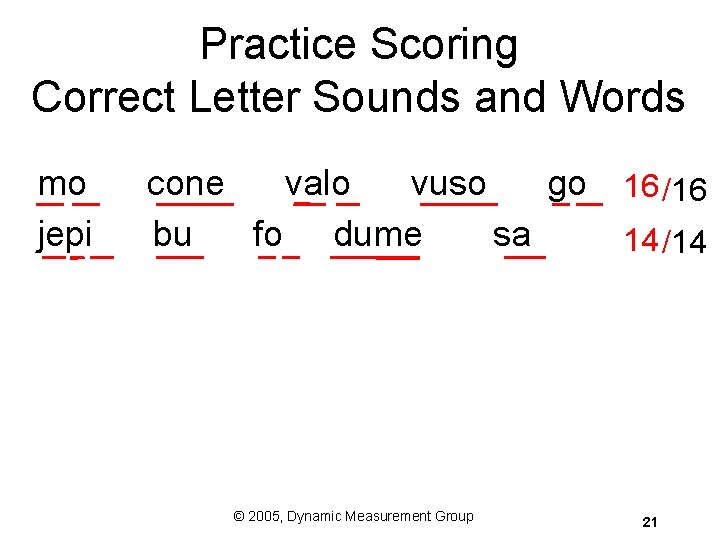
Scoring Examples: Underline Correct Letter Sounds in Words Use a single underline under multiple letters for correct letter sounds blended together and give credit for each letter sound correspondence produced correctly. Word Student Says Scoring Procedures mo mo mo 2 /2 cone co…n…e c o n e 4 /4 © 2005, Dynamic Measurement Group Correct Letter Sounds 19
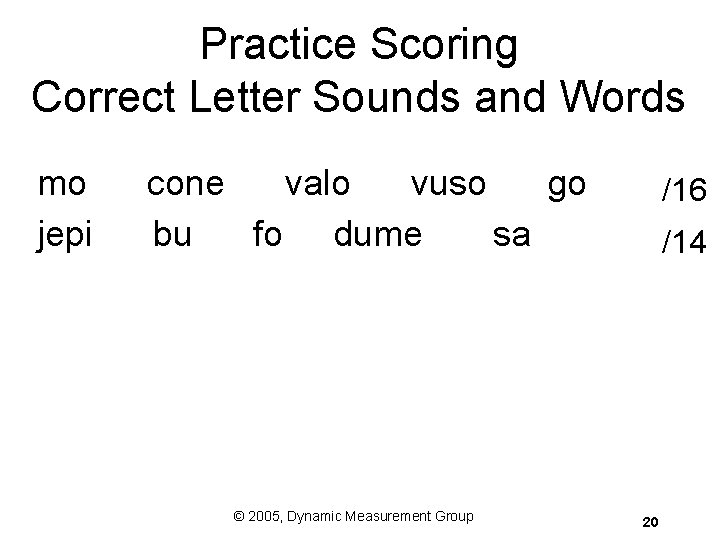
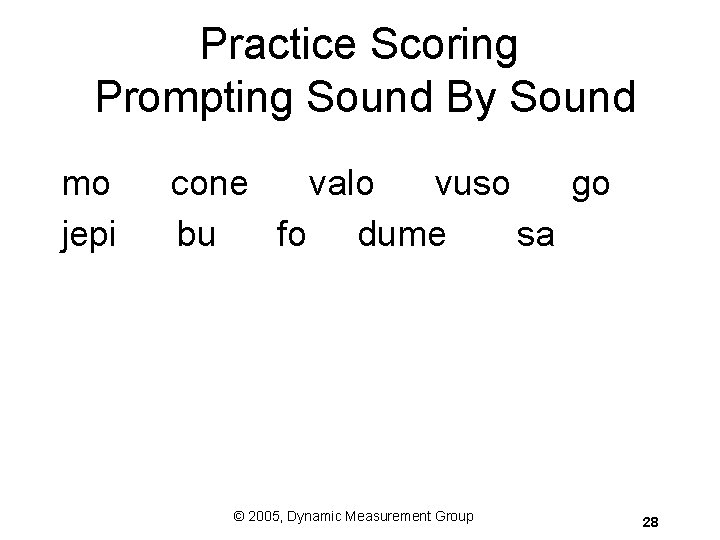
Practice Scoring Correct Letter Sounds and Words mo jepi cone valo vuso go bu fo dume sa © 2005, Dynamic Measurement Group /16 /14 20
Practice Scoring Correct Letter Sounds and Words mo jepi cone valo vuso go 16 /16 bu fo dume sa 14 /14 © 2005, Dynamic Measurement Group 21
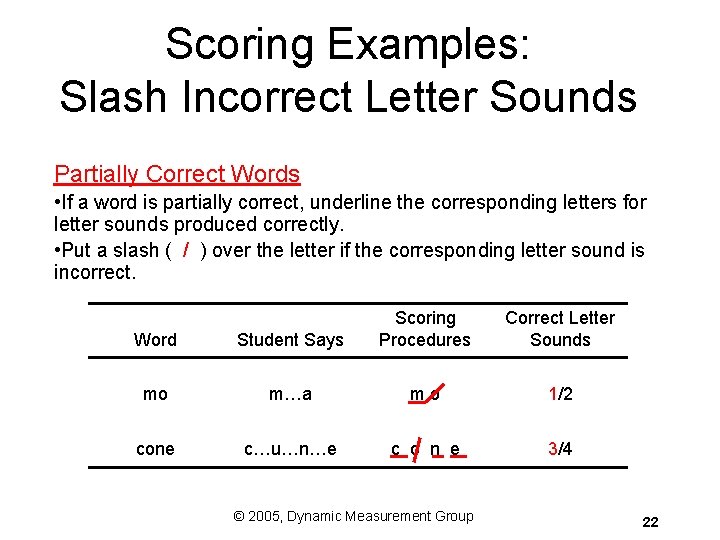
Scoring Examples: Slash Incorrect Letter Sounds Partially Correct Words • If a word is partially correct, underline the corresponding letters for letter sounds produced correctly. • Put a slash ( / ) over the letter if the corresponding letter sound is incorrect. Word Student Says Scoring Procedures mo m…a mo 1/2 cone c…u…n…e c o n e 3/4 © 2005, Dynamic Measurement Group Correct Letter Sounds 22
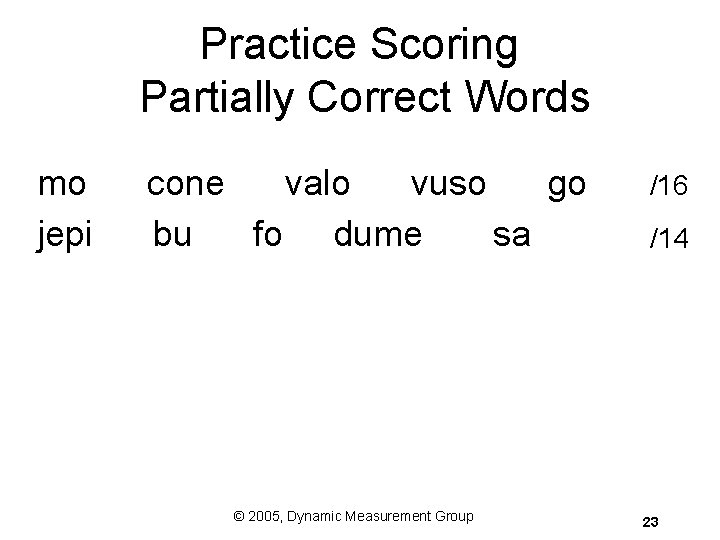
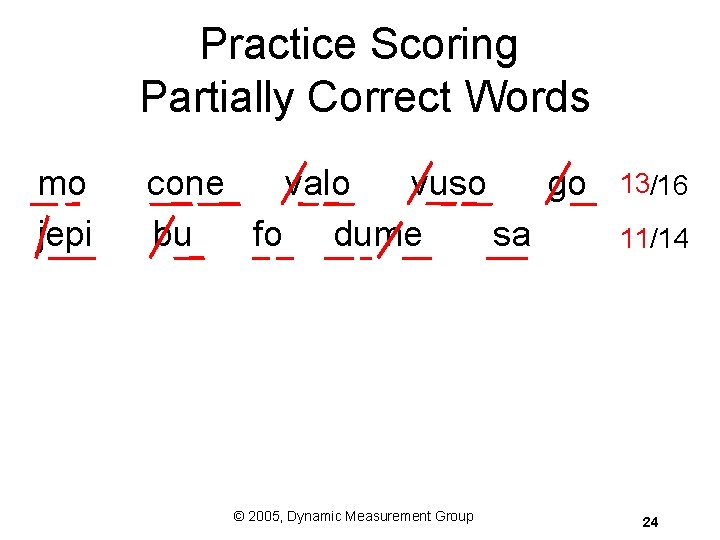
Practice Scoring Partially Correct Words mo jepi cone valo vuso go bu fo dume sa © 2005, Dynamic Measurement Group /16 /14 23
Practice Scoring Partially Correct Words mo jepi cone valo vuso go bu fo dume sa © 2005, Dynamic Measurement Group 13/16 11/14 24
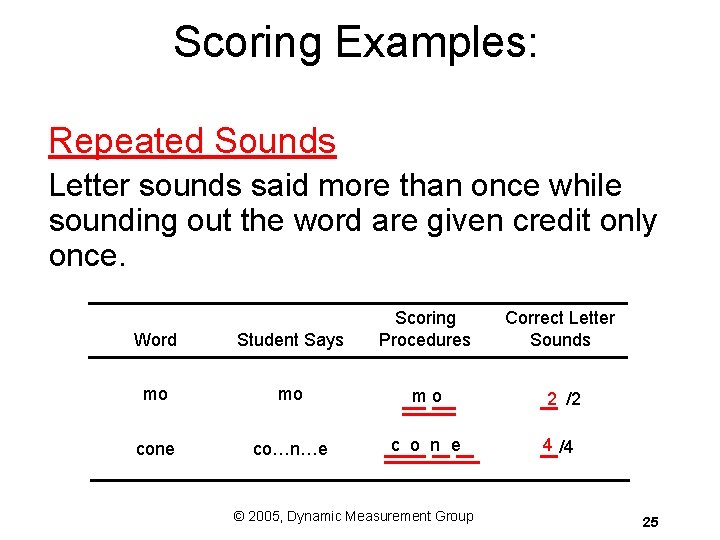
Scoring Examples: Repeated Sounds Letter sounds said more than once while sounding out the word are given credit only once. Word Student Says Scoring Procedures mo mo mo 2 /2 cone co…n…e c o n e 4 /4 © 2005, Dynamic Measurement Group Correct Letter Sounds 25
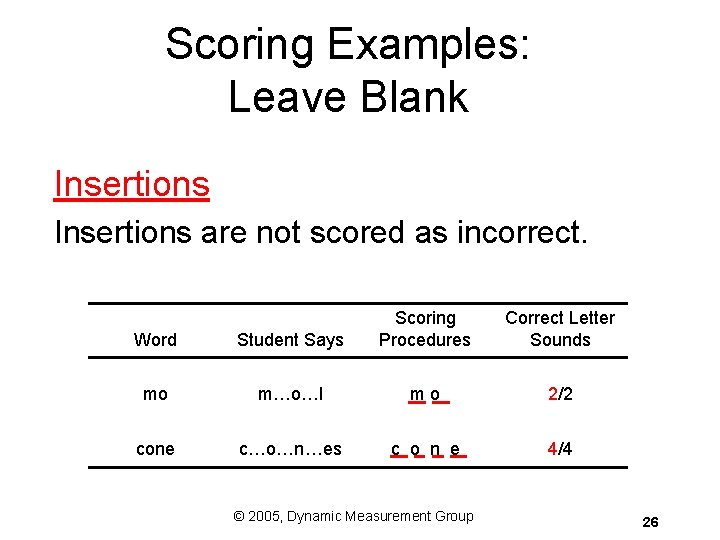
Scoring Examples: Leave Blank Insertions are not scored as incorrect. Word Student Says Scoring Procedures mo m…o…l mo 2/2 cone c…o…n…es c o n e 4/4 © 2005, Dynamic Measurement Group Correct Letter Sounds 26
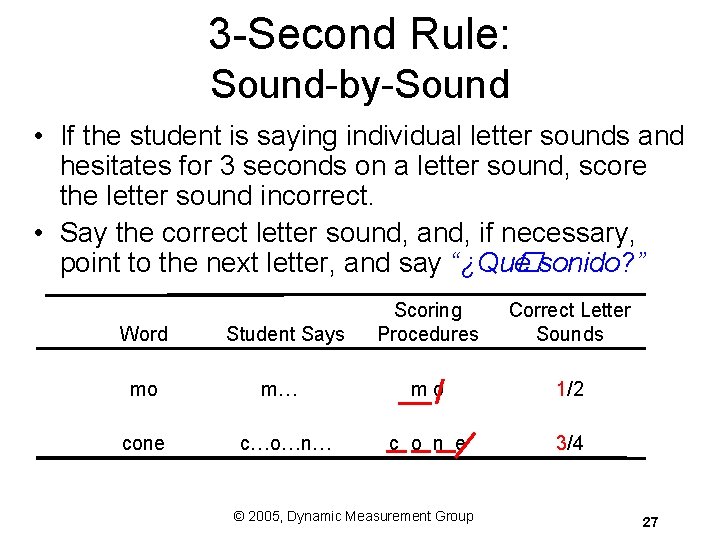
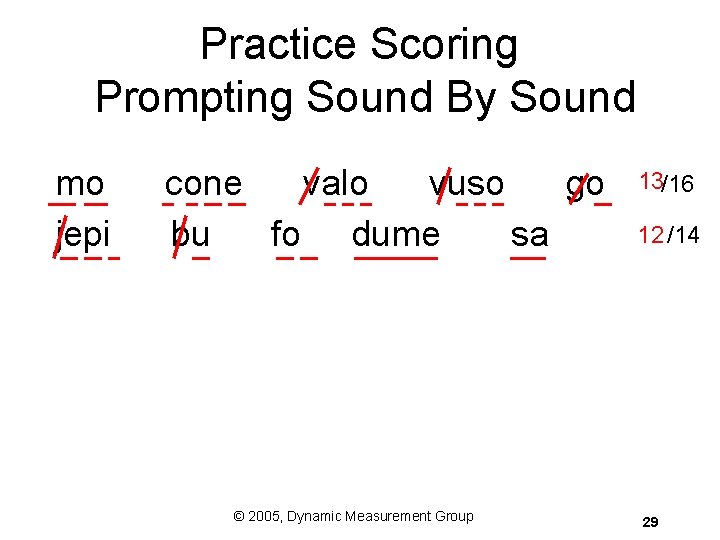
3 -Second Rule: Sound-by-Sound • If the student is saying individual letter sounds and hesitates for 3 seconds on a letter sound, score the letter sound incorrect. • Say the correct letter sound, and, if necessary, point to the next letter, and say “¿Qu� é sonido? ” Word mo cone Student Says m… c…o…n… Scoring Procedures Correct Letter Sounds mo 1/2 c o n e 3/4 © 2005, Dynamic Measurement Group 27
Practice Scoring Prompting Sound By Sound mo jepi cone valo vuso go bu fo dume sa © 2005, Dynamic Measurement Group 28
Practice Scoring Prompting Sound By Sound mo jepi cone valo vuso go bu fo dume sa © 2005, Dynamic Measurement Group 13/16 12 /14 29
3 -Second Prompting Rule: Word-by-Word • If the student is reading words and hesitates for 3 seconds on a word, score the word incorrect. • Say the correct word and, if necessary, point to the next word, and say, “¿Qué palabra? ” • This prompt can be repeated. © 2005, Dynamic Measurement Group 30
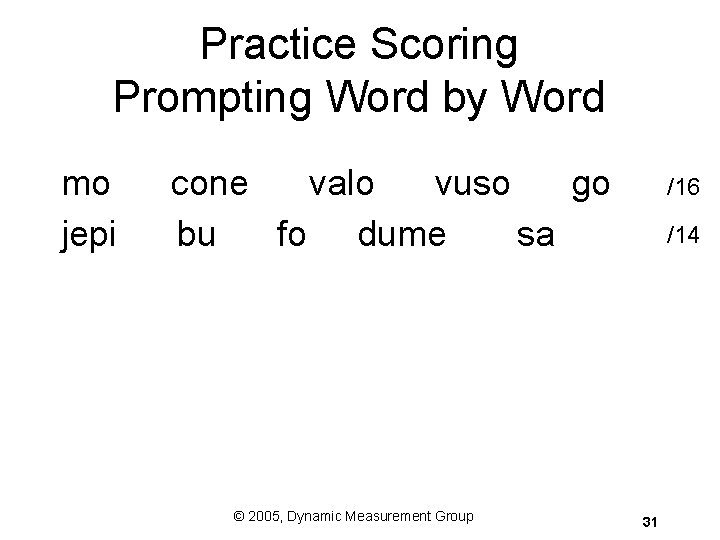
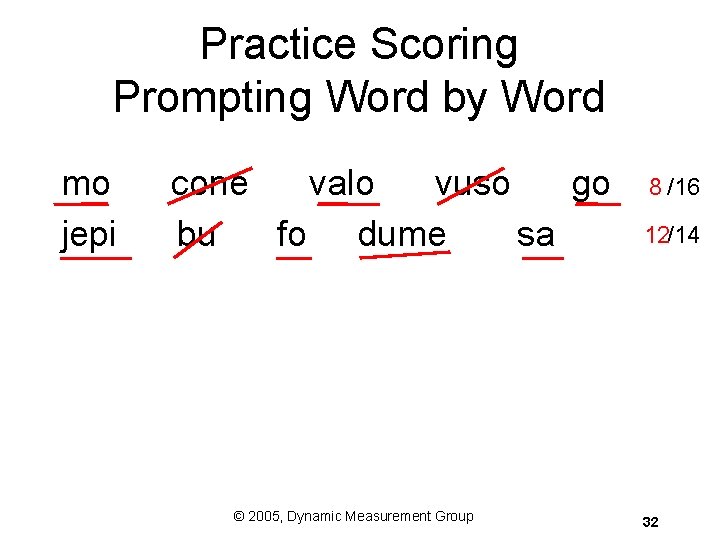
Practice Scoring Prompting Word by Word mo jepi cone valo vuso go bu fo dume sa © 2005, Dynamic Measurement Group /16 /14 31
Practice Scoring Prompting Word by Word mo jepi cone valo vuso go bu fo dume sa © 2005, Dynamic Measurement Group 8 /16 12/14 32
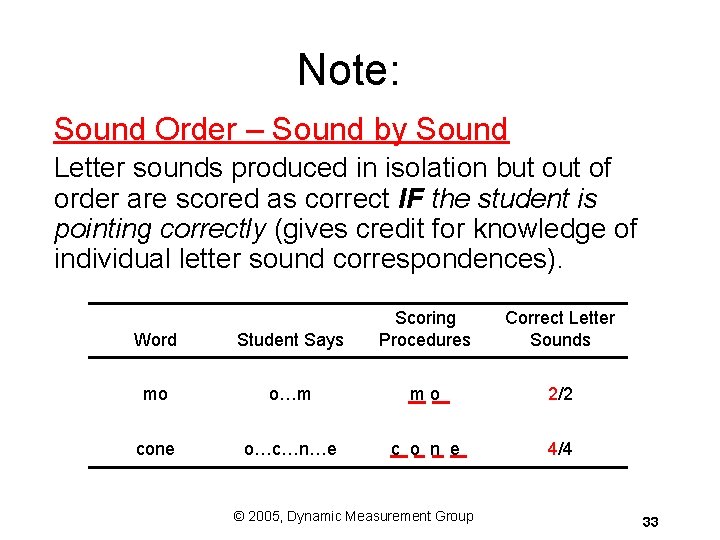
Note: Sound Order – Sound by Sound Letter sounds produced in isolation but of order are scored as correct IF the student is pointing correctly (gives credit for knowledge of individual letter sound correspondences). Word Student Says Scoring Procedures mo o…m mo 2/2 cone o…c…n…e c o n e 4/4 © 2005, Dynamic Measurement Group Correct Letter Sounds 33
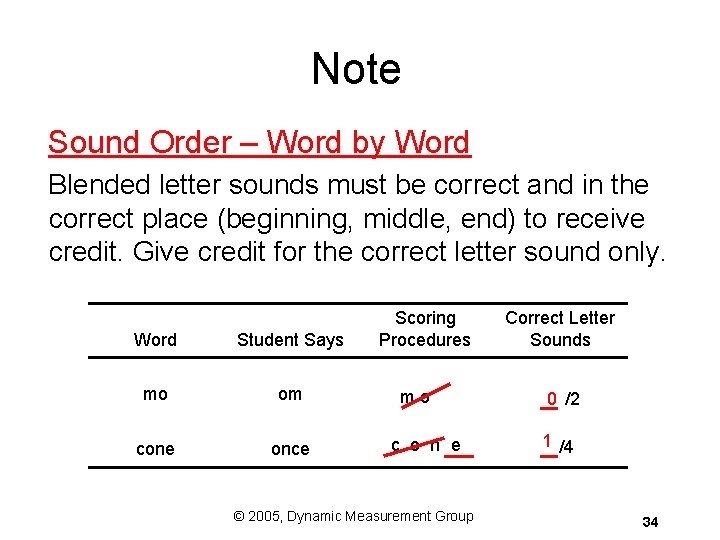
Note Sound Order – Word by Word Blended letter sounds must be correct and in the correct place (beginning, middle, end) to receive credit. Give credit for the correct letter sound only. Word Student Says mo om cone once Scoring Procedures mo c o n e © 2005, Dynamic Measurement Group Correct Letter Sounds 0 /2 1 /4 34
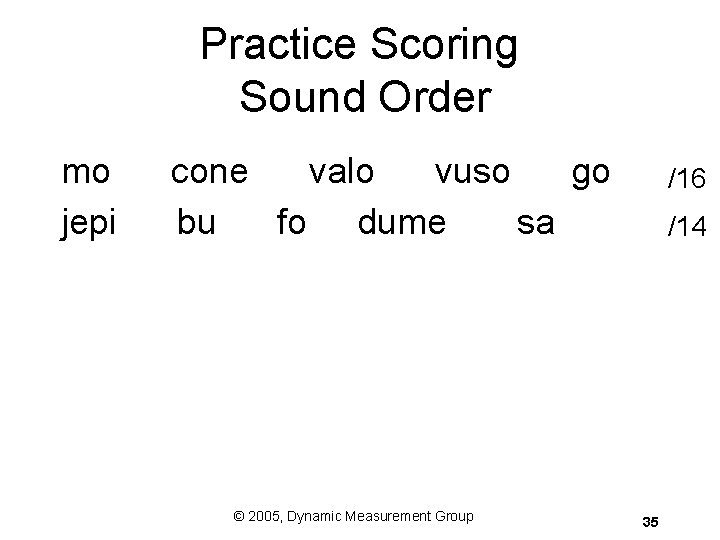
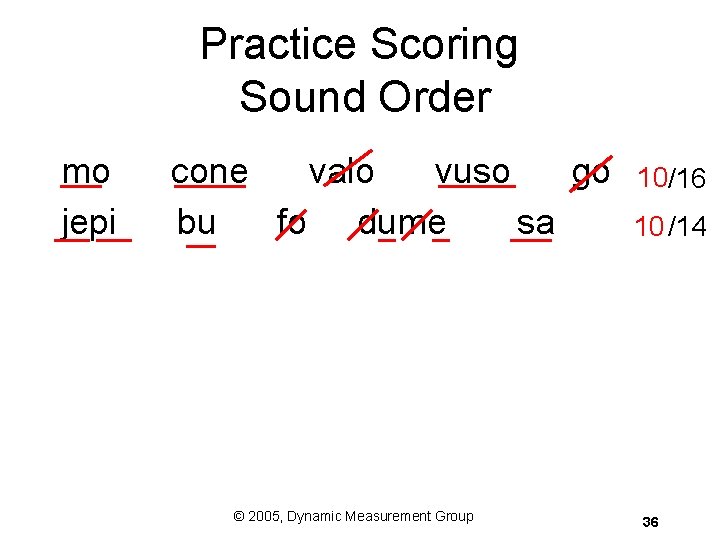
Practice Scoring Sound Order mo jepi cone valo vuso go bu fo dume sa © 2005, Dynamic Measurement Group /16 /14 35
Practice Scoring Sound Order mo jepi cone valo vuso go bu fo dume sa © 2005, Dynamic Measurement Group 10/16 10 /14 36
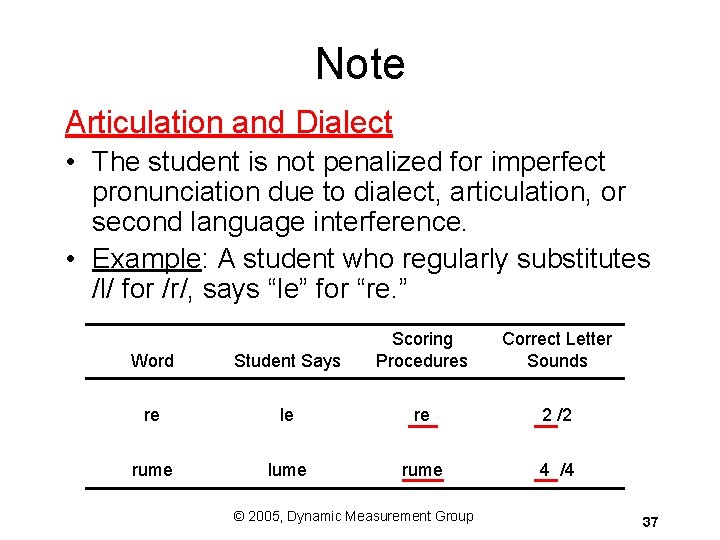
Note Articulation and Dialect • The student is not penalized for imperfect pronunciation due to dialect, articulation, or second language interference. • Example: A student who regularly substitutes /l/ for /r/, says “le” for “re. ” Word Student Says Scoring Procedures re le re 2 /2 rume lume rume 4 /4 © 2005, Dynamic Measurement Group Correct Letter Sounds 37
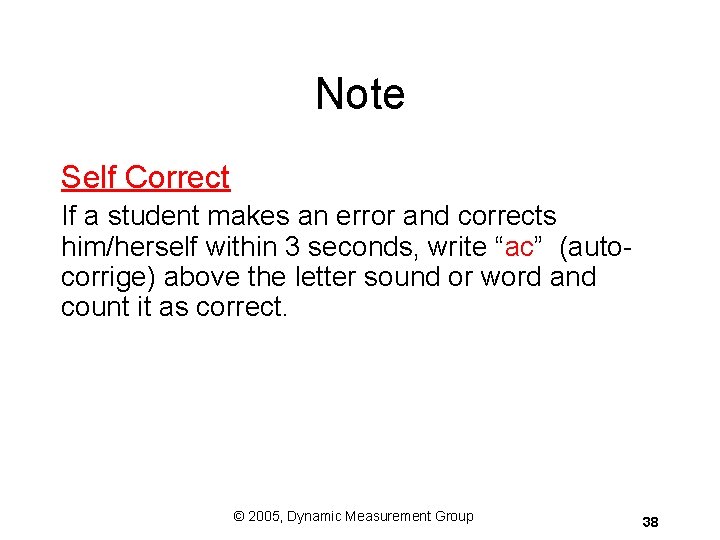
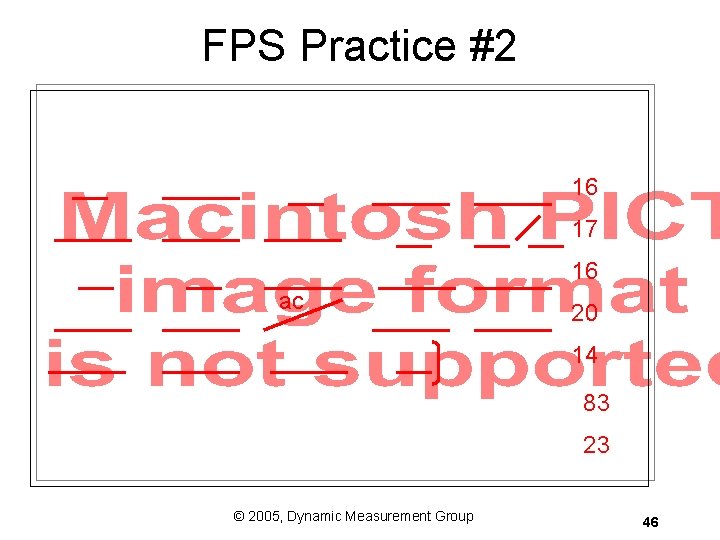
Note Self Correct If a student makes an error and corrects him/herself within 3 seconds, write “ac” (autocorrige) above the letter sound or word and count it as correct. © 2005, Dynamic Measurement Group 38
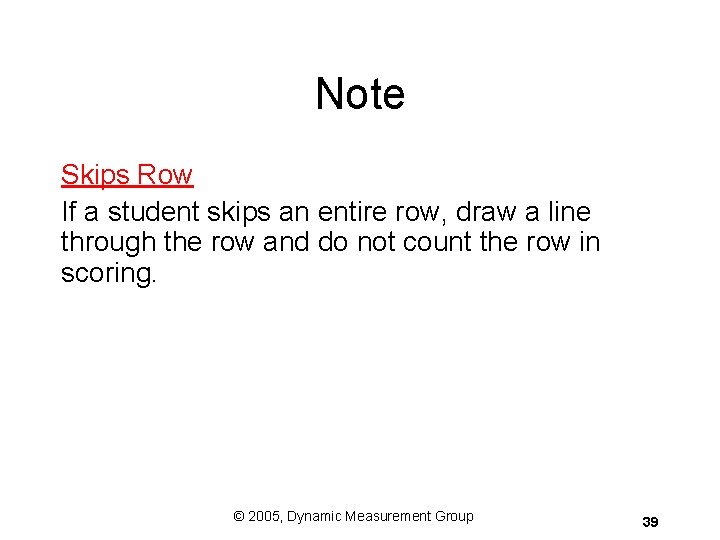
Note Skips Row If a student skips an entire row, draw a line through the row and do not count the row in scoring. © 2005, Dynamic Measurement Group 39
Final Score • Add number of correct letter sounds for each line up to bracket. • Total number of correct letter sounds and write it in space provided. 14 0 13 ] 27 0 © 2005, Dynamic Measurement Group 40
Final Score • Benchmark assessment: Transfer number of correct letter sounds to front of benchmark scoring booklet. © 2005, Dynamic Measurement Group 27 0 41
Accommodations for FPS Specific to FPS – Enlarged print/colored overlays – Braille – Marker/ruler to keep place © 2005, Dynamic Measurement Group 42
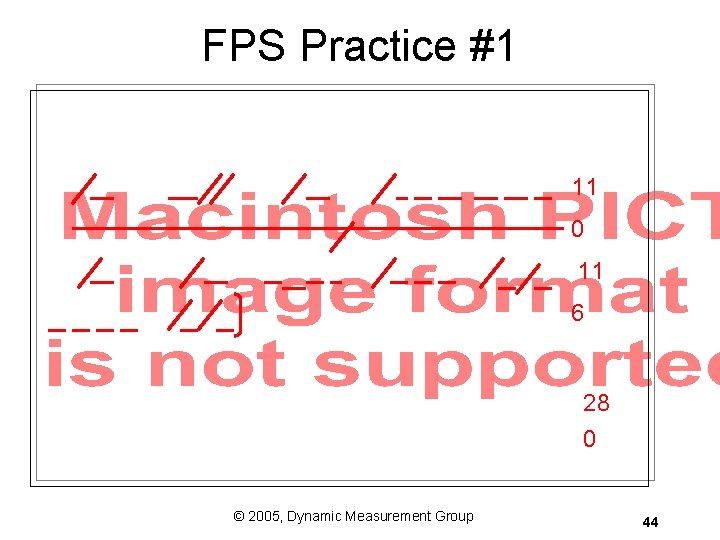
FPS Practice #1 © 2005, Dynamic Measurement Group 43
FPS Practice #1 11 0 11 6 28 0 © 2005, Dynamic Measurement Group 44
FPS Practice #2 © 2005, Dynamic Measurement Group 45
FPS Practice #2 16 17 16 ac 20 14 83 23 © 2005, Dynamic Measurement Group 46
FPS Practice Activity Instructions for Completing the Activity: 1. Form a three-person group. You will take turns administering FPS to a child in the winter of First Grade. 2. There will be 3 rounds to the activity where your role will change with each round. The roles are: © 2005, Dynamic Measurement Group 47
Examiner: Follow the script on the page titled “Examiner. ” Administer NWF to the “student”. Practice timing and scoring. Place a bracket and stop at the end of 1 minute. Score the student’s responses. © 2005, Dynamic Measurement Group 48
Student: Follow the script for your round on the page titled, “Student”. You will pretend to be a student and provide the written scripted responses. Pace the task and perform as a child in first grade. © 2005, Dynamic Measurement Group 49
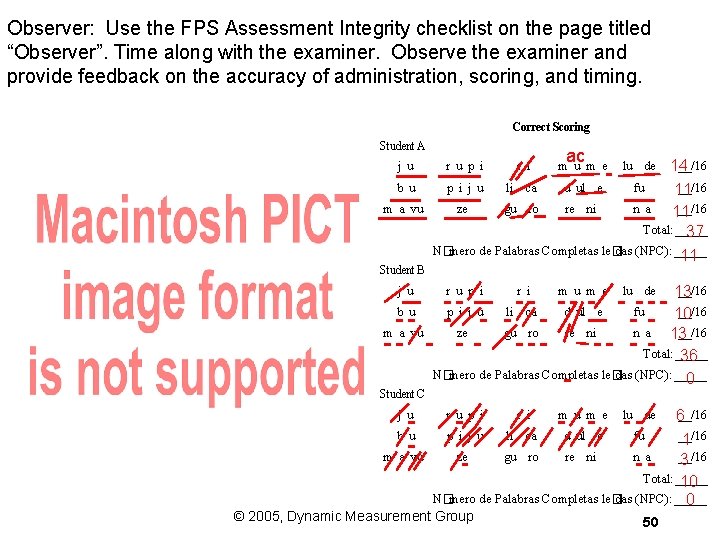
Observer: Use the FPS Assessment Integrity checklist on the page titled “Observer”. Time along with the examiner. Observe the examiner and provide feedback on the accuracy of administration, scoring, and timing. Correct Scoring Student A ac __/16 14 b u p i j u li ca d ul e fu __/16 11 m a vu ze gu ro re ni n a __/16 11 Total: _____ 37 N� mero de Palabras Completas le� das (NPC): _____ 11 j u r u p i r i m u m e lu de Student B __/16 13 b u p i j u li ca d ul e fu __/16 10 m a vu ze gu ro re ni n a 13 __/16 Total: _____ 36 N� mero de Palabras Completas le� das (NPC): _____ 0 j u r u p i r i m u m e lu de Student C 6__/16 b u p i j u li ca d ul e fu __/16 1 m a vu ze gu ro re ni n a __/16 3 Total: _____ 10 N�mero de Palabras Completas le� das (NPC): _____ 0 j u r u p i © 2005, Dynamic Measurement Group r i m u m e lu de 50
IDEL FPS Assessment Integrity Checklist © 2005, Dynamic Measurement Group 51
After completing each round, discuss as a group how the administration went. Answer the following questions for the round in which you are the examiner: - What was easy? What was difficult? What do you need to practice? How were the skills of the child you assessed? (Estimated: established =>70; emerging 50 -69; deficit <50) - What instructional recommendations do you have for the student you assessed? © 2005, Dynamic Measurement Group 52
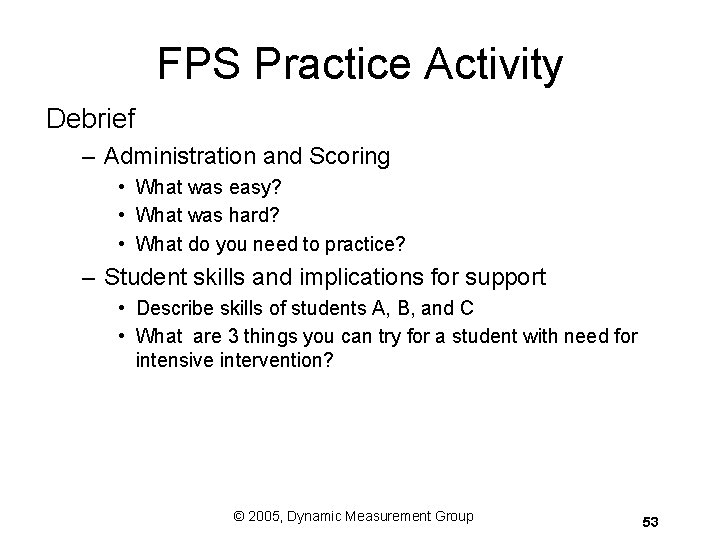
FPS Practice Activity Debrief – Administration and Scoring • What was easy? • What was hard? • What do you need to practice? – Student skills and implications for support • Describe skills of students A, B, and C • What are 3 things you can try for a student with need for intensive intervention? © 2005, Dynamic Measurement Group 53
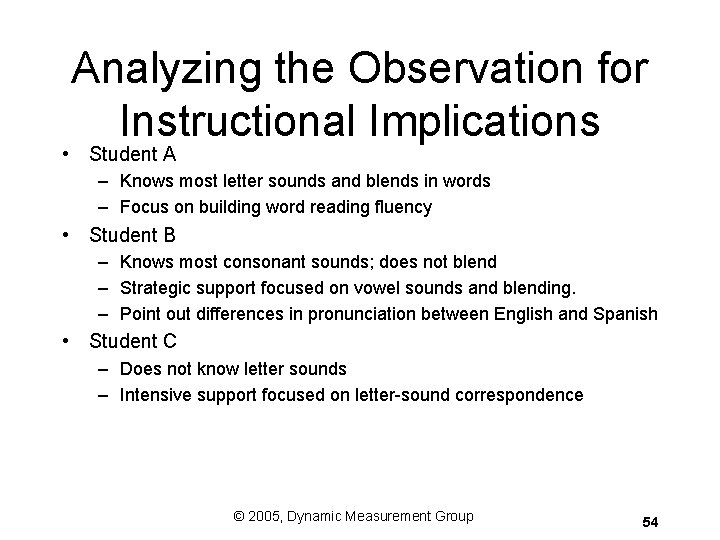
Analyzing the Observation for Instructional Implications • Student A – Knows most letter sounds and blends in words – Focus on building word reading fluency • Student B – Knows most consonant sounds; does not blend – Strategic support focused on vowel sounds and blending. – Point out differences in pronunciation between English and Spanish • Student C – Does not know letter sounds – Intensive support focused on letter-sound correspondence © 2005, Dynamic Measurement Group 54