Calculation of Oral Medications Unit Four Chapter 17
- Slides: 24
Calculation of Oral Medications Unit Four: Chapter 17 Mosby items and derived items © 2010 by Mosby, Inc. , an affiliate of Elsevier Inc.
Calculation of Oral Medications: Objectives After reviewing this chapter, you should be able to: Identify forms of oral medications 2. Identify terms on labels used in calculation 3. Calculate dosages for oral medications using ratio and proportion, the formula method, and dimensional analysis 4. Apply principles to obtain rational answers 1. Mosby items and derived items © 2010 by Mosby, Inc. , an affiliate of Elsevier Inc. 2
Background: Oral Medications Most economical Easiest to administer Most common type of medication given Available as solids and liquids Mosby items and derived items © 2010 by Mosby, Inc. , an affiliate of Elsevier Inc. 3
Forms of Solid Medications Tablets Ø Caplets Ø Powdered medications molded in shapes Elongated tablets coated to ease swallowing Scored tablets—use pill cutter Tablets with indented markings designed to cut and deliver ½ to ¼ what is in a whole tablet Note: Breaking an unscored tablet is dangerous and can result in an unintended dose Ø Mosby items and derived items © 2010 by Mosby, Inc. , an affiliate of Elsevier Inc. 4
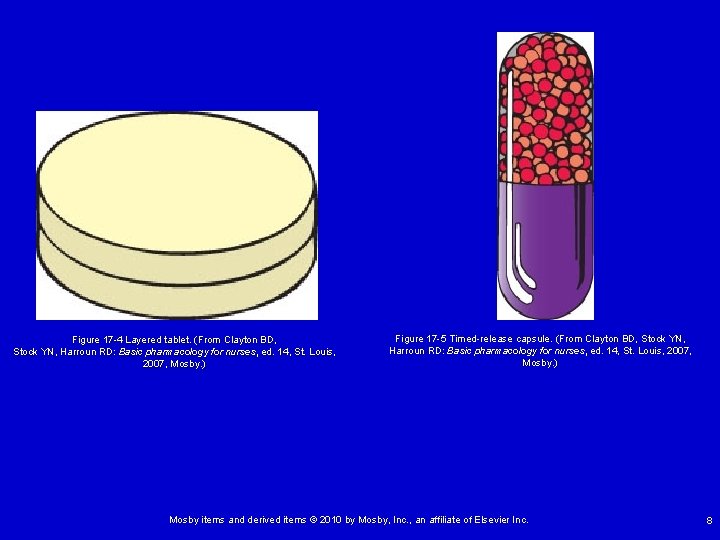
Forms of Solid Medications (cont’d) Enteric-Coated Tablets Special coating protects against gastric secretions Ø NEVER crush EC tablets—defeats the purpose Ø Sublingual Tablets Placed under tongue for direct absorption Ø NEVER swallow SL tablets—prevents desired effect Ø Layered Tablets Ø Layers or cores of two meds with different compatibilities or absorption components Mosby items and derived items © 2010 by Mosby, Inc. , an affiliate of Elsevier Inc. 5
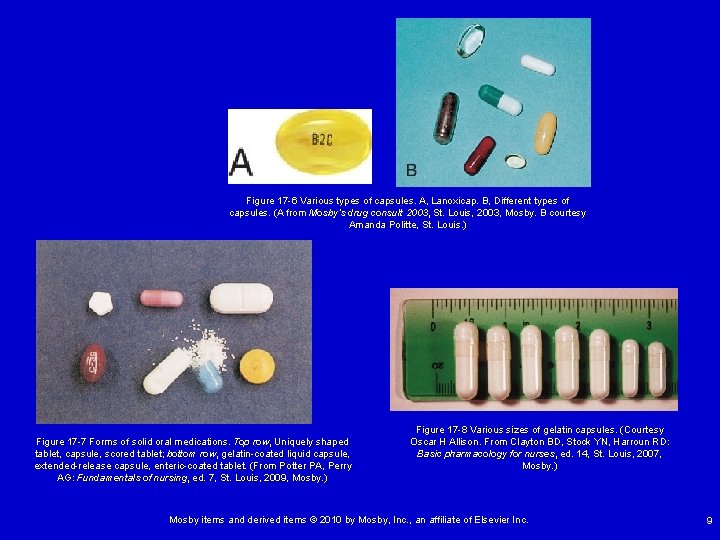
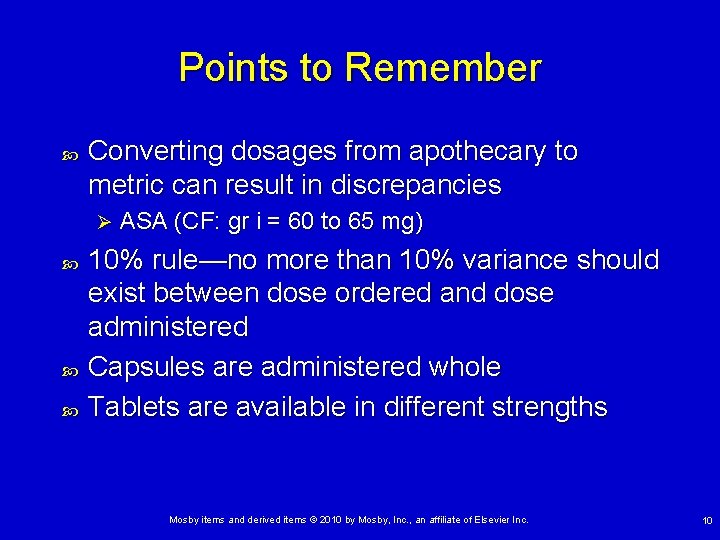
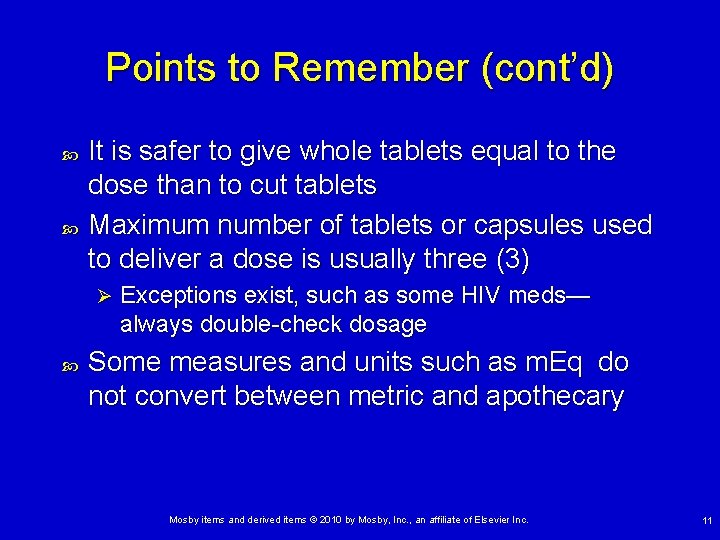
Forms of Solid Medications (cont’d) Time-Release and Extended-Release Tablets Labeled SA, LA, XL, SR, or ER Ø Released over a period of time Ø NEVER crush, chew, or break Ø Capsules Contains powder, liquid, or oil with hard/soft gelatin coating Ø NEVER crush, chew, or break without consulting a pharmacist Ø Others: Troches, Lozenges, Pulvules Mosby items and derived items © 2010 by Mosby, Inc. , an affiliate of Elsevier Inc. 6
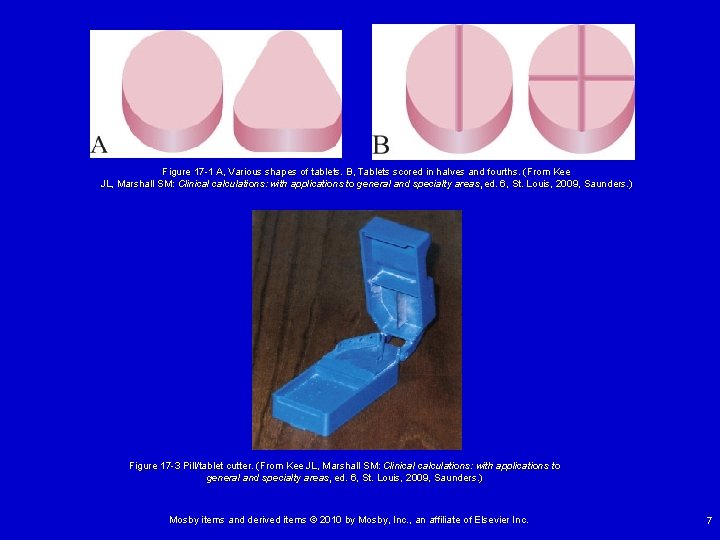
Figure 17 -1 A, Various shapes of tablets. B, Tablets scored in halves and fourths. (From Kee JL, Marshall SM: Clinical calculations: with applications to general and specialty areas, ed. 6, St. Louis, 2009, Saunders. ) Figure 17 -3 Pill/tablet cutter. (From Kee JL, Marshall SM: Clinical calculations: with applications to general and specialty areas, ed. 6, St. Louis, 2009, Saunders. ) Mosby items and derived items © 2010 by Mosby, Inc. , an affiliate of Elsevier Inc. 7
Figure 17 -4 Layered tablet. (From Clayton BD, Stock YN, Harroun RD: Basic pharmacology for nurses, ed. 14, St. Louis, 2007, Mosby. ) Figure 17 -5 Timed-release capsule. (From Clayton BD, Stock YN, Harroun RD: Basic pharmacology for nurses, ed. 14, St. Louis, 2007, Mosby. ) Mosby items and derived items © 2010 by Mosby, Inc. , an affiliate of Elsevier Inc. 8
Figure 17 -6 Various types of capsules. A, Lanoxicap. B, Different types of capsules. (A from Mosby’s drug consult 2003, St. Louis, 2003, Mosby. B courtesy Amanda Politte, St. Louis. ) Figure 17 -7 Forms of solid oral medications. Top row, Uniquely shaped tablet, capsule, scored tablet; bottom row, gelatin-coated liquid capsule, extended-release capsule, enteric-coated tablet. (From Potter PA, Perry AG: Fundamentals of nursing, ed. 7, St. Louis, 2009, Mosby. ) Figure 17 -8 Various sizes of gelatin capsules. (Courtesy Oscar H Allison. From Clayton BD, Stock YN, Harroun RD: Basic pharmacology for nurses, ed. 14, St. Louis, 2007, Mosby. ) Mosby items and derived items © 2010 by Mosby, Inc. , an affiliate of Elsevier Inc. 9
Points to Remember Converting dosages from apothecary to metric can result in discrepancies Ø ASA (CF: gr i = 60 to 65 mg) 10% rule—no more than 10% variance should exist between dose ordered and dose administered Capsules are administered whole Tablets are available in different strengths Mosby items and derived items © 2010 by Mosby, Inc. , an affiliate of Elsevier Inc. 10
Points to Remember (cont’d) It is safer to give whole tablets equal to the dose than to cut tablets Maximum number of tablets or capsules used to deliver a dose is usually three (3) Ø Exceptions exist, such as some HIV meds— always double-check dosage Some measures and units such as m. Eq do not convert between metric and apothecary Mosby items and derived items © 2010 by Mosby, Inc. , an affiliate of Elsevier Inc. 11
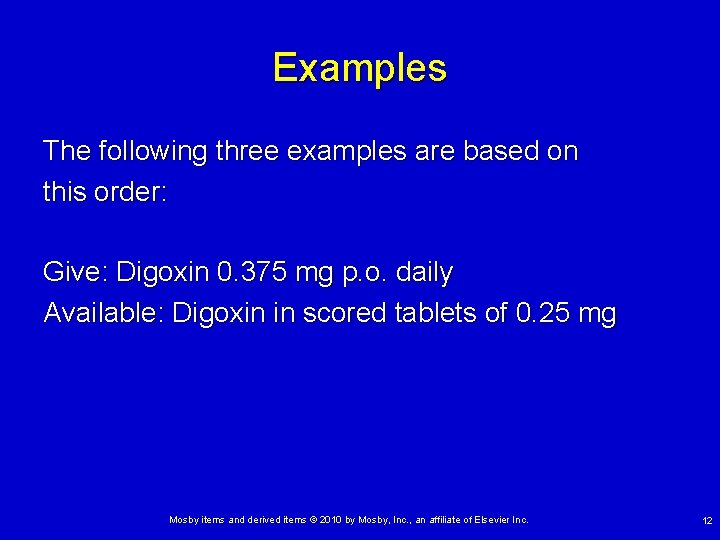
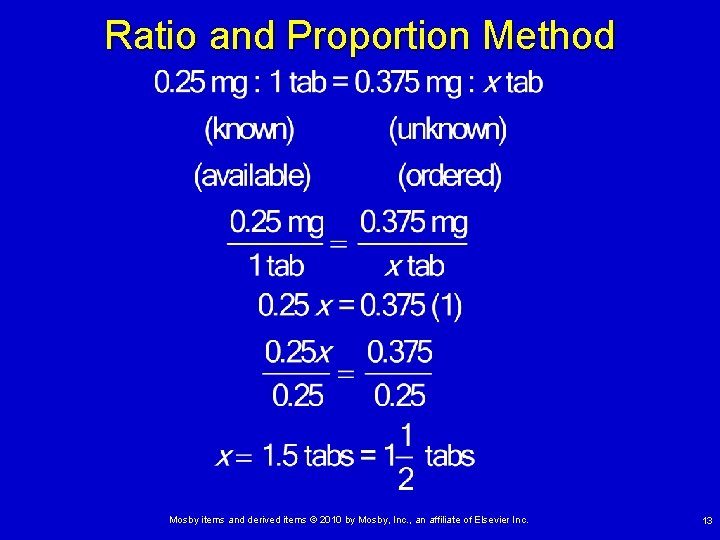
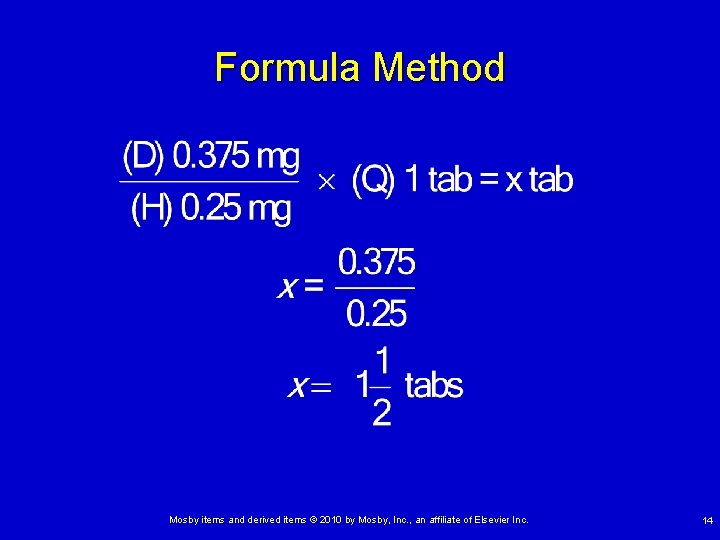
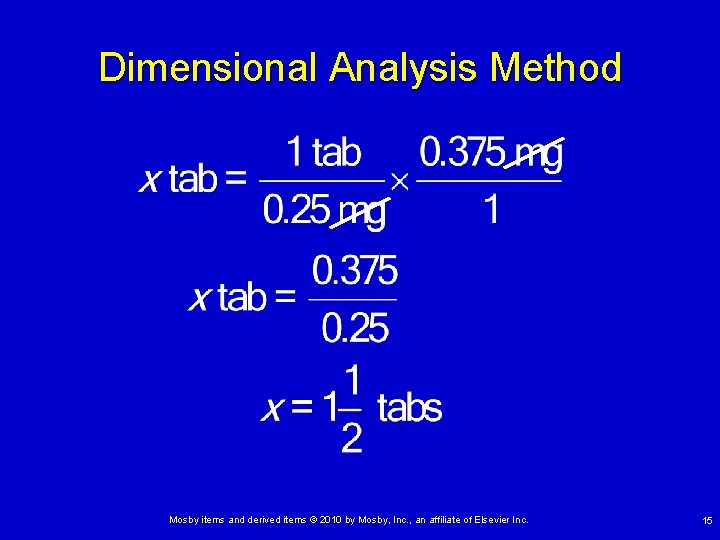
Examples The following three examples are based on this order: Give: Digoxin 0. 375 mg p. o. daily Available: Digoxin in scored tablets of 0. 25 mg Mosby items and derived items © 2010 by Mosby, Inc. , an affiliate of Elsevier Inc. 12
Ratio and Proportion Method Mosby items and derived items © 2010 by Mosby, Inc. , an affiliate of Elsevier Inc. 13
Formula Method Mosby items and derived items © 2010 by Mosby, Inc. , an affiliate of Elsevier Inc. 14
Dimensional Analysis Method Mosby items and derived items © 2010 by Mosby, Inc. , an affiliate of Elsevier Inc. 15
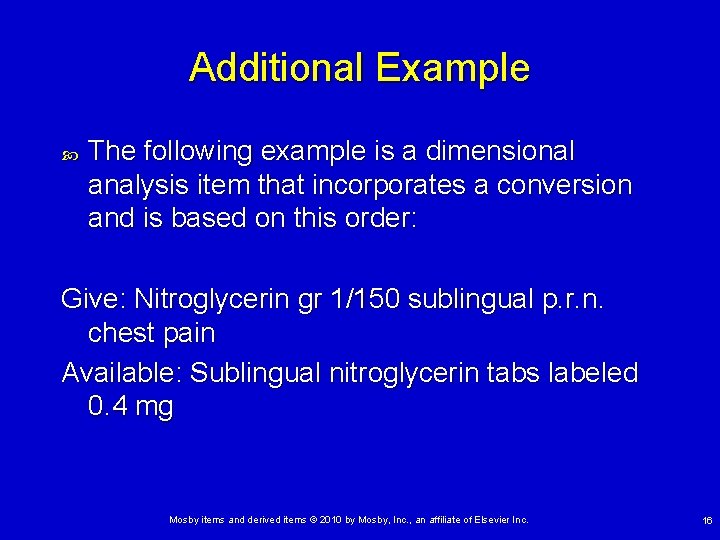
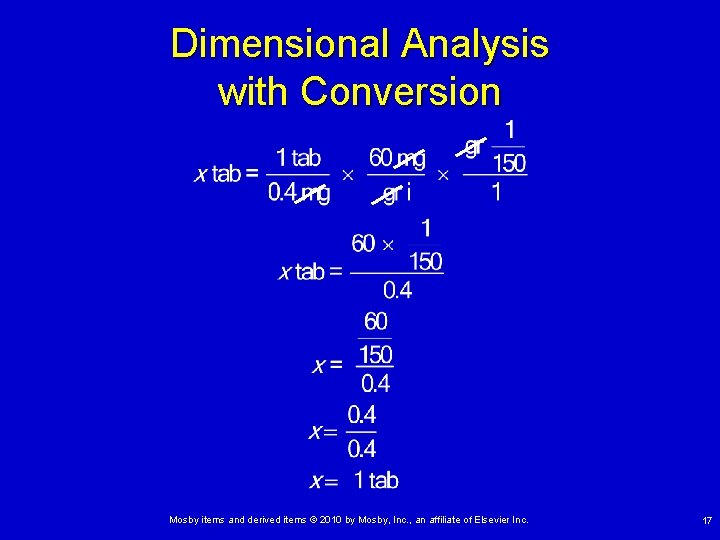
Additional Example The following example is a dimensional analysis item that incorporates a conversion and is based on this order: Give: Nitroglycerin gr 1/150 sublingual p. r. n. chest pain Available: Sublingual nitroglycerin tabs labeled 0. 4 mg Mosby items and derived items © 2010 by Mosby, Inc. , an affiliate of Elsevier Inc. 16
Dimensional Analysis with Conversion Mosby items and derived items © 2010 by Mosby, Inc. , an affiliate of Elsevier Inc. 17
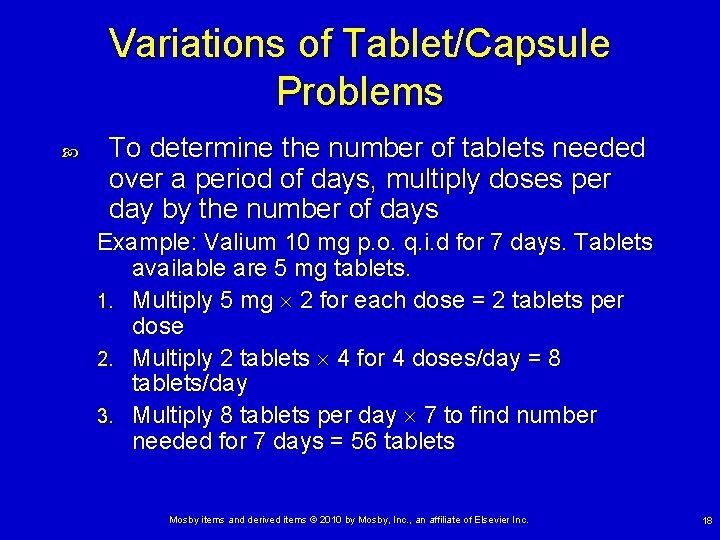
Variations of Tablet/Capsule Problems To determine the number of tablets needed over a period of days, multiply doses per day by the number of days Example: Valium 10 mg p. o. q. i. d for 7 days. Tablets available are 5 mg tablets. 1. Multiply 5 mg 2 for each dose = 2 tablets per dose 2. Multiply 2 tablets 4 for 4 doses/day = 8 tablets/day 3. Multiply 8 tablets per day 7 to find number needed for 7 days = 56 tablets Mosby items and derived items © 2010 by Mosby, Inc. , an affiliate of Elsevier Inc. 18
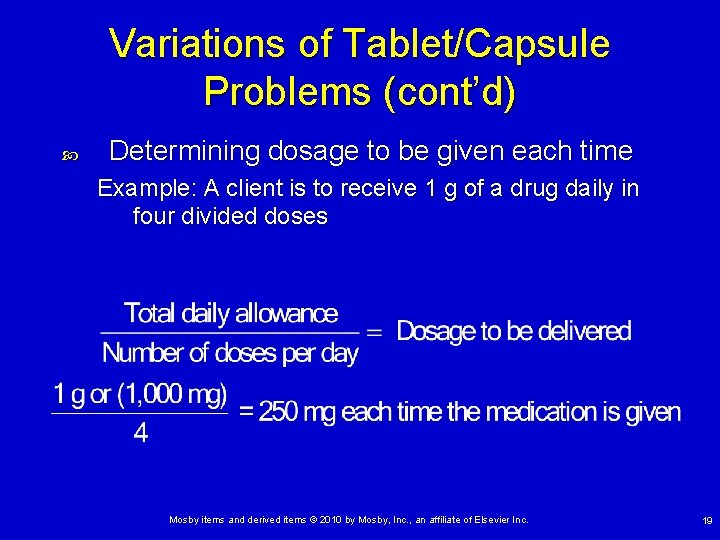
Variations of Tablet/Capsule Problems (cont’d) Determining dosage to be given each time Example: A client is to receive 1 g of a drug daily in four divided doses Mosby items and derived items © 2010 by Mosby, Inc. , an affiliate of Elsevier Inc. 19
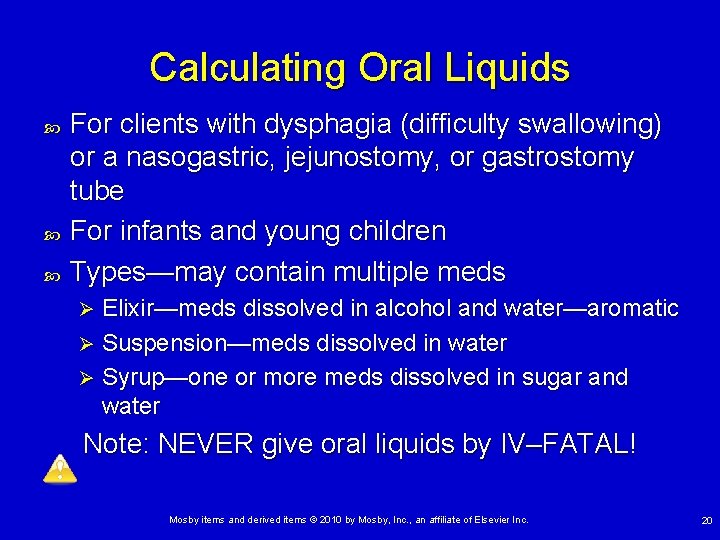
Calculating Oral Liquids For clients with dysphagia (difficulty swallowing) or a nasogastric, jejunostomy, or gastrostomy tube For infants and young children Types—may contain multiple meds Elixir—meds dissolved in alcohol and water—aromatic Ø Suspension—meds dissolved in water Ø Syrup—one or more meds dissolved in sugar and water Ø Note: NEVER give oral liquids by IV–FATAL! Mosby items and derived items © 2010 by Mosby, Inc. , an affiliate of Elsevier Inc. 20
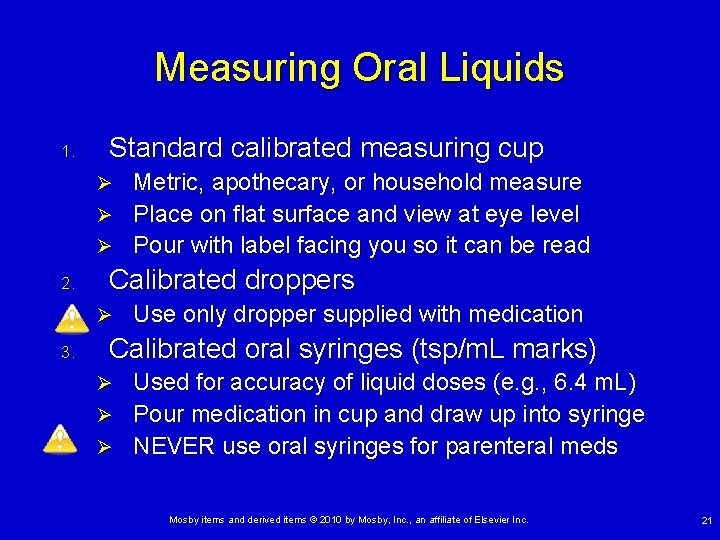
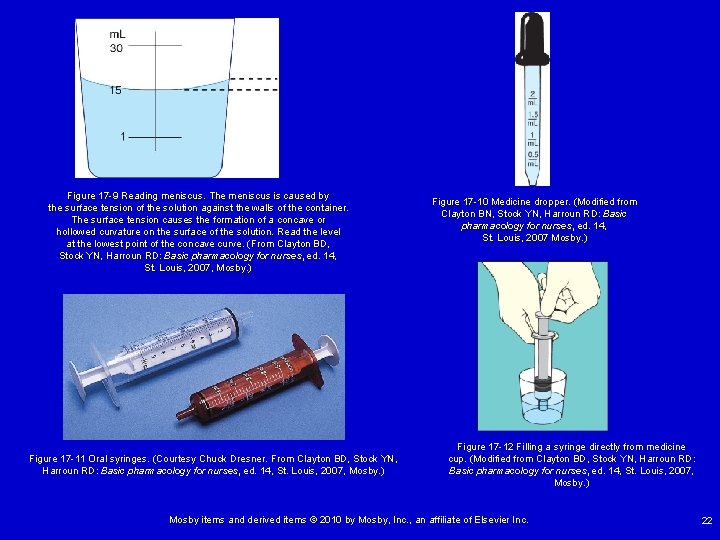
Measuring Oral Liquids 1. Standard calibrated measuring cup Metric, apothecary, or household measure Ø Place on flat surface and view at eye level Ø Pour with label facing you so it can be read Ø 2. Calibrated droppers Ø 3. Use only dropper supplied with medication Calibrated oral syringes (tsp/m. L marks) Used for accuracy of liquid doses (e. g. , 6. 4 m. L) Ø Pour medication in cup and draw up into syringe Ø NEVER use oral syringes for parenteral meds Ø Mosby items and derived items © 2010 by Mosby, Inc. , an affiliate of Elsevier Inc. 21
Figure 17 -9 Reading meniscus. The meniscus is caused by the surface tension of the solution against the walls of the container. The surface tension causes the formation of a concave or hollowed curvature on the surface of the solution. Read the level at the lowest point of the concave curve. (From Clayton BD, Stock YN, Harroun RD: Basic pharmacology for nurses, ed. 14, St. Louis, 2007, Mosby. ) Figure 17 -11 Oral syringes. (Courtesy Chuck Dresner. From Clayton BD, Stock YN, Harroun RD: Basic pharmacology for nurses, ed. 14, St. Louis, 2007, Mosby. ) Figure 17 -10 Medicine dropper. (Modified from Clayton BN, Stock YN, Harroun RD: Basic pharmacology for nurses, ed. 14, St. Louis, 2007 Mosby. ) Figure 17 -12 Filling a syringe directly from medicine cup. (Modified from Clayton BD, Stock YN, Harroun RD: Basic pharmacology for nurses, ed. 14, St. Louis, 2007, Mosby. ) Mosby items and derived items © 2010 by Mosby, Inc. , an affiliate of Elsevier Inc. 22
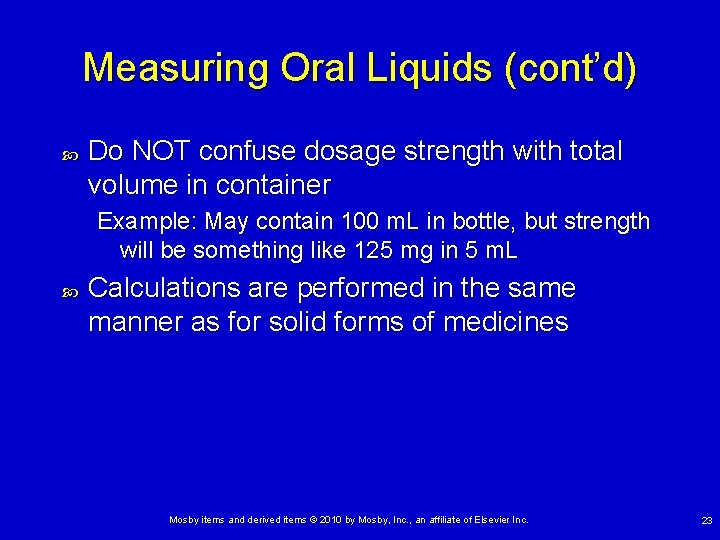
Measuring Oral Liquids (cont’d) Do NOT confuse dosage strength with total volume in container Example: May contain 100 m. L in bottle, but strength will be something like 125 mg in 5 m. L Calculations are performed in the same manner as for solid forms of medicines Mosby items and derived items © 2010 by Mosby, Inc. , an affiliate of Elsevier Inc. 23
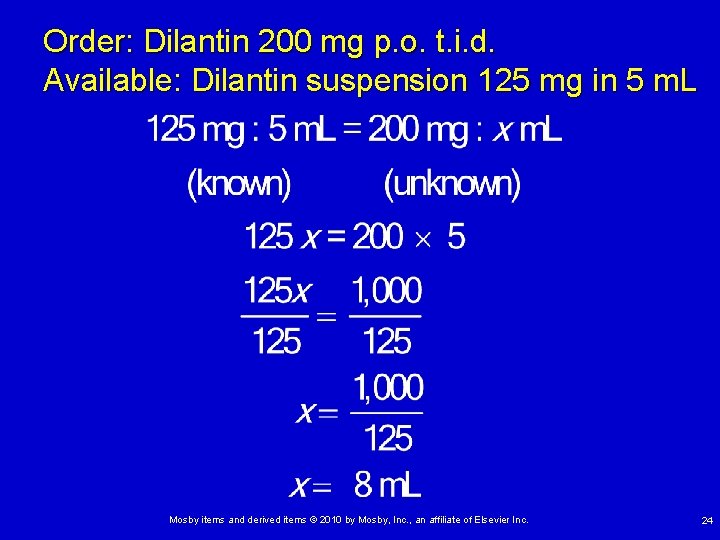
Order: Dilantin 200 mg p. o. t. i. d. Available: Dilantin suspension 125 mg in 5 m. L Mosby items and derived items © 2010 by Mosby, Inc. , an affiliate of Elsevier Inc. 24