
Pediatric Medication Safety A Pharmacys Calling Michael C
- Slides: 26
Pediatric Medication Safety: A Pharmacy’s Calling Michael C. Dejos, Pharm. D, BCPS Medication Safety Officer 1
Objectives § Pharmacist Objectives § Identify strengths and limitations to voluntary event reporting § Distinguish the various levels of error reduction strategies in medication safety § Technician Objectives § Describe the importance of medication safety in pediatric pharmacotherapy § Choose appropriate medication safety resources for pediatrics 2
Oath of a Pharmacist: A Call for Medication Outcomes Improvement § "I promise to devote myself to a lifetime of service to others through the profession of pharmacy. In fulfilling this vow: § I will consider the welfare of humanity and relief of suffering my primary concerns. § I will apply my knowledge, experience, and skills to the best of my ability to assure optimal outcomes for my patients. § I will respect and protect all personal and health information entrusted to me. § I will accept the lifelong obligation to improve my professional knowledge and competence. § I will hold myself and my colleagues to the highest principles of our profession’s moral, ethical and legal conduct. § I will embrace and advocate changes that improve patient care. § I will utilize my knowledge, skills, experiences, and values to prepare the next generation of pharmacists. § I take these vows voluntarily with the full realization of the responsibility with which I am entrusted by the public. ” 3 https: //www. pharmacist. com/node/25833? is_sso_called=1
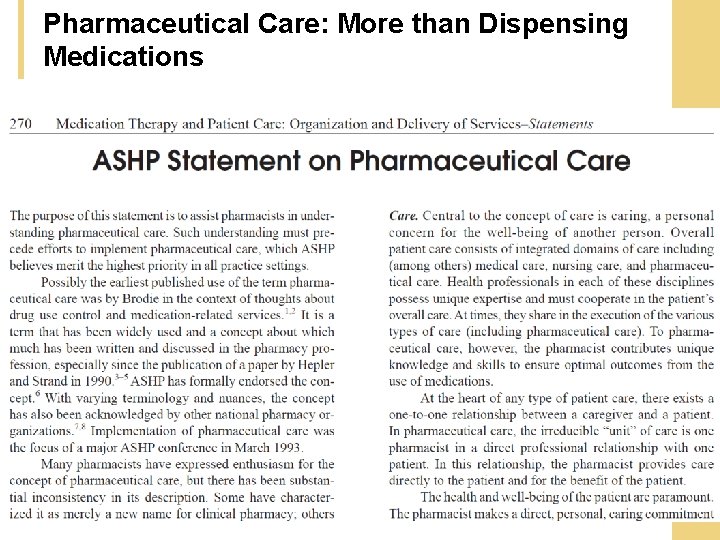
Pharmaceutical Care: More than Dispensing Medications 4
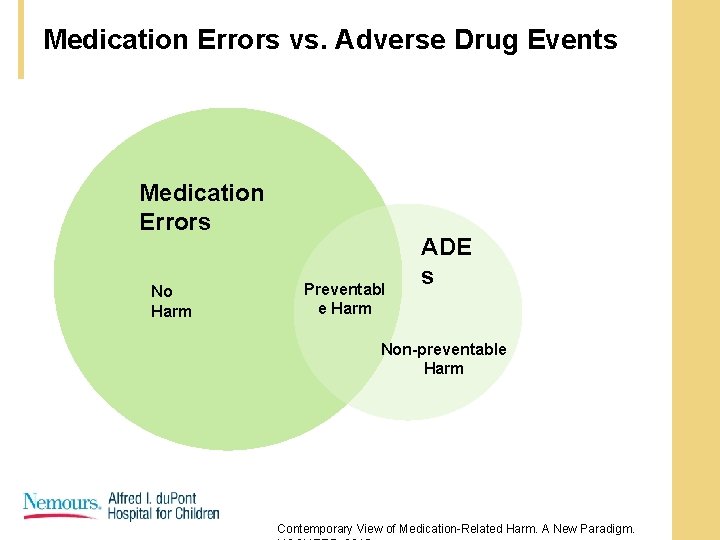
Medication Errors vs. Adverse Drug Events Medication Errors No Harm Preventabl e Harm ADE s Non-preventable Harm Contemporary View of Medication-Related Harm. A New Paradigm.
Medication Errors in Pediatric Patients § As many as 1 in 10 hospitalized children are impacted by a medication error § Up to 35% of these errors are serious or life threatening § Three times more likely than adults to experience harm from medication errors and adverse drug events Part 1: Results of Survey on Pediatric Medication Safety. ISMP. 2015 Part 2: Results of Survey on Pediatric Medication Safety. ISMP.
Reasons for Increased Risk of Medication Errors in Pediatric Patients § Different and changing pharmacokinetic parameters § Need for calculation of individualized doses based on the age, weight, body surface area (BSA) and clinical condition of patient § Lack of available dosage forms and concentrations – Dosage formulations extemporaneously compounded – Lack of stability, compatibility, and bioavailability data § Need for precise dose measurement and appropriate drug delivery systems § Lack of published information or FDA-approved labeling regarding dosing, pharmacokinetics, safety, efficacy, and clinical use Guidelines for preventing medication errors in pediatrics. J Pediatr Pharmacol Ther
Voluntary Event Reports: Reliable or Not? Pros § Ongoing data collection across time and entire organization Cons § Awareness of event prior to reporting is required § Often identifies clinically significant events § Fear of misuse and blame § Relatively low cost § Widely used and studied § Firsthand knowledge of the event § Reporter bias § Does not detect frequency of events – Rate of reporting only § Underreporting Am J Health-Syst Pharm: 2011; 68: 227– 40 8
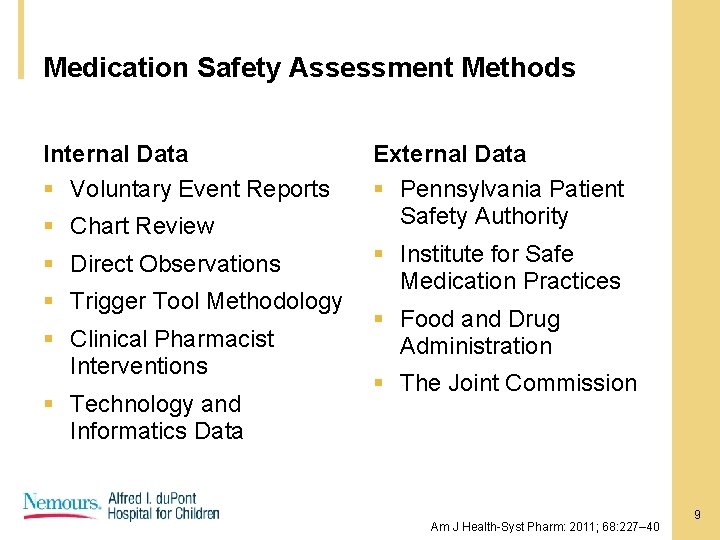
Medication Safety Assessment Methods Internal Data § Voluntary Event Reports § Chart Review § Direct Observations § Trigger Tool Methodology § Clinical Pharmacist Interventions § Technology and Informatics Data External Data § Pennsylvania Patient Safety Authority § Institute for Safe Medication Practices § Food and Drug Administration § The Joint Commission Am J Health-Syst Pharm: 2011; 68: 227– 40 9
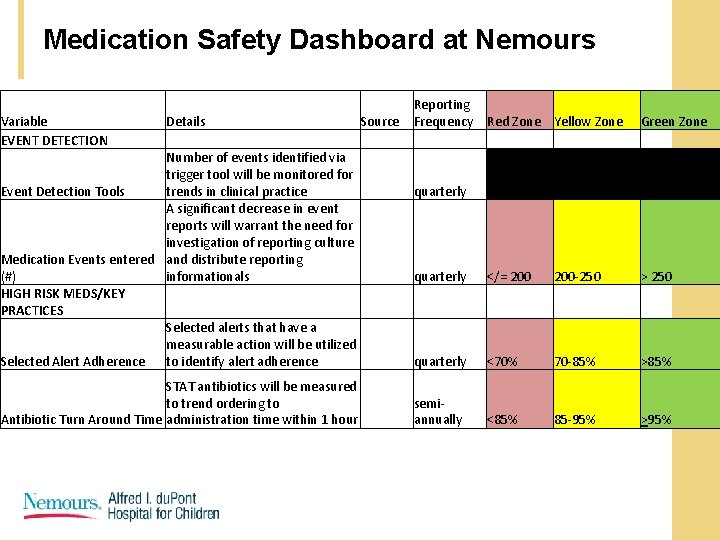
Medication Safety Dashboard at Nemours Variable EVENT DETECTION Details Source Number of events identified via trigger tool will be monitored for Event Detection Tools trends in clinical practice A significant decrease in event reports will warrant the need for investigation of reporting culture Medication Events entered and distribute reporting (#) informationals HIGH RISK MEDS/KEY PRACTICES Selected alerts that have a measurable action will be utilized Selected Alert Adherence to identify alert adherence STAT antibiotics will be measured to trend ordering to Antibiotic Turn Around Time administration time within 1 hour Reporting Frequency Red Zone Yellow Zone Green Zone quarterly </= 200 -250 > 250 quarterly <70% 70 -85% >85% semiannually <85% 85 -95% >95%
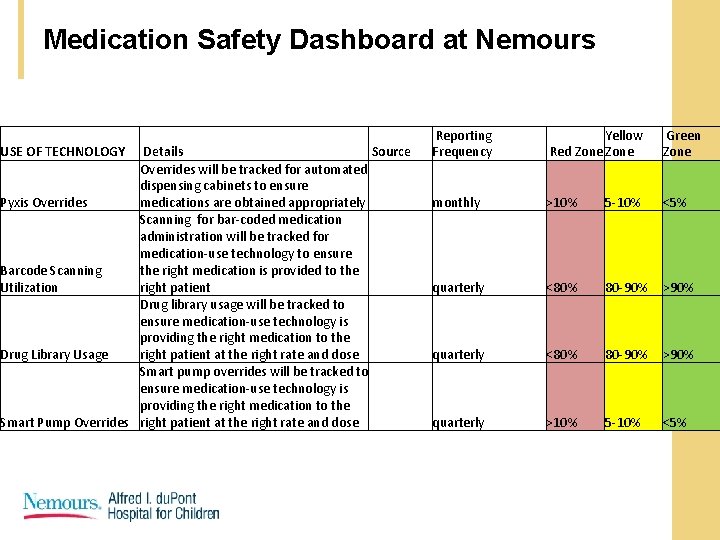
Medication Safety Dashboard at Nemours USE OF TECHNOLOGY Details Source Overrides will be tracked for automated dispensing cabinets to ensure Pyxis Overrides medications are obtained appropriately Scanning for bar-coded medication administration will be tracked for medication-use technology to ensure the right medication is provided to the Barcode Scanning Utilization right patient Drug library usage will be tracked to ensure medication-use technology is providing the right medication to the Drug Library Usage right patient at the right rate and dose Smart pump overrides will be tracked to ensure medication-use technology is providing the right medication to the Smart Pump Overrides right patient at the right rate and dose Reporting Frequency Yellow Red Zone Green Zone monthly >10% 5 -10% <5% quarterly <80% 80 -90% >90% quarterly >10% 5 -10% <5%
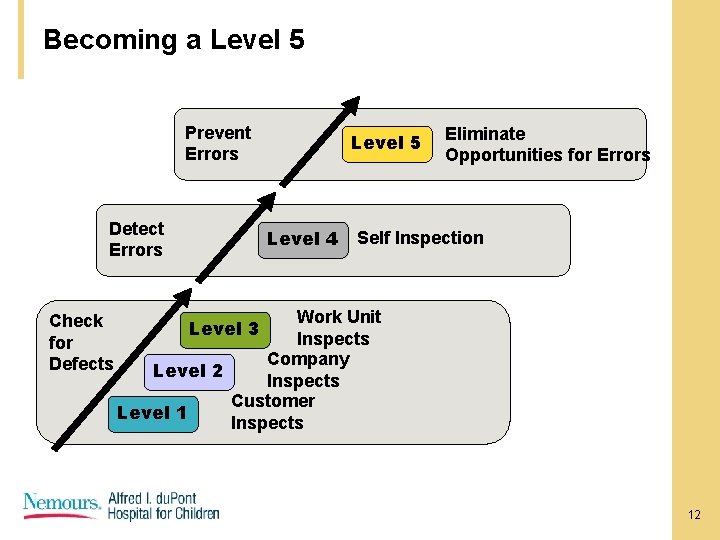
Becoming a Level 5 Prevent Errors Detect Errors Check for Defects Level 5 Level 4 Eliminate Opportunities for Errors Self Inspection Work Unit Inspects Company Level 2 Inspects Customer Level 1 Inspects Level 3 12
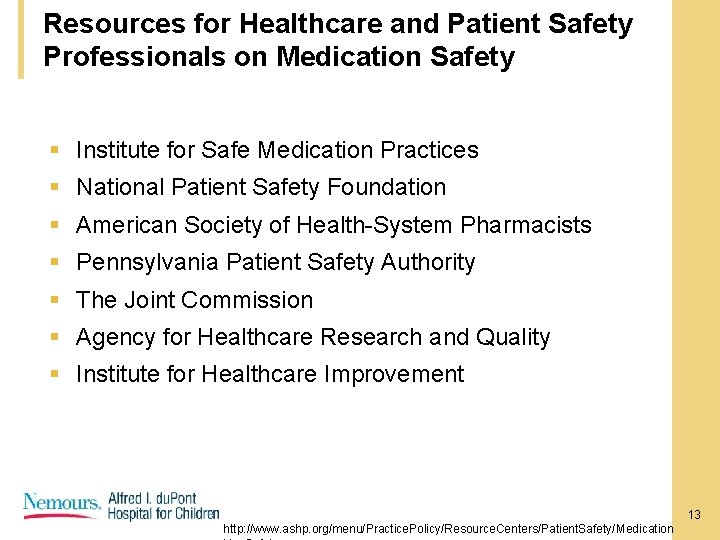
Resources for Healthcare and Patient Safety Professionals on Medication Safety § Institute for Safe Medication Practices § National Patient Safety Foundation § American Society of Health-System Pharmacists § Pennsylvania Patient Safety Authority § The Joint Commission § Agency for Healthcare Research and Quality § Institute for Healthcare Improvement 13 http: //www. ashp. org/menu/Practice. Policy/Resource. Centers/Patient. Safety/Medication
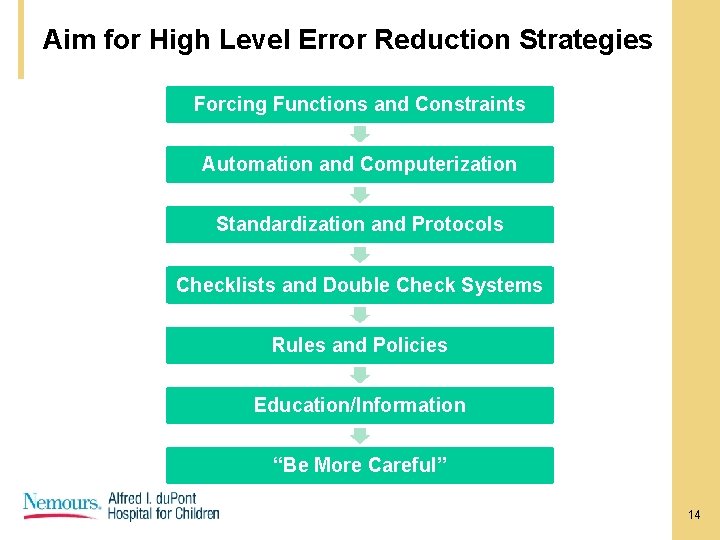
Aim for High Level Error Reduction Strategies Forcing Functions and Constraints Automation and Computerization Standardization and Protocols Checklists and Double Check Systems Rules and Policies Education/Information “Be More Careful” 14
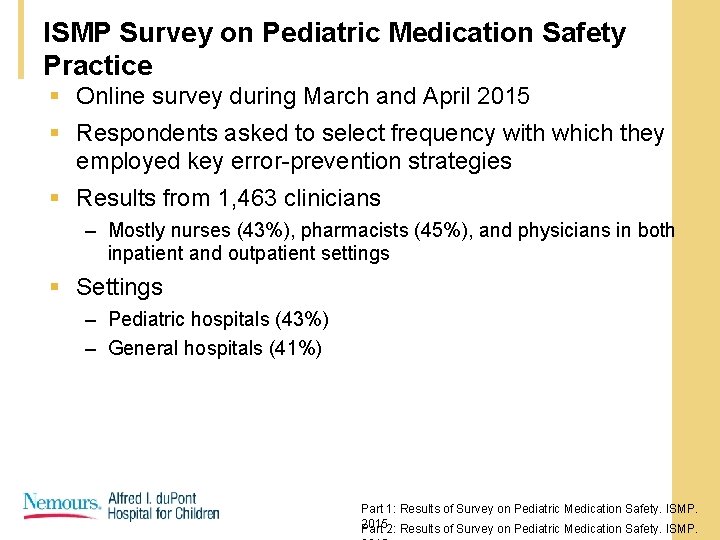
ISMP Survey on Pediatric Medication Safety Practice § Online survey during March and April 2015 § Respondents asked to select frequency with which they employed key error-prevention strategies § Results from 1, 463 clinicians – Mostly nurses (43%), pharmacists (45%), and physicians in both inpatient and outpatient settings § Settings – Pediatric hospitals (43%) – General hospitals (41%) Part 1: Results of Survey on Pediatric Medication Safety. ISMP. 2015 Part 2: Results of Survey on Pediatric Medication Safety. ISMP.
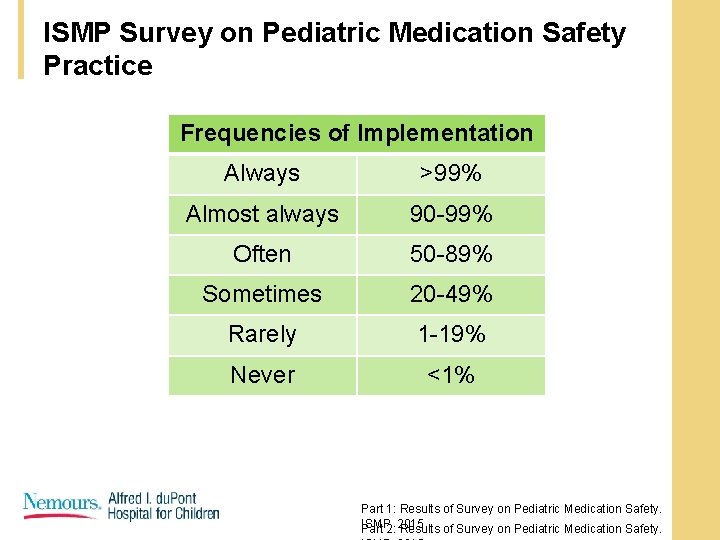
ISMP Survey on Pediatric Medication Safety Practice Frequencies of Implementation Always >99% Almost always 90 -99% Often 50 -89% Sometimes 20 -49% Rarely 1 -19% Never <1% Part 1: Results of Survey on Pediatric Medication Safety. ISMP. Part 2: 2015 Results of Survey on Pediatric Medication Safety.
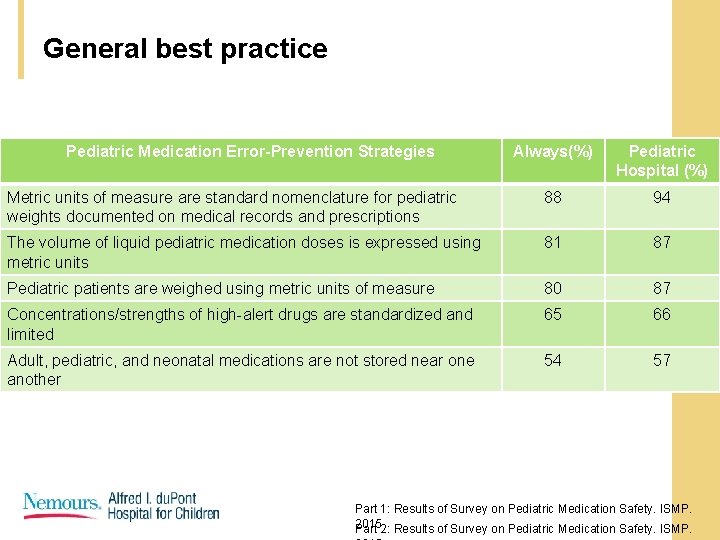
General best practice Pediatric Medication Error-Prevention Strategies Always(%) Pediatric Hospital (%) Metric units of measure are standard nomenclature for pediatric weights documented on medical records and prescriptions 88 94 The volume of liquid pediatric medication doses is expressed using metric units 81 87 Pediatric patients are weighed using metric units of measure 80 87 Concentrations/strengths of high-alert drugs are standardized and limited 65 66 Adult, pediatric, and neonatal medications are not stored near one another 54 57 Part 1: Results of Survey on Pediatric Medication Safety. ISMP. 2015 Part 2: Results of Survey on Pediatric Medication Safety. ISMP.
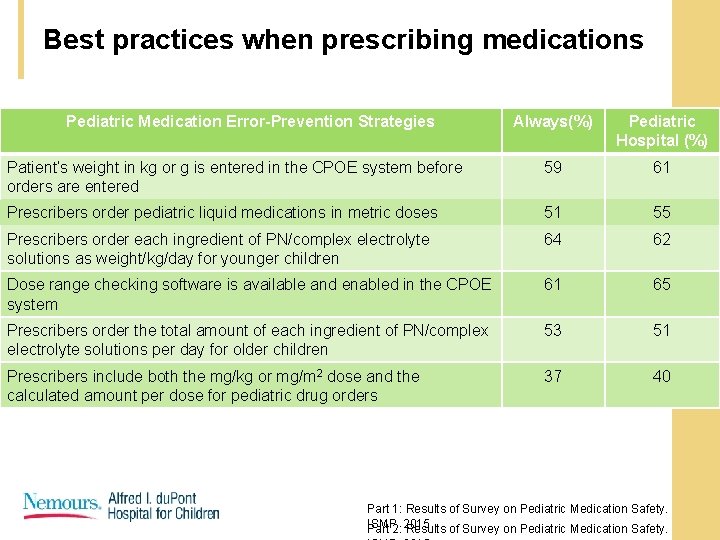
Best practices when prescribing medications Pediatric Medication Error-Prevention Strategies Always(%) Pediatric Hospital (%) Patient’s weight in kg or g is entered in the CPOE system before orders are entered 59 61 Prescribers order pediatric liquid medications in metric doses 51 55 Prescribers order each ingredient of PN/complex electrolyte solutions as weight/kg/day for younger children 64 62 Dose range checking software is available and enabled in the CPOE system 61 65 Prescribers order the total amount of each ingredient of PN/complex electrolyte solutions per day for older children 53 51 Prescribers include both the mg/kg or mg/m 2 dose and the calculated amount per dose for pediatric drug orders 37 40 Part 1: Results of Survey on Pediatric Medication Safety. ISMP. Part 2: 2015 Results of Survey on Pediatric Medication Safety.
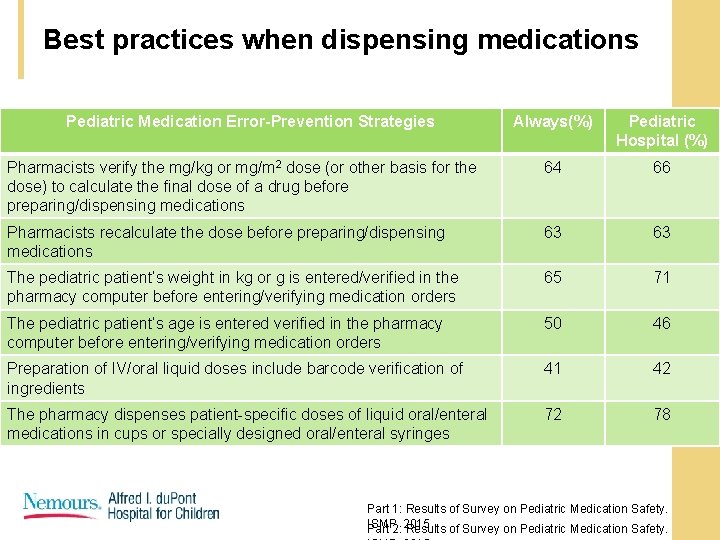
Best practices when dispensing medications Pediatric Medication Error-Prevention Strategies Always(%) Pediatric Hospital (%) Pharmacists verify the mg/kg or mg/m 2 dose (or other basis for the dose) to calculate the final dose of a drug before preparing/dispensing medications 64 66 Pharmacists recalculate the dose before preparing/dispensing medications 63 63 The pediatric patient’s weight in kg or g is entered/verified in the pharmacy computer before entering/verifying medication orders 65 71 The pediatric patient’s age is entered verified in the pharmacy computer before entering/verifying medication orders 50 46 Preparation of IV/oral liquid doses include barcode verification of ingredients 41 42 The pharmacy dispenses patient-specific doses of liquid oral/enteral medications in cups or specially designed oral/enteral syringes 72 78 Part 1: Results of Survey on Pediatric Medication Safety. ISMP. Part 2: 2015 Results of Survey on Pediatric Medication Safety.
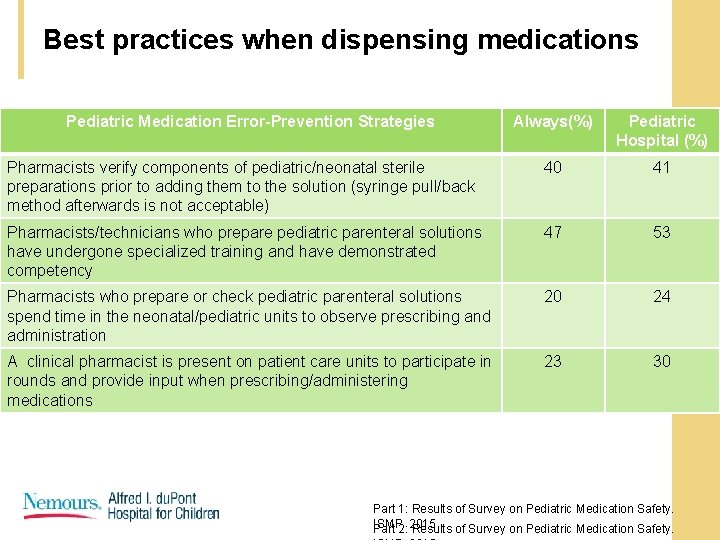
Best practices when dispensing medications Pediatric Medication Error-Prevention Strategies Always(%) Pediatric Hospital (%) Pharmacists verify components of pediatric/neonatal sterile preparations prior to adding them to the solution (syringe pull/back method afterwards is not acceptable) 40 41 Pharmacists/technicians who prepare pediatric parenteral solutions have undergone specialized training and have demonstrated competency 47 53 Pharmacists who prepare or check pediatric parenteral solutions spend time in the neonatal/pediatric units to observe prescribing and administration 20 24 A clinical pharmacist is present on patient care units to participate in rounds and provide input when prescribing/administering medications 23 30 Part 1: Results of Survey on Pediatric Medication Safety. ISMP. Part 2: 2015 Results of Survey on Pediatric Medication Safety.
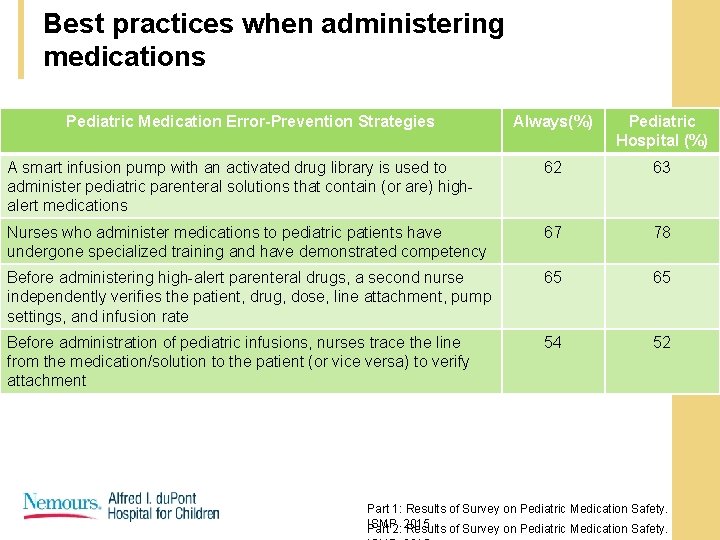
Best practices when administering medications Pediatric Medication Error-Prevention Strategies Always(%) Pediatric Hospital (%) A smart infusion pump with an activated drug library is used to administer pediatric parenteral solutions that contain (or are) highalert medications 62 63 Nurses who administer medications to pediatric patients have undergone specialized training and have demonstrated competency 67 78 Before administering high-alert parenteral drugs, a second nurse independently verifies the patient, drug, dose, line attachment, pump settings, and infusion rate 65 65 Before administration of pediatric infusions, nurses trace the line from the medication/solution to the patient (or vice versa) to verify attachment 54 52 Part 1: Results of Survey on Pediatric Medication Safety. ISMP. Part 2: 2015 Results of Survey on Pediatric Medication Safety.
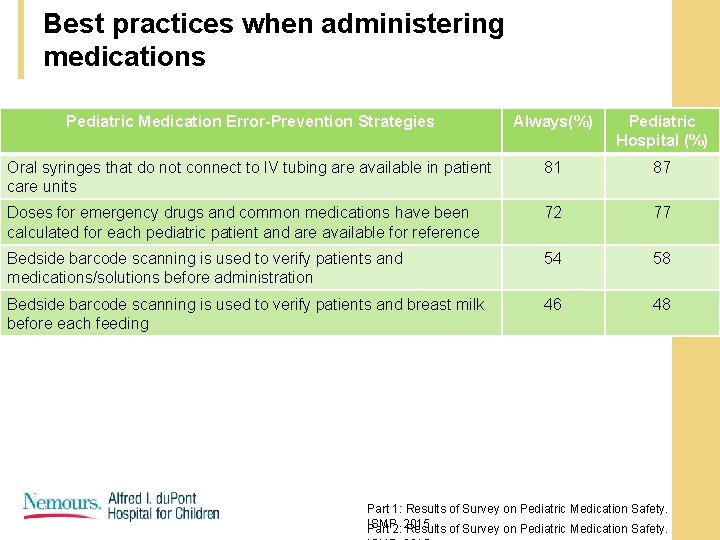
Best practices when administering medications Pediatric Medication Error-Prevention Strategies Always(%) Pediatric Hospital (%) Oral syringes that do not connect to IV tubing are available in patient care units 81 87 Doses for emergency drugs and common medications have been calculated for each pediatric patient and are available for reference 72 77 Bedside barcode scanning is used to verify patients and medications/solutions before administration 54 58 Bedside barcode scanning is used to verify patients and breast milk before each feeding 46 48 Part 1: Results of Survey on Pediatric Medication Safety. ISMP. Part 2: 2015 Results of Survey on Pediatric Medication Safety.
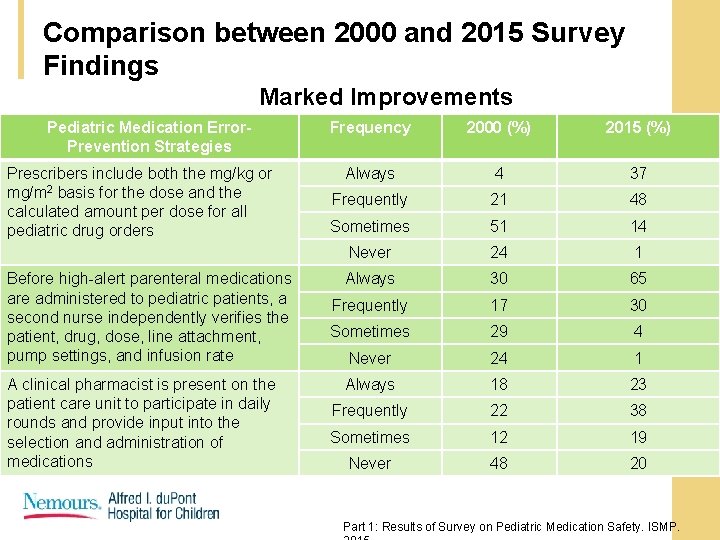
Comparison between 2000 and 2015 Survey Findings Marked Improvements Pediatric Medication Error. Prevention Strategies Prescribers include both the mg/kg or mg/m 2 basis for the dose and the calculated amount per dose for all pediatric drug orders Before high-alert parenteral medications are administered to pediatric patients, a second nurse independently verifies the patient, drug, dose, line attachment, pump settings, and infusion rate A clinical pharmacist is present on the patient care unit to participate in daily rounds and provide input into the selection and administration of medications Frequency 2000 (%) 2015 (%) Always 4 37 Frequently 21 48 Sometimes 51 14 Never 24 1 Always 30 65 Frequently 17 30 Sometimes 29 4 Never 24 1 Always 18 23 Frequently 22 38 Sometimes 12 19 Never 48 20 Part 1: Results of Survey on Pediatric Medication Safety. ISMP.
QUESTIONS? Michael C. Dejos, Pharm. D, BCPS Medication Safety Officer 24
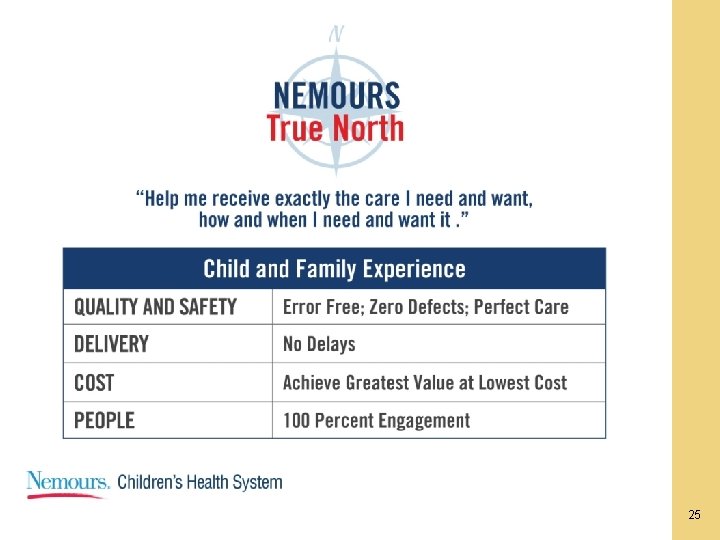
25
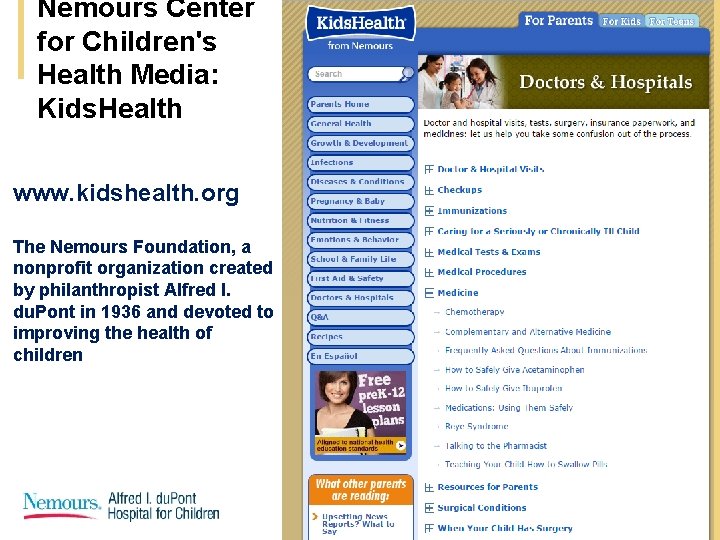
Nemours Center for Children's Health Media: Kids. Health www. kidshealth. org The Nemours Foundation, a nonprofit organization created by philanthropist Alfred I. du. Pont in 1936 and devoted to improving the health of children 26