Diploma in Funeral Arranging Administration 3 7 Registration

- Slides: 26
Diploma in Funeral Arranging & Administration 3. 7: Registration & Coroner’s Procedures
Aims and Objectives • Understand the function of the Registrar. • Understand the requirements of Registering a Death • Understand the relevance of the Medical Certificate of Cause of Death • Understand the Registrar’s duty to report a death • Understand the documentation used by the Registrar • Know the purpose of the Coroner’s Office • Understand the procedures for a Coroner’s removal of the deceased • Understand the purpose of the Coroner’s documentation
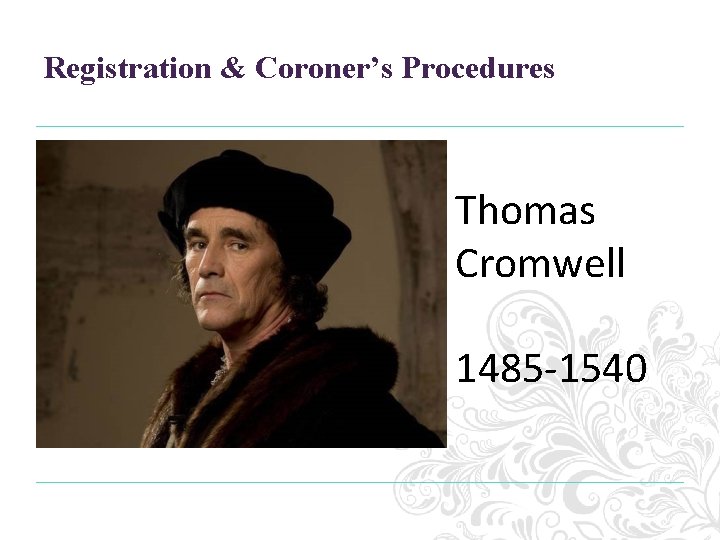
Registration & Coroner’s Procedures Thomas Cromwell 1485 -1540
A brief history • 1538 Thomas Cromwell asks clergy to keep a record of baptisms, marriages and burials. • 1597 Act establishes that parochial registers should be sent annually to the Diocesan Registrar. • 1836 Office of Registrar General created. Registrars must register but no obligation is placed on the public. • 1874 Births and Deaths Registration Act. Many feature still apply. • 1953 Births and Deaths Registration Act 1953. Current procedure. `
Function of Registrar • • To register births To register deaths To register marriages * To register civil partnerships * Only a Superintendent or Deputy Superintendent may officiate at marriages. These officers are also responsible for old registers.
Districts Coterminous with Local Authority Boundaries. In practice this means that: • • London Boroughs Shire Counties Unitary Authorities (eg. Milton Keynes, Powys, Swansea) Metropolitan Borough Councils (eg. Dudley, Wirral, Stockport) • City Councils (eg Manchester) • Denbighshire has north and south districts
Who can register? Deaths in Houses and Public Institutions • A relative or civil partner of the deceased, present at the death • A relative or civil partner of the deceased, in attendance during the last illness • A relative or civil partner of the deceased, residing or being in the sub-district where the death occurred • A person present at the death • The occupier if he/she knew of the happening of the death • Any inmate if he/she knew of the happening of the death • The person causing the disposal of the body. e. g. the person responsible for payment of the account
Who can register? Deaths not in Houses or Dead Bodies Found • Any relative or civil partner of the deceased having knowledge of any of the particulars required to be registered • Any person present at the death • Any person who found the body • Any person in charge of the body • The person causing the disposal of the body. e. g. the person responsible for payment of the account
Information required to register • • • The Medical Certificate of Cause of Death The Medical Card of the Deceased - if available The date and place of death The full name and surname (and the maiden surname if the deceased was a woman who had married) The date and place of birth The occupation (and if the deceased was a married woman or a widow the name and occupation of her husband) The usual address of the deceased Whether the deceased was in receipt of a pension or allowance from public funds If the deceased was married, the date of birth of the surviving widow or widower Name and surname of Informant’s qualification to register Usual address of informant
The Registrar will issue • Certified copies of the entry • Certificate of Registration or Notification of Death (BD 8) • Registrar’s Certificate for Burial or Cremation • Info about state benefits and Wills (Form 48)
What happens to the Registrar’s Certificate? • Part A – Retained by issuing Registrar • Part B – Given to FD who forwards it to cemetery/crematorium • Part C – Completed, signed and returned to issuing registrar within 96 hours of disposal
Registration by Declaration • • • Contact registrar in district of death for approval Obtain Medical Certificate of Cause of Death Attend local registrar Local registrar enters details electronically Informant signs document comparable to actual entry to confirm details • This certificate is posted to the registrar in district of death • Registrar in district of death effects registration • Copies of entry posted to informant
Stillbirth • Registration is required within 42 days • Informant must supply – Certificate of Stillbirth from a doctor or midwife, or – their own declaration that none was available to certify* * in which case, like as not, the case will go to the coroner
Stillbirth: acceptable informants • • • mother legitimate father occupier of house of stillbirth a person present at the stillbirth a person having charge of the stillborn child • the person finding the child, where applicable
Stillbirth: information required • • • Date and place of birth Gender Cause of death/evidence of stillbirth (from cert of stillbirth) • • • Father’s Full name Place of birth Occupation • • Mother’s Full name Place of birth Maiden name or surname at marriage (if applicable) Usual address if not child’s place of birth • • • Informant’s Full name Qualification to act as informant Usual address if not child’s place of birth
Duty of Registrar to refer to Coroner. IF: • the deceased was not attended during his/her last illness by a registered medical practitioner; • the Registrar has been unable to obtain a duly completed certificate of cause of death or; • it appears to the Registrar from the particulars contained in such certificate, or otherwise, that the deceased was not seen by the certifying Medical Practitioner either after death or within fourteen days before death:
Duty of Registrar to refer to Coroner. IF: • the cause of death appears to be unknown: • the Registrar has reason to believe that the death was unnatural or caused by violence or neglect, or by abortion, or was attended by suspicious circumstances; • where it appears to the Registrar that the death occurred during an operation or before recovery from the effect of an anaesthetic; • if it appears to the Registrar from the contents of any medical certificate that the death was due to industrial disease or industrial poisoning,
Duties of H. M. Coroner The main duties of the Coroner today are: • to investigate all sudden and unexpected deaths, • to investigate all deaths that happen abroad where the body is repatriated to the United Kingdom • to give permission to remove bodies out of England Wales • to act for the Crown in respect of Treasure Trove
Deaths Referred to the Coroner • The cause of death is unknown • It cannot readily be certified as being due to natural causes • The deceased was not attended by a Doctor during his / her last illness or was not seen within the last 14 days or viewed after death • There are suspicious circumstances or a history of violence • The death may be linked to an accident (whenever it occurred) • There is a question of self-neglect or neglect by others • The death has occurred or the illness arisen during or shortly after detention in a police station or prison custody (including voluntary attendance at a police station) • The deceased was detained under the Mental Health Act • The death is linked with abortion
Deaths Referred to the Coroner cont. • The death might have been contributed to by the actions of the deceased (such as history of drug abuse, self injury or overdose) • The death could be due to industrial disease or related in any way to the deceased employment • The death occurred during an operation or before full recovery from the effects of anaesthetic or was in any way related to the anaesthetic • The death may not be related to a medical procedure or treatment whether invasive or not • The death may be due to lack of medical care • There any other unusual or disturbing features to the case • The death occurs within 24 hours of admission to hospital (unless admitted purely for terminal care) • Any allegation of medical mismanagement
Three possible outcomes • No action required • Post-mortem only • Post-mortem and inquest An inquest must follow if there is reason to suspect that the deceased: (a) has died a violent or an unnatural death (b) has died a sudden death of which the cause is unknown (c) has died in prison or in such a place or in such circumstances as to require an inquest under any other Act
No action required • Registered Medical Practitioner is willing to certify • Coroner issues Form 100 a • Informant obtains Medical Certificate of Cause of Death • Registration follows in usual manner • Registrar issues Certificate for Burial or Cremation • Forms 4&5 obtained if required
Post-mortem only • Natural cause established for death – no inquest necessary • Coroner issues Form 100 b • Family attend registrar • Registrar issues Certificate for Burial (if burial required) • Coroner issues Cremation 6. This replaces Cremation 4&5
Post-mortem and inquest • Coroner not convinced death was from natural causes, or inquest obligatory according to law • Inquest usually opened with 5 days of death to receive basic identity and medical evidence then adjourned • If cause of death known either Form 6 (for cremation) or Form 101 (Coroner’s Order for Burial – now Form 3) issued • Interim death certificate issued upon request • Inquest held to establish • Who the deceased was • How when and where death occurred • Details required for death to be registered
Deprivation of Liberty Safeguards • Detention under Mental Health Act 2005 constitutes “state detention” for Coroner • Death in such detention automatically referred to Coroner • Automatically inquestable • PM may not be necessary • Doctor completes report for Coroner – May be accepted as confirmation of the death • Inquest may take place within hours (desk inquest) • FD may bring decedent into their own care to begin with
A family undertaking.