Hot Topics in General Relativity and Gravitation Aug
- Slides: 94
Hot Topics in General Relativity and Gravitation, Aug. 9 -15, Quy Nhon, Vietnam Holographic Superconductor Models Rong-Gen Cai Institute of Theoretical Physics Chinese Academy of Sciences
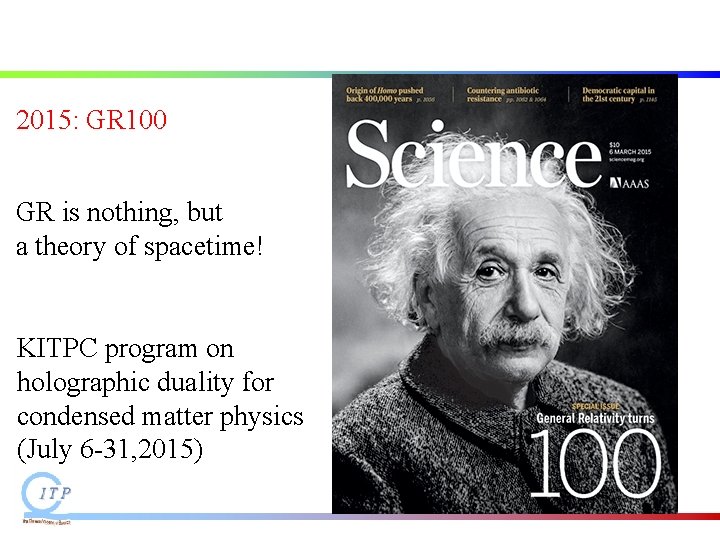
2015: GR 100 GR is nothing, but a theory of spacetime! KITPC program on holographic duality for condensed matter physics (July 6 -31, 2015)
Outline: 1 Introduction 2 Holographic models of superconductors s-wave, p-wave and d-wave, insulator/conductor 3 Holographic Josephson junction and SQUID 4 Competition and coexistence of superconductivity orders 5 Summary
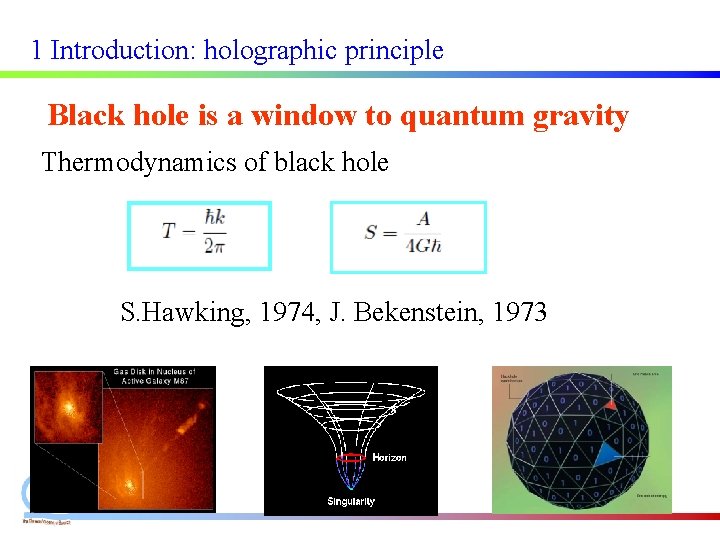
1 Introduction: holographic principle Black hole is a window to quantum gravity Thermodynamics of black hole S. Hawking, 1974, J. Bekenstein, 1973
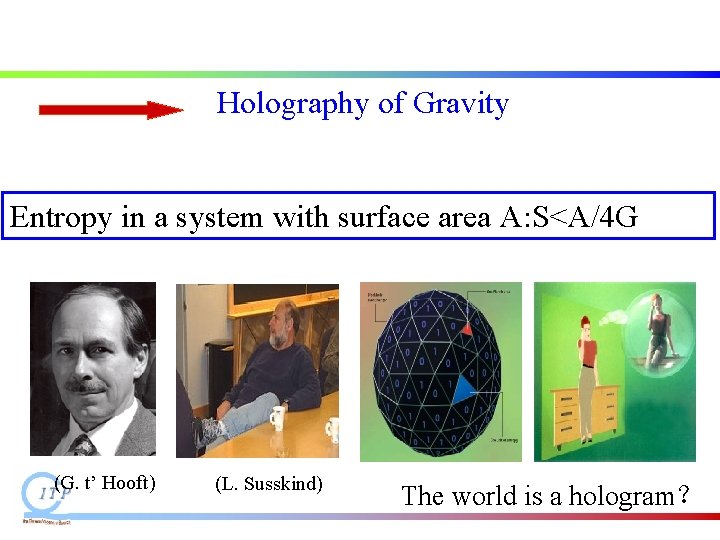
Holography of Gravity Entropy in a system with surface area A: S<A/4 G (G. t’ Hooft) (L. Susskind) The world is a hologram?
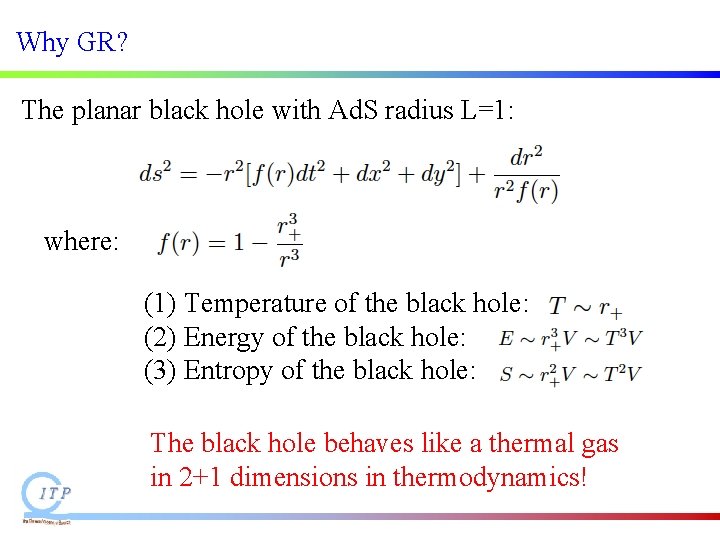
Why GR? The planar black hole with Ad. S radius L=1: where: (1) Temperature of the black hole: (2) Energy of the black hole: (3) Entropy of the black hole: The black hole behaves like a thermal gas in 2+1 dimensions in thermodynamics!
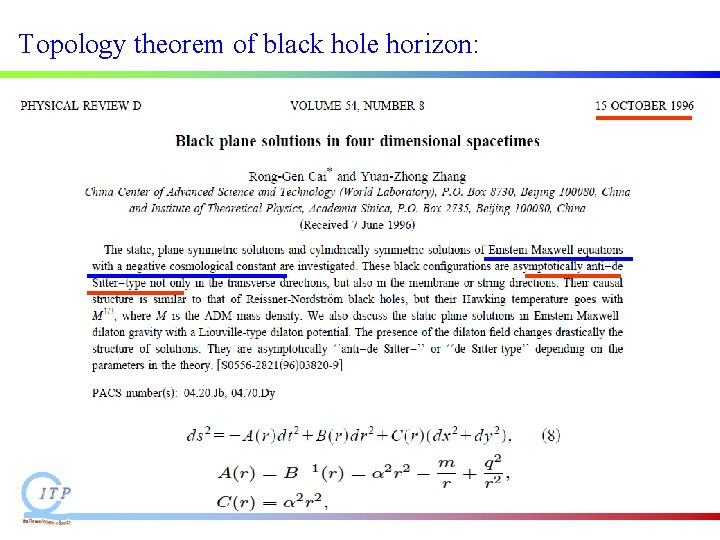
Topology theorem of black hole horizon:
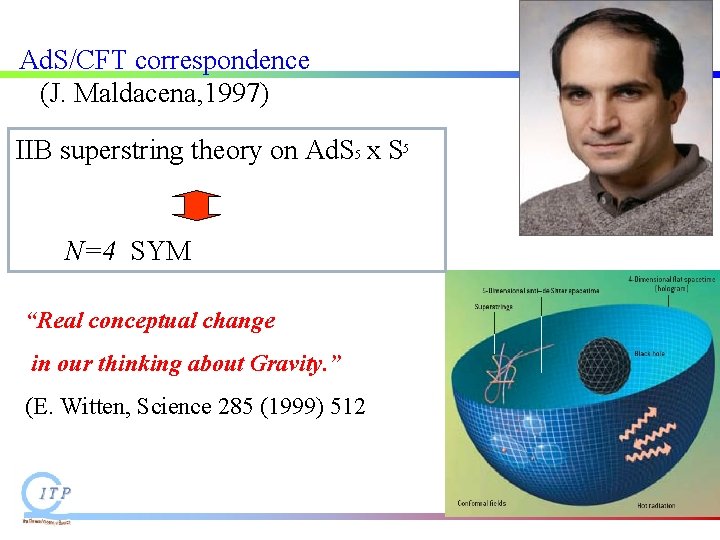
Ad. S/CFT correspondence (J. Maldacena, 1997) IIB superstring theory on Ad. S 5 x S 5 N=4 SYM “Real conceptual change in our thinking about Gravity. ” (E. Witten, Science 285 (1999) 512
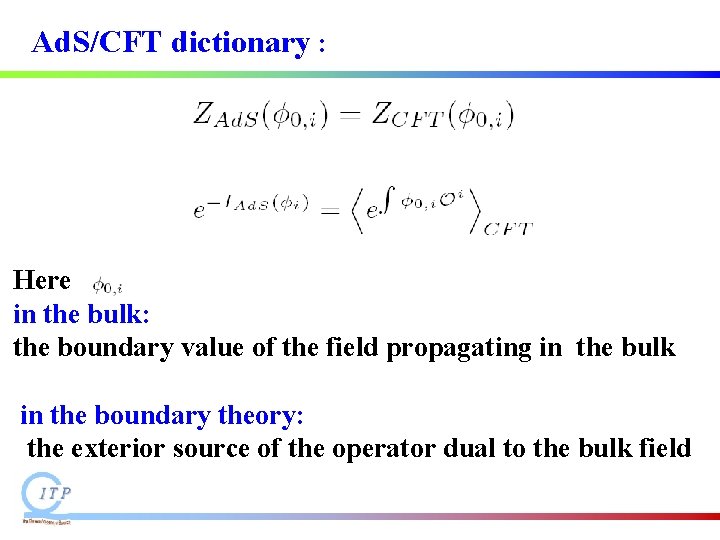
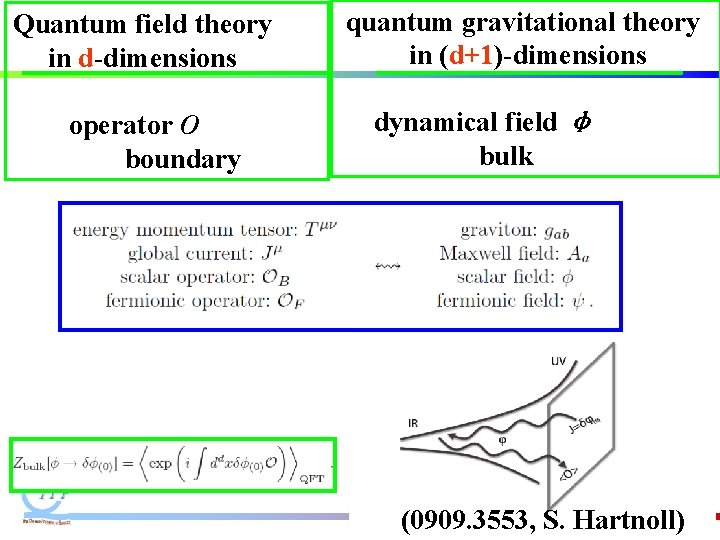
Ad. S/CFT dictionary : Here in the bulk: the boundary value of the field propagating in the bulk in the boundary theory: the exterior source of the operator dual to the bulk field
Quantum field theory in d-dimensions operator Ο boundary quantum gravitational theory in (d+1)-dimensions dynamical field φ bulk (0909. 3553, S. Hartnoll)
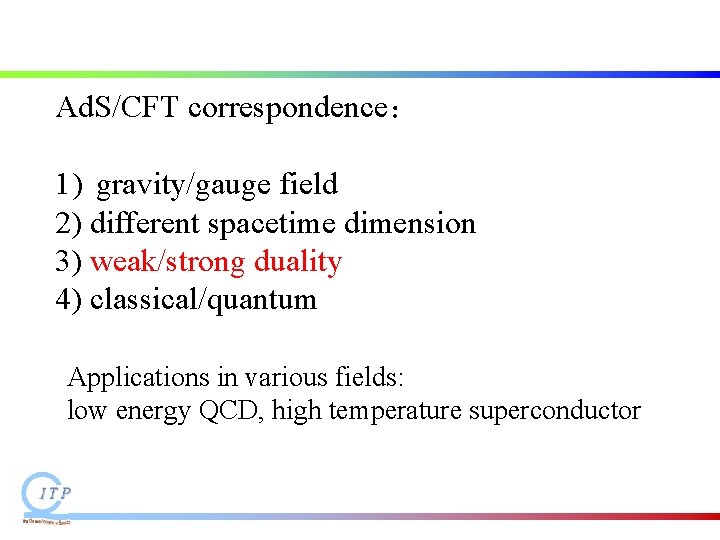
Ad. S/CFT correspondence: 1) gravity/gauge field 2) different spacetime dimension 3) weak/strong duality 4) classical/quantum Applications in various fields: low energy QCD, high temperature superconductor
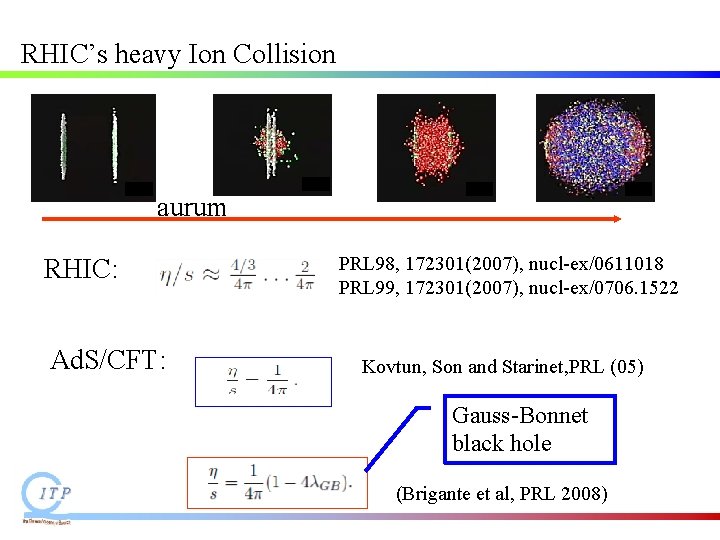
RHIC’s heavy Ion Collision aurum RHIC: Ad. S/CFT: PRL 98, 172301(2007), nucl-ex/0611018 PRL 99, 172301(2007), nucl-ex/0706. 1522 Kovtun, Son and Starinet, PRL (05) Gauss-Bonnet black hole (Brigante et al, PRL 2008)
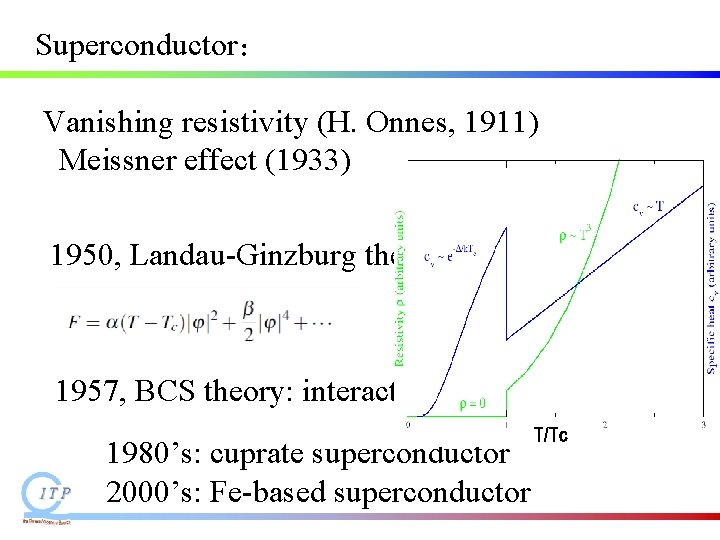
Superconductor: Vanishing resistivity (H. Onnes, 1911) Meissner effect (1933) 1950, Landau-Ginzburg theory 1957, BCS theory: interactions with phonons 1980’s: cuprate superconductor 2000’s: Fe-based superconductor
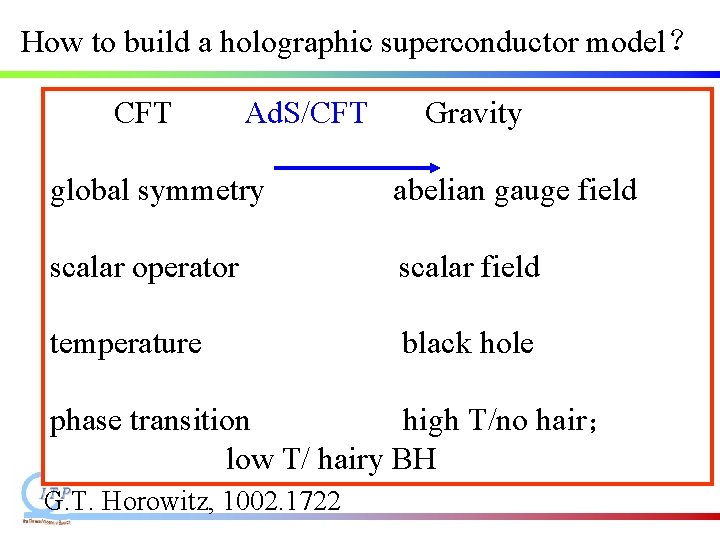
How to build a holographic superconductor model? CFT Ad. S/CFT Gravity global symmetry abelian gauge field scalar operator scalar field temperature black hole phase transition high T/no hair; low T/ hairy BH G. T. Horowitz, 1002. 1722
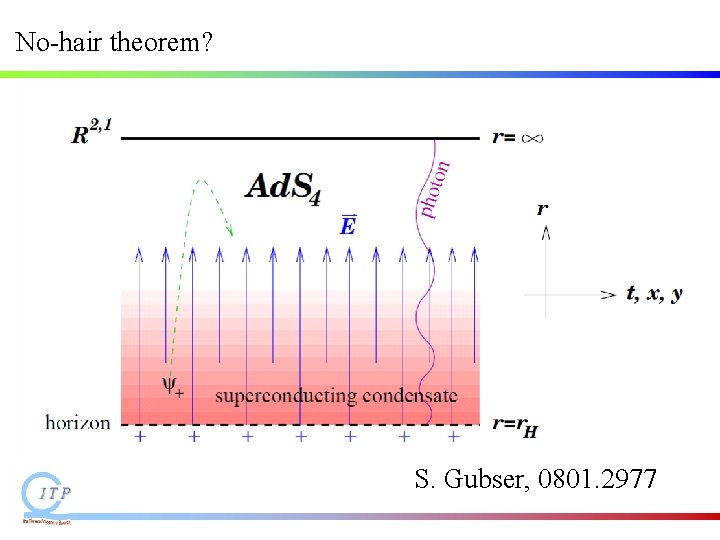
No-hair theorem? S. Gubser, 0801. 2977
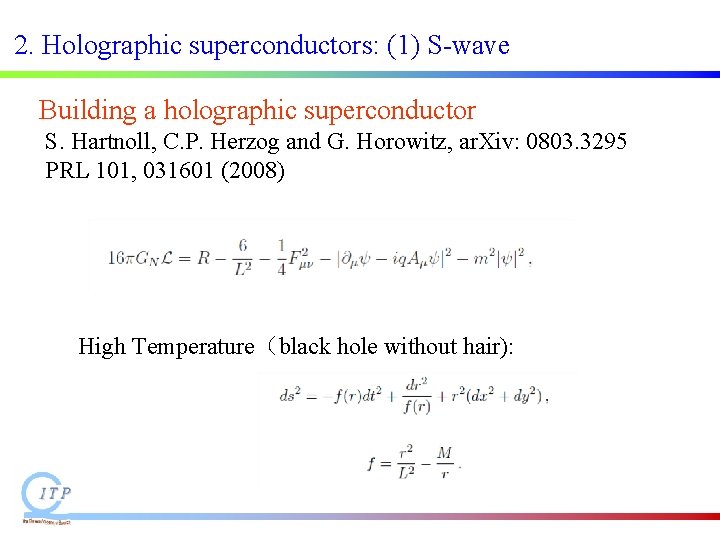
2. Holographic superconductors: (1) S-wave Building a holographic superconductor S. Hartnoll, C. P. Herzog and G. Horowitz, ar. Xiv: 0803. 3295 PRL 101, 031601 (2008) High Temperature(black hole without hair):
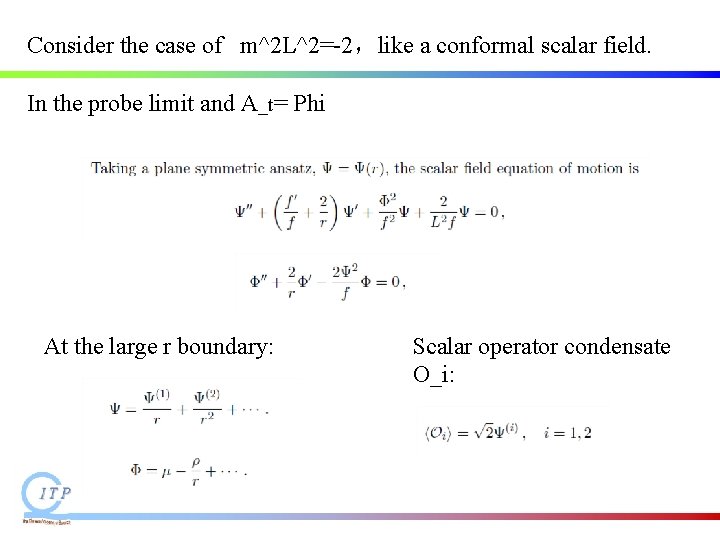
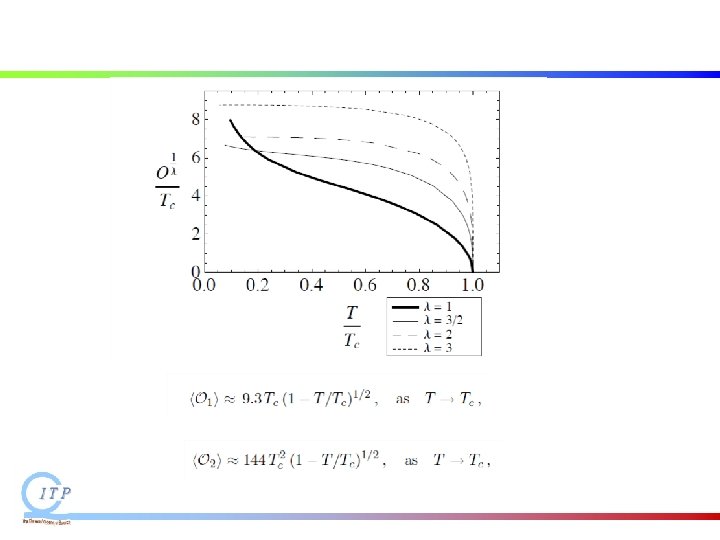
Consider the case of m^2 L^2=-2,like a conformal scalar field. In the probe limit and A_t= Phi At the large r boundary: Scalar operator condensate O_i:
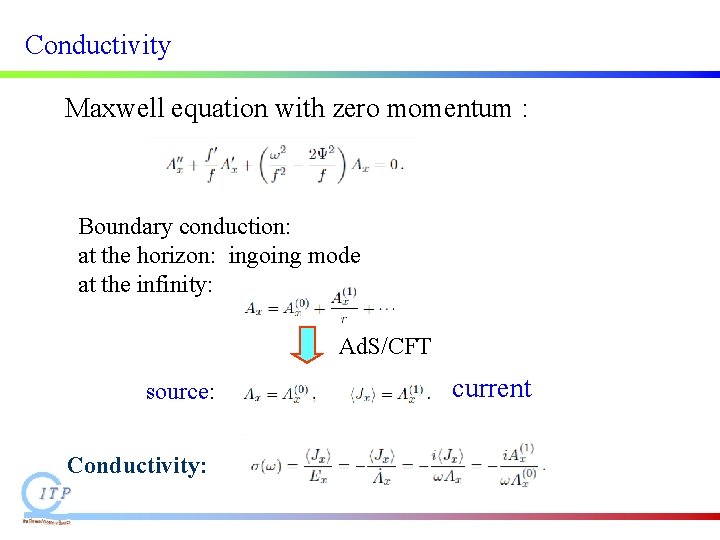
Conductivity Maxwell equation with zero momentum : Boundary conduction: at the horizon: ingoing mode at the infinity: Ad. S/CFT source: Conductivity: current
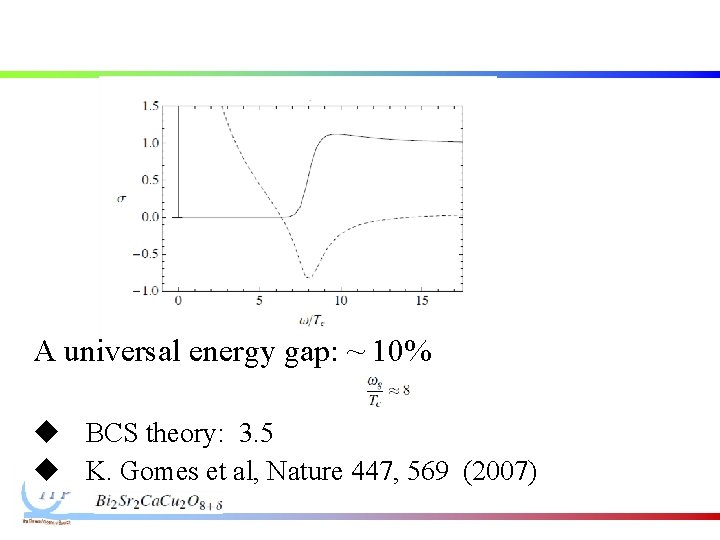
A universal energy gap: ~ 10% u BCS theory: 3. 5 u K. Gomes et al, Nature 447, 569 (2007)
Summary: 1. The CFT has a global abelian symmetry corresponding a massless gauge field propagating in the bulk Ad. S space. 2. Also require an operator in the CFT that corresponds to a scalar field that is charged with respect to this gauge field. . 3. Adding a black hole to the Ad. S describes the CFT at finite temperature. 4. Looks for cases where there are high temperature black hole solutions with no charged scalar hair, but below some critical temperature black hole solutions with charged scalar hair and dominates the free energy.
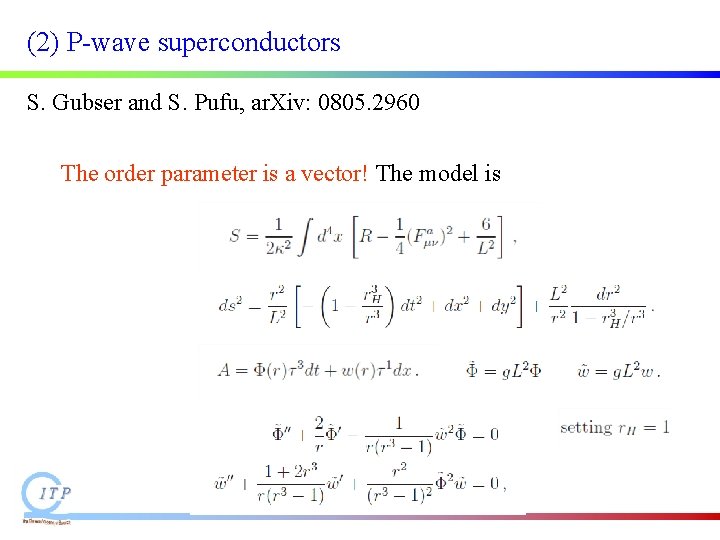
(2) P-wave superconductors S. Gubser and S. Pufu, ar. Xiv: 0805. 2960 The order parameter is a vector! The model is
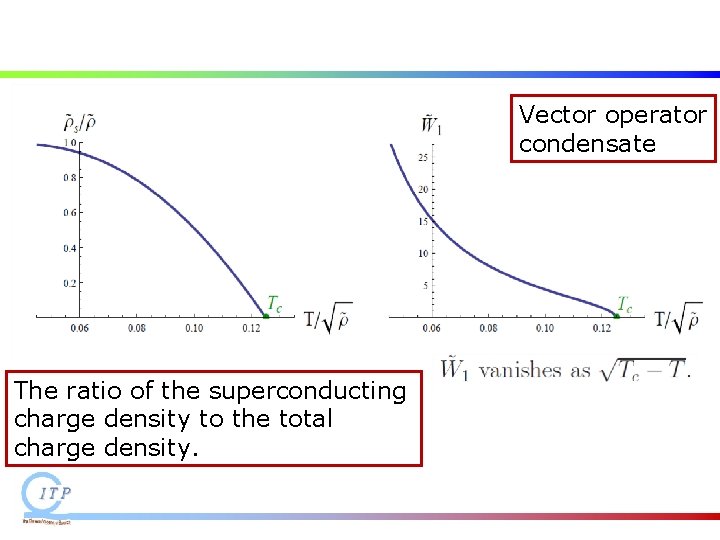
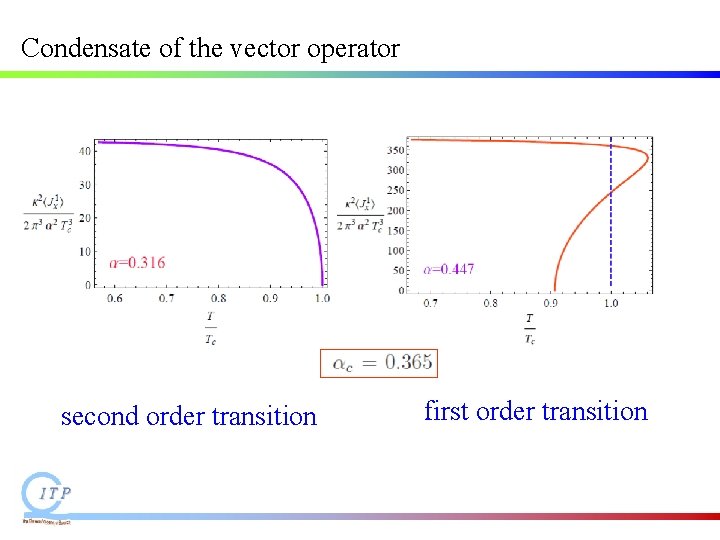
Vector operator condensate The ratio of the superconducting charge density to the total charge density.
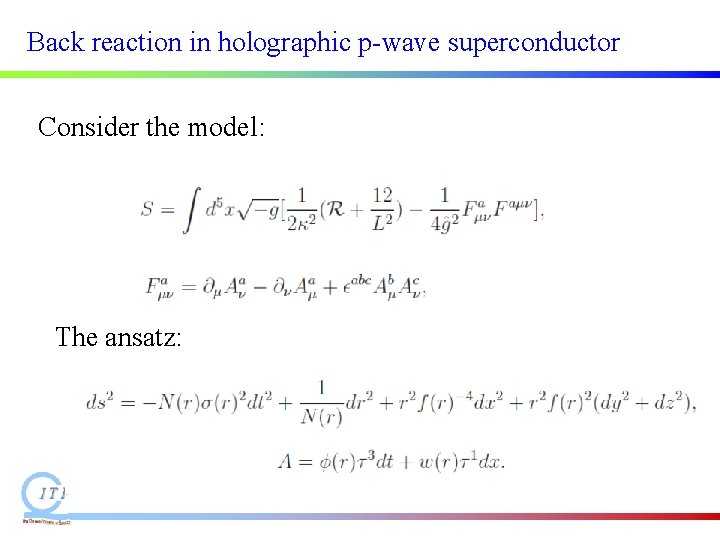
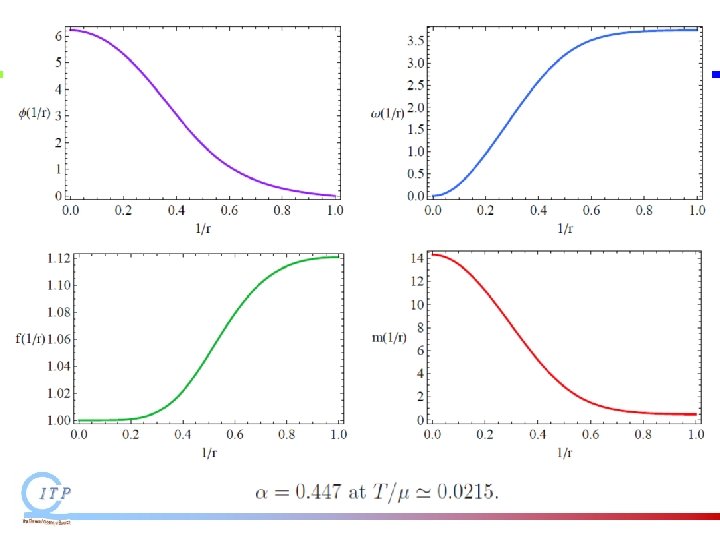
Back reaction in holographic p-wave superconductor Consider the model: The ansatz:
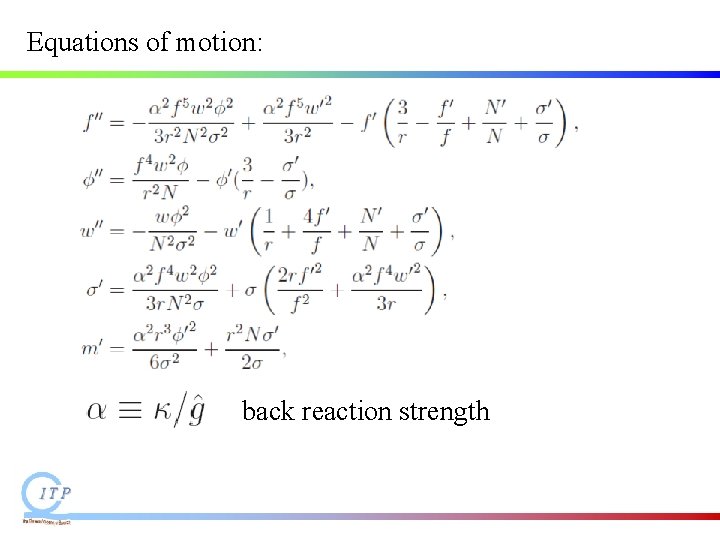
Equations of motion: back reaction strength
Condensate of the vector operator second order transition first order transition
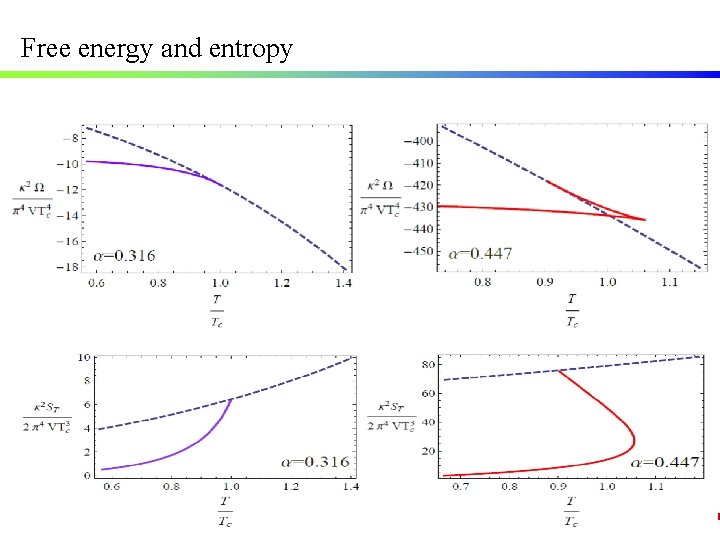
Free energy and entropy
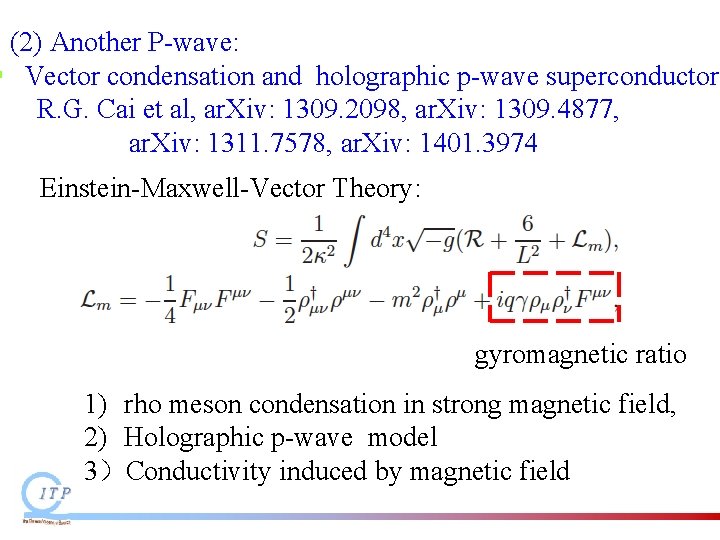
(2) Another P-wave: Vector condensation and holographic p-wave superconductor R. G. Cai et al, ar. Xiv: 1309. 2098, ar. Xiv: 1309. 4877, ar. Xiv: 1311. 7578, ar. Xiv: 1401. 3974 Einstein-Maxwell-Vector Theory: gyromagnetic ratio 1) rho meson condensation in strong magnetic field, 2) Holographic p-wave model 3)Conductivity induced by magnetic field
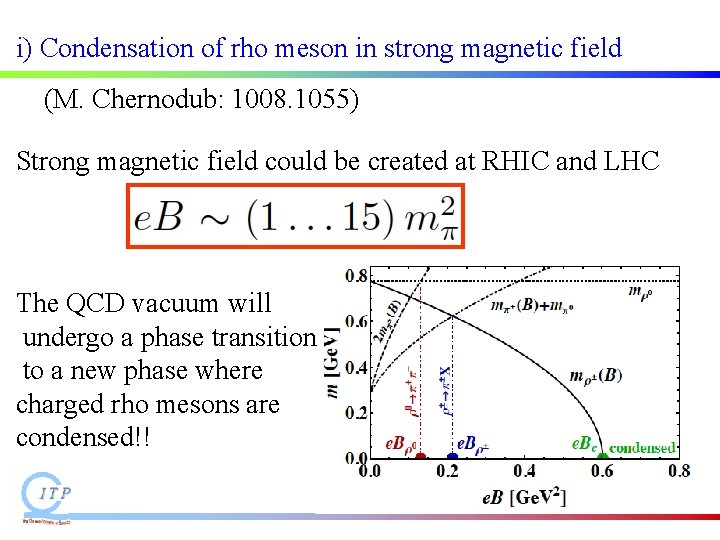
i) Condensation of rho meson in strong magnetic field (M. Chernodub: 1008. 1055) Strong magnetic field could be created at RHIC and LHC The QCD vacuum will undergo a phase transition to a new phase where charged rho mesons are condensed!!
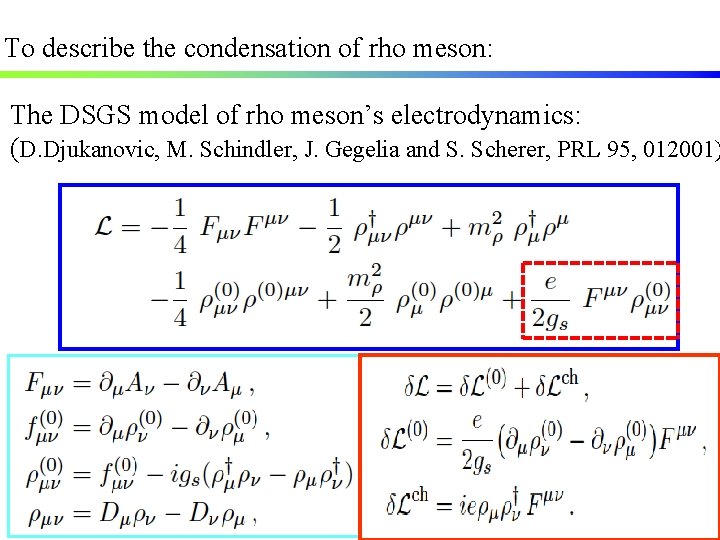
To describe the condensation of rho meson: The DSGS model of rho meson’s electrodynamics: (D. Djukanovic, M. Schindler, J. Gegelia and S. Scherer, PRL 95, 012001)
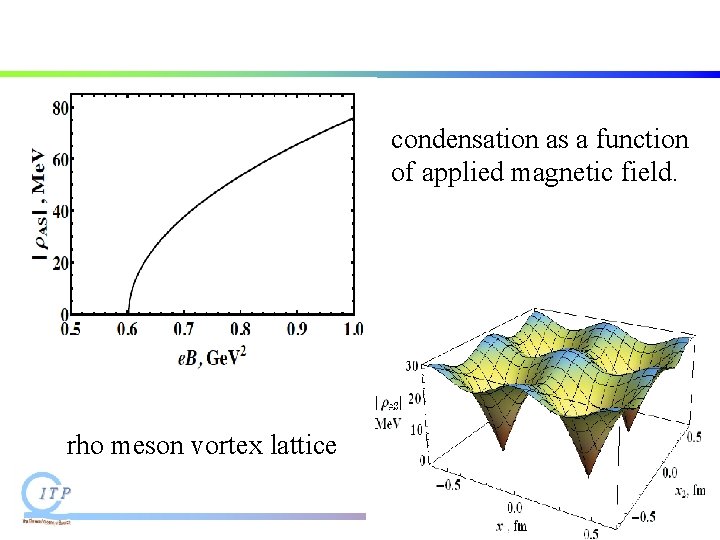
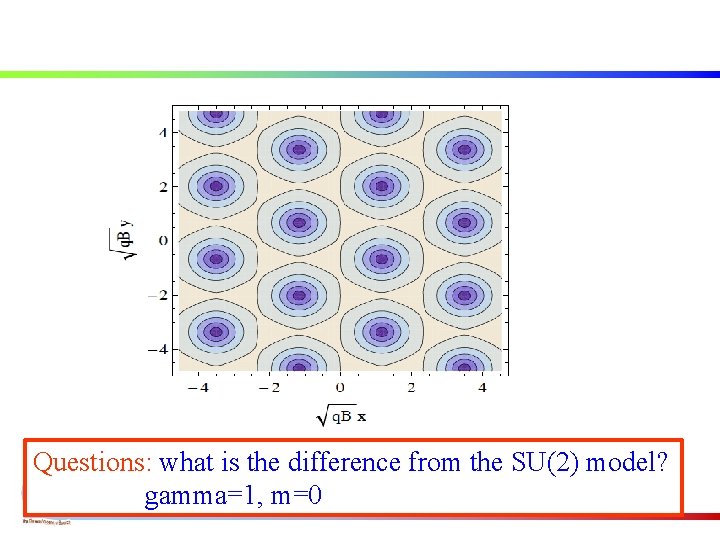
condensation as a function of applied magnetic field. rho meson vortex lattice
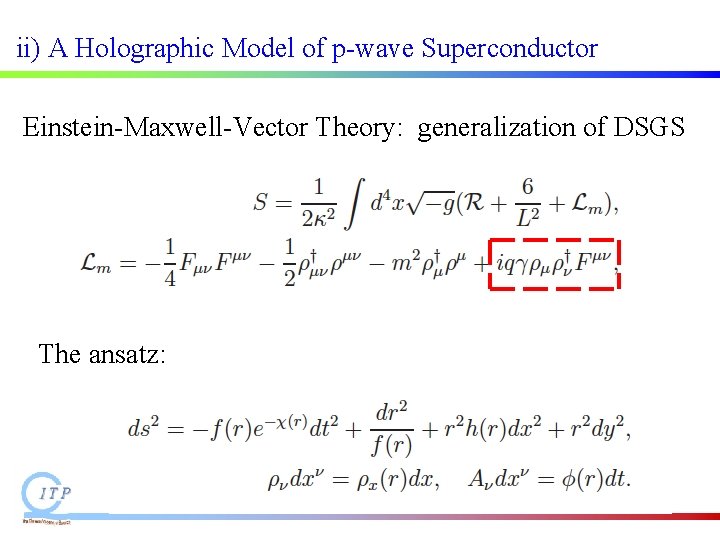
ii) A Holographic Model of p-wave Superconductor Einstein-Maxwell-Vector Theory: generalization of DSGS The ansatz:
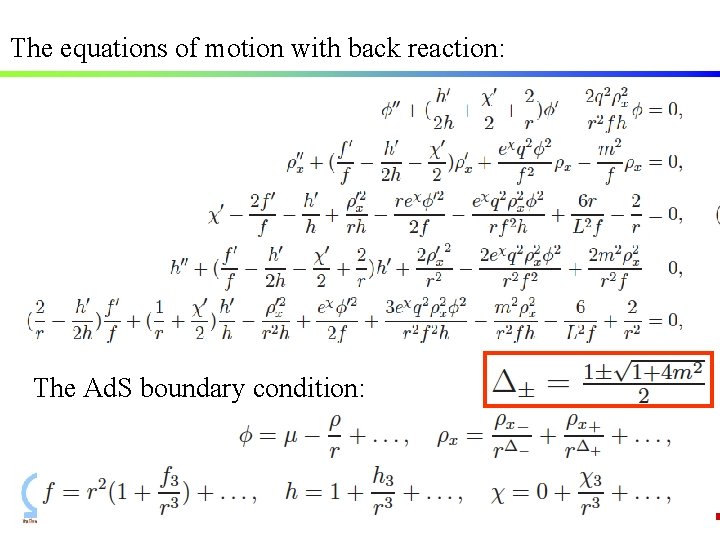
The equations of motion with back reaction: The Ad. S boundary condition:
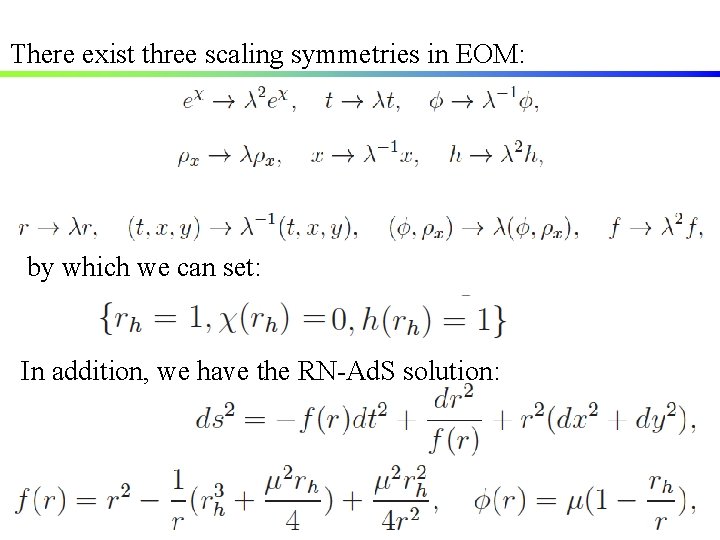
There exist three scaling symmetries in EOM: by which we can set: In addition, we have the RN-Ad. S solution:
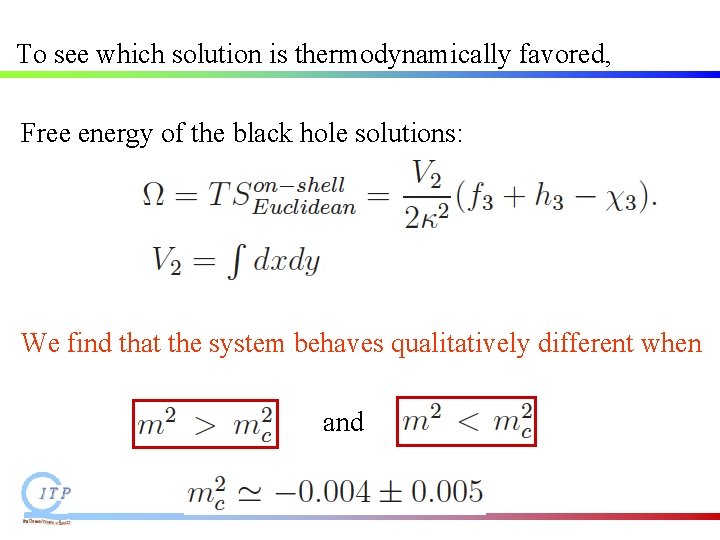
To see which solution is thermodynamically favored, Free energy of the black hole solutions: We find that the system behaves qualitatively different when and
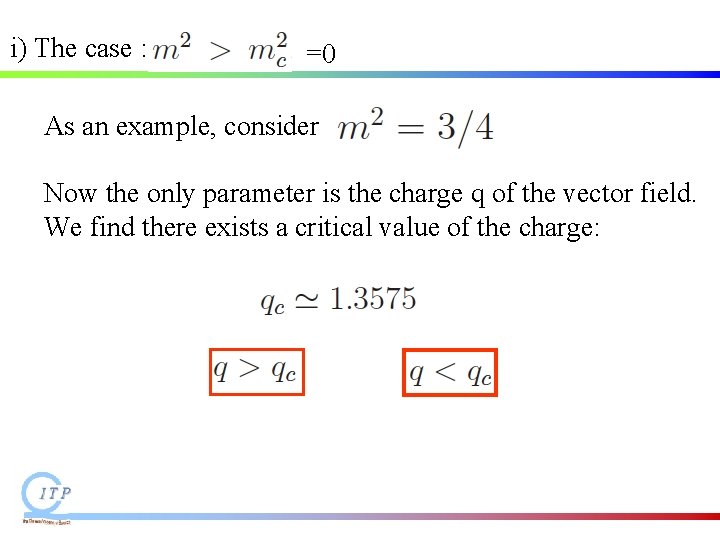
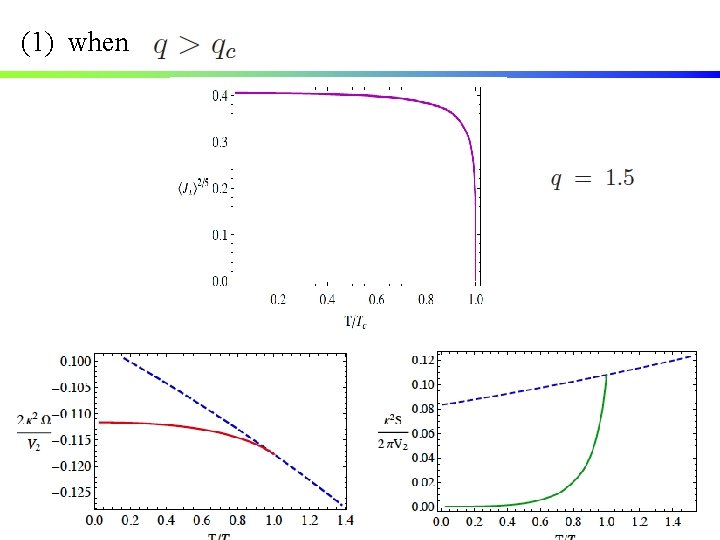
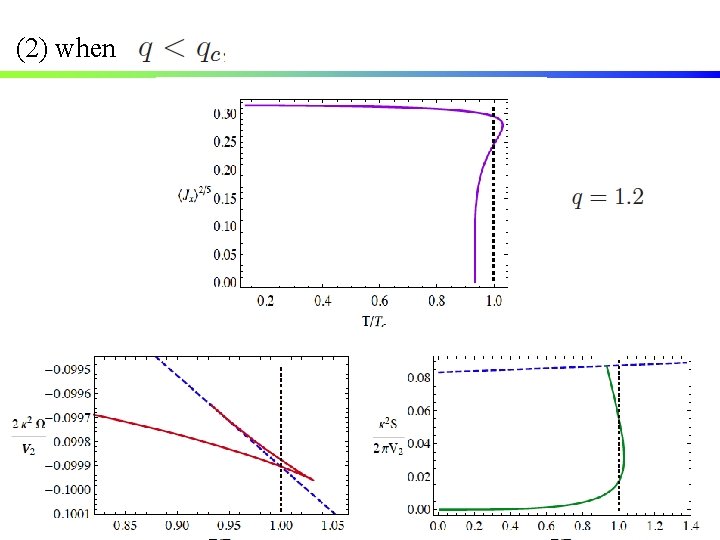
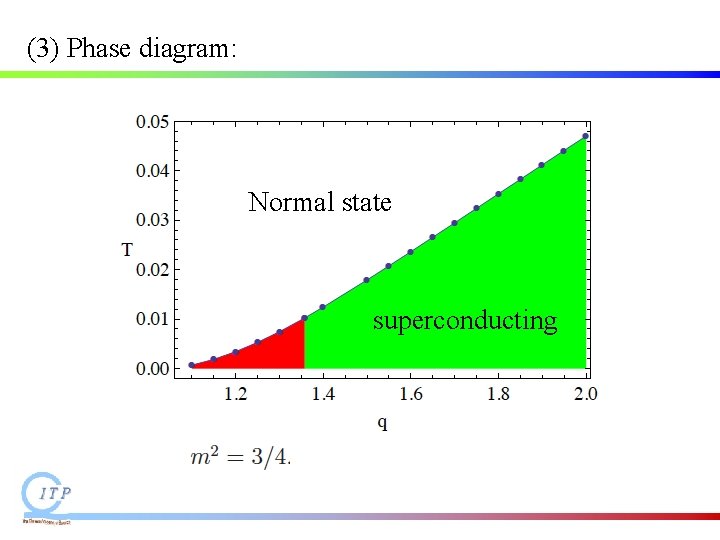
i) The case : =0 As an example, consider Now the only parameter is the charge q of the vector field. We find there exists a critical value of the charge:
(1) when
(2) when
(3) Phase diagram: Normal state superconducting
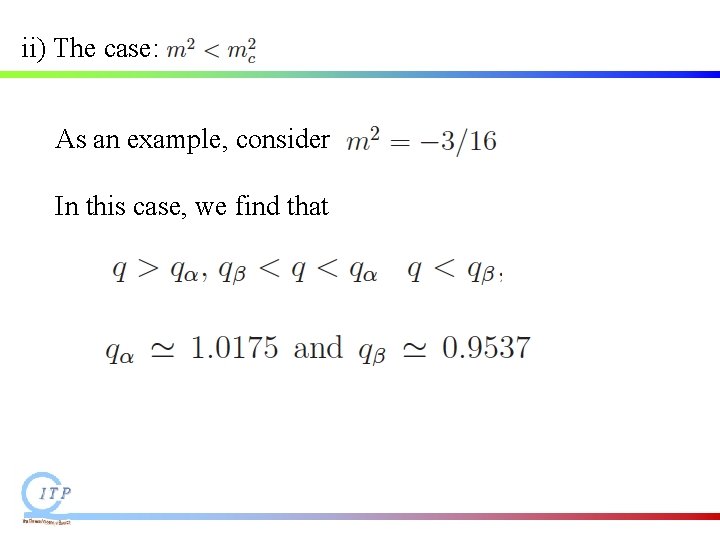
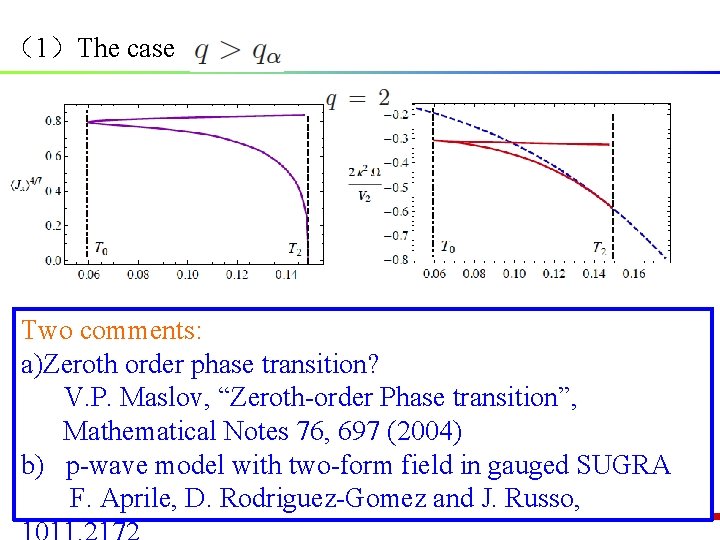
ii) The case: As an example, consider In this case, we find that
(1)The case Two comments: a)Zeroth order phase transition? V. P. Maslov, “Zeroth-order Phase transition”, Mathematical Notes 76, 697 (2004) b) p-wave model with two-form field in gauged SUGRA F. Aprile, D. Rodriguez-Gomez and J. Russo,
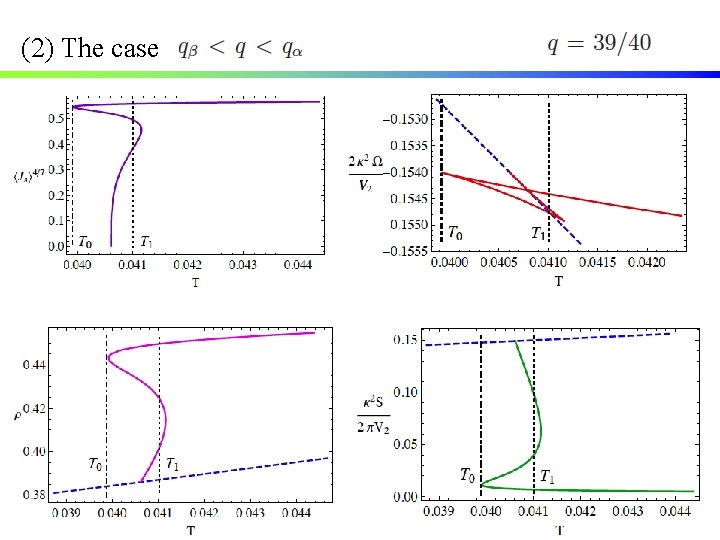
(2) The case
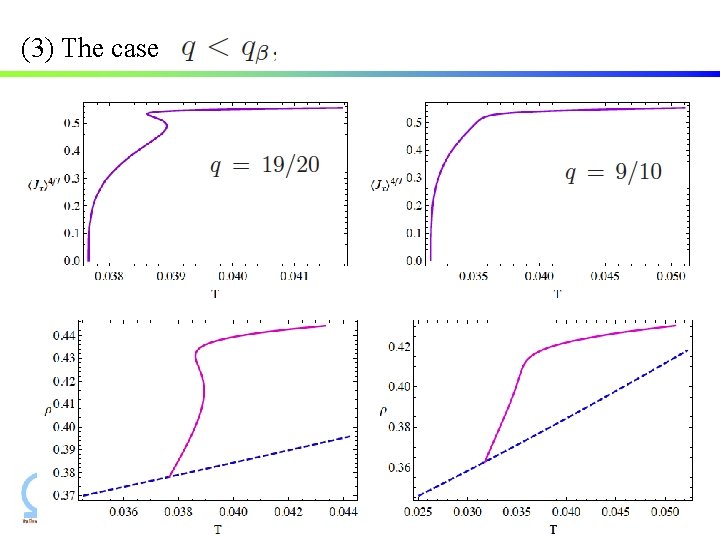
(3) The case
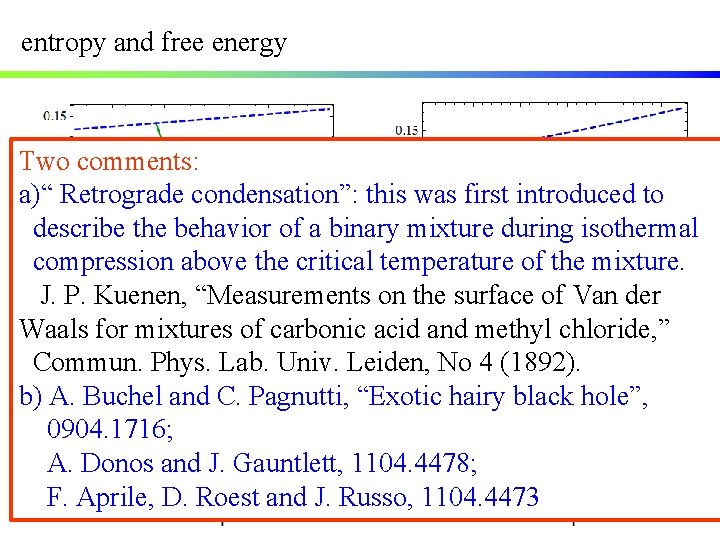
entropy and free energy Two comments: a)“ Retrograde condensation”: this was first introduced to describe the behavior of a binary mixture during isothermal compression above the critical temperature of the mixture. J. P. Kuenen, “Measurements on the surface of Van der Waals for mixtures of carbonic acid and methyl chloride, ” Commun. Phys. Lab. Univ. Leiden, No 4 (1892). b) A. Buchel and C. Pagnutti, “Exotic hairy black hole”, 0904. 1716; A. Donos and J. Gauntlett, 1104. 4478; F. Aprile, D. Roest and J. Russo, 1104. 4473
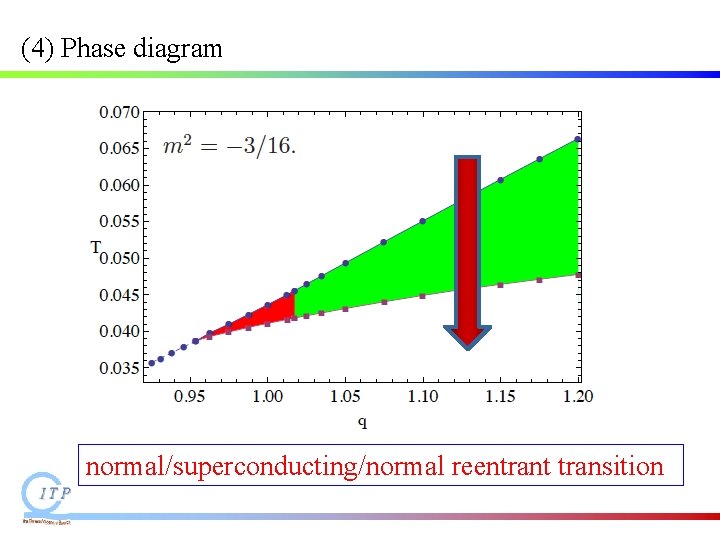
(4) Phase diagram normal/superconducting/normal reentrant transition
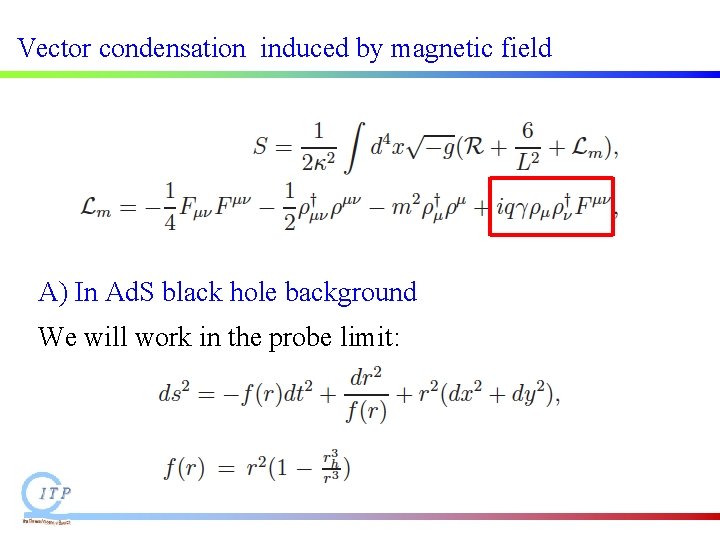
Vector condensation induced by magnetic field A) In Ad. S black hole background We will work in the probe limit:
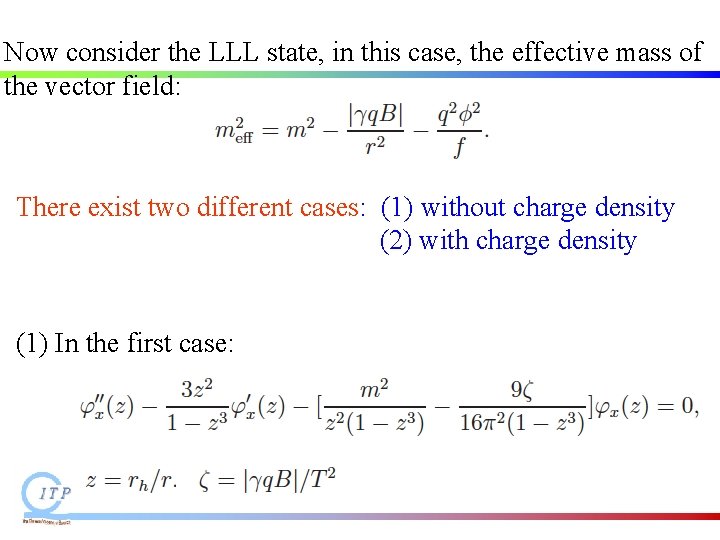
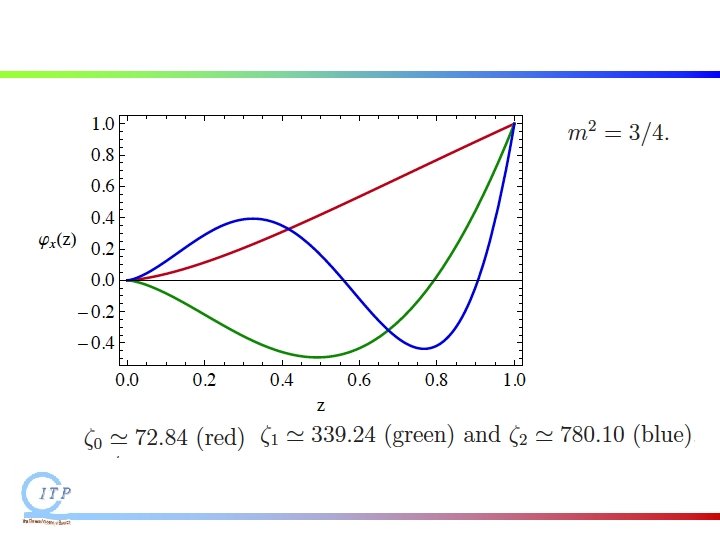
Now consider the LLL state, in this case, the effective mass of the vector field: There exist two different cases: (1) without charge density (2) with charge density (1) In the first case:
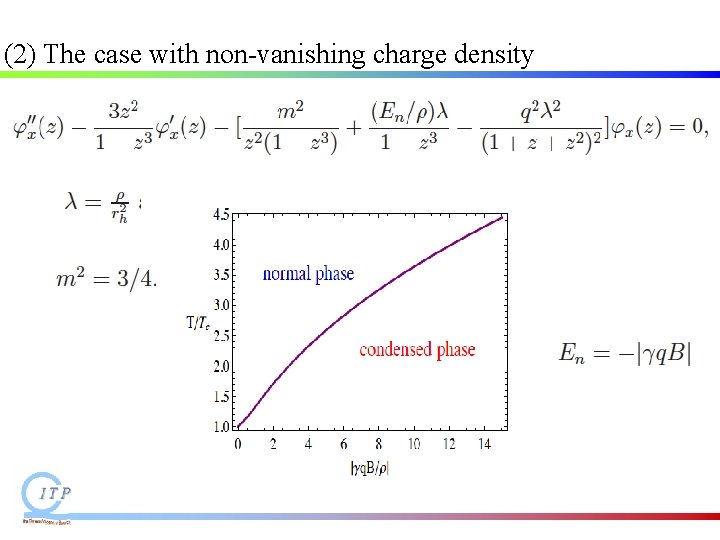
(2) The case with non-vanishing charge density
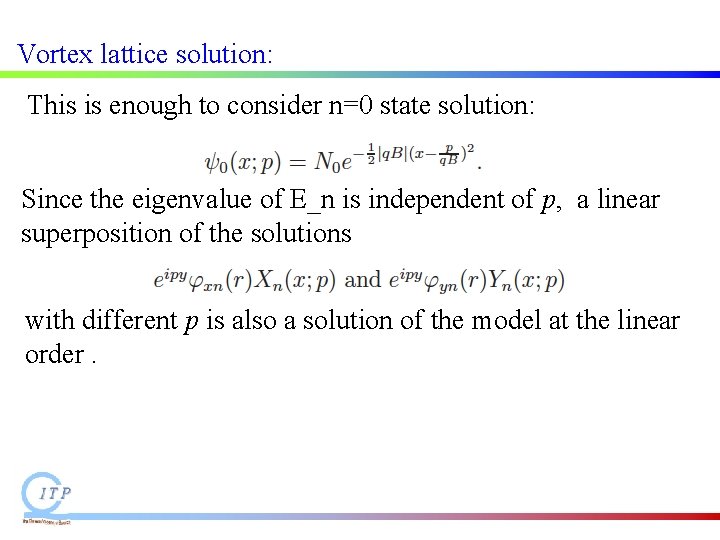
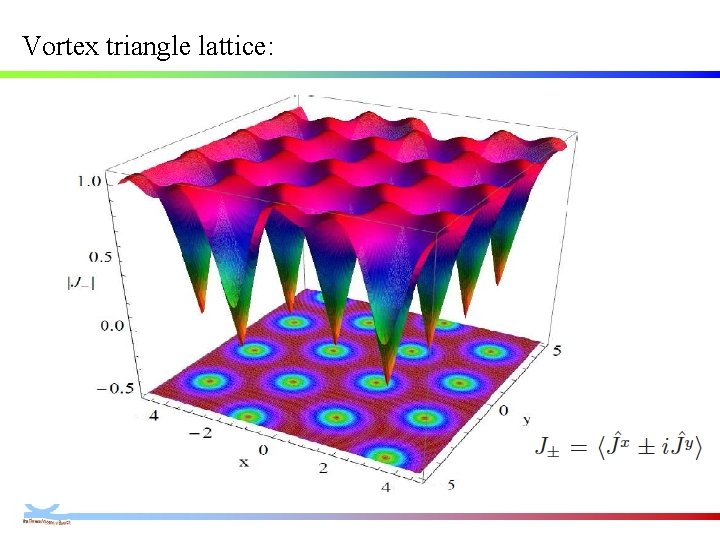
Vortex lattice solution: This is enough to consider n=0 state solution: Since the eigenvalue of E_n is independent of p, a linear superposition of the solutions with different p is also a solution of the model at the linear order.
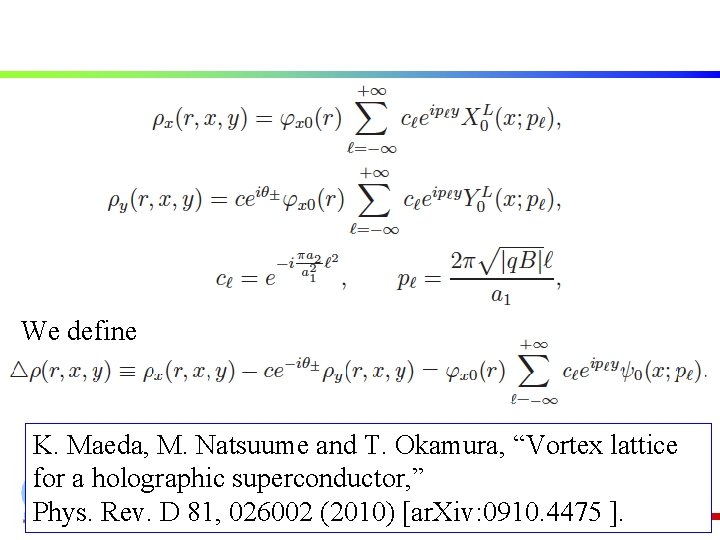
We define K. Maeda, M. Natsuume and T. Okamura, “Vortex lattice for a holographic superconductor, ” Phys. Rev. D 81, 026002 (2010) [ar. Xiv: 0910. 4475 ].
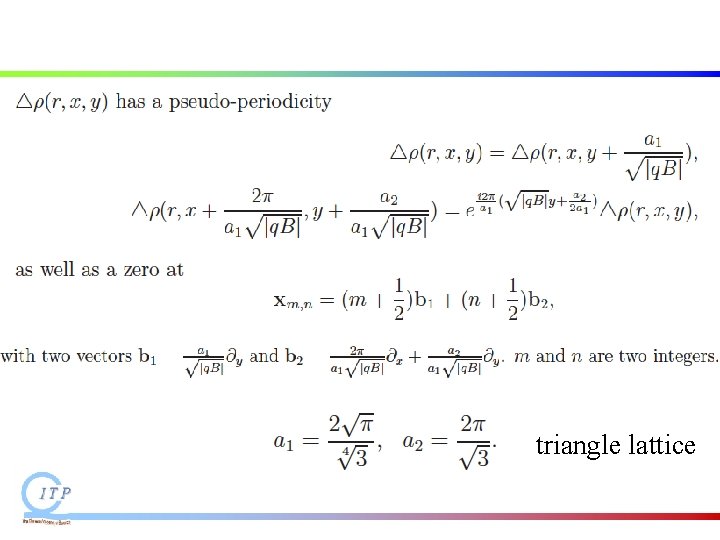
triangle lattice
Vortex triangle lattice:
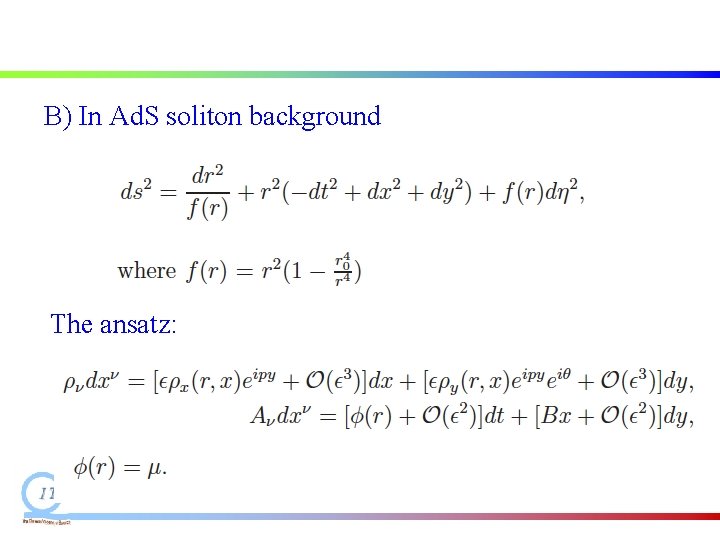
B) In Ad. S soliton background The ansatz:
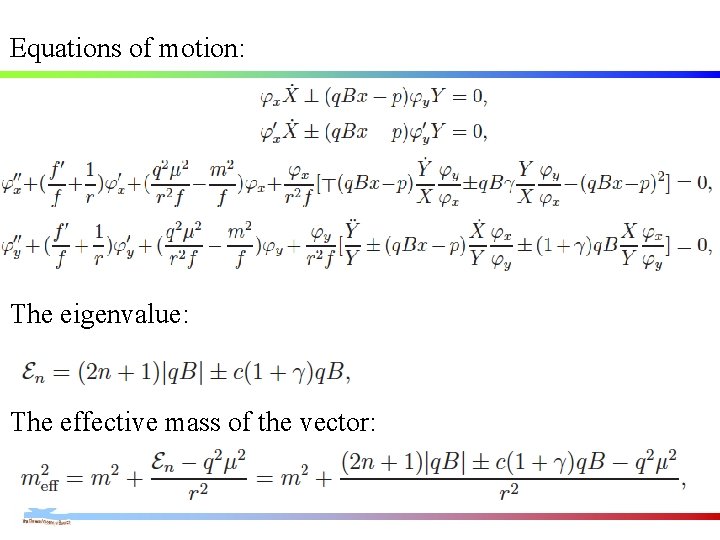
Equations of motion: The eigenvalue: The effective mass of the vector:
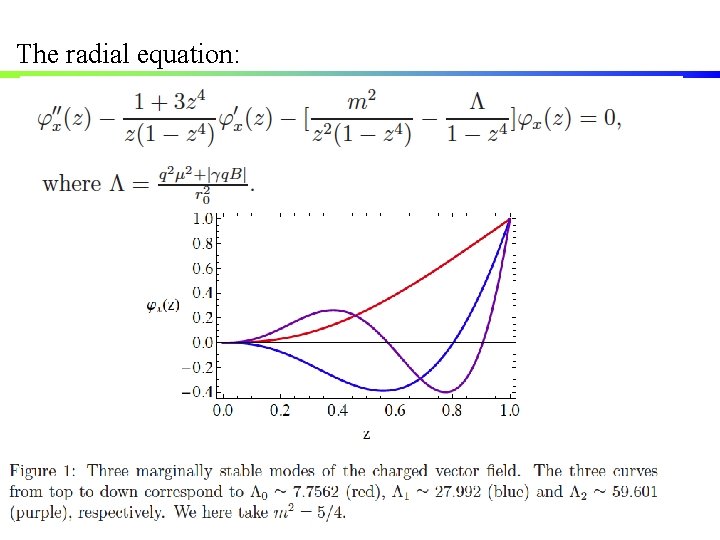
The radial equation:
Questions: what is the difference from the SU(2) model? gamma=1, m=0
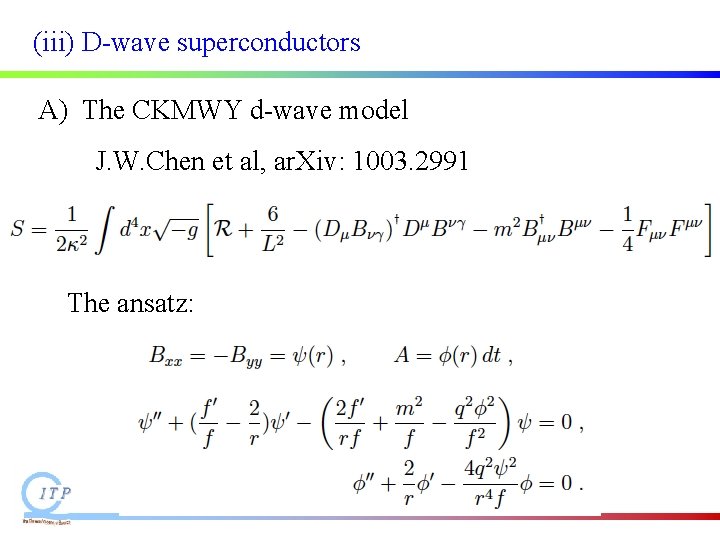
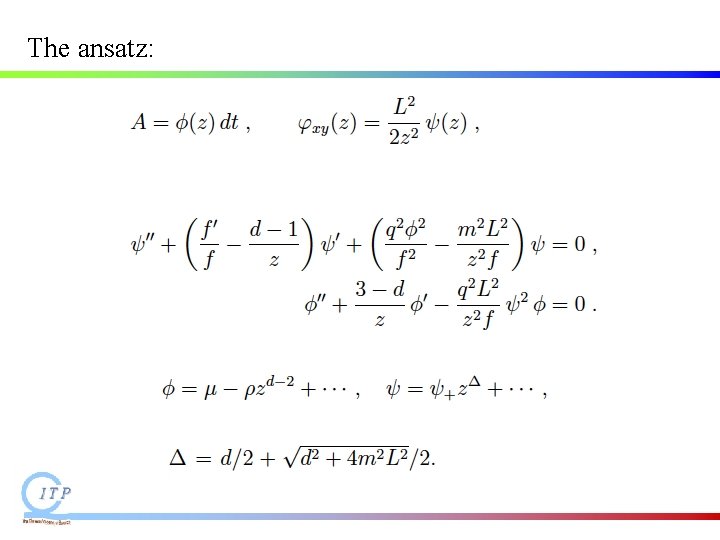
(iii) D-wave superconductors A) The CKMWY d-wave model J. W. Chen et al, ar. Xiv: 1003. 2991 The ansatz:
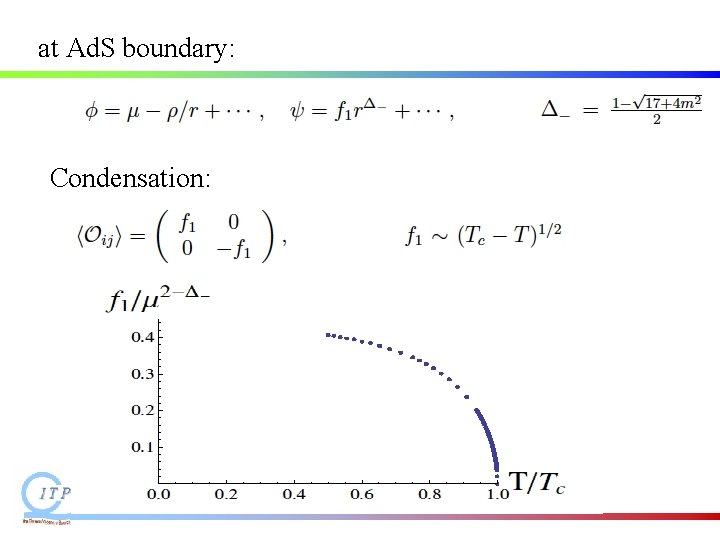
at Ad. S boundary: Condensation:
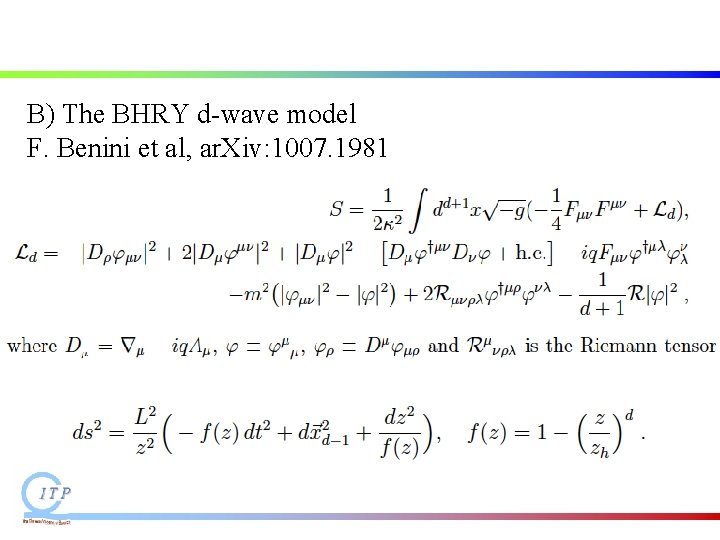
B) The BHRY d-wave model F. Benini et al, ar. Xiv: 1007. 1981
The ansatz:
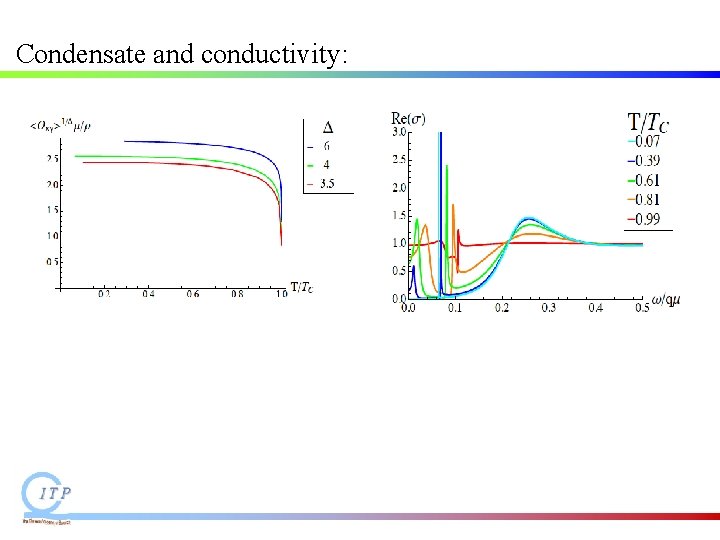
Condensate and conductivity:
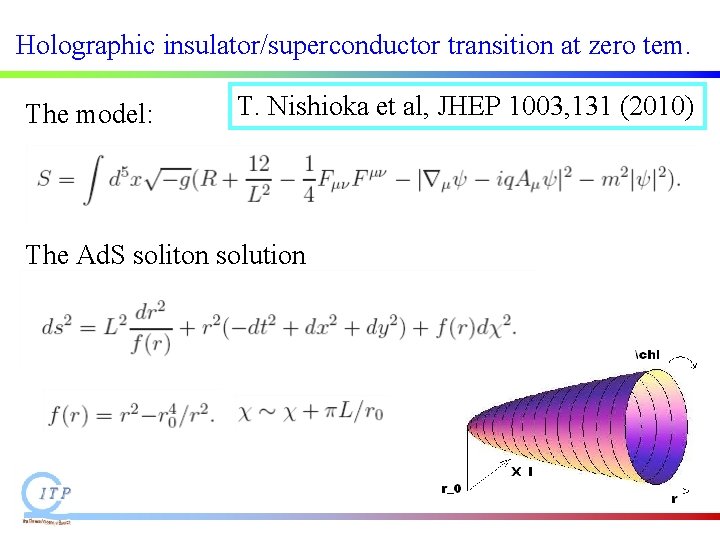
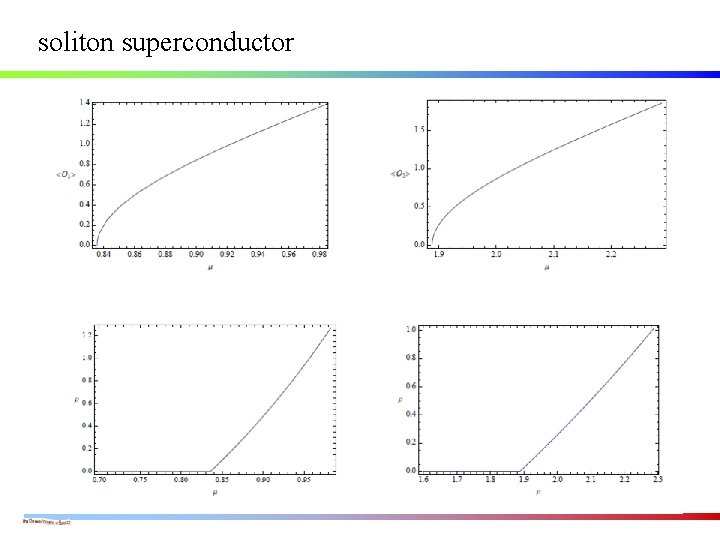
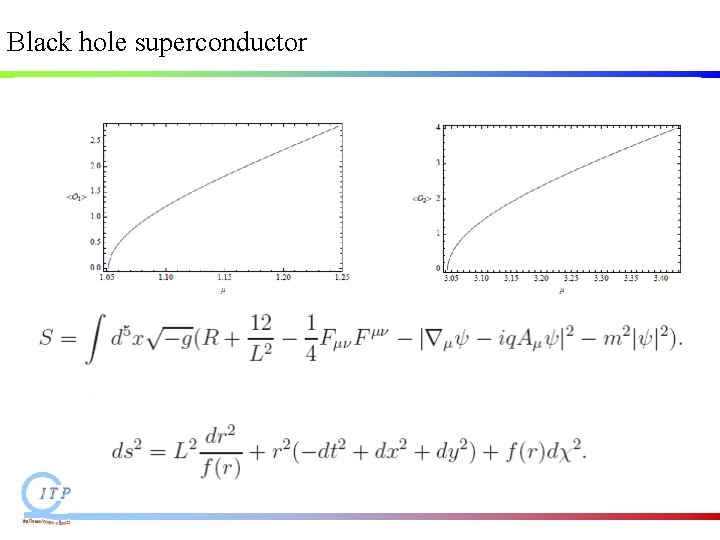
Holographic insulator/superconductor transition at zero tem. The model: T. Nishioka et al, JHEP 1003, 131 (2010) The Ad. S soliton solution
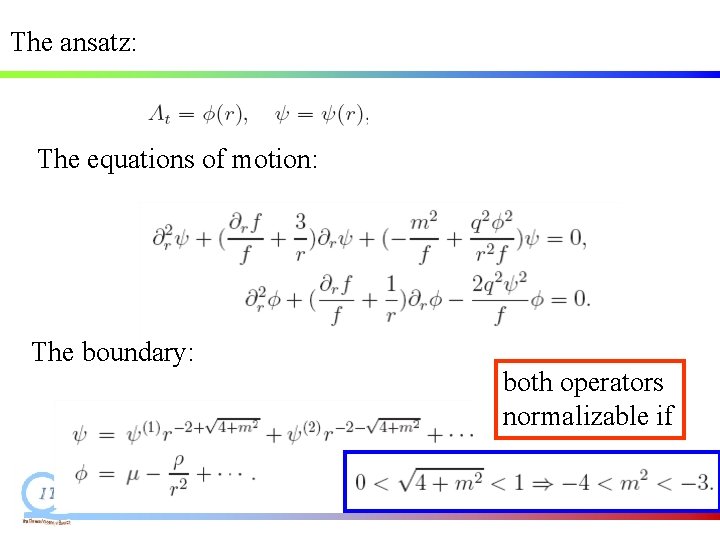
The ansatz: The equations of motion: The boundary: both operators normalizable if
soliton superconductor
Black hole superconductor
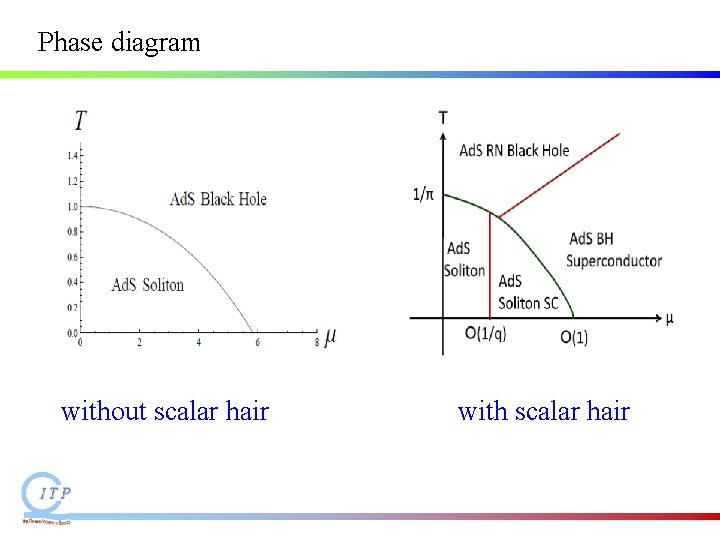
Phase diagram without scalar hair with scalar hair
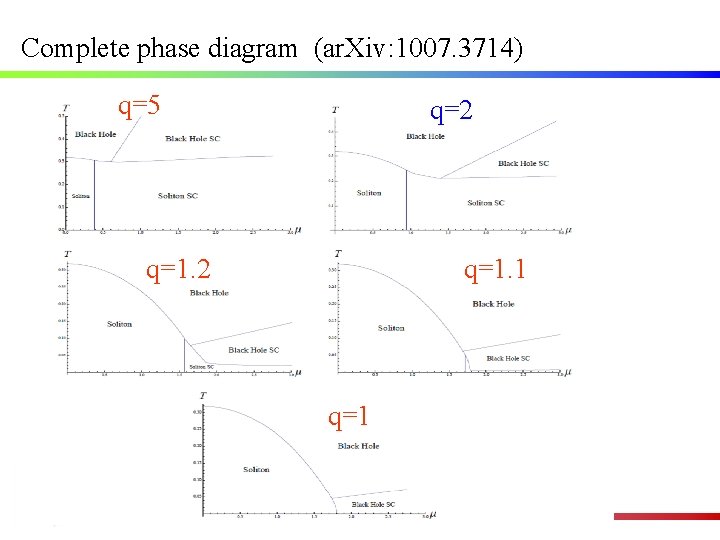
Complete phase diagram (ar. Xiv: 1007. 3714) q=5 q=2 q=1. 1 q=1
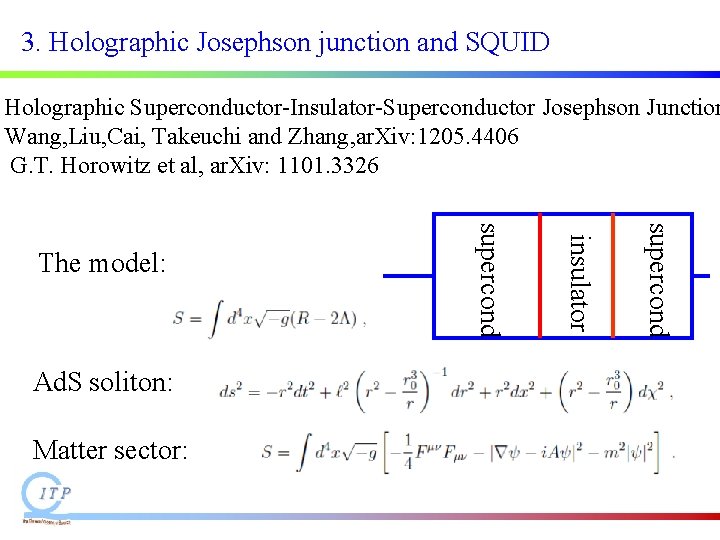
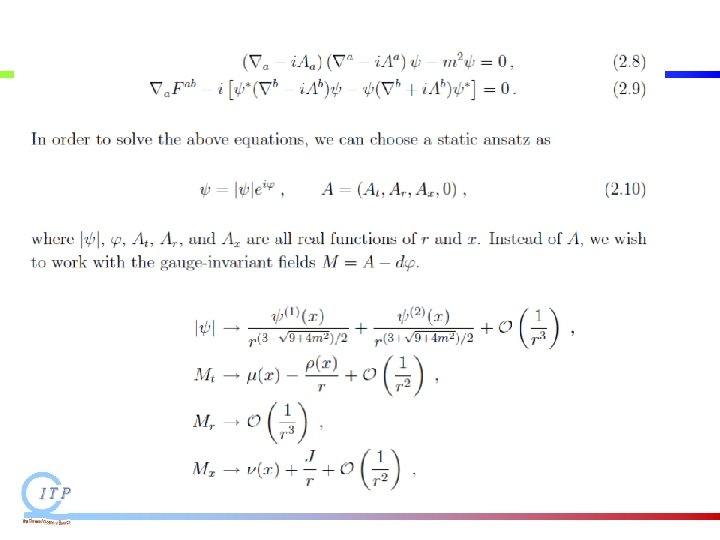
3. Holographic Josephson junction and SQUID Holographic Superconductor-Insulator-Superconductor Josephson Junction Wang, Liu, Cai, Takeuchi and Zhang, ar. Xiv: 1205. 4406 G. T. Horowitz et al, ar. Xiv: 1101. 3326 supercond Matter sector: insulator Ad. S soliton: supercond The model:
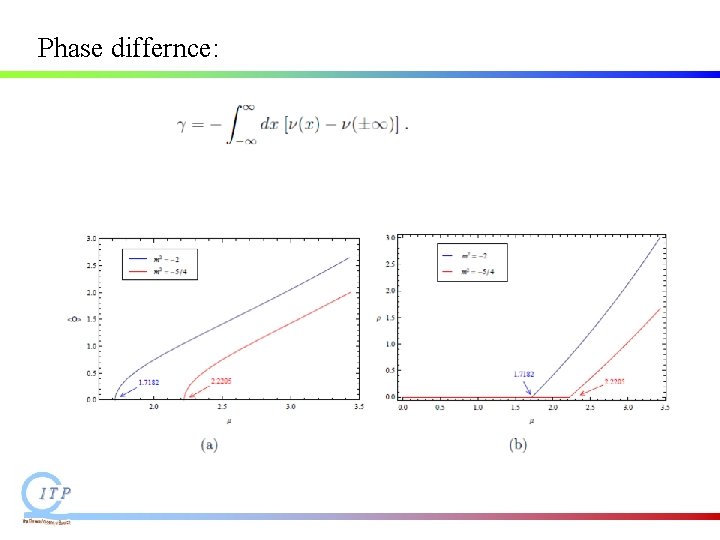
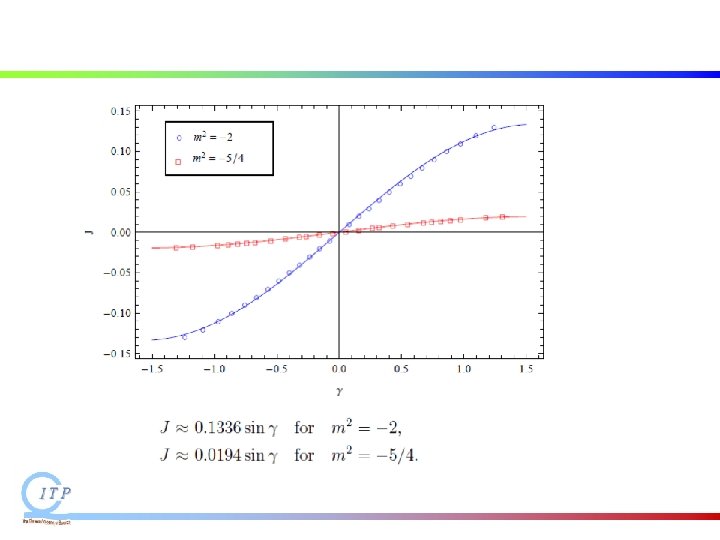
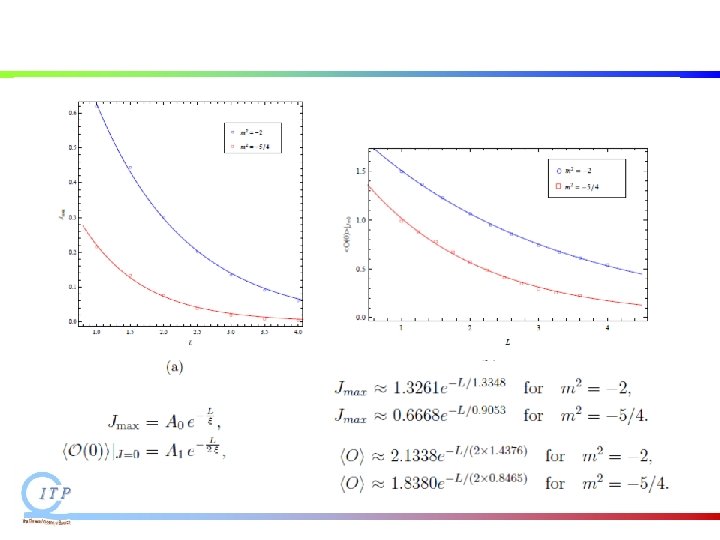
Phase differnce:
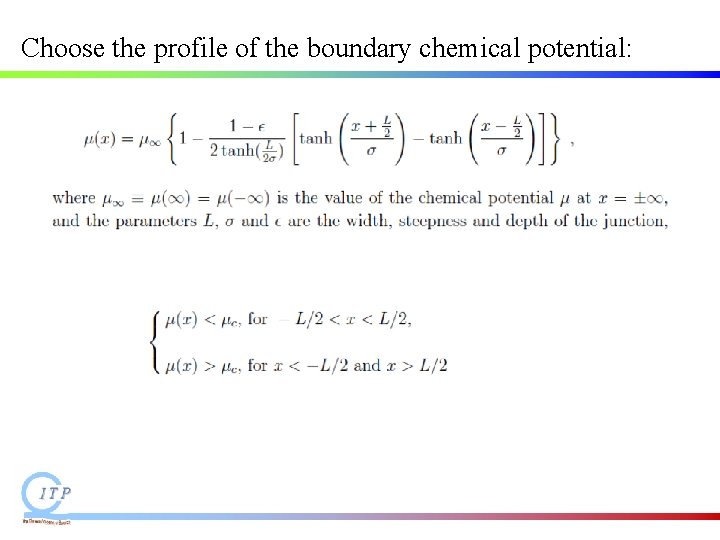
Choose the profile of the boundary chemical potential:
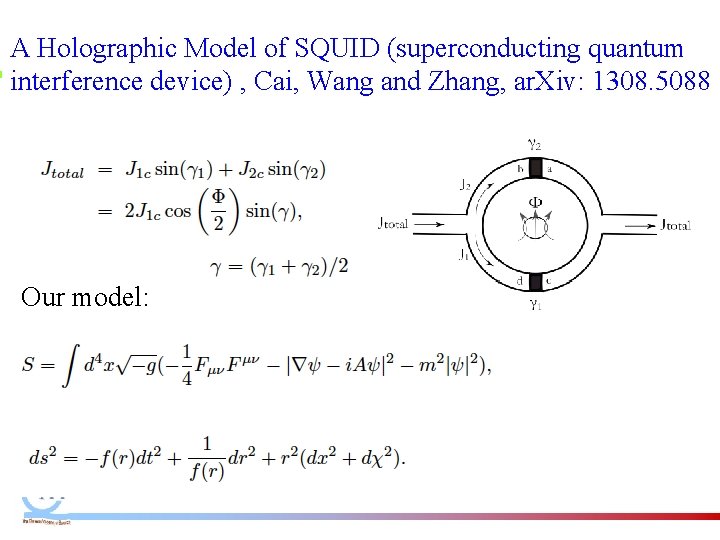
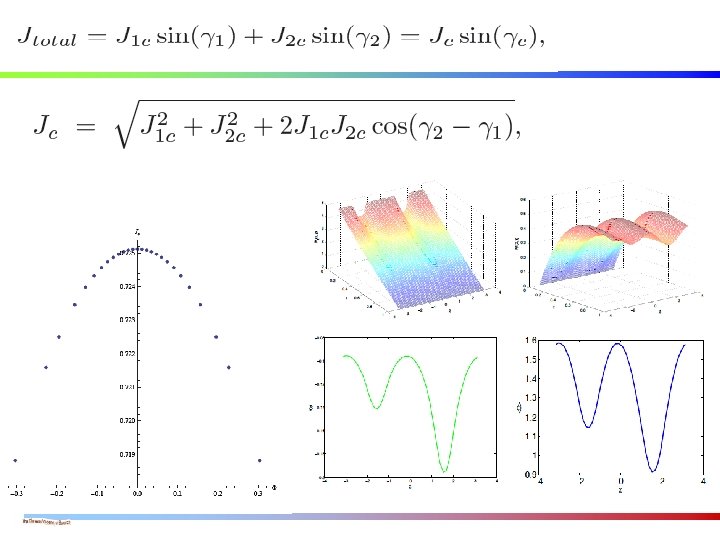
A Holographic Model of SQUID (superconducting quantum interference device) , Cai, Wang and Zhang, ar. Xiv: 1308. 5088 Our model:
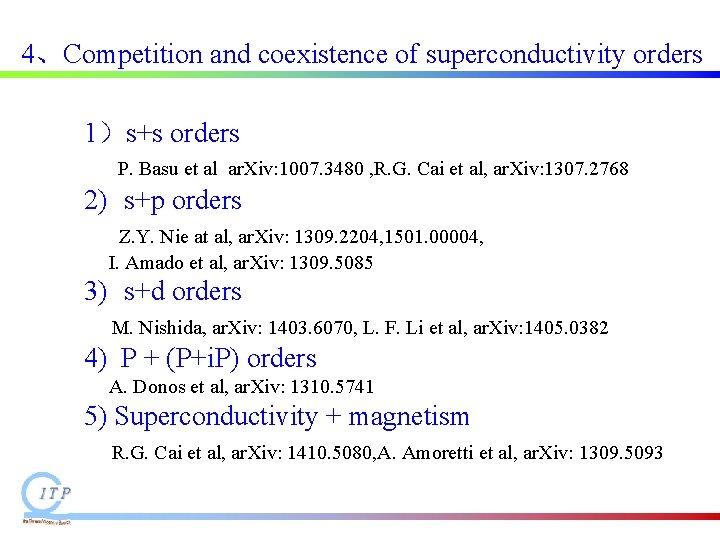
4、Competition and coexistence of superconductivity orders 1)s+s orders P. Basu et al ar. Xiv: 1007. 3480 , R. G. Cai et al, ar. Xiv: 1307. 2768 2) s+p orders Z. Y. Nie at al, ar. Xiv: 1309. 2204, 1501. 00004, I. Amado et al, ar. Xiv: 1309. 5085 3) s+d orders M. Nishida, ar. Xiv: 1403. 6070, L. F. Li et al, ar. Xiv: 1405. 0382 4) P + (P+i. P) orders A. Donos et al, ar. Xiv: 1310. 5741 5) Superconductivity + magnetism R. G. Cai et al, ar. Xiv: 1410. 5080, A. Amoretti et al, ar. Xiv: 1309. 5093
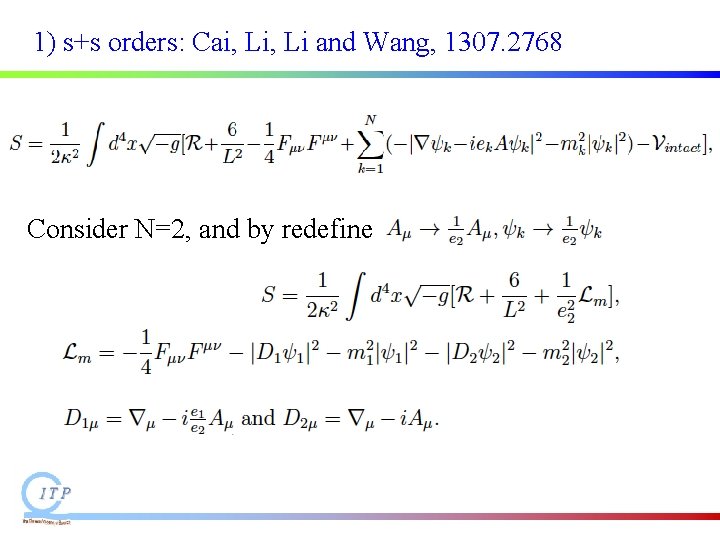
1) s+s orders: Cai, Li and Wang, 1307. 2768 Consider N=2, and by redefine
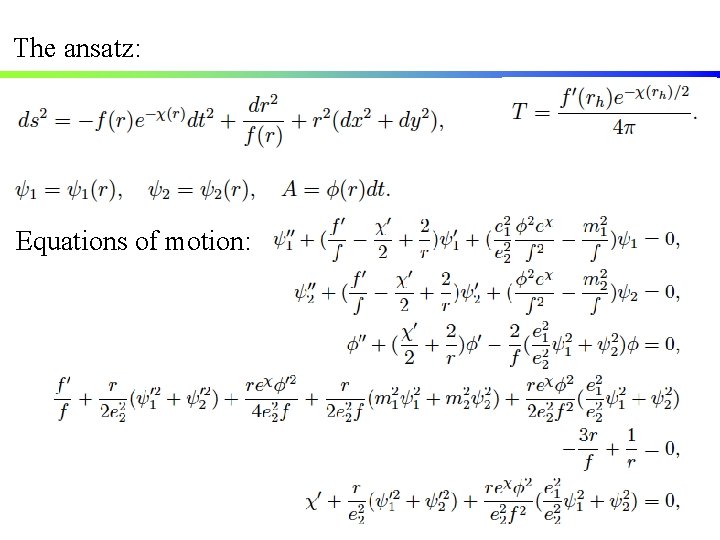
The ansatz: Equations of motion:
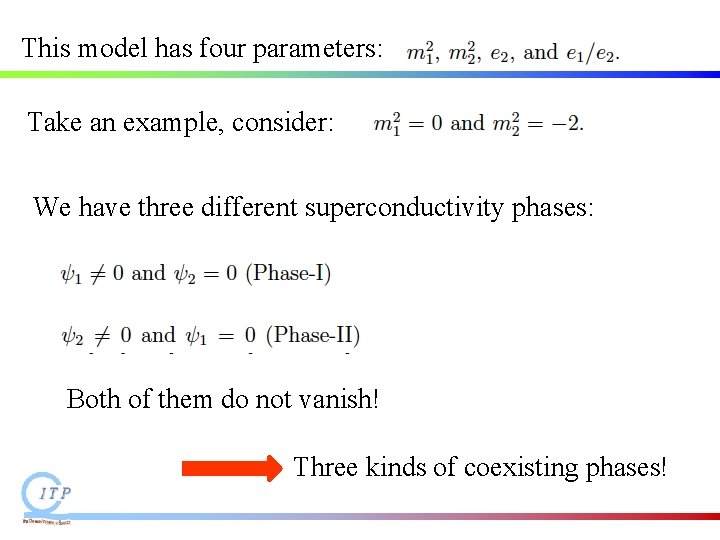
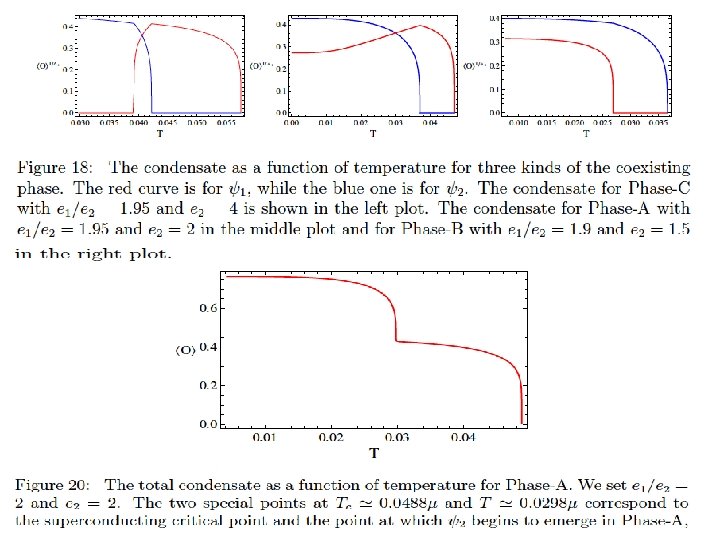
This model has four parameters: Take an example, consider: We have three different superconductivity phases: Both of them do not vanish! Three kinds of coexisting phases!
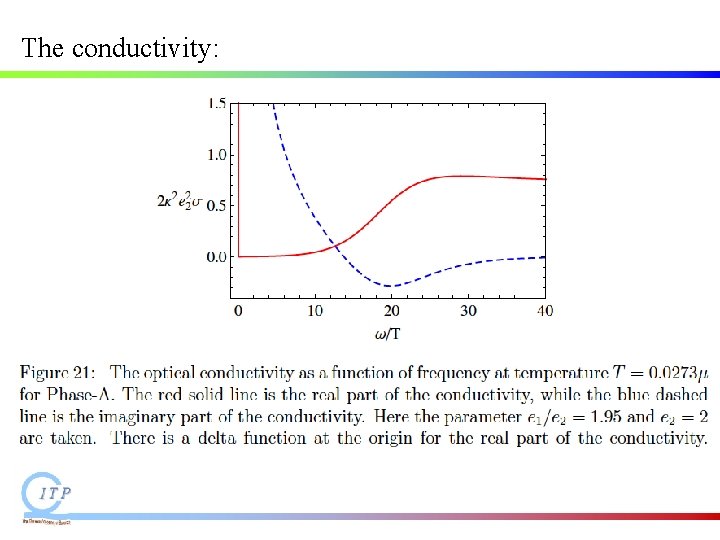
The conductivity:
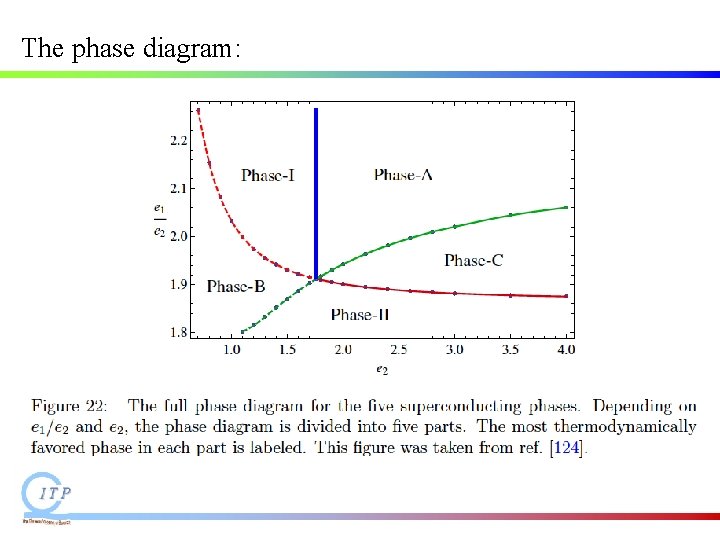
The phase diagram:
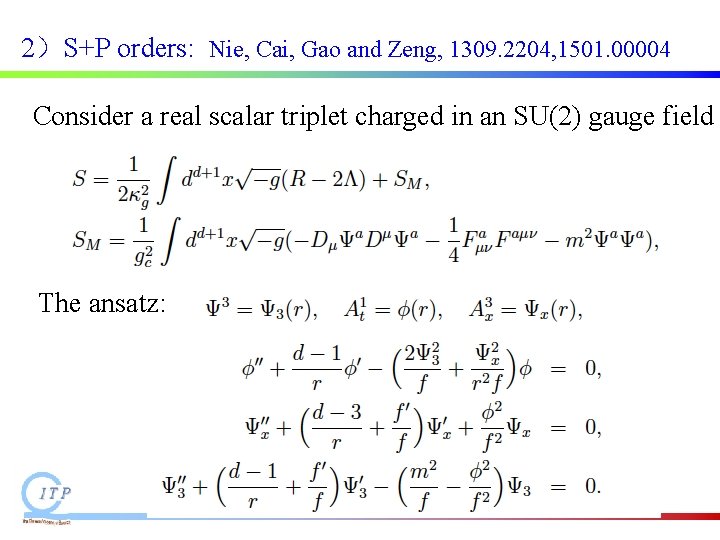
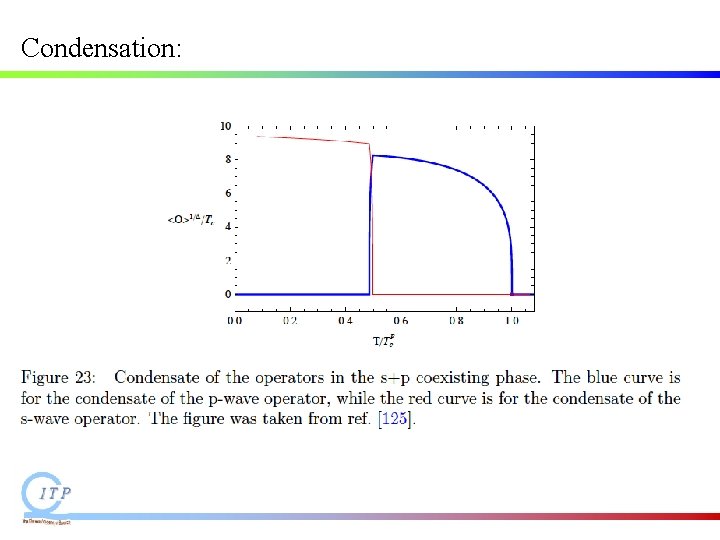
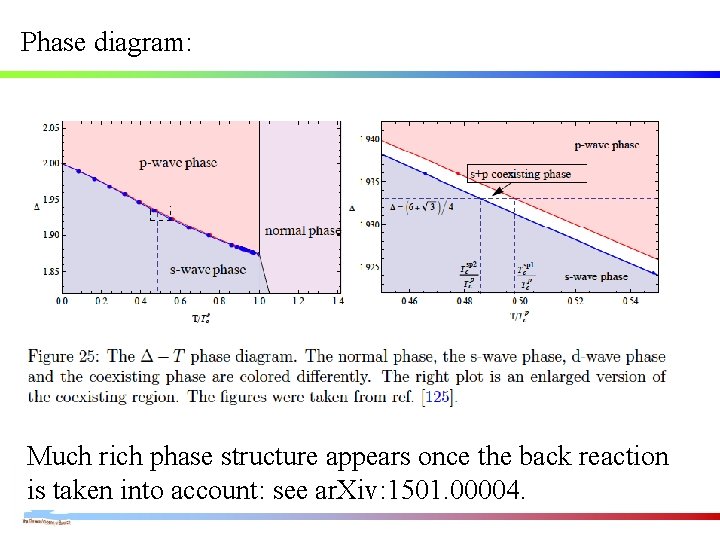
2)S+P orders: Nie, Cai, Gao and Zeng, 1309. 2204, 1501. 00004 Consider a real scalar triplet charged in an SU(2) gauge field The ansatz:
Condensation:
Phase diagram: Much rich phase structure appears once the back reaction is taken into account: see ar. Xiv: 1501. 00004.
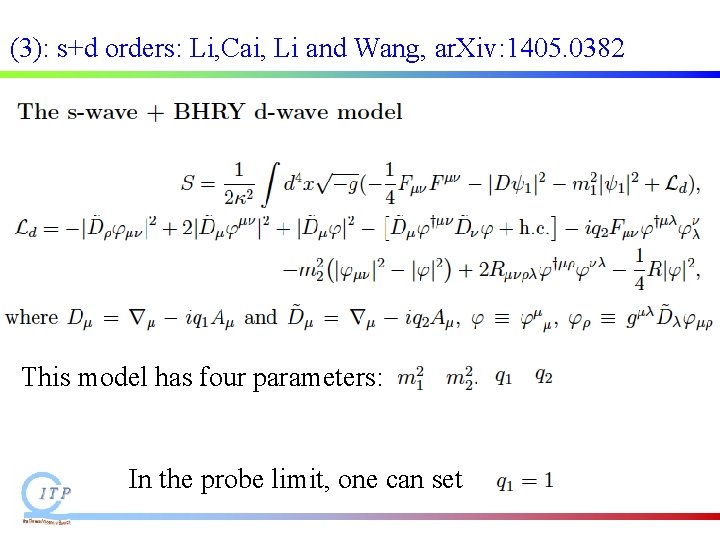
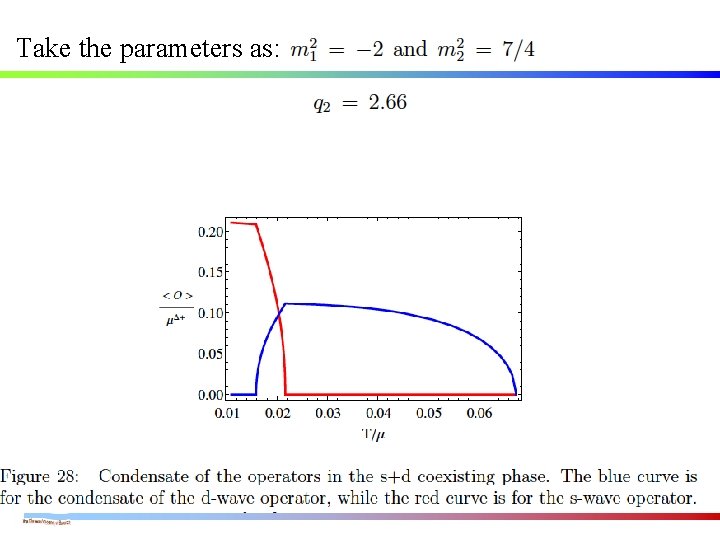
(3): s+d orders: Li, Cai, Li and Wang, ar. Xiv: 1405. 0382 This model has four parameters: In the probe limit, one can set
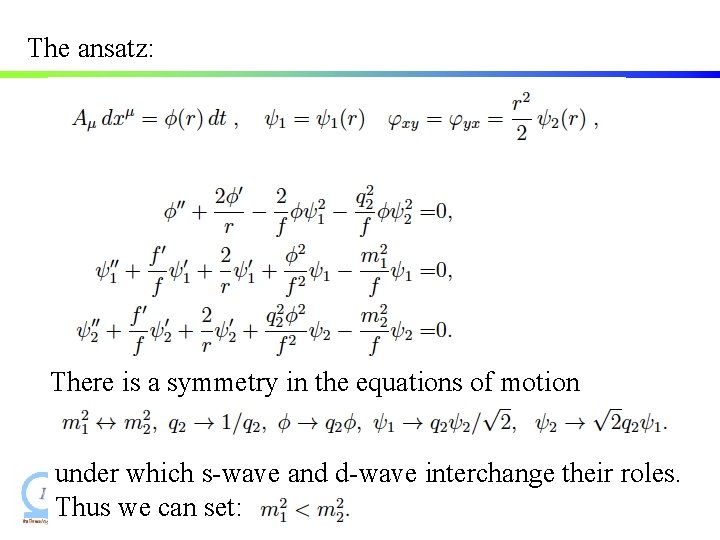
The ansatz: There is a symmetry in the equations of motion under which s-wave and d-wave interchange their roles. Thus we can set:
Take the parameters as:
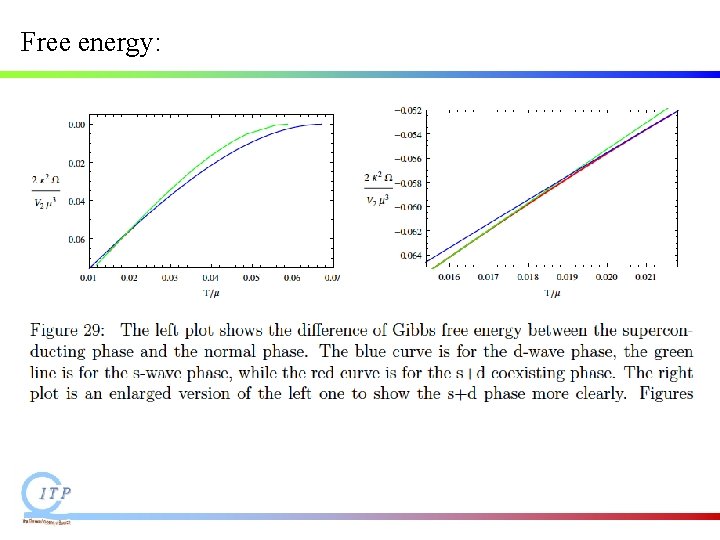
Free energy:
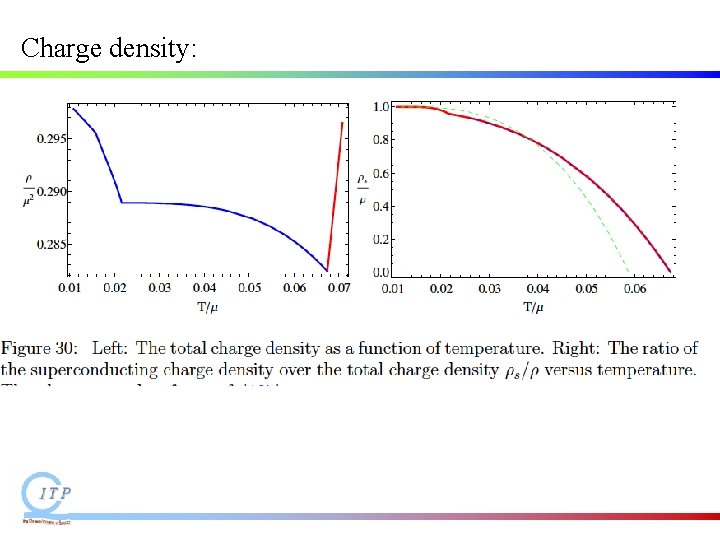
Charge density:
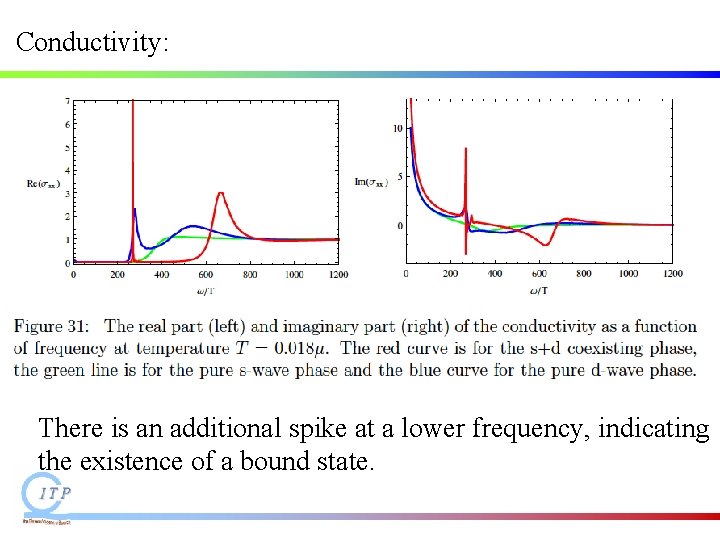
Conductivity: There is an additional spike at a lower frequency, indicating the existence of a bound state.
Thanks !