
Newtons Law of Universal Gravitation Physics Dorsey Universial



- Slides: 32
Newton’s Law of Universal Gravitation Physics Dorsey Universial Gravitation. ppt Adapted from AP physics curriculum Tenafly HS, New Jersey
Isaac Newton Late 1600 s, England n Shouldn’t everything want to fall? n Universial Gravitation. ppt
Questions n n n If the planets are orbiting the sun , what force is keeping them in orbit? What force keeps the moon in its orbit? Could the force of gravity be universal? Universial Gravitation. ppt
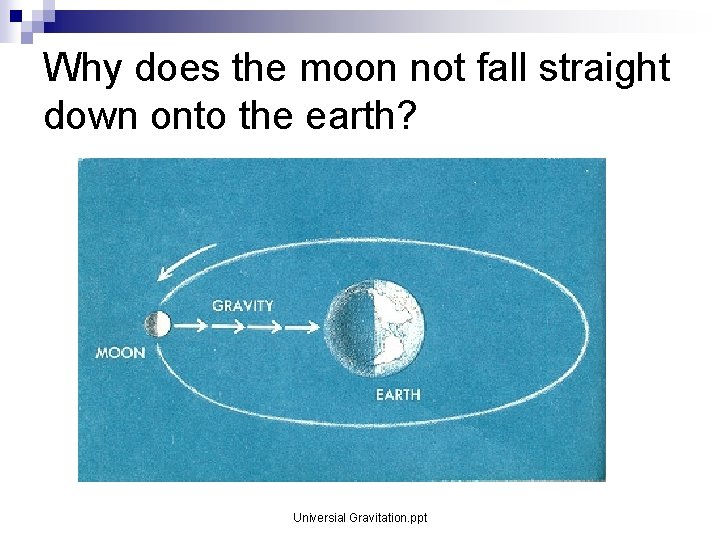
Why does the moon not fall straight down onto the earth? Universial Gravitation. ppt
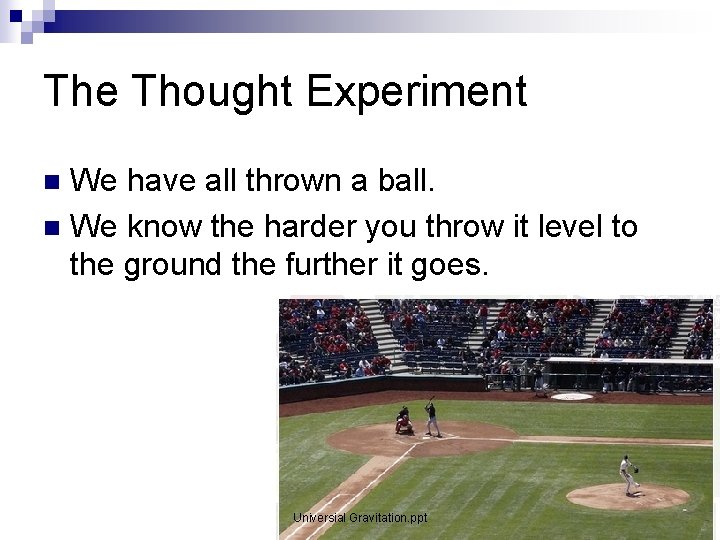
The Thought Experiment We have all thrown a ball. n We know the harder you throw it level to the ground the further it goes. n Universial Gravitation. ppt
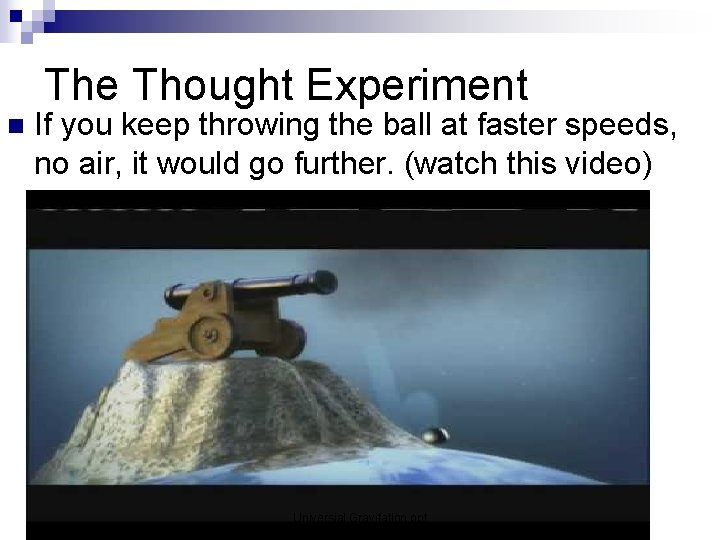
The Thought Experiment n If you keep throwing the ball at faster speeds, no air, it would go further. (watch this video) Universial Gravitation. ppt
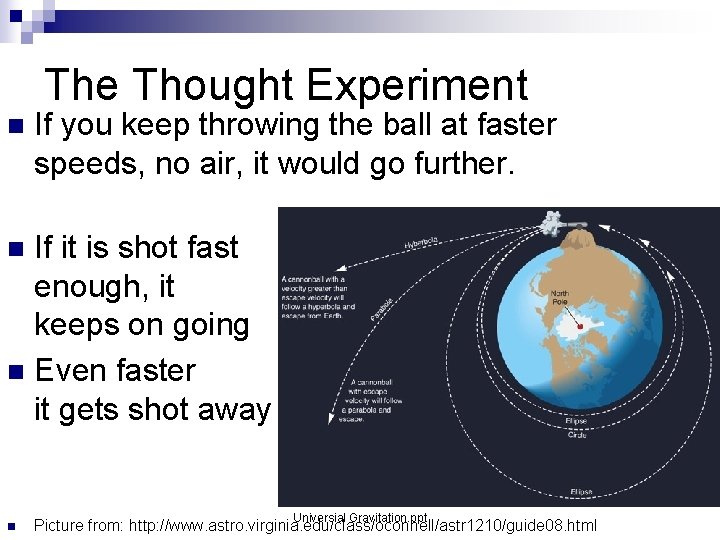
The Thought Experiment n If you keep throwing the ball at faster speeds, no air, it would go further. If it is shot fast enough, it keeps on going n Even faster it gets shot away n n Universial Gravitation. ppt Picture from: http: //www. astro. virginia. edu/class/oconnell/astr 1210/guide 08. html
Newton’s Law of Universal Gravitation n Any two objects attract each other with a gravitational force, proportional to the product of their masses and inversely proportional to the square of the distance between them. n The force acts in the direction of the line connecting the centers of the masses. Universial Gravitation. ppt
Newton’s Law of Universal Gravitation http: //scienceblogs. com/startswithabang/upload/2009/07/meet_our_second_moon/400 px-Newtons. Law. Of. Universal. Gravitation. svg. png Universial Gravitation. ppt
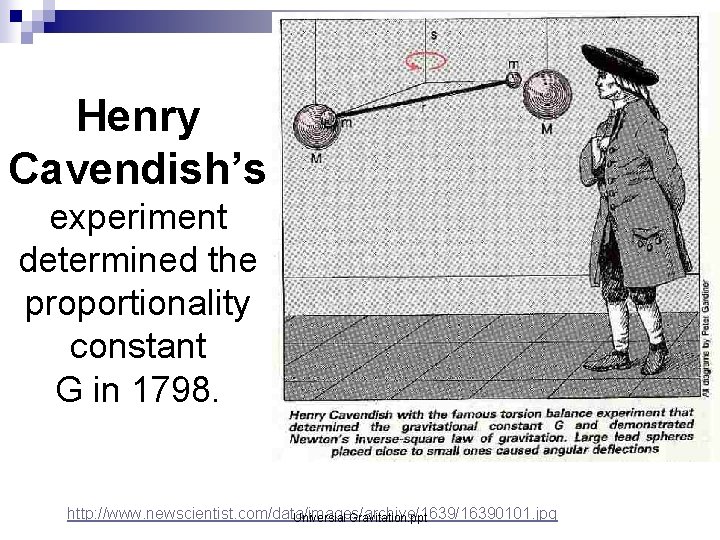
Henry Cavendish’s experiment determined the proportionality constant G in 1798. http: //www. newscientist. com/data/images/archive/16390101. jpg Universial Gravitation. ppt
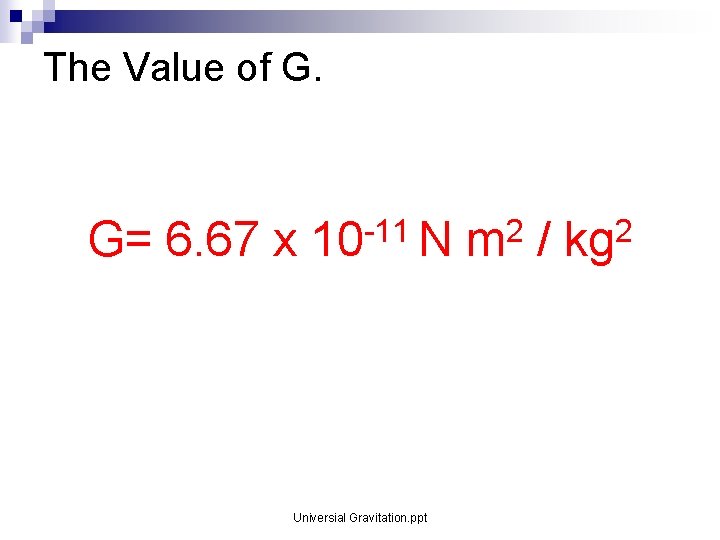
The Value of G. G= 6. 67 x -11 10 N Universial Gravitation. ppt 2 m / 2 kg
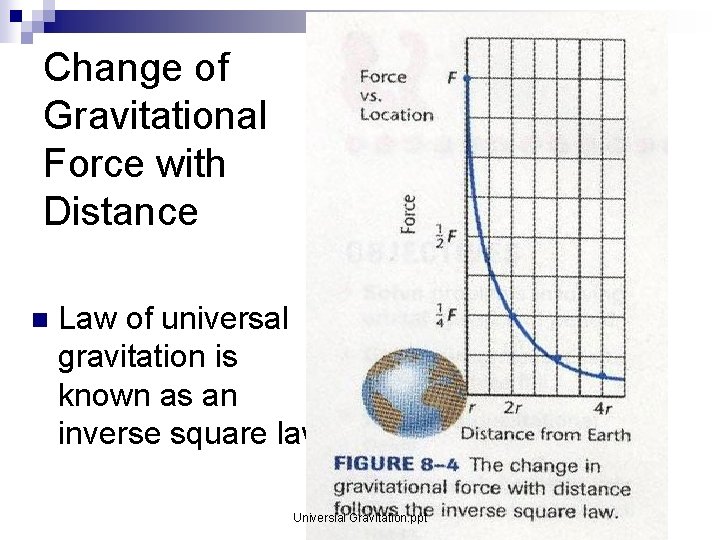
Change of Gravitational Force with Distance n Law of universal gravitation is known as an inverse square law. Universial Gravitation. ppt
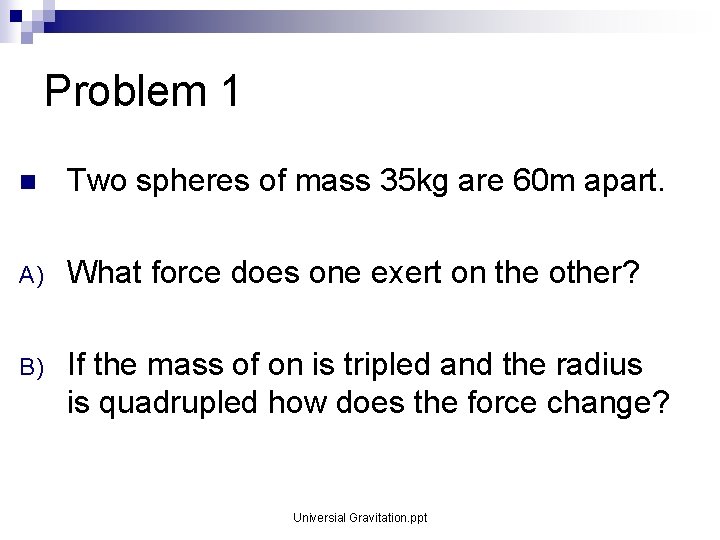
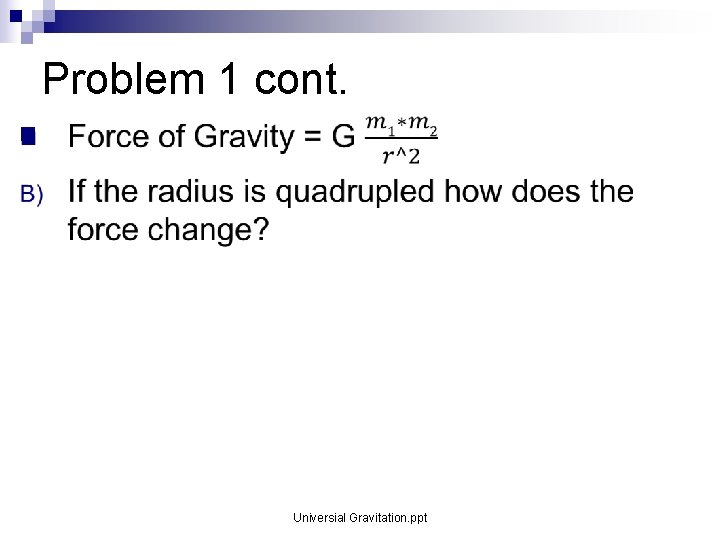
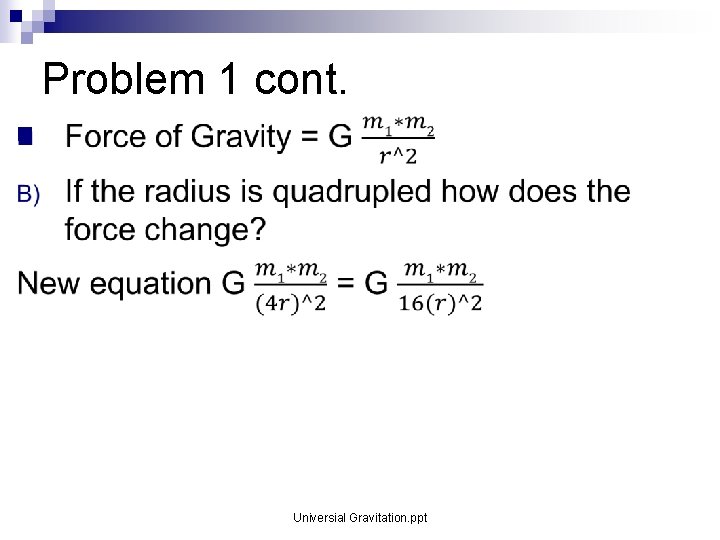
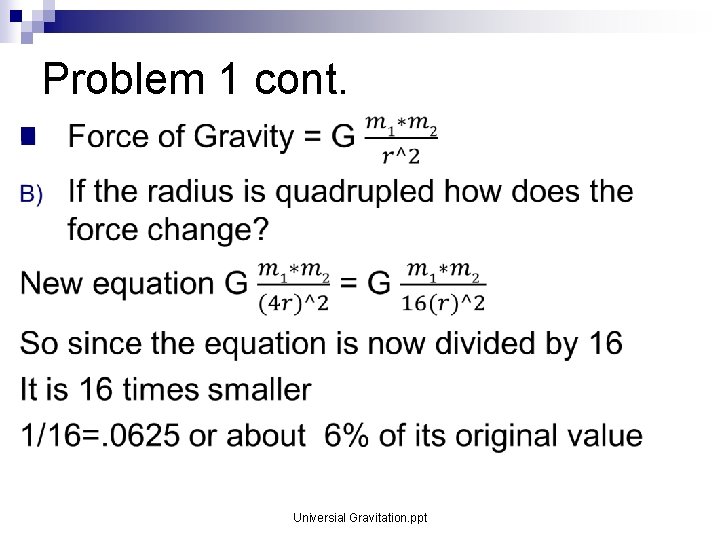
Problem 1 n Two spheres of mass 35 kg are 60 m apart. A) What force does one exert on the other? B) If the mass of on is tripled and the radius is quadrupled how does the force change? Universial Gravitation. ppt
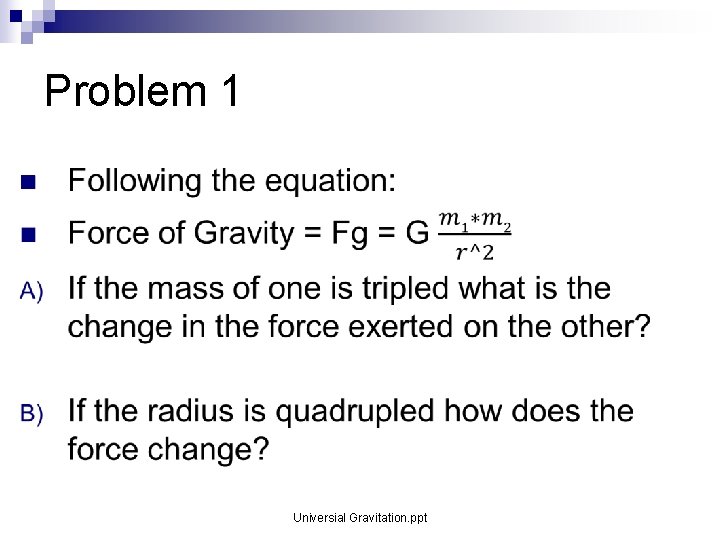
Problem 1 n Universial Gravitation. ppt
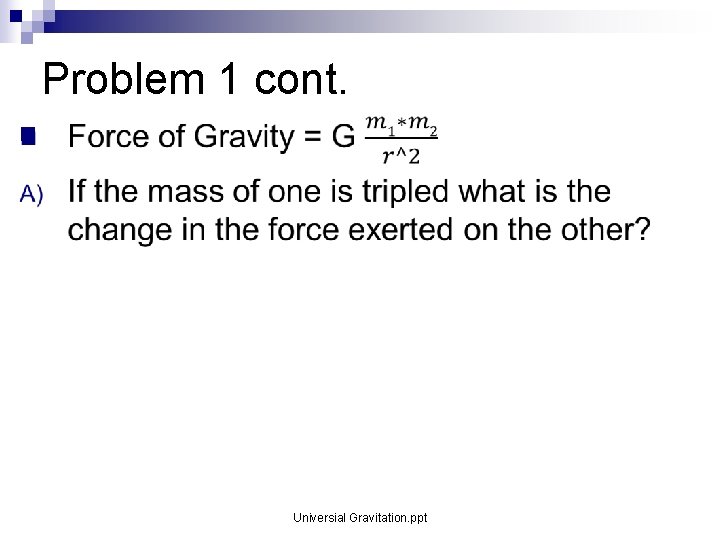
Problem 1 cont. n Universial Gravitation. ppt
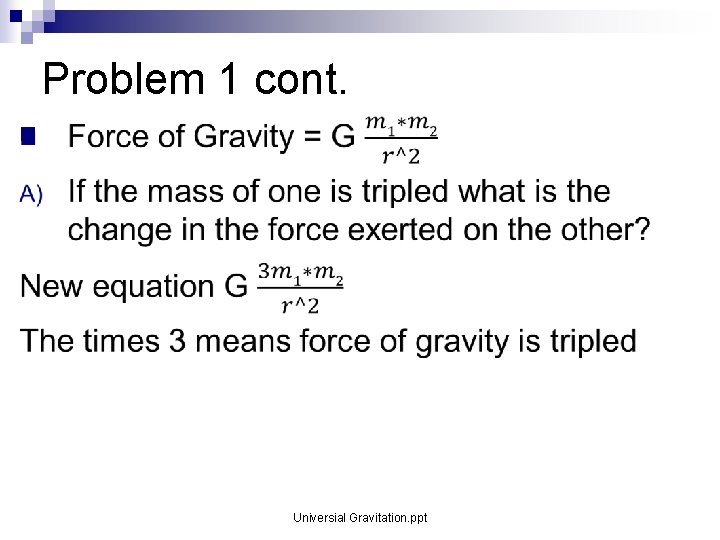
Problem 1 cont. n Universial Gravitation. ppt
Problem 1 cont. n Universial Gravitation. ppt
Problem 1 cont. n Universial Gravitation. ppt
Problem 1 cont. n Universial Gravitation. ppt
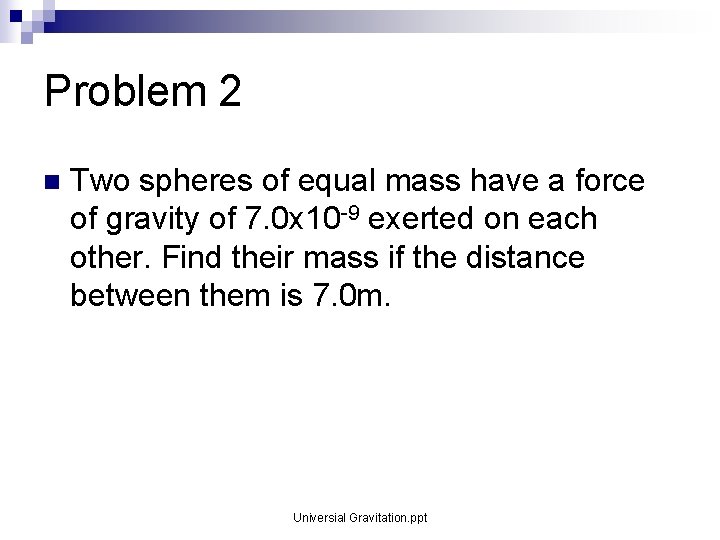
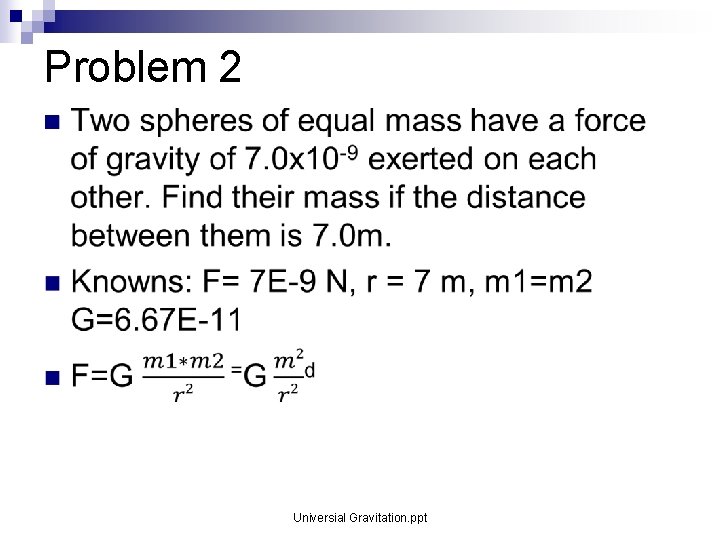
Problem 2 n Two spheres of equal mass have a force of gravity of 7. 0 x 10 -9 exerted on each other. Find their mass if the distance between them is 7. 0 m. Universial Gravitation. ppt
Problem 2 n Universial Gravitation. ppt
Problem 3 n Find the value of the gravitational acceleration g. The mass of the earth is 6. 0 x 1024 kg. Universial Gravitation. ppt
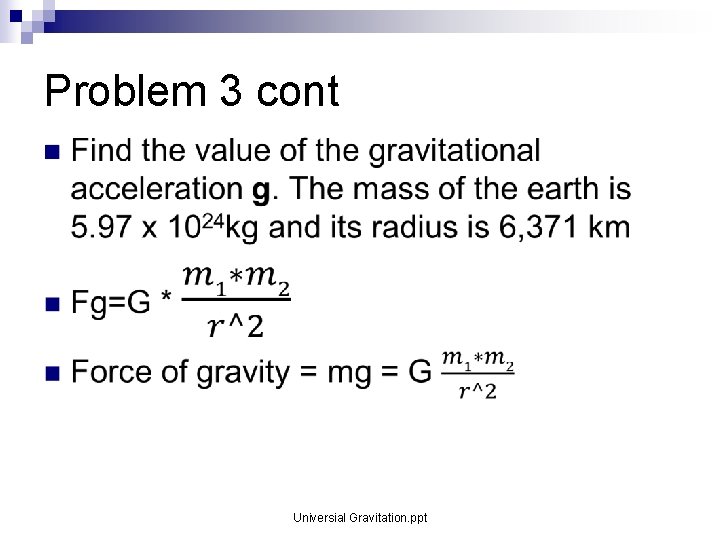
Problem 3 cont n Universial Gravitation. ppt
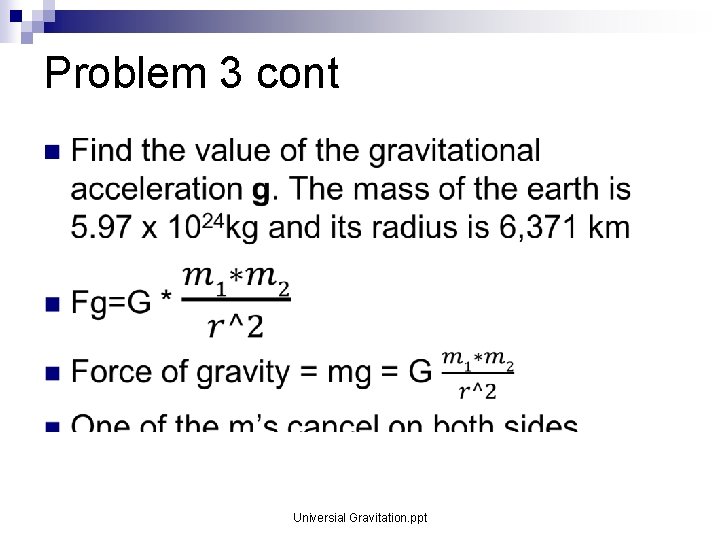
Problem 3 cont n Universial Gravitation. ppt
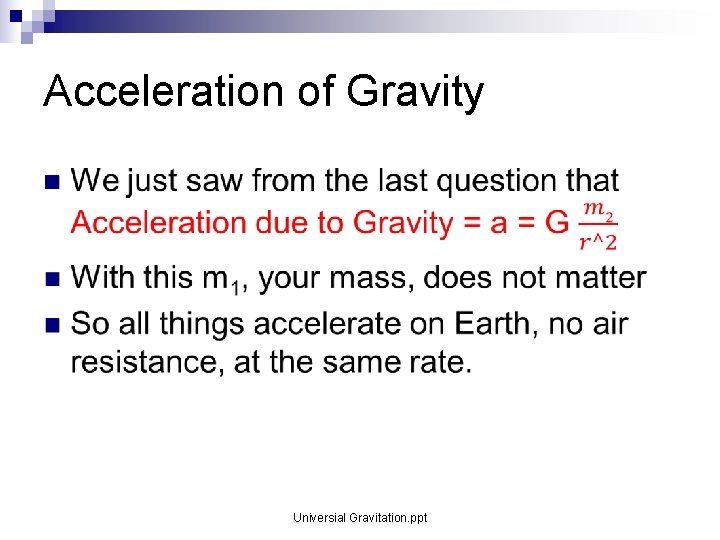
Acceleration of Gravity n Universial Gravitation. ppt
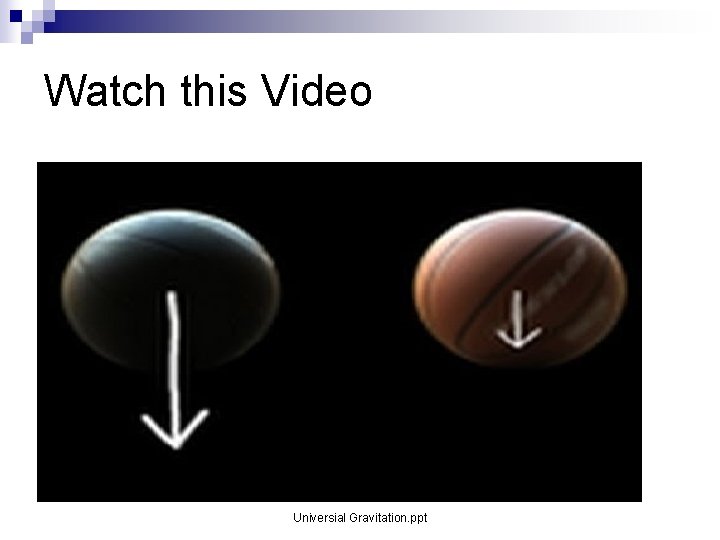
Watch this Video Universial Gravitation. ppt
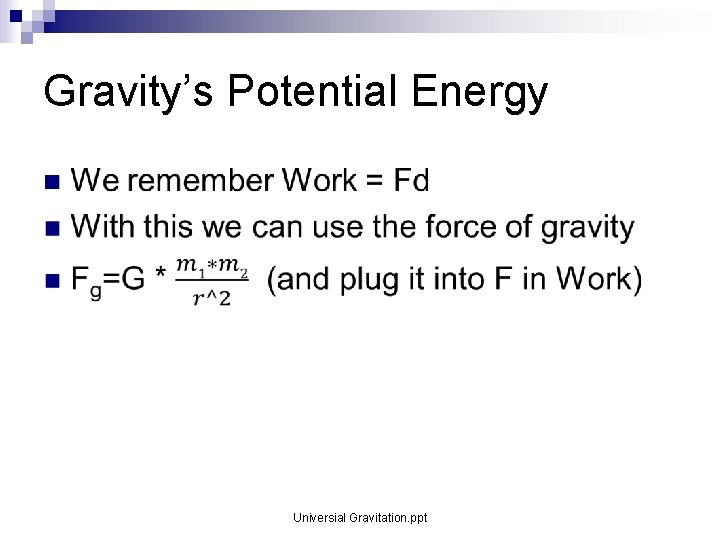
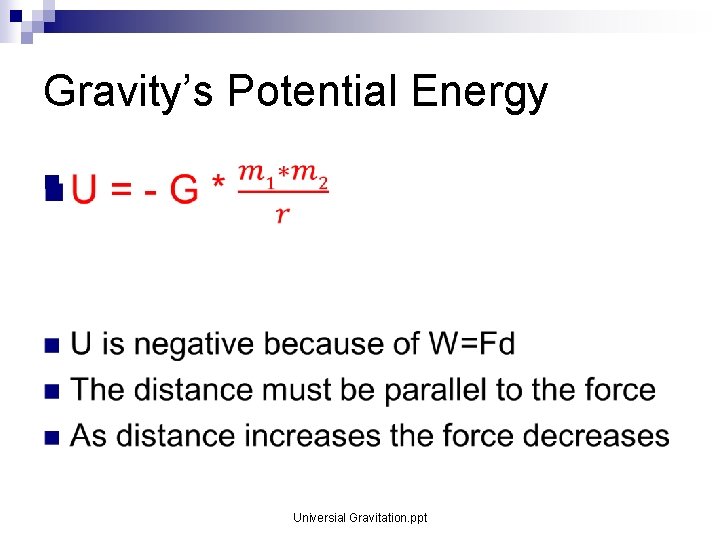
Gravity’s Potential Energy n Universial Gravitation. ppt
Gravity’s Potential Energy n Universial Gravitation. ppt
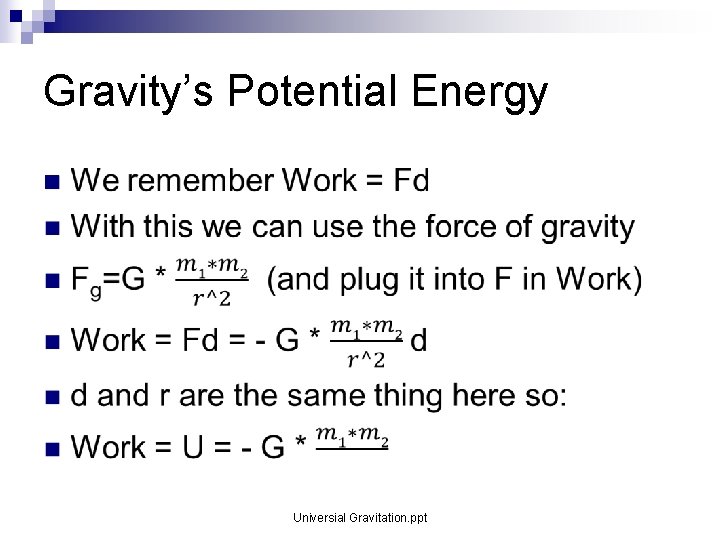
Gravity’s Potential Energy n Universial Gravitation. ppt
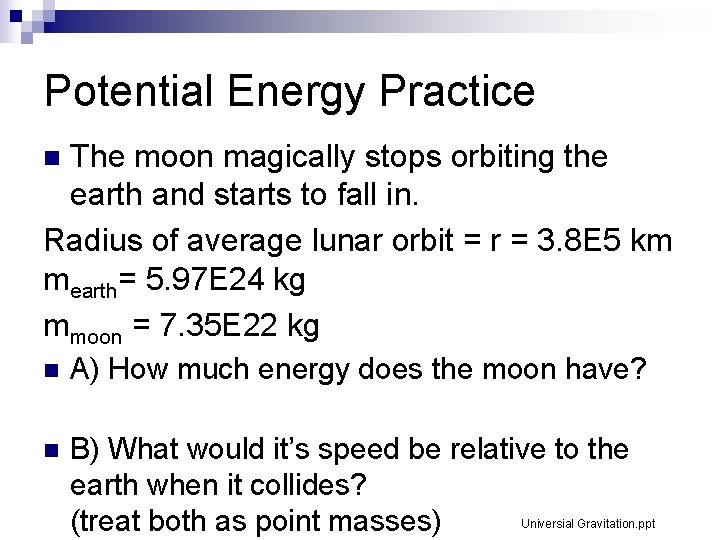
Potential Energy Practice The moon magically stops orbiting the earth and starts to fall in. Radius of average lunar orbit = r = 3. 8 E 5 km mearth= 5. 97 E 24 kg mmoon = 7. 35 E 22 kg n n A) How much energy does the moon have? n B) What would it’s speed be relative to the earth when it collides? (treat both as point masses) Universial Gravitation. ppt
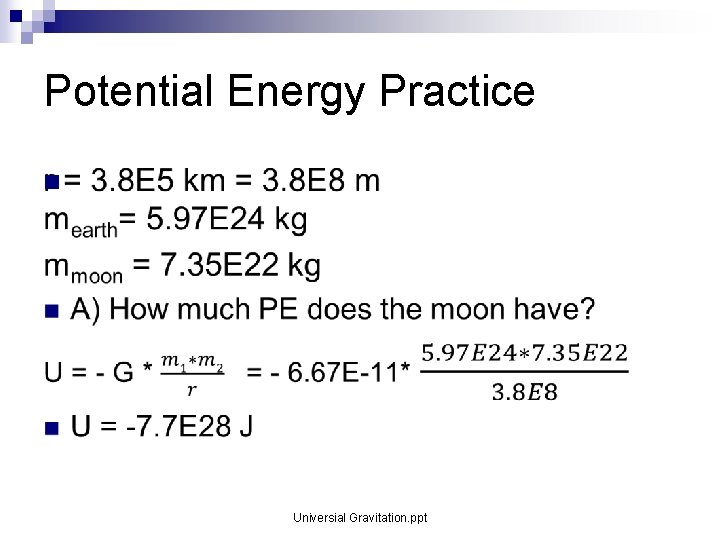
Potential Energy Practice n Universial Gravitation. ppt
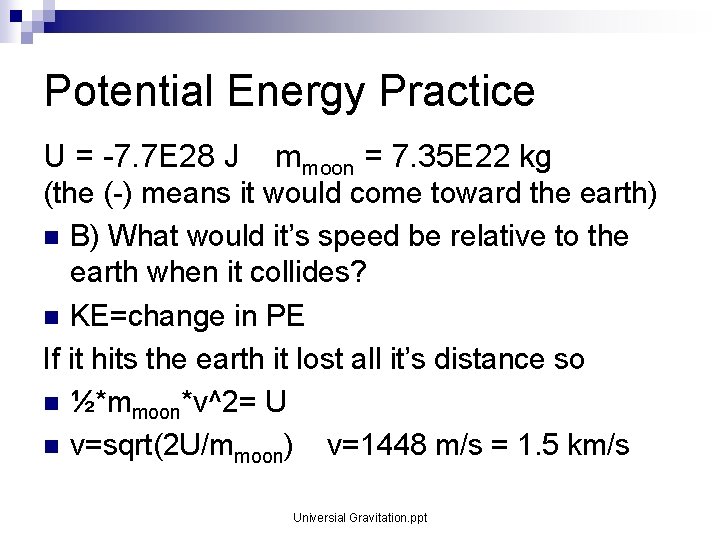
Potential Energy Practice U = -7. 7 E 28 J mmoon = 7. 35 E 22 kg (the (-) means it would come toward the earth) n B) What would it’s speed be relative to the earth when it collides? n KE=change in PE If it hits the earth it lost all it’s distance so n ½*mmoon*v^2= U n v=sqrt(2 U/mmoon) v=1448 m/s = 1. 5 km/s Universial Gravitation. ppt