
PSY 369 Psycholinguistics Language Culture and Cognition Lanuage







- Slides: 30
PSY 369: Psycholinguistics Language, Culture, and Cognition
Lanuage and thought n Can two people who speak different languages communicate? n Two approaches n Translation is possible n n linguistic realism Translation is essentially impossible n n linguistic determinism linguistic relativism n Sometimes called “Whorfian hypothesis” or “Sapir. Whorf hypothesis”
Benjamin Lee Whorf “Every language is a vast pattern system, different from others, in which are culturally ordained the forms and categories by which the personality not only communicates, but also analyzes nature, notices or neglects types of relationships and phenomena, channels his reasoning, and builds the house of his consciousness. ” —Whorf (1956: 252)
Language, behavior, and our perception of the world n Behavior n n What aspects of an image does my language lead me to attend to? How will the categories of my language affect the way in which I sort objects? How will the categories of my language affect the distinctions I can perceive, e. g. , on the color spectrum? The world n We often talk about a linguistic system ‘carving up reality’. n n This implies that languages differ only with respect to the ways in which they describe physical reality. But language is also used to express concepts that humans create— concepts that might only exist within a single speech community.
Some history n Franz Boas, father of American Anthropology n n Edward Sapir, student of Boas n n “grammatical meaning [can] only be understood in terms of the system of which it is part” “the ‘real world’ is to a large extent unconsciously build up on the language habits of the group. ” Benjamin Lee Whorf, student of Sapir (and insurance claims adjustor)
Does language affect thought? n Whorfian hypothesis n Strong version of the linguistic relativity hypothesis: n Language determines thought. n n Speakers of different languages see the world in different, incompatible ways, because their languages impose different conceptual structures on their experiences. Weak version of the linguistic relativity hypothesis: n Language influences thinking
The Sapir-Whorf Hypothesis n Linguistic relativity n n n Lexical and syntactic differences are accompanied by nonlinguistic cognitive differences. Thus, cultural differences in thinking are accompanied by linguistic differences between cultures. Linguistic determinism n n n One might argue that cultural differences in thinking lead to language differences or in a a cultural determinism for linguistic ability Linguistic determinism is the exact reverse of this. Whorf posited that cultural thinking differences were the direct result of differences in their languages
The Sapir-Whorf Hypothesis n What evidence led Whorf to this conclusion? n The bulk of his evidence was drawn from cross-cultural comparisons n n He studied several Native American cultures. But he also used examples drawn from his days as an insurance investigator
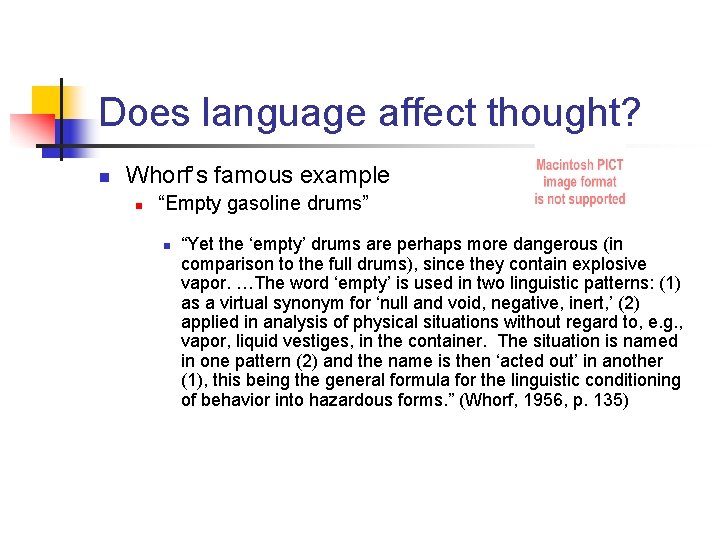
Does language affect thought? n Whorf’s famous example n “Empty gasoline drums” n “Yet the ‘empty’ drums are perhaps more dangerous (in comparison to the full drums), since they contain explosive vapor. …The word ‘empty’ is used in two linguistic patterns: (1) as a virtual synonym for ‘null and void, negative, inert, ’ (2) applied in analysis of physical situations without regard to, e. g. , vapor, liquid vestiges, in the container. The situation is named in one pattern (2) and the name is then ‘acted out’ in another (1), this being the general formula for the linguistic conditioning of behavior into hazardous forms. ” (Whorf, 1956, p. 135)
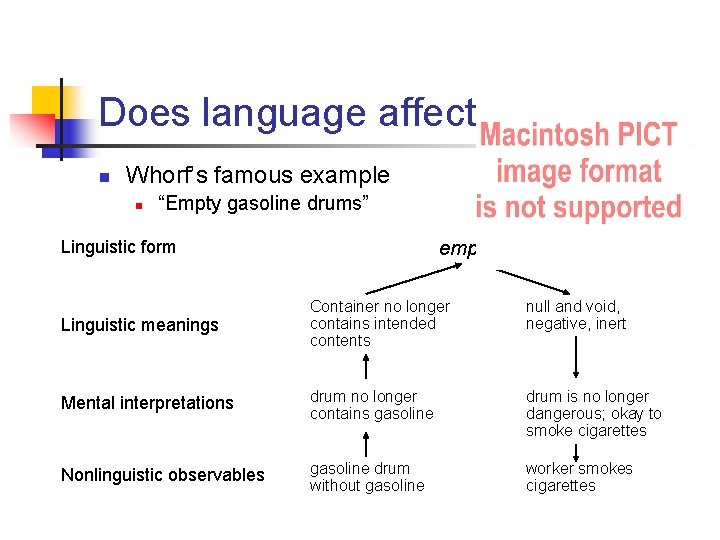
Does language affect thought? n Whorf’s famous example n “Empty gasoline drums” empty Linguistic form Linguistic meanings Container no longer contains intended contents null and void, negative, inert Mental interpretations drum no longer contains gasoline drum is no longer dangerous; okay to smoke cigarettes Nonlinguistic observables gasoline drum without gasoline worker smokes cigarettes
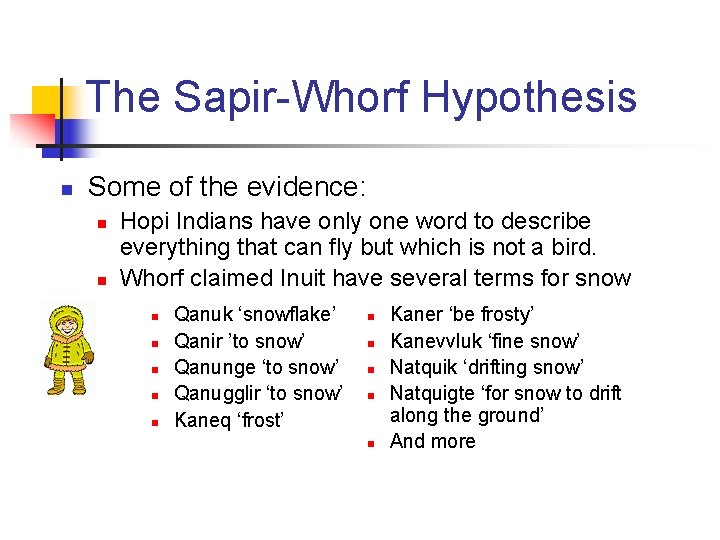
The Sapir-Whorf Hypothesis n Some of the evidence: n n Hopi Indians have only one word to describe everything that can fly but which is not a bird. Whorf claimed Inuit have several terms for snow n n n Qanuk ‘snowflake’ Qanir ’to snow’ Qanunge ‘to snow’ Qanugglir ‘to snow’ Kaneq ‘frost’ n n n Kaner ‘be frosty’ Kanevvluk ‘fine snow’ Natquik ‘drifting snow’ Natquigte ‘for snow to drift along the ground’ And more
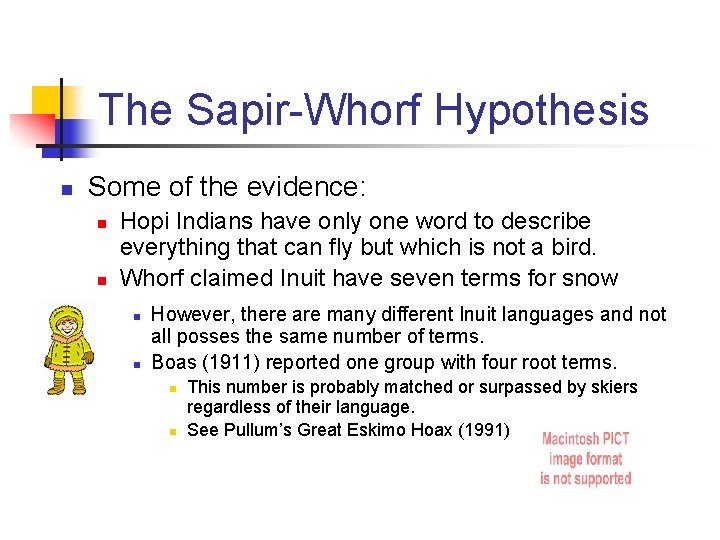
The Sapir-Whorf Hypothesis n Some of the evidence: n n Hopi Indians have only one word to describe everything that can fly but which is not a bird. Whorf claimed Inuit have seven terms for snow n n However, there are many different Inuit languages and not all posses the same number of terms. Boas (1911) reported one group with four root terms. n n This number is probably matched or surpassed by skiers regardless of their language. See Pullum’s Great Eskimo Hoax (1991)
The Sapir-Whorf Hypothesis n Specialization based on experience n Different groups within a culture vary in terms of the number of words they use for things n Consider memory n n n Most people are aware of two kinds of memory, short term and long term. As we discovered previously cognitive psychologists have many terms: Sensory registers, Iconic and echoic, short-term or working or primary memory, long-term, verbal and imagistic, declarative, procedural, and episodic. It would be fair to say that the layman and the cognitive psychologist think differently about memory.
Testing theory Two major approaches have been employed to test the Sapir-Whorf hypothesis. n n n Test the strong view – language determines thought by seeing if the cognitive system can make distinctions that are not linguistically represented Test a weaker view – that language influences thought.
Cultural Variations n Much of the initial research focused on an aspect of language which varies widely across cultures n Color Terms n n There a few languages which have only two color terms, and some with three. Most languages draw their color names from 11 specific colors.
Color Terms n Berlin and Kay (1969): Color hierarchy n n In 2 color term languages the terms correspond to Black & White In 3 color term languages they correspond to Black, White & Red Languages with additional terms items are added as follows: yellow, green, blue then brown, then purple, pink, orange, and gray. This data runs contrary to Whorf’s hypotheses n They suggest a universal physiological basis for color naming
Color Terms n So do naming practices influence our ability to distinguish or remember colors? n Brown & Lenneberg, 1954 n n n The process of naming in this manner is known as codability. Codability = how easily a concept can be described in a language, related to the length of the word. Describe the study and findings (pg 383)
Color Terms n Hieder (1972) (Rosch, 1973[same person]) n n Dani tribe of New Guinea use only two color names They had no difficulty in recognizing color chips that were from an initial presentation from among distractors even though they had no names for the colors. Additionally, they were better at recognizing focal colors (e. g. , the best example of blue) than non-focal colors (just as we English speakers are) This data does not support the strong view of Whorf’s hypothesis.
Color Terms n Comparative judgements among colors are affected by color naming practices n Kay & Kempton, (1984) n n n Investigated English and Tarahumara In Tarahumara there are no separate terms for blue and green The task was see 3 chips pick the one least similar in color n Some trials had chips English speakers would call C 1 green, C 2 blue and C 3 was a focal example of green but farther away in light spectrum from C 1 than was the case for C 1 vs. C 2
Color Terms n Kay & Kempton, (1984) Results n n n Predictions: Visual stimuli as only basis pick C 3 as odd Naming practices influence pick C 2 as odd Tarahumara speakers pick C 3 English speakers tended to pick the chip they would label blue (C 2) even though in the spectrum it was closer to C 1 than was C 3 Support for a weak version of the Whorfian hypothesis
Higher Cognitive Processes n Color naming is not a very complex cognitive process: n What about more complex mental processes? n n n Counting and other Arithmetic processes Reasoning Probably will run out of time here, skip to a short summary slide for these and the conclusions
Counting & Arithmetic n n n Greenberg (1978) has identified some cultures where the only number terms correspond to one, two, many. In such cultures there is obviously a limit to counting progression and comparing the size of different sets of items Different languages terms for numbers also has effects on arithmetic
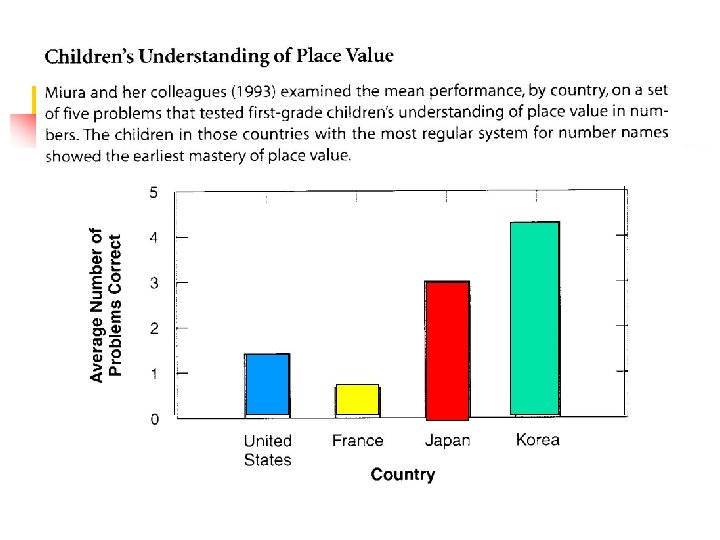
Counting & Arithmetic n n The greater regularity of number names in Chinese, Japanese and Korean as compared to English or French facilitates the learning of counting behavior beyond 10 in those languages. Another advantage is earlier mastery of ‘place value’ (understanding that in # 23 there are 2 tens and 3 ones)
Reasoning n n n In attempts to determine ability of counter-factual reasoning different researchers have reached different conclusions. The basis for their differing conclusions is centered on the equivalence of the statements translation from one language to another This problem was avoided by Hoffman, Lau & Johnson(1986) in a study of codability of personality descriptions
Reasoning n n n In English the term artistic also conveys the notion that a person is intense, moody, and unconventional In Chinese the term Shi Gu conveys that a person is worldly, reserved, social adept, and devoted to family Neither language has a corresponding term for artistic or Shi gu
Reasoning n n In the study the terms and their the list of traits were presented for both terms in Chinese or in English They then wrote an impression of the person and answered questions requiring inferences of character and behavior
Reasoning n The interesting result is that in both languages when a global term was available they tended to elaborate on the term with stereotypical traits. n n n When the global term was not available descriptions adhered more closely to listed traits. These results hold for bilingual speakers (Hoffman et. al. , 1986) This indicates we are most likely to judge people in term of a category or stereotype if that category is easily coded in our language
Conclusions n n At this point it is apparent that the strong view of Whorf’s hypothesis is not supported. The data from areas of investigation concerning color naming, counting & arithmetic, reasoning, visual memory, and other areas (e. g. , social inference) indicate that the use of certain specific terms can influence how we think n The question that remains is how much of the differences are because of the language and how much due to the culture?