
Relativistic models General relativity allows one to calculate


- Slides: 11
Relativistic models General relativity allows one to calculate the behaviour of space-time in the presence of mass-energy →PHY 314 l To see basic behaviour l use Newtonian approximation where possible assume some GR results PHY 306 1
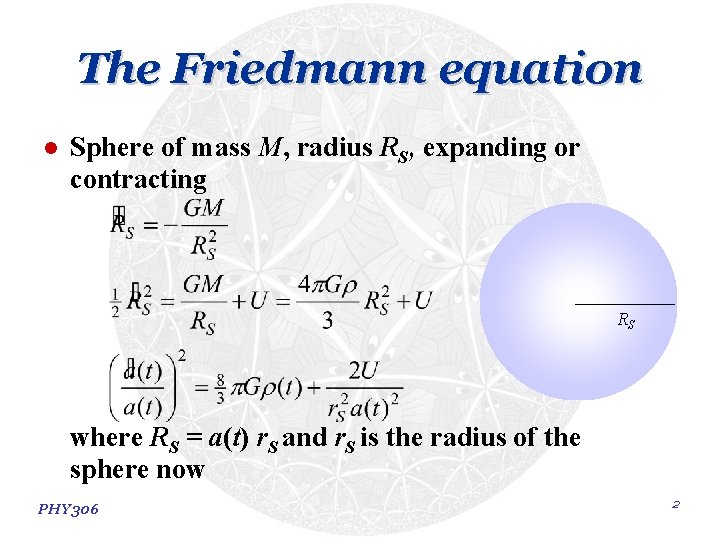
The Friedmann equation l Sphere of mass M, radius RS, expanding or contracting RS where RS = a(t) r. S and r. S is the radius of the sphere now PHY 306 2
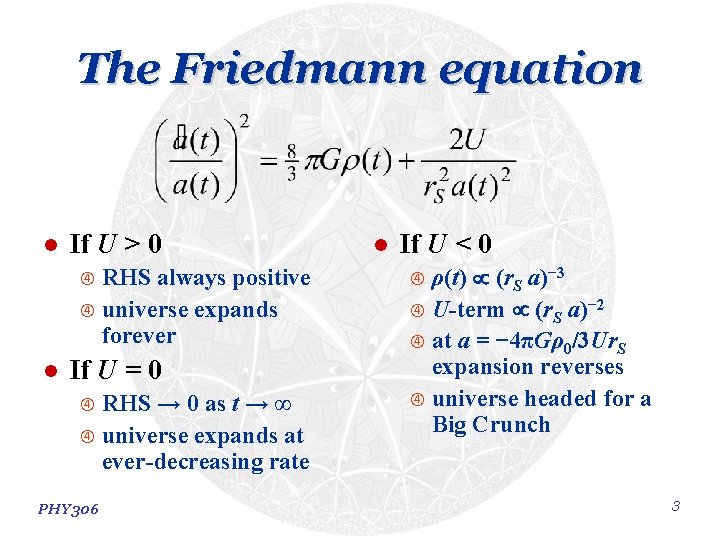
The Friedmann equation l If U > 0 RHS always positive universe expands forever l If U = 0 RHS → 0 as t → ∞ universe expands at ever-decreasing rate PHY 306 l If U < 0 ρ(t) (r. S a)− 3 U-term (r. S a)− 2 at a = − 4πGρ0/3 Ur. S expansion reverses universe headed for a Big Crunch 3
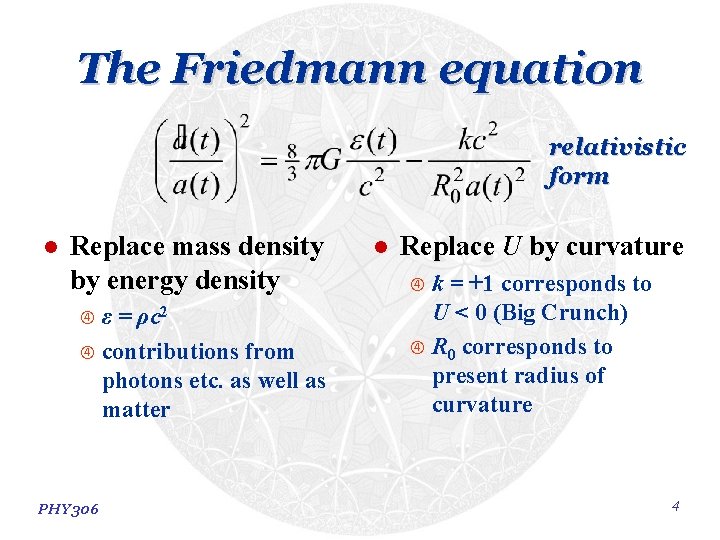
The Friedmann equation relativistic form l Replace mass density by energy density ε = ρc 2 contributions from photons etc. as well as matter PHY 306 l Replace U by curvature k = +1 corresponds to U < 0 (Big Crunch) R 0 corresponds to present radius of curvature 4
Ω l Energy density for k=0 εc = 3 c 2 H 2/8πG define Ω ≡ ε(t)/εc(t) then PHY 306 l H 2, R 2, a 2, c 2 all positive Ω=1↔k=0 Ω<1↔k<0 Ω>1↔k>0 5
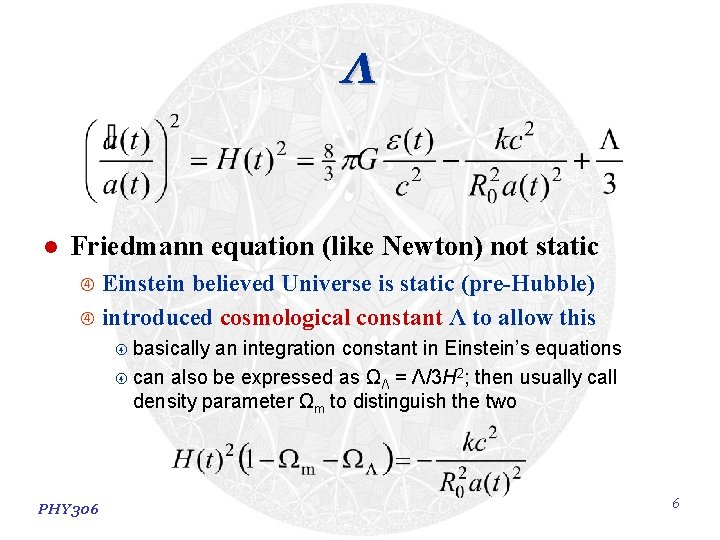
Λ l Friedmann equation (like Newton) not static Einstein believed Universe is static (pre-Hubble) introduced cosmological constant Λ to allow this basically an integration constant in Einstein’s equations can also be expressed as ΩΛ = Λ/3 H 2; then usually call density parameter Ωm to distinguish the two PHY 306 6
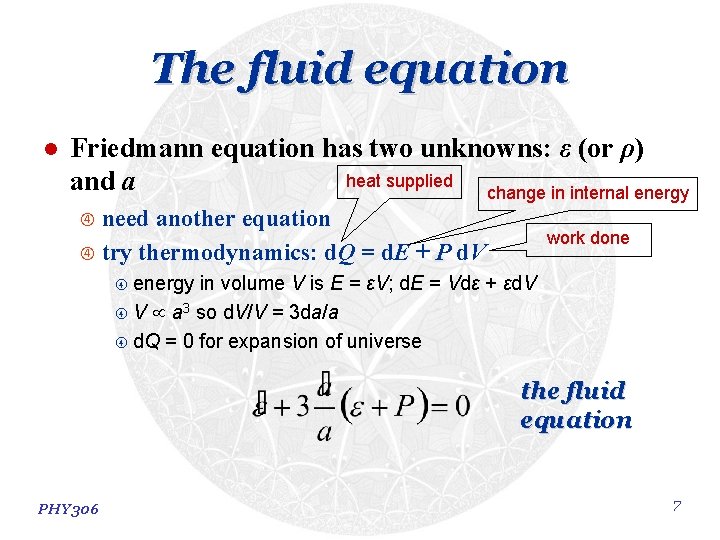
The fluid equation l Friedmann equation has two unknowns: ε (or ρ) heat supplied and a change in internal energy need another equation try thermodynamics: d. Q = d. E + P d. V work done energy in volume V is E = εV; d. E = Vdε + εd. V V a 3 so d. V/V = 3 da/a d. Q = 0 for expansion of universe the fluid equation PHY 306 7
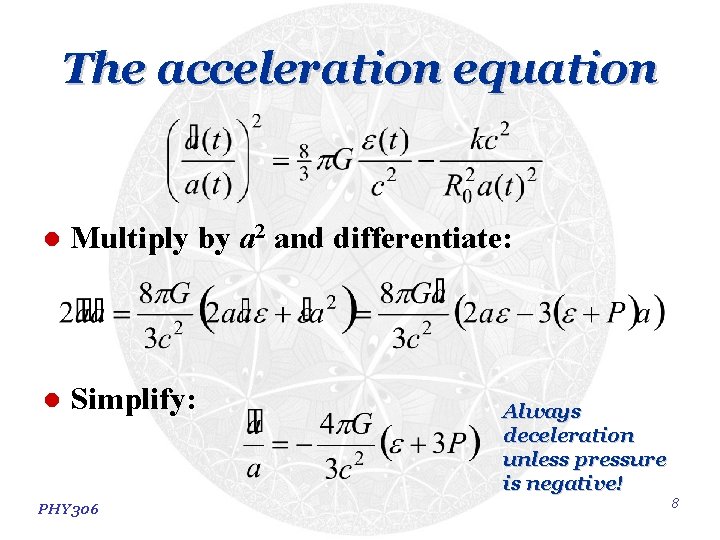
The acceleration equation l Multiply by a 2 and differentiate: l Simplify: PHY 306 Always deceleration unless pressure is negative! 8
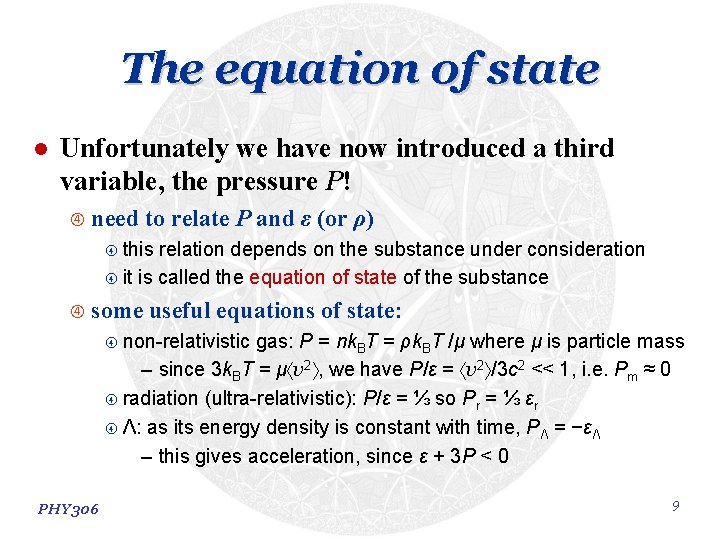
The equation of state l Unfortunately we have now introduced a third variable, the pressure P! need to relate P and ε (or ρ) this relation depends on the substance under consideration it is called the equation of state of the substance some useful equations of state: non-relativistic gas: P = nk. BT = ρk. BT /μ where μ is particle mass – since 3 k. BT = μ v 2 , we have P/ε = v 2 /3 c 2 << 1, i. e. Pm ≈ 0 radiation (ultra-relativistic): P/ε = ⅓ so Pr = ⅓ εr Λ: as its energy density is constant with time, PΛ = −εΛ – this gives acceleration, since ε + 3 P < 0 PHY 306 9
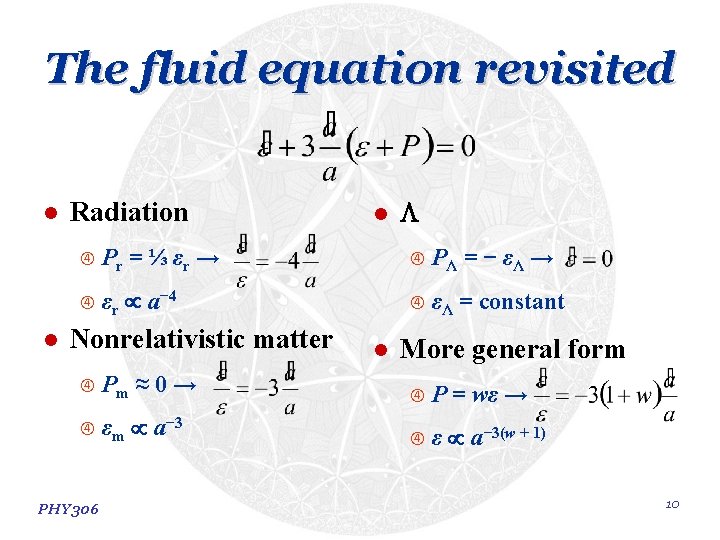
The fluid equation revisited l Radiation P r = ⅓ εr → εr l Pm ≈ 0 → εm PHY 306 a− 3 L a− 4 Nonrelativistic matter l P Λ = − εΛ → εΛ l = constant More general form P = wε → ε a− 3(w + 1) 10
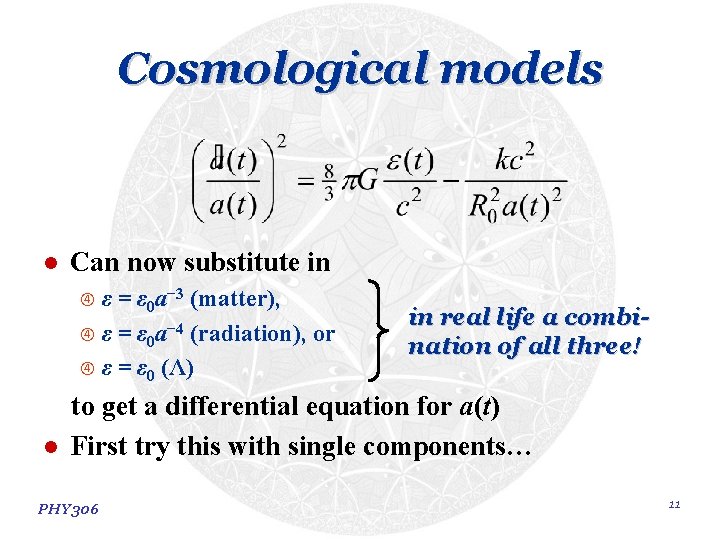
Cosmological models l Can now substitute in ε = ε 0 a− 3 (matter), ε = ε 0 a− 4 (radiation), or ε = ε 0 (Λ) l in real life a combination of all three! to get a differential equation for a(t) First try this with single components… PHY 306 11