
Chapter 13 Universal Gravitation This cartoon mixes two
- Slides: 12
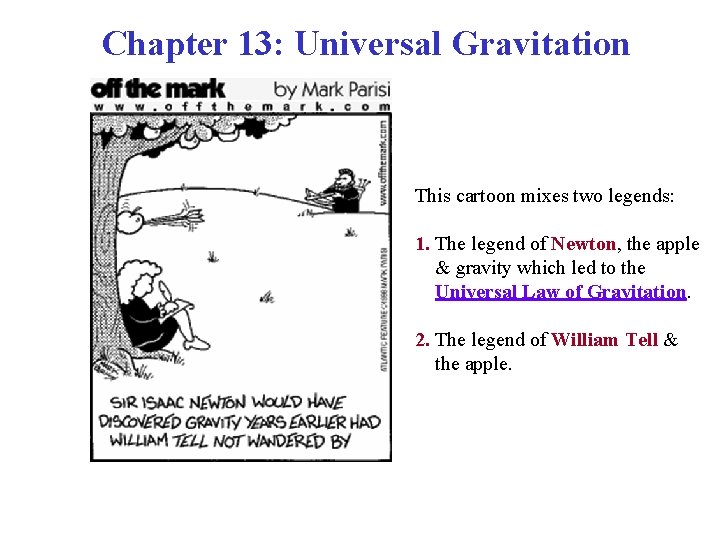
Chapter 13: Universal Gravitation This cartoon mixes two legends: 1. The legend of Newton, the apple & gravity which led to the Universal Law of Gravitation. 2. The legend of William Tell & the apple.
• It was very SIGNIFICANT & PROFOUND in the 1600's when Sir Isaac Newton first wrote Newton's Universal Law of Gravitation! • This was done at the young age of about 30. It was this, more than any of his achievements, which caused him to be well-known in the world scientific community of the late 1600's. • He used this law, along with Newton's 2 nd Law (his 2 nd Law!) plus Calculus, which he also (co-) invented, to PROVE that the orbits of the planets around the sun must be ellipses. – For simplicity, we will assume in Ch. 13 that these orbits are circular. • Ch. 13 fits THE COURSE THEME OF NEWTON'S LAWS OF MOTION because he used his Gravitation Law & his 2 nd Law in his analysis of planetary motion. • His prediction that planet orbits are elliptical is in excellent agreement with Kepler's analysis of observational data & with Kepler's empirical laws of planetary motion.
• When Newton first wrote the Universal Law of Gravitation, this was the first time, anyone had EVER written a theoretical expression (physics in math form) & used it to PREDICT something that is in agreement with observations! For this reason, Newton's formulation of his Universal Gravitation Law is considered THE BEGINNING OF THEORETICAL PHYSICS. • This also gave Newton his major “claim to fame”. After this, he was considered a “major player” in science & math among his peers. • In modern times, this, plus the many other things he did, have led to the consensus that Sir Isaac Newton was the GREATEST SCIENTIST WHO EVER LIVED
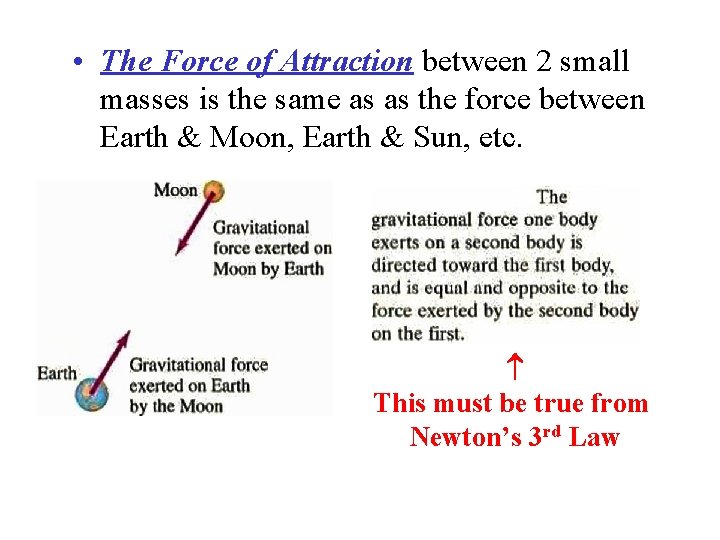
Sect. 13. 1: Newton’s Universal Law of Gravitation • This is an EXPERIMENTAL LAW describing the gravitational force of attraction between 2 objects. • Newton’s reasoning: the Gravitational force of attraction between 2 large objects (Earth - Moon, etc. ) is the SAME force as the attraction of objects to the Earth. • Apple story: This is likely not a true historical account, but the reasoning discussed there is correct. This story is probably legend rather than fact.
• The Force of Attraction between 2 small masses is the same as as the force between Earth & Moon, Earth & Sun, etc. This must be true from Newton’s 3 rd Law
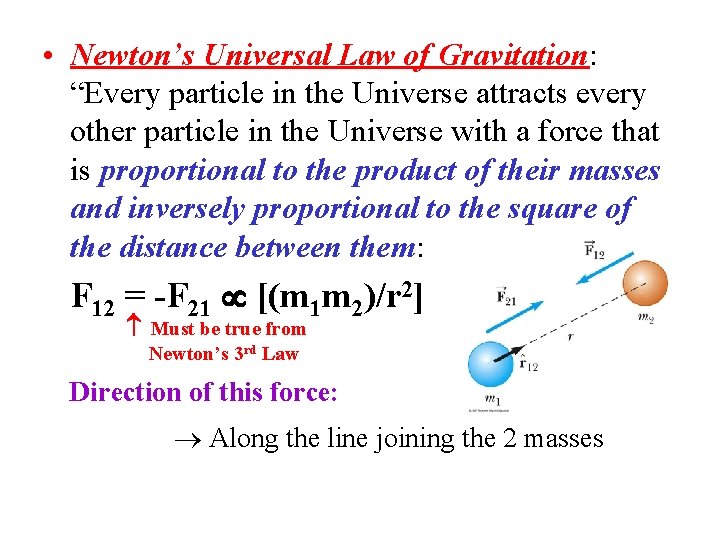
• Newton’s Universal Law of Gravitation: “Every particle in the Universe attracts every other particle in the Universe with a force that is proportional to the product of their masses and inversely proportional to the square of the distance between them: F 12 = -F 21 [(m 1 m 2)/r 2] Must be true from Newton’s 3 rd Law Direction of this force: Along the line joining the 2 masses
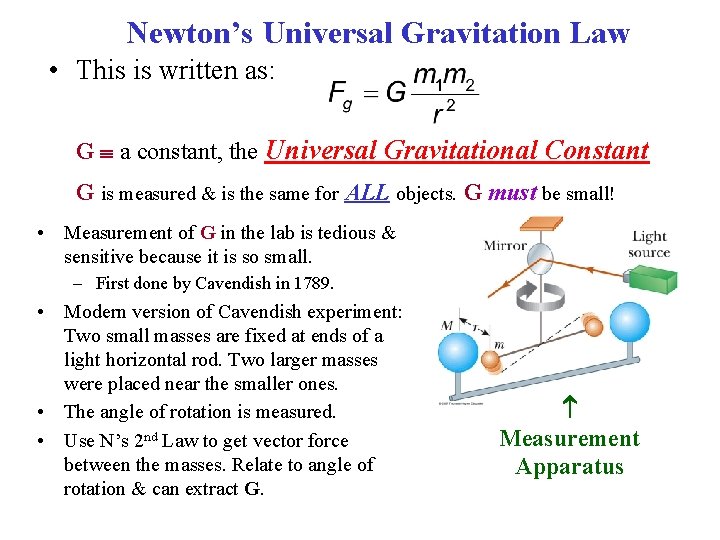
Newton’s Universal Gravitation Law • This is written as: G a constant, the Universal Gravitational Constant G is measured & is the same for ALL objects. G must be small! • Measurement of G in the lab is tedious & sensitive because it is so small. – First done by Cavendish in 1789. • Modern version of Cavendish experiment: Two small masses are fixed at ends of a light horizontal rod. Two larger masses were placed near the smaller ones. • The angle of rotation is measured. • Use N’s 2 nd Law to get vector force between the masses. Relate to angle of rotation & can extract G. Measurement Apparatus
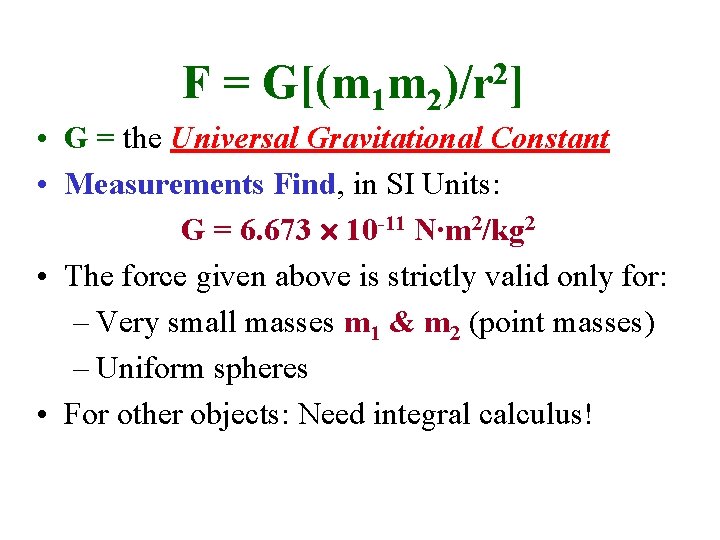
• • 2 F = G[(m 1 m 2)/r ] G = the Universal Gravitational Constant Measurements Find, in SI Units: G = 6. 673 10 -11 N∙m 2/kg 2 The force given above is strictly valid only for: – Very small masses m 1 & m 2 (point masses) – Uniform spheres For other objects: Need integral calculus!
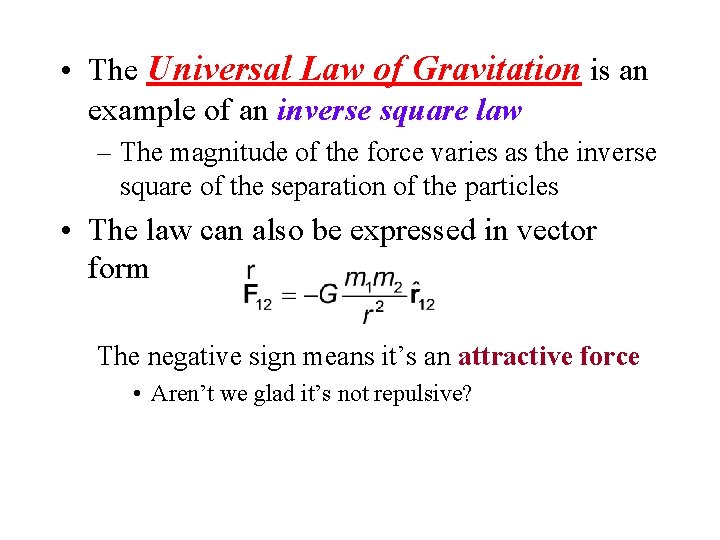
• The Universal Law of Gravitation is an example of an inverse square law – The magnitude of the force varies as the inverse square of the separation of the particles • The law can also be expressed in vector form The negative sign means it’s an attractive force • Aren’t we glad it’s not repulsive?
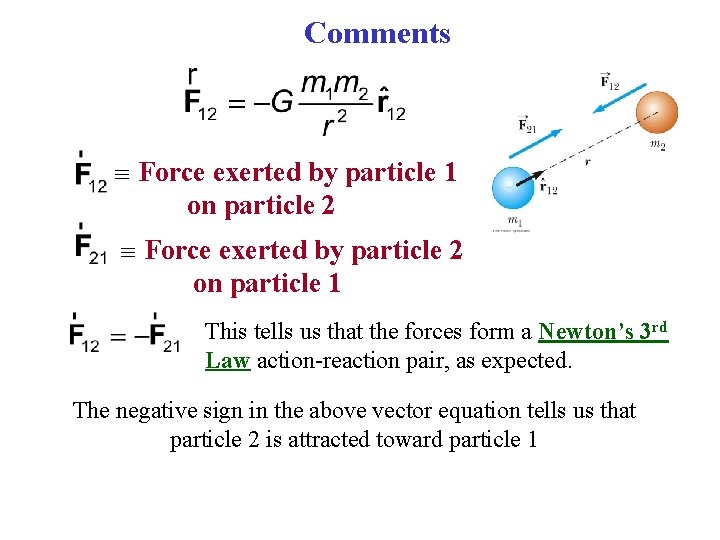
Comments Force exerted by particle 1 on particle 2 Force exerted by particle 2 on particle 1 This tells us that the forces form a Newton’s 3 rd Law action-reaction pair, as expected. The negative sign in the above vector equation tells us that particle 2 is attracted toward particle 1
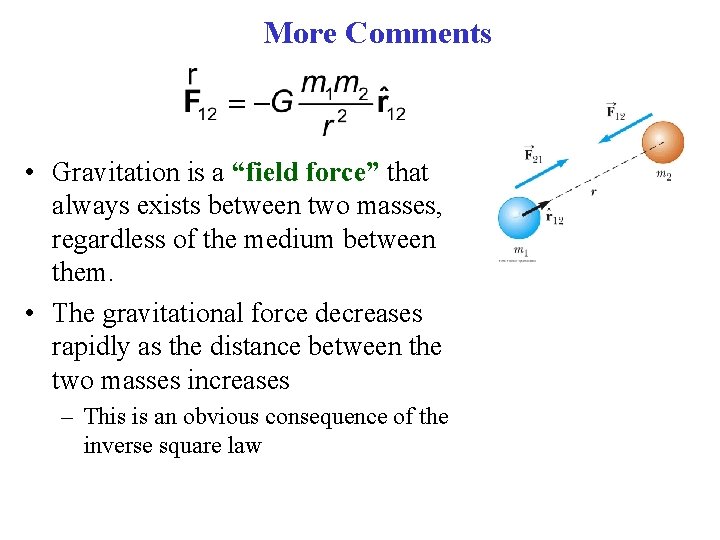
More Comments • Gravitation is a “field force” that always exists between two masses, regardless of the medium between them. • The gravitational force decreases rapidly as the distance between the two masses increases – This is an obvious consequence of the inverse square law
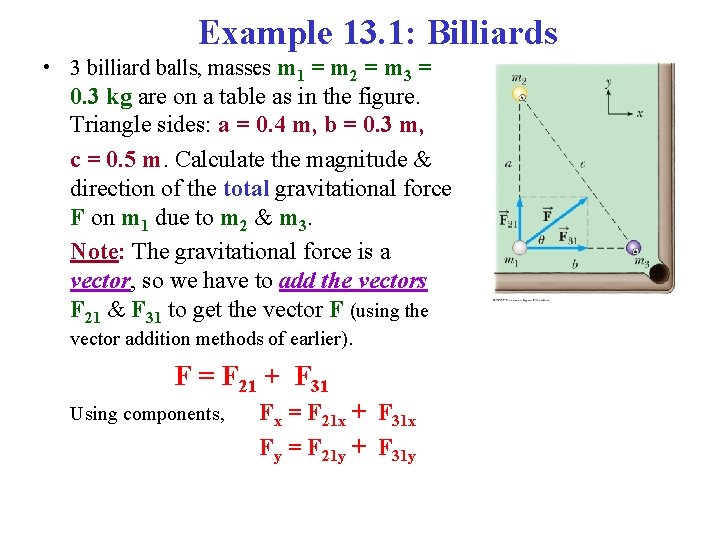
Example 13. 1: Billiards • 3 billiard balls, masses m 1 = m 2 = m 3 = 0. 3 kg are on a table as in the figure. Triangle sides: a = 0. 4 m, b = 0. 3 m, c = 0. 5 m. Calculate the magnitude & direction of the total gravitational force F on m 1 due to m 2 & m 3. Note: The gravitational force is a vector, so we have to add the vectors F 21 & F 31 to get the vector F (using the vector addition methods of earlier). F = F 21 + F 31 Using components, Fx = F 21 x + F 31 x Fy = F 21 y + F 31 y