Gul karam khan jadoon Dept of Statistics University


- Slides: 36
Gul karam khan jadoon Dept: of Statistics University of Peshawar.
SAMPLING 01/05/2020 G. k. khan jadoon 2
RANDOMIZATION � Randomization is a method of sampling in which each individual of the population has the equal chance or probability of selection of the individuals for constituting a sample. Methods of Randomization The following are main methods of randomization: (a) Lottery method of randomization. (b) Tossing a coin (Head or tail) method. (c) Throwing a dice. (d) Blind folded method. (e) Random tables 01/05/2020 G. k. khan jadoon 3
Advantages of Randomization 1. It is an objective method of sampling. 2. It is an economical method from money, energy point of view. 3. It is a convenient approach of sampling in the field of research. 4. It permits the application of statistical devices and treatments of data. The error due sampling can be estimated. 5. It maintains the accuracy in the analysis of results. 6. It is a practical method of sampling. 7. A representative sampling may be selected by using randomization. 01/05/2020 G. k. khan jadoon 4
TYPES OF SAMPLING DESIGNS 1. Probability Sampling: Method of sampling which gives the probability that our sample is representative of population is known as probability sampling. 2. Non-probability Sampling: If there is no such idea of probability then the method of sampling is known as non- probability sampling. 01/05/2020 G. k. khan jadoon 5
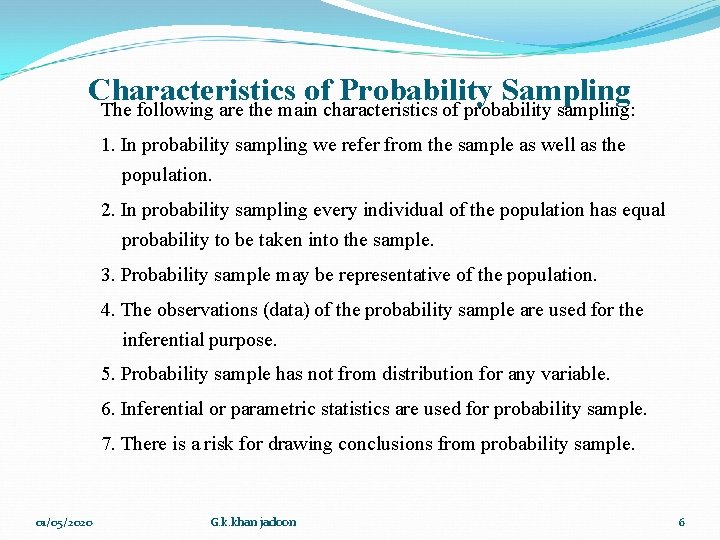
Characteristics of Probability Sampling The following are the main characteristics of probability sampling: 1. In probability sampling we refer from the sample as well as the population. 2. In probability sampling every individual of the population has equal probability to be taken into the sample. 3. Probability sample may be representative of the population. 4. The observations (data) of the probability sample are used for the inferential purpose. 5. Probability sample has not from distribution for any variable. 6. Inferential or parametric statistics are used for probability sample. 7. There is a risk for drawing conclusions from probability sample. 01/05/2020 G. k. khan jadoon 6
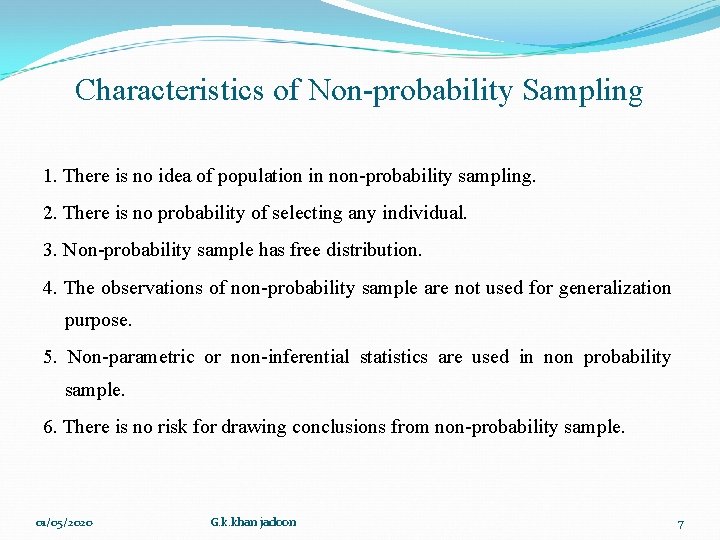
Characteristics of Non-probability Sampling 1. There is no idea of population in non-probability sampling. 2. There is no probability of selecting any individual. 3. Non-probability sample has free distribution. 4. The observations of non-probability sample are not used for generalization purpose. 5. Non-parametric or non-inferential statistics are used in non probability sample. 6. There is no risk for drawing conclusions from non-probability sample. 01/05/2020 G. k. khan jadoon 7
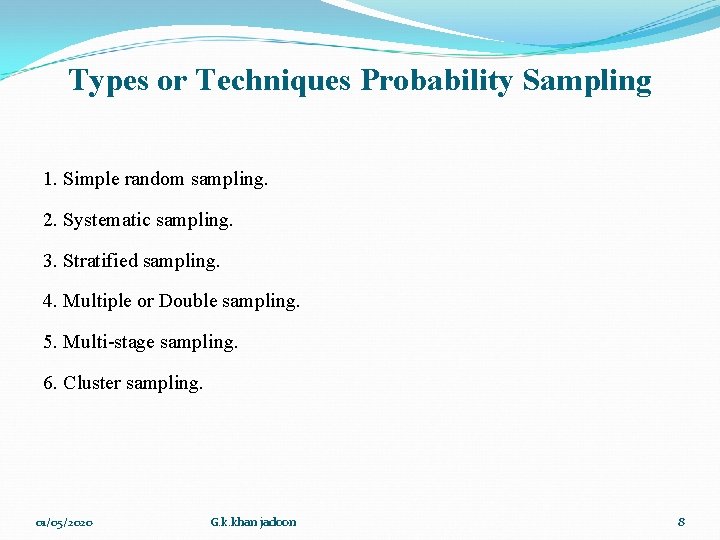
Types or Techniques Probability Sampling 1. Simple random sampling. 2. Systematic sampling. 3. Stratified sampling. 4. Multiple or Double sampling. 5. Multi-stage sampling. 6. Cluster sampling. 01/05/2020 G. k. khan jadoon 8
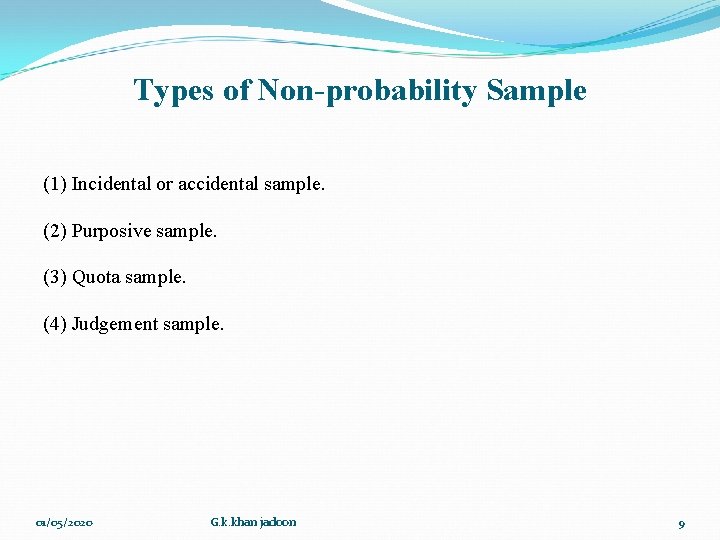
Types of Non-probability Sample (1) Incidental or accidental sample. (2) Purposive sample. (3) Quota sample. (4) Judgement sample. 01/05/2020 G. k. khan jadoon 9
1. Simple Random Sampling A simple random sample is one in which each element of the population has an equal and independent chance of being included in the sample i. e. a sample selected by randomization method is known as simple-random sample and this technique is simple random-sampling. � Tossing a coin. � Throwing a dice. � Lottery method. � Blind folded method. � By using random table 01/05/2020 G. k. khan jadoon 10
Advantages (a) It requires a minimum knowledge of population. (b) It is free from subjectivity and free from personal error. (c) It provides appropriate data for our purpose. (d) The observations of the sample can be used for inferential purpose. Disadvantages (a) The representativeness of a sample cannot be ensured by this method. (b) This method does not use the knowledge about the population. (c) The inferential accuracy of the finding depends upon the size of the sample. 01/05/2020 G. k. khan jadoon 11
2. Systematic Sampling This method requires the complete information about the population. There should be a list of information's of all the individuals of the population in any systematic way. Now we decide the size of the sample. Let sample size = n and population size = N Now we select each N/nth individual from the list and thus we have the desired size of sample which is known as systematic sample. Thus for this technique of sampling population should be arranged in any systematic way. 01/05/2020 G. k. khan jadoon 12
Advantages (a) This is a simple method of selecting a sample. (b) It reduces the field cost. (c) Inferential statistics may be used. (d) Sample may be comprehensive and representative of population. (e) Observations of the sample may be used for drawing conclusions and generalizations. Disadvantages (a) This is not free from error, since there is subjectivity due to different ways of systematic list by different individuals. Knowledge of population is essential. (b) Information of each individual is essential. (c) This method can’t ensure the representativeness. (d) There is a risk in drawing conclusions from the observations of the sample. 01/05/2020 G. k. khan jadoon 13
3. Stratified Sampling When employing this technique, the researcher divides his population in strata on the basis of some characteristics and from each of these smaller homogeneous groups (strata) draws at random a predetermined number of units. Researcher should choose that characteristic or criterion which seems to be more relevant in his research work. Stratified sampling may be of three types: 1. Disproportionate stratified sampling. 2. Proportionate stratified sampling. 3. Optimum allocation stratified sampling. 01/05/2020 G. k. khan jadoon 14
1. Disproportionate sampling means that the size of the sample in each unit is not proportionate to the size of the unit but depends upon considerations involving personal judgement and convenience. 2. Proportionate sampling refers to the selection from each sampling unit of a sample that is proportionate to the size of the unit. Advantages of this procedure include representativeness with respect to variables used as the basis of classifying categories and increased chances of being able to make comparisons between strata. 01/05/2020 G. k. khan jadoon 15
3. Optimum allocation stratified sampling is representative as well as comprehensive than other stratified samples. It refers to selecting units from each stratum should be in proportion to the corresponding stratum the population. Thus sample obtained is known as optimum allocation stratified sample. 01/05/2020 G. k. khan jadoon 16
� Advantages (a) It is (more precisely third way) a good representative of the population. (b) It is an improvement over the earlier. (c) It is an objective method of sampling. (d) Observations can be used for inferential purpose. � Disadvantages (a) Serious disadvantage of this method is that it is difficult for the researcher to decide the relevant criterion for stratification. (b) Only one criterion can be used for stratification, but it generally seems more than one criterion relevant for stratification. (c) It is costly and time consuming method. (d) Selected sample may be representative with reference to the used criterion but not for the other. (e) There is a risk in generalization. 01/05/2020 G. k. khan jadoon 17
Multiple or Double or Repetitive Sampling This is most frequently used for establishing the reliability of a sample. When employing a mailed questionnaire, double sampling is sometimes used to obtain a ‘more representative sample. This is done because some randomly selected subjects who are sent questionnaires may not return them. Obviously, the missing data will bias the result of the study, if the people who fail to reply the’ query differ in some fundamental way from the others in respect to the phenomena being studied. To eliminate this bias, a second sample may be drawn at random from the non-respondents and the people interviewed to obtain the desired information. Thus this technique is also known as repeated or multiple sampling. This double sampling technique enables one to check on the reliability of the information obtained from the first sample. Thus, double sampling, wherein one sample is analyzed, and information obtained is used to draw the next sample to examine the problem further. 01/05/2020 G. k. khan jadoon 18
Advantages (a) This sampling procedure leads to the inferences of free determine precision based on a number of observations. (b) This technique of sampling reduces the error. (c) This method maintains the procedure of the finding evaluate the reliability of the sample. Disadvantages (a) This technique of sampling cannot be used for a large sample. It is applicable only for small sample. (b) This technique is time consuming, costly, and requires more competition. (c) Its planning and administration is more complicated. 01/05/2020 G. k. khan jadoon 19
Multi-Stage Sampling This sample is more comprehensive and representative of the population. In this type of sampling primary sample units are inclusive groups and secondary units are sub-groups within these ultimate units to be selected which belong to one and only one group. Stages of a population are usually available within a group or population, whenever stratification is done by the researcher. The Individuals are selected from different stages for constituting the multi-stage sampling. 01/05/2020 G. k. khan jadoon 20
Advantages (a) It is a good representative of the population. (b) Multi-stage sampling is an improvement over the earlier methods. (c) It is an objective procedure of sampling. (d) The observations from multi-stage sample may be used for inferential purpose. Disadvantages (a) It is a difficult and complex method of samplings. (b) It involves errors when we consider the primary and secondary stages. (c) It is again a subjective phenomenon. 01/05/2020 G. k. khan jadoon 21
Cluster Sampling To select the intact group as a whole is known as a Cluster sampling. In Cluster sampling the sample units contain groups of elements (clusters) instead of individual members or items in the population. Rather than listing all elementary school children in a given city and randomly selecting 15 per cent of these students for the sample, a researcher lists all of the elementary schools in the city, selects at random 15 per cent of these clusters of units, and uses all of the children in the selected schools as the sample. 01/05/2020 G. k. khan jadoon 22
Advantages (a) It may be a good representative of the population. (b) It is an easy method. (c) It is an economical method. (d) It is practicable and highly applicable in education. (e) Observations can be used for inferential purpose. Disadvantages (a) Cluster sampling is not free from error. (b) It is not comprehensive. 01/05/2020 G. k. khan jadoon 23
Non-probability Sampling Techniques Non-probability is also known as non-parametric sampling which are used for certain purpose. Incidental or Accidental Assignment The term incidental or accidental applied to those samples that are taken because they are most frequently available, i. e. this refers to groups which are used as samples of a population because they are readily available or because the researcher is unable to employ more acceptable sampling methods. 01/05/2020 G. k. khan jadoon 24
Advantages (a) It is very easy method of sampling. (b) It is frequently used in behavioral sciences. (c) It reduces the time, money and energy i. e. it is an economical method. Disadvantages (a) It is not a representative of the population. (b) It is not free from error. (c) Parametric statistics cannot be used. 01/05/2020 G. k. khan jadoon 25
Judgement Sampling This involves the selection of a group from the population on the basis of available information thought. It is to be representative of the total population. Or the selection of a group by intuition on the basis of criterion deemed to be self-evident. Generally investigator should take the judgement sample so this sampling is highly risky. 01/05/2020 G. k. khan jadoon 26
Advantages (a) Knowledge of the investigator can be best used in this technique of sampling. (b) This technique of sampling is also economical. Disadvantages (a) This technique is objective. (b) It is not free from error. (c) It includes uncontrolled variation. (d) Inferential statistics cannot be used for the observations of this sampling, so generalization is not possible. 01/05/2020 G. k. khan jadoon 27
Purposive Sampling The purposive sampling is selected by some arbitrary method because it is known to be representative of the total population, or it is known that it will produce well matched groups. The Idea is to pick out the sample in relation to some criterion, which are considered important for the particular study. This method is appropriate when the study places special emphasis upon the control of certain specific variables. 01/05/2020 G. k. khan jadoon 28
Advantages (a) Use of the best available knowledge concerning the sample subjects. (b) Better control of significant variables. (c) Sample groups data can be easily matched. (d) Homogeneity of subjects used in the sample. Disadvantages (a) Reliability of the criterion is questionable. (b) Knowledge of population is essential. (c) Errors in classifying sampling subjects. (d) Inability to utilise the inferential parametric statistics. (e) Inability to make generalization concerning total population. 01/05/2020 G. k. khan jadoon 29
Quota Sampling This combined both judgement sampling and probability sampling. The population is classified into several categories: on the basis of judgement or assumption or the previous knowledge, the proportion of population falling into each category is decided. Thereafter a quota of cases to be drawn is fixed and the observer is allowed to sample as he likes. Quota sampling is very arbitrary and likely to figure in Municipal surveys. 01/05/2020 G. k. khan jadoon 30
Advantages (a) It is an improvement over the judgement sampling. (b) It is an easy sampling technique. (c) It is most frequently used in social surveys. Disadvantages (a) It is not a representative sample. (b) It is not free from error. (c) It has the influence of regional geographical and social factors. 01/05/2020 G. k. khan jadoon 31
Snowball sampling With this approach, you initially contact a few potential respondents and then ask them whether they know of anybody with the same characteristics that you are looking for in your research. For example, if you wanted to interview a sample of vegetarians /cyclists / people with a particular disability / people who support a particular political party etc. , your initial contacts may well have knowledge (through e. g. support group) of others. 01/05/2020 G. k. khan jadoon 32
Matched random sampling A method of assigning participants to groups in which pairs of participants are first matched on some characteristic and then individually assigned randomly to groups. Two samples in which the members are clearly paired, or are matched explicitly by the researcher. For example, IQ measurements or pairs of identical twins. Those samples in which the same attribute, or variable, is measured twice on each subject, under different circumstances. Commonly called repeated measures. Examples include the times of a group of athletes for 1500 m before and after a week of special training; the milk yields of cows before and after being fed a particular diet. 01/05/2020 G. k. khan jadoon 33
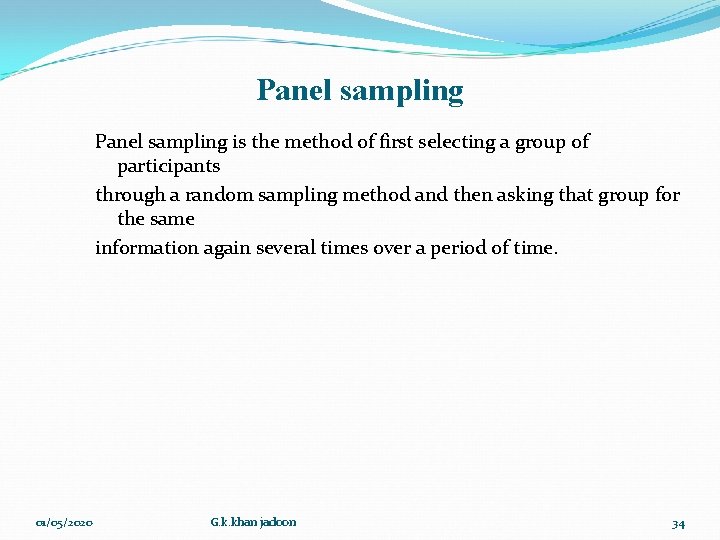
Panel sampling is the method of first selecting a group of participants through a random sampling method and then asking that group for the same information again several times over a period of time. 01/05/2020 G. k. khan jadoon 34
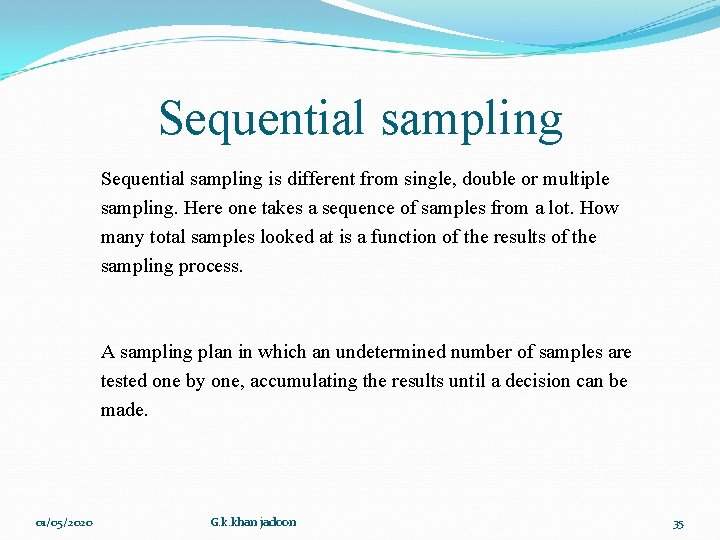
Sequential sampling is different from single, double or multiple sampling. Here one takes a sequence of samples from a lot. How many total samples looked at is a function of the results of the sampling process. A sampling plan in which an undetermined number of samples are tested one by one, accumulating the results until a decision can be made. 01/05/2020 G. k. khan jadoon 35
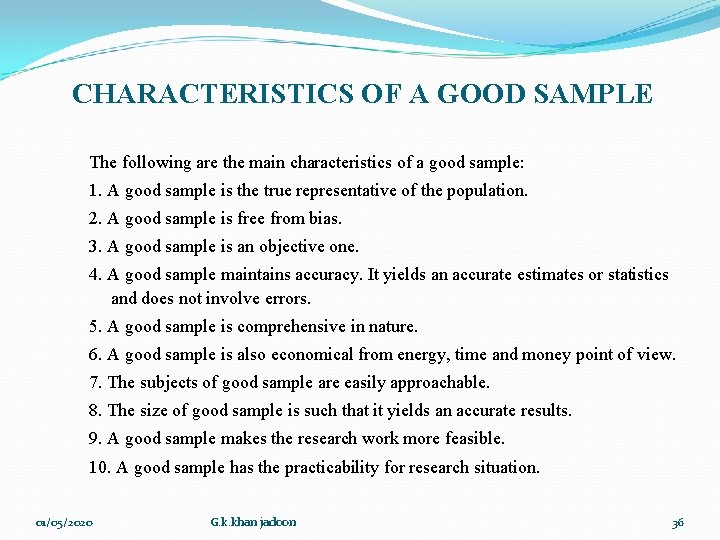
CHARACTERISTICS OF A GOOD SAMPLE The following are the main characteristics of a good sample: 1. A good sample is the true representative of the population. 2. A good sample is free from bias. 3. A good sample is an objective one. 4. A good sample maintains accuracy. It yields an accurate estimates or statistics and does not involve errors. 5. A good sample is comprehensive in nature. 6. A good sample is also economical from energy, time and money point of view. 7. The subjects of good sample are easily approachable. 8. The size of good sample is such that it yields an accurate results. 9. A good sample makes the research work more feasible. 10. A good sample has the practicability for research situation. 01/05/2020 G. k. khan jadoon 36