GLYCOSIDES Silpa M Assistant professor Dept of pharmacology


- Slides: 39
GLYCOSIDES Silpa M Assistant professor Dept. of pharmacology Yenepoya pharmacy college & research centre
Contents • • • Definition Physiochemical properties Classification chemical test General method of isolation Cardiac glycoside Anthraquinone glycoside Saponin glycoside Functions
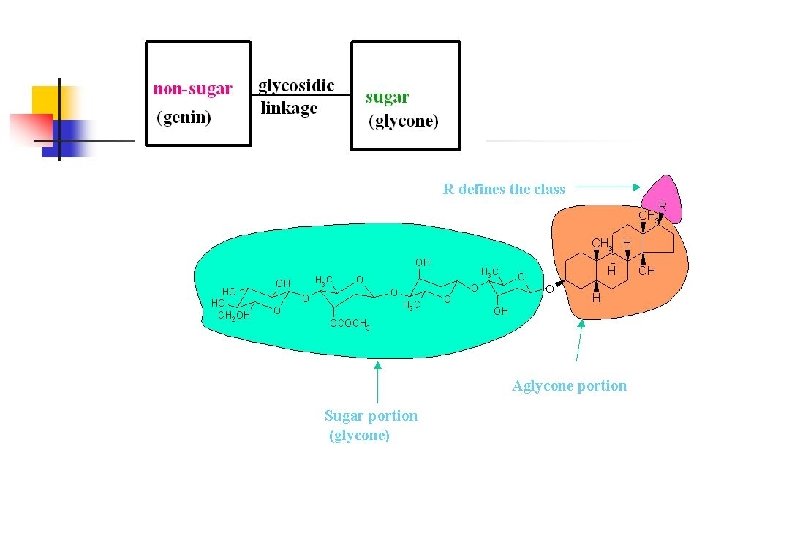
Definition • Glycosides are organic compounds of plant and animal origin which yield on either acidic or enzymatic hydrolysis, one or more sugar and a non-sugar residue. • The non-sugar moiety is called as genin or aglycone , while the sugar components are glycone
• Genins or aglycones may be hydroxylic compounds like alcohols or phenol or even it may be amine. • Glycosides are acetals and thus, the condensation products of sugar and aglycone. • Most commonly occurring sugars as a product of hydrolysis of glycosides are glucose, mannose and galactose • Rhamnose, digitoxose and cymarose occur rarely.
• Few glycosides like α, β and γ methyl glycosides and galactosides are prepared synthetically, as they are not found naturally • Thus, action of glucose on methanol produces α- methyl glycoside and β – methyl glycoside. • Pharmaceutically important glycosides are obtained from vegetable source only. • They occur in various parts of the plants like fruits, seeds, leaves and barks.
PHYSIOCHEMICAL PROPERTIES • Colorless, crystalline, non-reducing, optically active compounds, usually laevo-rotatory. • They are water soluble, as well as, alcohol soluble. • They are hydrolysed with dilute acids and with enzymes naturally present in the same plants containing glycosides , but in different cells.
• Maceration, germination and other physiological conditions of the tissues can cause hydrolysis of glycoside by an enzyme. • Like alkaloids, glycosides also perform important function in the plant life, ie, growth regulation, protection etc. • Therapeutically glycosides are important due to their aglycone content. • They exhibit various type of physiological actions
Classification 1. According to the basis of chemical nature of Aglycone. 2. According to the chemical linkage between Glycone & Aglycone.
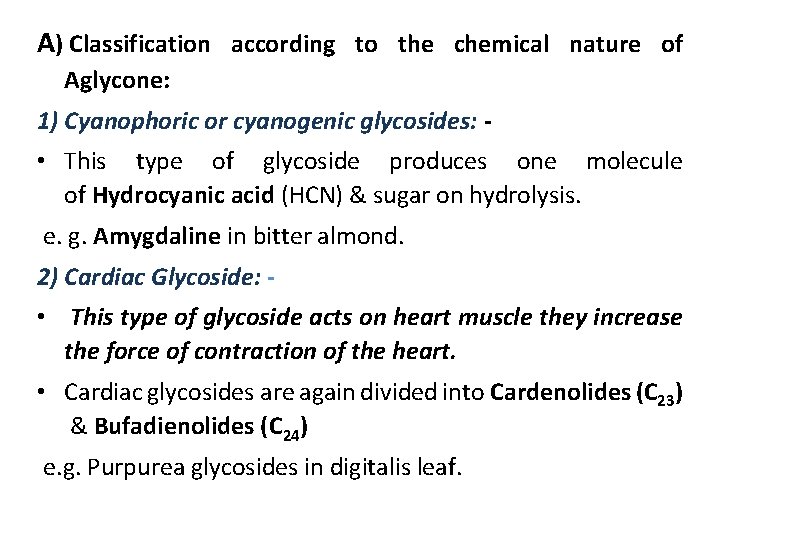
A) Classification according to the chemical nature of Aglycone: 1) Cyanophoric or cyanogenic glycosides: - • This type of glycoside produces one molecule of Hydrocyanic acid (HCN) & sugar on hydrolysis. e. g. Amygdaline in bitter almond. 2) Cardiac Glycoside: - • This type of glycoside acts on heart muscle they increase the force of contraction of the heart. • Cardiac glycosides are again divided into Cardenolides (C 23) & Bufadienolides (C 24) e. g. Purpurea glycosides in digitalis leaf.
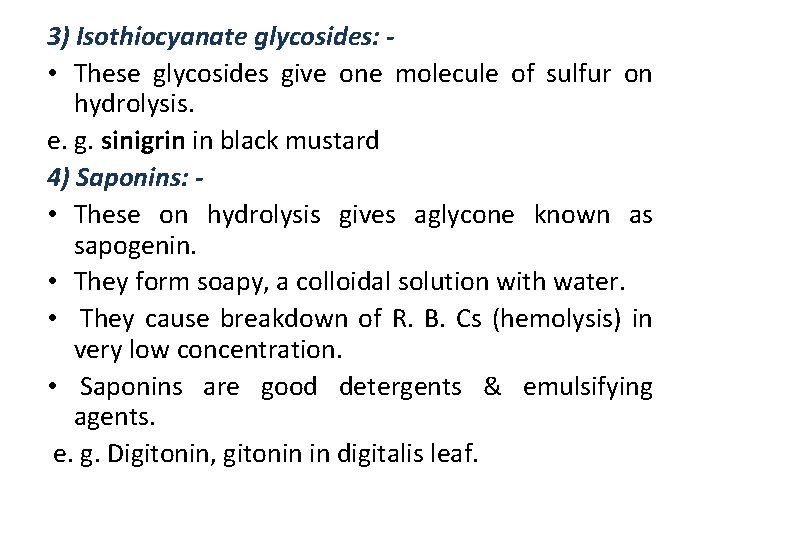
3) Isothiocyanate glycosides: • These glycosides give one molecule of sulfur on hydrolysis. e. g. sinigrin in black mustard 4) Saponins: • These on hydrolysis gives aglycone known as sapogenin. • They form soapy, a colloidal solution with water. • They cause breakdown of R. B. Cs (hemolysis) in very low concentration. • Saponins are good detergents & emulsifying agents. e. g. Digitonin, gitonin in digitalis leaf.
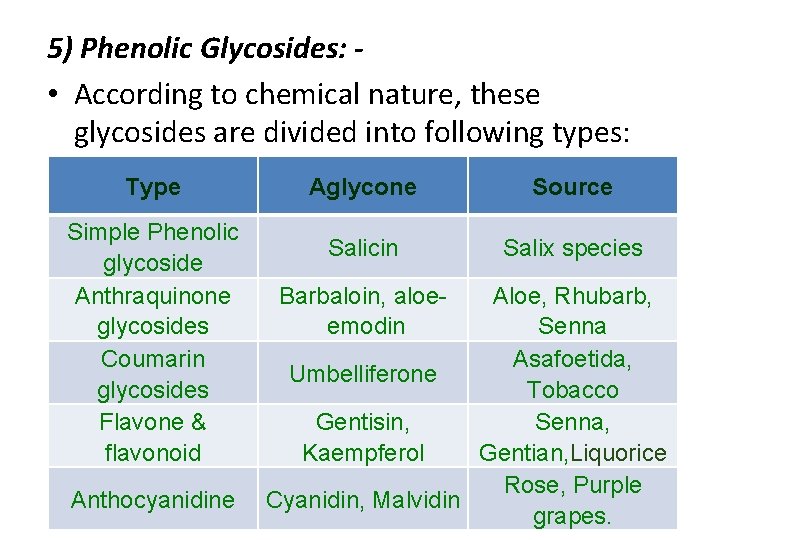
5) Phenolic Glycosides: • According to chemical nature, these glycosides are divided into following types: Type Simple Phenolic glycoside Anthraquinone glycosides Coumarin glycosides Flavone & flavonoid Anthocyanidine Aglycone Source Salicin Salix species Barbaloin, aloe emodin Aloe, Rhubarb, Senna Asafoetida, Umbelliferone Tobacco Gentisin, Senna, Kaempferol Gentian, Liquorice Rose, Purple Cyanidin, Malvidin grapes.
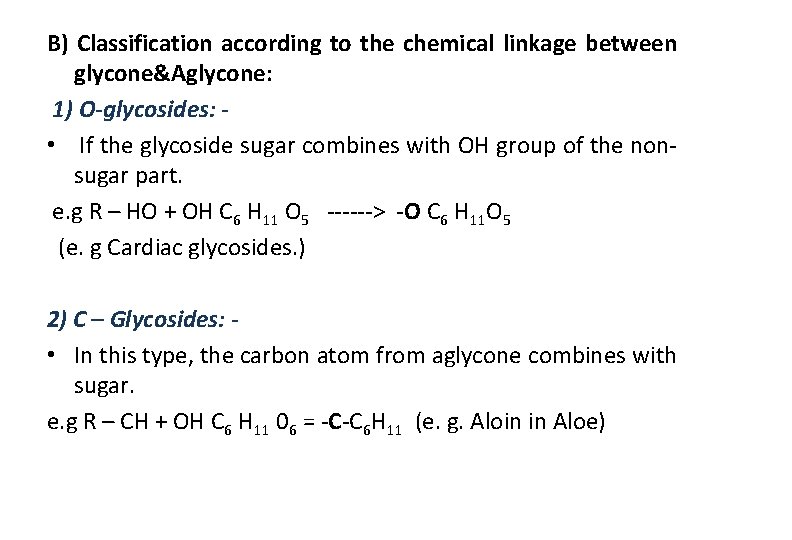
B) Classification according to the chemical linkage between glycone&Aglycone: 1) O-glycosides: • If the glycoside sugar combines with OH group of the non- sugar part. e. g R – HO + OH C 6 H 11 O 5 ------> -O C 6 H 11 O 5 (e. g Cardiac glycosides. ) 2) C – Glycosides: • In this type, the carbon atom from aglycone combines with sugar. e. g R – CH + OH C 6 H 11 06 = -C-C 6 H 11 (e. g. Aloin in Aloe)
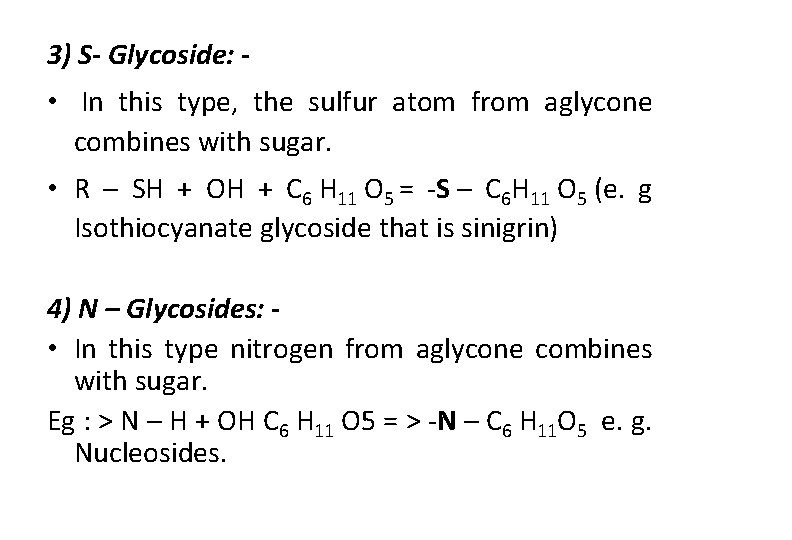
3) S- Glycoside: - • In this type, the sulfur atom from aglycone combines with sugar. • R – SH + OH + C 6 H 11 O 5 = -S – C 6 H 11 O 5 (e. g Isothiocyanate glycoside that is sinigrin) 4) N – Glycosides: • In this type nitrogen from aglycone combines with sugar. Eg : > N – H + OH C 6 H 11 O 5 = > -N – C 6 H 11 O 5 e. g. Nucleosides.
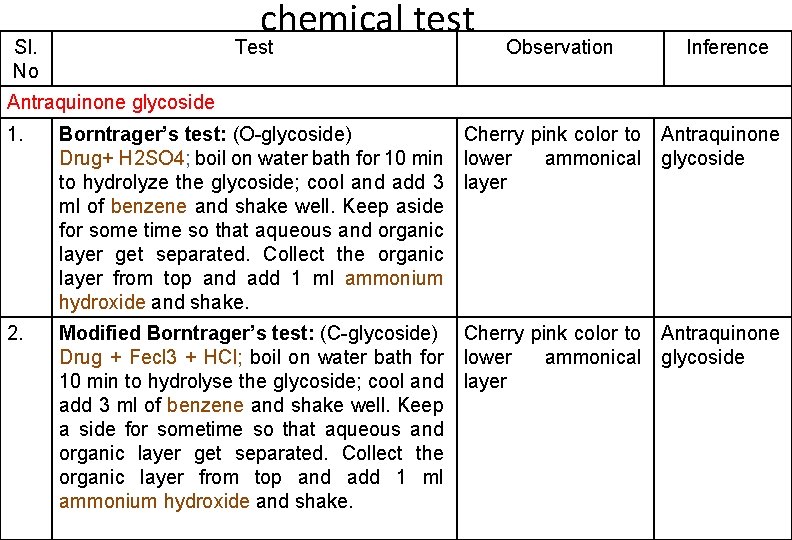
chemical test Sl. No Test Observation Inference Antraquinone glycoside 1. Borntrager’s test: (O-glycoside) Cherry pink color to Antraquinone Drug+ H 2 SO 4; boil on water bath for 10 min lower ammonical glycoside to hydrolyze the glycoside; cool and add 3 layer ml of benzene and shake well. Keep aside for some time so that aqueous and organic layer get separated. Collect the organic layer from top and add 1 ml ammonium hydroxide and shake. 2. Modified Borntrager’s test: (C-glycoside) Drug + Fecl 3 + HCl; boil on water bath for 10 min to hydrolyse the glycoside; cool and add 3 ml of benzene and shake well. Keep a side for sometime so that aqueous and organic layer get separated. Collect the organic layer from top and add 1 ml ammonium hydroxide and shake. Cherry pink color to Antraquinone lower ammonical glycoside layer
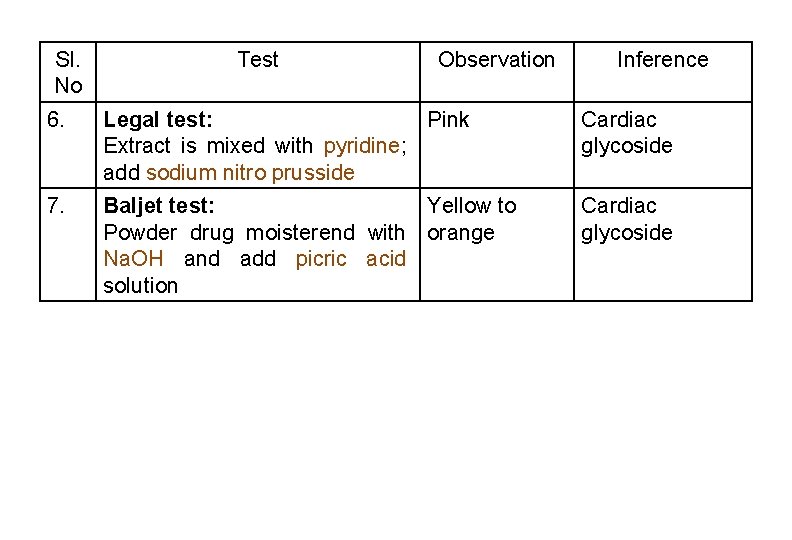
Sl. No Test Observation Inference 6. Legal test: Pink Extract is mixed with pyridine; add sodium nitro prusside Cardiac glycoside 7. Baljet test: Yellow to Powder drug moisterend with orange Na. OH and add picric acid solution Cardiac glycoside
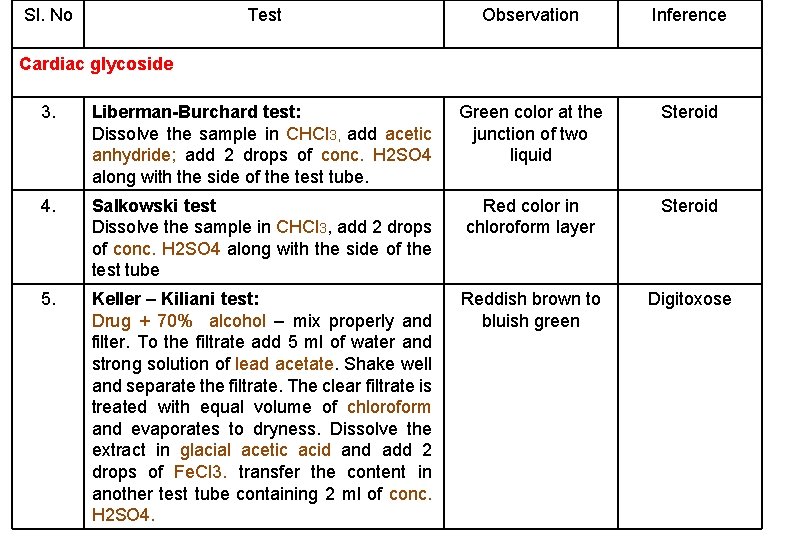
Sl. No Test Observation Inference 3. Liberman-Burchard test: Dissolve the sample in CHCl 3, add acetic anhydride; add 2 drops of conc. H 2 SO 4 along with the side of the test tube. Green color at the junction of two liquid Steroid 4. Salkowski test Dissolve the sample in CHCl 3, add 2 drops of conc. H 2 SO 4 along with the side of the test tube Red color in chloroform layer Steroid 5. Keller – Kiliani test: Drug + 70% alcohol – mix properly and filter. To the filtrate add 5 ml of water and strong solution of lead acetate. Shake well and separate the filtrate. The clear filtrate is treated with equal volume of chloroform and evaporates to dryness. Dissolve the extract in glacial acetic acid and add 2 drops of Fe. Cl 3. transfer the content in another test tube containing 2 ml of conc. H 2 SO 4. Reddish brown to bluish green Digitoxose Cardiac glycoside
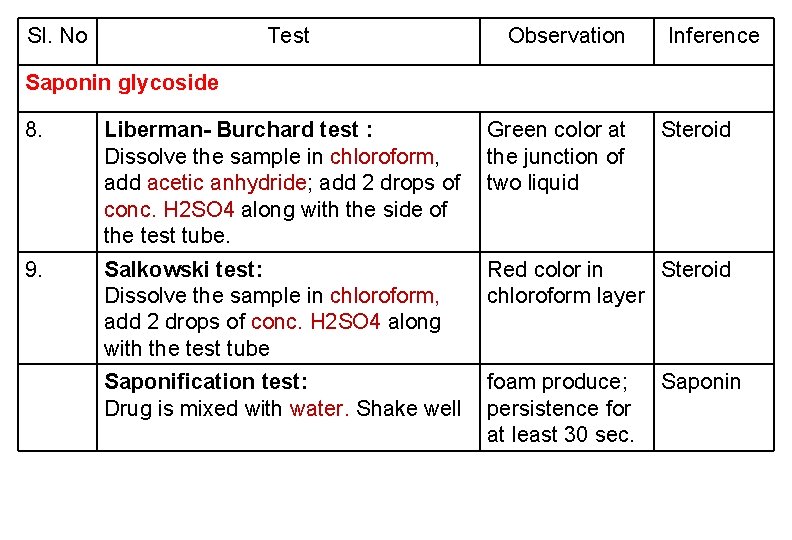
Sl. No Test Observation Inference Saponin glycoside 8. Liberman- Burchard test : Green color at Dissolve the sample in chloroform, the junction of add acetic anhydride; add 2 drops of two liquid conc. H 2 SO 4 along with the side of the test tube. Steroid 9. Salkowski test: Dissolve the sample in chloroform, add 2 drops of conc. H 2 SO 4 along with the test tube Red color in Steroid chloroform layer Saponification test: Drug is mixed with water. Shake well foam produce; persistence for at least 30 sec. Saponin
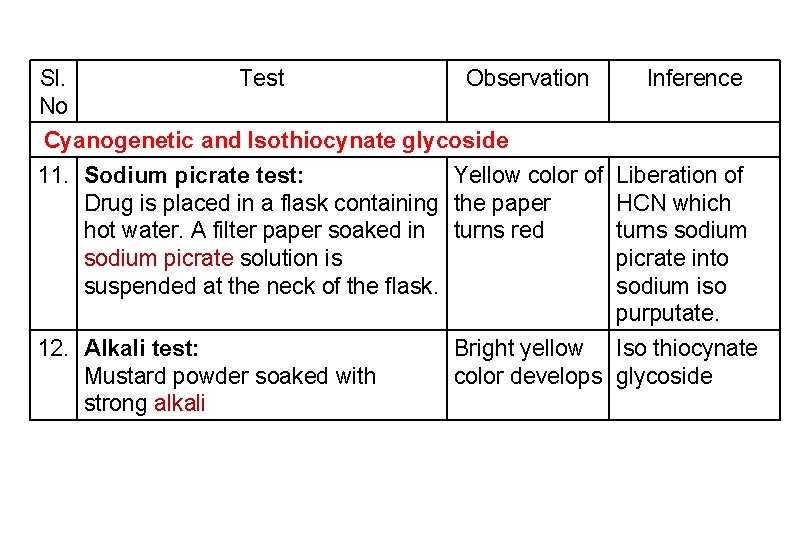
Sl. No Test Observation Inference Cyanogenetic and Isothiocynate glycoside 11. Sodium picrate test: Yellow color of Liberation of Drug is placed in a flask containing the paper HCN which hot water. A filter paper soaked in turns red turns sodium picrate solution is picrate into suspended at the neck of the flask. sodium iso purputate. 12. Alkali test: Mustard powder soaked with strong alkali Bright yellow Iso thiocynate color develops glycoside
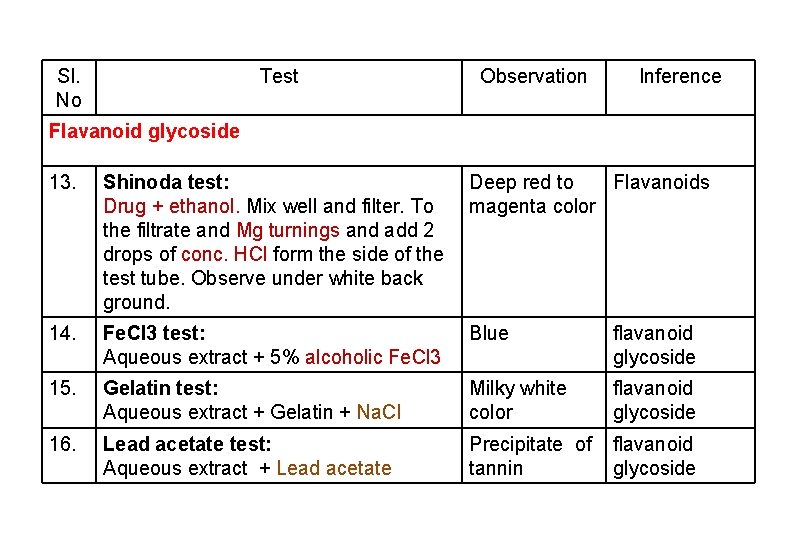
Sl. No Test Observation Inference Flavanoid glycoside 13. Shinoda test: Deep red to Flavanoids Drug + ethanol. Mix well and filter. To magenta color the filtrate and Mg turnings and add 2 drops of conc. HCl form the side of the test tube. Observe under white back ground. 14. Fe. Cl 3 test: Aqueous extract + 5% alcoholic Fe. Cl 3 Blue flavanoid glycoside 15. Gelatin test: Aqueous extract + Gelatin + Na. Cl Milky white color flavanoid glycoside 16. Lead acetate test: Aqueous extract + Lead acetate Precipitate of flavanoid tannin glycoside
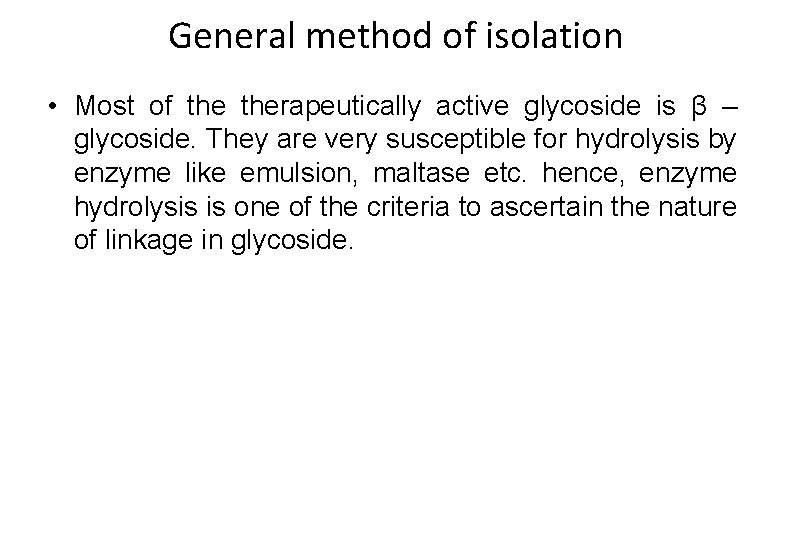
General method of isolation • Most of therapeutically active glycoside is β – glycoside. They are very susceptible for hydrolysis by enzyme like emulsion, maltase etc. hence, enzyme hydrolysis is one of the criteria to ascertain the nature of linkage in glycoside.
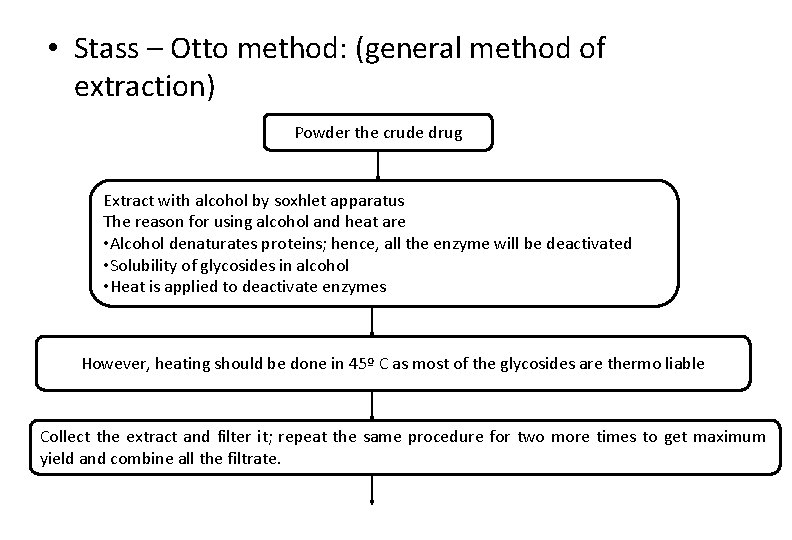
• Stass – Otto method: (general method of extraction) Powder the crude drug Extract with alcohol by soxhlet apparatus The reason for using alcohol and heat are • Alcohol denaturates proteins; hence, all the enzyme will be deactivated • Solubility of glycosides in alcohol • Heat is applied to deactivate enzymes However, heating should be done in 45º C as most of the glycosides are thermo liable Collect the extract and filter it; repeat the same procedure for two more times to get maximum yield and combine all the filtrate.
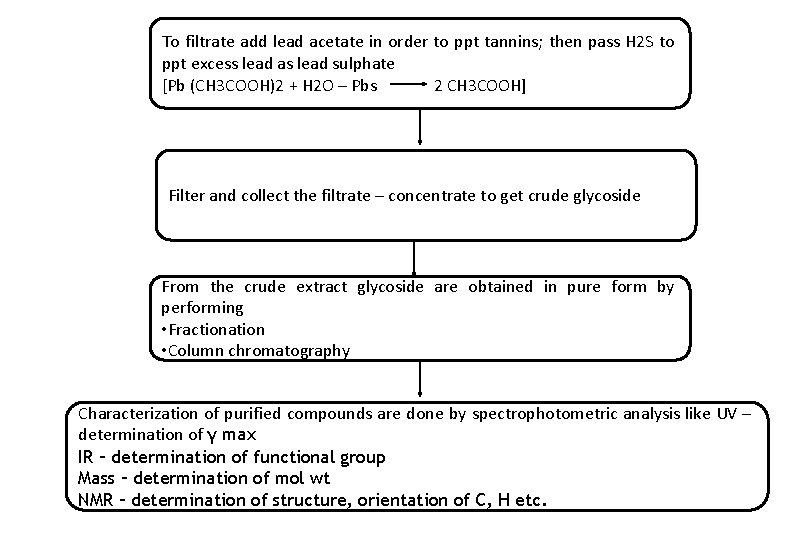
To filtrate add lead acetate in order to ppt tannins; then pass H 2 S to ppt excess lead as lead sulphate [Pb (CH 3 COOH)2 + H 2 O – Pbs 2 CH 3 COOH] Filter and collect the filtrate – concentrate to get crude glycoside From the crude extract glycoside are obtained in pure form by performing • Fractionation • Column chromatography Characterization of purified compounds are done by spectrophotometric analysis like UV – determination of γ max IR – determination of functional group Mass – determination of mol wt NMR – determination of structure, orientation of C, H etc.
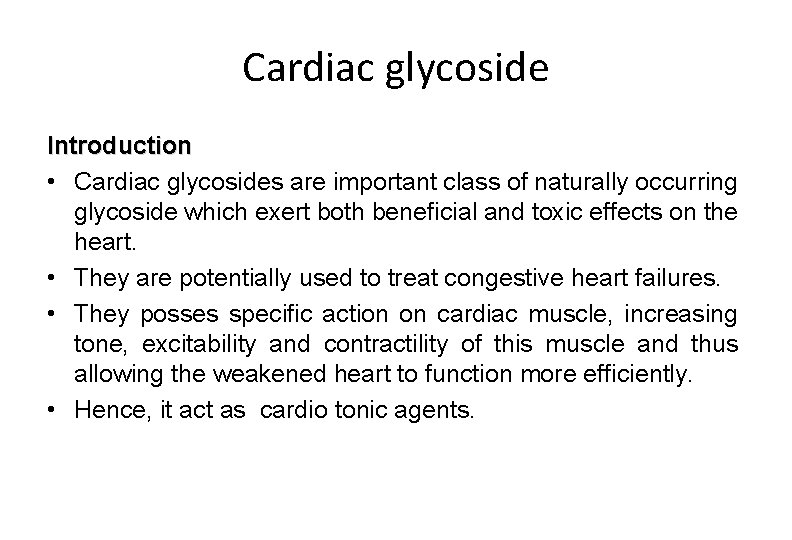
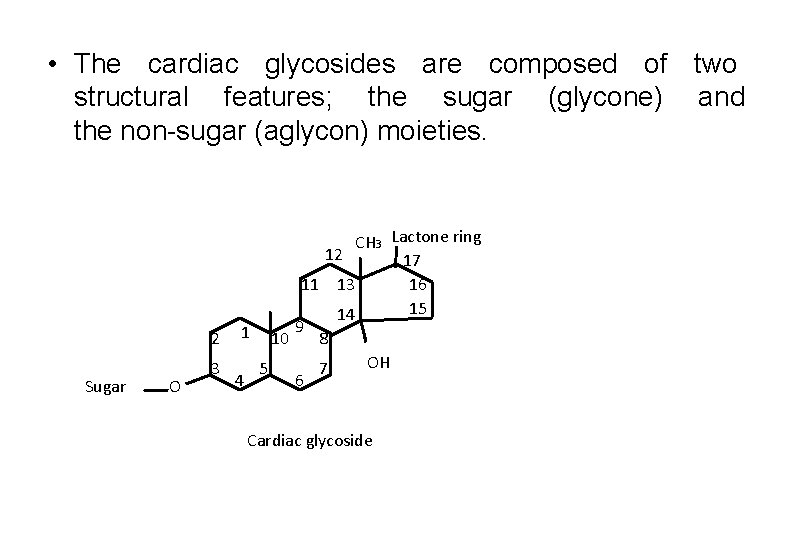
Cardiac glycoside Introduction • Cardiac glycosides are important class of naturally occurring glycoside which exert both beneficial and toxic effects on the heart. • They are potentially used to treat congestive heart failures. • They posses specific action on cardiac muscle, increasing tone, excitability and contractility of this muscle and thus allowing the weakened heart to function more efficiently. • Hence, it act as cardio tonic agents.
• The cardiac glycosides are composed of two structural features; the sugar (glycone) and the non-sugar (aglycon) moieties. Sugar O CH 3 Lactone ring 12 17 11 13 16 15 14 9 2 1 10 8 OH 3 5 7 4 6 Cardiac glycoside
• Aglycone part of cardiac glycosides is steroidal moiety, i. e 5 memberd or 6 memberd lactone rings. • Two classes exist in nature. • cardenolides and bufadienolides. • Those contain five memberd lactone ring are called cardenolides and six memberd lacton containing compounds called bufadienolides.
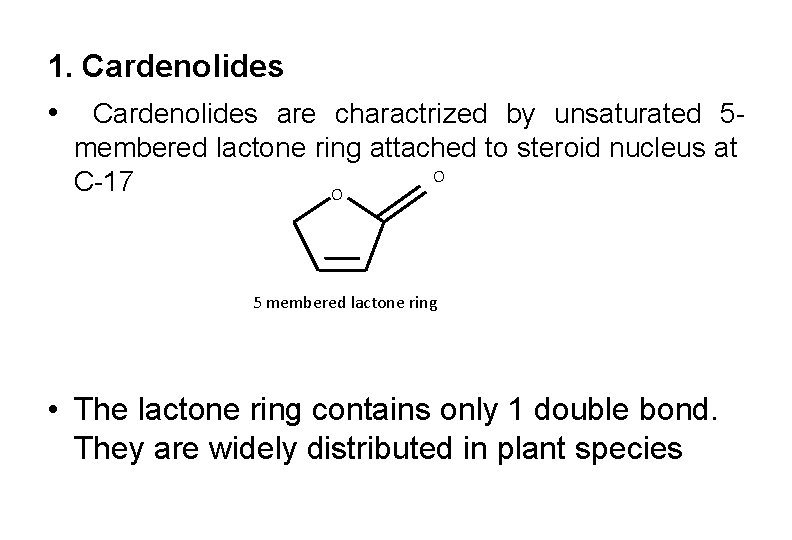
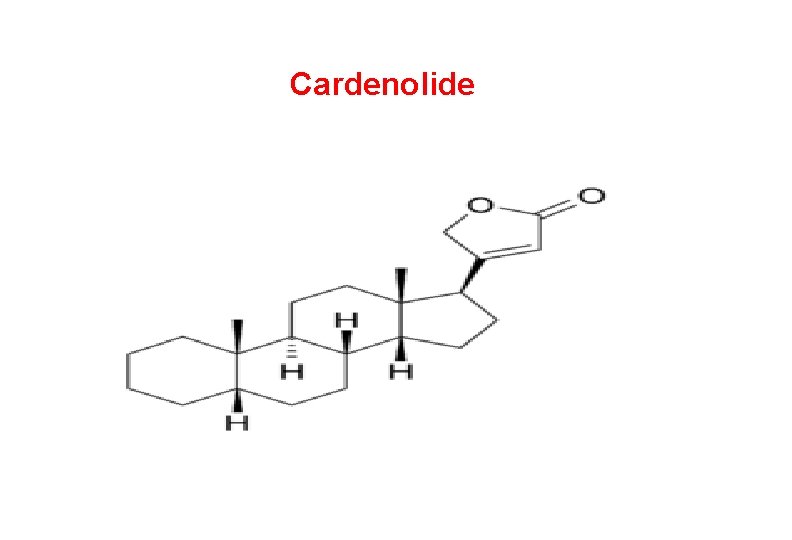
1. Cardenolides • Cardenolides are charactrized by unsaturated 5 membered lactone ring attached to steroid nucleus at O C-17 O 5 membered lactone ring • The lactone ring contains only 1 double bond. They are widely distributed in plant species
Cardenolide
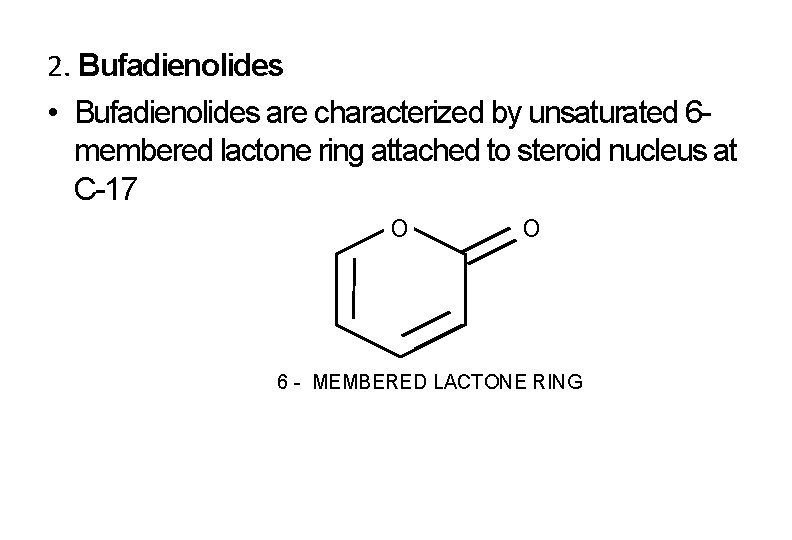
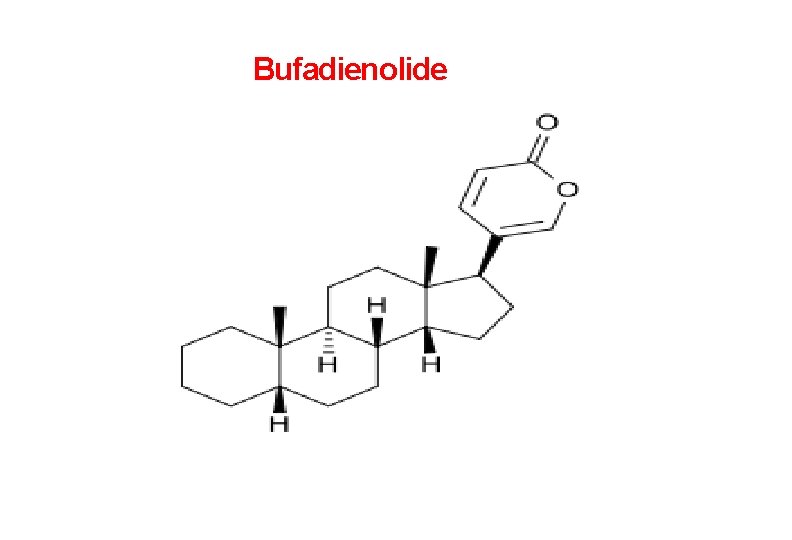
2. Bufadienolides • Bufadienolides are characterized by unsaturated 6 membered lactone ring attached to steroid nucleus at C-17 O O 6 - MEMBERED LACTONE RING
• The lactone ring of bufadinolide contains 2 double bond • They have at least one double bond in the steroid nucleus. They are mainly distributed in animal kingdom • Various types of sugar like glucose, rhamnose, arabinose can be attached to steroidal nucleus at C-3 position. Generally, at a time up to three molecules of sugar can be attached.
Bufadienolide
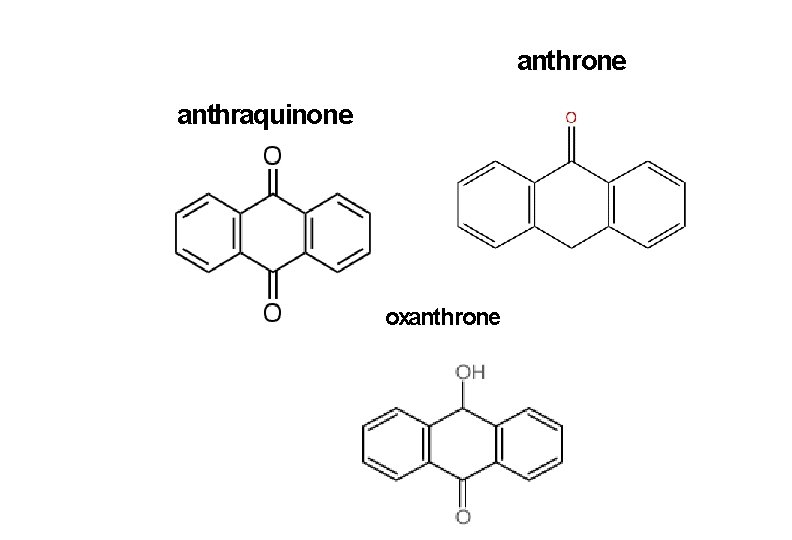
Anthraqiunone glycosides • Anthraquinone is derivative of anthracene. ( C 14 H 10, consisting of three fused benzene rings) • Natural anthraquinone derivative have laxative effects • These glycosides contains anthraquinone, anthrone, anthranol, dianthranol, oxanthrone, dianthrone etc as aglycone part. • parent molecule for all these aglycones is anthraquinone. • In reduced form anthraquinone is present as anthranol or anthrone which are isomeric to each other.
• oxanthrone is intermediate substance from anthraquinone to anthranol. • Bimeric form of anthrone is dianthrone. • in fresh drug these aglycones are present in reduced form which are biologically more active but during drying and storage they hydrolyzed , oxidized. • Sugar part can be glucose, rhamnose, arabinose, primeverose etc.
anthrone anthraquinone oxanthrone
Saponins glycosides • They contain aglycon part sapogenin. harmful safogenins are called sapotoxins. • This aglycone part have foaming action when shaked with water and yields colloidal solution. • They are considerd as haemotoxic because they causes haemolysis of erythrocytes, hence some of them used as fish poisons • Saponins are categorized in to two groups 1 - steroidal saponins(tetracyclic triterpenoid saponins) 2 - pentacyclic triterpenoid saponins
Functions of glycosides: In plant - glycosides play an important role in the life of plant & are involved in its 1. Regulatory function 2. Protective function 3. Sanitary function
• In animal- Because of their wide varieties of chemical nature of glycosides, their pharmacological actions are also widely distributed 1. Cardioactive : Digitalis, squill, strophanthus 2. Laxative - emodin (From Senna, Aloe, Cascara sagrada, Rhubarb) 3. Analgesic - Methyl salicylate (From wintergreen oil) 4. Local irritant - Allyl isothiocyanate (From sinigrin)
QUESTIONS 10 MARKS • Define glycosides. Classify with examples and give their identification test. 5 MARKS • Write the identification testes of glycosides and add a note on therapeutic effects and pharmaceutical application. 2 MARKS • Keller killani test • Chemical testes of glycoside
THANK YOU