Genshu Lu Wenjing Hu Zhengxia Peng Hui Kang
- Slides: 48
Genshu Lu, Wenjing Hu, Zhengxia Peng, Hui Kang Institute of Higher Education Xi’an Jiaotong University The Influence of Undergraduate Students' Academic Involvement and Learning Environment on Learning Outcomes
Main content Genshu Lu, XJTU 1 Introduction 2 Literature review 3 Research design 4 Results 5 Conclusions and suggestions 2 2021/3/4
Introduction • Influence of students’ Individual factor, educational environment factor and their interactions on students’ learning and development is a key issue focused by many researchers. • Many researches discussed the impact of student individual factor, such as individual background, involvement and academic engagement and so forth on their learning and development (Pike, 1991; Thompson et al. , 2006; Lu et al. , 2013). • Some other researchers explored the impact of educational environment on students’ learning and development (Kember & Gow, 1994; Trigwell & Prosser, 1991; Majeed, Fraser, & Aldridge, 2002; Pascarella & Blimling, 1996; Lu et al. , 2010) 2021/3/4 Genshu Lu, XJTU 3
Introduction • Though some researchers stated individual factor, educational environment factor and their interactions impacted on students’ learning and development, in China mainland, for the lack of data, this influence is rarely verified empirically. • Hence, this study, applying the data of Xi’an Jiaotong University Undergraduate Experience Survey attempts to empirically discuss the impact of campus climate, classroom learning environment and the individual factors like students’ academic involvement/engagement on students learning outcomes (like intellectual skill development, GPA). 2021/3/4 Genshu Lu, XJTU 4
Introduction • This study is mainly around the following questions: – a) How to measure learning environment? – b) How to measure students’ academic involvement/ engagement? – c) What is the relationship between students’ learning environment, academic involvement/engagement and students’ learning outcomes? • Methodologically, structural equation model is applied to explore the relationship between learning environment, academic involvement/engagement and students learning outcomes and the connection of these factors more accurately and completely. 2021/3/4 Genshu Lu, XJTU 5
Literature Review • The relationship between learning environment and learning outcomes – The influence of learning environment on learning outcomes is the key issue focused by many researchers – They discussed the influence of learning environment at different levels, including classroom level, faculty level and university level, on learning outcomes. 2021/3/4 Genshu Lu, XJTU 6
Literature Review • The relationship between learning environment and learning outcomes – As the indicators adopted to describe learning outcomes differ a lot, such as students’ cognitive development, the freshman retention, GPA, the pursuit of graduate education, employment outcome or emotional development and so forth, the exploration of the relationship between learning environment and learning outcomes involves in many aspects (Lu & Yang, 2008). 2021/3/4 Genshu Lu, XJTU 7
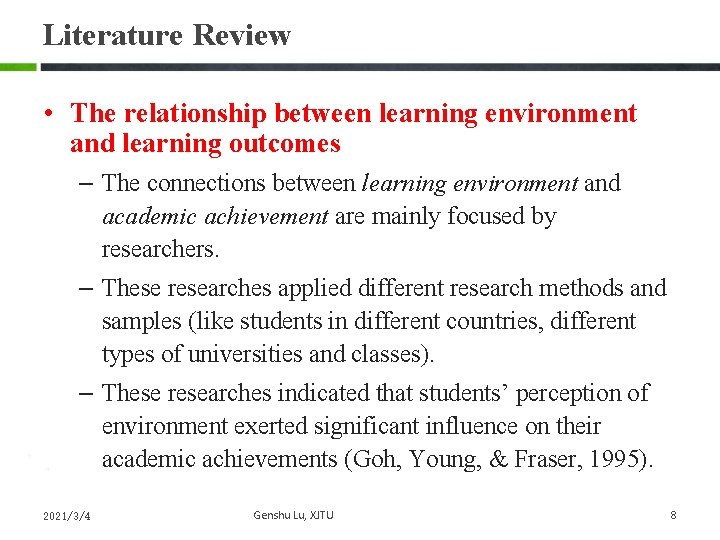
Literature Review • The relationship between learning environment and learning outcomes – The connections between learning environment and academic achievement are mainly focused by researchers. – These researches applied different research methods and samples (like students in different countries, different types of universities and classes). – These researches indicated that students’ perception of environment exerted significant influence on their academic achievements (Goh, Young, & Fraser, 1995). 2021/3/4 Genshu Lu, XJTU 8
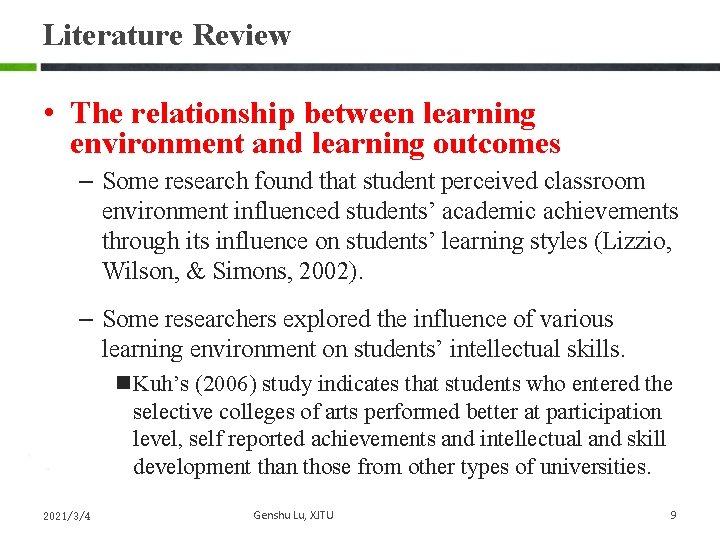
Literature Review • The relationship between learning environment and learning outcomes – Some research found that student perceived classroom environment influenced students’ academic achievements through its influence on students’ learning styles (Lizzio, Wilson, & Simons, 2002). – Some researchers explored the influence of various learning environment on students’ intellectual skills. n. Kuh’s (2006) study indicates that students who entered the selective colleges of arts performed better at participation level, self reported achievements and intellectual and skill development than those from other types of universities. 2021/3/4 Genshu Lu, XJTU 9
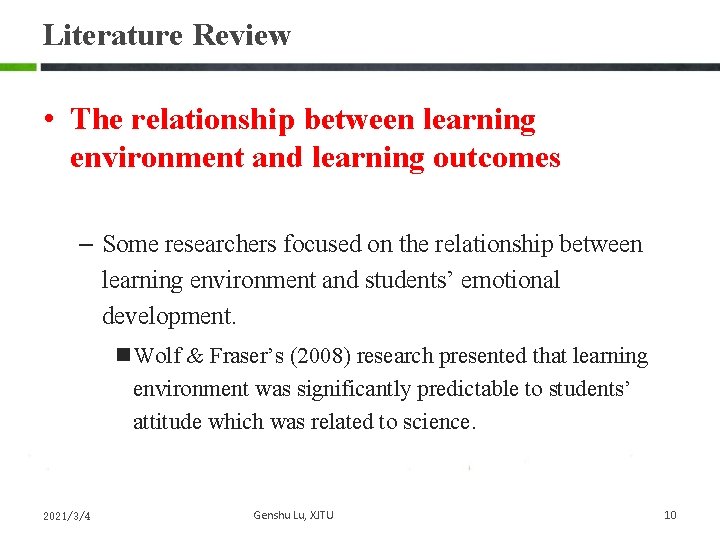
Literature Review • The relationship between learning environment and learning outcomes – Some researchers focused on the relationship between learning environment and students’ emotional development. n. Wolf & Fraser’s (2008) research presented that learning environment was significantly predictable to students’ attitude which was related to science. 2021/3/4 Genshu Lu, XJTU 10
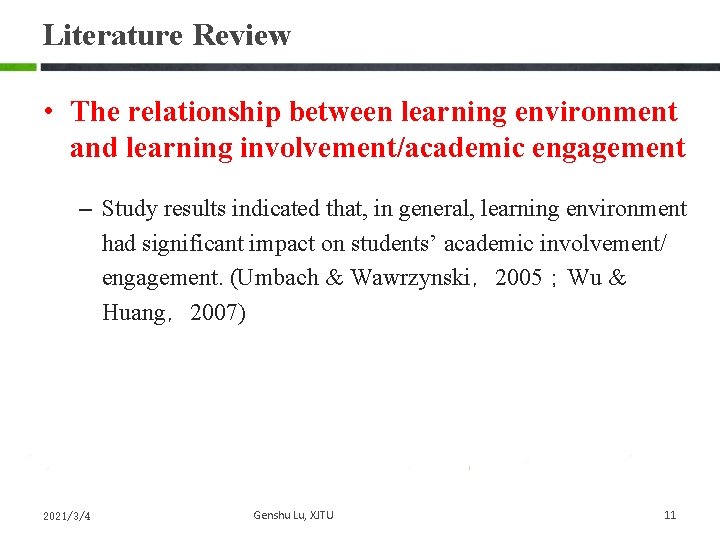
Literature Review • The relationship between learning environment and learning involvement/academic engagement – Study results indicated that, in general, learning environment had significant impact on students’ academic involvement/ engagement. (Umbach & Wawrzynski,2005;Wu & Huang,2007) 2021/3/4 Genshu Lu, XJTU 11
Literature Review • The relationship between learning engagement and learning outcomes – Some researches argued that academic involvement/ engagement played crucial role in promoting the development of cognitive skills and getting better achievements. 2021/3/4 Genshu Lu, XJTU 12
Literature Review • The relationship between learning environment, academic involvement/engagement and learning outcomes – Some researches comprehensively explored the influence of learning environment, academic involvement/ engagement on learning outcomes, finding the close connection between them. 2021/3/4 Genshu Lu, XJTU 13
Research design • Sample – This research data is collected through the survey of 14, 759 undergraduate (except those whose four year system were extended and international students) on April 6, 2012 by means of network questionnaire. – 5, 188 questionnaires are collected, accounting for 35. 15%, among which 3, 946 are valid, accounting for 76. 06%. Genshu Lu, XJTU 14 2011/4/15
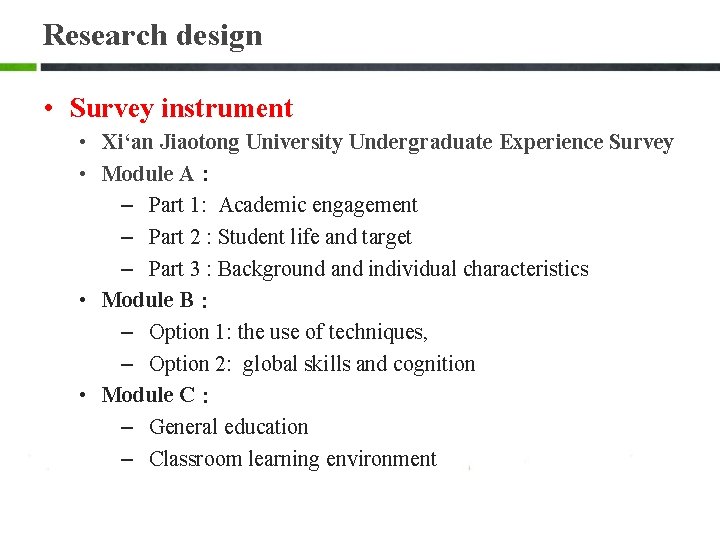
Research design • Survey instrument • Xi‘an Jiaotong University Undergraduate Experience Survey • Module A: – Part 1: Academic engagement – Part 2 : Student life and target – Part 3 : Background and individual characteristics • Module B: – Option 1: the use of techniques, – Option 2: global skills and cognition • Module C: – General education – Classroom learning environment
Research design The result of factor analysis and reliability analysis on student perceived classroom learning environment
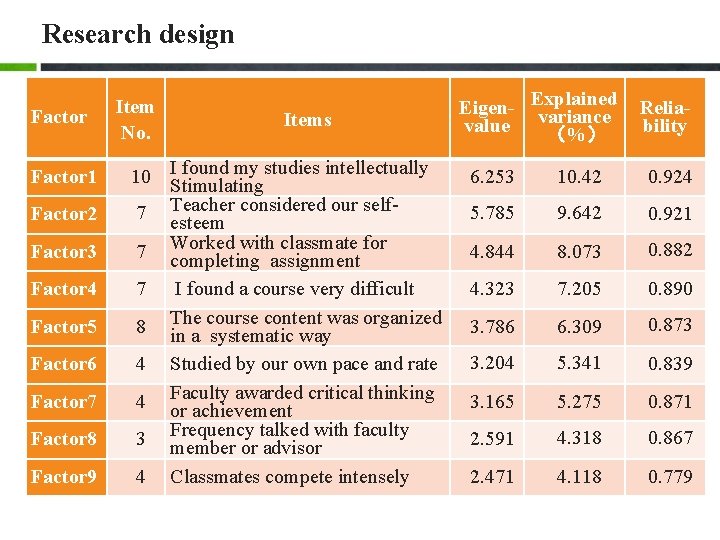
Research design Factor Item No. Items Eigen- Explained value variance (%) Reliability 6. 253 10. 42 0. 924 5. 785 9. 642 0. 921 Factor 3 found my studies intellectually 10 IStimulating 7 Teacher considered our selfesteem with classmate for 7 Worked completing assignment 4. 844 8. 073 0. 882 Factor 4 7 4. 323 7. 205 0. 890 Factor 5 8 3. 786 6. 309 0. 873 Factor 6 4 3. 204 5. 341 0. 839 Factor 7 4 3. 165 5. 275 0. 871 Factor 8 3 2. 591 4. 318 0. 867 Factor 9 4 2. 471 4. 118 0. 779 Factor 1 Factor 2 I found a course very difficult The course content was organized in a systematic way Studied by our own pace and rate Faculty awarded critical thinking or achievement Frequency talked with faculty member or advisor Classmates compete intensely
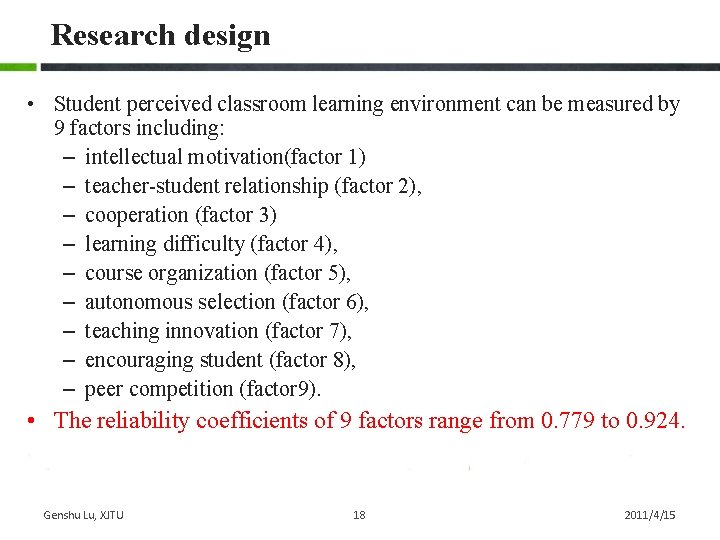
Research design • Student perceived classroom learning environment can be measured by 9 factors including: – intellectual motivation(factor 1) – teacher-student relationship (factor 2), – cooperation (factor 3) – learning difficulty (factor 4), – course organization (factor 5), – autonomous selection (factor 6), – teaching innovation (factor 7), – encouraging student (factor 8), – peer competition (factor 9). • The reliability coefficients of 9 factors range from 0. 779 to 0. 924. Genshu Lu, XJTU 18 2011/4/15
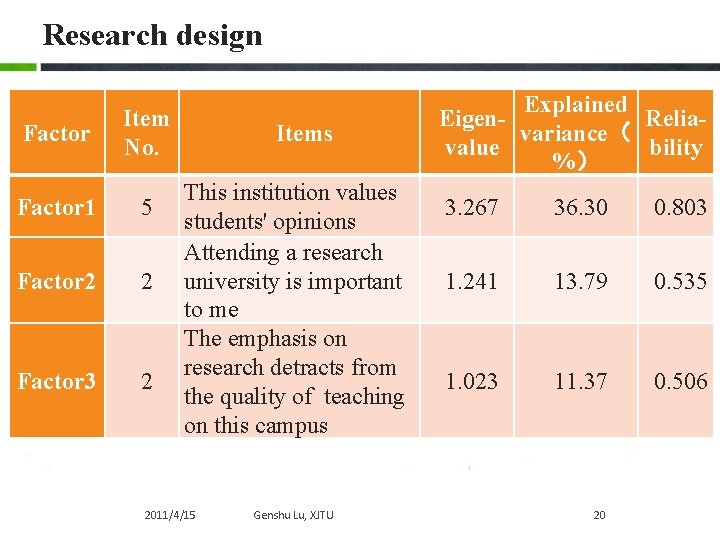
Research design The result of factor analysis and reliability analysis on student perceived campus climate 2011/4/15 Genshu Lu, XJTU 19
Research design Factor Item No. Factor 1 5 Factor 2 2 Factor 3 2 Items This institution values students' opinions Attending a research university is important to me The emphasis on research detracts from the quality of teaching on this campus 2011/4/15 Genshu Lu, XJTU Explained Eigen. Reliavariance( value bility %) 3. 267 36. 30 0. 803 1. 241 13. 79 0. 535 1. 023 11. 37 0. 506 20
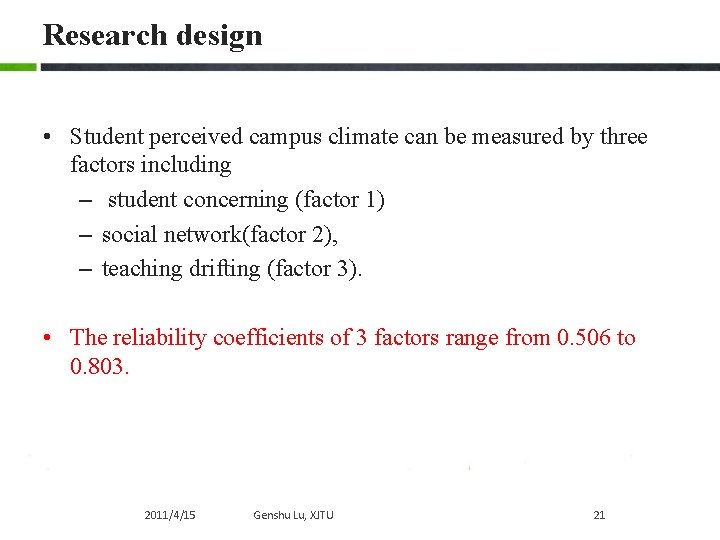
Research design • Student perceived campus climate can be measured by three factors including – student concerning (factor 1) – social network(factor 2), – teaching drifting (factor 3). • The reliability coefficients of 3 factors range from 0. 506 to 0. 803. 2011/4/15 Genshu Lu, XJTU 21
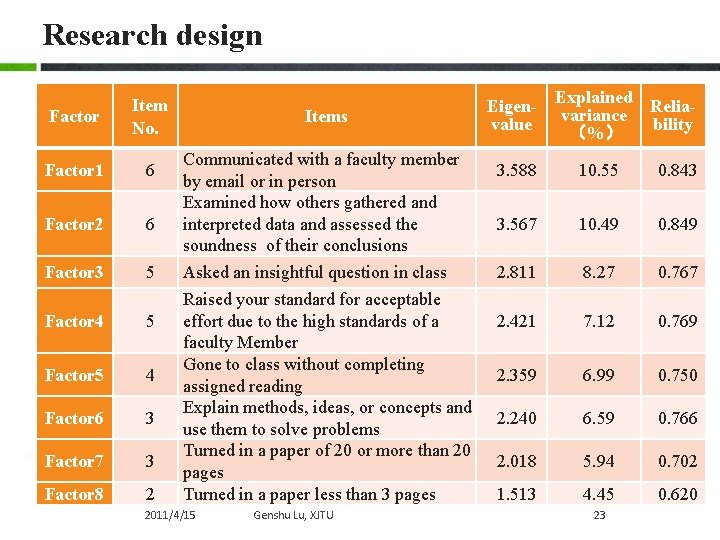
Research design The result of factor analysis and reliability analysis on academic involvement/engagement 2011/4/15 Genshu Lu, XJTU 22
Research design Factor Item No. Factor 1 6 Factor 2 6 Factor 3 5 Factor 4 5 Factor 5 4 Factor 6 3 Factor 7 3 Factor 8 2 Items Communicated with a faculty member by email or in person Examined how others gathered and interpreted data and assessed the soundness of their conclusions Asked an insightful question in class Raised your standard for acceptable effort due to the high standards of a faculty Member Gone to class without completing assigned reading Explain methods, ideas, or concepts and use them to solve problems Turned in a paper of 20 or more than 20 pages Turned in a paper less than 3 pages 2011/4/15 Genshu Lu, XJTU Eigenvalue Explained Reliavariance bility (%) 3. 588 10. 55 0. 843 3. 567 10. 49 0. 849 2. 811 8. 27 0. 767 2. 421 7. 12 0. 769 2. 359 6. 99 0. 750 2. 240 6. 59 0. 766 2. 018 5. 94 0. 702 1. 513 4. 45 0. 620 23
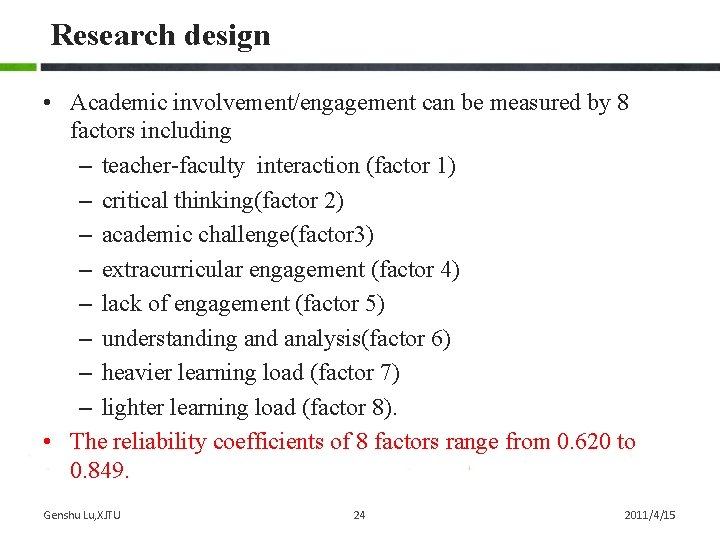
Research design • Academic involvement/engagement can be measured by 8 factors including – teacher-faculty interaction (factor 1) – critical thinking(factor 2) – academic challenge(factor 3) – extracurricular engagement (factor 4) – lack of engagement (factor 5) – understanding and analysis(factor 6) – heavier learning load (factor 7) – lighter learning load (factor 8). • The reliability coefficients of 8 factors range from 0. 620 to 0. 849. Genshu Lu, XJTU 24 2011/4/15
Research design The result of factor analysis and reliability analysis on student intellectual skills development Genshu Lu, XJTU 25 2011/4/15
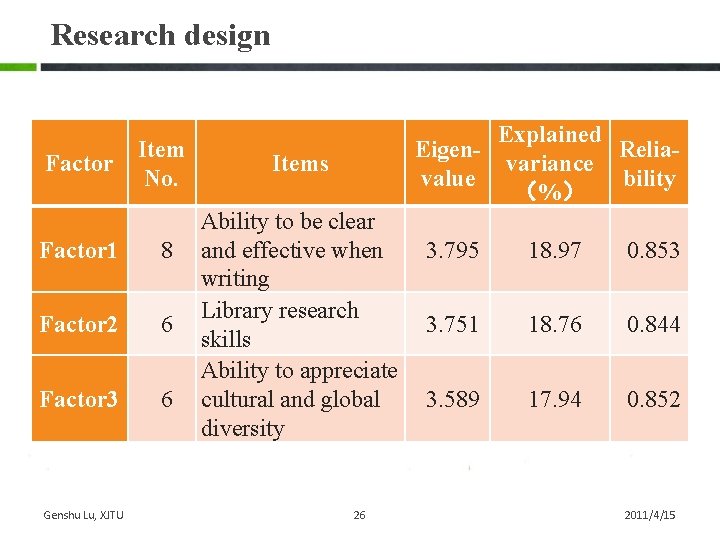
Research design Factor Item No. Factor 1 8 Factor 2 6 Factor 3 6 Genshu Lu, XJTU Explained Eigen. Reliavariance value bility (%) Items Ability to be clear and effective when writing Library research skills Ability to appreciate cultural and global diversity 26 3. 795 18. 97 0. 853 3. 751 18. 76 0. 844 3. 589 17. 94 0. 852 2011/4/15
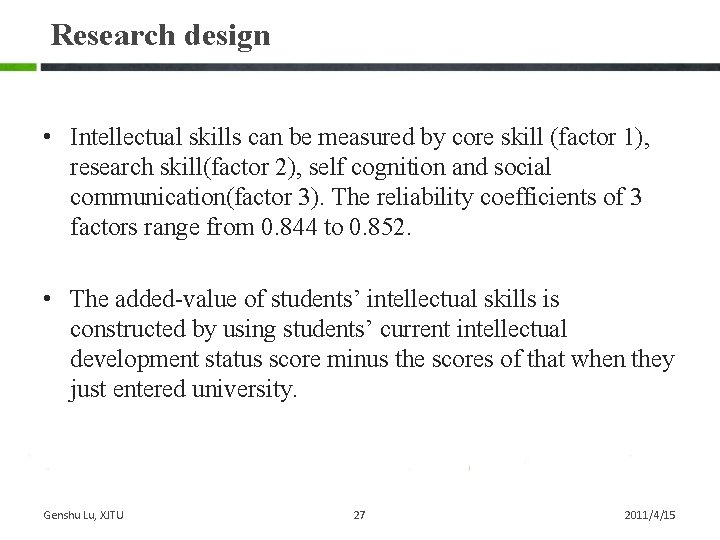
Research design • Intellectual skills can be measured by core skill (factor 1), research skill(factor 2), self cognition and social communication(factor 3). The reliability coefficients of 3 factors range from 0. 844 to 0. 852. • The added-value of students’ intellectual skills is constructed by using students’ current intellectual development status score minus the scores of that when they just entered university. Genshu Lu, XJTU 27 2011/4/15
Research design The result of factor analysis and reliability analysis on student perceived satisfaction of learning experience Genshu Lu, XJTU 28 2011/4/15
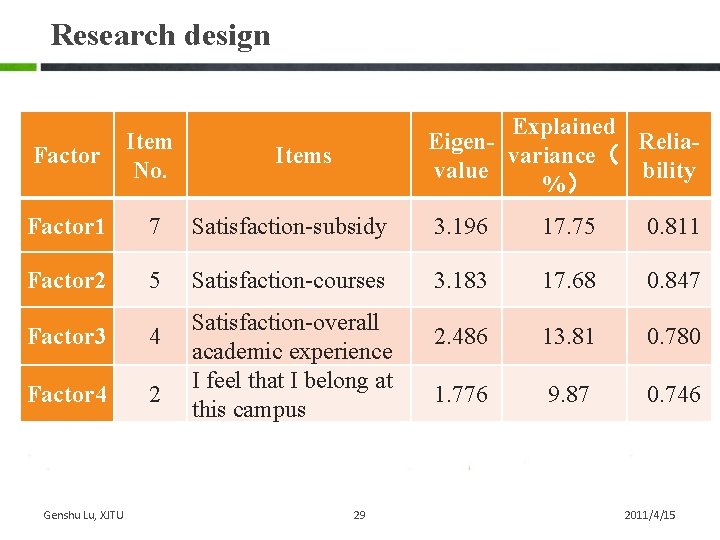
Research design Explained Eigen. Reliavariance( value bility %) Factor Item No. Factor 1 7 Satisfaction-subsidy 3. 196 17. 75 0. 811 Factor 2 5 Satisfaction-courses 3. 183 17. 68 0. 847 2. 486 13. 81 0. 780 1. 776 9. 87 0. 746 Factor 3 4 Factor 4 2 Genshu Lu, XJTU Items Satisfaction-overall academic experience I feel that I belong at this campus 29 2011/4/15
Research design • Student perceived satisfaction of learning experience can be measured by environmental support(factor 1), quality of course (factor 2), campus life(factor 3), sense of belonging (factor 4). The reliability coefficients of 4 factors range from 0. 746 to 0. 847. Genshu Lu, XJTU 30 2011/4/15
Research design • Analysis method – Structural equation model is applied in this study to simultaneously and holistically discuss the influence of learning environment and academic involvement/ engagement on learning outcomes. Genshu Lu, XJTU 31 2011/4/15
Results • The basic characteristics of student perceived classroom learning environment • In general, students are satisfied with perceived classroom learning environment
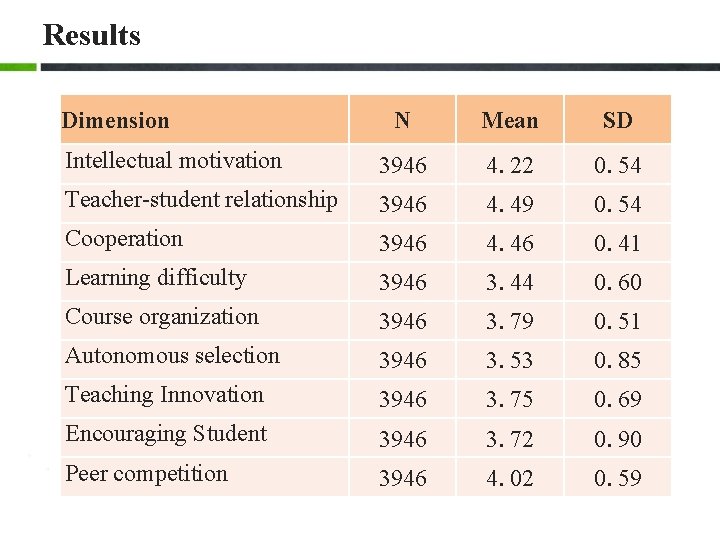
Results Dimension N Mean SD Intellectual motivation 3946 4. 22 0. 54 Teacher-student relationship 3946 4. 49 0. 54 Cooperation 3946 4. 46 0. 41 Learning difficulty 3946 3. 44 0. 60 Course organization 3946 3. 79 0. 51 Autonomous selection 3946 3. 53 0. 85 Teaching Innovation 3946 3. 75 0. 69 Encouraging Student 3946 3. 72 0. 90 Peer competition 3946 4. 02 0. 59
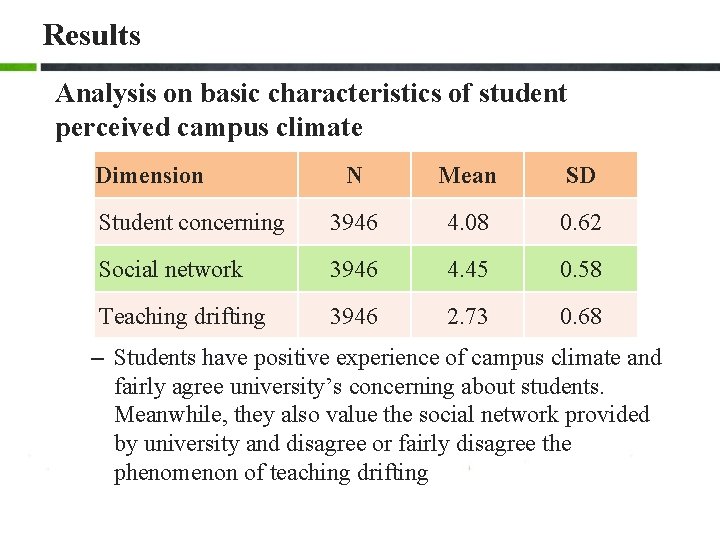
Results Analysis on basic characteristics of student perceived campus climate Dimension N Mean SD Student concerning 3946 4. 08 0. 62 Social network 3946 4. 45 0. 58 Teaching drifting 3946 2. 73 0. 68 – Students have positive experience of campus climate and fairly agree university’s concerning about students. Meanwhile, they also value the social network provided by university and disagree or fairly disagree the phenomenon of teaching drifting
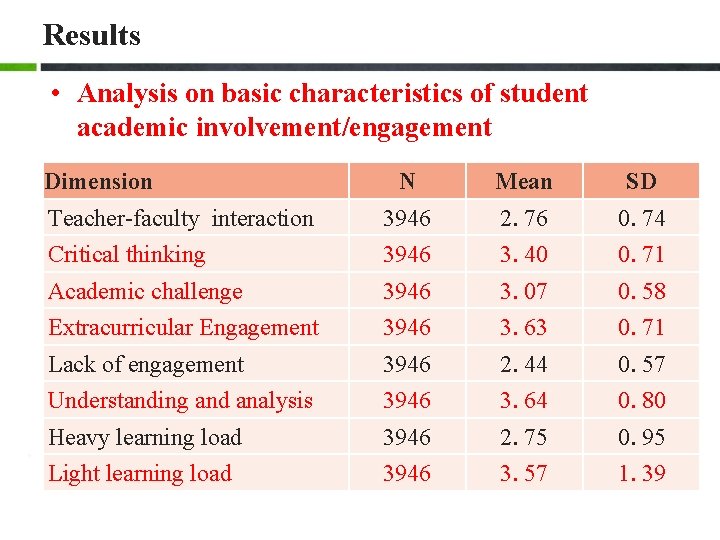
Results • Analysis on basic characteristics of student academic involvement/engagement Dimension N Mean SD Teacher-faculty interaction 3946 2. 76 0. 74 Critical thinking 3946 3. 40 0. 71 Academic challenge 3946 3. 07 0. 58 Extracurricular Engagement 3946 3. 63 0. 71 Lack of engagement 3946 2. 44 0. 57 Understanding and analysis 3946 3. 64 0. 80 Heavy learning load 3946 2. 75 0. 95 Light learning load 3946 3. 57 1. 39
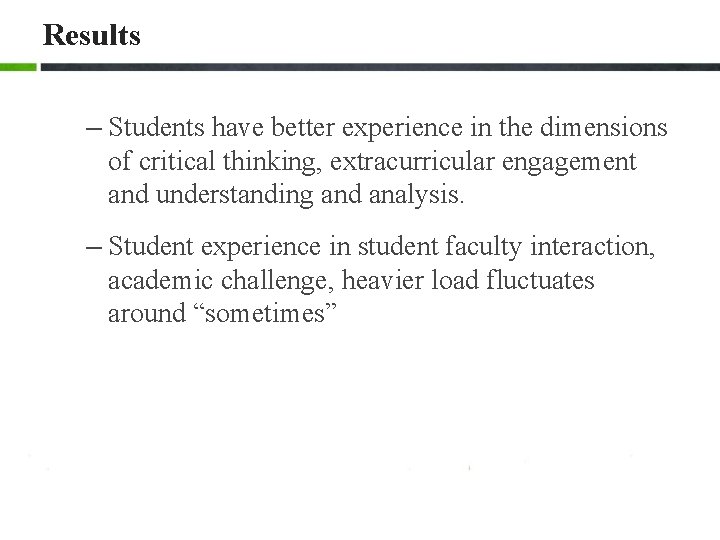
Results – Students have better experience in the dimensions of critical thinking, extracurricular engagement and understanding and analysis. – Student experience in student faculty interaction, academic challenge, heavier load fluctuates around “sometimes”
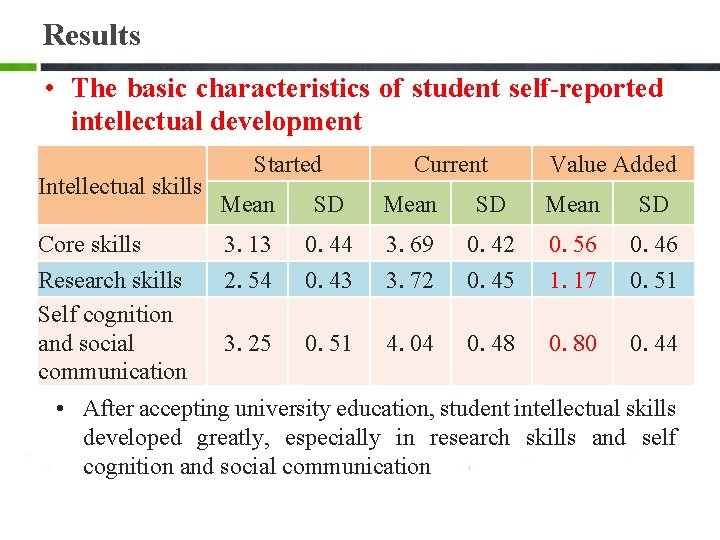
Results • The basic characteristics of student self-reported intellectual development Intellectual skills Started Current Value Added Mean SD Core skills 3. 13 0. 44 3. 69 0. 42 0. 56 0. 46 Research skills Self cognition and social communication 2. 54 0. 43 3. 72 0. 45 1. 17 0. 51 3. 25 0. 51 4. 04 0. 48 0. 80 0. 44 • After accepting university education, student intellectual skills developed greatly, especially in research skills and self cognition and social communication
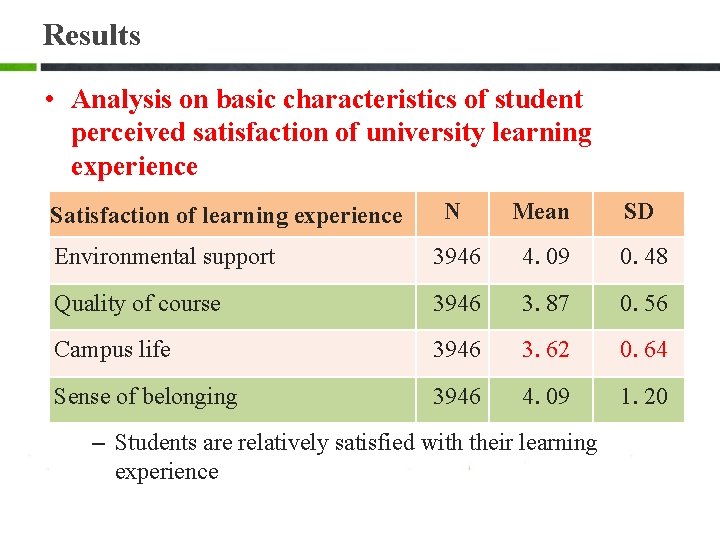
Results • Analysis on basic characteristics of student perceived satisfaction of university learning experience N Mean SD Environmental support 3946 4. 09 0. 48 Quality of course 3946 3. 87 0. 56 Campus life 3946 3. 62 0. 64 Sense of belonging 3946 4. 09 1. 20 Satisfaction of learning experience – Students are relatively satisfied with their learning experience
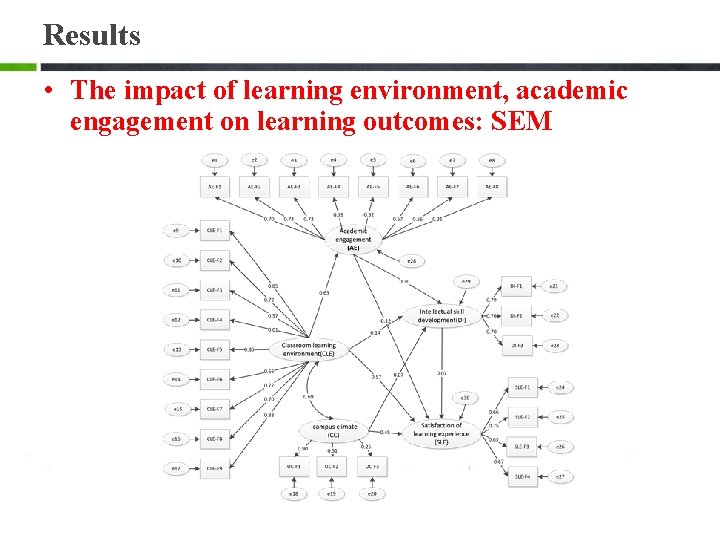
Results • The impact of learning environment, academic engagement on learning outcomes: SEM
Results • Student perceived learning environment, level of academic involvement/engagement, their intellectual skill development and satisfaction of university learning experience are correlated. That is, student who perceived the better learning environment reported higher levels of academic involvement/engagement, better intellectual skill development and more satisfied with university learning experience. • Student perceived classroom learning environment and campus climate are positively correlated.
Results • While comparing the influence of students perceived classroom learning environment with that of student perceived campus climate, we can see that students perceived classroom learning environment has direct and greater impact on the level of their academic involvement/engagement, intellectual skill development and satisfaction with university learning experience.
Results • The level of students’ academic involvement/engagement is positively correlated to their intellectual skill development whereas negatively related to student perceived satisfaction of university learning experience, which indicates more academic involvement/engagement would do good to students’ intellectual skill development but may raise their expectations and requirements to university education. Thereby, more engaged student might report lower level of satisfaction of university learning experience. 3/4/2021 Genshu Lu, XJTU 42
Results • Undergraduate intellectual skill development is positively associated with their perceived satisfaction of university learning experience. That means student who performed better in intellectual skill development reported a higher level of satisfaction with university learning experience. 3/4/2021 Genshu Lu, XJTU 43
Conclusions and Suggestions • Students perceive good classroom learning environment and campus climate. In their perception of all aspects of classroom learning environment, factors like teacher student relationship, cooperation and intellectual motivation are the best. Factors including peer competition, course organization, teaching innovation, encouraging student are better whereas factors like autonomous selection and learning difficulty are to be improved. Hence, the classroom learning environment is to be further optimized.
Conclusions and Suggestions • The level of undergraduates’ academic involvement/ engagement is high. Students engage themselves frequently into extracurricular activities as well as understanding and analysis activities. They sometimes take on heavy-loaded learning tasks and they perform a certain level of engagement in teacher student relationship, critical thinking and academic challenge. There hardly exists the phenomenon of “lack of engagement”. Therefore, student faculty interaction should be strengthened and academic challenge should be raised to promote student academic involvement/engagement.
Conclusions and Suggestions • Students intellectual skills are well developed. Seen from value -added, research skills developed best, then followed selfcognition and social communication while the least developing in core skills. This means the core skill training should be enforced to make the better development of student intellectual skills. • Undergraduates are fairly satisfied with their university learning experience, of which students are best satisfied with environmental support and sense of belonging, then with course quality, whereas the factor of campus life should be enhanced.
Conclusions and Suggestions • Learning environment and the level of student academic involvement/engagement have positive effect on undergraduates’ learning outcomes, which means by optimizing learning environment, especially the classroom learning environment and raising student academic involvement/engagement, students’ learning outcomes could be improved. This provides a brand new perspectives for improving learning quality.
Genshu Lu, Wenjing Hu, Zhengxia Peng, Hui Kang Institute of Higher Education Xi’an Jiaotong University Thank you !