The context of the Cold War changed in




- Slides: 40
The context of the Cold War changed in 1953. The death of Joseph Stalin opened up new possibilities for the Soviet Union, and for its relations with the outside world – both the satellite states within the Communist Bloc and with the West. All the contenders for power in the Politburo recognised the urgent need for change. Nikita Khrushchev who emerged from the power struggles to succeed Stalin, was bold, impulsive and ready to take risks in pursuit of ‘de-Stalinisation’. The United States was also under new leadership from 1953, with the inauguration of President Eisenhower. After twenty years when the Democrats, Franklin Roosevelt and Harry Truman, held the presidency, there was now a Republican in the White House. Eisenhower was no ordinary Republican. He was already famous as ‘Ike’ – the Supreme Commander of Allied forces in the Second World War. Eisenhower had fought the war alongside Soviet allies in the Grand Alliance; he knew many Soviet generals and diplomats personally. He was determined to formulate new policies to combat Communism in the Cold War; but he was also determined to avoid war, and to hold down the huge expenditures demanded by the arms race with the Soviet Union. For both Khrushchev and Eisenhower, the common aim to reduce Cold War tensions was very difficult to achieve. The hostilities and suspicions between the superpowers were deeply entrenched. This was clearly demonstrated in 1960, the final year of Eisenhower’s presidency, when high hopes for peace at a summit meeting in Paris collapsed amid mutual recriminations. But by 1960, despite many crises and confrontations, East-West relations had stabilised in what has been termed a ‘Long Peace’.
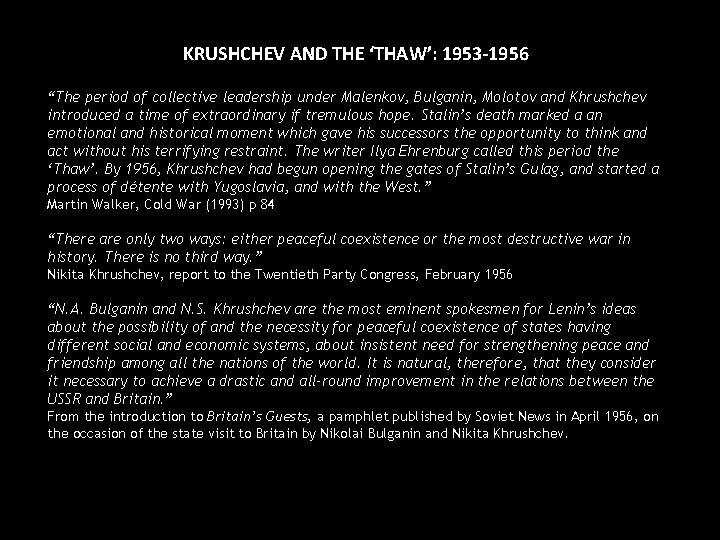
KRUSHCHEV AND THE ‘THAW’: 1953 -1956 “The period of collective leadership under Malenkov, Bulganin, Molotov and Khrushchev introduced a time of extraordinary if tremulous hope. Stalin’s death marked a an emotional and historical moment which gave his successors the opportunity to think and act without his terrifying restraint. The writer Ilya Ehrenburg called this period the ‘Thaw’. By 1956, Khrushchev had begun opening the gates of Stalin’s Gulag, and started a process of détente with Yugoslavia, and with the West. ” Martin Walker, Cold War (1993) p 84 “There are only two ways: either peaceful coexistence or the most destructive war in history. There is no third way. ” Nikita Khrushchev, report to the Twentieth Party Congress, February 1956 “N. A. Bulganin and N. S. Khrushchev are the most eminent spokesmen for Lenin’s ideas about the possibility of and the necessity for peaceful coexistence of states having different social and economic systems, about insistent need for strengthening peace and friendship among all the nations of the world. It is natural, therefore, that they consider it necessary to achieve a drastic and all-round improvement in the relations between the USSR and Britain. ” From the introduction to Britain’s Guests, a pamphlet published by Soviet News in April 1956, on the occasion of the state visit to Britain by Nikolai Bulganin and Nikita Khrushchev.
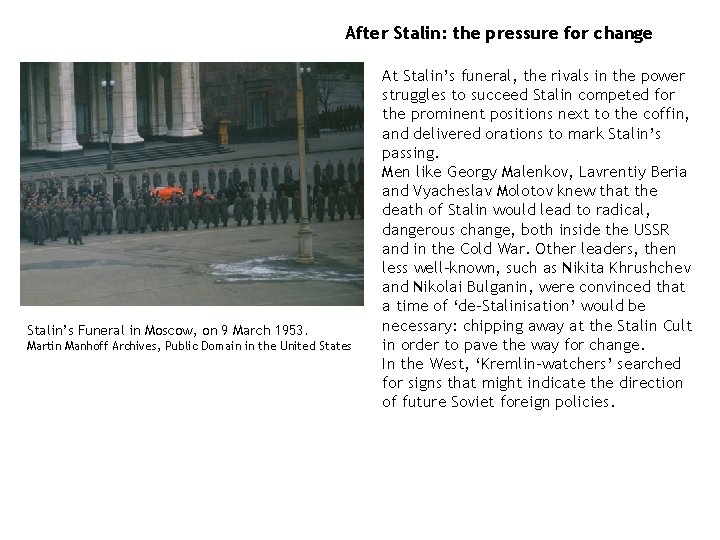
After Stalin: the pressure for change Stalin’s Funeral in Moscow, on 9 March 1953. Martin Manhoff Archives, Public Domain in the United States At Stalin’s funeral, the rivals in the power struggles to succeed Stalin competed for the prominent positions next to the coffin, and delivered orations to mark Stalin’s passing. Men like Georgy Malenkov, Lavrentiy Beria and Vyacheslav Molotov knew that the death of Stalin would lead to radical, dangerous change, both inside the USSR and in the Cold War. Other leaders, then less well-known, such as Nikita Khrushchev and Nikolai Bulganin, were convinced that a time of ‘de-Stalinisation’ would be necessary: chipping away at the Stalin Cult in order to pave the way for change. In the West, ‘Kremlin-watchers’ searched for signs that might indicate the direction of future Soviet foreign policies.
The Geneva Conference, 1954 Diplomats from ten countries attended the Geneva conference, April-July 1954: Cambodia, Democratic Republic of Vietnam, France, Indochina (South Vietnam), Laos, North Korea, the People’s Republic of China, South Korea, the United Kingdom, and the United States. Source: Manhoff Archives USA Creator: Martin Manhoff Public Domain USA After Stalin’s death in March 1953, the collective leadership of the USSR launched diplomatic initiatives to reduce international tensions in Asia. An ambitious international conference held in Geneva from April 1954 addressed the twin problems of Korea (the Korean War had ended in 1953 with partition between North and South Korea) and Indochina (Vietnam) where France was fighting a losing battle to maintain its colonial rule against revolutionary Communist-Nationalist forces led by Ho Chi Minh. The Soviet delegation, headed by Malenkov, Molotov and Khrushchev, worked closely with the Chinese delegation, led by Zhou Enlai, to reduce Cold War tensions in Asia. They also hoped the negotiations with Britain, France and the United States in Geneva might lead on to peace initiatives in Europe, especially over Austria and Germany. One year later, in July 1955, the ‘Big Four’ (Britain, France, the USSR and the United States) attended a summit in Geneva, the first personal meeting between Khrushchev and President Eisenhower.
A Russian view of the Khrushchev Thaw and the Cold War The basis of Khrushchev’s departure from Stalin’s legacy in 1955 -56 was his rejection of the ‘inevitability of global war’ and of the violent revolutionary transition of the world from capitalist to socialist order. Khrushchev adopted a broad interpretation of Lenin’s doctrine of ‘peaceful coexistence’. These innovations, as always with Khrushchev, were linked to his personal view of the awesome power of thermonuclear weapons and to his realisation of the impossibility of war between nuclear superpowers. This was a fundamental shift from the thinking of Stalin and Molotov, who saw the Cold War as the prelude to another world war among the great powers. Khrushchev saw the Cold War as a transitional period between the era of imperialist wars and a new era of peaceful economic competition between the two social systems. At first, Khrushchev counted on the ability of Soviet foreign policy to generate ‘soft power’ - a reputation as a peace-loving country, friendly to small nations, generous to friends, eager to settle disputes with opponents. He expected this to undermine the ‘dark forces’ in the West and undo US-made anti-Soviet blocs. Vladislav Zubok & Constantine Pleshakov, Inside the Kremlin’s Cold War (1996) pp 184 -5 Observers outside the USSR were slow to realise how powerful Nikita Khrushchev was becoming; the extent of his power only became clear after his ‘Secret Speech’ to the Twentieth Party Congress in February 1956. In reality, Khrushchev was already very influential even before Malenkov was removed from his posts early in 1955. ‘De-Stalinisation’ and the Khrushchev Thaw opened the way for liberalisation and change in the economy and in culture. It was also bound to change relations between the USSR and its allies; and between the USSR and the West. Setting new directions for Soviet foreign policy in 1955 -56 was shaped by Khrushchev. How change would develop depend not only on Khrushchev but on the leaders of his Communist allies, and on the response of the United States.
A Western view of the aims behind Khrushchev’s ‘Thaw’ Khrushchev’s strategy was fourfold. First, he needed to stabilise relations with the West, following the re-armament of West Germany, its incorporation into NATO and the establishment of the Warsaw Pact. At the same time, Moscow began building bridges to the ‘non-aligned world’, starting with Yugoslavia, with Khrushchev and Marshal Bulganin visiting Belgrade in May 1955 (just one month after the signing of the Austrian State Treaty) in order to rekindle Soviet-Yugoslav relations after seven years of very cold storage. Thirdly, Moscow started to encourage Party reformers in the satellite states, allowing circumspect criticism of the ‘mistakes’ of the Stalinist old guard, and rehabilitation of their victims. It was in this context that Khrushchev gingerly advanced to the fourth stage of controlled reform: the break with Stalin himself. Tony Judt Postwar, A History of Europe since 1945 (2005) p 310 Nikita Khrushchev was not a starryeyed, idealistic reformer. He was a Communist and a Leninist, a true believer in the superiority of the Soviet socialist system over Western capitalism. But Khrushchev knew (as did Malenkov and other key Soviet leaders) that the situation inherited on Stalin’s death was unsustainable, both within the Soviet Empire and in the Cold War. This analysis by the British historian, Tony Judt, of the aims behind Khrushchev’s policies in 1955 -56 sets out the structured approach that Khrushchev wished to follow, even if the volatile personality of the man himself often made him seem wild and unpredictable.
Relations with Yugoslavia This extract is part of a sequence of letters between Khrushchev and Tito in 1954 which paved the way for the Belgrade Declaration of May 1955, signed during Khrushchev’s visit to Yugoslavia. “As is well known, the policy of the Soviet Union is aimed at the consolidation of peace in Europe and the whole world. We do not doubt Yugoslavia will contribute to this consolidation of peace. As there now emerges a unity of outlook recognising the necessity of radical improvement of relations between our countries, we hope that rapprochement between the USSR and Yugoslavia will reflect favourably on relations between Yugoslavia and countries with which Yugoslav’s relations deteriorated after 1948. ” Letter from Nikita Khrushchev to the Communist Party of Yugoslavia, 23 September 1954. Source: http: //digitalarchive. wilsoncenter. org/document/1129 71. pdf? v=50485 b 52 e 5 c 681 abe 4444 f 6 d 263 da 841 One key aspect of Stalin’s legacy was the bitter split between the USSR and Yugoslavia. In 1948, the Yugoslav Communist leader Josip Broz Tito had clashed with Stalin and taken Yugoslavia out of the Soviet Bloc. Relations remained hostile until after Stalin’s death. Khrushchev was keen to heal the division between the former allies. In 1954, he initiated an exchange of letters between himself and Tito; later, in his 1956 Secret Speech, Khrushchev put all the blame for the 1948 split on Stalin. Tito invited Khrushchev to visit Belgrade in May 1955, where they jointly issued the Belgrade Declaration, reestablishing friendly relations between the two countries. Relations between Yugoslavia and satellite states like Hungary and Poland improved. But this was only a partial success for Khrushchev. Tito was not ready to align completely with the Soviet Bloc; and relations between Yugoslavia and the USSR deteriorated again when Soviet forces suppressed unrest in Hungary in 1956. In the longer term, Tito maintained Yugoslavia’s position as a ‘Third Way’ between East and West.
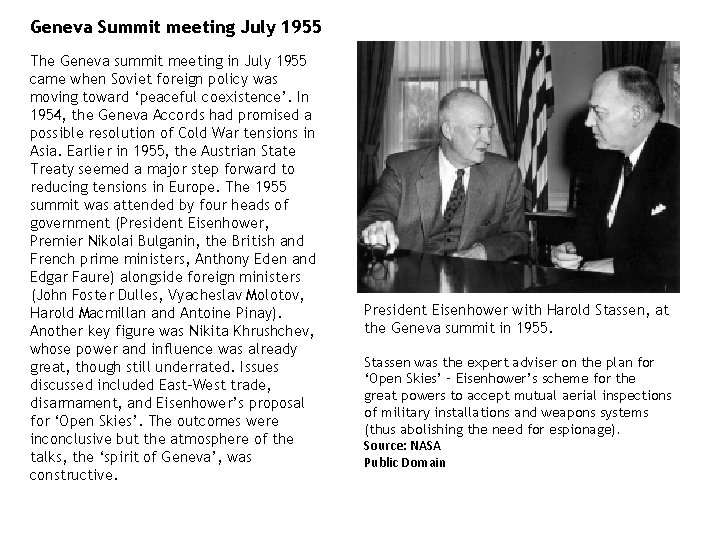
Geneva Summit meeting July 1955 The Geneva summit meeting in July 1955 came when Soviet foreign policy was moving toward ‘peaceful coexistence’. In 1954, the Geneva Accords had promised a possible resolution of Cold War tensions in Asia. Earlier in 1955, the Austrian State Treaty seemed a major step forward to reducing tensions in Europe. The 1955 summit was attended by four heads of government (President Eisenhower, Premier Nikolai Bulganin, the British and French prime ministers, Anthony Eden and Edgar Faure) alongside foreign ministers (John Foster Dulles, Vyacheslav Molotov, Harold Macmillan and Antoine Pinay). Another key figure was Nikita Khrushchev, whose power and influence was already great, though still underrated. Issues discussed included East-West trade, disarmament, and Eisenhower’s proposal for ‘Open Skies’. The outcomes were inconclusive but the atmosphere of the talks, the ‘spirit of Geneva’, was constructive. President Eisenhower with Harold Stassen, at the Geneva summit in 1955. Stassen was the expert adviser on the plan for ‘Open Skies’ – Eisenhower’s scheme for the great powers to accept mutual aerial inspections of military installations and weapons systems (thus abolishing the need for espionage). Source: NASA Public Domain
The status of Austria 1955 One important legacy of the Second World War, and the failure to reach a comprehensive peace settlement after it, was the status of Austria and its capital, Vienna. Like Germany, Austria had been divided into four zones of occupation, Soviet, American, British and French. Like Berlin, Vienna was governed by a Four-Power Allied Control Commission. By 1949, the situation of Germany had been resolved, at least in the short term, by the emergence of two separate states; but Austria remained in post -war limbo. In 1955, in the new atmosphere of the ‘Thaw’, it was hoped that there could be an agreement to restore Austria as an independent neutral nation, with Vienna once again a single city. The Austrian Chancellor, Julius Raab, flew to Moscow for talks, preparing the way for an international conference to be held in Vienna one month later. Austrian Chancellor, Julius Raab who visited Moscow in April 1955 for talks about the future status of Austria and its capital, Vienna. Source: BKA/BPD Free to use
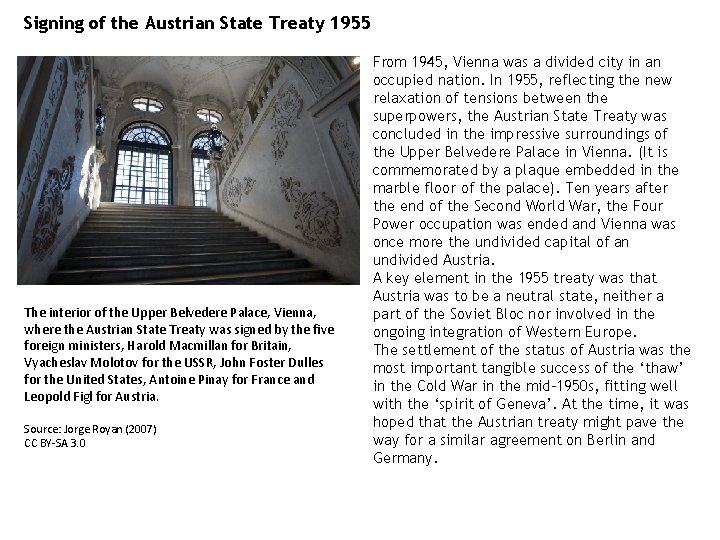
Signing of the Austrian State Treaty 1955 The interior of the Upper Belvedere Palace, Vienna, where the Austrian State Treaty was signed by the five foreign ministers, Harold Macmillan for Britain, Vyacheslav Molotov for the USSR, John Foster Dulles for the United States, Antoine Pinay for France and Leopold Figl for Austria. Source: Jorge Royan (2007) CC BY-SA 3. 0 From 1945, Vienna was a divided city in an occupied nation. In 1955, reflecting the new relaxation of tensions between the superpowers, the Austrian State Treaty was concluded in the impressive surroundings of the Upper Belvedere Palace in Vienna. (It is commemorated by a plaque embedded in the marble floor of the palace). Ten years after the end of the Second World War, the Four Power occupation was ended and Vienna was once more the undivided capital of an undivided Austria. A key element in the 1955 treaty was that Austria was to be a neutral state, neither a part of the Soviet Bloc nor involved in the ongoing integration of Western Europe. The settlement of the status of Austria was the most important tangible success of the ‘thaw’ in the Cold War in the mid-1950 s, fitting well with the ‘spirit of Geneva’. At the time, it was hoped that the Austrian treaty might pave the way for a similar agreement on Berlin and Germany.
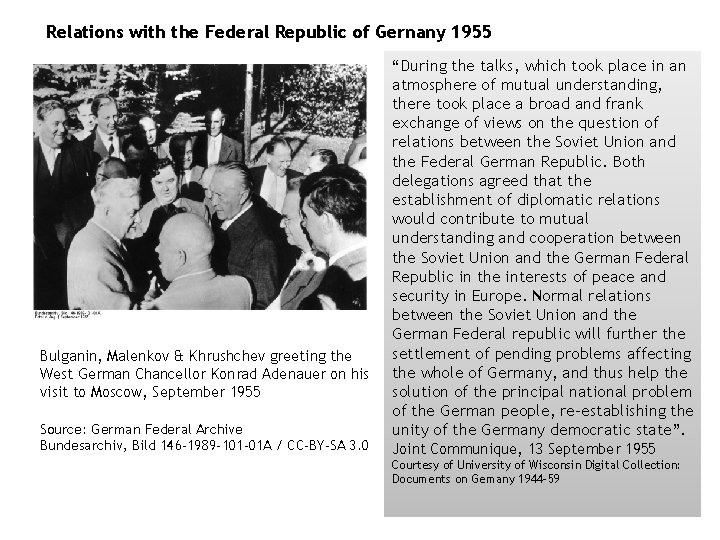
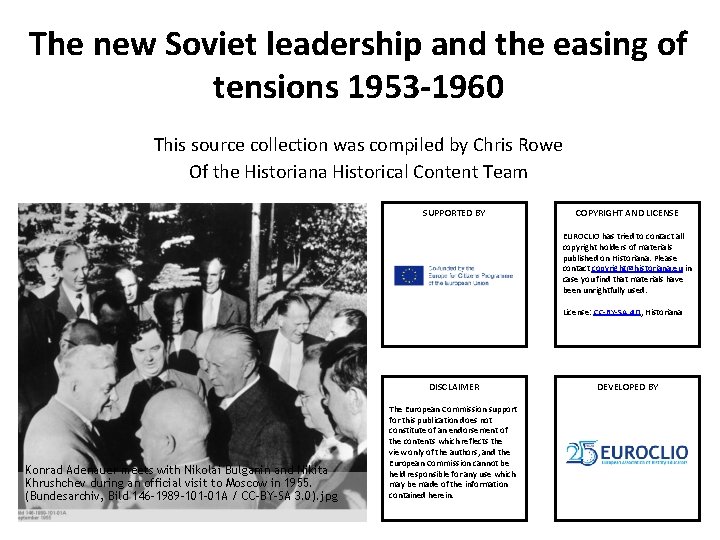
Relations with the Federal Republic of Gernany 1955 Bulganin, Malenkov & Khrushchev greeting the West German Chancellor Konrad Adenauer on his visit to Moscow, September 1955 Source: German Federal Archive Bundesarchiv, Bild 146 -1989 -101 -01 A / CC-BY-SA 3. 0 “During the talks, which took place in an atmosphere of mutual understanding, there took place a broad and frank exchange of views on the question of relations between the Soviet Union and the Federal German Republic. Both delegations agreed that the establishment of diplomatic relations would contribute to mutual understanding and cooperation between the Soviet Union and the German Federal Republic in the interests of peace and security in Europe. Normal relations between the Soviet Union and the German Federal republic will further the settlement of pending problems affecting the whole of Germany, and thus help the solution of the principal national problem of the German people, re-establishing the unity of the Germany democratic state”. Joint Communique, 13 September 1955 Courtesy of University of Wisconsin Digital Collection: Documents on Gemany 1944 -59
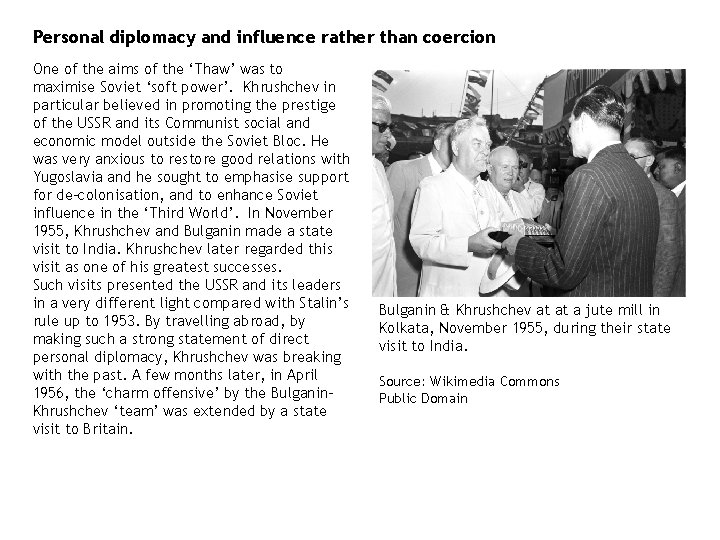
Personal diplomacy and influence rather than coercion One of the aims of the ‘Thaw’ was to maximise Soviet ‘soft power’. Khrushchev in particular believed in promoting the prestige of the USSR and its Communist social and economic model outside the Soviet Bloc. He was very anxious to restore good relations with Yugoslavia and he sought to emphasise support for de-colonisation, and to enhance Soviet influence in the ‘Third World’. In November 1955, Khrushchev and Bulganin made a state visit to India. Khrushchev later regarded this visit as one of his greatest successes. Such visits presented the USSR and its leaders in a very different light compared with Stalin’s rule up to 1953. By travelling abroad, by making such a strong statement of direct personal diplomacy, Khrushchev was breaking with the past. A few months later, in April 1956, the ‘charm offensive’ by the Bulganin. Khrushchev ‘team’ was extended by a state visit to Britain. Bulganin & Khrushchev at at a jute mill in Kolkata, November 1955, during their state visit to India. Source: Wikimedia Commons Public Domain
Relations with Britain “To see a country and people with his own eyes, to talk to people, from statesmen down to ordinary men in town or village – such is Khrushchev’s approach on the road to strengthening peace and friendship between nations. The visit of the Soviet leaders to Great Britain pursues the same aims. The Party Congress in February 1956 resolved: ‘Relations of firm friendship between the Soviet Union and the United States, and with such great powers as Britain and France, would be of enormous importance for ensuring peace throughout the world. N. S. Khrushchev is convinced that an improvement in British-Soviet relations is essential for the promotion of peace in Europe and the world. ” Extract from a booklet produced in English to commemorate the visit of Bulganin and Khrushchev to Britain in April 1956. Courtesy of University of Warwick Digital Archive/Russia The state visit to Britain by Nikolai Bulganin and Nikita Khrushchev on I April 1956 was a high point in the Soviet ‘charm offensive’ that aimed to improve international relations and promote Soviet influence and prestige during the ‘Khrushchev Thaw’. A pamphlet published by Soviet News to accompany the visit to Britain went all out to display the friendly intentions of the new Soviet leadership and to set out their great achievements. The impact of the visit was very mixed. Much of British media coverage was favourable; but Khrushchev’s impulsive and loquacious style often caused offence (even his meeting with leaders of the British Labour Party went very badly). Later events in 1956, including unrest in Poland Hungary, and the tensions of the Suez Crisis, showed that there were powerful constraints holding back attempts to relax Cold War hostilities.
THE ‘NEW LOOK’: EISENHOWER AND THE COLD WAR 1953 -1956 “We must use political and economic pressures, propaganda, and covert operations to create and exploit troublesome problems for the USSR, impair Soviet relations with China, complicate control in the satellites, and retard the growth of the military and economic potential of the Soviet Bloc. ” US National Security directive NSC-162/2, October 1953 “Here, then, is the problem we present to you, stark and dreadful and inescapable : Shall we put an end to the human race; or shall we mankind renounce war? ” The Einstein-Russell Manifesto calling for world peace, 1955 “It does not depend on you capitalist states whether we exist or not. If you don’t like us, don’t accept our invitations, and don’t invite us to come to see you. Whether you like it or not, history is on our side. We will bury you!” Khrushchev to Western ambassadors at a reception in the Polish Embassy in Moscow, November 1956 There were many different responses in the West to Soviet foreign policy initiatives during the Thaw. Many in the US government saw an opportunity to exploit Soviet weakness and to ‘roll back’ Communism in Europe. Many pacifists and left-wing sympathisers saw an opportunity for peace and disarmament, accepting Khrushchev’s offer of peaceful coexistence as genuine. Many in the West were just unsure whether Soviet motives could be trusted. The US government under President Eisenhower and John Foster Dulles, formulated a ‘New Look’ policy based on American strength, not on compromise.
The Rise of the National Security State: the United States in 1953 [Because of the Korean War] “expenditures for major national security programs rose to $22. 3 billion in 1951, to $44 billion in 1952, to $50. 4 billion in 1953. The total defense budget in 1953 was $85 billion. And so, equipped with the requisite budgets, the American national security state grew as an awesome collage of money, institutions, ideology, vested interests, commitments, capabilities, and firepower. The national security state acquired a life of its own. It helped to create a powerful presidency. It turned legions of ‘private’ companies into permanent clients of the Defense Department. And the American national security state grew, dialectically, with the ‘total security state’ of the Soviet Union. ” Daniel Yergin, Shattered Peace: the Origins of the Cold War and the National Security State, (1977) p 408 After the war, US forces had been demobilised; down from 12 million to 1. 5 million. But this process was reversed by the Korean War and the Cold War. By 1953, the Cold War had transformed America into a ‘national security state’. 3. 5 million men and women were in the armed forces; vast numbers of diplomats, intelligence agents and government advisers worked in the national security apparatus, staffing a global network of alliances that defended 42 nations. This vast machinery of power had a momentum of its own; once pointed in a particular direction it was very difficult to alter course. As Allied Supreme Commander during the Second World War, Eisenhower had maintained good relations with Soviet generals; but he now regarded the USSR as a dangerous enemy. Eisenhower’s advisers, the secretary of state, John Foster Dulles, military commanders, national security experts, the CIA, all urged him to take a hard line, and to be suspicious of Soviet diplomatic initiatives.
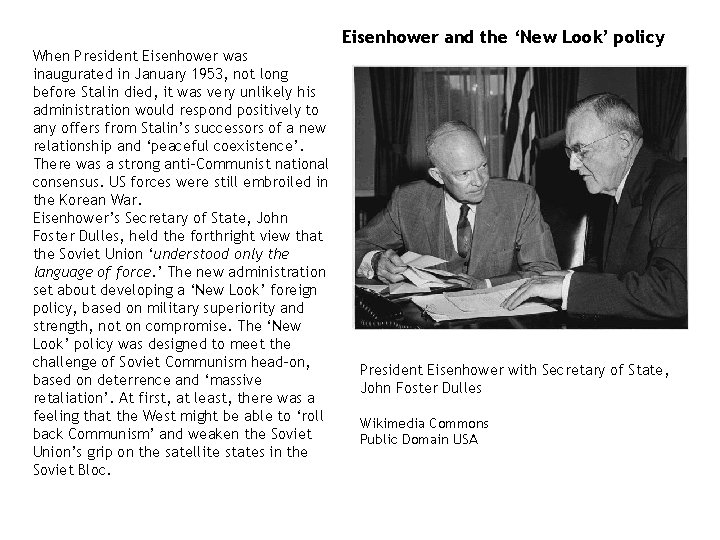
When President Eisenhower was inaugurated in January 1953, not long before Stalin died, it was very unlikely his administration would respond positively to any offers from Stalin’s successors of a new relationship and ‘peaceful coexistence’. There was a strong anti-Communist national consensus. US forces were still embroiled in the Korean War. Eisenhower’s Secretary of State, John Foster Dulles, held the forthright view that the Soviet Union ‘understood only the language of force. ’ The new administration set about developing a ‘New Look’ foreign policy, based on military superiority and strength, not on compromise. The ‘New Look’ policy was designed to meet the challenge of Soviet Communism head-on, based on deterrence and ‘massive retaliation’. At first, at least, there was a feeling that the West might be able to ‘roll back Communism’ and weaken the Soviet Union’s grip on the satellite states in the Soviet Bloc. Eisenhower and the ‘New Look’ policy President Eisenhower with Secretary of State, John Foster Dulles Wikimedia Commons Public Domain USA
“The Cold War defined American domestic life in the 1950 s. The Communist threat produced a mood of near hysterical fear, paranoic suspiciousness and stifling conformity. Top government officials ominously warned that the Communists were everywhere – ‘in factories, offices, butcher shops, on street corners, in private businesses, undermining your government, plotting to destroy your liberties, feverishly trying in whatever way they can to aid the Soviet Union’. Film makers, television producers, newspaper editors and novelists spewed forth fear-mongering products with emotive titles such as The Red Menace, I Was a Communist for the FBI, and I Married a Communist. ” G. C. Herring From Colony to Superpower: US Foreign Relations Since 1776, (2011), p 654 The anti-Communist consensus The ‘New Look’ policies of the Eisenhower administration from 1953 reflected entrenched anti-Communist attitudes across the nation; public opinion in America was not receptive to ideas such as ‘peaceful coexistence’. American politicians, especially Republicans, were strongly influenced by anti -Communism. From 1949 to 1952, the violent rhetoric of ’Mc. Carthyism’ had accused the Truman administration of being ‘soft on Communism’. The feeling that Eisenhower would keep America safe in the Cold War had been a key factor in his winning the 1952 election. Eisenhower was a moderate Republican and an internationalist. He disliked Senator Joseph Mc. Carthy intensely; and Mc. Carthy’s influence fell away by 1954. Even so, the anti-Communist consensus remained in place. There was more talk of ‘winning the Cold War’ or ‘rolling back Communism in Eastern Europe’ than any acceptance of the need for ‘peaceful coexistence’.
John Foster Dulles on massive retaliation “The ‘long time’ factor is of critical importance. The Soviet Communists are planning for what they call ’an entire historical era’, and so should we. They seek gradually to divide and weaken the free nations by overextending them in efforts which are, as Lenin put it, ‘beyond their strength’. ‘Then’ said Stalin, ‘ will be the moment for the decisive blow’. In the face of this strategy, it is not enough to ward off immediate danger. It is essential to do this without exhausting ourselves. The Eisenhower administration recognised new formulations were needed: It is not sound military strategy permanently to commit US land forces in Asia, leaving no reserves. It is not sound economics, or good foreign policy, to support permanently other countries for in the long run this creates as much ill will as good will. It is not sound to become permanently committed to military expenditures so vast they lead to practical bankruptcy. We need allies and collective security. Our purpose is to make these relations more effective, less costly. This can be done by placing more reliance on deterrent power, and less dependence on local defensive power. What the Eisenhower administration seeks, for ourselves and the other free nations, is a maximum deterrent at bearable cost. No local defense alone can contain the mighty landpower of the Communist world. Local defenses must be reinforced by the deterrent of massive retaliation. A potential aggressor, glutted with manpower, might be tempted to attack in confidence that resistance would be confined to manpower. The way to deter aggression is for the free community to be willing and able to respond vigorously at places and with means of its own choosing. ” US Secretary of State, John Foster Dulles, explaining the policy of ‘massive retaliation’ – the use of a full-scale nuclear attack if the Soviet Bloc attacked any of America’s allies. Dulles, John F. "The Doctrine of Massive Retaliation. " Department of State Bulletin, Vol. 30, 25 January 1954, pp. 107 -110.
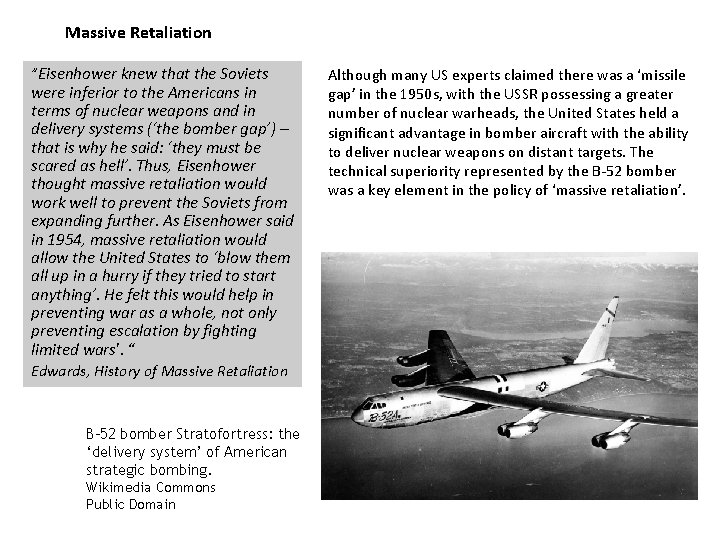
Massive Retaliation ”Eisenhower knew that the Soviets were inferior to the Americans in terms of nuclear weapons and in delivery systems (‘the bomber gap’) – that is why he said: ‘they must be scared as hell’. Thus, Eisenhower thought massive retaliation would work well to prevent the Soviets from expanding further. As Eisenhower said in 1954, massive retaliation would allow the United States to ‘blow them all up in a hurry if they tried to start anything’. He felt this would help in preventing war as a whole, not only preventing escalation by fighting limited wars’. “ Edwards, History of Massive Retaliation B-52 bomber Stratofortress: the ‘delivery system’ of American strategic bombing. Wikimedia Commons Public Domain Although many US experts claimed there was a ‘missile gap’ in the 1950 s, with the USSR possessing a greater number of nuclear warheads, the United States held a significant advantage in bomber aircraft with the ability to deliver nuclear weapons on distant targets. The technical superiority represented by the B-52 bomber was a key element in the policy of ‘massive retaliation’.
‘Rolling back Communism’ “We must use political and economic pressures, propaganda, and covert operations to create and exploit troublesome problems for the USSR, impair Soviet relations with China, complicate control in the satellites, and retard the growth of the military and economic potential of the Soviet Bloc. ” US National Security directive NSC-162/2, October 1953 “Covert actions and diplomatic support must be directed at fostering conditions which would make possible the liberation of the satellite states at a faourable moment in the future. ” National Security Council Policy paper 174, December 1953 “The United States is not prepared to resort to war to eliminate Soviet domination of the satellites. ” NSC 5608/1 US Policy toward the Soviet satellites in Eastern Europe, July 1956 The idea of ‘rolling back Communism in Europe’ featured prominently in the Republican election campaign in 1952. Numerous reports from CIA field officers were collated, assessing the extent of dissent and opposition undermining Communist regimes in Eastern and Central Europe. Vast sums of money financed propaganda broadcasts by anti -Communist radio stations such as Voice of America, Radio Free Europe and Radio Liberty. The importance of ‘rollback’ has been disputed by historians. For many, ‘rollback’ was merely rhetoric and wishful thinking, not a realistic policy aim; the Eisenhower administration never did intervene militarily in the Soviet sphere of influence. But this view is not shared by all. In the 1950 s, emotive broadcasts by Voice of America and Radio Free Europe did indeed encouraged dissidents in the Soviet Bloc to believe they might receive US assistance and support. And the leaders of the Soviet Union genuinely believed that ‘interference’ by the West, especially by the CIA, was a real danger to the security of the Soviet Bloc.
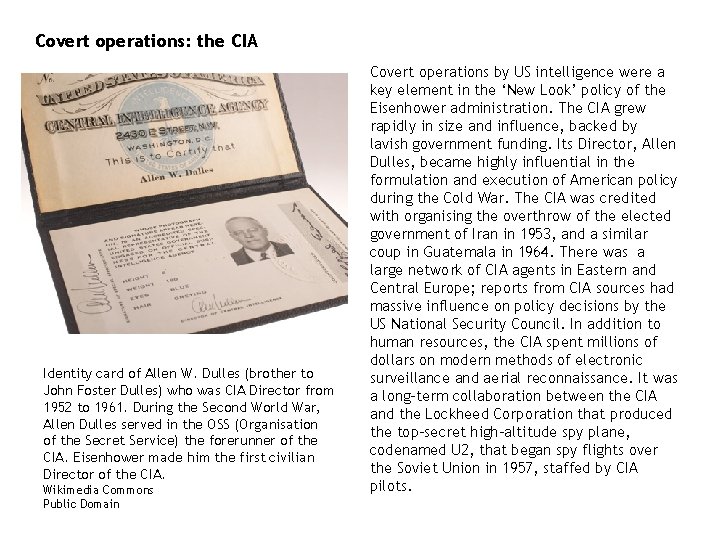
Covert operations: the CIA Identity card of Allen W. Dulles (brother to John Foster Dulles) who was CIA Director from 1952 to 1961. During the Second World War, Allen Dulles served in the OSS (Organisation of the Secret Service) the forerunner of the CIA. Eisenhower made him the first civilian Director of the CIA. Wikimedia Commons Public Domain Covert operations by US intelligence were a key element in the ‘New Look’ policy of the Eisenhower administration. The CIA grew rapidly in size and influence, backed by lavish government funding. Its Director, Allen Dulles, became highly influential in the formulation and execution of American policy during the Cold War. The CIA was credited with organising the overthrow of the elected government of Iran in 1953, and a similar coup in Guatemala in 1964. There was a large network of CIA agents in Eastern and Central Europe; reports from CIA sources had massive influence on policy decisions by the US National Security Council. In addition to human resources, the CIA spent millions of dollars on modern methods of electronic surveillance and aerial reconnaissance. It was a long-term collaboration between the CIA and the Lockheed Corporation that produced the top-secret high-altitude spy plane, codenamed U 2, that began spy flights over the Soviet Union in 1957, staffed by CIA pilots.
The Einstein-Russell Manifesto The response in the West to the ‘Khrushchev Thaw’ was multi-layered. The American government, military, and intelligence services generally took a firm line, fixated on policies such as ‘massive retaliation’, and ‘rolling back Communism’. This approach was supported by public opinion in the United States, influenced by the ideas of ‘Mc. Carthyism’, and by America’s NATO allies. But there were many divergent views in the western democracies. Intellectuals, liberals, socialists, and Communist sympathisers, were very receptive to Soviet offers of ‘peaceful coexistence’. Many of these voices were particularly opposed to concepts like ‘mutually assured destruction’. The ‘Einstein-Russell Manifesto’, put forward in 1955 by two world-famous philosophers, was a prominent example of this strand of thought. We have to learn to think in a new way. We have to ask ourselves, not what steps can be taken to give military victory to whatever group we prefer, for there are no longer such steps; the question we have to ask ourselves is: What steps can be taken to prevent a military contest of which the issue must be disastrous to all parties? Here, then, is the problem we present to you, stark and dreadful and inescapable : Shall we put an end to the human race; or shall we, mankind, renounce war? First: Any agreement between East and West is to the good in so far as it tends to diminish tension. Second: The abolition of thermonuclear weapons, if each side believed the other had carried it out sincerely, would lessen the fear of a sudden attack. There lies before us, if we choose, continual progress in happiness, knowledge and wisdom. Shall we, instead, choose death, because we cannot forget our quarrels? The ‘Einstein-Russell Manifesto’ issued by the philosophers Albert Einstein and Bertrand Russell in 1955. This manifesto was later signed by many leading scientists. Digitally available from https: //pugwash. org
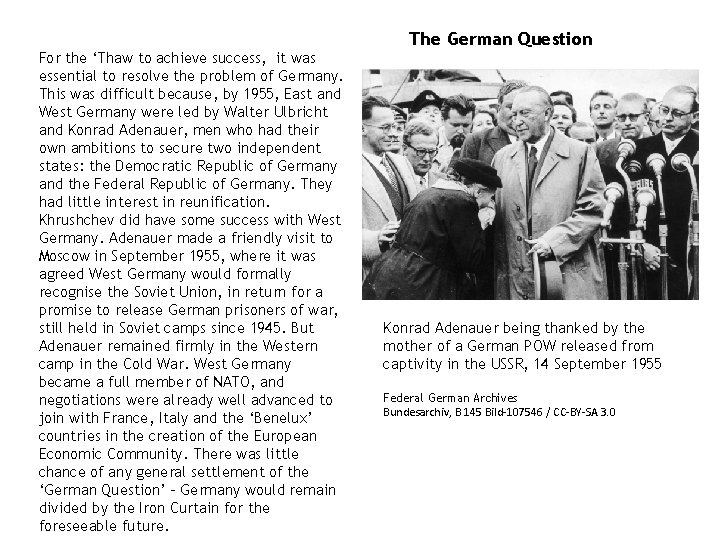
For the ‘Thaw to achieve success, it was essential to resolve the problem of Germany. This was difficult because, by 1955, East and West Germany were led by Walter Ulbricht and Konrad Adenauer, men who had their own ambitions to secure two independent states: the Democratic Republic of Germany and the Federal Republic of Germany. They had little interest in reunification. Khrushchev did have some success with West Germany. Adenauer made a friendly visit to Moscow in September 1955, where it was agreed West Germany would formally recognise the Soviet Union, in return for a promise to release German prisoners of war, still held in Soviet camps since 1945. But Adenauer remained firmly in the Western camp in the Cold War. West Germany became a full member of NATO, and negotiations were already well advanced to join with France, Italy and the ‘Benelux’ countries in the creation of the European Economic Community. There was little chance of any general settlement of the ‘German Question’ – Germany would remain divided by the Iron Curtain for the foreseeable future. The German Question Konrad Adenauer being thanked by the mother of a German POW released from captivity in the USSR, 14 September 1955 Federal German Archives Bundesarchiv, B 145 Bild-107546 / CC-BY-SA 3. 0
Bulganin and Khrushchev’s visit to Britain 1956 The state visit to Britain in April 1956 by Bulganin and Khrushchev was intended to be a high point in Soviet attempts to win respect and acceptance in the West. But the visit was only partially successful. Two incidents in particular revealed the problems undermining the diplomatic ‘charm offensive’. The first was Khrushchev’s explosive personality, which turned his meeting with leading figures in the Labour Party into a fiasco of insults and threats (and caused the cancellation of the proposed visit to the USSR by Labour Party leader, Hugh Gaitskell). The second was ongoing Cold War espionage: a British agent, Commander Crabb, vanished during a covert attempt to spy on the technical equipment of one of the Soviet warships in Portsmouth harbour. This mystery spying mission, and Crabb’s death, was covered up at the time but it reflected the mutual suspicions that undermined the prospects of success for the Bulganin-Khrushchev visit. “CIA intelligence reports show that the British government saw the trip as both a diplomatic opportunity and a propaganda hazard. It was desperate to avoid the kind of triumphant tour the Soviets had enjoyed on recent visits to India and Burma; and was deeply concerned about Soviet efforts to forge links with the labour Party, then led by Hugh Gaitskell. The Soviets spent eight full days in Britain, including three days of talks in Downing Street. They twice had dinner with Prime Mister Anthony Eden. But Bulganin and Khrushchev appeared surprised and frustrated by the cool reception they received from the British public. CIA documents state that: ‘For the most part, crowds have greeted the Soviet leaders in silence, or even with jeers. Khrushchev has shown his irritation by intemperate and even threatening remarks’. A report for BBC News by Dominic Blake
PEACEFUL COEXISTENCE OR CONFRONTATION? : 1956 -1960 “It does not depend on you whether we exist or not. If you don’t like us, don’t accept our invitations, don’t invite us to come to see you. Whether you like it or not, history is on our side. We will bury you!” Khrushchev to Western ambassadors at a reception in the Polish Embassy in Moscow, November 1956 “Paradoxical and contradictory, Khrushchev was the initiator of major, unilateral Soviet arms reductions, but he could speak of turning out Soviet missiles like sausages, and of ‘burying’ the West, and still imagine that his political opponents would become more compliant. ” Dmitri Volkogonov, The Rise and Fall of the Soviet Empire (1998) p 234 “Khrushchev was the most provocative, the most daring, and, ironically, the most desirous of a lasting agreement with the American people of any man or woman in the Kremlin. He also was no less cruel or ideological than the other Kremlin leaders who had survived Stalin” A. Fursenko & T. Naftali, Khrushchev’s Cold War (2007) The American historian John Lewis Gaddis famously defined the Cold War as the ‘Long Peace’, noting the essential stability and continuity of the relationship between the superpowers. Détente and confrontation lived side by side, sometimes on the edge of achieving peace, sometimes on the edge of nuclear catastrophe. From 1953 to 1960, this relationship was shaped by the contrasting personalities of Nikita Khrushchev and Dwight Eisenhower, who eventually achieved a wary understanding of each other. But there were still dangerous times ahead.
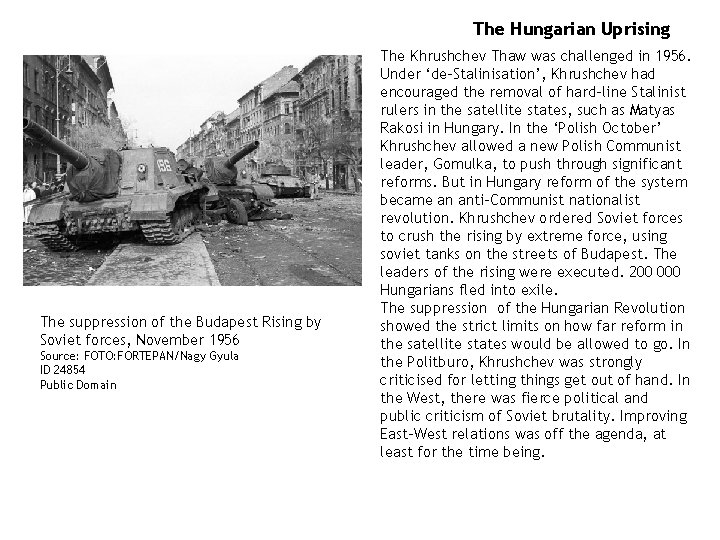
The Hungarian Uprising The suppression of the Budapest Rising by Soviet forces, November 1956 Source: FOTO: FORTEPAN/Nagy Gyula ID 24854 Public Domain The Khrushchev Thaw was challenged in 1956. Under ‘de-Stalinisation’, Khrushchev had encouraged the removal of hard-line Stalinist rulers in the satellite states, such as Matyas Rakosi in Hungary. In the ‘Polish October’ Khrushchev allowed a new Polish Communist leader, Gomulka, to push through significant reforms. But in Hungary reform of the system became an anti-Communist nationalist revolution. Khrushchev ordered Soviet forces to crush the rising by extreme force, using soviet tanks on the streets of Budapest. The leaders of the rising were executed. 200 000 Hungarians fled into exile. The suppression of the Hungarian Revolution showed the strict limits on how far reform in the satellite states would be allowed to go. In the Politburo, Khrushchev was strongly criticised for letting things get out of hand. In the West, there was fierce political and public criticism of Soviet brutality. Improving East-West relations was off the agenda, at least for the time being.
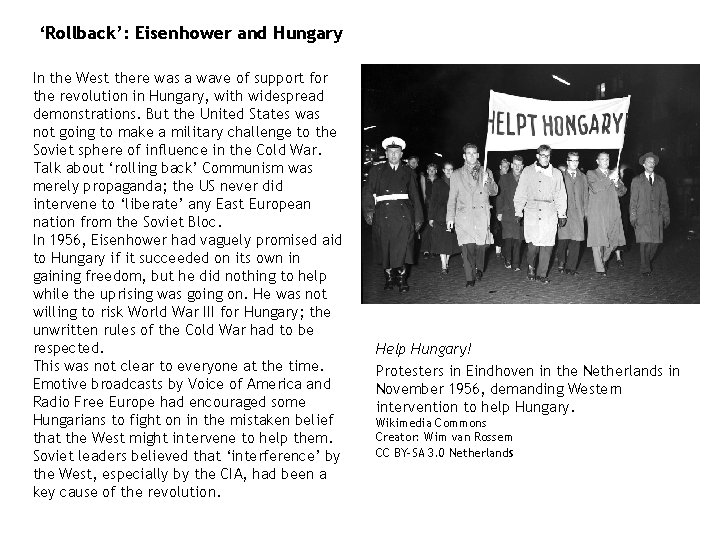
‘Rollback’: Eisenhower and Hungary In the West there was a wave of support for the revolution in Hungary, with widespread demonstrations. But the United States was not going to make a military challenge to the Soviet sphere of influence in the Cold War. Talk about ‘rolling back’ Communism was merely propaganda; the US never did intervene to ‘liberate’ any East European nation from the Soviet Bloc. In 1956, Eisenhower had vaguely promised aid to Hungary if it succeeded on its own in gaining freedom, but he did nothing to help while the uprising was going on. He was not willing to risk World War III for Hungary; the unwritten rules of the Cold War had to be respected. This was not clear to everyone at the time. Emotive broadcasts by Voice of America and Radio Free Europe had encouraged some Hungarians to fight on in the mistaken belief that the West might intervene to help them. Soviet leaders believed that ‘interference’ by the West, especially by the CIA, had been a key cause of the revolution. Help Hungary! Protesters in Eindhoven in the Netherlands in November 1956, demanding Western intervention to help Hungary. Wikimedia Commons Creator: Wim van Rossem CC BY-SA 3. 0 Netherlands
Hungary, the Suez Crisis and the Cold War “The Soviets were acting out of the belief that the only way to protect Soviet interests in the Middle East and forestall Western intervention in Egypt was to threaten a war that neither side wanted. Besides vindicating the risky policy that Khrushchev had been advocating since 1955, Nasser’s survival demonstrated the utility of the nuclear bluff for the weaker superpower in international politics. Now it seemed to Khrushchev that he had proved that the nuclear bluff was an effective way to weaken Soviet adversaries on the cheap. ” Aleksandr Fursenko & Timothy Naftali, Khrushchev’s Cold War (London 2007) On 6 November 1956, while Soviet tanks were still completing their crackdown in Budapest, the focus of the Cold War moved from Hungary to the Middle East. Britain and France, in collusion with Israel, launched an invasion of Egypt to secure the Suez Canal and to maintain western control of Middle East oil. Khrushchev, who had developed close relations with the Egyptian leader, Gamel Abdel Nasser, strongly condemned the Suez invasion. The USSR threatened war, if necessary, to defend Egypt from ‘Western imperialism’. This was a bluff; there was no chance of it actually happening but Egypt was protected anyway. President Eisenhower, who was in the midst of campaigning for re-election and had not been consulted by his British and French allies, forced Britain and France to withdraw, and even joined in condemnation of their invasion at the United Nations. The Suez Crisis changed the dynamics of the Cold War. It drew attention away from Soviet repression in Hungary. It gave Khrushchev a geopolitical success and an ally in the Middle East. And it temporarily divided and weakened the Western alliance.
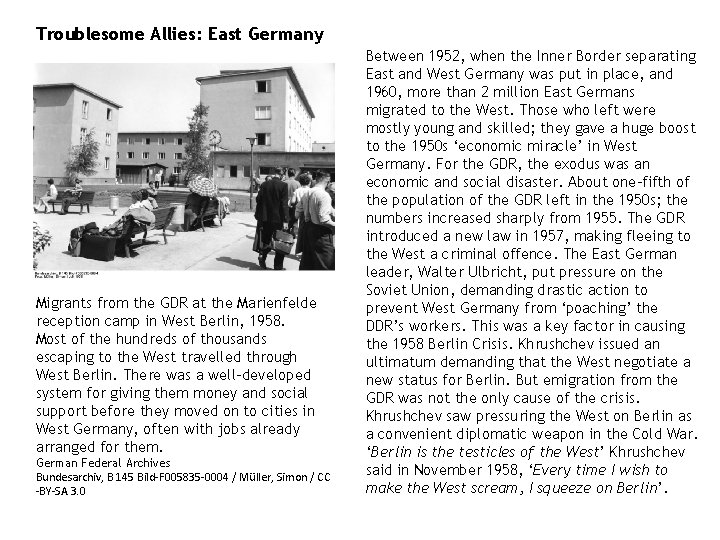
Troublesome Allies: East Germany Migrants from the GDR at the Marienfelde reception camp in West Berlin, 1958. Most of the hundreds of thousands escaping to the West travelled through West Berlin. There was a well-developed system for giving them money and social support before they moved on to cities in West Germany, often with jobs already arranged for them. German Federal Archives Bundesarchiv, B 145 Bild-F 005835 -0004 / Müller, Simon / CC -BY-SA 3. 0 Between 1952, when the Inner Border separating East and West Germany was put in place, and 1960, more than 2 million East Germans migrated to the West. Those who left were mostly young and skilled; they gave a huge boost to the 1950 s ‘economic miracle’ in West Germany. For the GDR, the exodus was an economic and social disaster. About one-fifth of the population of the GDR left in the 1950 s; the numbers increased sharply from 1955. The GDR introduced a new law in 1957, making fleeing to the West a criminal offence. The East German leader, Walter Ulbricht, put pressure on the Soviet Union, demanding drastic action to prevent West Germany from ‘poaching’ the DDR’s workers. This was a key factor in causing the 1958 Berlin Crisis. Khrushchev issued an ultimatum demanding that the West negotiate a new status for Berlin. But emigration from the GDR was not the only cause of the crisis. Khrushchev saw pressuring the West on Berlin as a convenient diplomatic weapon in the Cold War. ‘Berlin is the testicles of the West’ Khrushchev said in November 1958, ‘Every time I wish to make the West scream, I squeeze on Berlin’.
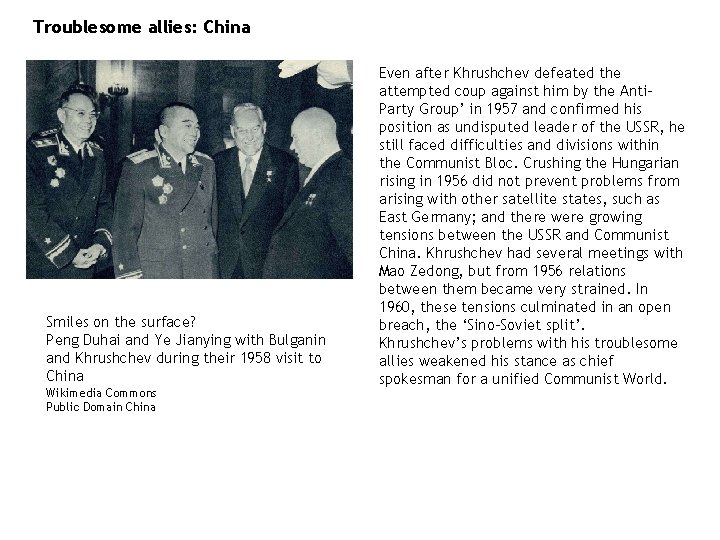
Troublesome allies: China Smiles on the surface? Peng Duhai and Ye Jianying with Bulganin and Khrushchev during their 1958 visit to China Wikimedia Commons Public Domain China Even after Khrushchev defeated the attempted coup against him by the Anti. Party Group’ in 1957 and confirmed his position as undisputed leader of the USSR, he still faced difficulties and divisions within the Communist Bloc. Crushing the Hungarian rising in 1956 did not prevent problems from arising with other satellite states, such as East Germany; and there were growing tensions between the USSR and Communist China. Khrushchev had several meetings with Mao Zedong, but from 1956 relations between them became very strained. In 1960, these tensions culminated in an open breach, the ‘Sino-Soviet split’. Khrushchev’s problems with his troublesome allies weakened his stance as chief spokesman for a unified Communist World.
The Berlin Crisis 1958 -59 “Khrushchev was deeply concerned about the unwelcome success of the West German State. Its ‘economic miracle’ was leaving East Germany far behind and causing a serious drain of youth and skills to the West. And the increasing involvement of West Germany in NATO stirred up old Soviet fears of the rebirth of German militarism. In January 1958 Khrushchev took the radical step of offering Soviet acceptance of the reunification of Germany as long as Germany was made neutral, as Austria had been in 1955. This led to some strange reactions. Many on the Western side were suspicious and were reluctant even to discuss Khrushchev’s offer. In the Soviet Bloc, there were many, especially the Chinese, who thought Khrushchev had gone too far. Seeing no response to his original concessions over Berlin, Khrushchev decided to apply pressure and issued an ultimatum. If there were talks on Berlin within six months, Khrushchev announced, ‘he would not take action’. The clear threat was that, without any talks, he would. ” Chris Rowe, The Cold War 1943 -1991 In Years of Division (1999) by J. Laver, C. Rowe & D. Williamson pp 398 -9 The United States made a calm response to Khrushchev’s ultimatum on Berlin. By 1958 American policymakers were more familiar with Khrushchev’s inflammatory style, and wished to avoid overreacting. Eisenhower did not back down. US forces in Germany were quietly strengthened but the ultimatum was more or less ignored. Berlin remained a potential flashpoint (and did later become the centre of a dangerous confrontation in 1961) but nothing happened on 27 May 1959, the day the ultimatum expired. By then, East-West relations were actually much improved. The British prime minister, Harold Macmillan, visited Moscow in February 1959; in July the US vice-president, Richard Nixon, made a similar visit, coinciding with an American National Exhibition that was intended to foster East-West trade. These visits paved the way for something Khrushchev very much desired, an invitation for a state visit to the United States, to last for two weeks, scheduled for September 1959. The Berlin Crisis was yet one more example of the way crises and confrontations existed alongside periods of coexistence.
The ‘Kitchen Debate’: Khrushchev & Nixon in Moscow, 1959 A ‘friendly’ dispute about American and Soviet social progress between Nikita Khrushchev and the US vicepresident Richard Nixon took place in the ‘model kitchen’ at the American National Exhibition in Moscow in July 1959. Wikimedia Commons Public Domain Despite the intensity of the 1958 Berlin Crisis, Khrushchev was still open to the possibility of improved Soviet-American relations. By 1959, the Eisenhower administration was also ready to consider dialogue. Preparations began for Khrushchev to visit the United States in the autumn of 1959. As part of the new mood of compromise and cooperation, an American National Exhibition was staged in Moscow in July 1959. Eisenhower’s vicepresident, Richard Nixon, flew to Moscow in support. Nixon had always been known as a hardline anti-Communist, so it was an important moment for the new East-West relationship when he engaged with Khrushchev in the ‘kitchen debate’ - lighthearted banter about the merits of Soviet kitchens and appliances compared with American ones. But it gained symbolic importance as an expression of a new willingness by the superpowers to resolve differences without hostility or war.
Khrushchev in America, September 1959 “The ‘Spirit of Geneva’ was resurrected, though now it was called the ‘Spirit of Camp David’. These two old men, without resolving a single specific question, made a lot of progress in the most important area, the sphere of human understanding of each other. The first glimmers of trust became visible. We had to move away from the ‘image of an enemy’. Father produced a rather good impression on Americans. He personally believed in the American president’s desire to achieve peace, and to have a good-neighbourly relationship. The image of Eisenhower as an evil instigator of war was finally dissipated; what remained was a clever, kind, somewhat tired person who had been through a great deal in his life. ” Sergei became an American citizen in 1999. Recollections of Nikita Khrushchev’s son Sergei quoted in John Lewis Gaddis, We Know Now: Rethinking Cold War History (Oxford 1998). Khrushchev’s goodwill tour of the United States in 1959 had many ups and downs and explosive moments. But its overall impact was positive. The public mood in America was very different from the Cold War paranoia of the early 1950 s. Most Americans were ready to overlook Khrushchev’s periodic outbursts of anger and bombast, and to accentuate the positive aspects of his visit. Media coverage was generally favourable. Khrushchev probably overrated the extent of the goodwill he had generated. Many Americans tended to laugh at his ‘peasant ways’ and exaggerated comments. But the visit mostly achieved its purpose of smoothing the way for future ‘friendly’ diplomacy. Approval ratings for Khrushchev’s visit to US in a public opinion poll: Approve: 66% Disapprove : 20% Don’t Know: 14%
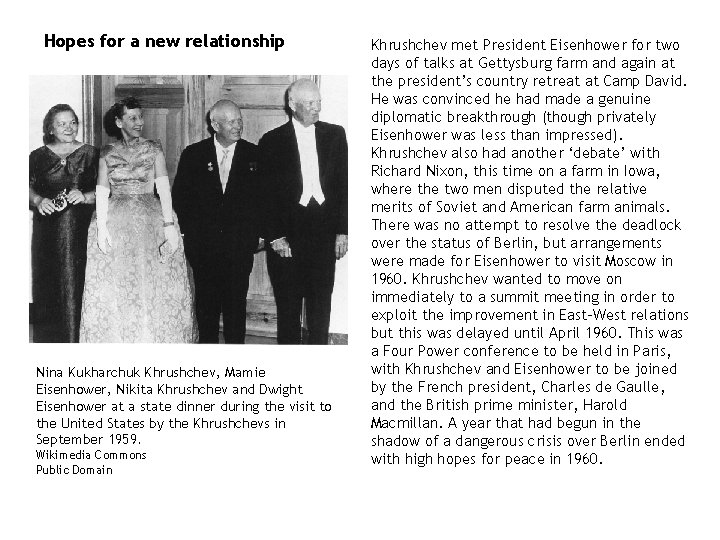
Hopes for a new relationship Nina Kukharchuk Khrushchev, Mamie Eisenhower, Nikita Khrushchev and Dwight Eisenhower at a state dinner during the visit to the United States by the Khrushchevs in September 1959. Wikimedia Commons Public Domain Khrushchev met President Eisenhower for two days of talks at Gettysburg farm and again at the president’s country retreat at Camp David. He was convinced he had made a genuine diplomatic breakthrough (though privately Eisenhower was less than impressed). Khrushchev also had another ‘debate’ with Richard Nixon, this time on a farm in Iowa, where the two men disputed the relative merits of Soviet and American farm animals. There was no attempt to resolve the deadlock over the status of Berlin, but arrangements were made for Eisenhower to visit Moscow in 1960. Khrushchev wanted to move on immediately to a summit meeting in order to exploit the improvement in East-West relations but this was delayed until April 1960. This was a Four Power conference to be held in Paris, with Khrushchev and Eisenhower to be joined by the French president, Charles de Gaulle, and the British prime minister, Harold Macmillan. A year that had begun in the shadow of a dangerous crisis over Berlin ended with high hopes for peace in 1960.
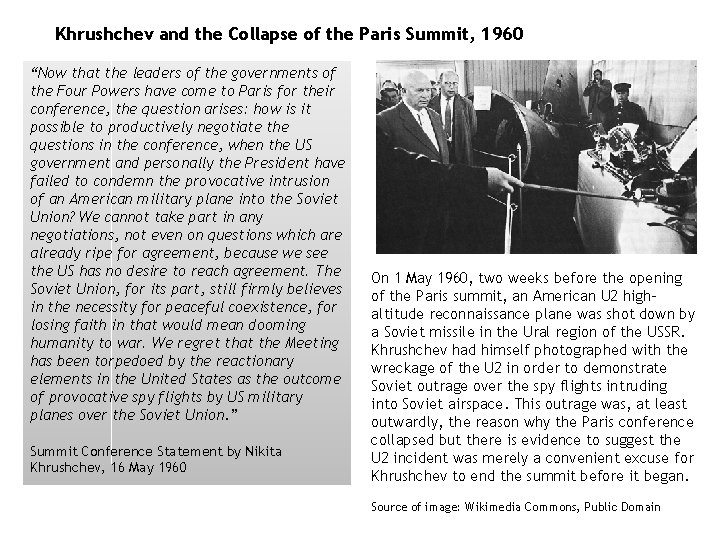
Khrushchev and the Collapse of the Paris Summit, 1960 “Now that the leaders of the governments of the Four Powers have come to Paris for their conference, the question arises: how is it possible to productively negotiate the questions in the conference, when the US government and personally the President have failed to condemn the provocative intrusion of an American military plane into the Soviet Union? We cannot take part in any negotiations, not even on questions which are already ripe for agreement, because we see the US has no desire to reach agreement. The Soviet Union, for its part, still firmly believes in the necessity for peaceful coexistence, for losing faith in that would mean dooming humanity to war. We regret that the Meeting has been torpedoed by the reactionary elements in the United States as the outcome of provocative spy flights by US military planes over the Soviet Union. ” Summit Conference Statement by Nikita Khrushchev, 16 May 1960 On 1 May 1960, two weeks before the opening of the Paris summit, an American U 2 highaltitude reconnaissance plane was shot down by a Soviet missile in the Ural region of the USSR. Khrushchev had himself photographed with the wreckage of the U 2 in order to demonstrate Soviet outrage over the spy flights intruding into Soviet airspace. This outrage was, at least outwardly, the reason why the Paris conference collapsed but there is evidence to suggest the U 2 incident was merely a convenient excuse for Khrushchev to end the summit before it began. Source of image: Wikimedia Commons, Public Domain
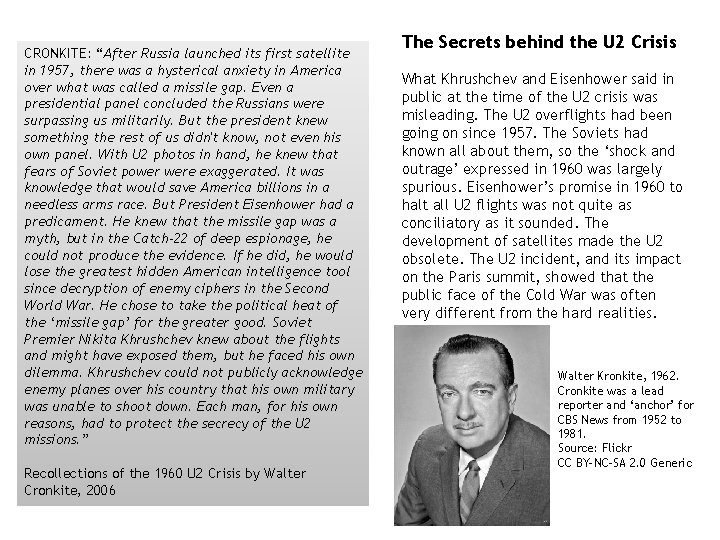
CRONKITE: “After Russia launched its first satellite in 1957, there was a hysterical anxiety in America over what was called a missile gap. Even a presidential panel concluded the Russians were surpassing us militarily. But the president knew something the rest of us didn't know, not even his own panel. With U 2 photos in hand, he knew that fears of Soviet power were exaggerated. It was knowledge that would save America billions in a needless arms race. But President Eisenhower had a predicament. He knew that the missile gap was a myth, but in the Catch-22 of deep espionage, he could not produce the evidence. If he did, he would lose the greatest hidden American intelligence tool since decryption of enemy ciphers in the Second World War. He chose to take the political heat of the ‘missile gap’ for the greater good. Soviet Premier Nikita Khrushchev knew about the flights and might have exposed them, but he faced his own dilemma. Khrushchev could not publicly acknowledge enemy planes over his country that his own military was unable to shoot down. Each man, for his own reasons, had to protect the secrecy of the U 2 missions. ” Recollections of the 1960 U 2 Crisis by Walter Cronkite, 2006 The Secrets behind the U 2 Crisis What Khrushchev and Eisenhower said in public at the time of the U 2 crisis was misleading. The U 2 overflights had been going on since 1957. The Soviets had known all about them, so the ‘shock and outrage’ expressed in 1960 was largely spurious. Eisenhower’s promise in 1960 to halt all U 2 flights was not quite as conciliatory as it sounded. The development of satellites made the U 2 obsolete. The U 2 incident, and its impact on the Paris summit, showed that the public face of the Cold War was often very different from the hard realities. Walter Kronkite, 1962. Cronkite was a lead reporter and ‘anchor’ for CBS News from 1952 to 1981. Source: Flickr CC BY-NC-SA 2. 0 Generic
“Having in mind the great importance of this conference and the hopes the peoples of the world have placed upon this meeting, I concluded it was best to see if any possibility existed through reason and restraint to dispose of this matter of the overflights, and permit the conference to go forward. Accordingly, despite the violence and inaccuracy of Mr Khrushchev’s statements, I replied in the following terms: ‘I have come to Paris to seek agreements with the Soviet Union which would eliminate the need for all forms of espionage, including overflights. I see no reason for this incident to disrupt the conference. We of the United States are here in good faith to consider all the important problems facing this conference’. In his statement Mr Khrushchev brushed aside all arguments of reason. It was thus made apparent that he was determined to wreck the Paris conference. In spite of this serious and adverse development, I have no intention whatever to diminish my continuing efforts to promote progress toward a peace with Justice. ” Statement by President Eisenhower, 16 May 1960 Eisenhower and the collapse of the Paris summit, 1960 Eisenhower refused to apologise for the U 2 overflights, though he promised there would be no more of them in future. This was an easy promise because the US now possessed the technology to spy by satellites instead. But Eisenhower took a conciliatory tone in his public statements, and it seems he genuinely wanted the Paris summit to go ahead. His attitude (and also the public mood in America more generally) was now much more receptive to the idea of peaceful coexistence than had been the case when his ‘New Look’ policy was put forward from 1953. Ironically, Khrushchev, who was worried about internal opposition in the Politburo and the Soviet military, was now less committed than he had been in the early days of his ‘Thaw’ in 1955 -56, or at the time of his visit to the United States in 1959. The collapse of the Paris summit revealed the continuing constraints of the Cold War.
The end of the Eisenhower era “America’s basic purposes have always been to keep the peace, to foster progress, and to enhance liberty and dignity among nations. Progress toward these noble goals is persistently threatened by the Cold War conflict now engulfing the world. We face a hostile ideology - global in scope, atheistic in character, ruthless in purpose, and insidious in method. We need to carry forward, steadily and surely, the burdens of a long and complex struggle. We have been compelled to create a permanent armaments industry of vast proportions. Added to this, three and a half million men and women are directly engaged in our defense establishments. Our military strength is a vital element in keeping the peace. Our arms must be mighty, ready for instant action, so that no potential aggressor may be tempted to risk its own destruction. This conjunction of an immense military establishment and a large arms industry is new in the American experience. We recognize the imperative need for this development. Yet we must not fail to comprehend its grave implications. In the councils of the government we must guard against the acquisition of unwarranted influence by the military-industrial complex. The potential for the disastrous rise of misplaced power exists and will persist. We must never let the weight of the military-industrial complex endanger our liberties or our democratic processes. Only an alert and knowledgeable citizenry can ensure the proper meshing of the huge industrial and military machinery of our defense with our peaceful methods and goals, so that peace, security and liberty may prosper together. ” President Eisenhower’s farewell address to the nation, after his departure from the White House in 1961 Eisenhower’s second term as president ended in 1960. His would-be successor, Vice-president Nixon was defeated in the November presidential elections by the Democratic candidate, Senator John F. Kennedy. Eisenhower’s farewell address, on 17 January 1961, just before Kennedy’s inauguration, showed several continuities with his ‘New Look’ policy, launched in 1953, but the tone was different. By this time, Eisenhower had faced Khrushchev across the Cold War divide for eight years. He knew that the superpower relationship was still dangerous, but also deceptively stable.
AFTER THE THAW: SUPERPOWER RELATIONS, 1960 “Despite frequent crises and the recurrent threat of war, Eisenhower managed to keep the peace during his time in office. He worked out with his European allies and the Soviet Union the basis for a viable if by no means perfect settlement in Europe Berlin, of course, the major exception – what John Lewis Gaddis has called the ‘Long Peace’. But, for the short term, with Cuba and Berlin unresolved and with Americans increasingly anxious, the Eisenhower administration left to its successor problems that would lead to the most dangerous period of the Cold War” G. C. Herring From Colony to Superpower (2011) p 701 “Did the collapse of personal relations with Eisenhower after the collapse of the Paris summit leave Khrushchev exposed to the hard-liners in Moscow? There was a great deal of secret gloating and hand-rubbing in Moscow; many in the Central Committee began to wonder if ‘special relations’ with the United States were worth the risk. But there were no serious challenges to Khrushchev from within the Kremlin as he steered the ship of Soviet foreign policy away from détente to confrontation. ” V. Zubok & C. Pleshakov Inside the Kremlin’s Cold War (1996) p 205
The new Soviet leadership and the easing of tensions 1953 -1960 This source collection was compiled by Chris Rowe Of the Historiana Historical Content Team SUPPORTED BY COPYRIGHT AND LICENSE EUROCLIO has tried to contact all copyright holders of materials published on Historiana. Please contact copyright@historiana. eu in case you find that materials have been unrightfully used. License: CC-BY-SA 4. 0, Historiana DISCLAIMER Konrad Adenauer meets with Nikolai Bulganin and Nikita Khrushchev during an official visit to Moscow in 1955. (Bundesarchiv, Bild 146 -1989 -101 -01 A / CC-BY-SA 3. 0). jpg The European Commission support for this publication does not constitute of an endorsement of the contents which reflects the view only of the authors, and the European Commission cannot be held responsible for any use which may be made of the information contained herein. DEVELOPED BY