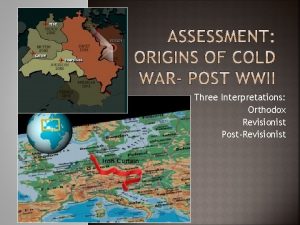
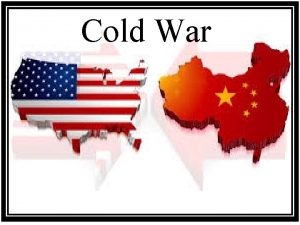
The Cold War After World War II the

- Slides: 41
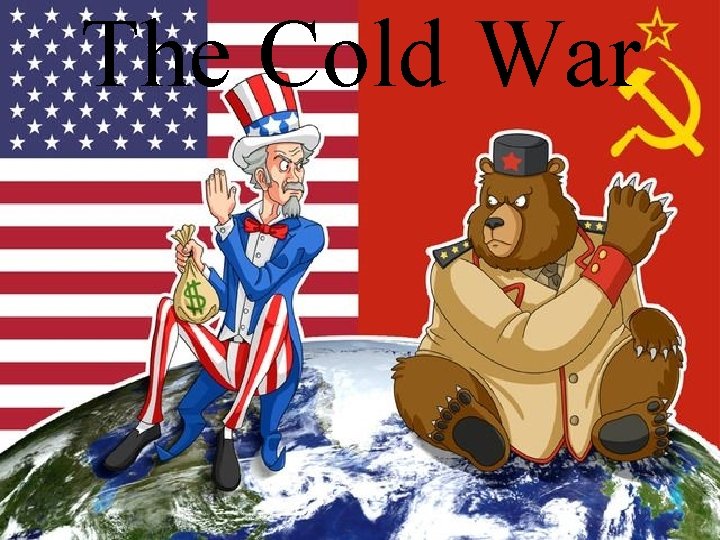
The Cold War
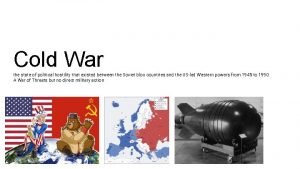
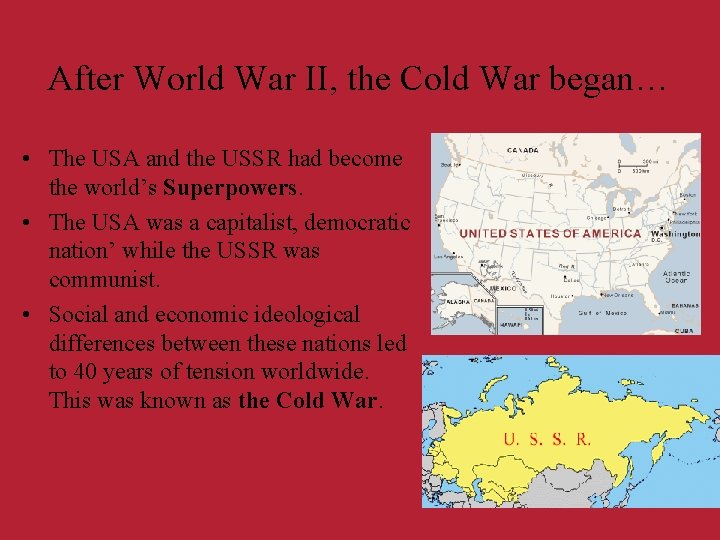
After World War II, the Cold War began… • The USA and the USSR had become the world’s Superpowers. • The USA was a capitalist, democratic nation’ while the USSR was communist. • Social and economic ideological differences between these nations led to 40 years of tension worldwide. This was known as the Cold War.
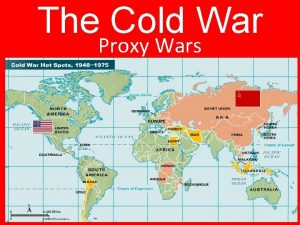
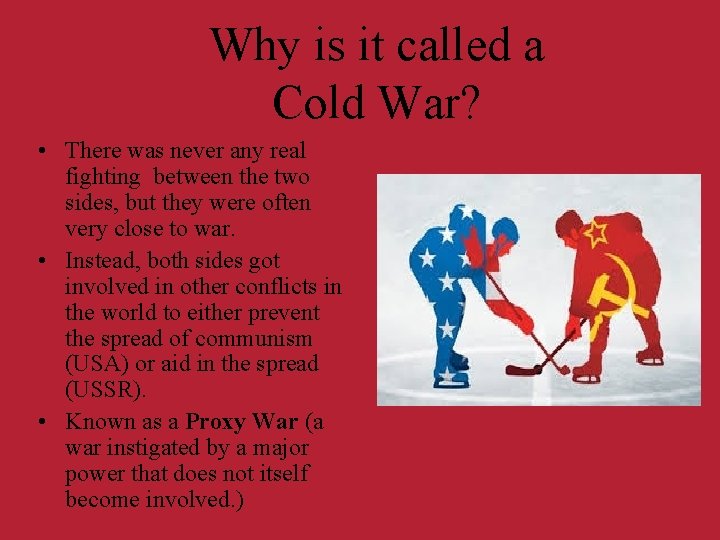
Why is it called a Cold War? • There was never any real fighting between the two sides, but they were often very close to war. • Instead, both sides got involved in other conflicts in the world to either prevent the spread of communism (USA) or aid in the spread (USSR). • Known as a Proxy War (a war instigated by a major power that does not itself become involved. )
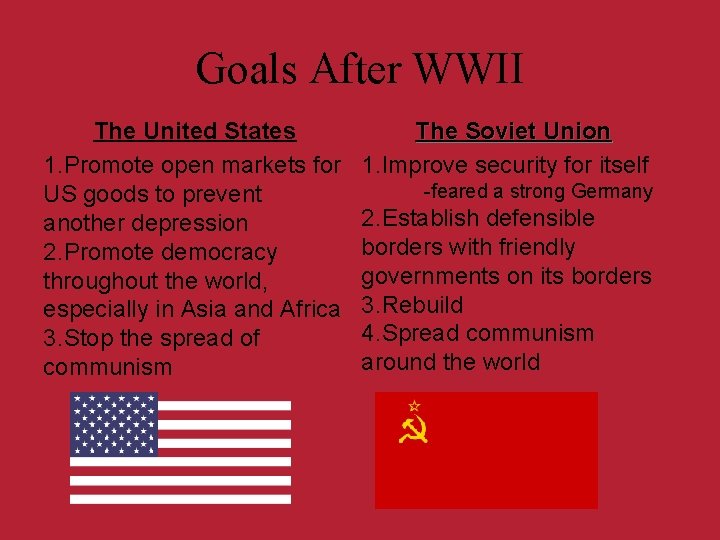
Goals After WWII The United States 1. Promote open markets for US goods to prevent another depression 2. Promote democracy throughout the world, especially in Asia and Africa 3. Stop the spread of communism The Soviet Union 1. Improve security for itself -feared a strong Germany 2. Establish defensible borders with friendly governments on its borders 3. Rebuild 4. Spread communism around the world
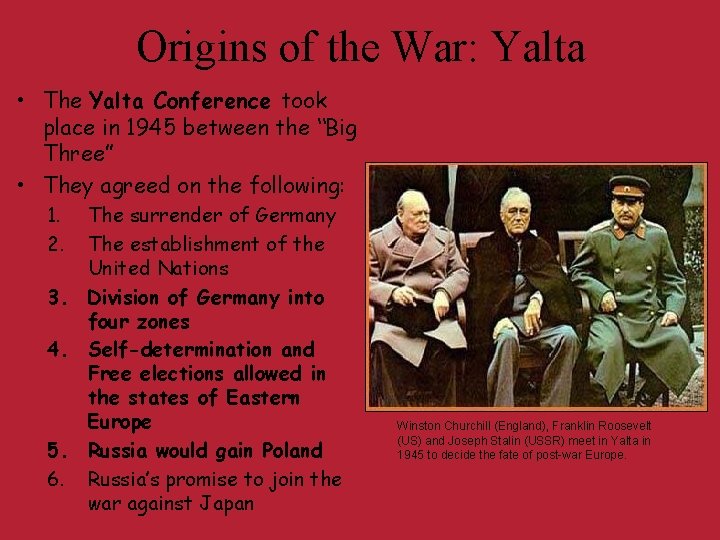
Origins of the War: Yalta • The Yalta Conference took place in 1945 between the “Big Three” • They agreed on the following: 1. 2. The surrender of Germany The establishment of the United Nations 3. Division of Germany into four zones 4. Self-determination and Free elections allowed in the states of Eastern Europe 5. Russia would gain Poland 6. Russia’s promise to join the war against Japan Winston Churchill (England), Franklin Roosevelt (US) and Joseph Stalin (USSR) meet in Yalta in 1945 to decide the fate of post-war Europe.
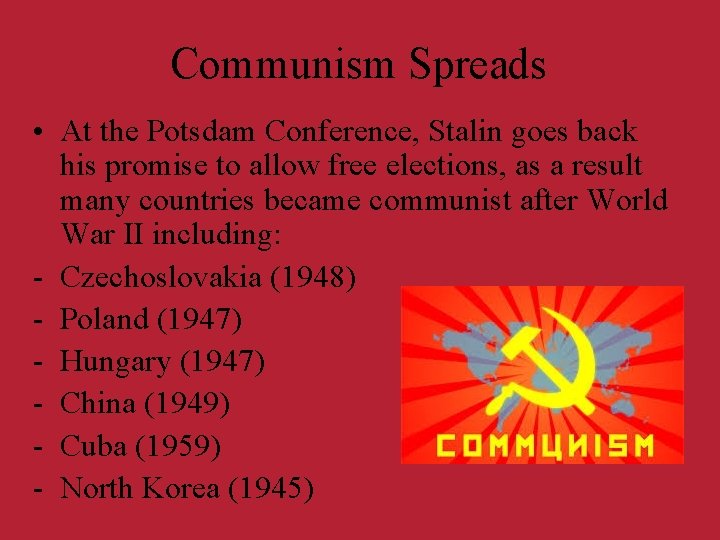
Communism Spreads • At the Potsdam Conference, Stalin goes back his promise to allow free elections, as a result many countries became communist after World War II including: - Czechoslovakia (1948) - Poland (1947) - Hungary (1947) - China (1949) - Cuba (1959) - North Korea (1945)
Satellite Nations • Satellite Nations= countries dependent upon & dominated by the Soviet Union
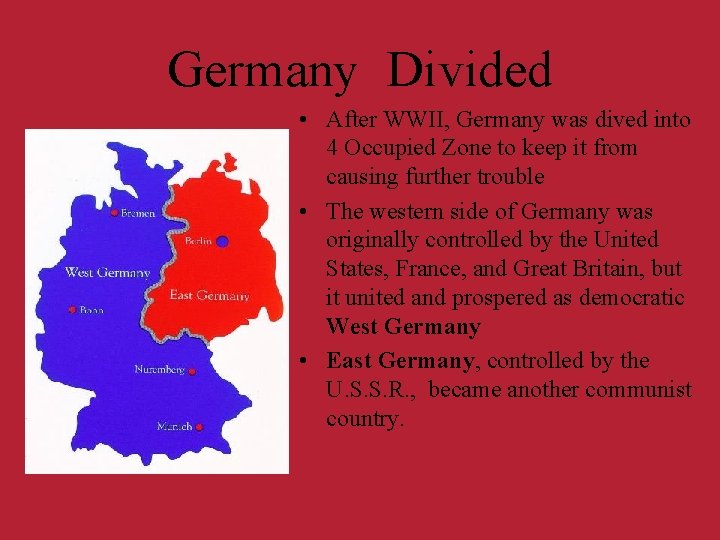
Germany Divided • After WWII, Germany was dived into 4 Occupied Zone to keep it from causing further trouble • The western side of Germany was originally controlled by the United States, France, and Great Britain, but it united and prospered as democratic West Germany • East Germany, controlled by the U. S. S. R. , became another communist country.
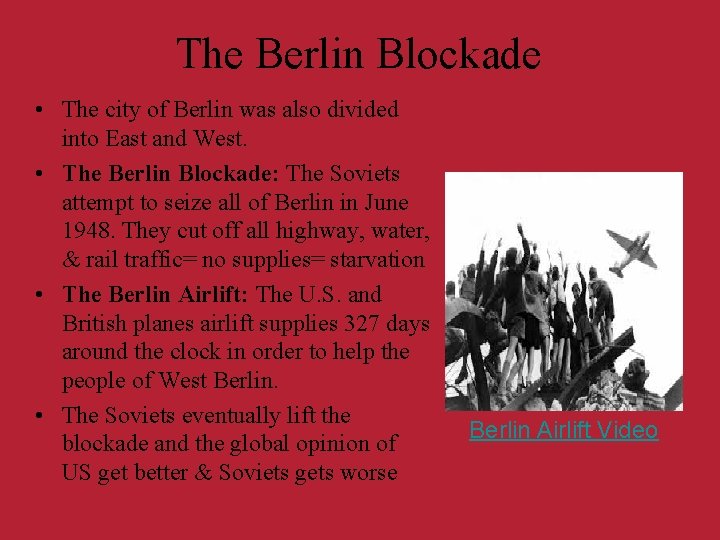
The Berlin Blockade • The city of Berlin was also divided into East and West. • The Berlin Blockade: The Soviets attempt to seize all of Berlin in June 1948. They cut off all highway, water, & rail traffic= no supplies= starvation • The Berlin Airlift: The U. S. and British planes airlift supplies 327 days around the clock in order to help the people of West Berlin. • The Soviets eventually lift the blockade and the global opinion of US get better & Soviets gets worse Berlin Airlift Video
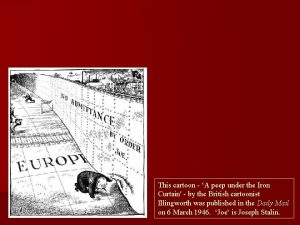
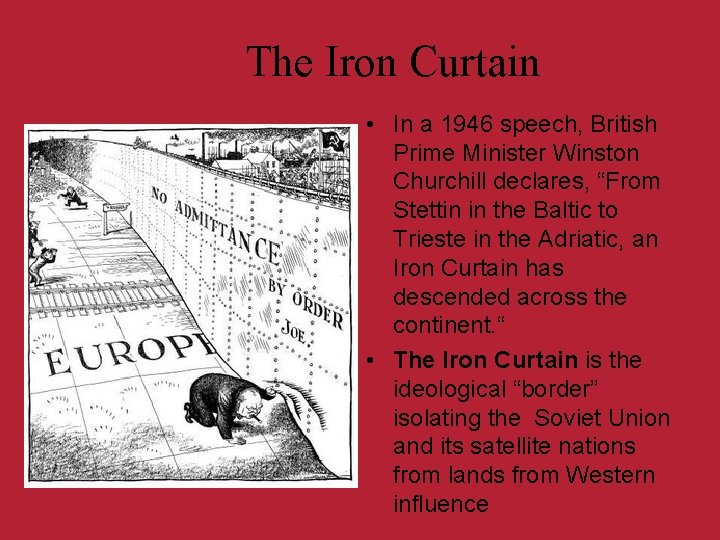
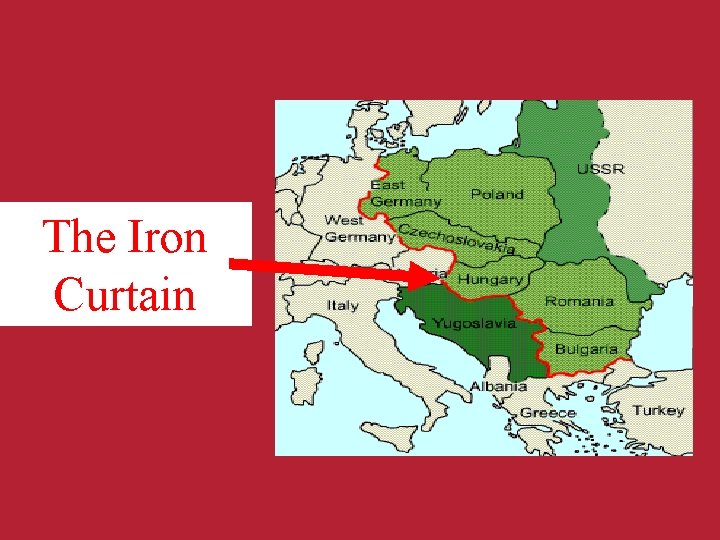
The Iron Curtain • In a 1946 speech, British Prime Minister Winston Churchill declares, “From Stettin in the Baltic to Trieste in the Adriatic, an Iron Curtain has descended across the continent. “ • The Iron Curtain is the ideological “border” isolating the Soviet Union and its satellite nations from lands from Western influence
The Iron Curtain
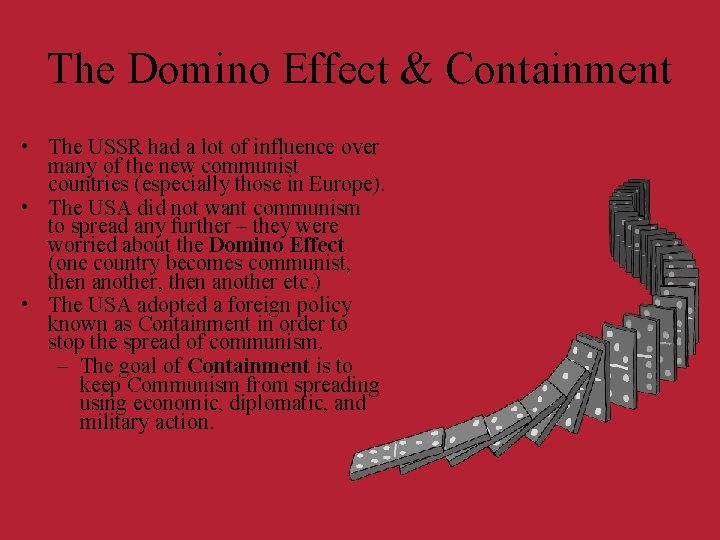
The Domino Effect & Containment • The USSR had a lot of influence over many of the new communist countries (especially those in Europe). • The USA did not want communism to spread any further – they were worried about the Domino Effect (one country becomes communist, then another, then another etc. ) • The USA adopted a foreign policy known as Containment in order to stop the spread of communism. – The goal of Containment is to keep Communism from spreading using economic, diplomatic, and military action.
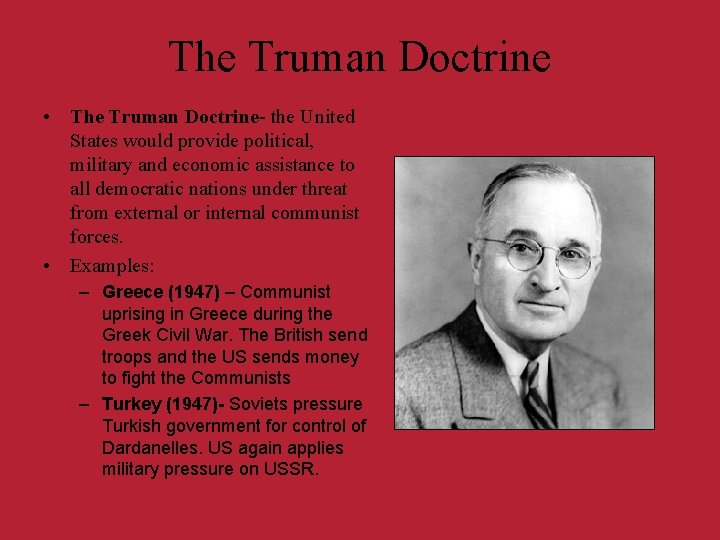
The Truman Doctrine • The Truman Doctrine- the United States would provide political, military and economic assistance to all democratic nations under threat from external or internal communist forces. • Examples: – Greece (1947) – Communist uprising in Greece during the Greek Civil War. The British send troops and the US sends money to fight the Communists – Turkey (1947)- Soviets pressure Turkish government for control of Dardanelles. US again applies military pressure on USSR.
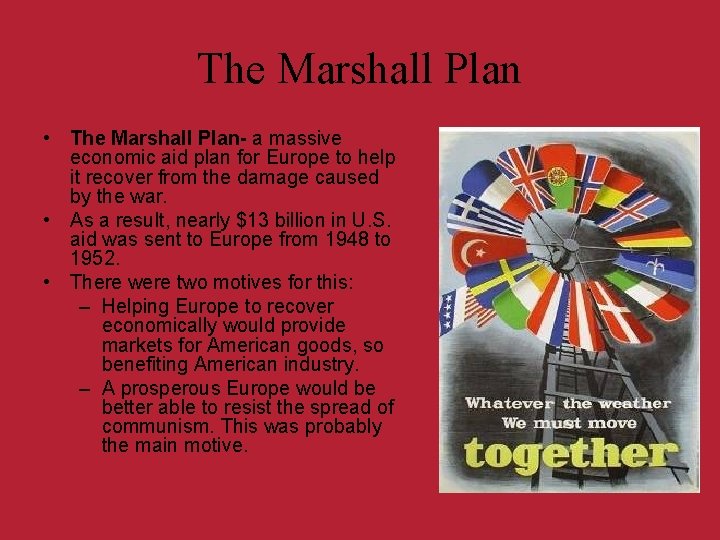
The Marshall Plan • The Marshall Plan- a massive economic aid plan for Europe to help it recover from the damage caused by the war. • As a result, nearly $13 billion in U. S. aid was sent to Europe from 1948 to 1952. • There were two motives for this: – Helping Europe to recover economically would provide markets for American goods, so benefiting American industry. – A prosperous Europe would be better able to resist the spread of communism. This was probably the main motive.
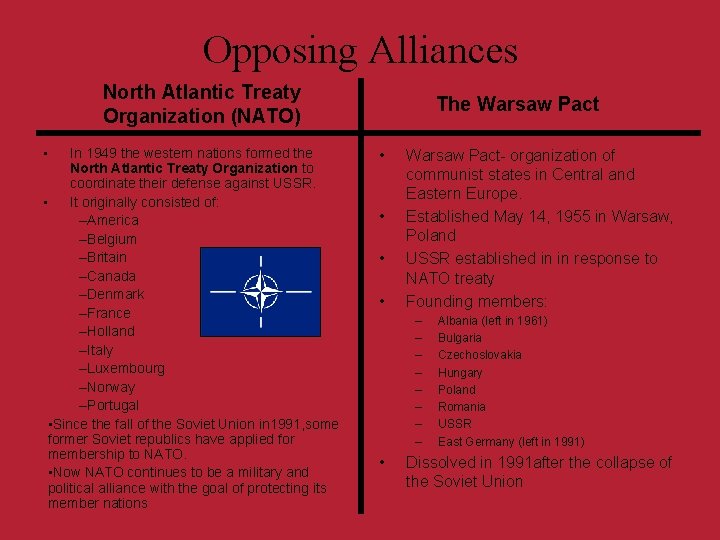
Opposing Alliances North Atlantic Treaty Organization (NATO) • In 1949 the western nations formed the North Atlantic Treaty Organization to coordinate their defense against USSR. • It originally consisted of: –America –Belgium –Britain –Canada –Denmark –France –Holland –Italy –Luxembourg –Norway –Portugal • Since the fall of the Soviet Union in 1991, some former Soviet republics have applied for membership to NATO. • Now NATO continues to be a military and political alliance with the goal of protecting its member nations The Warsaw Pact • • Warsaw Pact- organization of communist states in Central and Eastern Europe. Established May 14, 1955 in Warsaw, Poland USSR established in in response to NATO treaty Founding members: – – – – • Albania (left in 1961) Bulgaria Czechoslovakia Hungary Poland Romania USSR East Germany (left in 1991) Dissolved in 1991 after the collapse of the Soviet Union
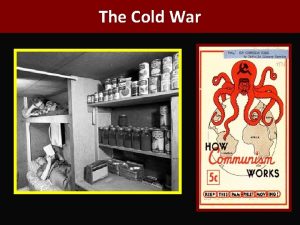
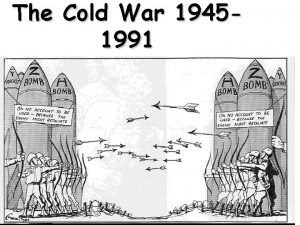
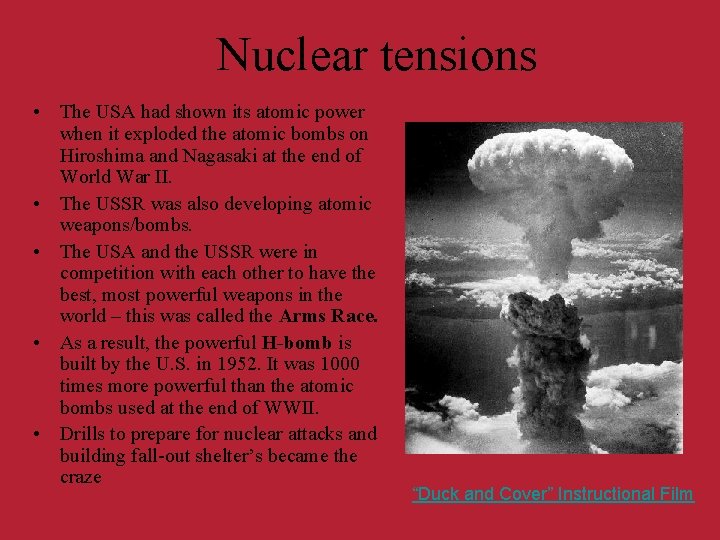
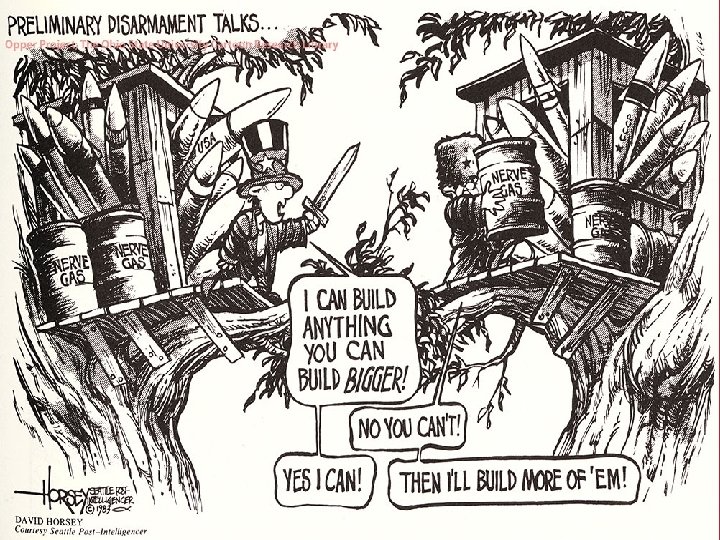
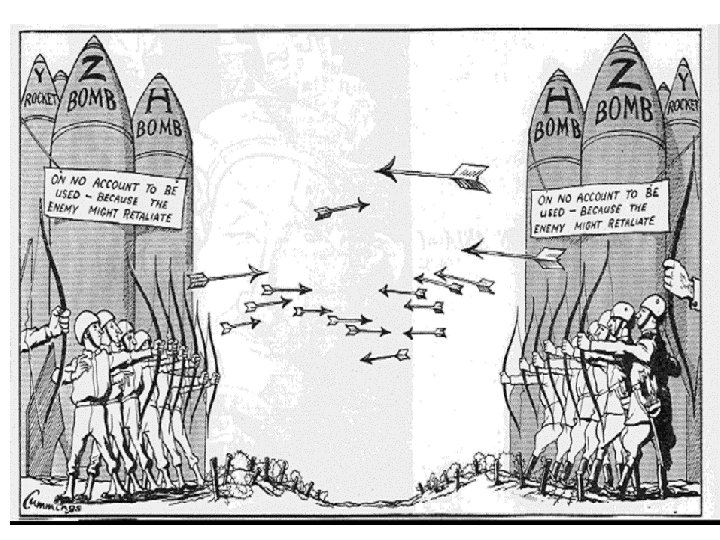
Nuclear tensions • The USA had shown its atomic power when it exploded the atomic bombs on Hiroshima and Nagasaki at the end of World War II. • The USSR was also developing atomic weapons/bombs. • The USA and the USSR were in competition with each other to have the best, most powerful weapons in the world – this was called the Arms Race. • As a result, the powerful H-bomb is built by the U. S. in 1952. It was 1000 times more powerful than the atomic bombs used at the end of WWII. • Drills to prepare for nuclear attacks and building fall-out shelter’s became the craze “Duck and Cover” Instructional Film
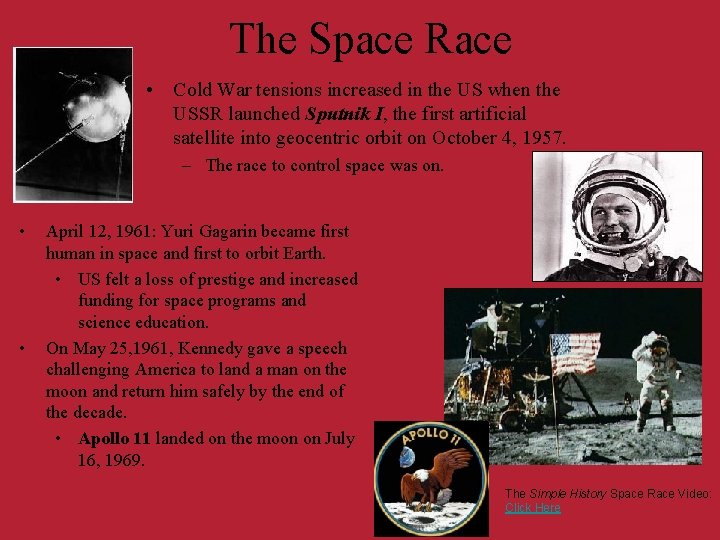
The Space Race • Cold War tensions increased in the US when the USSR launched Sputnik I, the first artificial satellite into geocentric orbit on October 4, 1957. – The race to control space was on. • • April 12, 1961: Yuri Gagarin became first human in space and first to orbit Earth. • US felt a loss of prestige and increased funding for space programs and science education. On May 25, 1961, Kennedy gave a speech challenging America to land a man on the moon and return him safely by the end of the decade. • Apollo 11 landed on the moon on July 16, 1969. The Simple History Space Race Video: Click Here
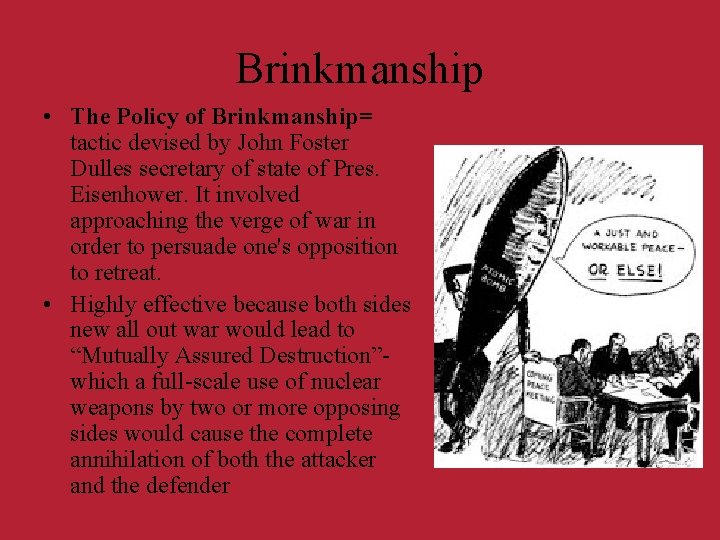
Brinkmanship • The Policy of Brinkmanship= tactic devised by John Foster Dulles secretary of state of Pres. Eisenhower. It involved approaching the verge of war in order to persuade one's opposition to retreat. • Highly effective because both sides new all out war would lead to “Mutually Assured Destruction”- which a full-scale use of nuclear weapons by two or more opposing sides would cause the complete annihilation of both the attacker and the defender
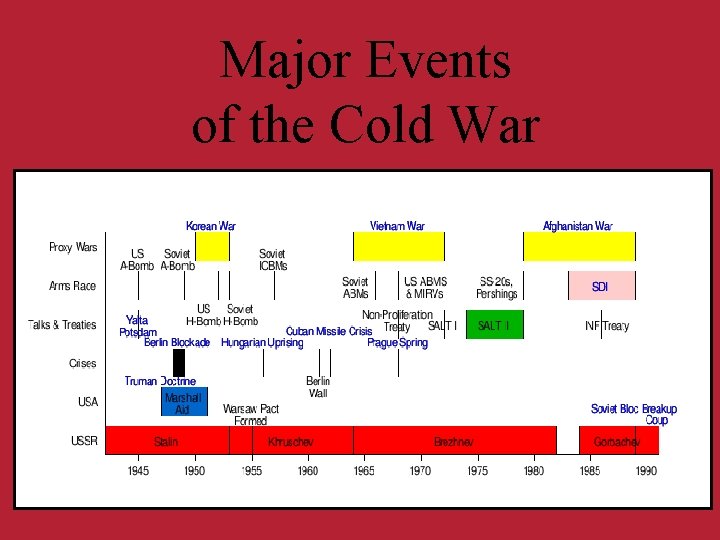
Major Events of the Cold War
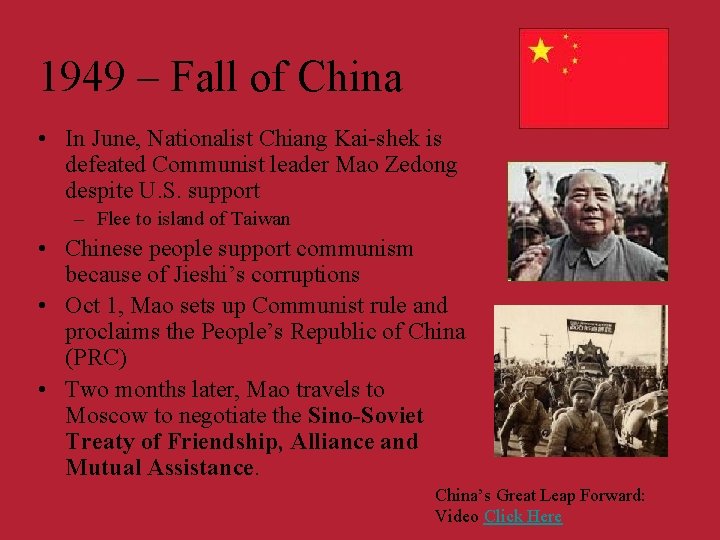
1949 – Fall of China • In June, Nationalist Chiang Kai-shek is defeated Communist leader Mao Zedong despite U. S. support – Flee to island of Taiwan • Chinese people support communism because of Jieshi’s corruptions • Oct 1, Mao sets up Communist rule and proclaims the People’s Republic of China (PRC) • Two months later, Mao travels to Moscow to negotiate the Sino-Soviet Treaty of Friendship, Alliance and Mutual Assistance. China’s Great Leap Forward: Video Click Here
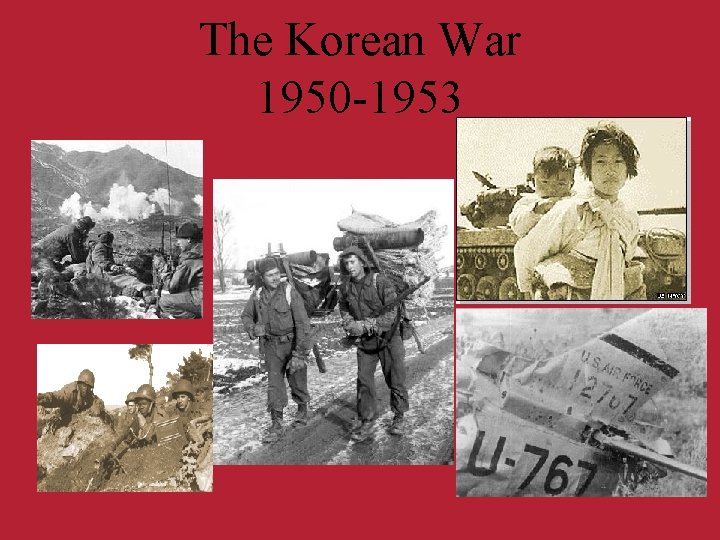
The Korean War 1950 -1953
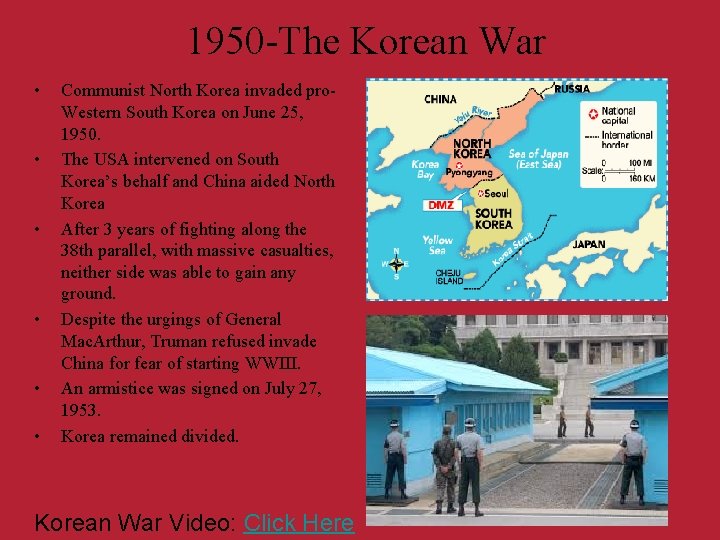
1950 -The Korean War • • • Communist North Korea invaded pro. Western South Korea on June 25, 1950. The USA intervened on South Korea’s behalf and China aided North Korea After 3 years of fighting along the 38 th parallel, with massive casualties, neither side was able to gain any ground. Despite the urgings of General Mac. Arthur, Truman refused invade China for fear of starting WWIII. An armistice was signed on July 27, 1953. Korea remained divided. Korean War Video: Click Here
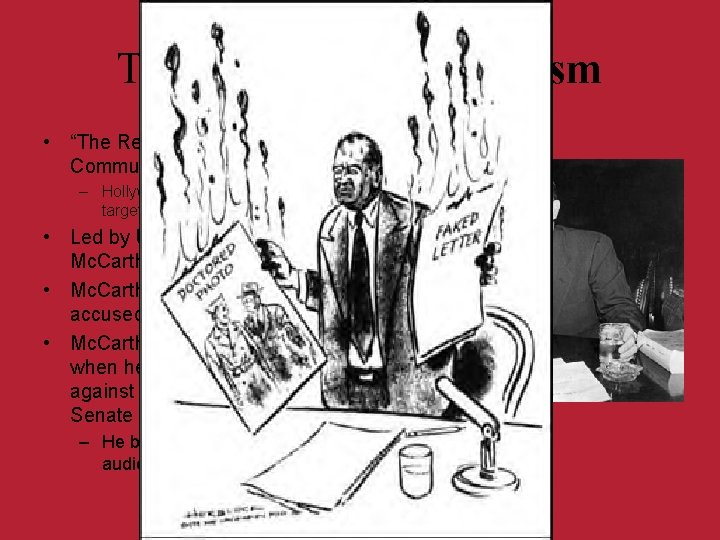
The 1950’s- Mc. Carthyism • “The Red Scare”- fear of Communist spies in the U. S. – Hollywood actor’s were a common target • Led by U. S. senator Joseph Mc. Carthy • Mc. Carthy spread fear and accused without evidence • Mc. Carthy’s downfall came when he made accusations against US Army = televised Senate investigation – He bullied witnesses alienated audience & lost public support
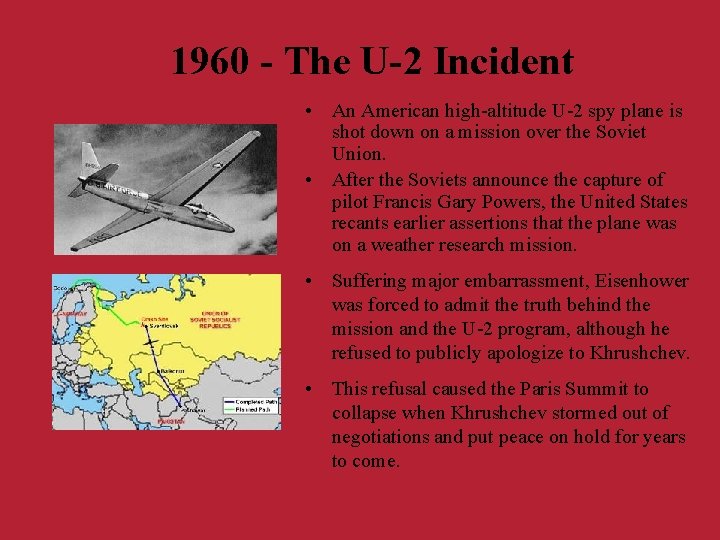
1960 - The U-2 Incident • An American high-altitude U-2 spy plane is shot down on a mission over the Soviet Union. • After the Soviets announce the capture of pilot Francis Gary Powers, the United States recants earlier assertions that the plane was on a weather research mission. • Suffering major embarrassment, Eisenhower was forced to admit the truth behind the mission and the U-2 program, although he refused to publicly apologize to Khrushchev. • This refusal caused the Paris Summit to collapse when Khrushchev stormed out of negotiations and put peace on hold for years to come.
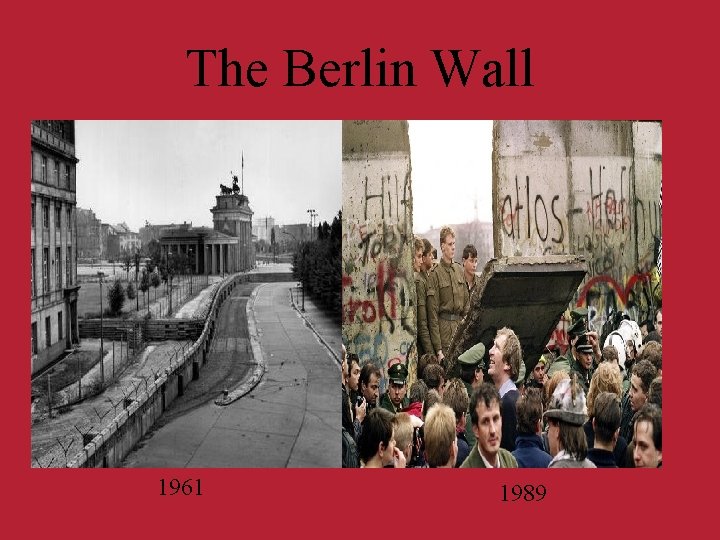
The Berlin Wall 1961 1989
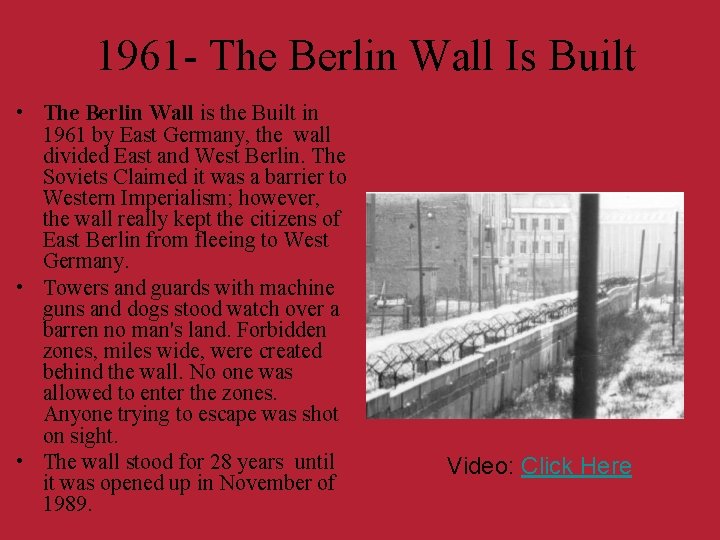
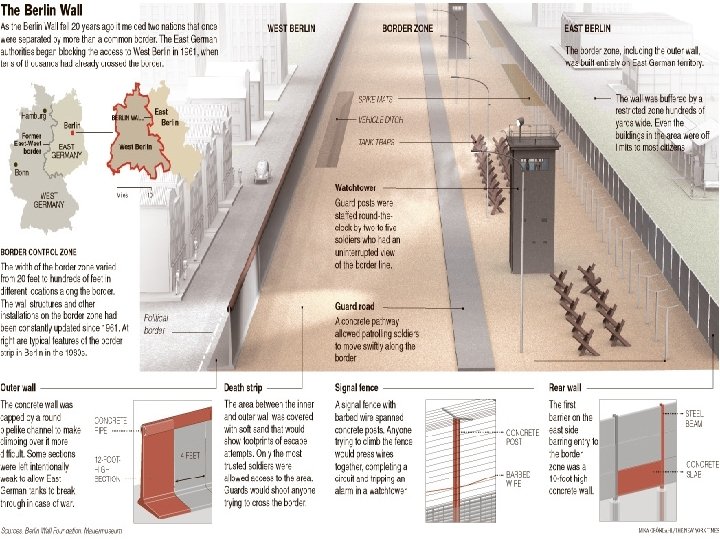
1961 - The Berlin Wall Is Built • The Berlin Wall is the Built in 1961 by East Germany, the wall divided East and West Berlin. The Soviets Claimed it was a barrier to Western Imperialism; however, the wall really kept the citizens of East Berlin from fleeing to West Germany. • Towers and guards with machine guns and dogs stood watch over a barren no man's land. Forbidden zones, miles wide, were created behind the wall. No one was allowed to enter the zones. Anyone trying to escape was shot on sight. • The wall stood for 28 years until it was opened up in November of 1989. Video: Click Here
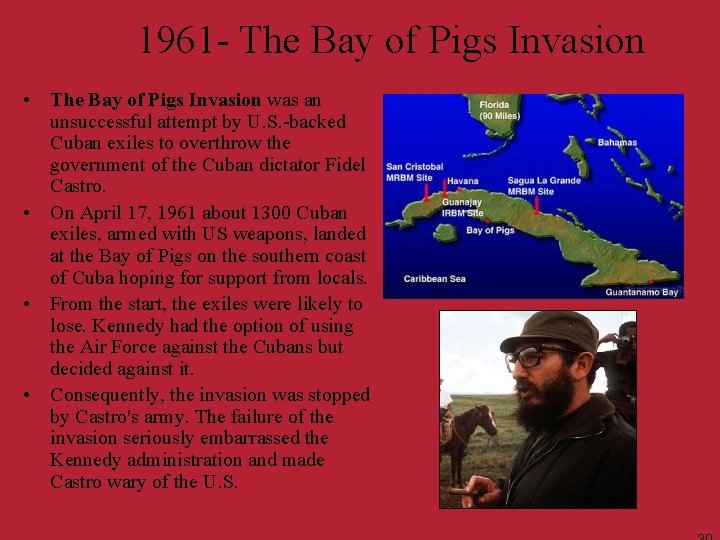
1961 - The Bay of Pigs Invasion • The Bay of Pigs Invasion was an unsuccessful attempt by U. S. -backed Cuban exiles to overthrow the government of the Cuban dictator Fidel Castro. • On April 17, 1961 about 1300 Cuban exiles, armed with US weapons, landed at the Bay of Pigs on the southern coast of Cuba hoping for support from locals. • From the start, the exiles were likely to lose. Kennedy had the option of using the Air Force against the Cubans but decided against it. • Consequently, the invasion was stopped by Castro's army. The failure of the invasion seriously embarrassed the Kennedy administration and made Castro wary of the U. S.
1962 -The Cuban Missile Crisis
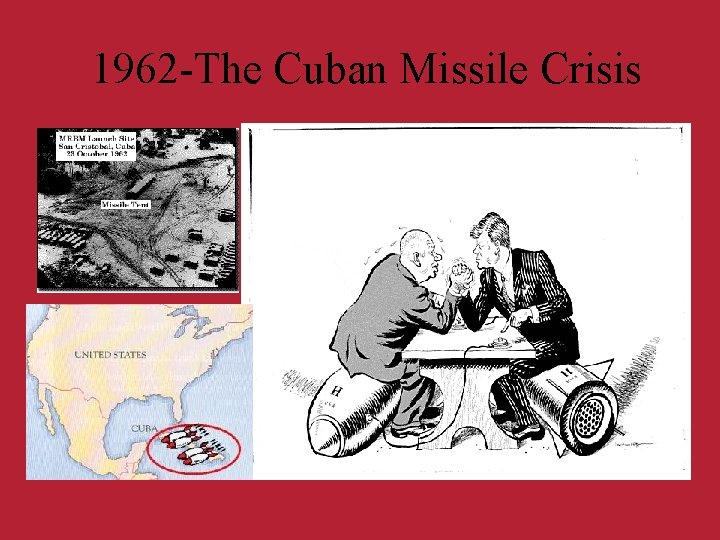
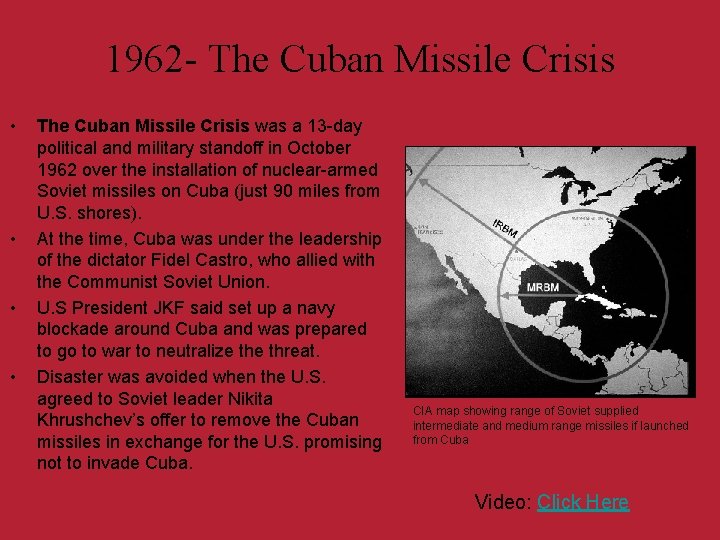
1962 - The Cuban Missile Crisis • • The Cuban Missile Crisis was a 13 -day political and military standoff in October 1962 over the installation of nuclear-armed Soviet missiles on Cuba (just 90 miles from U. S. shores). At the time, Cuba was under the leadership of the dictator Fidel Castro, who allied with the Communist Soviet Union. U. S President JKF said set up a navy blockade around Cuba and was prepared to go to war to neutralize threat. Disaster was avoided when the U. S. agreed to Soviet leader Nikita Khrushchev’s offer to remove the Cuban missiles in exchange for the U. S. promising not to invade Cuba. CIA map showing range of Soviet supplied intermediate and medium range missiles if launched from Cuba Video: Click Here
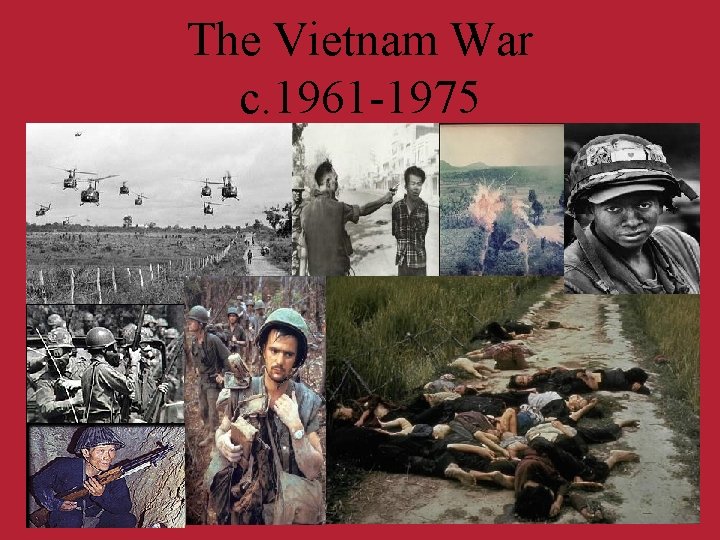
The Vietnam War c. 1961 -1975
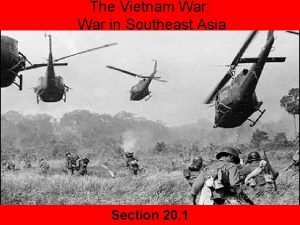
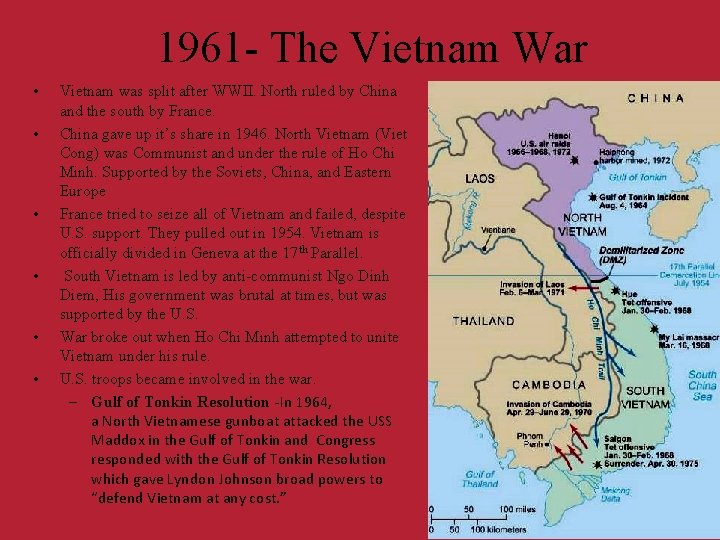
1961 - The Vietnam War • • • Vietnam was split after WWII. North ruled by China and the south by France. China gave up it’s share in 1946. North Vietnam (Viet Cong) was Communist and under the rule of Ho Chi Minh. Supported by the Soviets, China, and Eastern Europe France tried to seize all of Vietnam and failed, despite U. S. support. They pulled out in 1954. Vietnam is officially divided in Geneva at the 17 th Parallel. South Vietnam is led by anti-communist Ngo Dinh Diem, His government was brutal at times, but was supported by the U. S. War broke out when Ho Chi Minh attempted to unite Vietnam under his rule. U. S. troops became involved in the war. – Gulf of Tonkin Resolution -In 1964, a North Vietnamese gunboat attacked the USS Maddox in the Gulf of Tonkin and Congress responded with the Gulf of Tonkin Resolution which gave Lyndon Johnson broad powers to “defend Vietnam at any cost. ”
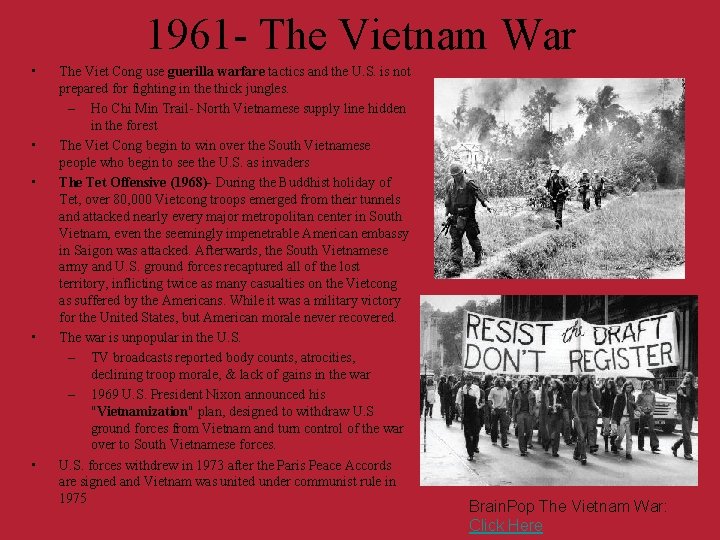
1961 - The Vietnam War • • • The Viet Cong use guerilla warfare tactics and the U. S. is not prepared for fighting in the thick jungles. – Ho Chi Min Trail- North Vietnamese supply line hidden in the forest The Viet Cong begin to win over the South Vietnamese people who begin to see the U. S. as invaders The Tet Offensive (1968)- During the Buddhist holiday of Tet, over 80, 000 Vietcong troops emerged from their tunnels and attacked nearly every major metropolitan center in South Vietnam, even the seemingly impenetrable American embassy in Saigon was attacked. Afterwards, the South Vietnamese army and U. S. ground forces recaptured all of the lost territory, inflicting twice as many casualties on the Vietcong as suffered by the Americans. While it was a military victory for the United States, but American morale never recovered. The war is unpopular in the U. S. – TV broadcasts reported body counts, atrocities, declining troop morale, & lack of gains in the war – 1969 U. S. President Nixon announced his "Vietnamization" plan, designed to withdraw U. S ground forces from Vietnam and turn control of the war over to South Vietnamese forces. U. S. forces withdrew in 1973 after the Paris Peace Accords are signed and Vietnam was united under communist rule in 1975 Brain. Pop The Vietnam War: Click Here
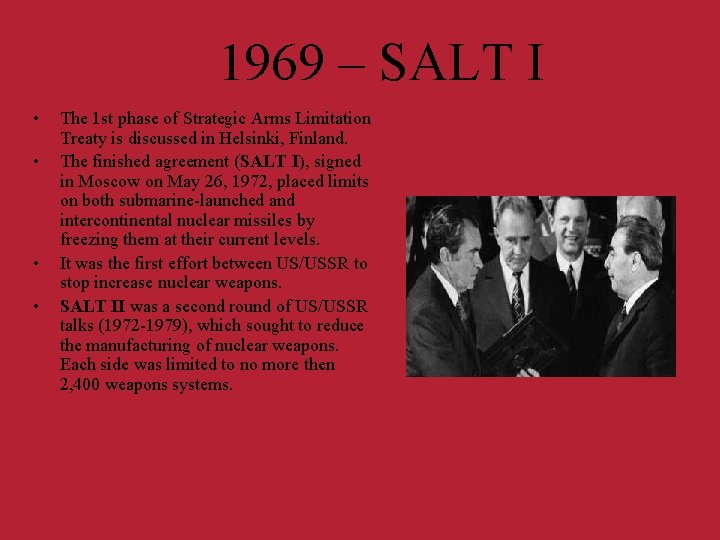
1969 – SALT I • • The 1 st phase of Strategic Arms Limitation Treaty is discussed in Helsinki, Finland. The finished agreement (SALT I), signed in Moscow on May 26, 1972, placed limits on both submarine-launched and intercontinental nuclear missiles by freezing them at their current levels. It was the first effort between US/USSR to stop increase nuclear weapons. SALT II was a second round of US/USSR talks (1972 -1979), which sought to reduce the manufacturing of nuclear weapons. Each side was limited to no more then 2, 400 weapons systems.
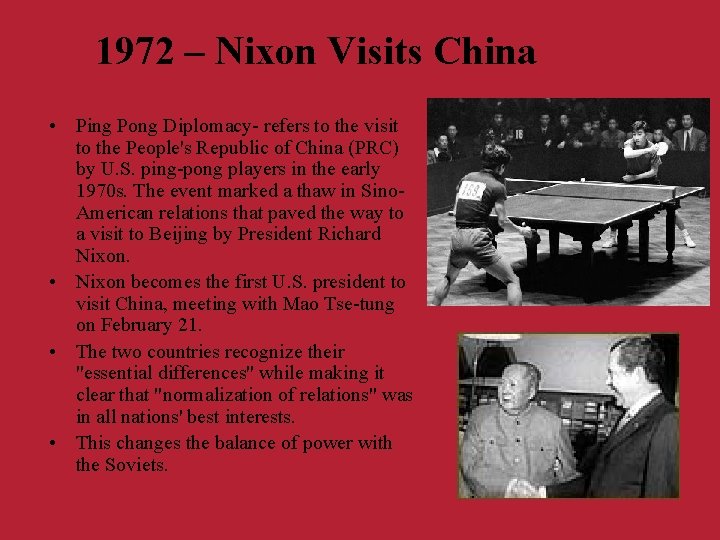
1972 – Nixon Visits China • Ping Pong Diplomacy- refers to the visit to the People's Republic of China (PRC) by U. S. ping-pong players in the early 1970 s. The event marked a thaw in Sino. American relations that paved the way to a visit to Beijing by President Richard Nixon. • Nixon becomes the first U. S. president to visit China, meeting with Mao Tse-tung on February 21. • The two countries recognize their "essential differences" while making it clear that "normalization of relations" was in all nations' best interests. • This changes the balance of power with the Soviets.
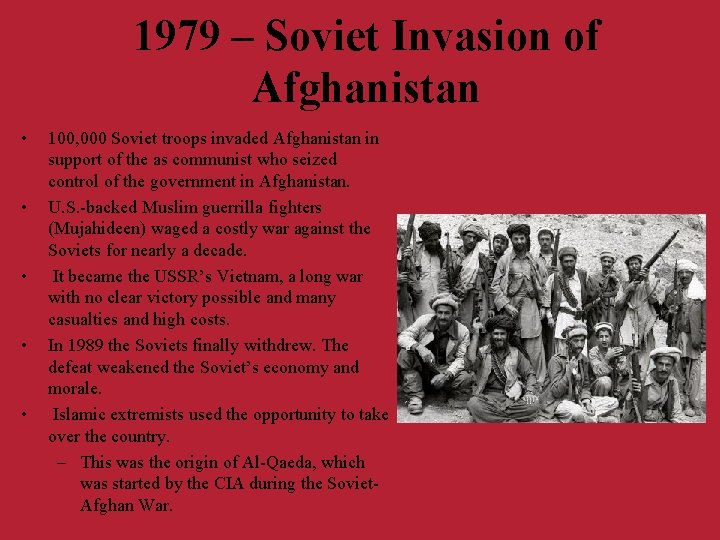
1979 – Soviet Invasion of Afghanistan • • • 100, 000 Soviet troops invaded Afghanistan in support of the as communist who seized control of the government in Afghanistan. U. S. -backed Muslim guerrilla fighters (Mujahideen) waged a costly war against the Soviets for nearly a decade. It became the USSR’s Vietnam, a long war with no clear victory possible and many casualties and high costs. In 1989 the Soviets finally withdrew. The defeat weakened the Soviet’s economy and morale. Islamic extremists used the opportunity to take over the country. – This was the origin of Al-Qaeda, which was started by the CIA during the Soviet. Afghan War.
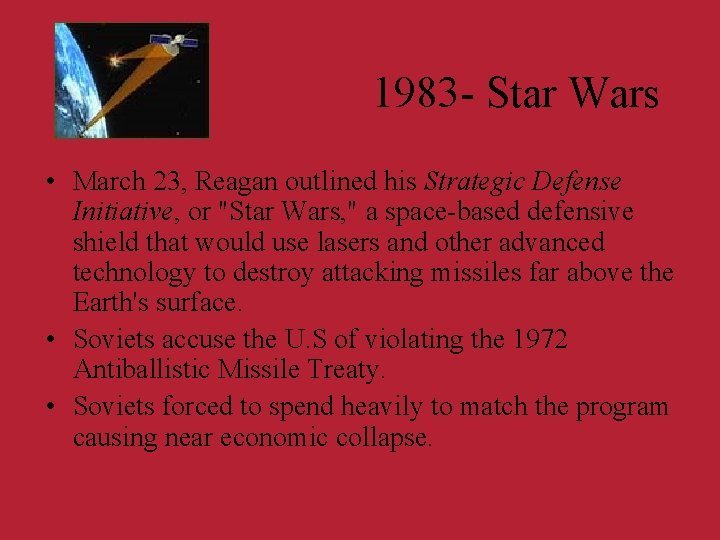
1983 - Star Wars • March 23, Reagan outlined his Strategic Defense Initiative, or "Star Wars, " a space-based defensive shield that would use lasers and other advanced technology to destroy attacking missiles far above the Earth's surface. • Soviets accuse the U. S of violating the 1972 Antiballistic Missile Treaty. • Soviets forced to spend heavily to match the program causing near economic collapse.
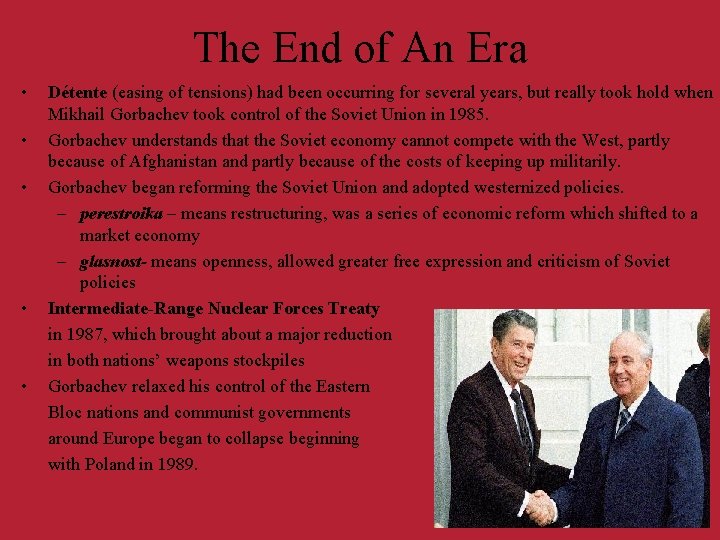
The End of An Era • Détente (easing of tensions) had been occurring for several years, but really took hold when Mikhail Gorbachev took control of the Soviet Union in 1985. • Gorbachev understands that the Soviet economy cannot compete with the West, partly because of Afghanistan and partly because of the costs of keeping up militarily. • Gorbachev began reforming the Soviet Union and adopted westernized policies. – perestroika – means restructuring, was a series of economic reform which shifted to a market economy – glasnost- means openness, allowed greater free expression and criticism of Soviet policies • Intermediate-Range Nuclear Forces Treaty in 1987, which brought about a major reduction in both nations’ weapons stockpiles • Gorbachev relaxed his control of the Eastern Bloc nations and communist governments around Europe began to collapse beginning with Poland in 1989.
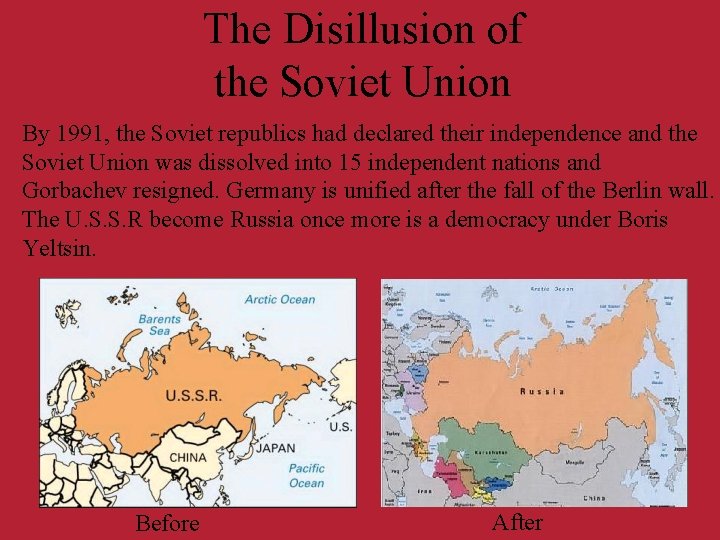
The Disillusion of the Soviet Union By 1991, the Soviet republics had declared their independence and the Soviet Union was dissolved into 15 independent nations and Gorbachev resigned. Germany is unified after the fall of the Berlin wall. The U. S. S. R become Russia once more is a democracy under Boris Yeltsin. Before After