
Fruit drop in coconut Speaker Momin Saeedanavar K

- Slides: 69
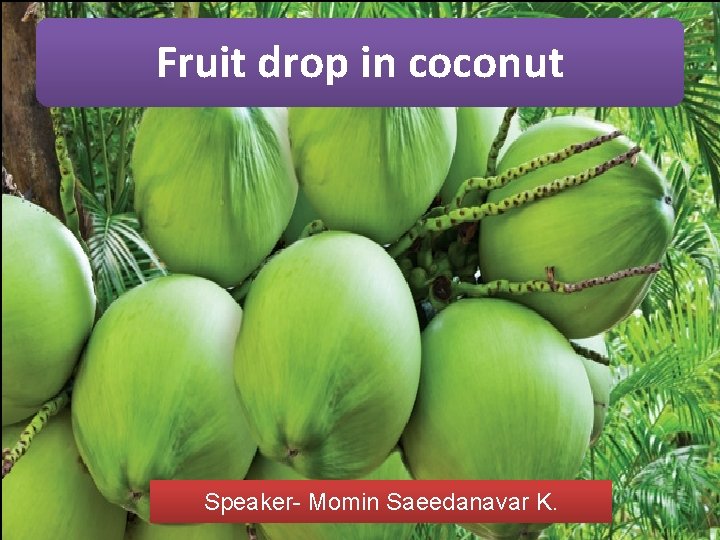
Fruit drop in coconut Speaker- Momin Saeedanavar K.
Contents Introduction Flowering physiology Button shedding fruit dropping Summery Conclusion Future trust
Introduction v. The coconut palm is a monocotyledon and tropical nut palm belongs to the family of the arecaceae botanical name is known as Cocos nucifera Linn. v. The most important and economically valuable produce of coconut palm is its fruit popularly known as ‘nut’. 3
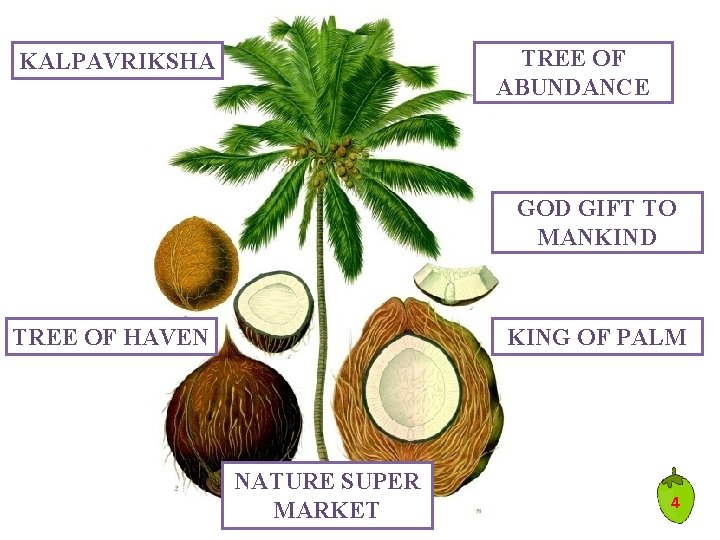
TREE OF ABUNDANCE KALPAVRIKSHA GOD GIFT TO MANKIND TREE OF HAVEN KING OF PALM NATURE SUPER MARKET 4
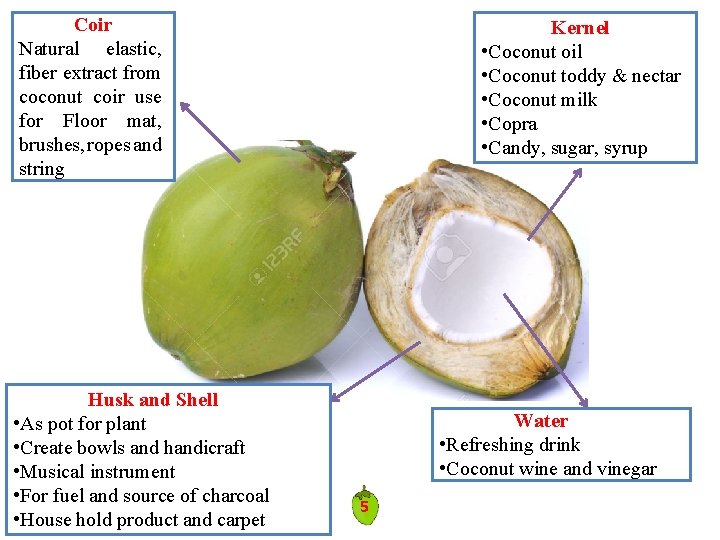
Coir Natural elastic, fiber extract from coconut coir use for Floor mat, brushes, ropes and string Husk and Shell • As pot for plant • Create bowls and handicraft • Musical instrument • For fuel and source of charcoal • House hold product and carpet Kernel • Coconut oil • Coconut toddy & nectar • Coconut milk • Copra • Candy, sugar, syrup Water • Refreshing drink • Coconut wine and vinegar 5
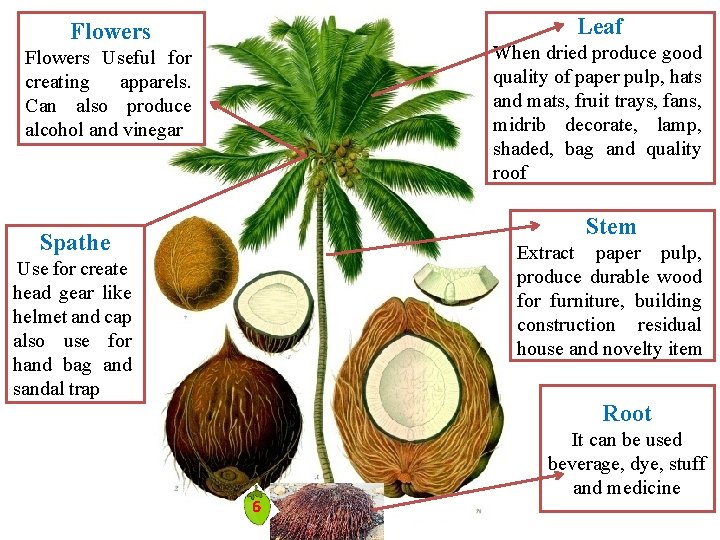
Leaf Flowers When dried produce good quality of paper pulp, hats and mats, fruit trays, fans, midrib decorate, lamp, shaded, bag and quality roof Flowers Useful for creating apparels. Can also produce alcohol and vinegar Stem Spathe Extract paper pulp, produce durable wood for furniture, building construction residual house and novelty item Use for create head gear like helmet and cap also use for hand bag and sandal trap Root 6 It can be used beverage, dye, stuff and medicine
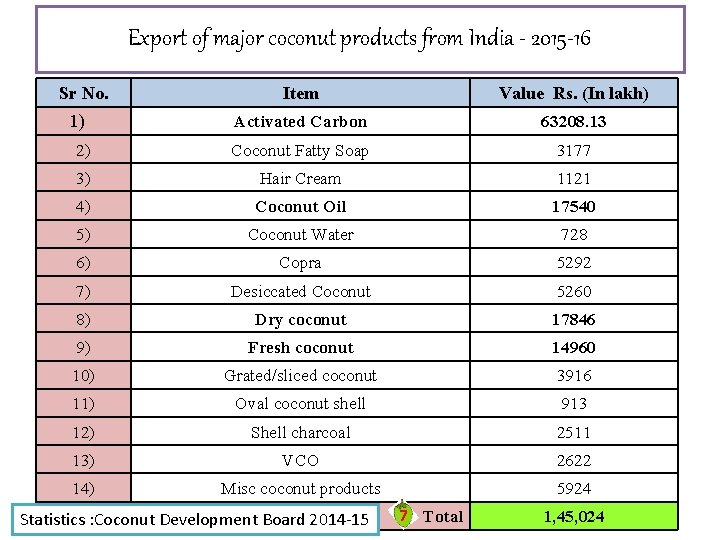
Export of major coconut products from India - 2015 -16 Sr No. Item Value Rs. (In lakh) Activated Carbon 63208. 13 2) Coconut Fatty Soap 3177 3) Hair Cream 1121 4) Coconut Oil 17540 5) Coconut Water 728 6) Copra 5292 7) Desiccated Coconut 5260 8) Dry coconut 17846 9) Fresh coconut 14960 10) Grated/sliced coconut 3916 11) Oval coconut shell 913 12) Shell charcoal 2511 13) VCO 2622 14) Misc coconut products 5924 1) Statistics : Coconut Development Board 2014 -15 7 Total 1, 45, 024
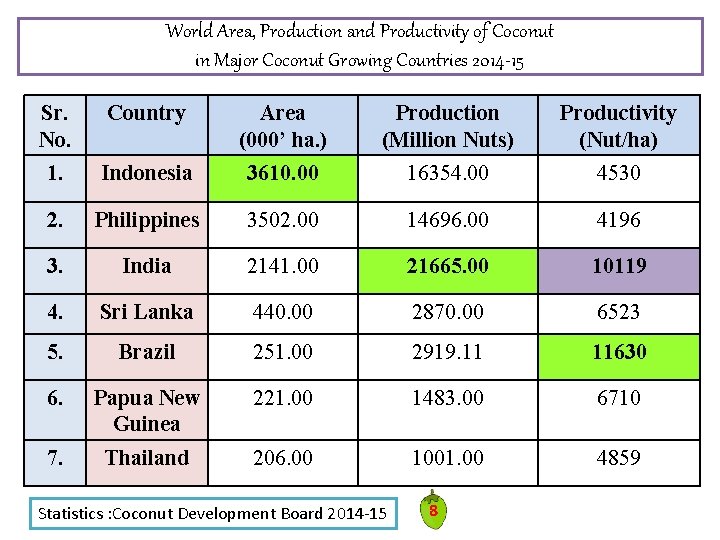
World Area, Production and Productivity of Coconut in Major Coconut Growing Countries 2014 -15 Sr. No. Country Area (000’ ha. ) Production (Million Nuts) Productivity (Nut/ha) 1. Indonesia 3610. 00 16354. 00 4530 2. Philippines 3502. 00 14696. 00 4196 3. India 2141. 00 21665. 00 10119 4. Sri Lanka 440. 00 2870. 00 6523 5. Brazil 251. 00 2919. 11 11630 6. Papua New Guinea 221. 00 1483. 00 6710 7. Thailand 206. 00 1001. 00 4859 Statistics : Coconut Development Board 2014 -15 8
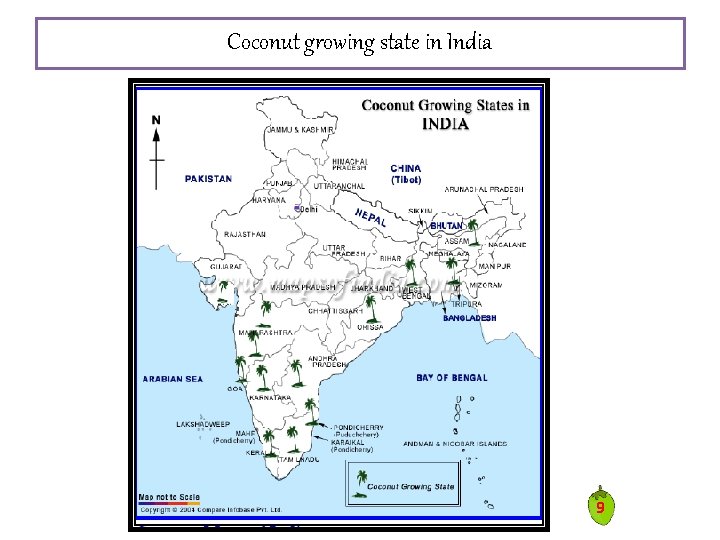
Coconut growing state in India 9
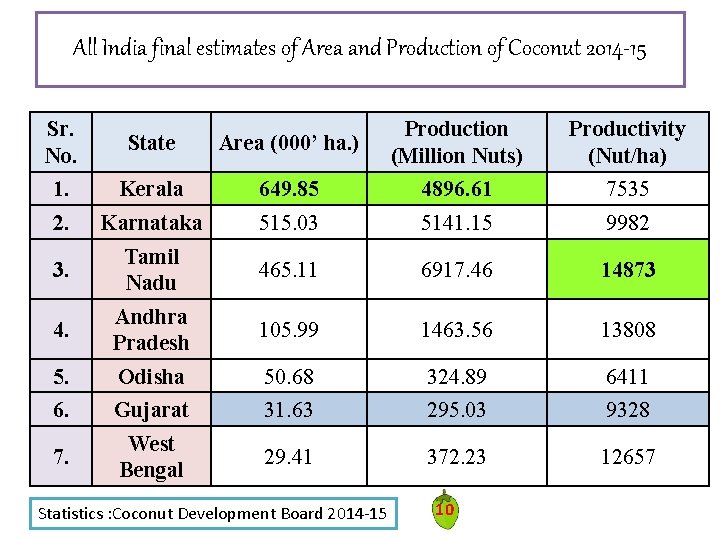
All India final estimates of Area and Production of Coconut 2014 -15 Sr. No. State Area (000’ ha. ) Production (Million Nuts) Productivity (Nut/ha) 1. Kerala 649. 85 4896. 61 7535 2. Karnataka 515. 03 5141. 15 9982 3. Tamil Nadu 465. 11 6917. 46 14873 4. Andhra Pradesh 105. 99 1463. 56 13808 5. Odisha 50. 68 324. 89 6411 6. Gujarat 31. 63 295. 03 9328 7. West Bengal 29. 41 372. 23 12657 Statistics : Coconut Development Board 2014 -15 10
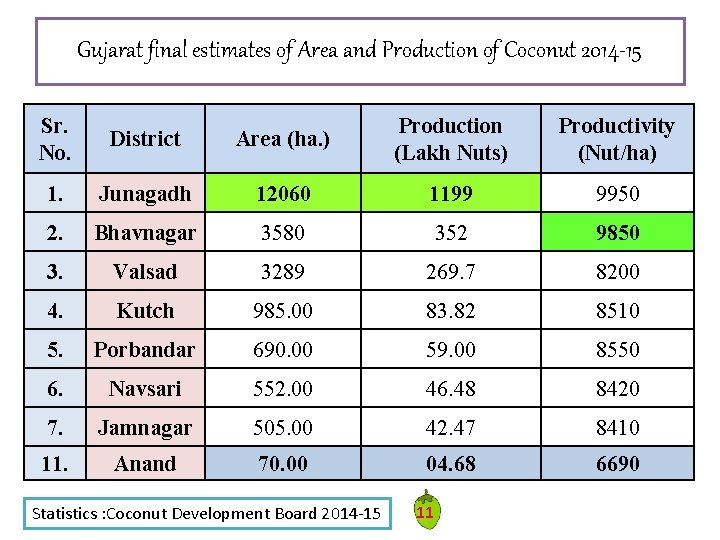
Gujarat final estimates of Area and Production of Coconut 2014 -15 Sr. No. District Area (ha. ) Production (Lakh Nuts) Productivity (Nut/ha) 1. Junagadh 12060 1199 9950 2. Bhavnagar 3580 352 9850 3. Valsad 3289 269. 7 8200 4. Kutch 985. 00 83. 82 8510 5. Porbandar 690. 00 59. 00 8550 6. Navsari 552. 00 46. 48 8420 7. Jamnagar 505. 00 42. 47 8410 11. Anand 70. 00 04. 68 6690 Statistics : Coconut Development Board 2014 -15 11
Flowering Physiology 12
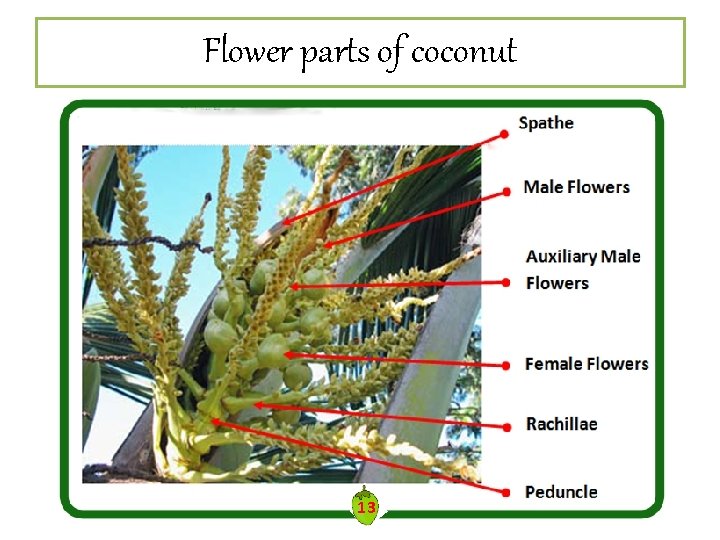
Flower parts of coconut 13
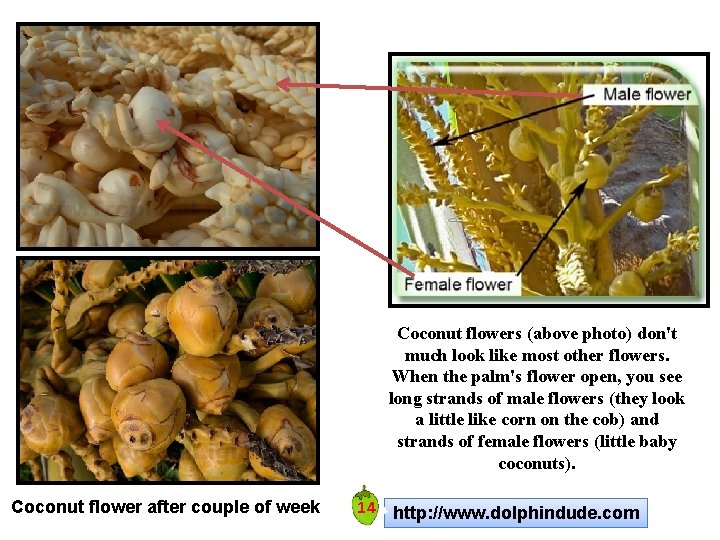
Coconut flowers (above photo) don't much look like most other flowers. When the palm's flower open, you see long strands of male flowers (they look a little like corn on the cob) and strands of female flowers (little baby coconuts). Coconut flower after couple of week 14 http: //www. dolphindude. com
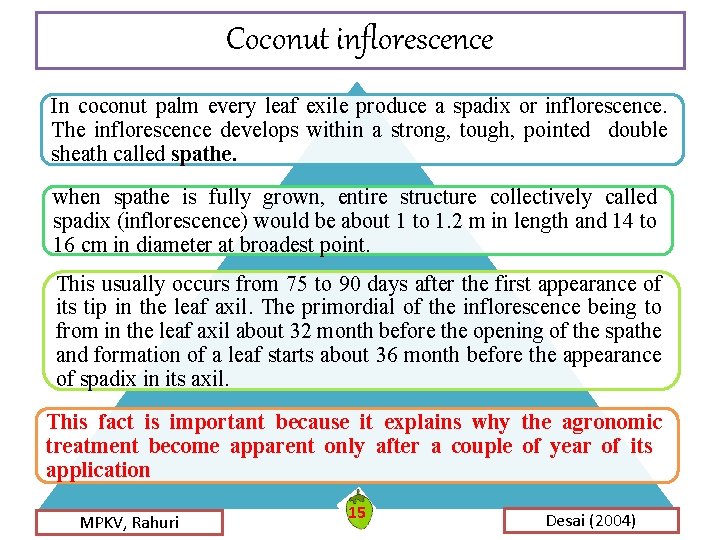
Coconut inflorescence In coconut palm every leaf exile produce a spadix or inflorescence. The inflorescence develops within a strong, tough, pointed double sheath called spathe. when spathe is fully grown, entire structure collectively called spadix (inflorescence) would be about 1 to 1. 2 m in length and 14 to 16 cm in diameter at broadest point. This usually occurs from 75 to 90 days after the first appearance of its tip in the leaf axil. The primordial of the inflorescence being to from in the leaf axil about 32 month before the opening of the spathe and formation of a leaf starts about 36 month before the appearance of spadix in its axil. This fact is important because it explains why the agronomic treatment become apparent only after a couple of year of its application MPKV, Rahuri 15 Desai (2004)
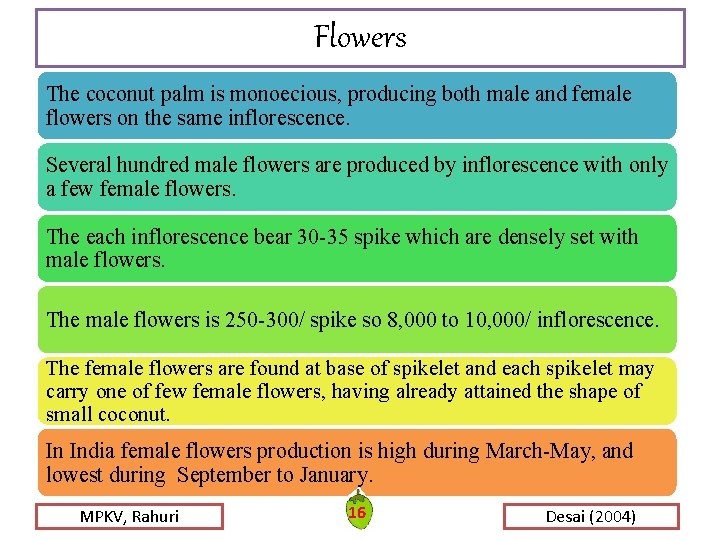
Flowers The coconut palm is monoecious, producing both male and female flowers on the same inflorescence. Several hundred male flowers are produced by inflorescence with only a few female flowers. The each inflorescence bear 30 -35 spike which are densely set with male flowers. The male flowers is 250 -300/ spike so 8, 000 to 10, 000/ inflorescence. The female flowers are found at base of spikelet and each spikelet may carry one of few female flowers, having already attained the shape of small coconut. In India female flowers production is high during March-May, and lowest during September to January. MPKV, Rahuri 16 Desai (2004)
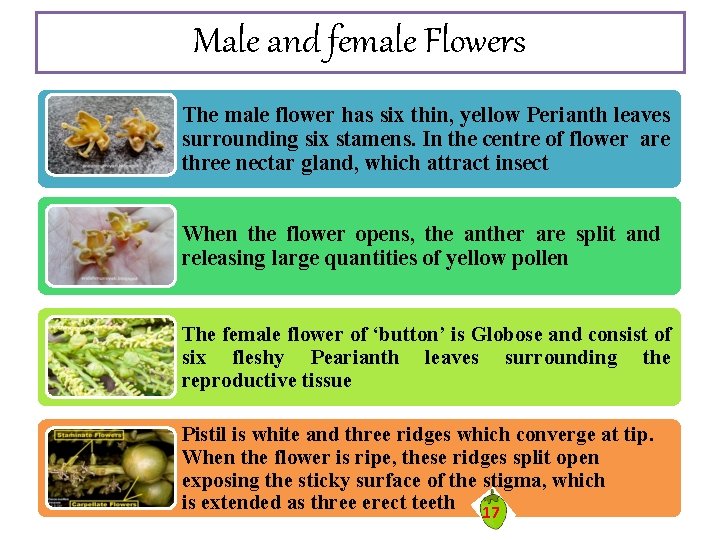
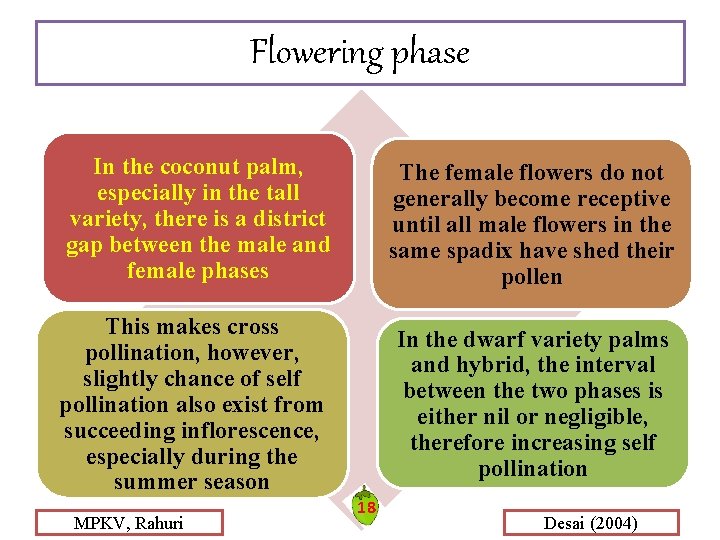
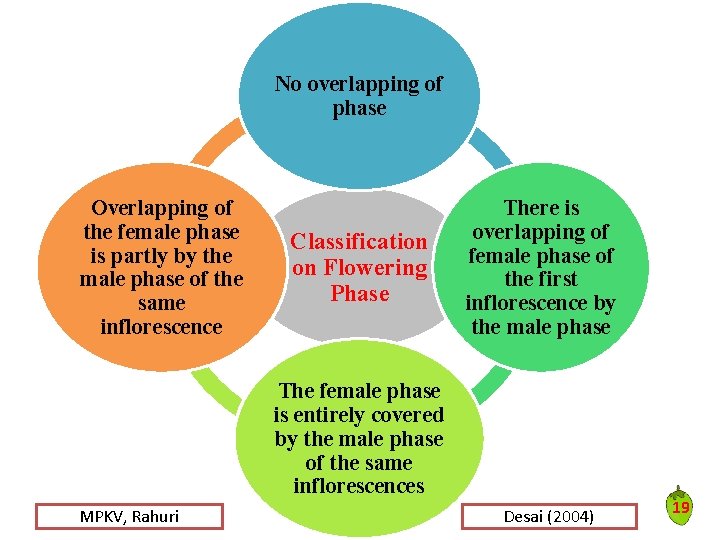
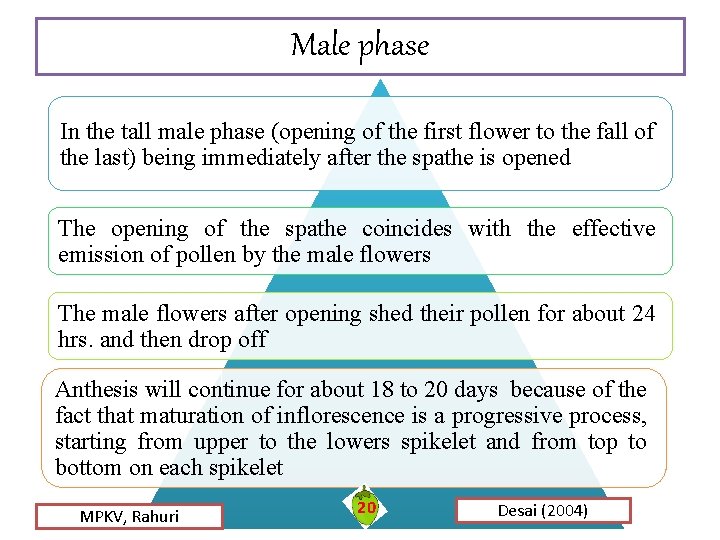
Male and female Flowers The male flower has six thin, yellow Perianth leaves surrounding six stamens. In the centre of flower are three nectar gland, which attract insect When the flower opens, the anther are split and releasing large quantities of yellow pollen The female flower of ‘button’ is Globose and consist of six fleshy Pearianth leaves surrounding the reproductive tissue Pistil is white and three ridges which converge at tip. When the flower is ripe, these ridges split open exposing the sticky surface of the stigma, which is extended as three erect teeth 17
Flowering phase In the coconut palm, especially in the tall variety, there is a district gap between the male and female phases The female flowers do not generally become receptive until all male flowers in the same spadix have shed their pollen This makes cross pollination, however, slightly chance of self pollination also exist from succeeding inflorescence, especially during the summer season In the dwarf variety palms and hybrid, the interval between the two phases is either nil or negligible, therefore increasing self pollination MPKV, Rahuri 18 Desai (2004)
No overlapping of phase Overlapping of the female phase is partly by the male phase of the same inflorescence Classification on Flowering Phase There is overlapping of female phase of the first inflorescence by the male phase The female phase is entirely covered by the male phase of the same inflorescences MPKV, Rahuri Desai (2004) 19
Male phase In the tall male phase (opening of the first flower to the fall of the last) being immediately after the spathe is opened The opening of the spathe coincides with the effective emission of pollen by the male flowers The male flowers after opening shed their pollen for about 24 hrs. and then drop off Anthesis will continue for about 18 to 20 days because of the fact that maturation of inflorescence is a progressive process, starting from upper to the lowers spikelet and from top to bottom on each spikelet MPKV, Rahuri 20 Desai (2004)
Female phase Normally female flowers begin to open by the 21 st day, during summer month the flowers may open even from the 18 th day onward. The female phase i. e the period from the opening of the first flowers to the opening of the last female flowers is from 4 to 7 days During this phase the receptivity of the flower remain intact, for a period start from 1 to 2 day after opening and stretches up to a maximum of 3 days When the stigma is receptive a clear sweet nector is found secreted from the flower MPKV, Rahuri 21 Desai (2004)
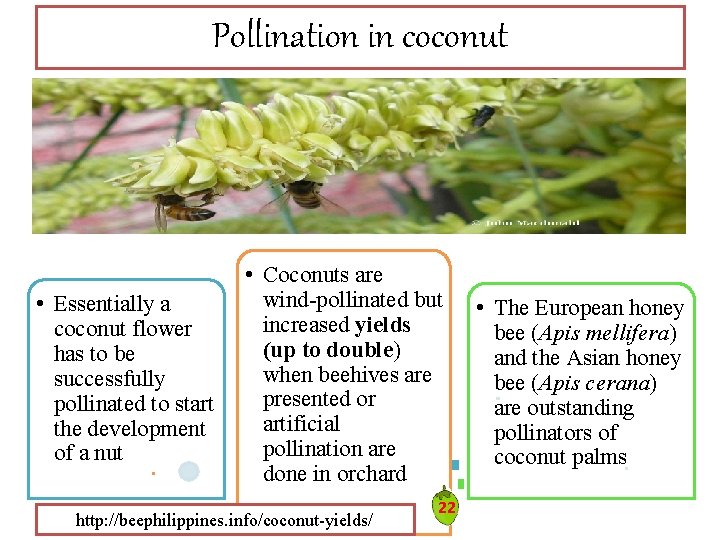
Pollination in coconut • Essentially a coconut flower has to be successfully pollinated to start the development of a nut • Coconuts are wind-pollinated but increased yields (up to double) when beehives are presented or artificial pollination are done in orchard http: //beephilippines. info/coconut-yields/ 22 • The European honey bee (Apis mellifera) and the Asian honey bee (Apis cerana) are outstanding pollinators of coconut palms
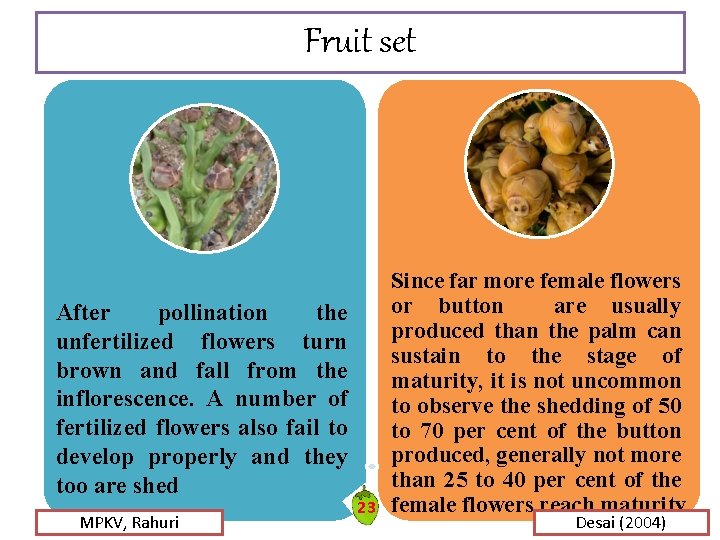
Fruit set After pollination the unfertilized flowers turn brown and fall from the inflorescence. A number of fertilized flowers also fail to develop properly and they too are shed MPKV, Rahuri 23 Since far more female flowers or button are usually produced than the palm can sustain to the stage of maturity, it is not uncommon to observe the shedding of 50 to 70 per cent of the button produced, generally not more than 25 to 40 per cent of the female flowers reach maturity Desai (2004)
The conditions of Button shedding Button and immature nut shedding before and after fertilization is common problem and occurs in all varieties of coconut The shedding of button seldom took place before they had attained stigmatic receptivity The majority of the shed button were the non-fertilized ones In general, about one third of the button produces in an inflorescence develop into nuts The most of button were shed within a period of two months of opening of inflorescence MPKV, Rahuri 24 Desai (2004)
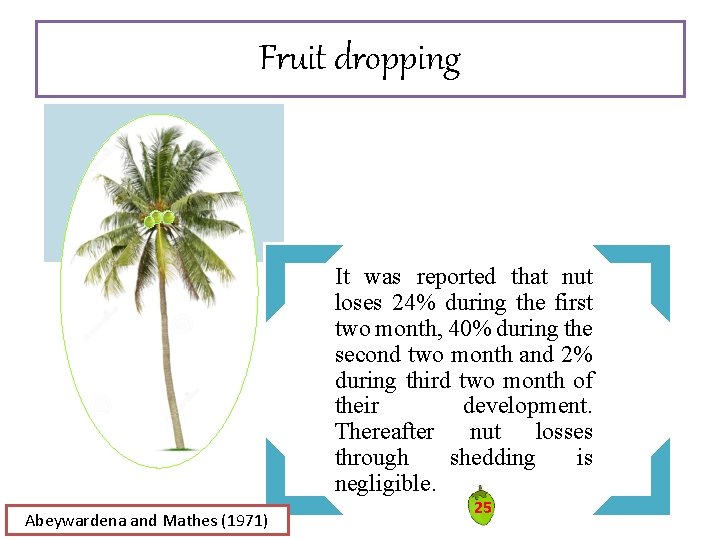
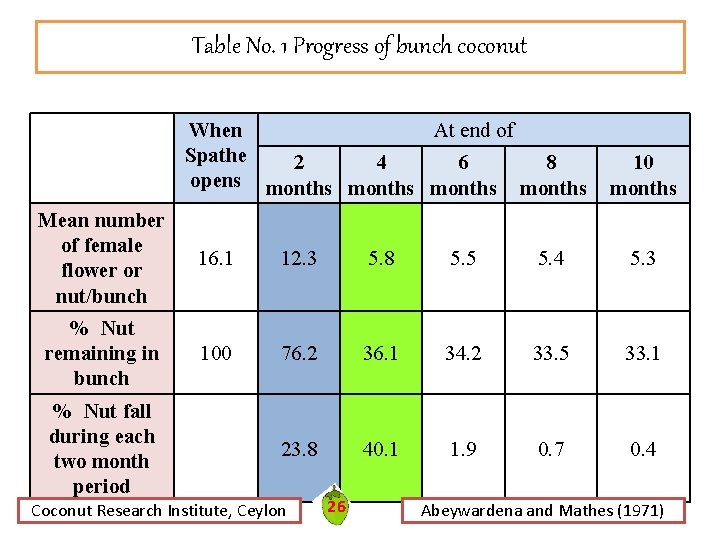
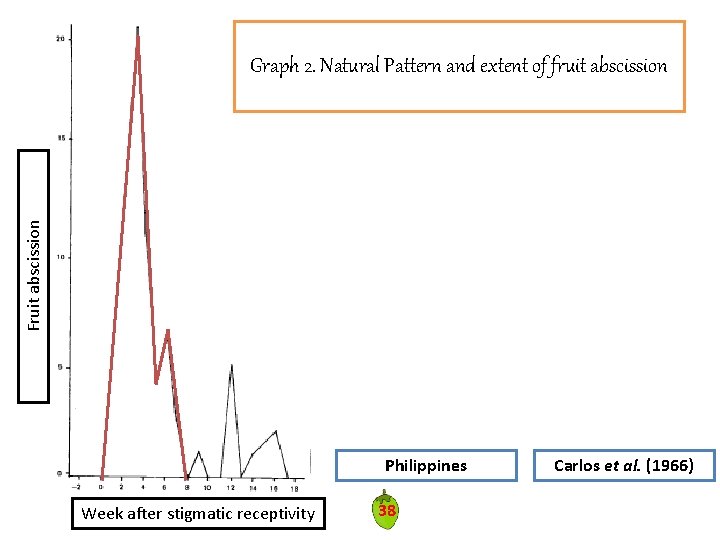
Fruit dropping It was reported that nut loses 24% during the first two month, 40% during the second two month and 2% during third two month of their development. Thereafter nut losses through shedding is negligible. Abeywardena and Mathes (1971) 25
Table No. 1 Progress of bunch coconut When At end of Spathe 2 4 6 8 opens months 10 months Mean number of female flower or nut/bunch 16. 1 12. 3 5. 8 5. 5 5. 4 5. 3 % Nut remaining in bunch 100 76. 2 36. 1 34. 2 33. 5 33. 1 23. 8 40. 1 1. 9 0. 7 0. 4 % Nut fall during each two month period Coconut Research Institute, Ceylon 26 Abeywardena and Mathes (1971)
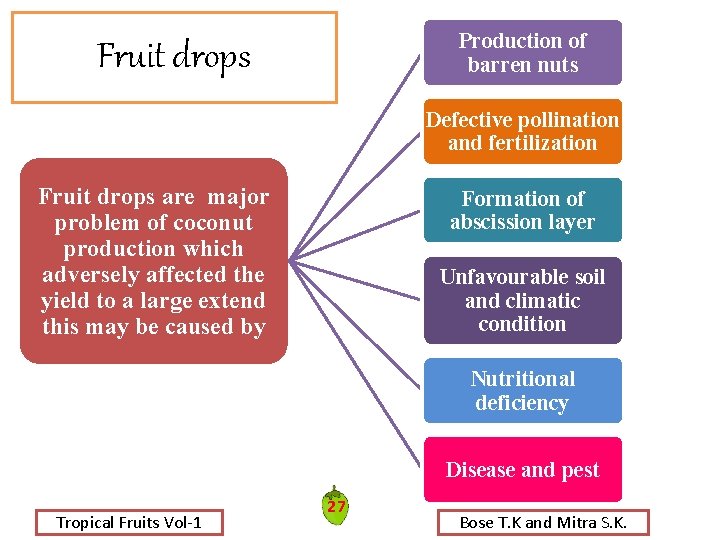
Production of barren nuts Fruit drops Defective pollination and fertilization Fruit drops are major problem of coconut production which adversely affected the yield to a large extend this may be caused by Formation of abscission layer Unfavourable soil and climatic condition Nutritional deficiency Disease and pest Tropical Fruits Vol-1 27 Bose T. K and Mitra S. K.
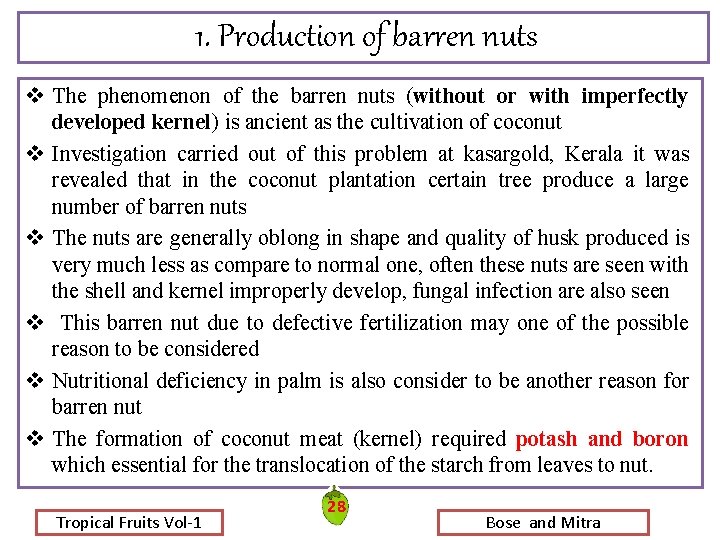
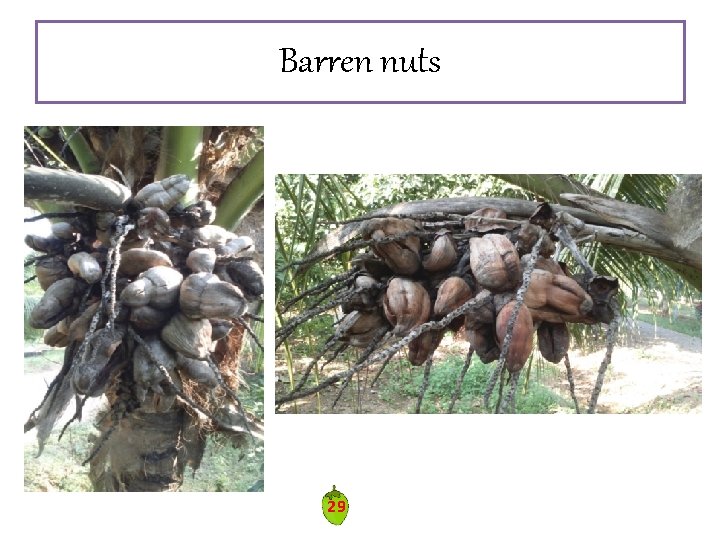
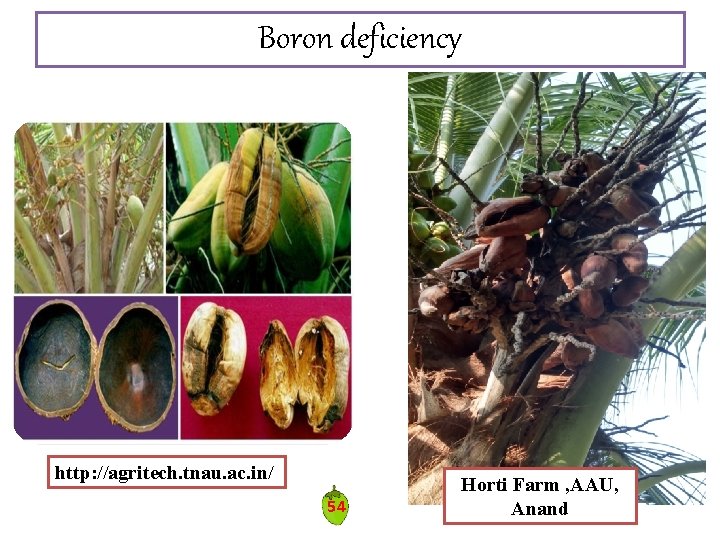
1. Production of barren nuts v The phenomenon of the barren nuts (without or with imperfectly developed kernel) is ancient as the cultivation of coconut v Investigation carried out of this problem at kasargold, Kerala it was revealed that in the coconut plantation certain tree produce a large number of barren nuts v The nuts are generally oblong in shape and quality of husk produced is very much less as compare to normal one, often these nuts are seen with the shell and kernel improperly develop, fungal infection are also seen v This barren nut due to defective fertilization may one of the possible reason to be considered v Nutritional deficiency in palm is also consider to be another reason for barren nut v The formation of coconut meat (kernel) required potash and boron which essential for the translocation of the starch from leaves to nut. Tropical Fruits Vol-1 28 Bose and Mitra
Barren nuts 29
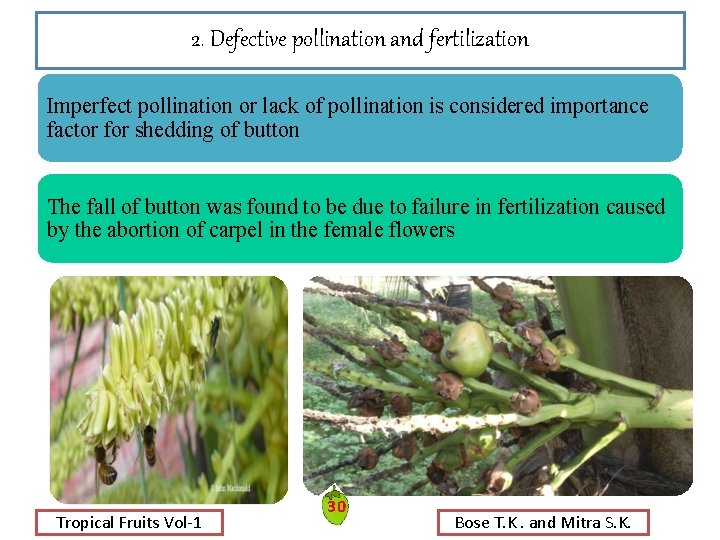
2. Defective pollination and fertilization Imperfect pollination or lack of pollination is considered importance factor for shedding of button The fall of button was found to be due to failure in fertilization caused by the abortion of carpel in the female flowers Tropical Fruits Vol-1 30 Bose T. K. and Mitra S. K.
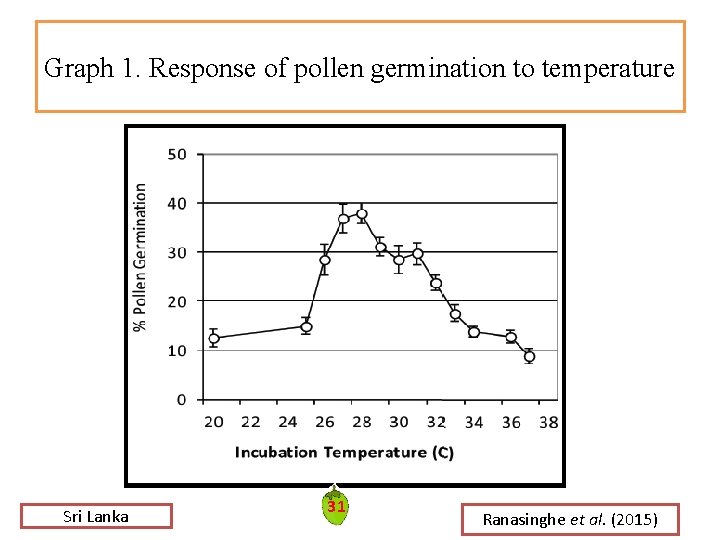
Graph 1. Response of pollen germination to temperature Sri Lanka 31 Ranasinghe et al. (2015)
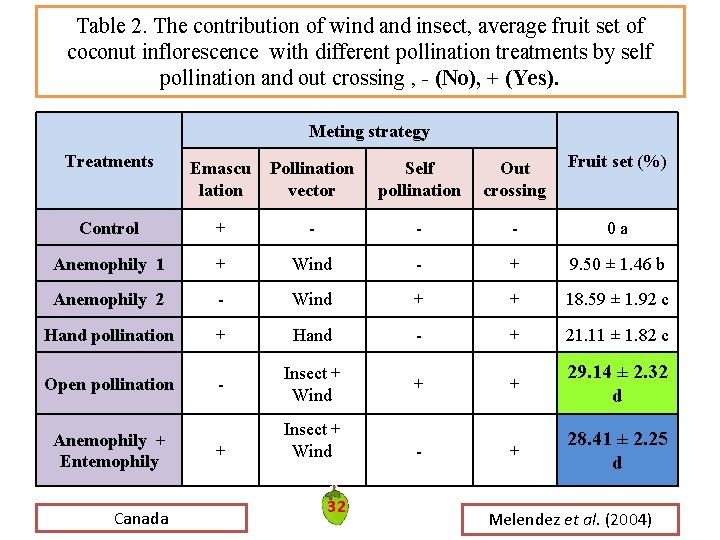
Table 2. The contribution of wind and insect, average fruit set of coconut inflorescence with different pollination treatments by self pollination and out crossing , - (No), + (Yes). Meting strategy Treatments Emascu lation Pollination vector Self pollination Out crossing Fruit set (%) Control + - - - 0 a Anemophily 1 + Wind - + 9. 50 ± 1. 46 b Anemophily 2 - Wind + + 18. 59 ± 1. 92 c Hand pollination + Hand - + 21. 11 ± 1. 82 c Open pollination - Insect + Wind + + 29. 14 ± 2. 32 d - + 28. 41 ± 2. 25 d Anemophily + Entemophily Canada + Insect + Wind 32 Melendez et al. (2004)
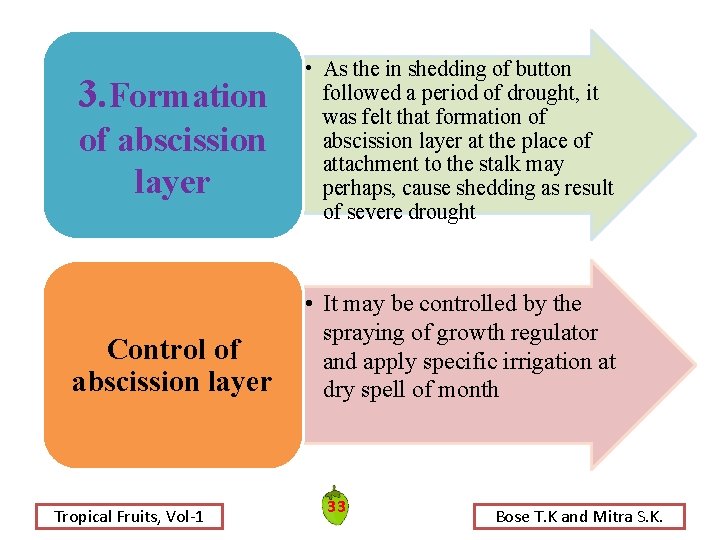
3. Formation of abscission layer Control of abscission layer Tropical Fruits, Vol-1 • As the in shedding of button followed a period of drought, it was felt that formation of abscission layer at the place of attachment to the stalk may perhaps, cause shedding as result of severe drought • It may be controlled by the spraying of growth regulator and apply specific irrigation at dry spell of month 33 Bose T. K and Mitra S. K.
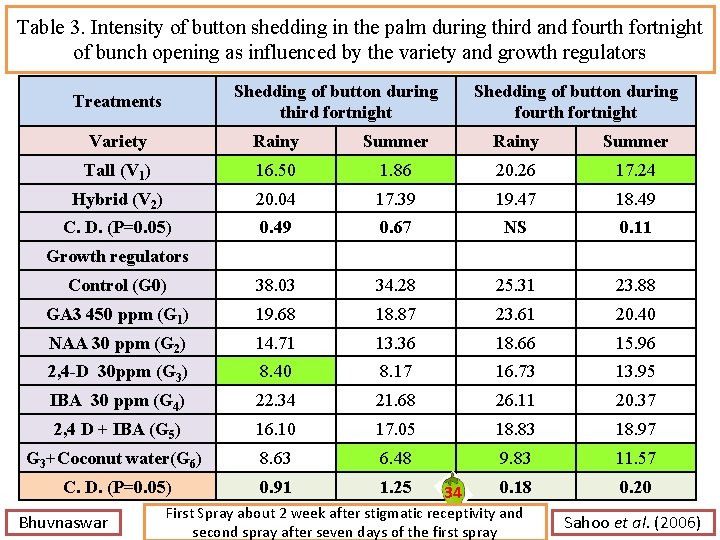
Table 3. Intensity of button shedding in the palm during third and fourth fortnight of bunch opening as influenced by the variety and growth regulators Shedding of button during third fortnight Treatments Shedding of button during fourth fortnight Variety Rainy Summer Tall (V 1) 16. 50 1. 86 20. 26 17. 24 Hybrid (V 2) 20. 04 17. 39 19. 47 18. 49 C. D. (P=0. 05) 0. 49 0. 67 NS 0. 11 Control (G 0) 38. 03 34. 28 25. 31 23. 88 GA 3 450 ppm (G 1) 19. 68 18. 87 23. 61 20. 40 NAA 30 ppm (G 2) 14. 71 13. 36 18. 66 15. 96 2, 4 -D 30 ppm (G 3) 8. 40 8. 17 16. 73 13. 95 IBA 30 ppm (G 4) 22. 34 21. 68 26. 11 20. 37 2, 4 D + IBA (G 5) 16. 10 17. 05 18. 83 18. 97 G 3+Coconut water(G 6) 8. 63 6. 48 9. 83 11. 57 C. D. (P=0. 05) 0. 91 1. 25 0. 18 0. 20 Growth regulators Bhuvnaswar 34 First Spray about 2 week after stigmatic receptivity and second spray after seven days of the first spray Sahoo et al. (2006)
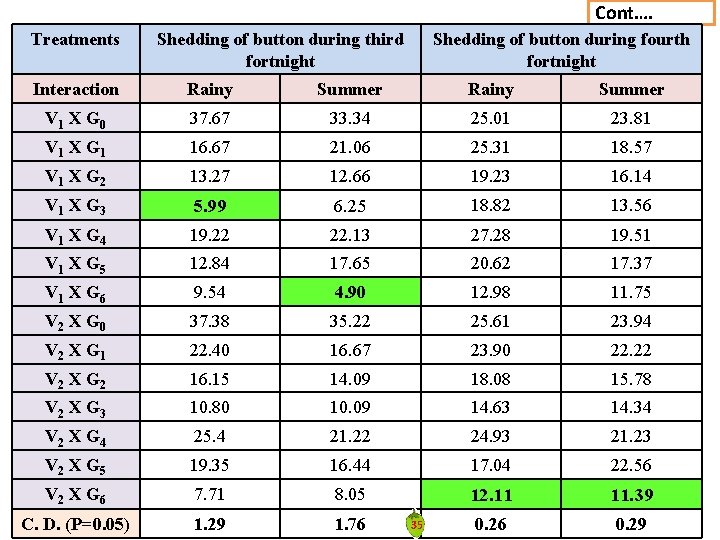
Cont…. Treatments Shedding of button during third fortnight Shedding of button during fourth fortnight Interaction Rainy Summer V 1 X G 0 37. 67 33. 34 25. 01 23. 81 V 1 X G 1 16. 67 21. 06 25. 31 18. 57 V 1 X G 2 13. 27 12. 66 19. 23 16. 14 V 1 X G 3 5. 99 6. 25 18. 82 13. 56 V 1 X G 4 19. 22 22. 13 27. 28 19. 51 V 1 X G 5 12. 84 17. 65 20. 62 17. 37 V 1 X G 6 9. 54 4. 90 12. 98 11. 75 V 2 X G 0 37. 38 35. 22 25. 61 23. 94 V 2 X G 1 22. 40 16. 67 23. 90 22. 22 V 2 X G 2 16. 15 14. 09 18. 08 15. 78 V 2 X G 3 10. 80 10. 09 14. 63 14. 34 V 2 X G 4 25. 4 21. 22 24. 93 21. 23 V 2 X G 5 19. 35 16. 44 17. 04 22. 56 V 2 X G 6 7. 71 8. 05 12. 11 11. 39 C. D. (P=0. 05) 1. 29 1. 76 0. 29 35
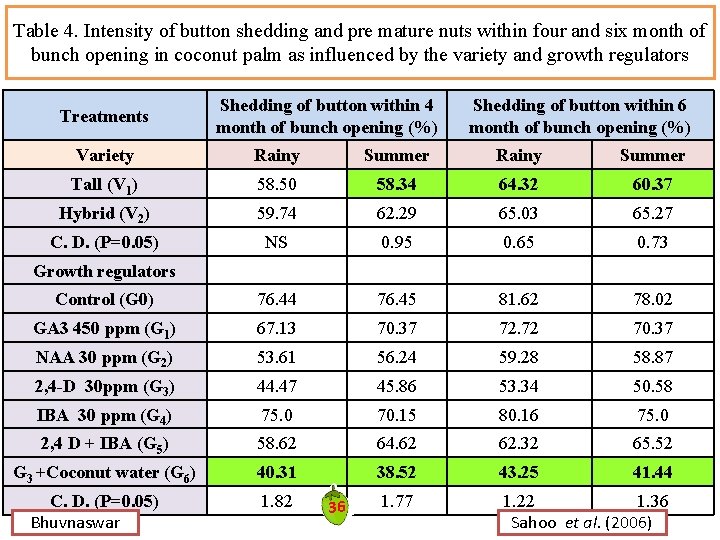
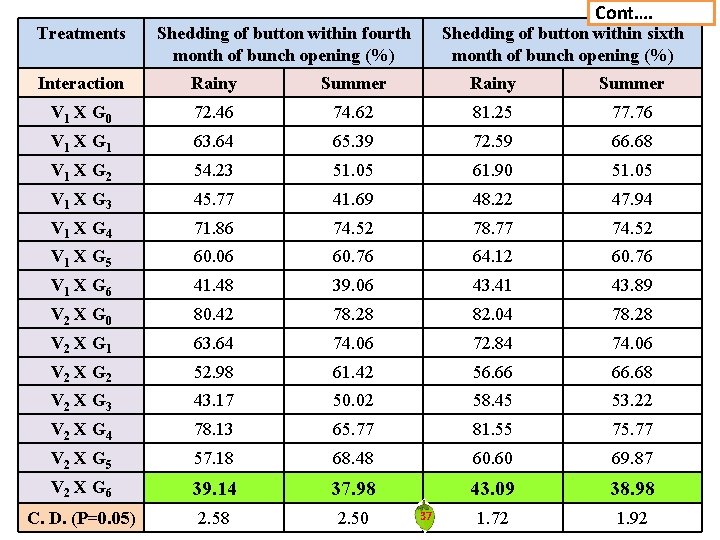
Table 4. Intensity of button shedding and pre mature nuts within four and six month of bunch opening in coconut palm as influenced by the variety and growth regulators Treatments Shedding of button within 4 month of bunch opening (%) Shedding of button within 6 month of bunch opening (%) Variety Rainy Summer Tall (V 1) 58. 50 58. 34 64. 32 60. 37 Hybrid (V 2) 59. 74 62. 29 65. 03 65. 27 C. D. (P=0. 05) NS 0. 95 0. 65 0. 73 Control (G 0) 76. 44 76. 45 81. 62 78. 02 GA 3 450 ppm (G 1) 67. 13 70. 37 72. 72 70. 37 NAA 30 ppm (G 2) 53. 61 56. 24 59. 28 58. 87 2, 4 -D 30 ppm (G 3) 44. 47 45. 86 53. 34 50. 58 IBA 30 ppm (G 4) 75. 0 70. 15 80. 16 75. 0 2, 4 D + IBA (G 5) 58. 62 64. 62 62. 32 65. 52 G 3 +Coconut water (G 6) 40. 31 38. 52 43. 25 41. 44 1. 77 1. 22 1. 36 Sahoo et al. (2006) Growth regulators C. D. (P=0. 05) Bhuvnaswar 1. 82 36
Treatments Cont…. Shedding of button within fourth month of bunch opening (%) Shedding of button within sixth month of bunch opening (%) Interaction Rainy Summer V 1 X G 0 72. 46 74. 62 81. 25 77. 76 V 1 X G 1 63. 64 65. 39 72. 59 66. 68 V 1 X G 2 54. 23 51. 05 61. 90 51. 05 V 1 X G 3 45. 77 41. 69 48. 22 47. 94 V 1 X G 4 71. 86 74. 52 78. 77 74. 52 V 1 X G 5 60. 06 60. 76 64. 12 60. 76 V 1 X G 6 41. 48 39. 06 43. 41 43. 89 V 2 X G 0 80. 42 78. 28 82. 04 78. 28 V 2 X G 1 63. 64 74. 06 72. 84 74. 06 V 2 X G 2 52. 98 61. 42 56. 66 66. 68 V 2 X G 3 43. 17 50. 02 58. 45 53. 22 V 2 X G 4 78. 13 65. 77 81. 55 75. 77 V 2 X G 5 57. 18 68. 48 60. 60 69. 87 V 2 X G 6 39. 14 37. 98 43. 09 38. 98 C. D. (P=0. 05) 2. 58 2. 50 1. 72 1. 92 37
Fruit abscission Graph 2. Natural Pattern and extent of fruit abscission Philippines Week after stigmatic receptivity 38 Carlos et al. (1966)
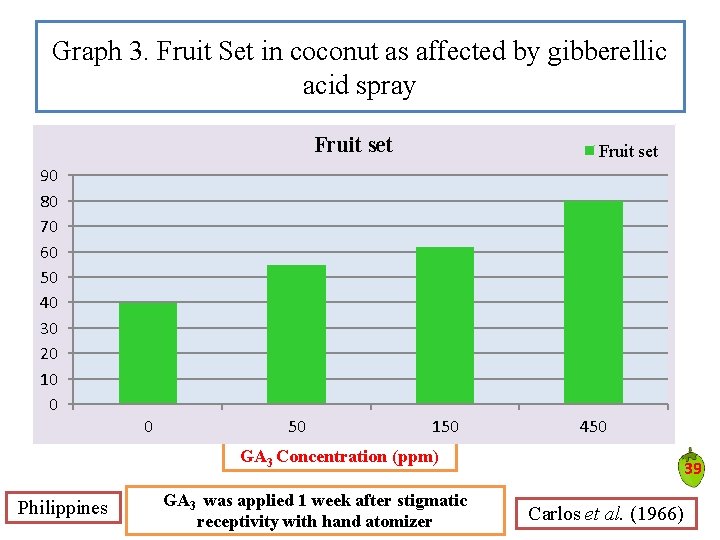
Graph 3. Fruit Set in coconut as affected by gibberellic acid spray Fruit set 90 80 70 60 50 40 30 20 10 0 0 50 Fruit set 150 GA 3 Concentration (ppm) Philippines GA 3 was applied 1 week after stigmatic receptivity with hand atomizer 450 39 Carlos et al. (1966)
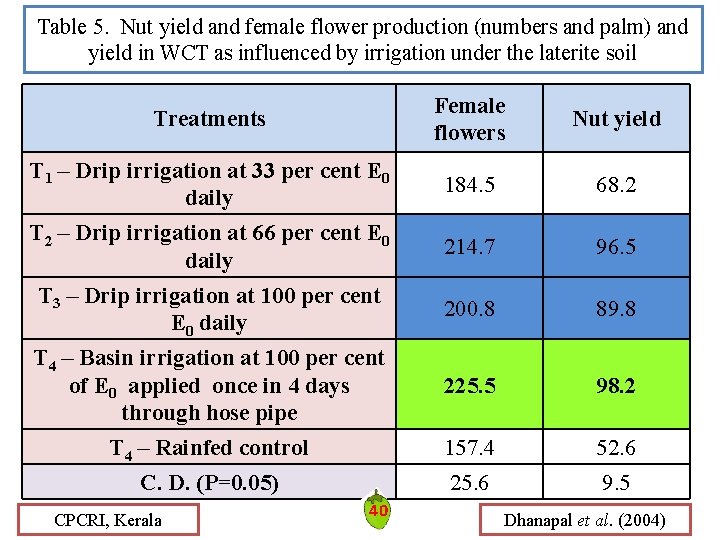
Table 5. Nut yield and female flower production (numbers and palm) and yield in WCT as influenced by irrigation under the laterite soil Treatments Female flowers Nut yield T 1 – Drip irrigation at 33 per cent E 0 daily 184. 5 68. 2 T 2 – Drip irrigation at 66 per cent E 0 daily 214. 7 96. 5 T 3 – Drip irrigation at 100 per cent E 0 daily 200. 8 89. 8 T 4 – Basin irrigation at 100 per cent of E 0 applied once in 4 days through hose pipe 225. 5 98. 2 T 4 – Rainfed control 157. 4 52. 6 C. D. (P=0. 05) 25. 6 9. 5 CPCRI, Kerala 40 Dhanapal et al. (2004)
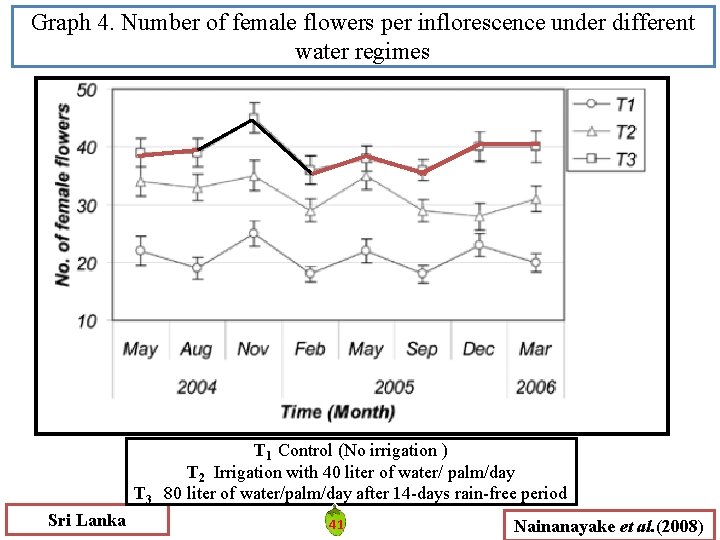
Graph 4. Number of female flowers per inflorescence under different water regimes T 3 Sri Lanka T 1 Control (No irrigation ) T 2 Irrigation with 40 liter of water/ palm/day 80 liter of water/palm/day after 14 -days rain-free period 41 Nainanayake et al. (2008)
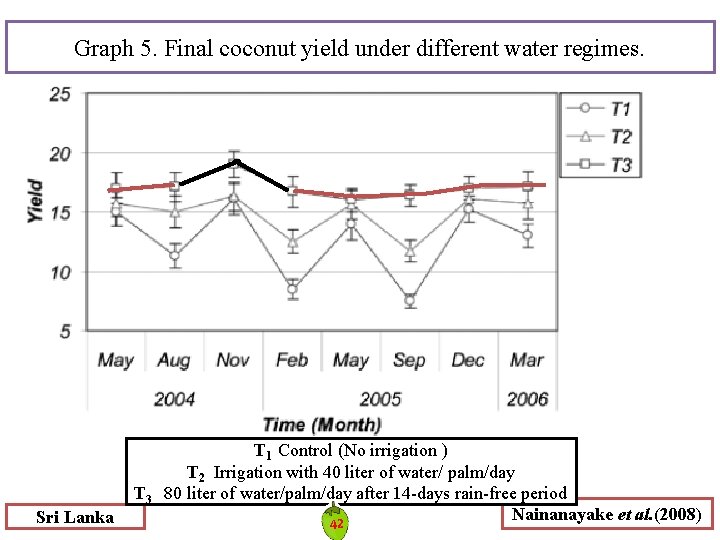
Graph 5. Final coconut yield under different water regimes. T 3 Sri Lanka T 1 Control (No irrigation ) T 2 Irrigation with 40 liter of water/ palm/day 80 liter of water/palm/day after 14 -days rain-free period Nainanayake et al. (2008) 42
4. Unfavourable soil and climatic condition It was indicated that shedding of button occurred not only when there was deficit of moisture but also during wettest time of the year. According to Patel (1938), shedding of button was very high during August, September and November and slightly lower during other month He further noted that shedding of button was more severe on heavy soil than on lighter soil Tropical Fruits, Vol-1 43 Bose T. K. and Mitra S. K.
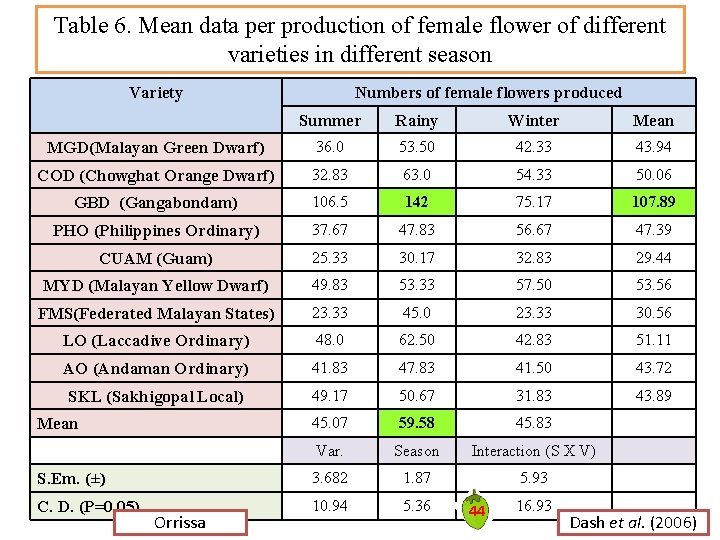
Table 6. Mean data per production of female flower of different varieties in different season Variety Numbers of female flowers produced Summer Rainy Winter Mean MGD(Malayan Green Dwarf) 36. 0 53. 50 42. 33 43. 94 COD (Chowghat Orange Dwarf) 32. 83 63. 0 54. 33 50. 06 GBD (Gangabondam) 106. 5 142 75. 17 107. 89 PHO (Philippines Ordinary) 37. 67 47. 83 56. 67 47. 39 CUAM (Guam) 25. 33 30. 17 32. 83 29. 44 MYD (Malayan Yellow Dwarf) 49. 83 53. 33 57. 50 53. 56 FMS(Federated Malayan States) 23. 33 45. 0 23. 33 30. 56 LO (Laccadive Ordinary) 48. 0 62. 50 42. 83 51. 11 AO (Andaman Ordinary) 41. 83 47. 83 41. 50 43. 72 SKL (Sakhigopal Local) 49. 17 50. 67 31. 83 43. 89 45. 07 59. 58 45. 83 Var. Season Interaction (S X V) S. Em. (±) 3. 682 1. 87 5. 93 C. D. (P=0. 05) 10. 94 5. 36 Mean Orrissa 44 16. 93 Dash et al. (2006)
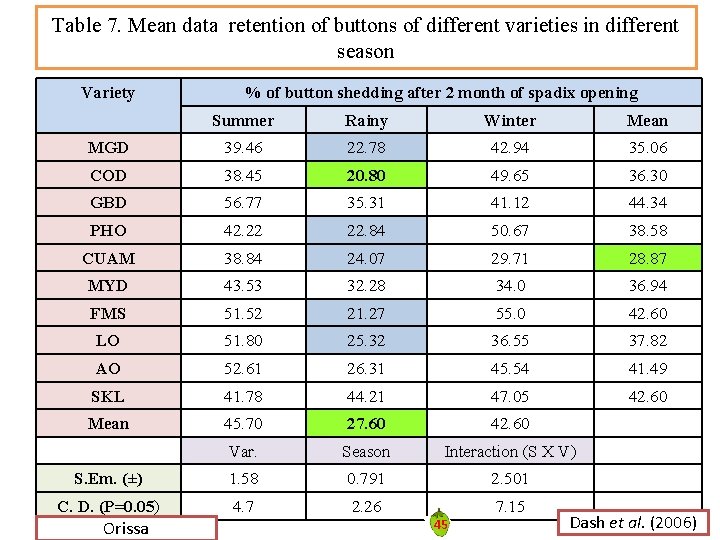
Table 7. Mean data retention of buttons of different varieties in different season Variety % of button shedding after 2 month of spadix opening Summer Rainy Winter Mean MGD 39. 46 22. 78 42. 94 35. 06 COD 38. 45 20. 80 49. 65 36. 30 GBD 56. 77 35. 31 41. 12 44. 34 PHO 42. 22 22. 84 50. 67 38. 58 CUAM 38. 84 24. 07 29. 71 28. 87 MYD 43. 53 32. 28 34. 0 36. 94 FMS 51. 52 21. 27 55. 0 42. 60 LO 51. 80 25. 32 36. 55 37. 82 AO 52. 61 26. 31 45. 54 41. 49 SKL 41. 78 44. 21 47. 05 42. 60 Mean 45. 70 27. 60 42. 60 Var. Season Interaction (S X V) S. Em. (±) 1. 58 0. 791 2. 501 C. D. (P=0. 05) 4. 7 2. 26 7. 15 Orissa 45 Dash et al. (2006)
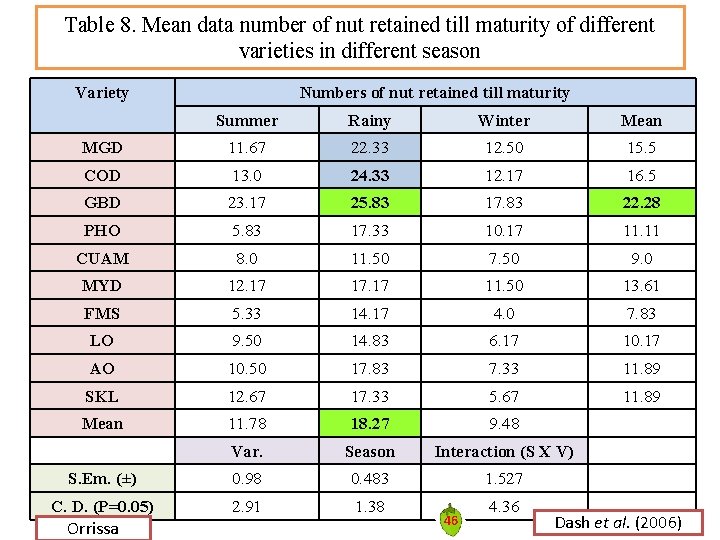
Table 8. Mean data number of nut retained till maturity of different varieties in different season Variety Numbers of nut retained till maturity Summer Rainy Winter Mean MGD 11. 67 22. 33 12. 50 15. 5 COD 13. 0 24. 33 12. 17 16. 5 GBD 23. 17 25. 83 17. 83 22. 28 PHO 5. 83 17. 33 10. 17 11. 11 CUAM 8. 0 11. 50 7. 50 9. 0 MYD 12. 17 17. 17 11. 50 13. 61 FMS 5. 33 14. 17 4. 0 7. 83 LO 9. 50 14. 83 6. 17 10. 17 AO 10. 50 17. 83 7. 33 11. 89 SKL 12. 67 17. 33 5. 67 11. 89 Mean 11. 78 18. 27 9. 48 Var. Season Interaction (S X V) S. Em. (±) 0. 98 0. 483 1. 527 C. D. (P=0. 05) 2. 91 1. 38 Orrissa 46 4. 36 Dash et al. (2006)
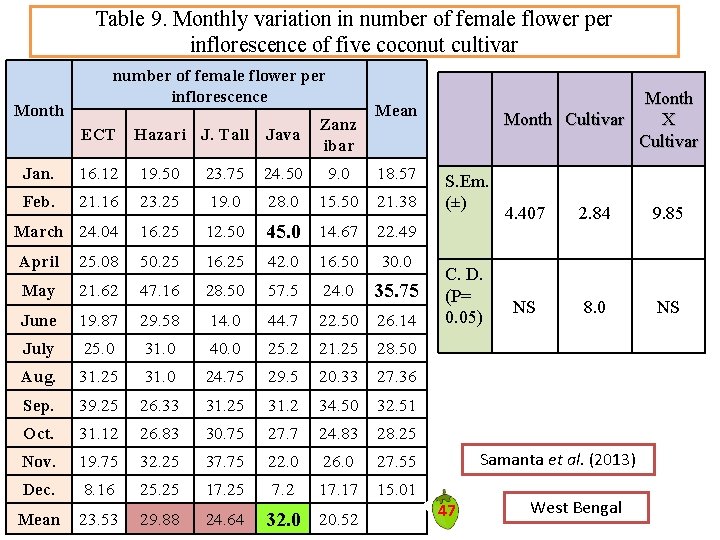
Table 9. Monthly variation in number of female flower per inflorescence of five coconut cultivar Month number of female flower per inflorescence ECT Hazari J. Tall Java Zanz ibar Jan. 16. 12 19. 50 23. 75 24. 50 9. 0 18. 57 Feb. 21. 16 23. 25 19. 0 28. 0 15. 50 21. 38 March 24. 04 16. 25 12. 50 45. 0 14. 67 22. 49 April 25. 08 50. 25 16. 25 42. 0 16. 50 30. 0 May 21. 62 47. 16 28. 50 57. 5 24. 0 35. 75 June 19. 87 29. 58 14. 0 44. 7 22. 50 26. 14 July 25. 0 31. 0 40. 0 25. 2 21. 25 28. 50 Aug. 31. 25 31. 0 24. 75 29. 5 20. 33 27. 36 Sep. 39. 25 26. 33 31. 25 31. 2 34. 50 32. 51 Oct. 31. 12 26. 83 30. 75 27. 7 24. 83 28. 25 Nov. 19. 75 32. 25 37. 75 22. 0 26. 0 27. 55 Dec. 8. 16 25. 25 17. 25 7. 2 17. 17 15. 01 Mean 23. 53 29. 88 24. 64 32. 0 20. 52 Month Cultivar X Cultivar Mean S. Em. (±) C. D. (P= 0. 05) 4. 407 2. 84 9. 85 NS 8. 0 NS Samanta et al. (2013) 47 West Bengal
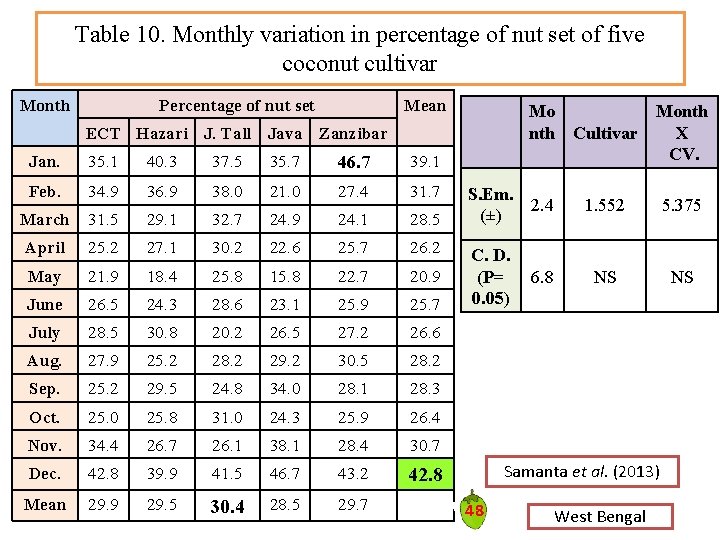
Table 10. Monthly variation in percentage of nut set of five coconut cultivar Month Percentage of nut set Mean Mo nth Cultivar ECT Hazari J. Tall Java Zanzibar Jan. 35. 1 40. 3 37. 5 35. 7 46. 7 39. 1 Feb. 34. 9 36. 9 38. 0 21. 0 27. 4 31. 7 March 31. 5 29. 1 32. 7 24. 9 24. 1 28. 5 April 25. 2 27. 1 30. 2 22. 6 25. 7 26. 2 May 21. 9 18. 4 25. 8 15. 8 22. 7 20. 9 June 26. 5 24. 3 28. 6 23. 1 25. 9 25. 7 July 28. 5 30. 8 20. 2 26. 5 27. 2 26. 6 Aug. 27. 9 25. 2 28. 2 29. 2 30. 5 28. 2 Sep. 25. 2 29. 5 24. 8 34. 0 28. 1 28. 3 Oct. 25. 0 25. 8 31. 0 24. 3 25. 9 26. 4 Nov. 34. 4 26. 7 26. 1 38. 1 28. 4 30. 7 Dec. 42. 8 39. 9 41. 5 46. 7 43. 2 42. 8 Mean 29. 9 29. 5 30. 4 28. 5 29. 7 S. Em. 2. 4 (±) C. D. (P= 0. 05) 6. 8 Month X CV. 1. 552 5. 375 NS NS Samanta et al. (2013) 48 West Bengal
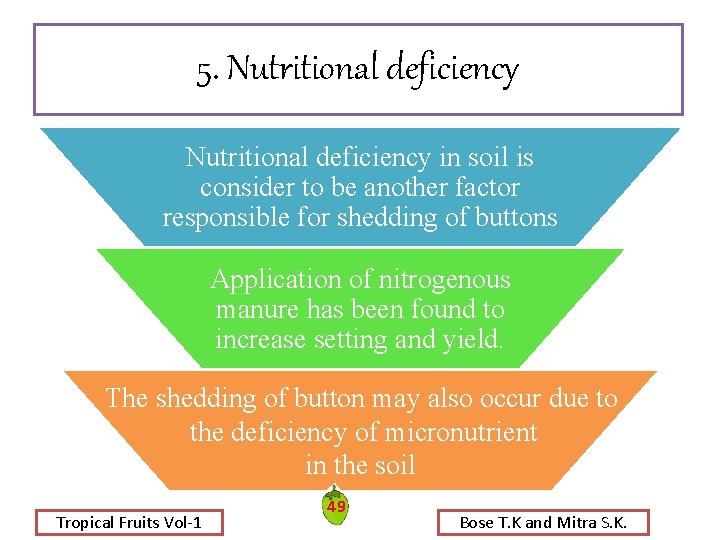
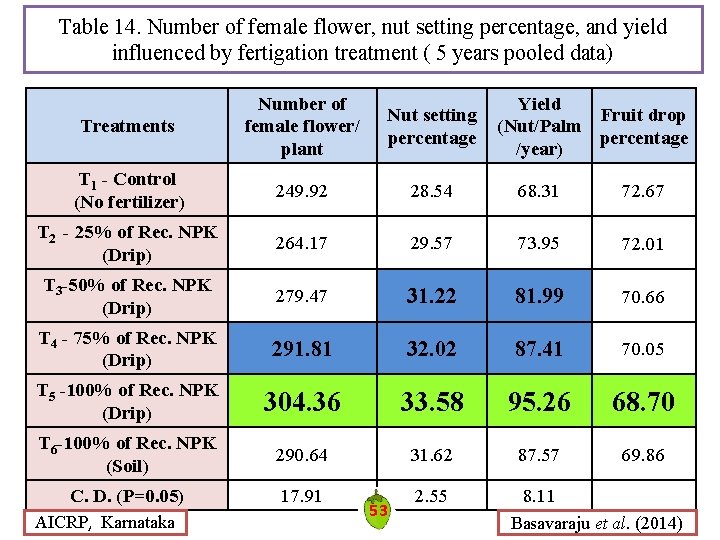
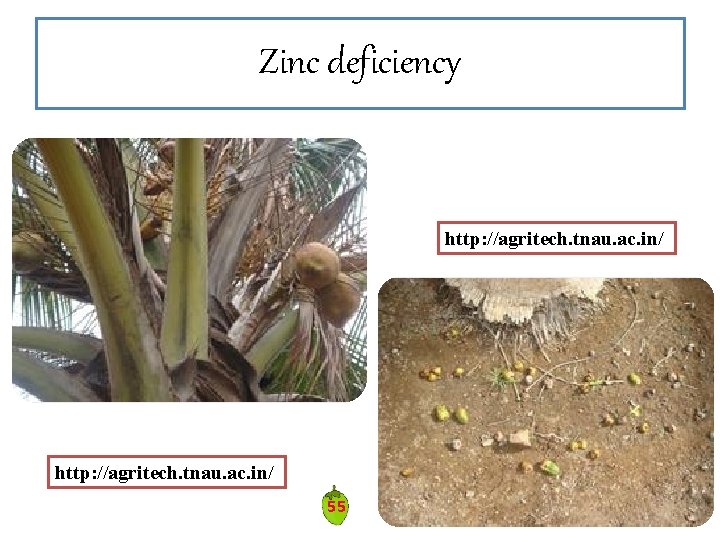
5. Nutritional deficiency in soil is consider to be another factor responsible for shedding of buttons Application of nitrogenous manure has been found to increase setting and yield. The shedding of button may also occur due to the deficiency of micronutrient in the soil Tropical Fruits Vol-1 49 Bose T. K and Mitra S. K.
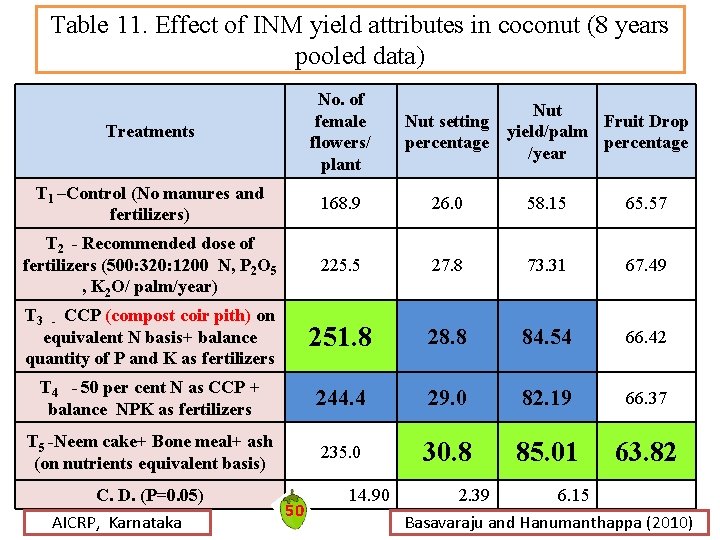
Table 11. Effect of INM yield attributes in coconut (8 years pooled data) Treatments No. of female flowers/ plant T 1 –Control (No manures and fertilizers) 168. 9 26. 0 58. 15 65. 57 T 2 - Recommended dose of fertilizers (500: 320: 1200 N, P 2 O 5 , K 2 O/ palm/year) 225. 5 27. 8 73. 31 67. 49 T 3 - CCP (compost coir pith) on equivalent N basis+ balance quantity of P and K as fertilizers 251. 8 28. 8 84. 54 66. 42 T 4 - 50 per cent N as CCP + balance NPK as fertilizers 244. 4 29. 0 82. 19 66. 37 T 5 -Neem cake+ Bone meal+ ash (on nutrients equivalent basis) 235. 0 30. 8 85. 01 63. 82 C. D. (P=0. 05) AICRP, Karnataka 50 14. 90 Nut setting Fruit Drop yield/palm percentage /year 2. 39 6. 15 Basavaraju and Hanumanthappa (2010)
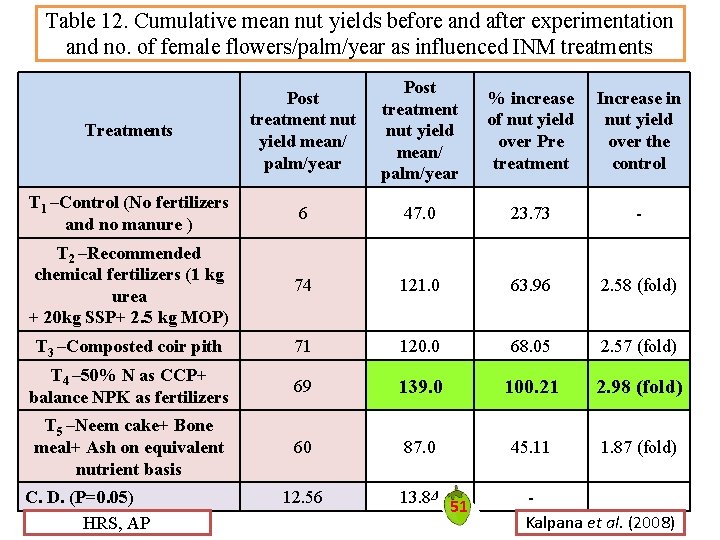
Table 12. Cumulative mean nut yields before and after experimentation and no. of female flowers/palm/year as influenced INM treatments Treatments Post treatment nut yield mean/ palm/year % increase of nut yield over Pre treatment Increase in nut yield over the control T 1 –Control (No fertilizers and no manure ) 6 47. 0 23. 73 - T 2 –Recommended chemical fertilizers (1 kg urea + 20 kg SSP+ 2. 5 kg MOP) 74 121. 0 63. 96 2. 58 (fold) T 3 –Composted coir pith 71 120. 0 68. 05 2. 57 (fold) T 4 – 50% N as CCP+ balance NPK as fertilizers 69 139. 0 100. 21 2. 98 (fold) T 5 –Neem cake+ Bone meal+ Ash on equivalent nutrient basis 60 87. 0 45. 11 1. 87 (fold) 12. 56 13. 84 C. D. (P=0. 05) HRS, AP 51 Kalpana et al. (2008)
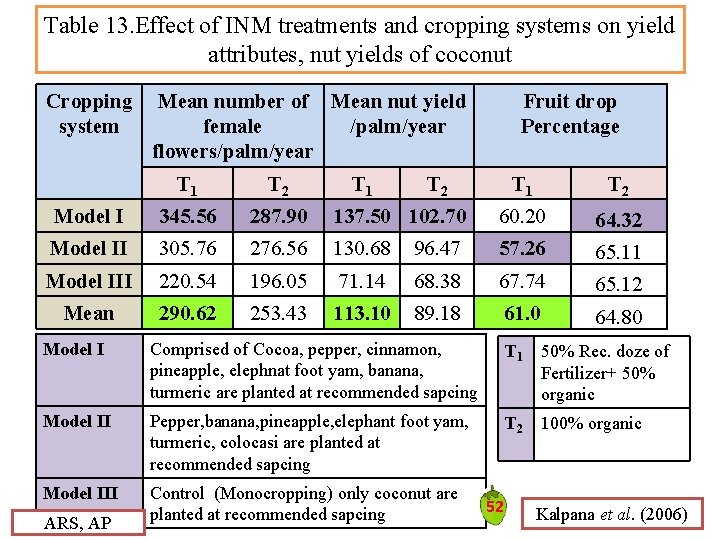
Table 13. Effect of INM treatments and cropping systems on yield attributes, nut yields of coconut Cropping system Mean number of Mean nut yield female /palm/year flowers/palm/year T 1 T 2 Model I 345. 56 287. 90 Model II 305. 76 Model III Mean T 1 Fruit drop Percentage T 2 T 1 T 2 137. 50 102. 70 60. 20 64. 32 276. 56 130. 68 96. 47 57. 26 65. 11 220. 54 196. 05 71. 14 68. 38 67. 74 65. 12 290. 62 253. 43 113. 10 89. 18 61. 0 64. 80 Model I Comprised of Cocoa, pepper, cinnamon, pineapple, elephnat foot yam, banana, turmeric are planted at recommended sapcing T 1 50% Rec. doze of Fertilizer+ 50% organic Model II Pepper, banana, pineapple, elephant foot yam, turmeric, colocasi are planted at recommended sapcing T 2 100% organic Model III Control (Monocropping) only coconut are planted at recommended sapcing ARS, AP 52 Kalpana et al. (2006)
Table 14. Number of female flower, nut setting percentage, and yield influenced by fertigation treatment ( 5 years pooled data) Treatments Number of female flower/ plant Nut setting percentage T 1 - Control (No fertilizer) 249. 92 28. 54 68. 31 72. 67 T 2 - 25% of Rec. NPK (Drip) 264. 17 29. 57 73. 95 72. 01 T 3 -50% of Rec. NPK (Drip) 279. 47 31. 22 81. 99 70. 66 T 4 - 75% of Rec. NPK (Drip) 291. 81 32. 02 87. 41 70. 05 T 5 -100% of Rec. NPK (Drip) 304. 36 33. 58 95. 26 68. 70 T 6 -100% of Rec. NPK (Soil) 290. 64 31. 62 87. 57 69. 86 C. D. (P=0. 05) 17. 91 2. 55 8. 11 AICRP, Karnataka 53 Yield Fruit drop (Nut/Palm percentage /year) Basavaraju et al. (2014)
Boron deficiency http: //agritech. tnau. ac. in/ 54 Horti Farm , AAU, Anand
Zinc deficiency http: //agritech. tnau. ac. in/ 55
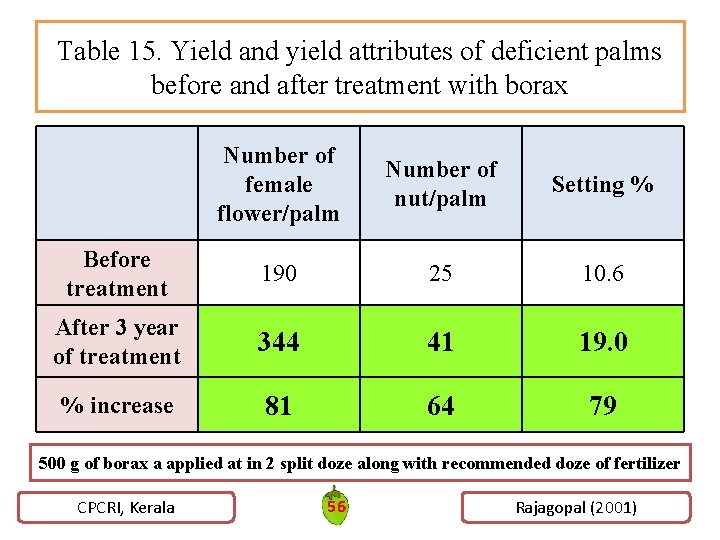
Table 15. Yield and yield attributes of deficient palms before and after treatment with borax Number of female flower/palm Number of nut/palm Setting % Before treatment 190 25 10. 6 After 3 year of treatment 344 41 19. 0 % increase 81 64 79 500 g of borax a applied at in 2 split doze along with recommended doze of fertilizer CPCRI, Kerala 56 Rajagopal (2001)
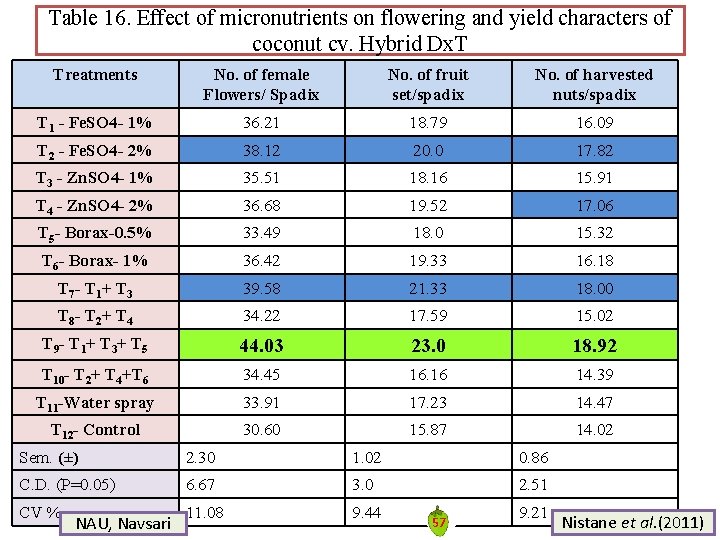
Table 16. Effect of micronutrients on flowering and yield characters of coconut cv. Hybrid Dx. T Treatments No. of female Flowers/ Spadix No. of fruit set/spadix No. of harvested nuts/spadix T 1 - Fe. SO 4 - 1% 36. 21 18. 79 16. 09 T 2 - Fe. SO 4 - 2% 38. 12 20. 0 17. 82 T 3 - Zn. SO 4 - 1% 35. 51 18. 16 15. 91 T 4 - Zn. SO 4 - 2% 36. 68 19. 52 17. 06 T 5 - Borax-0. 5% 33. 49 18. 0 15. 32 T 6 - Borax- 1% 36. 42 19. 33 16. 18 T 7 - T 1+ T 3 39. 58 21. 33 18. 00 T 8 - T 2+ T 4 34. 22 17. 59 15. 02 T 9 - T 1+ T 3+ T 5 44. 03 23. 0 18. 92 T 10 - T 2+ T 4+T 6 34. 45 16. 16 14. 39 T 11 -Water spray 33. 91 17. 23 14. 47 T 12 - Control 30. 60 15. 87 14. 02 Sem. (±) 2. 30 1. 02 0. 86 C. D. (P=0. 05) 6. 67 3. 0 2. 51 CV % 11. 08 9. 44 NAU, Navsari 57 9. 21 Nistane et al. (2011)
6. Disease and pest Investigation is carried out in India and Philippines showed that falling of button and immature nut was due to infection by fungus Phtophthora spp and in kenya and Africa it was due to Colletorichum spp Bordex mixture as preventive against shedding of immature The shedding of button was found to largely due to mite, moth, beetal, rats, bug and ants Tropical Fruits, Vol-1 58 Bose T. K. and Mitra S. K.
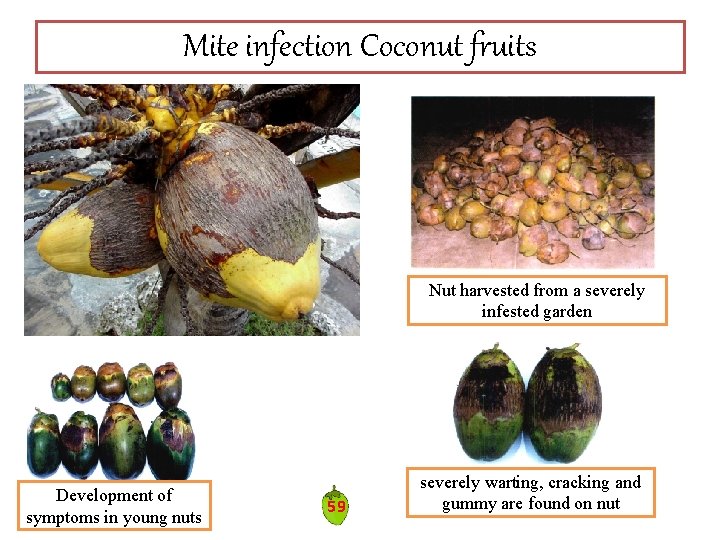
Mite infection Coconut fruits Nut harvested from a severely infested garden Development of symptoms in young nuts 59 severely warting, cracking and gummy are found on nut
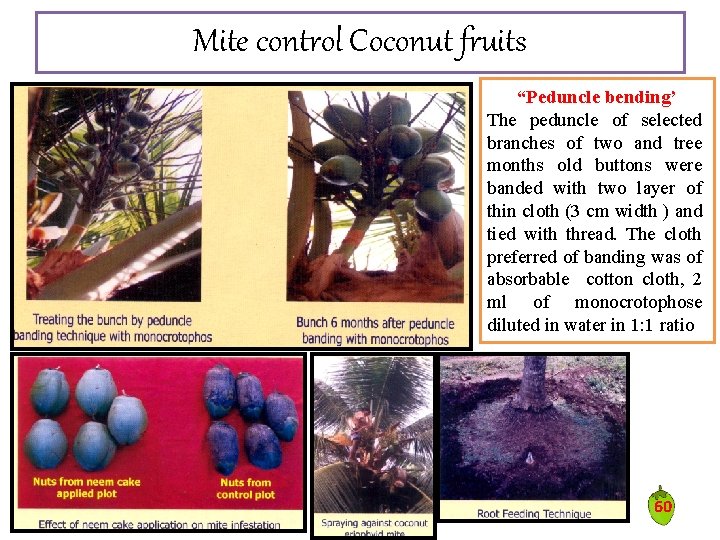
Mite control Coconut fruits “Peduncle bending’ The peduncle of selected branches of two and tree months old buttons were banded with two layer of thin cloth (3 cm width ) and tied with thread. The cloth preferred of banding was of absorbable cotton cloth, 2 ml of monocrotophose diluted in water in 1: 1 ratio 60
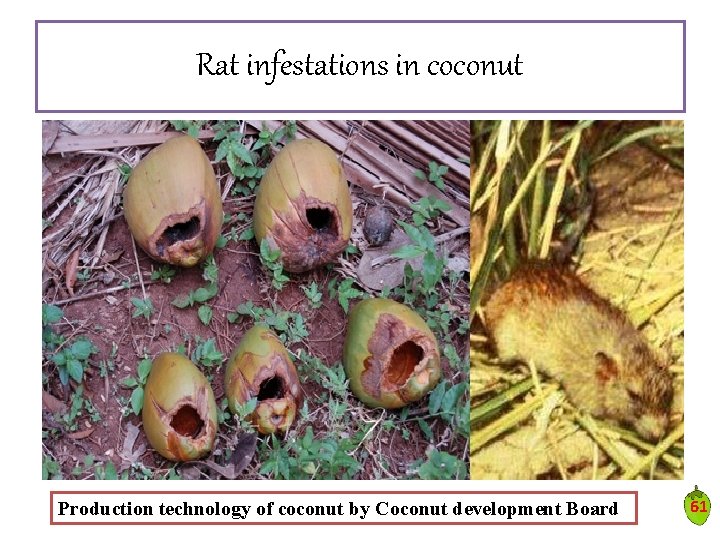
Rat infestations in coconut Production technology of coconut by Coconut development Board 61
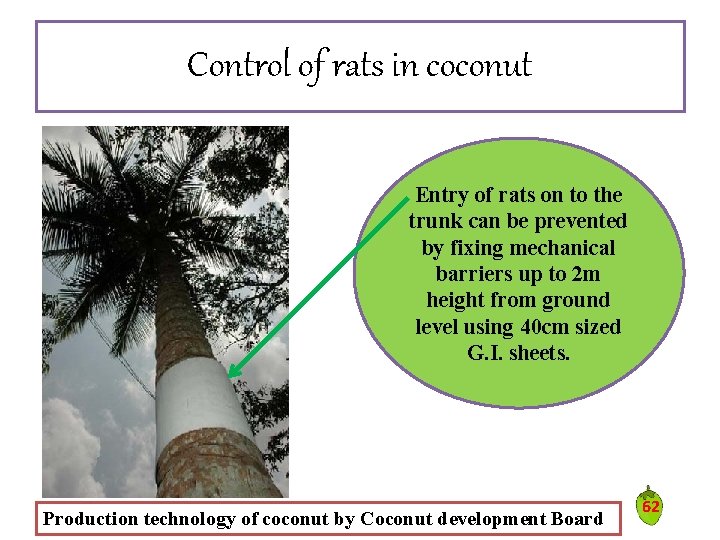
Control of rats in coconut Entry of rats on to the trunk can be prevented by fixing mechanical barriers up to 2 m height from ground level using 40 cm sized G. I. sheets. Production technology of coconut by Coconut development Board 62
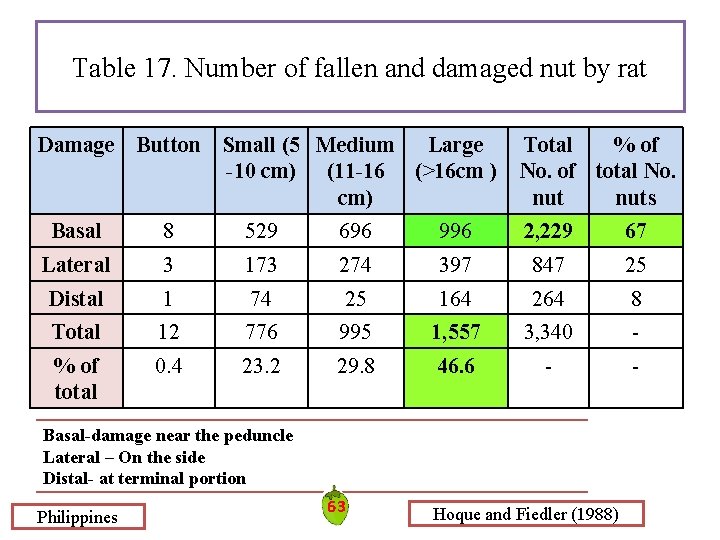
Table 17. Number of fallen and damaged nut by rat Damage Button Small (5 Medium Large -10 cm) (11 -16 (>16 cm ) cm) Total % of No. of total No. nuts Basal 8 529 696 996 2, 229 67 Lateral 3 173 274 397 847 25 Distal 1 74 25 164 264 8 Total 12 776 995 1, 557 3, 340 - % of total 0. 4 23. 2 29. 8 46. 6 - - Basal-damage near the peduncle Lateral – On the side Distal- at terminal portion Philippines 63 Hoque and Fiedler (1988)
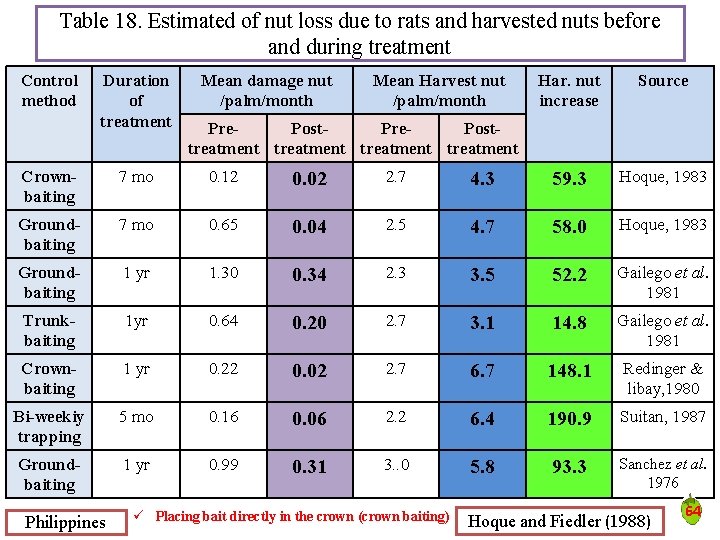
Table 18. Estimated of nut loss due to rats and harvested nuts before and during treatment Control method Duration of treatment Mean damage nut /palm/month Mean Harvest nut /palm/month Har. nut increase Source Pre. Posttreatment Crownbaiting 7 mo 0. 12 0. 02 2. 7 4. 3 59. 3 Hoque, 1983 Groundbaiting 7 mo 0. 65 0. 04 2. 5 4. 7 58. 0 Hoque, 1983 Groundbaiting 1 yr 1. 30 0. 34 2. 3 3. 5 52. 2 Gailego et al. 1981 Trunkbaiting 1 yr 0. 64 0. 20 2. 7 3. 1 14. 8 Gailego et al. 1981 Crownbaiting 1 yr 0. 22 0. 02 2. 7 6. 7 148. 1 Redinger & libay, 1980 Bi-weekiy trapping 5 mo 0. 16 0. 06 2. 2 6. 4 190. 9 Suitan, 1987 Groundbaiting 1 yr 0. 99 0. 31 3. . 0 5. 8 93. 3 Sanchez et al. 1976 Philippines ü Placing bait directly in the crown (crown baiting) Hoque and Fiedler (1988) 64
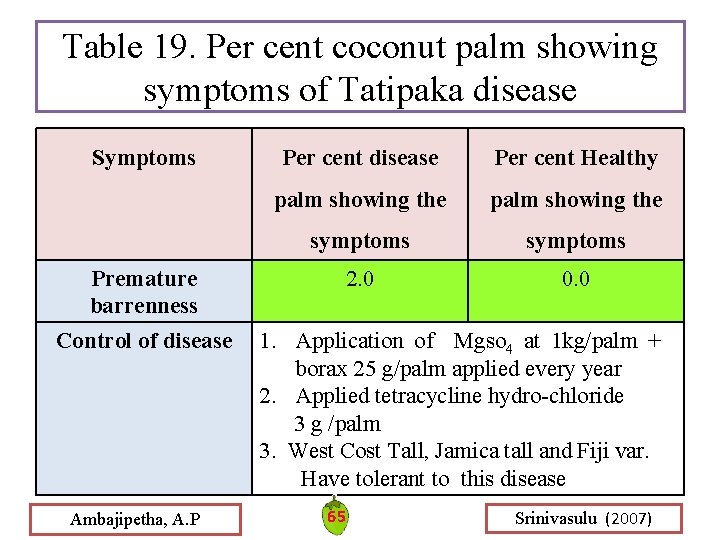
Table 19. Per cent coconut palm showing symptoms of Tatipaka disease Symptoms Per cent disease Per cent Healthy palm showing the symptoms 2. 0 0. 0 Premature barrenness Control of disease Ambajipetha, A. P 1. Application of Mgso 4 at 1 kg/palm + borax 25 g/palm applied every year 2. Applied tetracycline hydro-chloride 3 g /palm 3. West Cost Tall, Jamica tall and Fiji var. Have tolerant to this disease 65 Srinivasulu (2007)
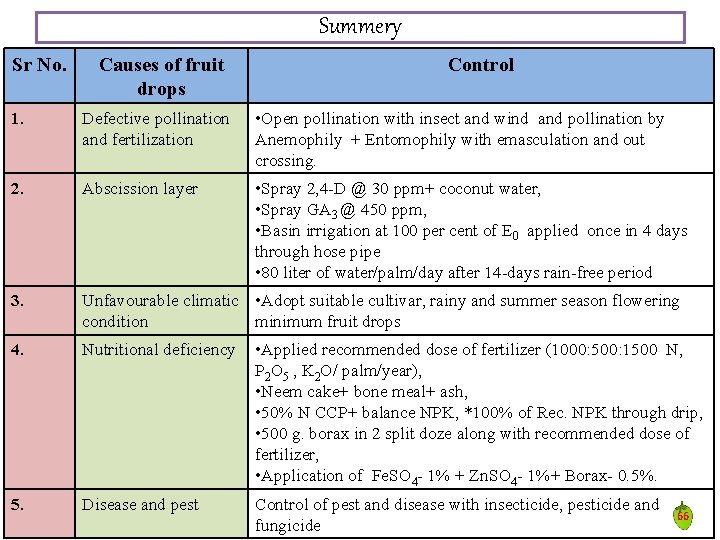
Summery Sr No. Causes of fruit drops Control 1. Defective pollination and fertilization • Open pollination with insect and wind and pollination by Anemophily + Entomophily with emasculation and out crossing. 2. Abscission layer • Spray 2, 4 -D @ 30 ppm+ coconut water, • Spray GA 3 @ 450 ppm, • Basin irrigation at 100 per cent of E 0 applied once in 4 days through hose pipe • 80 liter of water/palm/day after 14 -days rain-free period 3. Unfavourable climatic • Adopt suitable cultivar, rainy and summer season flowering condition minimum fruit drops 4. Nutritional deficiency • Applied recommended dose of fertilizer (1000: 500: 1500 N, P 2 O 5 , K 2 O/ palm/year), • Neem cake+ bone meal+ ash, • 50% N CCP+ balance NPK, *100% of Rec. NPK through drip, • 500 g. borax in 2 split doze along with recommended dose of fertilizer, • Application of Fe. SO 4 - 1% + Zn. SO 4 - 1%+ Borax- 0. 5%. 5. Disease and pest Control of pest and disease with insecticide, pesticide and fungicide 66
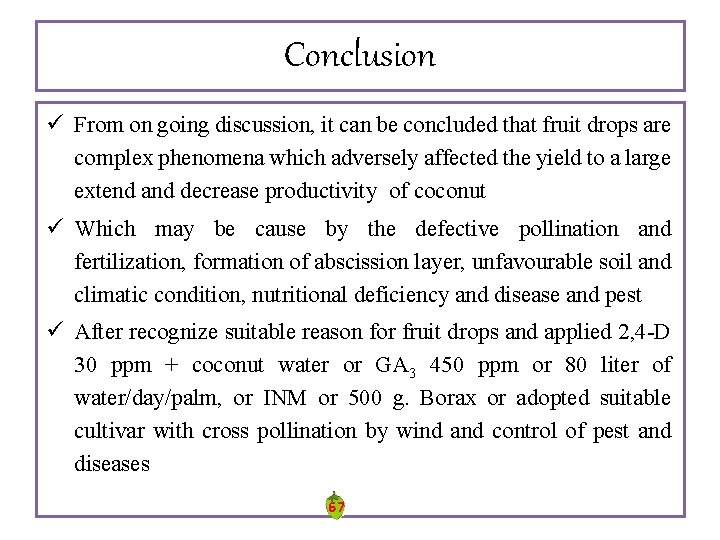
Conclusion ü From on going discussion, it can be concluded that fruit drops are complex phenomena which adversely affected the yield to a large extend and decrease productivity of coconut ü Which may be cause by the defective pollination and fertilization, formation of abscission layer, unfavourable soil and climatic condition, nutritional deficiency and disease and pest ü After recognize suitable reason for fruit drops and applied 2, 4 -D 30 ppm + coconut water or GA 3 450 ppm or 80 liter of water/day/palm, or INM or 500 g. Borax or adopted suitable cultivar with cross pollination by wind and control of pest and diseases 67
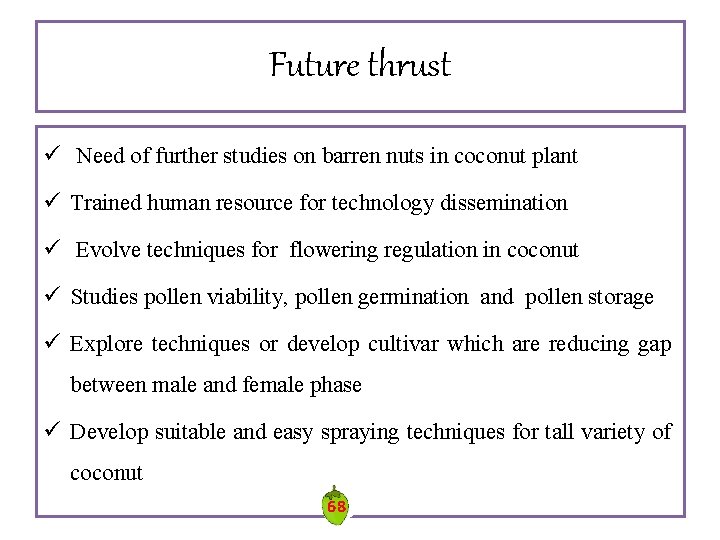
Future thrust ü Need of further studies on barren nuts in coconut plant ü Trained human resource for technology dissemination ü Evolve techniques for flowering regulation in coconut ü Studies pollen viability, pollen germination and pollen storage ü Explore techniques or develop cultivar which are reducing gap between male and female phase ü Develop suitable and easy spraying techniques for tall variety of coconut 68
Thank you For your Attention