
Insects and Fruit Jan van Kessel 1660 1665
- Slides: 24
Insects and Fruit Jan van Kessel 1660 - 1665, Rijksmuseum Netherlands, Public Domain COPYRIGHT AND DIGITISATION OF CULTURAL HERITAGE Copyright and digitisation of cultural heritage CC BY-SA
Table of contents • • • Why you need to know about copyright Intellectual property and copyright Rightsholders Neighbouring rights Obtaining permission of online publication Diligent search (OW directive) Copyright and digitisation of cultural heritage CC BY-SA
WHY YOU NEED TO KNOW ABOUT COPYRIGHT Troupe Banola leur dernière création Anonymous 1911 Circus Museum Netherlands, CC BY-SA
Copyright and the cultural heritage sector Through the rise of the digital information society, copyright playsa more central rolein our society and has great impact on access to knowledge and culture, education, research and innovation. Culture Heritage Institutions (CHIs)have a mission to preserve cultural heritage and provide access to cultural heritageto citizens. Copyright law must be understoodwhen digitising collections, as permission may be required from rights holderswhen copyright in an object or archival material still applies. Copyright and digitisation of cultural heritage CC BY-SA
INTELLECTUAL PROPERTY AND COPYRIGHT Cirque de Moscou Anonymous 1911 Circus Museum Netherlands, CC BY-SA
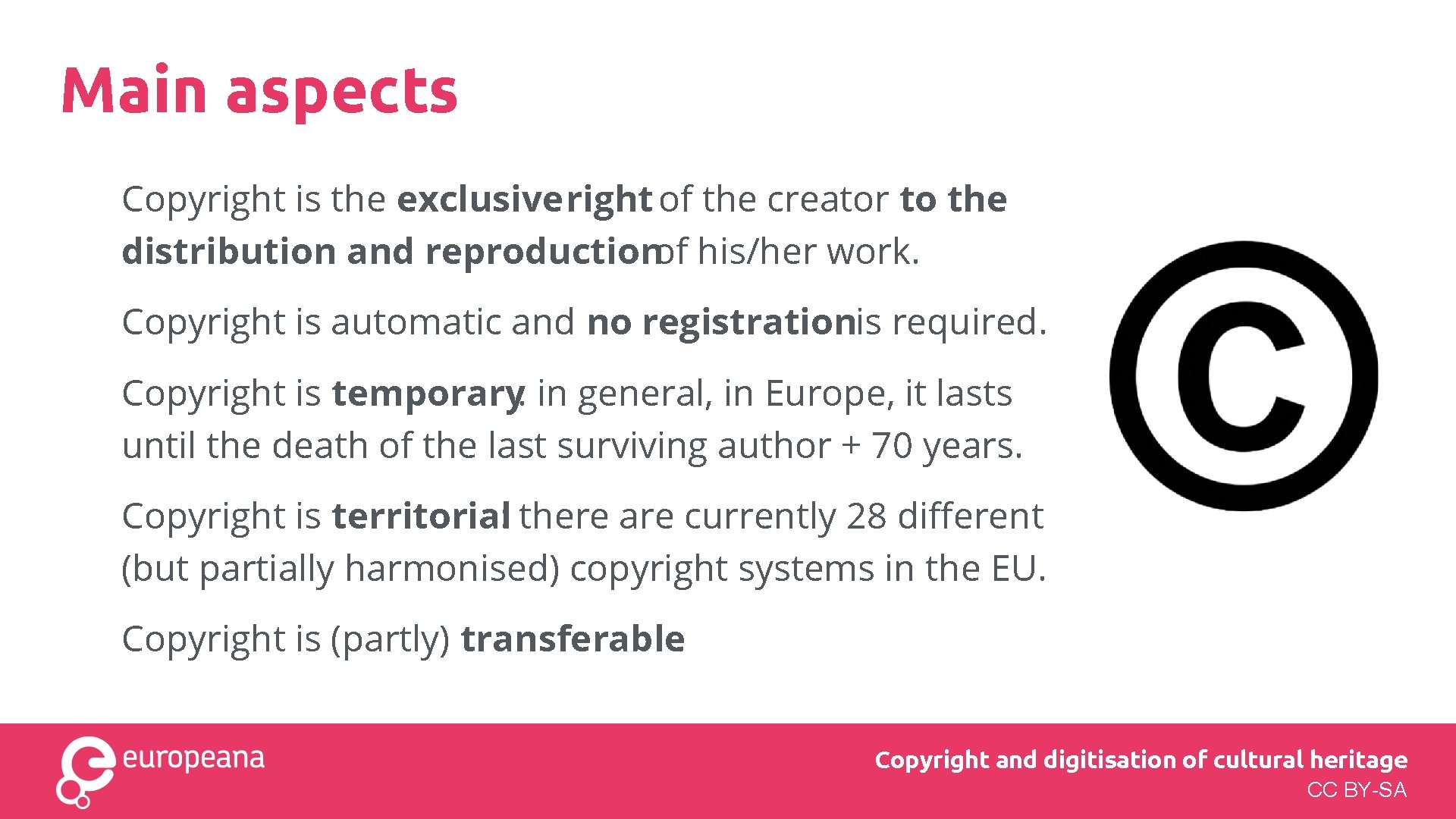
Main aspects Copyright is the exclusive right of the creator to the distribution and reproductionof his/her work. Copyright is automatic and no registrationis required. Copyright is temporary: in general, in Europe, it lasts until the death of the last surviving author + 70 years. Copyright is territorial: there are currently 28 different (but partially harmonised) copyright systems in the EU. Copyright is (partly) transferable. Copyright and digitisation of cultural heritage CC BY-SA
What is protected by copyright? Only original expressionsof ideas are protectedby copyright law. • Ideas are not protected. • Facts are not protected. The European Court of Justice defines originality as ‘the Author’s own intellectual creation’. Works protected by copyright include paintings, drawings, photography, letters, books, posters, maps, some fashion, architecture, poems, song lyrics and oral history. Copyright and digitisation of cultural heritage CC BY-SA
Structure of copyright Economic rights(transferable - harmonised): • the exclusive right to create reproductions of the work; • the exclusive right to communicate the work to the public. Moral rights(not transferable - not harmonised): • the right to be named (attribution): • the right to object to false attribution - publishing under a different name or title; • the right to object to any distortion, modification or other derogatory action, which harms the author’s honour or reputation. Copyright and digitisation of cultural heritage CC BY-SA
Exceptions (permitted acts) for CHIs Specific acts of reproduction can be done by publicly accessible libraries, educational establishments or museums, or by archives, which are not for direct or indirect economicor commercial advantage(art. 5. 2. c). Use for the purpose of research or private study by individual members of the public on dedicated terminals on the premises of cultural heritage institutions (art. 5. 2. n). Making an orphan workavailable to the public as well as reproducing it for the purposes of digitisation, making available, indexing, cataloguing, preservation or restoration (art. 6. 1 OW directive). Copyright and digitisation of cultural heritage CC BY-SA
RIGHTSHOLDERS Untitled Anonymous 1911 Circus Museum Netherlands, CC BY-SA
Rightsholders In principle the creator is the rights holderof his/her work. Rights can be transferred, sold and inherited. A work can have multiple rightsholders, e. g. rights in one audiovisual work may belong to the producer, director, performer, songwriter etc. Copyright and digitisation of cultural heritage CC BY-SA
Rights can be layered One object can contain several types of rights. Think for example of combinations of: • Copyright • Related rights / Neighbouring rights • Database rights One object can have an unlimited amount of rights holdersof these types of rights. There may also be rights in the objects such as portrait or privacy rights that limit if and how a work can be used. Copyright and digitisation of cultural heritage CC BY-SA
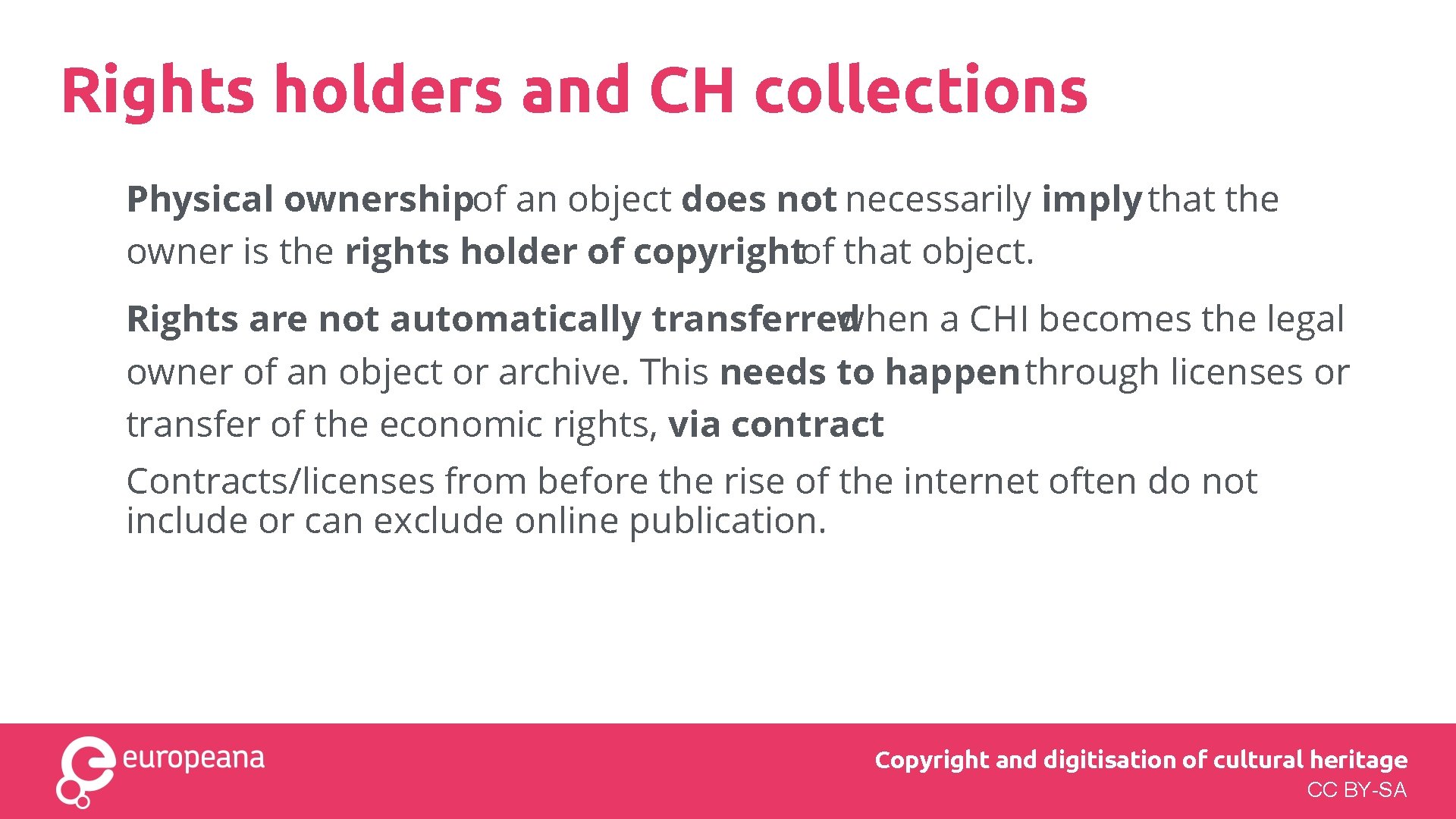
Rights holders and CH collections Physical ownershipof an object does not necessarily imply that the owner is the rights holder of copyrightof that object. Rights are not automatically transferred when a CHI becomes the legal owner of an object or archive. This needs to happen through licenses or transfer of the economic rights, via contract. Contracts/licenses from before the rise of the internet often do not include or can exclude online publication. Copyright and digitisation of cultural heritage CC BY-SA
NEIGHBOURING RIGHTS Kick-Cook musical trio Anonymous 1922 Circus Museum Netherlands, CC BY-SA
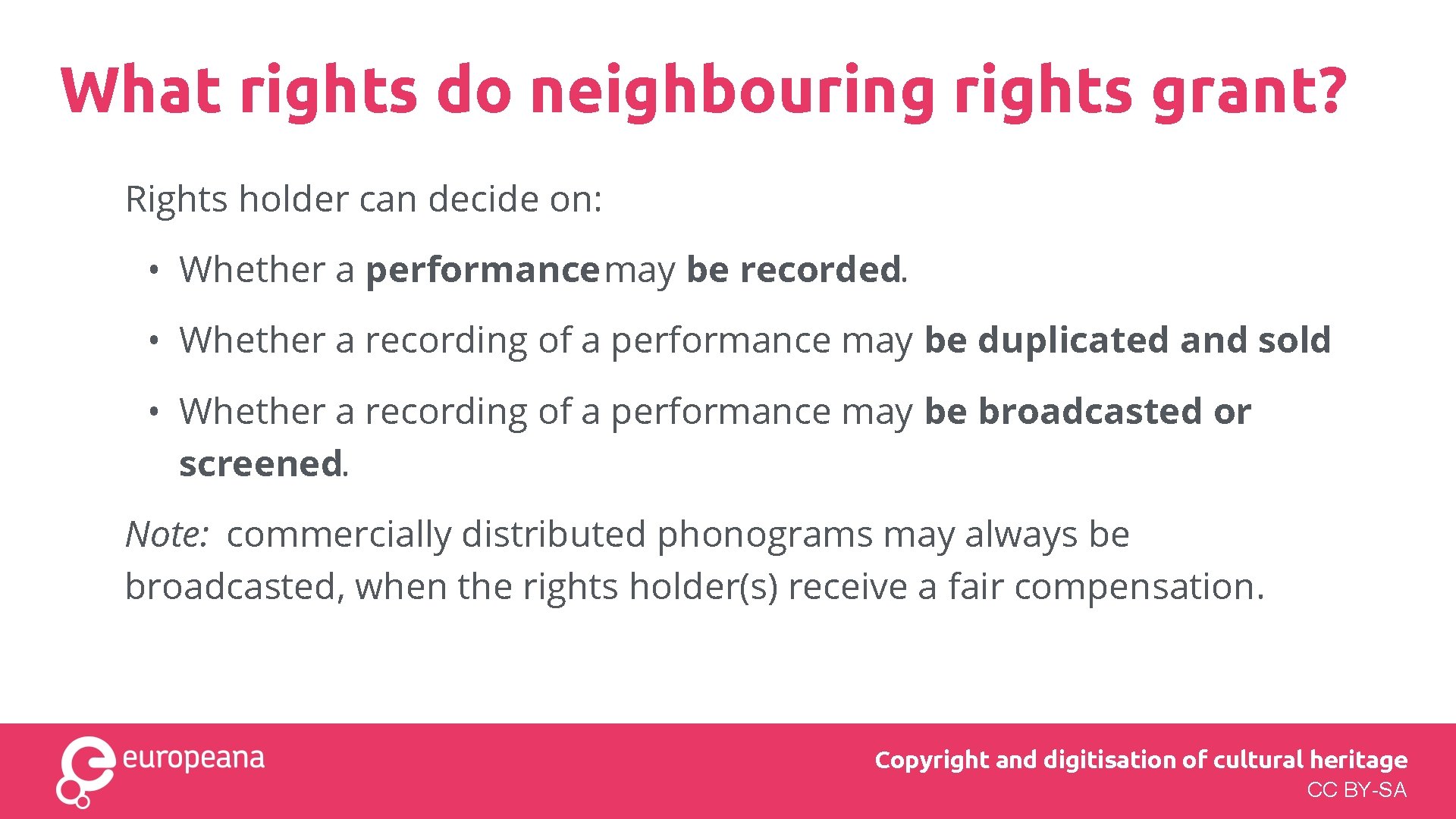
What rights do neighbouring rights grant? Rights holder can decide on: • Whether a performance may be recorded. • Whether a recording of a performance may be duplicated and sold. • Whether a recording of a performance may be broadcasted or screened. Note: commercially distributed phonograms may always be broadcasted, when the rights holder(s) receive a fair compensation. Copyright and digitisation of cultural heritage CC BY-SA
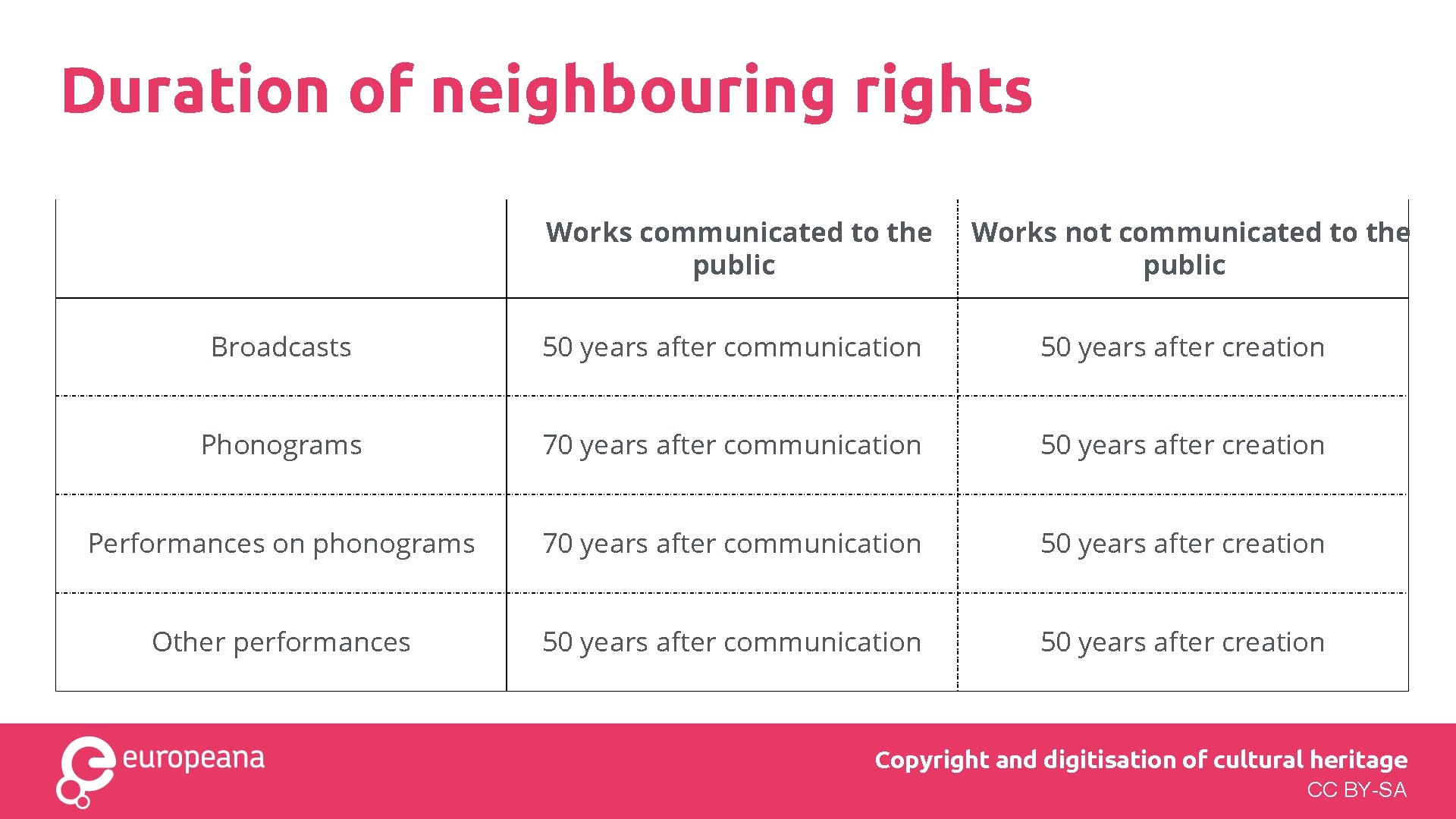
Duration of neighbouring rights Works communicated to the public Works not communicated to the public Broadcasts 50 years after communication 50 years after creation Phonograms 70 years after communication 50 years after creation Performances on phonograms 70 years after communication 50 years after creation Other performances 50 years after communication 50 years after creation Copyright and digitisation of cultural heritage CC BY-SA
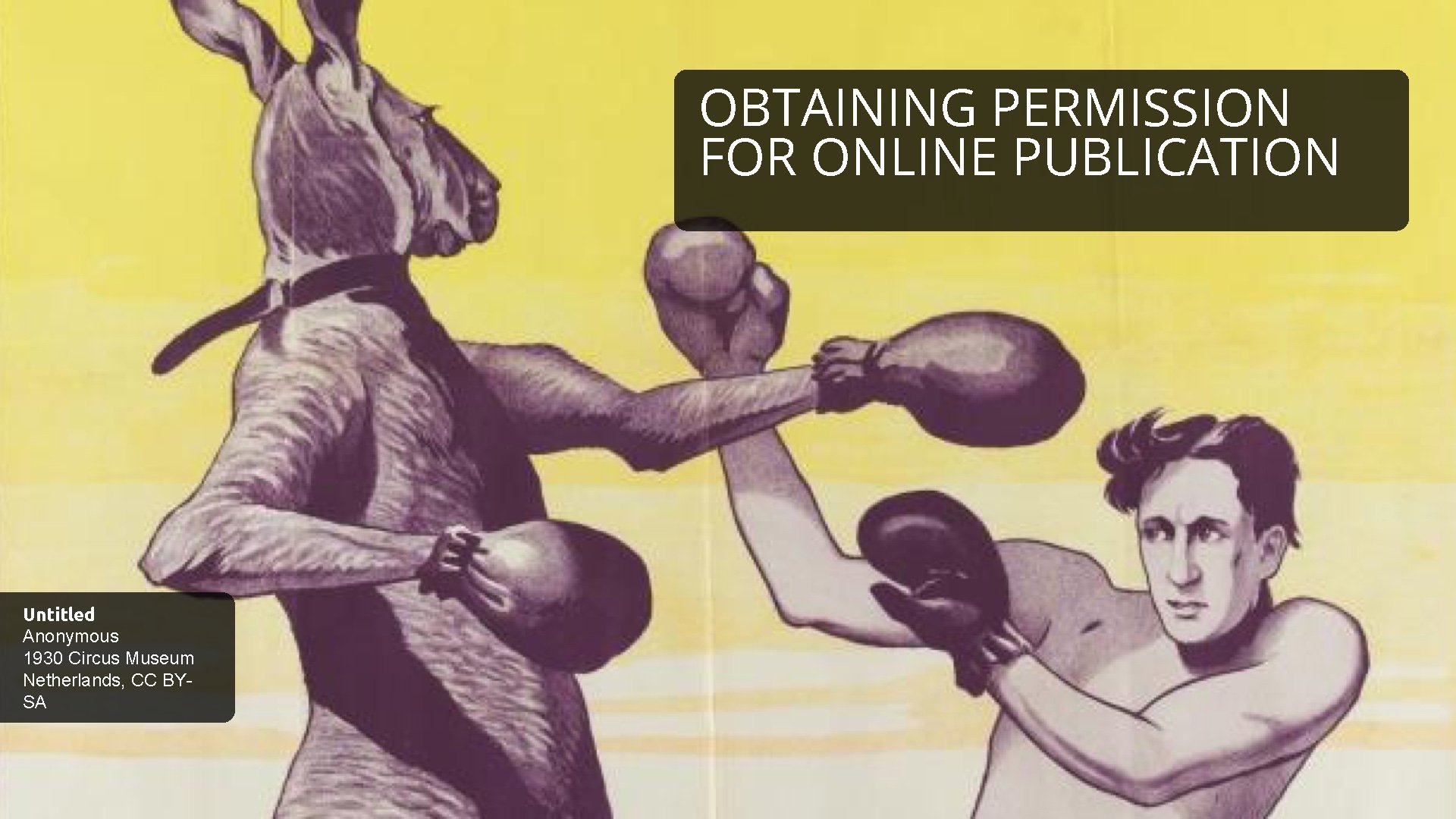
OBTAINING PERMISSION FOR ONLINE PUBLICATION Untitled Anonymous 1930 Circus Museum Netherlands, CC BYSA Copyright and digitisation of cultural heritage CC BY-SA
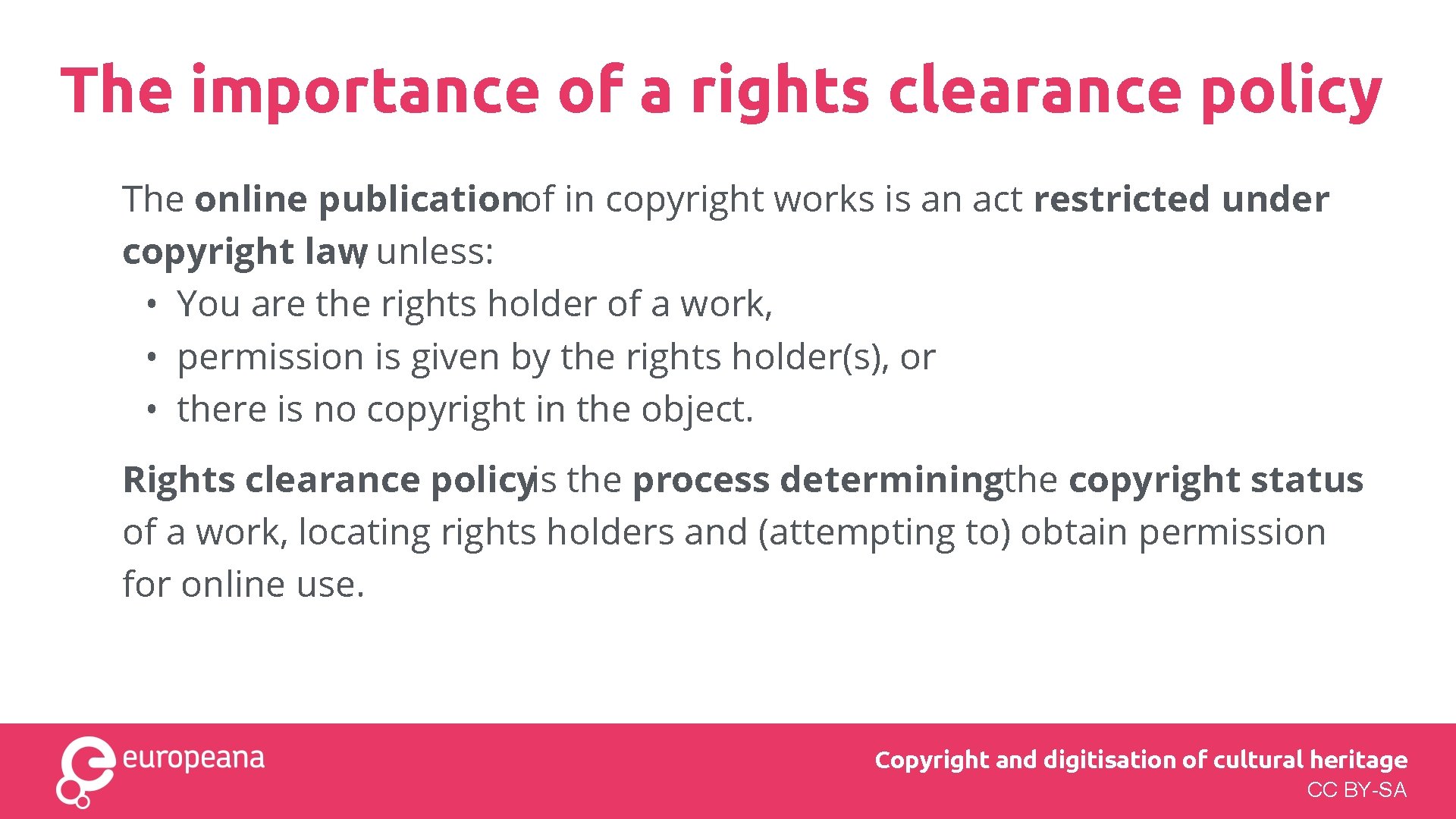
The importance of a rights clearance policy The online publicationof in copyright works is an act restricted under copyright law, unless: • You are the rights holder of a work, • permission is given by the rights holder(s), or • there is no copyright in the object. Rights clearance policyis the process determiningthe copyright status of a work, locating rights holders and (attempting to) obtain permission for online use. Copyright and digitisation of cultural heritage CC BY-SA
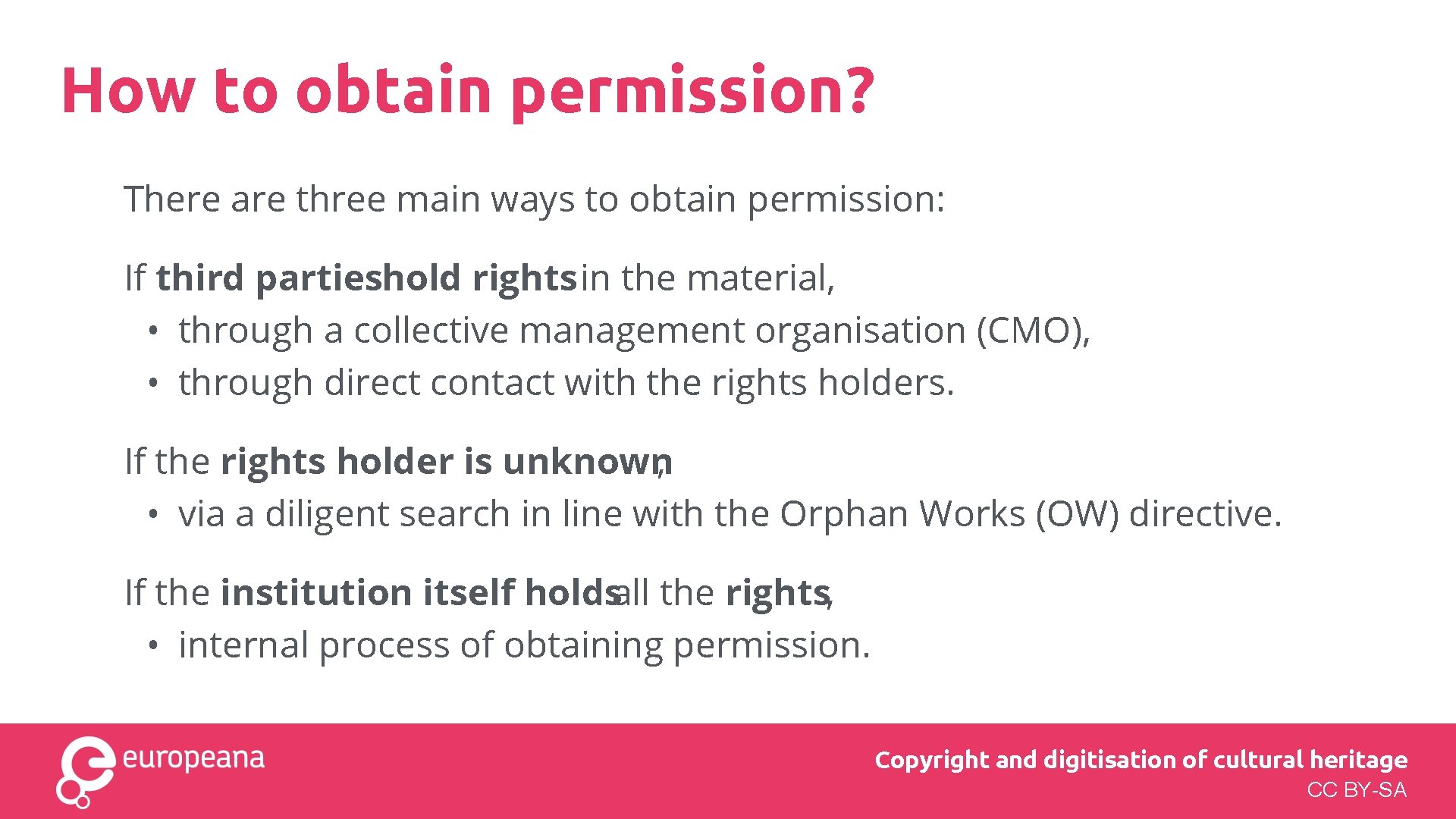
How to obtain permission? There are three main ways to obtain permission: If third partieshold rights in the material, • through a collective management organisation (CMO), • through direct contact with the rights holders. If the rights holder is unknown, • via a diligent search in line with the Orphan Works (OW) directive. If the institution itself holdsall the rights, • internal process of obtaining permission. Copyright and digitisation of cultural heritage CC BY-SA
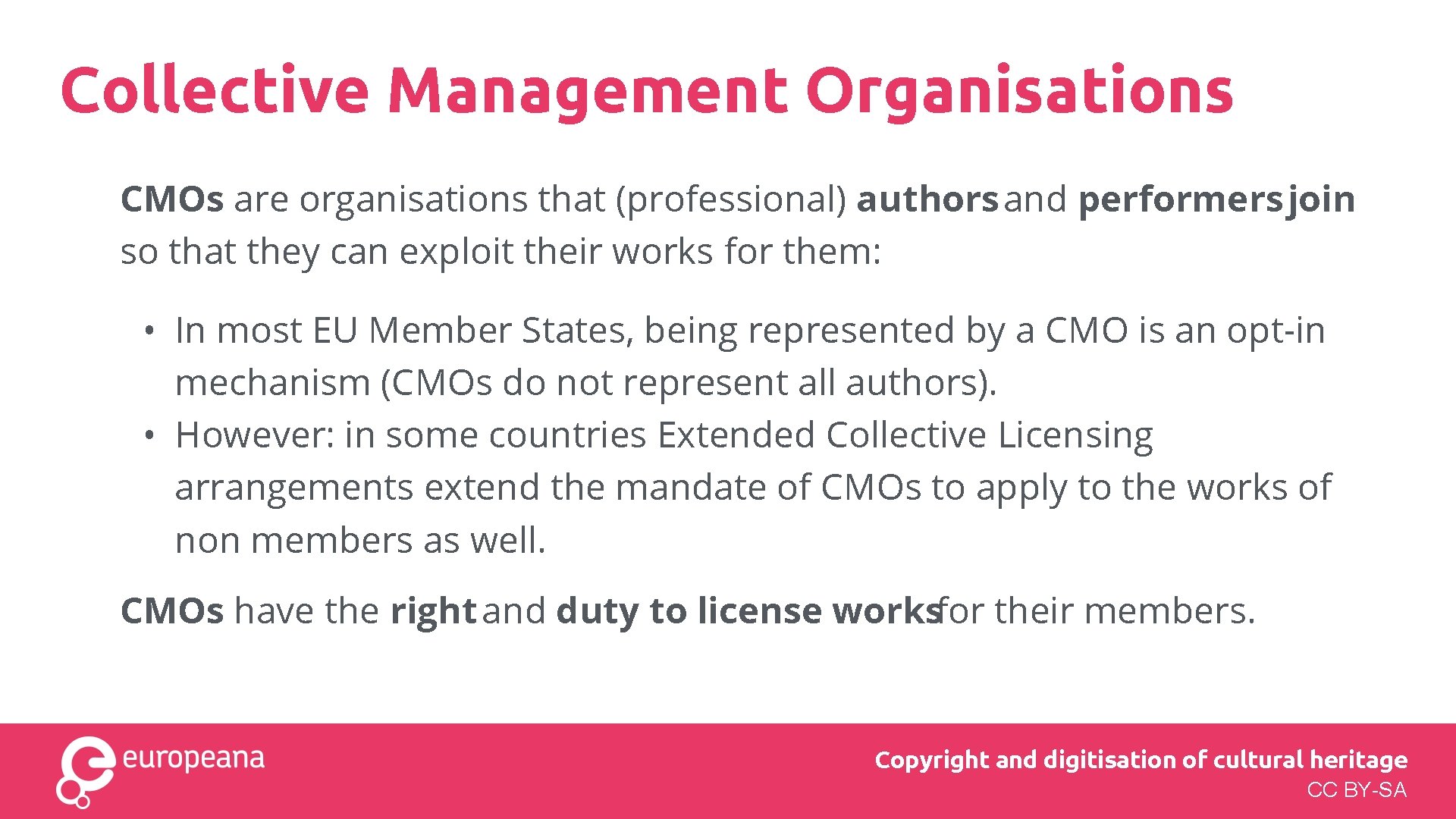
Collective Management Organisations CMOs are organisations that (professional) authors and performers join so that they can exploit their works for them: • In most EU Member States, being represented by a CMO is an opt-in mechanism (CMOs do not represent all authors). • However: in some countries Extended Collective Licensing arrangements extend the mandate of CMOs to apply to the works of non members as well. CMOs have the right and duty to license worksfor their members. Copyright and digitisation of cultural heritage CC BY-SA
Collective Management Organisations Most countries have separate CMOs for each type of rights holder. Given the layering of rights in cultural heritage objects this can mean having to obtain licenses from several CMOs in order to clear the rights for online publication. Under the 2014 Collective rights management directive CMOs are required to provideusers (CHIs) with informationabout the rights that they represent. Copyright and digitisation of cultural heritage CC BY-SA
Obtaining permission from rightsholder(s) Where authors/rightsholder(s) are not represented by a CMO permission to make a work available online needs to be obtained directly from the rightsholder(s). You can do so through: Getting permission viaa license: • The rights holder can apply a standardised license such as one of the Creative Commons Licenses • Creating a bespoke license (with the help of lawyers) Obtaining a transfer of the economic rights. Copyright and digitisation of cultural heritage CC BY-SA
Diligent search (OW directive) When a rights holder remains unknown(or unallocated) after a diligent search has been carried out in line with the requirements of the OW directive, it becomes an orphan work. Institutions are free to: • make orphan works available to the public, • reproduce them for the purposes of digitisation, making available, indexing, cataloguing, preservation or restoration. Orphan works need to be registered in the EU IPO database (via national competent authority). Copyright and digitisation of cultural heritage CC BY-SA
Flowers Anonymous 1700 - 1799, Rijksmuseum Netherlands, Public Domain @Europeana. IPR www. europeana. eu Copyright and digitisation of cultural heritage CC BY-SA