
Introduction to linguistics II FACULTY OF ENGLISH LANGUAGE
- Slides: 32
Introduction to linguistics II FACULTY OF ENGLISH LANGUAGE AND LITERATURE G. TOGIA SECTION ΠΗ-Ω 02/12/2020
Today’s topics 2 Words, meanings, and concepts. Polysemy. Homonymy. Homophony. Prototypes. Metonymy and metaphor. You can study these topics in: Yule G. : Chapter 10 Dirven, R. & M. Verspoor: Chapter 2
Semantics WORDS, MEANINGS, AND CONCEPTS Course title: Introduction to Linguistics II
What’s in a word? 4 Using language we categorise our experience of the world. What is linguistically categorised is what is important or prominent for a particular community.
Words and meanings 1 Is it that for a particular concept (or meaning) we have only one word? Or, is it that one word stands for only one concept or meaning?
Words and meanings 2 In a dictionary we find a number of concepts or meanings for the same word form. In a thesaurus we find a number of words for the same concept. E. g. for the concept ‘fruit’.
Two approaches 7 What a dictionary does: from a word form to meaning. Here we have to address polysemy or homonymy. What a thesaurus does: from meaning or concept to expressions used as synonyms to denote the same concept.
Synonymy, antonymy, lexical fields 8 Synonymy: Different words can have similar meanings. E. g. rich and wealthy. Antonymy: Words have opposite meanings. E. g. tall / short Lexical field: Groups of words that are somehow related in meaning. E. g. richness, affluence, wealth.
Semantics POLYSEMY. HOMONYMY. HOMOPHONY. Course title: Introduction to Linguistics II
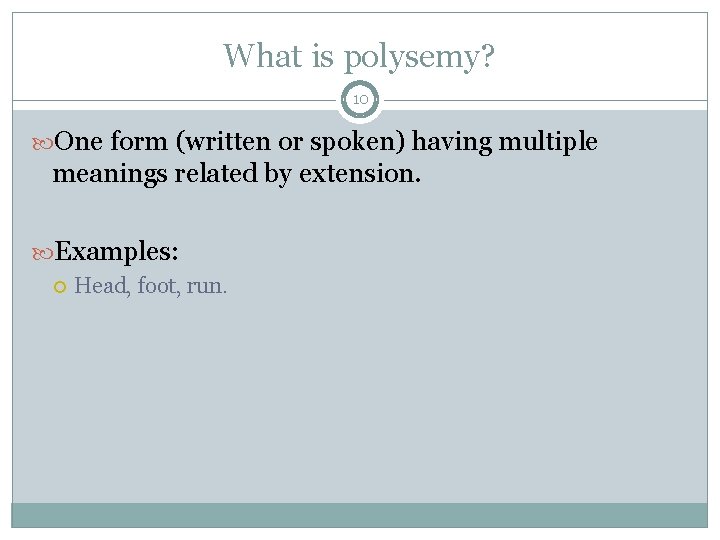
What is polysemy? 10 One form (written or spoken) having multiple meanings related by extension. Examples: Head, foot, run.
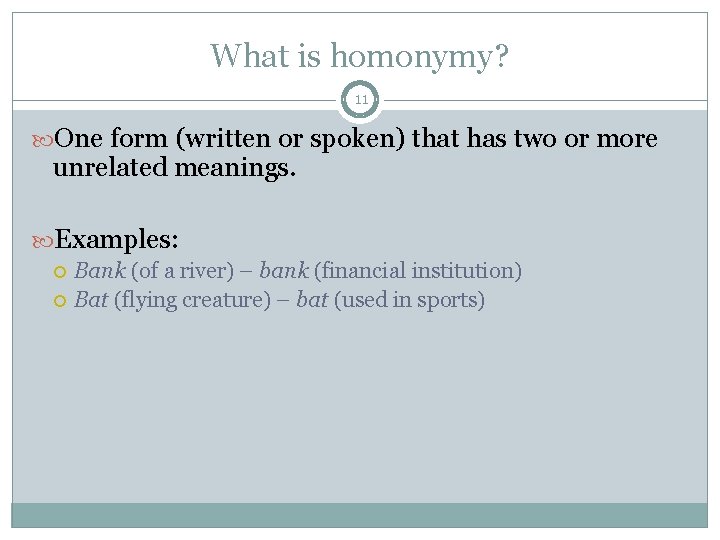
What is homonymy? 11 One form (written or spoken) that has two or more unrelated meanings. Examples: Bank (of a river) – bank (financial institution) Bat (flying creature) – bat (used in sports)
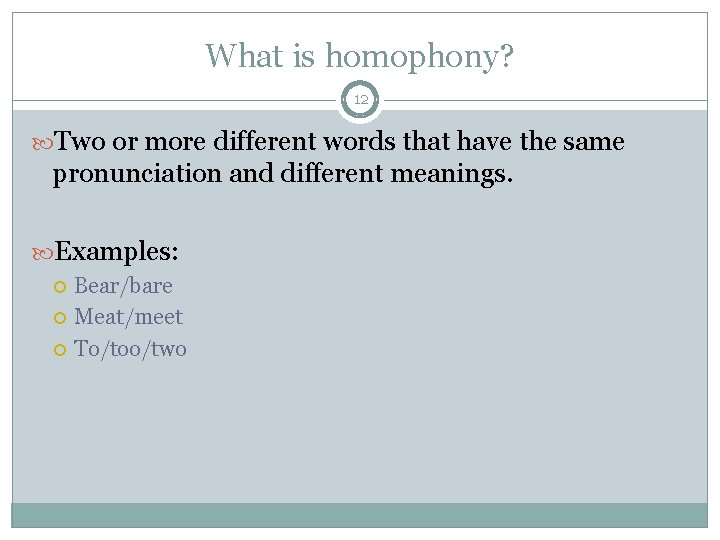
What is homophony? 12 Two or more different words that have the same pronunciation and different meanings. Examples: Bear/bare Meat/meet To/too/two
Homonymy and polysemy 13 Dictionaries have single entries for polysemous words but separate entries for homonymous words. Example: Date (thing we eat) – date (point in time): homonyms. Date as in ‘point in time’ is polysemous. Exercises 1 - 2
Prototypicality 14 Question: How many senses does a polysemous word have? Is there a central one? A word has: A central, prototypical sense and more marginal ones. Word senses are related to one another in terms of processes like metonymy and metaphor.
Semantics PROTOTYPES Course title: Introduction to Linguistics II
What is a prototype? 16 A word’s meaning can be looked at in terms of a prototype. A prototype is the most ‘characteristic instance’ of a category. E. g. take the category “bird”.
The prototypical member 17 The best member of a category. The one that first comes to mind when we think of the category. Which is the best example of a chair?
Prototypicality 18 The property characterizing the most prominent member of a category. Categories have: prototypical members (e. g. kitchen chair), less prototypical or marginal members (e. g. armchair, wheelchair) and peripheral members (e. g. highchair).
Category boundaries 19 Is a stool a member of the category “chair”? Category boundaries are fuzzy. Exercise 3
Fruit: an example 20 Consider the different senses of the polysemous word fruit: Something like a banana, apple, orange, etc. as in “fresh fruit and vegetables”. The part of a plant, bush, or tree that contains the seeds (technical use). All the natural things that the earth produces, e. g. fruit, vegetables, or minerals, as in “the fruits of the earth/nature”. A homosexual (old fashioned slang, derogatory). The result of hard work, as in “the fruits of his labour”. Offspring, as in “fruit of the womb” (biblical). Which sense(s) seem(s) more prototypical and which are marginal?
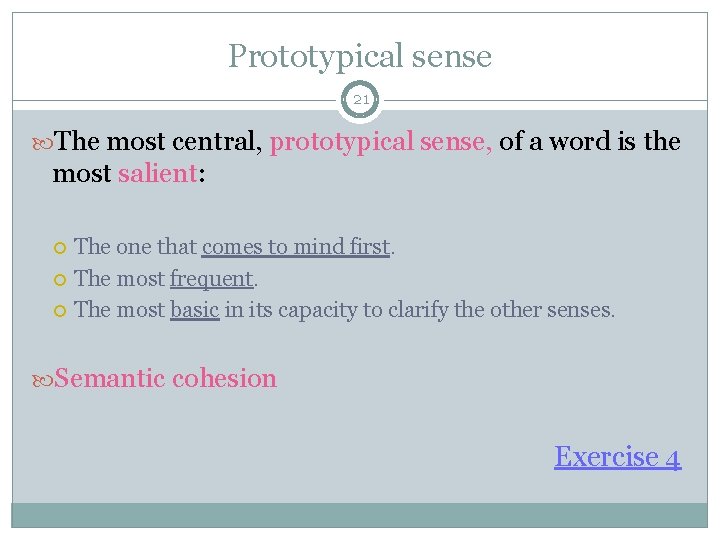
Prototypical sense 21 The most central, prototypical sense, of a word is the most salient: The one that comes to mind first. The most frequent. The most basic in its capacity to clarify the other senses. Semantic cohesion Exercise 4
Semantics METONYMY AND METAPHOR Course title: Introduction to Linguistics II
Prototypical word senses 23 The various senses of a polysemous word are systematically related to one another through cognitive processes such as metaphor and metonymy.
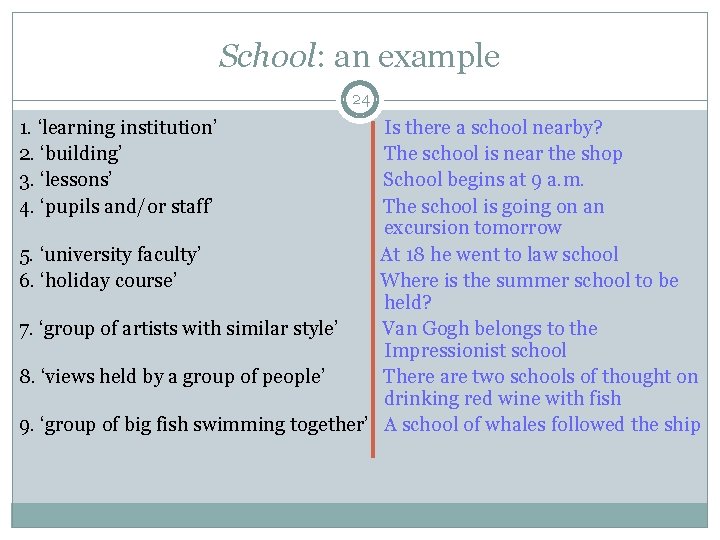
School: an example 24 1. ‘learning institution’ 2. ‘building’ 3. ‘lessons’ 4. ‘pupils and/or staff’ Is there a school nearby? The school is near the shop School begins at 9 a. m. The school is going on an excursion tomorrow 5. ‘university faculty’ At 18 he went to law school 6. ‘holiday course’ Where is the summer school to be held? 7. ‘group of artists with similar style’ Van Gogh belongs to the Impressionist school 8. ‘views held by a group of people’ There are two schools of thought on drinking red wine with fish 9. ‘group of big fish swimming together’ A school of whales followed the ship
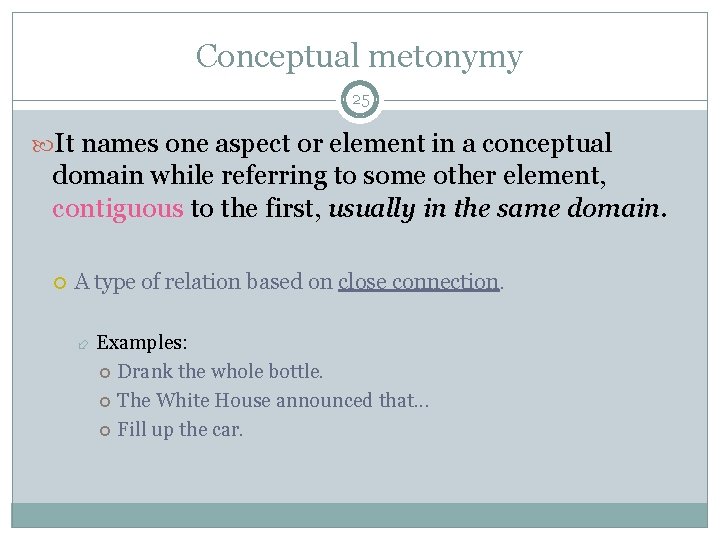
Conceptual metonymy 25 It names one aspect or element in a conceptual domain while referring to some other element, contiguous to the first, usually in the same domain. A type of relation based on close connection. Examples: Drank the whole bottle. The White House announced that. . . Fill up the car.
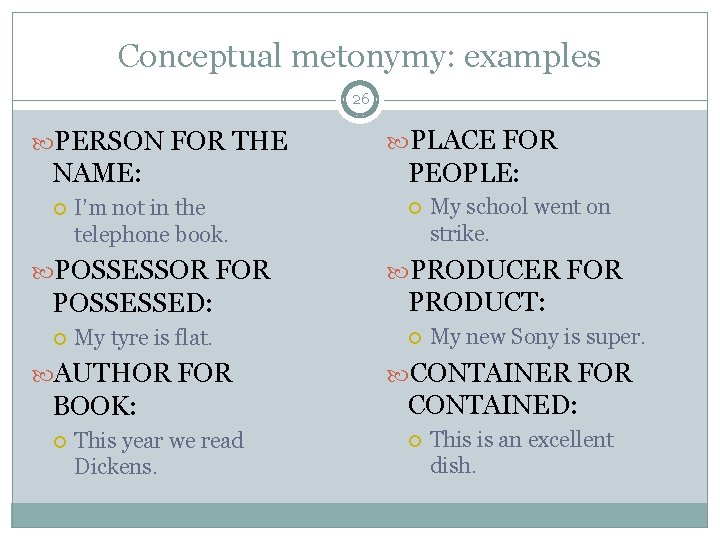
Conceptual metonymy: examples 26 PERSON FOR THE NAME: I’m not in the telephone book. POSSESSOR FOR POSSESSED: My tyre is flat. AUTHOR FOR BOOK: This year we read Dickens. PLACE FOR PEOPLE: My school went on strike. PRODUCER FOR PRODUCT: My new Sony is super. CONTAINER FOR CONTAINED: This is an excellent dish.
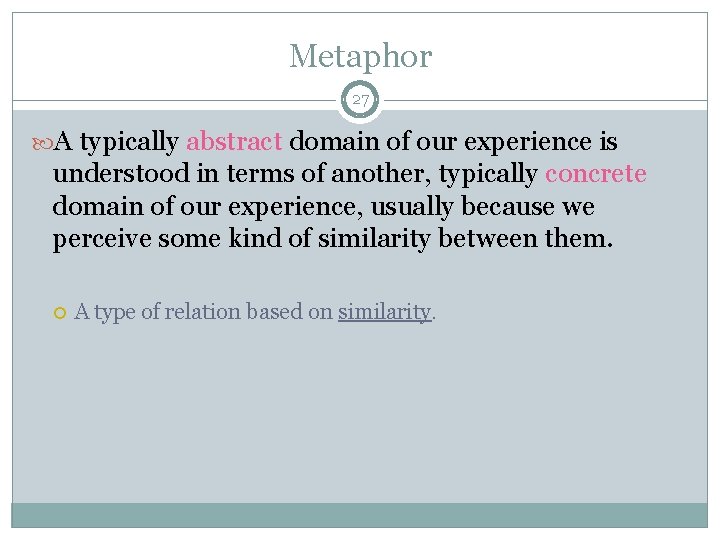
Metaphor 27 A typically abstract domain of our experience is understood in terms of another, typically concrete domain of our experience, usually because we perceive some kind of similarity between them. A type of relation based on similarity.
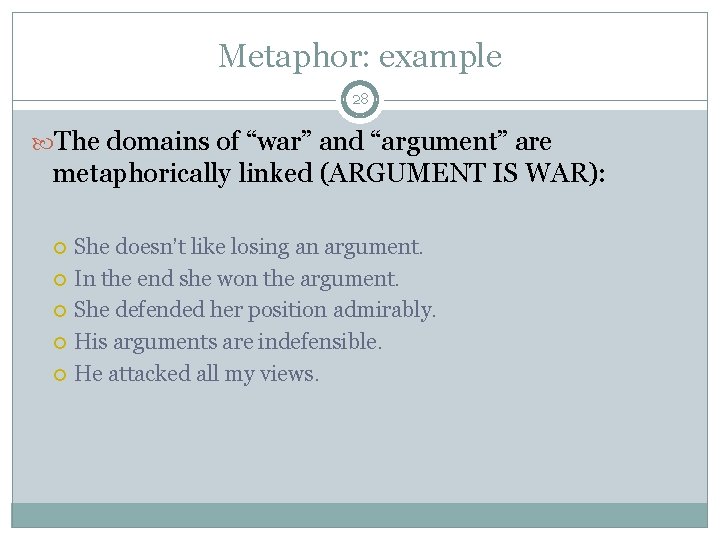
Metaphor: example 28 The domains of “war” and “argument” are metaphorically linked (ARGUMENT IS WAR): She doesn’t like losing an argument. In the end she won the argument. She defended her position admirably. His arguments are indefensible. He attacked all my views.
Source and target domains 29 The domain of “war” (source). The domain of “ideas and arguments” (target). We understand argumentation as war. ARGUMENT IS WAR: This is commonly called a conceptual metaphor. Exercises 5 - 7
Summary 1 30 Polysemy: Two or more words with the same form and related meanings. Homonymy: One form (written or spoken) that has two or more unrelated meanings. Homophony: Two or different words that have the same pronunciation and different meanings.
Summary 2 31 Prototype: The best member of a category. Categories have prototypical, less prototypical members and peripheral members. Metonymy: names one aspect or element in a conceptual domain while referring to some other element, contiguous to the first. Metaphor: A typically abstract domain of our experience is understood in terms of another, typically concrete domain of our experience.
Next week. . . 32 Lexical fields. Taxonomies, hierarchies. Synonymy, antonymy. Collocations.