Spanish Monastery Fairchild Gardens Coconut Grove Cemetery Vizcaya

















- Slides: 61
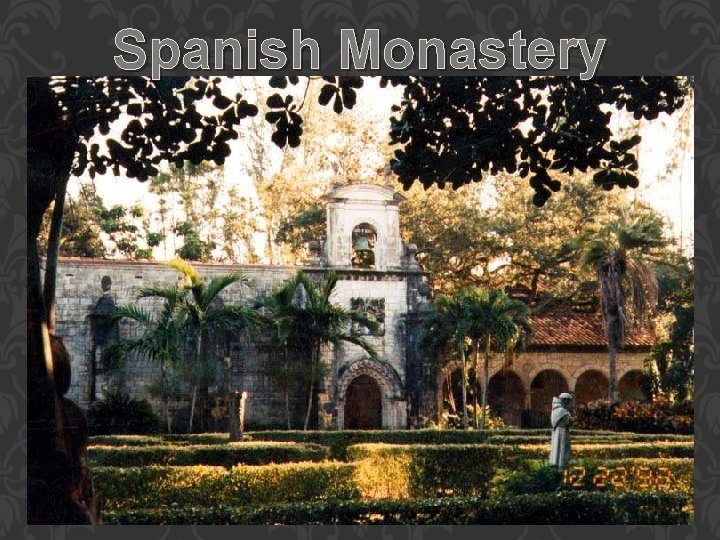
Spanish Monastery
Fairchild Gardens
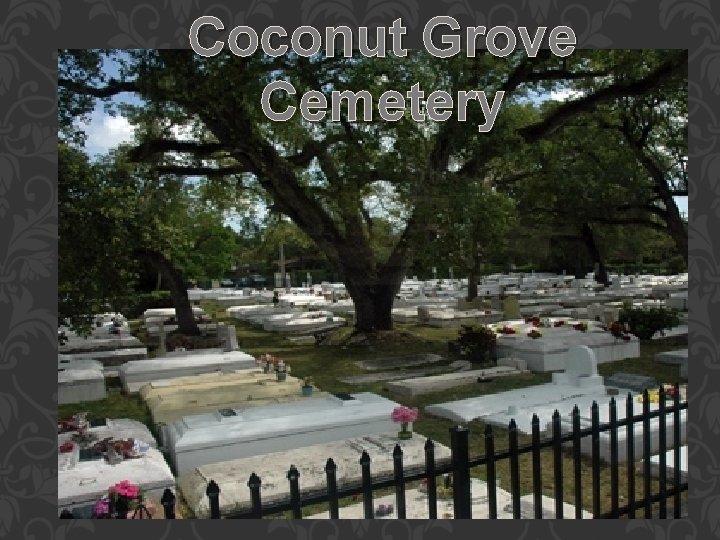
Coconut Grove Cemetery
Vizcaya Gardens
The Hard Rock Casino
Hollywood Beach Broadwalk
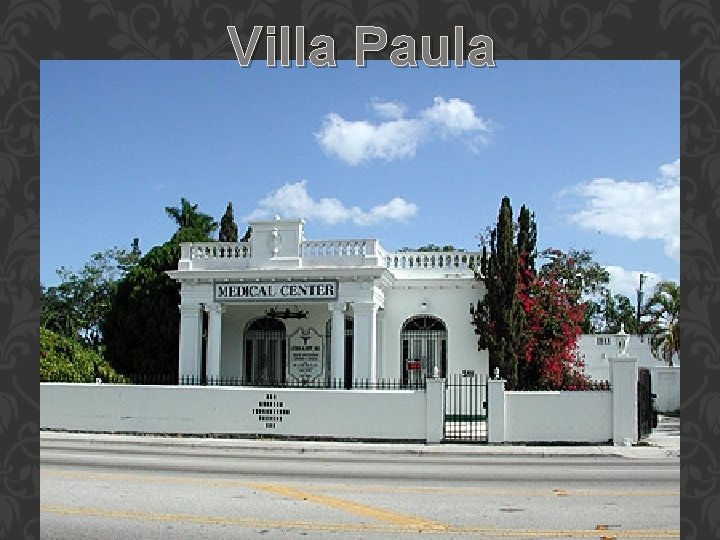
Villa Paula
Bayside Marketplace
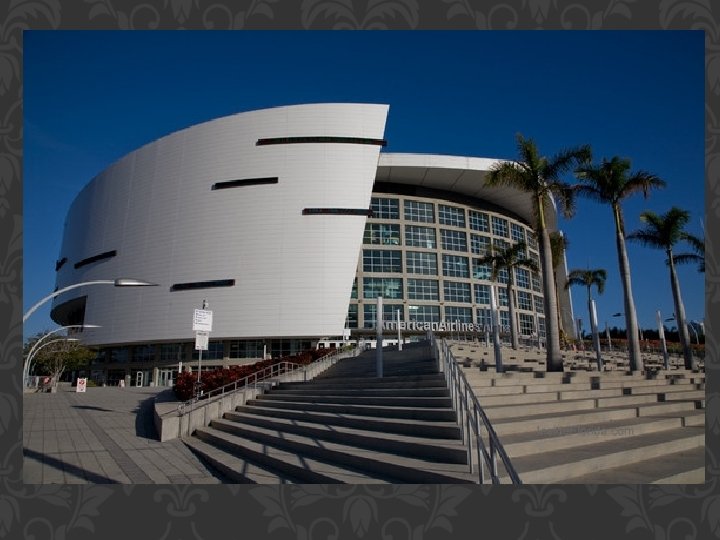
Adrienne Arsht Center
Va n D yk e C afe
The Biltmore
Coral Castle
WHAT DO THESE IMAGES HAVE IN COMMON?
Components of the Informative Essay “Surprising Reversal Technique” Assignment Sheet Purpose - The purpose of your assignment is to write an essay that educates, interests and surprises the reader about a specific place in South Florida. Your essay should present your reader with first hand observation and description of your location - this is known as primary research. Your essay will also require secondary research in order to obtain background and/or historical information about your location. In the first essay, you were asked to explore yourself through a literacy narrative. You used rhetorical contexts, such as audience, purpose, and genre, and rhetorical appeals, such as ethos, pathos, and logos, to compose your essay. In the second essay, you will be using these same contexts and appeals, but you will be writing with the aim to inform or educate the audience on a given location.
Components of the Informative Essay “Surprising Reversal Technique” Assignment Sheet Unit Objectives After completing this assignment, you will learn how to: 1. Effectively observe and incorporate your observation into your essay using descriptive language 2. Compose a logically structured essay 3. Navigate successfully between open and closed forms 4. Design a surprising reversal thesis that gives shape and purpose to your informative essay 5. Understand rhetorical contexts: audience, purpose, and genre and rhetorical appeals: ethos, pathos and logos 6. Develop an understanding of style that is appropriate and effective in your informative essay. 7. Understand incorporate primary and secondary research in the essay effectively 8. Demonstrate your writing process: drafting, revisions, editing and proofreading
Components of the Informative Essay “Surprising Reversal Technique” Assignment Sheet Topic - A place in South Florida Since you will be required to observe this place, the location you choose should be accessible and close enough to visit. Your location should be small enough for a focused essay. For example, do not choose an entire city or large area. Your location should be specific. Some examples of specific locations include, but are not limited to: a part of a beach, a restaurant, a house of worship, or any other interesting and significant location. You may choose a location at FIU, but make sure that your location is small and focused. Your essay should be interesting and surprising. For the purpose of this essay, you must make use of the “surprising reversal” technique to capture and hold your readers attention. Audience - Your classmates and instructors, and the larger FIU community
Components of the Informative Essay “Surprising Reversal Technique” Assignment Sheet Research Requirements: Primary research: Secondary Research An observation log. You will use your observation log to help you record the details that you observe, and to write about your location in a descriptive, interesting, and significant way. At least one secondary source. This may include but is not limited to local newspapers, local magazines, scholarly journals, and books. Do not use encyclopedic sources and only use Internet sources if they are credible. You will use your source to deepen your understanding of your location. You may discover new and surprising things about your location through your research. Your location may have an interesting history or cultural significance, or you may find that an interesting event takes place in your location
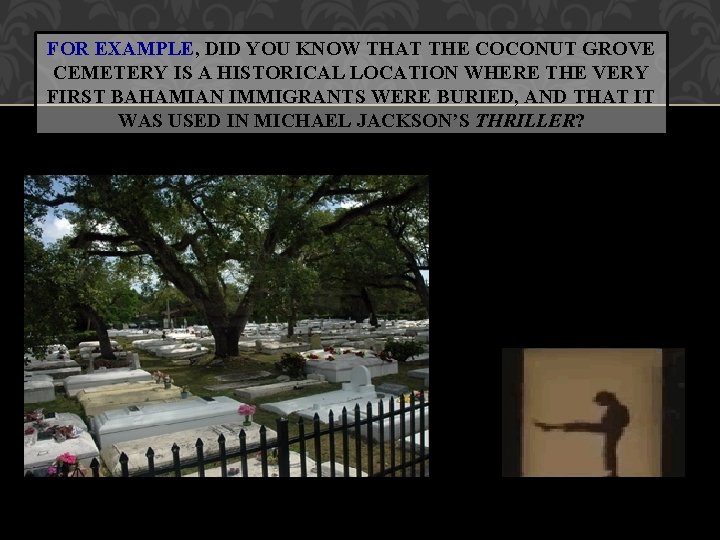
FOR EXAMPLE, DID YOU KNOW THAT THE COCONUT GROVE CEMETERY IS A HISTORICAL LOCATION WHERE THE VERY FIRST BAHAMIAN IMMIGRANTS WERE BURIED, AND THAT IT WAS USED IN MICHAEL JACKSON’S THRILLER?
Unit Assignment Activity Invention
Unit Assignment Activity Discussion Points 1. Is this location specific enough for a focused essay? Why or why not? 1. What makes this location significant and interesting? 2. Is there anything about this location that people may not know or that may be surprising? 3. What kinds of things might I want to look up to find out more information about this location?
1. Syllabus for ENC 1101 2. Informative Essay Unit assignment Includes: 3. Informative Essay Grading Rubric 4. Student schedule of events, daily learning objectives, and homework for Informative Essay Unit 5. Instructor schedule of events and complete lesson plans 6. Suggested Reading for Instructors
12 WEEK OVERVIEW OF INFORMATIVE ESSAY UNIT
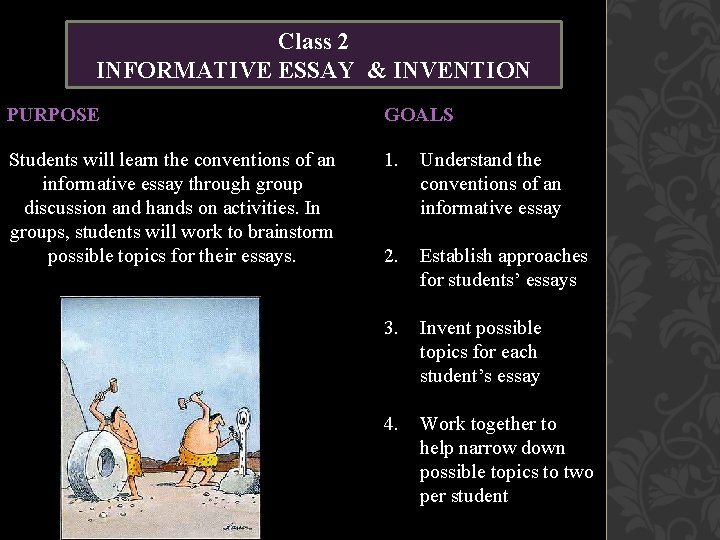
Class 2 INFORMATIVE ESSAY & INVENTION PURPOSE GOALS Students will learn the conventions of an informative essay through group discussion and hands on activities. In groups, students will work to brainstorm possible topics for their essays. 1. Understand the conventions of an informative essay 2. Establish approaches for students’ essays 3. Invent possible topics for each student’s essay 4. Work together to help narrow down possible topics to two per student
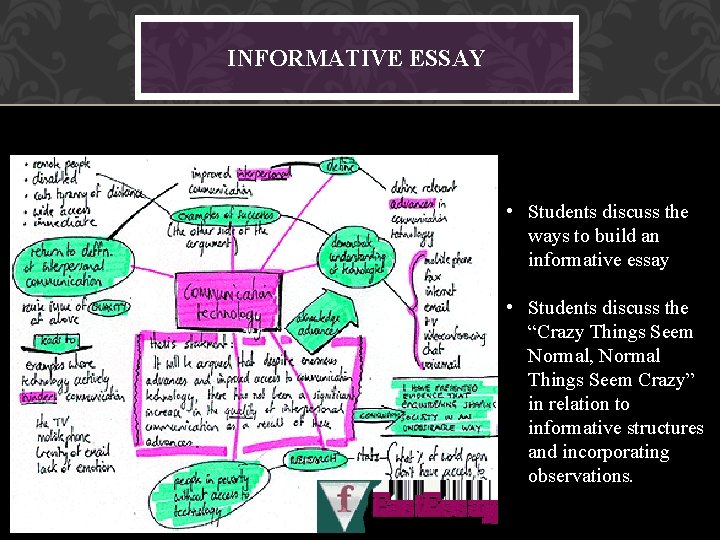
INFORMATIVE ESSAY • Students discuss the ways to build an informative essay • Students discuss the “Crazy Things Seem Normal, Normal Things Seem Crazy” in relation to informative structures and incorporating observations.
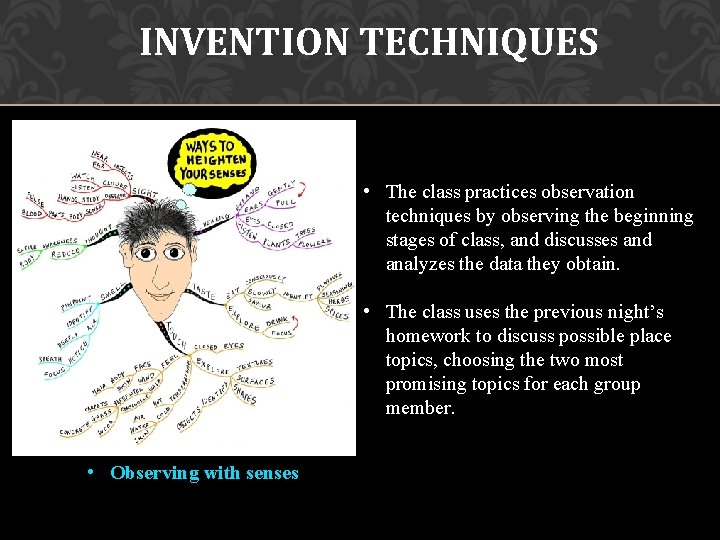
INVENTION TECHNIQUES • The class practices observation techniques by observing the beginning stages of class, and discusses and analyzes the data they obtain. • The class uses the previous night’s homework to discuss possible place topics, choosing the two most promising topics for each group member. • Observing with senses
Class 3 RESEARCH QUESTION & FURTHER INVENTION PURPOSE Through interactive class discussion, students will learn the importance of research questions, as well as, the best way to create a research question. They will work towards creating a research question of their own. GOALS 1. Understand the uses of research questions 2. Establish possible research questions 3. Better understand observations techniques
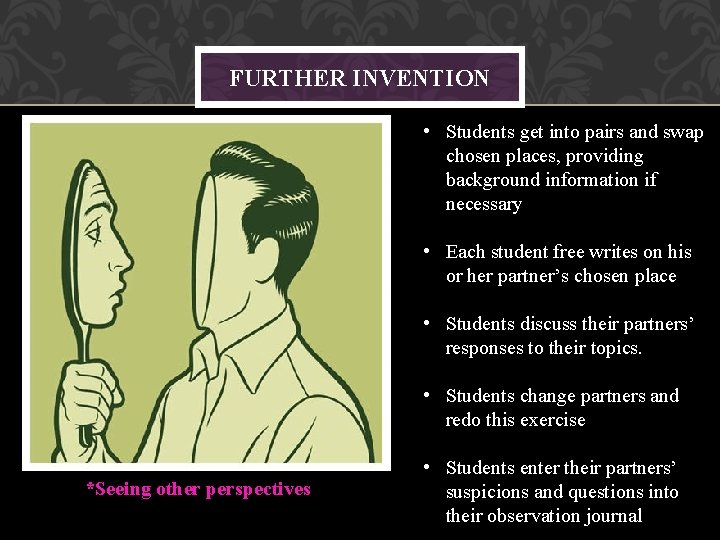
FURTHER INVENTION • Students get into pairs and swap chosen places, providing background information if necessary • Each student free writes on his or her partner’s chosen place • Students discuss their partners’ responses to their topics. • Students change partners and redo this exercise *Seeing other perspectives • Students enter their partners’ suspicions and questions into their observation journal
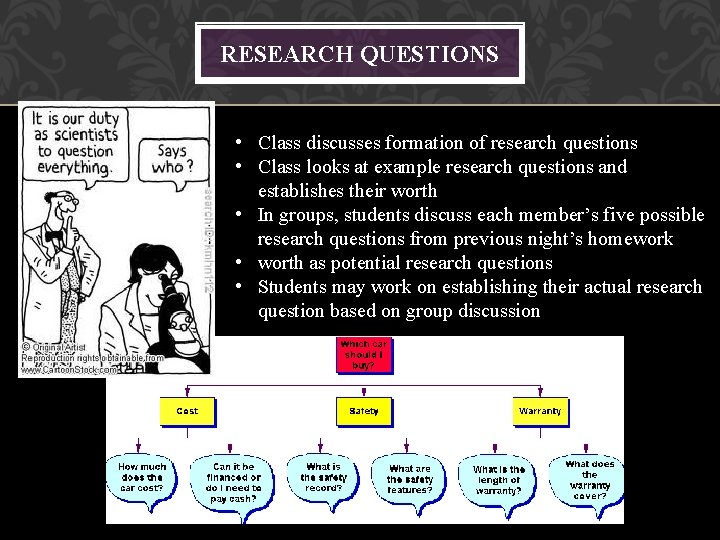
RESEARCH QUESTIONS • Class discusses formation of research questions • Class looks at example research questions and establishes their worth • In groups, students discuss each member’s five possible research questions from previous night’s homework • worth as potential research questions • Students may work on establishing their actual research question based on group discussion
CLASS 4 USING SECONDARY SOURCES AND AVOIDING PLAGIARISM Purpose: • Using both class discussion and small group work, students will work on understanding and using secondary sources effectively. • Students will also work on using attributive tags to separate their own ideas from their source material • In addition, students will discuss plagiarism and its effect on their own writing. Goals: 1. Understand three ways to use sources in an informative essay: quotation, paraphrase, and summary. 2. Clarify the difference between these sources and identify when they can be used effectively. 3. Understand the difference between plagiarism and patch writing. 4. Clarify the importance of avoiding plagiarism and patch writing in academic writing.
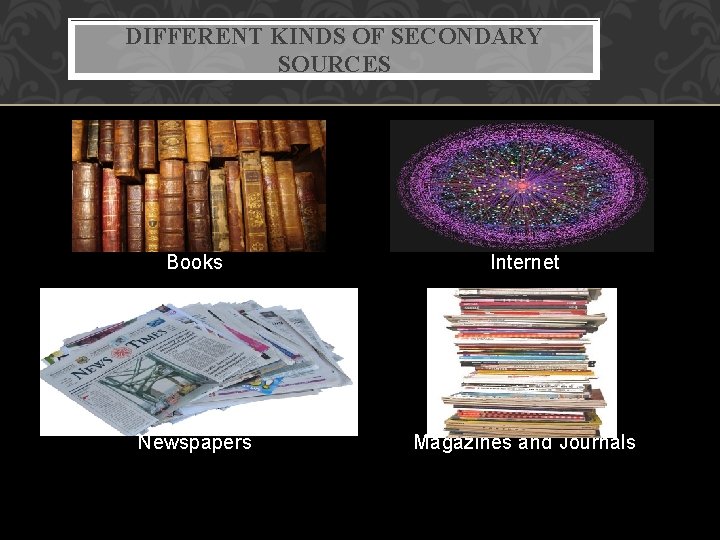
DIFFERENT KINDS OF SECONDARY SOURCES Books Internet Newspapers Magazines and Journals
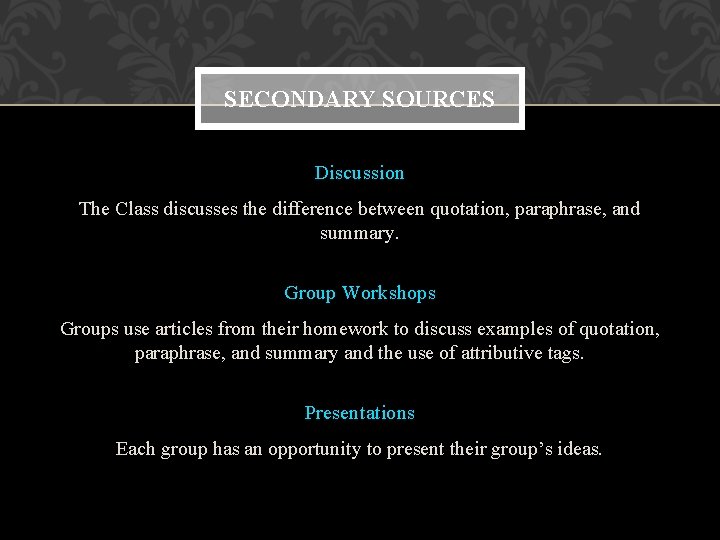
SECONDARY SOURCES Discussion The Class discusses the difference between quotation, paraphrase, and summary. Group Workshops Groups use articles from their homework to discuss examples of quotation, paraphrase, and summary and the use of attributive tags. Presentations Each group has an opportunity to present their group’s ideas.
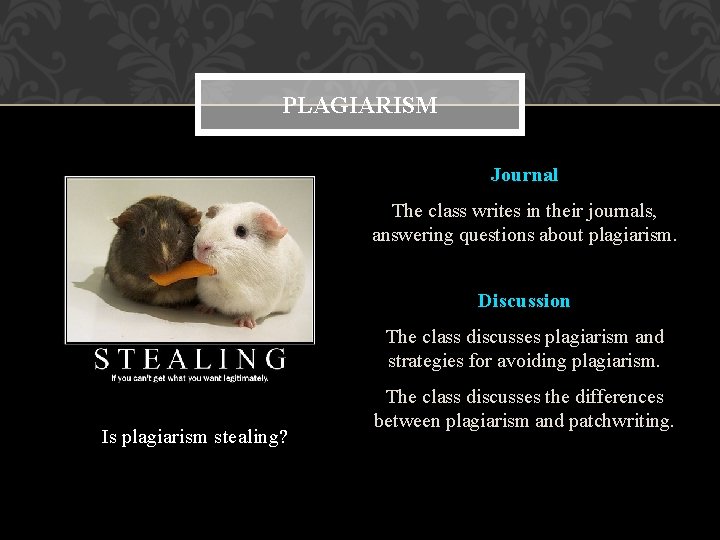
PLAGIARISM Journal The class writes in their journals, answering questions about plagiarism. Discussion The class discusses plagiarism and strategies for avoiding plagiarism. Is plagiarism stealing? The class discusses the differences between plagiarism and patchwriting.
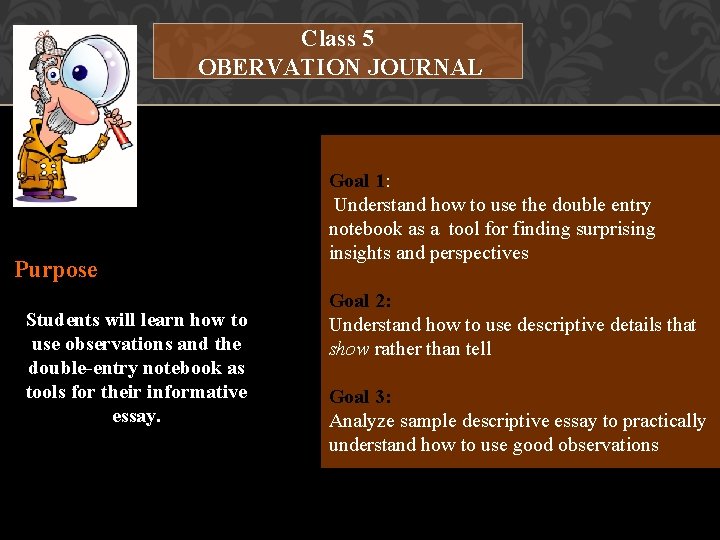
Class 5 OBERVATION JOURNAL Purpose Students will learn how to use observations and the double-entry notebook as tools for their informative essay. Goal 1: Understand how to use the double entry notebook as a tool for finding surprising insights and perspectives Goal 2: Understand how to use descriptive details that show rather than tell Goal 3: Analyze sample descriptive essay to practically understand how to use good observations
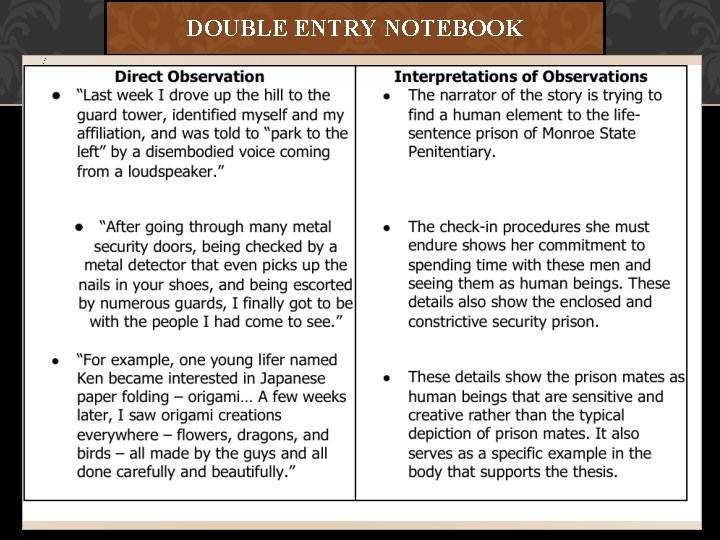
DOUBLE ENTRY NOTEBOOK
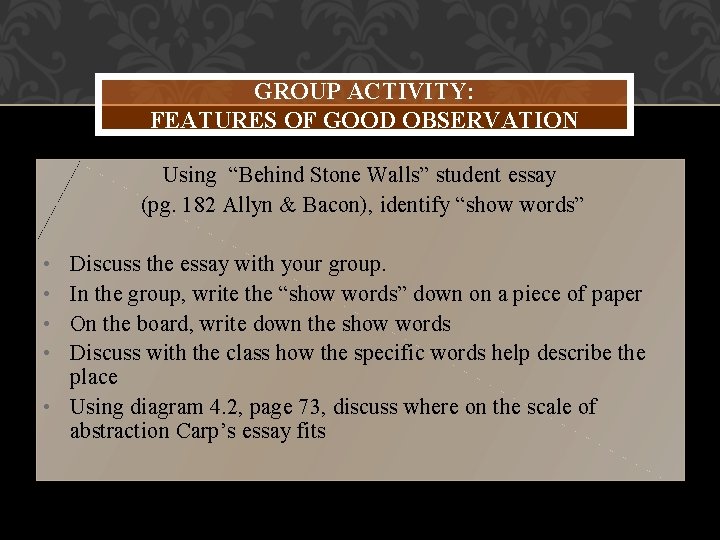
GROUP ACTIVITY: FEATURES OF GOOD OBSERVATION Using “Behind Stone Walls” student essay (pg. 182 Allyn & Bacon), identify “show words” • • Discuss the essay with your group. In the group, write the “show words” down on a piece of paper On the board, write down the show words Discuss with the class how the specific words help describe the place • Using diagram 4. 2, page 73, discuss where on the scale of abstraction Carp’s essay fits
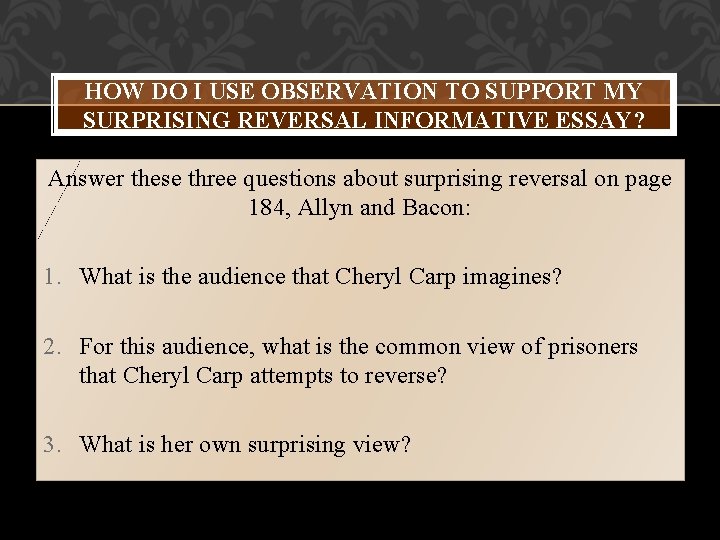
HOW DO I USE OBSERVATION TO SUPPORT MY SURPRISING REVERSAL INFORMATIVE ESSAY? Answer these three questions about surprising reversal on page 184, Allyn and Bacon: 1. What is the audience that Cheryl Carp imagines? 2. For this audience, what is the common view of prisoners that Cheryl Carp attempts to reverse? 3. What is her own surprising view?
CLASS 6 RHETORICAL APPEALS AND STYLE Purpose Through class discussion and writing, the students explore the rhetorical appeals and their relation to style in an informative essay. Goals 1. Understand the rhetorical appeals: logos, pathos and ethos. 2. Develop an understanding of the levels of style and the ways style can be used in an informative essay.
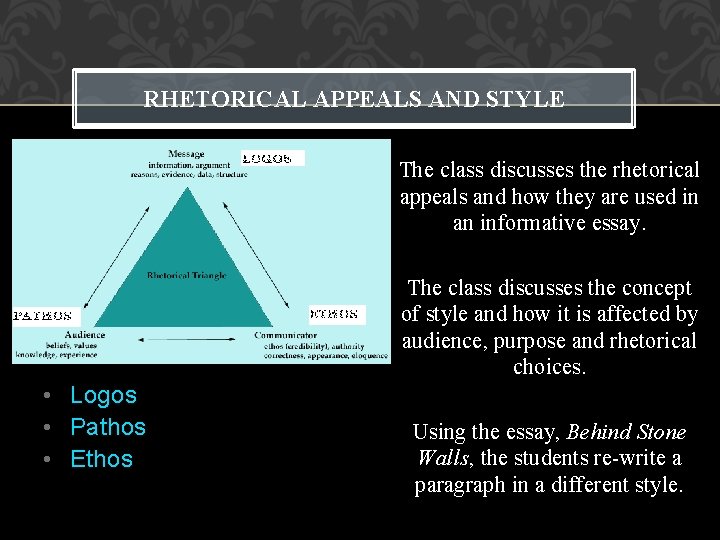
RHETORICAL APPEALS AND STYLE The class discusses the rhetorical appeals and how they are used in an informative essay. The class discusses the concept of style and how it is affected by audience, purpose and rhetorical choices. • Logos • Pathos • Ethos Using the essay, Behind Stone Walls, the students re-write a paragraph in a different style.
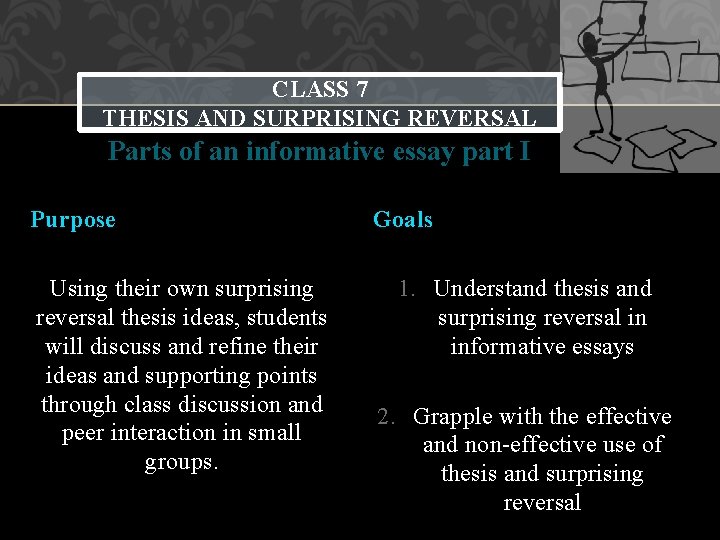
CLASS 7 THESIS AND SURPRISING REVERSAL Parts of an informative essay part I Purpose Using their own surprising reversal thesis ideas, students will discuss and refine their ideas and supporting points through class discussion and peer interaction in small groups. Goals 1. Understand thesis and surprising reversal in informative essays 2. Grapple with the effective and non-effective use of thesis and surprising reversal
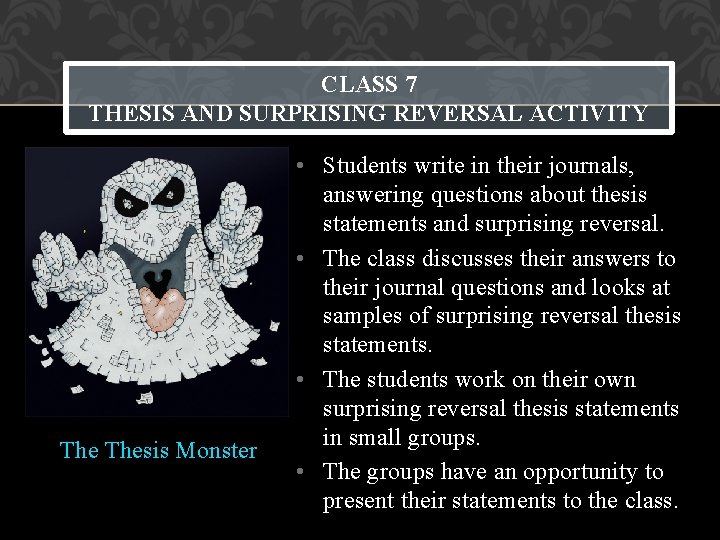
CLASS 7 THESIS AND SURPRISING REVERSAL ACTIVITY Thesis Monster • Students write in their journals, answering questions about thesis statements and surprising reversal. • The class discusses their answers to their journal questions and looks at samples of surprising reversal thesis statements. • The students work on their own surprising reversal thesis statements in small groups. • The groups have an opportunity to present their statements to the class.
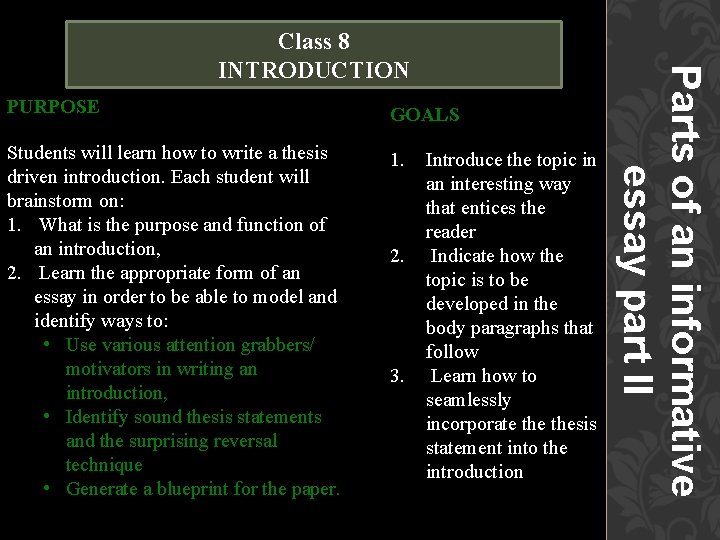
PURPOSE GOALS Students will learn how to write a thesis driven introduction. Each student will brainstorm on: 1. What is the purpose and function of an introduction, 2. Learn the appropriate form of an essay in order to be able to model and identify ways to: • Use various attention grabbers/ motivators in writing an introduction, • Identify sound thesis statements and the surprising reversal technique • Generate a blueprint for the paper. 1. 2. 3. Introduce the topic in an interesting way that entices the reader Indicate how the topic is to be developed in the body paragraphs that follow Learn how to seamlessly incorporate thesis statement into the introduction Parts of an informative essay part II Class 8 INTRODUCTION
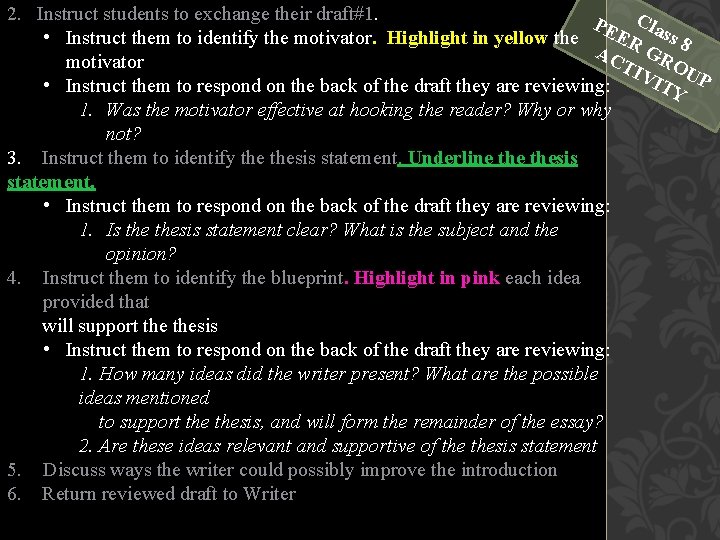
2. Instruct students to exchange their draft#1. PE Clas ER s 8 • Instruct them to identify the motivator. Highlight in yellow the AC GR motivator TIV OU ITY P • Instruct them to respond on the back of the draft they are reviewing: 1. Was the motivator effective at hooking the reader? Why or why not? 3. Instruct them to identify thesis statement. Underline thesis statement. • Instruct them to respond on the back of the draft they are reviewing: 1. Is thesis statement clear? What is the subject and the opinion? 4. Instruct them to identify the blueprint. Highlight in pink each idea provided that will support thesis • Instruct them to respond on the back of the draft they are reviewing: 1. How many ideas did the writer present? What are the possible ideas mentioned to support thesis, and will form the remainder of the essay? 2. Are these ideas relevant and supportive of thesis statement 5. Discuss ways the writer could possibly improve the introduction 6. Return reviewed draft to Writer
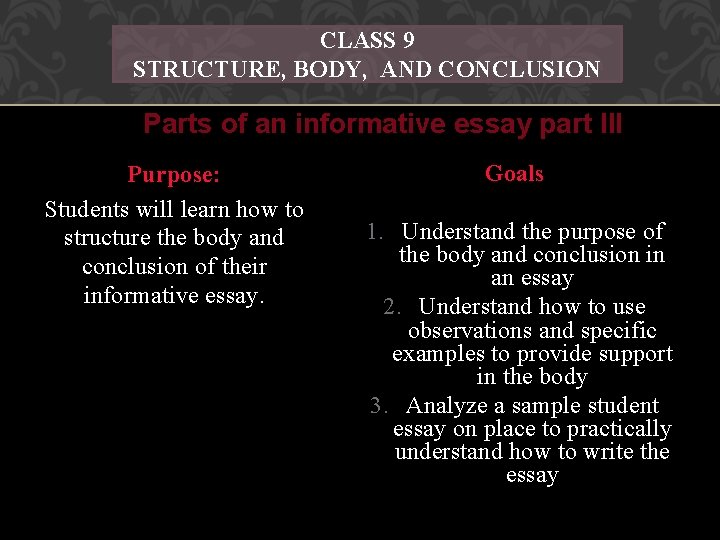
CLASS 9 STRUCTURE, BODY, AND CONCLUSION Parts of an informative essay part III Purpose: Students will learn how to structure the body and conclusion of their informative essay. Goals 1. Understand the purpose of the body and conclusion in an essay 2. Understand how to use observations and specific examples to provide support in the body 3. Analyze a sample student essay on place to practically understand how to write the essay
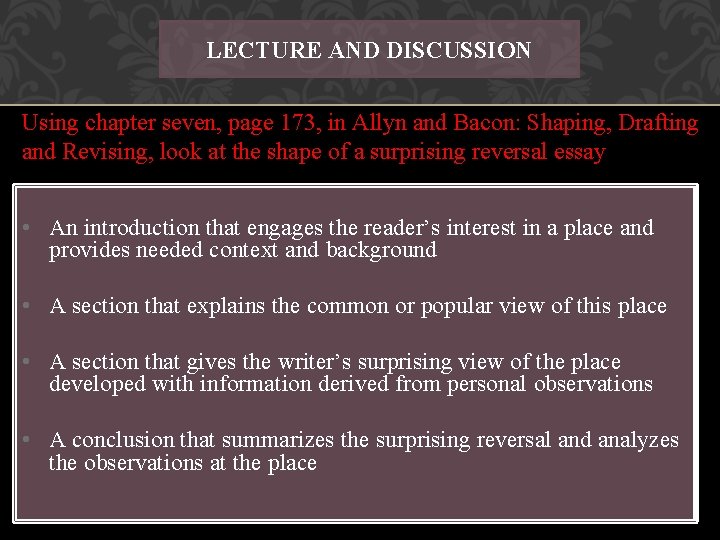
LECTURE AND DISCUSSION Using chapter seven, page 173, in Allyn and Bacon: Shaping, Drafting and Revising, look at the shape of a surprising reversal essay • An introduction that engages the reader’s interest in a place and provides needed context and background • A section that explains the common or popular view of this place • A section that gives the writer’s surprising view of the place developed with information derived from personal observations • A conclusion that summarizes the surprising reversal and analyzes the observations at the place
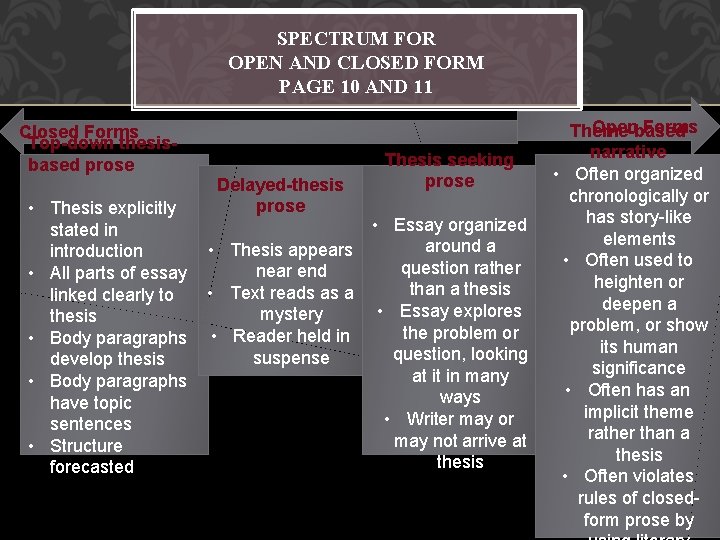
SPECTRUM FOR OPEN AND CLOSED FORM PAGE 10 AND 11 Closed Forms Top-down thesisbased prose Delayed-thesis prose Thesis seeking prose • Thesis explicitly • Essay organized stated in around a • Thesis appears introduction question rather near end • All parts of essay than a thesis • Text reads as a linked clearly to • Essay explores mystery thesis the problem or • Body paragraphs • Reader held in question, looking suspense develop thesis at it in many • Body paragraphs ways have topic • Writer may or sentences may not arrive at • Structure thesis forecasted Open Forms Theme-based narrative • Often organized chronologically or has story-like elements • Often used to heighten or deepen a problem, or show its human significance • Often has an implicit theme rather than a thesis • Often violates rules of closedform prose by
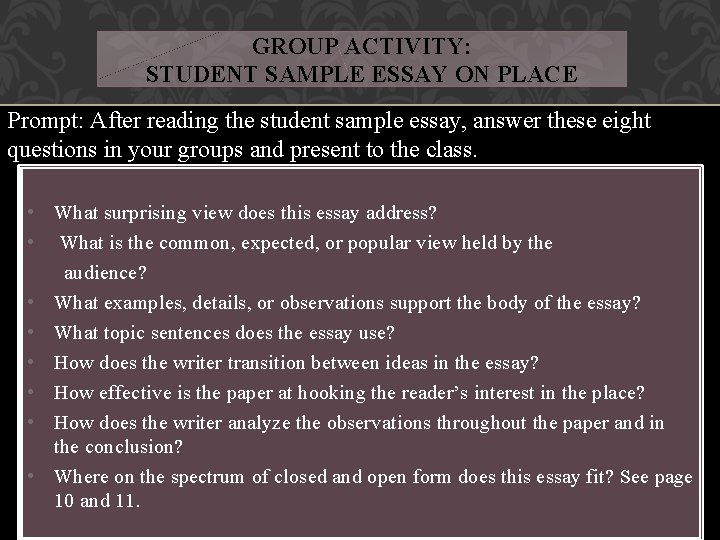
GROUP ACTIVITY: STUDENT SAMPLE ESSAY ON PLACE Prompt: After reading the student sample essay, answer these eight questions in your groups and present to the class. • What surprising view does this essay address? • What is the common, expected, or popular view held by the audience? • • • What examples, details, or observations support the body of the essay? What topic sentences does the essay use? How does the writer transition between ideas in the essay? How effective is the paper at hooking the reader’s interest in the place? How does the writer analyze the observations throughout the paper and in the conclusion? • Where on the spectrum of closed and open form does this essay fit? See page 10 and 11.
CLASS 10
Class 11 PEER REVIEW PURPOSE GOALS 1. Understand how to Using the rubric, students will break into evaluate and judge an groups of two and peer review each informative essay paper. other’s papers for global issues in their informative essay. 2. Understand the elements of an effective informative paper 3. Understand audience when writing an informative paper.
Class 12 CITING, EDITING, AND PROOFREADING PURPOSE GOALS Students will learn how to 1. Understand why we cite efficiently and effectively edit and proofread their paper: They will 2. Understand the importance understand: of proofreading a paper prior to submission • How to incorporate sources into their informative essay 3. Correctly use in-text citation paper and bibliography using the APA citation style • How to correct errors in spelling, mechanics, and 4. Effectively proofread a grammar; not problems with paper as an objective reader. organization
Class 12 HOMEWORK AND ACTIVITY Homework: Peer group procedure 1. Explain the aim is to point out minor problems not to fix them 2. Instruct students to mark the paper even if they are not sure if there is an error. The author can check it later Online grammar excercise Peer group activity 1. Instruct students to pass their final copy to the person to their right 2. Instruct students to check for first proofreading error 3. On chalkboard/white board/projector 3. When 6 minutes has passed, pass papers to the right again, this time draw the 4 symbols that will be used in check for next common error identified. the activity 1. insert a comma/use a period here, 4. Continue passing papers and checking 2. begin a new paragraph/ no specific aspects until the time is up and paragraph, the person has once again received their 3. spelling/capitalization, and own paper. 4. delete/insert
Class 13 Reflection Purpose: Students will reflect on their informative essays and their writing process
This Presentation has been brought to you by the members of Group 4. Sarah Cash Amanda Hosey Michelle Munroe Veronica Suarez We thank you for your time, and encourage you to take advantage of the resources we have provided, for teaching with ‘best practices. ’