Focused antenatal care in Tanzania Health care providers
- Slides: 42
Focused antenatal care in Tanzania – Health care providers’ perceptions of the quality of care: a metaethnography Joe´s comments September 2019
Abstract: Background “The current quality gap in antenatal care services in Tanzania manifests itself in poor quality, and high maternal- and new-born mortality. The quality of antenatal care services has mostly been researched from the perspective of expecting mothers. However, health care providers (HCPs) are the bridging link between the health care system and the community. They possess great knowledge on how quality of focused antenatal care (FANC) could be improved. ” RELATIVELY SHORT AND SWEET! THE KNOWLEDGE THAT IS LACKING IS THIS SENTENCE NECESSARY?
Abstract: Aims “The aim of this meta-ethnography is to synthesize the available evidence on the quality of focused antenatal care in Tanzania from the perspective of the HCPs. ” AGAIN, SHORT AND SWEET
Abstract: Methods DETAILED DESCRIPTION OF METHODS! “This lead to the identification of fifteen studies. ” “Results. A total of fifteen studies…were [was] included…” UNNECESSARY REPETITION SUBJECT AND VERB DO NOT AGREE
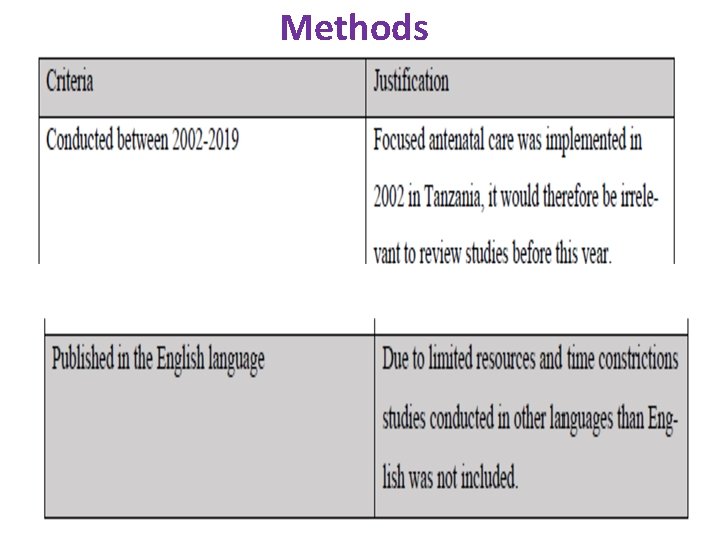
Abstract: Methods “The inclusion criteria were qualitative studies conducted from 2002 -2019 in Tanzania in the English language…” WHY THIS PERIOD OF TIME? POTENTIALLY IMPORTANT STUDIES IN SWAHILI?
Abstract: Results and Conclusions INFORMATIVE AND TO THE POINT!
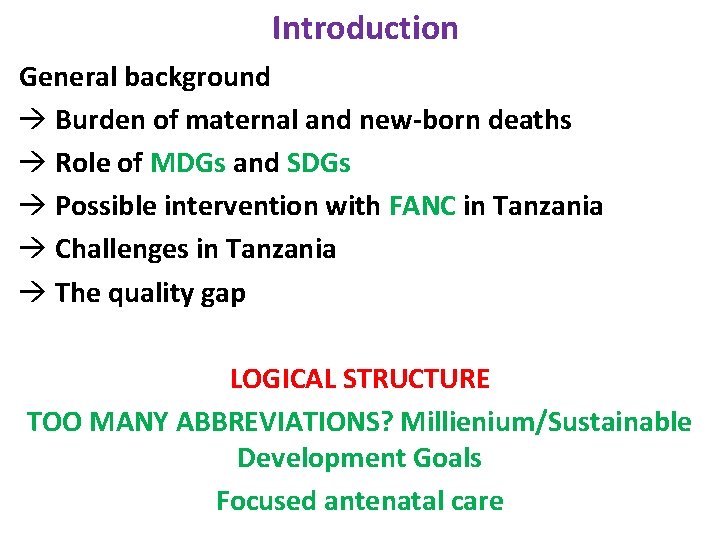
Introduction General background à Burden of maternal and new-born deaths à Role of MDGs and SDGs à Possible intervention with FANC in Tanzania à Challenges in Tanzania à The quality gap LOGICAL STRUCTURE TOO MANY ABBREVIATIONS? Millienium/Sustainable Development Goals Focused antenatal care
Introduction “…the challenges in providing quality maternal and new-born care in low-income settings. With a particular focus on the current quality gap in antenatal care services in Tanzania has worked towards reducing their maternal and new -born mortality … indi-cators of a country’s progress in improving their health care system (1). For this reason and through my work as a midwife in Tanzania, I have chosen to focus on how maternal and new-born care can be improved in Tanzania and if this is transferable to other contexts. ” STARTS ADMIRABLY WITH A MOTIVATION OF THE CHOICE OF TANZANIA ABSOLUTELY GOOD ENOUGH! (PERSONAL TOUCH)
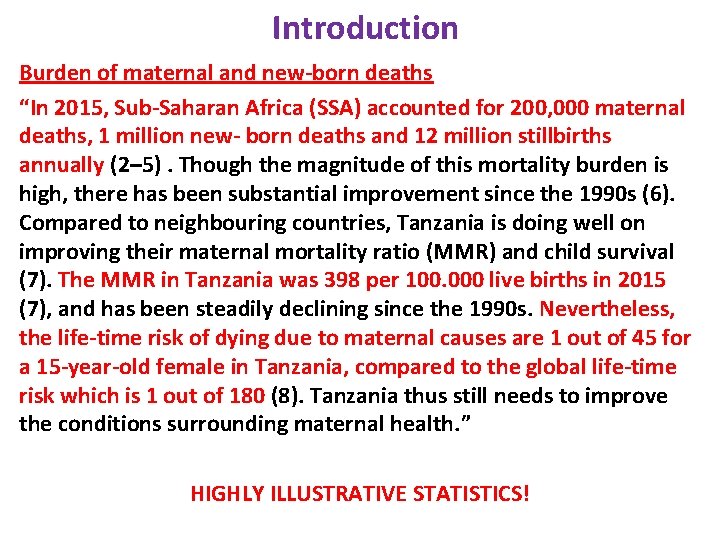
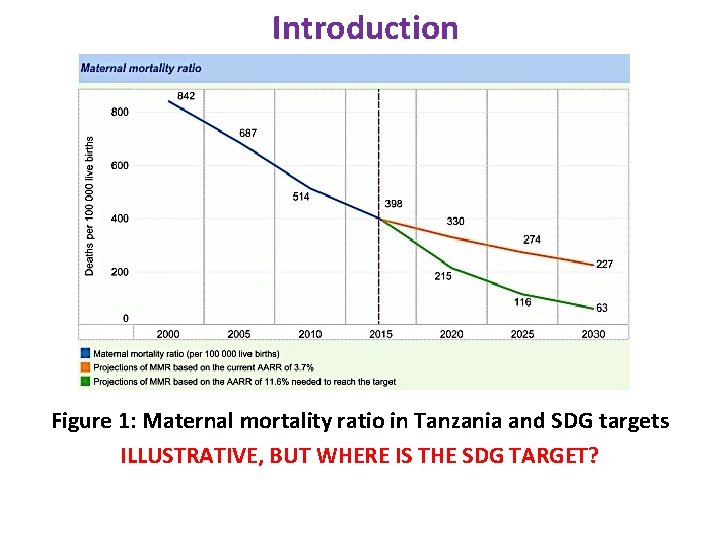
Introduction Burden of maternal and new-born deaths “In 2015, Sub-Saharan Africa (SSA) accounted for 200, 000 maternal deaths, 1 million new- born deaths and 12 million stillbirths annually (2– 5). Though the magnitude of this mortality burden is high, there has been substantial improvement since the 1990 s (6). Compared to neighbouring countries, Tanzania is doing well on improving their maternal mortality ratio (MMR) and child survival (7). The MMR in Tanzania was 398 per 100. 000 live births in 2015 (7), and has been steadily declining since the 1990 s. Nevertheless, the life-time risk of dying due to maternal causes are 1 out of 45 for a 15 -year-old female in Tanzania, compared to the global life-time risk which is 1 out of 180 (8). Tanzania thus still needs to improve the conditions surrounding maternal health. ” HIGHLY ILLUSTRATIVE STATISTICS!
Introduction Figure 1: Maternal mortality ratio in Tanzania and SDG targets ILLUSTRATIVE, BUT WHERE IS THE SDG TARGET?
Introduction “Globally, Tanzania ranked 172 out of 193 of countries accounting for highest number of stillbirths. In 2015, Tanzania had an estimated 47, 000 stillbirths (17). ” ANOTHER GOOD REASON FOR CHOOSING TANZANIA! COULD BE EMPHASIZED MORE
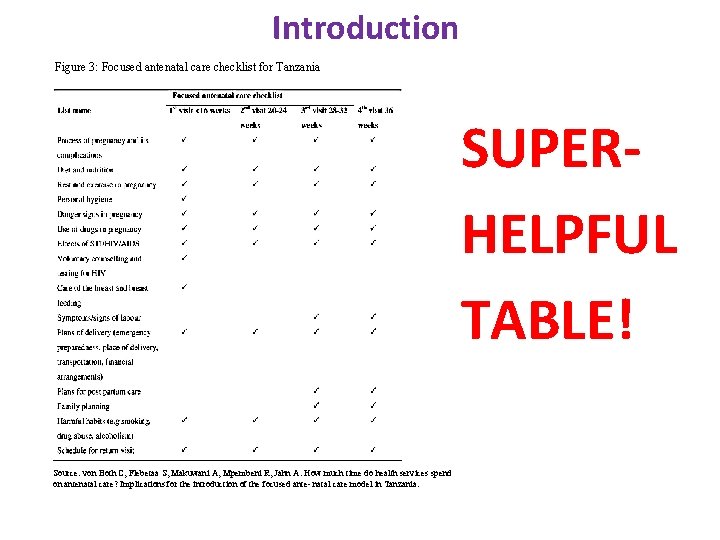
Introduction Figure 3: Focused antenatal care checklist for Tanzania SUPERHELPFUL TABLE! Source: von Both C, Flebetaa S, Makuwani A, Mpembeni R, Jahn A. How much time do health services spend on antenatal care? Implications for the introduction of the focused ante- natal care model in Tanzania.
Introduction “In 2016 the WHO made a new and improved ANC model (2016 WHO ANC model) that gathered all recommendations related to ANC services (20). The reason being that the FANC model is fragmented, lacked context-specific guidance and evidence revealed that the FANC model can cause harm if not implemented well (20). However, the FANC model is still utilized in Tanzania at this point in time (25, 26). ” I WOULD LIKE TO KNOW MORE ABOUT THIS WOULD THE AUTHOR RECOMMEND IMPLEMENTING THIS NEW ANC?
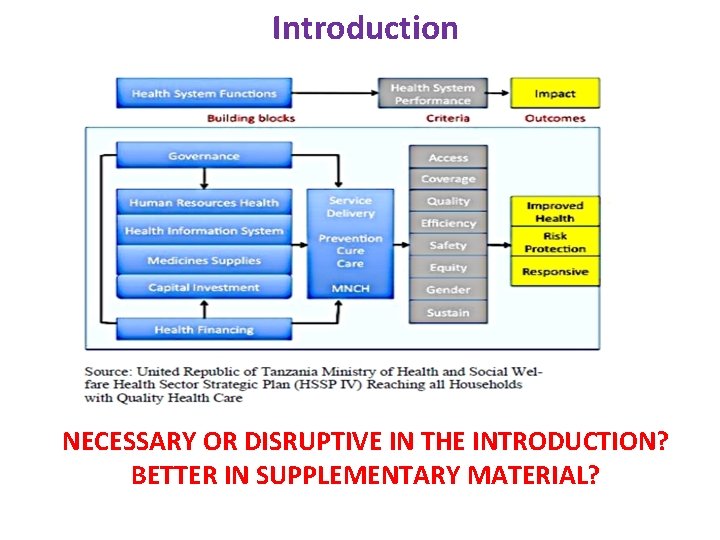
Introduction NECESSARY OR DISRUPTIVE IN THE INTRODUCTION? BETTER IN SUPPLEMENTARY MATERIAL?
Introduction “However, I find it important to incorporate the HCPs challenges in their daily work, since this can affect the quality of care greatly. ” PERSONAL TOUCH THROUGHOUT – GOOD OR BAD?
Introduction “Many studies have examined women’s experiences and perceptions of antenatal care in Tan- zania (32– 36)…However, only few studies have explored health care providers’ (HCPs) perceptions of the quality of antenatal care, which are as crucial to understand. ” AGAIN (AS IN THE ABSTRACT), A VERY CLEAR STATEMENT OF THE GAP IN KNOWLEDGE
Introduction “Many studies have examined women’s experiences and perceptions of antenatal care in Tan- zania (32– 36). Some of the main challenges being lack of testing and counselling affecting mothers’ knowledge and awareness of danger signs in pregnancy. Furthermore, disrespect was expressed as major factor influencing their willingness to seek care during pregnancy and at the onset of labour (32– 36). However, only few studies have explored health care provid- ers’ (HCPs) perceptions of the quality of antenatal care, which are as crucial to understand. HCPs perceptions and experiences have on the other hand been used to triangulate the women’s perceptions in research. Since HCPs are the bridging link between the women and the health care system, they contain important information on how to improve the current an- tenatal care system in Tanzania. When looking at HCPs perceptions of FANC in other Sub- Saharan countries some of the main challenges were lack of testing, counselling, poor work- ing conditions, lack of training, lack of knowledge on FANC and general stock-outs affecting the quality of care (37, 38). To synthesise the HCPs perceptions of quality of FANC in Tanza- nia I have chosen to use the meta-ethnography. The reason being that it is one of the most commonly used to synthesise qualitative studies, creating robust findings which could guide policy and practice (39). A metasynthesis by Finlayson and Downe examines why women do not use antenatal care services in low- and middle income countries (40). Some of the key findings were keeping pregnancy secret, pregnancy is a normal life event, influence from family members, lack of transport, lack of resources at health facilities and poor staff attitude (40). Findings from meta-ethnographies like the above, are helpful in guiding policies and guidelines so it is done from an evidence-based approach. The rationale behind choosing the meta-ethnography is further explained in the methodology section. ” PLEASE, DON´T FORGET THE “BREATHING SPACE”!
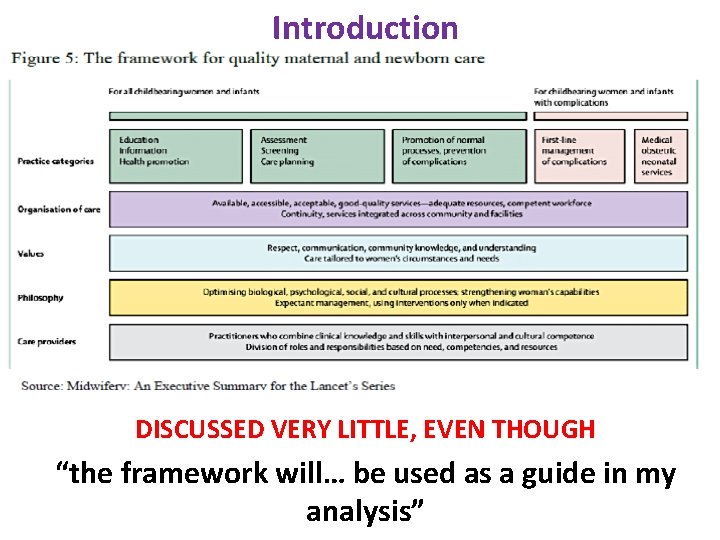
Introduction DISCUSSED VERY LITTLE, EVEN THOUGH “the framework will… be used as a guide in my analysis”
Introduction: AIMS “What are health care providers’ perceptions of the quality of focused antenatal care delivered in Tanzania? What individual and systemic factors influences the health care providers’ perceptions of quality of focused antenatal care in Tanzania, and does this vary by region? ” STRAIGHTFORWARD ENOUGH, BUT COULD BE COMBINED FOR HIGHER “IMPACT”
Introduction: AIMS How do healthcare providers in Tanzania perceive the quality of focused antenatal care there, what individual and systemic factors influence these perceptions, and do they vary by region?
Methods “Rationale for review design Meta-ethnography is a method for reviewing and synthesizing the findings of published studies from qualitative research by translating concepts and metaphors across studies. This method was originally developed by Noblit and Hare (41). Meta -ethnography approach was chosen as it is relevant for analysing qualitative studies and their findings (39, 42). Metaethnography has been under development since the 1990’s, and a set of high-quality meta-ethnography protocol, called e. MERGe, was published in 2019 by France et al. (39). The e. MERGe approach is evidence-based and aims to increase transparency, credibility and over- all quality of the review process (39). ” STARTS WITH A MOTIVATION FOR THE APPROACH CHOSEN = GREAT!
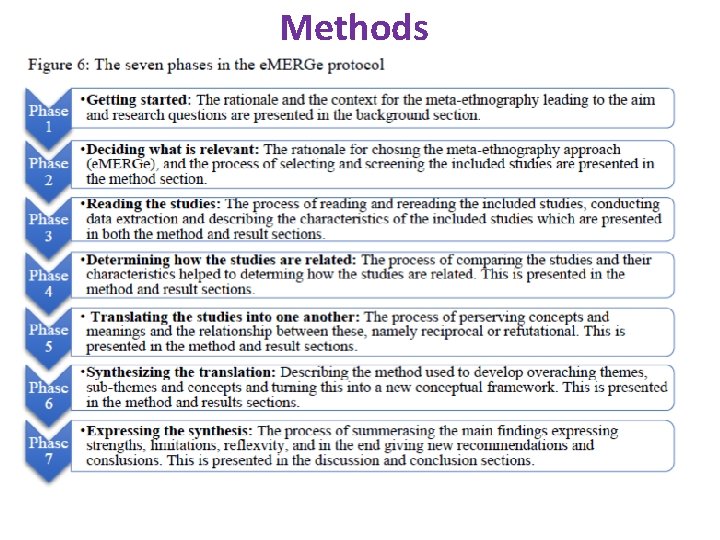
Methods “In this meta-ethnography, I use the e. MERGe approach’s seven phases, as demonstrated in appendix 1 (39). Phase 1 consist of introducing the rationale and the context for the meta-ethnography leading to the introduction of aim and research questions. Phase 2 consist of the method used in the meta-ethnography, and the process of selecting and screening the included studies. Phase 3 consist of reading through the included studies meanwhile doing data extraction and describing characteristics of the included studies. Phase 4 consist of determining how the included studies are related and how they were compared. Phase 5 consist of translating the included studies into one another, finding reciprocal and refutational translations. Phase 6 consist of synthesizing the translation found in phase 5 and describing a new conceptual framework. Phase 7 consist of expressing the synthesis, summarising main finding, strengths, limitations, reflexivity, and finally giving recommendations and a conclusion (39). ” APPENDIX 1 IS VERY HELPFUL, AS IS FIGURE 6! BUT FIGURE 6 MAKES THIS TEXT HIGHLY REPETITIVE AND TOTALLY UNNECESSARY!
Methods
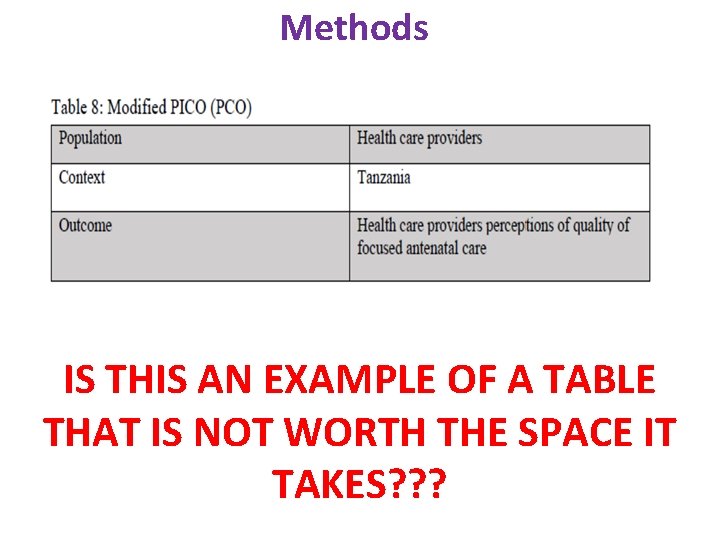
Methods IS THIS AN EXAMPLE OF A TABLE THAT IS NOT WORTH THE SPACE IT TAKES? ? ?
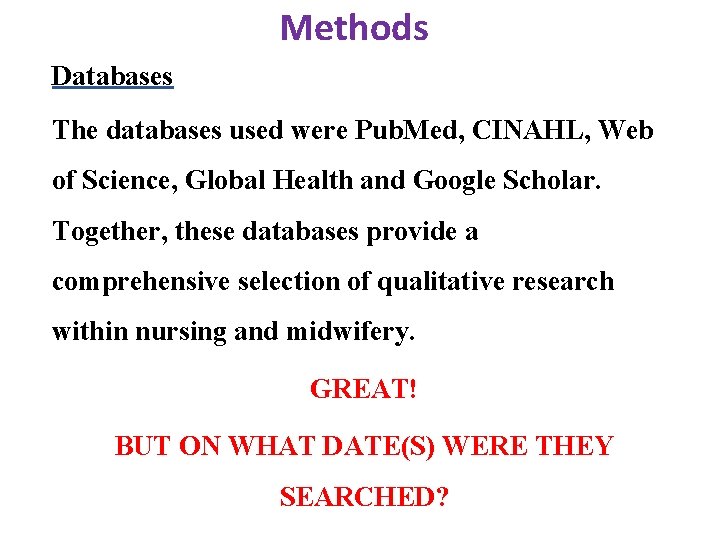
Methods Databases The databases used were Pub. Med, CINAHL, Web of Science, Global Health and Google Scholar. Together, these databases provide a comprehensive selection of qualitative research within nursing and midwifery. GREAT! BUT ON WHAT DATE(S) WERE THEY SEARCHED?
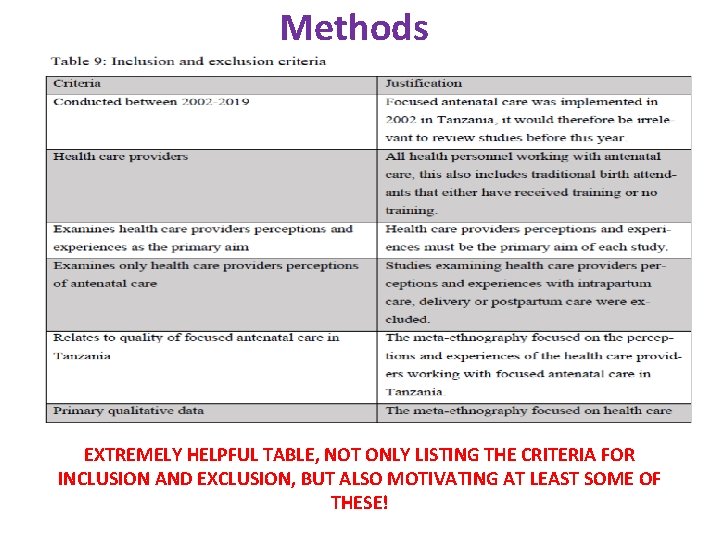
Methods EXTREMELY HELPFUL TABLE, NOT ONLY LISTING THE CRITERIA FOR INCLUSION AND EXCLUSION, BUT ALSO MOTIVATING AT LEAST SOME OF THESE!
Methods
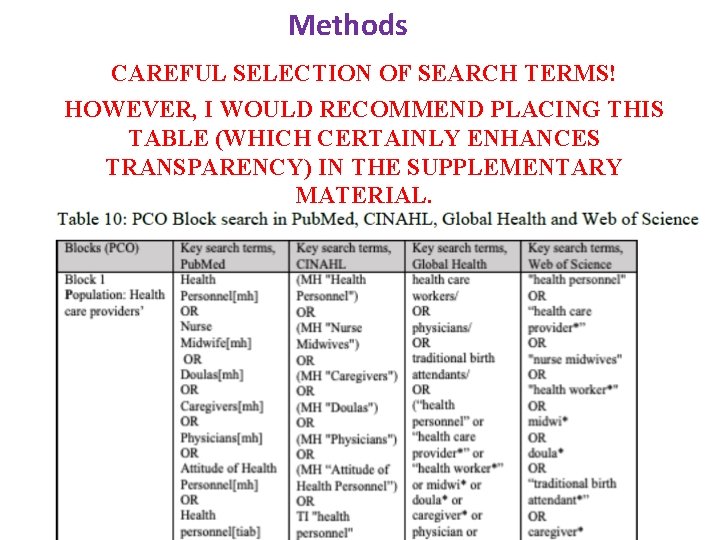
Methods CAREFUL SELECTION OF SEARCH TERMS! HOWEVER, I WOULD RECOMMEND PLACING THIS TABLE (WHICH CERTAINLY ENHANCES TRANSPARENCY) IN THE SUPPLEMENTARY MATERIAL.
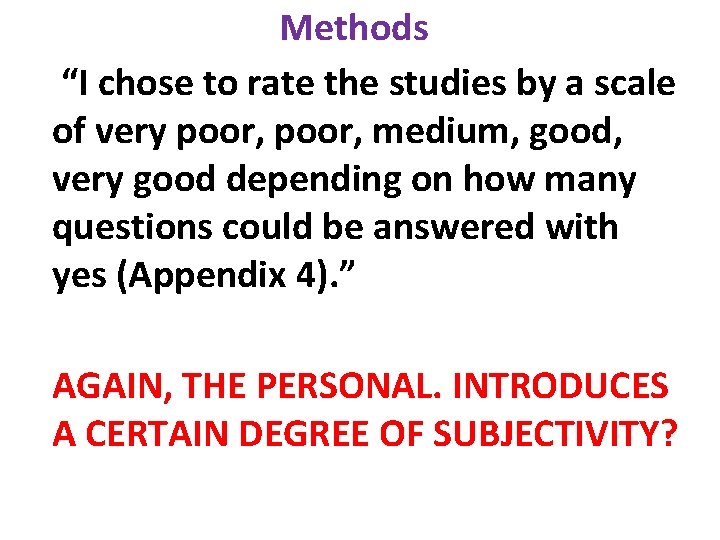
Methods “I chose to rate the studies by a scale of very poor, medium, good, very good depending on how many questions could be answered with yes (Appendix 4). ” AGAIN, THE PERSONAL. INTRODUCES A CERTAIN DEGREE OF SUBJECTIVITY?
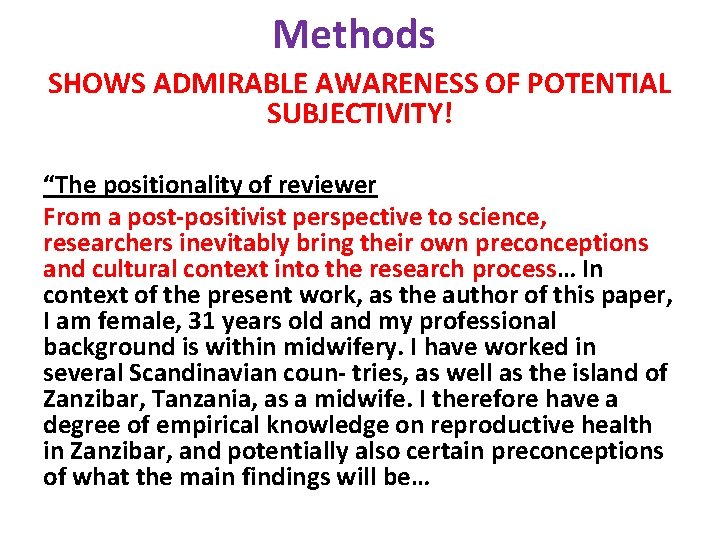
Methods SHOWS ADMIRABLE AWARENESS OF POTENTIAL SUBJECTIVITY! “The positionality of reviewer From a post-positivist perspective to science, researchers inevitably bring their own preconceptions and cultural context into the research process… In context of the present work, as the author of this paper, I am female, 31 years old and my professional background is within midwifery. I have worked in several Scandinavian coun- tries, as well as the island of Zanzibar, Tanzania, as a midwife. I therefore have a degree of empirical knowledge on reproductive health in Zanzibar, and potentially also certain preconceptions of what the main findings will be…
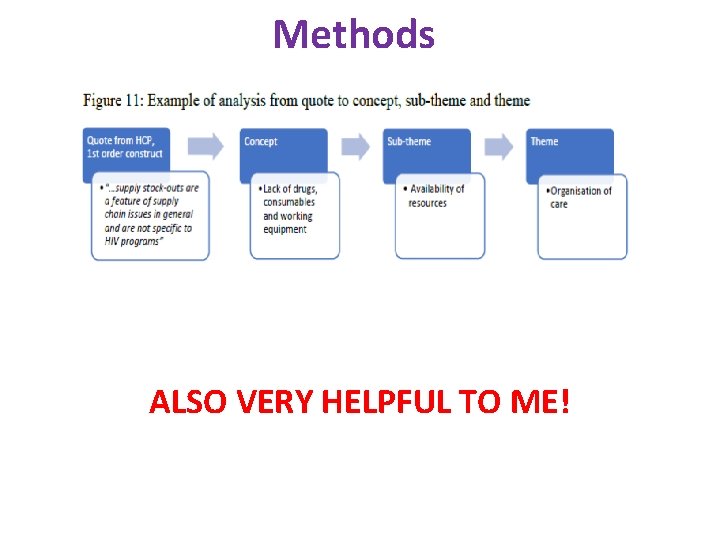
Methods ALSO VERY HELPFUL TO ME!
Results
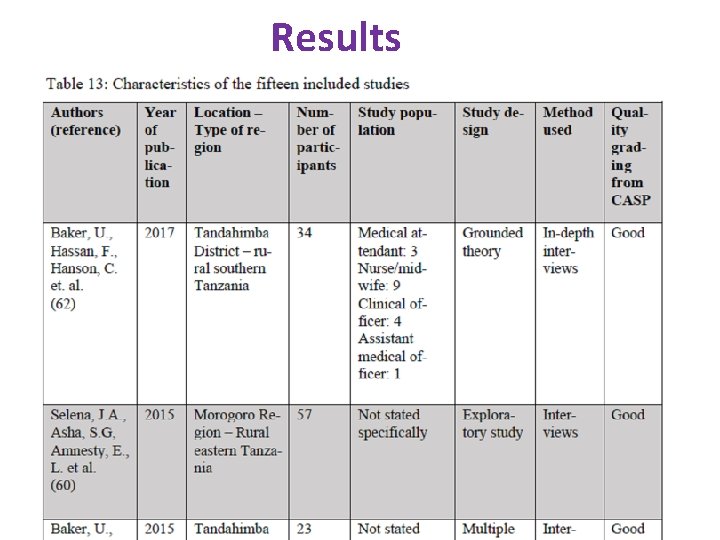
Results IN MY OPINION, THIS IS AN INCREDIBLY EFFECTIVE WAY TO PRESENT THE DETAILS CONCERNING DIFFERENT STUDIES IN ANY KIND OF REVIEW! IT ALLOWS THE STUDIES TO BE EASILY COMPARED. IT ALSO ALLOWS THE READER TO ACCESS MORE OR LESS IMMEDIATELY ANY INDIVIDUAL STUDY THAT HE/SHE IS PARTICULARLY INTERESTED IN. IT AVOIDS A MASS OF MORE OR LESS IMPENETRABLE TEXT!
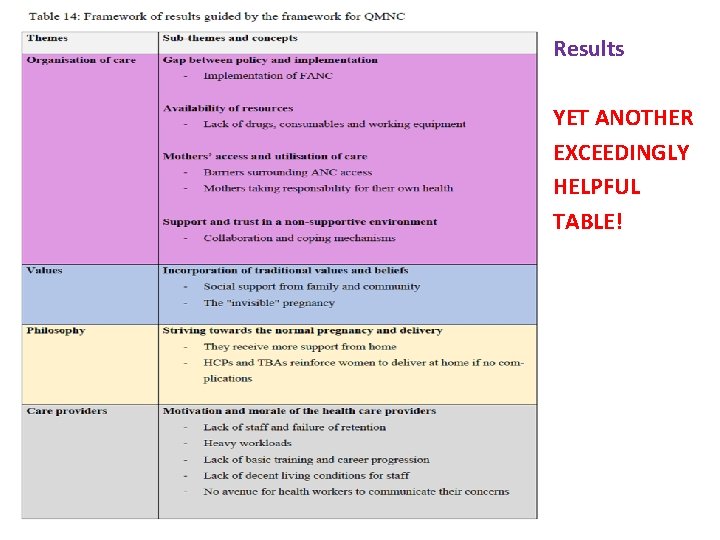
Results YET ANOTHER EXCEEDINGLY HELPFUL TABLE!
Results “The gap between policy and implementation was expressed by HCPs and initial researchers in all the included studies [studies included]. ” SPECIFIC!
Results “Several of the initial researchers put emphasis on the importance of understanding the tradi- tional values and beliefs in the future to tailor care to the needs of the women and the community they live in. Traditional values and beliefs were represented in eight out of the fifteen studies (47, 49, 52, 53, 59, 61– 63). ” SPECIFIC!
Results “However, as described in one study by An et al. 2015, some women took ad- vantage of the lack of resources, which made it possible to avoid any HIV testing during pregnancy due to fear of the test result. ” SPECIFIC!
Results “Even though the FANC guidelines were present in the department, not all HCPs understood the content of them. ” VAGUE!
Results “As expressed by HCPs, the number of staff was simply not enough to give proper care to the women. Furthermore, several studies pointed out that the distribution of health care staff between urban and rural areas are very uneven, and do not reflect the workloads at the given health facility. ” VAGUE!
Discussion “The findings of the meta-ethnography suggest that the quality of FANC is lacking both on a systemic and an individual level. My main findings relate to the gap between policy and implementation, mothers’ access and utilisation of care, availability of resources, support and trust in a non-supportive environment, incorporation of traditional values and beliefs, striving towards the normal pregnancy and delivery, and health care providers motivation and morale. These sub-themes show the quality of FANC from the perspective of the HCPs and indicate where improvements are necessary. ” STARTS WITH A HELPFUL SUMMARY OF THE MAIN FINDINGS!
Discussion LIMITATIONS: Meta-ethnography still a new approach Secondary data The reviewer´s subjectivity Only articles in English THIS IS ADMIRABLY HONEST! I WOULD LIKE TO SEE MORE EMPHASIS ON STRENGTHS
Supplementary material ONCE AGAIN, NUMEROUS HELPFUL TABLES ONE MAJOR STRENGTH OF THIS THESIS, I FEEL, IS ITS USE OF NUMEROUS, HELPFUL AND WELLFORMATED TABLES AND FIGURES