
Global Health Supply Chain Technical Assistance Tanzania GHSC

Global Health Supply Chain Technical Assistance – Tanzania GHSC – TA - TZ October 5, 2016
Introduction • Newly awarded 3 -year project by the USAID Tanzania • GHSC supports Mo. HCDGEC (PSU, MSD), PORALG and partners to improve health commodities availability through strengthening supply chain systems • The project builds on successful USAID efforts through JSI projects SCMS and USAID|DELIVER
Project Objectives • Objective 1: Strategic Planning: Provide Strategic Planning and Implementation Assistance • Objective 2: In-Country Logistics: Improve Delivery of Health Commodities to Service Sites • Objective 3: Capacity Building: Broaden stakeholders' understanding and engagement of the supply chain system. • Objective 4: Enabling Environment: Strengthen Enabling Environments to Improve Supply Chain Performance
Objective 1: Strategic Planning 1 2 3 Assist leadership to operationalize strategic plans: Plan for transition from donor-funded support: Further clarify operating processes: • Operationalize BRN and HSSP IV health supply chain priorities • Aid the MOHCDGEC, Ministry of Finance and MSD to formulate a longterm strategy to transition away from donorsupported activitiesincluding the procurement, management and oversight of health commodities- to domestic resources. • Identify areas of the supply chain that require further modification to SOPs and a method for communicating new processes. • Assist leadership to advocate for government resources needed for successful implementation. • Work to align MSD's strategic plan approach with national priorities • Identify cost-effective ways for communicating change that does not depend exclusively on classroom-based training
Objective 2: In-Country Logistics 1 2 Strengthen the e. LMIS: Streamline quantification: • Establish governance platform to manage system changes • Build skills for developing forecasting/quantification plans, and leveraging e. LMIS data • Engage with int’l Open. LMIS community • Strengthen capacity to provide Tier 2 and Tier 3 support • Support the LMU M&E team in analyzing e. LMIS data and using data for decision making. • Expand e. LMIS use at district and facility level • Urge LMU and vertical programs to budget for quantification activities. • Establish plan to involve stakeholders in exercises. • Verify that e. LMIS data is properly used • Oversee the supply plan and adjust shipments on a regular basis 3 4 Institutionalize data use, improve data quality: Support operational expenses of LMU: • Encourage stakeholders to use e. LMIS system. • Provide Supply Chain Monitoring Advisors • Assist the LMU team to verify that e. LMIS and HMIS data are complete, timely and accurate. • Work with the MOHSW to plan the mobilization of funds to support unit operations and develop a long-term approach to providing these services • Support the LMU headquarter M&E team and MSD staff on the collection, analysis and use of data to inform operations and business decisions
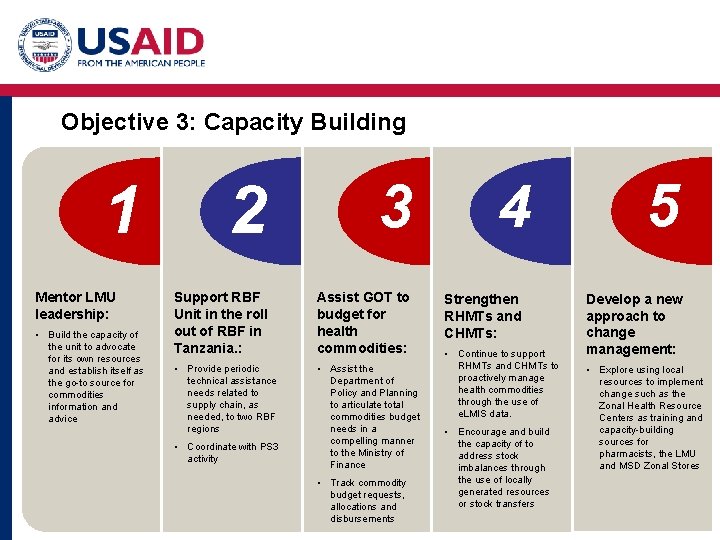
Objective 3: Capacity Building 1 Mentor LMU leadership: • Build the capacity of the unit to advocate for its own resources and establish itself as the go-to source for commodities information and advice 2 3 Support RBF Unit in the roll out of RBF in Tanzania. : Assist GOT to budget for health commodities: • Provide periodic technical assistance needs related to supply chain, as needed, to two RBF regions • Assist the Department of Policy and Planning to articulate total commodities budget needs in a compelling manner to the Ministry of Finance • Coordinate with PS 3 activity • Track commodity budget requests, allocations and disbursements 4 Strengthen RHMTs and CHMTs: • Continue to support RHMTs and CHMTs to proactively manage health commodities through the use of e. LMIS data. • Encourage and build the capacity of to address stock imbalances through the use of locally generated resources or stock transfers 5 Develop a new approach to change management: • Explore using local resources to implement change such as the Zonal Health Resource Centers as training and capacity-building sources for pharmacists, the LMU and MSD Zonal Stores
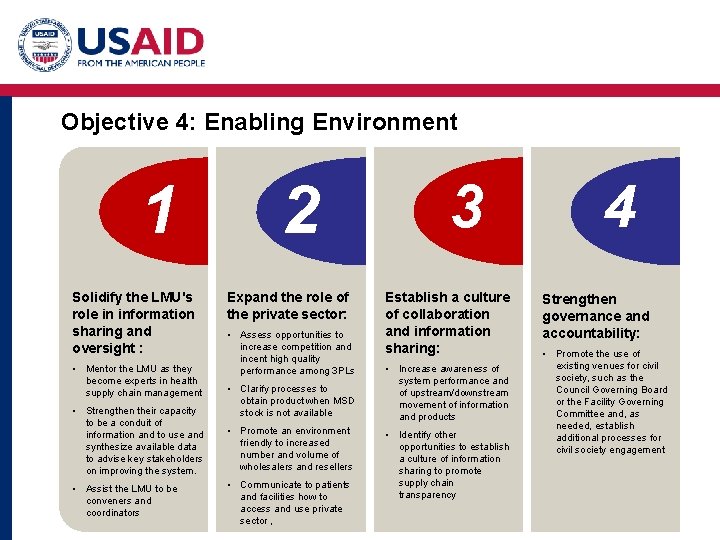
Objective 4: Enabling Environment 1 Solidify the LMU's role in information sharing and oversight : • Mentor the LMU as they become experts in health supply chain management • Strengthen their capacity to be a conduit of information and to use and synthesize available data to advise key stakeholders on improving the system. • Assist the LMU to be conveners and coordinators 2 Expand the role of the private sector: • Assess opportunities to increase competition and incent high quality performance among 3 PLs • Clarify processes to obtain product when MSD stock is not available • Promote an environment friendly to increased number and volume of wholesalers and resellers • Communicate to patients and facilities how to access and use private sector , 3 Establish a culture of collaboration and information sharing: • Increase awareness of system performance and of upstream/downstream movement of information and products • Identify other opportunities to establish a culture of information sharing to promote supply chain transparency 4 Strengthen governance and accountability: • Promote the use of existing venues for civil society, such as the Council Governing Board or the Facility Governing Committee and, as needed, establish additional processes for civil society engagement
GHSC expectations • Promotion and advocacy for more collaboration among IPs • Agreed priorities and common approach to strengthen Tanzania health supply chain system • Partners leveraging the GHSC mechanism to address supply chain challenges • Establishment of a well planned supply chain annual symposium • Elevation of the health supply chain agenda above and beyond MOHCDGEC • Go. T engagement, commitment and ownership of SC
Our contacts Mavere Tukai – Chief of Party Email: Mavere. Tukai@tz-ghsc. com Marasi Mwencha – Deputy Chief of Party Email: marasi. mwencha@tz-ghsc. com
- Slides: 9