Elements Compounds and Mixtures Chapter 4 Circle of


- Slides: 36
Elements, Compounds, and Mixtures Chapter 4
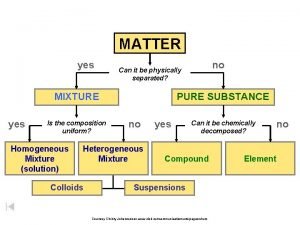
Circle of MATTER -this is how everything is related to one another ELEMENT SOLUTION COMPOUND ATOM MIXTURE SUSPENSION COLLOID MOLECULE
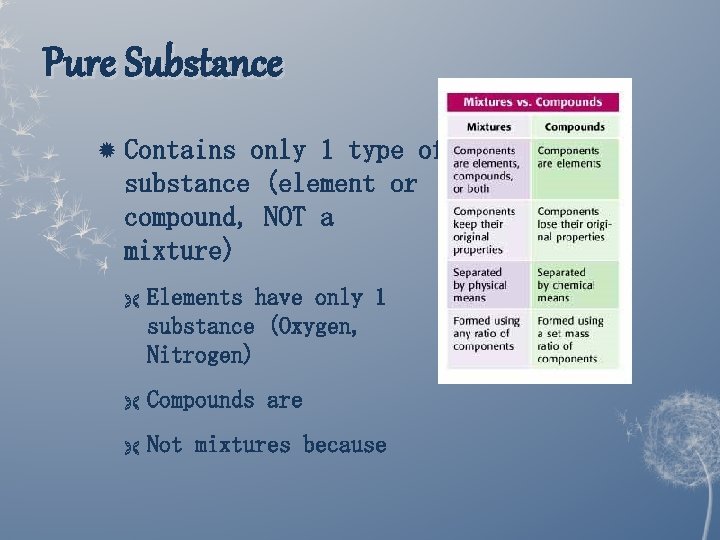
Pure Substance Contains only 1 type of substance (element or compound, NOT a mixture) Ë Elements have only 1 substance (Oxygen, Nitrogen) Ë Compounds are Ë Not mixtures because
Elements An element is a pure substance that cannot be broken down into any other substances by chemical or physical means. Elements are called the building blocks of matter.
Elements and Atoms Made of tiny particles called atoms. An atom is the smallest unit of an element that maintains the properties of the element. Atoms can combine to form compounds or molecules.
Elements Every element has its own symbol, symbol a one or two letter set of characters used to identify an element. Examples: aluminum (Al), carbon (C) Copper (Cu), Iron (Fe)
Properties of Elements Each element can be identified by it’s characteristic properties Properties that do not change regardless of the sample size Some examples are boiling point, melting point and density (physical properties) and reactivity with an acid (chemical property).
Compounds A compound is a pure substance made of two or more elements chemically combined in a specific ratio A formula is a combination of symbols that shows the ratio of elements in a compound. Elements in compounds do not retain their individual properties
How to make a Compound In a compound, a particle is formed when atoms from two or more elements join In order for atoms to join, they must react or undergo a chemical change with one another The compound is a new pure substance that is different from the elements that reacted to form it
How to break down a Compound Some compounds can be broken down into elements through chemical changes Compounds cannot be broken down by physical change
Compounds Example: Water ( H 2 O ) Hydrogen peroxide ( H 2 O 2 ) Carbon dioxide ( CO 2 ) Carbon monoxide ( CO ) Non-example: Oxygen (O 2) Nitrogen (N 2)
Molecules A molecule is the smallest unit of a substance that keeps all of the physical and chemical properties of the substance. Molecules contain two or more atoms chemically combined in a specific ratio. Ë EX: O 2, H 2 O
How are compounds and molecules different? ? ? A molecule is formed when two or more atoms join together chemically. A compound is a molecule that contains at least two different elements. All compounds are molecules but not all molecules are compounds.
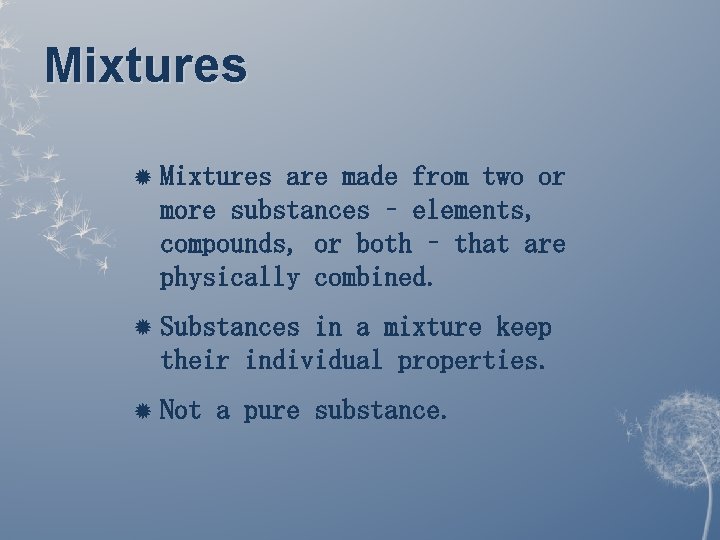
Mixtures are made from two or more substances – elements, compounds, or both – that are physically combined. Substances in a mixture keep their individual properties. Not a pure substance.
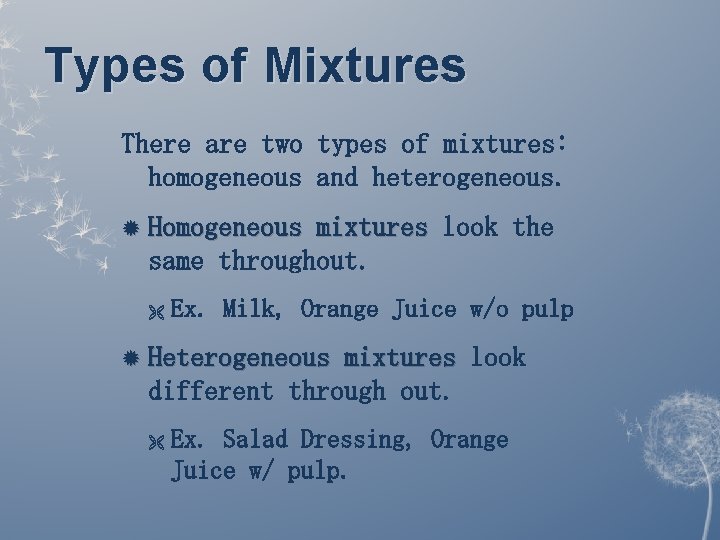
Types of Mixtures There are two types of mixtures: homogeneous and heterogeneous. Homogeneous mixtures look the same throughout. Ë Ex. Milk, Orange Juice w/o pulp Heterogeneous mixtures look different through out. Ë Ex. Salad Dressing, Orange Juice w/ pulp.
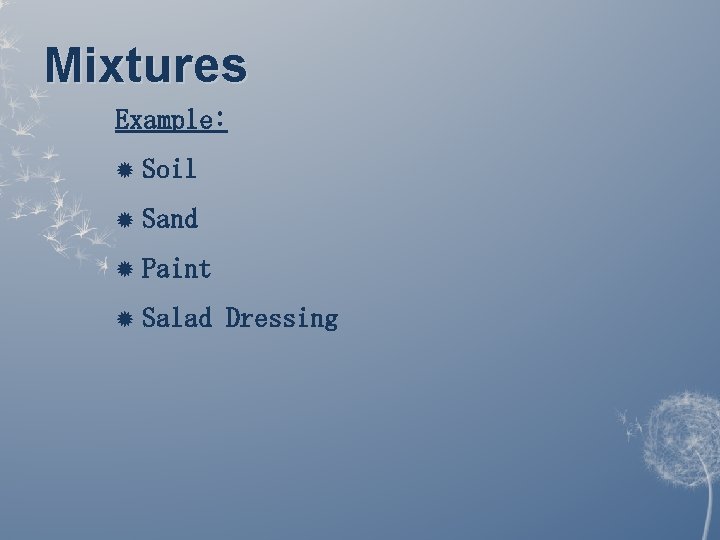
Mixtures Example: Soil Sand Paint Salad Dressing
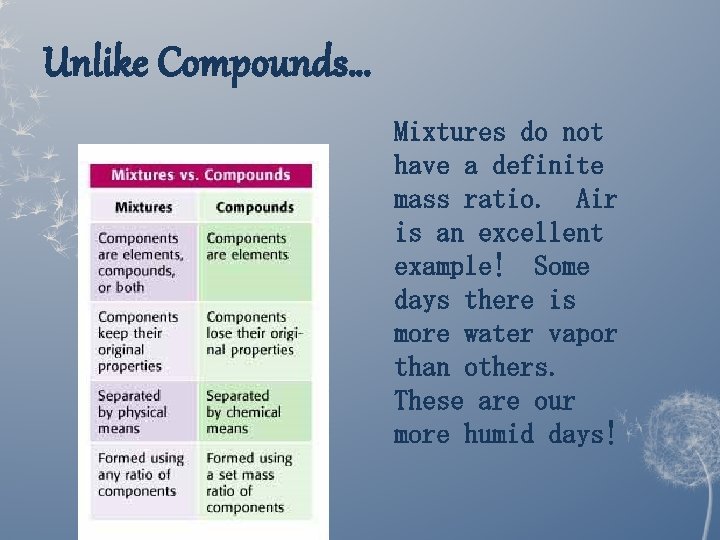
Unlike Compounds… Mixtures do not have a definite mass ratio. Air is an excellent example! Some days there is more water vapor than others. These are our more humid days!
3 Types of Mixtures Solutions Suspensions Colloids Ë Pay close attention to what each type is, particle size, and any additional information needed to tell them apart!
Let’s Talk Solutions A solution is a mixture that appears to be a single substance Contains particles from 2 or more substances Described as homogeneous solutions because they have the same appearance and properties throughout the mixture
How are solutions made? They Ë dissolve! Dissolving is when the particles in a solution separate and spread evenly throughout the mixture
What Are the Components Of A Solution? The solute is the substance or matter being dissolved or is soluble (able to be dissolved) in the solvent. The solvent is the substance into which the solute is dissolved
Think About It! In a salt water solution, which is the solute and which is the solvent? The salt is the solute and the water is the solvent.
Can Solids Be A Solution? YES! Some examples are alloys which are metals or nonmetals dissolved in metals. Ë Ë Brass is an alloy of the metal zinc dissolved in copper Steel, including the steel used to build the Titanic, is an alloy of the nonmetal carbon and other elements dissolved in iron.
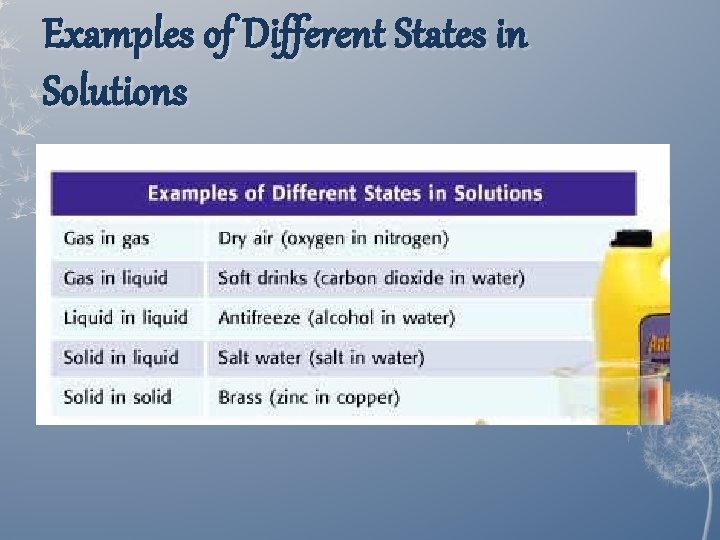
Examples of Different States in Solutions
What About Matter That Doesn’t Dissolve In A Solvent? This matter is insoluble ( in = not) and forms a mixture that is not homogeneous and is not a solution.
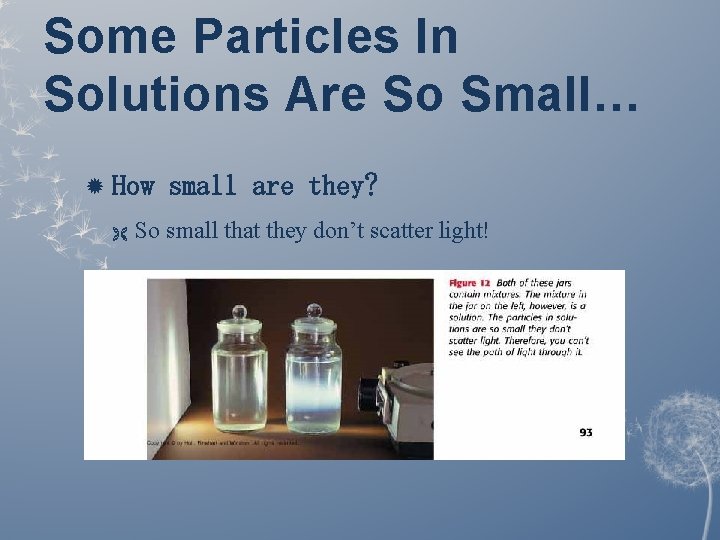
Some Particles In Solutions Are So Small… How Ë small are they? So small that they don’t scatter light!
Concentrate on Concentration: Concentration measure of the amount of solute dissolved in a solvent Concentration is expressed in grams of solute per milliliter of solvent Concentrations may be described as either concentrated or dilute
Suspensions Suspension: is a mixture in which particles of a material are dispersed throughout a liquid or gas but are large enough that they settle out The particles in a suspension are insoluble Particles are often described as heterogeneous mixtures because components are easily seen
The Particles In A Suspension Are So Big… How Ë big are they? They are so big that they scatter or block light making most suspensions difficult to see through. They are too heavy to remain mixed without being stirred or shaken
So, What Is Jello? Jello is a colloid! Colloid: Colloid is a mixture in which the particles are dispersed throughout but are not heavy enough to settle out. The particles are small and fairly well-mixed Solids, liquids and gases can be used to make colloids Ë Other examples: milk, mayo, stick deodorant, and whipped cream
How Small Are The Particles? Still big enough to scatter light And so small that they cannot be separated by filtration…they are small enough to pass through a filter.
Show Off Take out a sheet of paper and answer this question in a paragraph to turn in: What are the 3 differences between solutions and suspensions? Unlike particles in a solutions, particles in a suspension are large enough to settle out, block light, and be trapped by a filter. Particles in a solution do none of these.
Show Off Take out a sheet of paper and answer this question in a paragraph to turn in: How are compounds and elements alike? Different? What A is a compound? jar contains samples of the elements carbon and oxygen. Does the jar contain a compound? Support your response
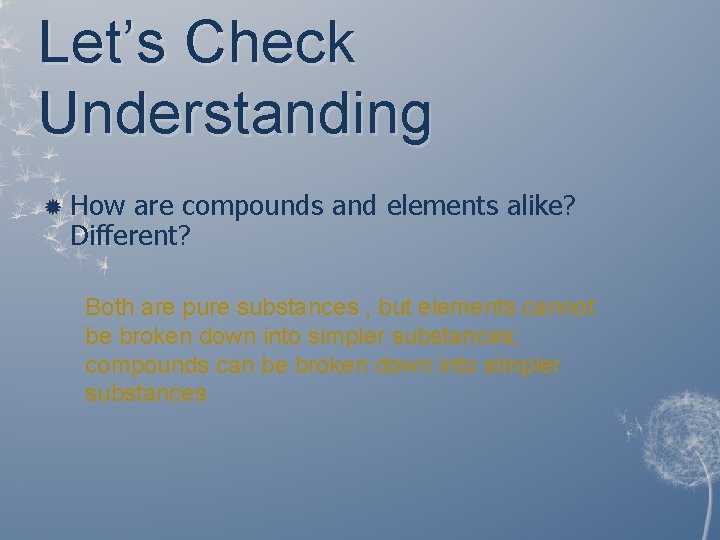
Let’s Check Understanding How are compounds and elements alike? Different? Both are pure substances , but elements cannot be broken down into simpler substances; compounds can be broken down into simpler substances
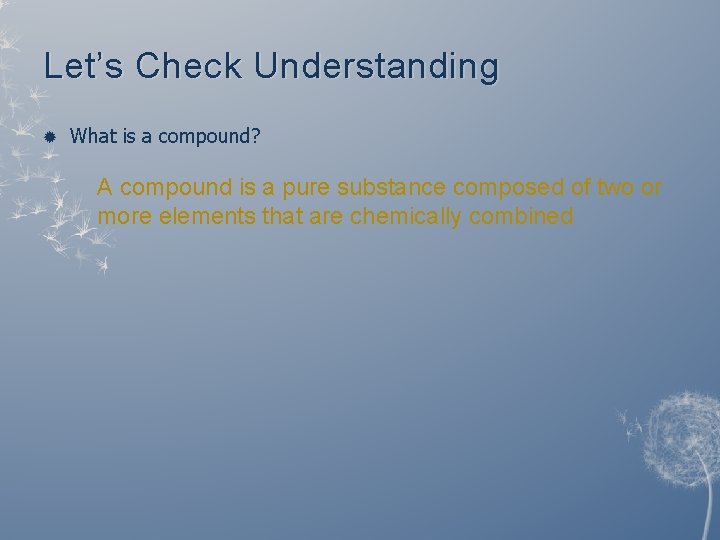
Let’s Check Understanding What is a compound? A compound is a pure substance composed of two or more elements that are chemically combined
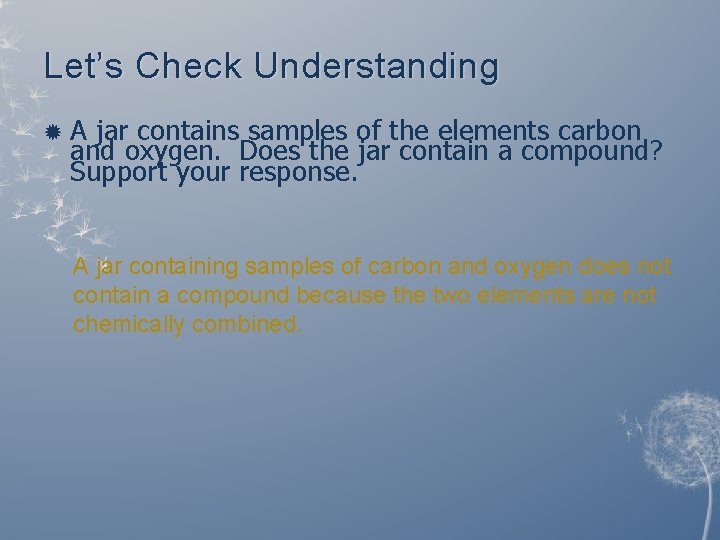
Let’s Check Understanding A jar contains samples of the elements carbon and oxygen. Does the jar contain a compound? Support your response. A jar containing samples of carbon and oxygen does not contain a compound because the two elements are not chemically combined.