Electroweak Physics at the LHC Michael Schmitt Northwestern


- Slides: 82
Electroweak Physics at the LHC Michael Schmitt Northwestern University April 28, 2011 28 -April-2011 LHC Electroweak Physics - Michael Schmitt 1
28 -April-2011 LHC Electroweak Physics - Michael Schmitt 2
28 -April-2011 LHC Electroweak Physics - Michael Schmitt 3
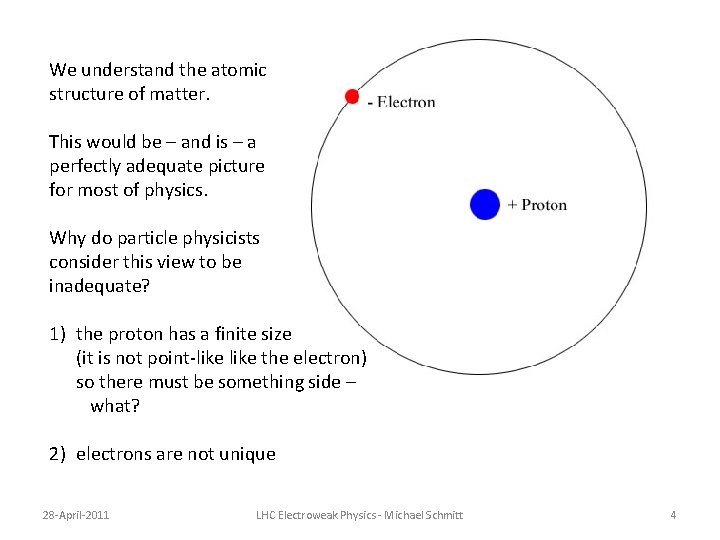
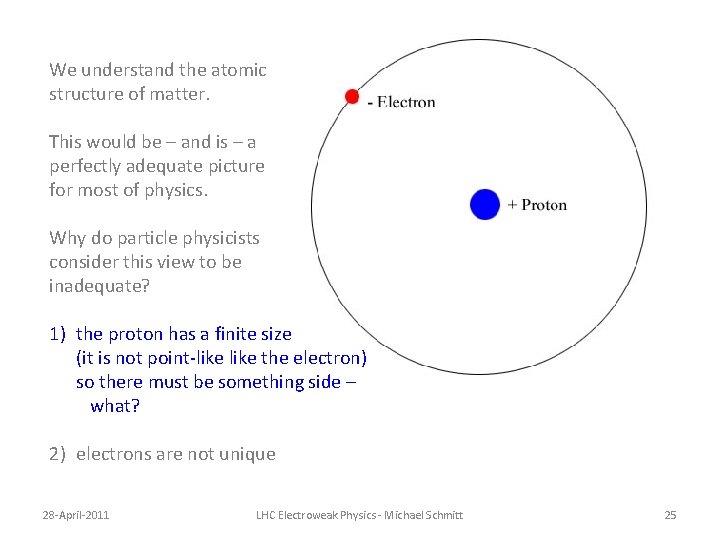
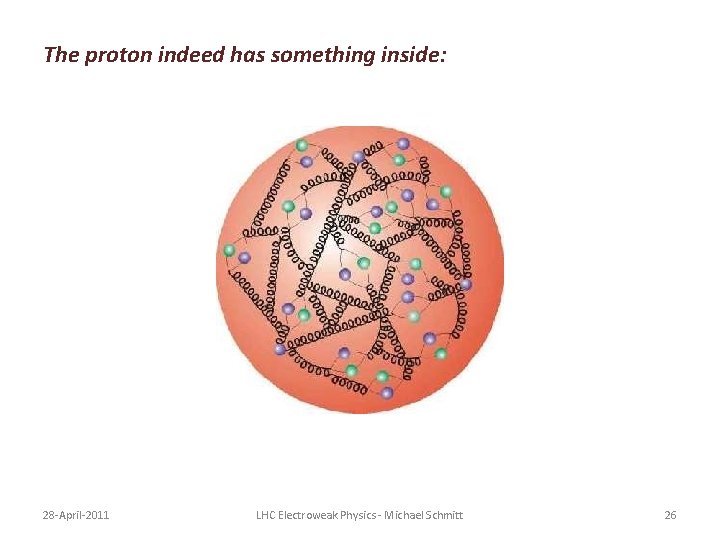
We understand the atomic structure of matter. This would be – and is – a perfectly adequate picture for most of physics. Why do particle physicists consider this view to be inadequate? 1) the proton has a finite size (it is not point-like the electron) so there must be something side – what? 2) electrons are not unique 28 -April-2011 LHC Electroweak Physics - Michael Schmitt 4
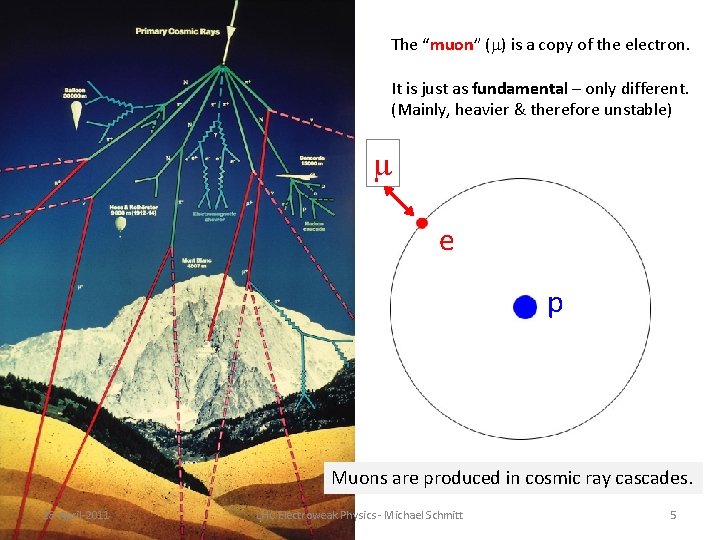
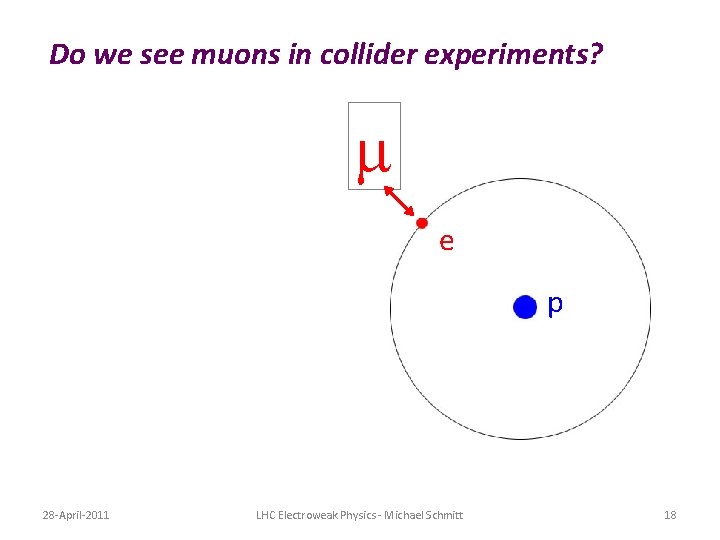
The “muon” (m) is a copy of the electron. It is just as fundamental – only different. (Mainly, heavier & therefore unstable) m e p Muons are produced in cosmic ray cascades. 28 -April-2011 LHC Electroweak Physics - Michael Schmitt 5
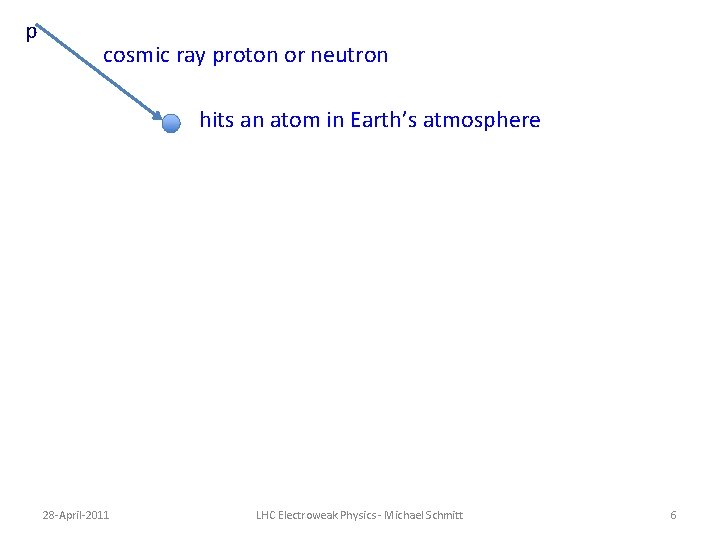
p cosmic ray proton or neutron hits an atom in Earth’s atmosphere 28 -April-2011 LHC Electroweak Physics - Michael Schmitt 6
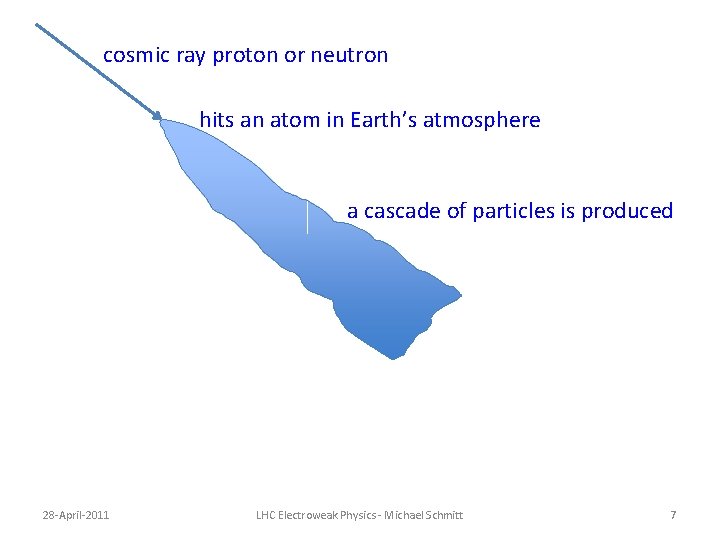
cosmic ray proton or neutron hits an atom in Earth’s atmosphere a cascade of particles is produced 28 -April-2011 LHC Electroweak Physics - Michael Schmitt 7
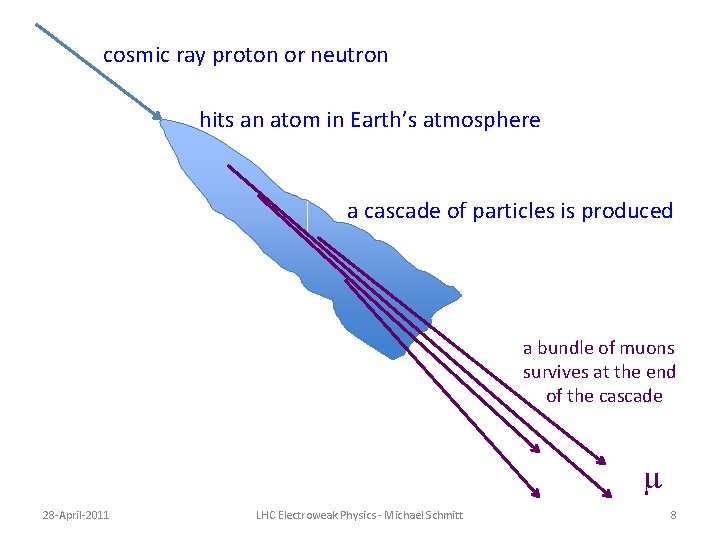
cosmic ray proton or neutron hits an atom in Earth’s atmosphere a cascade of particles is produced a bundle of muons survives at the end of the cascade m 28 -April-2011 LHC Electroweak Physics - Michael Schmitt 8
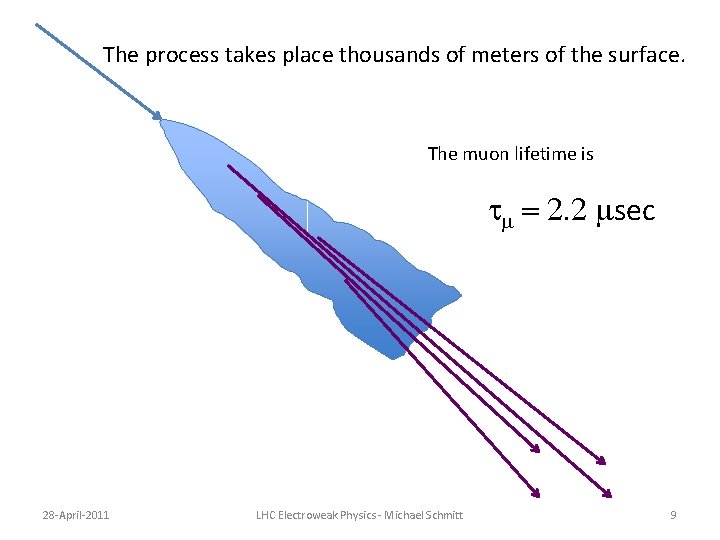
The process takes place thousands of meters of the surface. The muon lifetime is tm = 2. 2 msec 28 -April-2011 LHC Electroweak Physics - Michael Schmitt 9
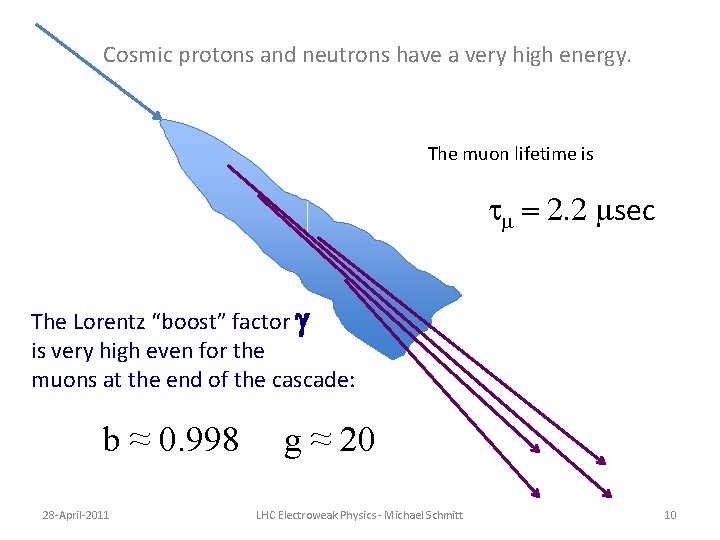
Cosmic protons and neutrons have a very high energy. The muon lifetime is tm = 2. 2 msec The Lorentz “boost” factor g is very high even for the muons at the end of the cascade: b ≈ 0. 998 28 -April-2011 g ≈ 20 LHC Electroweak Physics - Michael Schmitt 10
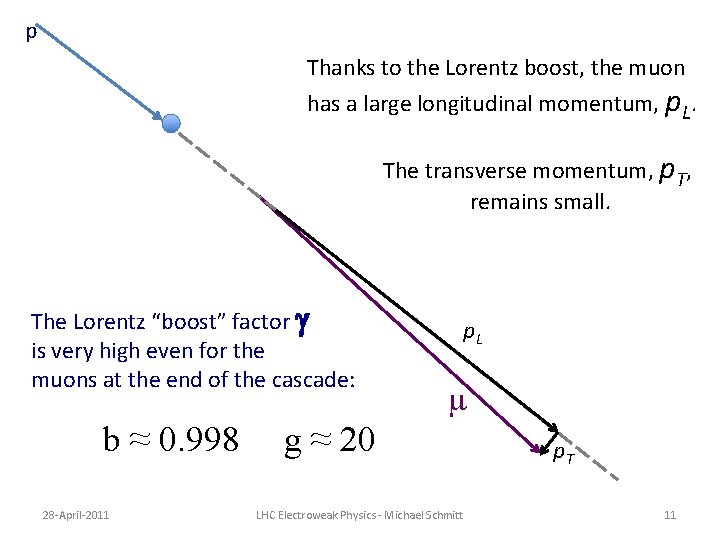
p Thanks to the Lorentz boost, the muon has a large longitudinal momentum, p. L. The transverse momentum, p. T, remains small. The Lorentz “boost” factor g is very high even for the muons at the end of the cascade: b ≈ 0. 998 28 -April-2011 p. L m g ≈ 20 LHC Electroweak Physics - Michael Schmitt p. T 11
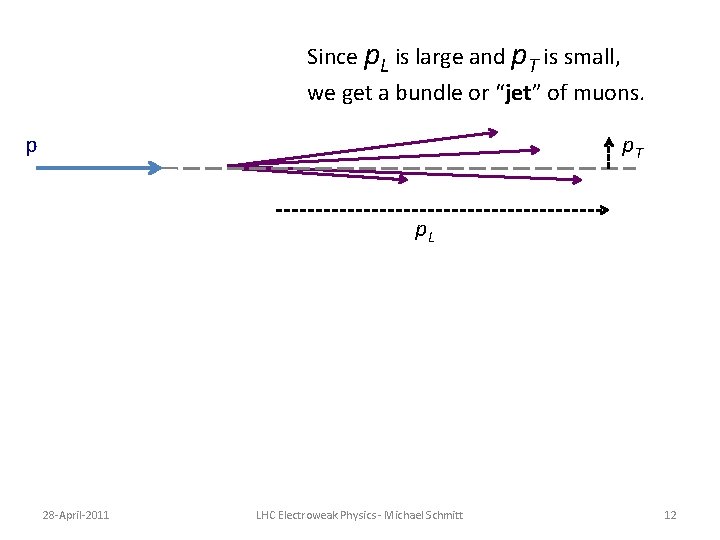
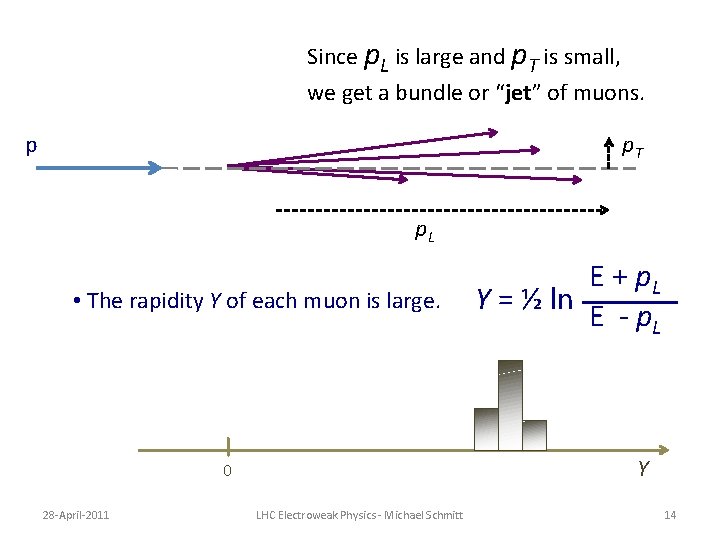
Since p. L is large and p. T is small, we get a bundle or “jet” of muons. p p. T p. L 28 -April-2011 LHC Electroweak Physics - Michael Schmitt 12
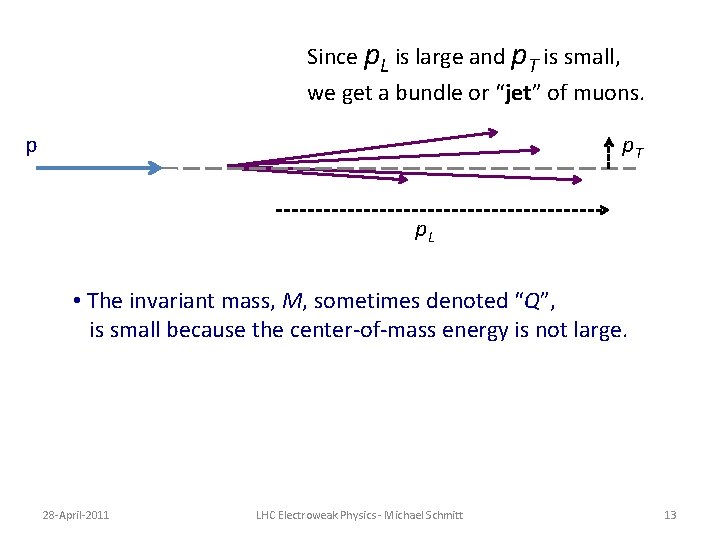
Since p. L is large and p. T is small, we get a bundle or “jet” of muons. p p. T p. L • The invariant mass, M, sometimes denoted “Q”, is small because the center-of-mass energy is not large. 28 -April-2011 LHC Electroweak Physics - Michael Schmitt 13
Since p. L is large and p. T is small, we get a bundle or “jet” of muons. p p. T p. L • The rapidity Y of each muon is large. Y 0 28 -April-2011 E + p. L Y = ½ ln E - p. L LHC Electroweak Physics - Michael Schmitt 14
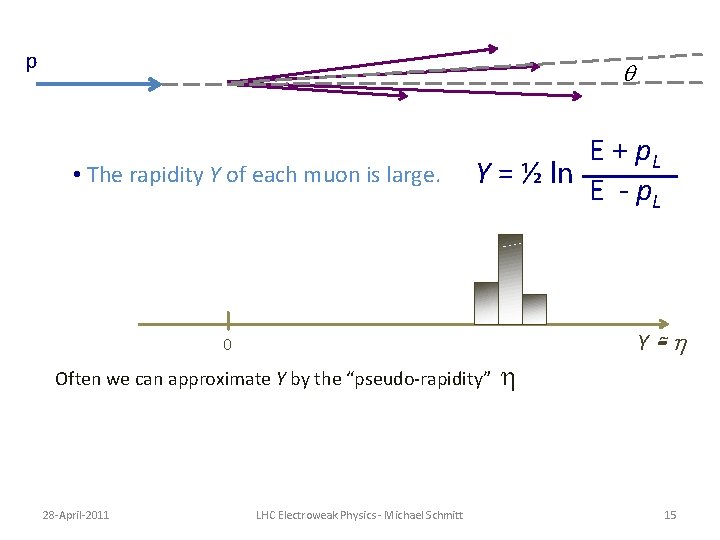
p q • The rapidity Y of each muon is large. E + p. L Y = ½ ln E - p. L Y≅h 0 Often we can approximate Y by the “pseudo-rapidity” 28 -April-2011 LHC Electroweak Physics - Michael Schmitt h 15
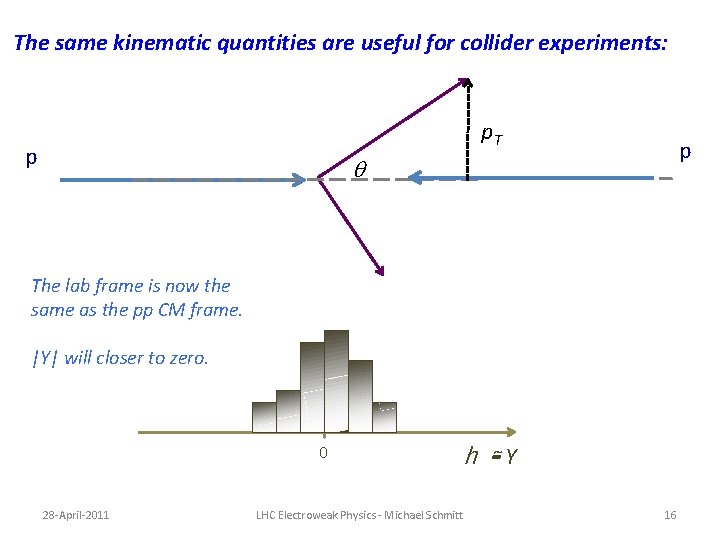
The same kinematic quantities are useful for collider experiments: p. T p p q The lab frame is now the same as the pp CM frame. |Y| will closer to zero. 0 28 -April-2011 LHC Electroweak Physics - Michael Schmitt h ≅Y 16
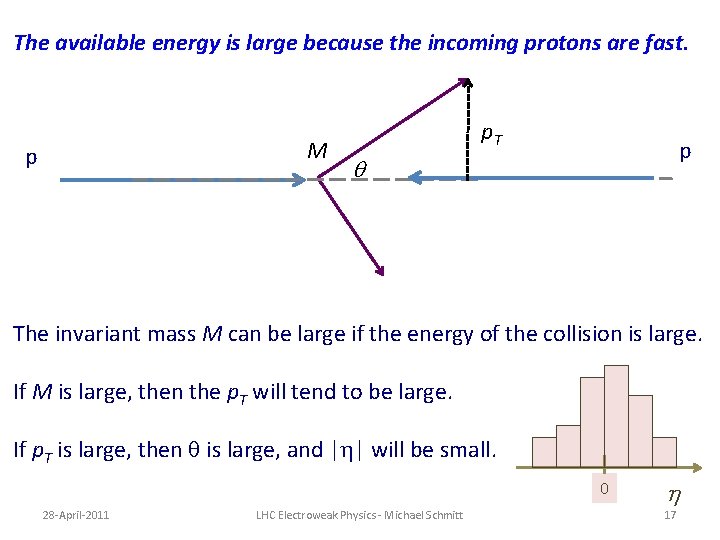
The available energy is large because the incoming protons are fast. M p p. T p q The invariant mass M can be large if the energy of the collision is large. If M is large, then the p. T will tend to be large. If p. T is large, then q is large, and |h| will be small. 0 28 -April-2011 LHC Electroweak Physics - Michael Schmitt h 17
Do we see muons in collider experiments? m e p 28 -April-2011 LHC Electroweak Physics - Michael Schmitt 18
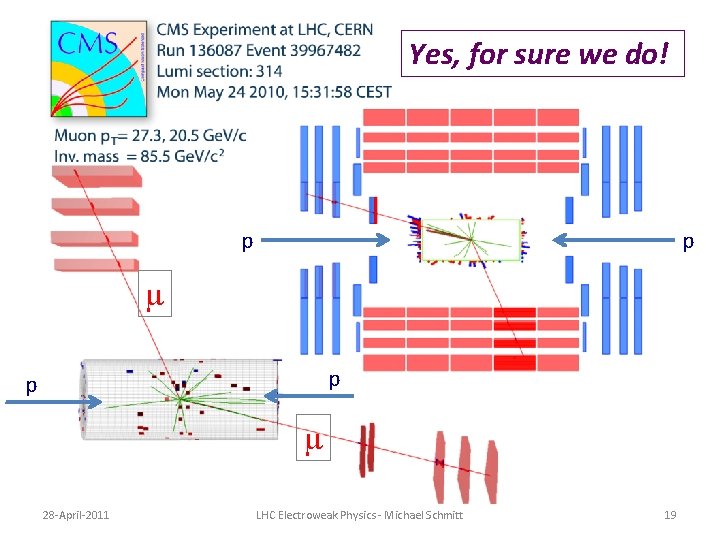
Yes, for sure we do! p p m 28 -April-2011 LHC Electroweak Physics - Michael Schmitt 19
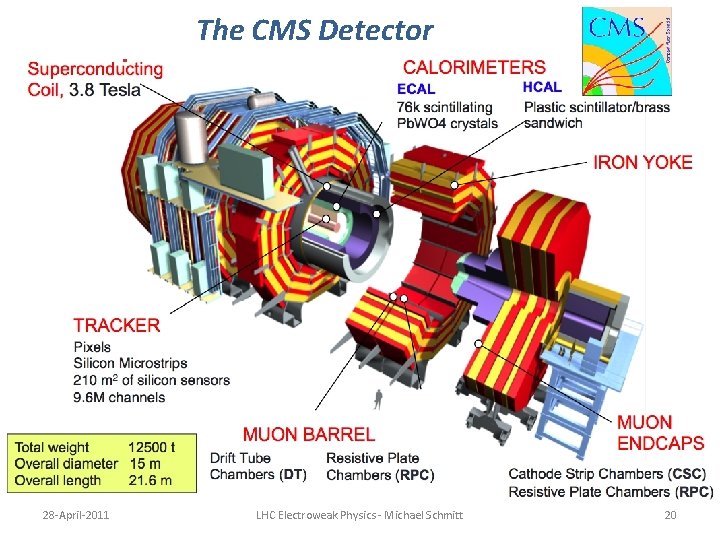
The CMS Detector 28 -April-2011 LHC Electroweak Physics - Michael Schmitt 20
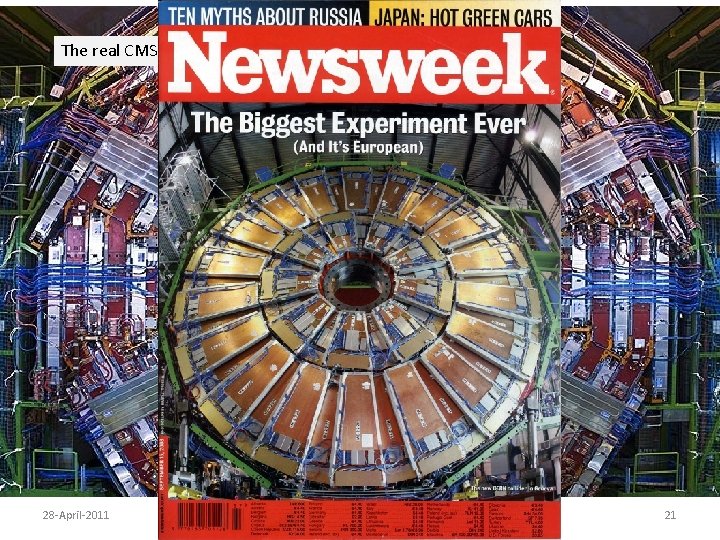
The real CMS Detector 28 -April-2011 LHC Electroweak Physics - Michael Schmitt 21
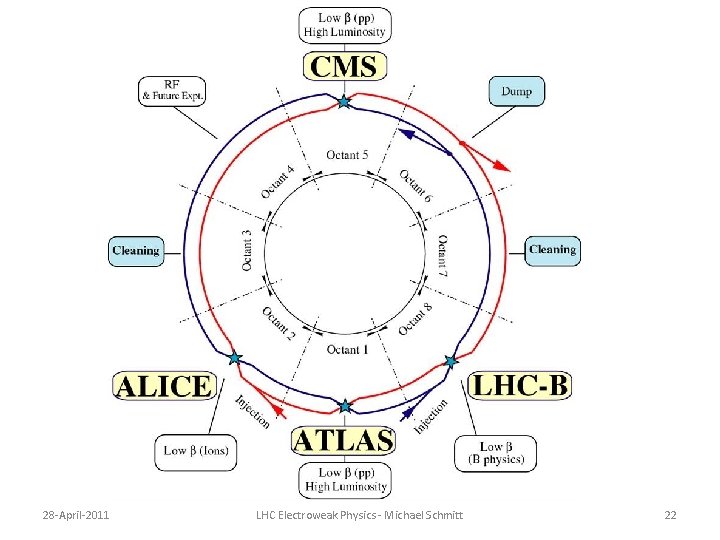
28 -April-2011 LHC Electroweak Physics - Michael Schmitt 22
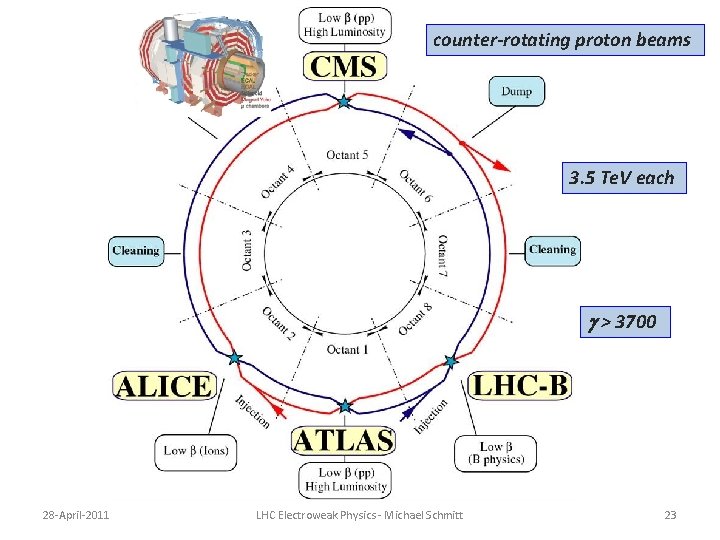
counter-rotating proton beams 3. 5 Te. V each g > 3700 28 -April-2011 LHC Electroweak Physics - Michael Schmitt 23
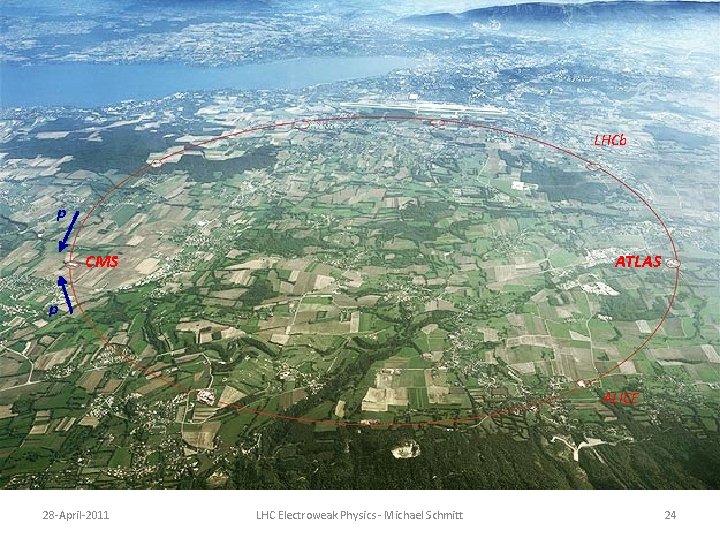
LHCb p CMS ATLAS p ALICE 28 -April-2011 LHC Electroweak Physics - Michael Schmitt 24
We understand the atomic structure of matter. This would be – and is – a perfectly adequate picture for most of physics. Why do particle physicists consider this view to be inadequate? 1) the proton has a finite size (it is not point-like the electron) so there must be something side – what? 2) electrons are not unique 28 -April-2011 LHC Electroweak Physics - Michael Schmitt 25
The proton indeed has something inside: 28 -April-2011 LHC Electroweak Physics - Michael Schmitt 26
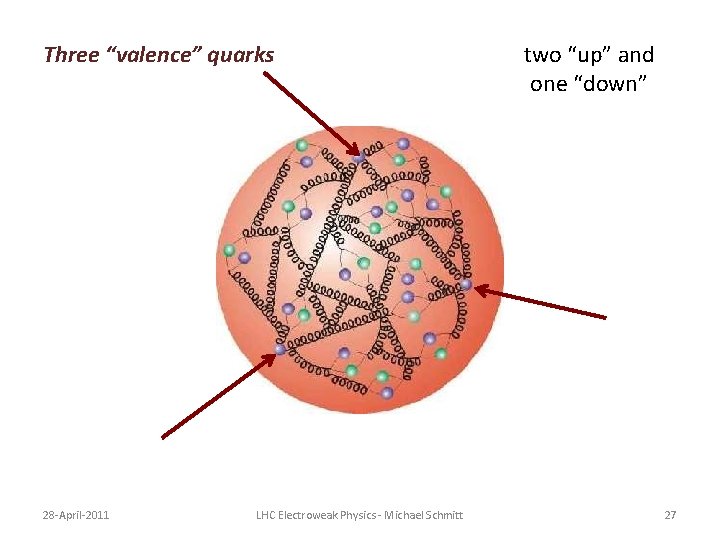
Three “valence” quarks 28 -April-2011 LHC Electroweak Physics - Michael Schmitt two “up” and one “down” 27
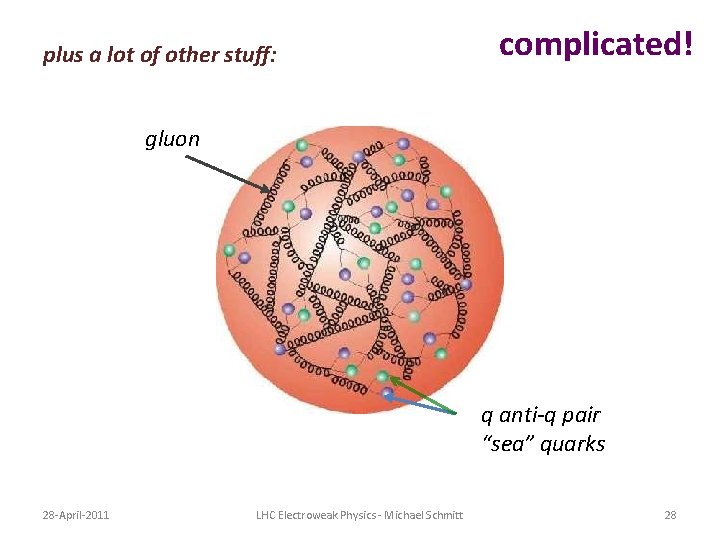
plus a lot of other stuff: complicated! gluon q anti-q pair “sea” quarks 28 -April-2011 LHC Electroweak Physics - Michael Schmitt 28
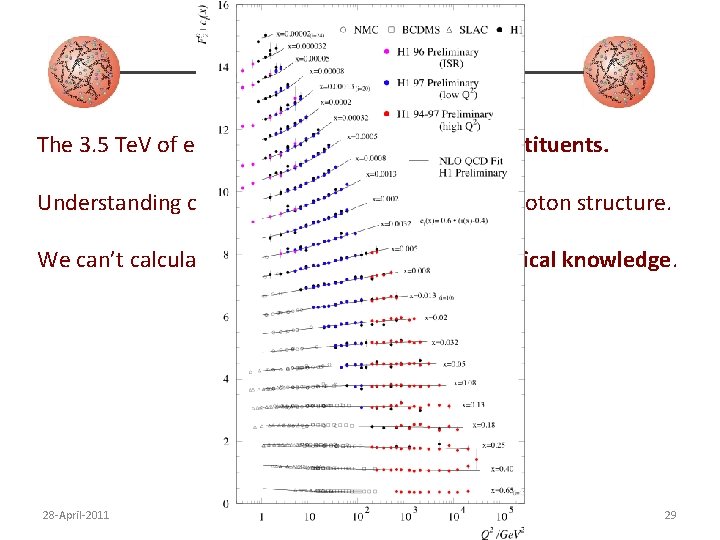
The 3. 5 Te. V of energy is shared amongst the constituents. Understanding collisions requires knowledge of proton structure. We can’t calculate this structure – we need empirical knowledge. 28 -April-2011 LHC Electroweak Physics - Michael Schmitt 29
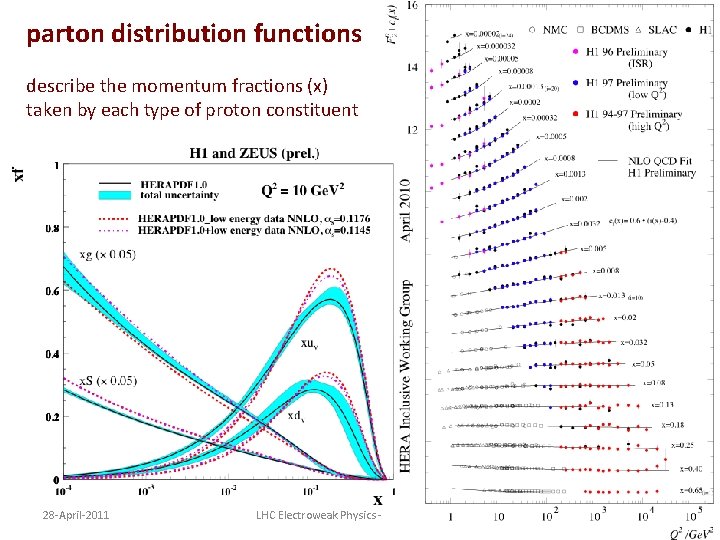
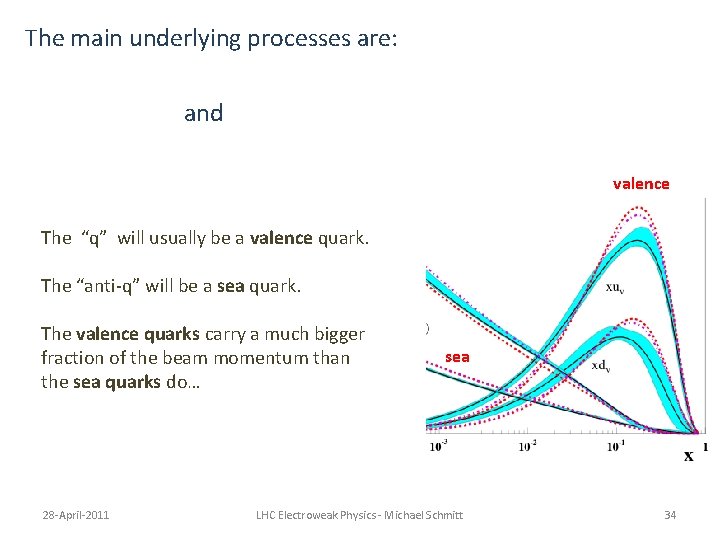
parton distribution functions describe the momentum fractions (x) taken by each type of proton constituent 28 -April-2011 LHC Electroweak Physics - Michael Schmitt 30
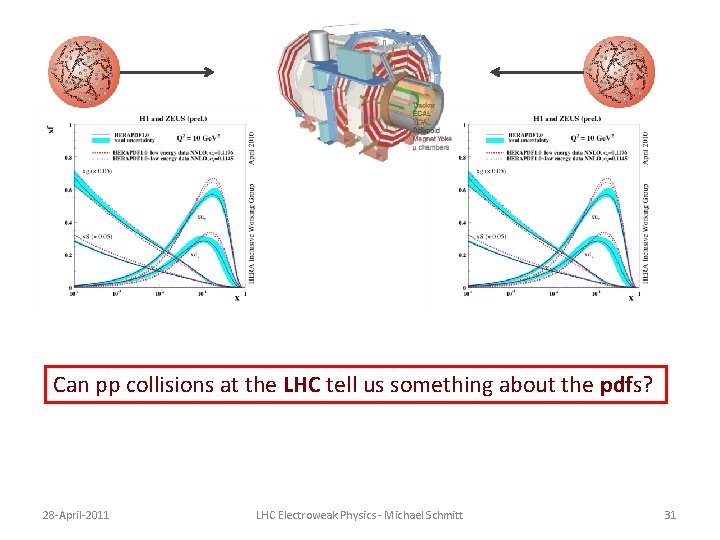
Can pp collisions at the LHC tell us something about the pdfs? 28 -April-2011 LHC Electroweak Physics - Michael Schmitt 31
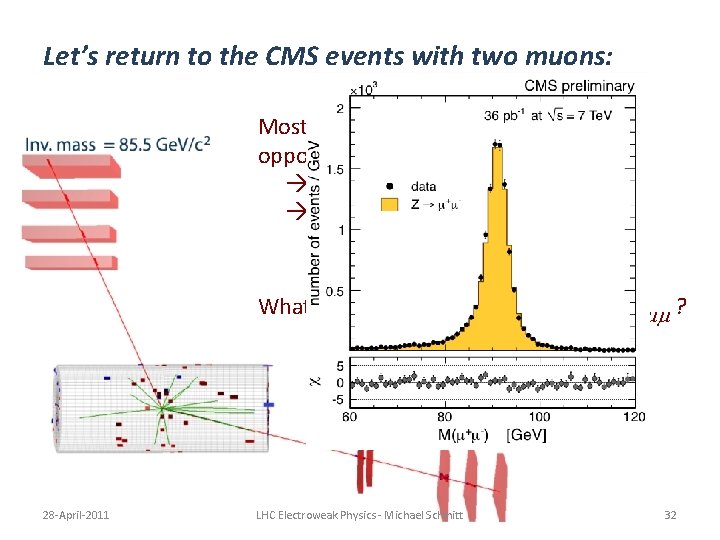
Let’s return to the CMS events with two muons: Most of these events have muons with opposite charge there is an anti-correlation they are produced jointly, through some common process…. What is the distribution of the mass, Mmm ? 28 -April-2011 LHC Electroweak Physics - Michael Schmitt 32
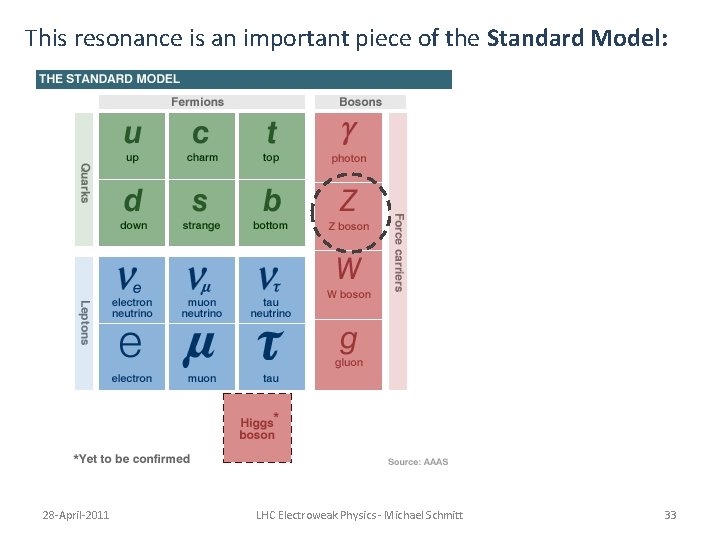
This resonance is an important piece of the Standard Model: 28 -April-2011 LHC Electroweak Physics - Michael Schmitt 33
The main underlying processes are: and valence The “q” will usually be a valence quark. The “anti-q” will be a sea quark. The valence quarks carry a much bigger fraction of the beam momentum than the sea quarks do… 28 -April-2011 sea LHC Electroweak Physics - Michael Schmitt 34
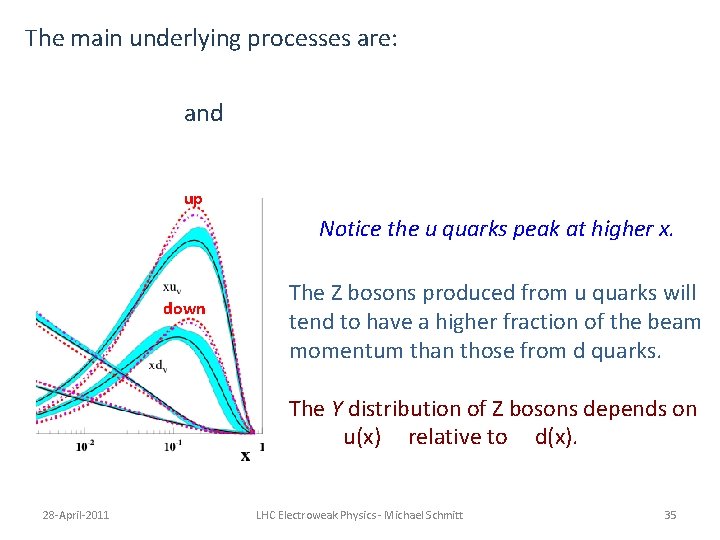
The main underlying processes are: and up Notice the u quarks peak at higher x. down The Z bosons produced from u quarks will tend to have a higher fraction of the beam momentum than those from d quarks. The Y distribution of Z bosons depends on u(x) relative to d(x). 28 -April-2011 LHC Electroweak Physics - Michael Schmitt 35
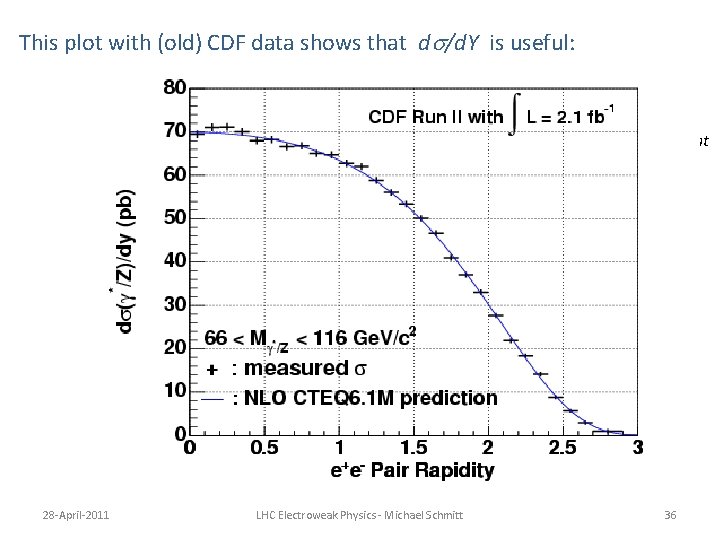
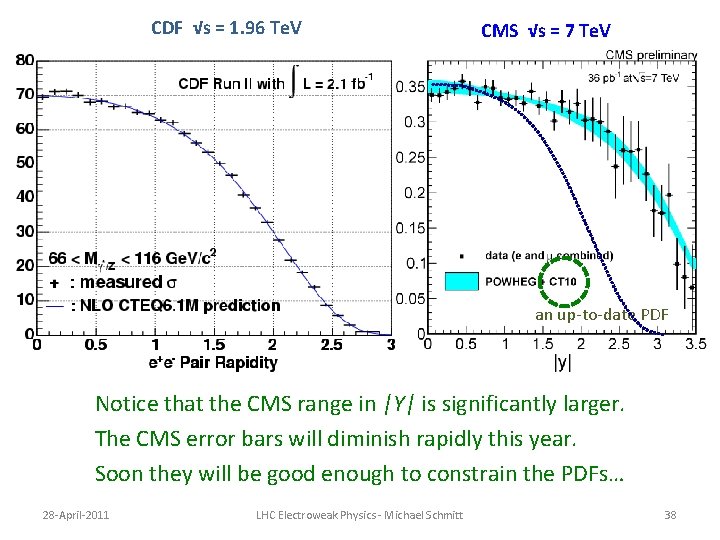
This plot with (old) CDF data shows that ds/d. Y is useful: Two different PDF sets 28 -April-2011 LHC Electroweak Physics - Michael Schmitt 36
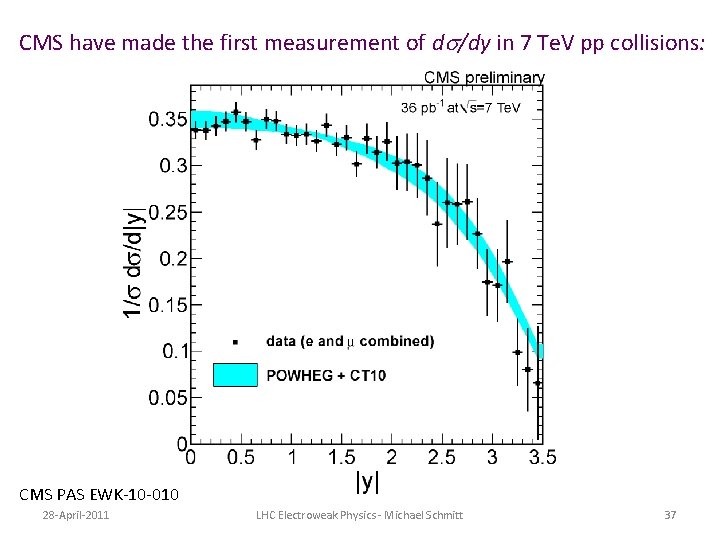
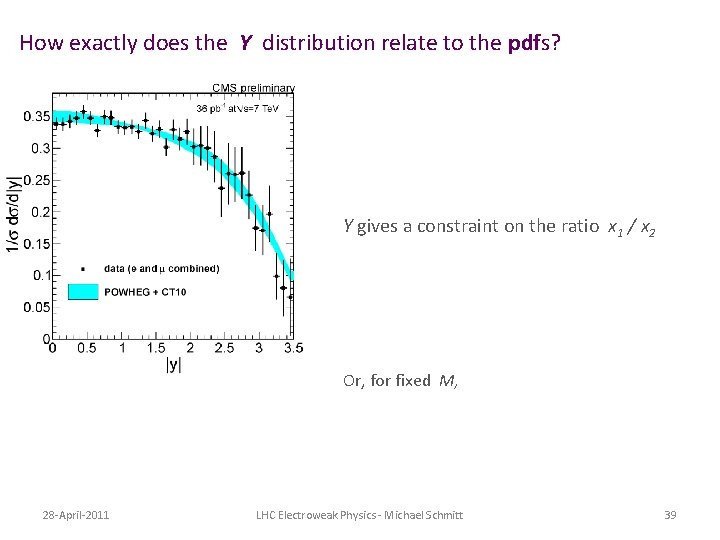
CMS have made the first measurement of ds/dy in 7 Te. V pp collisions: CMS PAS EWK-10 -010 28 -April-2011 LHC Electroweak Physics - Michael Schmitt 37
CDF √s = 1. 96 Te. V CMS √s = 7 Te. V an up-to-date PDF Notice that the CMS range in |Y| is significantly larger. The CMS error bars will diminish rapidly this year. Soon they will be good enough to constrain the PDFs… 28 -April-2011 LHC Electroweak Physics - Michael Schmitt 38
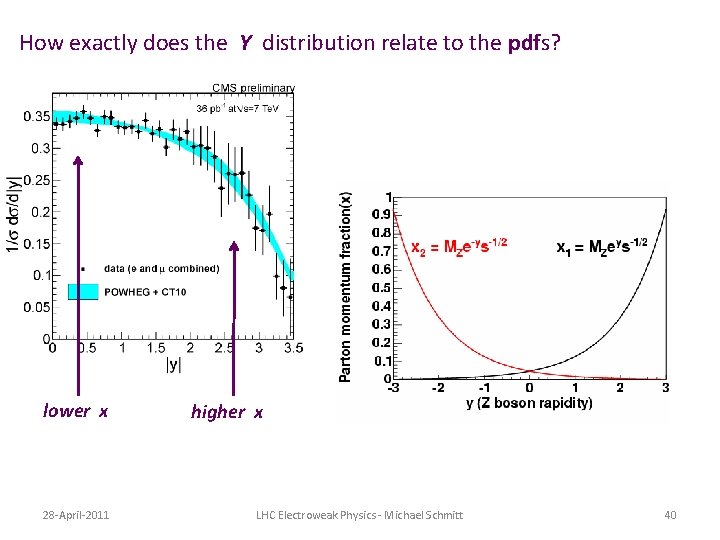
How exactly does the Y distribution relate to the pdfs? Y gives a constraint on the ratio x 1 / x 2 Or, for fixed M, 28 -April-2011 LHC Electroweak Physics - Michael Schmitt 39
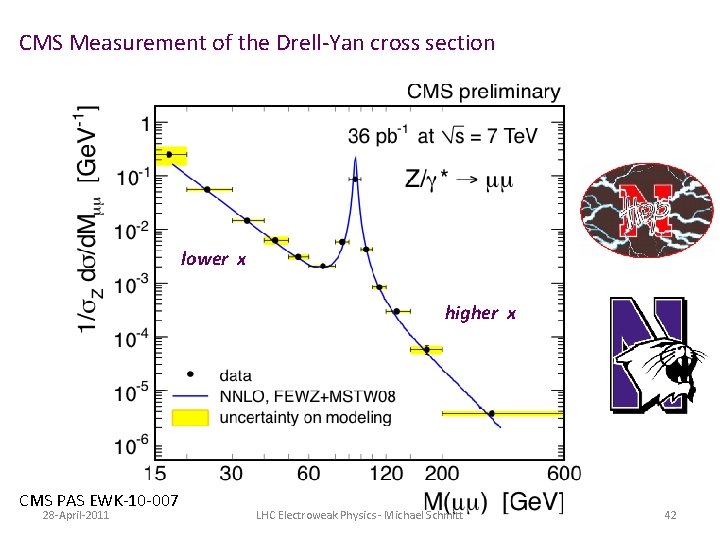
How exactly does the Y distribution relate to the pdfs? Y gives a constraint on the ratio x 1 / x 2 Or, for fixed M, lower x 28 -April-2011 higher x LHC Electroweak Physics - Michael Schmitt 40
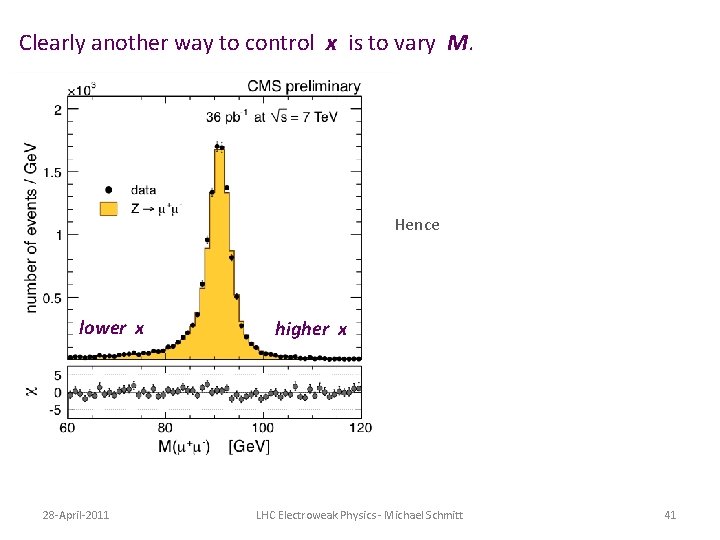
Clearly another way to control x is to vary M. Hence lower x 28 -April-2011 higher x LHC Electroweak Physics - Michael Schmitt 41
CMS Measurement of the Drell-Yan cross section lower x higher x CMS PAS EWK-10 -007 28 -April-2011 LHC Electroweak Physics - Michael Schmitt 42
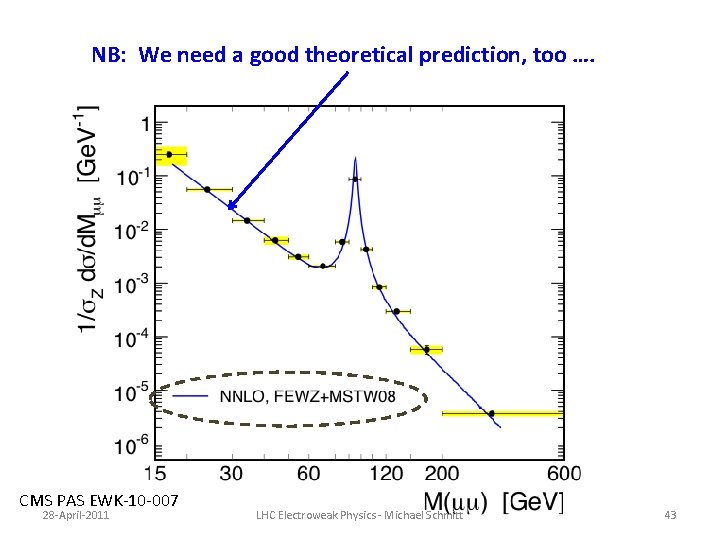
NB: We need a good theoretical prediction, too …. CMS PAS EWK-10 -007 28 -April-2011 LHC Electroweak Physics - Michael Schmitt 43
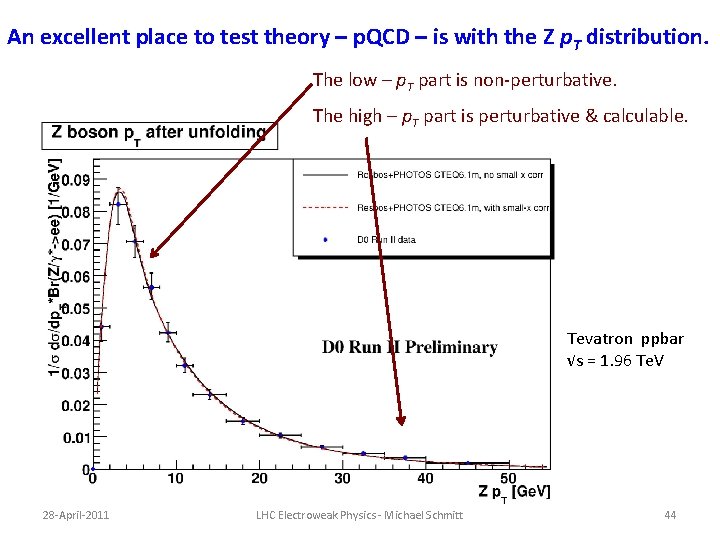
An excellent place to test theory – p. QCD – is with the Z p. T distribution. The low – p. T part is non-perturbative. The high – p. T part is perturbative & calculable. Tevatron ppbar √s = 1. 96 Te. V 28 -April-2011 LHC Electroweak Physics - Michael Schmitt 44
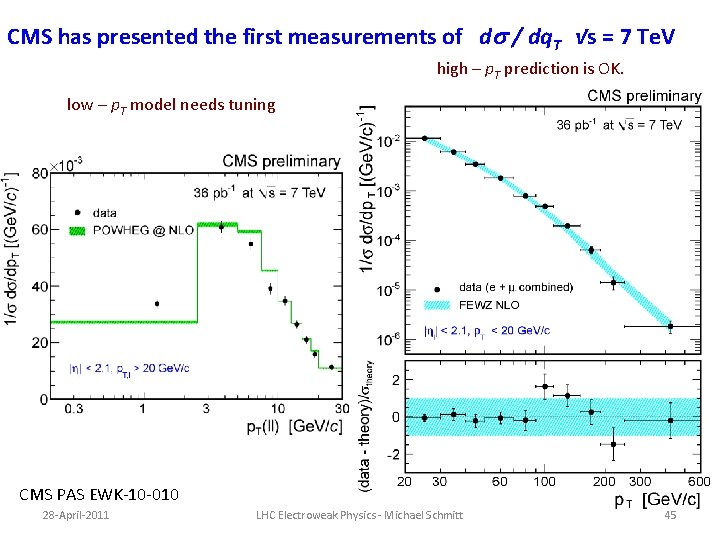
CMS has presented the first measurements of ds / dq. T √s = 7 Te. V high – p. T prediction is OK. low – p. T model needs tuning CMS PAS EWK-10 -010 28 -April-2011 LHC Electroweak Physics - Michael Schmitt 45
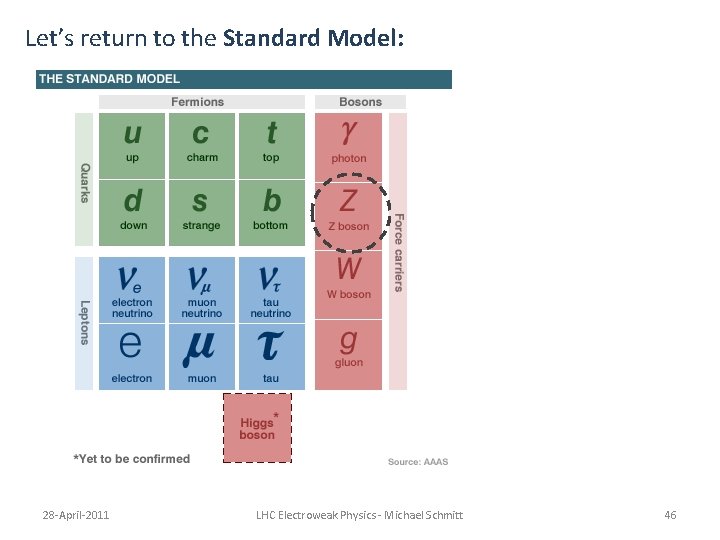
Let’s return to the Standard Model: 28 -April-2011 LHC Electroweak Physics - Michael Schmitt 46
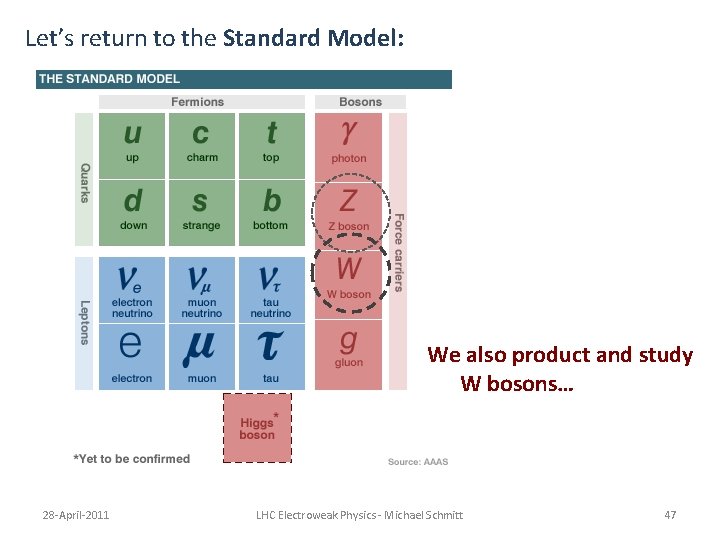
Let’s return to the Standard Model: We also product and study W bosons… 28 -April-2011 LHC Electroweak Physics - Michael Schmitt 47
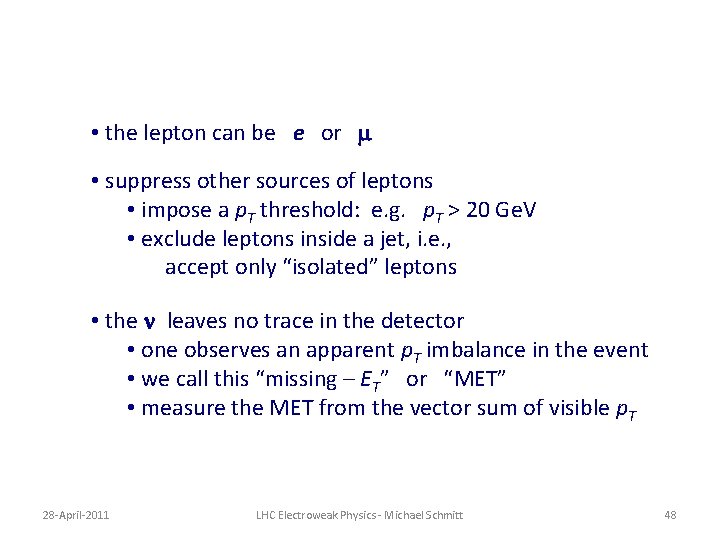
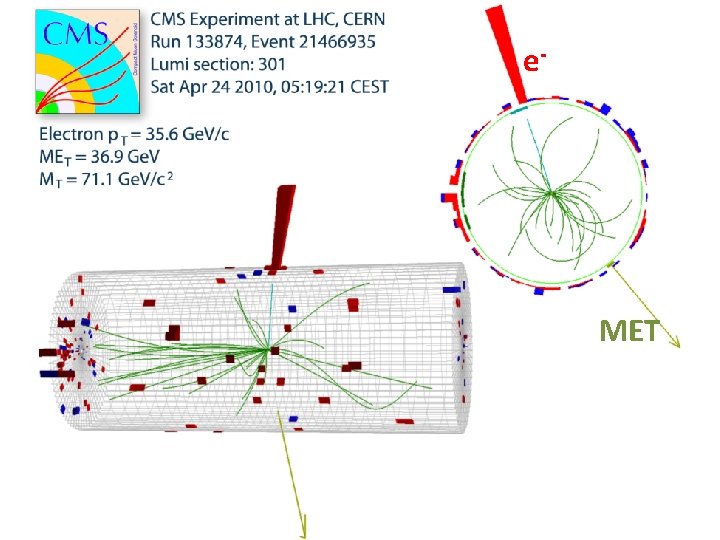
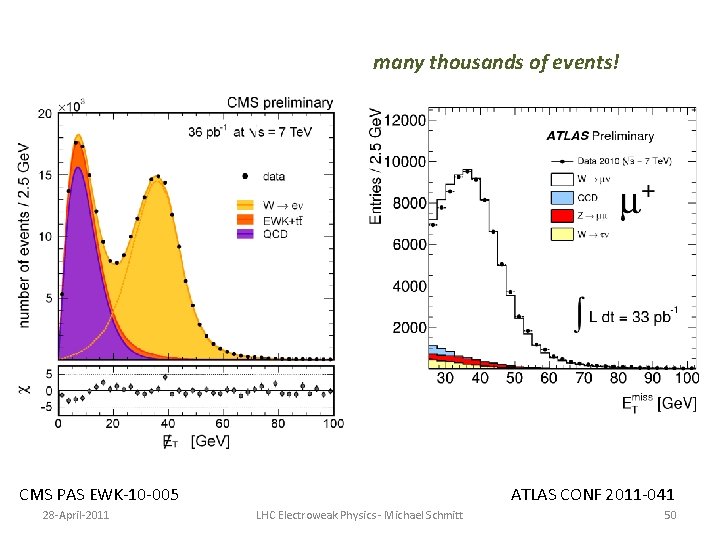
• the lepton can be e or m • suppress other sources of leptons • impose a p. T threshold: e. g. p. T > 20 Ge. V • exclude leptons inside a jet, i. e. , accept only “isolated” leptons • the n leaves no trace in the detector • one observes an apparent p. T imbalance in the event • we call this “missing – ET” or “MET” • measure the MET from the vector sum of visible p. T 28 -April-2011 LHC Electroweak Physics - Michael Schmitt 48
e- MET 28 -April-2011 LHC Electroweak Physics - Michael Schmitt 49
many thousands of events! CMS PAS EWK-10 -005 28 -April-2011 ATLAS CONF 2011 -041 LHC Electroweak Physics - Michael Schmitt 50
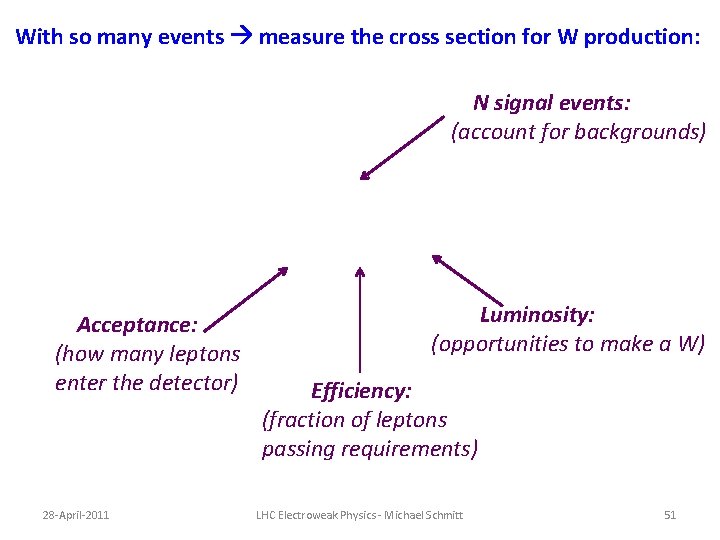
With so many events measure the cross section for W production: N signal events: (account for backgrounds) Acceptance: (how many leptons enter the detector) 28 -April-2011 Luminosity: (opportunities to make a W) Efficiency: (fraction of leptons passing requirements) LHC Electroweak Physics - Michael Schmitt 51
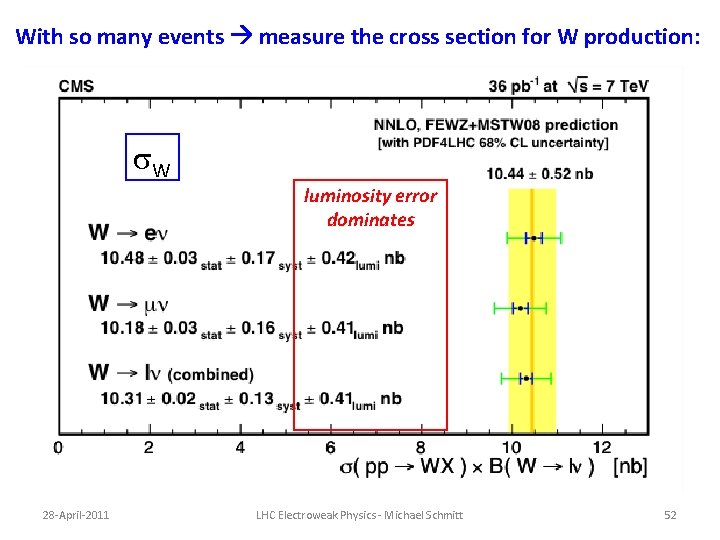
With so many events measure the cross section for W production: s. W luminosity error dominates 28 -April-2011 LHC Electroweak Physics - Michael Schmitt 52
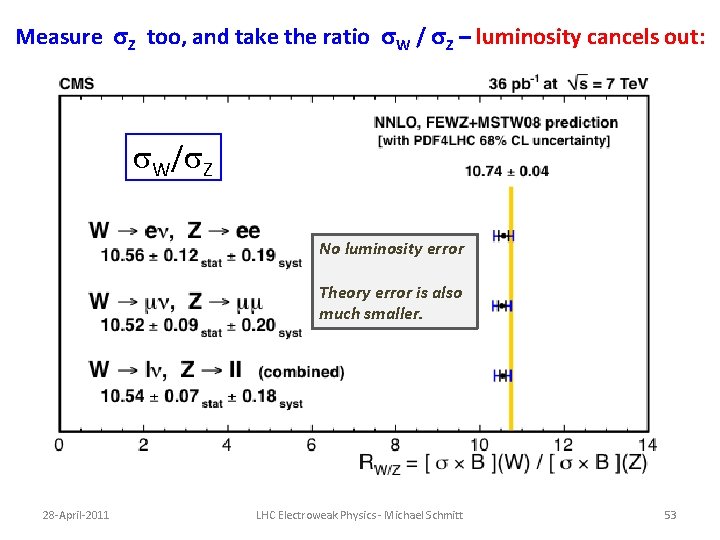
Measure s. Z too, and take the ratio s. W / s. Z – luminosity cancels out: s. W/s. Z No luminosity error Theory error is also much smaller. 28 -April-2011 LHC Electroweak Physics - Michael Schmitt 53
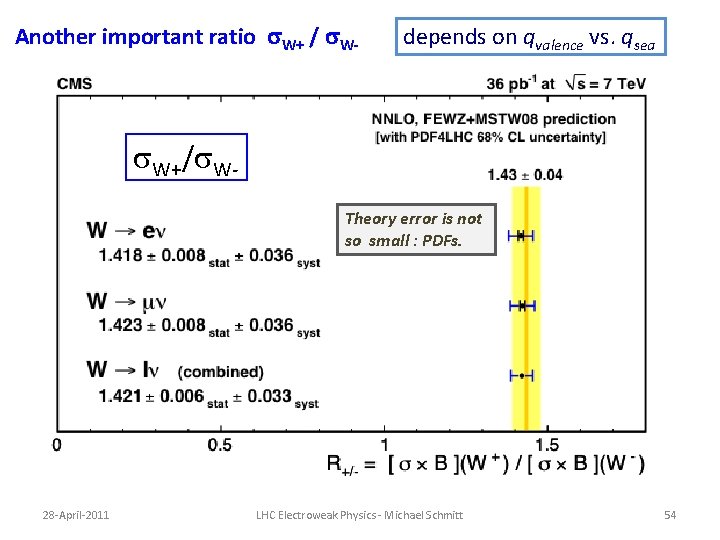
Another important ratio s. W+ / s. W- depends on qvalence vs. qsea s. W+/s. WTheory error is not so small : PDFs. 28 -April-2011 LHC Electroweak Physics - Michael Schmitt 54
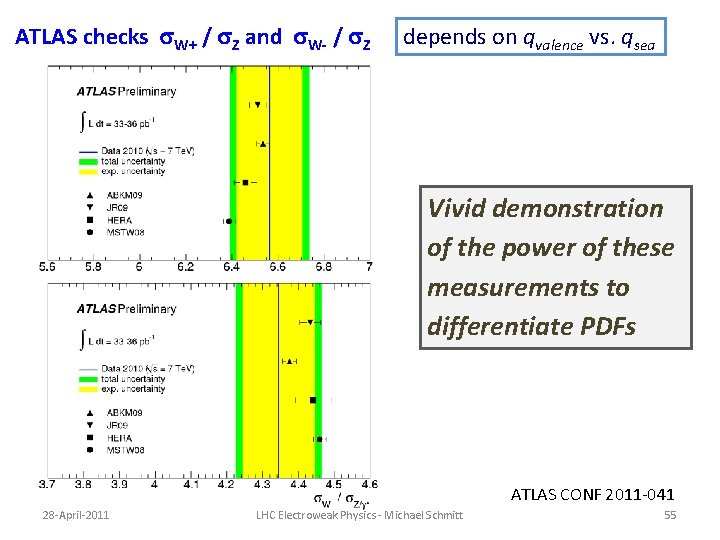
ATLAS checks s. W+ / s. Z and s. W- / s. Z depends on qvalence vs. qsea Vivid demonstration of the power of these measurements to differentiate PDFs ATLAS CONF 2011 -041 28 -April-2011 LHC Electroweak Physics - Michael Schmitt 55
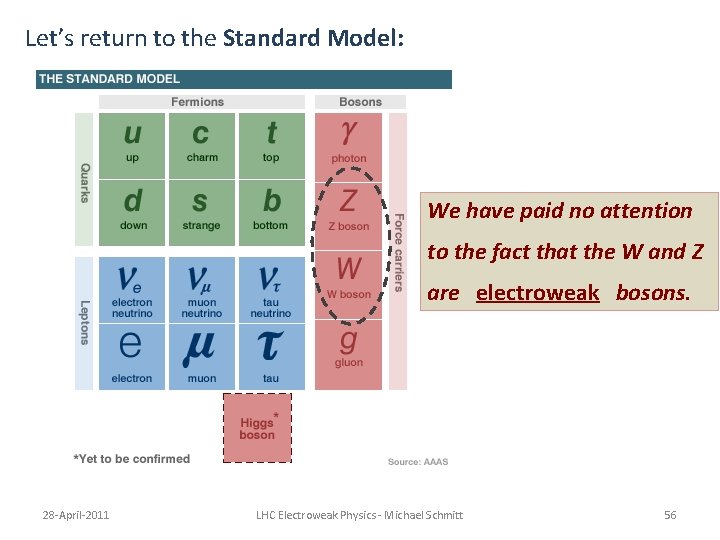
Let’s return to the Standard Model: We have paid no attention to the fact that the W and Z are electroweak bosons. 28 -April-2011 LHC Electroweak Physics - Michael Schmitt 56
Let’s return to the Standard Model: The W and Z are electroweak bosons. Key signature: parity violation 28 -April-2011 LHC Electroweak Physics - Michael Schmitt 57
Let’s return to the Standard Model: The W and Z are electroweak bosons. Key signature: parity violation for W: “V-A” coupling strongly favors for Z: 28 -April-2011 over more complicated – relative couplings for vs. depends on the fermion and a universal parameter LHC Electroweak Physics - Michael Schmitt 58
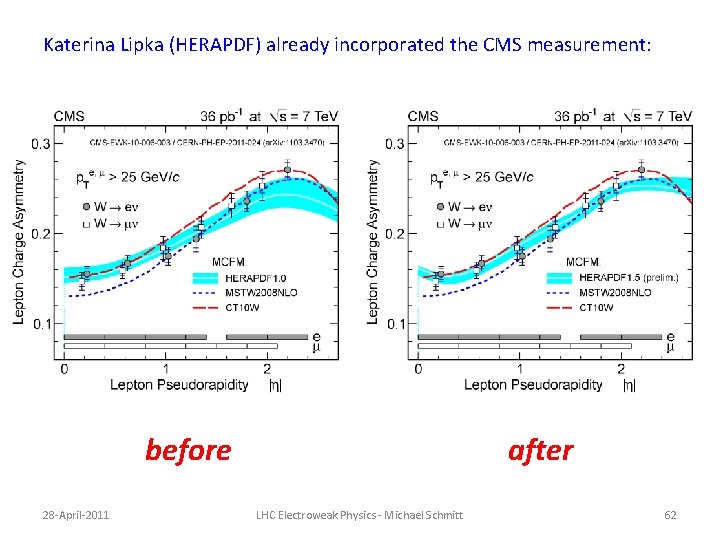
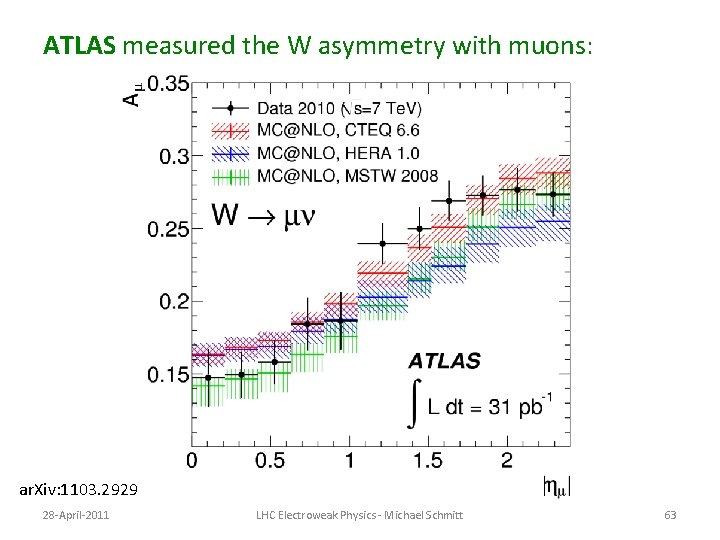
W charge asymmetry Clearly has something to say about u(x) vs. d(x). (Recall that the quark is mainly from the valence distribution, while the anti-quark is from the sea. Mainly. ) 28 -April-2011 LHC Electroweak Physics - Michael Schmitt 59
W charge asymmetry parity violation (PV) occurs at the production and at the decay interesting twist: (forward) W production is polarized due to PV at production, so there is a strong asymmetry in the lepton decay distribution (in the W rest frame) the lepton charge asymmetry is useful 28 -April-2011 LHC Electroweak Physics - Michael Schmitt 60
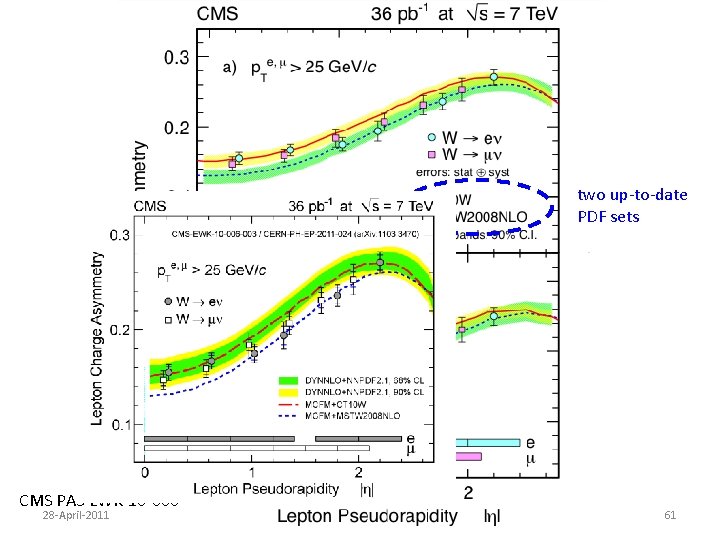
two up-to-date PDF sets CMS PAS EWK-10 -006 28 -April-2011 LHC Electroweak Physics - Michael Schmitt 61
Katerina Lipka (HERAPDF) already incorporated the CMS measurement: before 28 -April-2011 after LHC Electroweak Physics - Michael Schmitt 62
ATLAS measured the W asymmetry with muons: ar. Xiv: 1103. 2929 28 -April-2011 LHC Electroweak Physics - Michael Schmitt 63
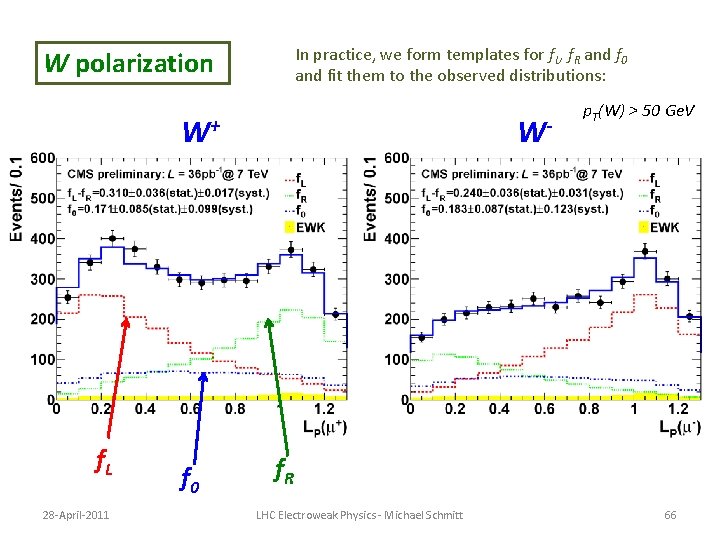
W polarization This is a bona fide PV effect. It is something new – it has not been seen at the Tevatron. i. e. , W + 1 -jet i. e. , high – p. T W The W will tend to be left-polarized. 28 -April-2011 LHC Electroweak Physics - Michael Schmitt 64
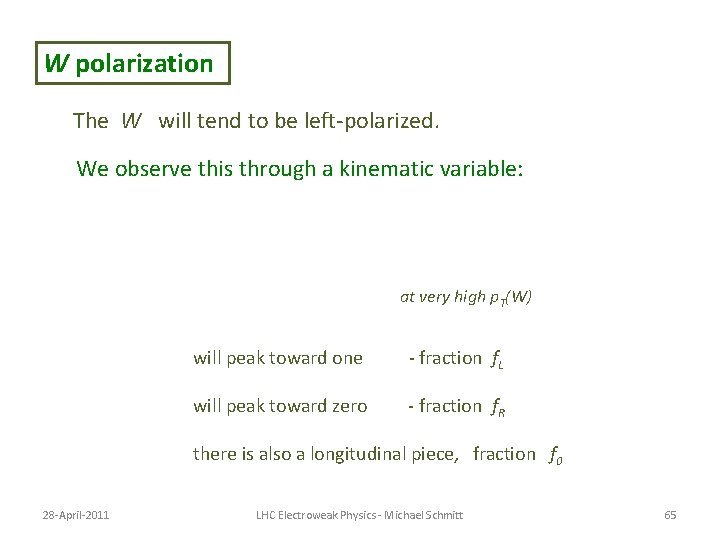
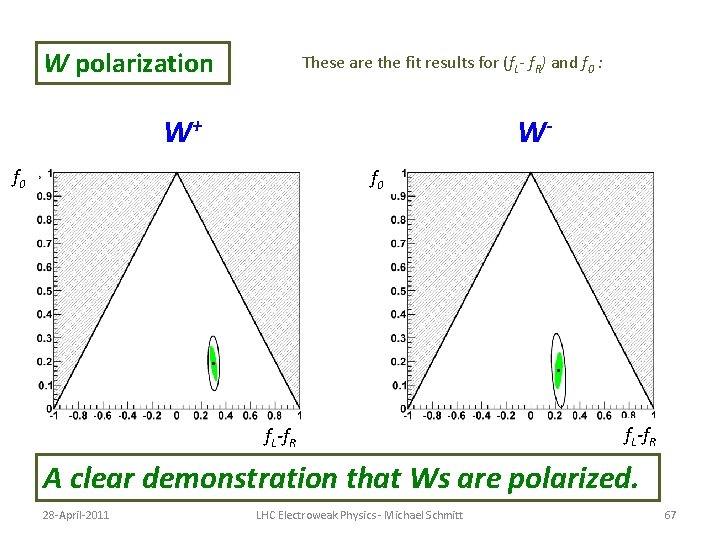
W polarization The W will tend to be left-polarized. We observe this through a kinematic variable: at very high p. T(W) will peak toward one - fraction f. L will peak toward zero - fraction f. R there is also a longitudinal piece, fraction f 0 28 -April-2011 LHC Electroweak Physics - Michael Schmitt 65
In practice, we form templates for f. L, f. R and f 0 and fit them to the observed distributions: W polarization W+ f. L 28 -April-2011 f 0 W- p. T(W) > 50 Ge. V f. R LHC Electroweak Physics - Michael Schmitt 66
W polarization These are the fit results for (f. L- f. R) and f 0 : W+ W- f 0 f. L-f. R A clear demonstration that Ws are polarized. 28 -April-2011 LHC Electroweak Physics - Michael Schmitt 67
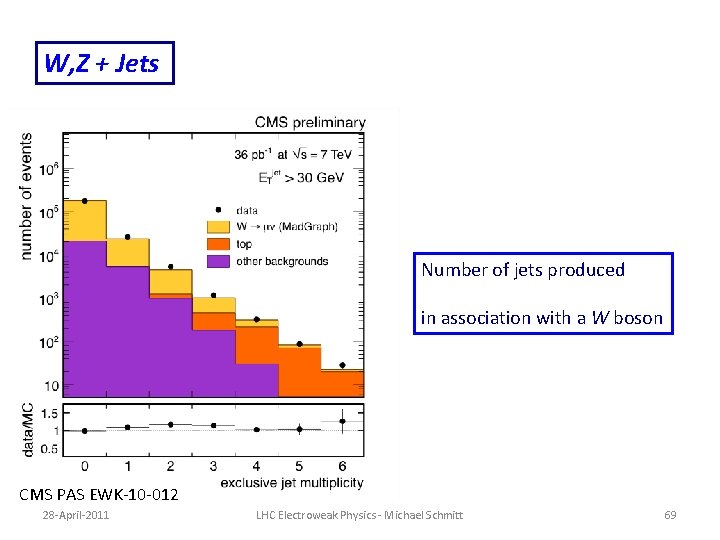
W, Z + Jets Those W bosons must be recoiling against something. jets How well do we know the multiplicity and energy spectrum of those jets? measure This is an important test of p. QCD. 28 -April-2011 LHC Electroweak Physics - Michael Schmitt 68
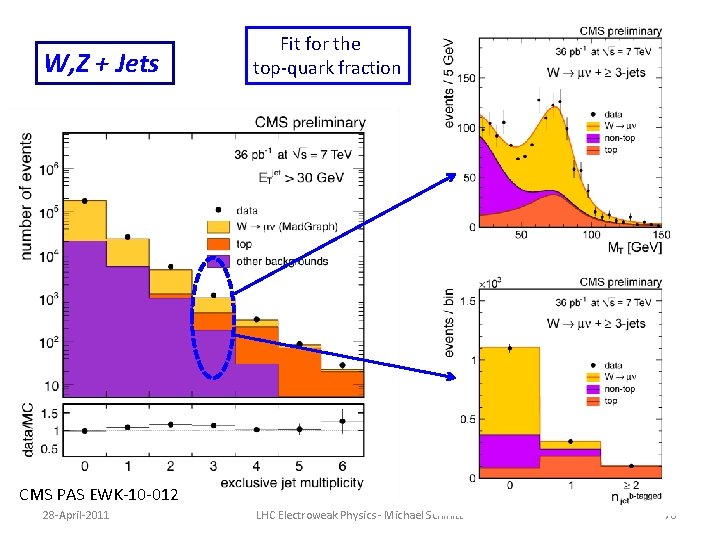
W, Z + Jets Number of jets produced in association with a W boson CMS PAS EWK-10 -012 28 -April-2011 LHC Electroweak Physics - Michael Schmitt 69
W, Z + Jets Fit for the top-quark fraction CMS PAS EWK-10 -012 28 -April-2011 LHC Electroweak Physics - Michael Schmitt 70
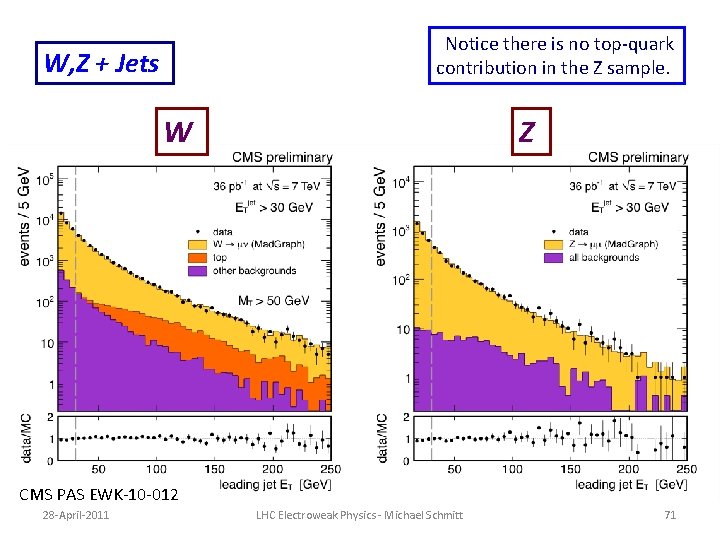
Notice there is no top-quark contribution in the Z sample. W, Z + Jets W Z CMS PAS EWK-10 -012 28 -April-2011 LHC Electroweak Physics - Michael Schmitt 71
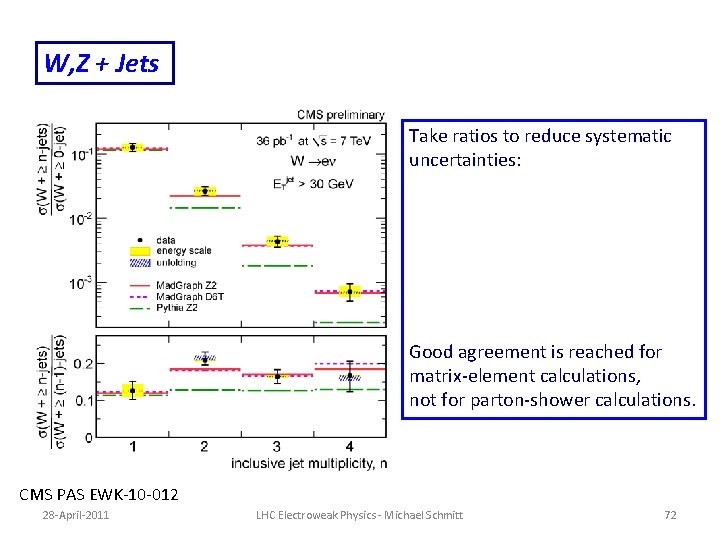
W, Z + Jets Take ratios to reduce systematic uncertainties: Good agreement is reached for matrix-element calculations, not for parton-shower calculations. CMS PAS EWK-10 -012 28 -April-2011 LHC Electroweak Physics - Michael Schmitt 72
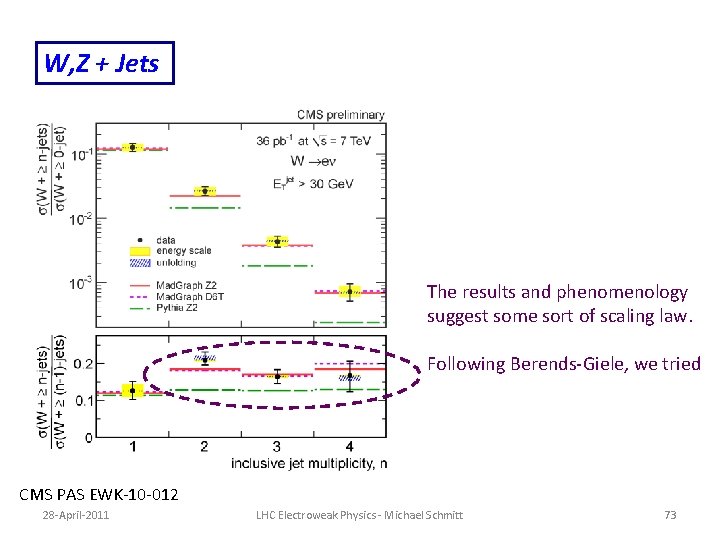
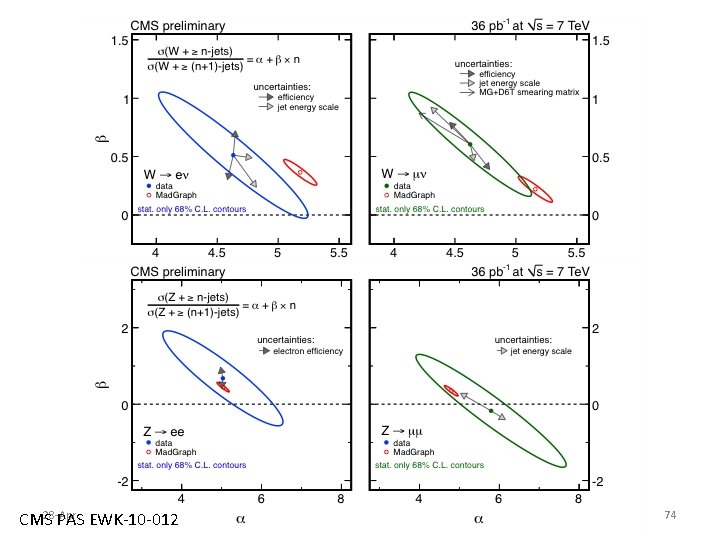
W, Z + Jets The results and phenomenology suggest some sort of scaling law. Following Berends-Giele, we tried CMS PAS EWK-10 -012 28 -April-2011 LHC Electroweak Physics - Michael Schmitt 73
28 -April-2011 CMS PAS EWK-10 -012 LHC Electroweak Physics - Michael Schmitt 74
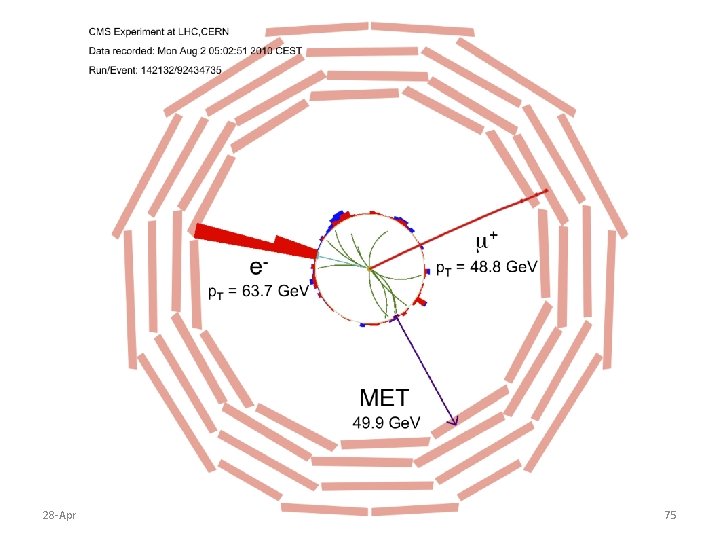
Take a look at this event … 28 -April-2011 LHC Electroweak Physics - Michael Schmitt 75
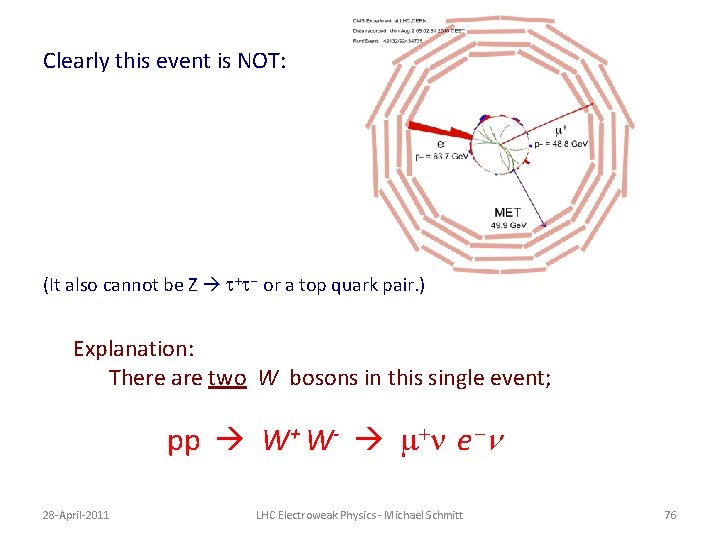
Clearly this event is NOT: (It also cannot be Z t+t- or a top quark pair. ) Explanation: There are two W bosons in this single event; pp W+ W- m+n e-n 28 -April-2011 LHC Electroweak Physics - Michael Schmitt 76
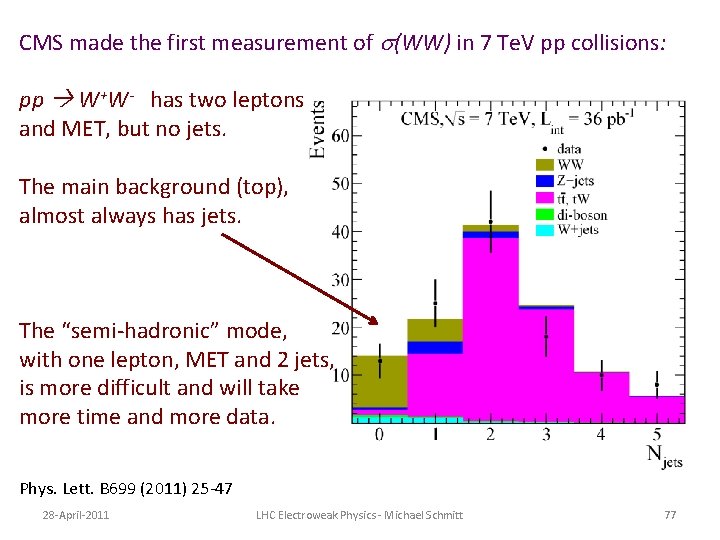
CMS made the first measurement of s(WW) in 7 Te. V pp collisions: pp W+W- has two leptons and MET, but no jets. The main background (top), almost always has jets. The “semi-hadronic” mode, with one lepton, MET and 2 jets, is more difficult and will take more time and more data. Phys. Lett. B 699 (2011) 25 -47 28 -April-2011 LHC Electroweak Physics - Michael Schmitt 77
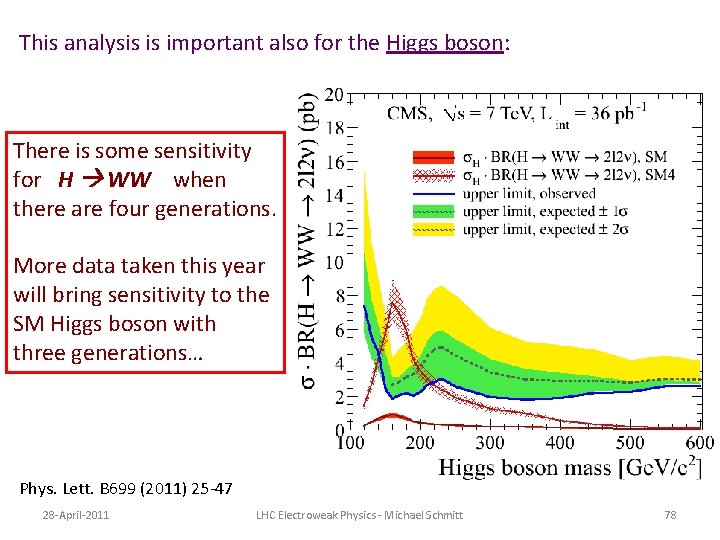
This analysis is important also for the Higgs boson: There is some sensitivity for H WW when there are four generations. More data taken this year will bring sensitivity to the SM Higgs boson with three generations… Phys. Lett. B 699 (2011) 25 -47 28 -April-2011 LHC Electroweak Physics - Michael Schmitt 78
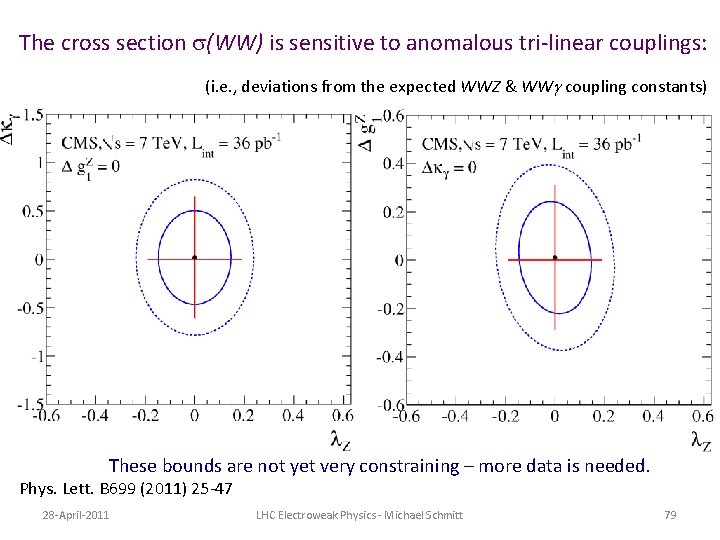
The cross section s(WW) is sensitive to anomalous tri-linear couplings: (i. e. , deviations from the expected WWZ & WWg coupling constants) These bounds are not yet very constraining – more data is needed. Phys. Lett. B 699 (2011) 25 -47 28 -April-2011 LHC Electroweak Physics - Michael Schmitt 79
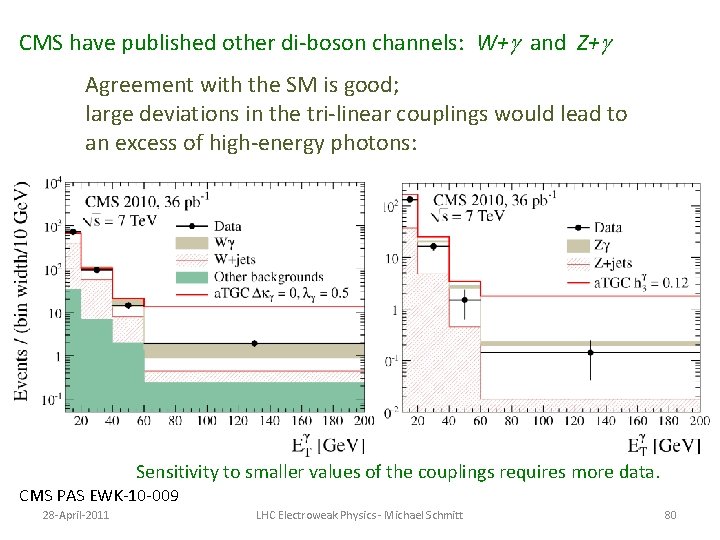
CMS have published other di-boson channels: W+g and Z+g Agreement with the SM is good; large deviations in the tri-linear couplings would lead to an excess of high-energy photons: Sensitivity to smaller values of the couplings requires more data. CMS PAS EWK-10 -009 28 -April-2011 LHC Electroweak Physics - Michael Schmitt 80
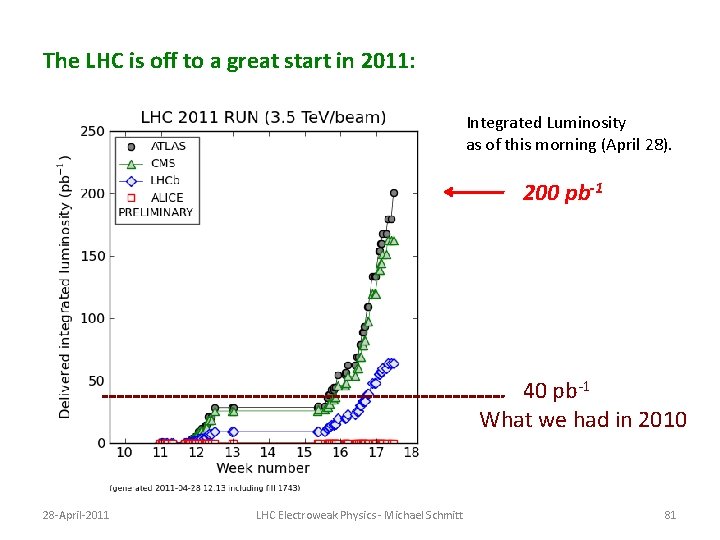
The LHC is off to a great start in 2011: Integrated Luminosity as of this morning (April 28). 200 pb-1 40 pb-1 What we had in 2010 28 -April-2011 LHC Electroweak Physics - Michael Schmitt 81
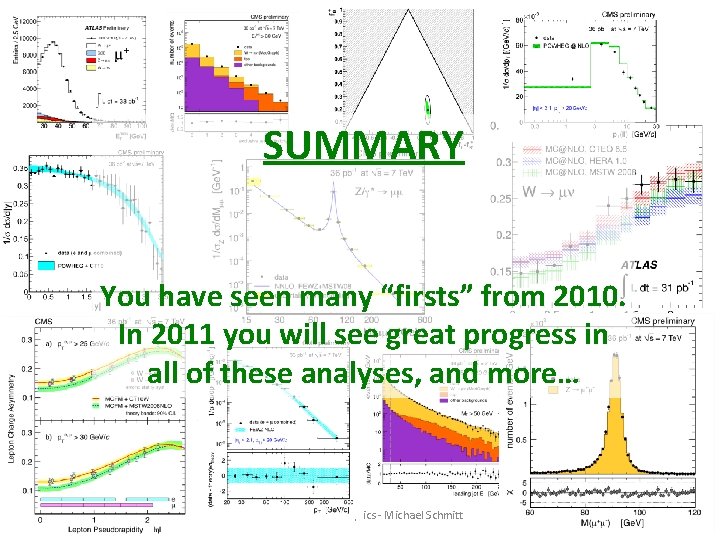
SUMMARY You have seen many “firsts” from 2010. In 2011 you will see great progress in all of these analyses, and more… 28 -April-2011 LHC Electroweak Physics - Michael Schmitt 82