
Exotica at the LHC UK HEP Forum Abingdon
Exotica at the LHC UK HEP Forum, Abingdon Ian Tomalin (RAL) 3/3/2021 1
Introduction v LHC exotica searches offer real possibilities of exciting discoveries this year ! I will: 1. Summarize UK interests 2. Review all the public CMS/ATLAS exotica results. (probably the last time it will be possible to do this in one talk. . . ) 3. Look at what we can expect in the near future. Ian Tomalin (RAL) 3/3/2021 2
UK Exotica Interests The UK has provided both ATLAS & CMS exotica conveners: v ATLAS: Cigdem Issever (Oxford) v CMS: Chris Hill (formally Bristol) and is pursuing many analyses: CMS: Stopped Gluinos (Bristol), Z’ e+e- (Bristol/RAL) , Displaced Fermions (RAL), Boosted Z from q*. . . (RAL) ATLAS: Black holes & Extra Dimensions (Cambridge/Oxford), Z’ e+e- (RHUL), q* dijets (Oxford/Glasgow) , G gg (Liverpool), Boosted Top from Z’ (Oxford/UCL). . . + those I missed ! Ian Tomalin (RAL) 3/3/2021 3
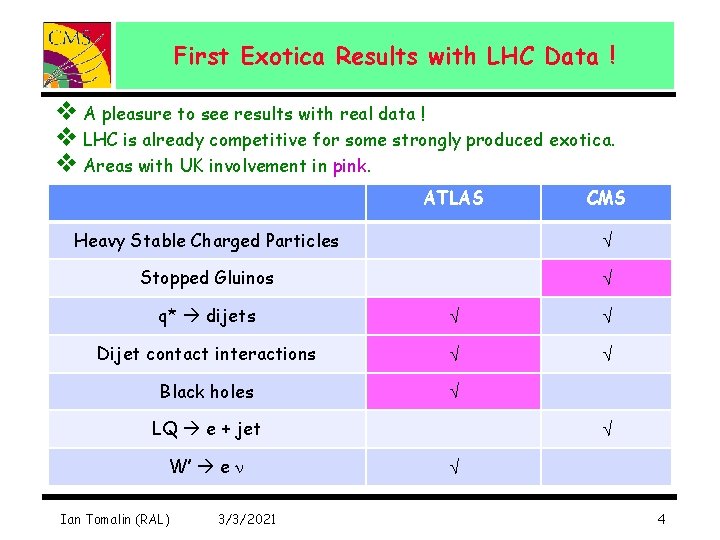
First Exotica Results with LHC Data ! v A pleasure to see results with real data ! v LHC is already competitive for some strongly produced exotica. v Areas with UK involvement in pink. ATLAS CMS Heavy Stable Charged Particles Stopped Gluinos q* dijets Dijet contact interactions Black holes LQ e + jet W’ e n Ian Tomalin (RAL) 3/3/2021 4
Search for Heavy Stable Charged Particles (CMS) Theoretical Models v Gluino in Split-SUSY. (Squarks very heavy, so gluino can only decay v via virtual squarks). Stop is NLSP (so can only decay radiatively to charm + neutralino). Both hadronize to R-hadrons. These are highly ionizing in the Tracker and look like muons in the calorimeters. They can flip charge whilst Traversing CMS ! Trigger & Selection § Muon trigger, supplemented by MET and Jet triggers in case of charge flip. § Select high Pt track with large d. E/dx in Tracker, optionally also requiring muon ID. (Later analyses will also use time-of-flight info). Ian Tomalin (RAL) 3/3/2021 5
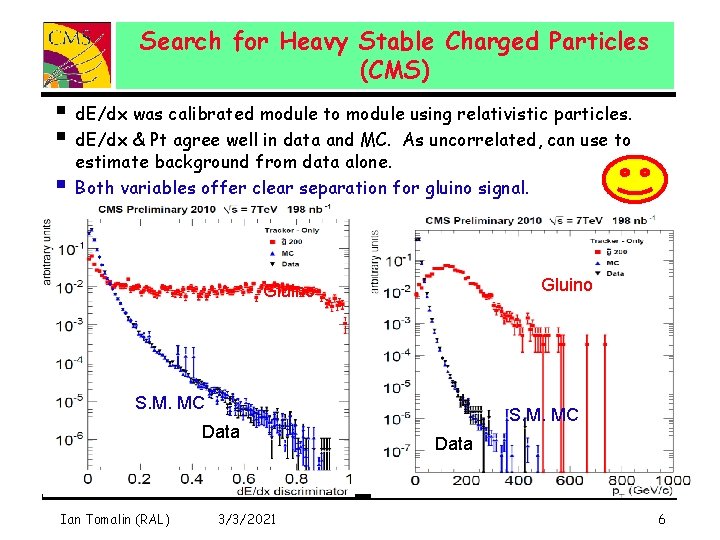
Search for Heavy Stable Charged Particles (CMS) § § § d. E/dx was calibrated module to module using relativistic particles. d. E/dx & Pt agree well in data and MC. As uncorrelated, can use to estimate background from data alone. Both variables offer clear separation for gluino signal. Gluino S. M. MC Data Ian Tomalin (RAL) 3/3/2021 S. M. MC Data 6
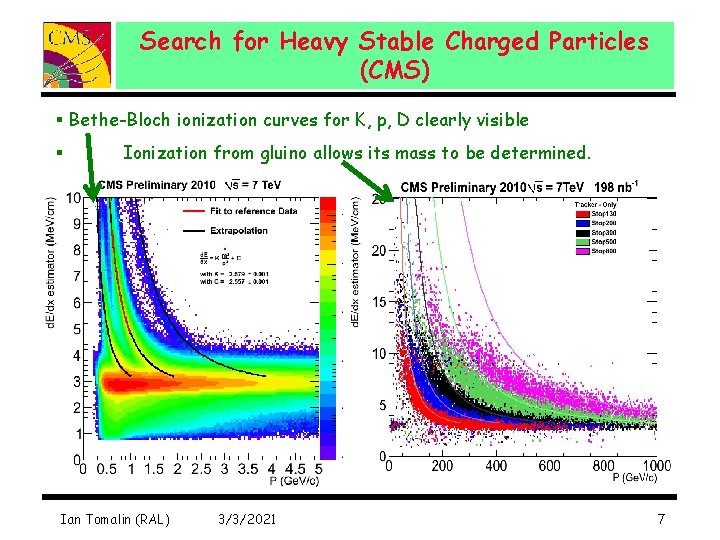
Search for Heavy Stable Charged Particles (CMS) § Bethe-Bloch ionization curves for K, p, D clearly visible § Ionization from gluino allows its mass to be determined. Ian Tomalin (RAL) 3/3/2021 7
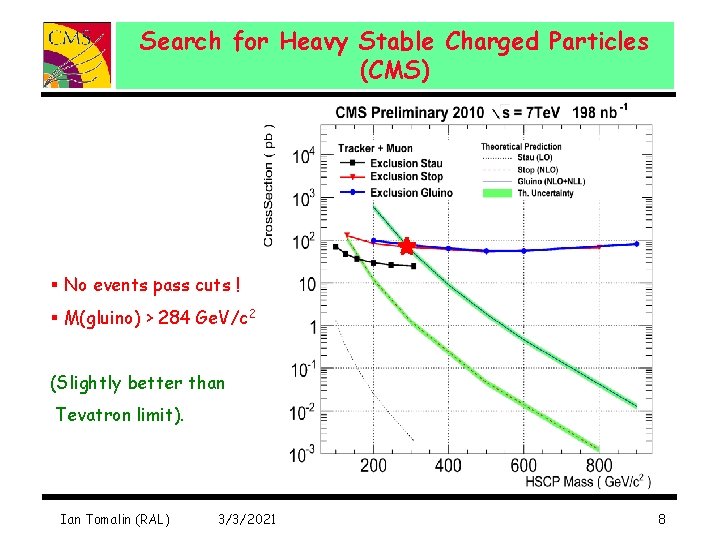
Search for Heavy Stable Charged Particles (CMS) § No events pass cuts ! § M(gluino) > 284 Ge. V/c 2 (Slightly better than Tevatron limit). Ian Tomalin (RAL) 3/3/2021 8
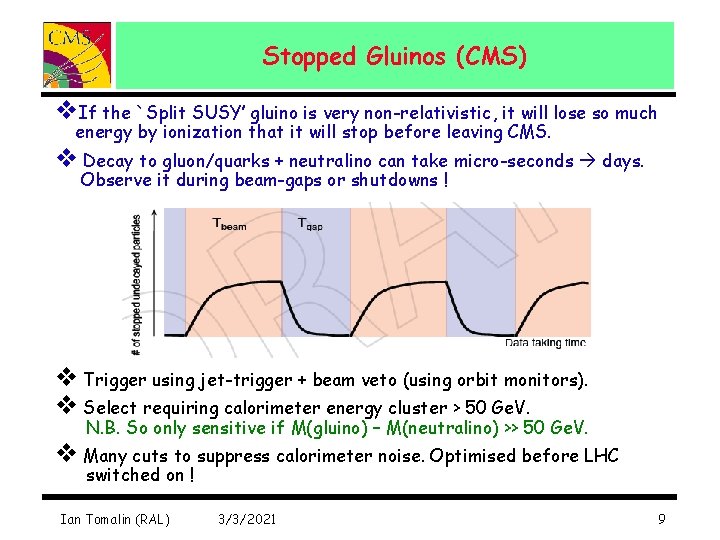
Stopped Gluinos (CMS) v. If the `Split SUSY’ gluino is very non-relativistic, it will lose so much energy by ionization that it will stop before leaving CMS. v Decay to gluon/quarks + neutralino can take micro-seconds days. Observe it during beam-gaps or shutdowns ! v Trigger using jet-trigger + beam veto (using orbit monitors). v Select requiring calorimeter energy cluster > 50 Ge. V. N. B. So only sensitive if M(gluino) – M(neutralino) >> 50 Ge. V. v Many cuts to suppress calorimeter noise. Optimised before LHC switched on ! Ian Tomalin (RAL) 3/3/2021 9
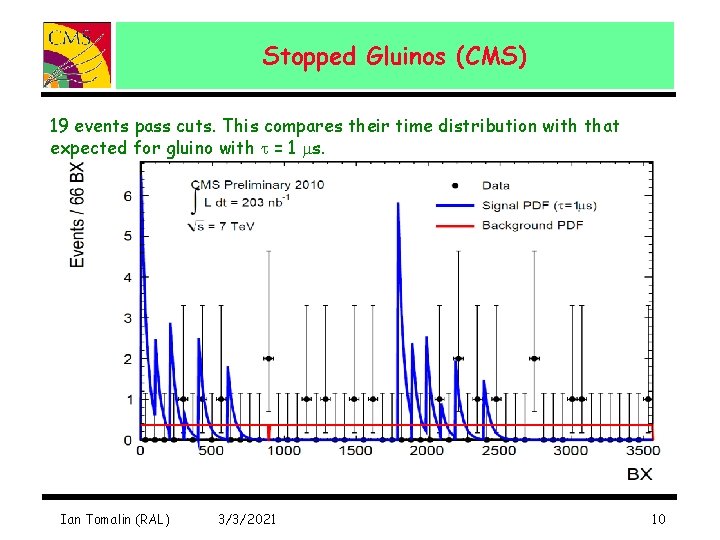
Stopped Gluinos (CMS) 19 events pass cuts. This compares their time distribution with that expected for gluino with t = 1 ms. Ian Tomalin (RAL) 3/3/2021 10
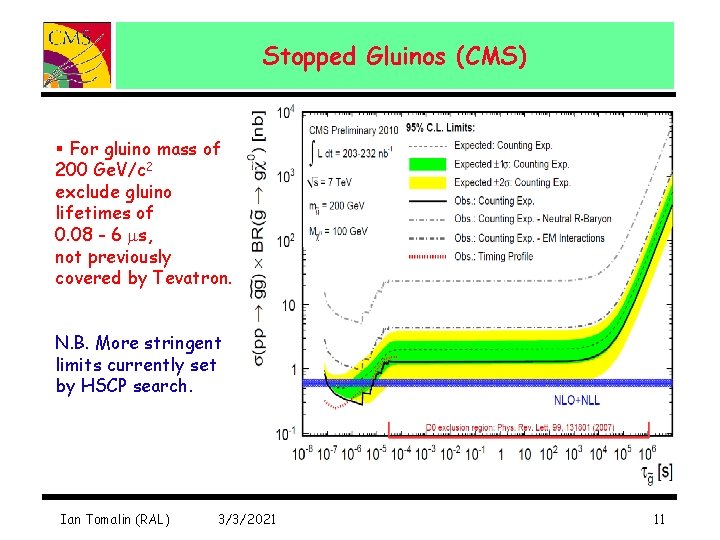
Stopped Gluinos (CMS) § For gluino mass of 200 Ge. V/c 2 exclude gluino lifetimes of 0. 08 - 6 ms, not previously covered by Tevatron. N. B. More stringent limits currently set by HSCP search. Ian Tomalin (RAL) 3/3/2021 11
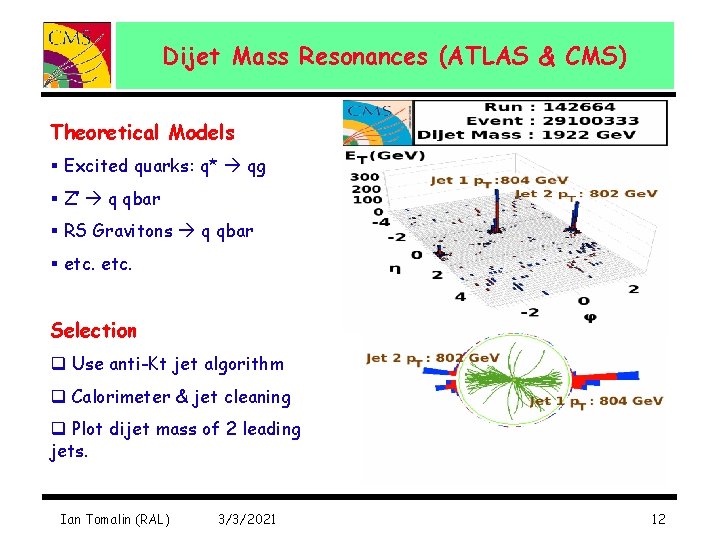
Dijet Mass Resonances (ATLAS & CMS) Theoretical Models § Excited quarks: q* qg § Z’ q qbar § RS Gravitons q qbar § etc. Selection q Use anti-Kt jet algorithm q Calorimeter & jet cleaning q Plot dijet mass of 2 leading jets. Ian Tomalin (RAL) 3/3/2021 12
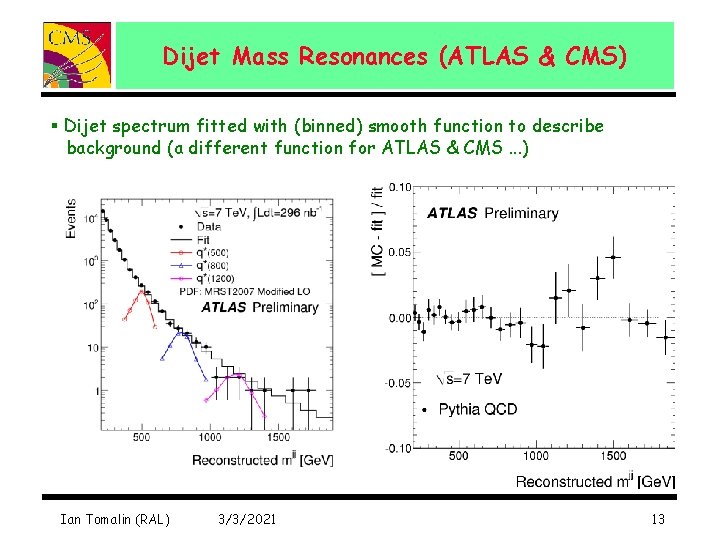
Dijet Mass Resonances (ATLAS & CMS) § Dijet spectrum fitted with (binned) smooth function to describe background (a different function for ATLAS & CMS. . . ) Ian Tomalin (RAL) 3/3/2021 13
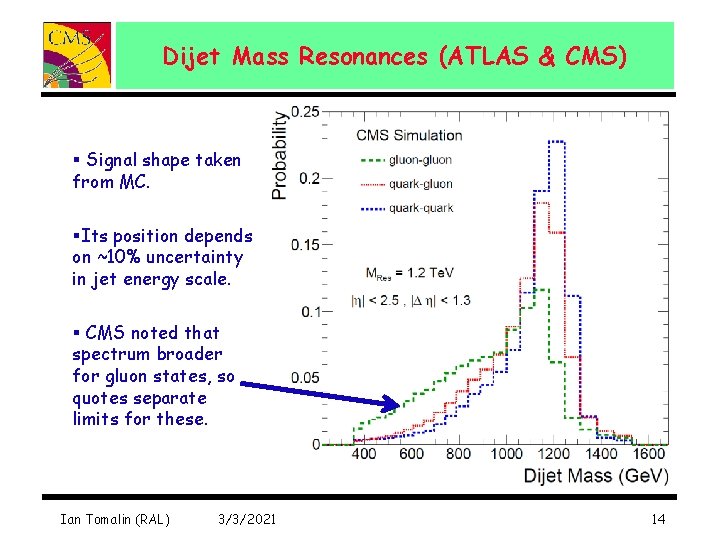
Dijet Mass Resonances (ATLAS & CMS) § Signal shape taken from MC. §Its position depends on ~10% uncertainty in jet energy scale. § CMS noted that spectrum broader for gluon states, so quotes separate limits for these. Ian Tomalin (RAL) 3/3/2021 14
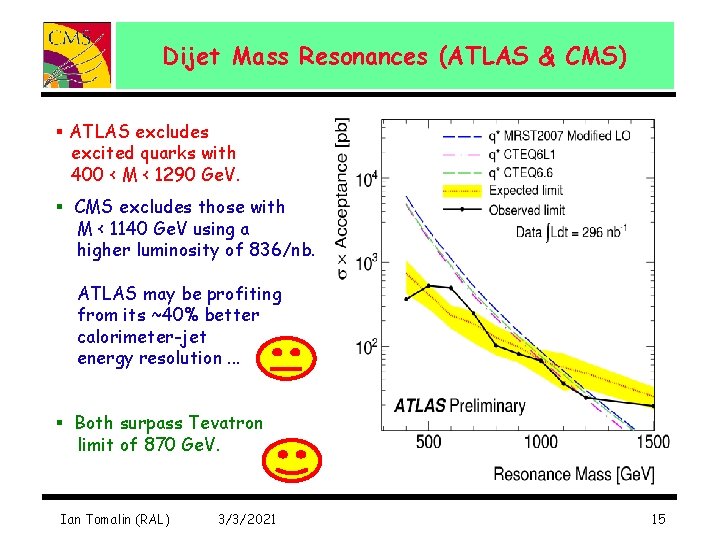
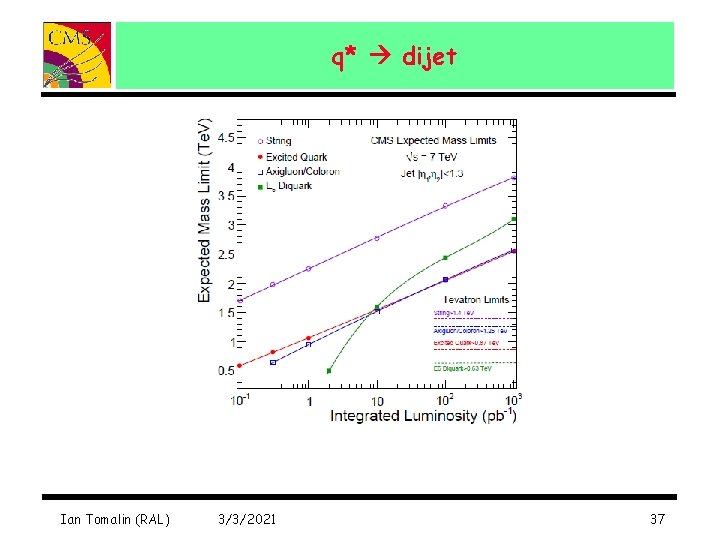
Dijet Mass Resonances (ATLAS & CMS) § ATLAS excludes excited quarks with 400 < M < 1290 Ge. V. § CMS excludes those with M < 1140 Ge. V using a higher luminosity of 836/nb. ATLAS may be profiting from its ~40% better calorimeter-jet energy resolution. . . § Both surpass Tevatron limit of 870 Ge. V. Ian Tomalin (RAL) 3/3/2021 15
Dijet Angular Distribution (ATLAS & CMS) Motivation v Z’ etc. whose mass exceeds the √s of the partons will not be seen as a resonance, but will modify the dijet spectra. v The effect can be parametrized as `contact interaction’. v v Changes to the dijet mass spectrum hard to distinguish from systematics. Better to plot `dijet centrality ratio’ vs. dijet mass so systematics cancel: N_dijets(| | < 0. 7) / N_dijets(0. 7 < | | < 1. 3) Flat for QCD, whereas exotica produced mainly in central region. Ian Tomalin (RAL) 3/3/2021 16
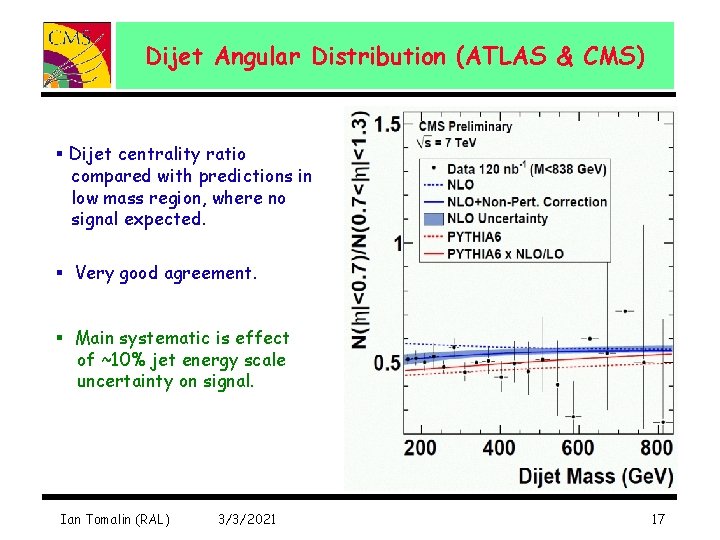
Dijet Angular Distribution (ATLAS & CMS) § Dijet centrality ratio compared with predictions in low mass region, where no signal expected. § Very good agreement. § Main systematic is effect of ~10% jet energy scale uncertainty on signal. Ian Tomalin (RAL) 3/3/2021 17
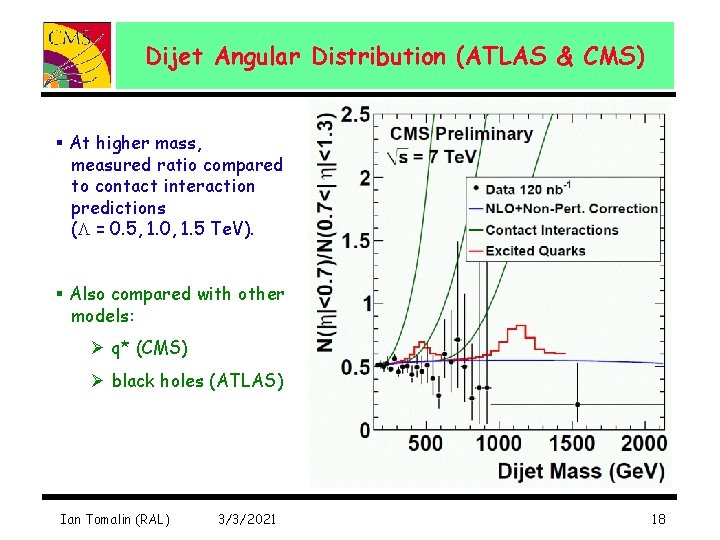
Dijet Angular Distribution (ATLAS & CMS) § At higher mass, measured ratio compared to contact interaction predictions (L = 0. 5, 1. 0, 1. 5 Te. V). § Also compared with other models: Ø q* (CMS) Ø black holes (ATLAS) Ian Tomalin (RAL) 3/3/2021 18
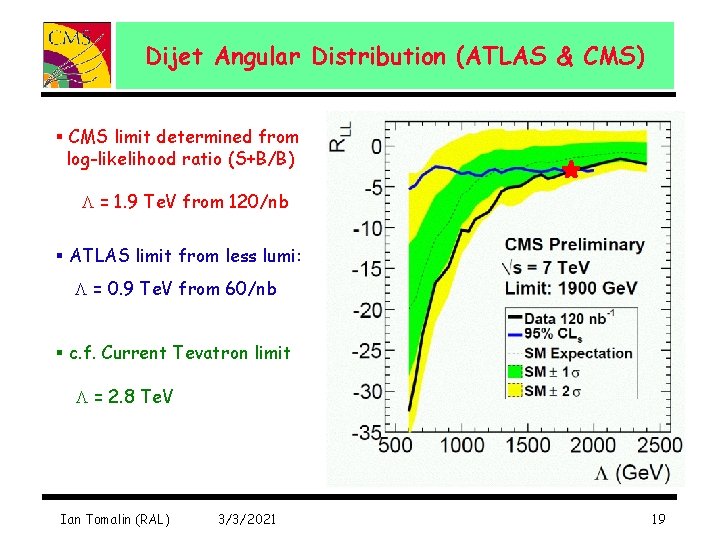
Dijet Angular Distribution (ATLAS & CMS) § CMS limit determined from log-likelihood ratio (S+B/B) L = 1. 9 Te. V from 120/nb § ATLAS limit from less lumi: L = 0. 9 Te. V from 60/nb § c. f. Current Tevatron limit L = 2. 8 Te. V Ian Tomalin (RAL) 3/3/2021 19
Black Holes & High Mass, Many Body Events (ATLAS) Theory v In ADD models, gravity propagates in additional spatial dimensions, which can have a size of up to millimetres. . v Below these distance scales, gravity rapidly becomes stronger, leading to an effective Planck mass MD far below normal. v Tevatron says MD > 800 Ge. V v As gravity couples to energy (not mass !), black holes evaporate democratically to all fermion/boson species. Many body final state. v Other exotica will also give many body final state. . . Ian Tomalin (RAL) 3/3/2021 20
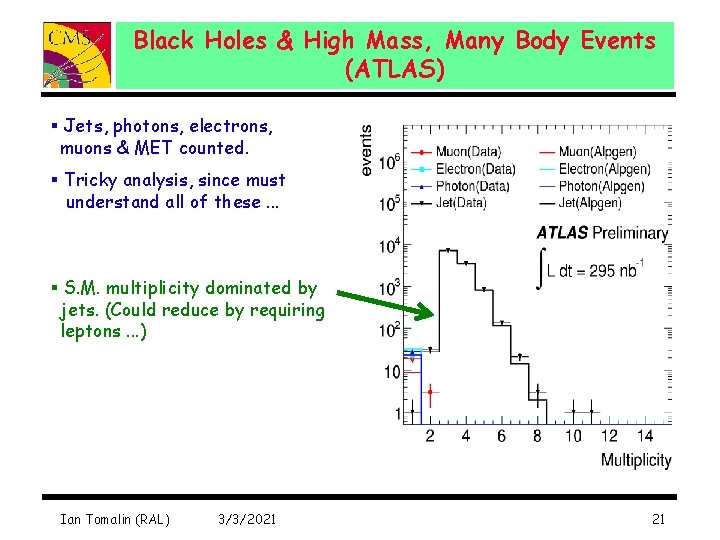
Black Holes & High Mass, Many Body Events (ATLAS) § Jets, photons, electrons, muons & MET counted. § Tricky analysis, since must understand all of these. . . § S. M. multiplicity dominated by jets. (Could reduce by requiring leptons. . . ) Ian Tomalin (RAL) 3/3/2021 21
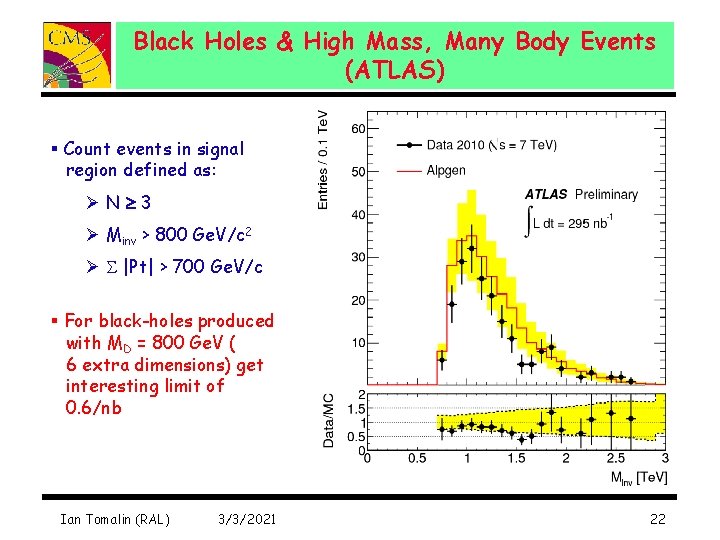
Black Holes & High Mass, Many Body Events (ATLAS) § Count events in signal region defined as: ØN 3 Ø Minv > 800 Ge. V/c 2 Ø |Pt| > 700 Ge. V/c § For black-holes produced with MD = 800 Ge. V ( 6 extra dimensions) get interesting limit of 0. 6/nb Ian Tomalin (RAL) 3/3/2021 22
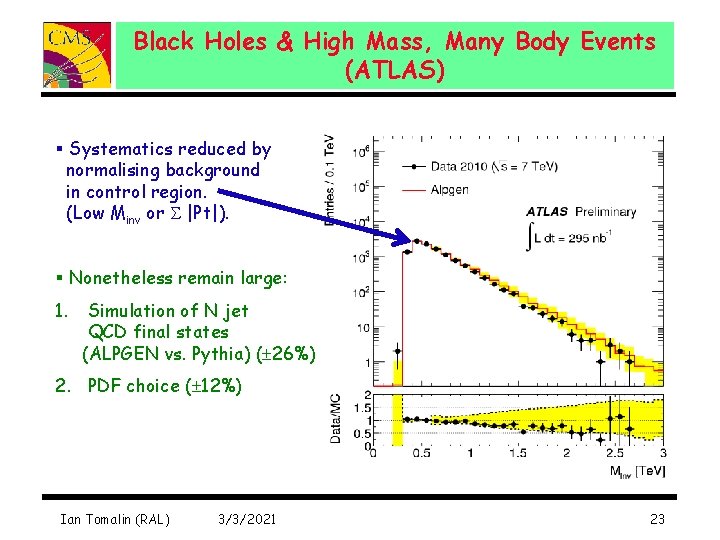
Black Holes & High Mass, Many Body Events (ATLAS) § Systematics reduced by normalising background in control region. (Low Minv or |Pt|). § Nonetheless remain large: 1. Simulation of N jet QCD final states (ALPGEN vs. Pythia) ( 26%) 2. PDF choice ( 12%) Ian Tomalin (RAL) 3/3/2021 23
Leptoquarks (CMS) Theory v gluon LQ pair has high cross-section. v Each (1 st generation) LQ decays to electron + jet. Selection § § § Require at least 2 electrons & 2 jets. Cut on their Sum |Pt|. Require M(e+e-) > 100 Ge. V/c 2 to suppress main background (Z + jets) (& measure background by reversing this cut. . . ) Ian Tomalin (RAL) 3/3/2021 24
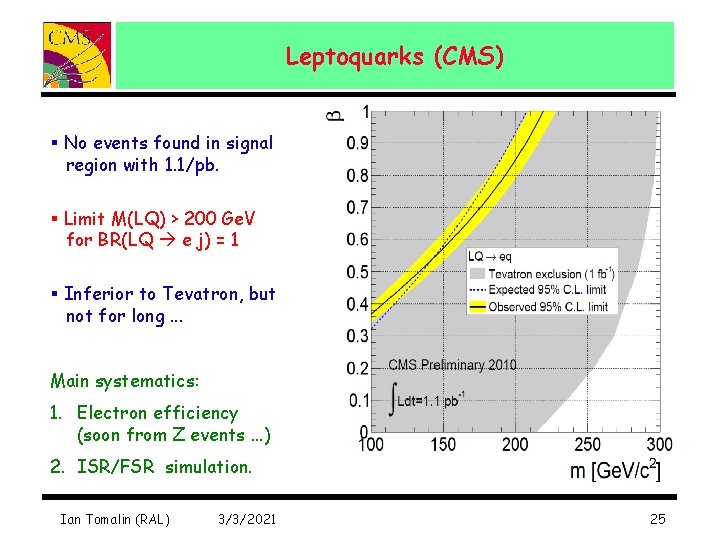
Leptoquarks (CMS) § No events found in signal region with 1. 1/pb. § Limit M(LQ) > 200 Ge. V for BR(LQ e j) = 1 § Inferior to Tevatron, but not for long. . . Main systematics: 1. Electron efficiency (soon from Z events. . . ) 2. ISR/FSR simulation. Ian Tomalin (RAL) 3/3/2021 25
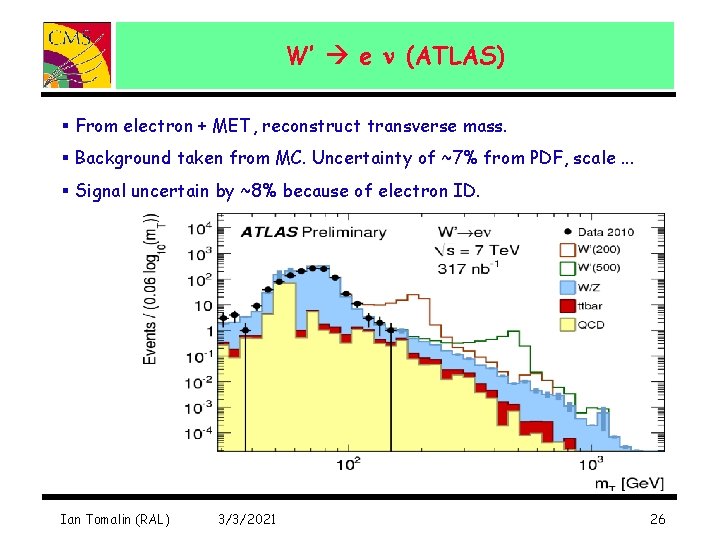
W’ e n (ATLAS) § From electron + MET, reconstruct transverse mass. § Background taken from MC. Uncertainty of ~7% from PDF, scale. . . § Signal uncertain by ~8% because of electron ID. Ian Tomalin (RAL) 3/3/2021 26
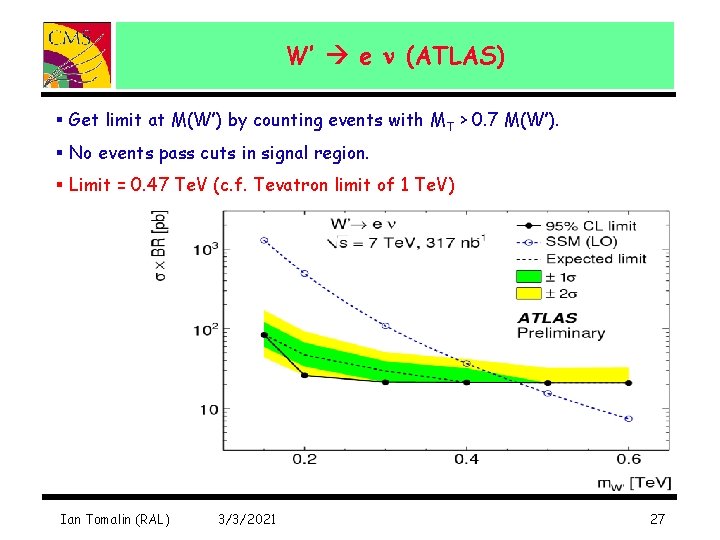
W’ e n (ATLAS) § Get limit at M(W’) by counting events with MT > 0. 7 M(W’). § No events pass cuts in signal region. § Limit = 0. 47 Te. V (c. f. Tevatron limit of 1 Te. V) Ian Tomalin (RAL) 3/3/2021 27
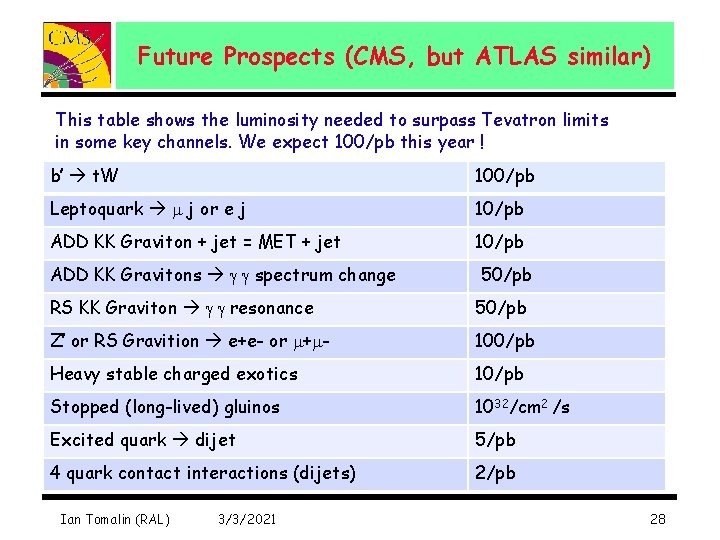
Future Prospects (CMS, but ATLAS similar) This table shows the luminosity needed to surpass Tevatron limits in some key channels. We expect 100/pb this year ! b’ t. W 100/pb Leptoquark m j or e j 10/pb ADD KK Graviton + jet = MET + jet 10/pb ADD KK Gravitons g g spectrum change 50/pb RS KK Graviton g g resonance 50/pb Z’ or RS Gravition e+e- or m+m- 100/pb Heavy stable charged exotics 10/pb Stopped (long-lived) gluinos 1032/cm 2 /s Excited quark dijet 5/pb 4 quark contact interactions (dijets) 2/pb Ian Tomalin (RAL) 3/3/2021 28
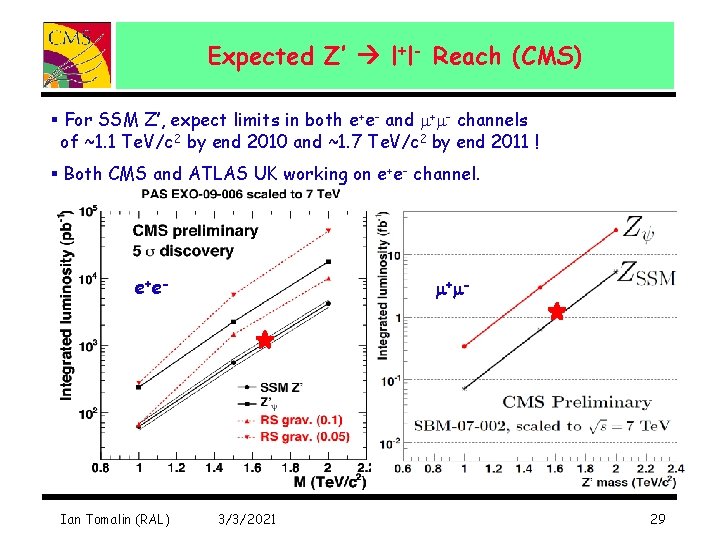
Expected Z’ l+l- Reach (CMS) § For SSM Z’, expect limits in both e+e- and m+m- channels of ~1. 1 Te. V/c 2 by end 2010 and ~1. 7 Te. V/c 2 by end 2011 ! § Both CMS and ATLAS UK working on e+e- channel. e+ e- Ian Tomalin (RAL) m+m- 3/3/2021 29
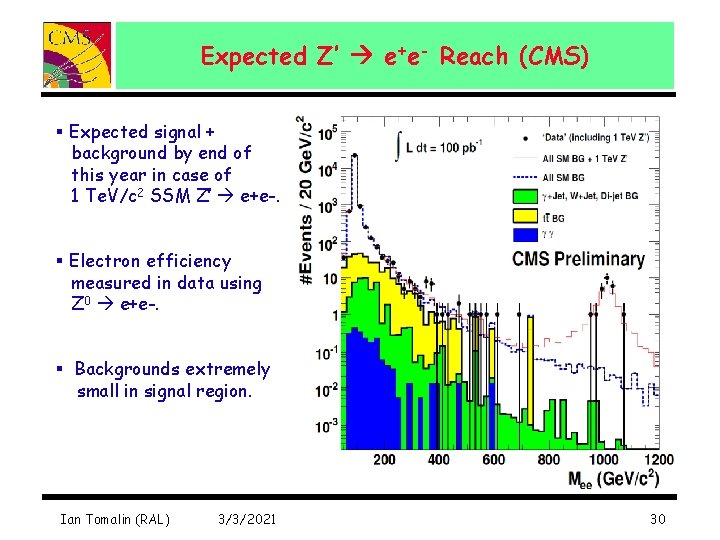
Expected Z’ e+e- Reach (CMS) § Expected signal + background by end of this year in case of 1 Te. V/c 2 SSM Z’ e+e-. § Electron efficiency measured in data using Z 0 e+e-. § Backgrounds extremely small in signal region. Ian Tomalin (RAL) 3/3/2021 30
Conclusions v LHC already sets the World’s best limits for heavy stable charged exotica and (in some regions of phase space) stopped gluinos. M(gluino) > 284 Ge. V/c 2 for long-lived gluinos v LHC also sets the best limits for excited quarks decaying to dijets. M(q*) > 1290 Ge. V/c 2. v As the LHC luminosity increases, new results are now flooding in. At Winter Conferences, expected to see limits (discoveries !? ? ) of Z’, lepto-quarks, extra dimensions. . . Ian Tomalin (RAL) 3/3/2021 31
Ian Tomalin (RAL) 3/3/2021 32
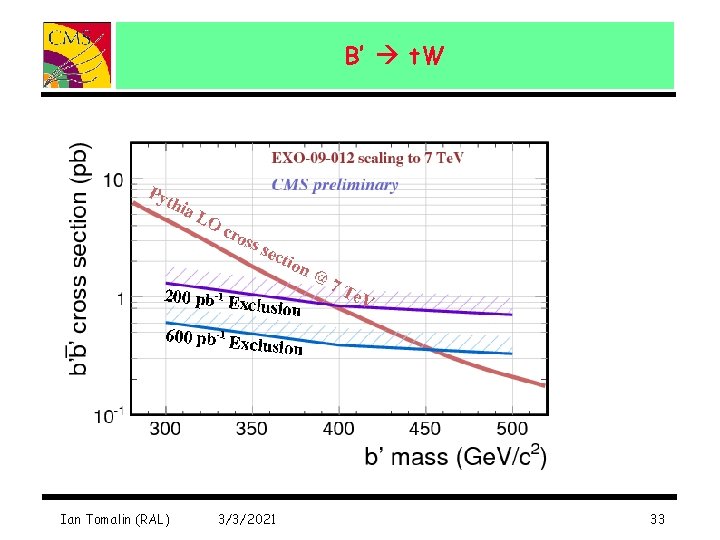
B’ t. W Ian Tomalin (RAL) 3/3/2021 33
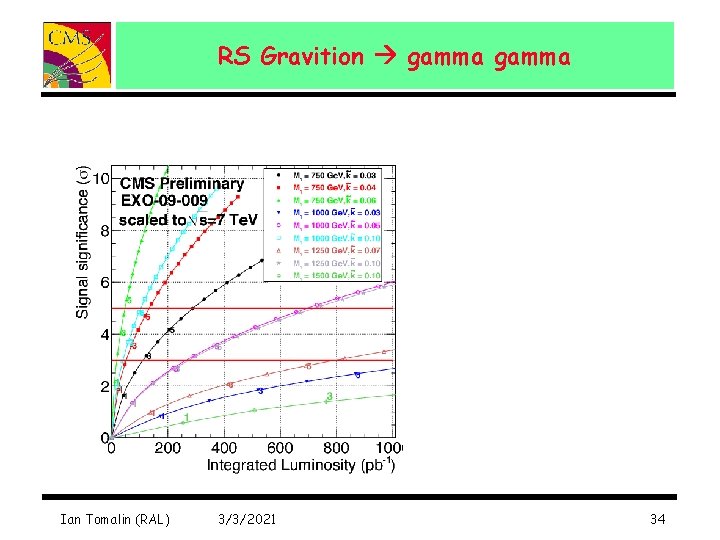
RS Gravition gamma Ian Tomalin (RAL) 3/3/2021 34
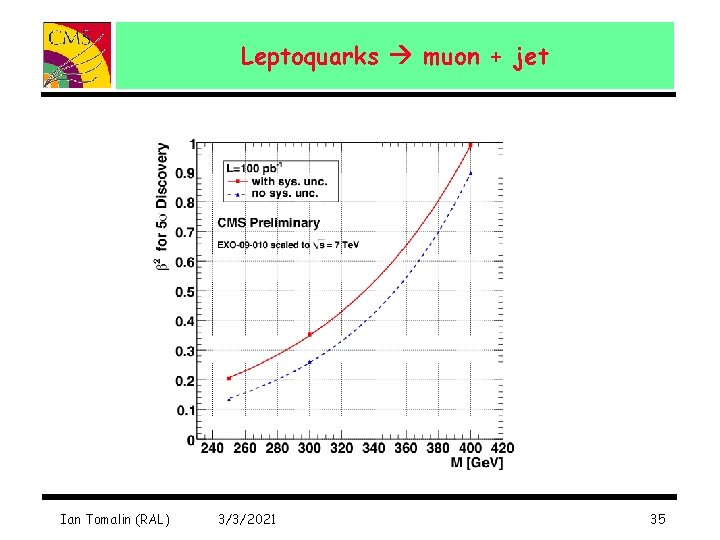
Leptoquarks muon + jet Ian Tomalin (RAL) 3/3/2021 35
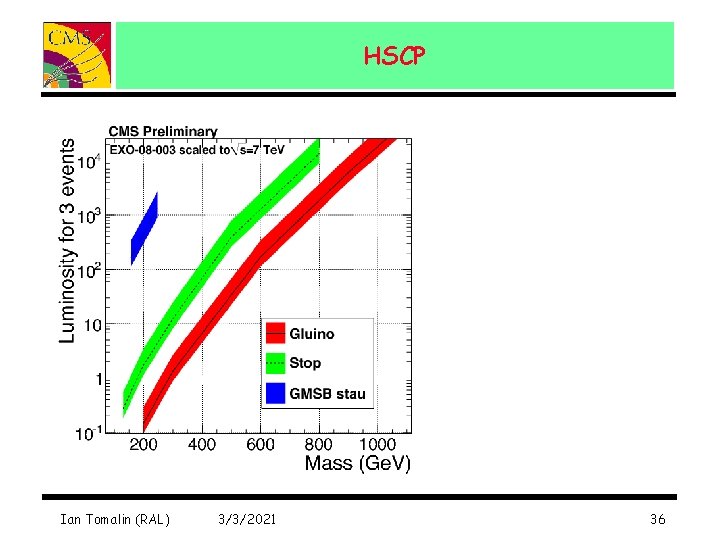
HSCP Ian Tomalin (RAL) 3/3/2021 36
q* dijet Ian Tomalin (RAL) 3/3/2021 37
- Slides: 37