Electronic Structure and Lewis Dot Structures PS 21





- Slides: 32
Electronic Structure and Lewis Dot Structures PS 21 Friday, January 27, 2017
Worst Taught Science Topics in Middle and High School Chemistry/Physical Science? 1) Electronic structure (Bohr model) of the atom 2) Eight electron rule for chemical bonding • Oversimplified approach often used teaches students concepts that are incorrect and a detriment to understanding at the college level
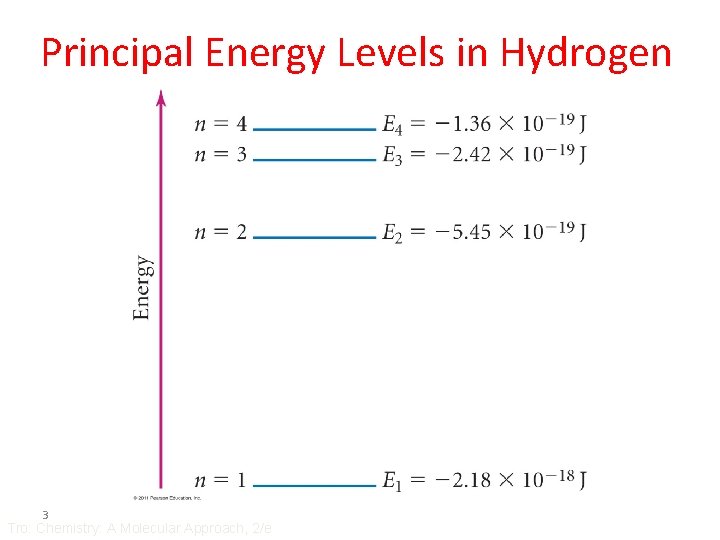
Principal Energy Levels in Hydrogen 3 Tro: Chemistry: A Molecular Approach, 2/e
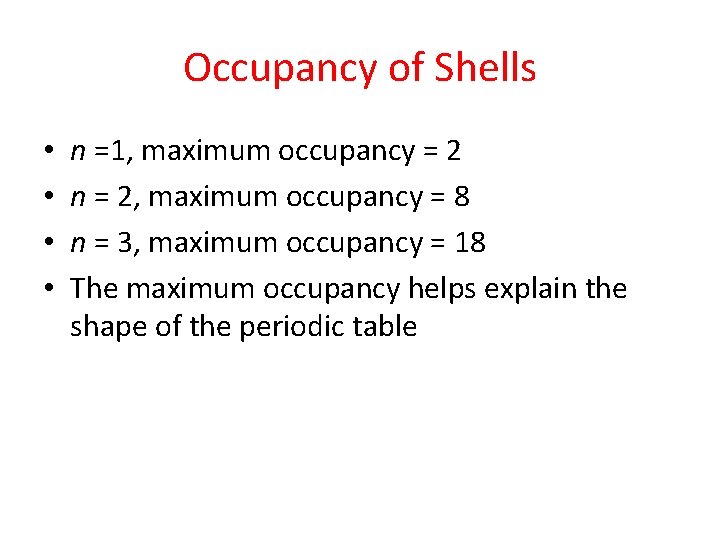
Shells • These allowed energy levels or states are called shells • Each shell can possess a maximum number of electrons with this amount of energy (although for atoms with more than one electron – i. e. , other than hydrogen – the situation becomes more complicated)
Occupancy of Shells • • n =1, maximum occupancy = 2 n = 2, maximum occupancy = 8 n = 3, maximum occupancy = 18 The maximum occupancy helps explain the shape of the periodic table
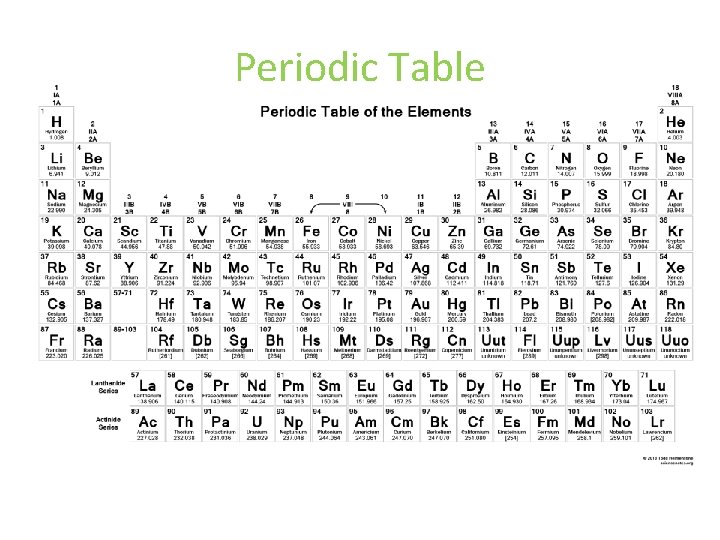
Periodic Table
Valence & Core Electrons • Electrons in the highest energy occupied shell are valence electrons • Electrons in the lower energy shells are core electrons • The chemistry of an atom is in large part determined by the number of valence electrons
Chemical Bonding • All substances are made from the just over 100 known elements • Chemical bonding – the joining of atoms to form new substances • Chemical bond - an interaction that holds two atoms together • The formation of chemical bonds involves the loss, gain or sharing of electrons
Theories of Chemical Bonding • The current understanding of chemical bonding has been the results of chemical experiments over about the last 150 years • Not all electrons are involved in bonding • Only electrons in the highest energy occupied shell – valence electrons - are involved in bonding
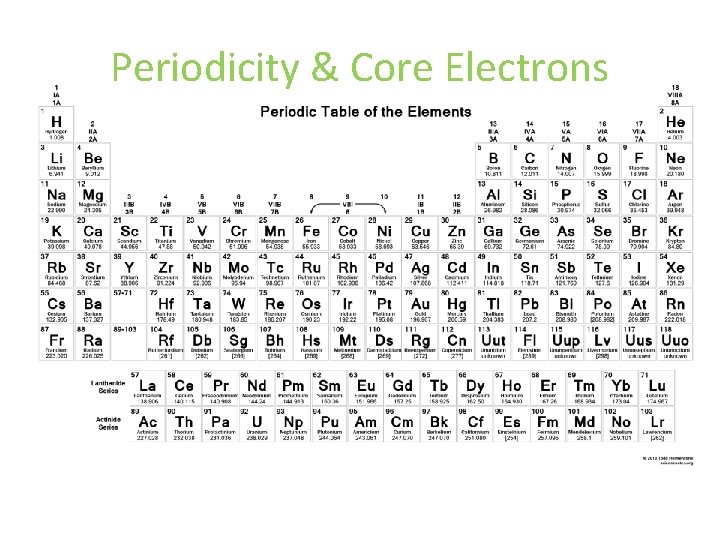
Periodicity & Core Electrons
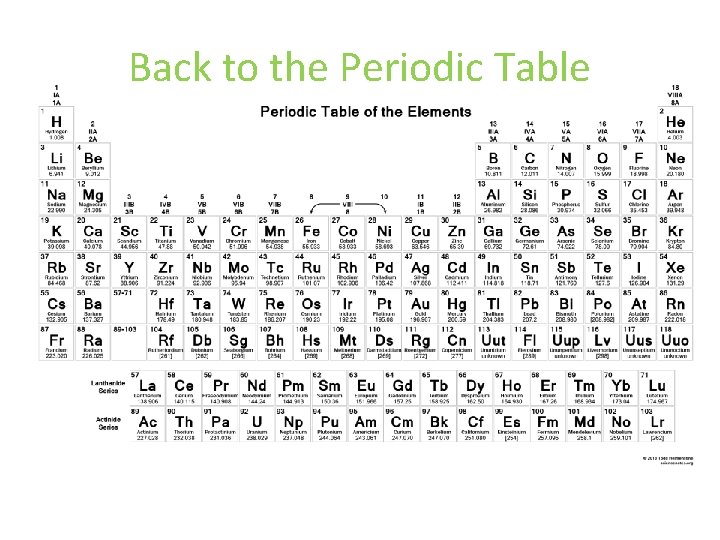
Periodicity & Core Electrons • The periodic table can be used to determine the number of valence electrons • Elements in a group (vertical column of the periodic tale) have the “same” number of valence electrons (only if we ignore d and f orbital electrons) • The chemistry of an atom is in large part determined by the number of valence electrons so that elements in the same group have similar chemical properties • Group I, alkali metals, have one valence electron and similar chemical and physical properties – soft, low melting, and reactive with water
Explaining Chemical Reactivity • Atoms with the highest occupied energy state filled to capacity are extremely stable • Thus, inert gases or noble gases (Group 18) are extremely stable • Atoms of inert gases rarely form bonds • Atoms of group 18 have 8 valence electrons – the outermost shell of an atom is considered full when it contains 8 electrons
Group Numbers • IUPAC – 1 -18 • Old American and English systems – 1 -8 (with A’s and B’s) • Old systems were designed to use the 8 electron rule – good for organic chemists (working primarily with C, H, N, and O) – bad for inorganic and physical chemists
Back to the Periodic Table
What Not to Do Handout page 1
Back to Explaining Chemical Reactivity • Atoms tend to undergo ionization or chemical reactions to obtain the same number of electrons as atoms of inert gases, i. e. fill its highest energy occupied shell • H, He, and Li normally need 2 valence electrons – H 2, He, Li+ • C, N, O, F, Ne, Na, Mg, and Al normally need 8 valence electrons – CH 4, NH 3, OH 2, HF, Ne, Na+, Mg 2+, Al 3+
What Not to Do Handout page 2
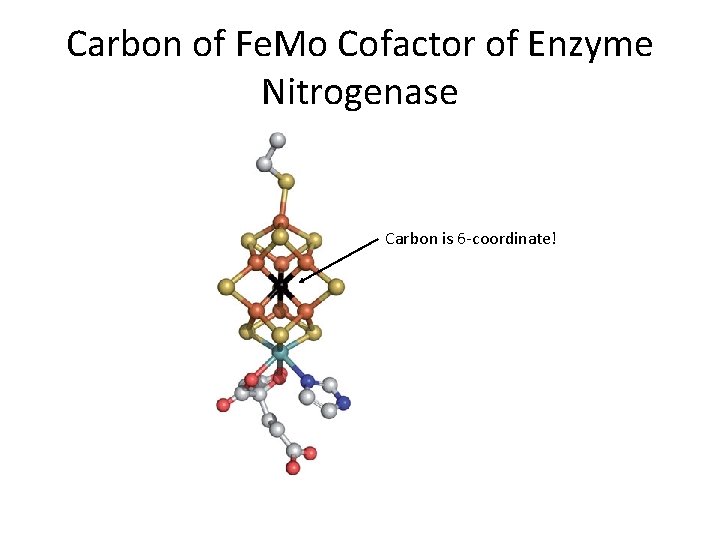
The Key Word is “TEND”! • Guess we ignore Be (e. g. , Be. H 2 - 4 valence electrons) and B (e. g. , BF 3 - 6 valence electrons, although does tend to form coordinate bonds to make compounds such as NH 3 BF 3) • “Eight-electron rule” does not even generally hold for all 2 nd row elements – (not Li, Be, and B) • 3 rd row elements in groups 15, 16, and 17 often do not obey 8 electron rule • Forget the rest of the table and the 8 electron rule as exceptions are the norm • Exceptions are even known for C, N, and O
Carbon of Fe. Mo Cofactor of Enzyme Nitrogenase Carbon is 6 -coordinate!
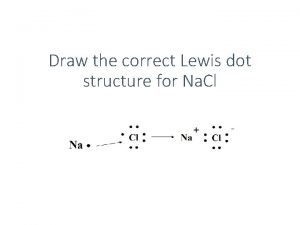
Ionic Bonding • An ionic bond is a bond that occurs when electrons are transferred from one atom to another • Ions are charged particles that form when atoms gain or loose electrons • Metal atoms with few valence electrons tend to loose electrons to most positive ions (fewer electrons than protons) • Nonmetal atoms tend to gain electrons and form negative ions (more electrons than protons)
What Not to Do Handout pages 3 and 4
Covalent Bonding • A covalent bond forms when atoms share one or more electron • A molecule is the smallest unit of a substance that keeps all the physical and chemical properties of that substance • A molecule consists of two or more atoms joined by covalent bonds in definite ratios
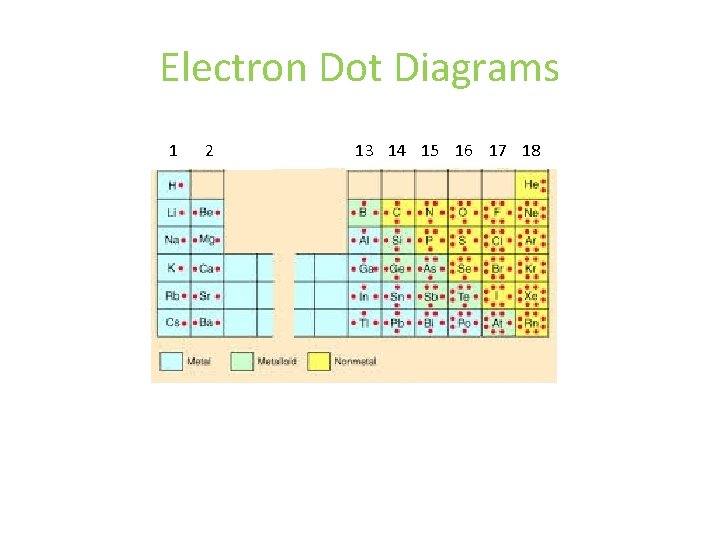
Electron Dot Diagrams • After explaining the limitations that the use of these is limited primarily to 1 st and 2 nd row elements and some 3 rd row elements and that exceptions exist even for these elements, • then electron dot diagrams are powerful rules in explaining the formulas of ionic compounds and covalent molecules
What Not to Do Handout page 5
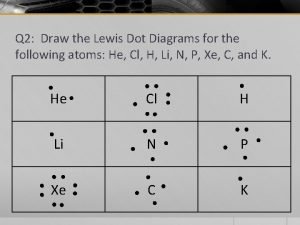
Electron Dot Diagrams 1 2 13 14 15 16 17 18
Lewis Dot Structures for Ions
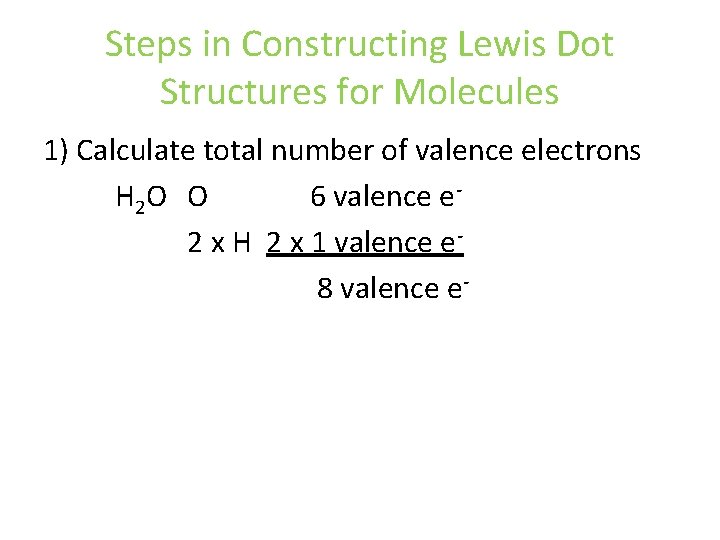
Steps in Constructing Lewis Dot Structures for Molecules 1) Calculate total number of valence electrons H 2 O O 6 valence e 2 x H 2 x 1 valence e 8 valence e-
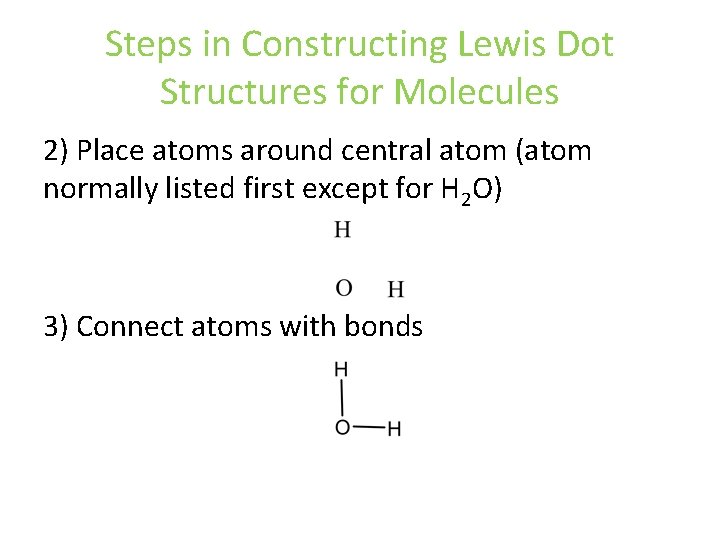
Steps in Constructing Lewis Dot Structures for Molecules 2) Place atoms around central atom (atom normally listed first except for H 2 O) 3) Connect atoms with bonds
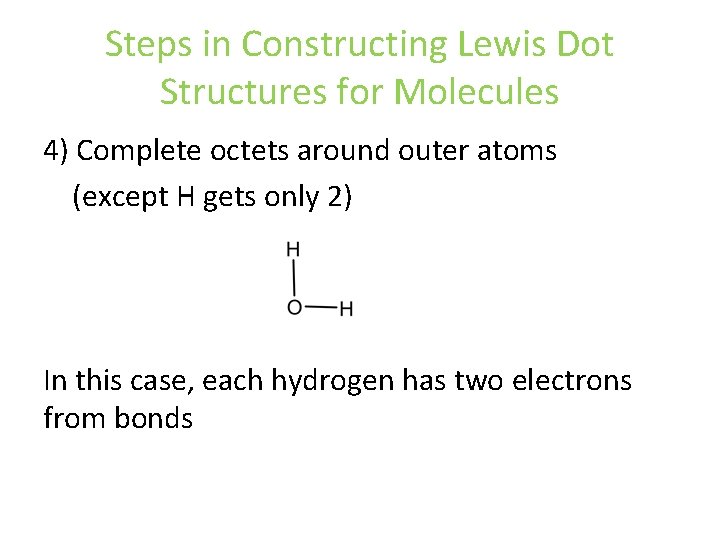
Steps in Constructing Lewis Dot Structures for Molecules 4) Complete octets around outer atoms (except H gets only 2) In this case, each hydrogen has two electrons from bonds
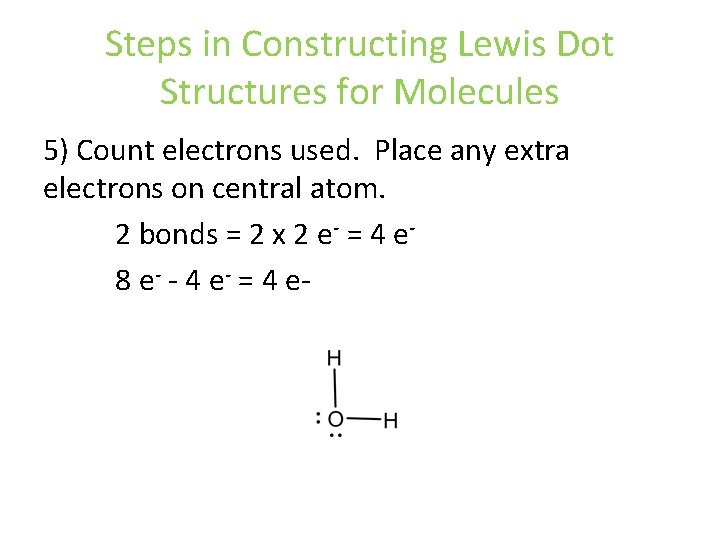
Steps in Constructing Lewis Dot Structures for Molecules 5) Count electrons used. Place any extra electrons on central atom. 2 bonds = 2 x 2 e- = 4 e 8 e- - 4 e- = 4 e-
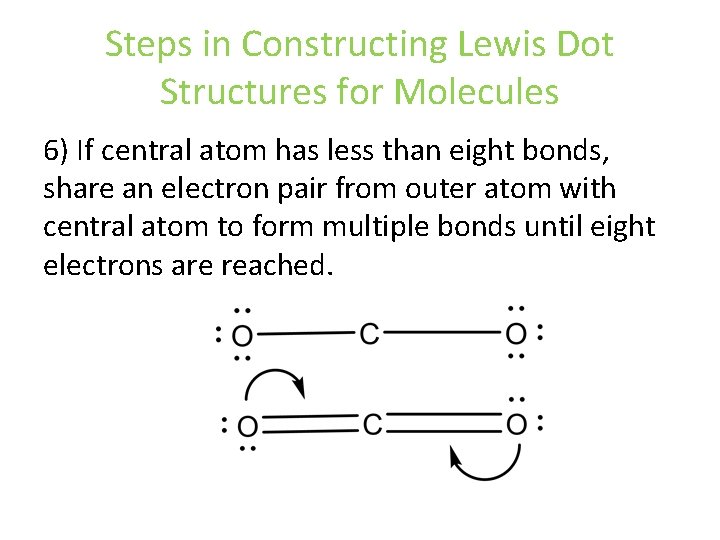
Steps in Constructing Lewis Dot Structures for Molecules 6) If central atom has less than eight bonds, share an electron pair from outer atom with central atom to form multiple bonds until eight electrons are reached.
Some video and tutorial suggestions Good tutorial on bond formation. ttp: //www. pbslearningmedia. org/asset/lsps 07_int_covalentbond/ Good tutorial on ionic bonding. http: //www. pbslearningmedia. org/asset/lsps 07_int_ionicbonding/ Excellent video on formation of ionic and covalent bonds without using planetary model. http: //www. diffen. com/difference/Covalent_Bonds_vs_Ionic_Bonds Excellent video for Lewis dot structures. http: //www. pbslearningmedia. org/resource/3 dae 2 ec 9 -414 e-4 ff 7 -a 438 -08 cb 24 ebff 9 c/bonding-models-and-lewisstructures-crash-course-chemistry-24/ (Except quadruple, quintuple, and sextuple bonds exist). Good video on bonding types. http: //www. pbslearningmedia. org/resource/fc 1461 da-20 f 4 -41 cb-9 b 2 f-289 a 2 f 1839 f 1/types-of-chemical-bonds-crashcourse-chemistry-22/ (A little too much depth, however). Good video on last PS 21 topic. http: //www. pbslearningmedia. org/resource/b 687 bee 7 -d 854 -4 e 6 c-84 b 3 -9 acfeaf 3 bbfc/the-history-of-atomic-chemistry -crash-course-chemistry-37/ (Although puts more than 1 electron in Bohr model).