
7 1 Lewis Dot Diagrams Dot Diagrams 4


- Slides: 28
7 -1 Lewis Dot Diagrams
Dot Diagrams +4 -4 -3 -2 : : [x] : +3 : [x] : +2 : +1 : : X : Be -1 [: x: ] : : s 2 : : H. s 2 p 6 2 p 3 s 2 p 4 s 2 p 5 : He 2 1 2 2 s sp sp. . : X. : C. : N. . : O. . : F. : : Ne: . . Al. X. . . X: : X : : : s 1 Ion formation: Loss (oxidation) or gain (reduction) of electrons
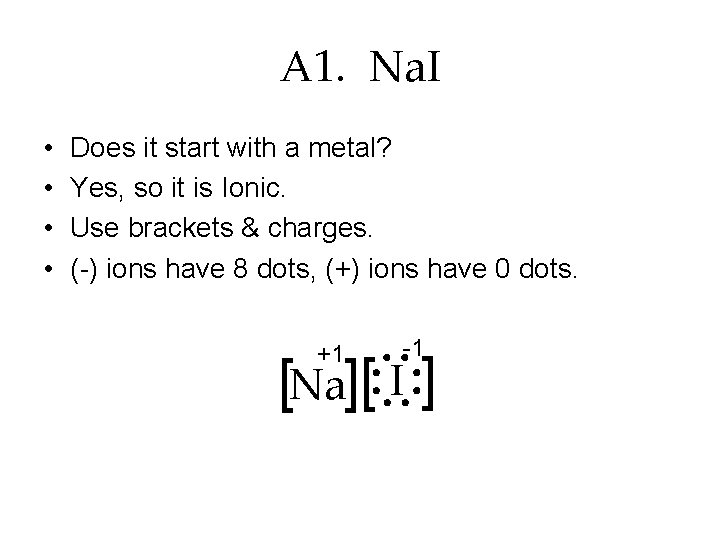
A 1. Na. I • • Does it start with a metal? Yes, so it is Ionic. Use brackets & charges. (-) ions have 8 dots, (+) ions have 0 dots. +1 -1 [Na][ I ]
Rules for Ionic Combos • If the combo starts with a metal, assume it is all charged and use brackets. • Put opposite charges next to each other and similar charges away. • Metal ions always are positive, non-metals are negative. • Determine the charges by columns in the periodic table. • Negative (-) ions will end up with 8 electron dots, positive (+) ions have 0.
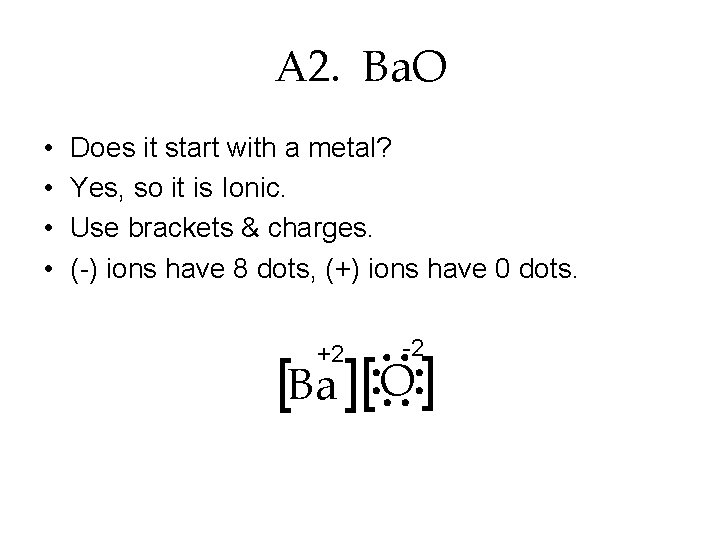
A 2. Ba. O • • Does it start with a metal? Yes, so it is Ionic. Use brackets & charges. (-) ions have 8 dots, (+) ions have 0 dots. +2 -2 [Ba ][ O ]
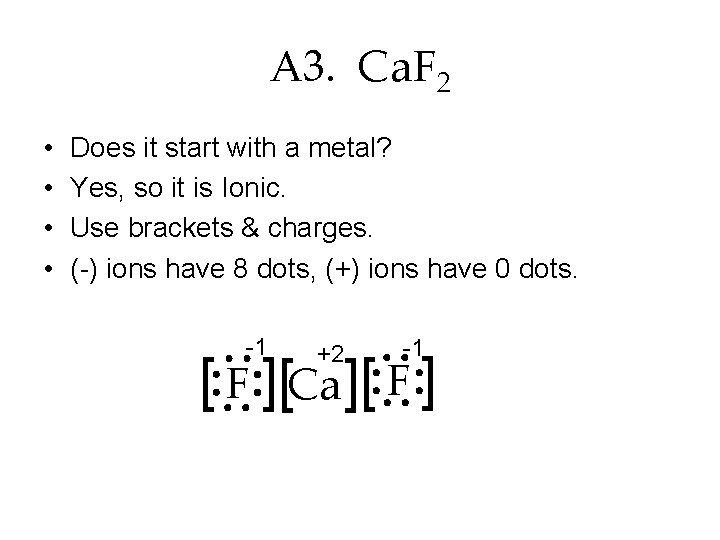
A 3. Ca. F 2 • • Does it start with a metal? Yes, so it is Ionic. Use brackets & charges. (-) ions have 8 dots, (+) ions have 0 dots. -1 +2 -1 [ F ][Ca ][ F ]
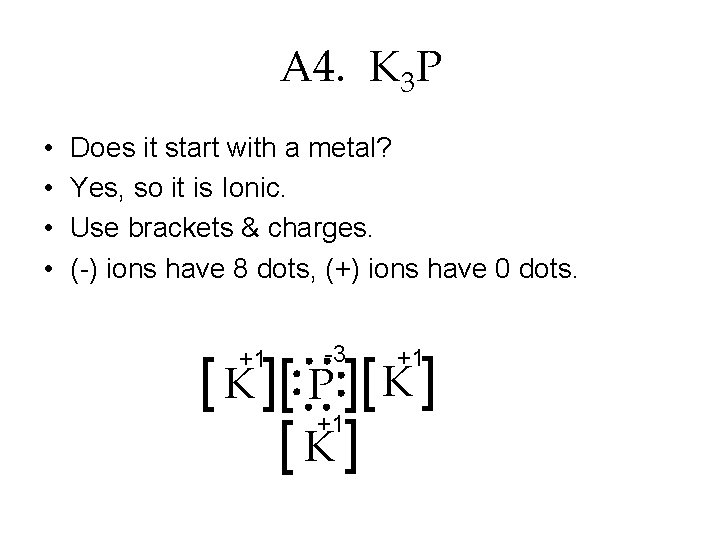
A 4. K 3 P • • Does it start with a metal? Yes, so it is Ionic. Use brackets & charges. (-) ions have 8 dots, (+) ions have 0 dots. -3 +1 [ K ] [ P ][ K ] [K] +1 +1
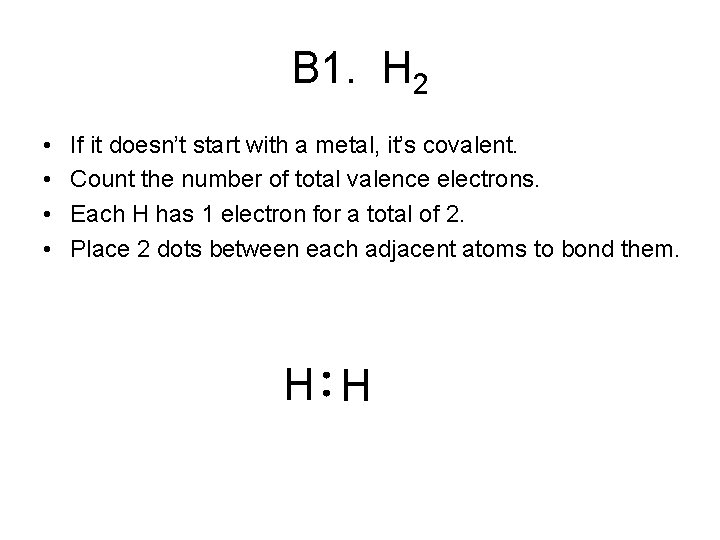
B 1. H 2 • • If it doesn’t start with a metal, it’s covalent. Count the number of total valence electrons. Each H has 1 electron for a total of 2. Place 2 dots between each adjacent atoms to bond them. H H
Rules for Covalent Combos • Make sure you have the right number of dots or you will never get the right answer. • Electron dots will always be in pairs. • Every non-metal but hydrogen must have 8 electron dots to be stable. • Hydrogen only needs 2 electron dots to be stable. • If you are short, move pairs in between to make double or triple bonds
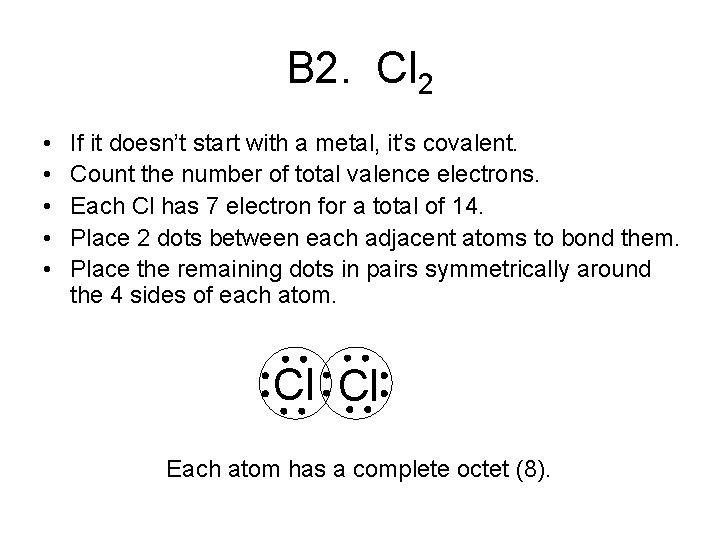
B 2. Cl 2 • • • If it doesn’t start with a metal, it’s covalent. Count the number of total valence electrons. Each Cl has 7 electron for a total of 14. Place 2 dots between each adjacent atoms to bond them. Place the remaining dots in pairs symmetrically around the 4 sides of each atom. Cl Cl Each atom has a complete octet (8).
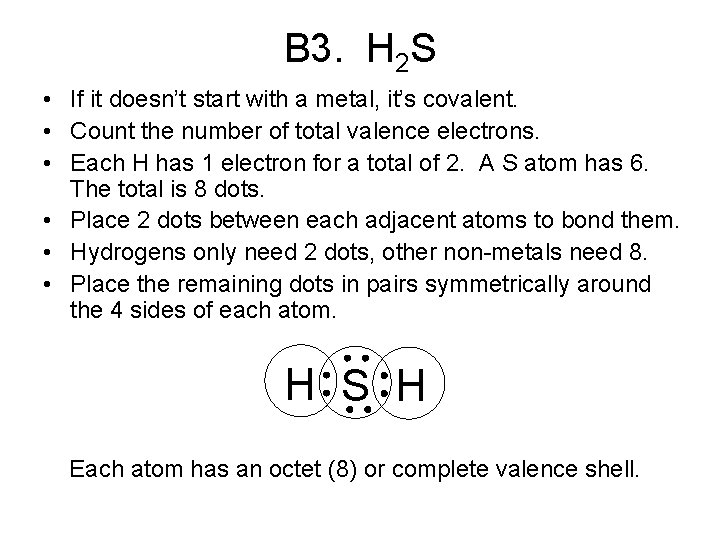
B 3. H 2 S • If it doesn’t start with a metal, it’s covalent. • Count the number of total valence electrons. • Each H has 1 electron for a total of 2. A S atom has 6. The total is 8 dots. • Place 2 dots between each adjacent atoms to bond them. • Hydrogens only need 2 dots, other non-metals need 8. • Place the remaining dots in pairs symmetrically around the 4 sides of each atom. H S H Each atom has an octet (8) or complete valence shell.
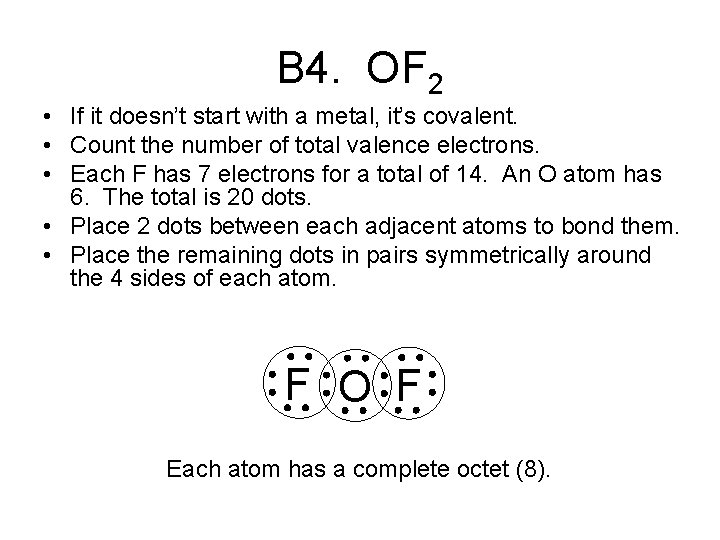
B 4. OF 2 • If it doesn’t start with a metal, it’s covalent. • Count the number of total valence electrons. • Each F has 7 electrons for a total of 14. An O atom has 6. The total is 20 dots. • Place 2 dots between each adjacent atoms to bond them. • Place the remaining dots in pairs symmetrically around the 4 sides of each atom. F O F Each atom has a complete octet (8).
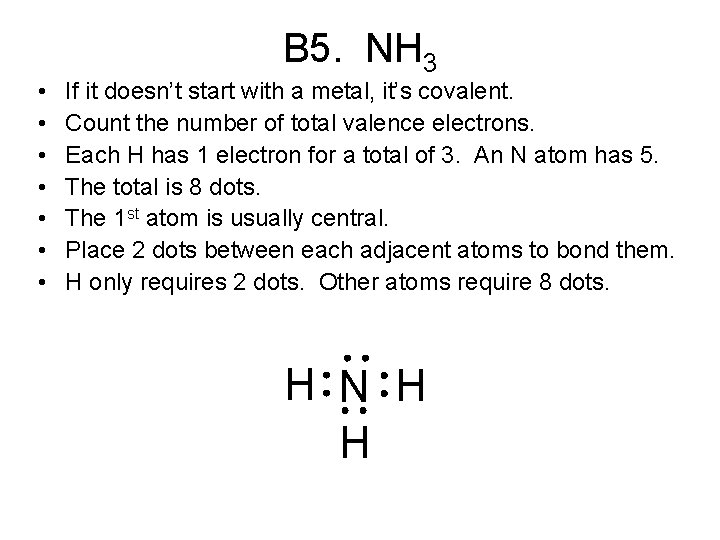
• • B 5. NH 3 If it doesn’t start with a metal, it’s covalent. Count the number of total valence electrons. Each H has 1 electron for a total of 3. An N atom has 5. The total is 8 dots. The 1 st atom is usually central. Place 2 dots between each adjacent atoms to bond them. H only requires 2 dots. Other atoms require 8 dots. H N H H
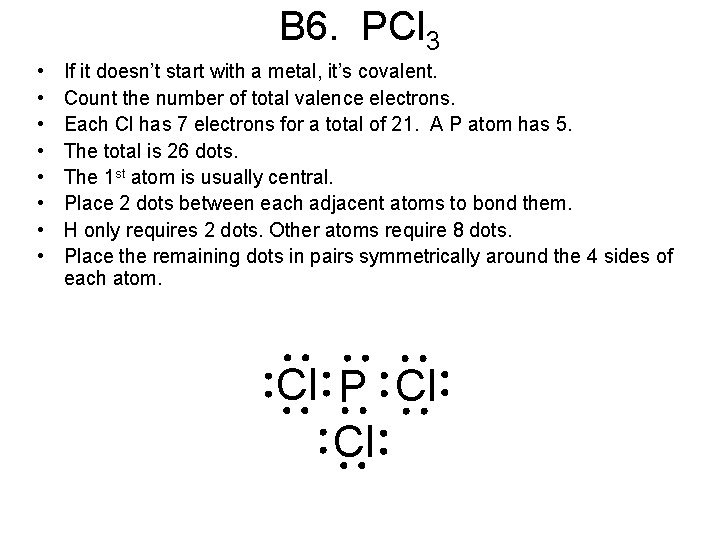
B 6. PCl 3 • • If it doesn’t start with a metal, it’s covalent. Count the number of total valence electrons. Each Cl has 7 electrons for a total of 21. A P atom has 5. The total is 26 dots. The 1 st atom is usually central. Place 2 dots between each adjacent atoms to bond them. H only requires 2 dots. Other atoms require 8 dots. Place the remaining dots in pairs symmetrically around the 4 sides of each atom. Cl P Cl Cl
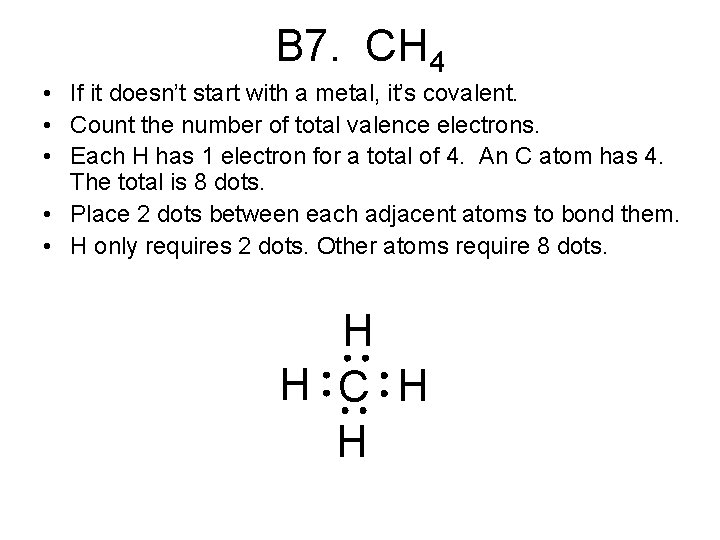
B 7. CH 4 • If it doesn’t start with a metal, it’s covalent. • Count the number of total valence electrons. • Each H has 1 electron for a total of 4. An C atom has 4. The total is 8 dots. • Place 2 dots between each adjacent atoms to bond them. • H only requires 2 dots. Other atoms require 8 dots. H H C H H
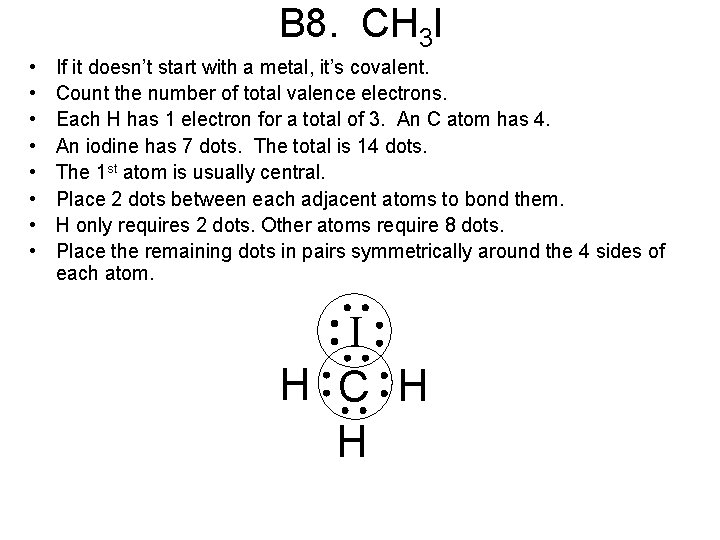
B 8. CH 3 I • • If it doesn’t start with a metal, it’s covalent. Count the number of total valence electrons. Each H has 1 electron for a total of 3. An C atom has 4. An iodine has 7 dots. The total is 14 dots. The 1 st atom is usually central. Place 2 dots between each adjacent atoms to bond them. H only requires 2 dots. Other atoms require 8 dots. Place the remaining dots in pairs symmetrically around the 4 sides of each atom. I H C H H
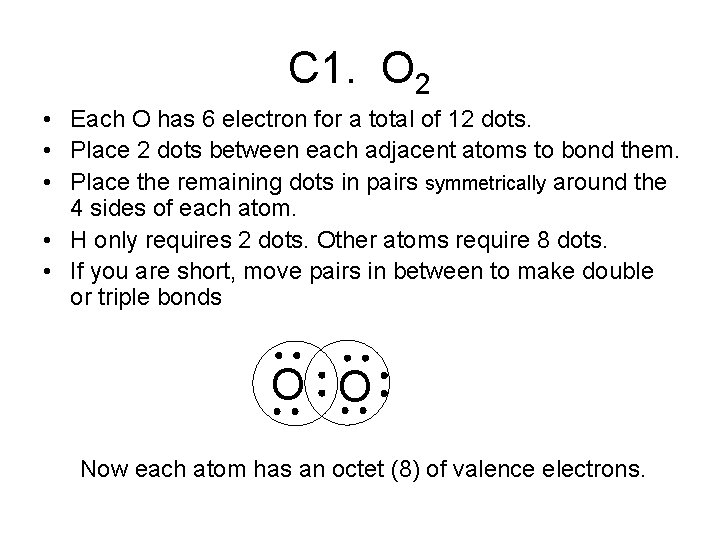
C 1. O 2 • Each O has 6 electron for a total of 12 dots. • Place 2 dots between each adjacent atoms to bond them. • Place the remaining dots in pairs symmetrically around the 4 sides of each atom. • H only requires 2 dots. Other atoms require 8 dots. • If you are short, move pairs in between to make double or triple bonds O O Now each atom has an octet (8) of valence electrons.
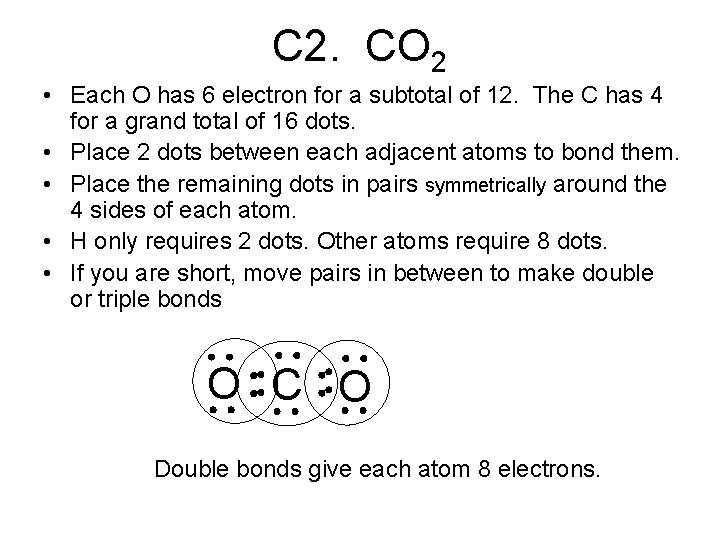
C 2. CO 2 • Each O has 6 electron for a subtotal of 12. The C has 4 for a grand total of 16 dots. • Place 2 dots between each adjacent atoms to bond them. • Place the remaining dots in pairs symmetrically around the 4 sides of each atom. • H only requires 2 dots. Other atoms require 8 dots. • If you are short, move pairs in between to make double or triple bonds O C O Double bonds give each atom 8 electrons.
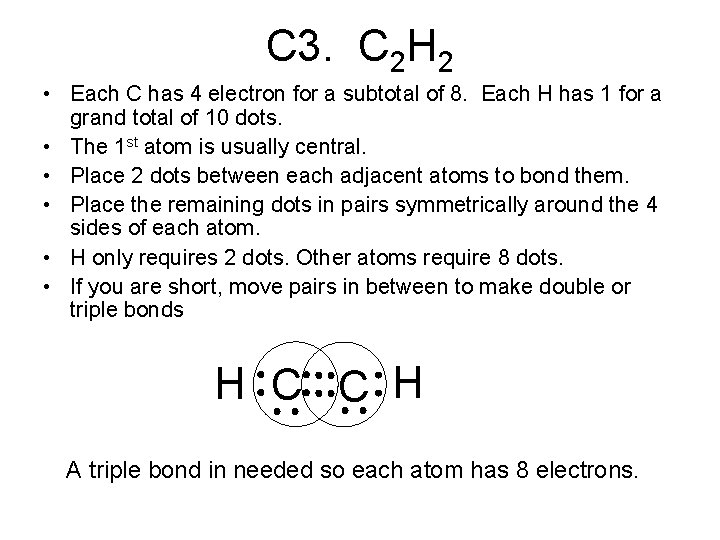
C 3. C 2 H 2 • Each C has 4 electron for a subtotal of 8. Each H has 1 for a grand total of 10 dots. • The 1 st atom is usually central. • Place 2 dots between each adjacent atoms to bond them. • Place the remaining dots in pairs symmetrically around the 4 sides of each atom. • H only requires 2 dots. Other atoms require 8 dots. • If you are short, move pairs in between to make double or triple bonds H C C H A triple bond in needed so each atom has 8 electrons.
D 1. H 3 O+ • Each H has 1 electron for a subtotal of 3. An O has 6. • A positive charge means 1 electron is missing. (Negative charge indicates extra electrons. ) • The total is 8 dots. • O has to be central. H’s can only make 1 bond. • Place 2 dots between each adjacent atoms to bond them. • H only requires 2 dots. Other atoms require 8 dots. • Place in brackets & label the charge. [ ] H O H +1 H
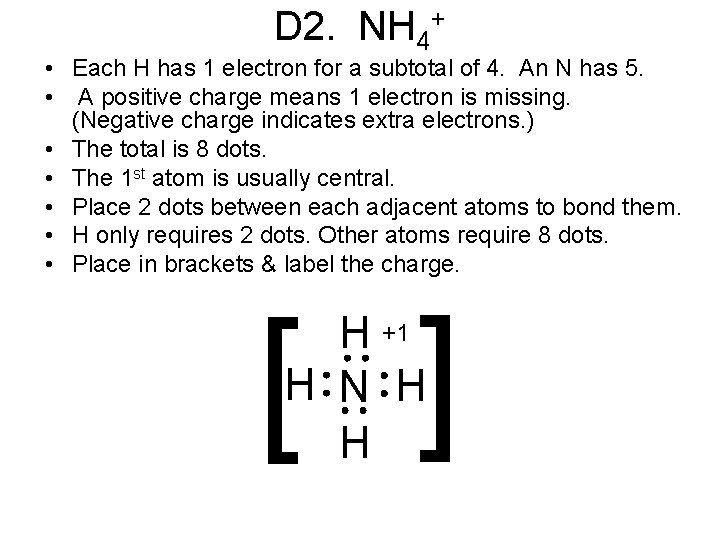
D 2. NH 4+ • Each H has 1 electron for a subtotal of 4. An N has 5. • A positive charge means 1 electron is missing. (Negative charge indicates extra electrons. ) • The total is 8 dots. • The 1 st atom is usually central. • Place 2 dots between each adjacent atoms to bond them. • H only requires 2 dots. Other atoms require 8 dots. • Place in brackets & label the charge. [ ] H +1 H N H H
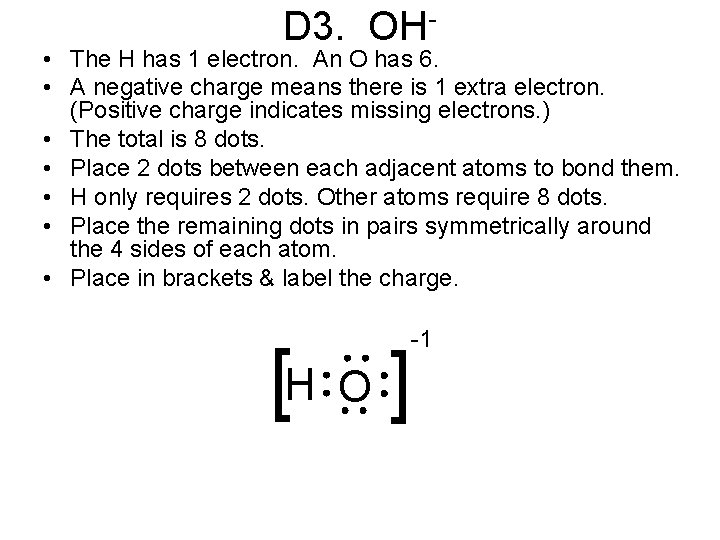
D 3. OH- • The H has 1 electron. An O has 6. • A negative charge means there is 1 extra electron. (Positive charge indicates missing electrons. ) • The total is 8 dots. • Place 2 dots between each adjacent atoms to bond them. • H only requires 2 dots. Other atoms require 8 dots. • Place the remaining dots in pairs symmetrically around the 4 sides of each atom. • Place in brackets & label the charge. [H O ] -1
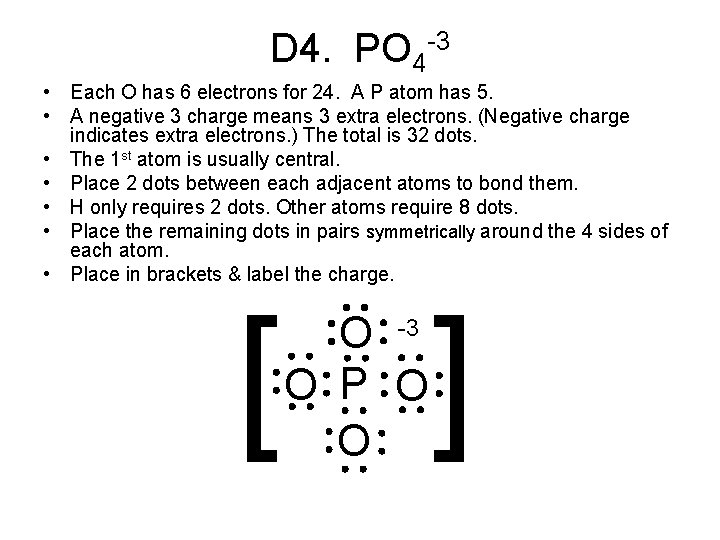
D 4. PO 4 -3 • Each O has 6 electrons for 24. A P atom has 5. • A negative 3 charge means 3 extra electrons. (Negative charge indicates extra electrons. ) The total is 32 dots. • The 1 st atom is usually central. • Place 2 dots between each adjacent atoms to bond them. • H only requires 2 dots. Other atoms require 8 dots. • Place the remaining dots in pairs symmetrically around the 4 sides of each atom. • Place in brackets & label the charge. [ ] O -3 O P O O
Review Examples • • E 1 – Al. Cl 3 E 4 – OCl 2 E 8 – HCN Get out your periodic table & dot diagram handout.
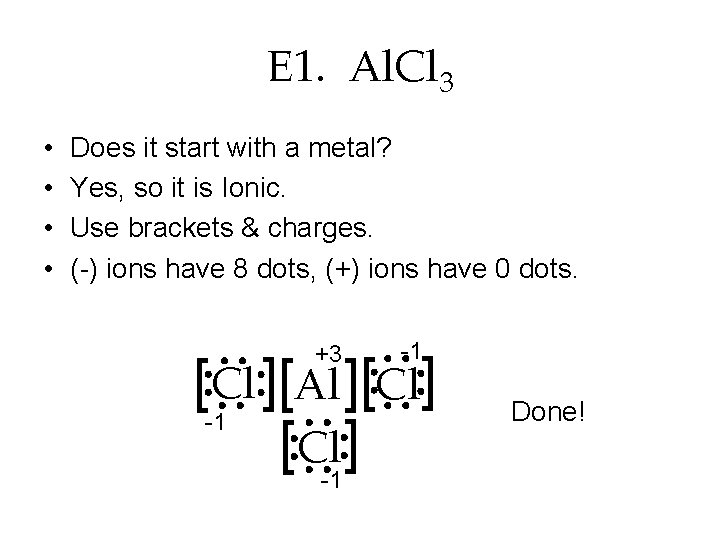
E 1. Al. Cl 3 • • Does it start with a metal? Yes, so it is Ionic. Use brackets & charges. (-) ions have 8 dots, (+) ions have 0 dots. +3 -1 [ Cl ][Al ][Cl] [ Cl] -1 -1 Done!
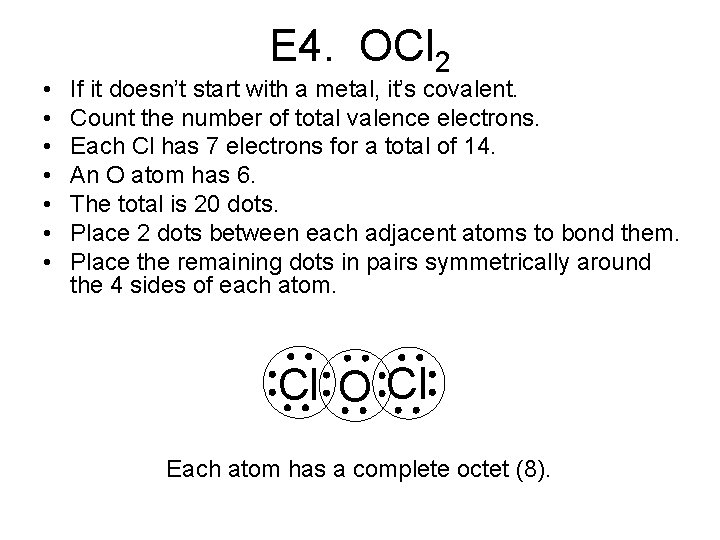
• • E 4. OCl 2 If it doesn’t start with a metal, it’s covalent. Count the number of total valence electrons. Each Cl has 7 electrons for a total of 14. An O atom has 6. The total is 20 dots. Place 2 dots between each adjacent atoms to bond them. Place the remaining dots in pairs symmetrically around the 4 sides of each atom. Cl O Cl Each atom has a complete octet (8).
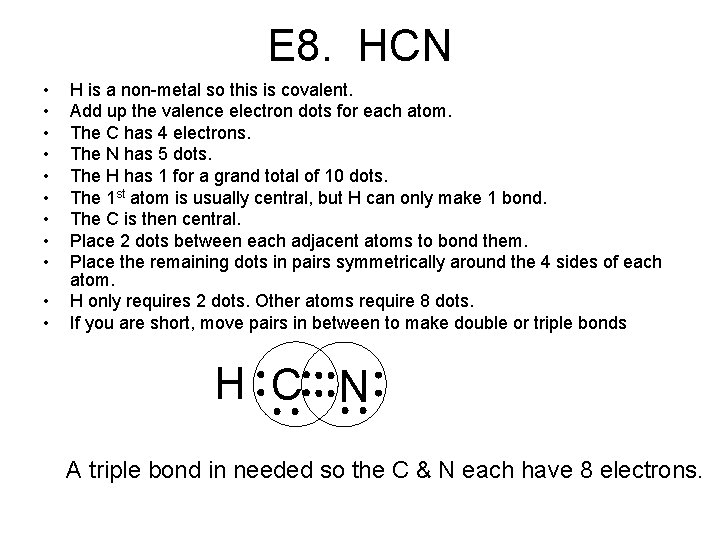
E 8. HCN • • • H is a non-metal so this is covalent. Add up the valence electron dots for each atom. The C has 4 electrons. The N has 5 dots. The H has 1 for a grand total of 10 dots. The 1 st atom is usually central, but H can only make 1 bond. The C is then central. Place 2 dots between each adjacent atoms to bond them. Place the remaining dots in pairs symmetrically around the 4 sides of each atom. H only requires 2 dots. Other atoms require 8 dots. If you are short, move pairs in between to make double or triple bonds H C N A triple bond in needed so the C & N each have 8 electrons.
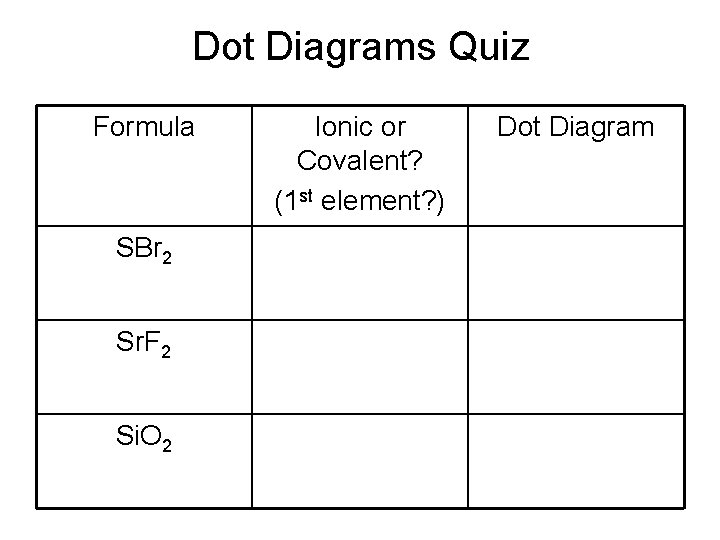
Dot Diagrams Quiz Formula SBr 2 Sr. F 2 Si. O 2 Ionic or Covalent? (1 st element? ) Dot Diagram