Ecological Stoichiometry Hao Wang MATH 570 University of



- Slides: 80
Ecological Stoichiometry Hao Wang MATH 570 University of Alberta
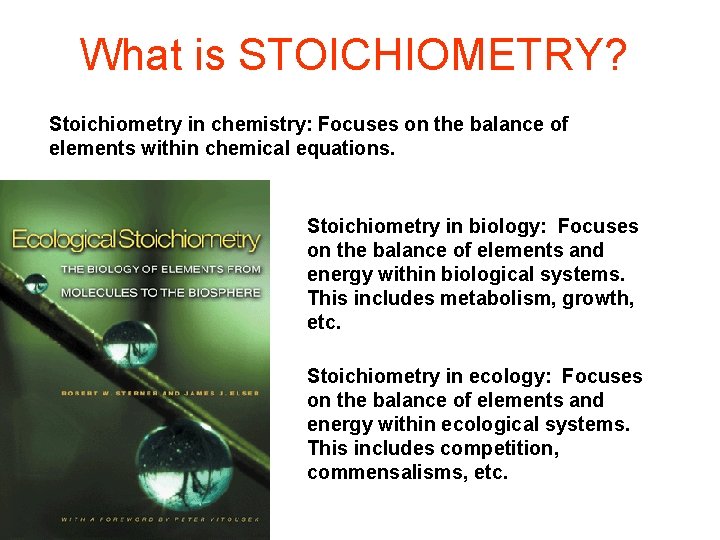
What is STOICHIOMETRY? Stoichiometry in chemistry: Focuses on the balance of elements within chemical equations. Stoichiometry in biology: Focuses on the balance of elements and energy within biological systems. This includes metabolism, growth, etc. Stoichiometry in ecology: Focuses on the balance of elements and energy within ecological systems. This includes competition, commensalisms, etc.
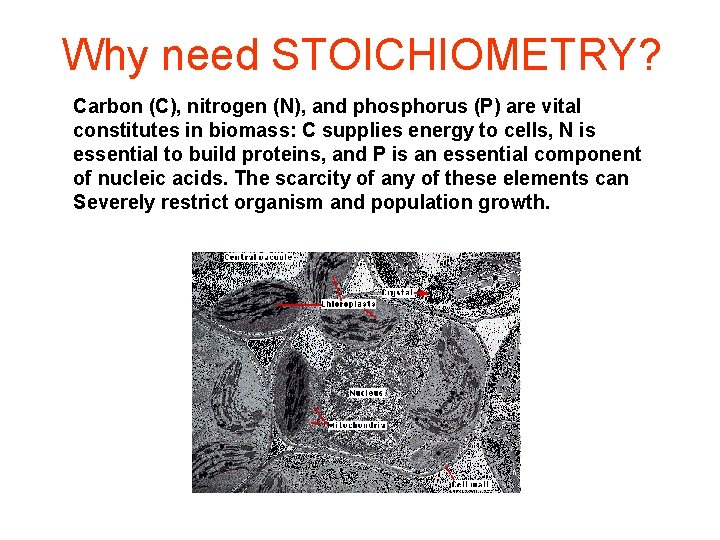
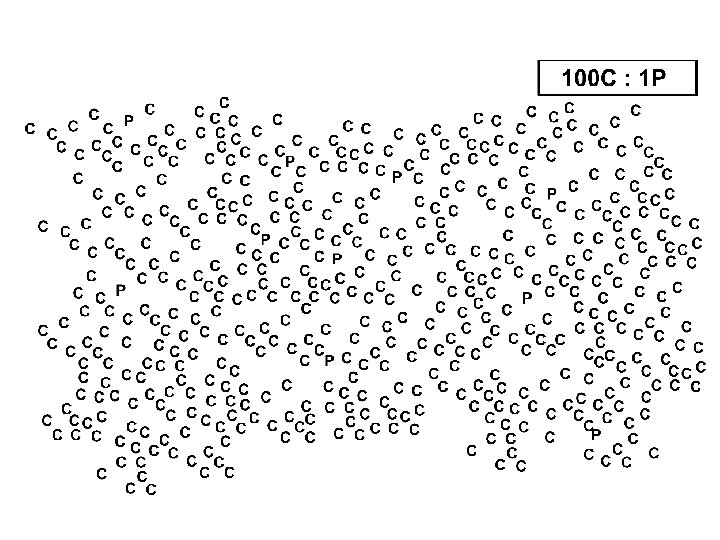
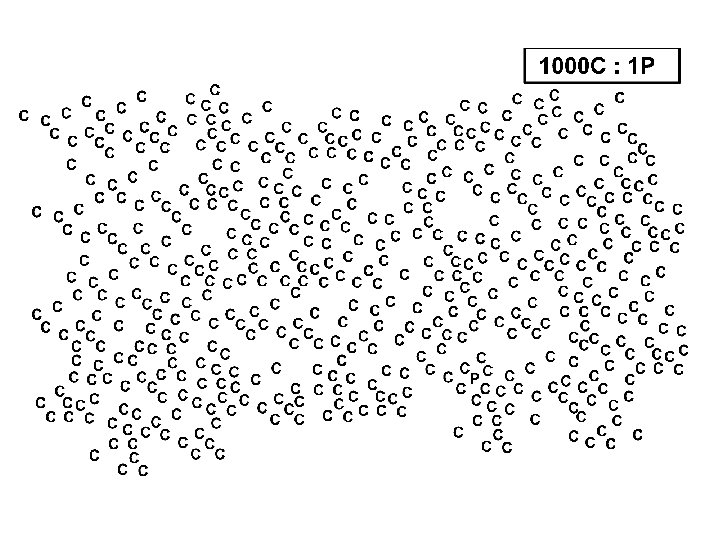
Why need STOICHIOMETRY? Carbon (C), nitrogen (N), and phosphorus (P) are vital constitutes in biomass: C supplies energy to cells, N is essential to build proteins, and P is an essential component of nucleic acids. The scarcity of any of these elements can Severely restrict organism and population growth.
What would happen to cows if there wasn't so much sunlight? Expectations from a 9 -year old ecologist James J. Elser’s son
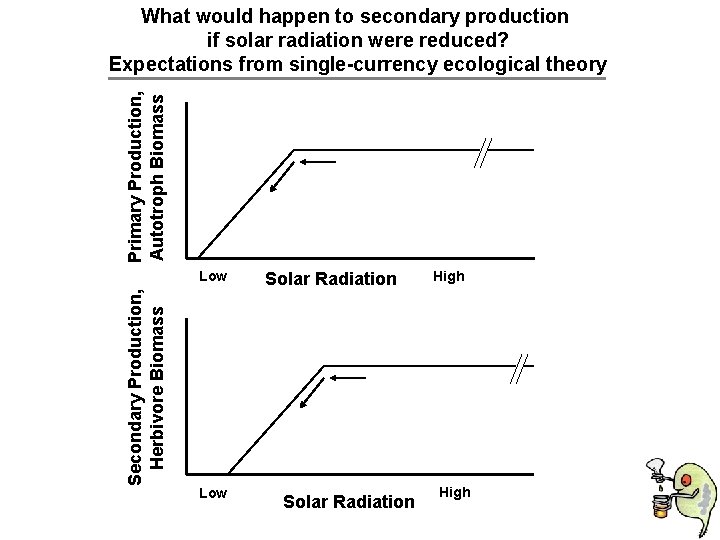
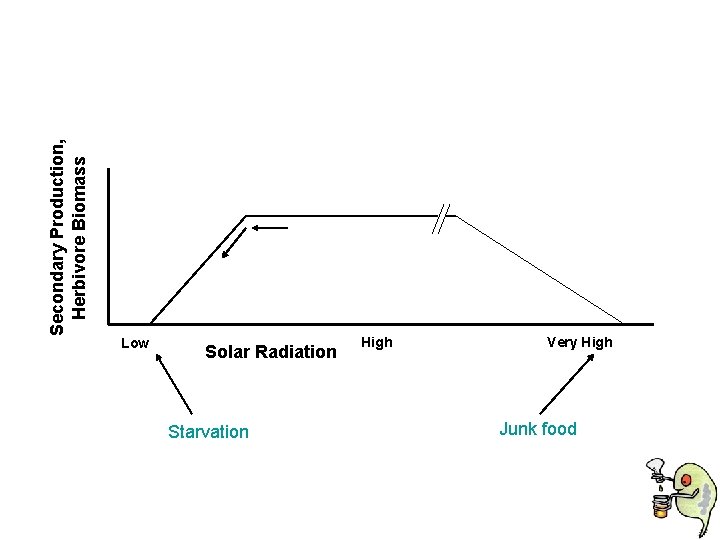
Primary Production, Autotroph Biomass What would happen to secondary production if solar radiation were reduced? Expectations from single-currency ecological theory Secondary Production, Herbivore Biomass Low Solar Radiation High
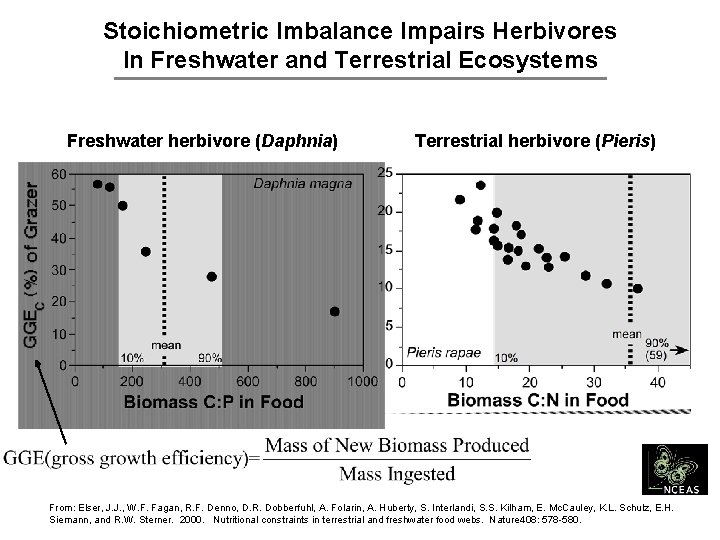
Stoichiometric Imbalance Impairs Herbivores In Freshwater and Terrestrial Ecosystems Freshwater herbivore (Daphnia) Terrestrial herbivore (Pieris) From: Elser, J. J. , W. F. Fagan, R. F. Denno, D. R. Dobberfuhl, A. Folarin, A. Huberty, S. Interlandi, S. S. Kilham, E. Mc. Cauley, K. L. Schulz, E. H. Siemann, and R. W. Sterner. 2000. Nutritional constraints in terrestrial and freshwater food webs. Nature 408: 578 -580.
Secondary Production, Herbivore Biomass Low Solar Radiation Starvation High Very High Junk food
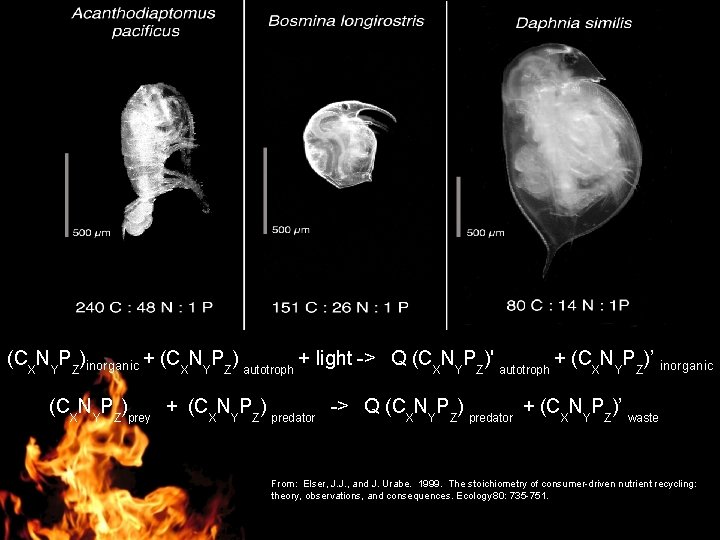
(CXNYPZ)inorganic + (CXNYPZ) autotroph + light -> Q (CXNYPZ)' autotroph + (CXNYPZ)’ inorganic (CXNYPZ)prey + (CXNYPZ) predator -> Q (CXNYPZ) predator + (CXNYPZ)’ waste From: Elser, J. J. , and J. Urabe. 1999. The stoichiometry of consumer-driven nutrient recycling: theory, observations, and consequences. Ecology 80: 735 -751.
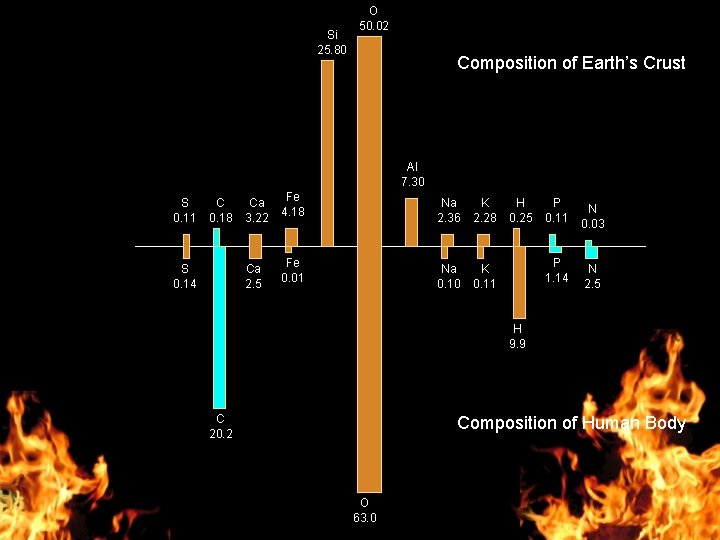
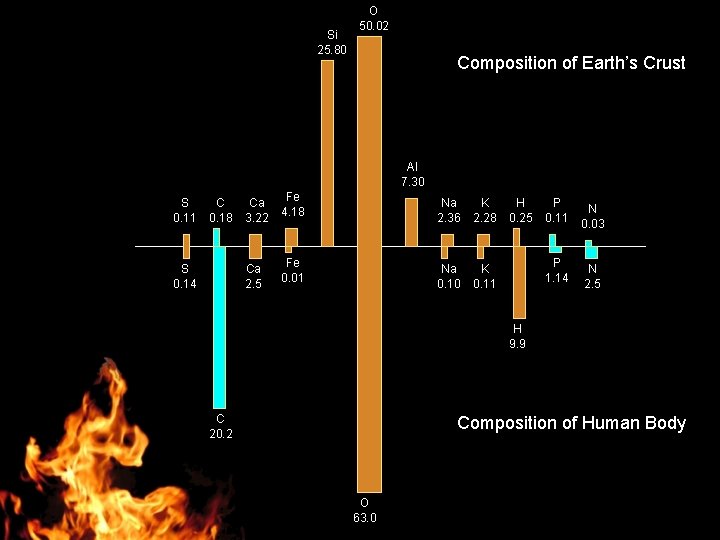
C, N, and P are three of the main constitutes in biological structural molecules. HOWEVER, C, N, and P are not particularly abundant on Earth or in the universe as a whole and thus it seems that living things made a very discriminating selection of elements from the environment.
Si 25. 80 O 50. 02 Composition of Earth’s Crust Al 7. 30 S 0. 11 C 0. 18 S 0. 14 Ca 3. 22 Fe 4. 18 Na 2. 36 K 2. 28 Ca 2. 5 Fe 0. 01 Na 0. 10 K 0. 11 H 0. 25 P 0. 11 N 0. 03 P 1. 14 N 2. 5 H 9. 9 C 20. 2 Composition of Human Body O 63. 0
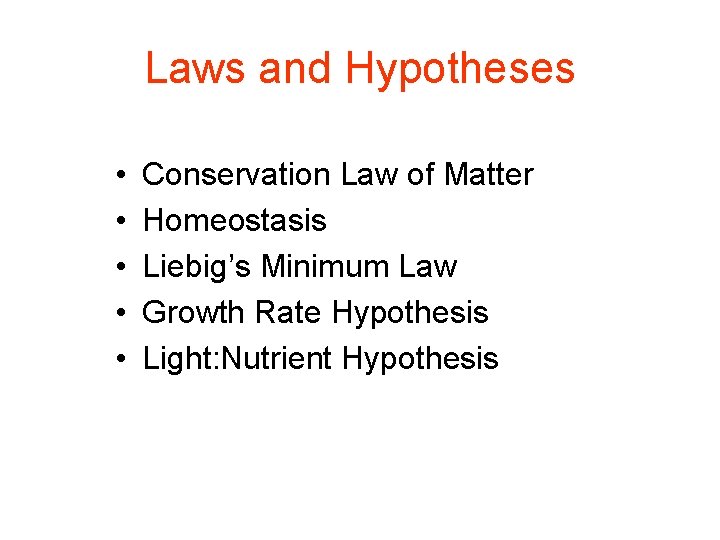
Laws and Hypotheses • • • Conservation Law of Matter Homeostasis Liebig’s Minimum Law Growth Rate Hypothesis Light: Nutrient Hypothesis
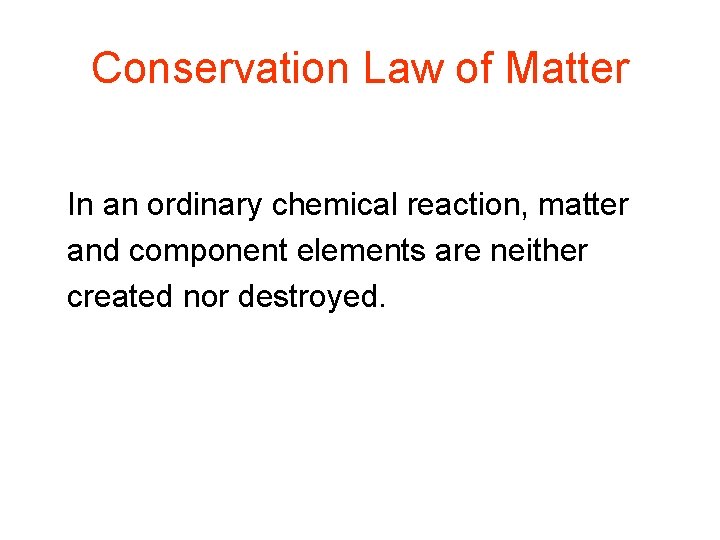
Conservation Law of Matter In an ordinary chemical reaction, matter and component elements are neither created nor destroyed.
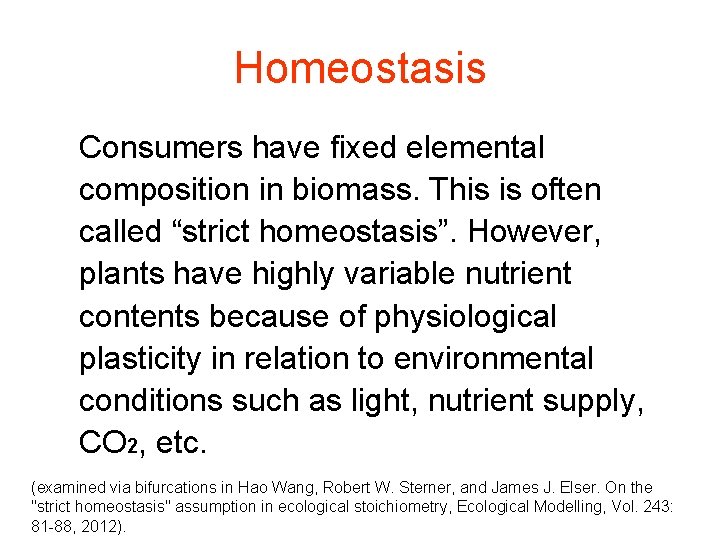
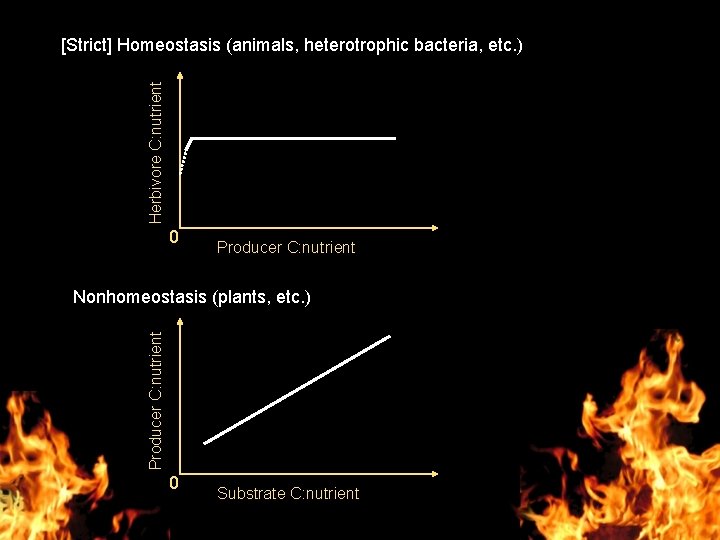
Homeostasis Consumers have fixed elemental composition in biomass. This is often called “strict homeostasis”. However, plants have highly variable nutrient contents because of physiological plasticity in relation to environmental conditions such as light, nutrient supply, CO 2, etc. (examined via bifurcations in Hao Wang, Robert W. Sterner, and James J. Elser. On the "strict homeostasis" assumption in ecological stoichiometry, Ecological Modelling, Vol. 243: 81 -88, 2012).
Herbivore C: nutrient [Strict] Homeostasis (animals, heterotrophic bacteria, etc. ) 0 Producer C: nutrient Nonhomeostasis (plants, etc. ) 0 Substrate C: nutrient
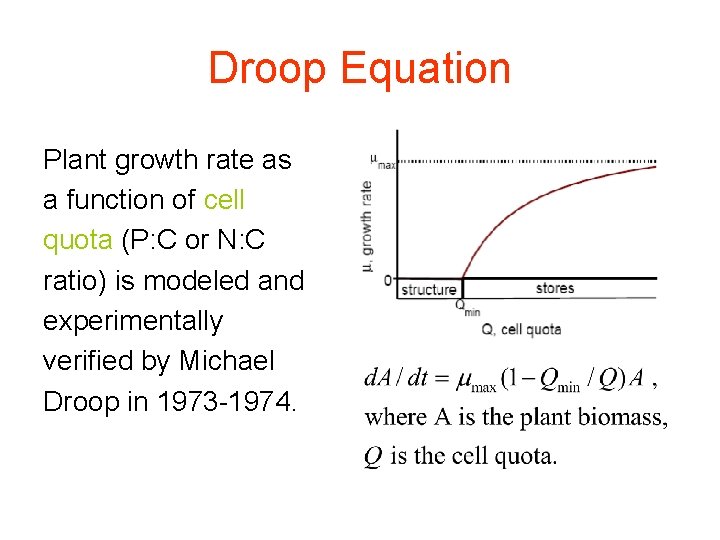
Droop Equation Plant growth rate as a function of cell quota (P: C or N: C ratio) is modeled and experimentally verified by Michael Droop in 1973 -1974.
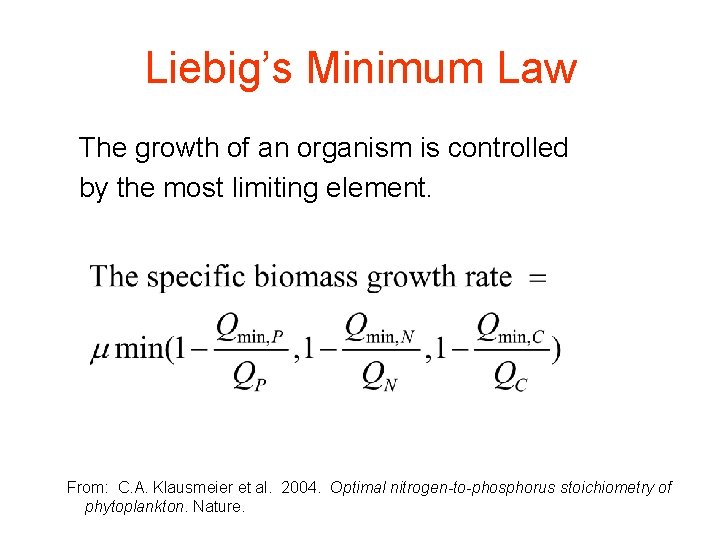
Liebig’s Minimum Law The growth of an organism is controlled by the most limiting element. From: C. A. Klausmeier et al. 2004. Optimal nitrogen-to-phosphorus stoichiometry of phytoplankton. Nature.
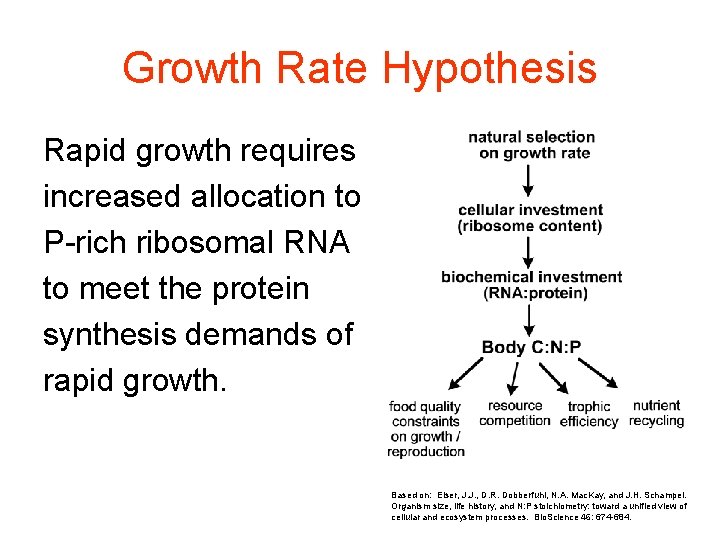
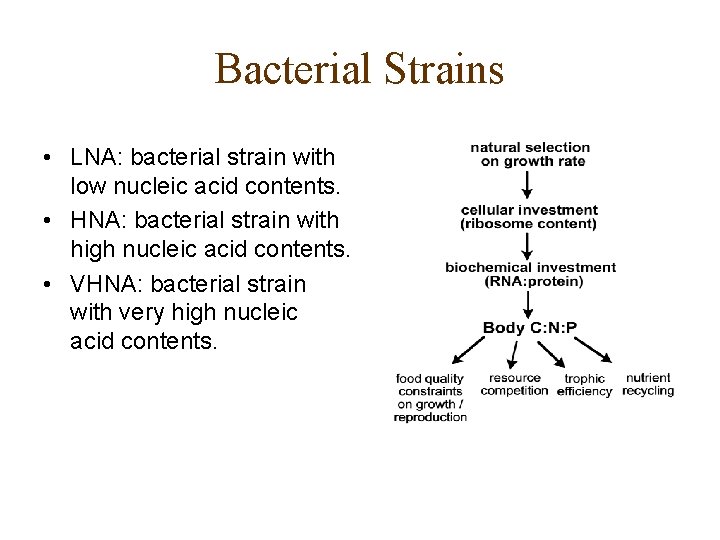
Growth Rate Hypothesis Rapid growth requires increased allocation to P-rich ribosomal RNA to meet the protein synthesis demands of rapid growth. Based on: Elser, J. J. , D. R. Dobberfuhl, N. A. Mac. Kay, and J. H. Schampel. Organism size, life history, and N: P stoichiometry: toward a unified view of cellular and ecosystem processes. Bio. Science 46: 674 -684.
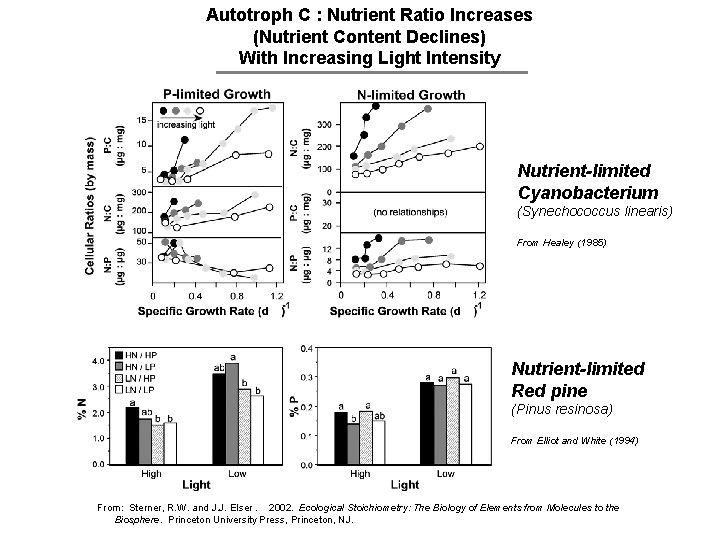
Autotroph C : Nutrient Ratio Increases (Nutrient Content Declines) With Increasing Light Intensity Nutrient-limited Cyanobacterium (Synechococcus linearis) From Healey (1985) Nutrient-limited Red pine (Pinus resinosa) From Elliot and White (1994) From: Sterner, R. W. and J. J. Elser. 2002. Ecological Stoichiometry: The Biology of Elements from Molecules to the Biosphere. Princeton University Press, Princeton, NJ.
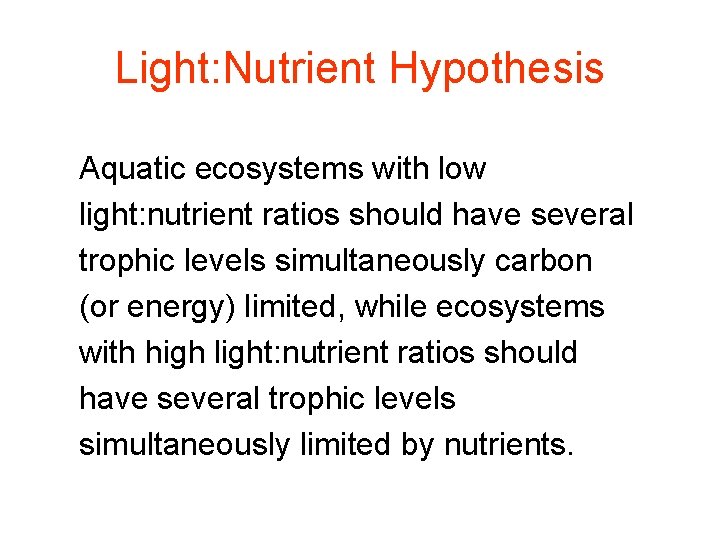
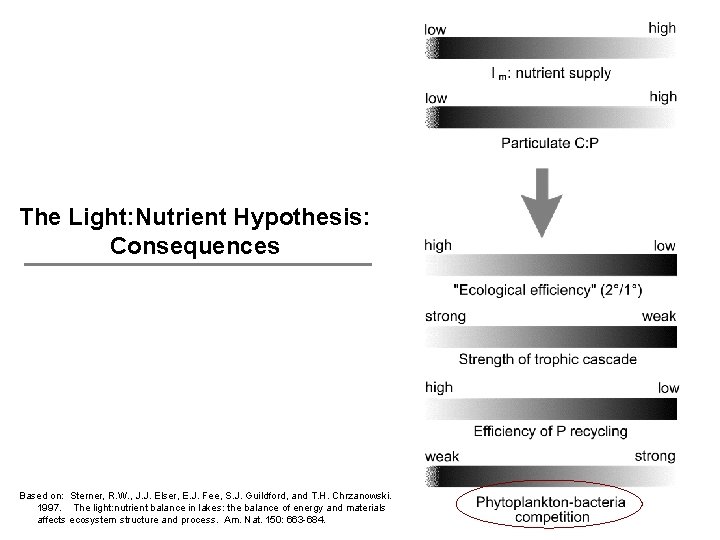
Light: Nutrient Hypothesis Aquatic ecosystems with low light: nutrient ratios should have several trophic levels simultaneously carbon (or energy) limited, while ecosystems with high light: nutrient ratios should have several trophic levels simultaneously limited by nutrients.
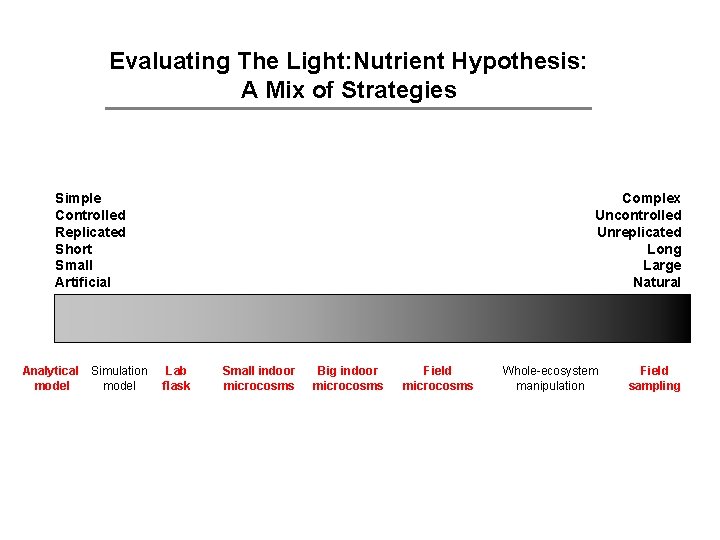
Evaluating The Light: Nutrient Hypothesis: A Mix of Strategies Simple Controlled Replicated Short Small Artificial Analytical model Simulation model Complex Uncontrolled Unreplicated Long Large Natural Lab flask Small indoor microcosms Big indoor microcosms Field microcosms Whole-ecosystem manipulation Field sampling
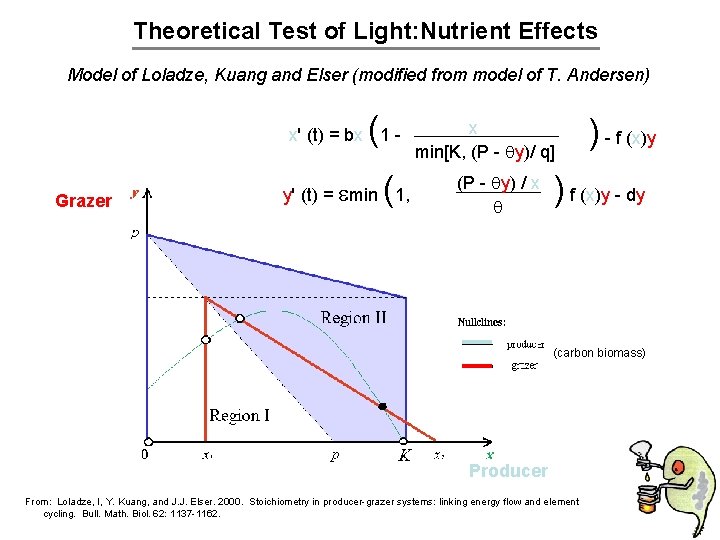
Theoretical Test of Light: Nutrient Effects Model of Loladze, Kuang and Elser (modified from model of T. Andersen) ( x' (t) = bx 1 - Grazer ( y' (t) = emin 1, x min[K, (P - qy)/ q] (P - qy) / x q ) - f (x)y ) f (x)y - dy (carbon biomass) Producer From: Loladze, I, Y. Kuang, and J. J. Elser. 2000. Stoichiometry in producer-grazer systems: linking energy flow and element cycling. Bull. Math. Biol. 62: 1137 -1162.
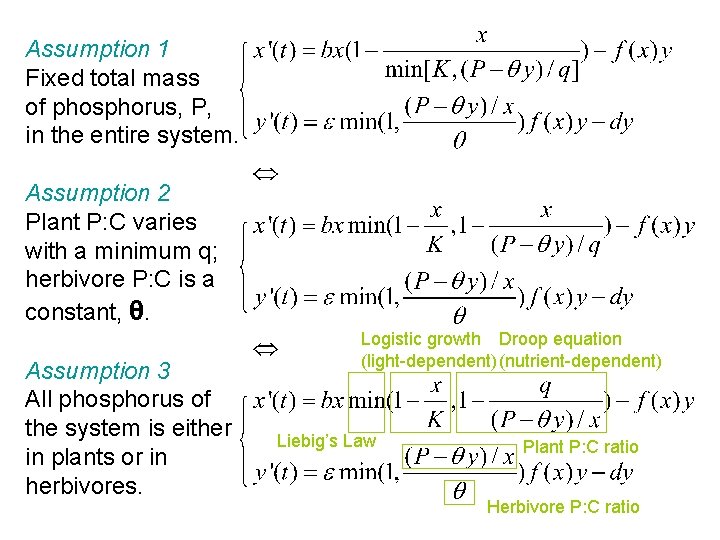
Assumption 1 Fixed total mass of phosphorus, P, in the entire system. Assumption 2 Plant P: C varies with a minimum q; herbivore P: C is a constant, θ. Assumption 3 All phosphorus of the system is either in plants or in herbivores. Logistic growth Droop equation (light-dependent) (nutrient-dependent) Liebig’s Law Plant P: C ratio Herbivore P: C ratio
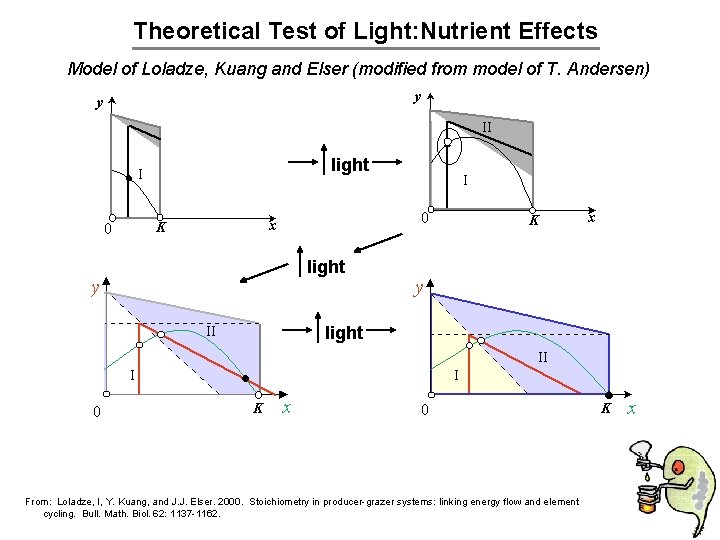
Theoretical Test of Light: Nutrient Effects Model of Loladze, Kuang and Elser (modified from model of T. Andersen) light From: Loladze, I, Y. Kuang, and J. J. Elser. 2000. Stoichiometry in producer-grazer systems: linking energy flow and element cycling. Bull. Math. Biol. 62: 1137 -1162.
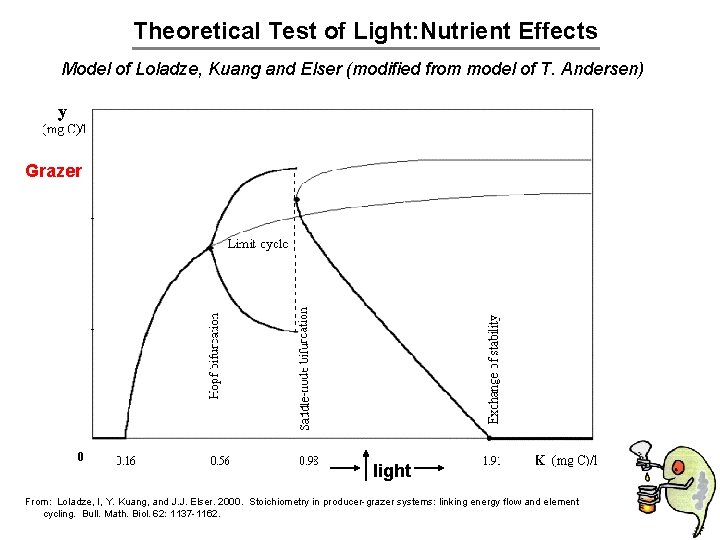
Theoretical Test of Light: Nutrient Effects Model of Loladze, Kuang and Elser (modified from model of T. Andersen) Grazer light From: Loladze, I, Y. Kuang, and J. J. Elser. 2000. Stoichiometry in producer-grazer systems: linking energy flow and element cycling. Bull. Math. Biol. 62: 1137 -1162.
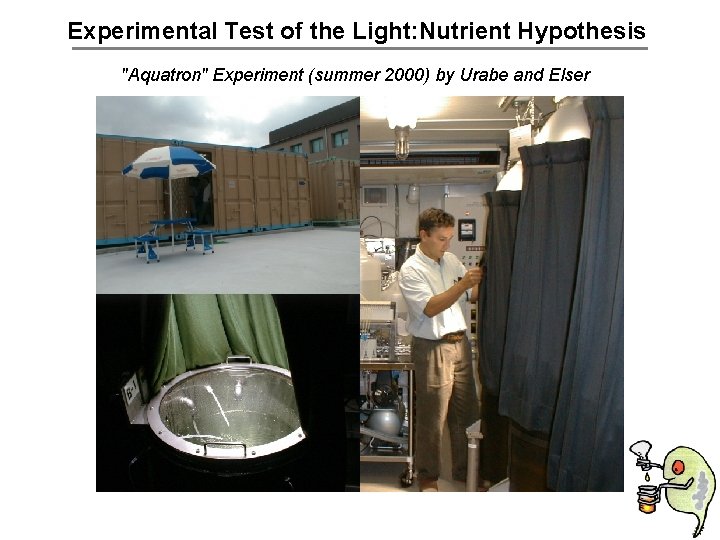
Experimental Test of the Light: Nutrient Hypothesis "Aquatron" Experiment (summer 2000) by Urabe and Elser
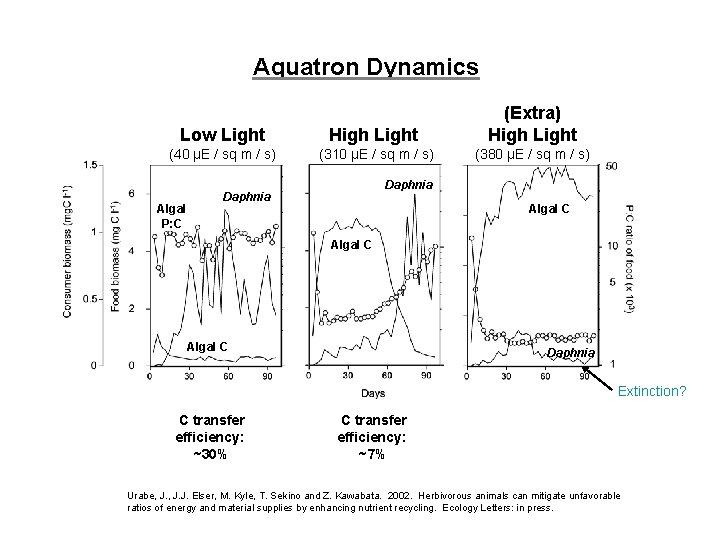
Aquatron Dynamics Low Light High Light (Extra) High Light (40 µE / sq m / s) (310 µE / sq m / s) (380 µE / sq m / s) Algal P: C Daphnia Algal C Daphnia Extinction? C transfer efficiency: ~30% C transfer efficiency: ~7% Urabe, J. J. Elser, M. Kyle, T. Sekino and Z. Kawabata. 2002. Herbivorous animals can mitigate unfavorable ratios of energy and material supplies by enhancing nutrient recycling. Ecology Letters: in press.
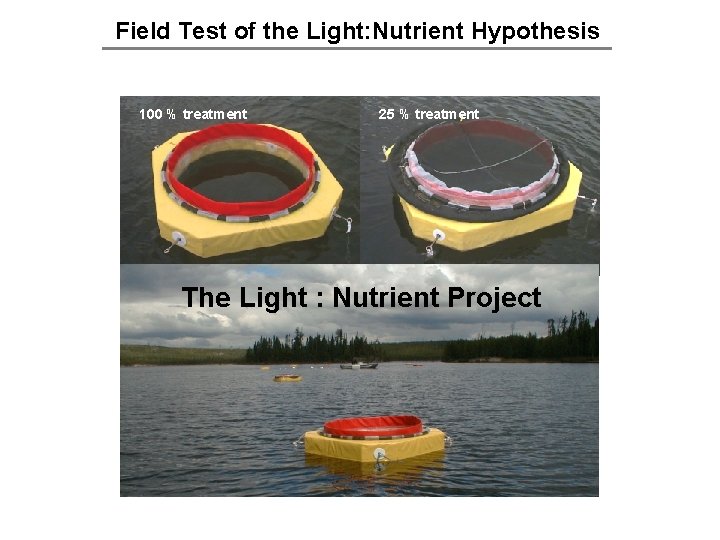
Field Test of the Light: Nutrient Hypothesis 100 % treatment 25 % treatment The Light : Nutrient Project
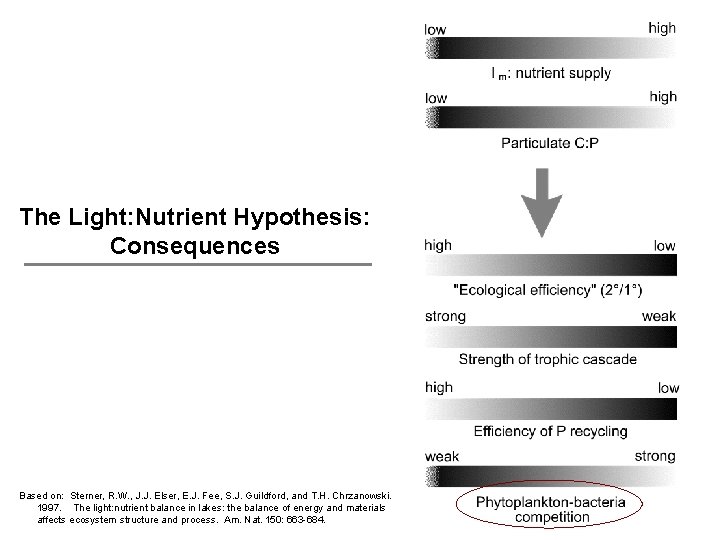
The Light: Nutrient Hypothesis: Consequences Based on: Sterner, R. W. , J. J. Elser, E. J. Fee, S. J. Guildford, and T. H. Chrzanowski. 1997. The light: nutrient balance in lakes: the balance of energy and materials affects ecosystem structure and process. Am. Nat. 150: 663 -684.
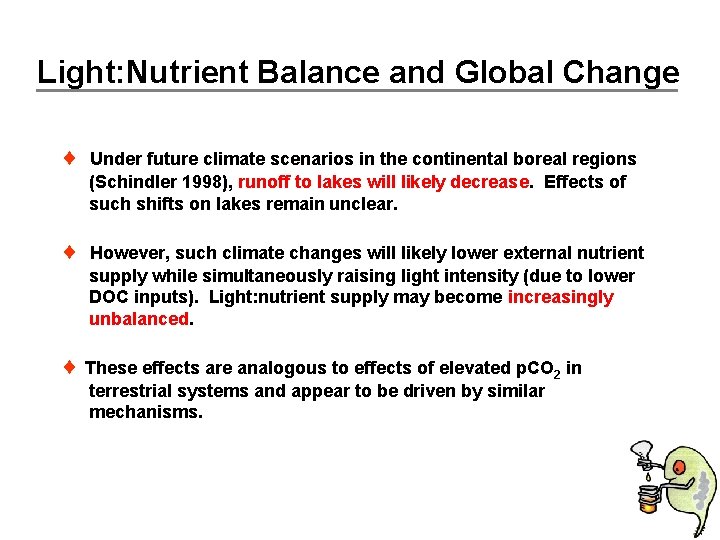
Light: Nutrient Balance and Global Change Under future climate scenarios in the continental boreal regions (Schindler 1998), runoff to lakes will likely decrease. Effects of such shifts on lakes remain unclear. However, such climate changes will likely lower external nutrient supply while simultaneously raising light intensity (due to lower DOC inputs). Light: nutrient supply may become increasingly unbalanced. These effects are analogous to effects of elevated p. CO 2 in terrestrial systems and appear to be driven by similar mechanisms.
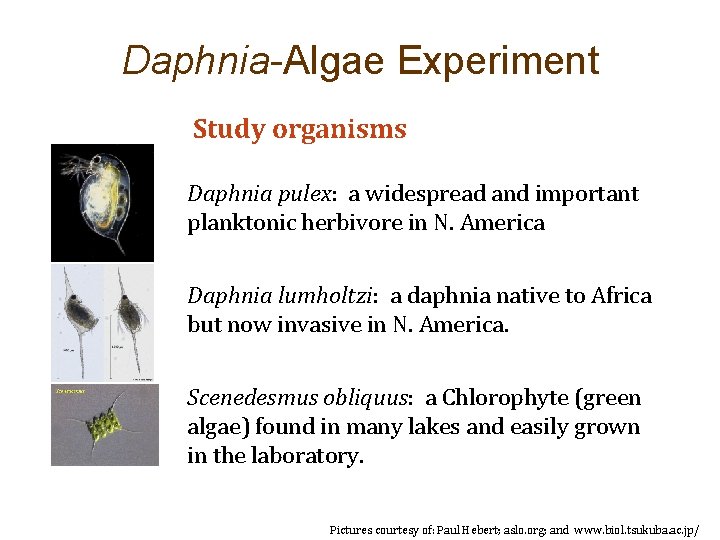
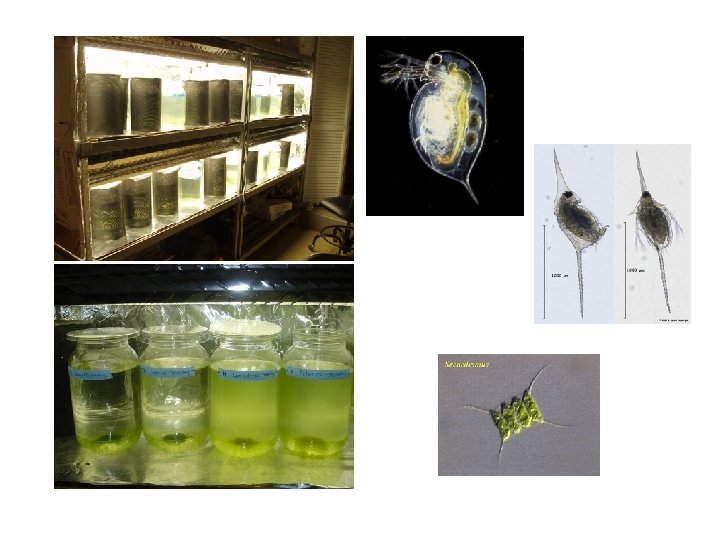
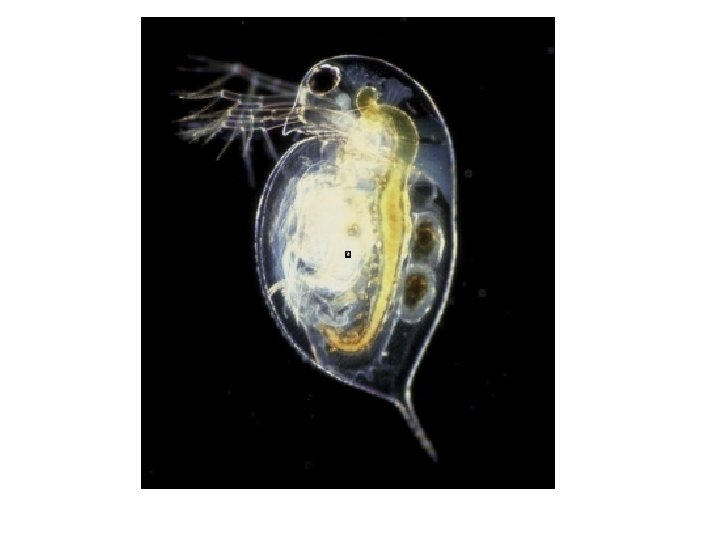
Daphnia-Algae Experiment Study organisms Daphnia pulex: a widespread and important planktonic herbivore in N. America Daphnia lumholtzi: a daphnia native to Africa but now invasive in N. America. Scenedesmus obliquus: a Chlorophyte (green algae) found in many lakes and easily grown in the laboratory. Pictures courtesy of: Paul Hebert; aslo. org; and www. biol. tsukuba. ac. jp/
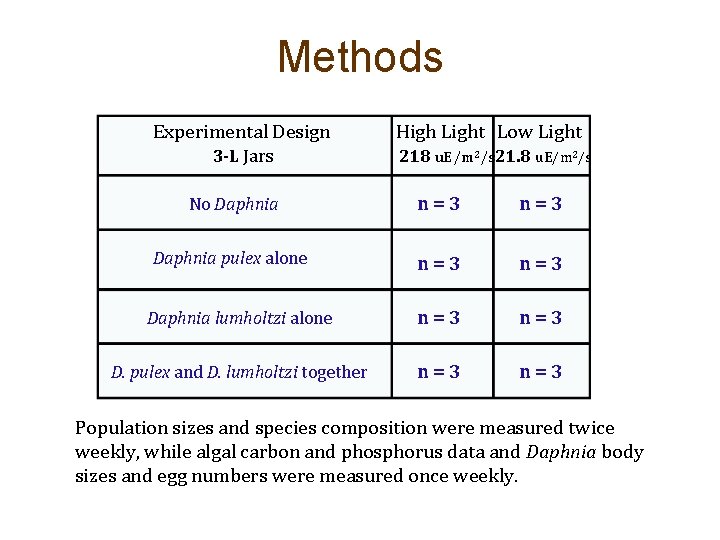
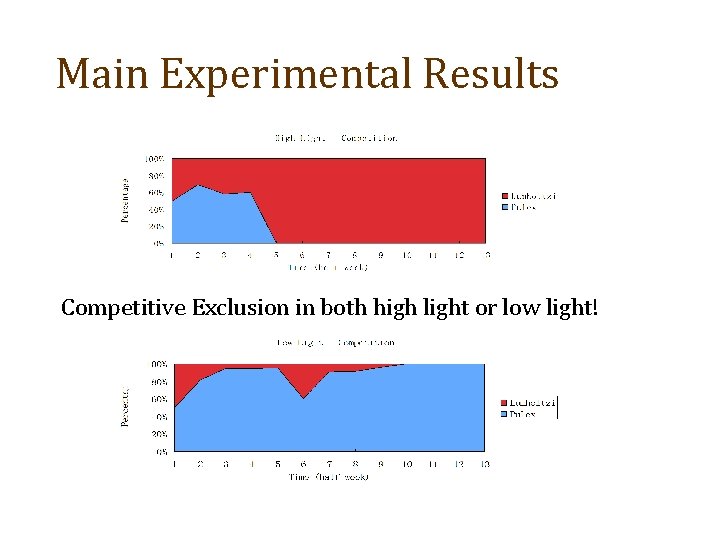
Methods Experimental Design 3 -L Jars High Light Low Light 218 u. E/m 2/s 21. 8 u. E/m 2/s No Daphnia n=3 Daphnia pulex alone n=3 Daphnia lumholtzi alone n=3 D. pulex and D. lumholtzi together n=3 Population sizes and species composition were measured twice weekly, while algal carbon and phosphorus data and Daphnia body sizes and egg numbers were measured once weekly.
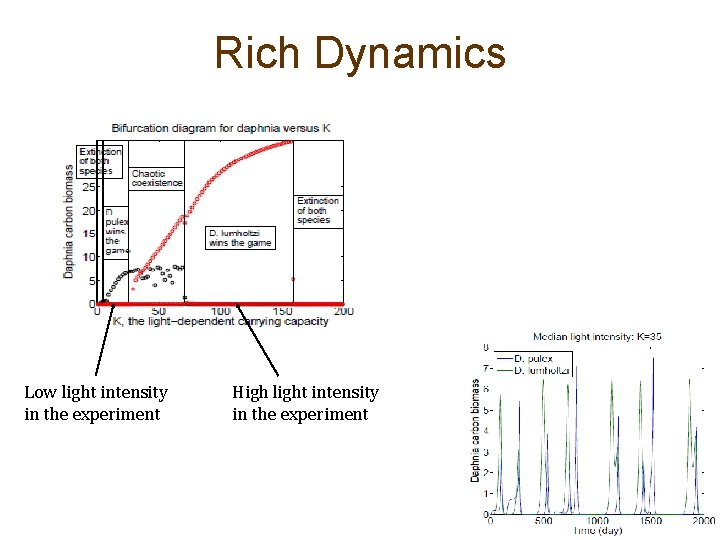
Main Experimental Results Competitive Exclusion in both high light or low light!
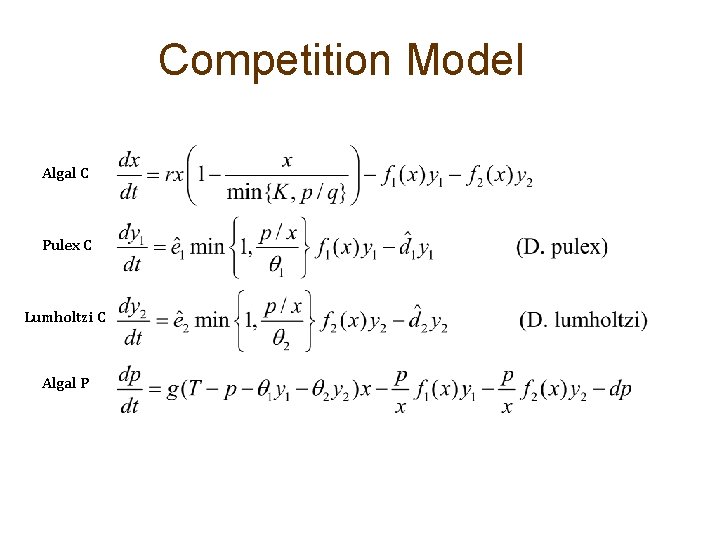
Competition Model Algal C Pulex C Lumholtzi C Algal P
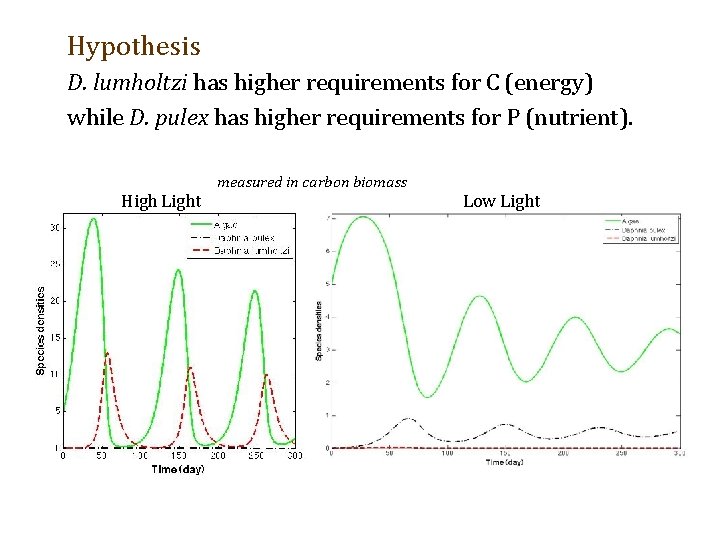
Hypothesis D. lumholtzi has higher requirements for C (energy) while D. pulex has higher requirements for P (nutrient). High Light measured in carbon biomass Low Light
Rich Dynamics Low light intensity in the experiment High light intensity in the experiment
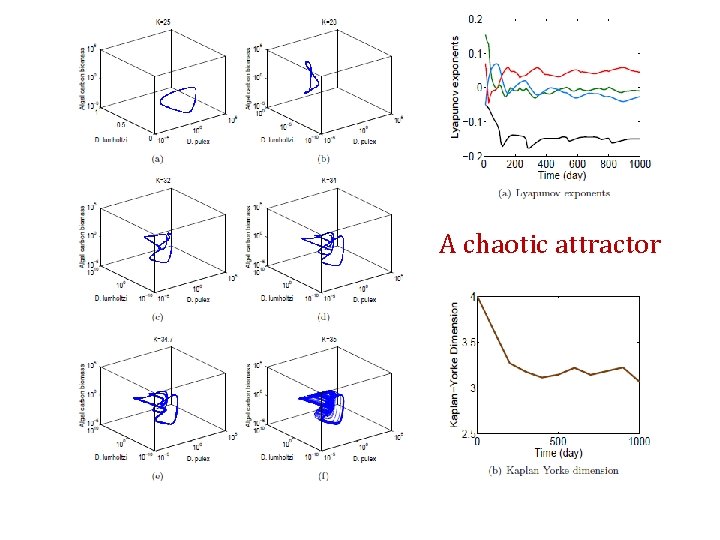
A chaotic attractor
The Light: Nutrient Hypothesis: Consequences Based on: Sterner, R. W. , J. J. Elser, E. J. Fee, S. J. Guildford, and T. H. Chrzanowski. 1997. The light: nutrient balance in lakes: the balance of energy and materials affects ecosystem structure and process. Am. Nat. 150: 663 -684.
Dynamics of Stoichiometric Bacteria. Algae Interactions in the Epilimnion
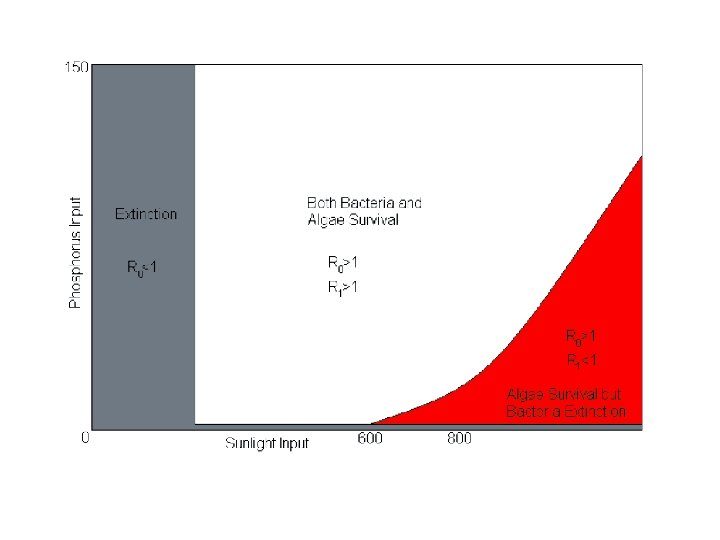
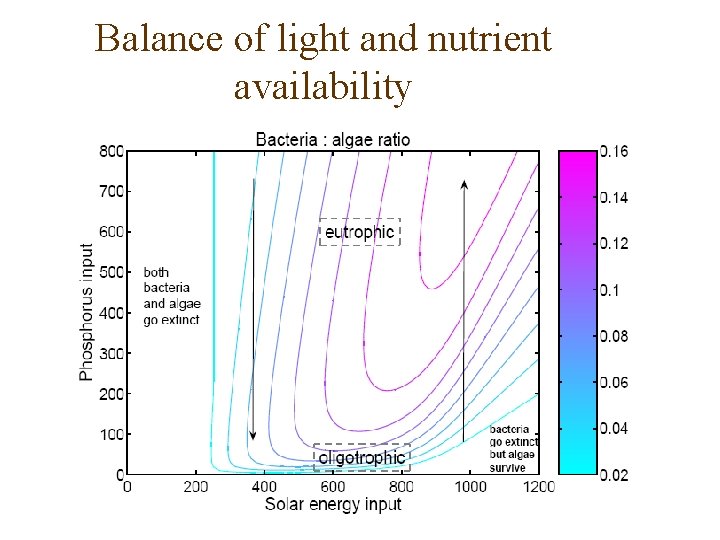
Question 1 What is the relationship between cyanobacteria and algae? How do light and nutrient availability regulate relative abundances of bacteria and algae in the Epilimnion?
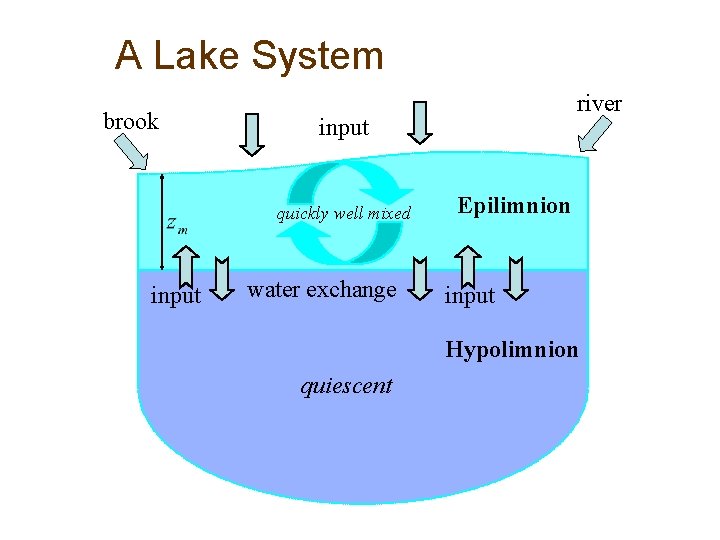
A Lake System brook input quickly well mixed input river water exchange Epilimnion input Hypolimnion quiescent
Scenario The Epilimnion is quickly well mixed in the sense that it is well mixed over night. Assumption The Epilimnion is well mixed all the time.
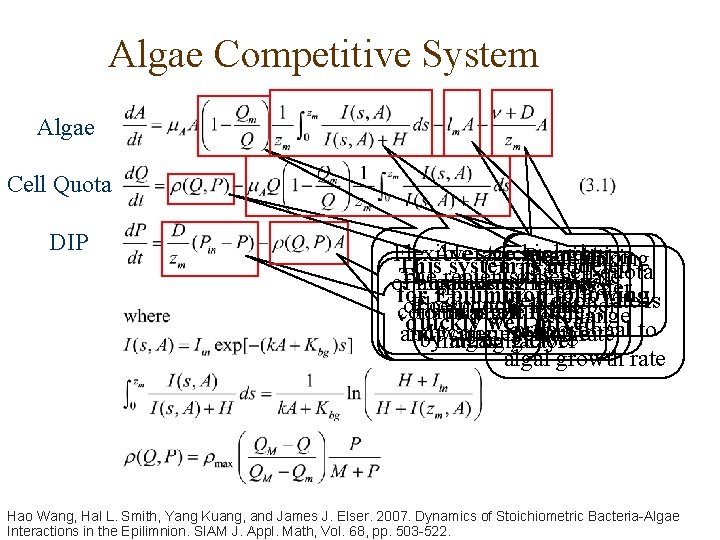
Algae Competitive System Algae Cell Quota DIP Flexible Average stoichiometry sunlight Respiration Algal sinking This system is modeled The cell quota The replenishment rate Phosphorus of algae uptake using efficiency Droop’s loss and water for Epilimnion following depletion rate is of. Phosphorus cell quota is the per input consumption form of as algae a nutrient in the exchange ‘quickly well mixed’. proportional unit consumption and water exchange bylimitng algae mixing factor layer rate to algal growth rate Hao Wang, Hal L. Smith, Yang Kuang, and James J. Elser. 2007. Dynamics of Stoichiometric Bacteria-Algae Interactions in the Epilimnion. SIAM J. Appl. Math, Vol. 68, pp. 503 -522.
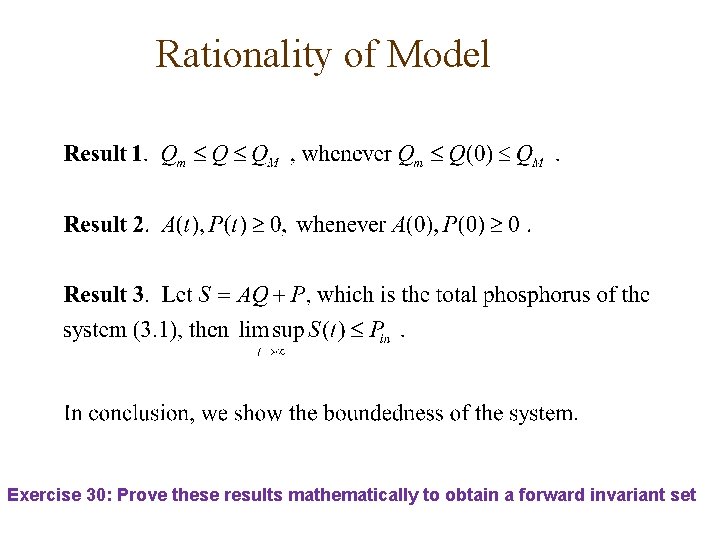
Rationality of Model Exercise 30: Prove these results mathematically to obtain a forward invariant set
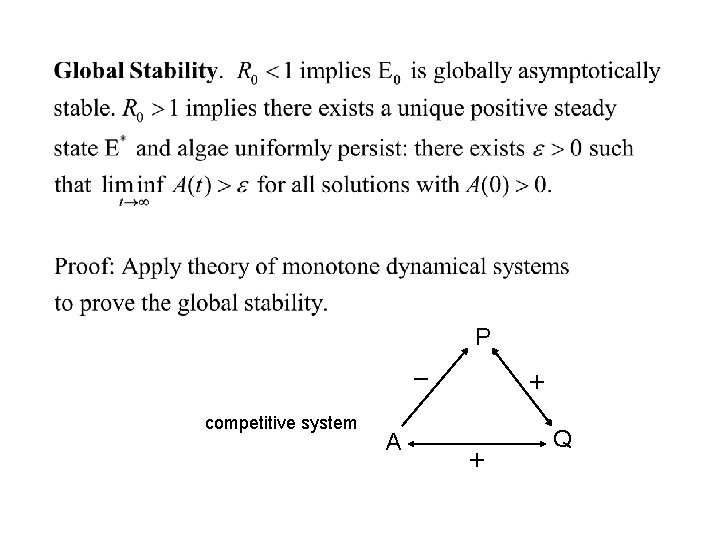
P _ competitive system A + + Q
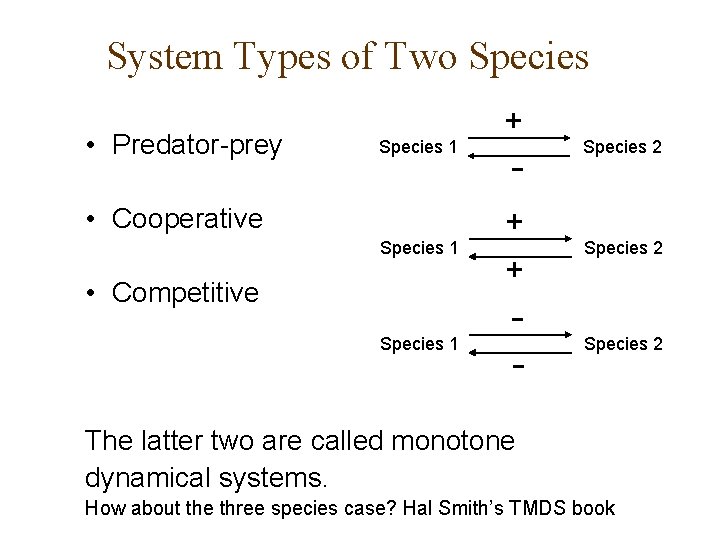
System Types of Two Species • Predator-prey Species 1 • Cooperative + - Species 2 Species 1 + + Species 2 Species 1 - Species 2 • Competitive The latter two are called monotone dynamical systems. How about the three species case? Hal Smith’s TMDS book
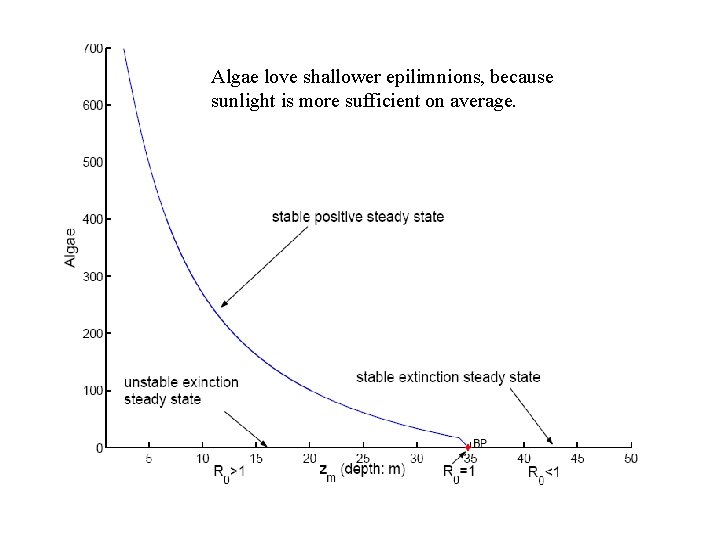
Algae love shallower epilimnions, because sunlight is more sufficient on average.
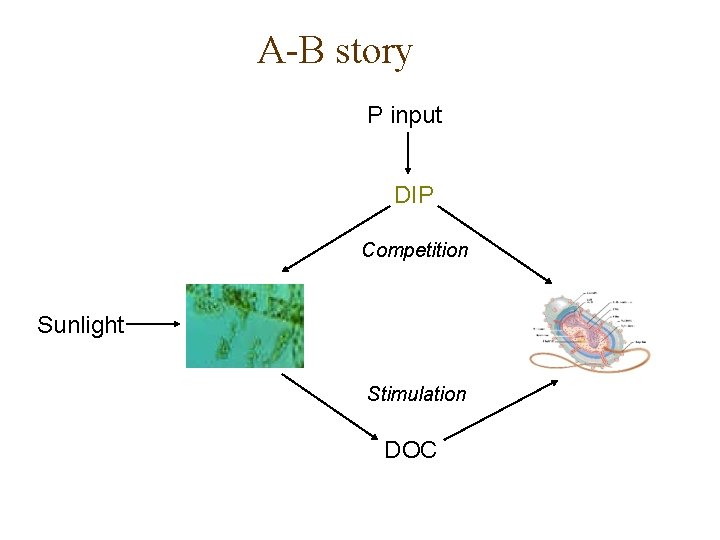
A-B story P input DIP Competition Sunlight Stimulation DOC
Homeostasis Scenario Algae have flexible stoichiometry whereas bacteria have relatively fixed stoichiometry. Assumption (P: C) in bacterial cells is fixed. W. Makino, J. B. Cotner, R. W. Sterner and J. J. Elser, Are bacteria more like plants or animals? Growth rate and resource dependence of bacterial C: N: P stoichiometry, Functional Ecology, 17 (2003), pp. 121 -130.
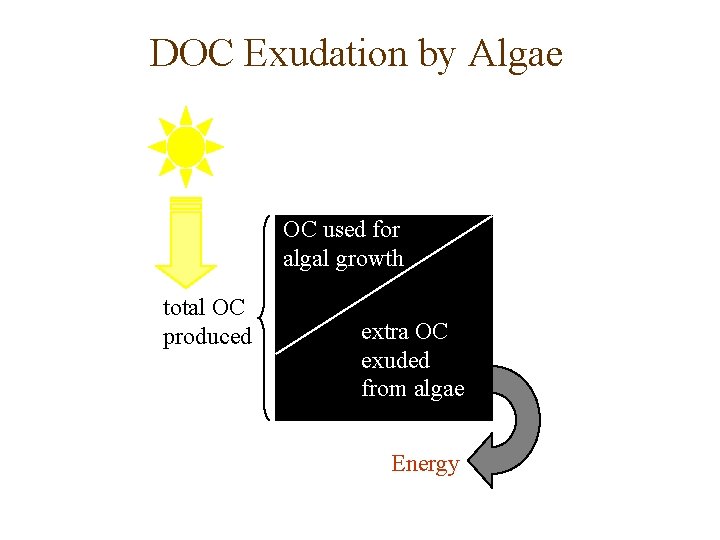
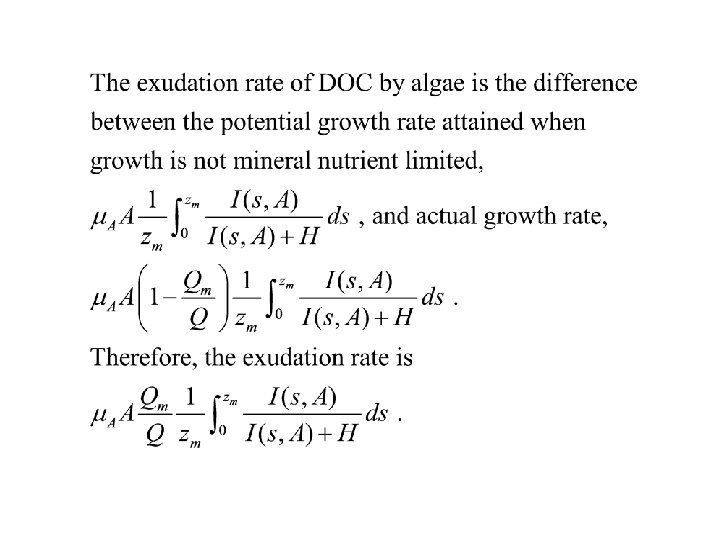
DOC Exudation by Algae OC used for algal growth total OC produced extra OC exuded from algae Energy
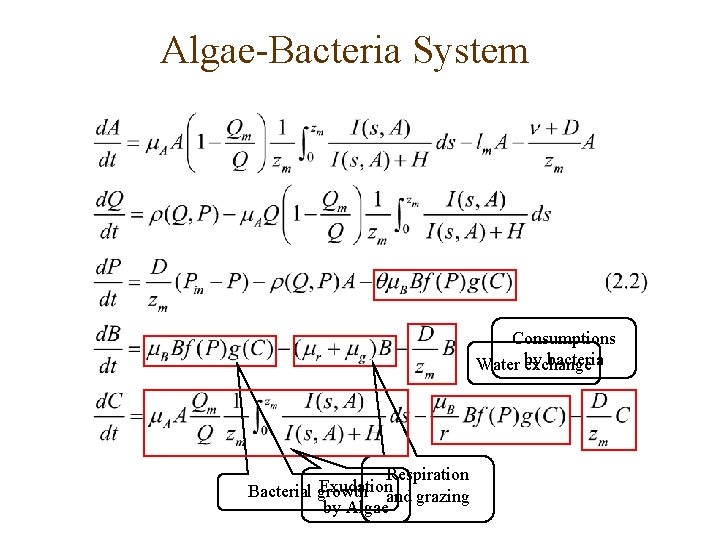
Algae-Bacteria System Consumptions by bacteria Water exchange Respiration Exudation Bacterial growth and grazing by Algae
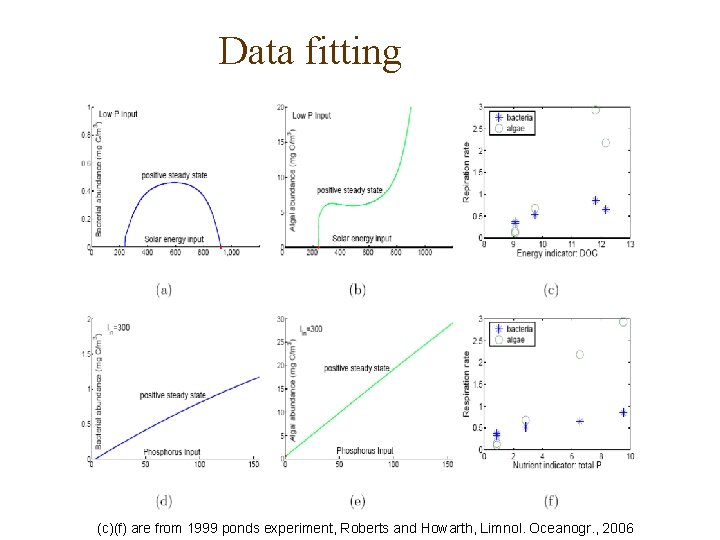
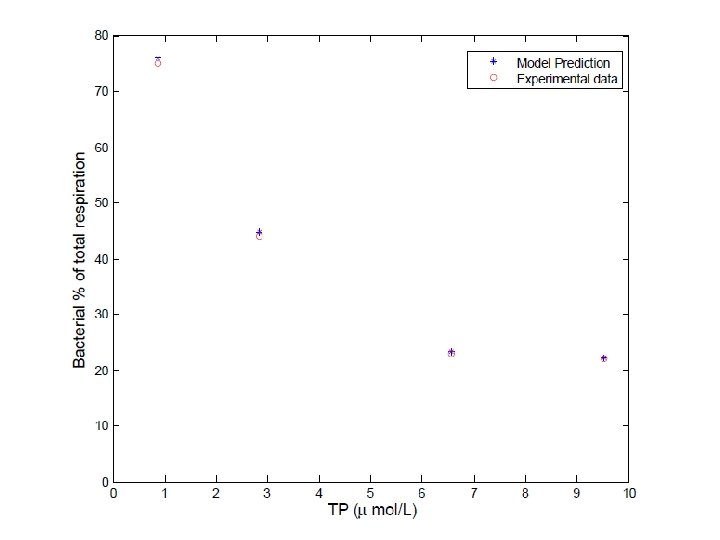
Data fitting (c)(f) are from 1999 ponds experiment, Roberts and Howarth, Limnol. Oceanogr. , 2006
Balance of light and nutrient availability
Bacterial Strains • LNA: bacterial strain with low nucleic acid contents. • HNA: bacterial strain with high nucleic acid contents. • VHNA: bacterial strain with very high nucleic acid contents.
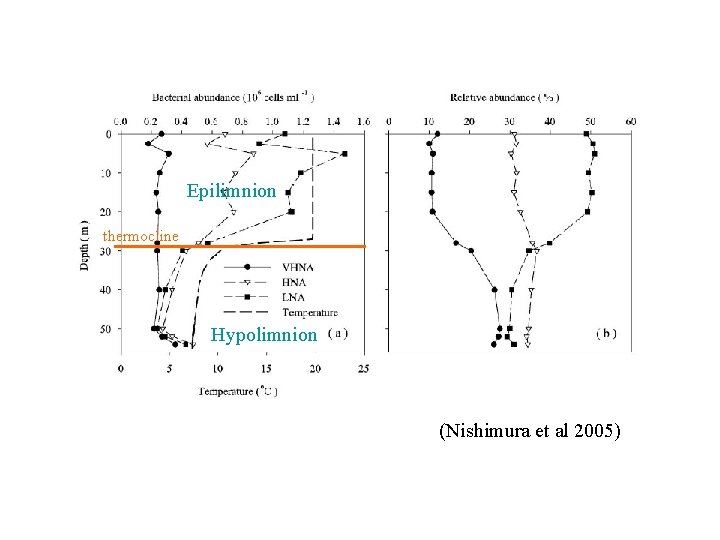
Epilimnion thermocline Hypolimnion (Nishimura et al 2005)
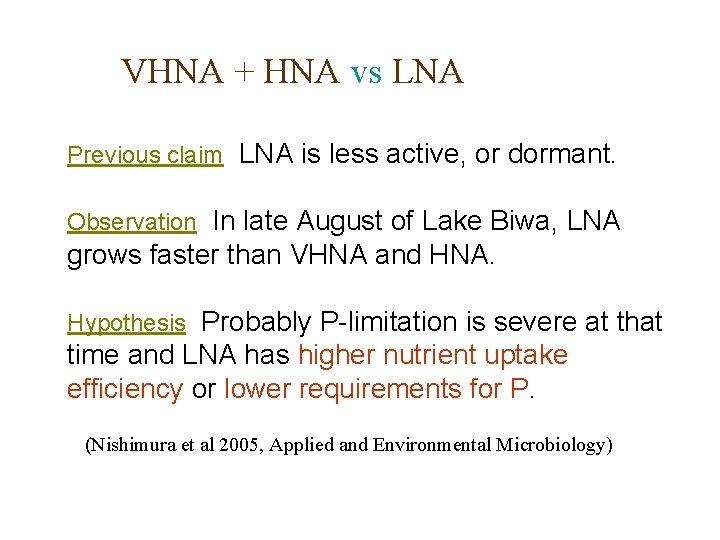
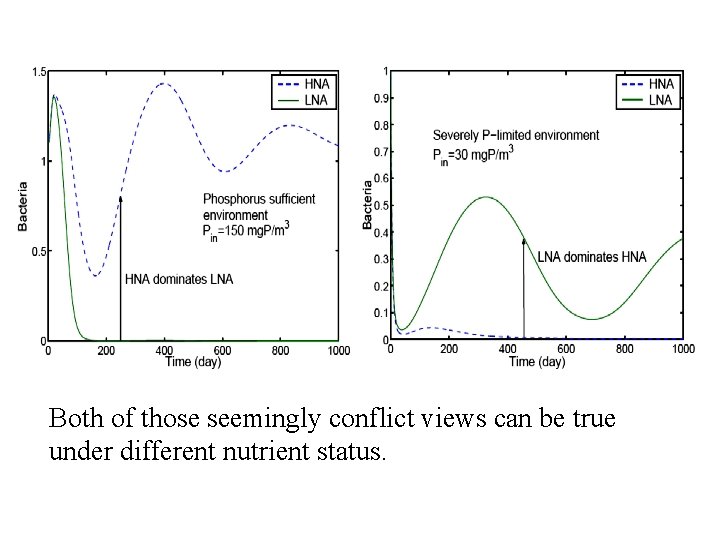
VHNA + HNA vs LNA Previous claim LNA is less active, or dormant. Observation In late August of Lake Biwa, LNA grows faster than VHNA and HNA. Hypothesis Probably P-limitation is severe at that time and LNA has higher nutrient uptake efficiency or lower requirements for P. (Nishimura et al 2005, Applied and Environmental Microbiology)
Question 2 Why do LNA bacteria dominate other two strains in late August of Lake Biwa?
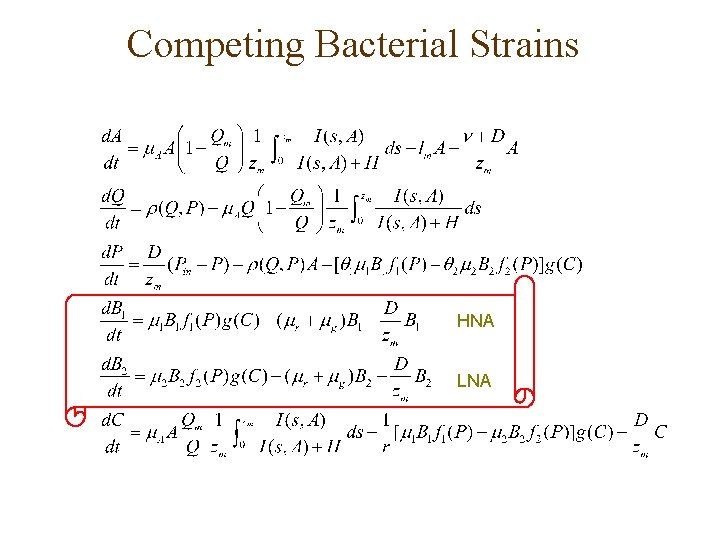
Competing Bacterial Strains HNA LNA
VHNA + HNA vs LNA Previous claim LNA is less active, or dormant. Observation In late August of Lake Biwa, LNA grows faster than VHNA and HNA. Hypothesis Probably P-limitation is severe at that time and LNA has higher nutrient uptake efficiency or lower requirements for P. (Nishimura et al 2005, Applied and Environmental Microbiology)
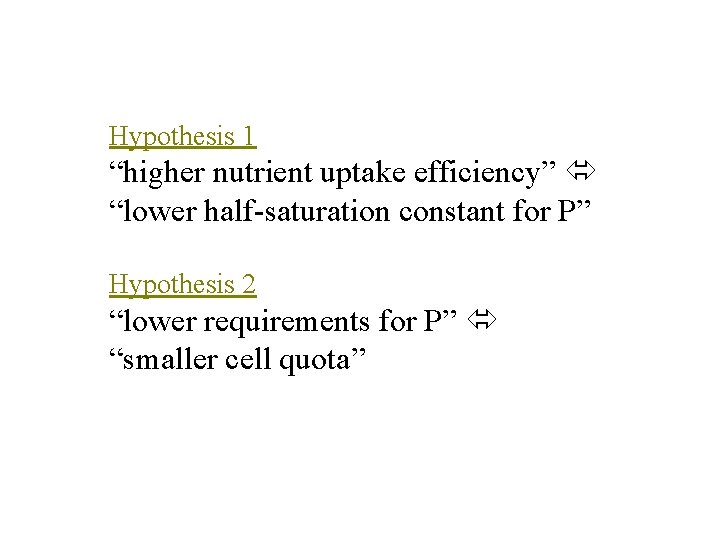
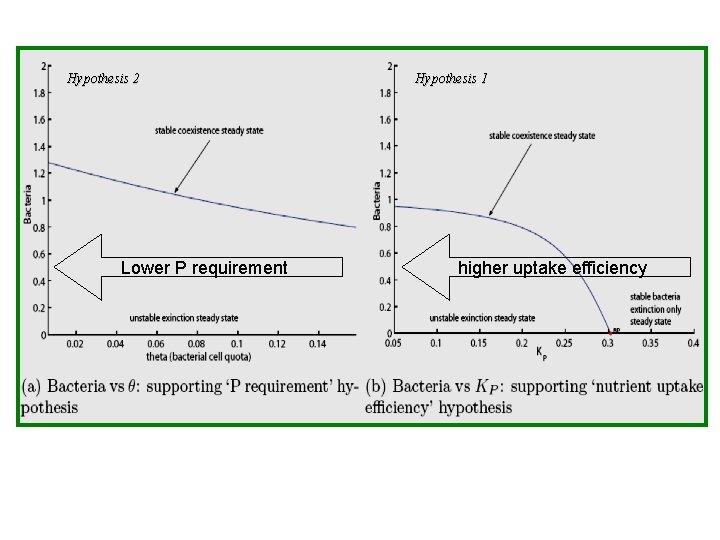
Hypothesis 1 “higher nutrient uptake efficiency” “lower half-saturation constant for P” Hypothesis 2 “lower requirements for P” “smaller cell quota”
Hypothesis 2 Lower P requirement Hypothesis 1 higher uptake efficiency
Both of those seemingly conflict views can be true under different nutrient status.
Stoichiometry Discussion
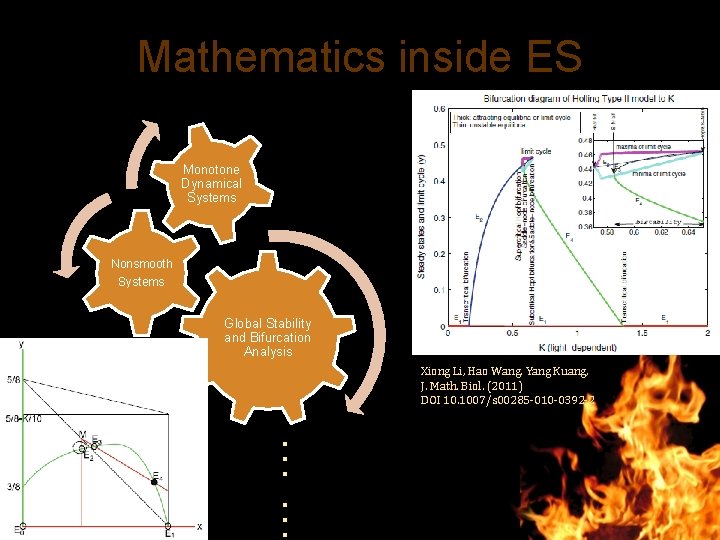
Mathematics inside ES Monotone Dynamical Systems Nonsmooth Systems Global Stability and Bifurcation Analysis Xiong Li, Hao Wang, Yang Kuang, J. Math. Biol. (2011) DOI 10. 1007/s 00285 -010 -0392 -2 ……
C, N, and P are three of the main constitutes in biological structural molecules. HOWEVER, C, N, and P are not particularly abundant on Earth or in the universe as a whole and thus it seems that living things made a very discriminating selection of elements from the environment.
Si 25. 80 O 50. 02 Composition of Earth’s Crust Al 7. 30 S 0. 11 C 0. 18 S 0. 14 Ca 3. 22 Fe 4. 18 Na 2. 36 K 2. 28 Ca 2. 5 Fe 0. 01 Na 0. 10 K 0. 11 H 0. 25 P 0. 11 N 0. 03 P 1. 14 N 2. 5 H 9. 9 C 20. 2 Composition of Human Body O 63. 0
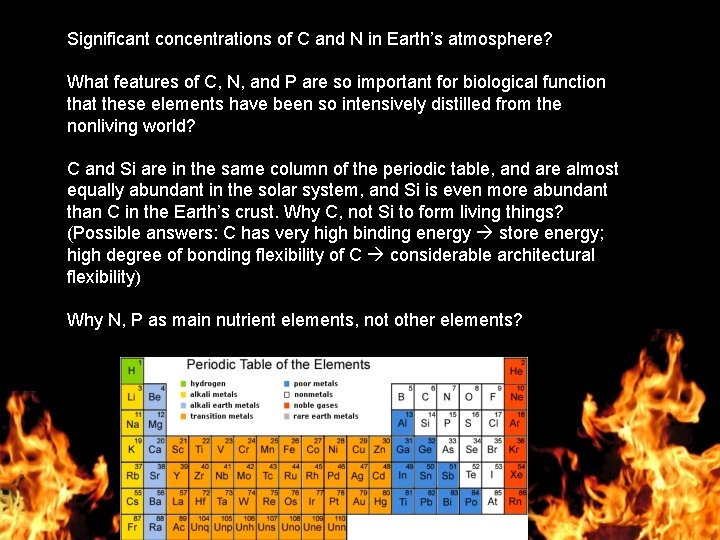
Significant concentrations of C and N in Earth’s atmosphere? What features of C, N, and P are so important for biological function that these elements have been so intensively distilled from the nonliving world? C and Si are in the same column of the periodic table, and are almost equally abundant in the solar system, and Si is even more abundant than C in the Earth’s crust. Why C, not Si to form living things? (Possible answers: C has very high binding energy store energy; high degree of bonding flexibility of C considerable architectural flexibility) Why N, P as main nutrient elements, not other elements?
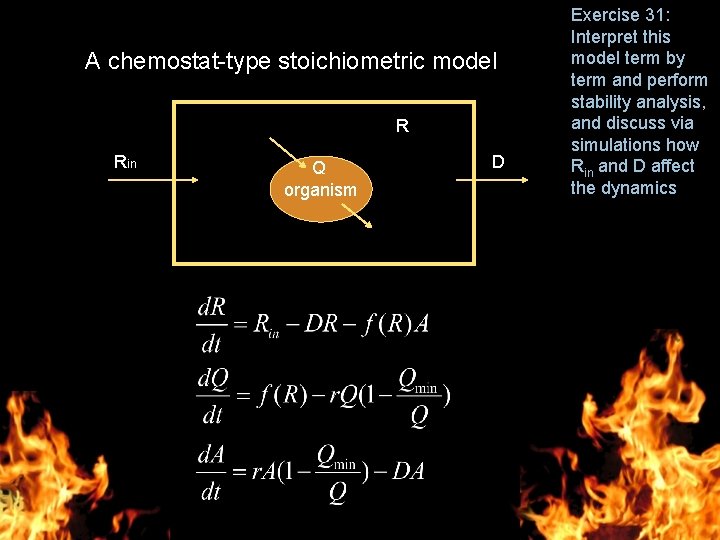
A chemostat-type stoichiometric model R Rin Q organism D Exercise 31: Interpret this model term by term and perform stability analysis, and discuss via simulations how Rin and D affect the dynamics