
Outline Of Todays Discussion 1 Classical Theories of
- Slides: 29
Outline Of Today’s Discussion 1. Classical Theories of Perception 2. Structuralism 3. Gestaltism 4. Ecological Optics 5. Constructivism
Part 1 Classical Theories of Perception
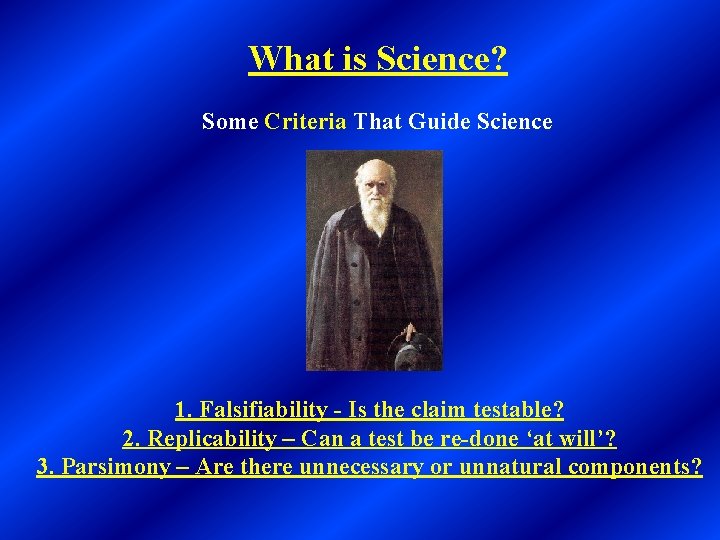
What is Science? Some Criteria That Guide Science 1. Falsifiability - Is the claim testable? 2. Replicability – Can a test be re-done ‘at will’? 3. Parsimony – Are there unnecessary or unnatural components?
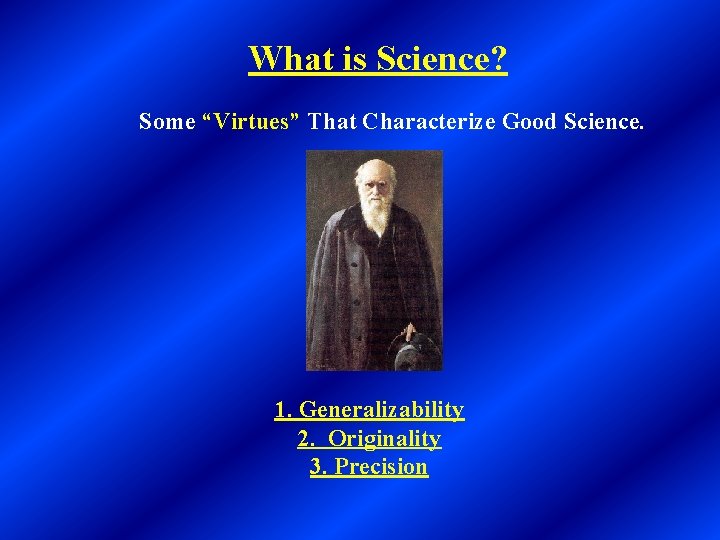
What is Science? Some “Virtues” That Characterize Good Science. 1. Generalizability 2. Originality 3. Precision
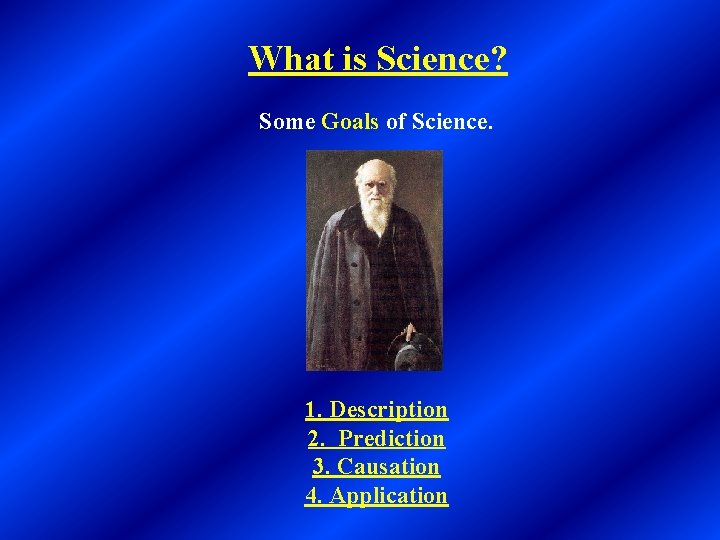
What is Science? Some Goals of Science. 1. Description 2. Prediction 3. Causation 4. Application
Classical Theories of Perception • We will spend much of this semester answering Kurt Koffka’s Question… Why do things look as they do? • We could also ask why things sound, feel, taste, smell as they do?
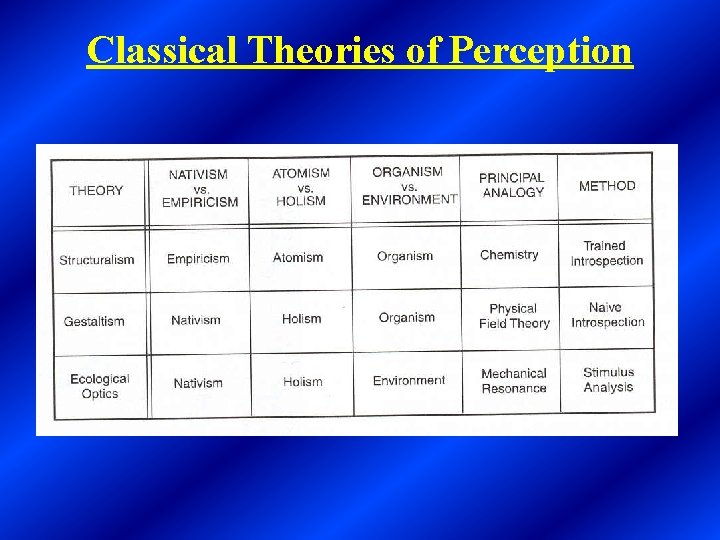
Classical Theories of Perception
Part 2 Structuralism
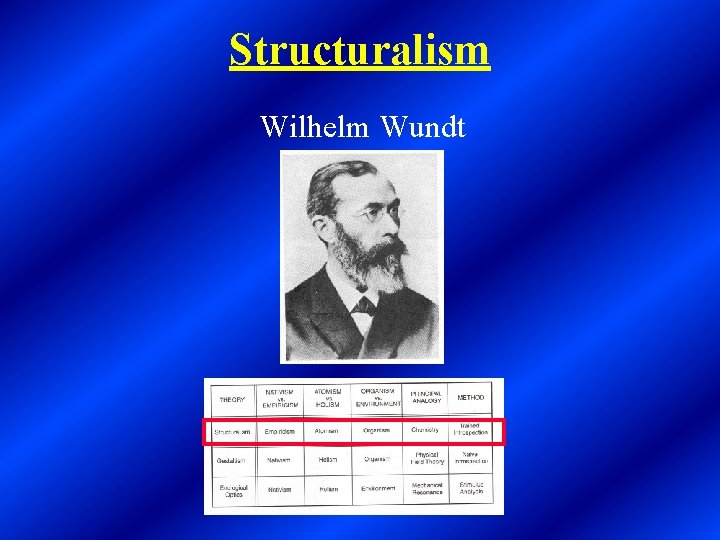
Structuralism Wilhelm Wundt
Structuralism • Structuralism’s one liner: – The whole is equal to the sum of the parts. • To structuralists, perceptual experiences are made of “sensory atoms” – indivisible elements in a sensory modality. (sound like chemistry? ) – An individual pixel on a monitor. • The sensory atoms are simply “concatenated” – strung together, as if by overlaying a series of transparencies.
Structuralism • Structuralists believed that stimulus-driven experiences in one sensory modality aroused memories from other sensory modalities. – EX: The sight of a dog became “associated” with the sound and smell of a dog. – They had an early intuition similar to Hebb’s rule: “what fires together wires together”. • How is this related to the notion of associationism in other branches of psychology? (Hint: Think back to intro psych)
Structuralism • The structuralists relied heavily on trained introspection. What is that? • Opinion Question: Do you believe that introspection is an important tool in perceptual research? Why and/or why not?
Part 3 Gestaltism
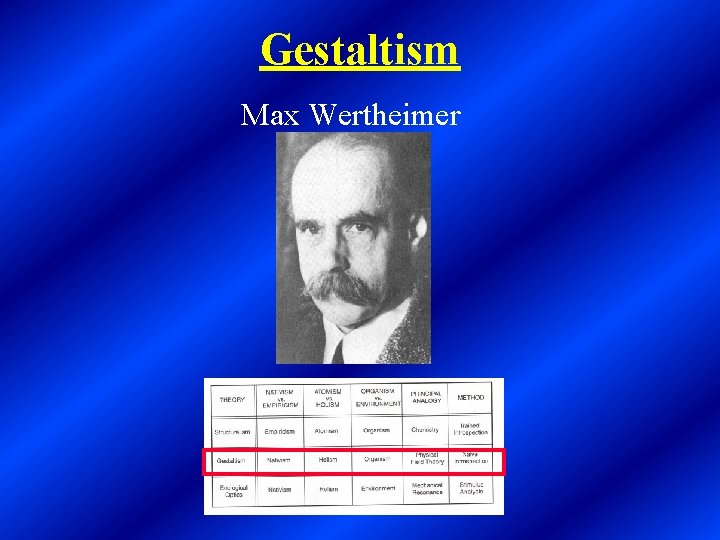
Gestaltism Max Wertheimer
Gestaltism • If you had to briefly summarize the gestalt approach, what would be a good ‘one liner’? • Describe what the gestaltists meant by the phrase “emergent properties”. • Potential Pop Quiz Question: From our “Consciousness” chapter, what was William James’ view on consciousness as an epiphenomenon?
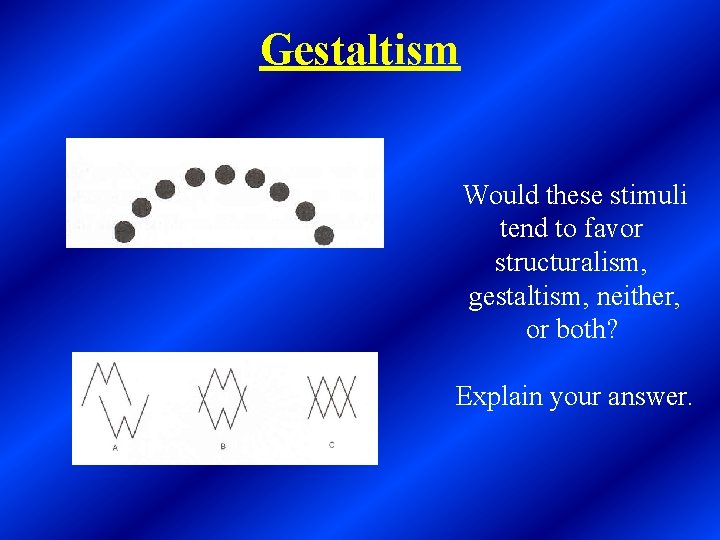
Gestaltism Would these stimuli tend to favor structuralism, gestaltism, neither, or both? Explain your answer.
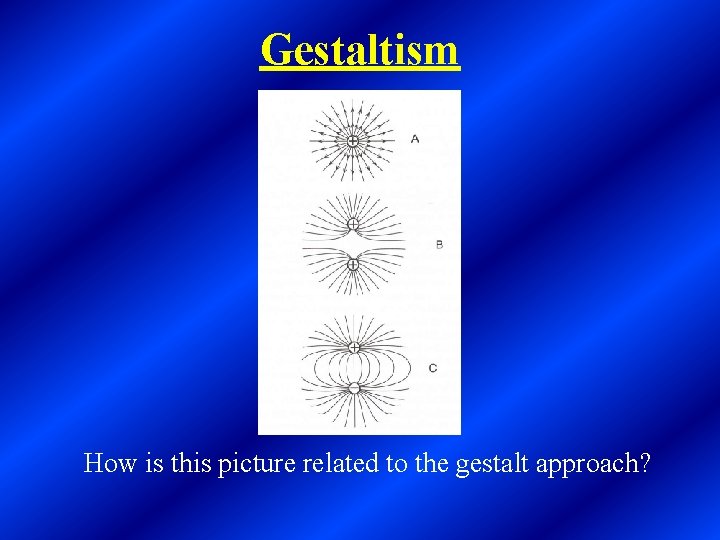
Gestaltism How is this picture related to the gestalt approach?
Part 4 Ecological Optics
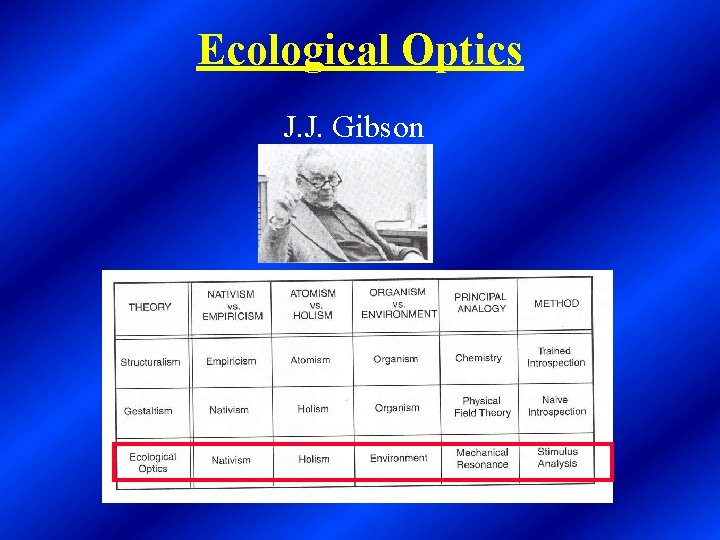
Ecological Optics J. J. Gibson
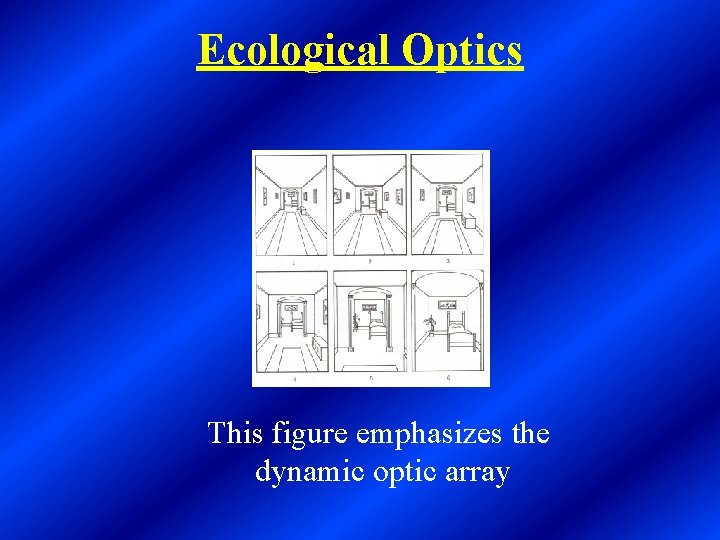
Ecological Optics • One liner for the ecological approach to perception Perception is for ACTION! • Eye’s are pricey, metabolically. • Eye’s evolved to help organisms MOVE!!! • “Get out of your (contrived) lab. Measure perception in the real world, where it evolved!” • A key concept in ecological optics – ‘Information Pick-up’: By actively exploring / sampling the environment, stimulation on the retina is sufficient to unambiguously perceive the environment! • • • “We don’t need “extra-retinal” information to explain visual perception. ” “The dynamic optic array (changing retinal image) is especially informative. ” “Why would we need to hold “representations” (UGH!) of the world in our head? ” “We can pick up the information we need by moving through the environment. ” “Ask not what’s inside the head. Ask what the head’s inside of!”
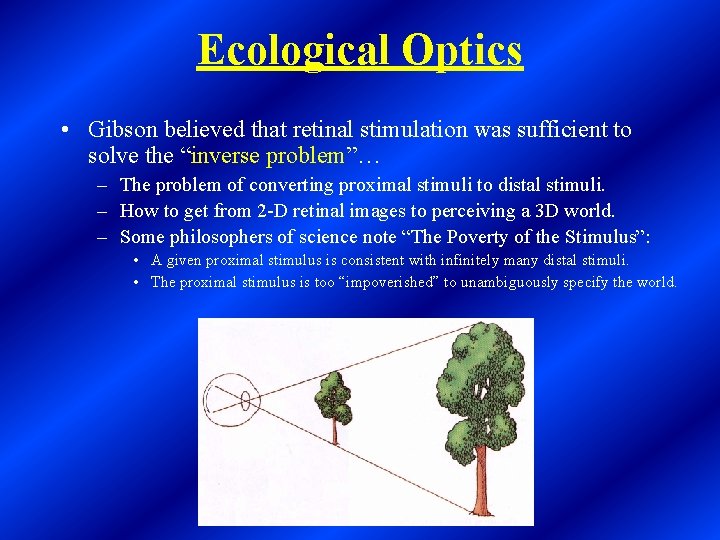
Ecological Optics • Gibson believed that retinal stimulation was sufficient to solve the “inverse problem”… – The problem of converting proximal stimuli to distal stimuli. – How to get from 2 -D retinal images to perceiving a 3 D world. – Some philosophers of science note “The Poverty of the Stimulus”: • A given proximal stimulus is consistent with infinitely many distal stimuli. • The proximal stimulus is too “impoverished” to unambiguously specify the world.
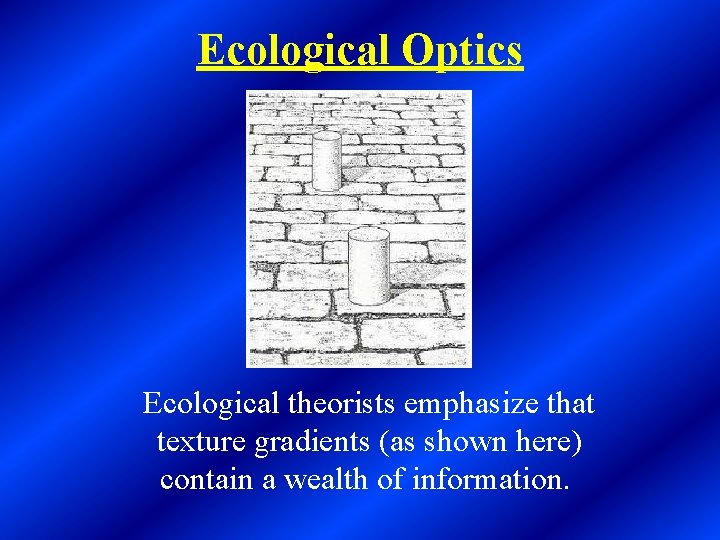
Ecological Optics Ecological theorists emphasize that texture gradients (as shown here) contain a wealth of information.
Ecological Optics This figure emphasizes the dynamic optic array
Ecological Optics • To explain perception biologically, the ecological approach posited a ‘resonance metaphor’ for information pick-up. – Information in the environment / stimuli cause corresponding neural mechanisms to “vibrate” metaphorically…or “fire” more literally. • Just as mechanical vibrations of a given frequency cause a tuning fork to vibrate. • Biology was not a major concern for many in ecological optics. – Some researchers in ecological optics don’t make reference to the central nervous system! – Ecological optics has done much for robot vision / machine vision.
Part 5 Constructivism
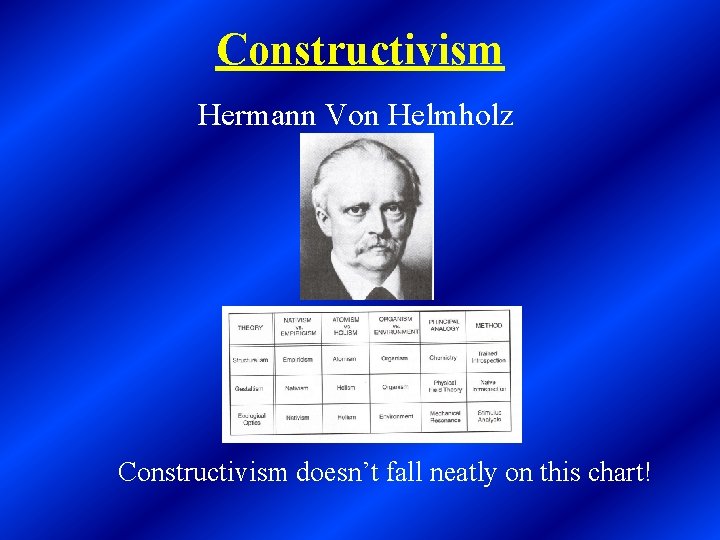
Constructivism Hermann Von Helmholz Constructivism doesn’t fall neatly on this chart!
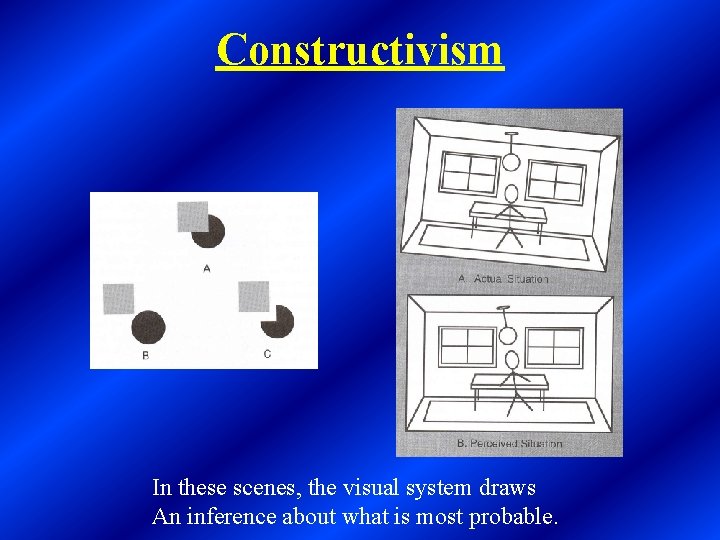
Constructivism • Helmholz believed that retinal information alone was not sufficient to account for our perception of the world. • He posited the “unconscious inference” - An assumption that one learns to make about the world; a statistical best guess. • The statistical best guess is combined with retinal information to “CONSTRUCT” an inference about the world…
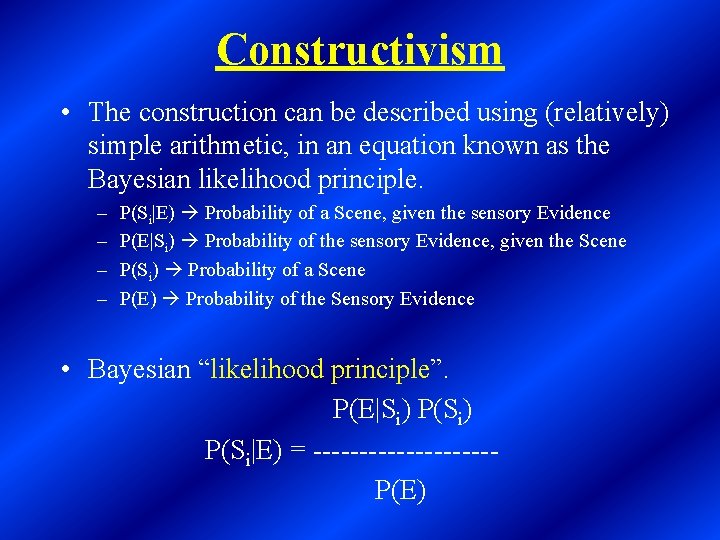
Constructivism • The construction can be described using (relatively) simple arithmetic, in an equation known as the Bayesian likelihood principle. – – P(Si|E) Probability of a Scene, given the sensory Evidence P(E|Si) Probability of the sensory Evidence, given the Scene P(Si) Probability of a Scene P(E) Probability of the Sensory Evidence • Bayesian “likelihood principle”. P(E|Si) P(Si|E) = ----------P(E)
Constructivism In these scenes, the visual system draws An inference about what is most probable.