ECE 171 Digital Circuits Prof Marek Perkowski Maseeh
- Slides: 42
ECE 171 Digital Circuits Prof. Marek Perkowski Maseeh College of Engineering and Computer Science
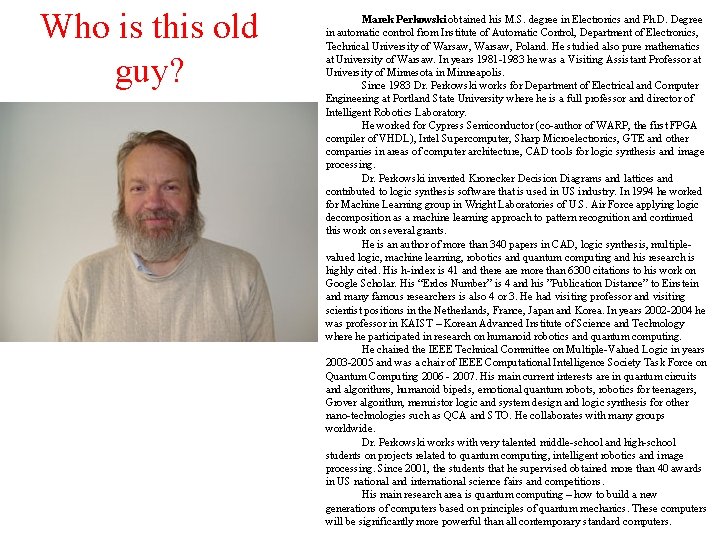
Who is this old guy? Marek Perkowski obtained his M. S. degree in Electronics and Ph. D. Degree in automatic control from Institute of Automatic Control, Department of Electronics, Technical University of Warsaw, Poland. He studied also pure mathematics at University of Warsaw. In years 1981 -1983 he was a Visiting Assistant Professor at University of Minnesota in Minneapolis. Since 1983 Dr. Perkowski works for Department of Electrical and Computer Engineering at Portland State University where he is a full professor and director of Intelligent Robotics Laboratory. He worked for Cypress Semiconductor (co-author of WARP, the first FPGA compiler of VHDL), Intel Supercomputer, Sharp Microelectronics, GTE and other companies in areas of computer architecture, CAD tools for logic synthesis and image processing. Dr. Perkowski invented Kronecker Decision Diagrams and lattices and contributed to logic synthesis software that is used in US industry. In 1994 he worked for Machine Learning group in Wright Laboratories of U. S. Air Force applying logic decomposition as a machine learning approach to pattern recognition and continued this work on several grants. He is an author of more than 340 papers in CAD, logic synthesis, multiplevalued logic, machine learning, robotics and quantum computing and his research is highly cited. His h-index is 41 and there are more than 6300 citations to his work on Google Scholar. His “ErdÖs Number” is 4 and his ”Publication Distance” to Einstein and many famous researchers is also 4 or 3. He had visiting professor and visiting scientist positions in the Netherlands, France, Japan and Korea. In years 2002 -2004 he was professor in KAIST – Korean Advanced Institute of Science and Technology where he participated in research on humanoid robotics and quantum computing. He chaired the IEEE Technical Committee on Multiple-Valued Logic in years 2003 -2005 and was a chair of IEEE Computational Intelligence Society Task Force on Quantum Computing 2006 - 2007. His main current interests are in quantum circuits and algorithms, humanoid bipeds, emotional quantum robots, robotics for teenagers, Grover algorithm, memristor logic and system design and logic synthesis for other nano-technologies such as QCA and STO. He collaborates with many groups worldwide. Dr. Perkowski works with very talented middle-school and high-school students on projects related to quantum computing, intelligent robotics and image processing. Since 2001, the students that he supervised obtained more than 40 awards in US national and international science fairs and competitions. His main research area is quantum computing – how to build a new generations of computers based on principles of quantum mechanics. These computers will be significantly more powerful than all contemporary standard computers.
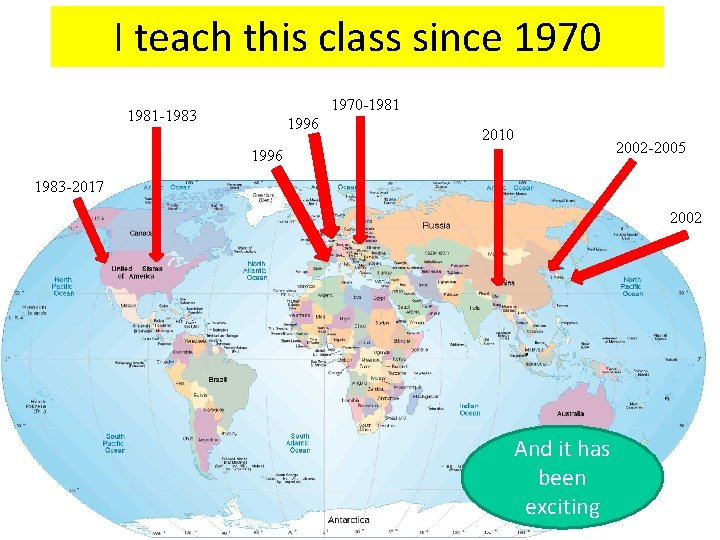
I teach this class since 1970 -1981 -1983 1996 2010 2002 -2005 1996 1983 -2017 2002 And it has been exciting 3
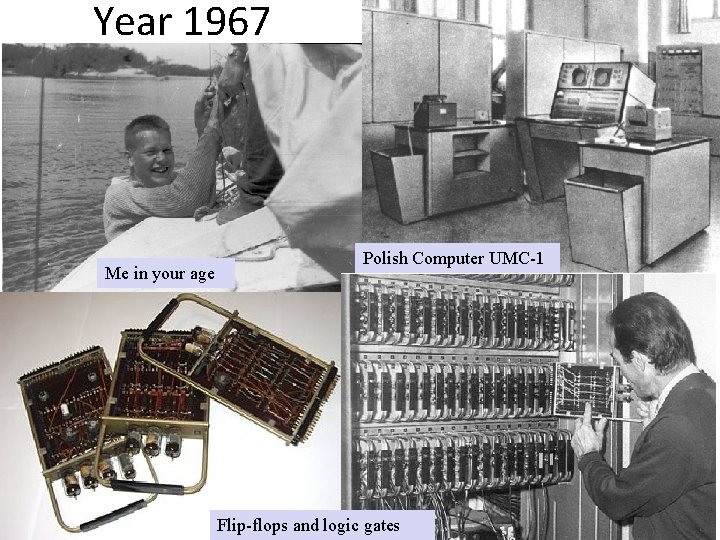
Year 1967 Me in your age Polish Computer UMC-1 4 Flip-flops and logic gates
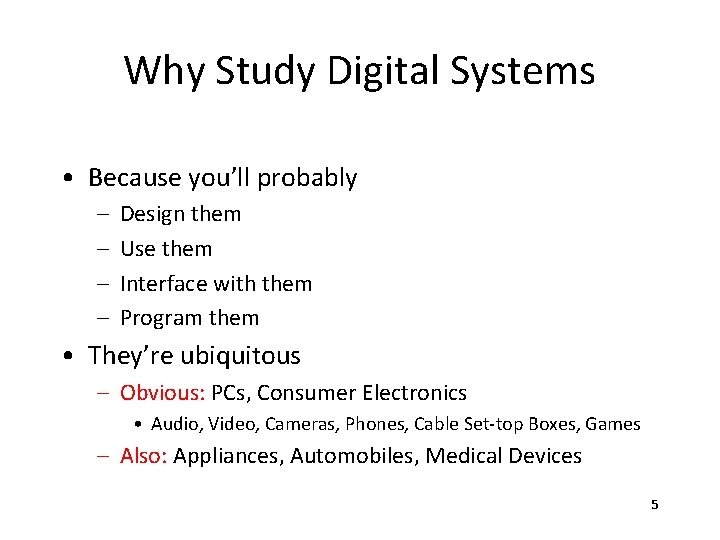
Why Study Digital Systems • Because you’ll probably – – Design them Use them Interface with them Program them • They’re ubiquitous – Obvious: PCs, Consumer Electronics • Audio, Video, Cameras, Phones, Cable Set-top Boxes, Games – Also: Appliances, Automobiles, Medical Devices 5
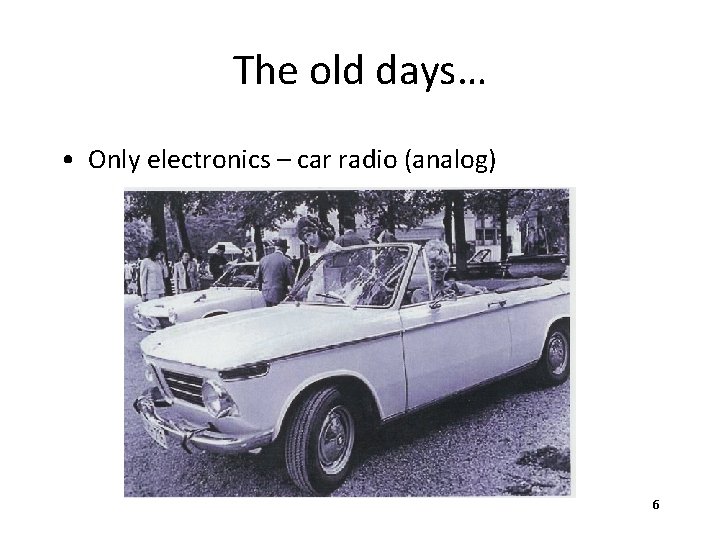
The old days… • Only electronics – car radio (analog) 6
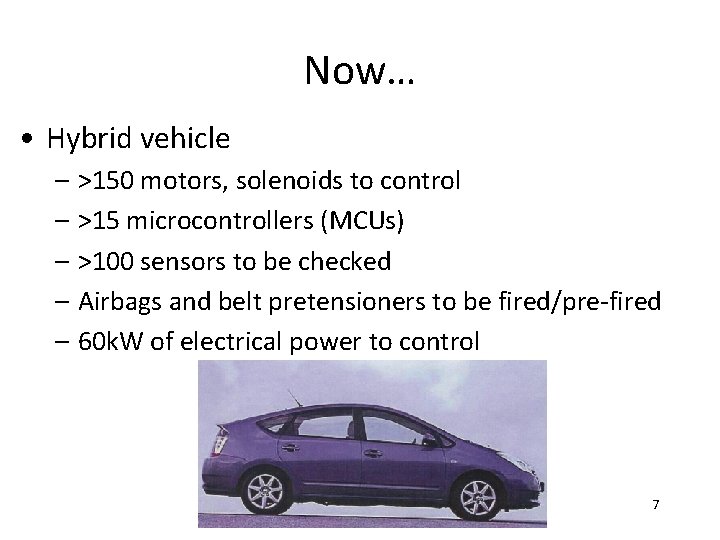
Now… • Hybrid vehicle – >150 motors, solenoids to control – >15 microcontrollers (MCUs) – >100 sensors to be checked – Airbags and belt pretensioners to be fired/pre-fired – 60 k. W of electrical power to control 7
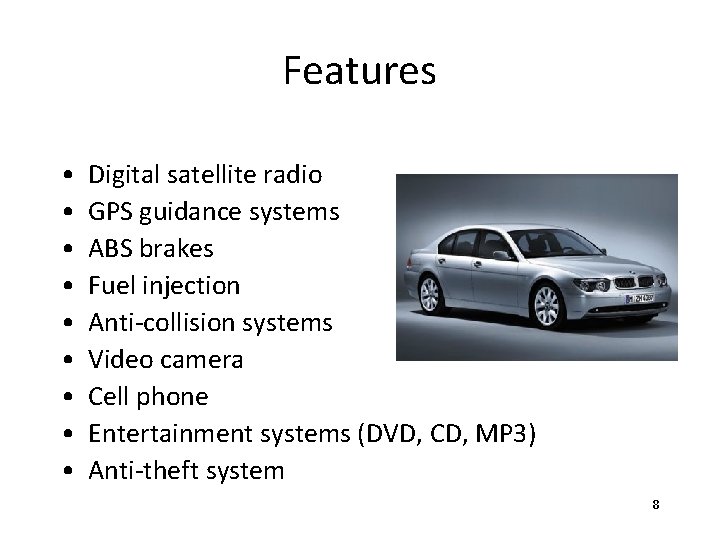
Features • • • Digital satellite radio GPS guidance systems ABS brakes Fuel injection Anti-collision systems Video camera Cell phone Entertainment systems (DVD, CD, MP 3) Anti-theft system 8
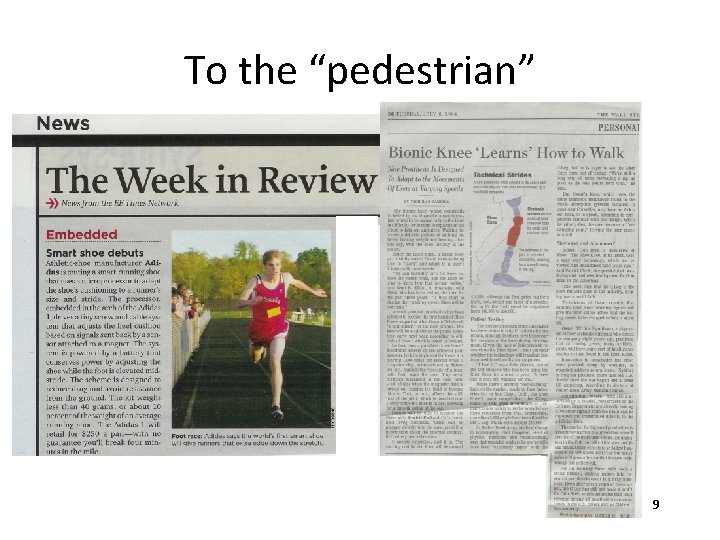
To the “pedestrian” 9
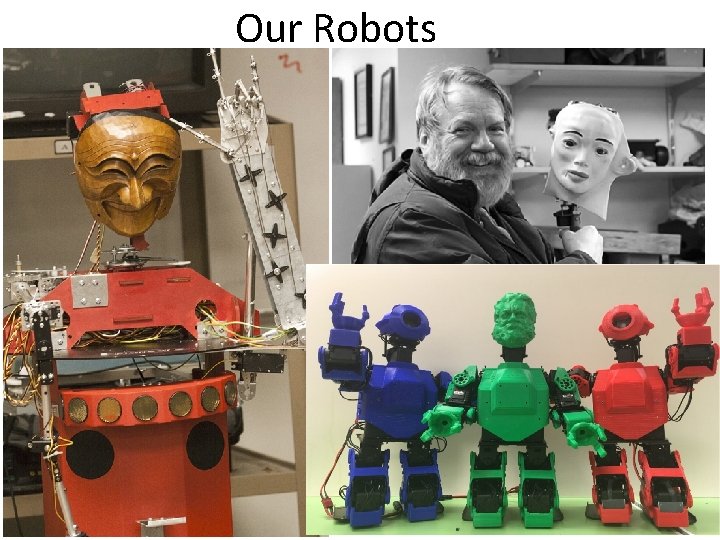
Our Robots 10
Digital Systems • Two Valued (Binary) System – On/Off – High/Low Voltage – Open/Closed Switch (vs. “Dimmer” Switch) – Magnetized/Unmagnetized – 1/0 11
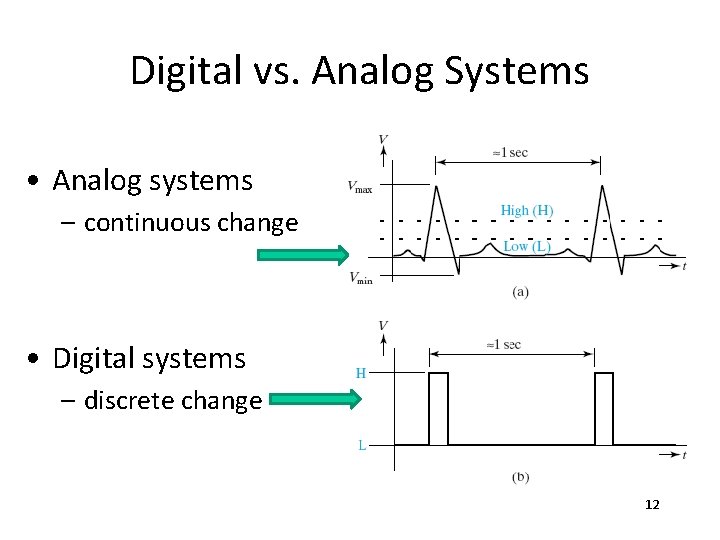
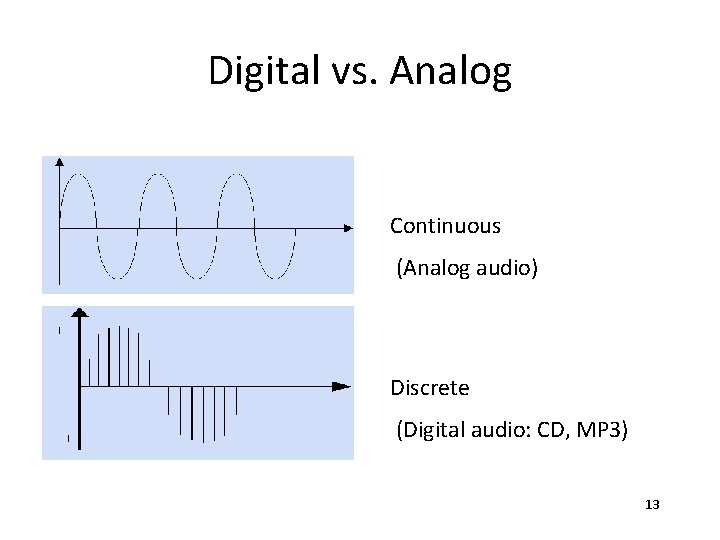
Digital vs. Analog Systems • Analog systems – continuous change • Digital systems – discrete change 12
Digital vs. Analog Continuous (Analog audio) Discrete (Digital audio: CD, MP 3) 13
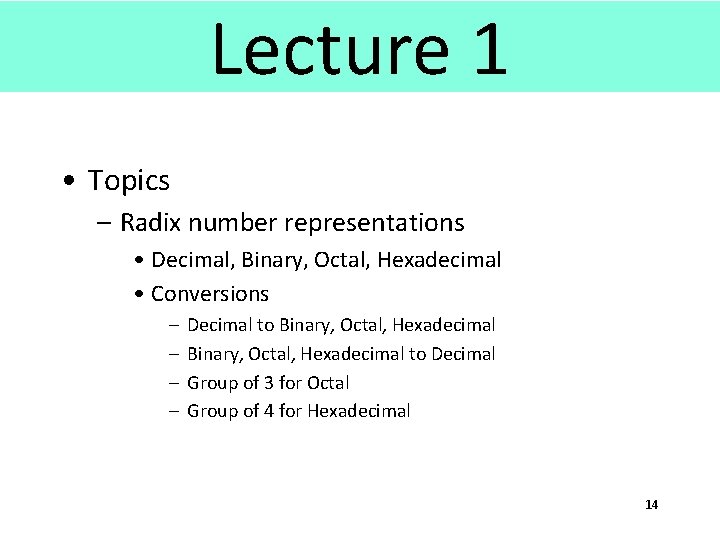
Lecture 1 • Topics – Radix number representations • Decimal, Binary, Octal, Hexadecimal • Conversions – – Decimal to Binary, Octal, Hexadecimal to Decimal Group of 3 for Octal Group of 4 for Hexadecimal 14
Decimal and Binary Numbers
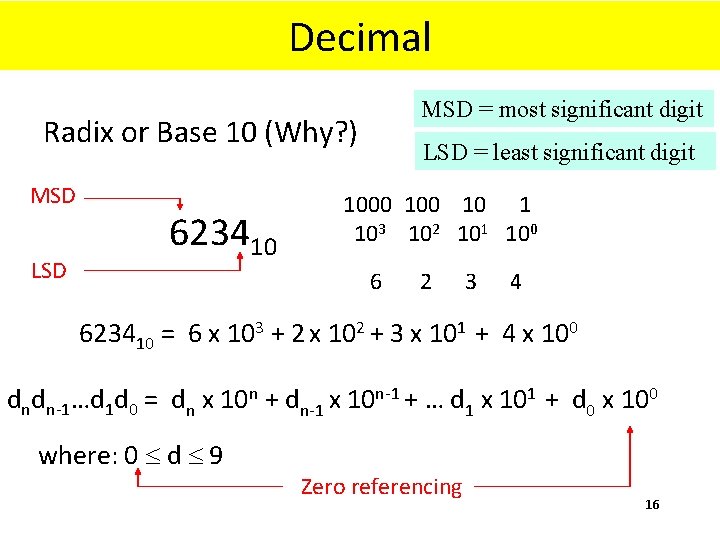
Decimal MSD = most significant digit Radix or Base 10 (Why? ) MSD LSD 623410 LSD = least significant digit 1000 10 1 103 102 101 100 6 2 3 4 623410 = 6 x 10³ + 2 x 10² + 3 x 101 + 4 x 100 dndn-1…d 1 d 0 = dn x 10 n + dn-1 x 10 n-1 + … d 1 x 101 + d 0 x 100 where: 0 £ d £ 9 Zero referencing 16
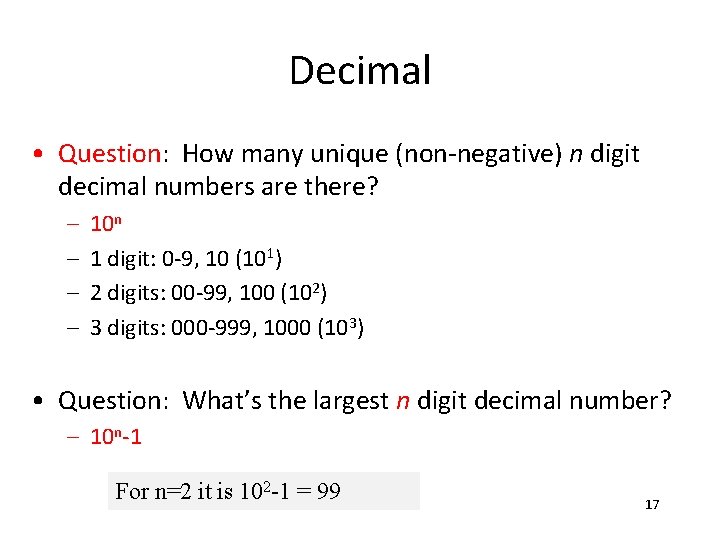
Decimal • Question: How many unique (non-negative) n digit decimal numbers are there? – – 10 n 1 digit: 0 -9, 10 (101) 2 digits: 00 -99, 100 (102) 3 digits: 000 -999, 1000 (103) • Question: What’s the largest n digit decimal number? – 10 n-1 For n=2 it is 102 -1 = 99 17
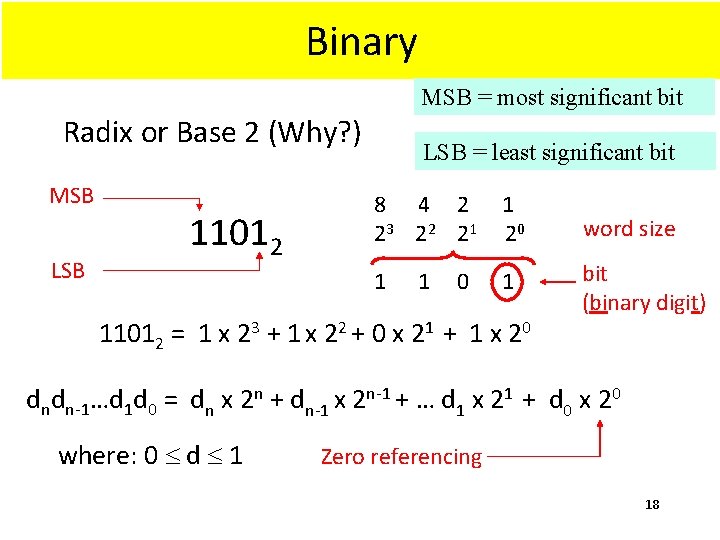
Binary MSB = most significant bit Radix or Base 2 (Why? ) MSB LSB 11012 LSB = least significant bit 8 4 2 23 22 21 1 20 word size 1 1 bit (binary digit) 1 0 11012 = 1 x 23 + 1 x 22 + 0 x 21 + 1 x 20 dndn-1…d 1 d 0 = dn x 2 n + dn-1 x 2 n-1 + … d 1 x 21 + d 0 x 20 where: 0 £ d £ 1 Zero referencing 18
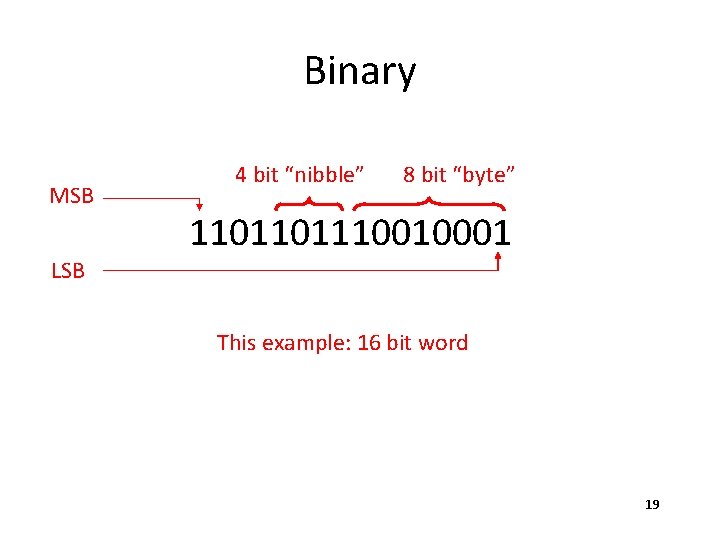
Binary MSB LSB 4 bit “nibble” 8 bit “byte” 1101101110010001 This example: 16 bit word 19
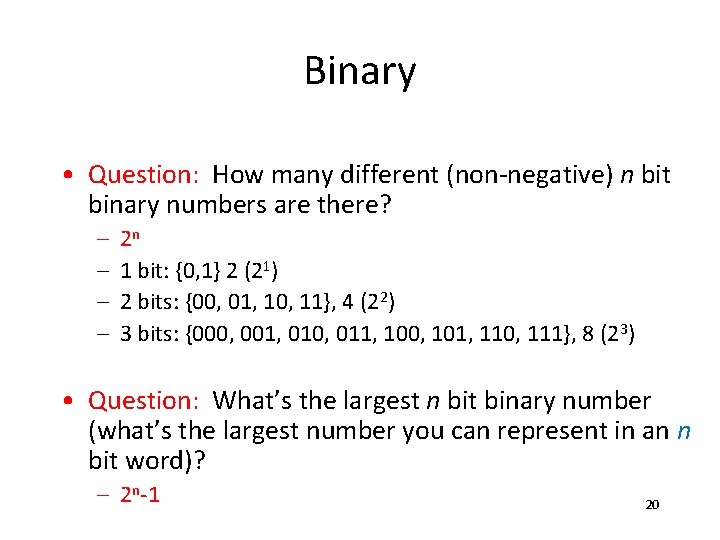
Binary • Question: How many different (non-negative) n bit binary numbers are there? – – 2 n 1 bit: {0, 1} 2 (21) 2 bits: {00, 01, 10, 11}, 4 (22) 3 bits: {000, 001, 010, 011, 100, 101, 110, 111}, 8 (2 3) • Question: What’s the largest n bit binary number (what’s the largest number you can represent in an n bit word)? – 2 n-1 20
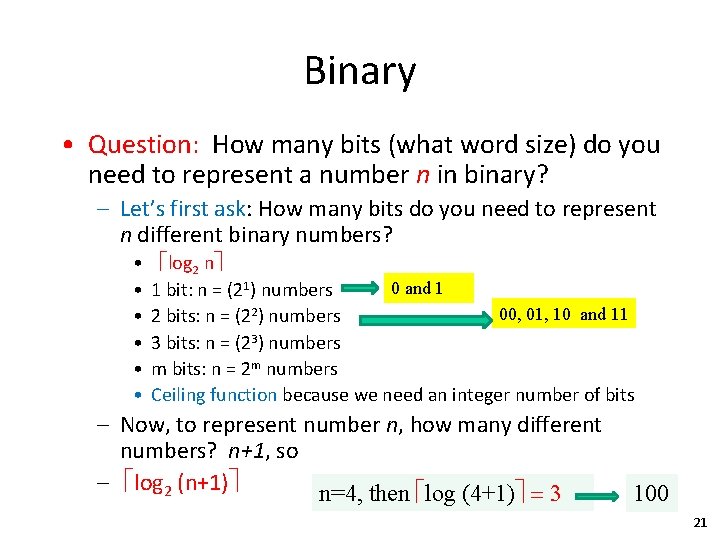
Binary • Question: How many bits (what word size) do you need to represent a number n in binary? – Let’s first ask: How many bits do you need to represent n different binary numbers? • • • élog 2 nù 0 and 1 1 bit: n = (21) numbers 00, 01, 10 and 11 2 bits: n = (22) numbers 3 bits: n = (23) numbers m bits: n = 2 m numbers Ceiling function because we need an integer number of bits – Now, to represent number n, how many different numbers? n+1, so – élog 2 (n+1)ù n=4, then élog (4+1)ù = 3 100 21
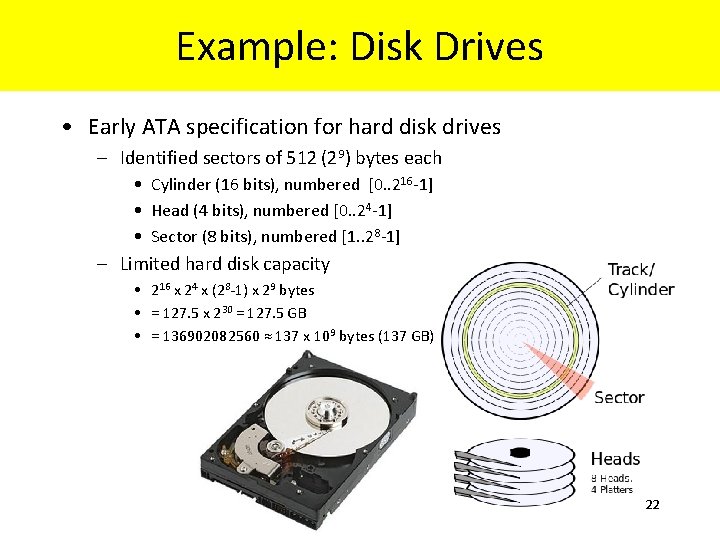
Example: Disk Drives • Early ATA specification for hard disk drives – Identified sectors of 512 (29) bytes each • Cylinder (16 bits), numbered [0. . 216 -1] • Head (4 bits), numbered [0. . 24 -1] • Sector (8 bits), numbered [1. . 28 -1] – Limited hard disk capacity • 216 x 24 x (28 -1) x 29 bytes • = 127. 5 x 230 = 127. 5 GB • = 136902082560 ≈ 137 x 109 bytes (137 GB) 22
Decimal Fractions
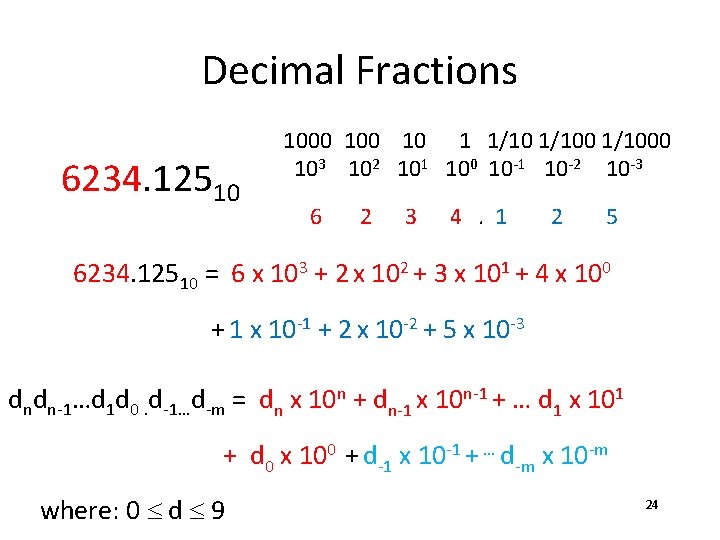
Decimal Fractions 6234. 12510 100 10 1 1/1000 103 102 101 100 10 -1 10 -2 10 -3 6 2 3 4. 1 2 5 6234. 12510 = 6 x 10³ + 2 x 10² + 3 x 101 + 4 x 100 + 1 x 10 -1 + 2 x 10 -2 + 5 x 10 -3 dndn-1…d 1 d 0. d-1…d-m = dn x 10 n + dn-1 x 10 n-1 + … d 1 x 101 + d 0 x 100 + d-1 x 10 -1 + … d-m x 10 -m where: 0 £ d £ 9 24
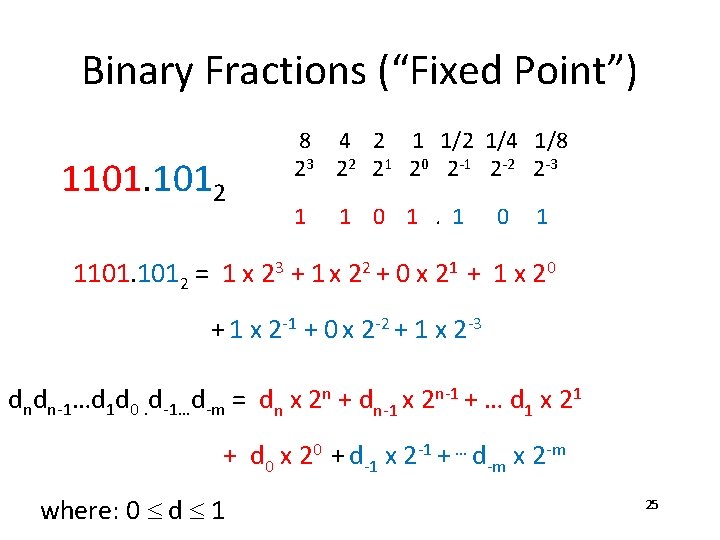
Binary Fractions (“Fixed Point”) 1101. 1012 8 4 2 1 1/2 1/4 1/8 23 22 21 20 2 -1 2 -2 2 -3 1 1 0 1 1101. 1012 = 1 x 23 + 1 x 22 + 0 x 21 + 1 x 20 + 1 x 2 -1 + 0 x 2 -2 + 1 x 2 -3 dndn-1…d 1 d 0. d-1…d-m = dn x 2 n + dn-1 x 2 n-1 + … d 1 x 21 + d 0 x 20 + d-1 x 2 -1 + … d-m x 2 -m where: 0 £ d £ 1 25
Octal Numbers
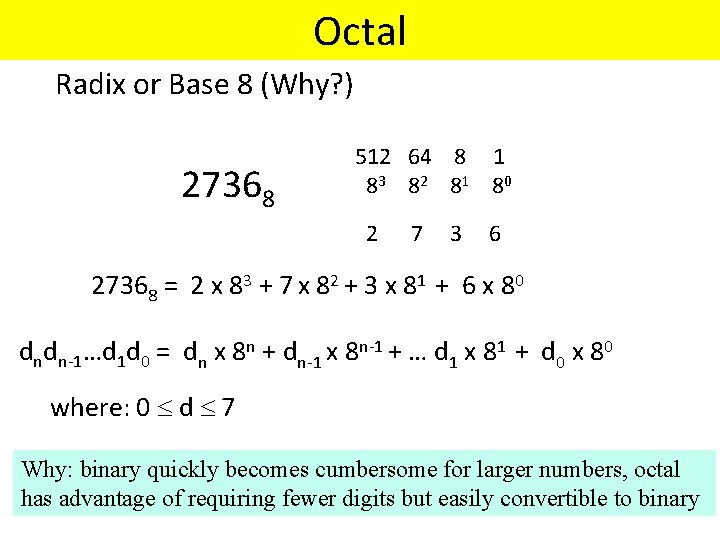
Octal Radix or Base 8 (Why? ) 27368 512 64 8 1 83 82 81 80 2 7 3 6 27368 = 2 x 83 + 7 x 82 + 3 x 81 + 6 x 80 dndn-1…d 1 d 0 = dn x 8 n + dn-1 x 8 n-1 + … d 1 x 81 + d 0 x 80 where: 0 £ d £ 7 Why: binary quickly becomes cumbersome for larger numbers, octal has advantage of requiring fewer digits but easily convertible to binary
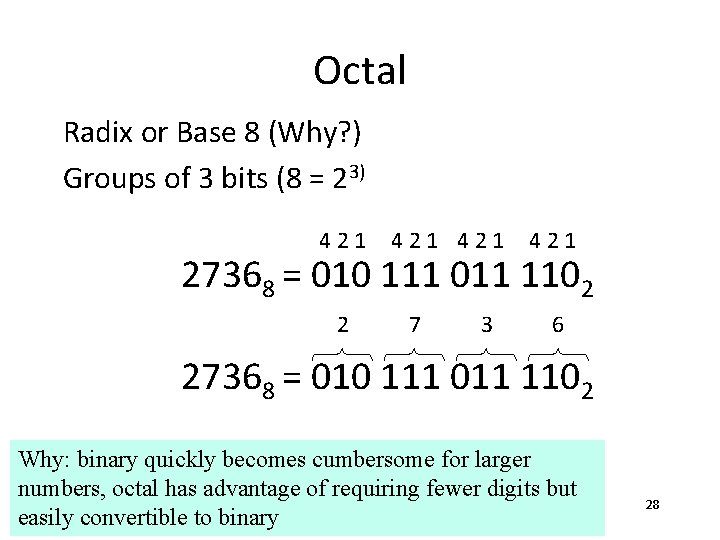
Octal Radix or Base 8 (Why? ) Groups of 3 bits (8 = 23) 421 421 27368 = 010 111 011 1102 2 7 3 6 27368 = 010 111 011 1102 Why: binary quickly becomes cumbersome for larger numbers, octal has advantage of requiring fewer digits but easily convertible to binary 28
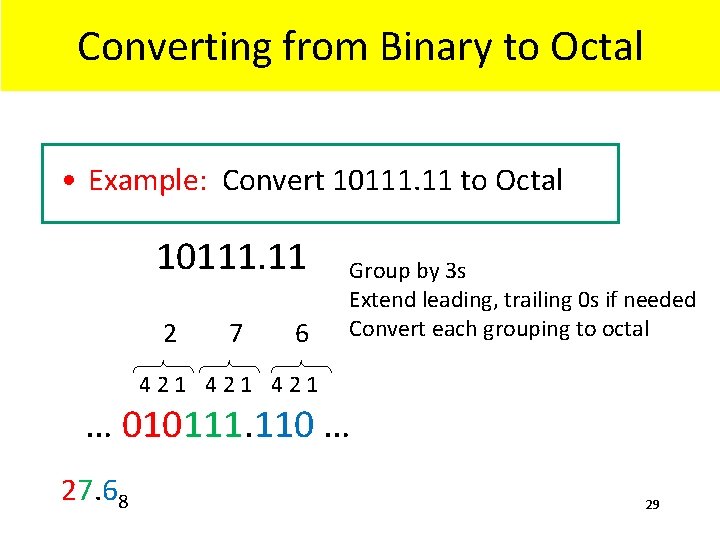
Converting from Binary to Octal • Example: Convert 10111. 11 to Octal 10111. 11 2 7 6 Group by 3 s Extend leading, trailing 0 s if needed Convert each grouping to octal 421 421 … 010111. 110 … 27. 68 29
Hexadecimal Numbers
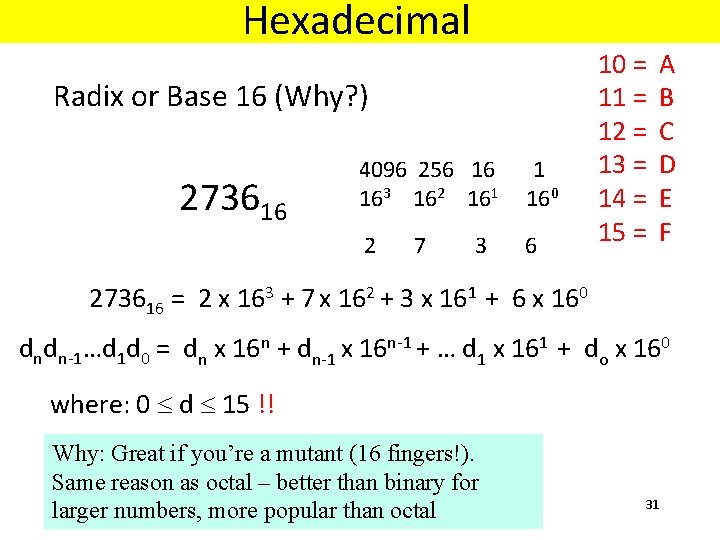
Hexadecimal Radix or Base 16 (Why? ) 273616 4096 256 16 163 162 161 1 160 2 6 7 3 10 = 11 = 12 = 13 = 14 = 15 = A B C D E F 273616 = 2 x 163 + 7 x 162 + 3 x 161 + 6 x 160 dndn-1…d 1 d 0 = dn x 16 n + dn-1 x 16 n-1 + … d 1 x 161 + do x 160 where: 0 £ d £ 15 !! Why: Great if you’re a mutant (16 fingers!). Same reason as octal – better than binary for larger numbers, more popular than octal 31
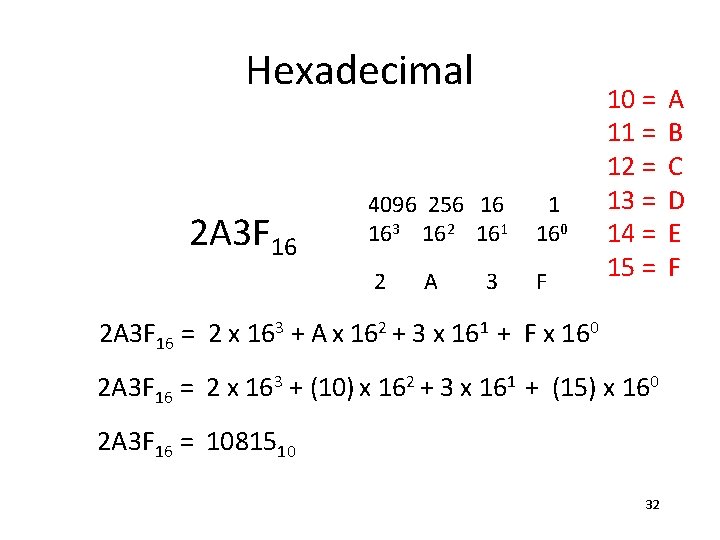
Hexadecimal 2 A 3 F 16 4096 256 16 163 162 161 1 160 2 F A 3 10 = 11 = 12 = 13 = 14 = 15 = 2 A 3 F 16 = 2 x 163 + A x 162 + 3 x 161 + F x 160 2 A 3 F 16 = 2 x 163 + (10) x 162 + 3 x 161 + (15) x 160 2 A 3 F 16 = 1081510 32 A B C D E F
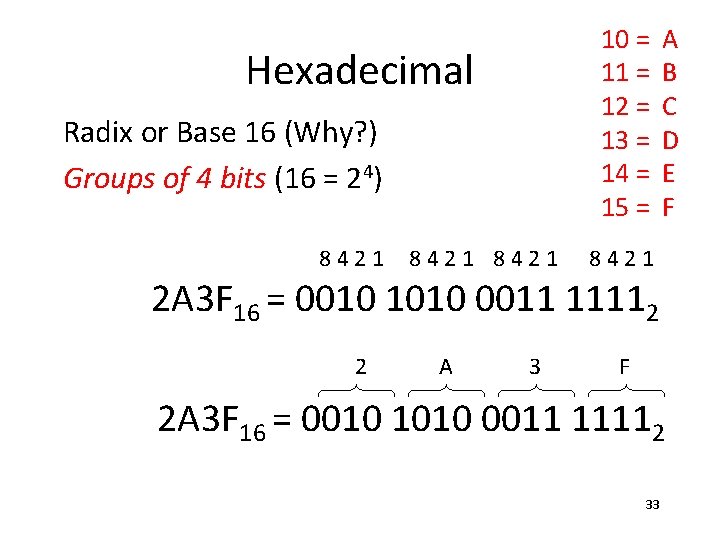
10 = 11 = 12 = 13 = 14 = 15 = Hexadecimal Radix or Base 16 (Why? ) Groups of 4 bits (16 = 24) 8421 A B C D E F 8421 2 A 3 F 16 = 0010 1010 0011 11112 2 A 3 F 2 A 3 F 16 = 0010 1010 0011 11112 33
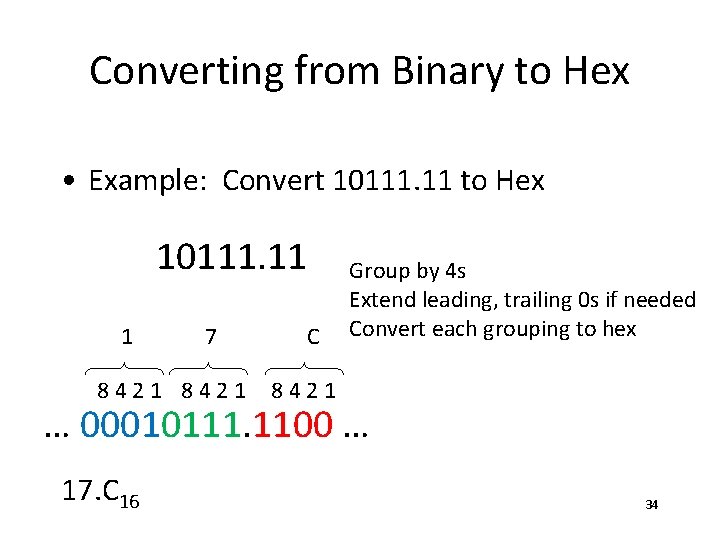
Converting from Binary to Hex • Example: Convert 10111. 11 to Hex 10111. 11 1 7 8421 C Group by 4 s Extend leading, trailing 0 s if needed Convert each grouping to hex 8421 … 00010111. 1100 … 17. C 16 34
Decimal Conversions
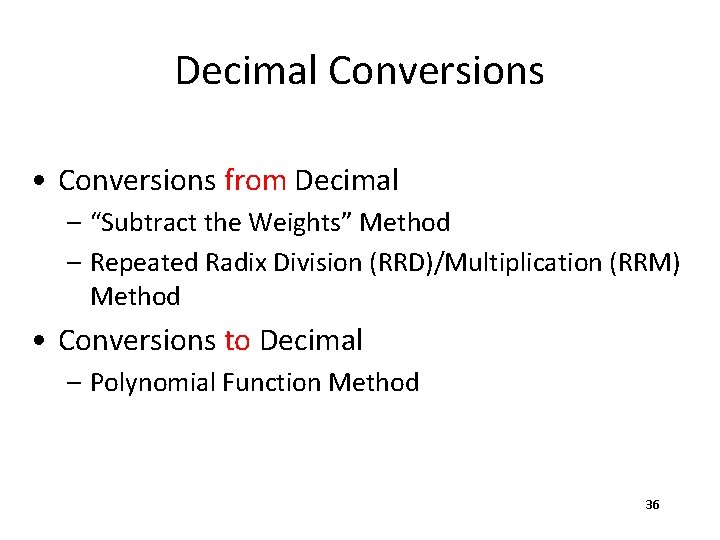
Decimal Conversions • Conversions from Decimal – “Subtract the Weights” Method – Repeated Radix Division (RRD)/Multiplication (RRM) Method • Conversions to Decimal – Polynomial Function Method 36
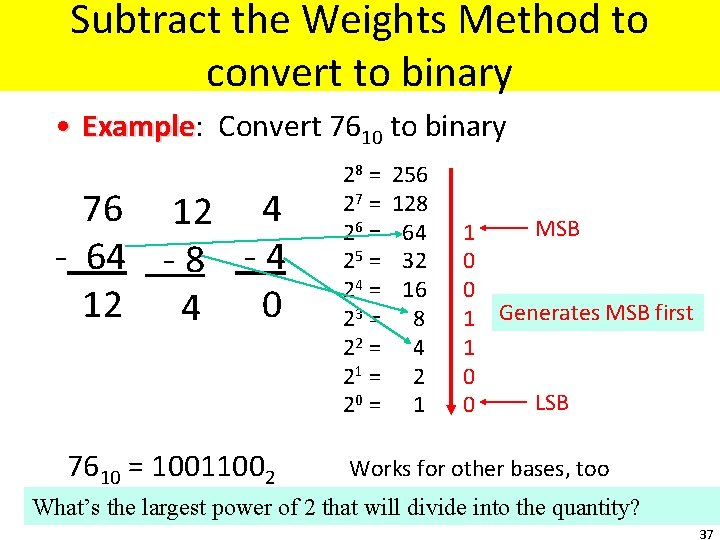
Subtract the Weights Method to convert to binary • Example: Example Convert 7610 to binary 76 12 4 - 64 - 8 - 4 12 4 0 7610 = 10011002 28 = 27 = 26 = 25 = 24 = 23 = 22 = 21 = 20 = 256 128 64 32 16 8 4 2 1 MSB 1 0 0 1 Generates MSB first 1 0 LSB 0 Works for other bases, too What’s the largest power of 2 that will divide into the quantity? 37
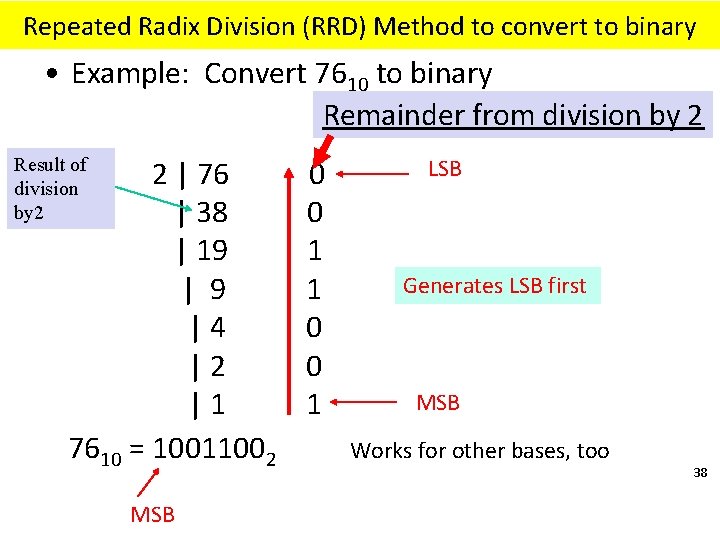
Repeated Radix Division (RRD) Method to convert to binary • Example: Convert 7610 to binary Remainder from division by 2 2 | 76 | 38 | 19 | 9 |4 |2 |1 7610 = 10011002 Result of division by 2 MSB 0 0 1 1 0 0 1 LSB Generates LSB first MSB Works for other bases, too 38
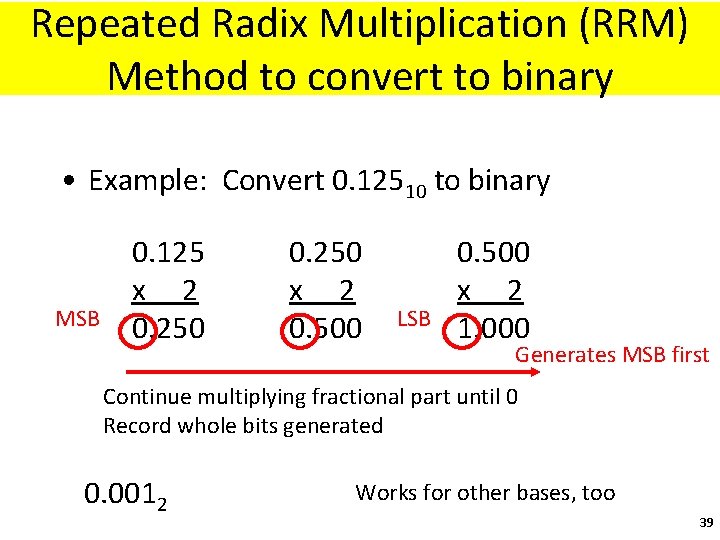
Repeated Radix Multiplication (RRM) Method to convert to binary • Example: Convert 0. 12510 to binary MSB 0. 125 x 2 0. 250 x 2 0. 500 LSB 0. 500 x 2 1. 000 Generates MSB first Continue multiplying fractional part until 0 Record whole bits generated 0. 0012 Works for other bases, too 39
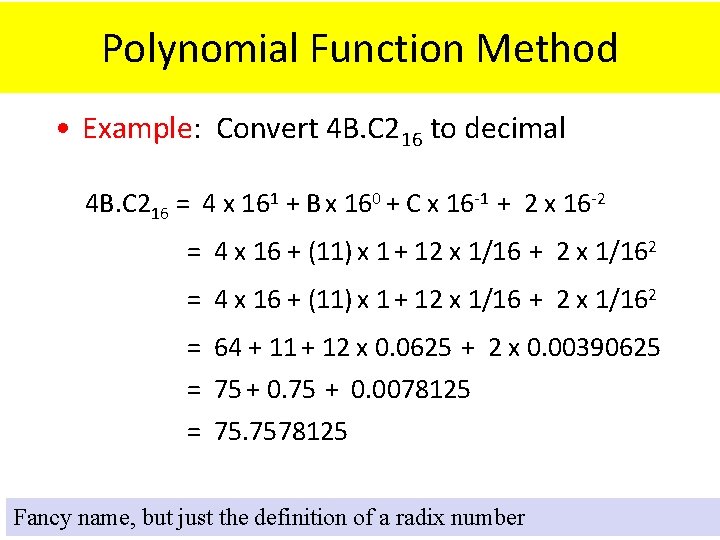
Polynomial Function Method • Example: Convert 4 B. C 216 to decimal 4 B. C 216 = 4 x 161 + B x 160 + C x 16 -1 + 2 x 16 -2 = 4 x 16 + (11) x 1 + 12 x 1/16 + 2 x 1/162 = 64 + 11 + 12 x 0. 0625 + 2 x 0. 00390625 = 75 + 0. 0078125 = 75. 7578125 Fancy name, but just the definition of a radix number 40
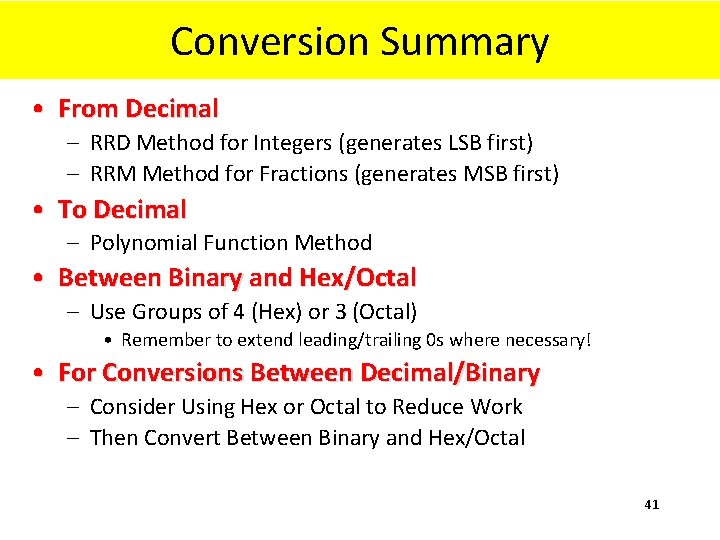
Conversion Summary • From Decimal – RRD Method for Integers (generates LSB first) – RRM Method for Fractions (generates MSB first) • To Decimal – Polynomial Function Method • Between Binary and Hex/Octal – Use Groups of 4 (Hex) or 3 (Octal) • Remember to extend leading/trailing 0 s where necessary! • For Conversions Between Decimal/Binary – Consider Using Hex or Octal to Reduce Work – Then Convert Between Binary and Hex/Octal 41
Sources • Mark G. Faust • John Wakerly 42