Drivers Education Written Exam Preparation Part III Introduction

- Slides: 70
Driver’s Education Written Exam Preparation Part III
Introduction & Welcome • Welcome to i. Drivio’s Online Written Exam Preparation Course part 3! This presentation will prepare you to take the Written Exam administered by the Illinois Secretary of State when you apply for an instruction permit or renew your driver’s license. • To navigate through the presentation, click the forward and back arrows on the screen.
Traffic Signs • Traffic signs typically fit into one of three broad categories: Regulatory Signs, Warning Signs, or Guide Signs/Informational Signs. • Regulatory signs indicate what motorists must do or must not do and must be obeyed. The next few slides will show you a variety of regulatory signs that you will see on the road.
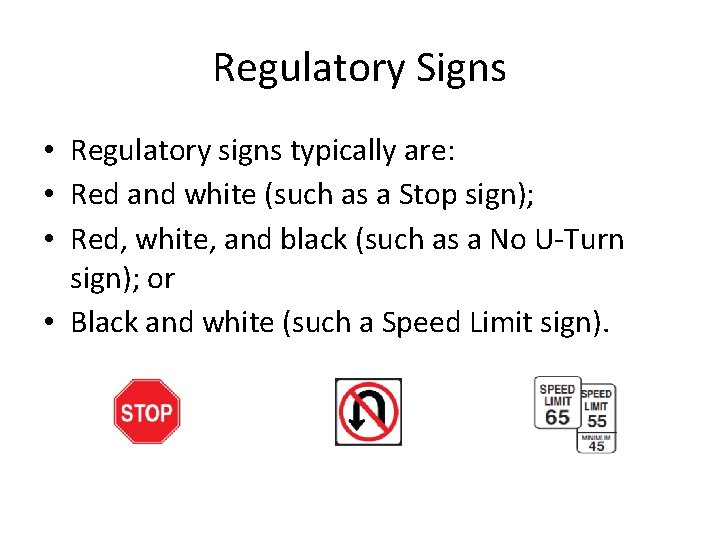
Regulatory Signs • Regulatory signs typically are: • Red and white (such as a Stop sign); • Red, white, and black (such as a No U-Turn sign); or • Black and white (such a Speed Limit sign).
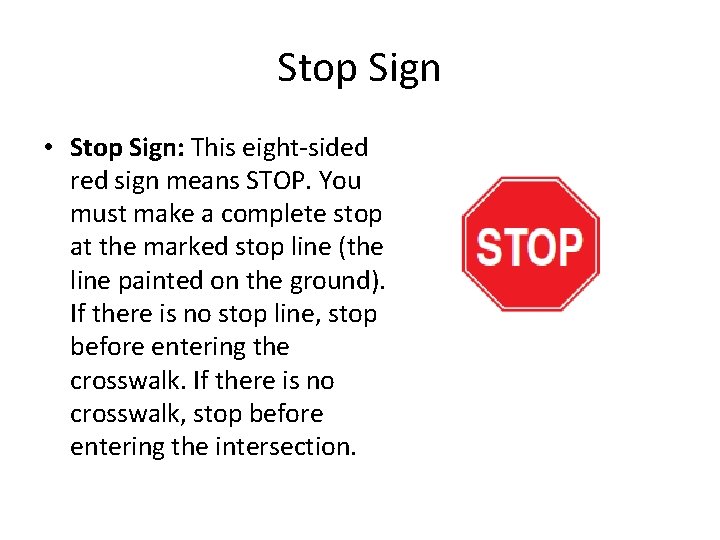
Stop Sign • Stop Sign: This eight-sided red sign means STOP. You must make a complete stop at the marked stop line (the line painted on the ground). If there is no stop line, stop before entering the crosswalk. If there is no crosswalk, stop before entering the intersection.
Stop Sign • When you reach a stop sign, yield the right-ofway to pedestrians and closely approaching traffic. If it is an all-way STOP sign, wait your turn.
Yield Sign • The three-sided (triangle) sign tells you to give the right-of-way to all vehicles and pedestrians near you. Slow down to a safe speed and stop if necessary. • When stopping, do so at a marked crosswalk or before entering the intersection.
Yield Sign • You also may see YIELD signs on expressway ramps. These signs are posted when there is no extra lane where drivers may speed up to merge with expressway traffic.
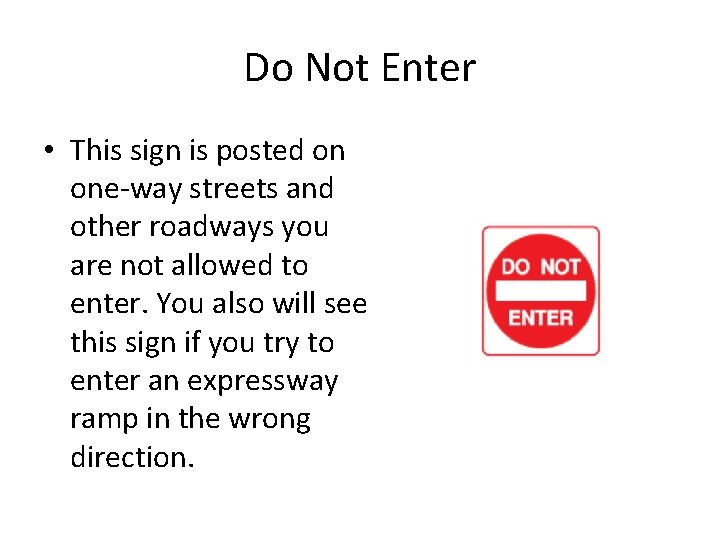
Do Not Enter • This sign is posted on one-way streets and other roadways you are not allowed to enter. You also will see this sign if you try to enter an expressway ramp in the wrong direction.
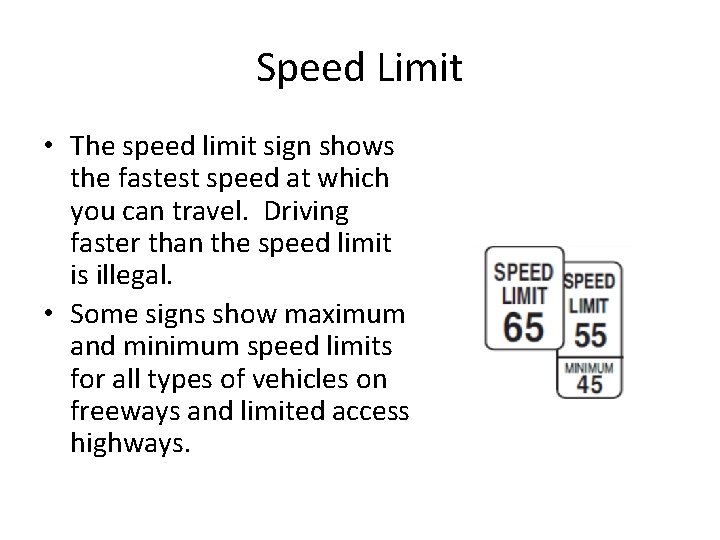
Speed Limit • The speed limit sign shows the fastest speed at which you can travel. Driving faster than the speed limit is illegal. • Some signs show maximum and minimum speed limits for all types of vehicles on freeways and limited access highways.
Speed Limit • In construction and maintenance zones, posted speeds legally reduce the speed limit on that portion of the highway. Unless necessary for safety, driving slower than the minimum is illegal.
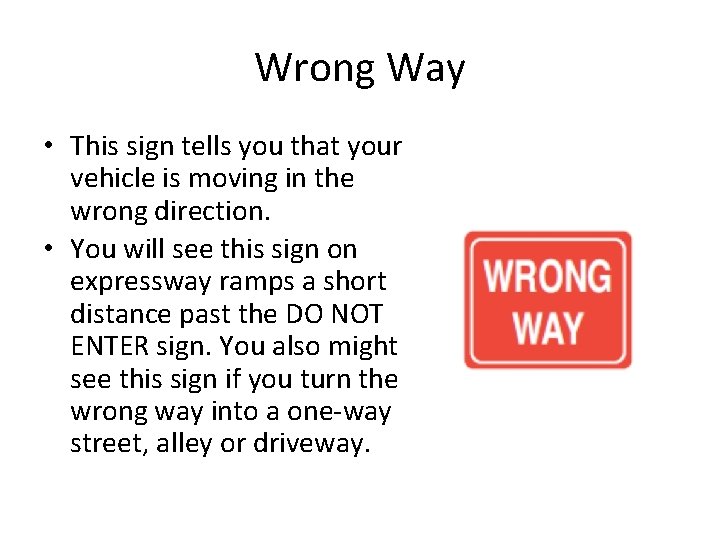
Wrong Way • This sign tells you that your vehicle is moving in the wrong direction. • You will see this sign on expressway ramps a short distance past the DO NOT ENTER sign. You also might see this sign if you turn the wrong way into a one-way street, alley or driveway.
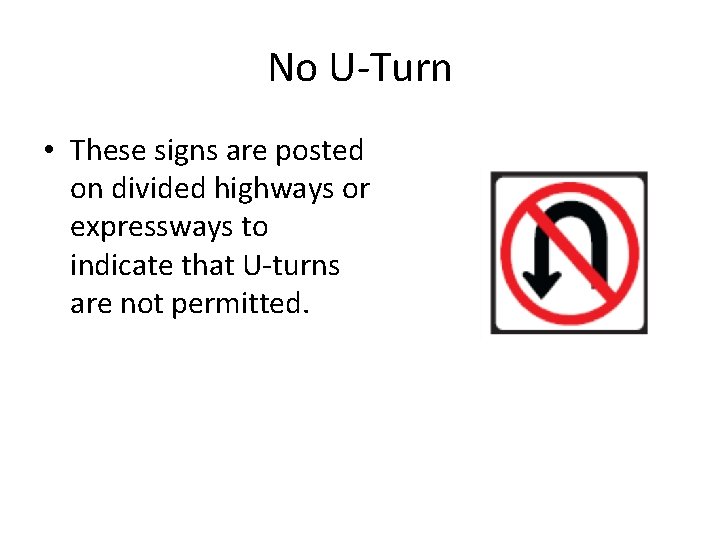
No U-Turn • These signs are posted on divided highways or expressways to indicate that U-turns are not permitted.
No U-Turn • You may see one where there is an opening in the divided highway that leads to the other side. • These openings are for authorized vehicles only such as police cars, ambulances, snow plows, construction/maintenance equipment and other emergency vehicles. You may not use this opening.
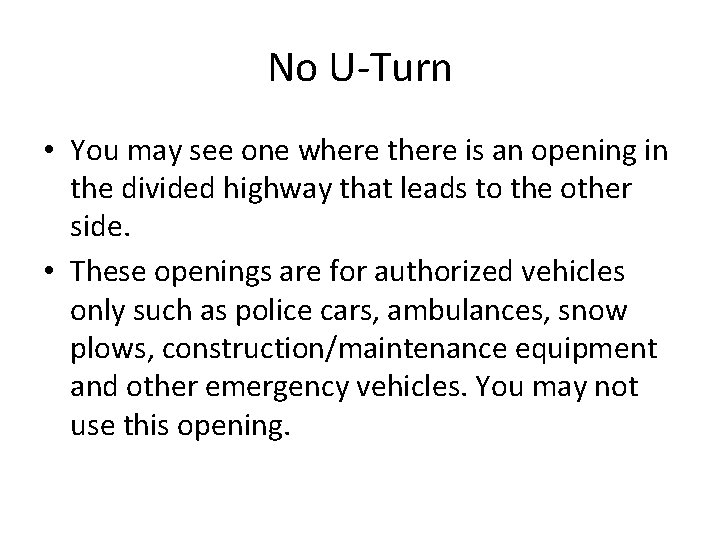
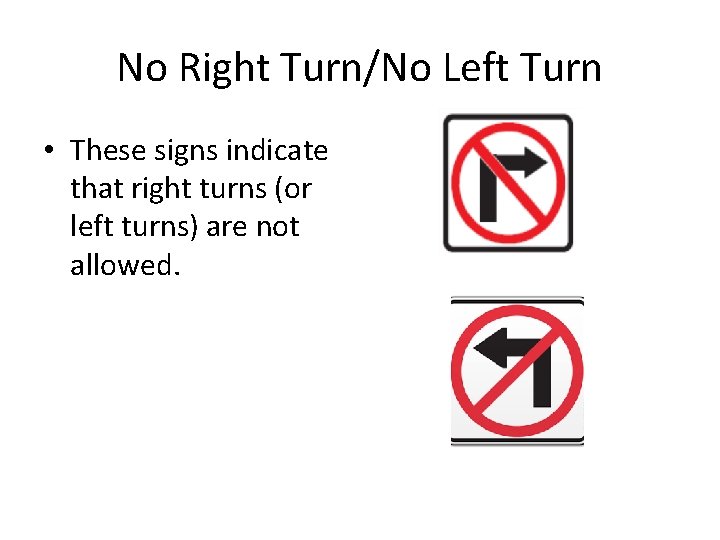
No Right Turn/No Left Turn • These signs indicate that right turns (or left turns) are not allowed.
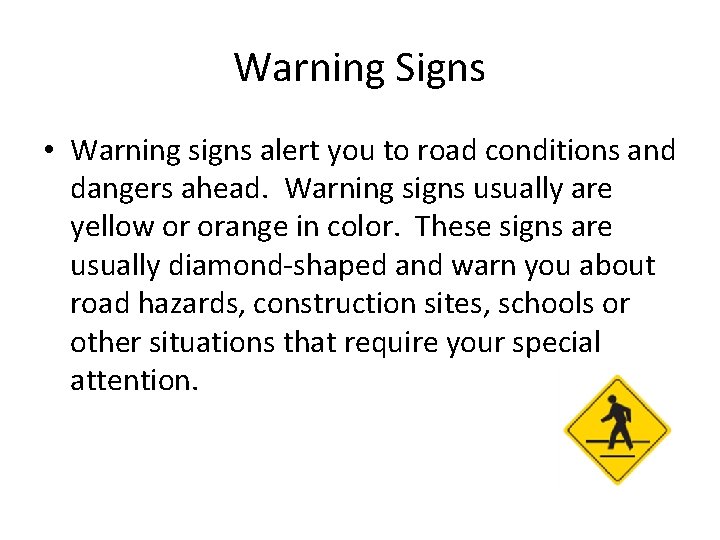
Warning Signs • Warning signs alert you to road conditions and dangers ahead. Warning signs usually are yellow or orange in color. These signs are usually diamond-shaped and warn you about road hazards, construction sites, schools or other situations that require your special attention.
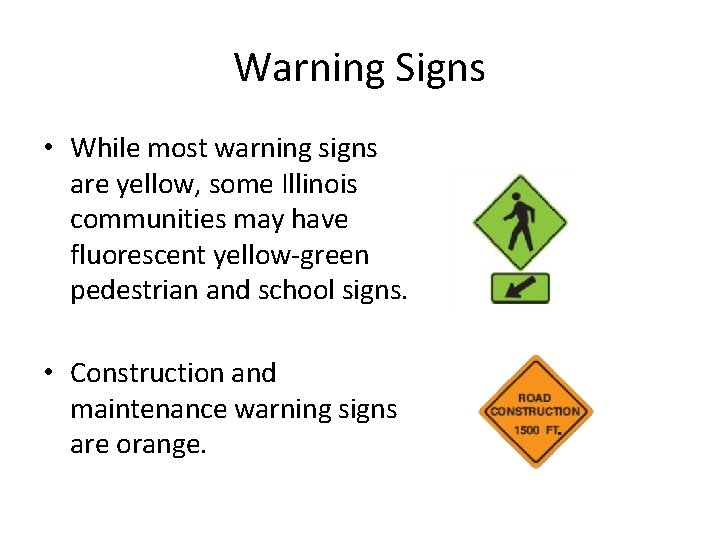
Warning Signs • While most warning signs are yellow, some Illinois communities may have fluorescent yellow-green pedestrian and school signs. • Construction and maintenance warning signs are orange.
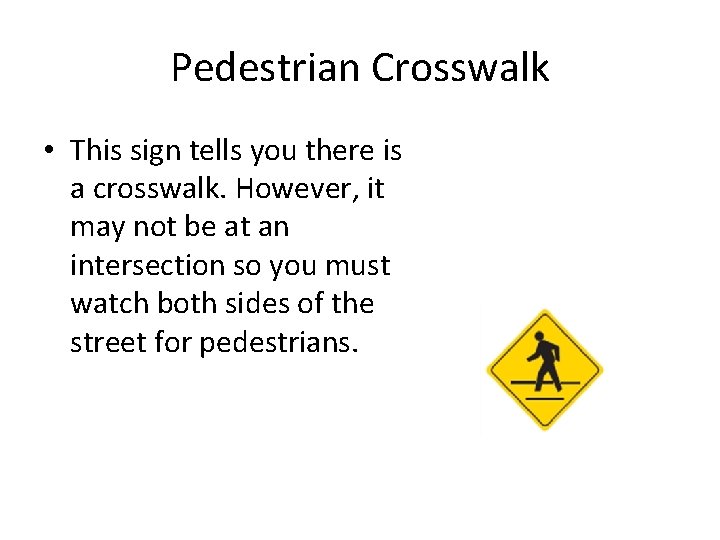
Pedestrian Crosswalk • This sign tells you there is a crosswalk. However, it may not be at an intersection so you must watch both sides of the street for pedestrians.
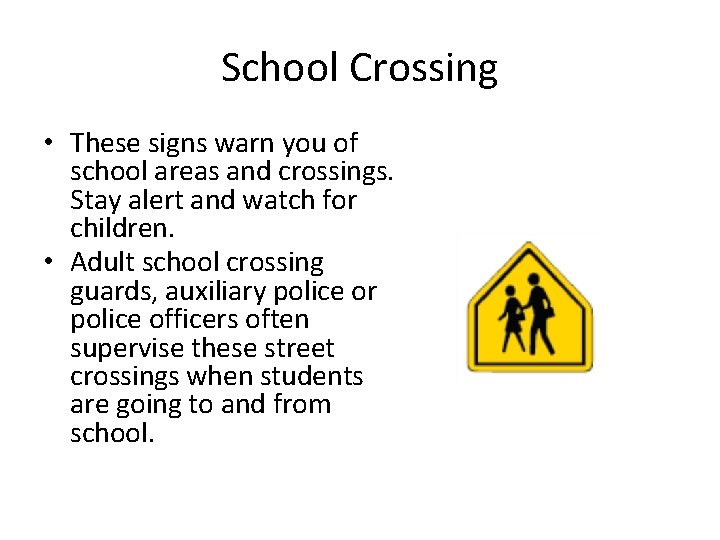
School Crossing • These signs warn you of school areas and crossings. Stay alert and watch for children. • Adult school crossing guards, auxiliary police or police officers often supervise these street crossings when students are going to and from school.
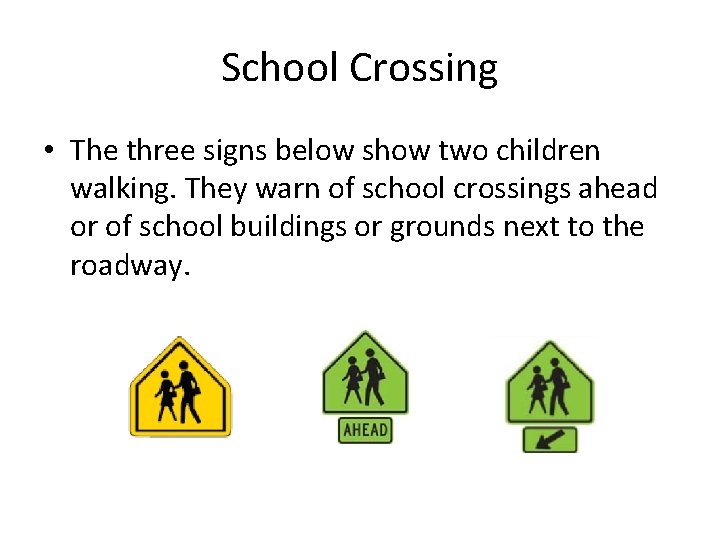
School Crossing • The three signs below show two children walking. They warn of school crossings ahead or of school buildings or grounds next to the roadway.
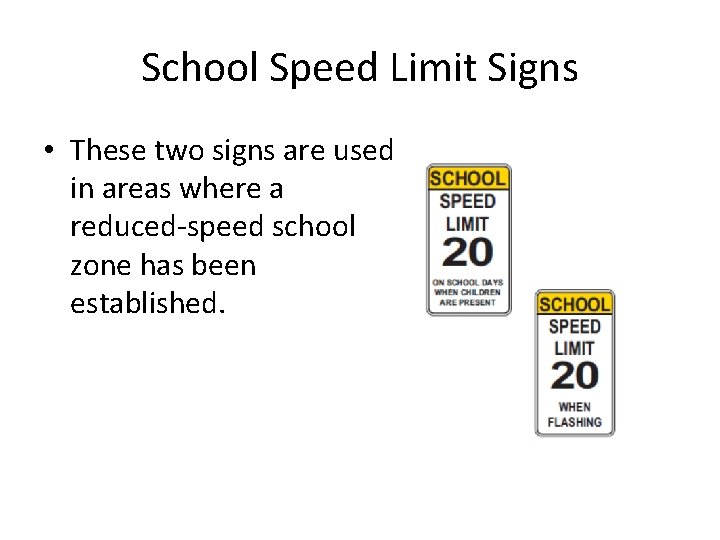
School Speed Limit Signs • These two signs are used in areas where a reduced-speed school zone has been established.
School Speed Limit Signs • The posted speed applies only on school days when children are present (usual school hours are 7 a. m. to 4 p. m. , but hours may vary), where a potential hazard exists because of the children’s close proximity to traffic, or when a light is flashing.
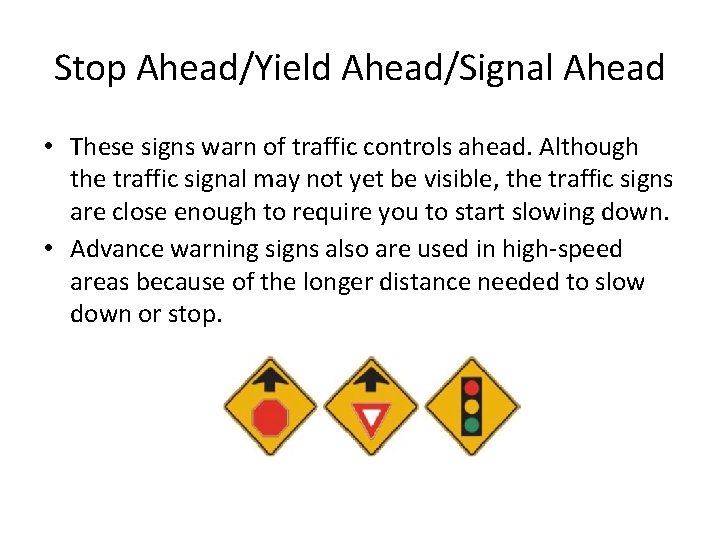
Stop Ahead/Yield Ahead/Signal Ahead • These signs warn of traffic controls ahead. Although the traffic signal may not yet be visible, the traffic signs are close enough to require you to start slowing down. • Advance warning signs also are used in high-speed areas because of the longer distance needed to slow down or stop.
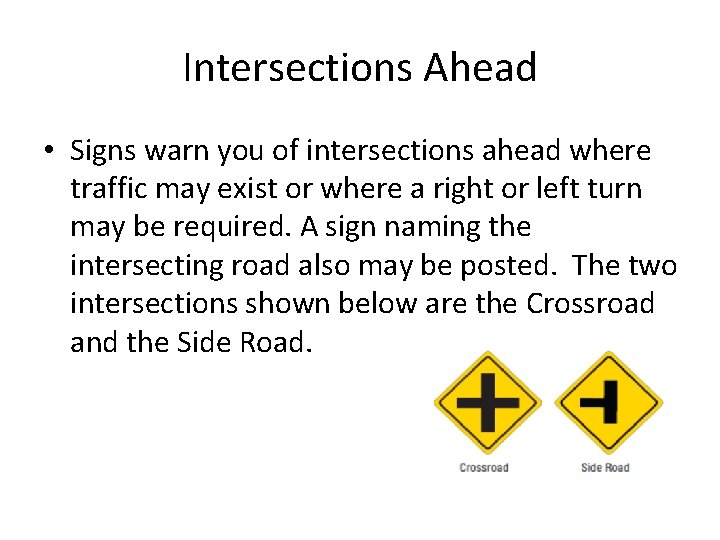
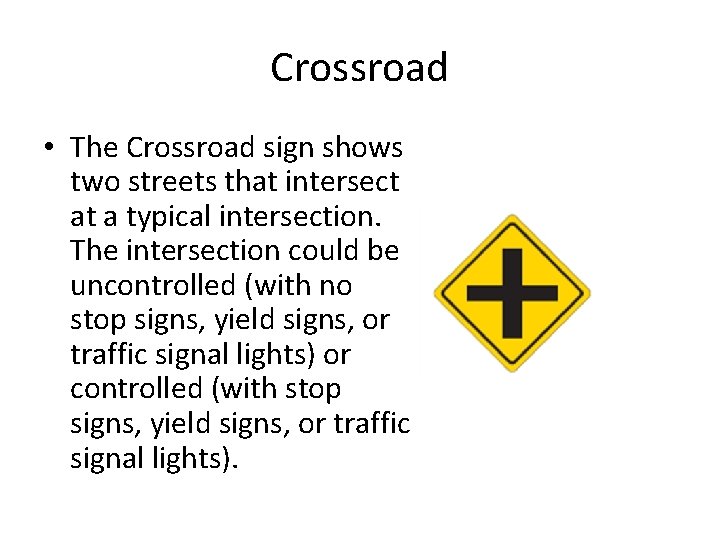
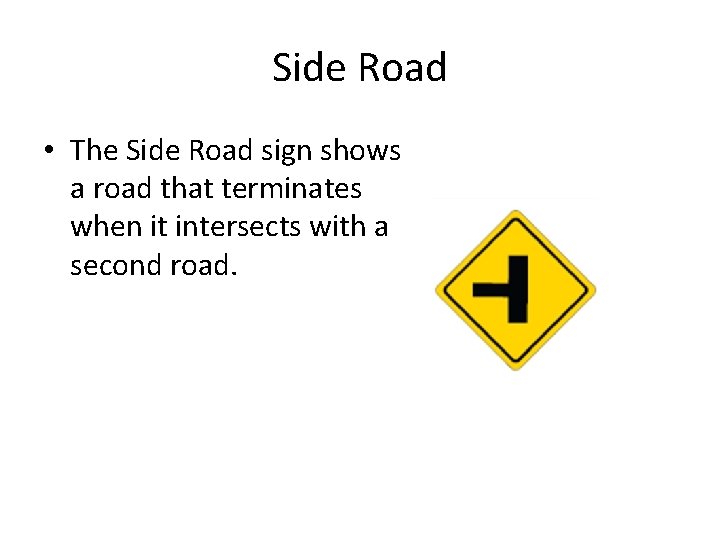
Intersections Ahead • Signs warn you of intersections ahead where traffic may exist or where a right or left turn may be required. A sign naming the intersecting road also may be posted. The two intersections shown below are the Crossroad and the Side Road.
Crossroad • The Crossroad sign shows two streets that intersect at a typical intersection. The intersection could be uncontrolled (with no stop signs, yield signs, or traffic signal lights) or controlled (with stop signs, yield signs, or traffic signal lights).
Side Road • The Side Road sign shows a road that terminates when it intersects with a second road.
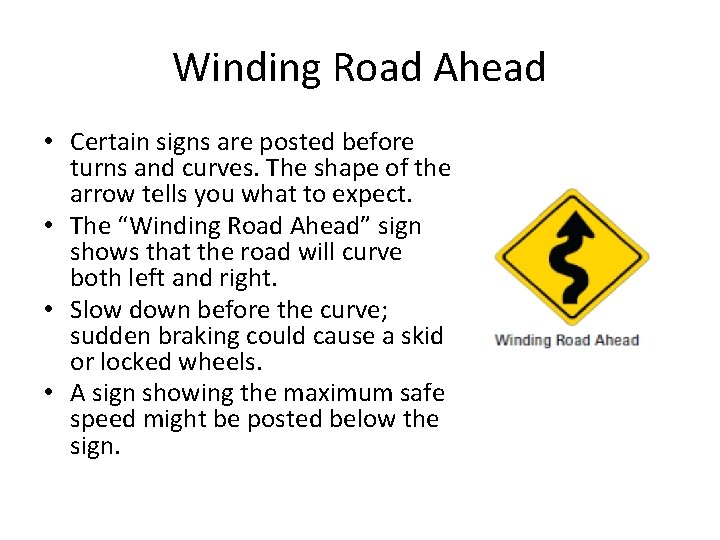
Winding Road Ahead • Certain signs are posted before turns and curves. The shape of the arrow tells you what to expect. • The “Winding Road Ahead” sign shows that the road will curve both left and right. • Slow down before the curve; sudden braking could cause a skid or locked wheels. • A sign showing the maximum safe speed might be posted below the sign.
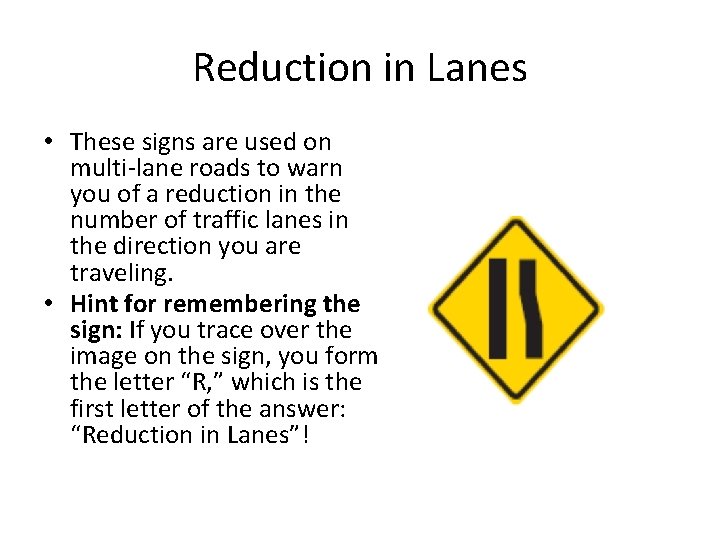
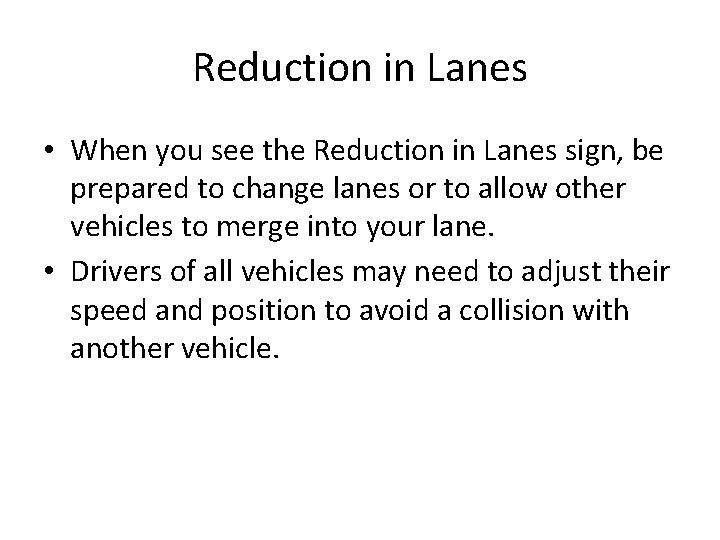
Reduction in Lanes • These signs are used on multi-lane roads to warn you of a reduction in the number of traffic lanes in the direction you are traveling. • Hint for remembering the sign: If you trace over the image on the sign, you form the letter “R, ” which is the first letter of the answer: “Reduction in Lanes”!
Reduction in Lanes • When you see the Reduction in Lanes sign, be prepared to change lanes or to allow other vehicles to merge into your lane. • Drivers of all vehicles may need to adjust their speed and position to avoid a collision with another vehicle.
Reduction in Lanes • The sign at right is another way of communicating to drivers that they need to make a lane change if they want to continue in their direction of travel.
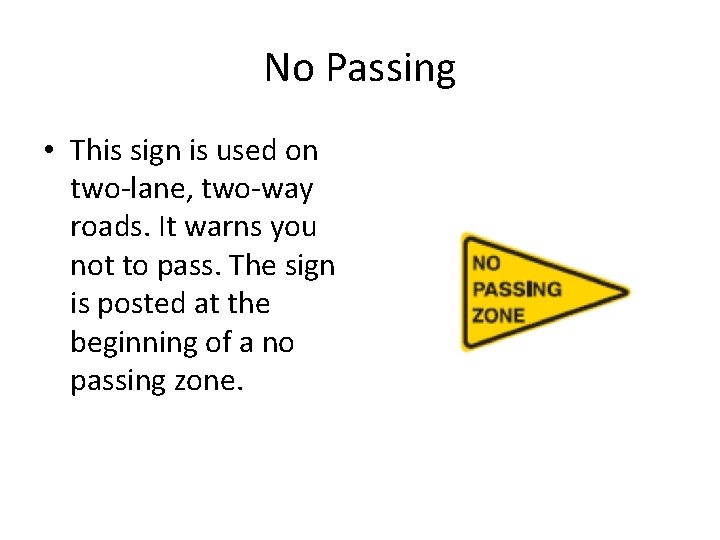
No Passing • This sign is used on two-lane, two-way roads. It warns you not to pass. The sign is posted at the beginning of a no passing zone.
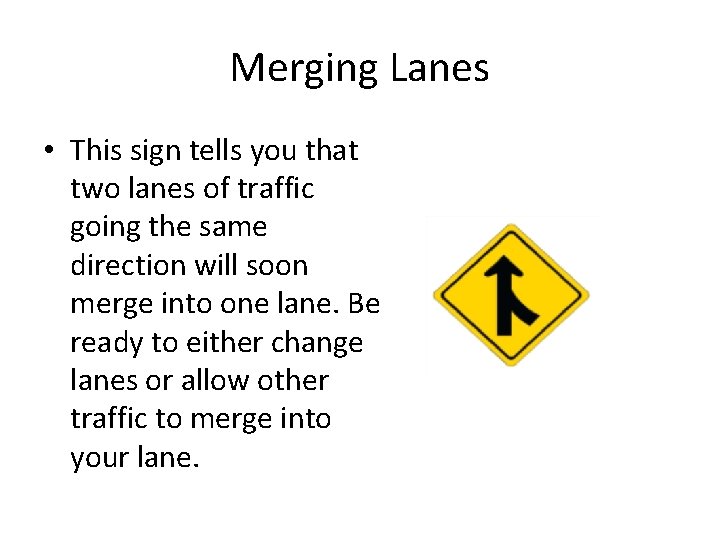
Merging Lanes • This sign tells you that two lanes of traffic going the same direction will soon merge into one lane. Be ready to either change lanes or allow other traffic to merge into your lane.
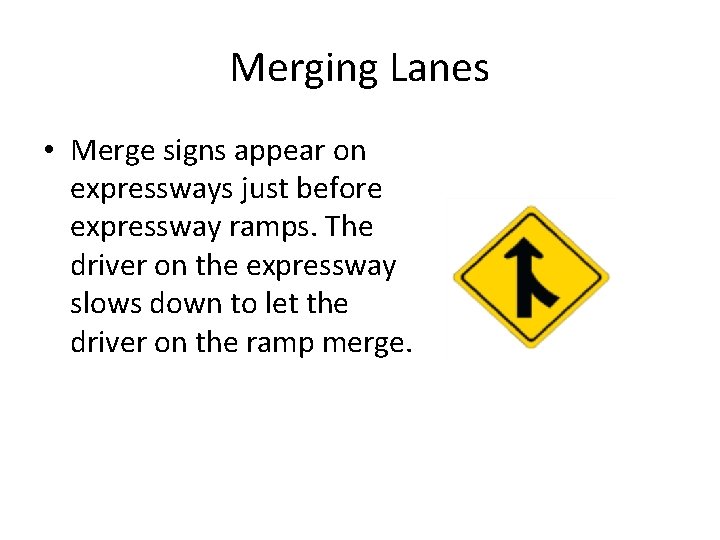
Merging Lanes • Merge signs appear on expressways just before expressway ramps. The driver on the expressway slows down to let the driver on the ramp merge.
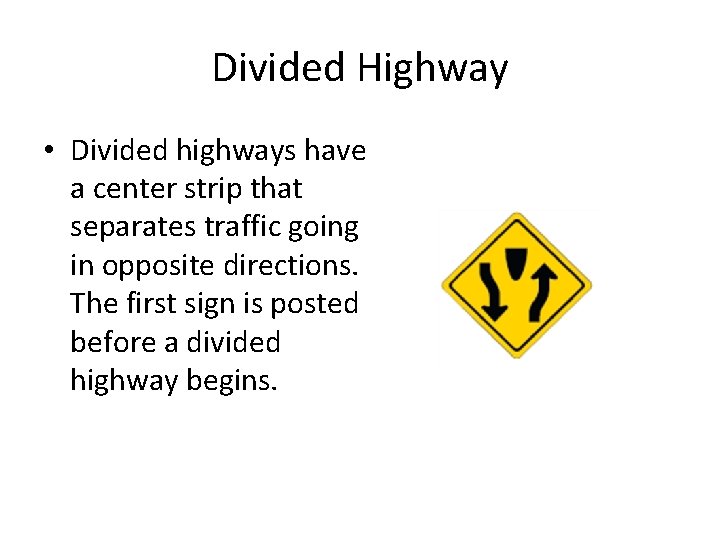
Divided Highway • Divided highways have a center strip that separates traffic going in opposite directions. The first sign is posted before a divided highway begins.
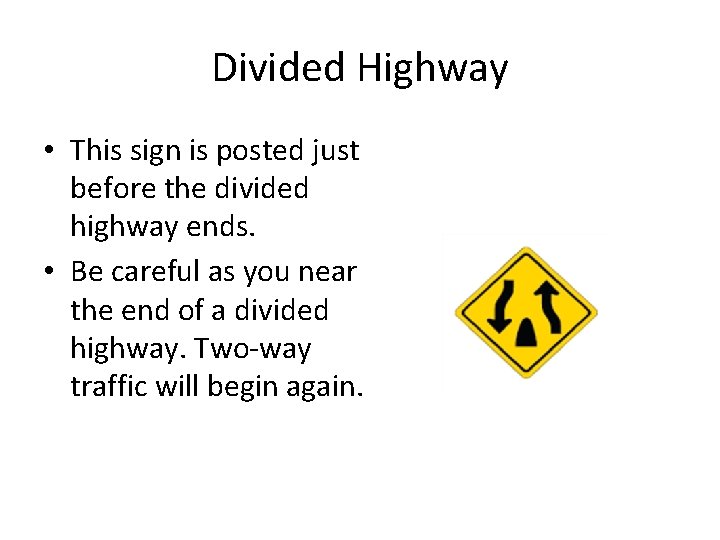
Divided Highway • This sign is posted just before the divided highway ends. • Be careful as you near the end of a divided highway. Two-way traffic will begin again.
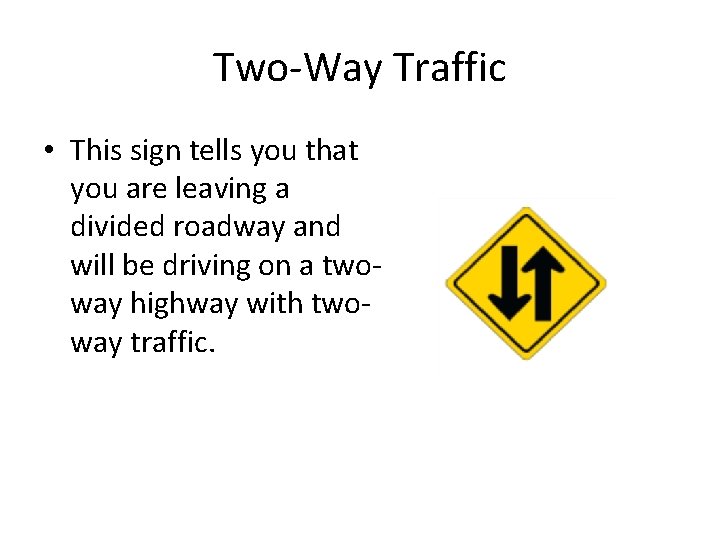
Two-Way Traffic • This sign tells you that you are leaving a divided roadway and will be driving on a twoway highway with twoway traffic.
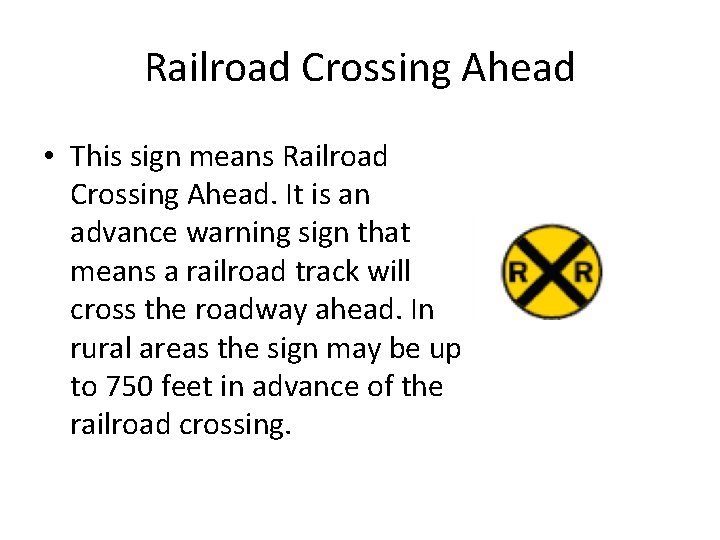
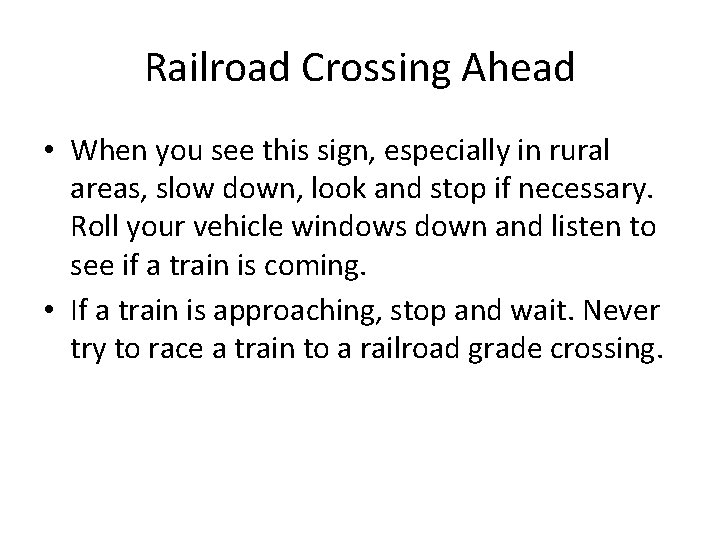
Railroad Crossing Ahead • This sign means Railroad Crossing Ahead. It is an advance warning sign that means a railroad track will cross the roadway ahead. In rural areas the sign may be up to 750 feet in advance of the railroad crossing.
Railroad Crossing Ahead • When you see this sign, especially in rural areas, slow down, look and stop if necessary. Roll your vehicle windows down and listen to see if a train is coming. • If a train is approaching, stop and wait. Never try to race a train to a railroad grade crossing.
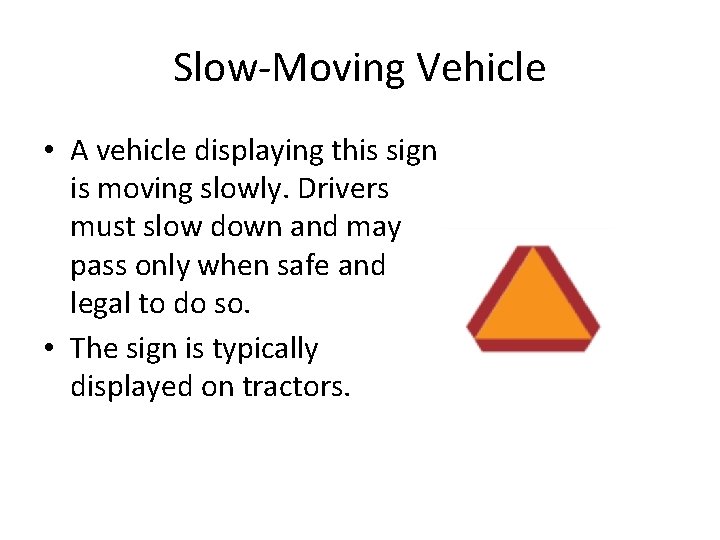
Slow-Moving Vehicle • A vehicle displaying this sign is moving slowly. Drivers must slow down and may pass only when safe and legal to do so. • The sign is typically displayed on tractors.
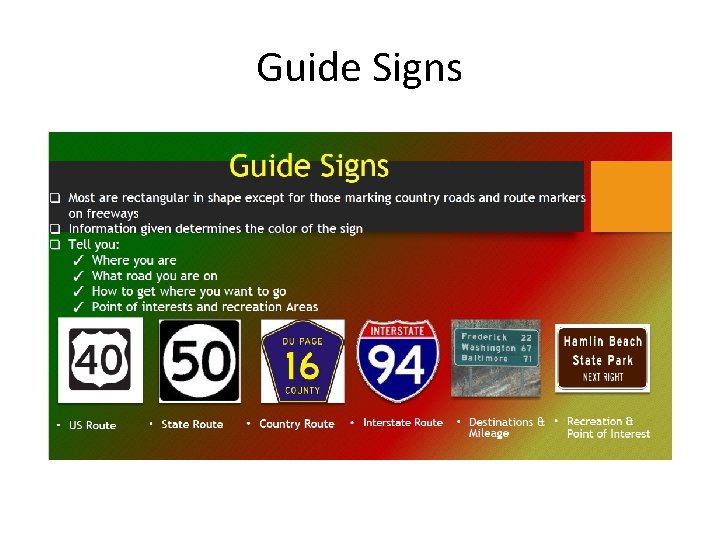
Guide Signs
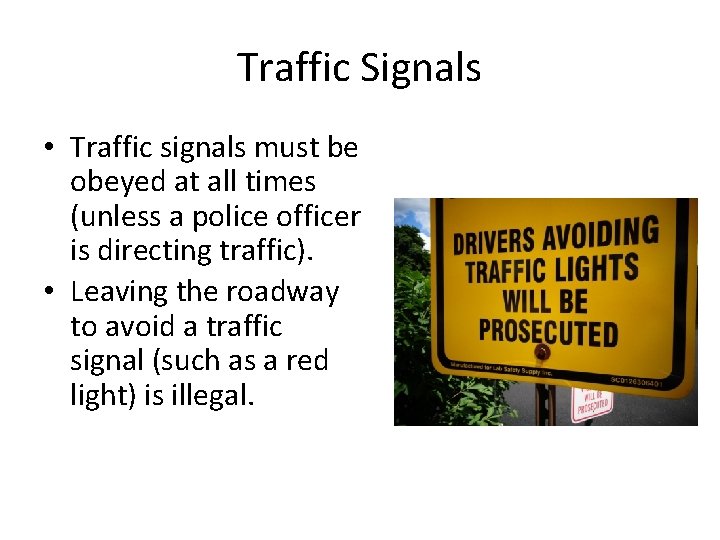
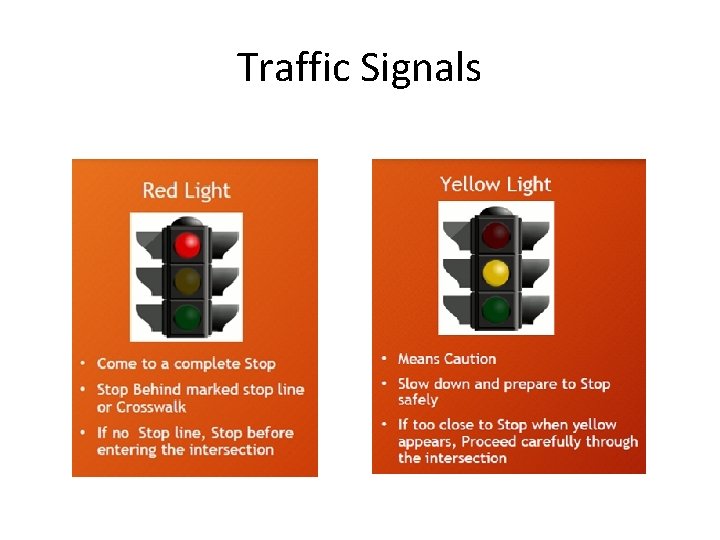
Traffic Signals • Traffic signals must be obeyed at all times (unless a police officer is directing traffic). • Leaving the roadway to avoid a traffic signal (such as a red light) is illegal.
Traffic Signals
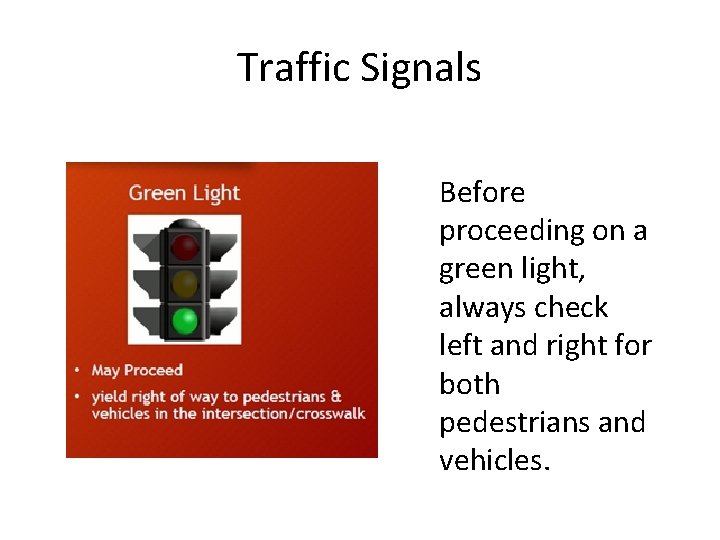
Traffic Signals Before proceeding on a green light, always check left and right for both pedestrians and vehicles.
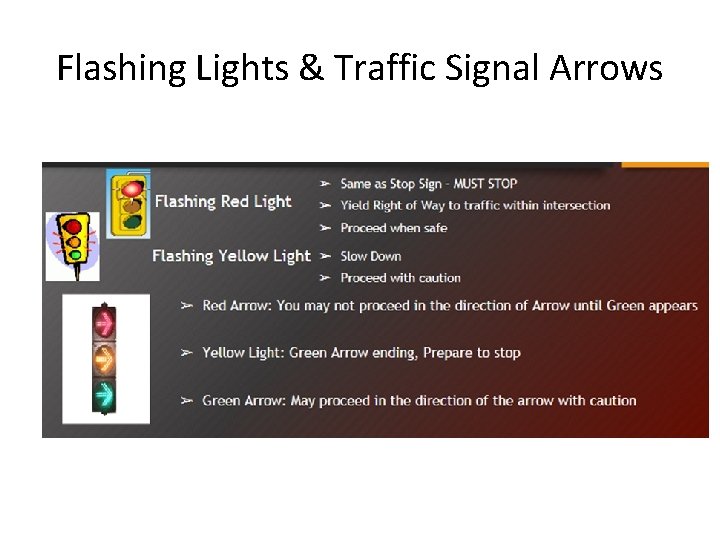
Flashing Lights & Traffic Signal Arrows
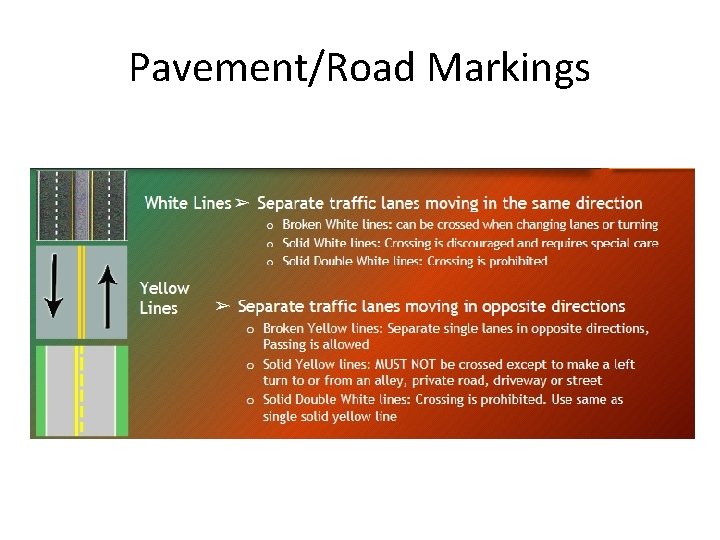
Pavement/Road Markings
Safe-Driving Tips • The slides in this section provide a range of tips for driving safely in all conditions, including bad weather. • You’ll learn how to drive safely in rain, snow, fog, and at night.
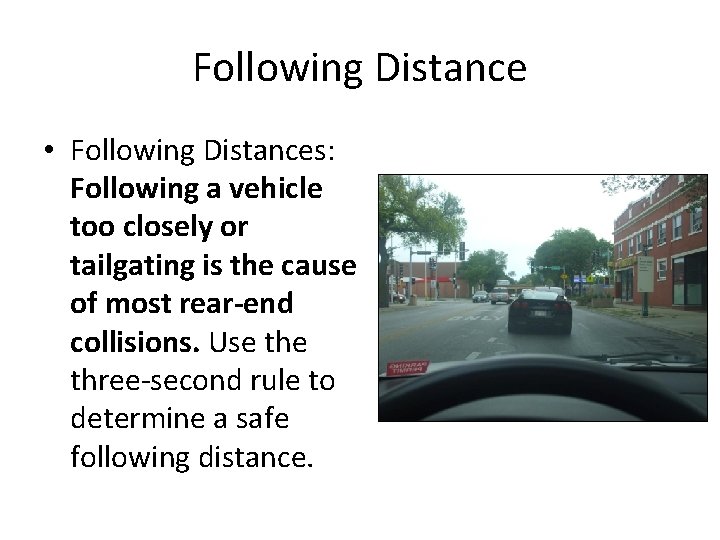
Following Distance • Following Distances: Following a vehicle too closely or tailgating is the cause of most rear-end collisions. Use three-second rule to determine a safe following distance.
Using the Three-Second Rule • When the driver in front of you passes a fixed object, such as a sign or tree, start counting, “One-thousand one, one-thousand two, onethousand three. ” If you get to the fixed object before “one-thousand three, ” you’re following too closely and should reduce your speed. • In adverse weather conditions, you will need a longer following distance, such as a six-second or eight-second following distance.
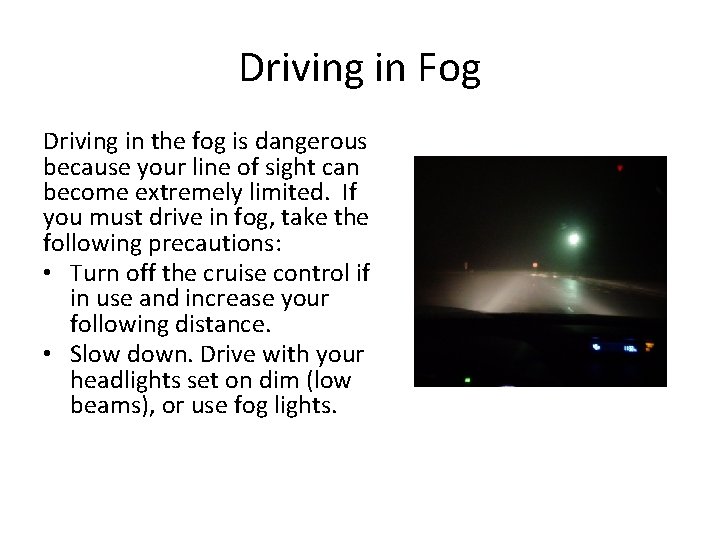
Driving in Fog Driving in the fog is dangerous because your line of sight can become extremely limited. If you must drive in fog, take the following precautions: • Turn off the cruise control if in use and increase your following distance. • Slow down. Drive with your headlights set on dim (low beams), or use fog lights.
Driving in Fog • Do not overdrive your headlights. Stay within the limits of your vision. You may have to stop suddenly. If the fog is too dense, pull off the roadway and stop. Do not drive at 5 -10 mph. • Use your turn signal long before you turn, and brake early when you approach a stop to warn other drivers.
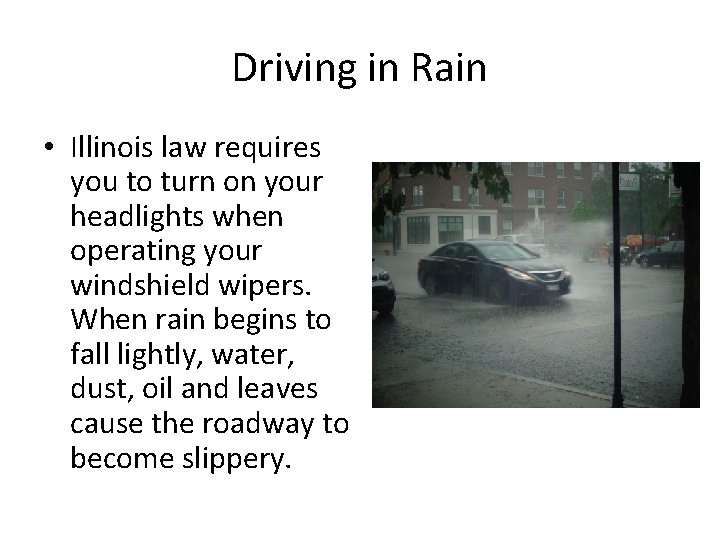
Driving in Rain • Illinois law requires you to turn on your headlights when operating your windshield wipers. When rain begins to fall lightly, water, dust, oil and leaves cause the roadway to become slippery.
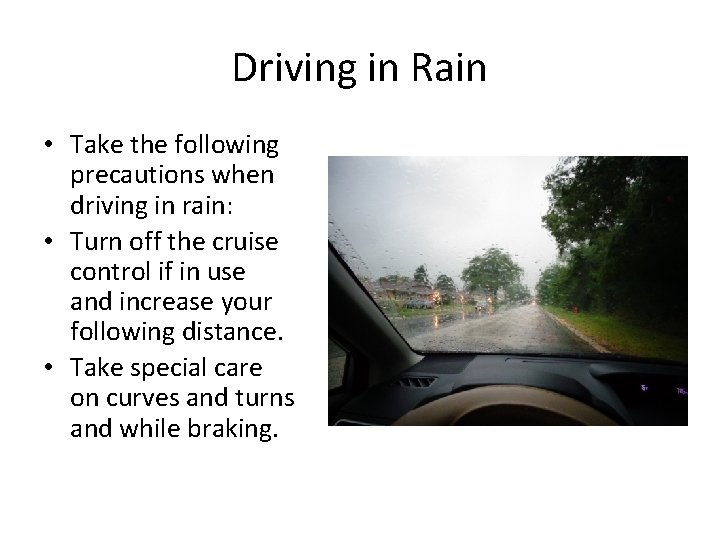
Driving in Rain • Take the following precautions when driving in rain: • Turn off the cruise control if in use and increase your following distance. • Take special care on curves and turns and while braking.
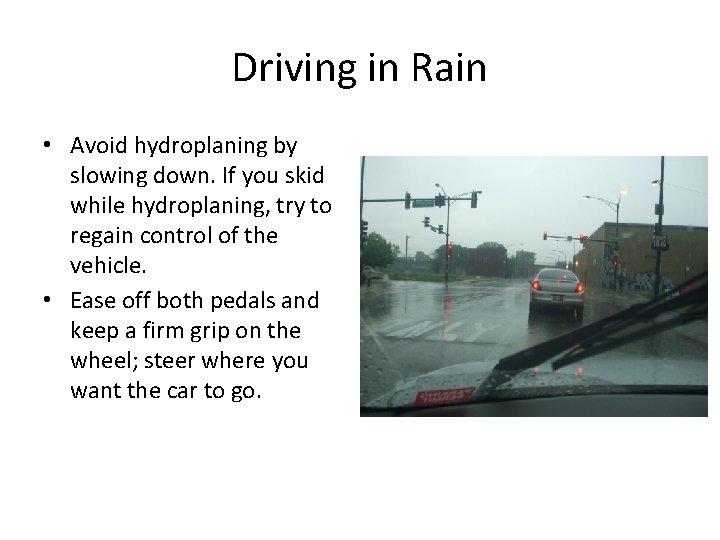
Driving in Rain • Avoid hydroplaning by slowing down. If you skid while hydroplaning, try to regain control of the vehicle. • Ease off both pedals and keep a firm grip on the wheel; steer where you want the car to go.
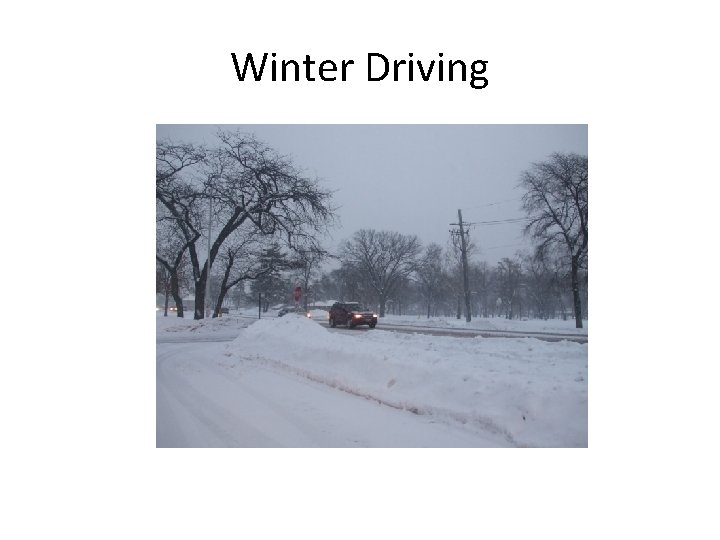
Winter Driving
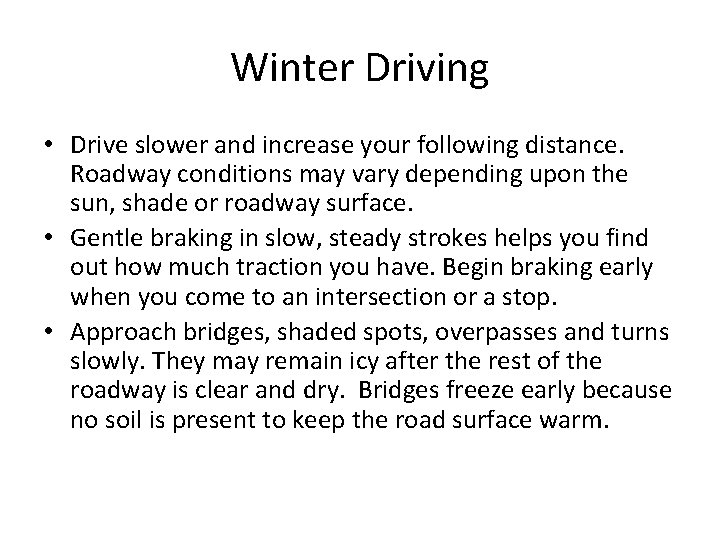
Winter Driving • Drive slower and increase your following distance. Roadway conditions may vary depending upon the sun, shade or roadway surface. • Gentle braking in slow, steady strokes helps you find out how much traction you have. Begin braking early when you come to an intersection or a stop. • Approach bridges, shaded spots, overpasses and turns slowly. They may remain icy after the rest of the roadway is clear and dry. Bridges freeze early because no soil is present to keep the road surface warm.
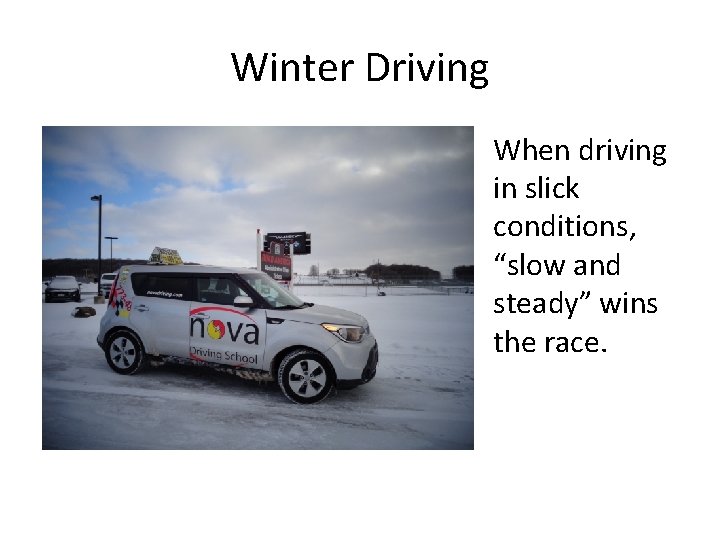
Winter Driving When driving in slick conditions, “slow and steady” wins the race.
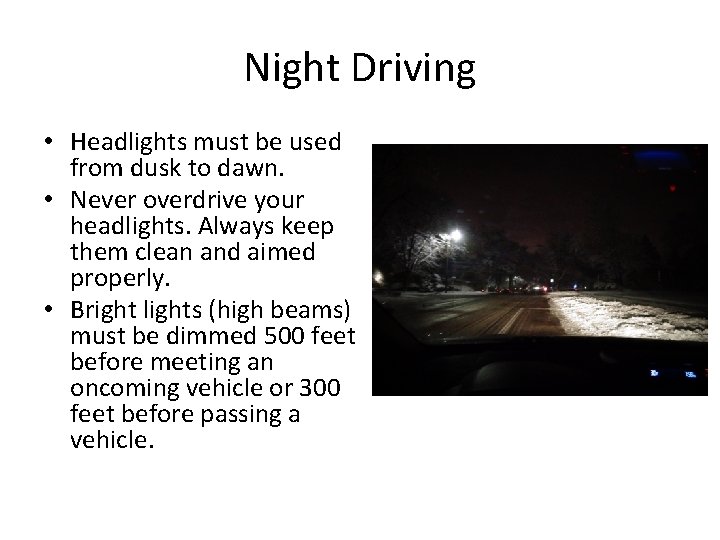
Night Driving • Headlights must be used from dusk to dawn. • Never overdrive your headlights. Always keep them clean and aimed properly. • Bright lights (high beams) must be dimmed 500 feet before meeting an oncoming vehicle or 300 feet before passing a vehicle.
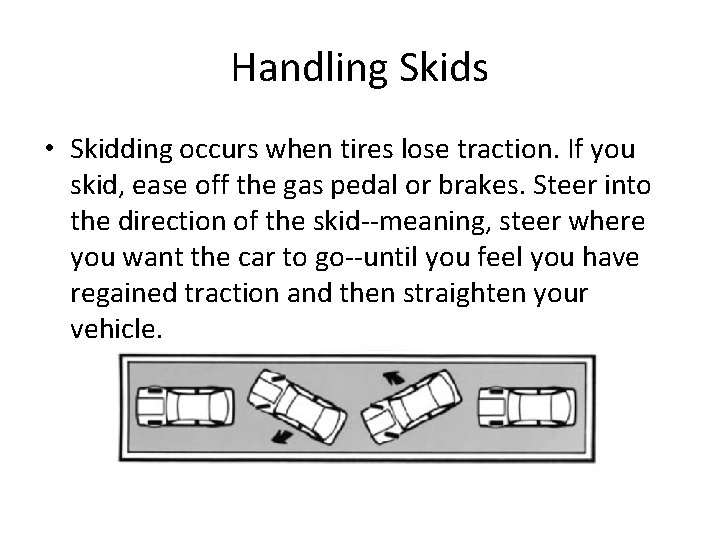
Handling Skids • Skidding occurs when tires lose traction. If you skid, ease off the gas pedal or brakes. Steer into the direction of the skid--meaning, steer where you want the car to go--until you feel you have regained traction and then straighten your vehicle.
Driving off the Pavement by Mistake • If your wheels drift off the pavement onto the shoulder, grip the wheel firmly, ease your foot off the gas pedal and brake gently. After checking for traffic behind you, gently steer back onto the pavement. • Do not jerk your wheel to correct your steering. This abrupt steering may cause you to drive into oncoming traffic.
Equipment Failure: Blowouts and Brake Failure • Blowouts — A thumping sound may be a warning of a blowout. If this happens, ease your foot off the gas pedal and keep a firm grasp on the steering wheel. Do not brake suddenly. Pull safely off the roadway and check your tires. • Brake failure — If your brake pedal suddenly sinks to the floor, pump it to build pressure. If that does not work, use your emergency or parking brake. To slow down, shift your vehicle into a lower gear.
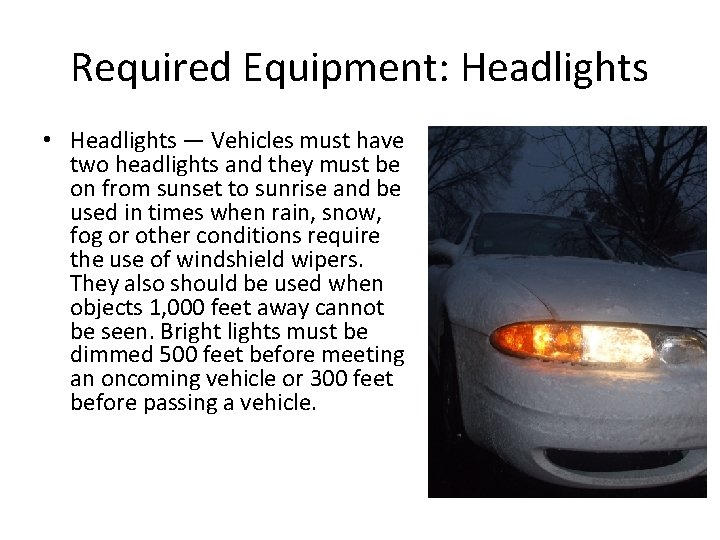
Required Equipment: Headlights • Headlights — Vehicles must have two headlights and they must be on from sunset to sunrise and be used in times when rain, snow, fog or other conditions require the use of windshield wipers. They also should be used when objects 1, 000 feet away cannot be seen. Bright lights must be dimmed 500 feet before meeting an oncoming vehicle or 300 feet before passing a vehicle.
Restricted Equipment: TV/Video Monitors • Since a driver must be focused on the road at all times, televisions or video recording monitors that can be seen from the driver’s seat are prohibited while the vehicle is in motion.
Mandatory Insurance • All vehicles operated in Illinois must be covered by liability insurance, which covers injuries or damages you may cause with your vehicle to other persons or their property. • Following are minimum liability insurance limits: • $20, 000 for injury or death of one person in a crash. • $40, 000 for injury or death of more than one person in a crash. • $15, 000 for damage to property of another person. • Evidence of liability coverage must be carried by the motorist or in the vehicle and shown to law enforcement officers upon request.
Quiz 1. When approaching a stop sign, a driver should: ( ) Stop the car as close as possible to the stop sign. ( ) Stop the car at the marked stop line, before entering the crosswalk, or before entering the intersection if there is no line or crosswalk. ( ) Stop anywhere near the intersection, as long as he or she comes to a complete stop. You must stop at the marked stop LINE first. If you don’t see one, then stop before you get to a crosswalk, and if there is not one, then you stop before entering the intersection itself. 1. In the winter, the surface of a bridge may be dangerous because ( ) There may be ice on bridges even when other roads are clear. ( ) The surface of the bridge may be warmer than other roads. ( ) None of the above. Since the underside of a bridge has more surface exposed to cold air than a regular road, it tends to freeze before other roads insulated by the warmer temperatures of the surrounding soil. This can surprise drivers who expect a bridge to have the same traction as other, warmer pavement surfaces. When approaching a bridge in cold weather, always be alert for icy conditions. 1. When you enter a construction zone, you should change a lane away from construction workers/vehicles if it is possible. If a lane change is not possible due to traffic conditions, a driver should slow down and yield. ( ) True ( ) False True. In construction zones, drivers are required to move into a lane away from construction vehicles and workers. This law is intended to lower the risk of a collision in the work zone or maintenance zone. 1. If an intersection allows a right turn on a red light, you must: ( ) Turn immediately to get out of the way of other traffic. ( ) Stop, yield the right-of-way to any pedestrians or cars in the intersection, then proceed to cautiously make your turn. ( ) Stop, beep your horn to alert other drivers, then proceed to turn. Turning right at a red light without stopping is illegal. If there are no signs that prohibit a right turn on red, you still must stop completely before turning. After checking that no one is already in the intersection, and yielding to cross-traffic moving through the intersection on a green light, you can turn.
Quiz 1. 1. When waiting at a traffic light that turns to green, you can start driving: ( ) Immediately. ( ) When you feel that it’s safe to continue driving. ( ) After first yielding to people and cars that are already in the intersection. Even after the traffic light turns green, you must allow drivers in the intersection to clear it first before you enter the intersection. Make sure that the road is clear and it is safe to drive before proceeding. The second answer choice might seem like it is the correct answer, but it is not as specific as the third answer choice. If you experience your car hydroplaning (skidding on water) you should: ( ) Steer slightly to the right and press the brake repeatedly. ( ) Turn off your ignition and allow the car to come to a stop. ( ) Take your foot off the accelerator to reduce your speed. Do not turn your ignition off; doing so will deactivate your power brakes and power steering. Instead, simply stop pressing the gas and allow your car’s speed to drop gradually. Once you are traveling at a slower speed, the grooves in your tires will channel the water away from the tire tread, increasing your traction. If the rear end of your vehicle starts to skid while you are driving on a slippery roadway, you should: ( ) Steer the front wheels in the direction of the skid. ( ) Grasp the wheel firmly and steer straight ahead, braking gradually. ( ) Press on the brakes immediately. Skidding means that your wheels have lost traction, which means you’ve lost control. The best way to fix this is to ease off of the gas or brake and steer in the direction of the curve until you regain traction. You should avoid driving in foggy conditions, but if you must, you should turn on your LOW-BEAMS and: ( ) Drive only at a speed that is safe based on how far ahead you can actually see. ( ) Periodically flash your headlights. ( ) Keep constant, gentle pressure on the brake pedal so that your tail light can be seen more easily. Slowing down to a safe speed that allows you to see effectively is the safest approach to follow. As the question notes, you should use your LOW beams, not your high-beam headlights during fog. The bright light from the high-beams reflects light off the fog and creates dangerous glare for the driver. The other answer choices, such as flashing your headlights and continuously applying the brake, will not increase your line of sight in the fog. If you drive faster than how far you can see, you may not see a curve, obstacle, person, or vehicle until it is too late; you might not have time to stop.
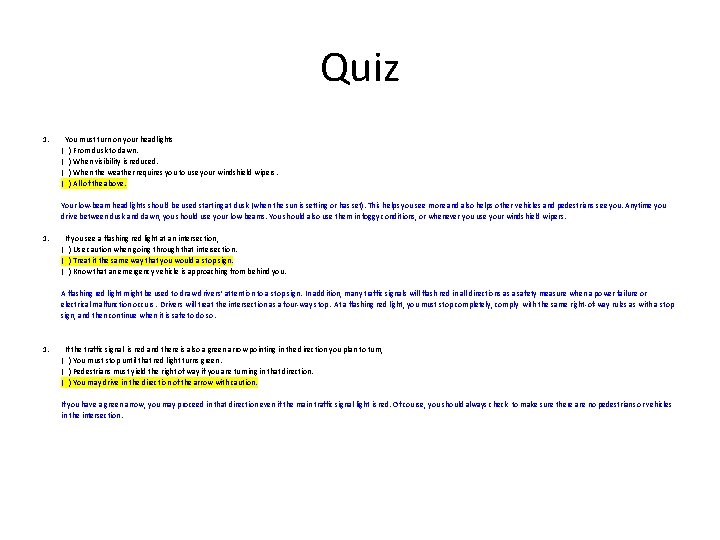
Quiz 1. You must turn on your headlights ( ) From dusk to dawn. ( ) When visibility is reduced. ( ) When the weather requires you to use your windshield wipers. ( ) All of the above. Your low-beam headlights should be used starting at dusk (when the sun is setting or has set). This helps you see more and also helps other vehicles and pedestrians see you. Anytime you drive between dusk and dawn, you should use your low-beams. You should also use them in foggy conditions, or whenever you use your windshield wipers. 1. If you see a flashing red light at an intersection, ( ) Use caution when going through that intersection. ( ) Treat it the same way that you would a stop sign. ( ) Know that an emergency vehicle is approaching from behind you. A flashing red light might be used to draw drivers’ attention to a stop sign. In addition, many traffic signals will flash red in all directions as a safety measure when a power failure or electrical malfunction occurs. Drivers will treat the intersection as a four-way stop. At a flashing red light, you must stop completely, comply with the same right-of-way rules as with a stop sign, and then continue when it is safe to do so. 1. If the traffic signal is red and there is also a green arrow pointing in the direction you plan to turn, ( ) You must stop until that red light turns green. ( ) Pedestrians must yield the right of way if you are turning in that direction. ( ) You may drive in the direction of the arrow with caution. If you have a green arrow, you may proceed in that direction even if the main traffic signal light is red. Of course, you should always check to make sure there are no pedestrians or vehicles in the intersection.
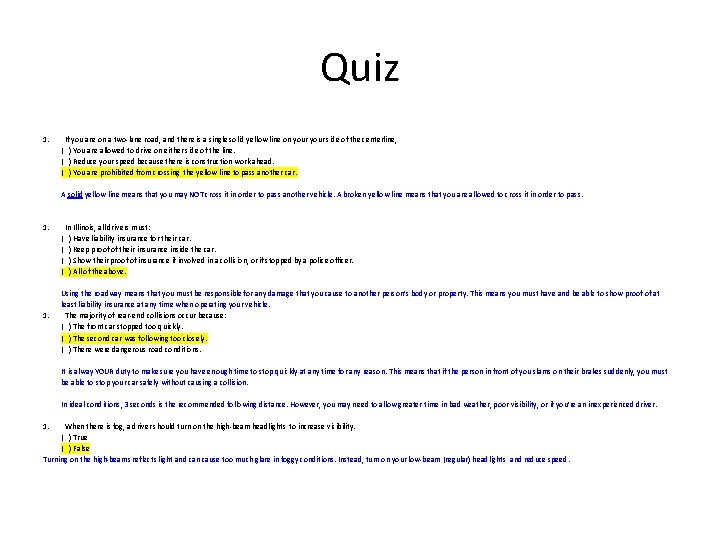
Quiz 1. If you are on a two-lane road, and there is a single solid yellow line on your side of the centerline, ( ) You are allowed to drive on either side of the line. ( ) Reduce your speed because there is construction work ahead. ( ) You are prohibited from crossing the yellow line to pass another car. A solid yellow line means that you may NOT cross it in order to pass another vehicle. A broken yellow line means that you are allowed to cross it in order to pass. 1. In Illinois, all drivers must: ( ) Have liability insurance for their car. ( ) Keep proof of their insurance inside the car. ( ) Show their proof of insurance if involved in a collision, or if stopped by a police officer. ( ) All of the above. Using the roadway means that you must be responsible for any damage that you cause to another person’s body or property. This means you must have and be able to show proof of at least liability insurance at any time when operating your vehicle. The majority of rear-end collisions occur because: ( ) The front car stopped too quickly. ( ) The second car was following too closely. ( ) There were dangerous road conditions. It is alway YOUR duty to make sure you have enough time to stop quickly at any time for any reason. This means that if the person in front of you slams on their brakes suddenly, you must be able to stop your car safely without causing a collision. In ideal conditions, 3 seconds is the recommended following distance. However, you may need to allow greater time in bad weather, poor visibility, or if you’re an inexperienced driver. 1. When there is fog, a driver should turn on the high-beam headlights to increase visibility. ( ) True ( ) False Turning on the high-beams reflects light and can cause too much glare in foggy conditions. Instead, turn on your low-beam (regular) headlights and reduce speed.
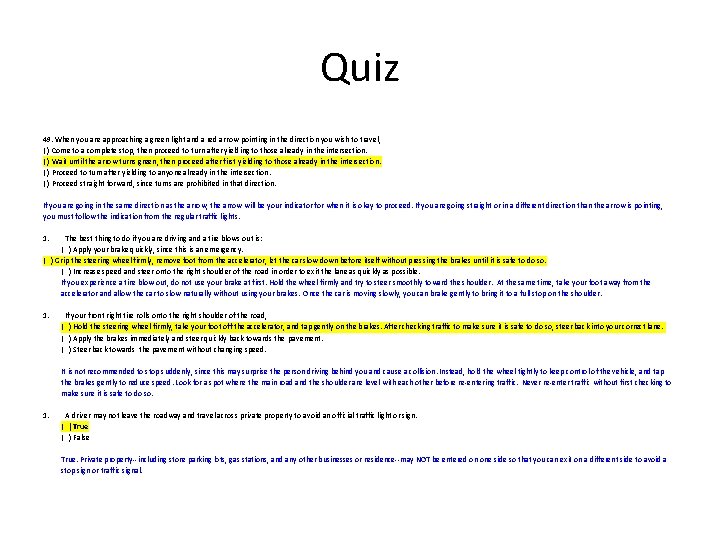
Quiz 49. When you are approaching a green light and a red arrow pointing in the direction you wish to travel, ( ) Come to a complete stop, then proceed to turn after yielding to those already in the intersection. ( ) Wait until the arrow turns green, then proceed after first yielding to those already in the intersection. ( ) Proceed to turn after yielding to anyone already in the intersection. ( ) Proceed straight forward, since turns are prohibited in that direction. If you are going in the same direction as the arrow, the arrow will be your indicator for when it is okay to proceed. If you are going straight or in a different direction than the arrow is pointing, you must follow the indication from the regular traffic lights. 1. The best thing to do if you are driving and a tire blows out is: ( ) Apply your brake quickly, since this is an emergency. ( ) Grip the steering wheel firmly, remove foot from the accelerator, let the car slow down before itself without pressing the brakes until it is safe to do so. ( ) Increase speed and steer onto the right shoulder of the road in order to exit the lane as quickly as possible. If you experience a tire blow-out, do not use your brake at first. Hold the wheel firmly and try to steer smoothly toward the shoulder. At the same time, take your foot away from the accelerator and allow the car to slow naturally without using your brakes. Once the car is moving slowly, you can brake gently to bring it to a full stop on the shoulder. 1. If your front right tire rolls onto the right shoulder of the road, ( ) Hold the steering wheel firmly, take your foot off the accelerator, and tap gently on the brakes. After checking traffic to make sure it is safe to do so, steer back into your correct lane. ( ) Apply the brakes immediately and steer quickly back towards the pavement. ( ) Steer back towards the pavement without changing speed. It is not recommended to stop suddenly, since this may surprise the person driving behind you and cause a collision. Instead, hold the wheel tightly to keep control of the vehicle, and tap the brakes gently to reduce speed. Look for a spot where the main road and the shoulder are level with each other before re-entering traffic. Never re-enter traffic without first checking to make sure it is safe to do so. 1. A driver may not leave the roadway and travel across private property to avoid an official traffic light or sign. ( ) True ( ) False True. Private property--including store parking lots, gas stations, and any other businesses or residence--may NOT be entered on one side so that you can exit on a different side to avoid a stop sign or traffic signal.
Signs Quiz https: //docs. google. com/document/d/1 TMyy 4 Q 8 y. V_h 7 y. HVn 0 l. YFam. Hnohuc. BNZkbmvx 3 ou. Q 64/edit? usp= sharing
Thank You! • Thank you for completing the Online Written Exam Course. Nova Driving School believes that the material you just read will provide you with a solid background for success on the Written Exam. • To take the practice Written Exam, please click the link below: • https: //docs. google. com/document/d/1 xzep. I QR 4 Ro 7 Q 3 c. GXg. FPrtomx 221 p 2 xeo 6 e. N 37 Me. Jc SU/edit? usp=sharing