
Study Smarter TM Effective Study Strategies for the




- Slides: 61
Study Smarter TM Effective Study Strategies for the ECFVG Basic Clinical Sciences Exam (BCSE) Steven I Mc. Laughlin DVM, MPH, DACVPM Steve@Zukureview. com www. Zukureview. com 1 800 928 8218
“It is not enough to be a good chess player, you must also play well. ” -Savielly Tartakower
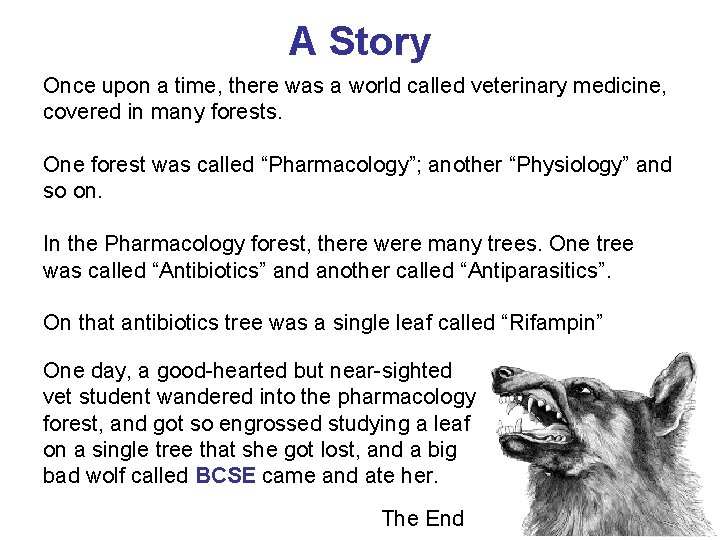
A Story Once upon a time, there was a world called veterinary medicine, covered in many forests. One forest was called “Pharmacology”; another “Physiology” and so on. In the Pharmacology forest, there were many trees. One tree was called “Antibiotics” and another called “Antiparasitics”. On that antibiotics tree was a single leaf called “Rifampin” One day, a good-hearted but near-sighted vet student wandered into the pharmacology forest, and got so engrossed studying a leaf on a single tree that she got lost, and a big bad wolf called BCSE came and ate her. The End
The need for speed It is time to go fast, people. • The goal is not to know everything • The goal is not to get every question right • The goal is to pass In the forests of knowledge, let this be your map
This presentation • BCSE Structure • Study strategies for BCSE • Test-taking strategies BCSE
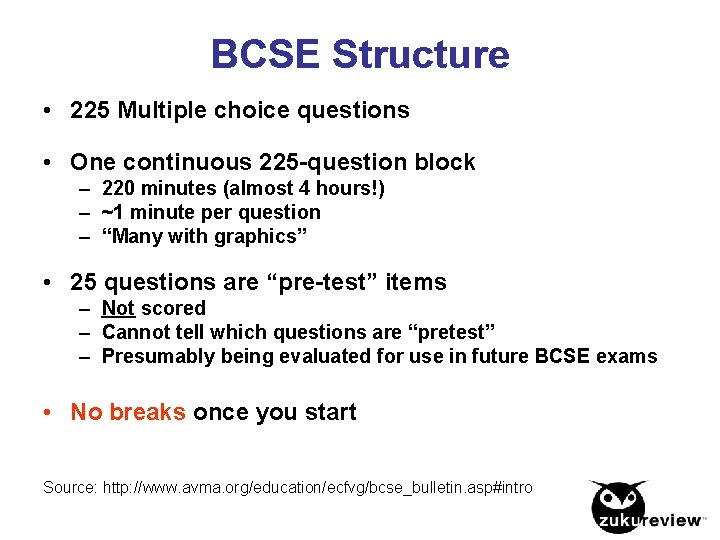
BCSE Structure • 225 Multiple choice questions • One continuous 225 -question block – 220 minutes (almost 4 hours!) – ~1 minute per question – “Many with graphics” • 25 questions are “pre-test” items – Not scored – Cannot tell which questions are “pretest” – Presumably being evaluated for use in future BCSE exams • No breaks once you start Source: http: //www. avma. org/education/ecfvg/bcse_bulletin. asp#intro
BCSE Pass Rates ? To date, the ECFVG has released no data on the numbers of people taking BCSE or the numbers passing Source: http: //www. avma. org/education/ecfvg/bcse_bulletin. asp#intro
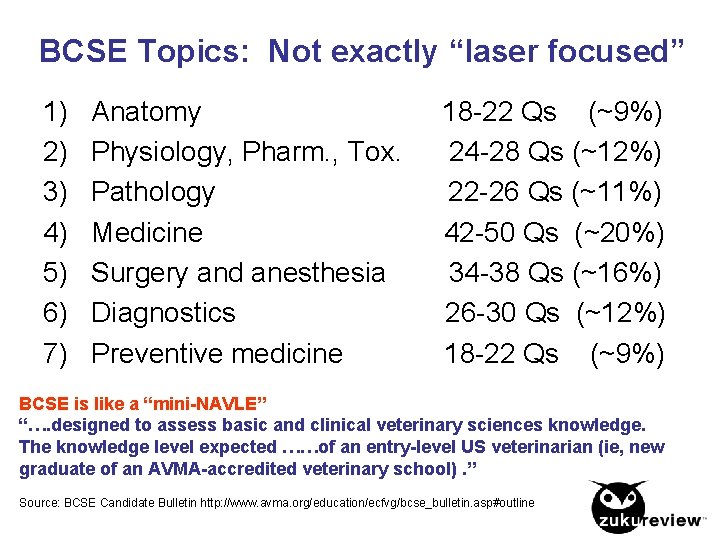
BCSE Topics: Not exactly “laser focused” 1) 2) 3) 4) 5) 6) 7) Anatomy 18 -22 Qs (~9%) Physiology, Pharm. , Tox. 24 -28 Qs (~12%) Pathology 22 -26 Qs (~11%) Medicine 42 -50 Qs (~20%) Surgery and anesthesia 34 -38 Qs (~16%) Diagnostics 26 -30 Qs (~12%) Preventive medicine 18 -22 Qs (~9%) BCSE is like a “mini-NAVLE” “…. designed to assess basic and clinical veterinary sciences knowledge. The knowledge level expected ……of an entry-level US veterinarian (ie, new graduate of an AVMA-accredited veterinary school). ” Source: BCSE Candidate Bulletin http: //www. avma. org/education/ecfvg/bcse_bulletin. asp#outline
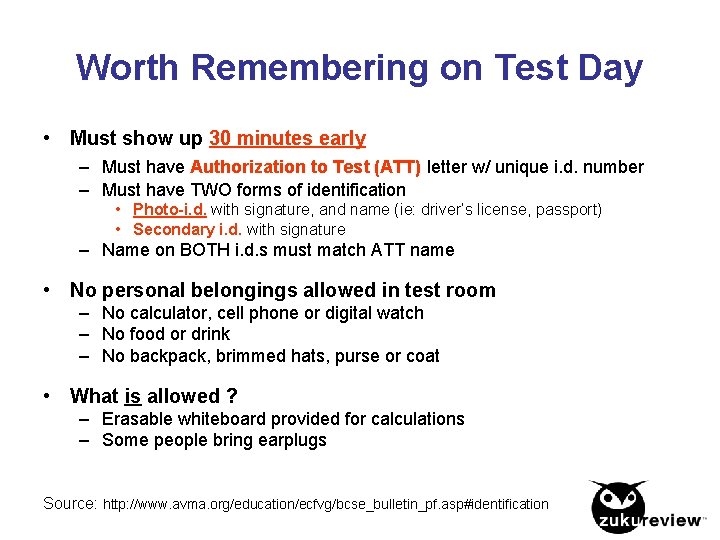
Worth Remembering on Test Day • Must show up 30 minutes early – Must have Authorization to Test (ATT) letter w/ unique i. d. number – Must have TWO forms of identification • Photo-i. d. with signature, and name (ie: driver’s license, passport) • Secondary i. d. with signature – Name on BOTH i. d. s must match ATT name • No personal belongings allowed in test room – No calculator, cell phone or digital watch – No food or drink – No backpack, brimmed hats, purse or coat • What is allowed ? – Erasable whiteboard provided for calculations – Some people bring earplugs Source: http: //www. avma. org/education/ecfvg/bcse_bulletin_pf. asp#identification
Why bother to study effectively ? • BCSE is foundational knowledge – Concepts support your NAVLE prep – AND help you in clinics • Use motivation of BCSE to learn how to learn (This isn’t the last test you’ll ever take…. ) • Who wants to waste time and money taking this test more than once?
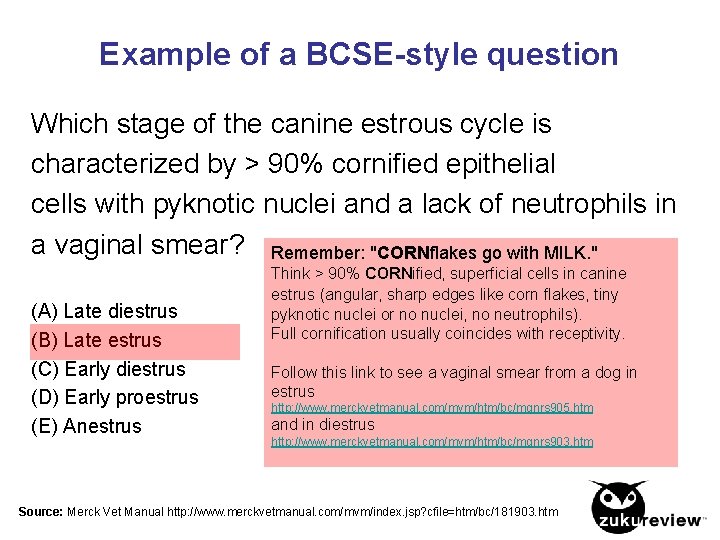
Example of a BCSE-style question Which stage of the canine estrous cycle is characterized by > 90% cornified epithelial cells with pyknotic nuclei and a lack of neutrophils in a vaginal smear? Remember: "CORNflakes go with MILK. " (A) Late diestrus (B) Late estrus (C) Early diestrus (D) Early proestrus (E) Anestrus Think > 90% CORNified, superficial cells in canine estrus (angular, sharp edges like corn flakes, tiny pyknotic nuclei or no nuclei, no neutrophils). Full cornification usually coincides with receptivity. Follow this link to see a vaginal smear from a dog in estrus http: //www. merckvetmanual. com/mvm/htm/bc/mgnrs 905. htm and in diestrus http: //www. merckvetmanual. com/mvm/htm/bc/mgnrs 903. htm Source: Merck Vet Manual http: //www. merckvetmanual. com/mvm/index. jsp? cfile=htm/bc/181903. htm
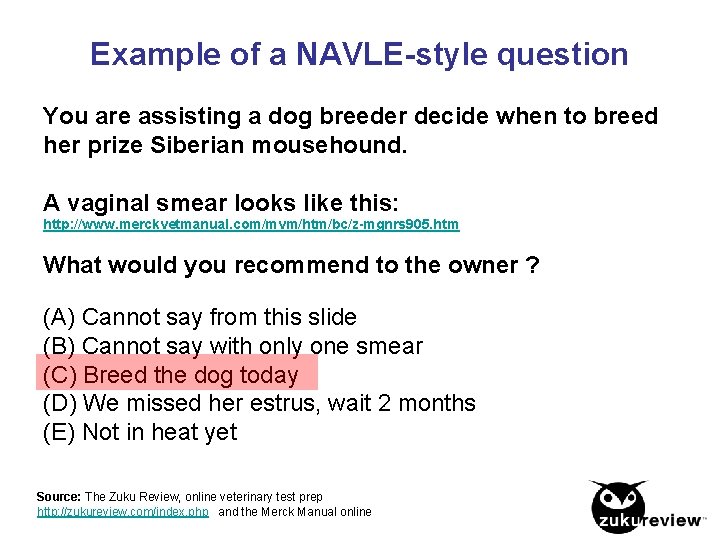
Example of a NAVLE-style question You are assisting a dog breeder decide when to breed her prize Siberian mousehound. A vaginal smear looks like this: http: //www. merckvetmanual. com/mvm/htm/bc/z-mgnrs 905. htm What would you recommend to the owner ? (A) Cannot say from this slide (B) Cannot say with only one smear (C) Breed the dog today (D) We missed her estrus, wait 2 months (E) Not in heat yet Source: The Zuku Review, online veterinary test prep http: //zukureview. com/index. php and the Merck Manual online
If the BCSE is so broad, where do I start? Be guided by BCSE example questions http: //www. avma. org/education/ecfvg/bcse_practice_test. asp – A springboard to study – A pointer to key topics – Gives you a sense of the depth, style of questions Note: BCSE questions are similar to the QE. For more practice, try the PAVE QE practice test. http: //www. nbvme. org/? id=35&page=QE+Sample+Questions
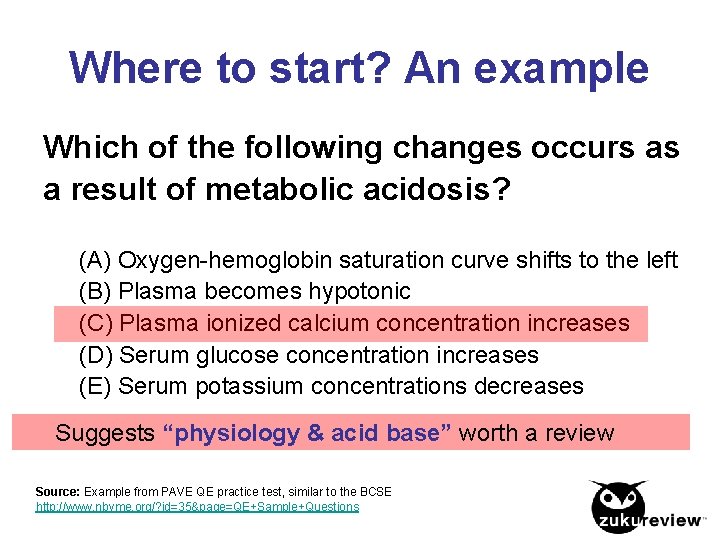
Where to start? An example Which of the following changes occurs as a result of metabolic acidosis? (A) Oxygen-hemoglobin saturation curve shifts to the left (B) Plasma becomes hypotonic (C) Plasma ionized calcium concentration increases (D) Serum glucose concentration increases (E) Serum potassium concentrations decreases Suggests “physiology & acid base” worth a review Source: Example from PAVE QE practice test, similar to the BCSE http: //www. nbvme. org/? id=35&page=QE+Sample+Questions
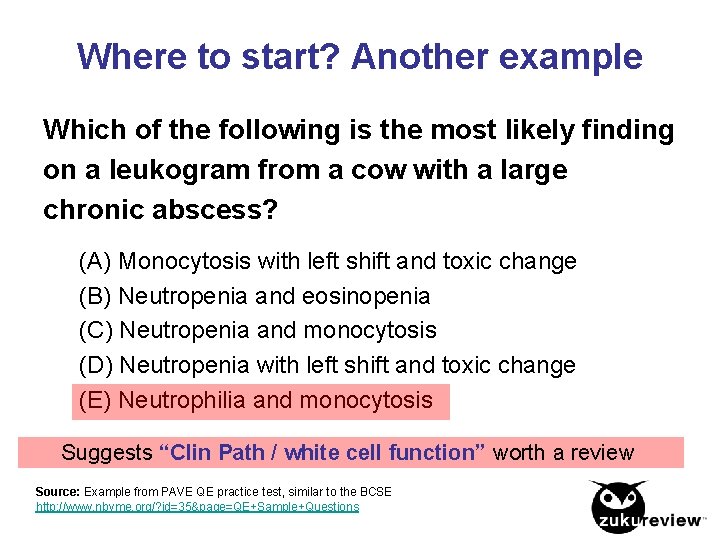
Where to start? Another example Which of the following is the most likely finding on a leukogram from a cow with a large chronic abscess? (A) Monocytosis with left shift and toxic change (B) Neutropenia and eosinopenia (C) Neutropenia and monocytosis (D) Neutropenia with left shift and toxic change (E) Neutrophilia and monocytosis Suggests “Clin Path / white cell function” worth a review Source: Example from PAVE QE practice test, similar to the BCSE http: //www. nbvme. org/? id=35&page=QE+Sample+Questions
Study Smarter TM “Successful learning is not measured by how many hours you study. Successful learning means using the hours you do have effectively. ” -Dr. Zuku (Steven I Mclaughlin DVM, MPH, DACVPM)
A study technique that doesn’t work “I spent 6 hours reading endocrinology on Saturday, …. . But Monday, I didn’t remember any of it !” “Reading = Learning”
USE IT OR LOSE IT • MOST adults forget 50% of what they just read • And 80% within 24 hours BUT !! • Anything you have studied well will come back very quickly with a review …. if you make good notes
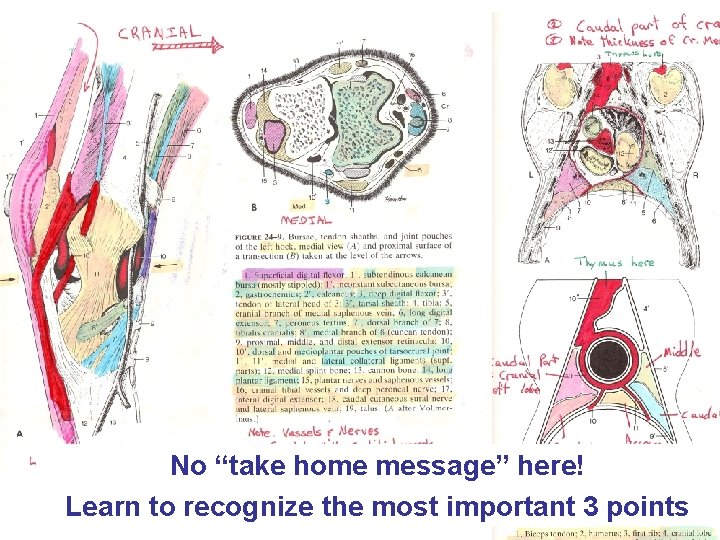
Another study technique that doesn’t work Treating every single factoid as if it were important Ref: Dyce, Sack and Wensing Textbook of Veterinary Anatomy No “take home message” here! Learn to recognize the most important 3 points
Study Smarter TM • Start with a calendar – Map out your study plan, week by week – Make test prep part of your routine • First Pass: finish 3 weeks before test – All study-mode tests – Write out summary notes • Second Pass: during the 3 weeks before test – All test-mode tests – Review summary notes
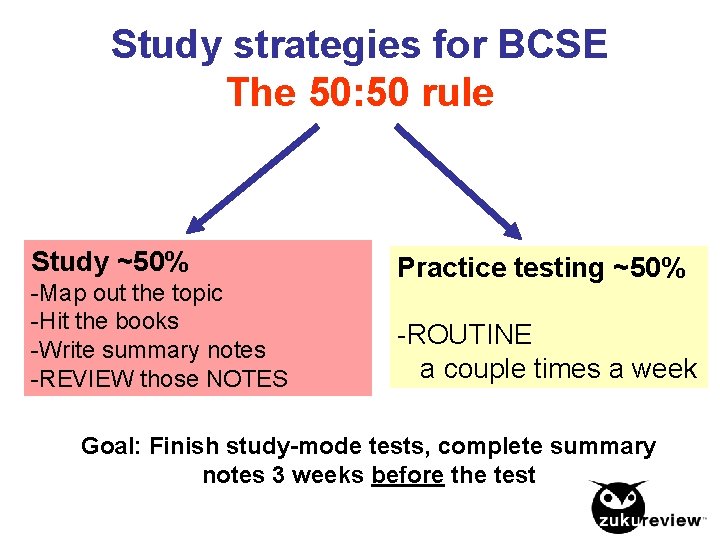
Study strategies for BCSE The 50: 50 rule Study ~50% -Map out the topic -Hit the books -Write summary notes -REVIEW those NOTES Practice testing ~50% -ROUTINE a couple times a week Goal: Finish study-mode tests, complete summary notes 3 weeks before the test
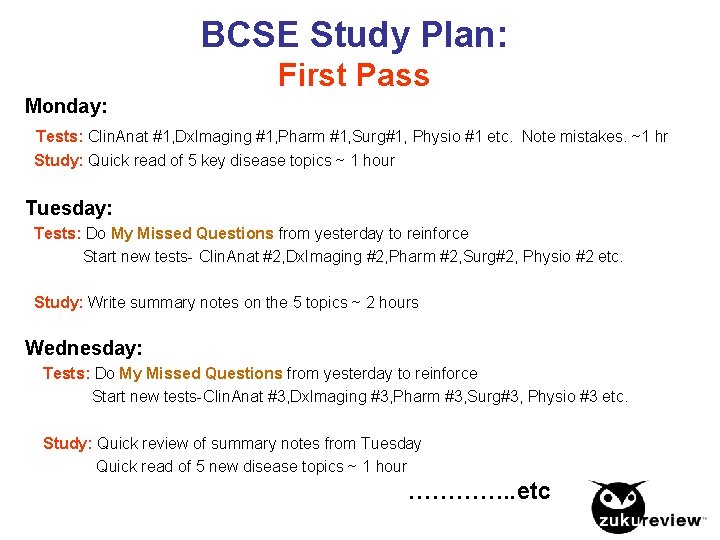
BCSE Study Plan: First Pass Monday: Tests: Clin. Anat #1, Dx. Imaging #1, Pharm #1, Surg#1, Physio #1 etc. Note mistakes. ~1 hr Study: Quick read of 5 key disease topics ~ 1 hour Tuesday: Tests: Do My Missed Questions from yesterday to reinforce Start new tests- Clin. Anat #2, Dx. Imaging #2, Pharm #2, Surg#2, Physio #2 etc. Study: Write summary notes on the 5 topics ~ 2 hours Wednesday: Tests: Do My Missed Questions from yesterday to reinforce Start new tests-Clin. Anat #3, Dx. Imaging #3, Pharm #3, Surg#3, Physio #3 etc. Study: Quick review of summary notes from Tuesday Quick read of 5 new disease topics ~ 1 hour …………. . etc
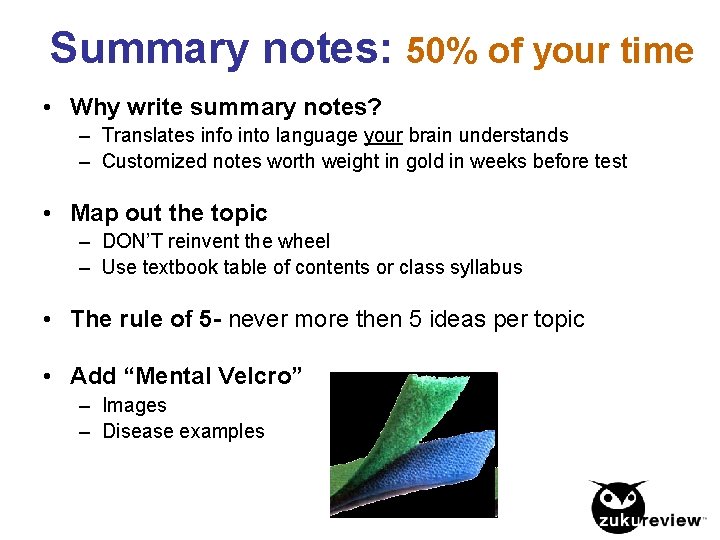
Summary notes: 50% of your time • Why write summary notes? – Translates info into language your brain understands – Customized notes worth weight in gold in weeks before test • Map out the topic – DON’T reinvent the wheel – Use textbook table of contents or class syllabus • The rule of 5 - never more then 5 ideas per topic • Add “Mental Velcro” – Images – Disease examples
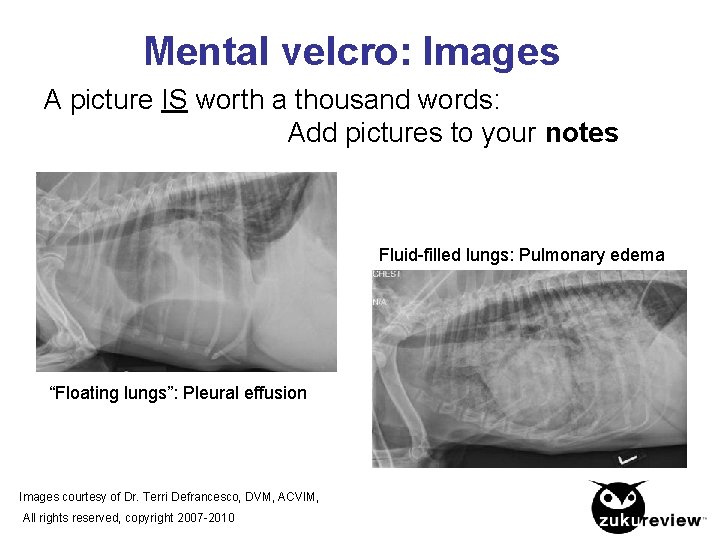
Mental velcro: Images A picture IS worth a thousand words: Add pictures to your notes Fluid-filled lungs: Pulmonary edema “Floating lungs”: Pleural effusion Images courtesy of Dr. Terri Defrancesco, DVM, ACVIM, All rights reserved, copyright 2007 -2010
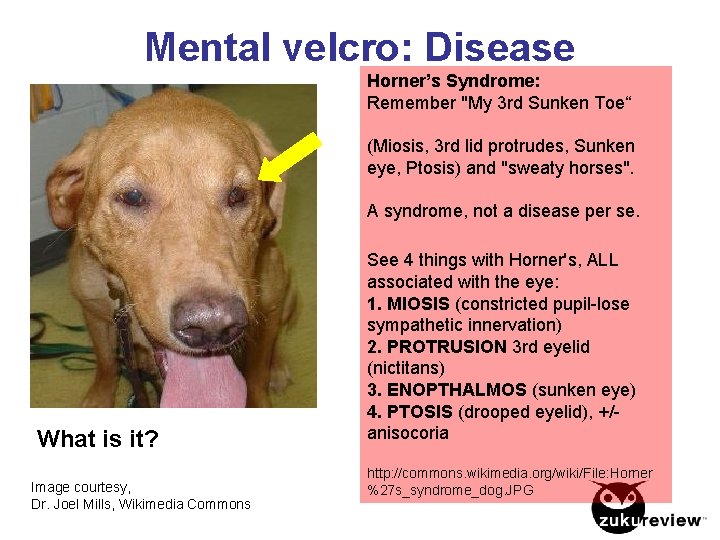
Mental velcro: Disease Horner’s Syndrome: Remember "My 3 rd Sunken Toe“ (Miosis, 3 rd lid protrudes, Sunken eye, Ptosis) and "sweaty horses". A syndrome, not a disease per se. What is it? Image courtesy, Dr. Joel Mills, Wikimedia Commons See 4 things with Horner's, ALL associated with the eye: 1. MIOSIS (constricted pupil-lose sympathetic innervation) 2. PROTRUSION 3 rd eyelid (nictitans) 3. ENOPTHALMOS (sunken eye) 4. PTOSIS (drooped eyelid), +/- anisocoria http: //commons. wikimedia. org/wiki/File: Horner %27 s_syndrome_dog. JPG
Map Out Your Topic You are on the ground in the forest of “Pharmacology”, looking at a tree called “Misc antibiotics” and a leaf called “Rifampin”. To figure out where you are (and to get where you want to go), Visualize where you are from 10, 000 feet up
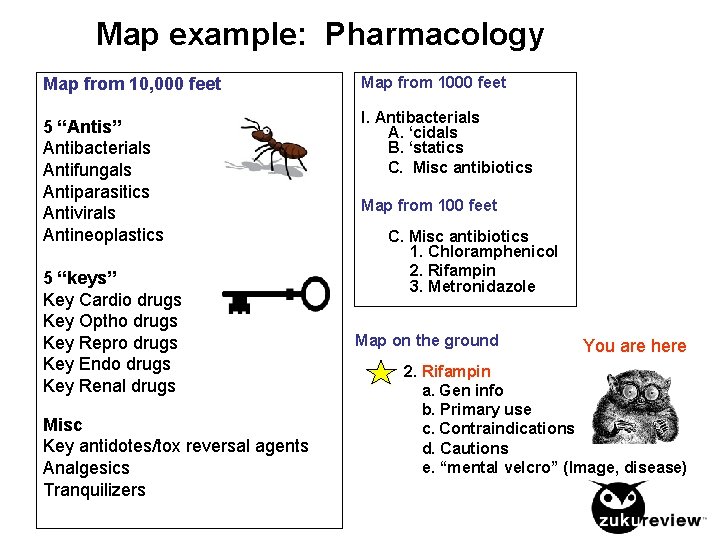
Map example: Pharmacology Map from 10, 000 feet 5 “Antis” Antibacterials Antifungals Antiparasitics Antivirals Antineoplastics 5 “keys” Key Cardio drugs Key Optho drugs Key Repro drugs Key Endo drugs Key Renal drugs Misc Key antidotes/tox reversal agents Analgesics Tranquilizers Map from 1000 feet I. Antibacterials A. ‘cidals B. ‘statics C. Misc antibiotics Map from 100 feet C. Misc antibiotics 1. Chloramphenicol 2. Rifampin 3. Metronidazole Map on the ground You are here 2. Rifampin a. Gen info b. Primary use c. Contraindications d. Cautions e. “mental velcro” (Image, disease)
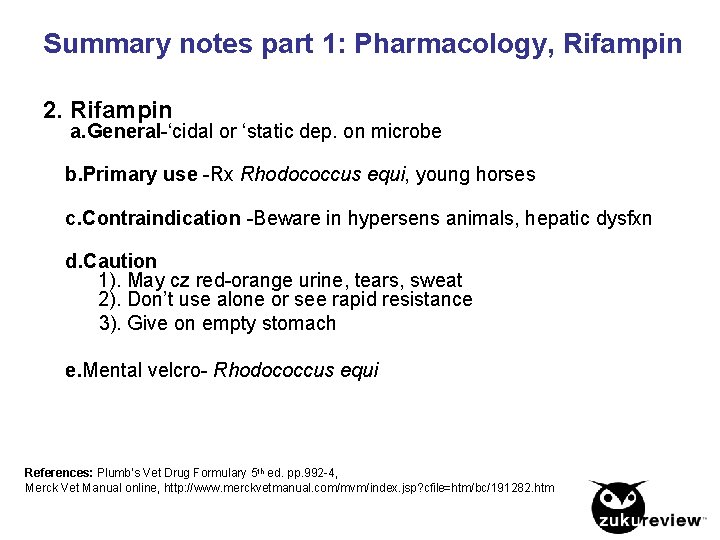
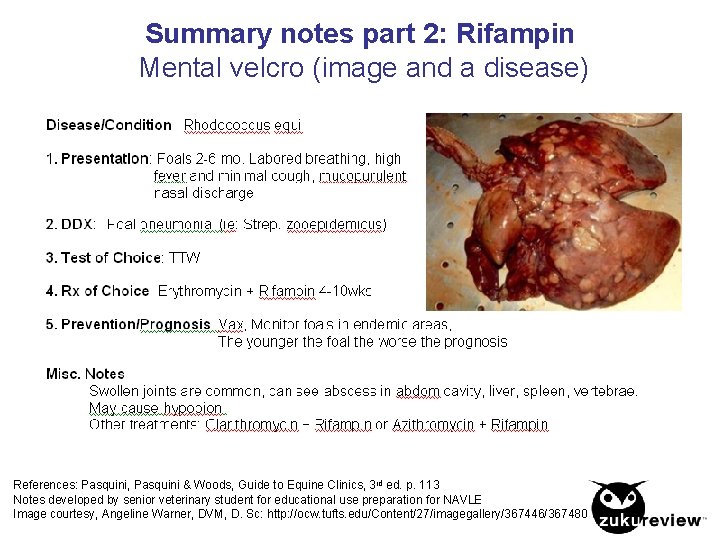
Summary notes part 1: Pharmacology, Rifampin 2. Rifampin a. General-‘cidal or ‘static dep. on microbe b. Primary use -Rx Rhodococcus equi, young horses c. Contraindication -Beware in hypersens animals, hepatic dysfxn d. Caution 1). May cz red-orange urine, tears, sweat 2). Don’t use alone or see rapid resistance 3). Give on empty stomach e. Mental velcro- Rhodococcus equi References: Plumb’s Vet Drug Formulary 5 th ed. pp. 992 -4, Merck Vet Manual online, http: //www. merckvetmanual. com/mvm/index. jsp? cfile=htm/bc/191282. htm
Summary notes part 2: Rifampin Mental velcro (image and a disease) References: Pasquini, Pasquini & Woods, Guide to Equine Clinics, 3 rd ed. p. 113 Notes developed by senior veterinary student for educational use preparation for NAVLE Image courtesy, Angeline Warner, DVM, D. Sc: http: //ocw. tufts. edu/Content/27/imagegallery/367446/367480
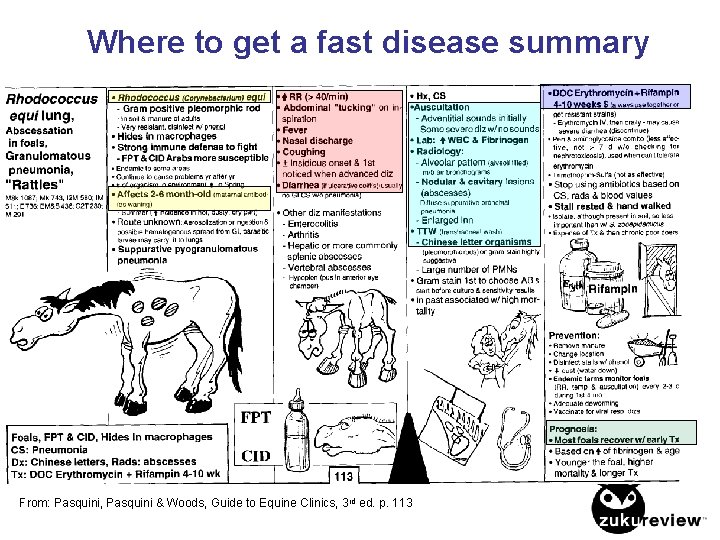
Where to get a fast disease summary From: Pasquini, Pasquini & Woods, Guide to Equine Clinics, 3 rd ed. p. 113
Outside a dog, a book is a man’s best friend. Inside a dog, it’s too dark to read. - Groucho Marx If you believe everything you read, better not read. - Japanese proverb
Practice testing for BCSE: 50% of your time “You don't get ready for a marathon by reading a book about it. You put on your running shoes and run. ” -Dr. Zuku
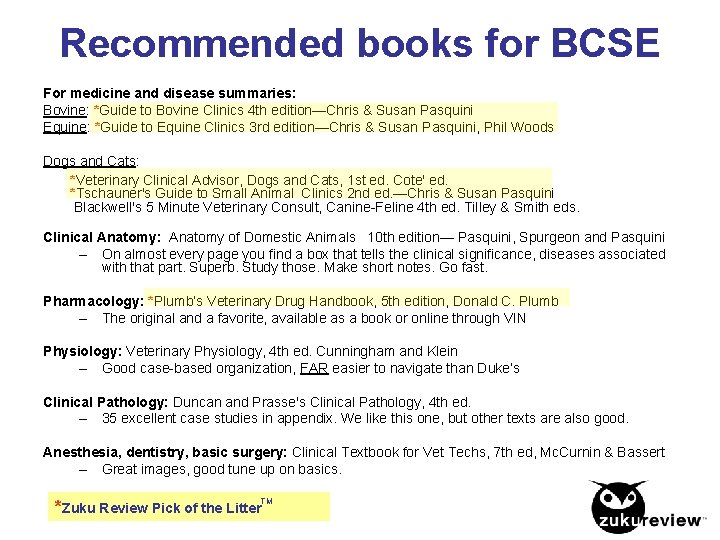
Recommended books for BCSE For medicine and disease summaries: Bovine: *Guide to Bovine Clinics 4 th edition—Chris & Susan Pasquini Equine: *Guide to Equine Clinics 3 rd edition—Chris & Susan Pasquini, Phil Woods Dogs and Cats: *Veterinary Clinical Advisor, Dogs and Cats, 1 st ed. Cote' ed. *Tschauner's Guide to Small Animal Clinics 2 nd ed. —Chris & Susan Pasquini Blackwell's 5 Minute Veterinary Consult, Canine-Feline 4 th ed. Tilley & Smith eds. Clinical Anatomy: Anatomy of Domestic Animals 10 th edition— Pasquini, Spurgeon and Pasquini – On almost every page you find a box that tells the clinical significance, diseases associated with that part. Superb. Study those. Make short notes. Go fast. Pharmacology: *Plumb’s Veterinary Drug Handbook, 5 th edition, Donald C. Plumb – The original and a favorite, available as a book or online through VIN Physiology: Veterinary Physiology, 4 th ed. Cunningham and Klein – Good case-based organization, FAR easier to navigate than Duke’s Clinical Pathology: Duncan and Prasse's Clinical Pathology, 4 th ed. – 35 excellent case studies in appendix. We like this one, but other texts are also good. Anesthesia, dentistry, basic surgery: Clinical Textbook for Vet Techs, 7 th ed, Mc. Curnin & Bassert – Great images, good tune up on basics. *Zuku Review Pick of the Litter TM
Multiple choice tricks of the trade • The Good News Correct answer is GUARANTEED to be among the choices • The Bad News You WILL hit questions you don’t know Common mistake: Spending MOST of your time on questions about which you know the LEAST. • Key to success: Train yourself to MAKE CHOICES and then MOVE ON.
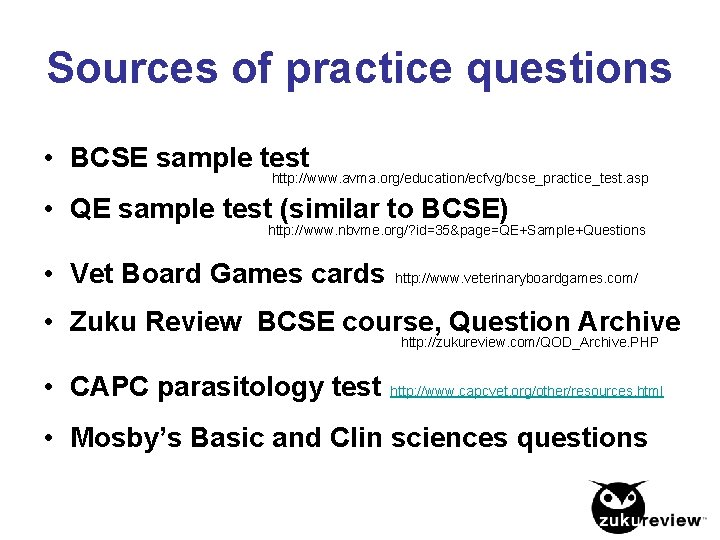
Sources of practice questions • BCSE sample test http: //www. avma. org/education/ecfvg/bcse_practice_test. asp • QE sample test (similar to BCSE) http: //www. nbvme. org/? id=35&page=QE+Sample+Questions • Vet Board Games cards http: //www. veterinaryboardgames. com/ • Zuku Review BCSE course, Question Archive http: //zukureview. com/QOD_Archive. PHP • CAPC parasitology test http: //www. capcvet. org/other/resources. html • Mosby’s Basic and Clin sciences questions
Multiple choice tricks of the trade • READ the question first (DON’T look at answers) • PREDICT the answer (protects you from distractors) • Is your answer the best of the choices ? If “Yes” SELECT it and move on • Unsure of the correct answer ? ELIMINATE wrong ones, choose from what’s left, and MOVE ON
“What if I don’t think this system will work for me ? ” Do what works for you. “How do I know when I should I change an answer ? ” Stick with your first answer unless you recognize that it is clearly not correct - studies show that changed answers are more frequently wrong. “I am clueless about chickens/cardiology/box turtle halitosis, what do I do? ” Read, Predict, Eliminate, Select -The correct answer is guaranteed to be among the choices. Whittle the choices down to as few as possible and guess.
The 24 -hour “golden period” of short golden period -term memory • A mistake is the best teacher – Mistakes sting – Sting helps you remember, …. . . IF you redo missed question within 24 hrs • After 24 hours, most new info fades from memory • Note questions you miss today on scratch paper • Redo “Missed Questions” tomorrow – Reinforces weak areas fast
Pop Quiz What is a Cook's speculum? A) Three-pronged ear speculum B) Four-pronged rectal speculum C) Three-pronged nasal speculum D) Three-pronged rectal speculum
Multiple choice tricks of the trade: Convergence What is a Cook's speculum? A) Three-pronged ear speculum B) Four-pronged rectal speculum C) Three-pronged nasal speculum D) Three-pronged rectal speculum This is an example of convergence. Options A, C and D all contain the words "three-pronged“ Options B and D both contain the word "rectal. " These two sets converge at option D Adapted from: Leo M. Harvill, Ph. D. “The Test Of Obscure Medical Information”
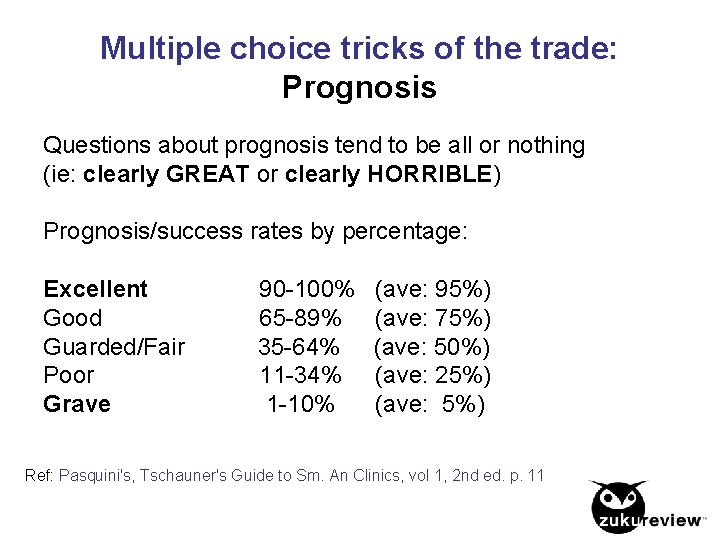
Multiple choice tricks of the trade: Prognosis Questions about prognosis tend to be all or nothing (ie: clearly GREAT or clearly HORRIBLE) Prognosis/success rates by percentage: Excellent 90 -100% (ave: 95%) Good 65 -89% (ave: 75%) Guarded/Fair 35 -64% (ave: 50%) Poor 11 -34% (ave: 25%) Grave 1 -10% (ave: 5%) Ref: Pasquini's, Tschauner's Guide to Sm. An Clinics, vol 1, 2 nd ed. p. 11
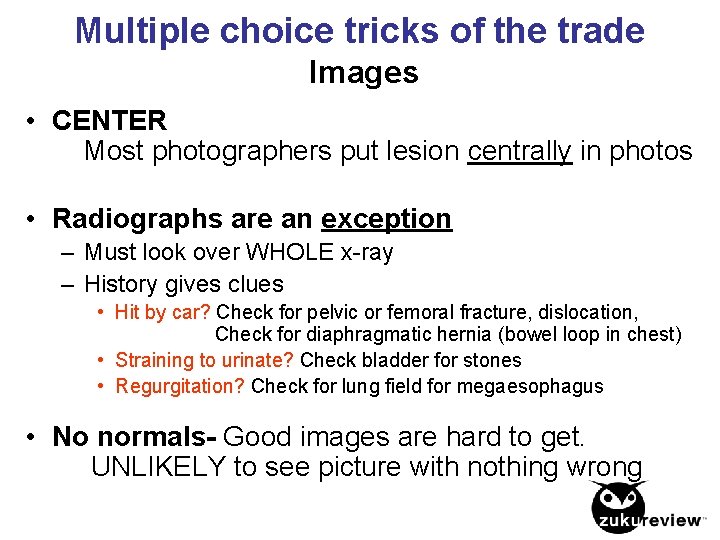
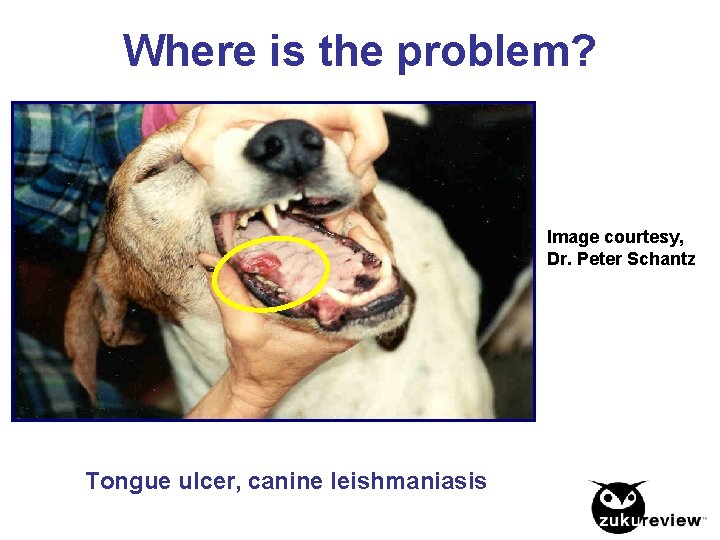
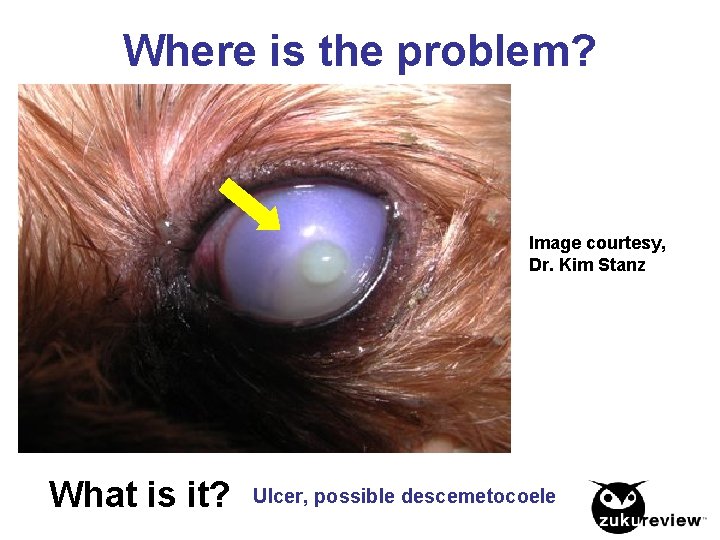
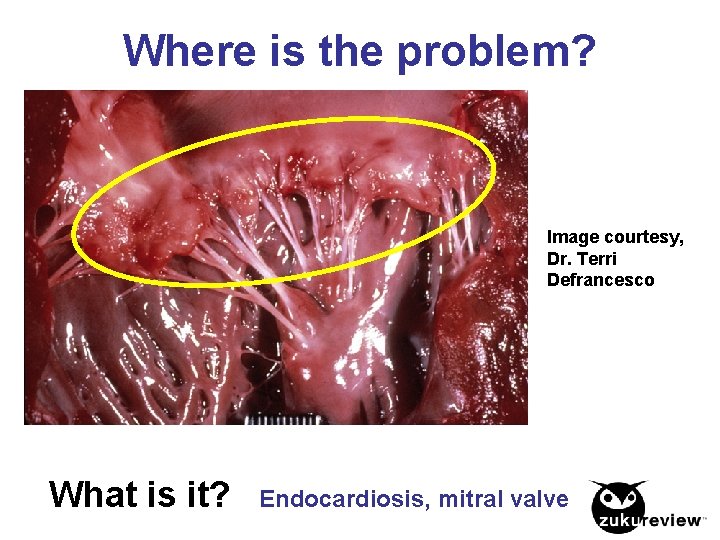
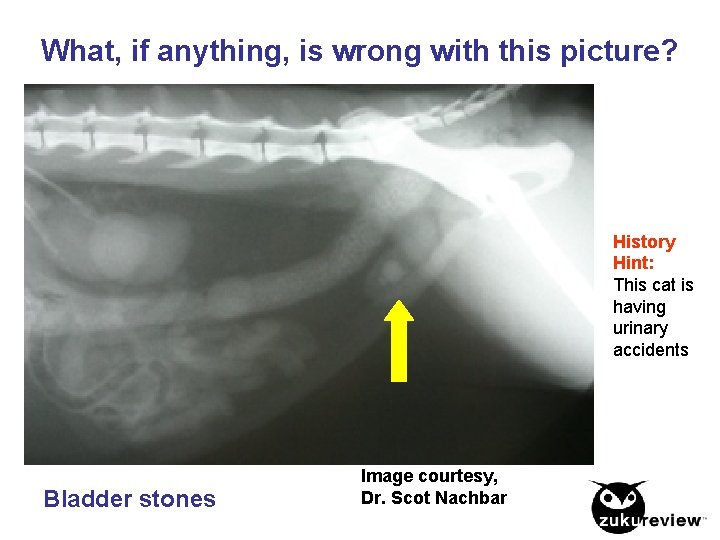
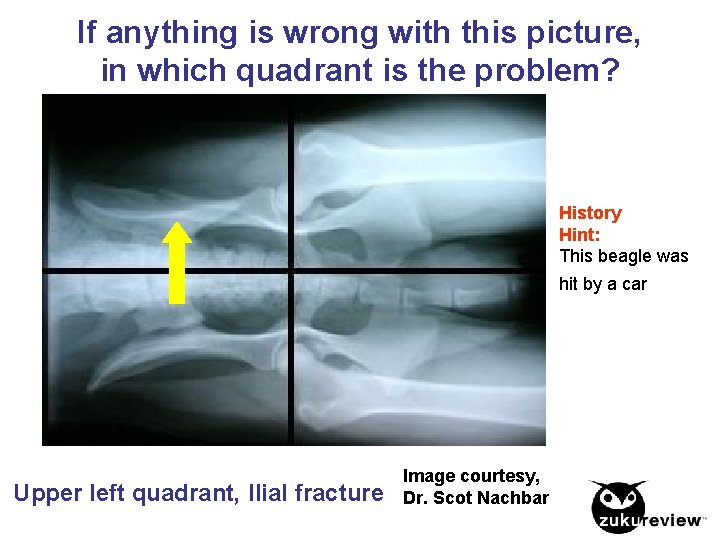
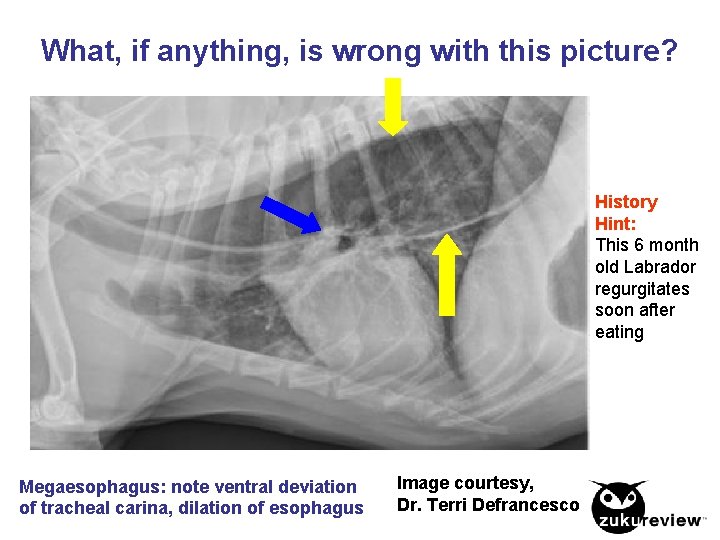
Multiple choice tricks of the trade Images • CENTER Most photographers put lesion centrally in photos • Radiographs are an exception – Must look over WHOLE x-ray – History gives clues • Hit by car? Check for pelvic or femoral fracture, dislocation, Check for diaphragmatic hernia (bowel loop in chest) • Straining to urinate? Check bladder for stones • Regurgitation? Check for lung field for megaesophagus • No normals- Good images are hard to get. UNLIKELY to see picture with nothing wrong
If there is a problem in this picture, where is it ? (click link) http: //www. merckvetmanual. com/mvm/htm/bc/z-exlha 29. htm Intussusception, Hamster, center of image Click this version for explanatory text: http: //www. merckvetmanual. com/mvm/htm/bc/z-exlha 29. htm Reference: The Merck Veterinary Manual online edition http: //www. merckvetmanual. com/mvm/index. jsp
Where is the problem? Image courtesy, Dr. Peter Schantz Tongue ulcer, canine leishmaniasis
Where is the problem? Image courtesy, Dr. Kim Stanz What is it? Ulcer, possible descemetocoele
Where is the problem? Image courtesy, Dr. Terri Defrancesco What is it? Endocardiosis, mitral valve
What, if anything, is wrong with this picture? History Hint: This cat is having urinary accidents Bladder stones Image courtesy, Dr. Scot Nachbar
If anything is wrong with this picture, in which quadrant is the problem? History Hint: This beagle was hit by a car Upper left quadrant, Ilial fracture Image courtesy, Dr. Scot Nachbar
What, if anything, is wrong with this picture? History Hint: This 6 month old Labrador regurgitates soon after eating Megaesophagus: note ventral deviation of tracheal carina, dilation of esophagus Image courtesy, Dr. Terri Defrancesco
Online Case Study & Image Resources Surgery case studies http: //www. acvs. org/Animal. Owners/Health. Conditions/ Radiology case studies http: //www. vet. k-state. edu/depts/VMTH/radiology/cow/index. htm Radiology artifacts http: //vet. osu. edu/index. php? id=2355 Clin Path Case studies http: //www. medvet. umontreal. ca/clinpath/choice. htm Clin Path images http: //www. medvet. umontreal. ca/clinpath/banq-im/menu. E. htm Tech hint: Right-click your mouse over an internet image, to copy and paste it elsewhere Pathology/Histopathology images http: //w 3. vet. cornell. edu/nst. asp Vet video library: www. vetvideos. com Merck images online http: //www. merckvetmanual. com/mvm/index. jsp? cfile=htm/bc/mvm_list_img. htm
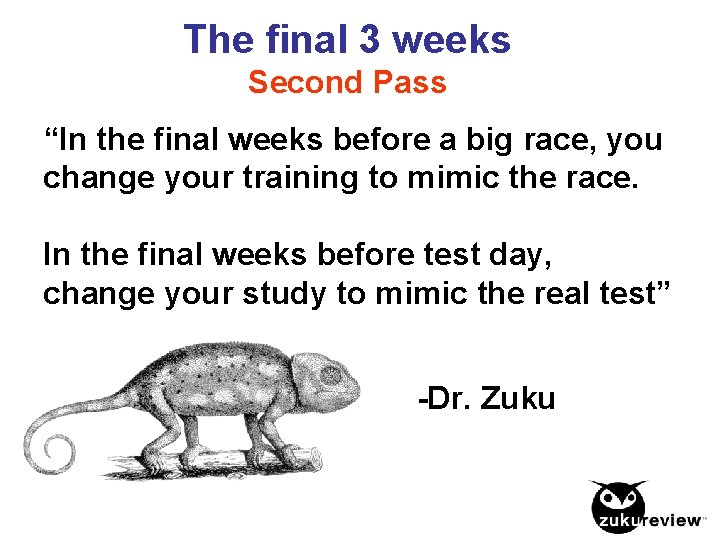
The final 3 weeks Second Pass “In the final weeks before a big race, you change your training to mimic the race. In the final weeks before test day, change your study to mimic the real test” -Dr. Zuku
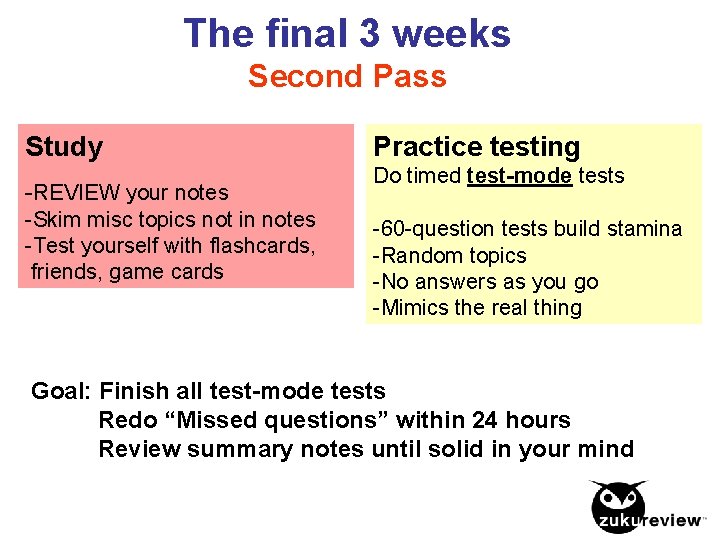
The final 3 weeks Second Pass Study -REVIEW your notes -Skim misc topics not in notes -Test yourself with flashcards, friends, game cards Practice testing Do timed test-mode tests -60 -question tests build stamina -Random topics -No answers as you go -Mimics the real thing Goal: Finish all test-mode tests Redo “Missed questions” within 24 hours Review summary notes until solid in your mind
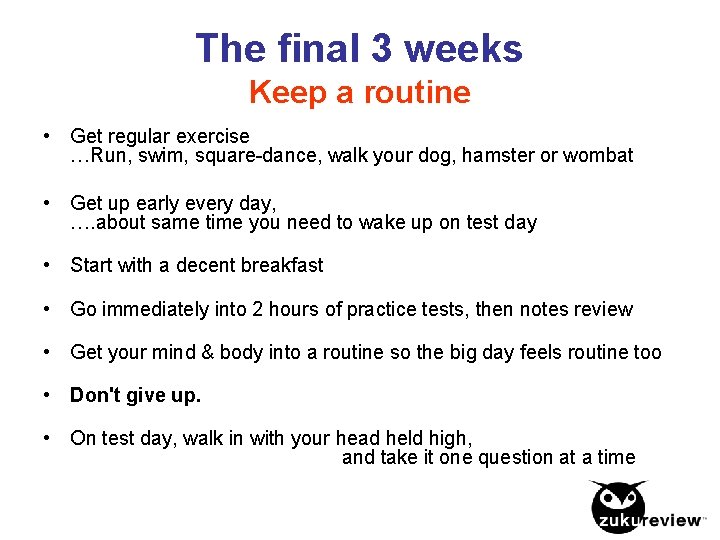
The final 3 weeks Keep a routine • Get regular exercise …Run, swim, square-dance, walk your dog, hamster or wombat • Get up early every day, …. about same time you need to wake up on test day • Start with a decent breakfast • Go immediately into 2 hours of practice tests, then notes review • Get your mind & body into a routine so the big day feels routine too • Don't give up. • On test day, walk in with your head held high, and take it one question at a time
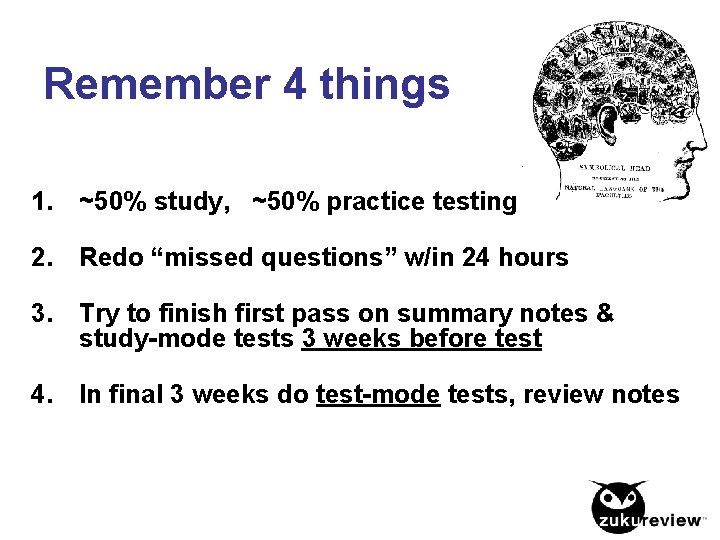
Remember 4 things 1. ~50% study, ~50% practice testing 2. Redo “missed questions” w/in 24 hours 3. Try to finish first pass on summary notes & study-mode tests 3 weeks before test 4. In final 3 weeks do test-mode tests, review notes
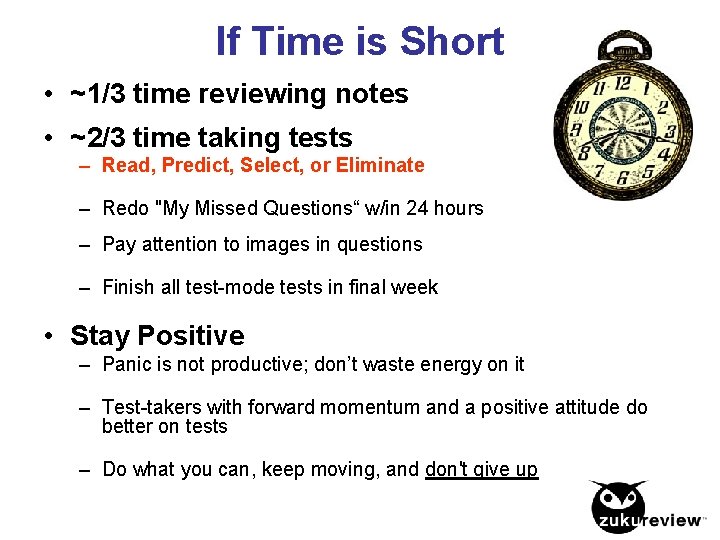
If Time is Short • ~1/3 time reviewing notes • ~2/3 time taking tests – Read, Predict, Select, or Eliminate – Redo "My Missed Questions“ w/in 24 hours – Pay attention to images in questions – Finish all test-mode tests in final week • Stay Positive – Panic is not productive; don’t waste energy on it – Test-takers with forward momentum and a positive attitude do better on tests – Do what you can, keep moving, and don't give up
Good luck! “No student knows his subject: the most he knows is where and how to find out the things he does not know. ” –Woodrow Wilson
References The summary of multiple choice strategies comes principally from: “What Smart Students Know” by Adam Robinson, co-founder of The Princeton Review test preparation company George Washington University Academic Success Center- “Strategies for Multiple Choice Questions” Kaplan Test Prep US Medical Licensure Exam (USMLE) Strategy Sessions Convergence concept Adapted from: “The Test Of Obscure Medical Information” Leo M. Harvill, Ph. D. ECFVG Candidate Bulletin http: //www. avma. org/education/ecfvg/bcse_bulletin. asp BCSE practice test http: //www. avma. org/education/ecfvg/bcse_practice_test. asp QE practice tests Text version: http: //www. nbvme. org/? id=35&page=QE+Sample+Questions Web version: http: //nbvmepractice. starttest. com/
Extra slides
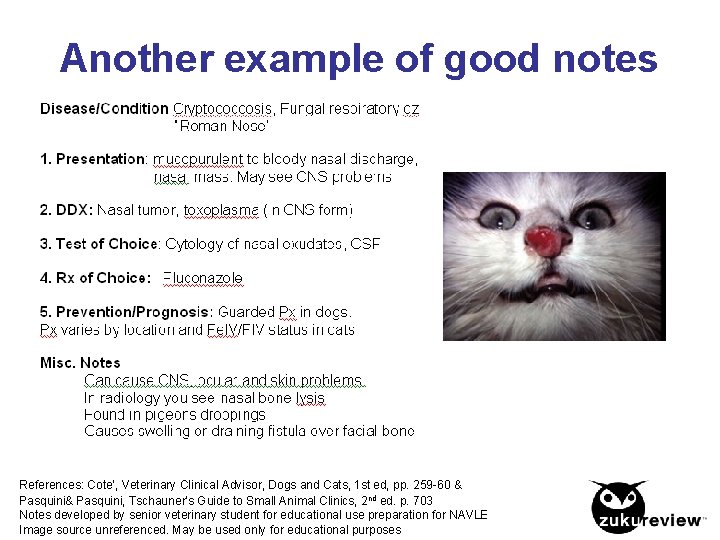
Another example of good notes References: Cote’, Veterinary Clinical Advisor, Dogs and Cats, 1 st ed, pp. 259 -60 & Pasquini, Tschauner’s Guide to Small Animal Clinics, 2 nd ed. p. 703 Notes developed by senior veterinary student for educational use preparation for NAVLE Image source unreferenced. May be used only for educational purposes
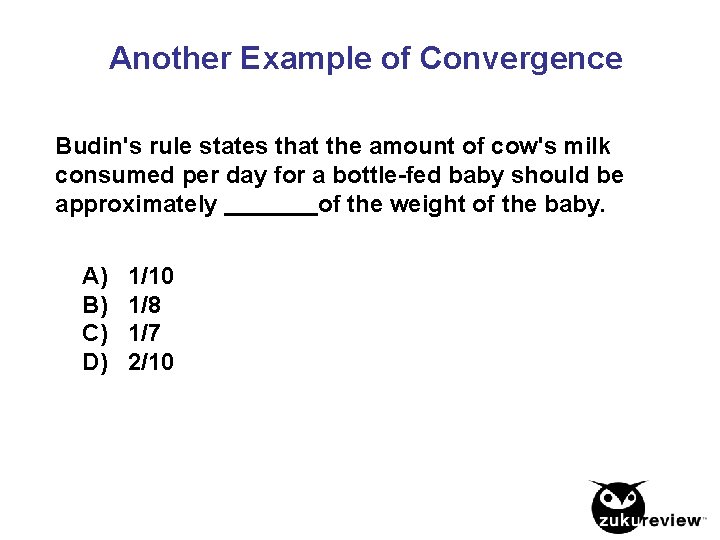
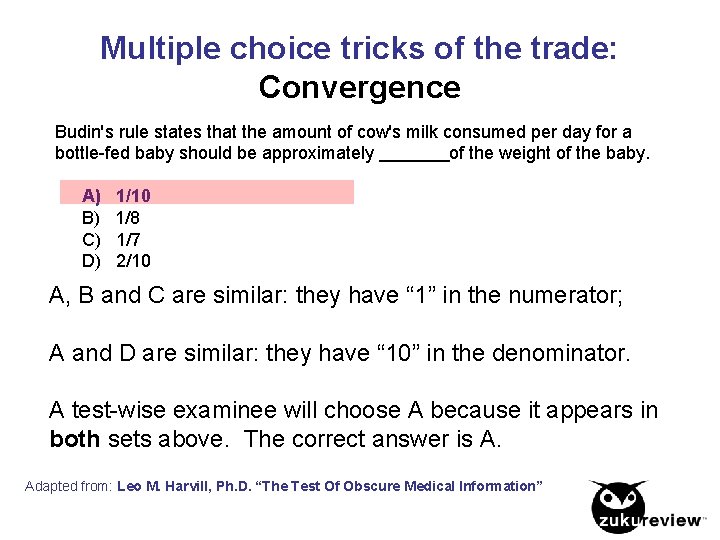
Another Example of Convergence Budin's rule states that the amount of cow's milk consumed per day for a bottle-fed baby should be approximately of the weight of the baby. A) 1/10 B) 1/8 C) 1/7 D) 2/10
Multiple choice tricks of the trade: Convergence Budin's rule states that the amount of cow's milk consumed per day for a bottle-fed baby should be approximately of the weight of the baby. A) 1/10 B) 1/8 C) 1/7 D) 2/10 A, B and C are similar: they have “ 1” in the numerator; A and D are similar: they have “ 10” in the denominator. A test-wise examinee will choose A because it appears in both sets above. The correct answer is A. Adapted from: Leo M. Harvill, Ph. D. “The Test Of Obscure Medical Information”