Cryptography An Introduction Shon Harris CISSP 5 th
- Slides: 41
Cryptography An Introduction Shon Harris CISSP, 5 th Edition
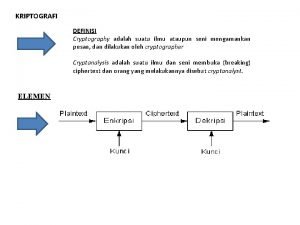
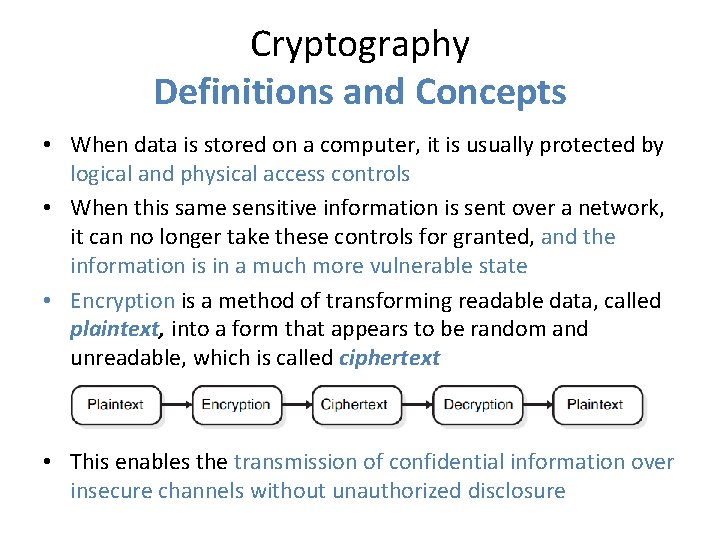
Cryptography Definitions and Concepts • When data is stored on a computer, it is usually protected by logical and physical access controls • When this same sensitive information is sent over a network, it can no longer take these controls for granted, and the information is in a much more vulnerable state • Encryption is a method of transforming readable data, called plaintext, into a form that appears to be random and unreadable, which is called ciphertext • This enables the transmission of confidential information over insecure channels without unauthorized disclosure
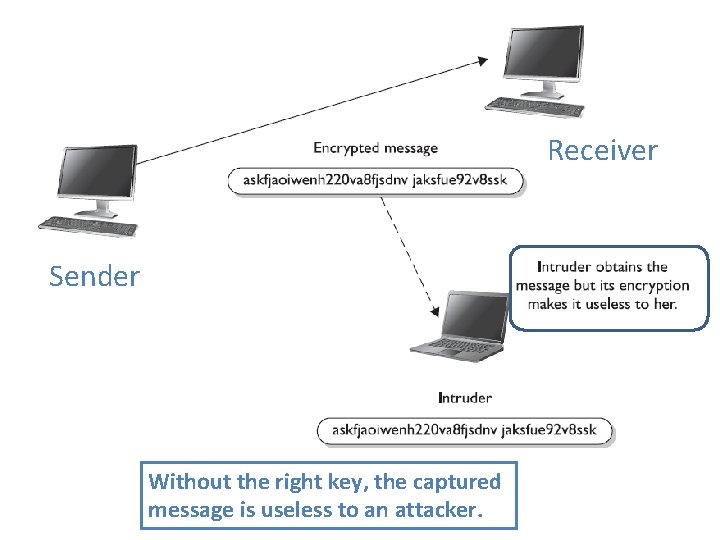
Receiver Sender Without the right key, the captured message is useless to an attacker.
Cryptosystem • A system or product that provides encryption and decryption is referred to as a cryptosystem and can be created through hardware components or program code in an application • The cryptosystem uses an encryption algorithm • Most algorithms are complex mathematical formulas that are applied in a specific sequence to the plaintext • A cryptosystem encompasses all of the necessary components for encryption and decryption to take place. Pretty Good Privacy (PGP) is just one example of a cryptosystem. • A cryptosystem is made up of at least the following: – – Software Protocols Algorithms Keys
key • Most encryption methods use a secret value called a key (usually a long string of bits), which works with the algorithm to encrypt and decrypt the text • The algorithm, the set of rules also known as the cipher, dictates how enciphering and deciphering takes place • Many of the mathematical algorithms used in computer systems today are publicly known and are not the secret part of the encryption process • If the internal mechanisms of the algorithm are not a secret, then something must be • The secret piece of using a well-known encryption algorithm is the key
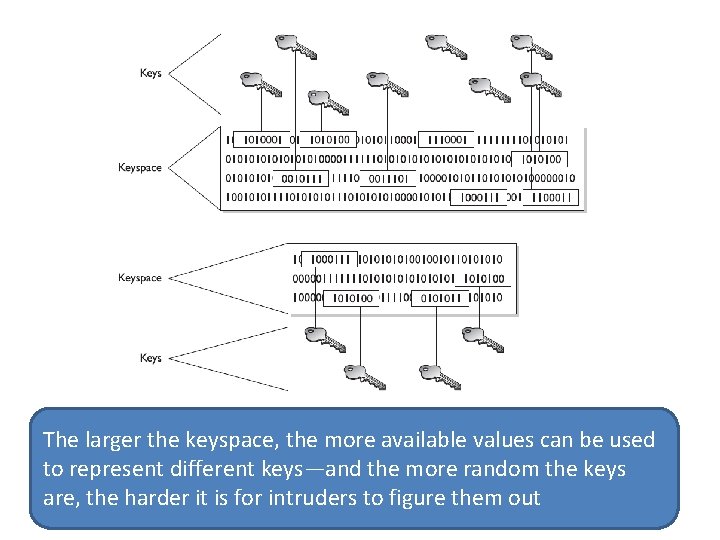
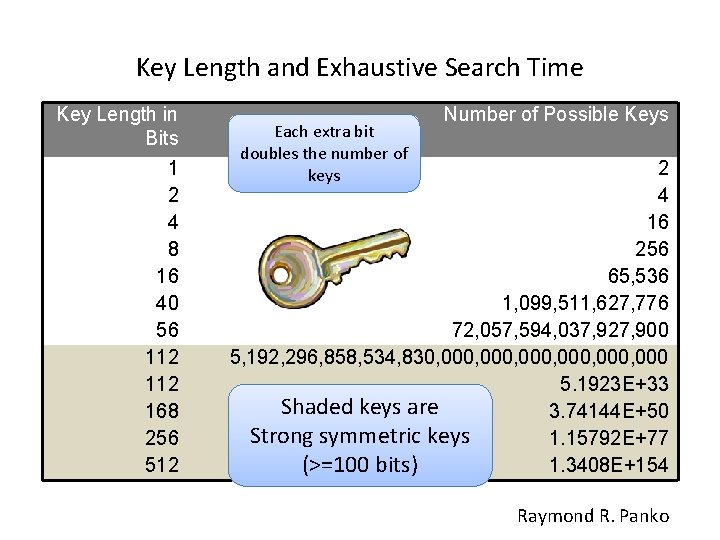
Cryptography Definitions and Concepts • In encryption, the key (cryptovariable) is a value that comprises a large sequence of random bits • An algorithm contains a keyspace, which is a range of values that can be used to construct a key • When the algorithm needs to generate a new key, it uses random values from this keyspace • A large keyspace allows for more possible keys. • Today, we are commonly using key sizes of 128, 256, 512, or even 1, 024 bits and larger. So a key size of 512 bits would provide a 2512 possible combinations (the keyspace) • The encryption algorithm should use the entire keyspace and choose the values to make up the keys as randomly as possible.
The larger the keyspace, the more available values can be used to represent different keys—and the more random the keys are, the harder it is for intruders to figure them out
Key Length and Exhaustive Search Time Key Length in Bits 1 2 4 8 16 40 56 112 168 256 512 Each extra bit doubles the number of keys Number of Possible Keys 2 4 16 256 65, 536 1, 099, 511, 627, 776 72, 057, 594, 037, 927, 900 5, 192, 296, 858, 534, 830, 000, 000 5. 1923 E+33 Shaded keys are 3. 74144 E+50 Strong symmetric keys 1. 15792 E+77 (>=100 bits) 1. 3408 E+154 Raymond R. Panko
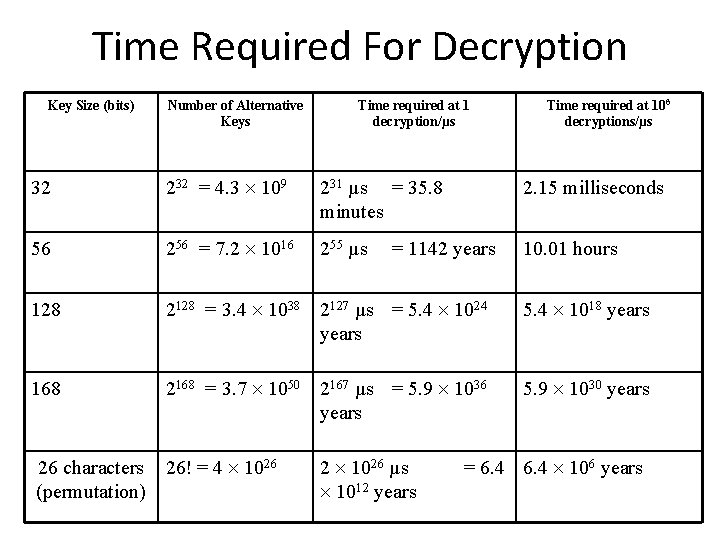
Time Required For Decryption Key Size (bits) Number of Alternative Keys Time required at 1 decryption/µs Time required at 106 decryptions/µs 32 232 = 4. 3 109 231 µs = 35. 8 minutes 2. 15 milliseconds 56 256 = 7. 2 1016 255 µs 10. 01 hours 128 2128 = 3. 4 1038 2127 µs = 5. 4 1024 years 5. 4 1018 years 168 2168 = 3. 7 1050 2167 µs = 5. 9 1036 years 5. 9 1030 years 26 characters 26! = 4 1026 (permutation) = 1142 years 2 1026 µs 1012 years = 6. 4 106 years
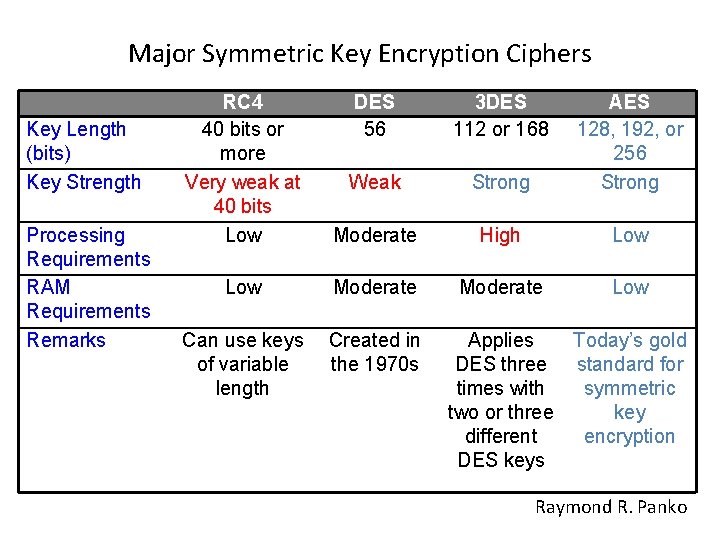
Major Symmetric Key Encryption Ciphers Key Length (bits) Key Strength Processing Requirements RAM Requirements Remarks RC 4 40 bits or more Very weak at 40 bits Low DES 56 3 DES 112 or 168 Weak Strong AES 128, 192, or 256 Strong Moderate High Low Moderate Low Can use keys of variable length Created in the 1970 s Applies Today’s gold DES three standard for times with symmetric two or three key different encryption DES keys Raymond R. Panko
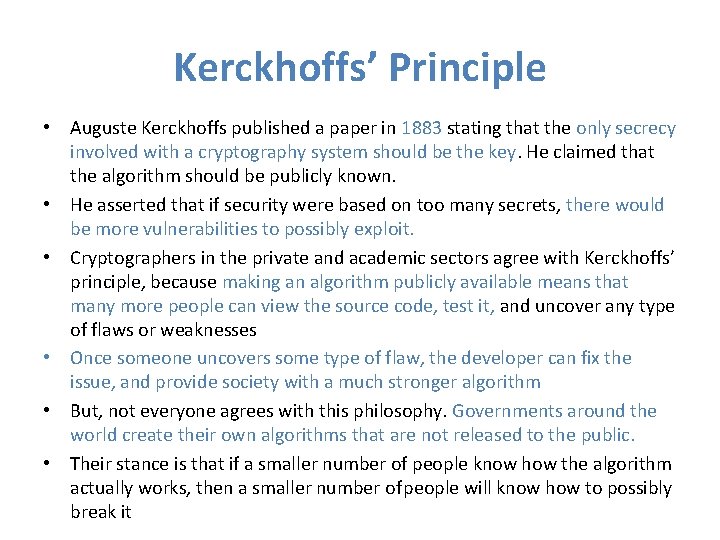
Kerckhoffs’ Principle • Auguste Kerckhoffs published a paper in 1883 stating that the only secrecy involved with a cryptography system should be the key. He claimed that the algorithm should be publicly known. • He asserted that if security were based on too many secrets, there would be more vulnerabilities to possibly exploit. • Cryptographers in the private and academic sectors agree with Kerckhoffs’ principle, because making an algorithm publicly available means that many more people can view the source code, test it, and uncover any type of flaws or weaknesses • Once someone uncovers some type of flaw, the developer can fix the issue, and provide society with a much stronger algorithm • But, not everyone agrees with this philosophy. Governments around the world create their own algorithms that are not released to the public. • Their stance is that if a smaller number of people know how the algorithm actually works, then a smaller number ofpeople will know how to possibly break it
The Strength of the Cryptosystem • The strength of an encryption method comes from the algorithm, the secrecy of the key, the length of the key, the initialization vectors, and how they all work together within the cryptosystem. • When strength is discussed in encryption, it refers to how hard it is to figure out the algorithm or key, whichever is not made public. • The strength of an encryption method correlates to the amount of necessary processing power, resources, and time required to break the cryptosystem or to figure out the value of the key. • Breaking a cryptosystem can be accomplished by a brute force attack, which means trying every possible key value until the resulting plaintext is meaningful • Depending on the algorithm and length of the key, this can be an easy task or one that is close to impossible
Services of Cryptosystems • Confidentiality Renders the information unintelligible except by authorized entities • Integrity Data has not been altered in an unauthorized manner since it was created, transmitted, or stored • Authentication Verifies the identity of the user or system that created information • Authorization Upon proving identity, the individual is then provided with the key or password that will allow access to some resource • Nonrepudiation Ensures that the sender cannot deny sending the message.
Cryptography Definitions (Review) • Algorithm Set of mathematical rules used in encryption and decryption • Cipher Another name for algorithm • Cryptography Science of secret writing that enables you to store and transmit data in a form that is available only to the intended individuals • Cryptosystem Hardware or software implementation of cryptography that transforms a message to ciphertext and back to plaintext • Cryptanalysis Practice of breaking cryptic systems • Cryptology The study of both cryptography and cryptanalysis
Cryptography Definitions (Review)… • Data origin authentication Proving the source of a message (system based authentication) • Encipher Act of transforming data into an unreadable format • Entity authentication Proving the identity of the entity that sent a message • Decipher Act of transforming data into a readable format • Key Secret sequence of bits and instructions that governs the act of encryption and decryption • Keyspace A range of possible values used to construct keys • Plaintext Data in readable format, also referred to as cleartext • Receipt Acknowledgment that a message has been received • Work factor Estimated time, effort, and resources necessary to break a cryptosystem
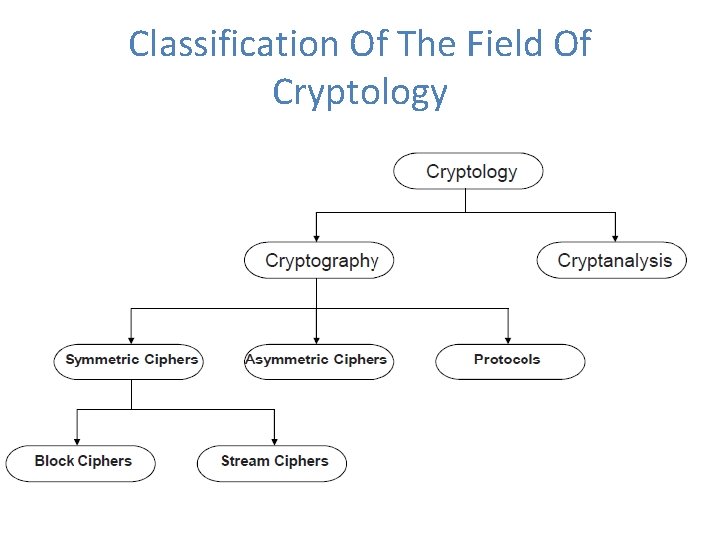
Classification Of The Field Of Cryptology
3. 3 One-time Pad • A one-time pad is a perfect encryption scheme because it is considered unbreakable if implemented properly • It was invented by Gilbert Vernam in 1917, so sometimes it is referred to as the Vernam cipher • This cipher does not use shift alphabets, as do the Caesar ciphers discussed earlier, but instead uses a pad made up of random values
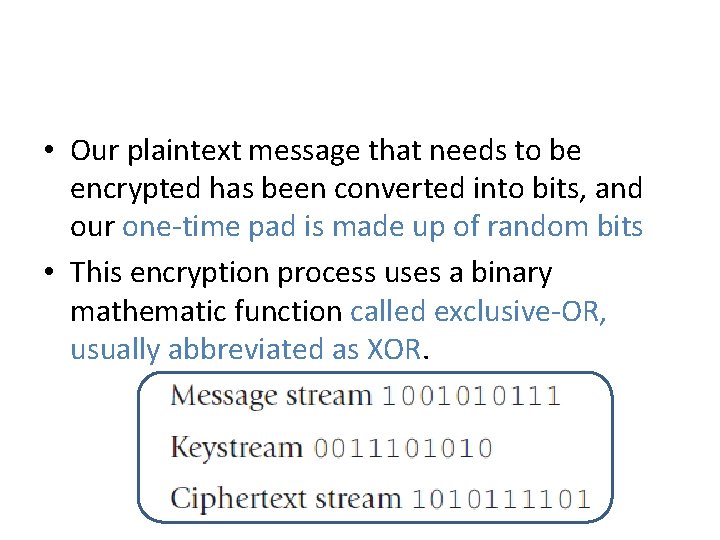
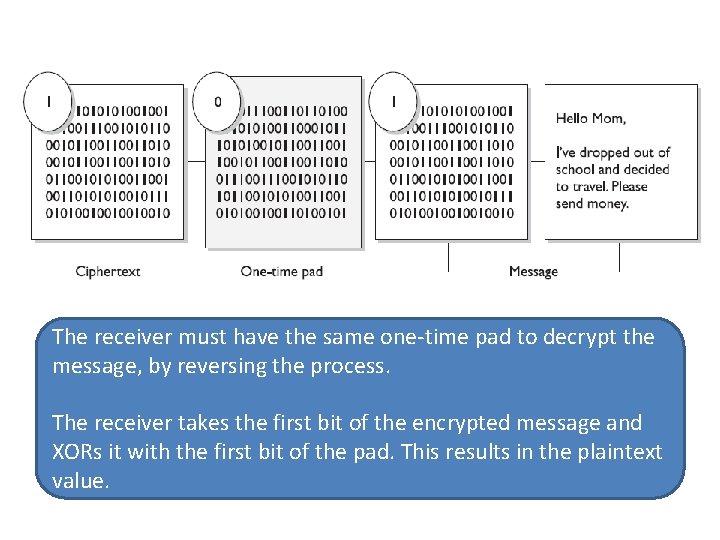
• Our plaintext message that needs to be encrypted has been converted into bits, and our one-time pad is made up of random bits • This encryption process uses a binary mathematic function called exclusive-OR, usually abbreviated as XOR.
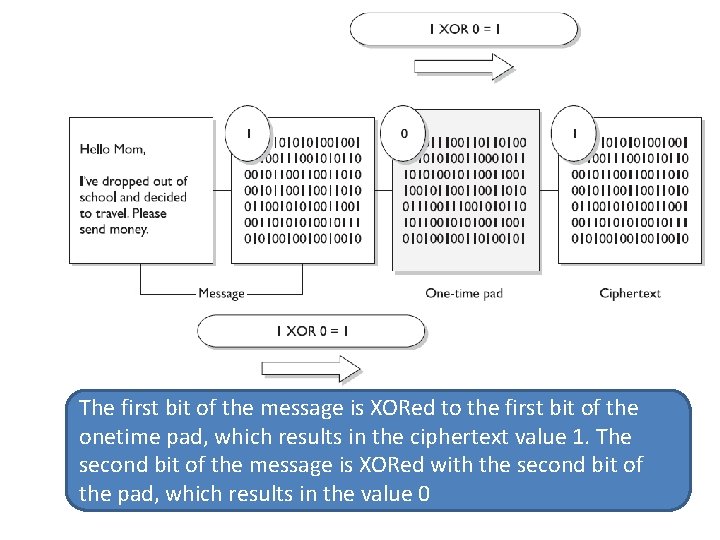
The first bit of the message is XORed to the first bit of the onetime pad, which results in the ciphertext value 1. The second bit of the message is XORed with the second bit of the pad, which results in the value 0
The receiver must have the same one-time pad to decrypt the message, by reversing the process. The receiver takes the first bit of the encrypted message and XORs it with the first bit of the pad. This results in the plaintext value.
One-Time Pad Requirements • • • For a one-time pad encryption scheme to be considered unbreakable, each pad in the scheme must be: Made up of truly random values Used only one time Securely distributed to its destination Secured at sender’s and receiver’s sites At least as long as the message
A number generator is used to create a stream of random values and must be seeded by an initial value. This piece of software obtains its seeding value from some component within the computer system (time, CPU cycles, and so on). Although a computer system is complex, it is a predictable environment, so if the seeding value is predictable in any way, the resulting values created are not truly random—but pseudorandom.
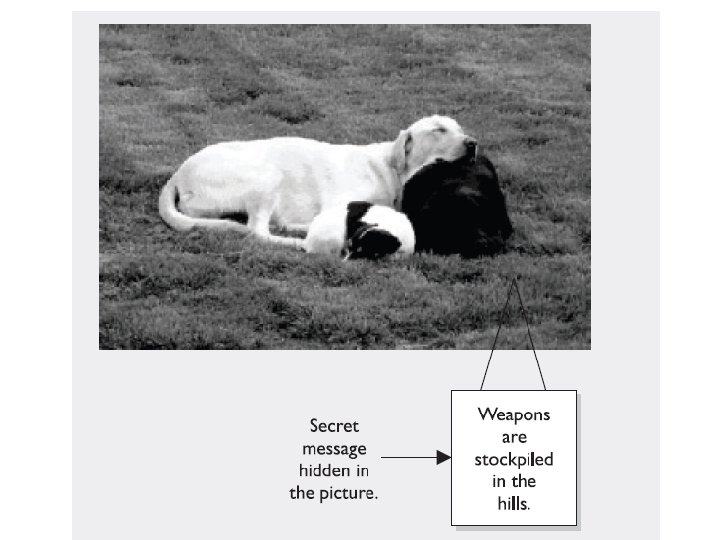
3. 4 Steganography • Steganography is a method of hiding data in another media type so the very existence of the data is concealed as illustrated in the Figure • Only the sender and receiver are supposed to be able to see the message because it is secretly hidden in a graphic, wave file, document, or other type of media. • The message is not encrypted, just hidden
• A method of embedding the message into some type of medium is to use the least significant bit (LSB). • Many types of files have some bits that can be modified and not affect the file they are in, which is where secret data can be hidden without altering the file in a visible manner
• In the LSB approach, graphics with a high resolution or an audio file that has many different types of sounds (high bit rate) are the most successful for hiding information within. • There is commonly no noticeable distortion, and the file is usually not increased to a size that can be detected
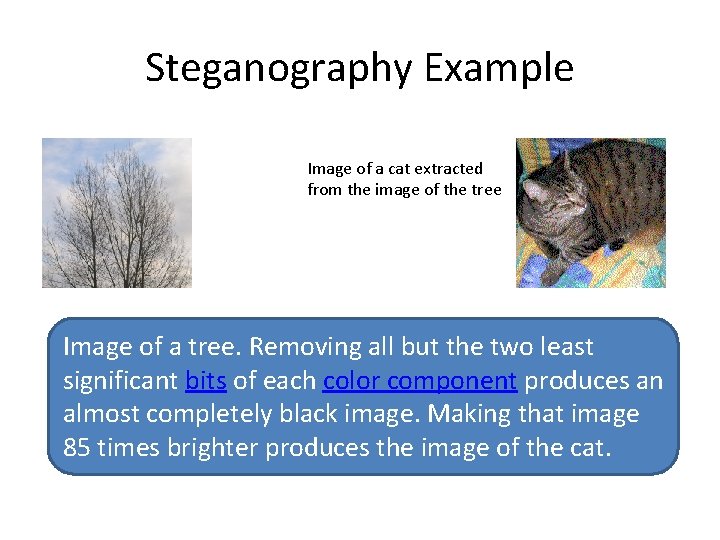
Steganography Example Image of a cat extracted from the image of the tree Image of a tree. Removing all but the two least significant bits of each color component produces an almost completely black image. Making that image 85 times brighter produces the image of the cat.
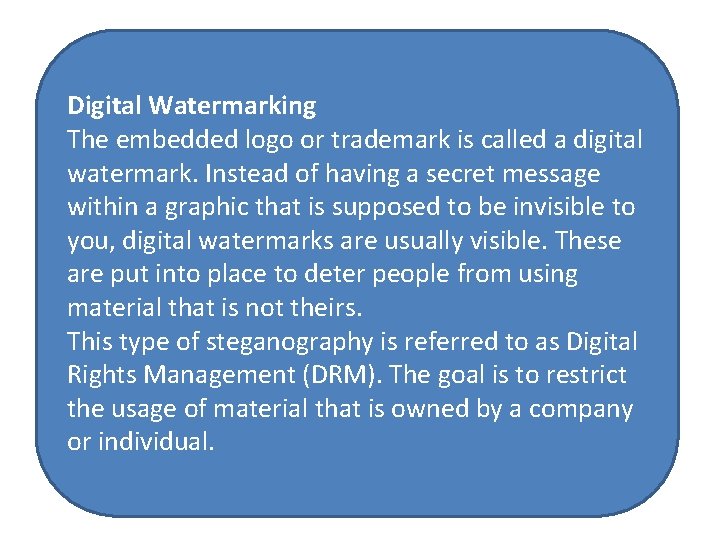
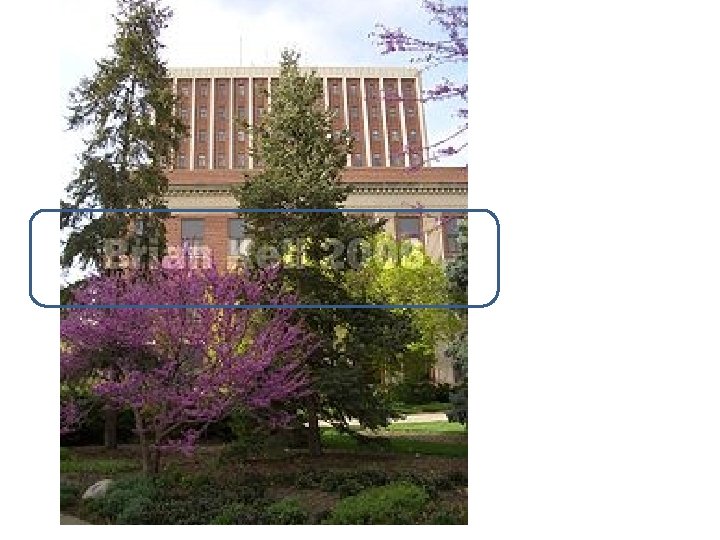
Digital Watermarking The embedded logo or trademark is called a digital watermark. Instead of having a secret message within a graphic that is supposed to be invisible to you, digital watermarks are usually visible. These are put into place to deter people from using material that is not theirs. This type of steganography is referred to as Digital Rights Management (DRM). The goal is to restrict the usage of material that is owned by a company or individual.
3. 5 Types of Ciphers • Symmetric encryption ciphers come in two basic types: – Substitution – Transposition
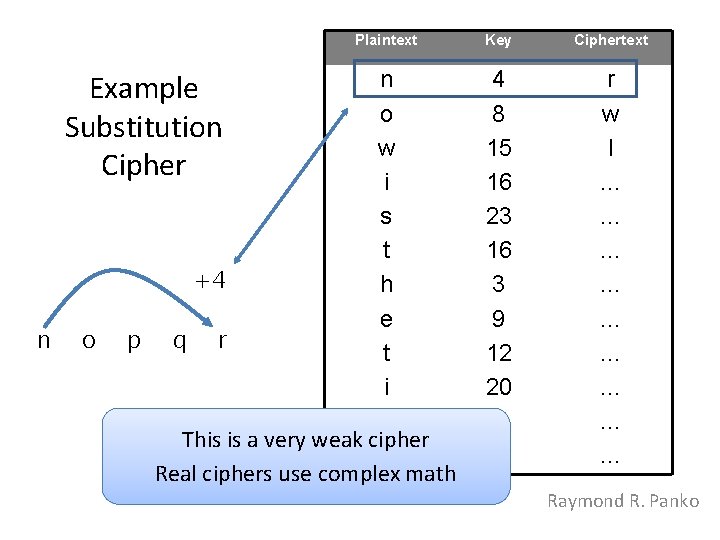
Substitution Ciphers • The substitution cipher replaces bits, characters, or blocks of characters with different bits, characters, or blocks
Plaintext n o w i s t +4 h e p q r t i m This is a very weak cipher e Real ciphers use complex math Example Substitution Cipher n o Key Ciphertext 4 8 15 16 23 16 3 9 12 20 6 25 r w l … … … … … Raymond R. Panko
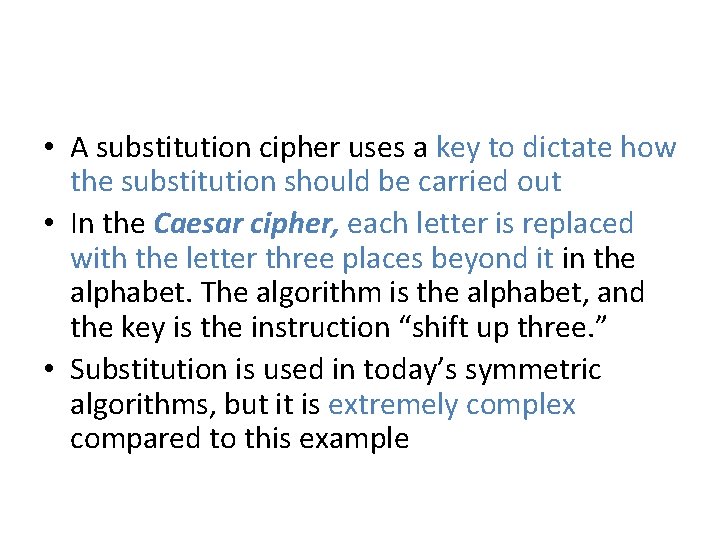
• A substitution cipher uses a key to dictate how the substitution should be carried out • In the Caesar cipher, each letter is replaced with the letter three places beyond it in the alphabet. The algorithm is the alphabet, and the key is the instruction “shift up three. ” • Substitution is used in today’s symmetric algorithms, but it is extremely complex compared to this example
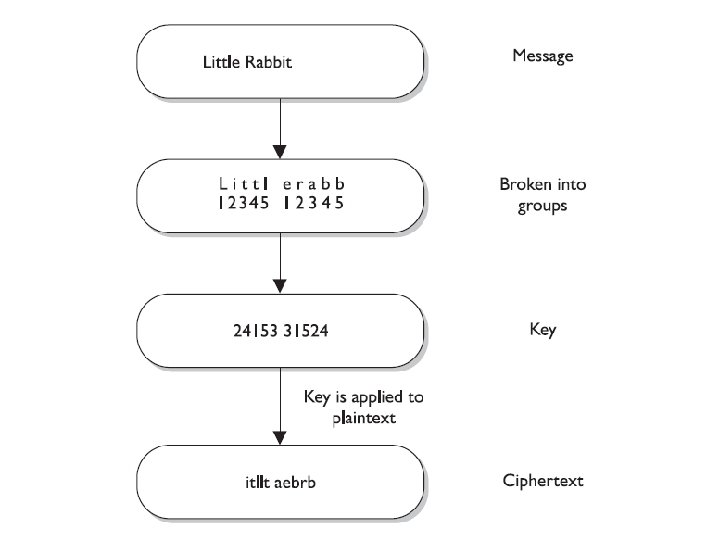
Transposition Ciphers • In a transposition cipher, the values are scrambled, or put into a different order • The key determines the positions the values are moved to, as illustrated in the Figure
• This is a simplistic example of a transposition cipher and only shows one way of performing transposition • When implemented with complex mathematical functions, transpositions can become quite sophisticated and difficult to break
• Symmetric algorithms employed today use both long sequences of complicated substitutions and transpositions on messages • The algorithm contains the possible ways that substitution and transposition processes can take place (represented in mathematical formulas). • The key is used as the instructions for the algorithm, dictating exactly how these processes will happen and in what order
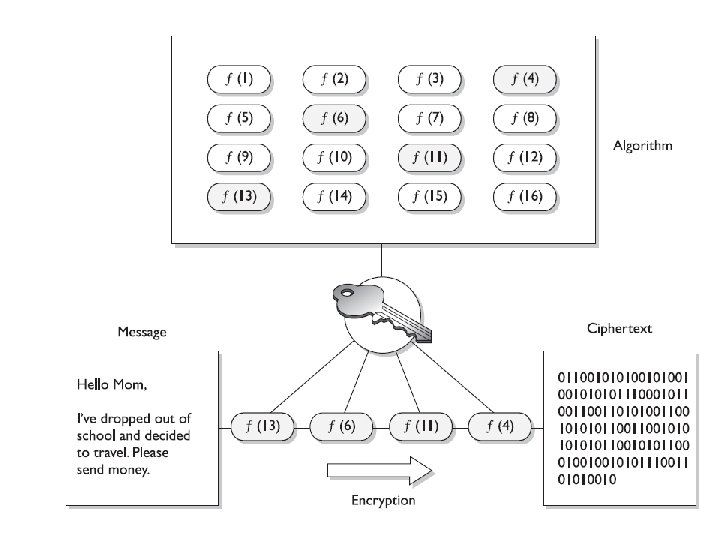
• To understand the relationship between an algorithm and a key, let’s look at the Figure • Conceptually, an algorithm is made up of different boxes, each of which has a different set of mathematical formulas that dictates the substitution and transposition steps that will take place on the bits that enter the box • To encrypt our message, the bit values must go through these different boxes
• If each of our messages goes through each of these different boxes in the same order with the same values, the evildoer will be able to easily reverse-engineer this process and uncover our plaintext message • To foil an evildoer, we use a key, which is a set of values that indicates which box should be used, in what order, and with what values
• So if message A is encrypted with key 1, the key will make the message go through boxes 1, 6, 4, and then 5 • When we need to encrypt message B, we will use key 2, which will make the message go through boxes 8, 3, 2, and then 9 • It is the key that adds the randomness and the secrecy to the encryption process