
CISSP Common Body of Knowledge Review Cryptography Domain
CISSP® Common Body of Knowledge Review: Cryptography Domain – Part 2 Version: 5. 9. 2 CISSP Common Body of Knowledge Review by Alfred Ouyang is licensed under the Creative Commons Attribution -Non. Commercial-Share. Alike 3. 0 Unported License. To view a copy of this license, visit http: //creativecommons. org/licenses/by-nc-sa/3. 0/ or send a letter to Creative Commons, 444 Castro Street, Suite 900, Mountain View, California, 94041, USA.
Learning Objective Cryptography Domain The Cryptography domain addresses the principles, means, and methods of applying mathematical algorithms and data transformations to information to ensure its integrity, confidentiality, and authentication. The candidate is expected to know basic concepts within cryptography; public and private key algorithms in terms of their applications and uses; algorithm construction, key distribution and management, and methods of attack; the applications, construction and use of digital signatures to provide authenticity of electronic transactions, and non-repudiation of the parties involved; and the organization and management of the Public Key Infrastructure (PKIs) and digital certification and management. Reference: CISSP CIB, January 2012 (Rev. 5) -2 -
Review of Part 1 • Classic ciphers: – – Substitution cipher Transposition cipher Polyalphabetic (or running key) cipher Concealment • Modern ciphers: – – Block cipher Stream cipher Steganography Combination -3 -
Review of Part 1 • Hash Function Cryptography – Non-keyed Digest (for integrity) – Keyed Digest (for authentication) – Digital Signature (for non-repudiation) • Symmetric Cryptography – Block Ciphers • Confusion & Diffusion – Confusion: S-box – Diffusion: Feistel network & Columnar transposition – Stream Ciphers • XOR operation – Modes of operation • Block mode: ECB and CBC • Stream mode: CFB, OFB, CTR -4 -
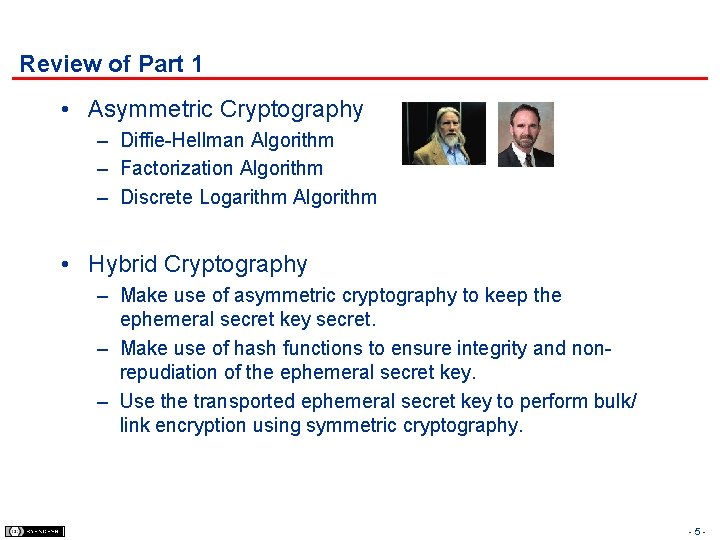
Review of Part 1 • Asymmetric Cryptography – Diffie-Hellman Algorithm – Factorization Algorithm – Discrete Logarithm Algorithm • Hybrid Cryptography – Make use of asymmetric cryptography to keep the ephemeral secret key secret. – Make use of hash functions to ensure integrity and nonrepudiation of the ephemeral secret key. – Use the transported ephemeral secret key to perform bulk/ link encryption using symmetric cryptography. -5 -
Discussion on Part 2 • Utilization of Cryptography – – Public Key Infrastructure (PKI) HTTP, S-HTTP, IPsec, SSH, SET Single Sign-On (SSO) Secured E-mail • Types of Crypto Attacks – Cryptoanalytic Attacks – Cryptographic Attacks • Discussion on export of crypto technologies -6 -
Topics Cryptography Domain – Part 2 • Utilization of Cryptography – – – Public Key Infrastructure (PKI) HTTP, S-HTTP, IPsec, SSH, SET Single Sign-On (SSO) Secured E-mail Quantum Cryptography • Types of Crypto Attacks – Cryptanalytic Attacks – Cryptographic Attacks • Discussion on export of crypto technologies -7 -
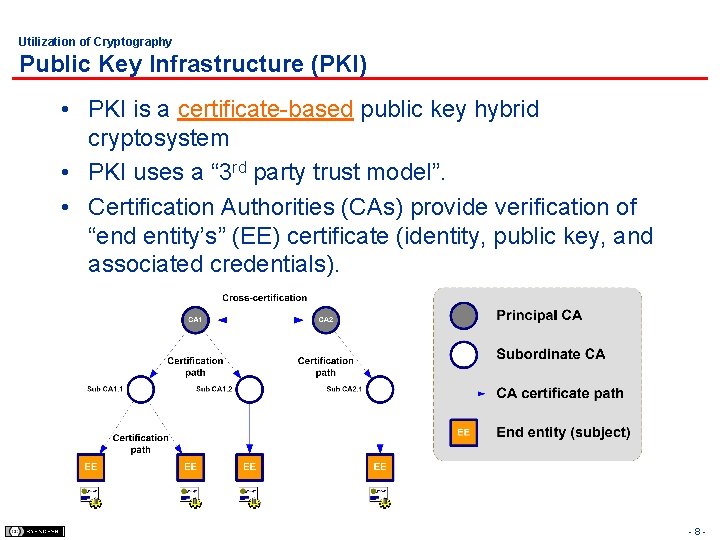
Utilization of Cryptography Public Key Infrastructure (PKI) • PKI is a certificate-based public key hybrid cryptosystem • PKI uses a “ 3 rd party trust model”. • Certification Authorities (CAs) provide verification of “end entity’s” (EE) certificate (identity, public key, and associated credentials). -8 -
Utilization of Cryptography Public Key Infrastructure (PKI) For CISSP Exam… PKI provides four (4) core services: • Authentication – Provide assurance the person is who he/she claims to be. • Integrity – Provide assurance that data received has not been altered, either intentionally or unintentionally. • Confidentiality – Provide assurance that no one can read a particular piece of data except the intended receiver. • Non-Repudiation – Provide assurance that the message sent cannot be disputed. -9 -
Utilization of Cryptography Public Key Infrastructure (PKI) – Functional Components PKI consists of… • Directory Service – Who are you? Who knows you? • Certificate Management Service – Where is your credential? Who issued your credential? Is it valid? • Key Management Service – Please make me a key. Your public key? My public key? • Cryptography Service – Asymmetric, and hash - 10 -
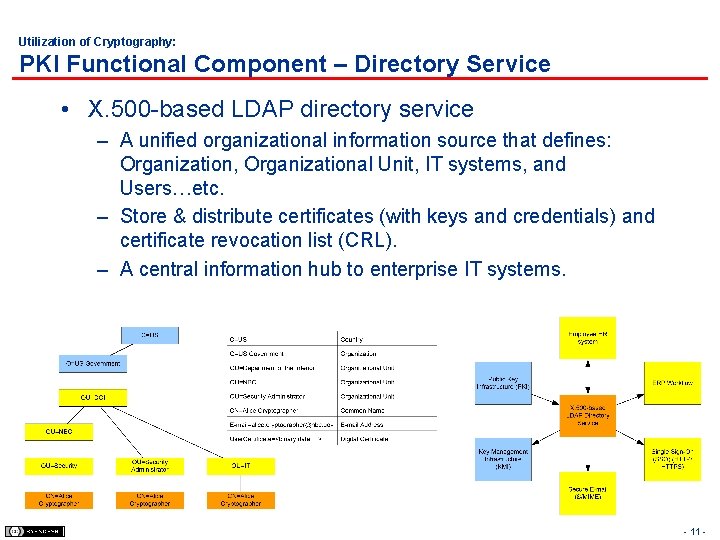
Utilization of Cryptography: PKI Functional Component – Directory Service • X. 500 -based LDAP directory service – A unified organizational information source that defines: Organization, Organizational Unit, IT systems, and Users…etc. – Store & distribute certificates (with keys and credentials) and certificate revocation list (CRL). – A central information hub to enterprise IT systems. - 11 -
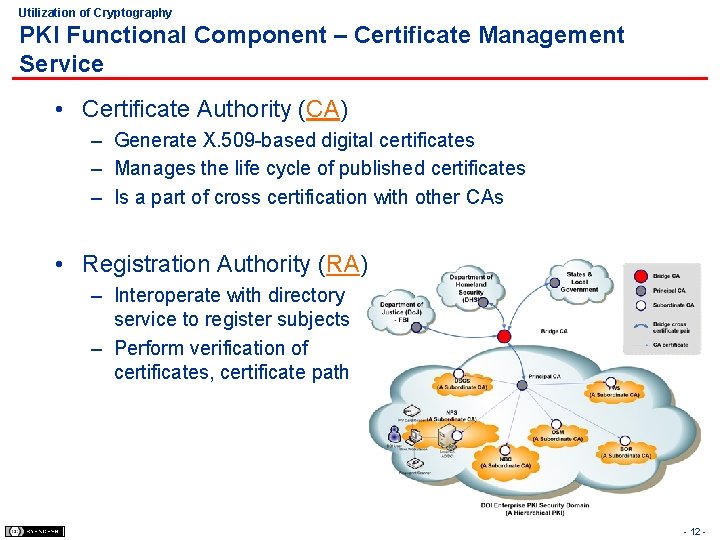
Utilization of Cryptography PKI Functional Component – Certificate Management Service • Certificate Authority (CA) – Generate X. 509 -based digital certificates – Manages the life cycle of published certificates – Is a part of cross certification with other CAs • Registration Authority (RA) – Interoperate with directory service to register subjects – Perform verification of certificates, certificate path - 12 -
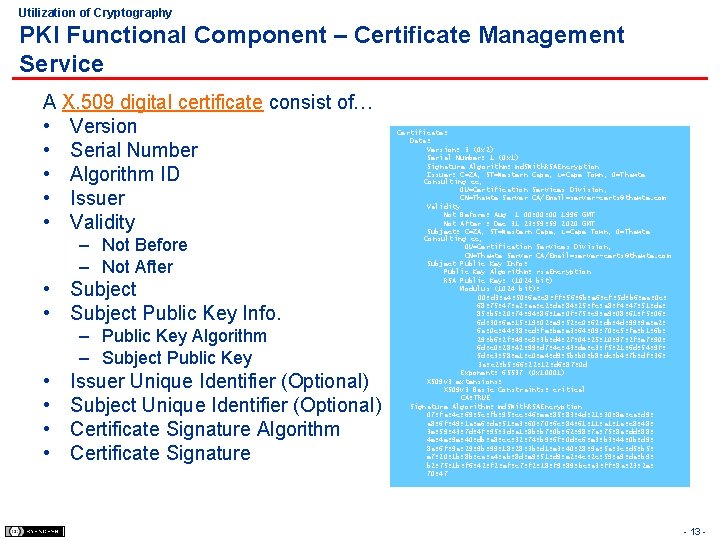
Utilization of Cryptography PKI Functional Component – Certificate Management Service A X. 509 digital certificate consist of… • Version • Serial Number • Algorithm ID • Issuer • Validity – Not Before – Not After • Subject Public Key Info. – Public Key Algorithm – Subject Public Key • • Issuer Unique Identifier (Optional) Subject Unique Identifier (Optional) Certificate Signature Algorithm Certificate Signature Certificate: Data: Version: 3 (0 x 2) Serial Number: 1 (0 x 1) Signature Algorithm: md 5 With. RSAEncryption Issuer: C=ZA, ST=Western Cape, L=Cape Town, O=Thawte Consulting cc, OU=Certification Services Division, CN=Thawte Server CA/Email=server-certs@thawte. com Validity Not Before: Aug 1 00: 00 1996 GMT Not After : Dec 31 23: 59 2020 GMT Subject: C=ZA, ST=Western Cape, L=Cape Town, O=Thawte Consulting cc, OU=Certification Services Division, CN=Thawte Server CA/Email=server-certs@thawte. com Subject Public Key Info: Public Key Algorithm: rsa. Encryption RSA Public Key: (1024 bit) Modulus (1024 bit): 00: d 3: a 4: 50: 6 e: c 8: ff: 56: 6 b: e 6: cf: 5 d: b 6: ea: 0 c: 68: 75: 47: a 2: aa: c 2: da: 84: 25: fc: a 8: f 4: 47: 51: da: 85: b 5: 20: 74: 94: 86: 1 e: 0 f: 75: c 9: e 9: 08: 61: f 5: 06: 6 d: 30: 6 e: 15: 19: 02: e 9: 52: c 0: 62: db: 4 d: 99: 9 e: e 2: 6 a: 0 c: 44: 38: cd: fe: be: e 3: 64: 09: 70: c 5: fe: b 1: 6 b: 29: b 6: 2 f: 49: c 8: 3 b: d 4: 27: 04: 25: 10: 97: 2 f: e 7: 90: 6 d: c 0: 28: 42: 99: d 7: 4 c: 43: de: c 3: f 5: 21: 6 d: 54: 9 f: 5 d: c 3: 58: e 1: c 0: e 4: d 9: 5 b: b 0: b 8: dc: b 4: 7 b: df: 36: 3 a: c 2: b 5: 66: 22: 12: d 6: 87: 0 d Exponent: 65537 (0 x 10001) X 509 v 3 extensions: X 509 v 3 Basic Constraints: critical CA: TRUE Signature Algorithm: md 5 With. RSAEncryption 07: fa: 4 c: 69: 5 c: fb: 95: cc: 46: ee: 85: 83: 4 d: 21: 30: 8 e: ca: d 9: a 8: 6 f: 49: 1 a: e 6: da: 51: e 3: 60: 70: 6 c: 84: 61: 11: a 1: 1 a: c 8: 48: 3 e: 59: 43: 7 d: 4 f: 95: 3 d: a 1: 8 b: b 7: 0 b: 62: 98: 7 a: 75: 8 a: dd: 88: 4 e: 9 e: 40: db: a 8: cc: 32: 74: b 9: 6 f: 0 d: c 6: e 3: b 3: 44: 0 b: d 9: 8 a: 6 f: 9 a: 29: 9 b: 99: 18: 28: 3 b: d 1: e 3: 40: 28: 9 a: 5 a: 3 c: d 5: b 5: e 7: 20: 1 b: 8 b: ca: a 4: ab: 8 d: e 9: 51: d 9: e 2: 4 c: 2 c: 59: a 9: da: b 9: b 2: 75: 1 b: f 6: 42: f 2: ef: c 7: f 2: 18: f 9: 89: bc: a 3: ff: 8 a: 23: 2 e: 70: 47 - 13 -
Utilization of Cryptography PKI Functional Component – Key Management Service • Key establishment function – after a private key (or secret key in symmetric key crypto. operation) has been generated using RNG, a public key is then generated from the private key using an asymmetric key algorithm. (i. e. , key generation) • Key exchange function – composed of a set of key agreement protocols and key distribution rules, executing exchange of encryption keys. • Key backup & recovery function – excluding ephemeral keys, “seeds” for RNG, and shared secret keys. Reference: NIST SP 800 -57, Recommendation on Key Management - 14 -
Utilization of Cryptography PKI Functional Component – Key Management Service • Key revocation function – If a key has been compromised or subjected to a change, then… – the status of key-pair is revoked, and – the certificate status shall be listed in the certificate revocation list (CRL). • Key destruction function – Key zero-ization is used in the destruction of key-pair. • Key escrow function – Use of 3 rd party agent (i. e. CA) to store “encrypted” key-pair. – Fair Cryptosystem, defined by FIPS 185 Escrowed Encryption Standard: SKIPJACK Algorithm and a Law Enforcement Access Field (LEAF) creation method. Reference: NIST SP 800 -57, Recommendation on Key Management - 15 -
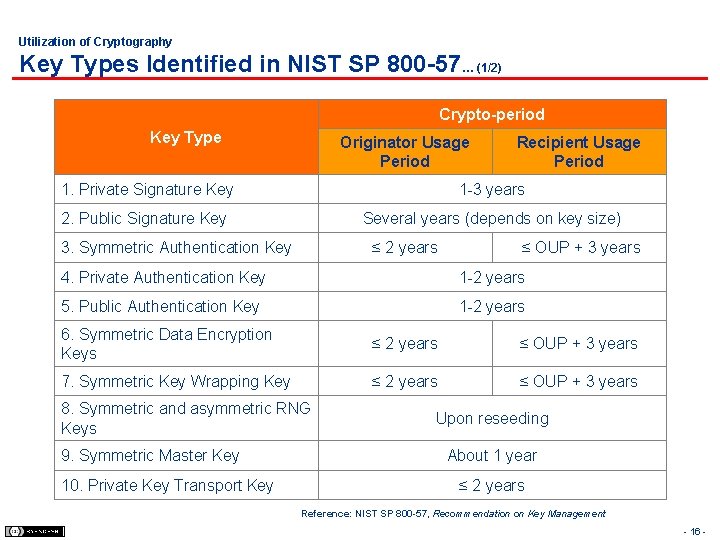
Utilization of Cryptography Key Types Identified in NIST SP 800 -57… (1/2) Crypto-period Key Type Originator Usage Period Recipient Usage Period 1. Private Signature Key 1 -3 years 2. Public Signature Key Several years (depends on key size) 3. Symmetric Authentication Key ≤ 2 years ≤ OUP + 3 years 4. Private Authentication Key 1 -2 years 5. Public Authentication Key 1 -2 years 6. Symmetric Data Encryption Keys ≤ 2 years ≤ OUP + 3 years 7. Symmetric Key Wrapping Key ≤ 2 years ≤ OUP + 3 years 8. Symmetric and asymmetric RNG Keys 9. Symmetric Master Key 10. Private Key Transport Key Upon reseeding About 1 year ≤ 2 years Reference: NIST SP 800 -57, Recommendation on Key Management - 16 -
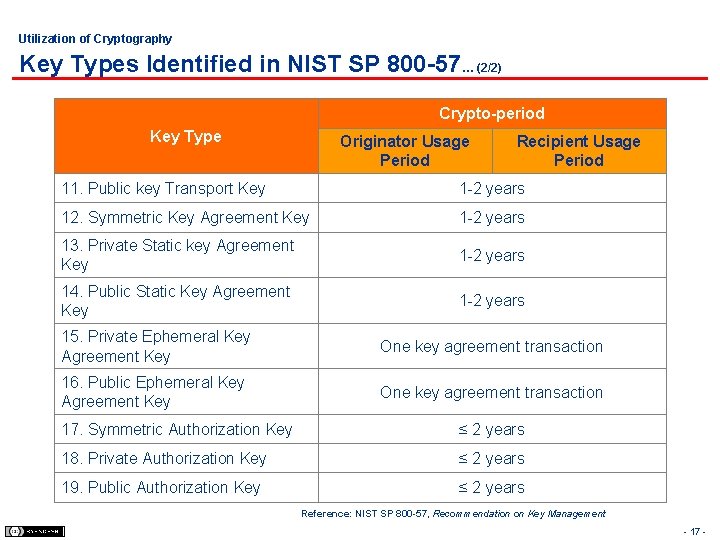
Utilization of Cryptography Key Types Identified in NIST SP 800 -57… (2/2) Crypto-period Key Type Originator Usage Period Recipient Usage Period 11. Public key Transport Key 1 -2 years 12. Symmetric Key Agreement Key 1 -2 years 13. Private Static key Agreement Key 1 -2 years 14. Public Static Key Agreement Key 1 -2 years 15. Private Ephemeral Key Agreement Key One key agreement transaction 16. Public Ephemeral Key Agreement Key One key agreement transaction 17. Symmetric Authorization Key ≤ 2 years 18. Private Authorization Key ≤ 2 years 19. Public Authorization Key ≤ 2 years Reference: NIST SP 800 -57, Recommendation on Key Management - 17 -
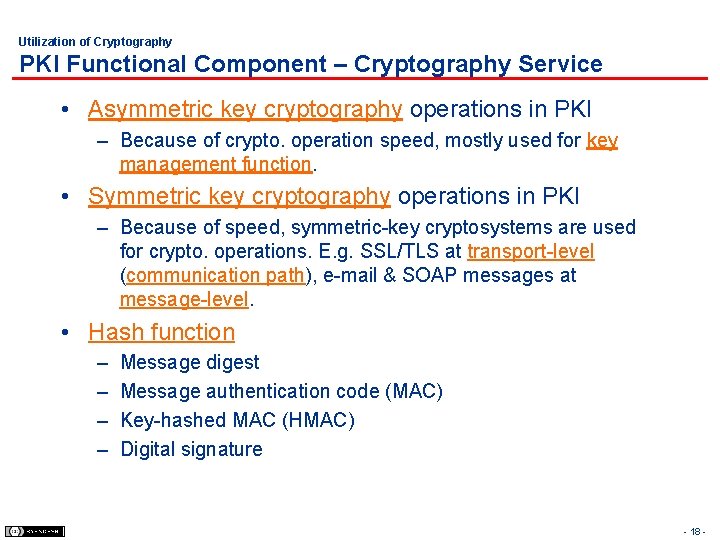
Utilization of Cryptography PKI Functional Component – Cryptography Service • Asymmetric key cryptography operations in PKI – Because of crypto. operation speed, mostly used for key management function. • Symmetric key cryptography operations in PKI – Because of speed, symmetric-key cryptosystems are used for crypto. operations. E. g. SSL/TLS at transport-level (communication path), e-mail & SOAP messages at message-level. • Hash function – – Message digest Message authentication code (MAC) Key-hashed MAC (HMAC) Digital signature - 18 -
Questions: • What are the four key functional services for PKI? – – • In PKI, what protocol is used to transport public keys? – • In PKI, what is the “ 3 rd party” entity that authenticates the “end entity’s” certificate? – - 19 -
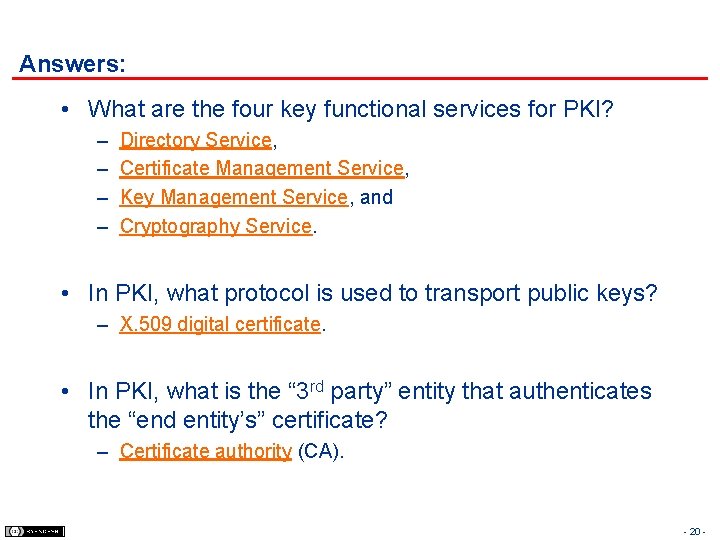
Answers: • What are the four key functional services for PKI? – – Directory Service, Certificate Management Service, Key Management Service, and Cryptography Service. • In PKI, what protocol is used to transport public keys? – X. 509 digital certificate. • In PKI, what is the “ 3 rd party” entity that authenticates the “end entity’s” certificate? – Certificate authority (CA). - 20 -
Questions: • What are the six functions performed by PKI key management service? – – – - 21 -
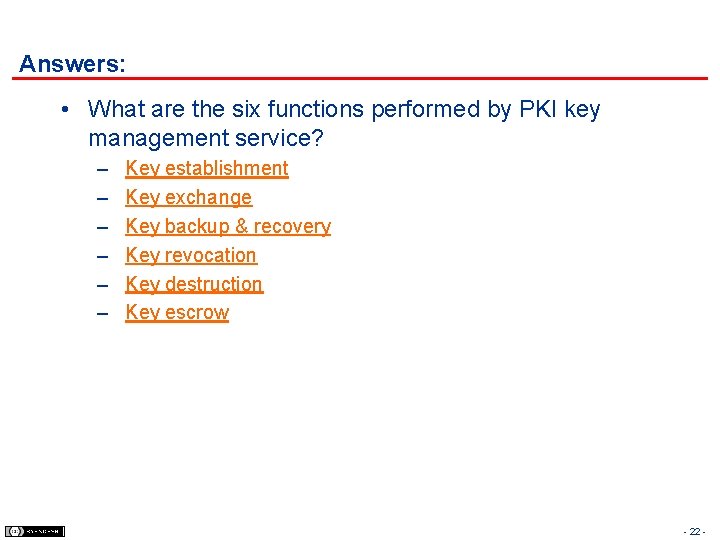
Answers: • What are the six functions performed by PKI key management service? – – – Key establishment Key exchange Key backup & recovery Key revocation Key destruction Key escrow - 22 -
Topics Cryptography Domain – Part 2 • Utilization of Cryptography – – – Public Key Infrastructure (PKI) HTTP, S-HTTP, IPsec, SSH, SET Single Sign-On (SSO) Secured E-mail Quantum Cryptography • Types of Crypto Attacks – Cryptanalytic Attacks – Cryptographic Attacks • Discussion on export of crypto technologies - 23 -
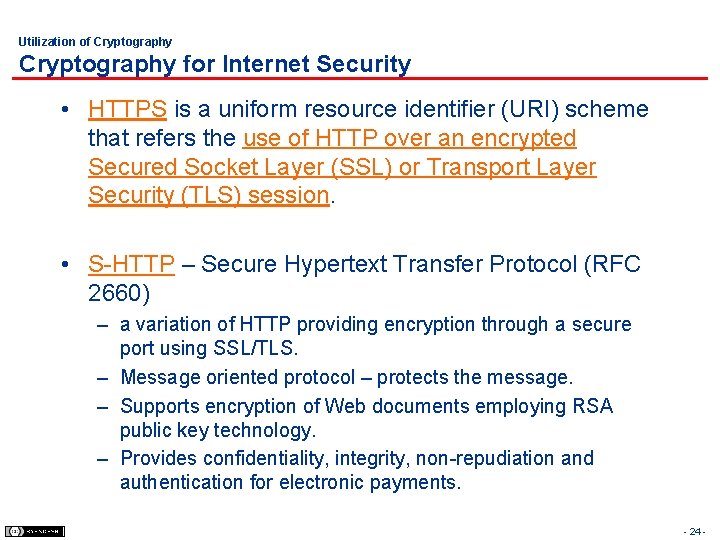
Utilization of Cryptography for Internet Security • HTTPS is a uniform resource identifier (URI) scheme that refers the use of HTTP over an encrypted Secured Socket Layer (SSL) or Transport Layer Security (TLS) session. • S-HTTP – Secure Hypertext Transfer Protocol (RFC 2660) – a variation of HTTP providing encryption through a secure port using SSL/TLS. – Message oriented protocol – protects the message. – Supports encryption of Web documents employing RSA public key technology. – Provides confidentiality, integrity, non-repudiation and authentication for electronic payments. - 24 -
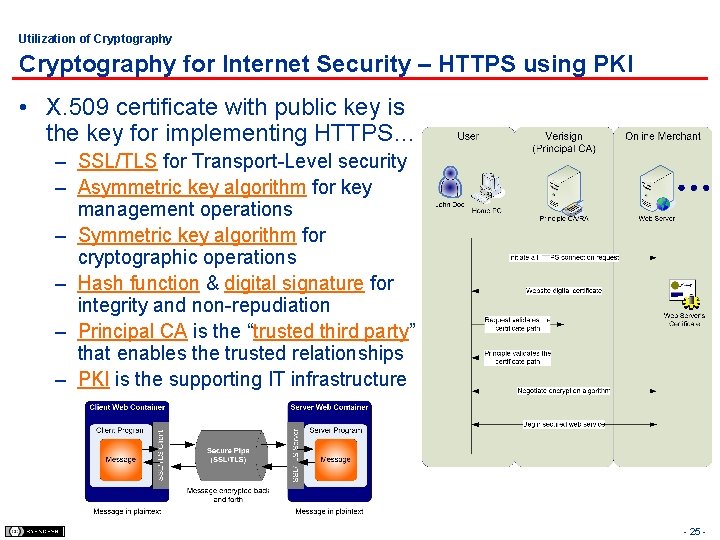
Utilization of Cryptography for Internet Security – HTTPS using PKI • X. 509 certificate with public key is the key for implementing HTTPS… – SSL/TLS for Transport-Level security – Asymmetric key algorithm for key management operations – Symmetric key algorithm for cryptographic operations – Hash function & digital signature for integrity and non-repudiation – Principal CA is the “trusted third party” that enables the trusted relationships – PKI is the supporting IT infrastructure - 25 -
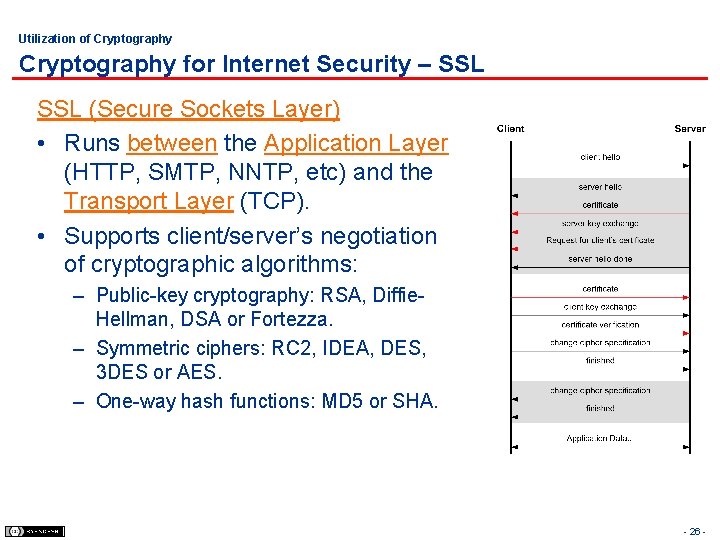
Utilization of Cryptography for Internet Security – SSL (Secure Sockets Layer) • Runs between the Application Layer (HTTP, SMTP, NNTP, etc) and the Transport Layer (TCP). • Supports client/server’s negotiation of cryptographic algorithms: – Public-key cryptography: RSA, Diffie. Hellman, DSA or Fortezza. – Symmetric ciphers: RC 2, IDEA, DES, 3 DES or AES. – One-way hash functions: MD 5 or SHA. - 26 -
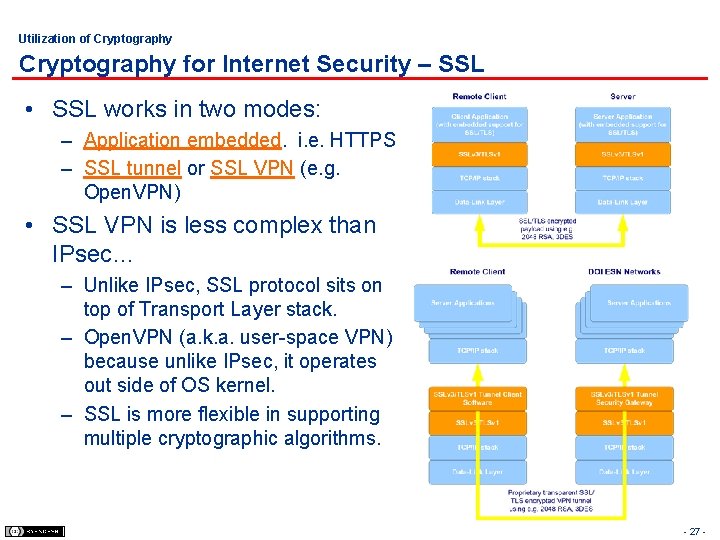
Utilization of Cryptography for Internet Security – SSL • SSL works in two modes: – Application embedded. i. e. HTTPS – SSL tunnel or SSL VPN (e. g. Open. VPN) • SSL VPN is less complex than IPsec… – Unlike IPsec, SSL protocol sits on top of Transport Layer stack. – Open. VPN (a. k. a. user-space VPN) because unlike IPsec, it operates out side of OS kernel. – SSL is more flexible in supporting multiple cryptographic algorithms. - 27 -
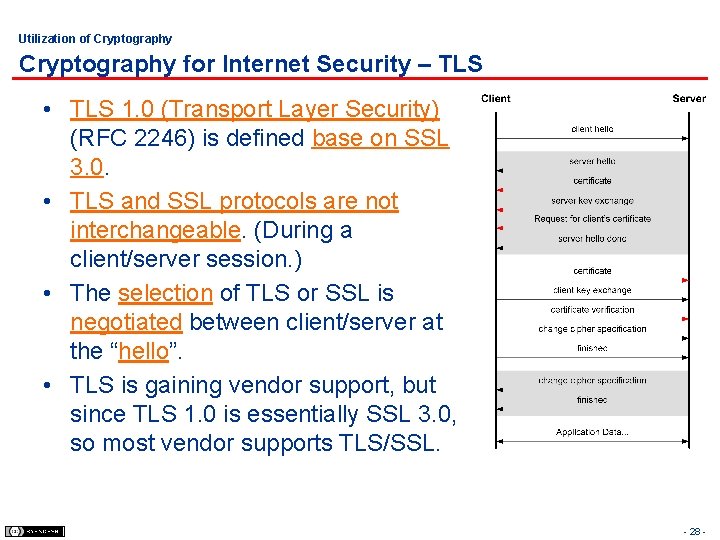
Utilization of Cryptography for Internet Security – TLS • TLS 1. 0 (Transport Layer Security) (RFC 2246) is defined base on SSL 3. 0. • TLS and SSL protocols are not interchangeable. (During a client/server session. ) • The selection of TLS or SSL is negotiated between client/server at the “hello”. • TLS is gaining vendor support, but since TLS 1. 0 is essentially SSL 3. 0, so most vendor supports TLS/SSL. - 28 -
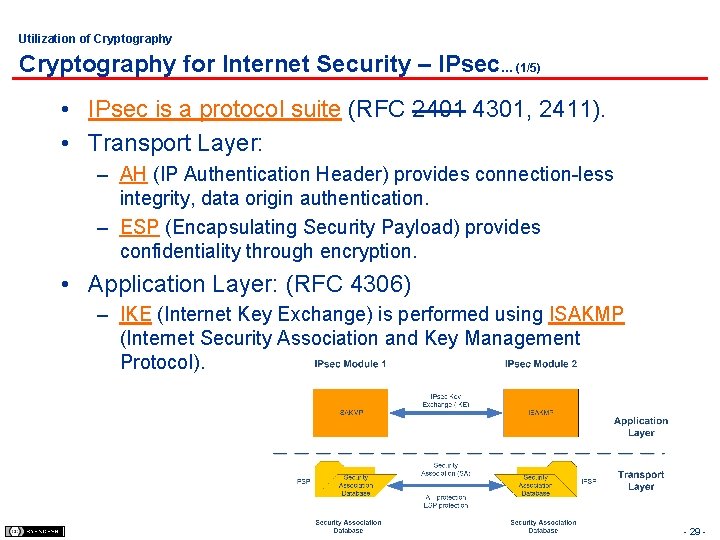
Utilization of Cryptography for Internet Security – IPsec… (1/5) • IPsec is a protocol suite (RFC 2401 4301, 2411). • Transport Layer: – AH (IP Authentication Header) provides connection-less integrity, data origin authentication. – ESP (Encapsulating Security Payload) provides confidentiality through encryption. • Application Layer: (RFC 4306) – IKE (Internet Key Exchange) is performed using ISAKMP (Internet Security Association and Key Management Protocol). - 29 -
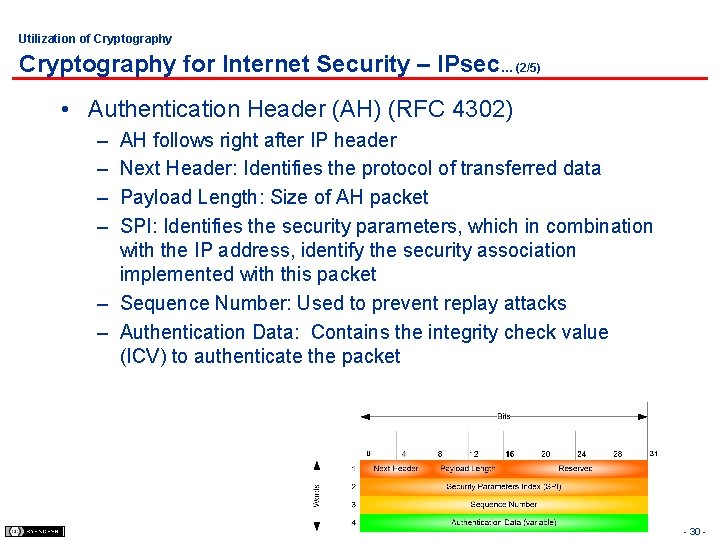
Utilization of Cryptography for Internet Security – IPsec… (2/5) • Authentication Header (AH) (RFC 4302) – – AH follows right after IP header Next Header: Identifies the protocol of transferred data Payload Length: Size of AH packet SPI: Identifies the security parameters, which in combination with the IP address, identify the security association implemented with this packet – Sequence Number: Used to prevent replay attacks – Authentication Data: Contains the integrity check value (ICV) to authenticate the packet - 30 -
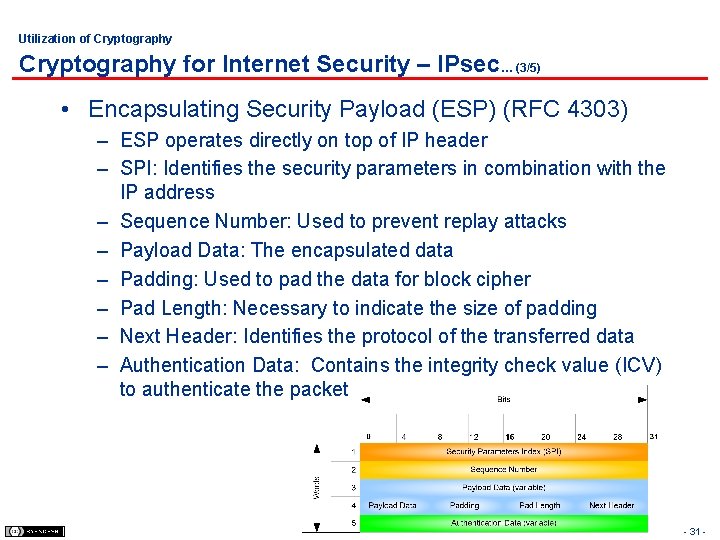
Utilization of Cryptography for Internet Security – IPsec… (3/5) • Encapsulating Security Payload (ESP) (RFC 4303) – ESP operates directly on top of IP header – SPI: Identifies the security parameters in combination with the IP address – Sequence Number: Used to prevent replay attacks – Payload Data: The encapsulated data – Padding: Used to pad the data for block cipher – Pad Length: Necessary to indicate the size of padding – Next Header: Identifies the protocol of the transferred data – Authentication Data: Contains the integrity check value (ICV) to authenticate the packet - 31 -
Utilization of Cryptography for Internet Security – IPsec… (4/5) IPsec operates in two modes: • Transport mode: – – Only the payload is protected (i. e. , encryption & hash) IP headers are not encrypted If AH is used then IP address can not be translated (i. e. , NAT) For host-to-host communications only • Tunnel mode: – The payload and header are protected (i. e. , encryption & hash) – Used for network-to-network, host-to-network, and host-to-host communications Reference: http: //en. wikipedia. org/wiki/IPsec - 32 -
Utilization of Cryptography for Internet Security – IPsec. . . (5/5) IPsec is implemented in the following “popular” ways… • Network-to-Network – IPsec tunnel between two security gateways – GRE/IPsec in established Layer 3 tunnel – L 2 TP/IPsec in established Layer 2 tunnel • Host-to-Network – L 2 TP/IPsec in established Layer 2 tunnel via VPN client on remote client (i. e. your laptop or PC) • Host-to-Host – IPsec in transport mode or tunnel mode between two computing machines Reference: • http: //en. wikipedia. org/wiki/IPsec • http: //en. wikipedia. org/wiki/L 2 TP • http: //www. cisco. com/en/US/tech/tk 583/tk 372/tech_configuration_examples_list. html • http: //www. cisco. com/univercd/cc/td/doc/product/software/ios 120/12 cgcr/secur_c/scprt 4/scipsec. htm • RFC 4301, Security Architecture for the Internet Protocol (http: //tools. ietf. org/html/rfc 4301) - 33 -
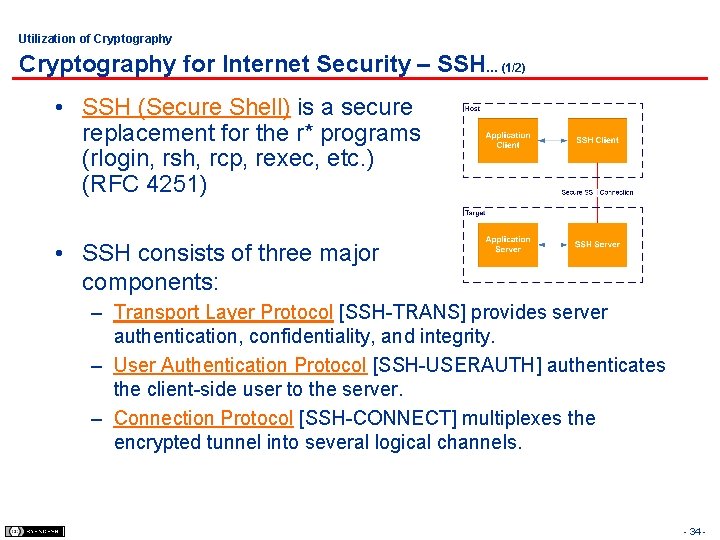
Utilization of Cryptography for Internet Security – SSH… (1/2) • SSH (Secure Shell) is a secure replacement for the r* programs (rlogin, rsh, rcp, rexec, etc. ) (RFC 4251) • SSH consists of three major components: – Transport Layer Protocol [SSH-TRANS] provides server authentication, confidentiality, and integrity. – User Authentication Protocol [SSH-USERAUTH] authenticates the client-side user to the server. – Connection Protocol [SSH-CONNECT] multiplexes the encrypted tunnel into several logical channels. - 34 -
Utilization of Cryptography for Internet Security – SSH… (2/2) • SSH has an open architecture (RFC 4251): – Uses public-key trust model to authenticate users • “Web of trust”: Client has a local database of public keys • “ 3 rd party of trust”: Public keys are certified by CAs – Supports variety of cryptography algorithms: • Blowfish, TDES, AES, IDEA, etc. • SSH protects: – Eavesdropping of data transmitted over the network. – Manipulation of data at intermediate elements in the network (e. g. routers). – IP address spoofing where an attack hosts pretends to be a trusted host by sending packets with the source address of the trusted host. – DNS spoofing of trusted host names/IP addresses. – IP source routing. - 35 -
Utilization of Cryptography for Internet Security – SET Secure Electronic Transaction (SET) is a system for ensuring the security of financial transactions on the Internet. It was supported initially by Mastercard, Visa, Microsoft, Netscape, and others. • A user is given an electronic wallet (digital certificate) and a transaction is conducted and verified using a combination of digital certificates and digital signature among the purchaser, a merchant, and the purchaser's bank in a way that ensures privacy and confidentiality. – SET uses Netscape's SSL, Microsoft's STT (Secure Transaction Technology), and Terisa System's S-HTTP. – SET uses some but not all aspects of a PKI. - 36 -
Questions: • What is the difference between HTTPS and S-HTTP? – HTTPS is – S-HTTP is • What are the two modes the SSL works in? – – • Secure Shell (SSH) uses what for authenticating users? – - 37 -
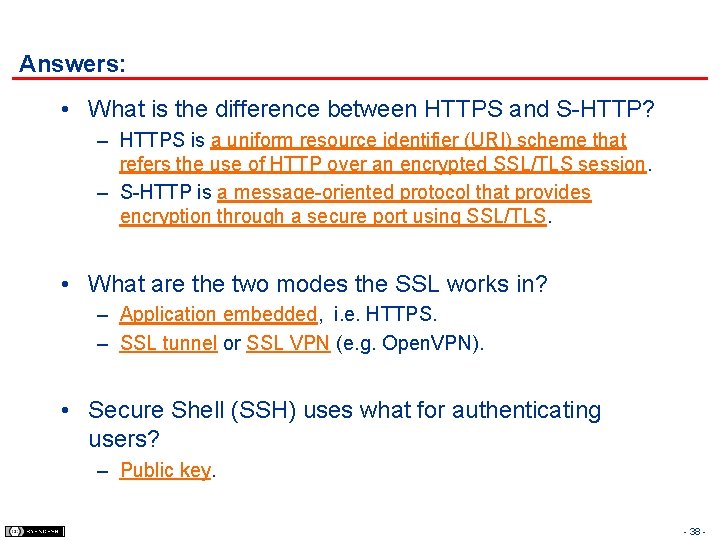
Answers: • What is the difference between HTTPS and S-HTTP? – HTTPS is a uniform resource identifier (URI) scheme that refers the use of HTTP over an encrypted SSL/TLS session. – S-HTTP is a message-oriented protocol that provides encryption through a secure port using SSL/TLS. • What are the two modes the SSL works in? – Application embedded, i. e. HTTPS. – SSL tunnel or SSL VPN (e. g. Open. VPN). • Secure Shell (SSH) uses what for authenticating users? – Public key. - 38 -
Topics Cryptography Domain – Part 2 • Utilization of Cryptography – – – Public Key Infrastructure (PKI) HTTP, S-HTTP, IPsec, SSH, SET Single Sign-On (SSO) Secured E-mail Quantum Cryptography • Types of Crypto Attacks – Cryptanalytic Attacks – Cryptographic Attacks • Discussion on export of crypto technologies - 39 -
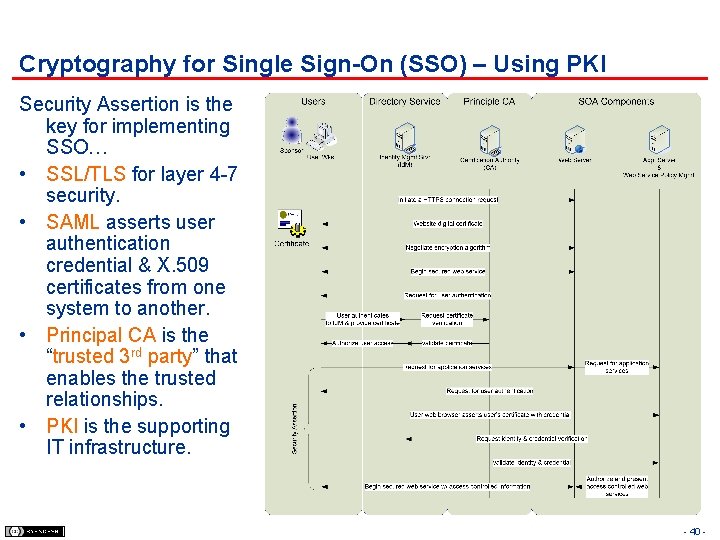
Cryptography for Single Sign-On (SSO) – Using PKI Security Assertion is the key for implementing SSO… • SSL/TLS for layer 4 -7 security. • SAML asserts user authentication credential & X. 509 certificates from one system to another. • Principal CA is the “trusted 3 rd party” that enables the trusted relationships. • PKI is the supporting IT infrastructure. - 40 -
Topics Cryptography Domain – Part 2 • Utilization of Cryptography – – – Public Key Infrastructure (PKI) HTTP, S-HTTP, IPsec, SSH, SET Single Sign-On (SSO) Secured E-mail Quantum Cryptography • Types of Crypto Attacks – Cryptanalytic Attacks – Cryptographic Attacks • Discussion on export of crypto technologies - 41 -
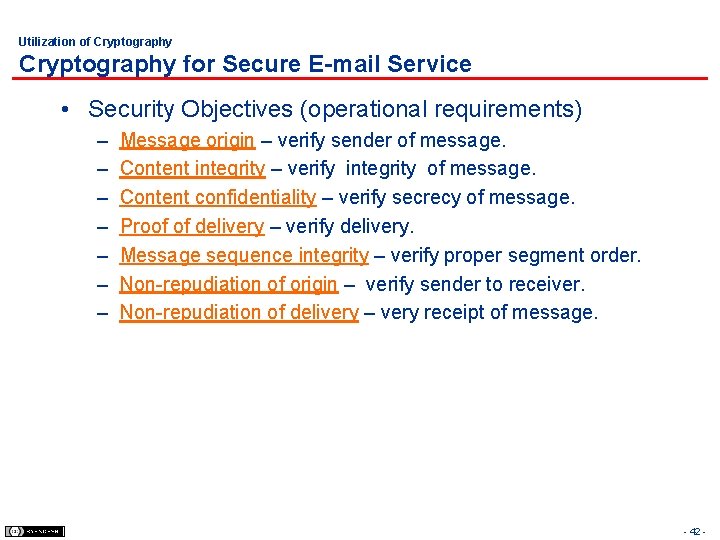
Utilization of Cryptography for Secure E-mail Service • Security Objectives (operational requirements) – – – – Message origin – verify sender of message. Content integrity – verify integrity of message. Content confidentiality – verify secrecy of message. Proof of delivery – verify delivery. Message sequence integrity – verify proper segment order. Non-repudiation of origin – verify sender to receiver. Non-repudiation of delivery – very receipt of message. - 42 -
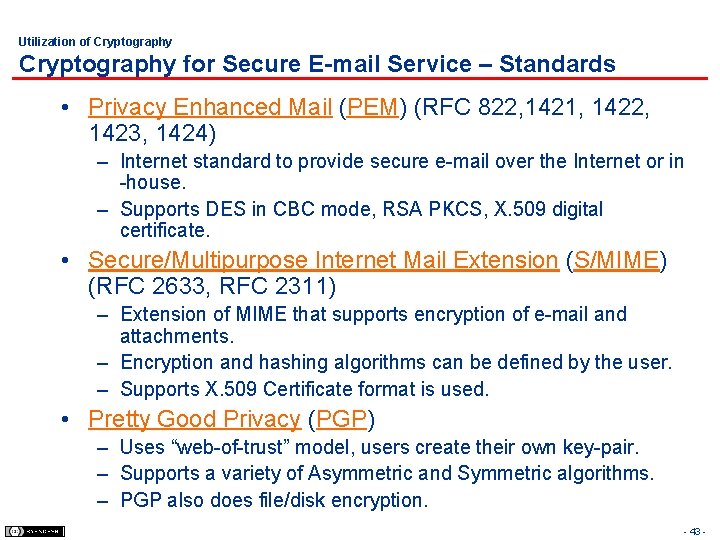
Utilization of Cryptography for Secure E-mail Service – Standards • Privacy Enhanced Mail (PEM) (RFC 822, 1421, 1422, 1423, 1424) – Internet standard to provide secure e-mail over the Internet or in -house. – Supports DES in CBC mode, RSA PKCS, X. 509 digital certificate. • Secure/Multipurpose Internet Mail Extension (S/MIME) (RFC 2633, RFC 2311) – Extension of MIME that supports encryption of e-mail and attachments. – Encryption and hashing algorithms can be defined by the user. – Supports X. 509 Certificate format is used. • Pretty Good Privacy (PGP) – Uses “web-of-trust” model, users create their own key-pair. – Supports a variety of Asymmetric and Symmetric algorithms. – PGP also does file/disk encryption. - 43 -
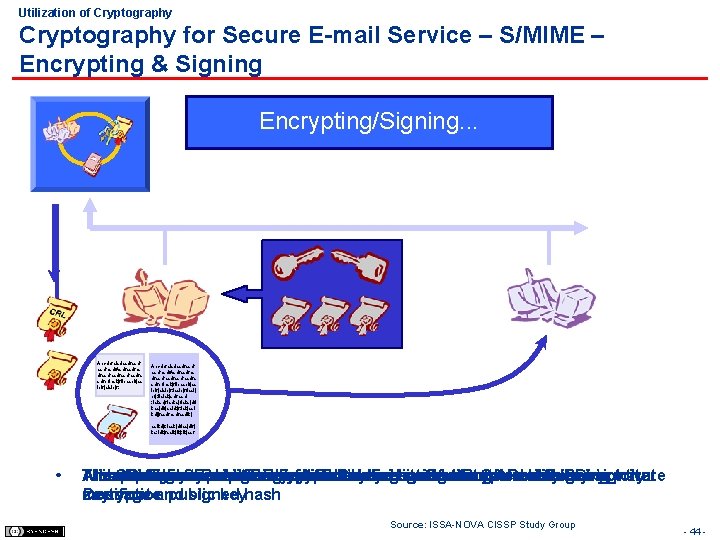
Utilization of Cryptography for Secure E-mail Service – S/MIME – Encrypting & Signing Encrypting/Signing. . . Alice Abcdefalsdasdfasdf. Asdfasdfasdfasdfasdfa sdfpolaskjflieaseifjas leifjalsiejf; lasiejfflasij efj; lialakjsdf asd ; laksdjfladksjflaksjdfl kasjdlfjsald; jf; lakjasl kdjjfasdfasdlkj Bob Entrust Profile aslkdjf; laskjdflasjdlfj ks; ldkjfsalkjlkj; lkjasf • This Alice’s The Alice A one-time Hash one-time CRL validity package Retrieves opens composes verification ofisthe symmetric retrieved of her symmetric is message Bob’s private sent a message public Certificate to to Encryption encryption Bob key is check encryption key created store foris. Bob’s Bob is included Public key and verified key revocation is isis generated Key signed to using itself allow Certificate encrypted using status the Bob and CAAlice’s to used from Public verify with to the signing Key encrypt her Bob’s Directory signature private the encryption Certificate message key and public signed keyhash Source: ISSA-NOVA CISSP Study Group - 44 -
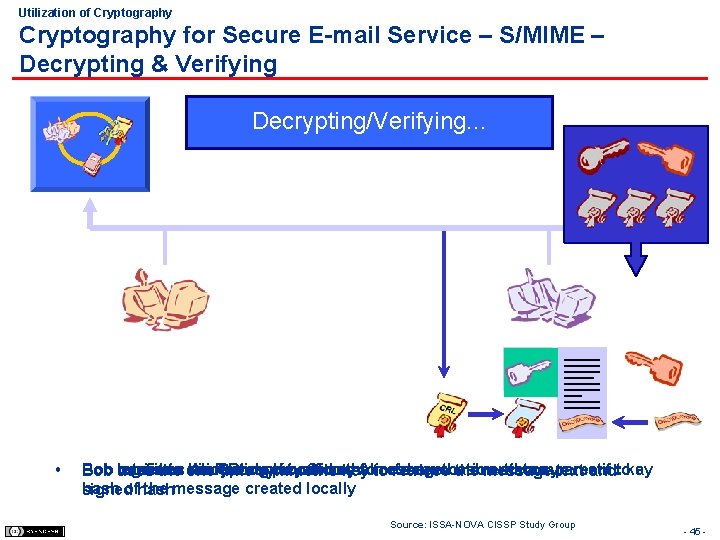
Utilization of Cryptography for Secure E-mail Service – S/MIME – Decrypting & Verifying Entrust Profile Decrypting/Verifying. . . Alice Bob Abcdefalsdasdfasdf. Asdfasdfasdfasdfasdfa sdfpolaskjflieaseifjas leifjalsiejf; lasiejfflasij efj; lialakjsdf asd ; laksdjfladksjflaksjdfl kasjdlfjsald; jf; lakjasl kdjjfasdfasdlkj aslkdjf; laskjdflasjdlfj ks; ldkjfsalkjlkj; lkjasf • logs retrieves into his the Private CRLsignature and Key confirms Store Alice’s revocation status confirms his encryption Alice’s private on key the toto message retrieve the hash one-time and compares symmetric it tokey a Bob uses the one-time symmetric key retrieve the message text and hash ofhash the message created locally signed Source: ISSA-NOVA CISSP Study Group - 45 -
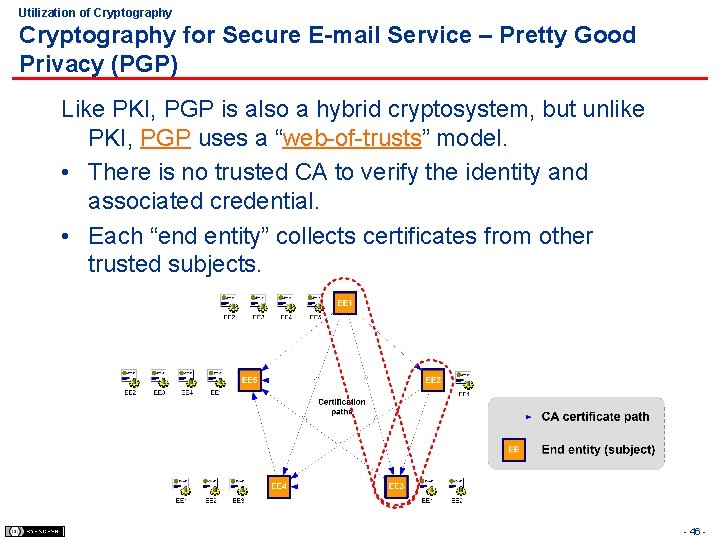
Utilization of Cryptography for Secure E-mail Service – Pretty Good Privacy (PGP) Like PKI, PGP is also a hybrid cryptosystem, but unlike PKI, PGP uses a “web-of-trusts” model. • There is no trusted CA to verify the identity and associated credential. • Each “end entity” collects certificates from other trusted subjects. - 46 -
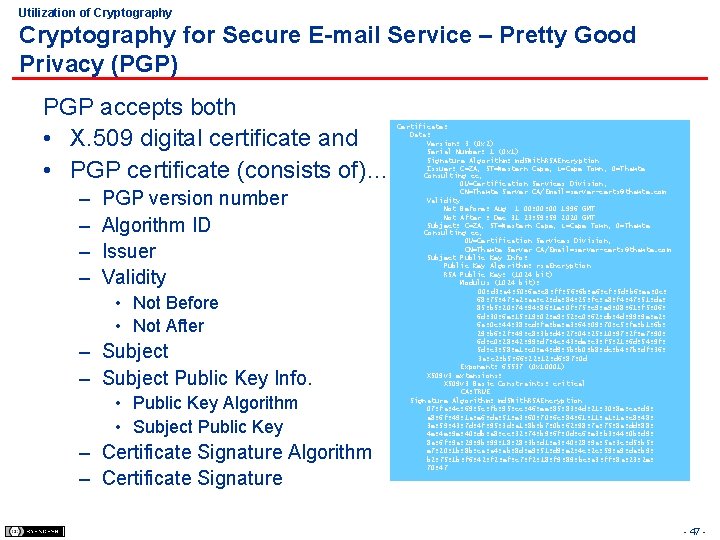
Utilization of Cryptography for Secure E-mail Service – Pretty Good Privacy (PGP) PGP accepts both • X. 509 digital certificate and • PGP certificate (consists of)… – – PGP version number Algorithm ID Issuer Validity • Not Before • Not After – Subject Public Key Info. • Public Key Algorithm • Subject Public Key – Certificate Signature Algorithm – Certificate Signature Certificate: Data: Version: 3 (0 x 2) Serial Number: 1 (0 x 1) Signature Algorithm: md 5 With. RSAEncryption Issuer: C=ZA, ST=Western Cape, L=Cape Town, O=Thawte Consulting cc, OU=Certification Services Division, CN=Thawte Server CA/Email=server-certs@thawte. com Validity Not Before: Aug 1 00: 00 1996 GMT Not After : Dec 31 23: 59 2020 GMT Subject: C=ZA, ST=Western Cape, L=Cape Town, O=Thawte Consulting cc, OU=Certification Services Division, CN=Thawte Server CA/Email=server-certs@thawte. com Subject Public Key Info: Public Key Algorithm: rsa. Encryption RSA Public Key: (1024 bit) Modulus (1024 bit): 00: d 3: a 4: 50: 6 e: c 8: ff: 56: 6 b: e 6: cf: 5 d: b 6: ea: 0 c: 68: 75: 47: a 2: aa: c 2: da: 84: 25: fc: a 8: f 4: 47: 51: da: 85: b 5: 20: 74: 94: 86: 1 e: 0 f: 75: c 9: e 9: 08: 61: f 5: 06: 6 d: 30: 6 e: 15: 19: 02: e 9: 52: c 0: 62: db: 4 d: 99: 9 e: e 2: 6 a: 0 c: 44: 38: cd: fe: be: e 3: 64: 09: 70: c 5: fe: b 1: 6 b: 29: b 6: 2 f: 49: c 8: 3 b: d 4: 27: 04: 25: 10: 97: 2 f: e 7: 90: 6 d: c 0: 28: 42: 99: d 7: 4 c: 43: de: c 3: f 5: 21: 6 d: 54: 9 f: 5 d: c 3: 58: e 1: c 0: e 4: d 9: 5 b: b 0: b 8: dc: b 4: 7 b: df: 36: 3 a: c 2: b 5: 66: 22: 12: d 6: 87: 0 d Exponent: 65537 (0 x 10001) X 509 v 3 extensions: X 509 v 3 Basic Constraints: critical CA: TRUE Signature Algorithm: md 5 With. RSAEncryption 07: fa: 4 c: 69: 5 c: fb: 95: cc: 46: ee: 85: 83: 4 d: 21: 30: 8 e: ca: d 9: a 8: 6 f: 49: 1 a: e 6: da: 51: e 3: 60: 70: 6 c: 84: 61: 11: a 1: 1 a: c 8: 48: 3 e: 59: 43: 7 d: 4 f: 95: 3 d: a 1: 8 b: b 7: 0 b: 62: 98: 7 a: 75: 8 a: dd: 88: 4 e: 9 e: 40: db: a 8: cc: 32: 74: b 9: 6 f: 0 d: c 6: e 3: b 3: 44: 0 b: d 9: 8 a: 6 f: 9 a: 29: 9 b: 99: 18: 28: 3 b: d 1: e 3: 40: 28: 9 a: 5 a: 3 c: d 5: b 5: e 7: 20: 1 b: 8 b: ca: a 4: ab: 8 d: e 9: 51: d 9: e 2: 4 c: 2 c: 59: a 9: da: b 9: b 2: 75: 1 b: f 6: 42: f 2: ef: c 7: f 2: 18: f 9: 89: bc: a 3: ff: 8 a: 23: 2 e: 70: 47 -
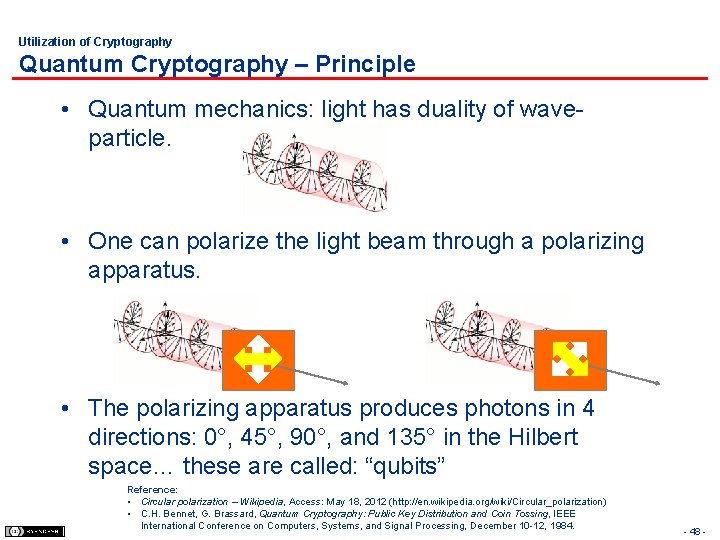
Utilization of Cryptography Quantum Cryptography – Principle • Quantum mechanics: light has duality of waveparticle. • One can polarize the light beam through a polarizing apparatus. • The polarizing apparatus produces photons in 4 directions: 0°, 45°, 90°, and 135° in the Hilbert space… these are called: “qubits” Reference: • Circular polarization – Wikipedia, Access: May 18, 2012 (http: //en. wikipedia. org/wiki/Circular_polarization) • C. H. Bennet, G. Brassard, Quantum Cryptography: Public Key Distribution and Coin Tossing, IEEE International Conference on Computers, Systems, and Signal Processing, December 10 -12, 1984. - 48 -
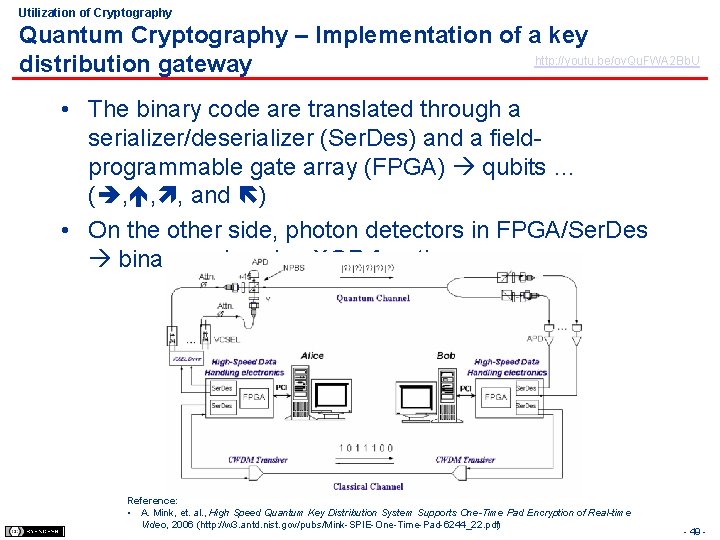
Utilization of Cryptography Quantum Cryptography – Implementation of a key http: //youtu. be/ov. Qu. FWA 2 Bb. U distribution gateway • The binary code are translated through a serializer/deserializer (Ser. Des) and a fieldprogrammable gate array (FPGA) qubits … ( , , , and ) • On the other side, photon detectors in FPGA/Ser. Des binary code using XOR function. Reference: • A. Mink, et. al. , High Speed Quantum Key Distribution System Supports One-Time Pad Encryption of Real-time Video, 2006 (http: //w 3. antd. nist. gov/pubs/Mink-SPIE-One-Time-Pad-6244_22. pdf) - 49 -
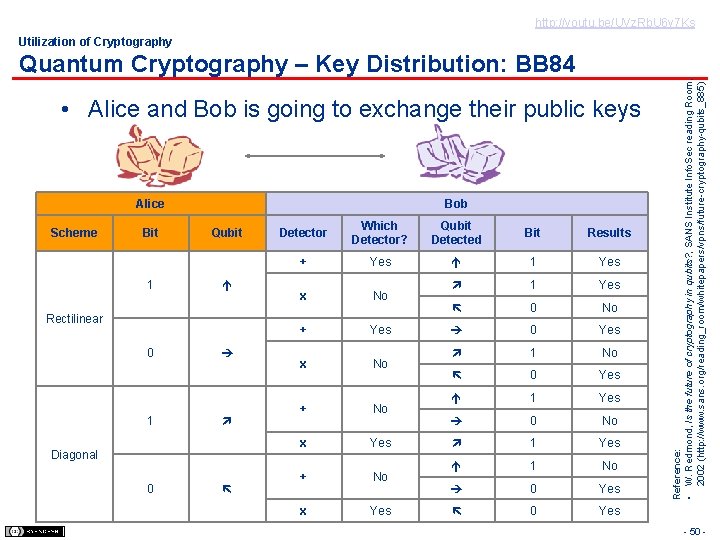
http: //youtu. be/UVz. Rb. U 6 y 7 Ks Utilization of Cryptography • Alice and Bob is going to exchange their public keys Alice Scheme Bit 1 Bob Qubit Rectilinear 0 1 Diagonal 0 Detector Which Detector? Qubit Detected Bit Results + Yes 1 Yes x No 1 Yes 0 No + Yes 0 Yes x No 1 No 0 Yes + No 1 Yes 0 No x Yes 1 Yes + No 1 No 0 Yes x Yes 0 Yes Reference: • W. Redmond, Is the future of cryptography in qubits? , SANS Institute Info. Sec reading Room, 2002 (http: //www. sans. org/reading_room/whitepapers/vpns/future-cryptography-qubits_885) Quantum Cryptography – Key Distribution: BB 84 - 50 -
Questions: • What are three secure e-mail standards? – – – • What is the difference between PKI and PGP? – PKI is based on… – PGP is based on… - 51 -
Answers: • What are three secure e-mail standards? – Privacy Enhanced Mail (PEM) – Secure/Multipurpose Internet Mail Extension (S/MIME) – Pretty Good Privacy (PGP) • What is the difference between PKI and PGP? – PKI is based on “ 3 rd party of trust”. – PGP is based on “web of trusts”. - 52 -
Topics Cryptography Domain – Part 2 • Utilization of Cryptography – – – Public Key Infrastructure (PKI) HTTP, S-HTTP, IPsec, SSH, SET Single Sign-On (SSO) Secured E-mail Quantum Cryptography • Types of Crypto Attacks – Cryptanalytic Attacks – Cryptographic Attacks • Discussion on export of crypto technologies - 53 -
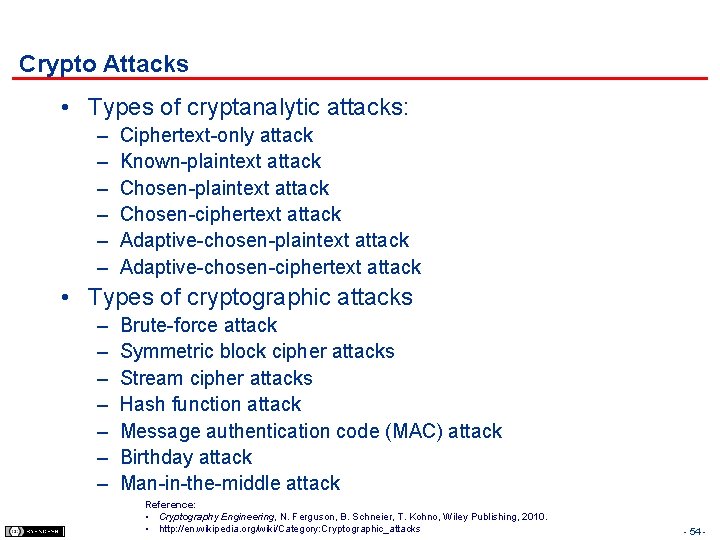
Crypto Attacks • Types of cryptanalytic attacks: – – – Ciphertext-only attack Known-plaintext attack Chosen-ciphertext attack Adaptive-chosen-plaintext attack Adaptive-chosen-ciphertext attack • Types of cryptographic attacks – – – – Brute-force attack Symmetric block cipher attacks Stream cipher attacks Hash function attack Message authentication code (MAC) attack Birthday attack Man-in-the-middle attack Reference: • Cryptography Engineering, N. Ferguson, B. Schneier, T. Kohno, Wiley Publishing, 2010. • http: //en. wikipedia. org/wiki/Category: Cryptographic_attacks - 54 -
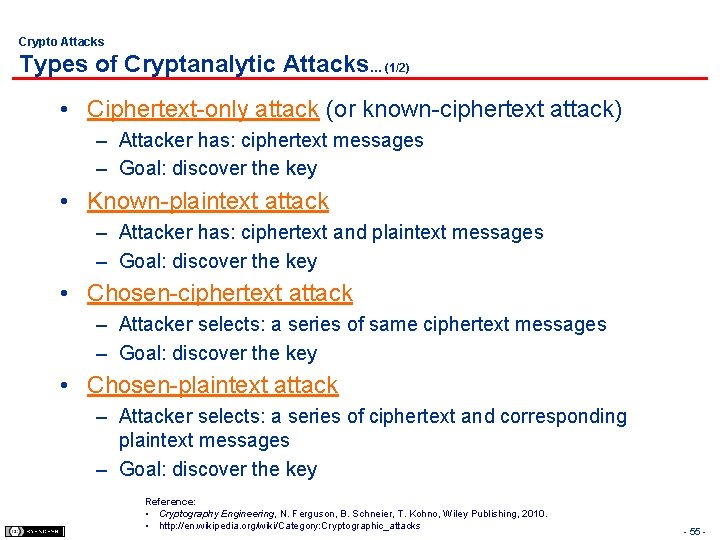
Crypto Attacks Types of Cryptanalytic Attacks… (1/2) • Ciphertext-only attack (or known-ciphertext attack) – Attacker has: ciphertext messages – Goal: discover the key • Known-plaintext attack – Attacker has: ciphertext and plaintext messages – Goal: discover the key • Chosen-ciphertext attack – Attacker selects: a series of same ciphertext messages – Goal: discover the key • Chosen-plaintext attack – Attacker selects: a series of ciphertext and corresponding plaintext messages – Goal: discover the key Reference: • Cryptography Engineering, N. Ferguson, B. Schneier, T. Kohno, Wiley Publishing, 2010. • http: //en. wikipedia. org/wiki/Category: Cryptographic_attacks - 55 -
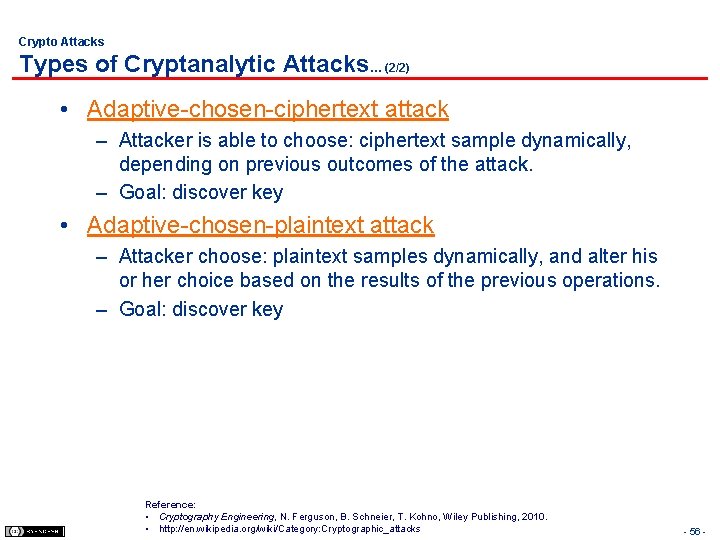
Crypto Attacks Types of Cryptanalytic Attacks… (2/2) • Adaptive-chosen-ciphertext attack – Attacker is able to choose: ciphertext sample dynamically, depending on previous outcomes of the attack. – Goal: discover key • Adaptive-chosen-plaintext attack – Attacker choose: plaintext samples dynamically, and alter his or her choice based on the results of the previous operations. – Goal: discover key Reference: • Cryptography Engineering, N. Ferguson, B. Schneier, T. Kohno, Wiley Publishing, 2010. • http: //en. wikipedia. org/wiki/Category: Cryptographic_attacks - 56 -
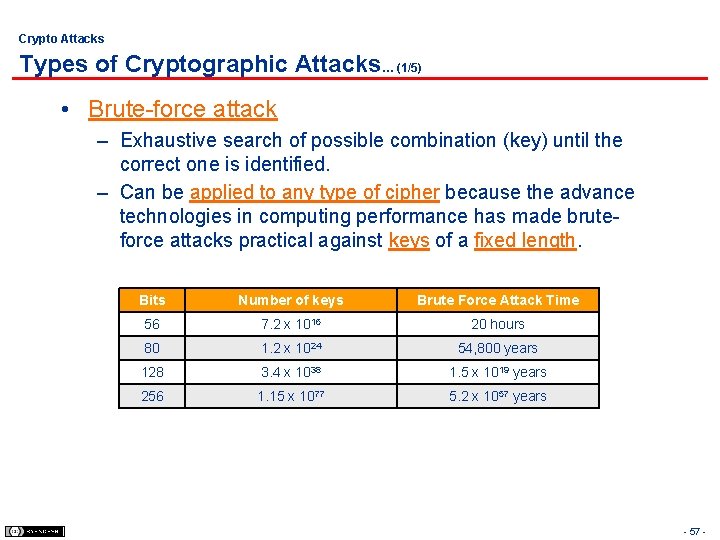
Crypto Attacks Types of Cryptographic Attacks… (1/5) • Brute-force attack – Exhaustive search of possible combination (key) until the correct one is identified. – Can be applied to any type of cipher because the advance technologies in computing performance has made bruteforce attacks practical against keys of a fixed length. Bits Number of keys Brute Force Attack Time 56 7. 2 x 10¹⁶ 20 hours 80 1. 2 x 1024 54, 800 years 128 3. 4 x 1038 1. 5 x 10¹⁹ years 256 1. 15 x 1077 5. 2 x 1057 years - 57 -
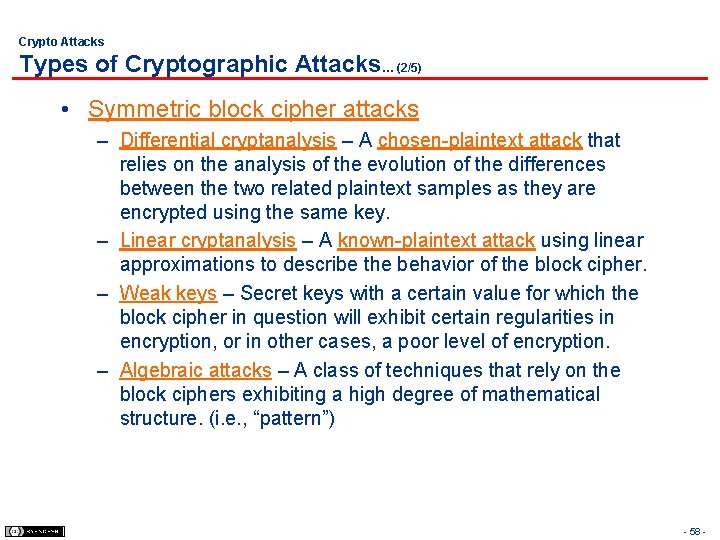
Crypto Attacks Types of Cryptographic Attacks… (2/5) • Symmetric block cipher attacks – Differential cryptanalysis – A chosen-plaintext attack that relies on the analysis of the evolution of the differences between the two related plaintext samples as they are encrypted using the same key. – Linear cryptanalysis – A known-plaintext attack using linear approximations to describe the behavior of the block cipher. – Weak keys – Secret keys with a certain value for which the block cipher in question will exhibit certain regularities in encryption, or in other cases, a poor level of encryption. – Algebraic attacks – A class of techniques that rely on the block ciphers exhibiting a high degree of mathematical structure. (i. e. , “pattern”) - 58 -
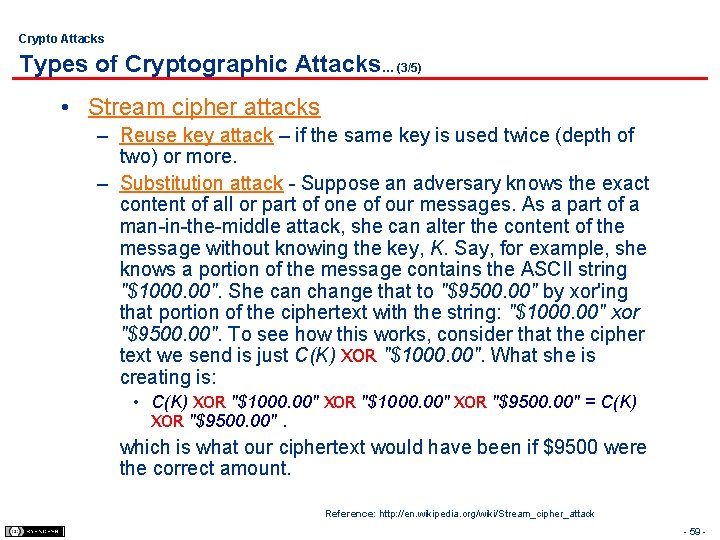
Crypto Attacks Types of Cryptographic Attacks… (3/5) • Stream cipher attacks – Reuse key attack – if the same key is used twice (depth of two) or more. – Substitution attack - Suppose an adversary knows the exact content of all or part of one of our messages. As a part of a man-in-the-middle attack, she can alter the content of the message without knowing the key, K. Say, for example, she knows a portion of the message contains the ASCII string "$1000. 00". She can change that to "$9500. 00" by xor'ing that portion of the ciphertext with the string: "$1000. 00" xor "$9500. 00". To see how this works, consider that the cipher text we send is just C(K) XOR "$1000. 00". What she is creating is: • C(K) XOR "$1000. 00" XOR "$9500. 00" = C(K) XOR "$9500. 00". which is what our ciphertext would have been if $9500 were the correct amount. Reference: http: //en. wikipedia. org/wiki/Stream_cipher_attack - 59 -
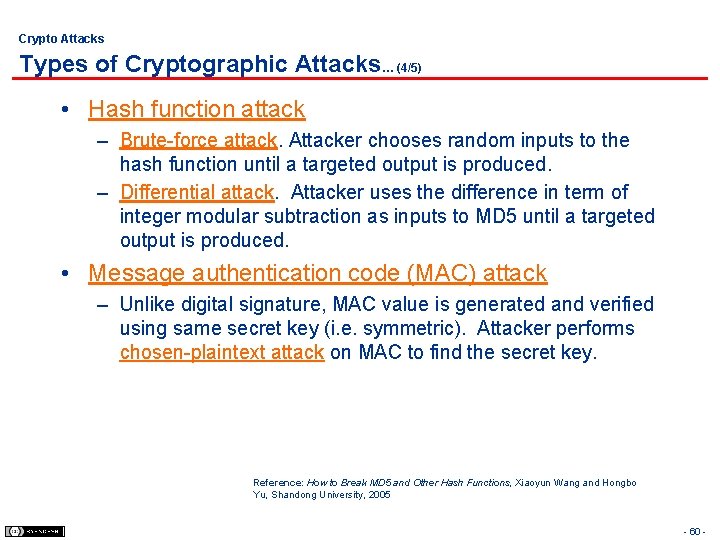
Crypto Attacks Types of Cryptographic Attacks… (4/5) • Hash function attack – Brute-force attack. Attacker chooses random inputs to the hash function until a targeted output is produced. – Differential attack. Attacker uses the difference in term of integer modular subtraction as inputs to MD 5 until a targeted output is produced. • Message authentication code (MAC) attack – Unlike digital signature, MAC value is generated and verified using same secret key (i. e. symmetric). Attacker performs chosen-plaintext attack on MAC to find the secret key. Reference: How to Break MD 5 and Other Hash Functions, Xiaoyun Wang and Hongbo Yu, Shandong University, 2005 - 60 -
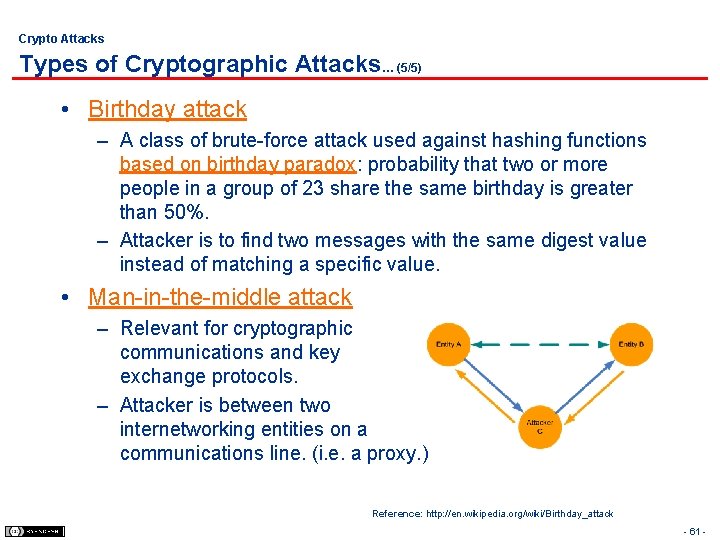
Crypto Attacks Types of Cryptographic Attacks… (5/5) • Birthday attack – A class of brute-force attack used against hashing functions based on birthday paradox: probability that two or more people in a group of 23 share the same birthday is greater than 50%. – Attacker is to find two messages with the same digest value instead of matching a specific value. • Man-in-the-middle attack – Relevant for cryptographic communications and key exchange protocols. – Attacker is between two internetworking entities on a communications line. (i. e. a proxy. ) Reference: http: //en. wikipedia. org/wiki/Birthday_attack - 61 -
Questions: • Name the type of cryptanalytic attack where the attacker uses ciphertext and plaintext messages to discover the key? – • Name the type of cryptanalytic attack where the attacker selects a series of ciphertext and corresponding plaintext messages to discover the key? – - 62 -
Answers: • Name the type of cryptanalytic attack where the attacker uses ciphertext and plaintext messages to discover the key? – Known-plaintext attack • Name the type of cryptanalytic attack where the attacker selects a series of ciphertext and corresponding plaintext messages to discover the key? – Chosen-plaintext attack - 63 -
Questions: • Brute-force attack is what type of attack? – • Birthday attack is what type of attack? – • In attacking the symmetric block cipher, differential cryptanalysis is what type of attack? – - 64 -

Answers: • Brute-force attack is what type of attack? – Cryptographic attack. • Birthday attack is what type of attack? – Cryptographic attack. • In attacking the symmetric block cipher, differential cryptanalysis is what type of attack? – Cryptographic attack. - 65 -
Topics Cryptography Domain – Part 2 • Utilization of Cryptography – – Public Key Infrastructure (PKI) HTTP, S-HTTP, IPsec, SSH, SET Single Sign-On (SSO) Secured E-mail • Types of Crypto Attacks – Cryptanalytic Attacks – Cryptographic Attacks • Discussion on export of crypto technologies - 66 -
Export Issues • Coordinating Committee for Multilateral Export Controls (COCOM) – 17 member nations, dissolved in March 1994. – Maintained International Industrial List & International Munitions List. To prevent export of cryptography to “dangerous” countries. • Wassenaar Arrangement on Export Controls for Conventional Arms and Dual-Use Goods and Technologies (1995) – December 1998, 33 nations has agree to restrict export of crypto products based on key length. (56 -bit for symmetric, 512 bit for asymmetric) – Products that use encryption to protect intellectual property (e. g. DVDs) is relaxed. – Export of all other crypto require license. Reference: Official (ISC)2® Guide to the CISSP® Exam - 67 -
Export Issues • U. S. Export Administration Regulations (EAR) – Administered by Bureau of Industry and Security, Department of Commerce (DOC). (http: //www. access. gpo. gov/bis/ear_data. html). – EAR, Part 774, Category 5 (Part 2) – Information Security: Mass market & retail cryptography can be exported without a license. • • Parity bits are not included in the key length Key length of 56 -bit for symmetric (DES) Key length of 512 -bit for asymmetric (RSA, Diffie-Hellman) Key length of 112 -bit for ECC-DH Reference: Official (ISC)2® Guide to the CISSP® Exam - 68 -
Export Issues • European Union Council (EC) Regulation No. 1334/2000 (22 June 2000): Setting up a Community Regime for the Control of Exports of Dual-use Items and Technology (http: //eur-lex. europa. eu/Lex. Uri. Serv. do? uri=OJ: L: 2000: 159: 0001: 0215: EN: PDF) – Member states can issue General Intra-Community Licenses to export crypto products within EU. – Export to non-EU countries require a Community General Export License (CGEA) or General National License. – Part 2 – Information Security • • Parity bits are not included in the key length Key length of 56 -bit for symmetric (DES) Key length of 512 -bit for asymmetric (RSA, Diffie-Hellman) Key length of 112 -bit for ECC-DH Reference: Official (ISC)2® Guide to the CISSP® Exam - 69 -
- Slides: 69