Coordination Chemistry Paper III Unit 1 No of
![Werner’s Theory & Isomerism Co(NH 3)4 Cl 2] Cl – Coord. no. 6 Theoretically](https://slidetodoc.com/presentation_image_h2/5730b8bc615677f0ea3c6d9ae2706463/image-29.jpg "Werner’s Theory & Isomerism Co(NH 3)4 Cl 2] Cl – Coord. no. 6 Theoretically")
- Slides: 33
Coordination Chemistry Paper III Unit 1 No. of Classes - 12 www. smitaasthana. com 1
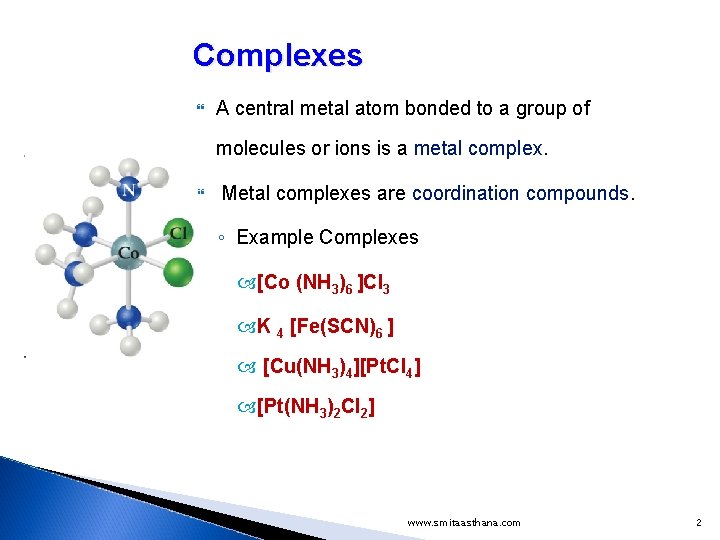
Complexes A central metal atom bonded to a group of molecules or ions is a metal complex. Metal complexes are coordination compounds. ◦ Example Complexes [Co (NH 3)6 ]Cl 3 K 4 [Fe(SCN)6 ] [Cu(NH 3)4][Pt. Cl 4] [Pt(NH 3)2 Cl 2] www. smitaasthana. com 2
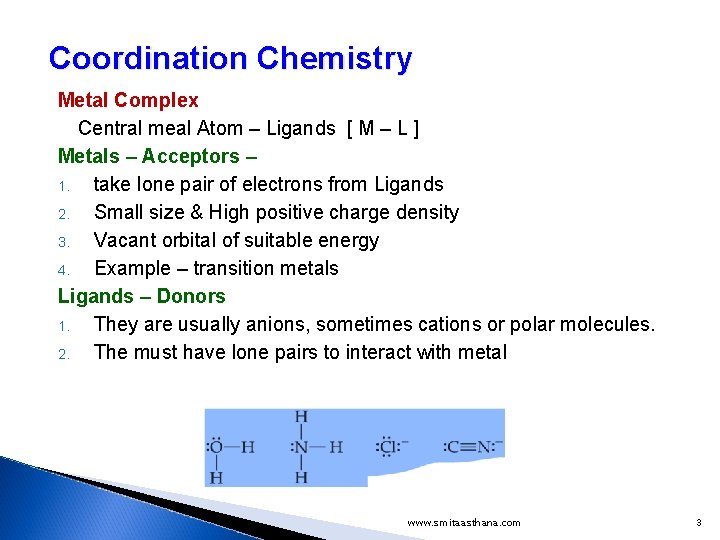
Coordination Chemistry Metal Complex Central meal Atom – Ligands [ M – L ] Metals – Acceptors – 1. take lone pair of electrons from Ligands 2. Small size & High positive charge density 3. Vacant orbital of suitable energy 4. Example – transition metals Ligands – Donors 1. They are usually anions, sometimes cations or polar molecules. 2. The must have lone pairs to interact with metal www. smitaasthana. com 3
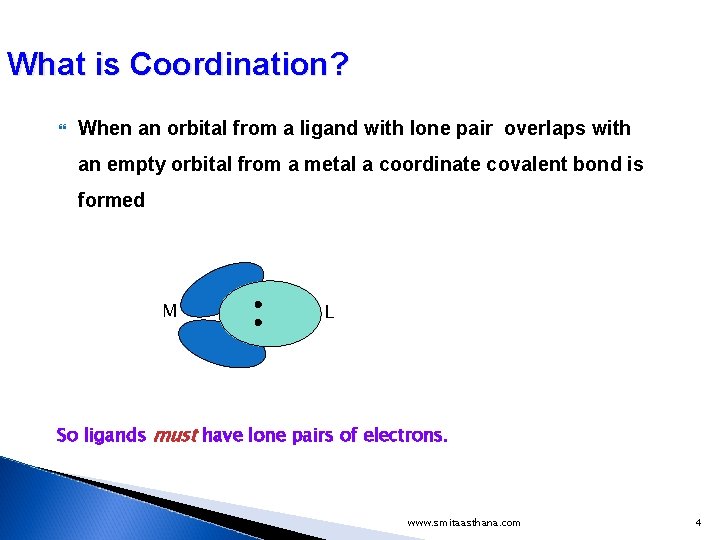
What is Coordination? When an orbital from a ligand with lone pair overlaps with an empty orbital from a metal a coordinate covalent bond is formed M L So ligands must have lone pairs of electrons. www. smitaasthana. com 4
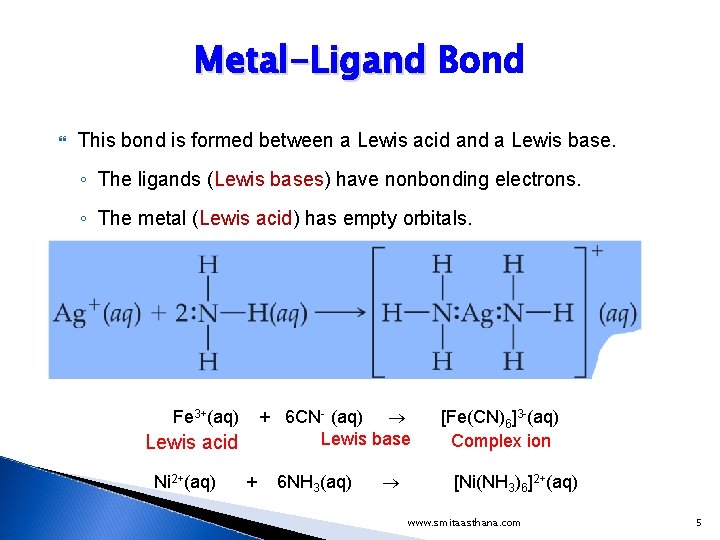
Metal-Ligand Bond This bond is formed between a Lewis acid and a Lewis base. ◦ The ligands (Lewis bases) have nonbonding electrons. ◦ The metal (Lewis acid) has empty orbitals. + 6 CN- (aq) Lewis base Fe 3+(aq) Lewis acid Ni 2+(aq) + 6 NH 3(aq) [Fe(CN)6]3 -(aq) Complex ion [Ni(NH 3)6]2+(aq) www. smitaasthana. com 5
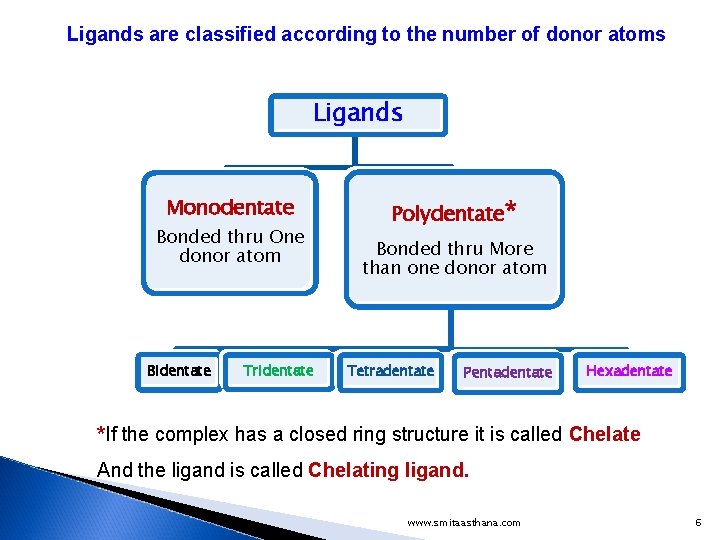
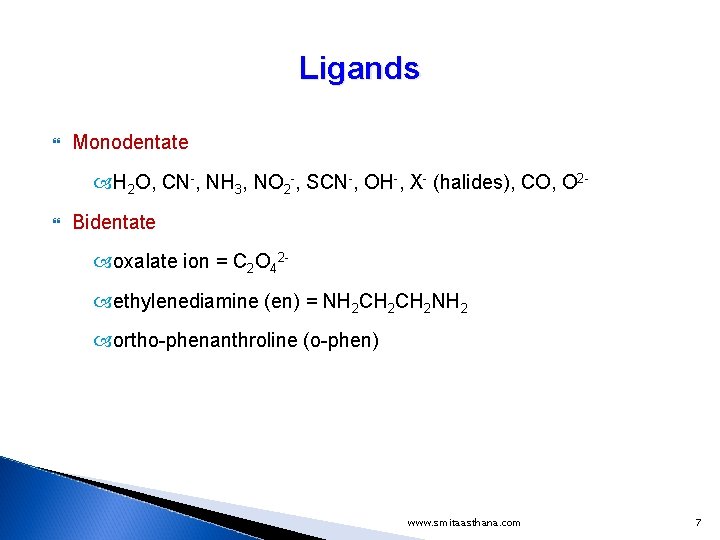
Ligands are classified according to the number of donor atoms Ligands Monodentate Bonded thru One donor atom Bidentate Tridentate Polydentate* Bonded thru More than one donor atom Tetradentate Pentadentate Hexadentate *If the complex has a closed ring structure it is called Chelate And the ligand is called Chelating ligand. www. smitaasthana. com 6
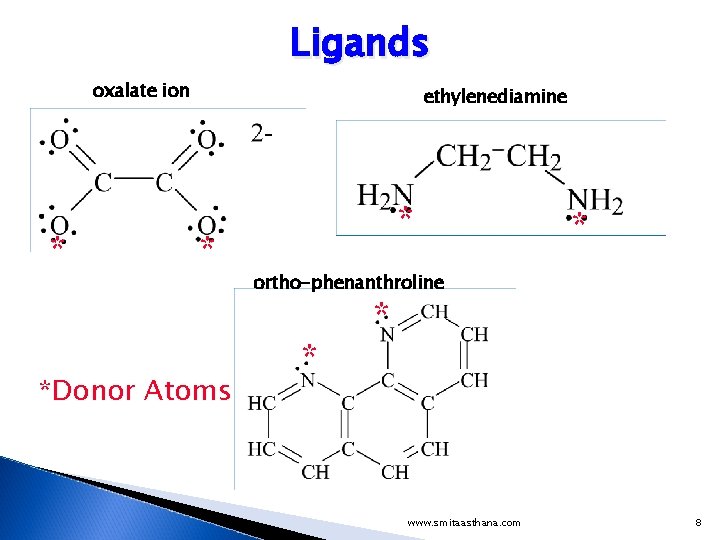
Ligands Monodentate H 2 O, CN-, NH 3, NO 2 -, SCN-, OH-, X- (halides), CO, O 2 Bidentate oxalate ion = C 2 O 42 ethylenediamine (en) = NH 2 CH 2 NH 2 ortho-phenanthroline (o-phen) www. smitaasthana. com 7
Ligands oxalate ion * ethylenediamine * *Donor Atoms * * ortho-phenanthroline * * www. smitaasthana. com 8
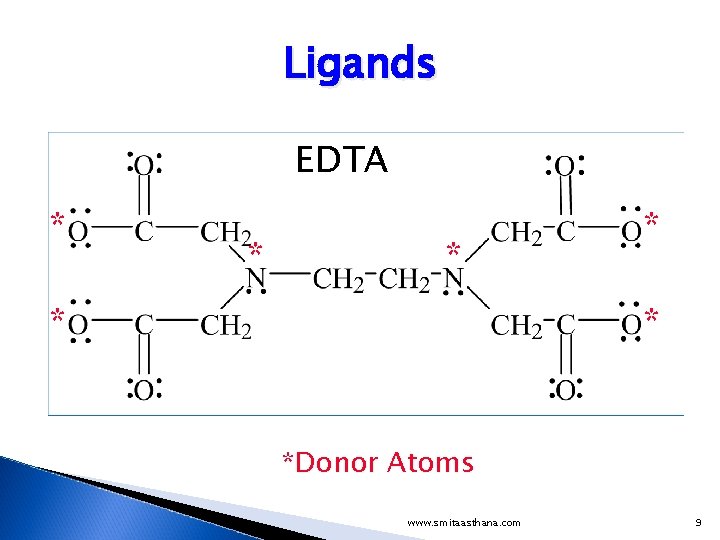
Ligands EDTA * * * *Donor Atoms www. smitaasthana. com 9
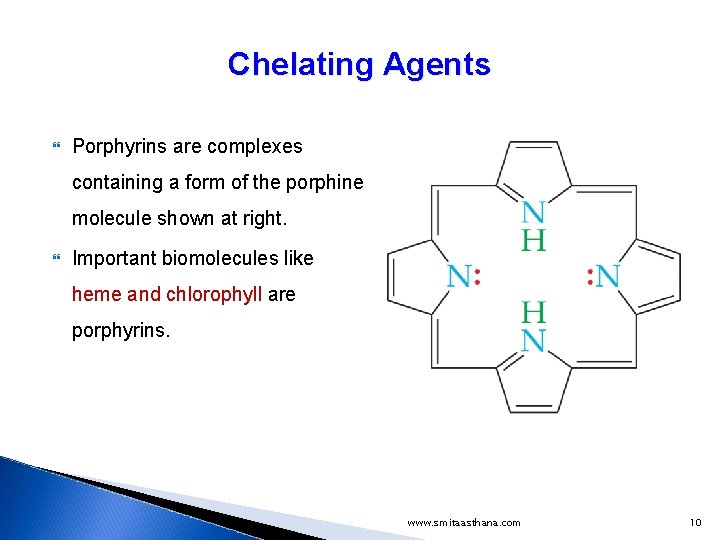
Chelating Agents Porphyrins are complexes containing a form of the porphine molecule shown at right. Important biomolecules like heme and chlorophyll are porphyrins. www. smitaasthana. com 10
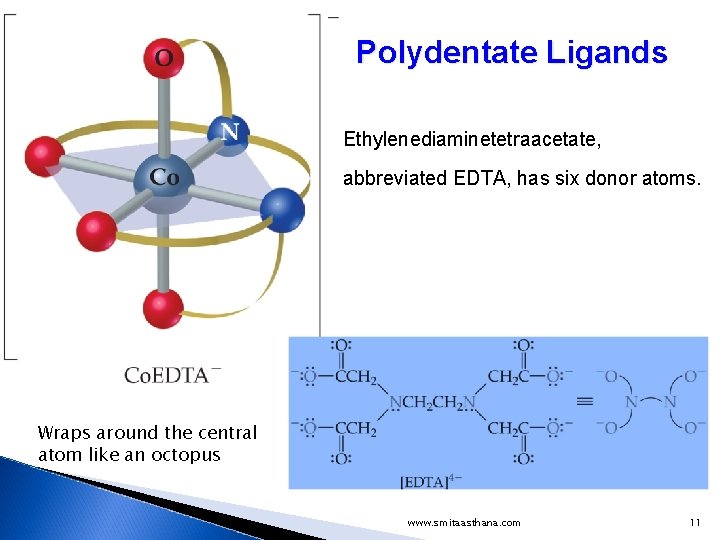
Polydentate Ligands Ethylenediaminetetraacetate, abbreviated EDTA, has six donor atoms. Wraps around the central atom like an octopus www. smitaasthana. com 11
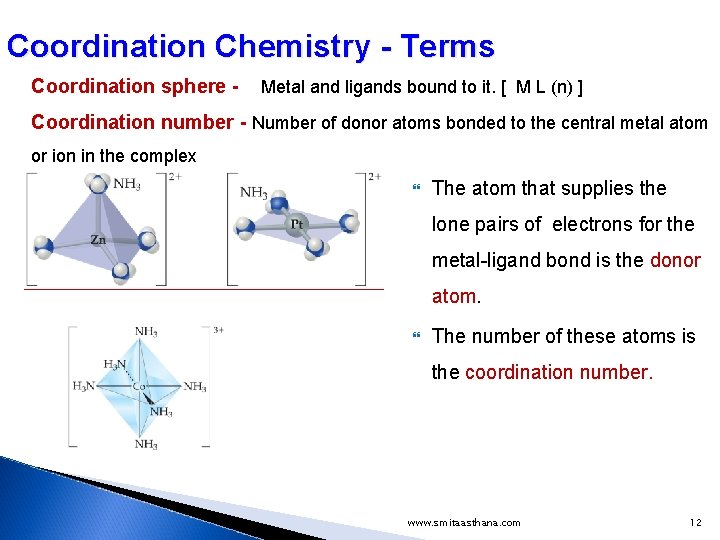
Coordination Chemistry - Terms Coordination sphere - Metal and ligands bound to it. [ M L (n) ] Coordination number - Number of donor atoms bonded to the central metal atom or ion in the complex The atom that supplies the lone pairs of electrons for the metal-ligand bond is the donor atom. The number of these atoms is the coordination number. www. smitaasthana. com 12
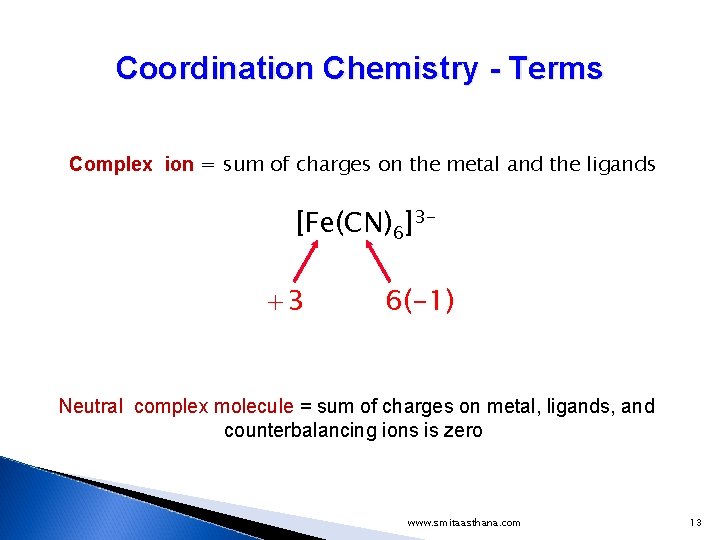
Coordination Chemistry - Terms Complex ion = sum of charges on the metal and the ligands [Fe(CN)6]3+3 6(-1) Neutral complex molecule = sum of charges on metal, ligands, and counterbalancing ions is zero www. smitaasthana. com 13
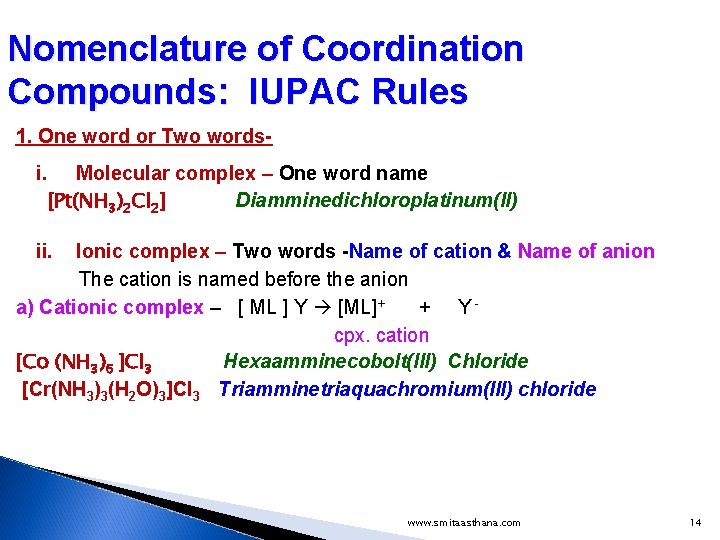
Nomenclature of Coordination Compounds: IUPAC Rules 1. One word or Two words- i. Molecular complex – One word name [Pt(NH 3)2 Cl 2] Diamminedichloroplatinum(II) ii. Ionic complex – Two words -Name of cation & Name of anion The cation is named before the anion a) Cationic complex – [ ML ] Y [ML]+ + Ycpx. cation [Co (NH 3)6 ]Cl 3 Hexaamminecobolt(III) Chloride [Cr(NH 3)3(H 2 O)3]Cl 3 Triamminetriaquachromium(III) chloride www. smitaasthana. com 14
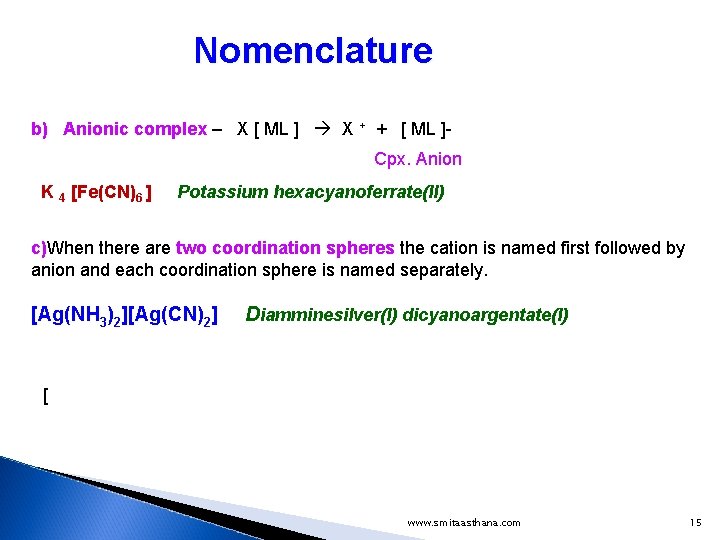
Nomenclature b) Anionic complex – X [ ML ] X + + [ ML ]Cpx. Anion K 4 [Fe(CN)6 ] Potassium hexacyanoferrate(II) c)When there are two coordination spheres the cation is named first followed by anion and each coordination sphere is named separately. [Ag(NH 3)2][Ag(CN)2] Diamminesilver(I) dicyanoargentate(I) [ www. smitaasthana. com 15
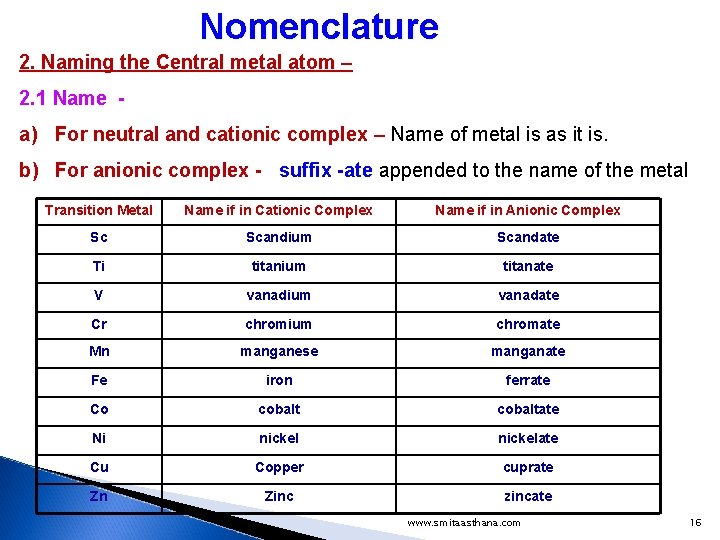
Nomenclature 2. Naming the Central metal atom – 2. 1 Name - a) For neutral and cationic complex – Name of metal is as it is. b) For anionic complex - suffix -ate appended to the name of the metal Transition Metal Name if in Cationic Complex Name if in Anionic Complex Sc Scandium Scandate Ti titanium titanate V vanadium vanadate Cr chromium chromate Mn manganese manganate Fe iron ferrate Co cobaltate Ni nickelate Cu Copper cuprate Zn Zinc zincate www. smitaasthana. com 16
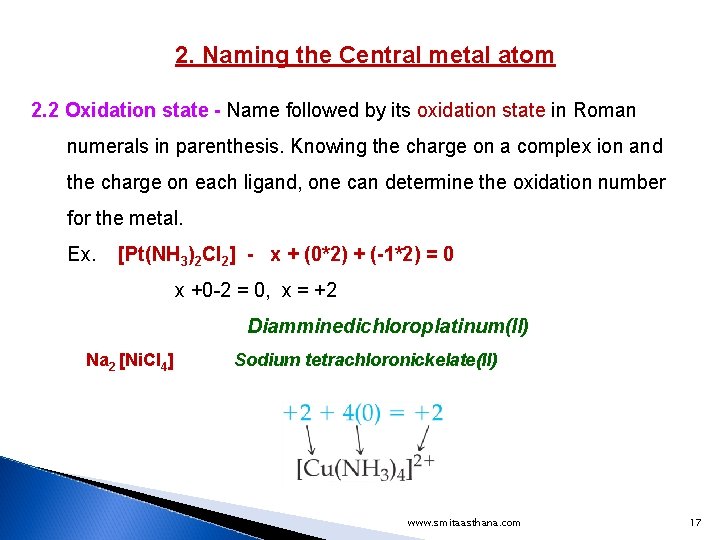
2. Naming the Central metal atom 2. 2 Oxidation state - Name followed by its oxidation state in Roman numerals in parenthesis. Knowing the charge on a complex ion and the charge on each ligand, one can determine the oxidation number for the metal. Ex. [Pt(NH 3)2 Cl 2] - x + (0*2) + (-1*2) = 0 x +0 -2 = 0, x = +2 Diamminedichloroplatinum(II) Na 2 [Ni. Cl 4] Sodium tetrachloronickelate(II) www. smitaasthana. com 17
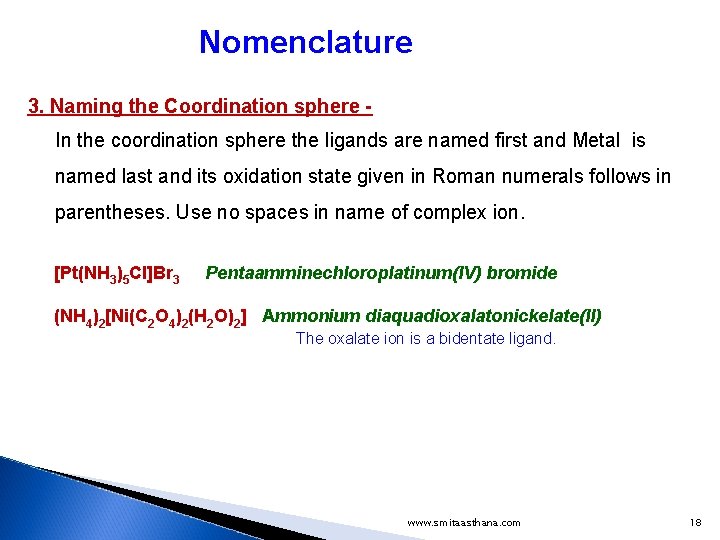
Nomenclature 3. Naming the Coordination sphere In the coordination sphere the ligands are named first and Metal is named last and its oxidation state given in Roman numerals follows in parentheses. Use no spaces in name of complex ion. [Pt(NH 3)5 Cl]Br 3 Pentaamminechloroplatinum(IV) bromide (NH 4)2[Ni(C 2 O 4)2(H 2 O)2] Ammonium diaquadioxalatonickelate(II) The oxalate ion is a bidentate ligand. www. smitaasthana. com 18
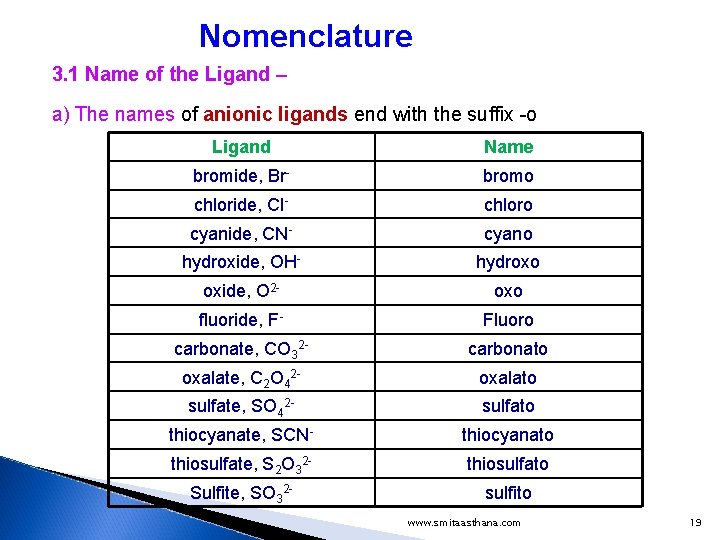
Nomenclature 3. 1 Name of the Ligand – a) The names of anionic ligands end with the suffix -o Ligand Name bromide, Br- bromo chloride, Cl- chloro cyanide, CN- cyano hydroxide, OH- hydroxo oxide, O 2 - oxo fluoride, F- Fluoro carbonate, CO 32 - carbonato oxalate, C 2 O 42 - oxalato sulfate, SO 42 - sulfato thiocyanate, SCN- thiocyanato thiosulfate, S 2 O 32 - thiosulfato Sulfite, SO 32 - sulfito www. smitaasthana. com 19
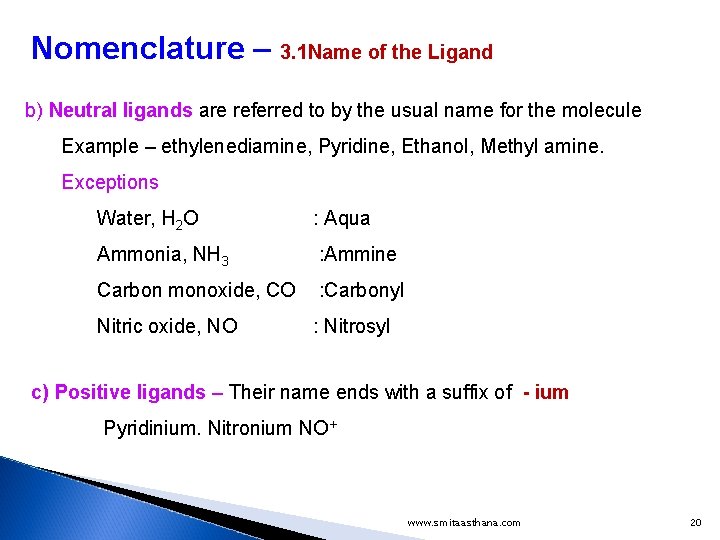
Nomenclature – 3. 1 Name of the Ligand b) Neutral ligands are referred to by the usual name for the molecule Example – ethylenediamine, Pyridine, Ethanol, Methyl amine. Exceptions Water, H 2 O : Aqua Ammonia, NH 3 : Ammine Carbon monoxide, CO : Carbonyl Nitric oxide, NO : Nitrosyl c) Positive ligands – Their name ends with a suffix of - ium Pyridinium. Nitronium NO+ www. smitaasthana. com 20
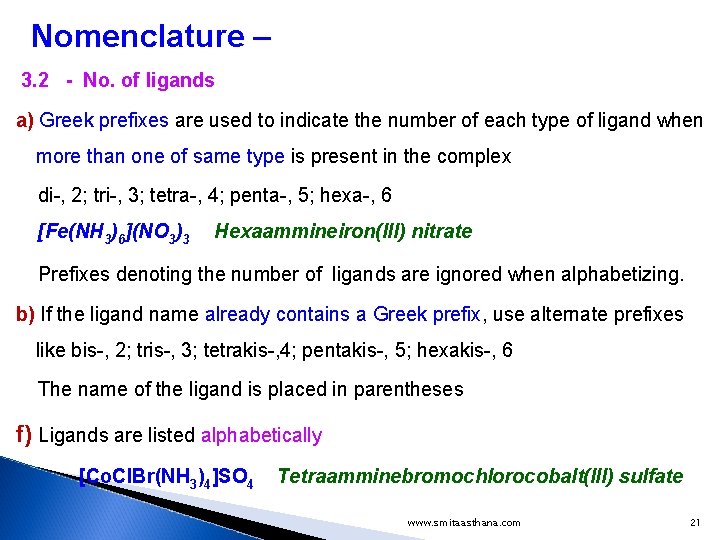
Nomenclature – 3. 2 - No. of ligands a) Greek prefixes are used to indicate the number of each type of ligand when more than one of same type is present in the complex di-, 2; tri-, 3; tetra-, 4; penta-, 5; hexa-, 6 [Fe(NH 3)6](NO 3)3 Hexaammineiron(III) nitrate Prefixes denoting the number of ligands are ignored when alphabetizing. b) If the ligand name already contains a Greek prefix, use alternate prefixes like bis-, 2; tris-, 3; tetrakis-, 4; pentakis-, 5; hexakis-, 6 The name of the ligand is placed in parentheses f) Ligands are listed alphabetically [Co. Cl. Br(NH 3)4]SO 4 Tetraamminebromochlorocobalt(III) sulfate www. smitaasthana. com 21
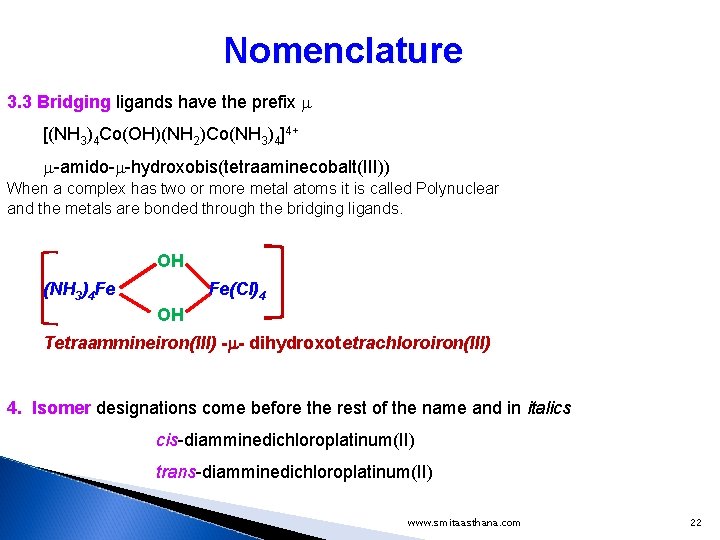
Nomenclature 3. 3 Bridging ligands have the prefix m [(NH 3)4 Co(OH)(NH 2)Co(NH 3)4]4+ m-amido-m-hydroxobis(tetraaminecobalt(III)) When a complex has two or more metal atoms it is called Polynuclear and the metals are bonded through the bridging ligands. OH (NH 3)4 Fe Fe(Cl)4 OH Tetraammineiron(III) -m- dihydroxotetrachloroiron(III) 4. Isomer designations come before the rest of the name and in italics cis-diamminedichloroplatinum(II) trans-diamminedichloroplatinum(II) www. smitaasthana. com 22
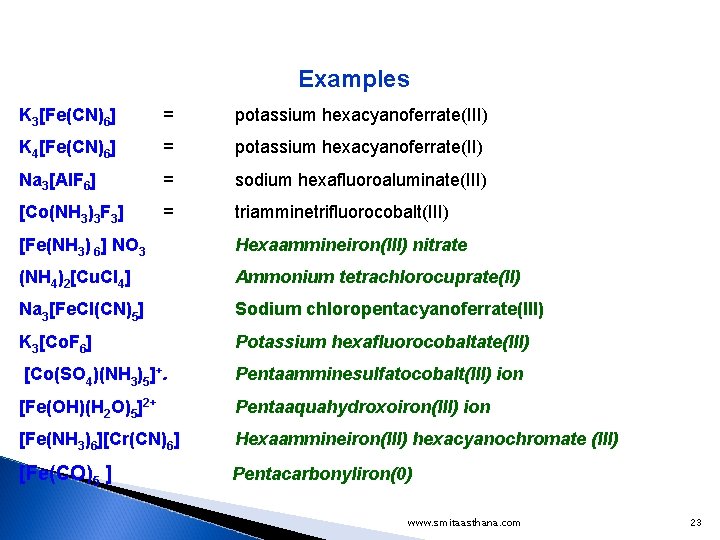
Examples K 3[Fe(CN)6] = potassium hexacyanoferrate(III) K 4[Fe(CN)6] = potassium hexacyanoferrate(II) Na 3[Al. F 6] = sodium hexafluoroaluminate(III) [Co(NH 3)3 F 3] = triamminetrifluorocobalt(III) [Fe(NH 3) 6] NO 3 Hexaammineiron(III) nitrate (NH 4)2[Cu. Cl 4] Ammonium tetrachlorocuprate(II) Na 3[Fe. Cl(CN)5] Sodium chloropentacyanoferrate(III) K 3[Co. F 6] Potassium hexafluorocobaltate(III) [Co(SO 4)(NH 3)5]+. Pentaamminesulfatocobalt(III) ion [Fe(OH)(H 2 O)5]2+ Pentaaquahydroxoiron(III) ion [Fe(NH 3)6][Cr(CN)6] Hexaammineiron(III) hexacyanochromate (III) [Fe(CO)5 ] Pentacarbonyliron(0) www. smitaasthana. com 23
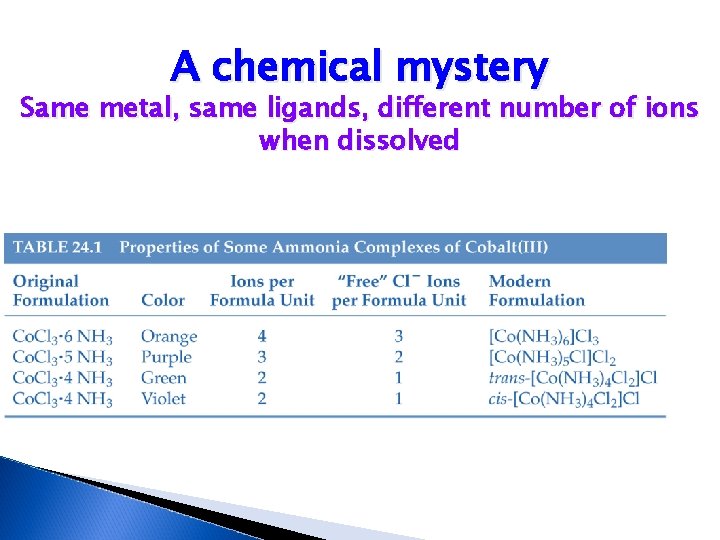
A chemical mystery Same metal, same ligands, different number of ions when dissolved
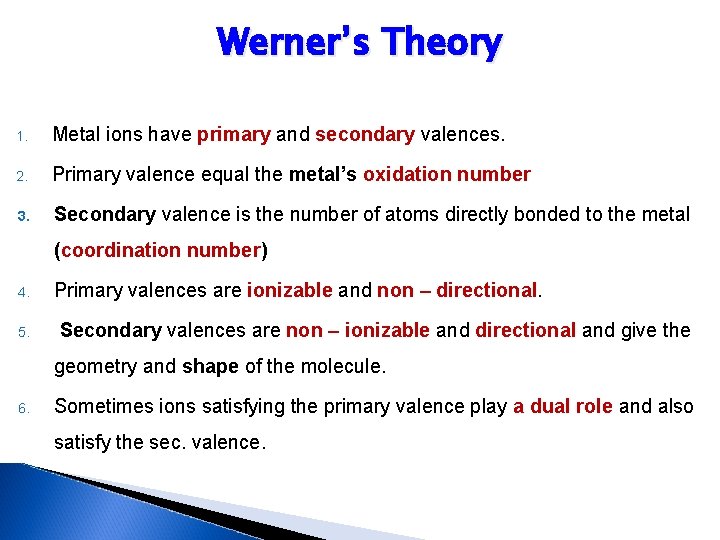
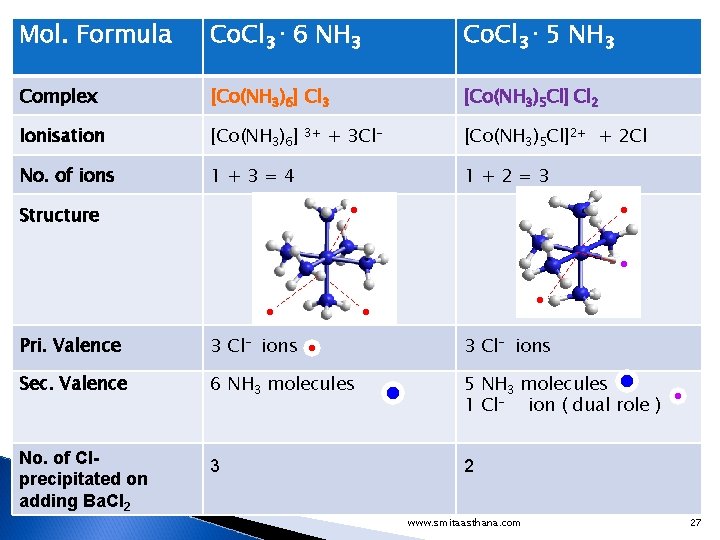
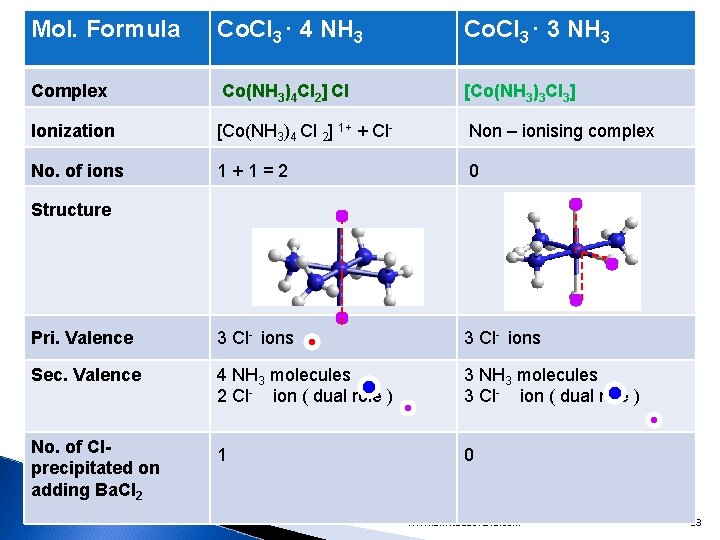
Werner’s Theory 1. Metal ions have primary and secondary valences. 2. Primary valence equal the metal’s oxidation number 3. Secondary valence is the number of atoms directly bonded to the metal (coordination number) 4. 5. Primary valences are ionizable and non – directional. Secondary valences are non – ionizable and directional and give the geometry and shape of the molecule. 6. Sometimes ions satisfying the primary valence play a dual role and also satisfy the sec. valence.
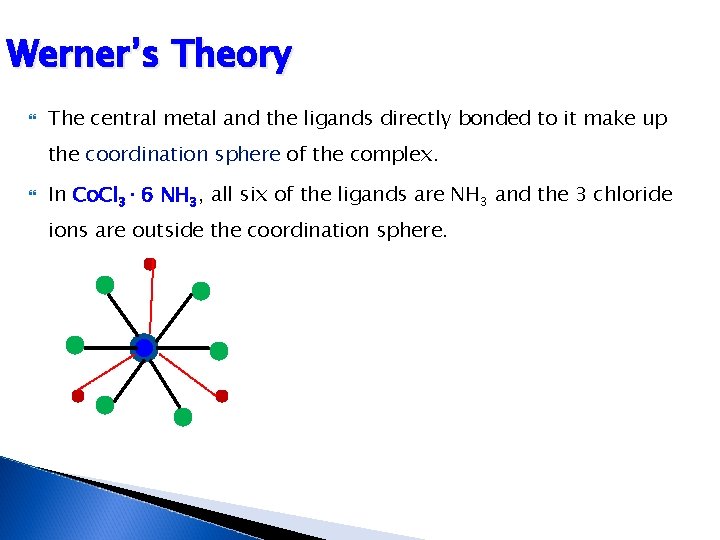
Werner’s Theory The central metal and the ligands directly bonded to it make up the coordination sphere of the complex. In Co. Cl 3 ∙ 6 NH 3, all six of the ligands are NH 3 and the 3 chloride ions are outside the coordination sphere.
Mol. Formula Co. Cl 3 ∙ 6 NH 3 Co. Cl 3 ∙ 5 NH 3 Complex [Co(NH 3)6] Cl 3 [Co(NH 3)5 Cl] Cl 2 Ionisation [Co(NH 3)6] [Co(NH 3)5 Cl]2+ + 2 Cl No. of ions 1+3=4 1+2=3 Pri. Valence 3 Cl- ions Sec. Valence 6 NH 3 molecules 5 NH 3 molecules 1 Cl- ion ( dual role ) No. of Clprecipitated on adding Ba. Cl 2 3+ + 3 Cl- Structure www. smitaasthana. com 27
Mol. Formula Co. Cl 3 ∙ 4 NH 3 Co. Cl 3 ∙ 3 NH 3 Complex Co(NH 3)4 Cl 2] Cl [Co(NH 3)3 Cl 3] Ionization [Co(NH 3)4 Cl 2] 1+ + Cl- Non – ionising complex No. of ions 1+1=2 0 Pri. Valence 3 Cl- ions Sec. Valence 4 NH 3 molecules 2 Cl- ion ( dual role ) 3 NH 3 molecules 3 Cl- ion ( dual role ) No. of Clprecipitated on adding Ba. Cl 2 1 0 Structure www. smitaasthana. com 28
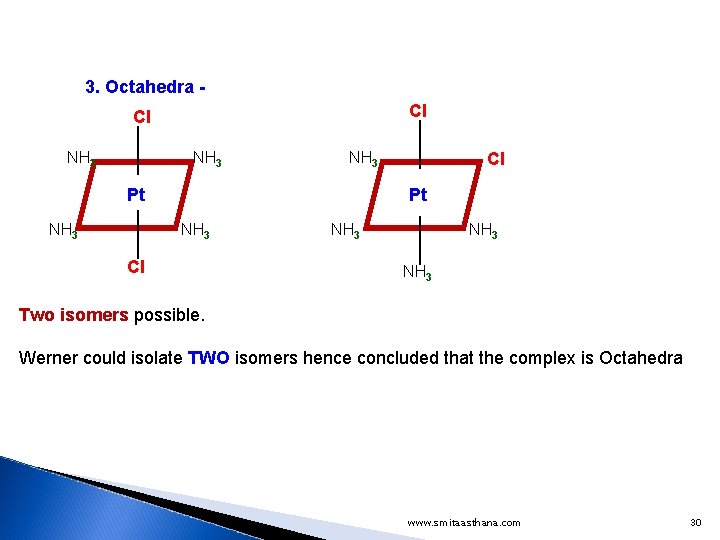
Werner’s Theory & Isomerism Co(NH 3)4 Cl 2] Cl – Coord. no. 6 Theoretically 3 shapes possible 1. Hexagonal Planar - 3 isomers NH 3 Cl Cl NH 3 2. Cl NH 3 NH 3 NH 3 Cl Trigonal Prism – 3 isomers Cl Cl NH 3 NH 3 Cl NH 3
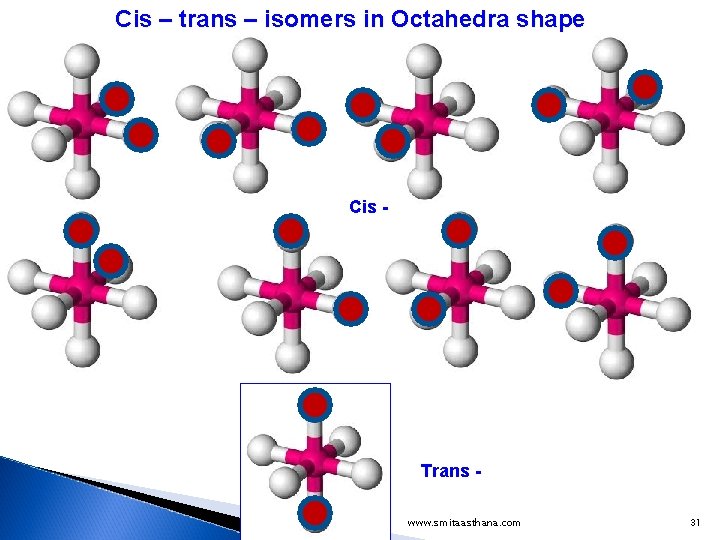
3. Octahedra Cl Cl NH 3 Pt NH 3 Cl NH 3 Two isomers possible. Werner could isolate TWO isomers hence concluded that the complex is Octahedra www. smitaasthana. com 30
Cis – trans – isomers in Octahedra shape Cis - Trans www. smitaasthana. com 31
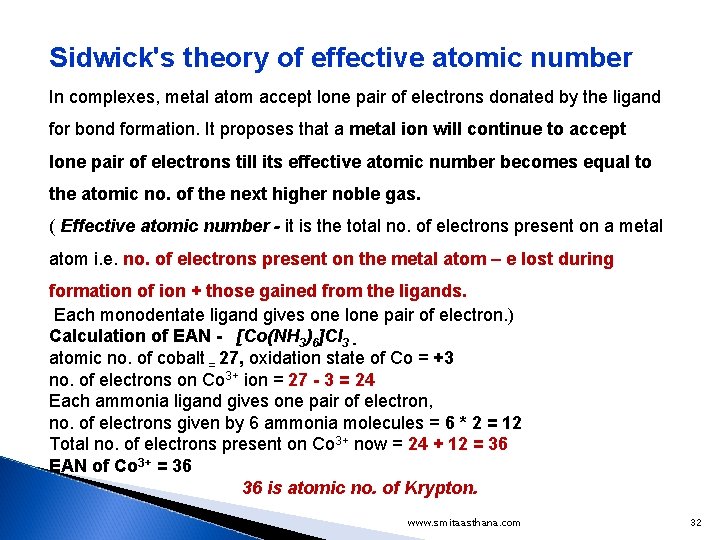
Sidwick's theory of effective atomic number In complexes, metal atom accept lone pair of electrons donated by the ligand for bond formation. It proposes that a metal ion will continue to accept lone pair of electrons till its effective atomic number becomes equal to the atomic no. of the next higher noble gas. ( Effective atomic number - it is the total no. of electrons present on a metal atom i. e. no. of electrons present on the metal atom – e lost during formation of ion + those gained from the ligands. Each monodentate ligand gives one lone pair of electron. ) Calculation of EAN - [Co(NH 3)6]Cl 3 atomic no. of cobalt = 27, oxidation state of Co = +3 no. of electrons on Co 3+ ion = 27 - 3 = 24 Each ammonia ligand gives one pair of electron, no. of electrons given by 6 ammonia molecules = 6 * 2 = 12 Total no. of electrons present on Co 3+ now = 24 + 12 = 36 EAN of Co 3+ = 36 36 is atomic no. of Krypton. www. smitaasthana. com 32
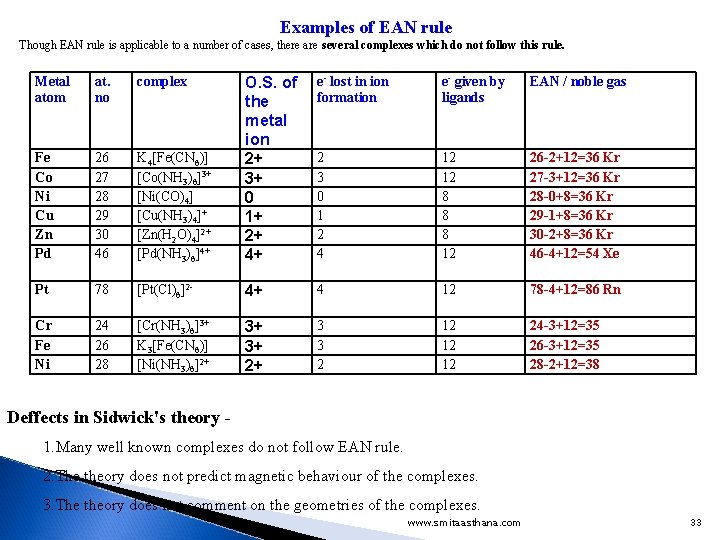
Examples of EAN rule Though EAN rule is applicable to a number of cases, there are several complexes which do not follow this rule. Metal atom at. no complex e- lost in ion formation e- given by ligands EAN / noble gas K 4[Fe(CN 6)] [Co(NH 3)6]3+ [Ni(CO)4] [Cu(NH 3)4]+ [Zn(H 2 O)4]2+ [Pd(NH 3)6]4+ O. S. of the metal ion 2+ 3+ 0 1+ 2+ 4+ Fe Co Ni Cu Zn Pd 26 27 28 29 30 46 2 3 0 1 2 4 12 12 8 8 8 12 26 -2+12=36 Kr 27 -3+12=36 Kr 28 -0+8=36 Kr 29 -1+8=36 Kr 30 -2+8=36 Kr 46 -4+12=54 Xe Pt 78 [Pt(Cl)6]2 - 4+ 4 12 78 -4+12=86 Rn Cr Fe Ni 24 26 28 [Cr(NH 3)6]3+ K 3[Fe(CN 6)] [Ni(NH 3)6]2+ 3+ 3+ 2+ 3 3 2 12 12 12 24 -3+12=35 26 -3+12=35 28 -2+12=38 Deffects in Sidwick's theory 1. Many well known complexes do not follow EAN rule. 2. The theory does not predict magnetic behaviour of the complexes. 3. The theory does not comment on the geometries of the complexes. www. smitaasthana. com 33