Chapters 1 10 Midterm Review CSCI 3753 Operating






- Slides: 37
Chapters 1 -10 Midterm Review CSCI 3753 Operating Systems, Spring 2005 Professor Rick Han Prof. Rick Han, University of Colorado at Boulder
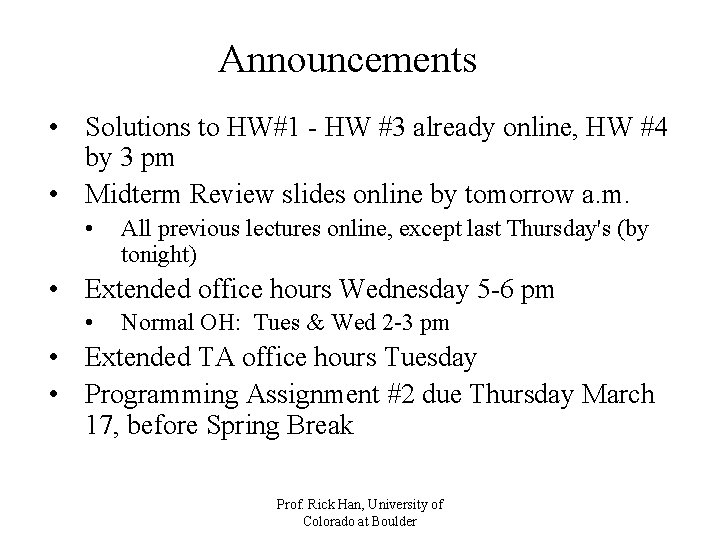
Announcements • Solutions to HW#1 - HW #3 already online, HW #4 by 3 pm • Midterm Review slides online by tomorrow a. m. • All previous lectures online, except last Thursday's (by tonight) • Extended office hours Wednesday 5 -6 pm • Normal OH: Tues & Wed 2 -3 pm • Extended TA office hours Tuesday • Programming Assignment #2 due Thursday March 17, before Spring Break Prof. Rick Han, University of Colorado at Boulder
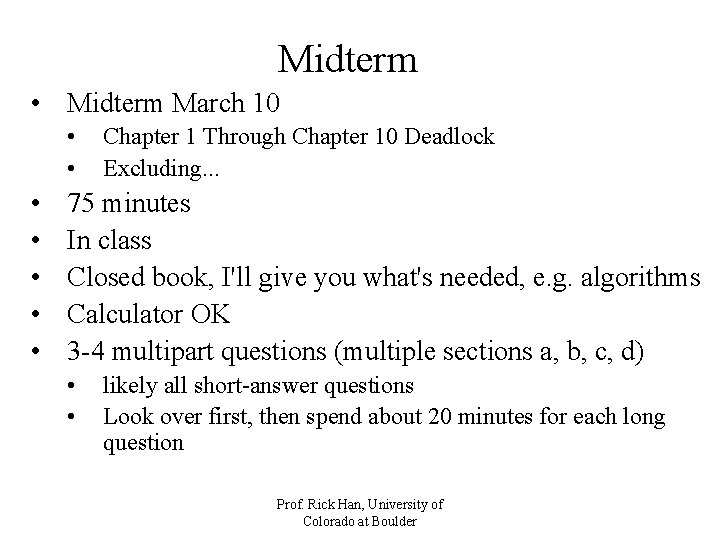
Midterm • Midterm March 10 • • Chapter 1 Through Chapter 10 Deadlock Excluding. . . 75 minutes In class Closed book, I'll give you what's needed, e. g. algorithms Calculator OK 3 -4 multipart questions (multiple sections a, b, c, d) • • likely all short-answer questions Look over first, then spend about 20 minutes for each long question Prof. Rick Han, University of Colorado at Boulder
Potential Topics for Midterm • List is not all-inclusive; some topics may appear on midterm not listed here • How does ___ work? Why is it used? Under what conditions does it apply/not apply? • Work backwards • Start with the slides, then supplement with the book • • • Chapters 8 -10 Synchronization and Deadlock • probably 2 problems Chapters 6 -7 Processes, Threads, and Scheduling • probably 1 problem Chapters 3 -5 Hardware, Device Management • probably 1 problem Prof. Rick Han, University of Colorado at Boulder
Potential Topics for Midterm • Synchronization – Critical sections – Race conditions – Atomic operations – Mutual exclusion – Spinlocks – disabling interrupts – Testand. Set() Prof. Rick Han, University of Colorado at Boulder
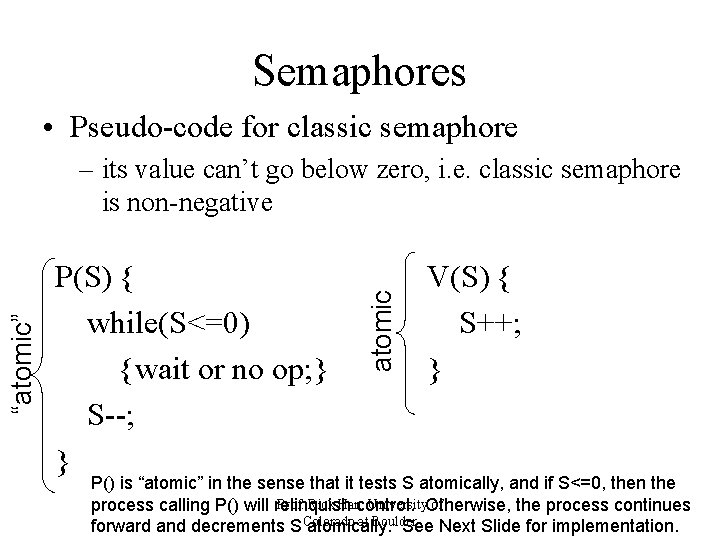
Semaphores • Pseudo-code for classic semaphore P(S) { while(S<=0) {wait or no op; } S--; } atomic “atomic” – its value can’t go below zero, i. e. classic semaphore is non-negative V(S) { S++; } P() is “atomic” in the sense that it tests S atomically, and if S<=0, then the Prof. Rick Han, University. Otherwise, of process calling P() will relinquish control. the process continues at Boulder forward and decrements S Colorado atomically. See Next Slide for implementation.
Semaphores • Synchronization – Binary semaphores as mutex locks – Counting semaphores – Deadlock examples with semaphores Prof. Rick Han, University of Colorado at Boulder
Classic Synchronization Problems • Bounded Buffer Producer-Consumer Problem • Readers-Writers Problem – First Readers Problem • Dining Philosophers Problem • These are not just abstract problems – They are representative of several classes of synchronization problems commonly encountered when trying to synchronize access to shared resources among multiple processes Prof. Rick Han, University of Colorado at Boulder
Bounded Buffer Producer/Consumer Problem • Pool of n buffers, each capable of holding 1 item • producer takes an empty buffer and produces a full buffer • consumer takes a full buffer. Empty and produces Pool an empty buffer Producer Consumer Full Pool Prof. Rick Han, University of Colorado at Boulder Graphic © Pearson textbook slides
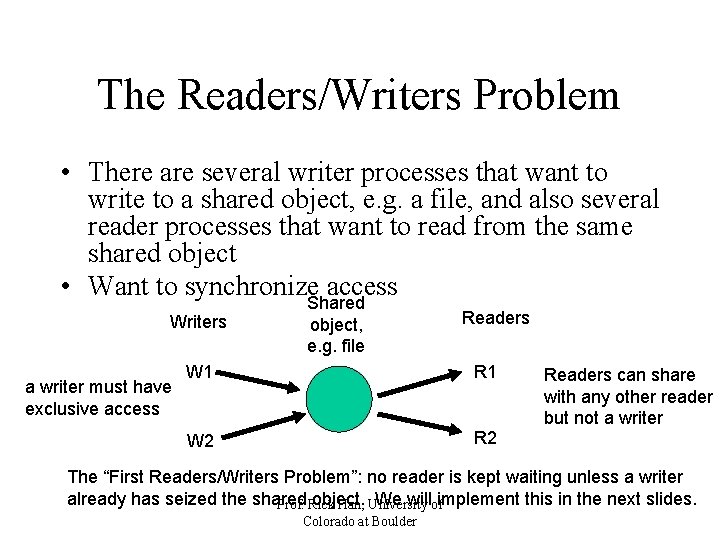
The Readers/Writers Problem • There are several writer processes that want to write to a shared object, e. g. a file, and also several reader processes that want to read from the same shared object • Want to synchronize. Shared access Writers a writer must have exclusive access object, e. g. file Readers W 1 R 1 W 2 Readers can share with any other reader but not a writer The “First Readers/Writers Problem”: no reader is kept waiting unless a writer already has seized the shared object. We willofimplement this in the next slides. Prof. Rick Han, University Colorado at Boulder
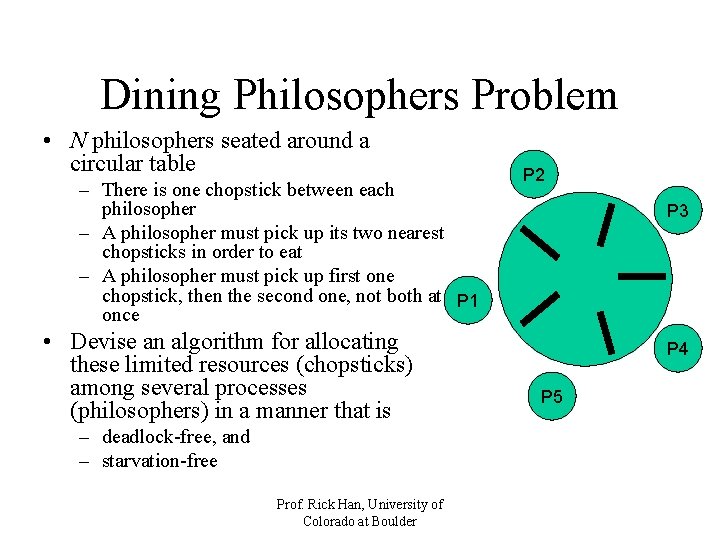
Dining Philosophers Problem • N philosophers seated around a circular table – There is one chopstick between each philosopher – A philosopher must pick up its two nearest chopsticks in order to eat – A philosopher must pick up first one chopstick, then the second one, not both at P 1 once • Devise an algorithm for allocating these limited resources (chopsticks) among several processes (philosophers) in a manner that is – deadlock-free, and – starvation-free Prof. Rick Han, University of Colorado at Boulder P 2 P 3 P 4 P 5
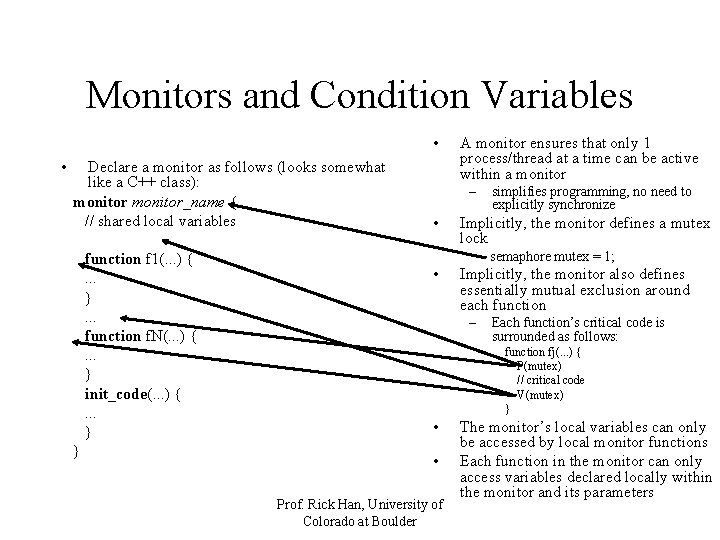
Monitors and Condition Variables • • Declare a monitor as follows (looks somewhat like a C++ class): monitor_name { // shared local variables function f 1(. . . ) {. . . }. . . function f. N(. . . ) {. . . } init_code(. . . ) {. . . } } A monitor ensures that only 1 process/thread at a time can be active within a monitor – • simplifies programming, no need to explicitly synchronize Implicitly, the monitor defines a mutex lock semaphore mutex = 1; • Implicitly, the monitor also defines essentially mutual exclusion around each function – Each function’s critical code is surrounded as follows: function fj(. . . ) { P(mutex) // critical code V(mutex) } • • Prof. Rick Han, University of Colorado at Boulder The monitor’s local variables can only be accessed by local monitor functions Each function in the monitor can only access variables declared locally within the monitor and its parameters
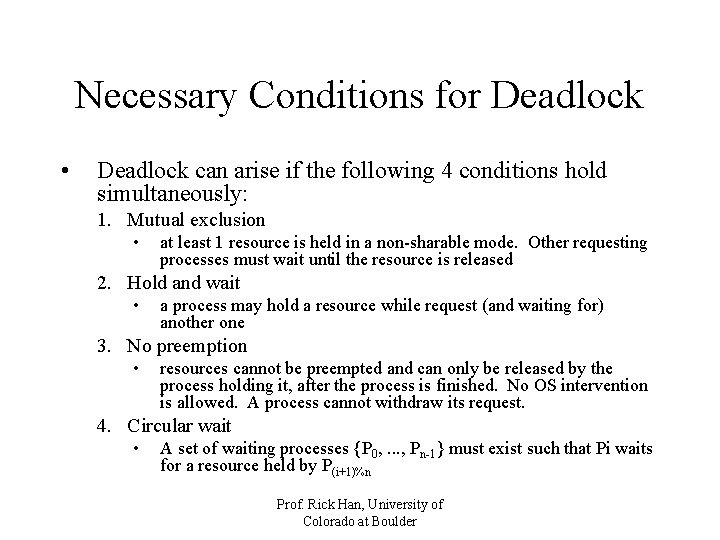
Necessary Conditions for Deadlock • Deadlock can arise if the following 4 conditions hold simultaneously: 1. Mutual exclusion • at least 1 resource is held in a non-sharable mode. Other requesting processes must wait until the resource is released 2. Hold and wait • a process may hold a resource while request (and waiting for) another one 3. No preemption • resources cannot be preempted and can only be released by the process holding it, after the process is finished. No OS intervention is allowed. A process cannot withdraw its request. 4. Circular wait • A set of waiting processes {P 0, . . . , Pn-1} must exist such that Pi waits for a resource held by P(i+1)%n Prof. Rick Han, University of Colorado at Boulder
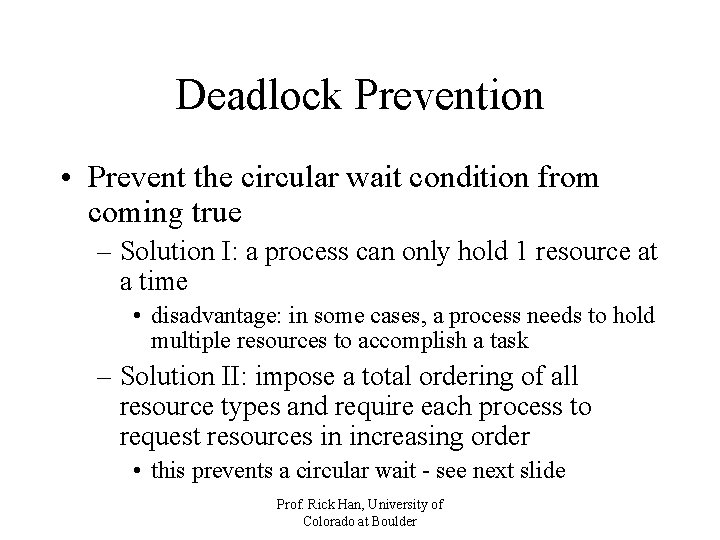
Deadlock Prevention • Prevent the circular wait condition from coming true – Solution I: a process can only hold 1 resource at a time • disadvantage: in some cases, a process needs to hold multiple resources to accomplish a task – Solution II: impose a total ordering of all resource types and require each process to request resources in increasing order • this prevents a circular wait - see next slide Prof. Rick Han, University of Colorado at Boulder
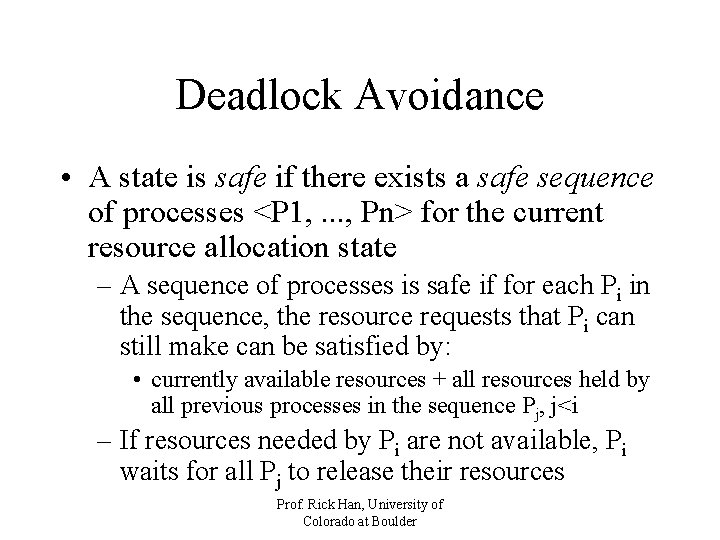
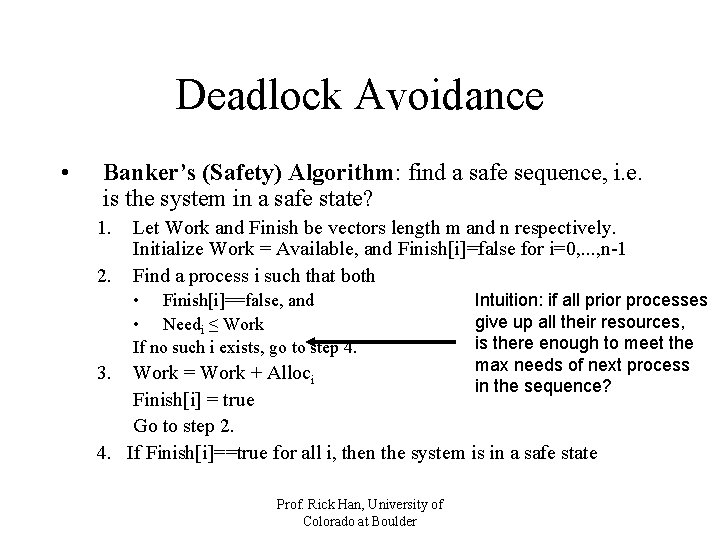
Deadlock Avoidance • A state is safe if there exists a safe sequence of processes <P 1, . . . , Pn> for the current resource allocation state – A sequence of processes is safe if for each Pi in the sequence, the resource requests that Pi can still make can be satisfied by: • currently available resources + all resources held by all previous processes in the sequence Pj, j<i – If resources needed by Pi are not available, Pi waits for all Pj to release their resources Prof. Rick Han, University of Colorado at Boulder
Deadlock Avoidance • Banker’s (Safety) Algorithm: find a safe sequence, i. e. is the system in a safe state? 1. 2. Let Work and Finish be vectors length m and n respectively. Initialize Work = Available, and Finish[i]=false for i=0, . . . , n-1 Find a process i such that both • Finish[i]==false, and • Needi ≤ Work If no such i exists, go to step 4. 3. Intuition: if all prior processes give up all their resources, is there enough to meet the max needs of next process in the sequence? Work = Work + Alloci Finish[i] = true Go to step 2. 4. If Finish[i]==true for all i, then the system is in a safe state Prof. Rick Han, University of Colorado at Boulder
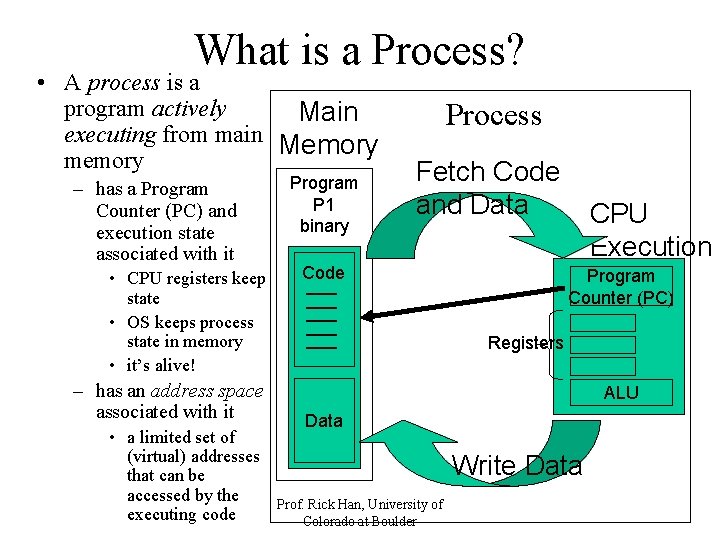
What is a Process? • A process is a program actively Main executing from main Memory memory – has a Program Counter (PC) and execution state associated with it • CPU registers keep state • OS keeps process state in memory • it’s alive! – has an address space associated with it • a limited set of (virtual) addresses that can be accessed by the executing code Program P 1 binary Process Fetch Code and Data Code CPU Execution Program Counter (PC) Registers ALU Data Write Data Prof. Rick Han, University of Colorado at Boulder
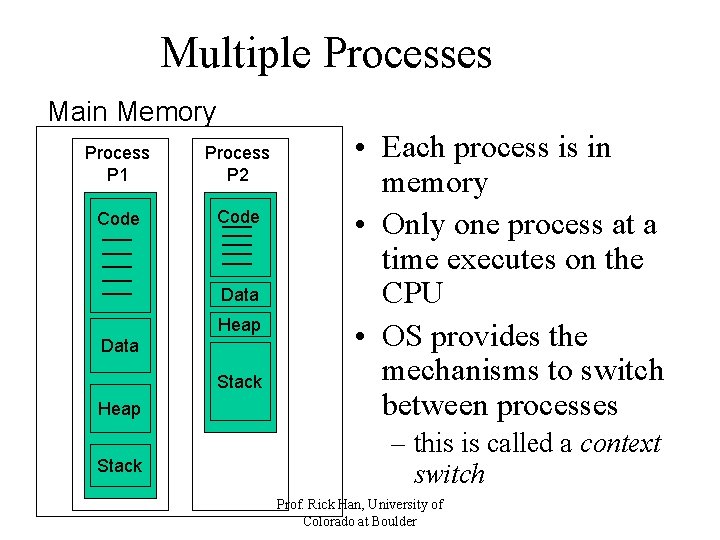
Multiple Processes Main Memory Process P 1 Process P 2 Code Data Heap Data Stack Heap Stack • Each process is in memory • Only one process at a time executes on the CPU • OS provides the mechanisms to switch between processes – this is called a context switch Prof. Rick Han, University of Colorado at Boulder
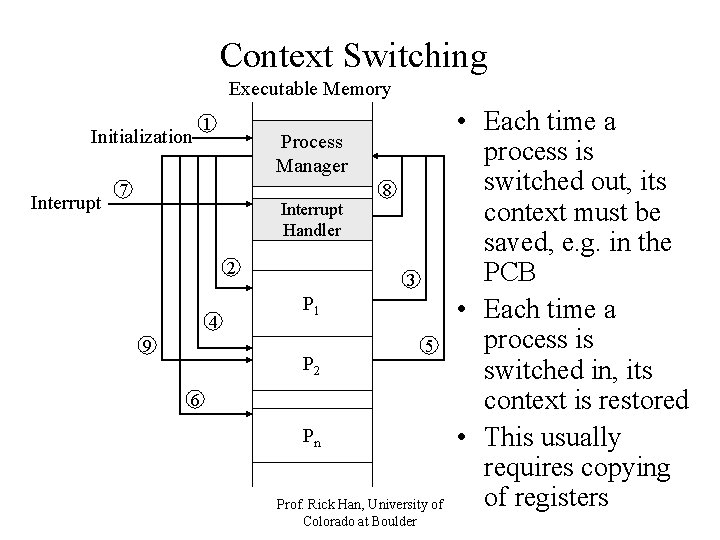
Context Switching Executable Memory Initialization Interrupt 1 Process Manager 7 Interrupt Handler 2 4 9 8 3 P 1 P 2 5 6 Pn Prof. Rick Han, University of Colorado at Boulder • Each time a process is switched out, its context must be saved, e. g. in the PCB • Each time a process is switched in, its context is restored • This usually requires copying of registers
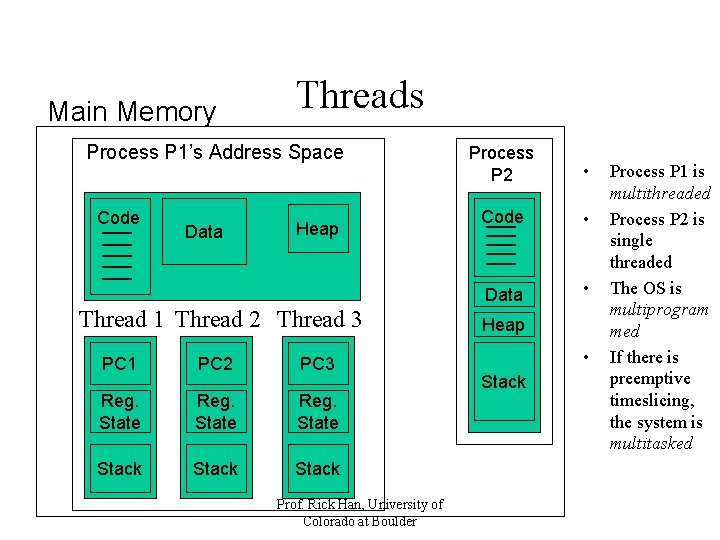
Main Memory Threads Process P 1’s Address Space Code Data Heap Thread 1 Thread 2 Thread 3 PC 1 PC 2 PC 3 Reg. State Stack Prof. Rick Han, University of Colorado at Boulder Process P 2 • Code • Data • Heap • Stack Process P 1 is multithreaded Process P 2 is single threaded The OS is multiprogram med If there is preemptive timeslicing, the system is multitasked
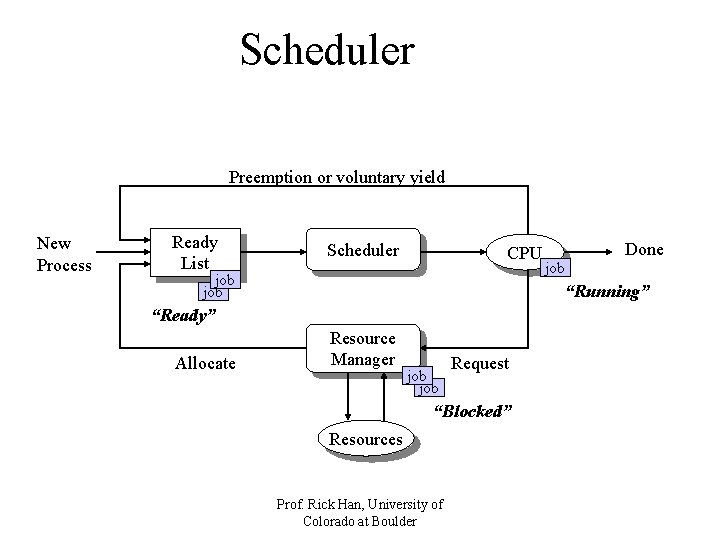
Scheduler Preemption or voluntary yield New Process Ready List Scheduler CPU job “Running” “Ready” Allocate job Done Resource Manager job Request “Blocked” Resources Prof. Rick Han, University of Colorado at Boulder
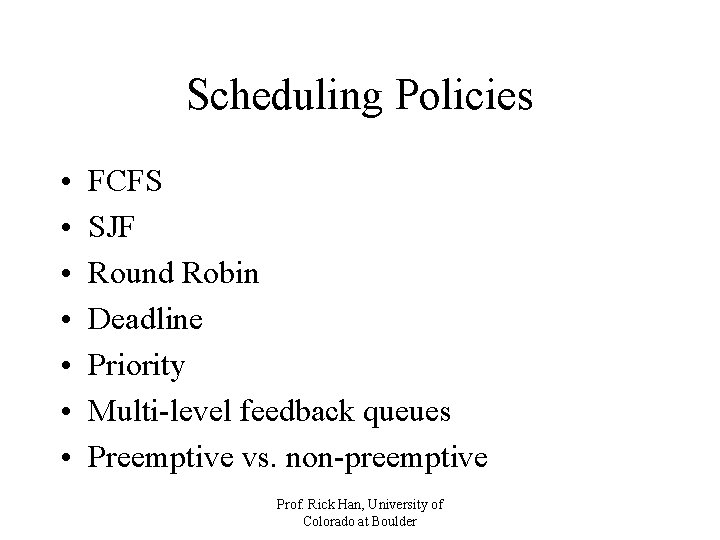
Scheduling Policies • • FCFS SJF Round Robin Deadline Priority Multi-level feedback queues Preemptive vs. non-preemptive Prof. Rick Han, University of Colorado at Boulder
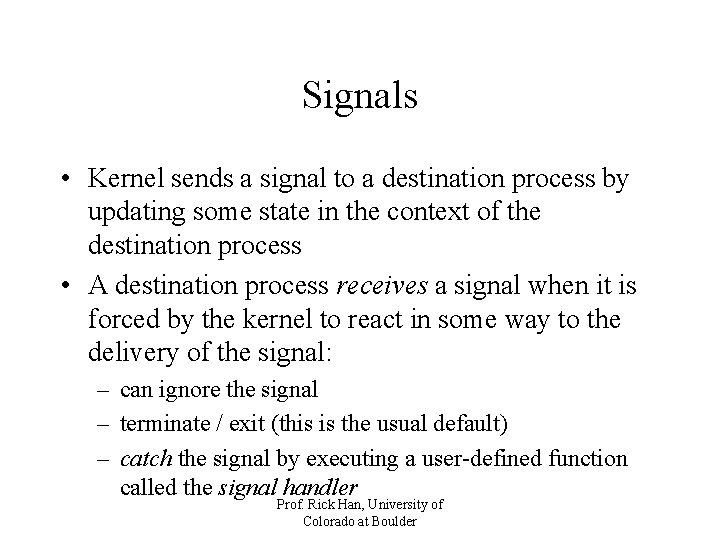
Signals • Kernel sends a signal to a destination process by updating some state in the context of the destination process • A destination process receives a signal when it is forced by the kernel to react in some way to the delivery of the signal: – can ignore the signal – terminate / exit (this is the usual default) – catch the signal by executing a user-defined function called the signal handler Prof. Rick Han, University of Colorado at Boulder
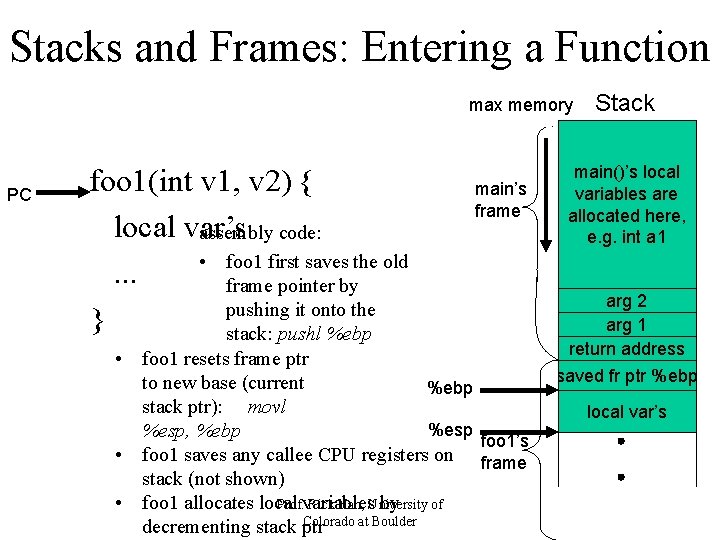
Stacks and Frames: Entering a Function %ebp PC PC foo 1(int v 1, v 2) { local var’s assembly code: • foo 1 first saves the old. . . frame pointer by pushing it onto the } stack: pushl %ebp • • max memory main’s frame Stack unallocated main()’s local variables are allocated here, e. g. int a 1 %esp arg 2 top of the stack unallocated arg 1 %esp top of the stack return address foo 1 resets frame ptr top of the stack saved fr ptr %ebp to new base (current %ebp and %esp %ebp stack ptr): movl top of the stack local var’s unallocated %esp, %ebp foo 1’s foo 1 saves any callee CPU registers on frame stack (not shown) • foo 1 allocates local by Prof. variables Rick Han, University of Colorado at Boulder decrementing stack ptr
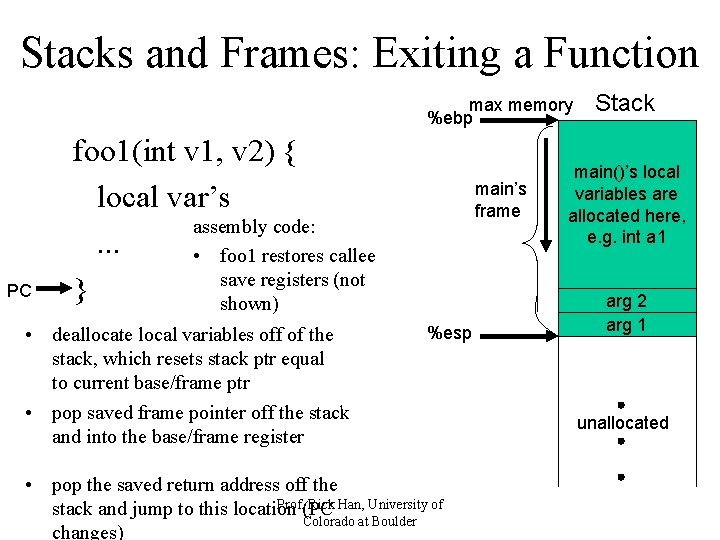
Stacks and Frames: Exiting a Function max memory %ebp PC foo 1(int v 1, v 2) { local var’s assembly code: . . . • foo 1 restores callee save registers (not } shown) main’s frame %esp • deallocate local variables off of the %esp stack, which resets stack ptr equal to current base/frame ptr %esp and %ebp • pop saved frame pointer off the stack %esp and into the base/frame register foo 1’s frame • pop the saved return address off the Prof. (PC Rick Han, University of stack and jump to this location Colorado at Boulder changes) Stack unallocated main()’s local variables are allocated here, e. g. int a 1 arg 2 unallocated arg 1 return address saved fr ptr %ebp local var’s unallocated
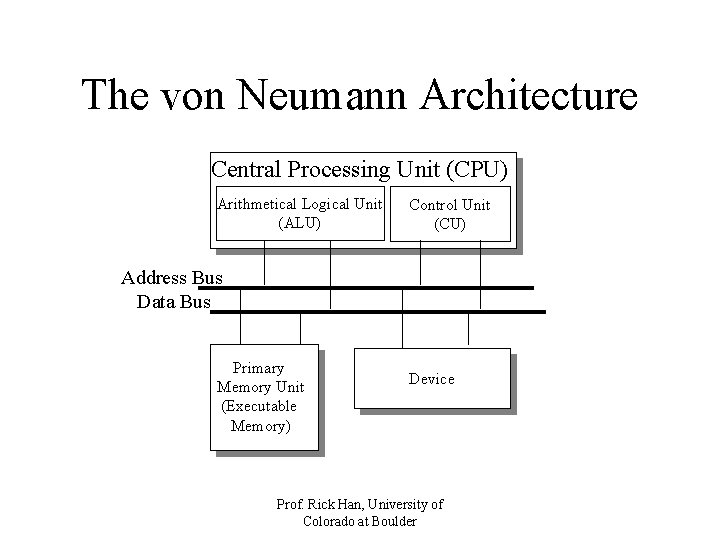
The von Neumann Architecture Central Processing Unit (CPU) Arithmetical Logical Unit (ALU) Control Unit (CU) Address Bus Data Bus Primary Memory Unit (Executable Memory) Device Prof. Rick Han, University of Colorado at Boulder
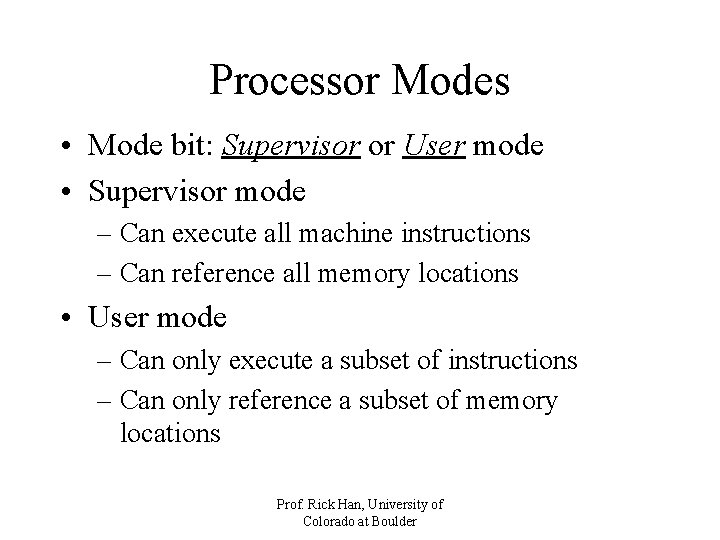
Processor Modes • Mode bit: Supervisor or User mode • Supervisor mode – Can execute all machine instructions – Can reference all memory locations • User mode – Can only execute a subset of instructions – Can only reference a subset of memory locations Prof. Rick Han, University of Colorado at Boulder
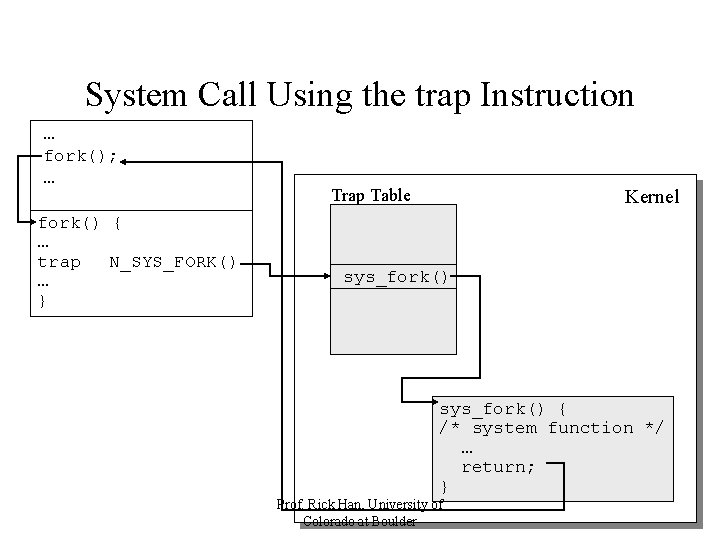
System Call Using the trap Instruction … fork(); … fork() { … trap N_SYS_FORK() … } Trap Table Kernel sys_fork() { /* system function */ … return; } Prof. Rick Han, University of Colorado at Boulder
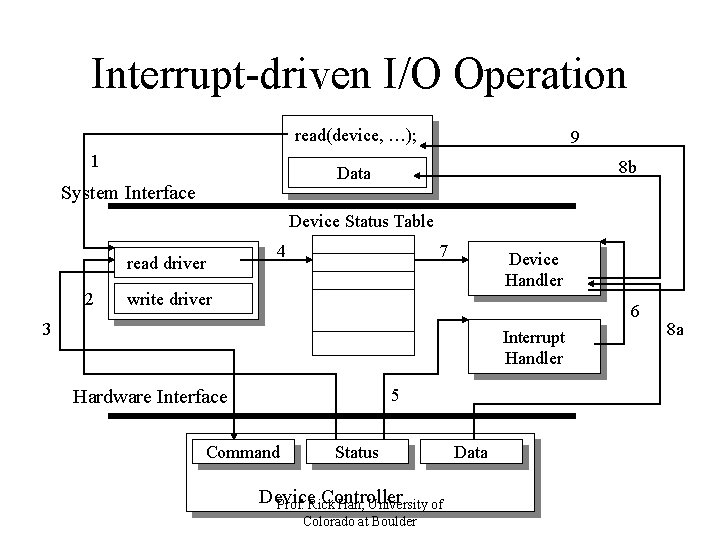
Interrupt-driven I/O Operation read(device, …); 1 9 8 b Data System Interface Device Status Table read driver 2 4 7 Device Handler write driver 6 3 Interrupt Handler 5 Hardware Interface Command Status Device Controller Prof. Rick Han, University of Colorado at Boulder Data 8 a
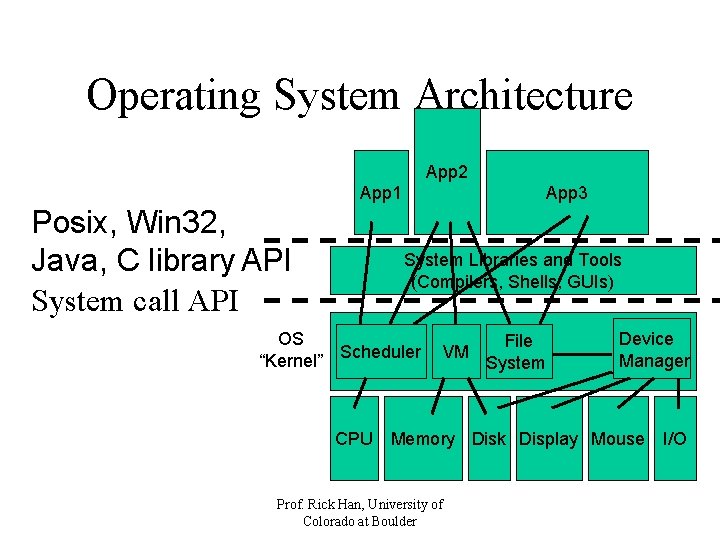
Operating System Architecture App 2 App 1 Posix, Win 32, Java, C library API System call API App 3 System Libraries and Tools (Compilers, Shells, GUIs) OS “Kernel” Scheduler VM File System Device Manager CPU Memory Disk Display Mouse I/O Prof. Rick Han, University of Colorado at Boulder
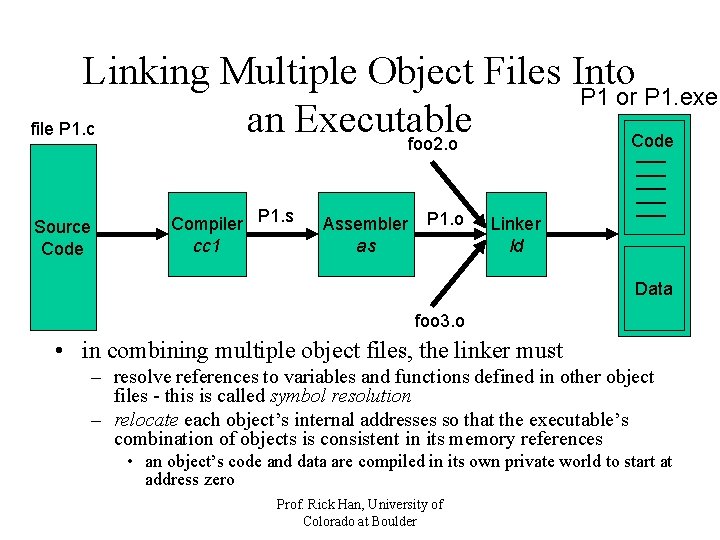
Linking Multiple Object Files Into P 1 or P 1. exe an Executable file P 1. c Code foo 2. o Source Code Compiler P 1. s cc 1 Assembler as P 1. o Linker ld Data foo 3. o • in combining multiple object files, the linker must – resolve references to variables and functions defined in other object files - this is called symbol resolution – relocate each object’s internal addresses so that the executable’s combination of objects is consistent in its memory references • an object’s code and data are compiled in its own private world to start at address zero Prof. Rick Han, University of Colorado at Boulder
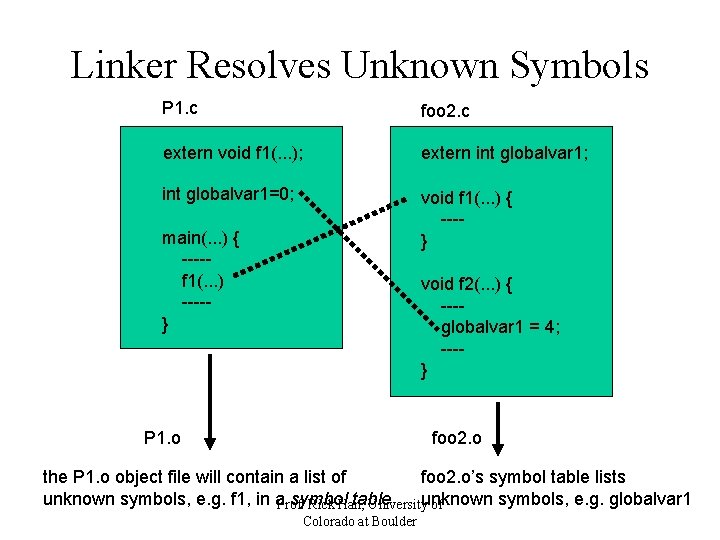
Linker Resolves Unknown Symbols P 1. c foo 2. c extern void f 1(. . . ); extern int globalvar 1; int globalvar 1=0; void f 1(. . . ) { ---} main(. . . ) { ----f 1(. . . ) ----} void f 2(. . . ) { ---globalvar 1 = 4; ---} foo 2. o P 1. o foo 2. o’s symbol table lists the P 1. o object file will contain a list of symbols, e. g. globalvar 1 unknown symbols, e. g. f 1, in a. Prof. symbol table Rick Han, Universityunknown of Colorado at Boulder
Linker Relocates Addresses • After resolving symbols, the linker relocates addresses when combining the different object modules – – merges separate code. text sections into a single. text section merges separate. data sections into a single. data section each section is assigned a memory address then each symbol reference in the code and data sections is reassigned to the correct memory address • looks at. relo. text and. relo. data to find relocation entries of references that needed address translation – these are virtual memory addresses that are translated at load time into real run-time memory addresses Prof. Rick Han, University of Colorado at Boulder
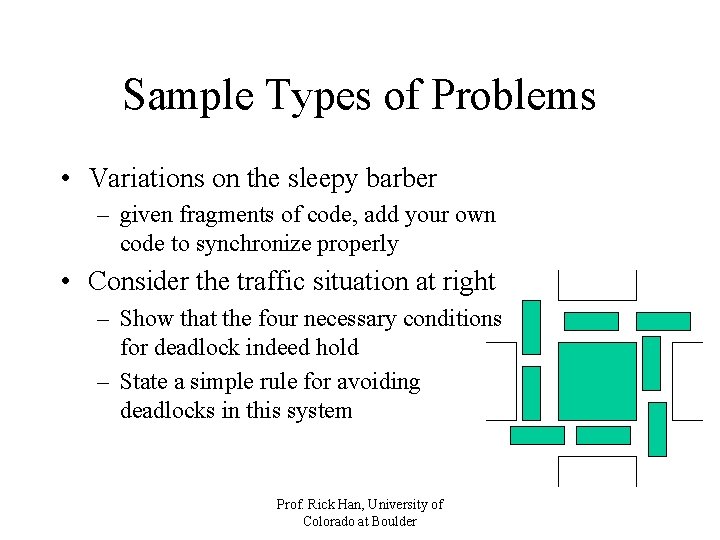
Sample Types of Problems • Variations on the sleepy barber – given fragments of code, add your own code to synchronize properly • Consider the traffic situation at right – Show that the four necessary conditions for deadlock indeed hold – State a simple rule for avoiding deadlocks in this system Prof. Rick Han, University of Colorado at Boulder
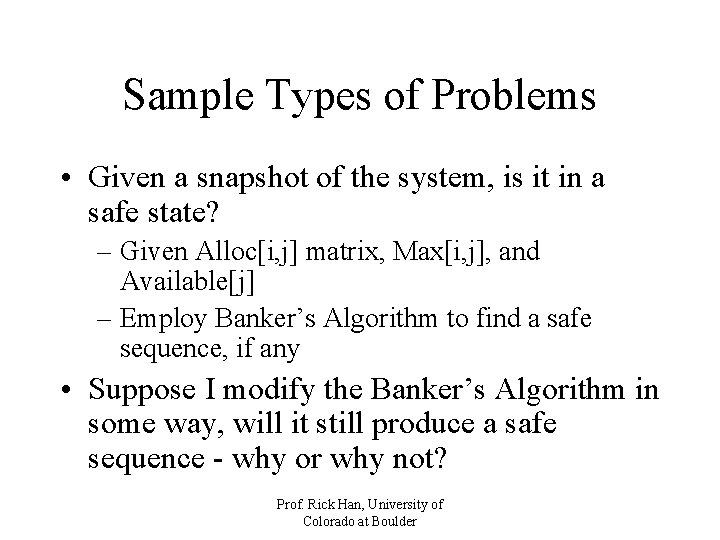
Sample Types of Problems • Given a snapshot of the system, is it in a safe state? – Given Alloc[i, j] matrix, Max[i, j], and Available[j] – Employ Banker’s Algorithm to find a safe sequence, if any • Suppose I modify the Banker’s Algorithm in some way, will it still produce a safe sequence - why or why not? Prof. Rick Han, University of Colorado at Boulder
Sample Types of Problems • Use monitors to implement solutions to – Producer/Consumer problem – First Readers/Writers problem – explain how condition variables work - do they have state? • Apply semaphores to solve synchronization problems – given a fragment of code, improve it to provide mutual exclusion Prof. Rick Han, University of Colorado at Boulder
Sample Types of Problems • How are wait() and signal() implemented? • Given N processes, M resources, Q instances, D demands, is the system in deadlock? • Scheduling – – – Given some process arrival times I/O overlap Draw a Gantt chart for deadline-based scheduling What is the total waiting time? In general, does scheduling policy X produce less average waiting time than scheduling policy Y? Prof. Rick Han, University of Colorado at Boulder