
Stacks and Frames Demystified CSCI 3753 Operating Systems

- Slides: 22
Stacks and Frames Demystified CSCI 3753 Operating Systems Spring 2005 Prof. Rick Han
Announcements • Homework Set #2 due Friday at 11 am extension • Program Assignment #1 due Tuesday Feb. 15 at 11 am - note extension • Read chapters 6 and 7
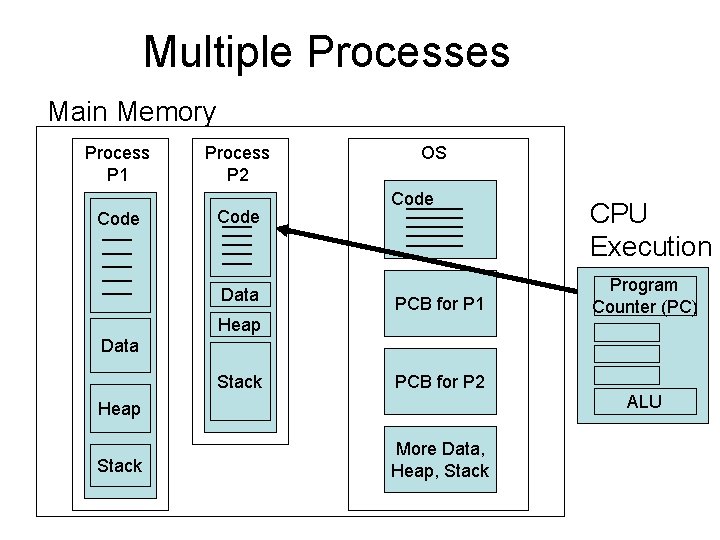
Multiple Processes Main Memory Process P 1 Code Process P 2 Code Data OS Code PCB for P 1 Heap CPU Execution Program Counter (PC) Data Stack PCB for P 2 ALU Heap Stack More Data, Heap, Stack
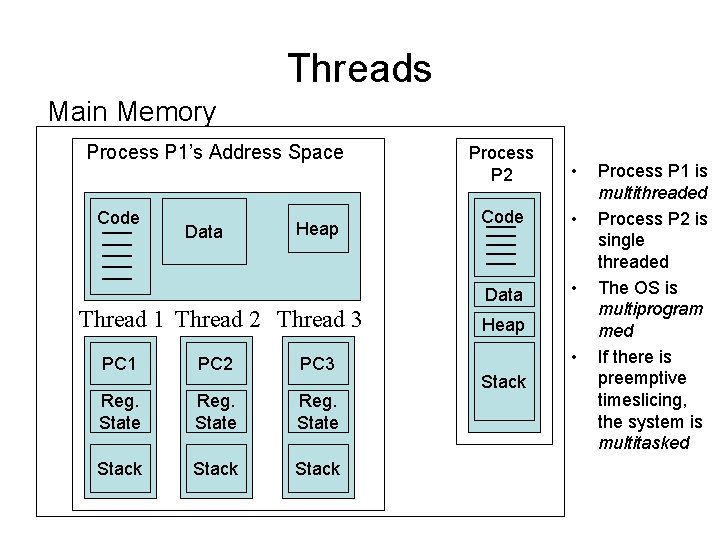
Threads Main Memory Process P 1’s Address Space Code Data Heap Thread 1 Thread 2 Thread 3 PC 1 PC 2 PC 3 Reg. State Stack Process P 2 • Code • Data • Heap • Stack Process P 1 is multithreaded Process P 2 is single threaded The OS is multiprogram med If there is preemptive timeslicing, the system is multitasked
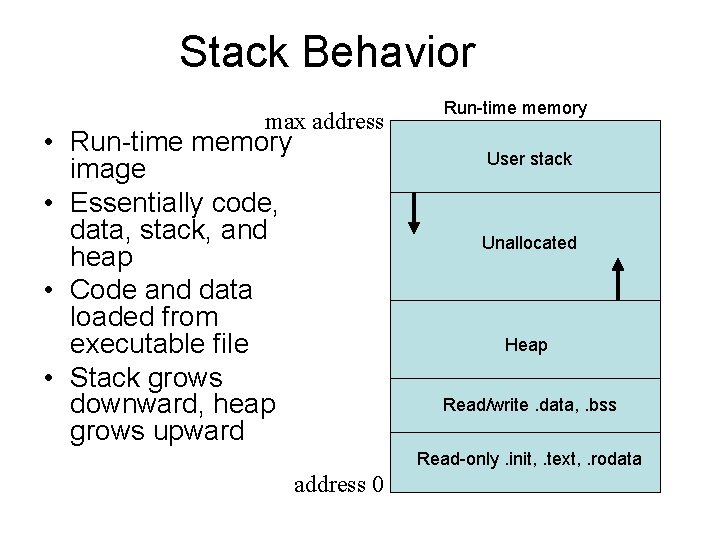
Stack Behavior max address • Run-time memory image • Essentially code, data, stack, and heap • Code and data loaded from executable file • Stack grows downward, heap grows upward Run-time memory User stack Unallocated Heap Read/write. data, . bss Read-only. init, . text, . rodata address 0
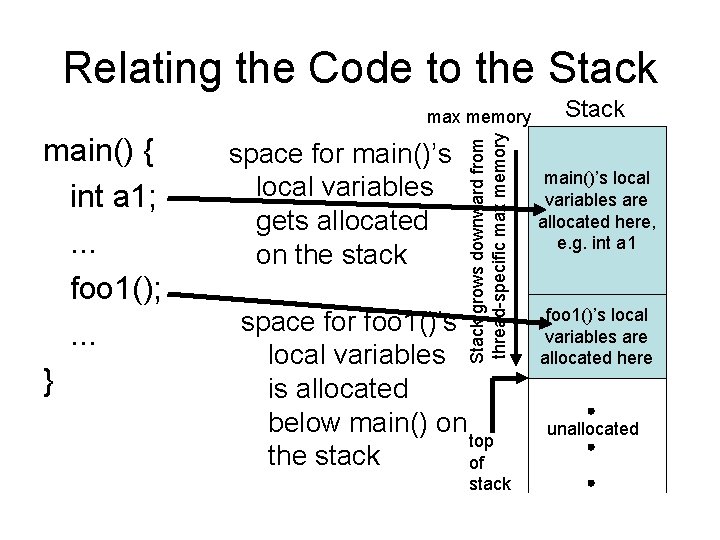
Relating the Code to the Stack main() { int a 1; . . . foo 1(); . . . } space for main()’s local variables gets allocated on the stack Stack grows downward from thread-specific max memory space for foo 1()’s local variables is allocated below main() on top the stack of stack Stack unallocated main()’s local variables are allocated here, e. g. int a 1 foo 1()’s local unallocated variables are allocated here unallocated
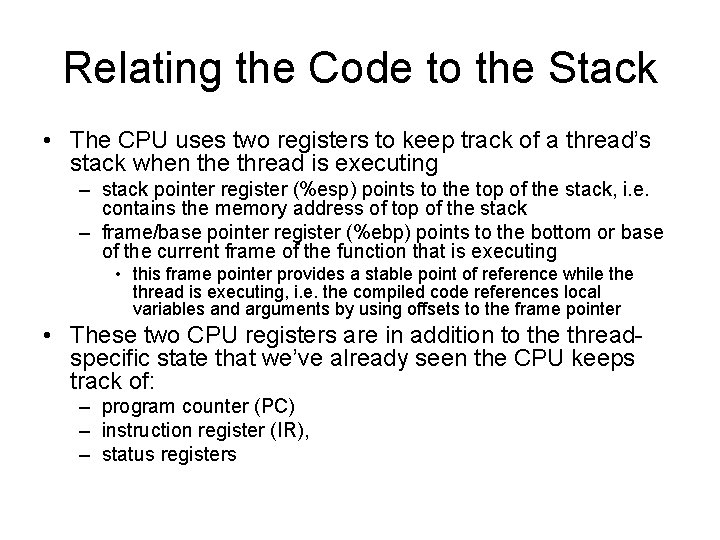
Relating the Code to the Stack • The CPU uses two registers to keep track of a thread’s stack when the thread is executing – stack pointer register (%esp) points to the top of the stack, i. e. contains the memory address of top of the stack – frame/base pointer register (%ebp) points to the bottom or base of the current frame of the function that is executing • this frame pointer provides a stable point of reference while thread is executing, i. e. the compiled code references local variables and arguments by using offsets to the frame pointer • These two CPU registers are in addition to the threadspecific state that we’ve already seen the CPU keeps track of: – program counter (PC) – instruction register (IR), – status registers
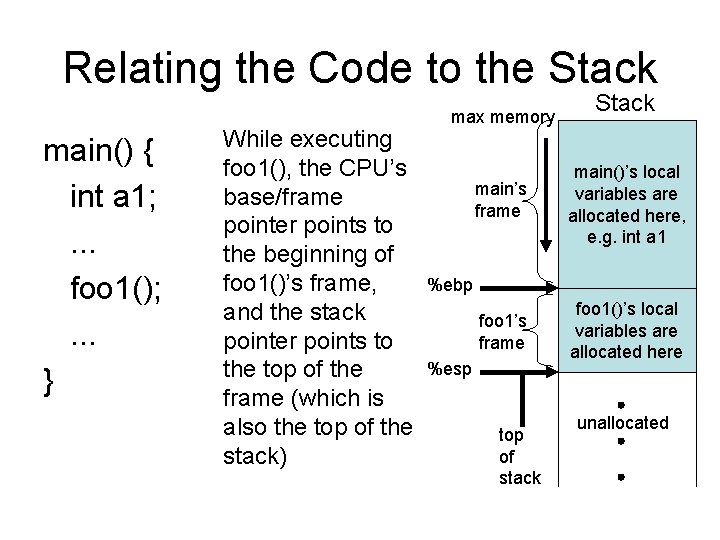
Relating the Code to the Stack main() { int a 1; . . . foo 1(); . . . } While executing foo 1(), the CPU’s base/frame pointer points to the beginning of foo 1()’s frame, and the stack pointer points to the top of the frame (which is also the top of the stack) max memory Stack main’s frame unallocated main()’s local variables are allocated here, e. g. int a 1 foo 1’s frame foo 1()’s local unallocated variables are allocated here %ebp %esp top of stack unallocated
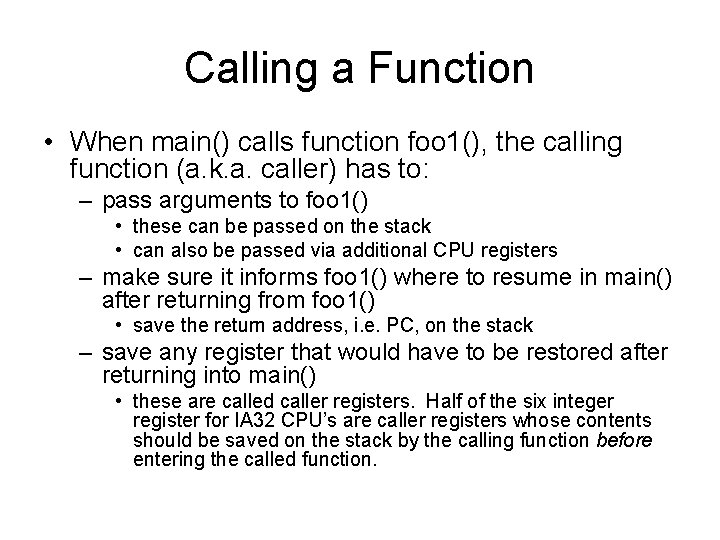
Calling a Function • When main() calls function foo 1(), the calling function (a. k. a. caller) has to: – pass arguments to foo 1() • these can be passed on the stack • can also be passed via additional CPU registers – make sure it informs foo 1() where to resume in main() after returning from foo 1() • save the return address, i. e. PC, on the stack – save any register that would have to be restored after returning into main() • these are called caller registers. Half of the six integer register for IA 32 CPU’s are caller registers whose contents should be saved on the stack by the calling function before entering the called function.
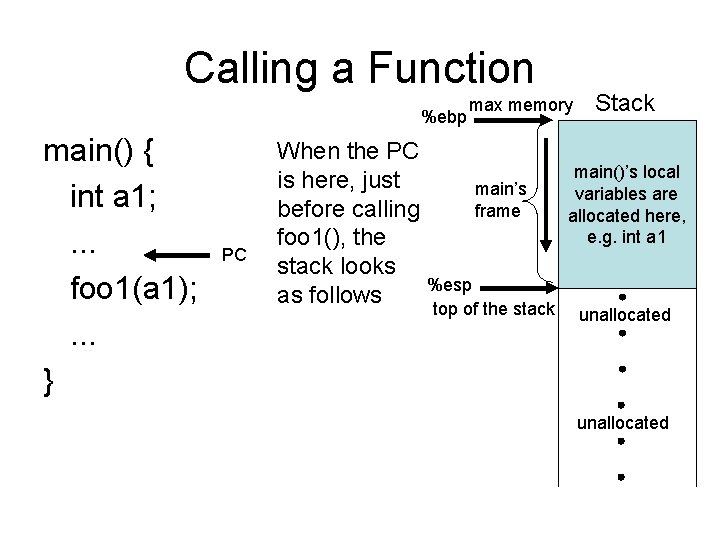
Calling a Function %ebp main() { int a 1; . . . foo 1(a 1); . . . } PC When the PC is here, just before calling foo 1(), the stack looks as follows max memory main’s frame %esp top of the stack Stack unallocated main()’s local variables are allocated here, e. g. int a 1 unallocated
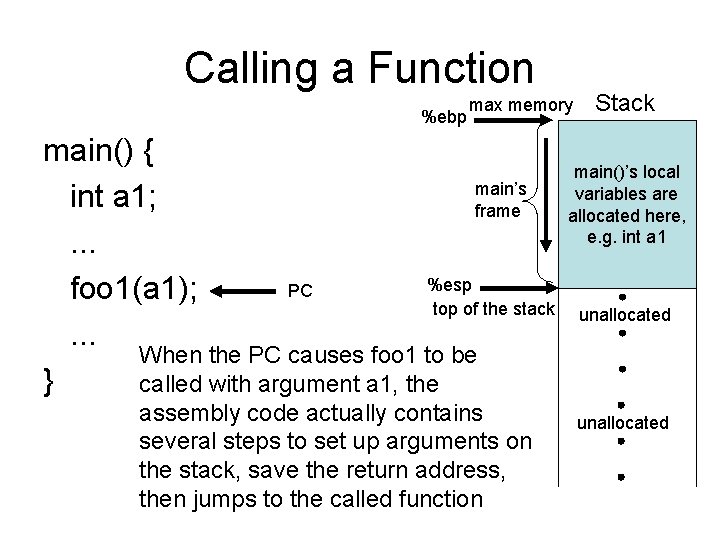
Calling a Function %ebp max memory main() { main’s int a 1; frame. . . %esp PC foo 1(a 1); top of the stack. . . When the PC causes foo 1 to be } called with argument a 1, the assembly code actually contains several steps to set up arguments on the stack, save the return address, then jumps to the called function Stack unallocated main()’s local variables are allocated here, e. g. int a 1 unallocated
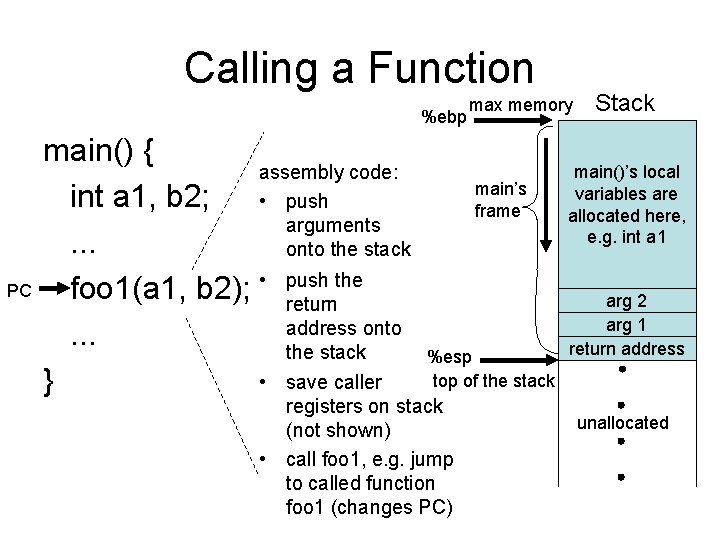
Calling a Function %ebp PC main() { assembly code: int a 1, b 2; • push arguments. . . onto the stack the foo 1(a 1, b 2); • push return address onto. . . the stack • save caller } max memory main’s frame Stack unallocated main()’s local variables are allocated here, e. g. int a 1 %esp arg 2 top of the stack unallocated arg 1 %esp top of the stack return address top of the stack registers on stack (not shown) • call foo 1, e. g. jump to called function foo 1 (changes PC) unallocated
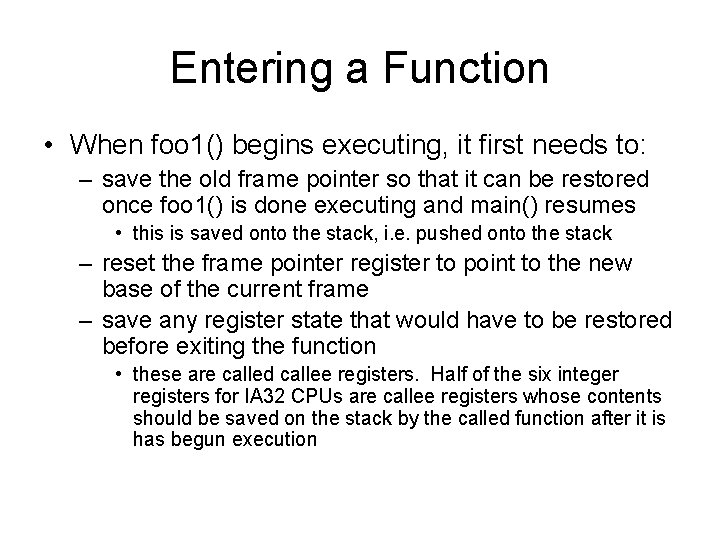
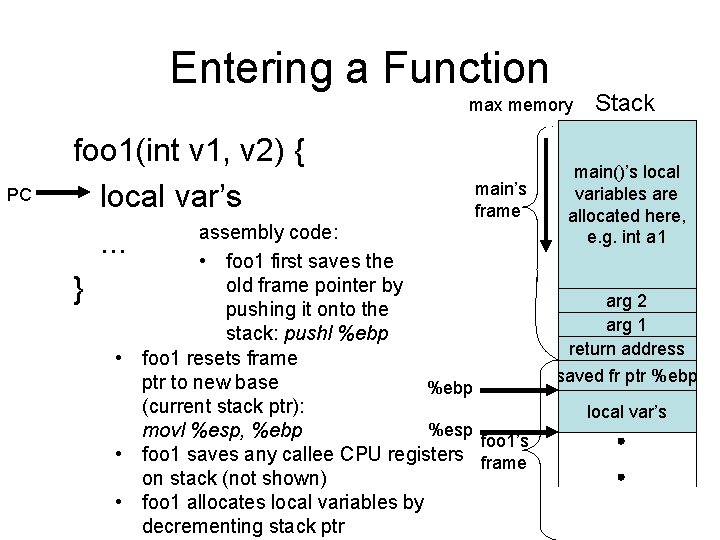
Entering a Function • When foo 1() begins executing, it first needs to: – save the old frame pointer so that it can be restored once foo 1() is done executing and main() resumes • this is saved onto the stack, i. e. pushed onto the stack – reset the frame pointer register to point to the new base of the current frame – save any register state that would have to be restored before exiting the function • these are called callee registers. Half of the six integer registers for IA 32 CPUs are callee registers whose contents should be saved on the stack by the called function after it is has begun execution
Entering a Function %ebp PC PC foo 1(int v 1, v 2) { local var’s assembly code: . . . • foo 1 first saves the old frame pointer by } • • max memory main’s frame Stack unallocated main()’s local variables are allocated here, e. g. int a 1 %esp arg 2 top of the stack unallocated pushing it onto the arg 1 %esp stack: pushl %ebp %esp top of the stack return address foo 1 resets frame top of the stack saved fr ptr %ebp ptr to new base %ebp and %esp %ebp (current stack ptr): top of the stack local var’s unallocated %esp movl %esp, %ebp foo 1’s foo 1 saves any callee CPU registers frame on stack (not shown) • foo 1 allocates local variables by decrementing stack ptr
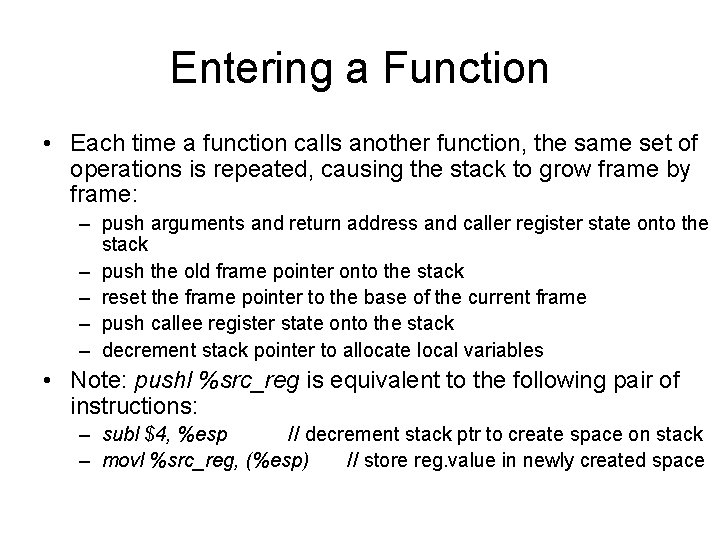
Entering a Function • Each time a function calls another function, the same set of operations is repeated, causing the stack to grow frame by frame: – push arguments and return address and caller register state onto the stack – push the old frame pointer onto the stack – reset the frame pointer to the base of the current frame – push callee register state onto the stack – decrement stack pointer to allocate local variables • Note: pushl %src_reg is equivalent to the following pair of instructions: – subl $4, %esp // decrement stack ptr to create space on stack – movl %src_reg, (%esp) // store reg. value in newly created space
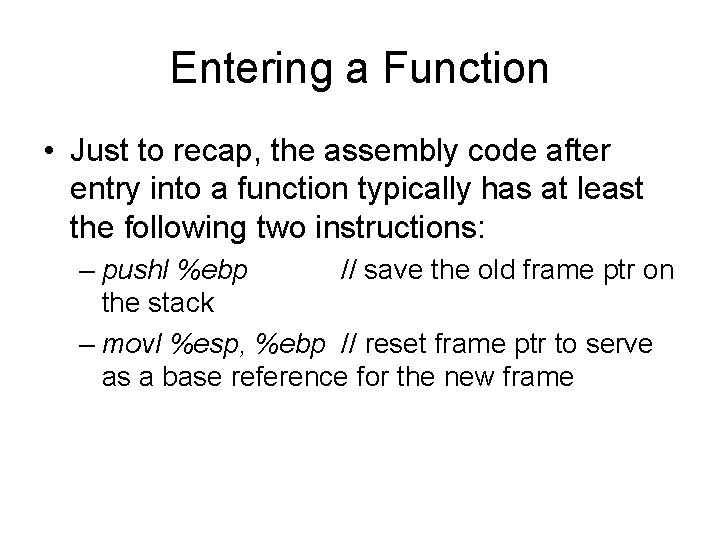
Entering a Function • Just to recap, the assembly code after entry into a function typically has at least the following two instructions: – pushl %ebp // save the old frame ptr on the stack – movl %esp, %ebp // reset frame ptr to serve as a base reference for the new frame
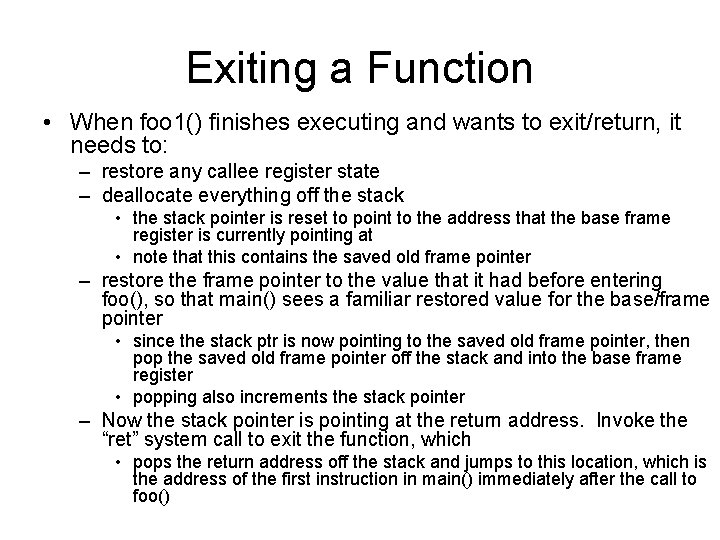
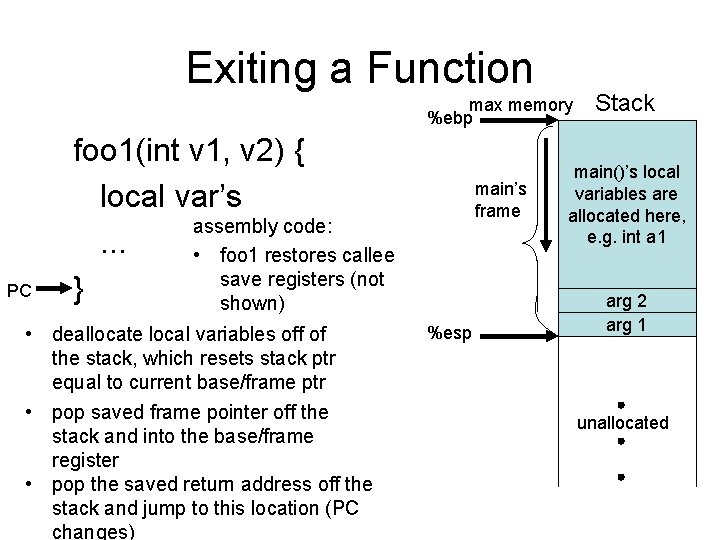
Exiting a Function • When foo 1() finishes executing and wants to exit/return, it needs to: – restore any callee register state – deallocate everything off the stack • the stack pointer is reset to point to the address that the base frame register is currently pointing at • note that this contains the saved old frame pointer – restore the frame pointer to the value that it had before entering foo(), so that main() sees a familiar restored value for the base/frame pointer • since the stack ptr is now pointing to the saved old frame pointer, then pop the saved old frame pointer off the stack and into the base frame register • popping also increments the stack pointer – Now the stack pointer is pointing at the return address. Invoke the “ret” system call to exit the function, which • pops the return address off the stack and jumps to this location, which is the address of the first instruction in main() immediately after the call to foo()
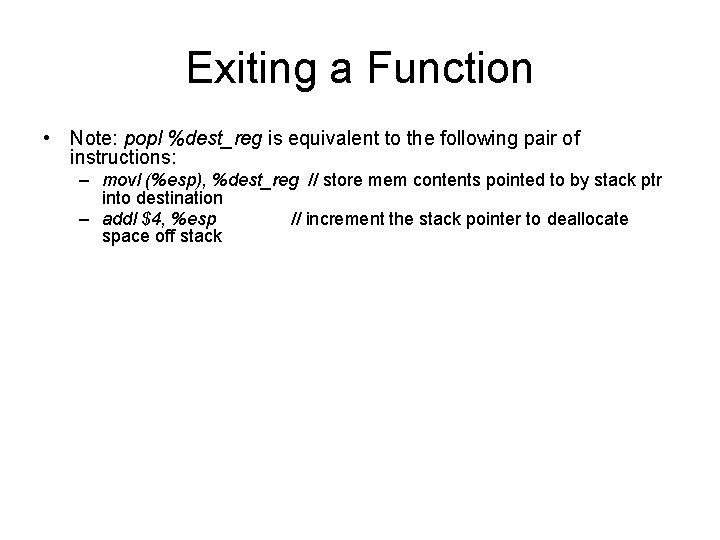
Exiting a Function • Note: popl %dest_reg is equivalent to the following pair of instructions: – movl (%esp), %dest_reg // store mem contents pointed to by stack ptr into destination – addl $4, %esp // increment the stack pointer to deallocate space off stack
Exiting a Function max memory %ebp PC foo 1(int v 1, v 2) { local var’s assembly code: . . . • foo 1 restores callee save registers (not } shown) main’s frame %esp • deallocate local variables off of %esp the stack, which resets stack ptr equal to current base/frame ptr %esp and %ebp • pop saved frame pointer off the %esp stack and into the base/frame foo 1’s register frame • pop the saved return address off the stack and jump to this location (PC changes) Stack unallocated main()’s local variables are allocated here, e. g. int a 1 arg 2 unallocated arg 1 return address saved fr ptr %ebp local var’s unallocated
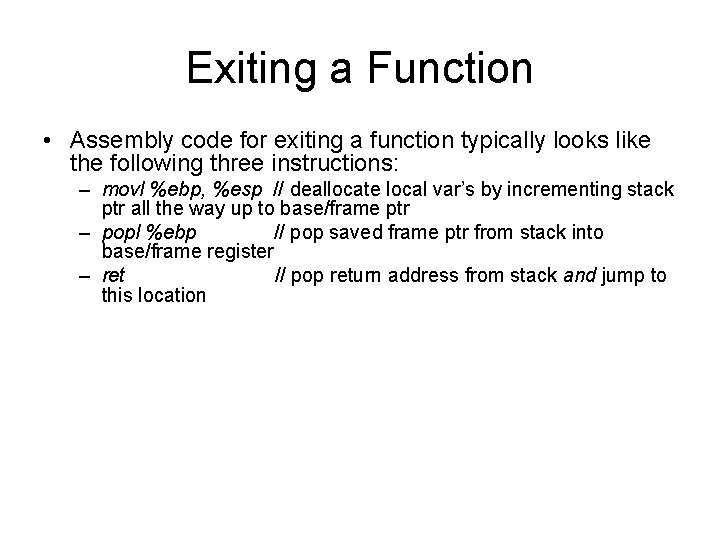
Exiting a Function • Assembly code for exiting a function typically looks like the following three instructions: – movl %ebp, %esp // deallocate local var’s by incrementing stack ptr all the way up to base/frame ptr – popl %ebp // pop saved frame ptr from stack into base/frame register – ret // pop return address from stack and jump to this location
Reentering the Calling Function • When main() begins again after foo 1() has exited, main() has to: – restore any caller registers – inspect any arguments that may have been passed back • these arguments are still accessible in its frame!
User/Kernel Level Threads • This material will be posted in an addendum to these slides