
Autonomous CyberPhysical Systems Timed Models Fall 2020 CSCI
Autonomous Cyber-Physical Systems: Timed Models Fall 2020. CSCI 513. Instructor: Jyo Deshmukh Acknowledgment: Some of the material in these slides is based on the lecture slides for CIS 540: Principles of Embedded Computation taught by Rajeev Alur at the University of Pennsylvania. http: //www. seas. upenn. edu/~cis 540/ USC Viterbi School of Engineering Department of Computer Science
Models of Computation Synchronous Reactive Components Asynchronous Processes Timed Model Like Asynchronous models, but with explicit time information Can make use of global time for coordination Continuous-time models/Dynamical system models Like Synchronous, but time evolves continuously Hybrid Dynamical Models USC Viterbi School of Engineering Department of Computer Science 2
Models of Computation Synchronous Process Models Asynchronous Process Models Timed Models Like Asynchronous models, but with explicit time information Can make use of global time for coordination Continuous-time models/Dynamical system models Like Synchronous, but time evolves continuously Hybrid Dynamical Models USC Viterbi School of Engineering Department of Computer Science 3 [1] Nicolescu, Gabriela; Mosterman, Pieter J. , eds. (2010). Model-Based Design for Embedded Systems. Computational Analysis, Synthesis, and Design of Dynamic Systems. 1. Boca Raton: CRC Press.
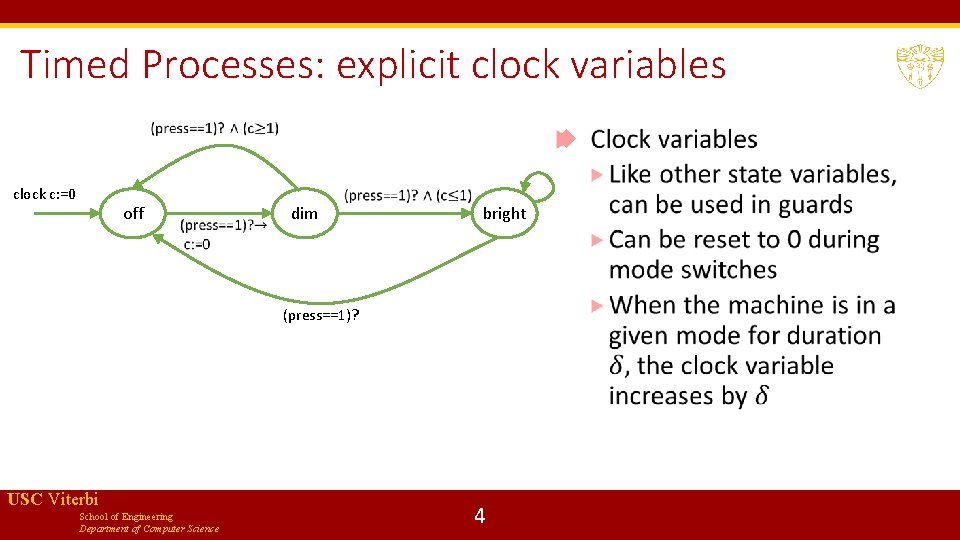
Timed Processes: explicit clock variables clock c: =0 off dim bright (press==1)? USC Viterbi School of Engineering Department of Computer Science 4
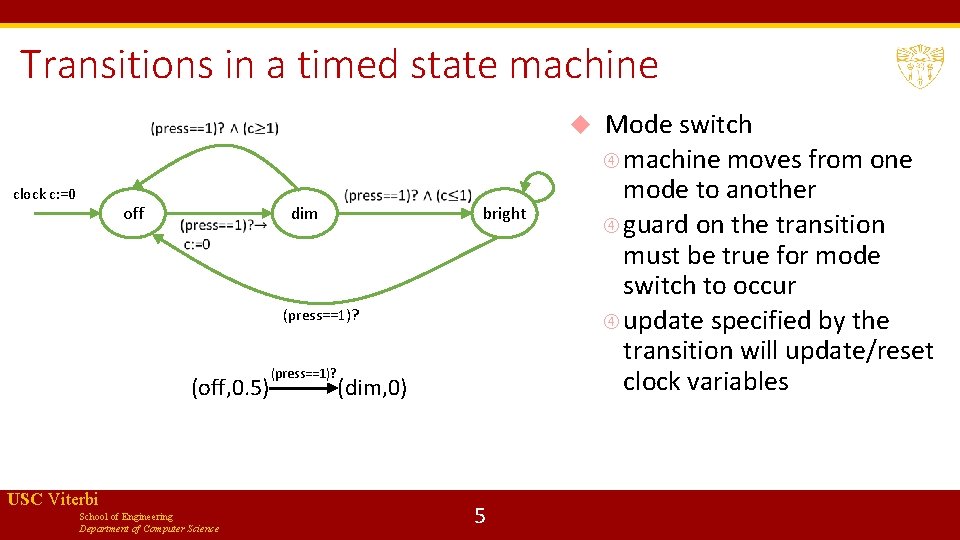
Transitions in a timed state machine clock c: =0 off dim bright (press==1)? (off, 0. 5) USC Viterbi School of Engineering Department of Computer Science (press==1)? (dim, 0) 5 Mode switch machine moves from one mode to another guard on the transition must be true for mode switch to occur update specified by the transition will update/reset clock variables
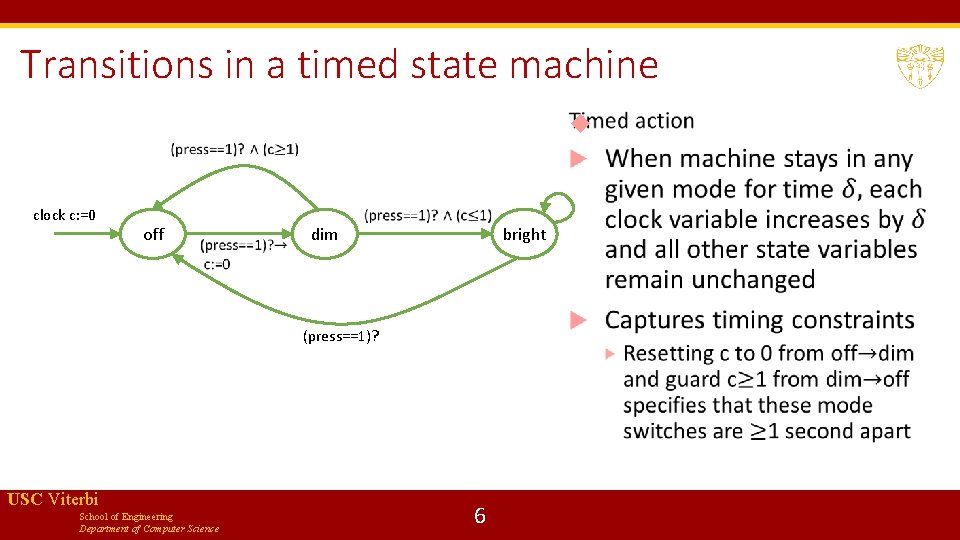
Transitions in a timed state machine clock c: =0 off dim bright (press==1)? USC Viterbi School of Engineering Department of Computer Science 6

Timed Process Execution clock c: =0 off dim bright Machine execution is through alternating timed transitions and mode switches (press==1)? (off, 0) (off, 0. 5) (press==1)? (dim, 0) (dim, 0. 8) (press==1)? (bright, 0. 8) (dim, 3. 8) USC Viterbi School of Engineering Department of Computer Science 7 (press==1)? (off, 3. 8)
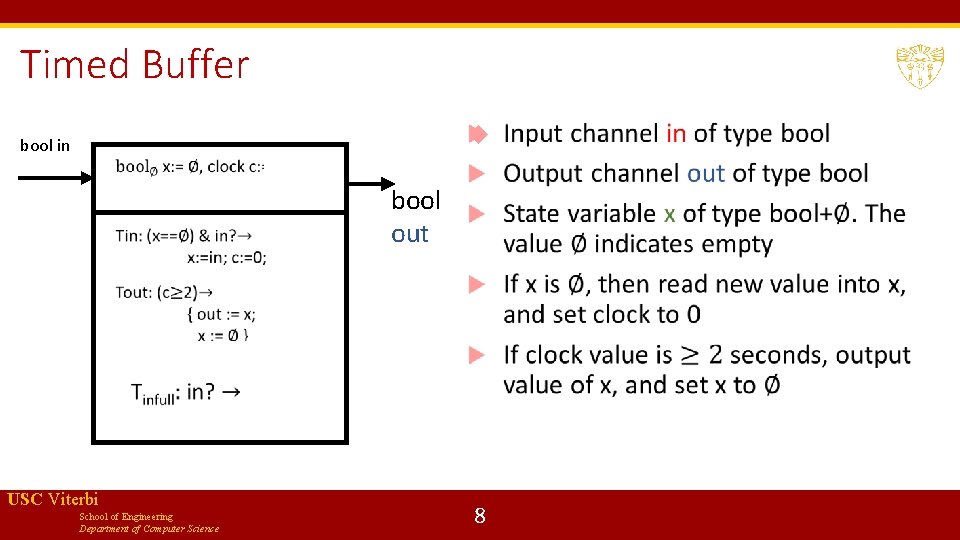
Timed Buffer bool in bool out USC Viterbi School of Engineering Department of Computer Science 8
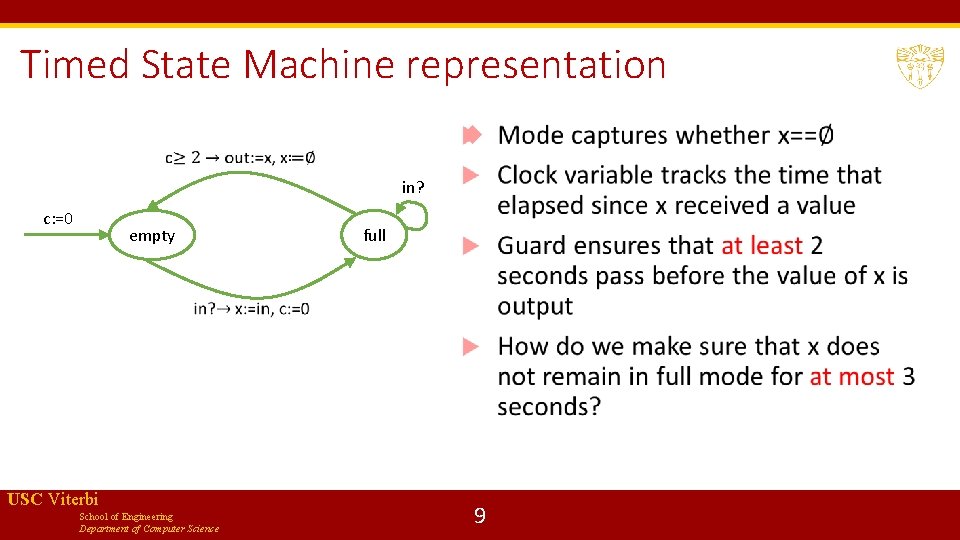
Timed State Machine representation in? c: =0 empty USC Viterbi School of Engineering Department of Computer Science full 9
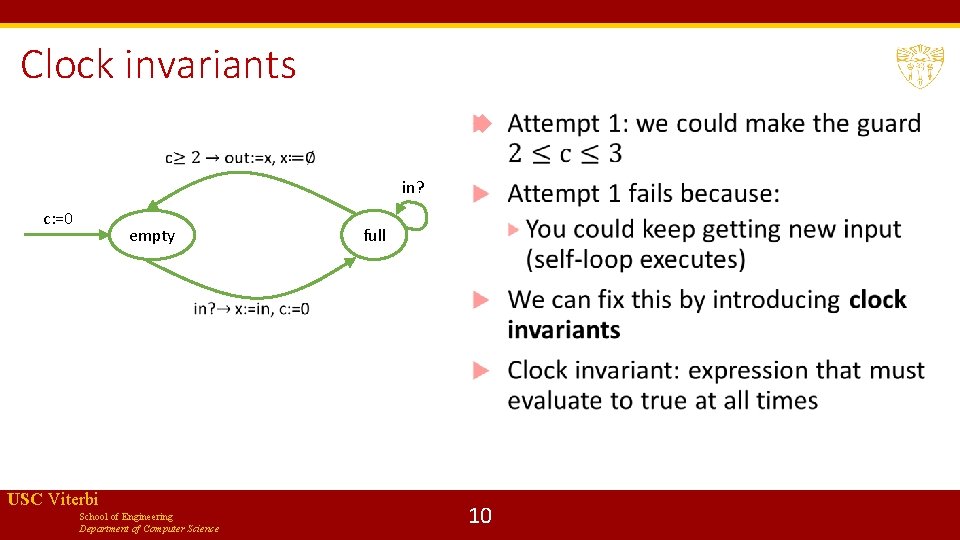
Clock invariants in? c: =0 empty USC Viterbi School of Engineering Department of Computer Science full 10
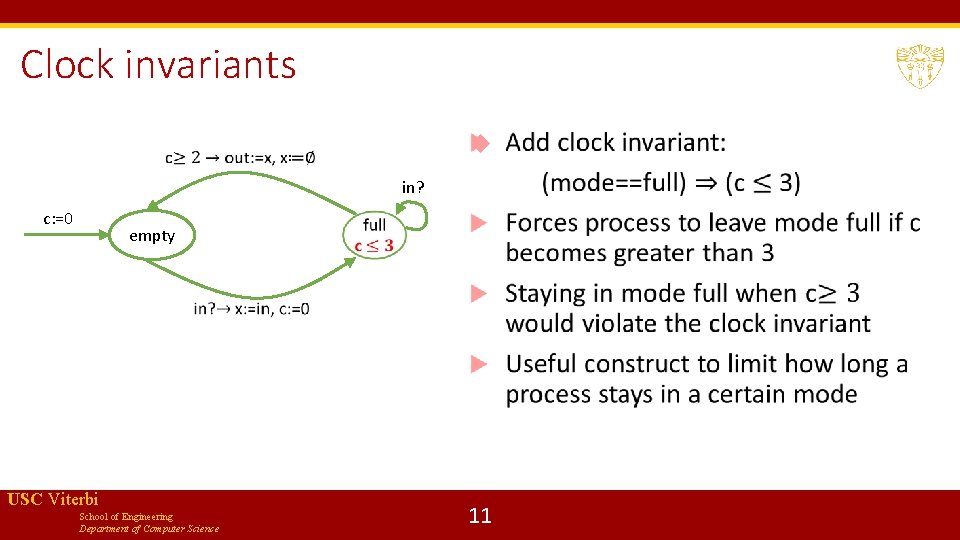
Clock invariants in? c: =0 empty USC Viterbi School of Engineering Department of Computer Science 11
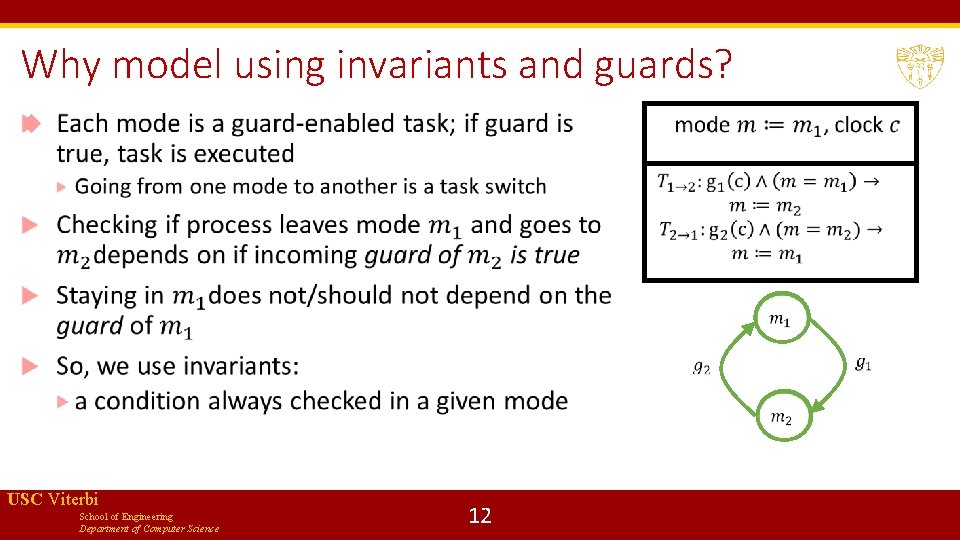
Why model using invariants and guards? USC Viterbi School of Engineering Department of Computer Science 12
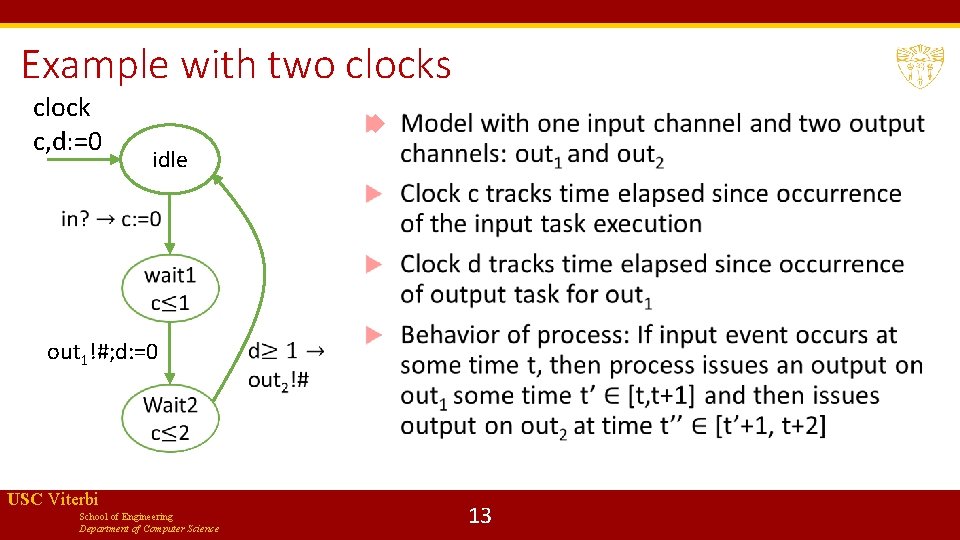
Example with two clocks clock c, d: =0 idle out 1!#; d: =0 USC Viterbi School of Engineering Department of Computer Science 13
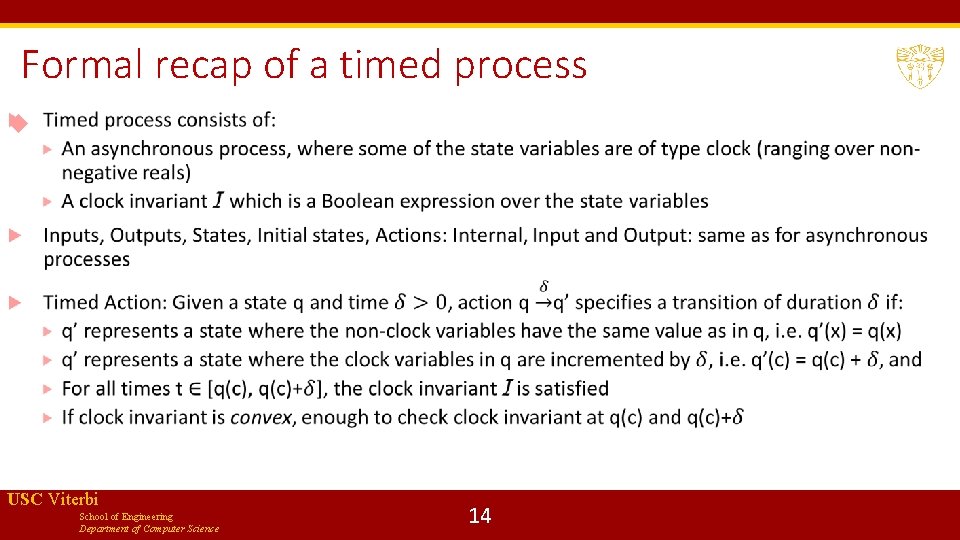
Formal recap of a timed process USC Viterbi School of Engineering Department of Computer Science 14
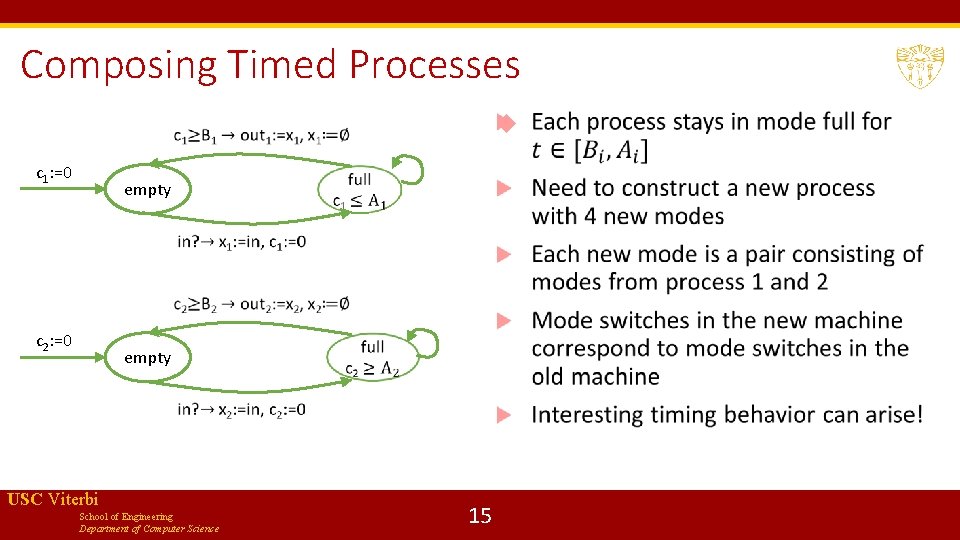
Composing Timed Processes c 1: =0 empty c 2: =0 empty USC Viterbi School of Engineering Department of Computer Science 15
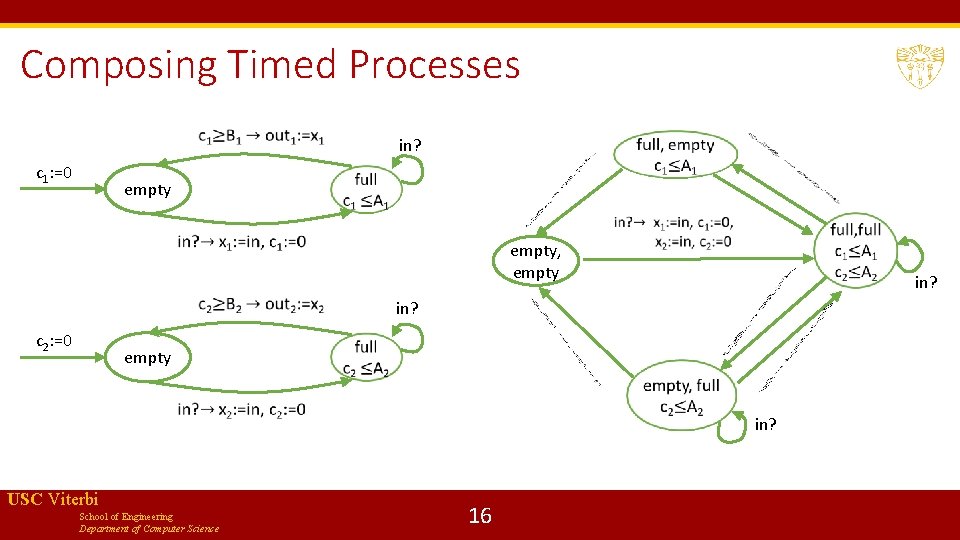
Composing Timed Processes in? c 1: =0 empty, empty in? c 2: =0 empty in? USC Viterbi School of Engineering Department of Computer Science 16
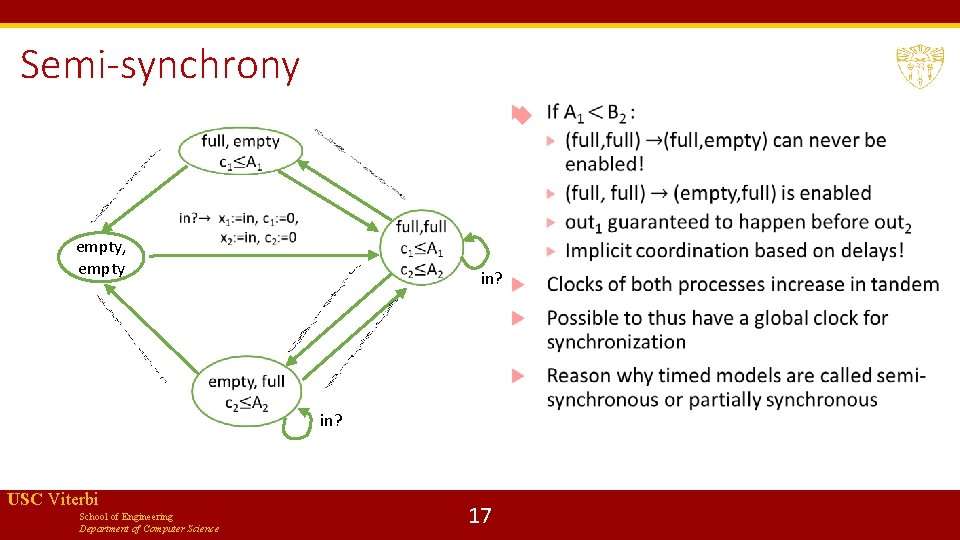
Semi-synchrony empty, empty in? USC Viterbi School of Engineering Department of Computer Science 17
Pacemaker Modeling as a Timed Process Most material that follows is from this paper: Z. Jiang, M. Pajic, S. Moarref, R. Alur, R. Mangharam, Modeling and Verification of a Dual Chamber Implantable Pacemaker, In Proceedings of Tools and Algorithms for the Construction and Analysis of Systems (TACAS), 2012. The textbook has detailed descriptions of some other pacemaker components USC Viterbi School of Engineering Department of Computer Science 18
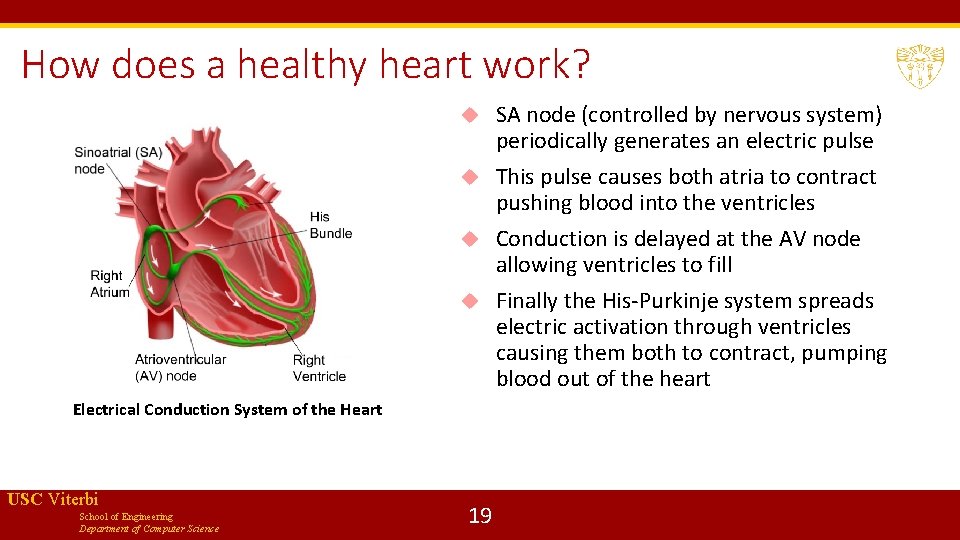
How does a healthy heart work? SA node (controlled by nervous system) periodically generates an electric pulse This pulse causes both atria to contract pushing blood into the ventricles Conduction is delayed at the AV node allowing ventricles to fill Finally the His-Purkinje system spreads electric activation through ventricles causing them both to contract, pumping blood out of the heart Electrical Conduction System of the Heart USC Viterbi School of Engineering Department of Computer Science 19
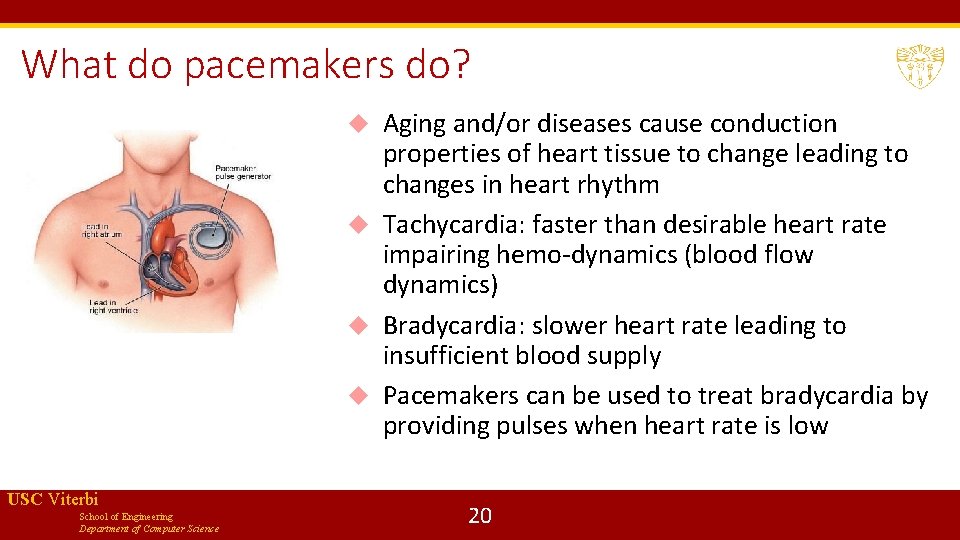
What do pacemakers do? Aging and/or diseases cause conduction properties of heart tissue to change leading to changes in heart rhythm Tachycardia: faster than desirable heart rate impairing hemo-dynamics (blood flow dynamics) Bradycardia: slower heart rate leading to insufficient blood supply Pacemakers can be used to treat bradycardia by providing pulses when heart rate is low USC Viterbi School of Engineering Department of Computer Science 20
Implantable Pacemaker modeling USC Viterbi School of Engineering Department of Computer Science 21
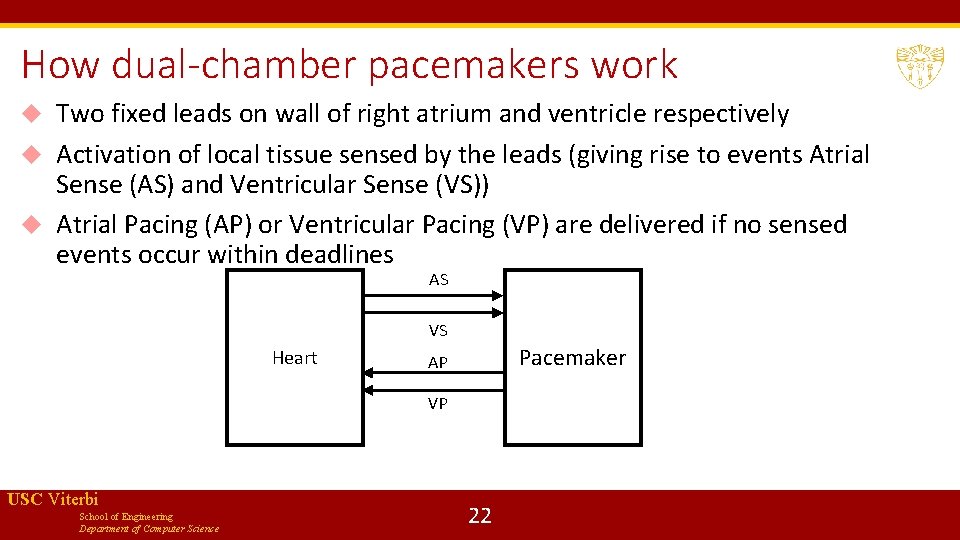
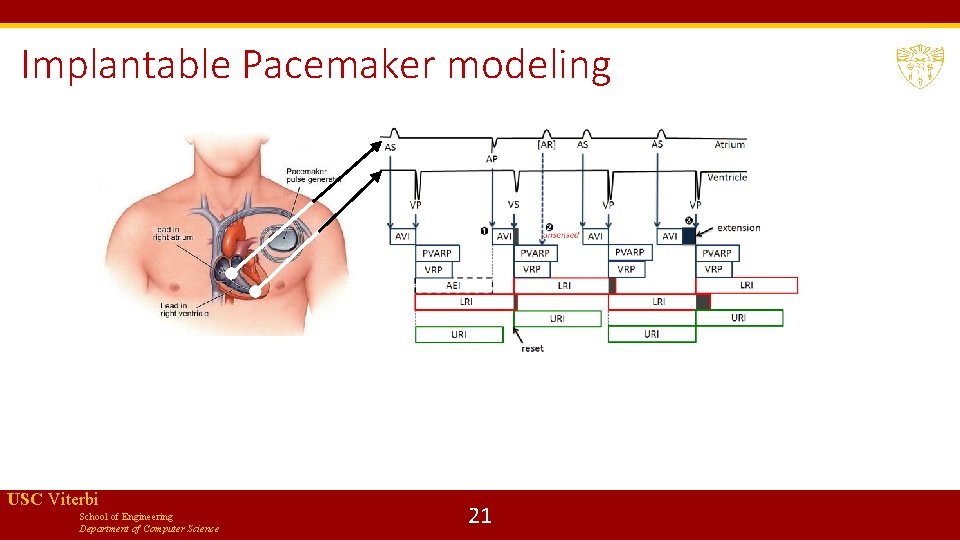
How dual-chamber pacemakers work Two fixed leads on wall of right atrium and ventricle respectively Activation of local tissue sensed by the leads (giving rise to events Atrial Sense (AS) and Ventricular Sense (VS)) Atrial Pacing (AP) or Ventricular Pacing (VP) are delivered if no sensed events occur within deadlines AS VS Heart Pacemaker AP VP USC Viterbi School of Engineering Department of Computer Science 22
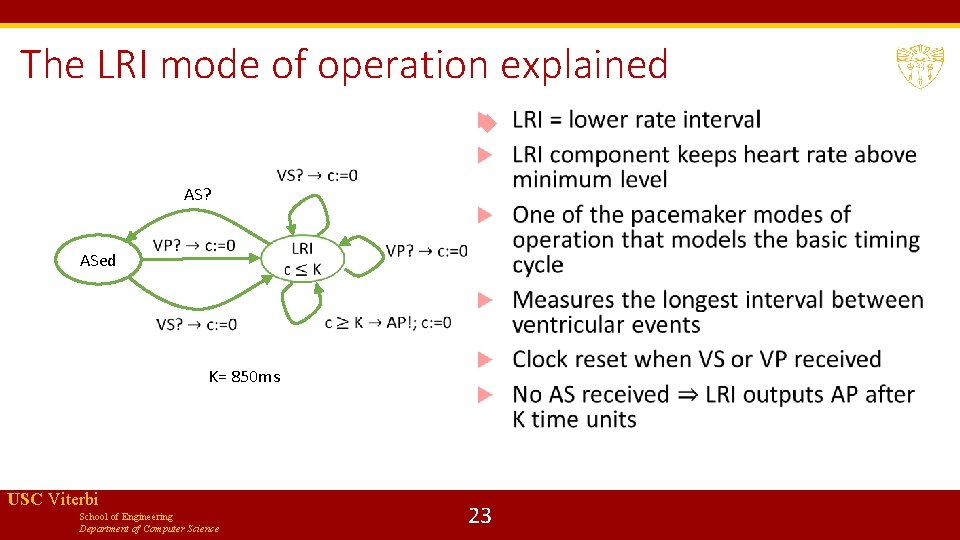
The LRI mode of operation explained AS? ASed K= 850 ms USC Viterbi School of Engineering Department of Computer Science 23
- Slides: 23