Chapter Reviews Inservice Quiz Quinton Gopen M D


- Slides: 73
Chapter Reviews & Inservice Quiz Quinton Gopen, M. D. UCLA Medical Center Nov 17 th, 2010
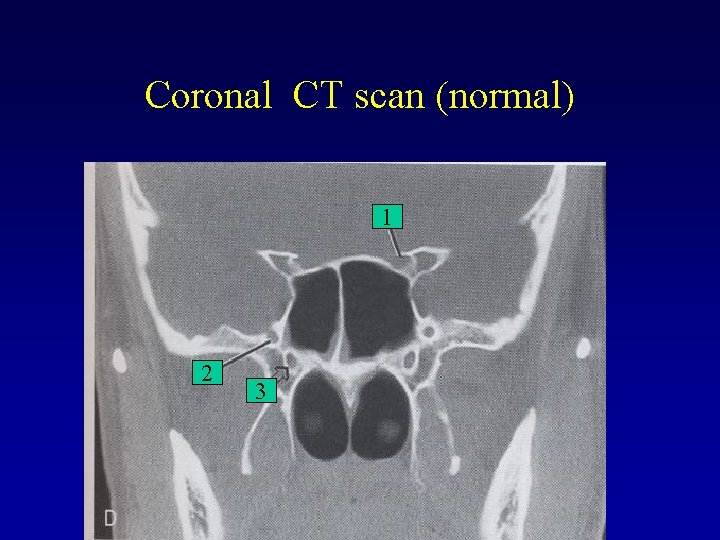
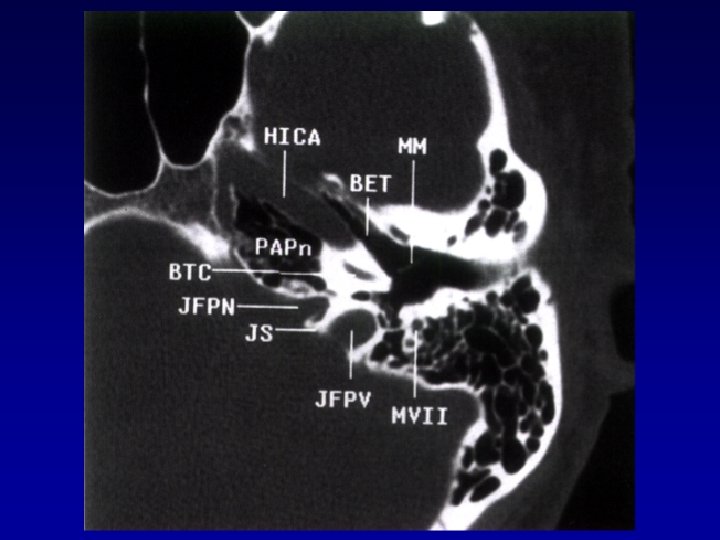
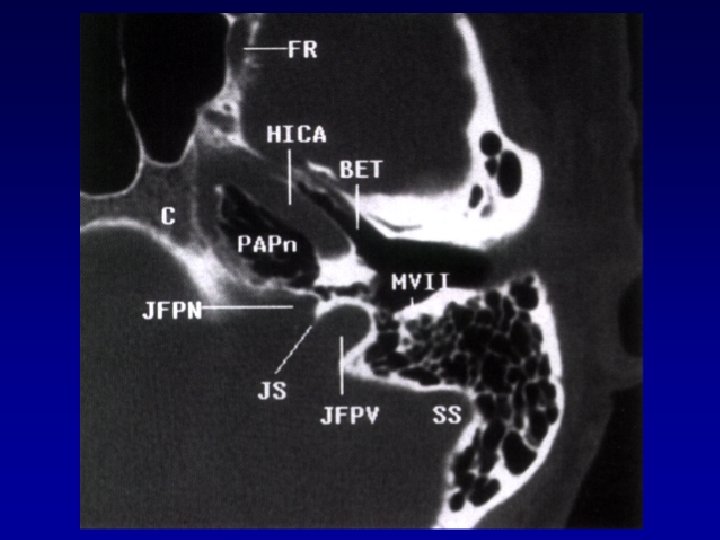
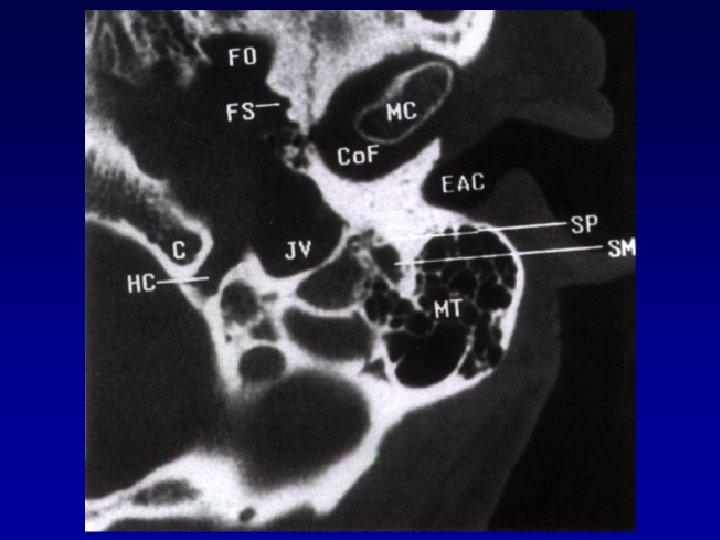
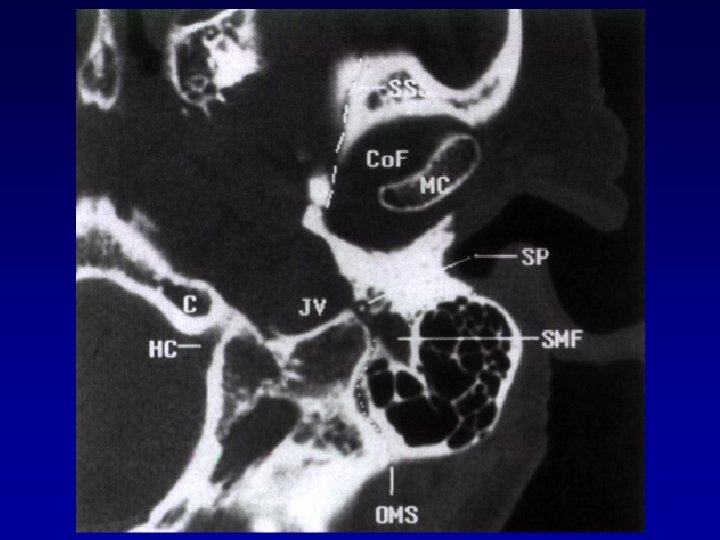
Coronal CT scan (normal) 1 2 3
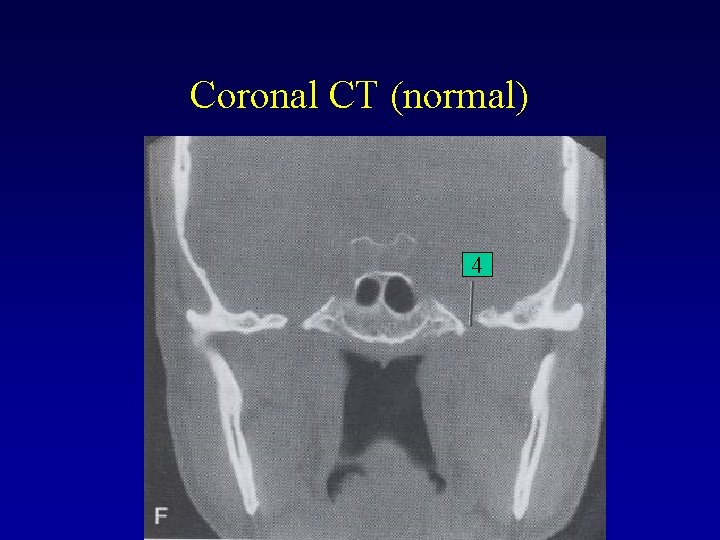
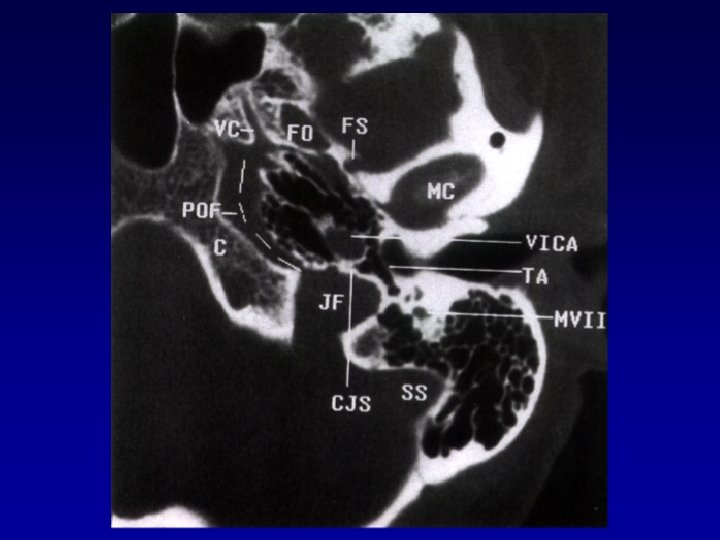
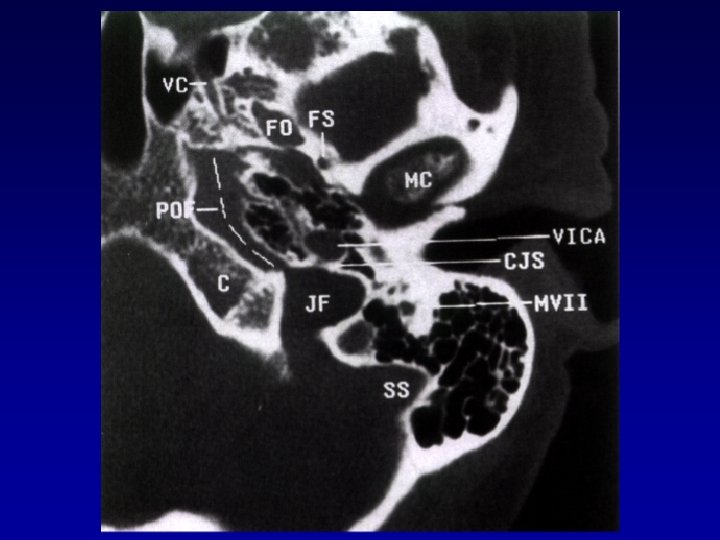
Coronal CT (normal) 4
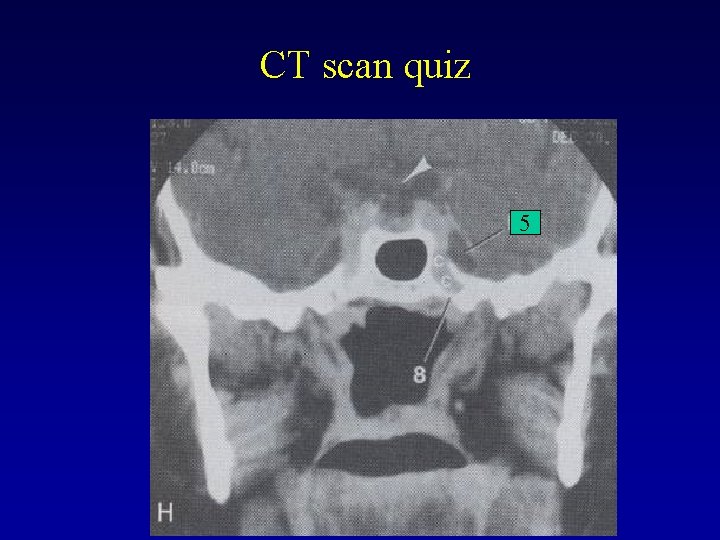
CT scan quiz 5
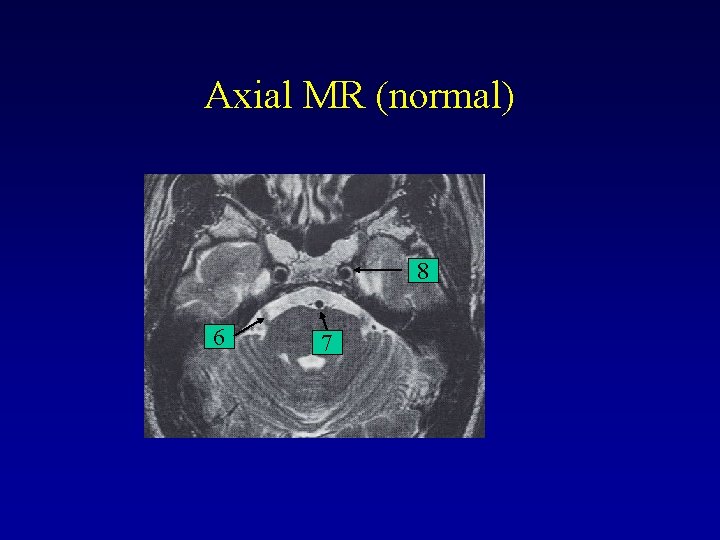
Axial MR (normal) 8 6 7
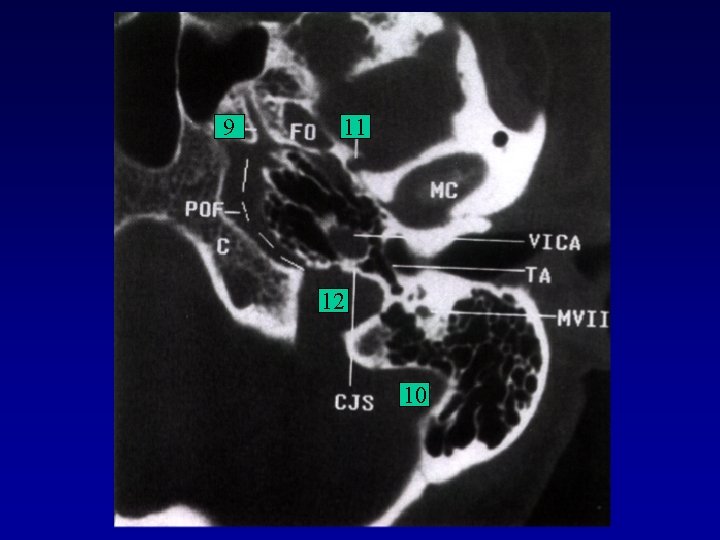
9 11 12 10
Board Review Quinton Gopen, MD
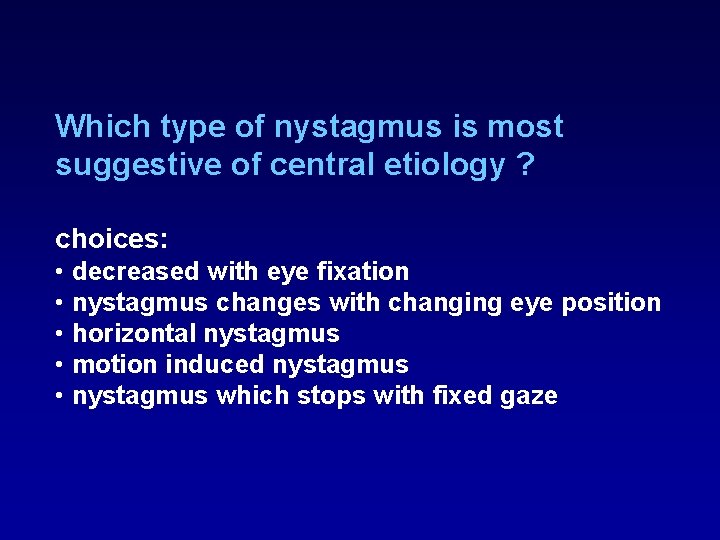
Which type of nystagmus is most suggestive of central etiology ? choices: • decreased with eye fixation • nystagmus changes with changing eye position • horizontal nystagmus • motion induced nystagmus • nystagmus which stops with fixed gaze
answer: nystagmus changes with changing eye position
What structure is under efferent nerve control in the inner ear? choices: • inner hair cell • stria vascularis • outer hair cells • spiral ligament • Deiter’s cells
answer: outer hair cells
What form of words is used to test in SRT? choices: • phoneme • spondee • balanced • recruited • tri-syllabic
answer: spondee
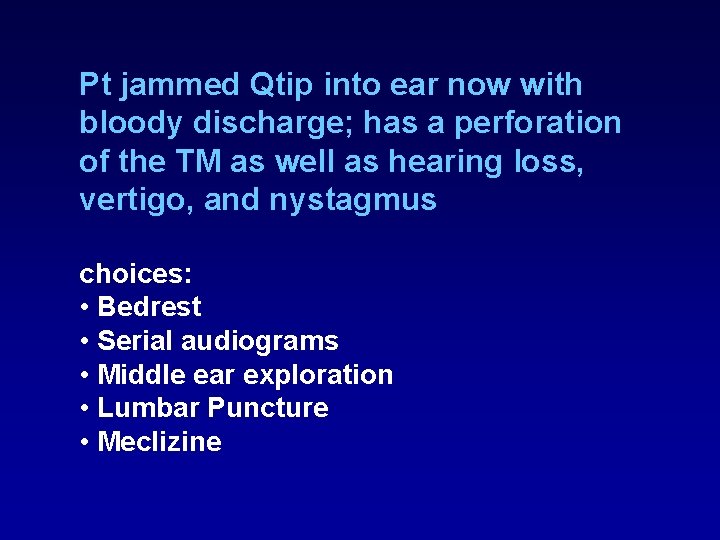
Pt jammed Qtip into ear now with bloody discharge; has a perforation of the TM as well as hearing loss, vertigo, and nystagmus choices: • Bedrest • Serial audiograms • Middle ear exploration • Lumbar Puncture • Meclizine
answer: middle ear exploration
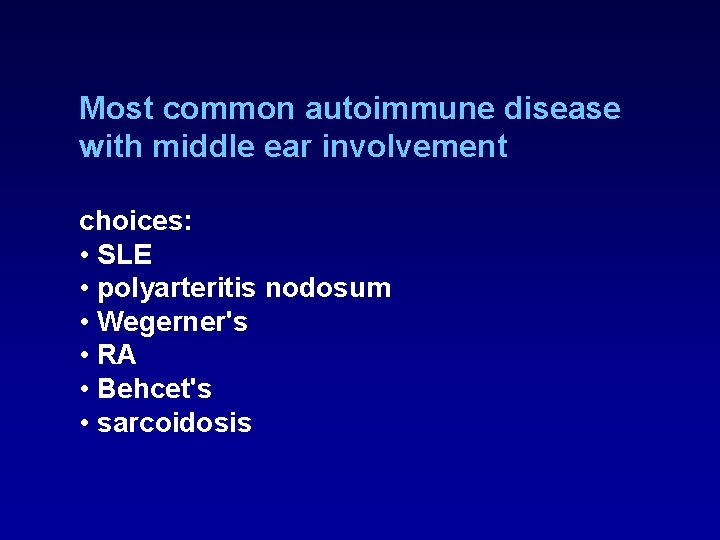
Most common autoimmune disease with middle ear involvement choices: • SLE • polyarteritis nodosum • Wegerner's • RA • Behcet's • sarcoidosis
answer: Wegner's granulomatosis
Most common virus implicated in congenital hearing loss choices: • CMV • Herpes • Toxoplasmosis • mumps • Varicella
discussion: congenital CMV infection accounts for a large amount of childhood deafness ~ 30 -40 k infants/year - roughly 1% of all newborns. All infants with congenital CMV infection shed the virus in high titers in bodily secretions. Definitive diagnosis can be confirmed by means of isolation of the virus from urine or saliva with PCR techniques within the first 2 weeks of life. answer: CMV
In malignant otitis externa, what is the best modality for following the infection ? choices: • Gallium scan • CT scan • PET scan • technetium scan • MRI scan
discussion: technetium bone scan evaluates osteoblastic activity and is excellent for localizing the infection but will not normalize after infection has resolved. Gallium bone scan evaluates inflammation and follows the course of the malignant otitis externa answer: gallium scan
Young woman with bilateral moderate SNHL and diffuse thyroid enlargement; what is next step ? choices: • perchlorate level • measure antithyroglobulin antibodies • renal UTZ • thyroid uptake scan • head CT
discussion: The woman has Pendred's syndrome, which is a defect in tyrosine iodination and presents as multinodular goiter at 8 -14 yrs old from failure of iodine organification - diagnosed by perchlorate levels (a positive perchlorate test is decreased perchlorate discharge). The treatment is exogenous thyroid hormone with thyroidectomy typically not required. answer: perchlorate level
Audiogram of pt with otosclerosis. H/o LT stapes now with very poor hearing in left ear (PTA 60 d. B, discrim 20%) Now with large air bone gap in right ear. choices: • hearing aids • right stapedectomy • left stapedectomy • fluoride • left cochlear implant
answer: hearing aids
What happens after stimulation of Jacobsen's nerve ? choices: • increased lacrimation • decreased lacrimation • increased submandibular gland flow • decreased submandibular gland flow • increase parotid gland flow
discussion: Jacobsen's nerve, a branch of cranial nerve IX provides parasympathetic innervation via the otic ganglion and auriculotemporal nerve to the parotid gland. answer: increase parotid gland flow
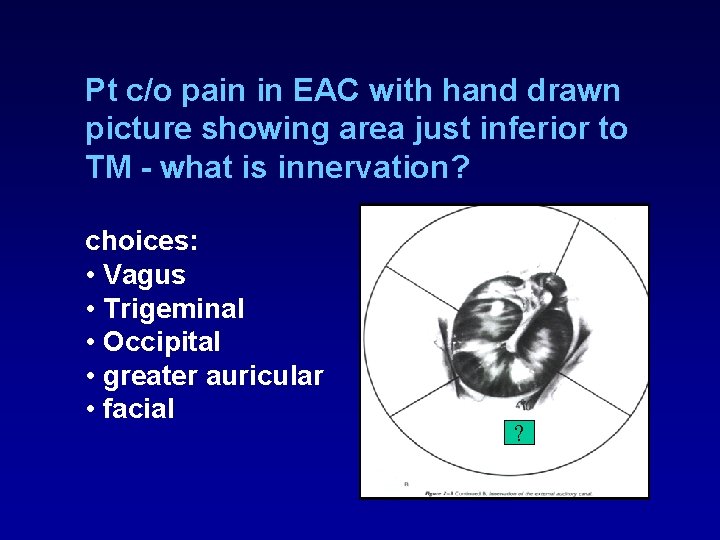
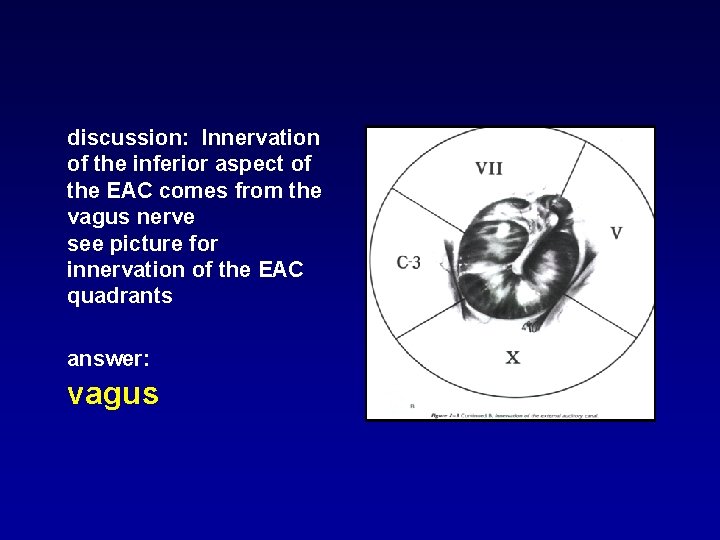
Pt c/o pain in EAC with hand drawn picture showing area just inferior to TM - what is innervation? choices: • Vagus • Trigeminal • Occipital • greater auricular • facial ?
discussion: Innervation of the inferior aspect of the EAC comes from the vagus nerve see picture for innervation of the EAC quadrants answer: vagus
Pt with resection of mastoid facial neuroma how best reconstruct ? choices: • XII-VII anastamosis • cable graft • VII-VII crossover • pedicled temporalis flap • facial sling
discussion: For facial nerve reconstruction, there is a definite order of preference in the method of repair. The first choice is always direct reapproximation of severed nerve ends, however due to tissue loss or in this case tumor resection this is not always possible. The second choice is a cable graft, with things like XII-VII and VII-VII coming after the cable graft in order of preference. answer: cable graft
Profuse bleeding during resection of a tumor involving the jugular bulb what is blood supply ? choices: • superior petrosal sinus • transverse sinus • inferior petrosal sinus • ascending pharyngeal • external carotid
discussion: the jugular bulb becomes the internal jugular vein inferiorly; superiorly the sigmoid sinus and the inferior petrosal sinus culminate to form the jugular bulb, and profuse bleeding certainly can arise in this area. The superior petrosal sinus drains into the lateral extent of the sigmoid sinus. Of the two listed, the inferior petrosal sinus is the best choice. answer: inferior petrosal sinus
Maximum conductive loss comes from what ? choices: • intact drum with ossicular discontinuity • total perforation • inferior perforation • superior perforation • middle ear effusion
discussion: A maximum conductive hearing loss is obtained when there is ossicular discontinuity in the presence of an intact eardrum and is around 60 d. B answer: intact drum with ossicular discontinuity
Which nerve is responsible for gustatory sweating ? choices: • Glossopharyngeal • Facial • Chordae • Lingual • Vidian nerve
discussion: the glossopharyngeal nerve innervates the parotid gland via the following pathway: inferior salvatory nucleus (medulla) glossophayryngeal nerve (Jacobsen's nerve) lesser superficial petrosal nerve - otic ganglion (now postganglionic fibers) - auriculotemporal nerve (CNV 3) - partoid gland After the parotid gland is cut out, the parasympathetic fibers aberently regenerate into the sweat glands which leads to Frey's syndrome, also known as gustatory sweating answer: glossopharyngeal
Tumor at fundus with intact hearing what would be best approach ? choices: • Middle fossa • Suboccipital • Retrosigmoid • Translabyrinthine • Infracochlear
discussion: There are three main types of approach to CP angle tumors: translab, retrosigmoid and middle fossa. The translab can get out any size tumor but has the down side of destroying any residual hearing. The middle fossa and retrosigmoid approaches spare hearing but can only be used in certain instances: middle fossa is best for small tumors at the fundus (very far lateral just as nerve enters cochlea) whereas retrosigmoid (aka suboccipital) is best for tumor at the meatus (very far medially where the nerve exits the brainstem at the CP angle. answer: middle fossa
Which pt will do worst with a cochlear implant ? choices: • postlingually deaf adult • postlingually deaf child • prelingually deaf child of short duration • sign language before implant • congenitally deaf
discussion: cochear implants (CI) depend on an intact cochlear nerve which can be stimulated, so the patients which do worse have the least viable cochlear nerve - this would be the congenitally deaf patient answer: congenitally deaf
Best hearing test for 8 month old ? choices: • Behavioral • Play • Conventional • Visual reinforced • Infant
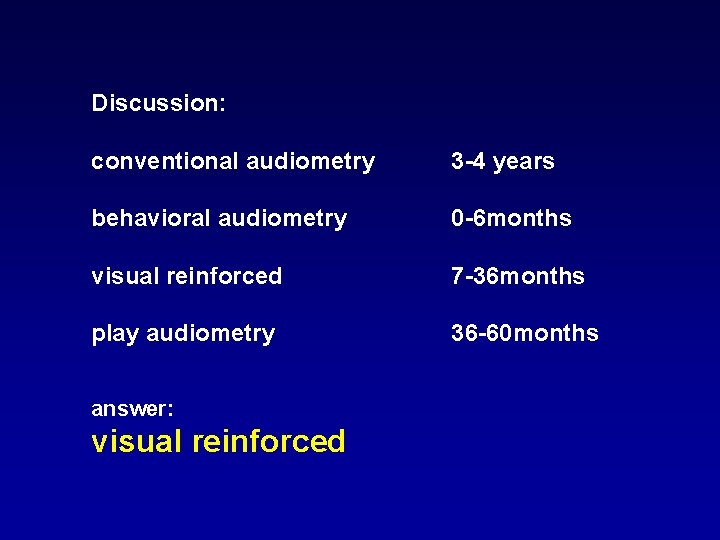
Discussion: conventional audiometry 3 -4 years behavioral audiometry 0 -6 months visual reinforced 7 -36 months play audiometry 36 -60 months answer: visual reinforced
CROS hearing aid is for ? choices: • unilateral profound hearing loss • bilateral profound hearing loss • unilateral conductive hearing loss • chronic draining ear • poor manual dexterity
answer: unilateral profound hearing loss
What structure is contained in the cochlear aqueduct ? choices: • loose arachnoid tissue • endolymphatic duct • cochlear artery • singular nerve • subarcuate artery
discussion: The structure contained inside the cochlear aqueduct is called the periotic duct and consists of loos connective tissue/loose arachnoid tissue answer: loose arachnoid tissue
While in surgery, the surgeon notes that he cog has been eroded by cholesteatoma, what is the most likely other structure to be affected ? choices: • lateral semicircular canal • verticle facial nerve • labyrinthine facial nerve • tympanic facial nerve • Posterior semicircular canal
discussion: The cog is a ridge of bone that extends inferiorly from the tegmen and separates the anterior epitympanum. The cog lies immediately superior to the cochleariform process. The tympanic segment of the facial nerve courses under the base of the cog. answer: tympanic segment of facial nerve
Site of ototoxicity of cisplatin ? choices: • basal cochlea • apical cochlea • saccule • utricle • lateral semicircular canal
discussion: cisplatin causes selective loss of outer hair cells in basal turn of the cochlea; toxicity related to dose of individual cycle rather than total dose of therapy; elderly and young children more at risk answer: basal cochlea
What is the most common complication of cochlear implantation ? choices: • flap necrosis • facial nerve stimulation • misplaced electrode • meningitis • encephalocele
discussion: Ear, Nose & Throat Journal, Dec, 1999, by Arvind Kumar, Richard Mugge, Marci Lipner Flap-related problems continue to be the most common complications, although their rates have fallen from 5. 44% in 1988 [1] to 2. 79% in l 995. [5] The incidence of compressed/misplaced electrodes has also declined, from 1. 74 to 1. 18%, as has the incidence of facial paresis, from 1. 74 to 0. 56%. answer: flap necrosis
Which cells are first damaged with noise exposure? choices: • outer hair cells at apical turn • outer hair cells at basal turn • inner hair cells at apical turn • inner hair cells at base • Claudius cells
discussion: high frequencies are lost first in noise exposure, which corresponds to the basal portion of the cochlea - and outer hair cells are more sensitive than inner hair cells to noise exposure so outer hair cells in the base answer: outer hair cells at basal turn
Cerebellopontine mass hypointense on T 1 and hyperintense on T 2 Also no gadolinium enhancement choices: • cholesterol granuloma • lipoma • arachnoid cyst • Meningioma • acoustic neuroma
discussion: T 1 images fat lights up whereas on T 2 images water lights up; here we have a mass lighting up on T 2 (like water) without enhancement when gadolinium is given. We can therefore rule out acoustic neuroma and meningioma which would enhance with gad and light up on T 1 images. Arachnoid cyst is like a big water bag so this is a good possibility and is often found in the CP angle and doesn't enhance with contrast! Cholesterol granuloma is one of the few things that will be intense on both T 1 and T 2 images. Lipoma has T 1 hyperintensity. answer: arachnoid cyst
Most common petrous apex lesion ? choices: • Cholesteatoma • Mucocele • cholesterol granuloma • teratoma • malignant schwannoma
discussion: Cholesterol granuloma is the most common lesion of the petrous apex. It is approximately 10 times more common than cholesteatoma and 40 times more common than mucocele. answer: cholesterol granuloma
Child with otitis media and fluctuance in sub. Q tissue over mastoid with fever but no facial nerve paralysis choices: • PET and simple mastoidectomy • IV ABX • radical mastoidectomy • wide myringotomy
discussion: Pt has a subperiosteal abscess (fluctuance) which must be drained via a simple mastoidectomy answer: PET and simple mastoidectomy
During a tympanoplasty mastoidectomy which medicaiton should anesthesia use to paralyze the patient ? choices: • Atracuronium • Curare • Pancuronium • Rocuronium • Succinylcholine
discussion: the idea here is you must be able to monitor the facial nerve funtion throughout the case so the shortest acting agent is the best – succinylcholine answer: succinylcholine