
Introduction to Franchising Course Pamela Currie Franchise Intellect









- Slides: 29
Introduction to Franchising Course Pamela Currie Franchise Intellect, Inc.
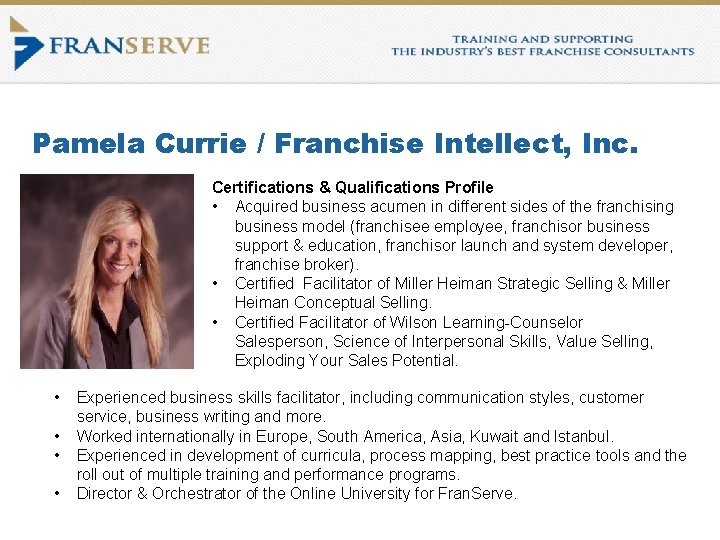
Pamela Currie / Franchise Intellect, Inc. Certifications & Qualifications Profile • Acquired business acumen in different sides of the franchising business model (franchisee employee, franchisor business support & education, franchisor launch and system developer, franchise broker). • Certified Facilitator of Miller Heiman Strategic Selling & Miller Heiman Conceptual Selling. • Certified Facilitator of Wilson Learning-Counselor Salesperson, Science of Interpersonal Skills, Value Selling, Exploding Your Sales Potential. • • Experienced business skills facilitator, including communication styles, customer service, business writing and more. Worked internationally in Europe, South America, Asia, Kuwait and Istanbul. Experienced in development of curricula, process mapping, best practice tools and the roll out of multiple training and performance programs. Director & Orchestrator of the Online University for Fran. Serve.
Agenda Topics q What is a Franchise? q What is an FDD? q What are the advantages & disadvantages of owning a franchise? q What are the different types of franchises? q What is the difference between a franchise opportunity and a business opportunity?
Webinar Ground Rules q Participation & Questions are Welcomed q Mute Your Phone (If You Have Background Noise) q Share Your Experiences q Open Your Mind To Learning q Positive Attitude q Joint Success
Introduction to the Franchise Industry The International Franchise Association defines a franchising system as… "a continuing relationship in which the franchisor provides a licensed privilege to do business, plus assistance in organizing, training, merchandising, and management in return for a consideration from the franchisee”. Website: www. franchise. org
Two Main Types of Franchises 1) Product franchising, sometimes called distributor franchising, gives the franchisee the right to sell the products of the company (product that the franchisor manufactures / supplier –dealer relationship). The franchisor licenses its trademark and logo to the franchisees, but typically does not provide them with an entire system for running their business. Industries you most often find this type of franchise is…automobile dealerships, soft drink distributors & gasoline service stations). 2) Business format franchising is the newest and fastest growing segment of franchising. Business format means simply that the franchise replicates its business format for a fee to the franchisee. Business format franchising programs include three key elements: (1) An identity, or trade name used by everyone in the system, (2) A business format that is followed closely by each outlet (Note: a business system is the hallmark of business format franchising), and (3) A continuous financial arrangement in the form of royalties in exchange for ongoing support.
Industry Factors Franchising is defined by State and Federal Laws as a commercial relationship in which three factors are present: 1) A Licensed Trademark 2) A Business Operating Format / Prescribed Marketing Plan 3) A Continuous Financial Arrangement (Royalties) for the right to participate in the program and receive ongoing support. When these three factors exist, the relationship is regulated as a franchise by state and federal laws. Federal Law (called the “FTC Rule”): require franchisors to prepare a Franchise Disclosure Document (“FDD”) and provide it to prospective franchisees. (f/k/a the “Uniform Franchise Offering Circular” or “UFOC”)
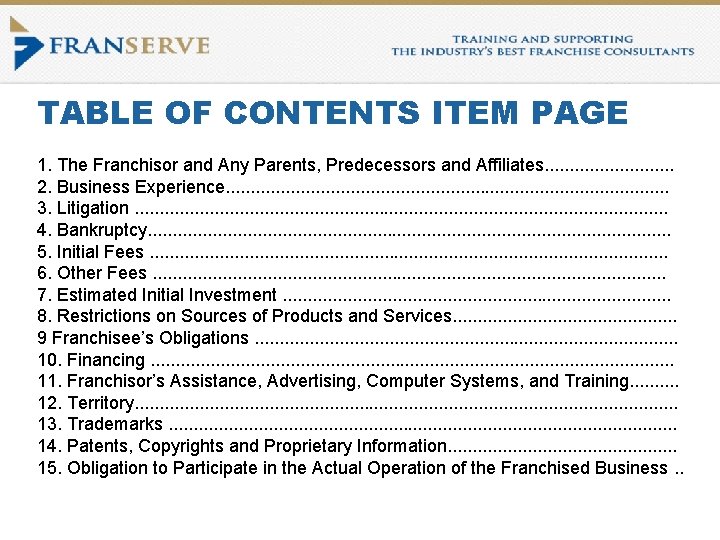
TABLE OF CONTENTS ITEM PAGE 1. The Franchisor and Any Parents, Predecessors and Affiliates. . . 2. Business Experience. . . . . . 3. Litigation. . . . . . . 4. Bankruptcy. . . . . . . 5. Initial Fees. . . . . . . 6. Other Fees. . . . . . . 7. Estimated Initial Investment. . . . . 8. Restrictions on Sources of Products and Services. . . 9 Franchisee’s Obligations. . . . . . 10. Financing. . . . . . . 11. Franchisor’s Assistance, Advertising, Computer Systems, and Training. . 12. Territory. . . . . . . 13. Trademarks. . . . . . . 14. Patents, Copyrights and Proprietary Information. . . 15. Obligation to Participate in the Actual Operation of the Franchised Business. .
TABLE OF CONTENTS ITEM PAGE CONTINUED…. . 16. Restrictions on What the Franchisee May Sell. . . 17. Renewal, Termination, Transfer and Dispute Resolution. . . . . 18. Public Figures. . . . . . . 19. Financial Performance Representations. . . . 20. Outlets and Franchisee Information. . . . 21. Financial Statements. . . . . . 22. Contracts. . . . . . . 23. Receipt. . . . . . . Exhibits A. FINANCIAL STATEMENTS B. APPLICATION C. FRANCHISE AGREEMENT (INCLUDING STATE-SPECIFIC ADDENDA) D. STATE ADMINISTRATORS E. AGENTS AUTHORIZED TO RECEIVE SERVICE OF PROCESS F. TABLE OF CONTENTS FOR MANUALS G. STATE-SPECIFIC DISCLOSURES H. LIST OF FRANCHISEES I. FRANCHISEE COMPLIANCE CERTIFICATION
What is a Franchise FRANCHISOR FRANCHISEE Owns Trademark or Trade Name Uses Trademark or Trade Name Successful Method of Doing Business Rights to Market a Product or Service / Business Operating Format Using the Operating Methods Of the Franchisor. Provides Support Training Advertising & Marketing (Sometimes) Financing, Site Selection and more. Receives Franchisor’s Support and the ability to Expand Grow their Business. Receives Fees Pays Fees
Three Common Fee’s in an FDD q Franchise Fee q Royalty Fee q Marketing Ad Fund Fee/Requirement - National - Regional - Local Note: Franchisor can dictate fees as they choose, as long as it is properly and legally disclosed in the FDD.
Categories of Franchising n n n n n n Accounting/Tax Services Advertising/Direct Mail Auto & Truck Rentals Automotive Products/Services Batteries-Retail & Comm. Beverages: Special Business Brokers Business/Mgmt Consultants Campgrounds Check Cashing/Financial Services Children’s Services Clothing and Shoes Computer/Electronics/Internet Construction Materials Consumer Buying Services Convenience Stores Cosmetics Dating Services Drug Stores Educational Products/Services Employment Services n n n n n Fitness Florist Shops Food/Restaurants Golf Products/Services Greeting Cards Hair Salons & Services Health Aids & Services Home Furnishings Home Inspection Hotels and Motels Insurance Janitorial Services Jewelry Laundry & Dry Cleaning Lawn/Garden/Agriculture Maid & Personal Services Maintenance Marine Services Optical Aids & Services n n n n n n Packaging/Ship/Mail Painting Services Paralegal Services Payroll Services Pest Control Services Pet Sales/Supplies Photography Printing/Copying Real Estate Services Recreational Services Rental Equipment & Supplies Retail Stores Security Systems Senior Care Sign Products & Services Tanning Centers Telecommunications Transportation Services Travel Agents Vitamin & Mineral Stores Weight Control
Franchising Success Rate Franchises have a 90%+ success rate. Most people can’t even predict that they can keep their jobs with 90% certainty.
The Franchise Prototype “Over the course of one year, Business Format Franchises have reported a success rate of 95 percent in contrast to the 50 -plus percent failure rate of new independently owned businesses” “The reason for that success is the Franchise Prototype”. “The Prototype becomes the incubator and the nursery for all creative thought, the station where creativity is nursed by pragmatism to grow into an innovation that works. ” “The Franchise Prototype is also the place where all assumptions are put to the test to see how well they work before becoming operational in the business. ” “Once having completed his Prototype, the franchisor then turns to the franchisee and says, “Let me show you how it works. ” “And work it does. The system runs the business. The people run the system. ” Book: The E-MYTH REVISITED by Michael E. Gerber
Advantages of Franchising q Proven System of Operation / Go into Business for Yourself, but Not by Yourself q Increases Your Chance of Business Success / Minimizes Risk with Predicable Results q Brand Recognition / Competitive Advantage q Marketing /Advertising q Economies of Scale / Volume Purchasing Power q Research & Development q Training / Ongoing Support (training, peer exchange, operating procedures & operational assistance, ongoing supervision) q Pre-Opening Support (site selection, design & construction, financing, training, grand-opening program)
Disadvantages of Franchising q Franchisee is not completely independent / Conformity to Standard Operating Procedures q Franchise Fee and On-going Royalties q Underfinanced, inexperienced, weak franchisor q Reliant upon Franchisor’s success q Duration of the Franchise Agreement
Determining if Franchising is Right for You… Frantrepreneur (fran*tre*pre*neur) n. A cross between a traditional entrepreneur and a modern franchise owner. One possessing the desire to be a business owner without the desire to recreate the wheel. The ability to follow a proven system for the benefit of personal and professional goals.
Determining if Franchising is Right for You… Frantrepreneur Mentality “I’m in business for myself, but not by myself”. “I want a ‘bottled’ process for success that I can use in developing my own successful business. ” “Why would I work for someone else when I can work for myself and reap the rewards of my efforts? " “I have the opportunity to learn from the success and failure of others. ” "Why would I spend years and the investment required to establish a successful brand when I could buy a franchise which provides immediate access to a successful business system and a brand name which others already have made successful? "
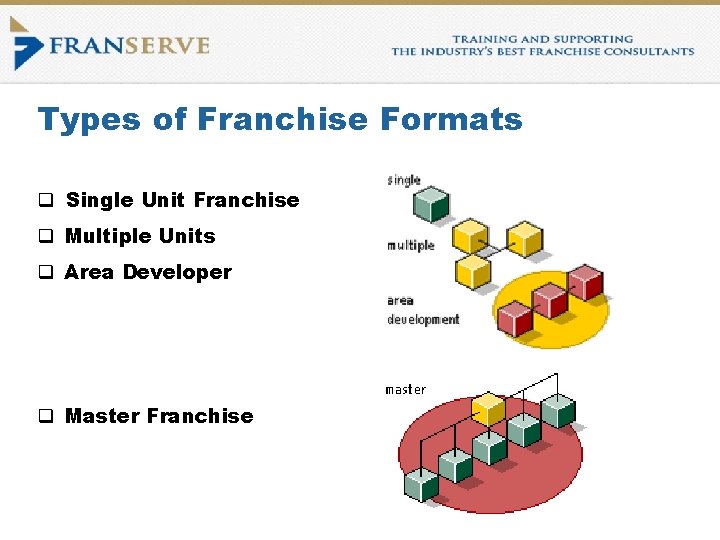
Types of Franchise Formats q Single Unit Franchise q Multiple Units q Area Developer q Master Franchise
Single Unit Franchise SINGLE -UNIT FRANCHISES A franchisee has the right to operate one franchise unit. Most franchisees enter the world of franchising by owning one unit. It is a great way to get in and understand the system before taking on more units. Territory: The franchisee may have a small radius of exclusive territory to operate within. If it is a retail store, the area of exclusivity may be a two or three mile radius around the store. If it is a home-based business the area may consist of a few specific zip codes. Level of participation: The franchisee is usually very involved with almost all operations of this type. Even if it is a semi-absentee owned business, the franchisee will want to be present at the business and be as hands-on as possible.
Multiple Units Franchise MULTI-UNIT FRANCHISES The franchisee acquires more than one unit of the franchise, usually at reduced franchise fees. The risk is lower because the franchisee can take advantage of the economies-of-scale theory; by spreading costs across multiunits, the locations may be more successful. A good sign of the health of the franchise is if many of the franchisees are multi-unit owners. Territory: There is usually no exclusive territory where the franchises must be set up. The franchisee may have one unit in one part of town with a surrounding radius of exclusivity, and another unit in another part of town 15 miles away or even in another county with its exclusive radius of operation. Level of participation: The franchisee is less involved with each of the units operations, but will be managing multiple operations and will need to have some level of supervision in each unit. If many units are opened, a general manager and additional administrative and training staff may be needed. The franchisee is more of a general manager when many units are involved.
Area Developer Franchise AREA DEVELOPMENT FRANCHISES This license usually grants the franchisee the right to open a certain number of franchises in a given area. There is usually a production schedule where the franchisee must open a certain number of franchises during a certain period. The franchisee has an exclusive area where no other franchisees can be allowed to open a franchise. Territory: The franchisee maintains an exclusive geographic territory as long as the opening schedule is maintained. The territories range from a small city to parts or all of a larger city. Level of participation: The franchisee will be very involved in the beginning stages of the first location to make sure it is successful. The franchisee will also need to be looking for qualified real estate to open the next few locations. Once several locations are open, the franchisee will need additional assistance to manage several units.
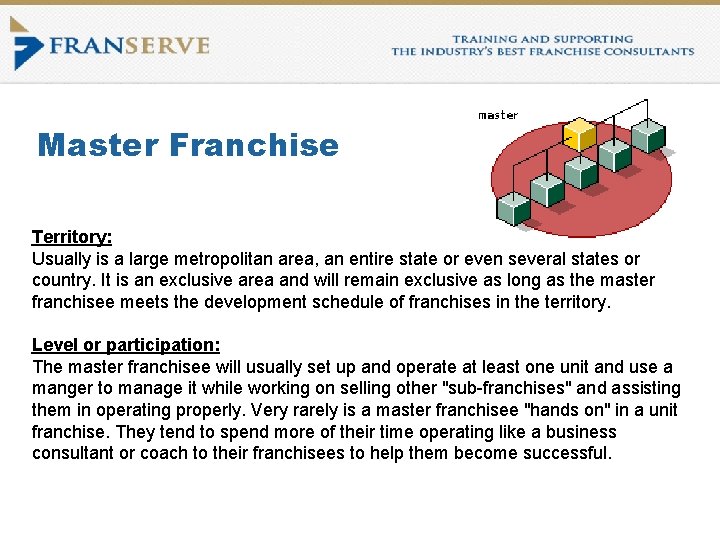
Master Franchise MASTER FRANCHISE A Master Franchisee, sometimes called a Regional Developer, has the rights to a larger area than that of an Area Developer. The Master Franchisee, in addition to opening franchises at a much reduced franchise fee and royalty, can also sell unit franchises, multi-unit franchises and area development franchises and make a nice return on the sale. The master usually receives a part of the royalty and franchise fee paid by each franchisee. There may be additional income available from distribution of products through the franchisees in the area and possibly even some real estate interest. The master becomes somewhat of a sub-franchisor for the area, without having experienced all the trial and error the original franchisor did. The master franchisee will usually want to open and operate at least one unit (pilot location), for income and use as a training center. Master franchises are rare; most franchisors do not offer them. However, when they are available they usually sell quickly. The income available from a master franchise is extremely lucrative. The initial investment is low compared to the type of value you can build in the master franchise area. The flexibility is also the greatest at this level.
Master Franchise Territory: Usually is a large metropolitan area, an entire state or even several states or country. It is an exclusive area and will remain exclusive as long as the master franchisee meets the development schedule of franchises in the territory. Level or participation: The master franchisee will usually set up and operate at least one unit and use a manger to manage it while working on selling other "sub-franchises" and assisting them in operating properly. Very rarely is a master franchisee "hands on" in a unit franchise. They tend to spend more of their time operating like a business consultant or coach to their franchisees to help them become successful.
Difference Between a Franchise Opportunity & a Business Opportunity? q Business Opportunity will get someone started on how to operate their business (the system, the training), but may or may not require them to pay ongoing fees and conform to given operating procedures. Franchisor’s usually have strict operating procedures that Franchisees are required to follow and are operating under one brand name. A business opportunity provides training and best practices without such rigid operating restrictions. q Business Opportunity means the owner will have his own business brand name.
Business Opportunities
Learning Opportunities q Review the IFA Publication “Introduction to Franchising” q Attend Fran. Serve University Certification & Elective Courses q Get your hands on an Franchise Disclosure Document. (Online Resource: http: //www. corp. ca. gov/Cal. EASI/caleasi. asp) q Check out a couple of Franchisor Websites and get familiar with how they represent their Franchise Opportunity. (Certa. Pro, Care. Minders, Friendly Computers, AAMCO, Signworld)
In Closing q You are in the right place at the right time q People are disenchanted with corporate jobs q 20 -34 year olds are going into business for themselves three times as frequently as 35 -55 year olds q The ‘Baby Boomers’ are retiring from their jobs, but feel they’re too young to truly retire q Women are going into business at twice the rate q Minorities are a fast growing sector in franchising
Wishing You Much Success! Please complete online evaluation form located on the FS University cover page