Computational Nano Enginering of Polymer Surface Systems Aquil

- Slides: 30
Computational Nano. Enginering of Polymer Surface Systems Aquil Frost, Environmental Engineering, Central State University John Lewnard, Mechanical Engineering, University of Cincinnati Anne Shim, Biomedical Engineering, The Ohio State University 1
Why Simulations? �“Because they provide the freedom to fail!” • Cost • Time [3] �“Assess real-world processes too complex to analyze via spreadsheets or flowcharts” [5] 2
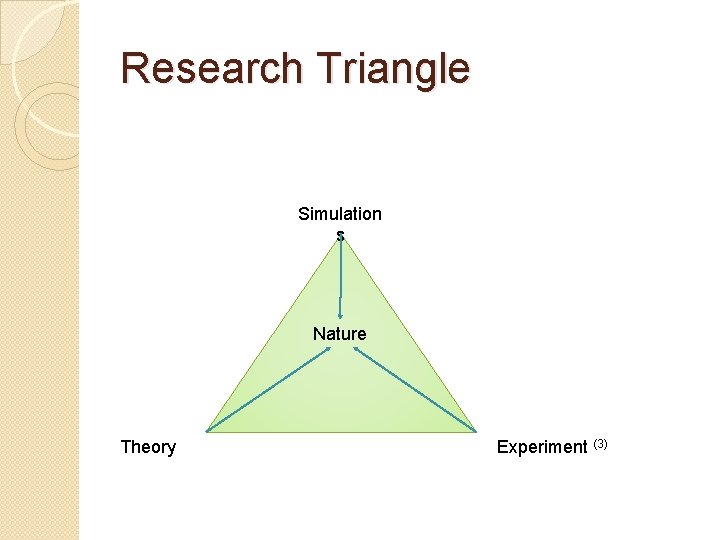
Research Triangle Simulation s Nature Theory Experiment (3)
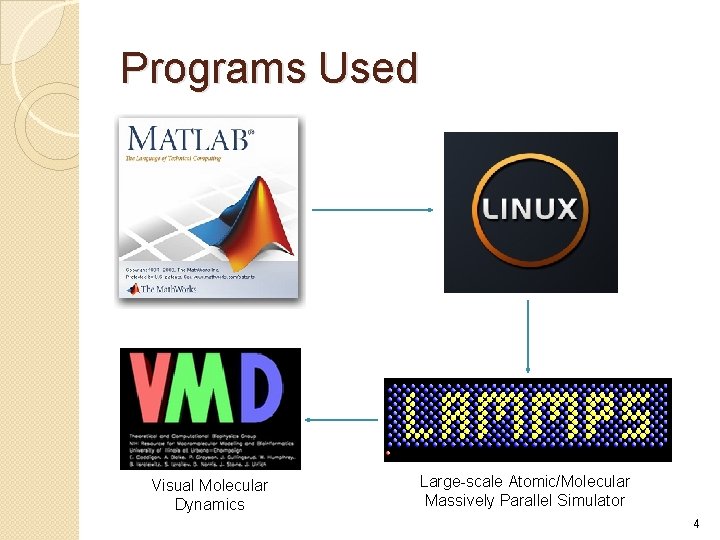
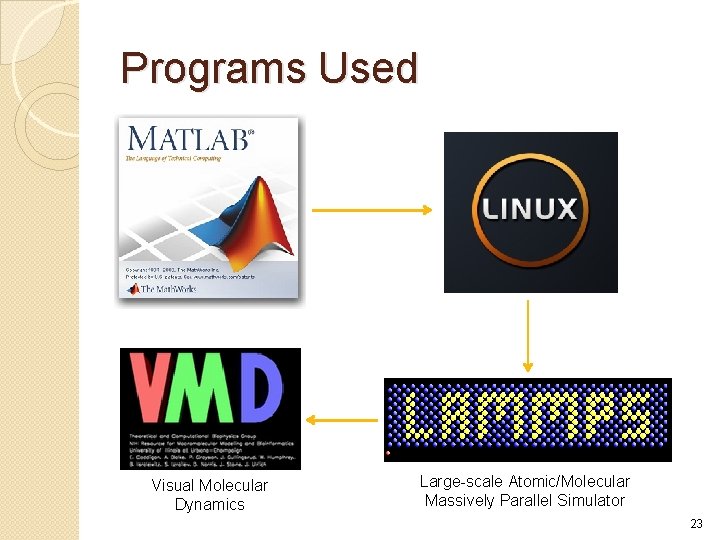
Programs Used Visual Molecular Dynamics Large-scale Atomic/Molecular Massively Parallel Simulator 4
General Task Overview Literature Review 2. Generation of Surfaces and Polymers 3. Run Simulations and Analyze 4. Project Deliverables 1. 5
Task 1: Literature Review 6
What Are Polymers? � Substances which consist of a large number of repeating units called “monomers” � Polymers are used as adhesives, coatings, foams, and packaging materials to textile and industrial fibers, composites, electronic devices, biomedical devices, optical devices, and precursors for many newly developed high-tech ceramics � The polymer industry has grown to be larger than the aluminum, copper, and steel industries combined [4]
Physical Properties Of Polymers � Are dependent upon interchain and intrachain bonding, nature of the back bone, processing events, presence or absence of the additive, chain size and geometry, and molecular weight distribution. � Polymers are semi-crystalline � Polymers that crystallize are different in characteristics to equivalent low molecular weight materials. [1]
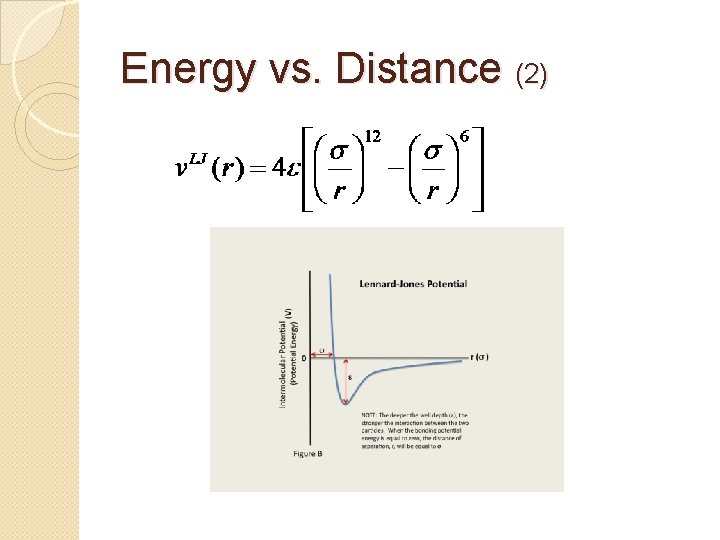
Energy vs. Distance (2)
Molecular Structure � Molecular arrangement of polymers can be compared to that of spaghetti � Amorphous organization of molecules has no longrange order or form in which the polymer chains arrange themselves � Amorphous polymers are generally transparent, which is an important characteristic for many applications including food wrap, plastic windows, headlight senses, and contact lenses [1]
Monte Carlo Method �Dependent on numbers randomly generated within confined spaces ◦ The data from the random generation are averaged in some way �Time is irrelevant ◦ Less time is required compared to wet lab ◦ MC Method is not proof that something has happen – it probably will happen [6]
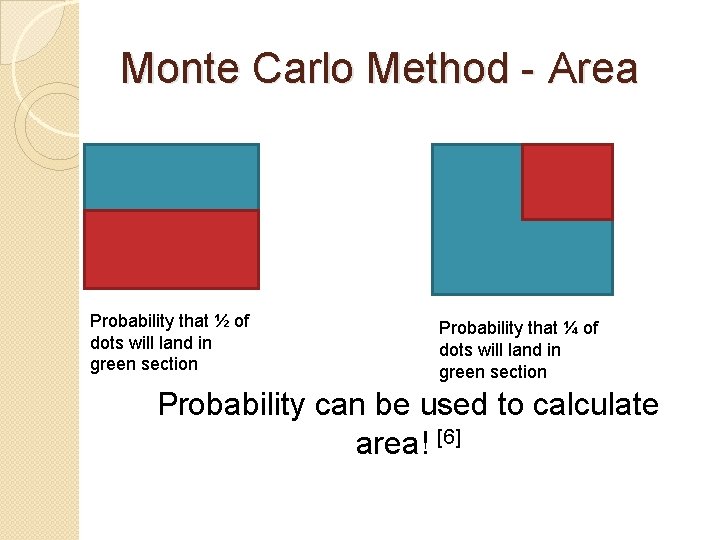
Monte Carlo Method - Area Probability that ½ of dots will land in green section Probability that ¼ of dots will land in green section Probability can be used to calculate area! [6]
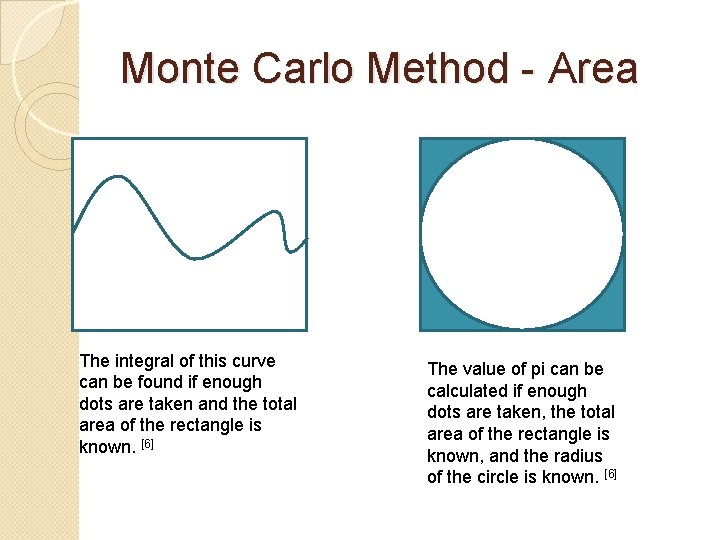
Monte Carlo Method - Area The integral of this curve can be found if enough dots are taken and the total area of the rectangle is known. [6] The value of pi can be calculated if enough dots are taken, the total area of the rectangle is known, and the radius of the circle is known. [6]
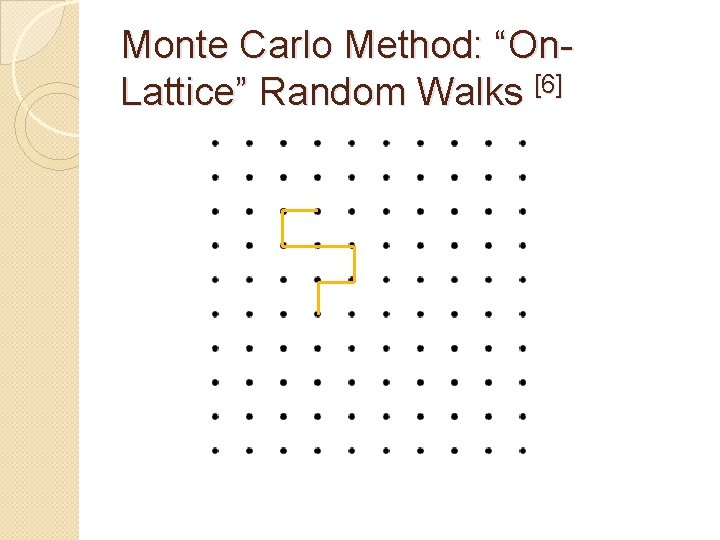
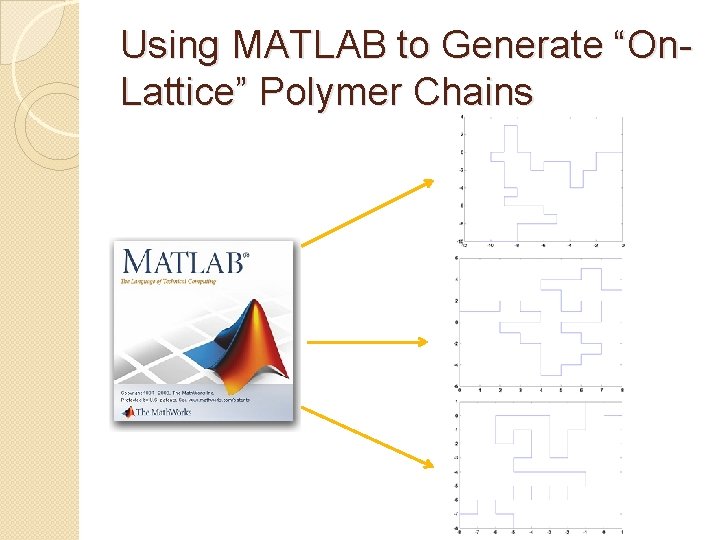
Monte Carlo Method: “On. Lattice” Random Walks [6]
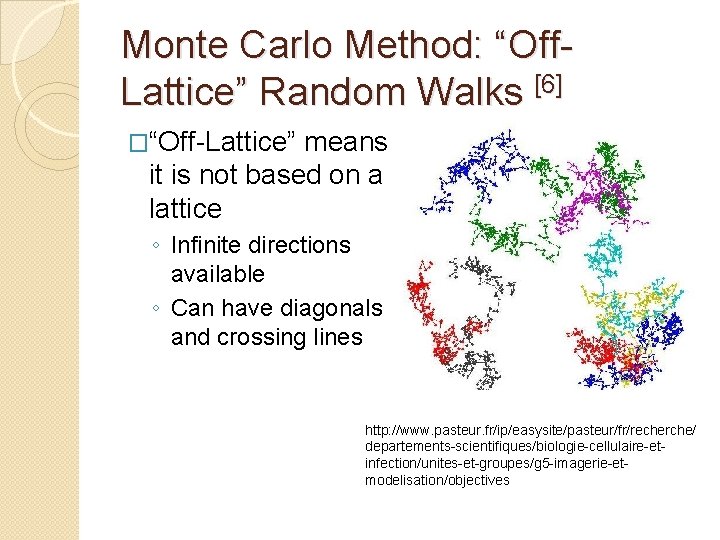
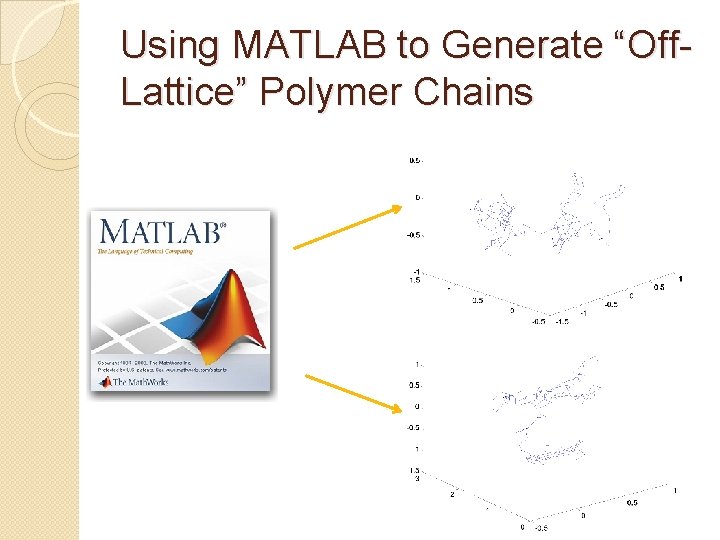
Monte Carlo Method: “Off. Lattice” Random Walks [6] �“Off-Lattice” means it is not based on a lattice ◦ Infinite directions available ◦ Can have diagonals and crossing lines http: //www. pasteur. fr/ip/easysite/pasteur/fr/recherche/ departements-scientifiques/biologie-cellulaire-etinfection/unites-et-groupes/g 5 -imagerie-etmodelisation/objectives
How Monte Carlo Method will be Used �The creation of polymer chains ◦ “Off lattice” Random Walks �The placement of polymer chains �When polymer is adsorbing with surface randomly: ◦ Energy , entropy, and distance from surface will be measured for each random placement ◦ These values will be averaged for each simulation
Task 2: Generate Surfaces and Polymers 17
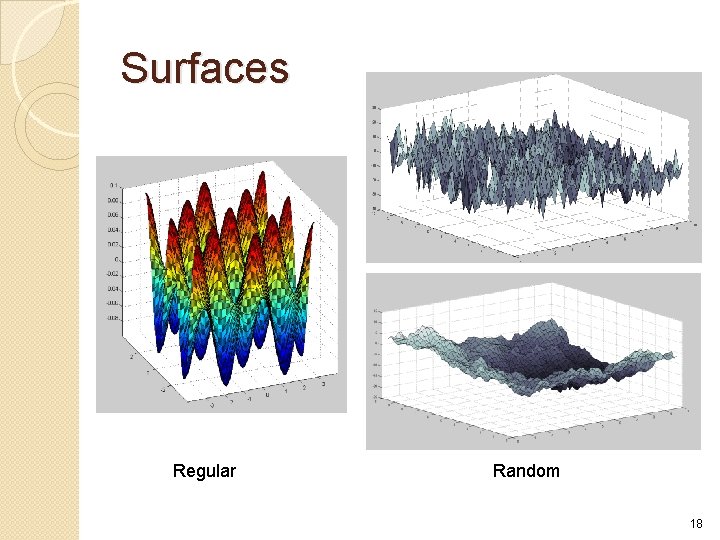
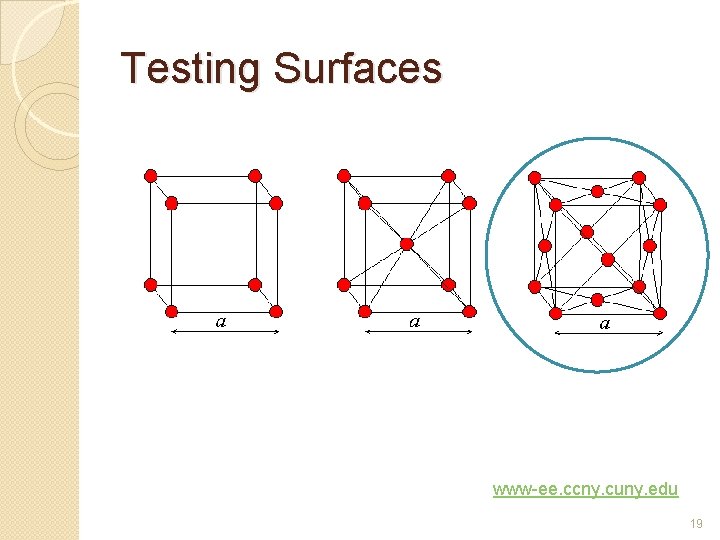
Surfaces Regular Random 18
Testing Surfaces www-ee. ccny. cuny. edu 19
Using MATLAB to Generate “On. Lattice” Polymer Chains
Using MATLAB to Generate “Off. Lattice” Polymer Chains
Task 3: Run Simulations and Analyze 22
Programs Used Visual Molecular Dynamics Large-scale Atomic/Molecular Massively Parallel Simulator 23
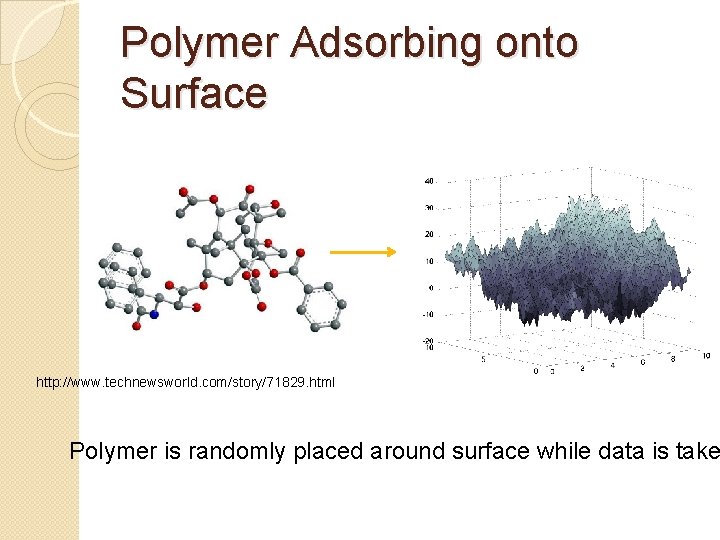
Polymer Adsorbing onto Surface http: //www. technewsworld. com/story/71829. html Polymer is randomly placed around surface while data is take
Data that might be taken from simulation �Entropy – How many options does the polymer have? ◦ At bottom of trough – the polymer is compact �Not many options ◦ At top of trough – the polymer is free to move �A lot of options �Energy – What is energy at a certain distance? ◦ Each distance corresponds to a certain energy level
Analysis of Data �Analysis will answer questions such as: ◦ What was the average entropy level? ◦ What was the average energy level? ◦ What was the average distance from the polymer to the surface?
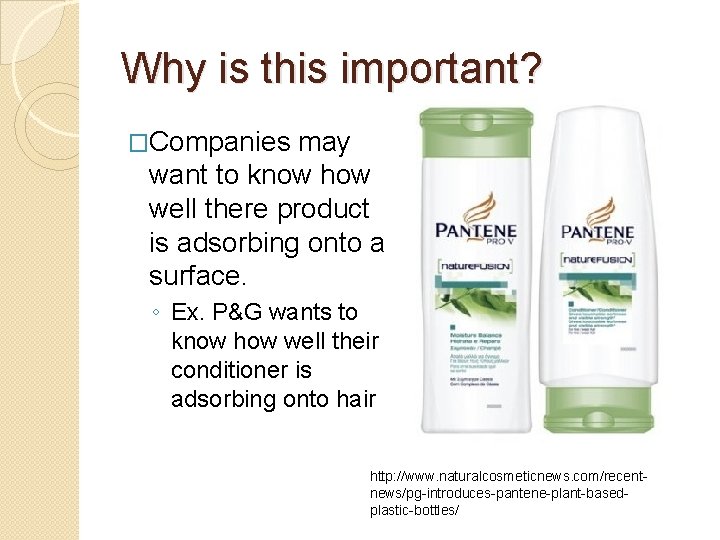
Why is this important? �Companies may want to know how well there product is adsorbing onto a surface. ◦ Ex. P&G wants to know how well their conditioner is adsorbing onto hair http: //www. naturalcosmeticnews. com/recentnews/pg-introduces-pantene-plant-basedplastic-bottles/
Task 4: Project Deliverables Research Paper Final Poster Final Presentation 28
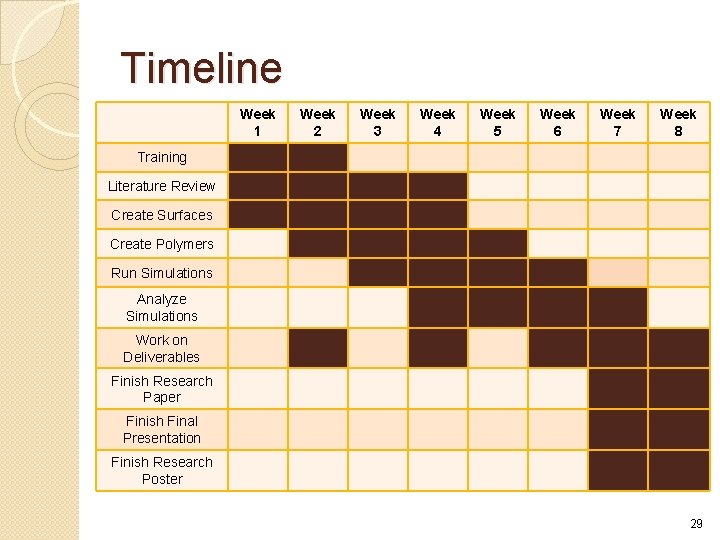
Timeline Week 1 Week 2 Week 3 Week 4 Week 5 Week 6 Week 7 Week 8 Training Literature Review Create Surfaces Create Polymers Run Simulations Analyze Simulations Work on Deliverables Finish Research Paper Finish Final Presentation Finish Research Poster 29
Works Cited [1] (2010). “Polymers”, Chemical of the Week, <http: //scifun. chem. wisc. edu/chemweek/polymers. html>(May 31, 2013). [2] (2010). “Lennard-Jones Potential”, UCDavis. Chem. Wiki, <http: //chemwiki. ucdavis. edu/Physical_Chemistry/Quantum_Mechanics/ Atomic_Theory/Intermolecular_Forces/Lennard-Jones_Potential>(May 31, 2013). [3] (2012). “Solutions: Simulation Software Overview. ” Imagine That!, <http: //www. extendsim. com/sols_simoverview. html#monte. Carlo>(May 29, 2013). [4] (2012). “What are Polymers? , MAST, <http: //matse 1. matse. illinois. edu/polymers/ware. html>(May 31, 2013). [5] (2013). “Why Simulations? ” TATA Interactive Systems, <http: //blog. tatainteractive. com/2013/01/why-simulations. html>(May 29, 2013). [6] Landau D. P. Binder K. (2000). “Introduction, ” “Simple Sampling Monte Carlo Methods , “Monte Carlo Simulations in Statistical Physics, Press Syndicate of the University of Cambridge, United Kingdom, 30 1 -6, 48 -67