
The Sense of Structure Writing From the Readers
- Slides: 31
The Sense of Structure Writing From the Reader’s Perspective By George D. Gopen Benjamin Lok 9/21/06
Outline Why should this interest me? n Gopen’s Approach n Sentences n Paragraphs n Summary n
Who would benefit from this talk/book? Writers of technical papers and proposals n Writers who write X, but get reviewers that complain of Y n Writers for whom English is not a primary language n
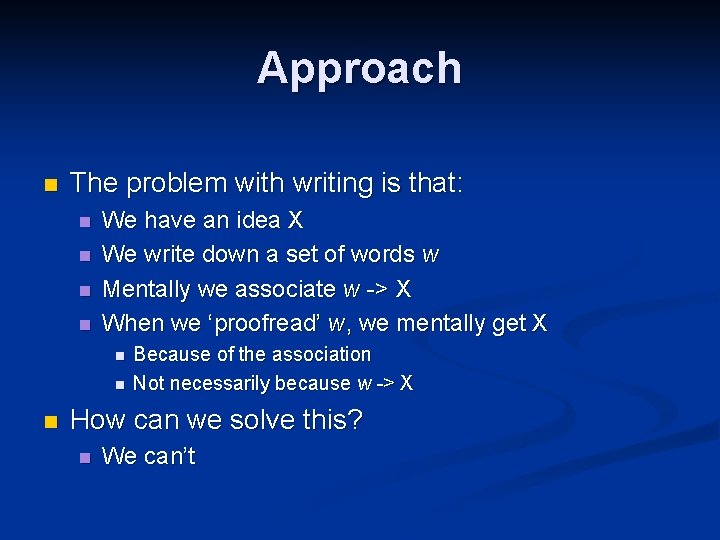
Approach n The problem with writing is that: n n We have an idea X We write down a set of words w Mentally we associate w -> X When we ‘proofread’ w, we mentally get X n n n Because of the association Not necessarily because w -> X How can we solve this? n We can’t
Approach However, we can try to raise the percentage chance that a reader will associate w->X n By understanding what readers comprehend when reading w n Note: This means that some people will still believe w!->X n
Gopen’s Approach n Study writing from the reader’s perspective n n Fewer rules! Example: n n n In the second study, people performed the task twice. Study participants, in the second study, twice performed the task. . From the reader’s perspective, which sentence gave us more information? n n n Why? While we’ve been taught writing rules are paramount, it really is secondary in impacting what the user comprehends. So what is primary? Not word choice. Word order! 85% word order, 15% word choice
Emphasis n Although Fred is a nice guy, he beats his dog. n n Although Fred beats his dog, he’s a nice guy. n n n #3 Fred beat his dog, but he’s a nice guy. n n #1 Fred is a nice guy, but he beats his dog. n n #4 #2 Evaluate: Stress point, and dependent/independent clauses Important things to consider: n n Dog lovers always hate Fred You can make Fred unlikable
Carrot Confidence - the message you are writing will be the same message the reader is reading n Efficiency - spend less time with your writing n Persuasion - subtly shape reader’s perceptions n Tools not rules. You won’t be forced to memorize anything! n
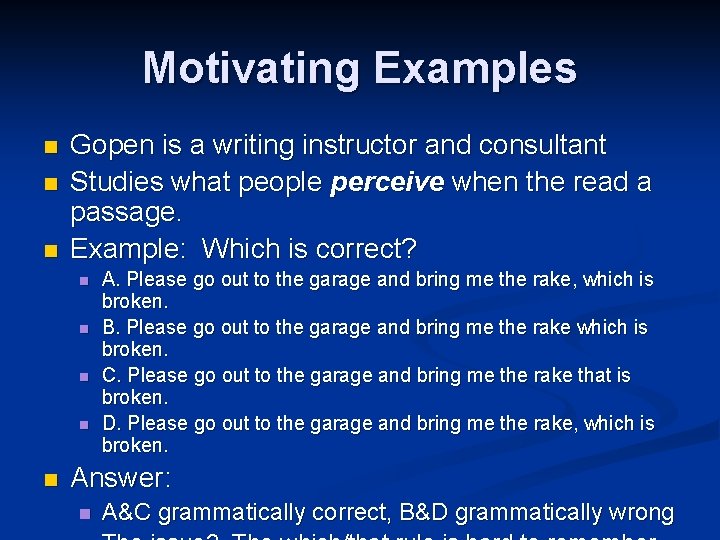
Motivating Examples n n n Gopen is a writing instructor and consultant Studies what people perceive when the read a passage. Example: Which is correct? n n n A. Please go out to the garage and bring me the rake, which is broken. B. Please go out to the garage and bring me the rake which is broken. C. Please go out to the garage and bring me the rake that is broken. D. Please go out to the garage and bring me the rake, which is broken. Answer: n A&C grammatically correct, B&D grammatically wrong
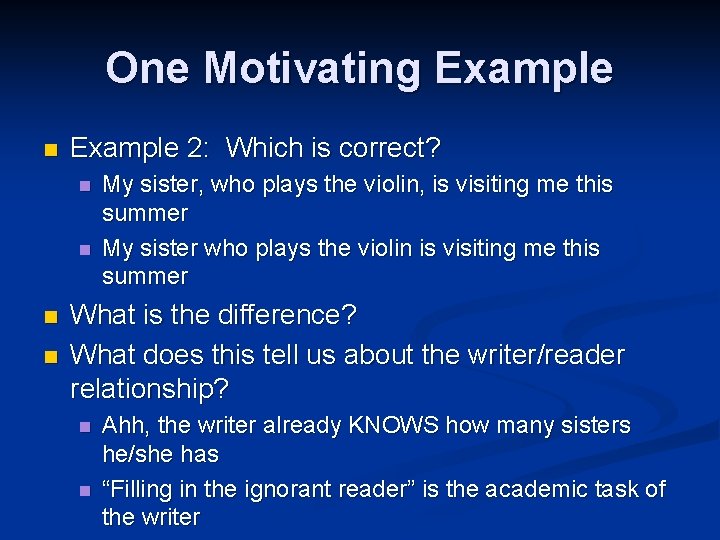
One Motivating Example n Example 2: Which is correct? n n My sister, who plays the violin, is visiting me this summer My sister who plays the violin is visiting me this summer What is the difference? What does this tell us about the writer/reader relationship? n n Ahh, the writer already KNOWS how many sisters he/she has “Filling in the ignorant reader” is the academic task of the writer
Sentences n A sentence by itself is: Rarely good nor bad n Neither correct nor wrong n E. g. stick a sentence in from the Gettysburg Address into Dr. King’s “I have a Dream” speech n n What matters? Context Counts n Word Order counts n
Links to Movies/Songs You attend a concert. Freeze a moment in time about 15 minutes into the concert. What do you expect in the next minute? n Movies – n Watchers/Listeners/READERS have expectations n If you break expectations n n They get confused (the muddled feeling you get) n They distrust you (this is difficult to recover from)
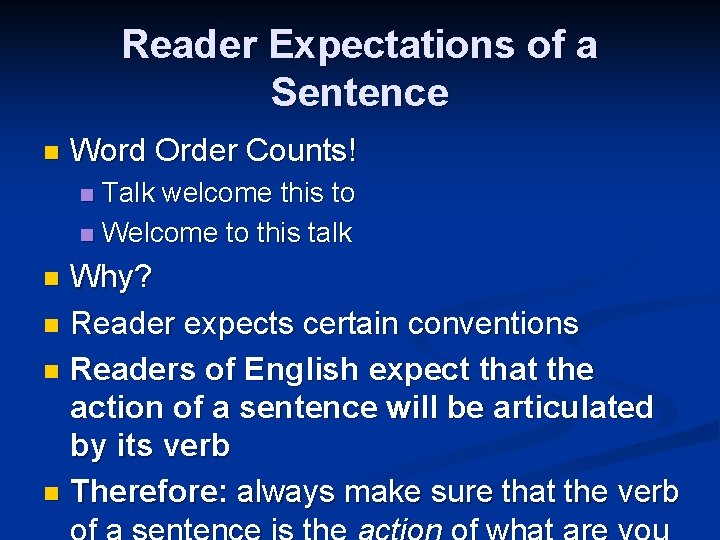
Reader Expectations of a Sentence n Word Order Counts! Talk welcome this to n Welcome to this talk n Why? n Reader expects certain conventions n Readers of English expect that the action of a sentence will be articulated by its verb n Therefore: always make sure that the verb n
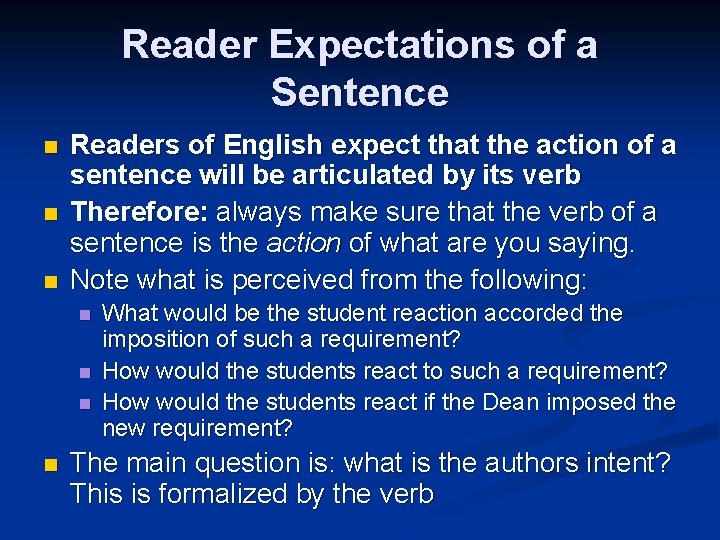
Reader Expectations of a Sentence n n n Readers of English expect that the action of a sentence will be articulated by its verb Therefore: always make sure that the verb of a sentence is the action of what are you saying. Note what is perceived from the following: n n What would be the student reaction accorded the imposition of such a requirement? How would the students react to such a requirement? How would the students react if the Dean imposed the new requirement? The main question is: what is the authors intent? This is formalized by the verb
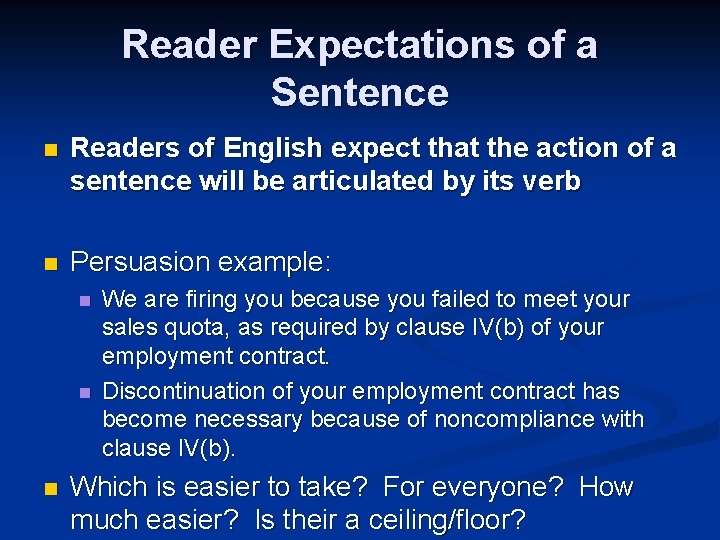
Reader Expectations of a Sentence n Readers of English expect that the action of a sentence will be articulated by its verb n Persuasion example: n n n We are firing you because you failed to meet your sales quota, as required by clause IV(b) of your employment contract. Discontinuation of your employment contract has become necessary because of noncompliance with clause IV(b). Which is easier to take? For everyone? How much easier? Is their a ceiling/floor?
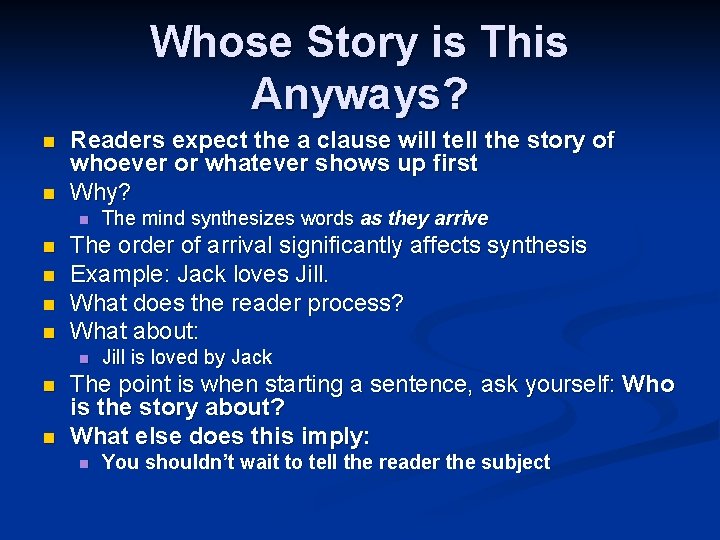
Whose Story is This Anyways? n n Readers expect the a clause will tell the story of whoever or whatever shows up first Why? n n n The order of arrival significantly affects synthesis Example: Jack loves Jill. What does the reader process? What about: n n n The mind synthesizes words as they arrive Jill is loved by Jack The point is when starting a sentence, ask yourself: Who is the story about? What else does this imply: n You shouldn’t wait to tell the reader the subject
What are you waiting for? Readers expect the grammatical subject to be followed almost immediately by the grammatical verb n Ex. The combination of such confidence in understanding situations and such unwillingness – or perhaps inability – to step forward and be assertive was completely new to her n Completely new to her was the combination of such confidence in understanding situations and such n
What are you waiting for? n n n Readers expect the grammatical subject to be followed almost immediately by the grammatical verb Make the first word is the subject Make what the subject does the second word A side effect: If you don’t readers will less likely remember what you place between a subject and verb! Example: Participants, in the second study, took twice as long to complete the task as those in the first study.
A reminder… so what? n So what if I don’t follow these guidelines? n SUBJECT VERB… n ?
Save the Best for Last n n n n Humans like to save the best for last Like eating! Dessert is last! Tool: Readers of English expect the material most to be emphasized in the sentence will appear at a moment of full syntactic closure, called a Stress Point (SP). Corollary: Readers of English expect that every Stress position will be filled with material intended to receive significant emphasis. Ex. Jack loves Jill What do we expect is the author’s main point? What do we expect to follow?
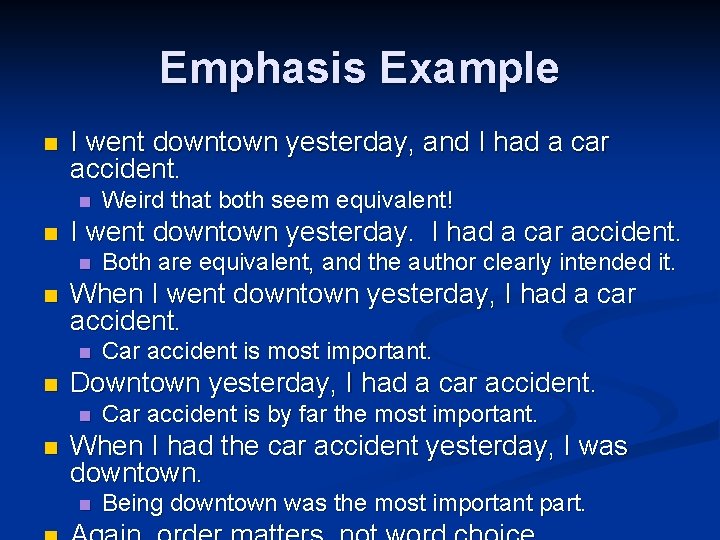
Emphasis Example n I went downtown yesterday, and I had a car accident. n n I went downtown yesterday. I had a car accident. n n Car accident is most important. Downtown yesterday, I had a car accident. n n Both are equivalent, and the author clearly intended it. When I went downtown yesterday, I had a car accident. n n Weird that both seem equivalent! Car accident is by far the most important. When I had the car accident yesterday, I was downtown. n Being downtown was the most important part.
Summary Word order is important n Subject should be the first word n Verb should follow n Stress point should in the last part of the sentence. n Foreshadowing: You can manipulate the reader!!! n
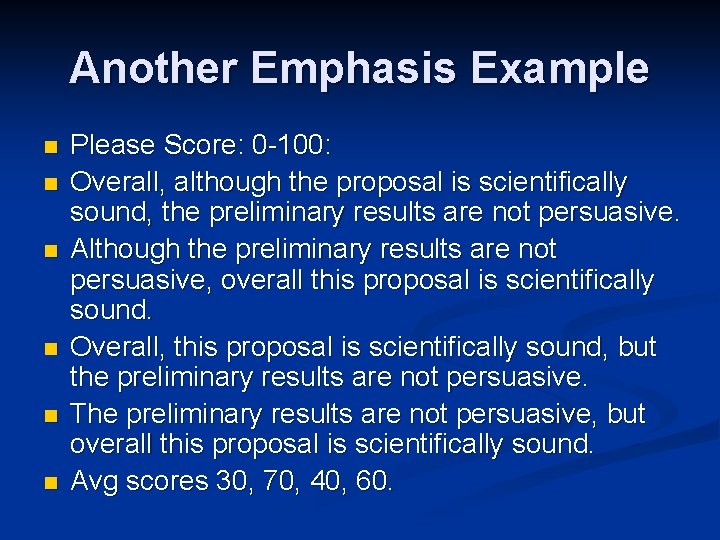
Another Emphasis Example n n n Please Score: 0 -100: Overall, although the proposal is scientifically sound, the preliminary results are not persuasive. Although the preliminary results are not persuasive, overall this proposal is scientifically sound. Overall, this proposal is scientifically sound, but the preliminary results are not persuasive. The preliminary results are not persuasive, but overall this proposal is scientifically sound. Avg scores 30, 70, 40, 60.
Topic Position Tool: Readers expect the material at the beginning of a sentence to provide a connection backward to the previous sentence. n Look at a paragraph’s topic positions! n Backward-Linking old information + Whose story = CONTEXT n
Subject->SP relationship Tool: Readers expect the material at the beginning of a sentence to contextualize them for the new and important material to be presented later in the sentence. n Tool: Readers form that context by answer two questions: (1) Whose story is this? And (2) How does this sentence link backward to the sentence before it? n How am I to use this to help me write? n n Tool: Make sure that your subject and stress points in a paragraph are connected!
Paragraphs connect sentences Eg. Asbestos insulation installers who have inhaled asbestos fibers over a period of many years regularly contract these diseases. n What is the most important things? n Could be installers, asbestos fibers, insulation, over a period of many years n You control things. AND the reader expects things (SP). n If you don’t the odds of them picking up on what you meant drop considerably n
But it feels too restrictive! You can add phrases, etc. however you just need to know how they will be perceived n Boredom does not rise from structure, but from content n Lots of freedom! n If your Topic and Stress points are full of stupid and boring things, perhaps your idea is too. n
Take Home Points n Write most sentences as: n n Subject -> Verb ->Stress Point Whose Story – Action – Stress
Take Home Points n Paragraph n n The *point* of your paragraph should be in the first two sentences (almost always) The point of your entire paper should be at the end of the first paragraph Subject 1 -> Verb 1 ->Stress Point 1. Subject 2 -> Verb 2 ->Stress Point 2. n Stress Point 1 should be clearly related to Subject 2. Controlling movement->controlling thought n Controlling the whose story let’s you say what is the ‘star’ of the text. Controlling the stress points means you control what is important.
Bad Advice n Myth: “Write the way you speak” n n n Instead: “Write the way your readers read” Myth: “To see if your writing is good, read it out loud” n n Longer sentences are harder to write, not read! Myth: “Avoid the verb to be and other weak verbs” n n You only reinforce the w->X linkage, not whether someone will comprehend w->X Myth: “To make it better, make it shorter” n n Speaking has more information (verbal/nonverbal cues) Verbs gain meaning through context. This is more important Myth: “Vary the way you begin sentences to keep your reader interested” n Linkages, plus beginning of a sentence is just too important for variety sake. What is the role of your writing?
http: //www. amazon. com/gp/product/02052 96327/104 -79592755021534? %5 Fencoding=UTF 8&v=glance &n=283155 n Remember: Writing is a part of the thinking process. n