
Chapter 7 Stereochemistry 7 1 Molecular Chirality Enantiomers

- Slides: 30
Chapter 7 Stereochemistry
7. 1 Molecular Chirality: Enantiomers
Chirality A molecule is chiral if its two mirror image forms are not superposable upon one another. A molecule is achiral if its two mirror image forms are superposable.
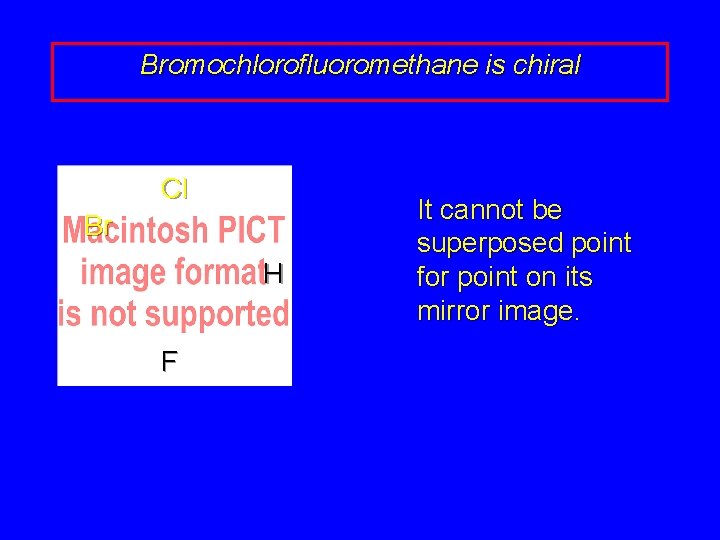
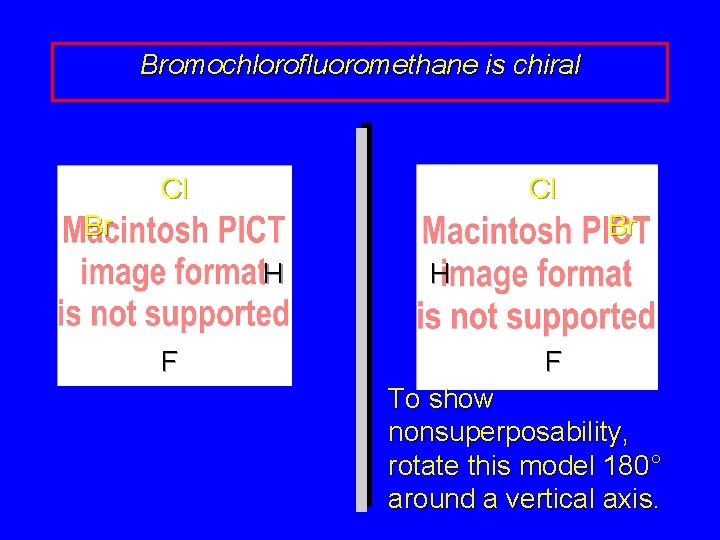
Bromochlorofluoromethane is chiral Cl Br H F It cannot be superposed point for point on its mirror image.
Bromochlorofluoromethane is chiral Cl Cl Br Br H F To show nonsuperposability, rotate this model 180° around a vertical axis.
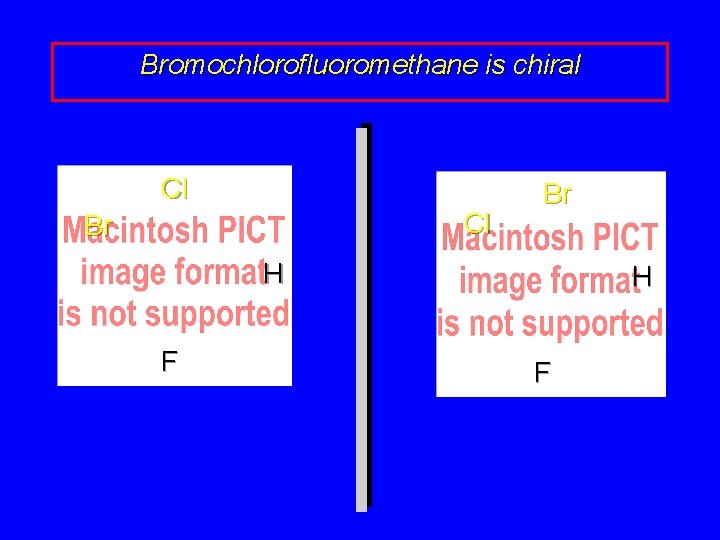
Bromochlorofluoromethane is chiral Cl Cl Br Br H F
Another look
Enantiomers nonsuperposable mirror images are called enantiomers and are enantiomers with respect to each other
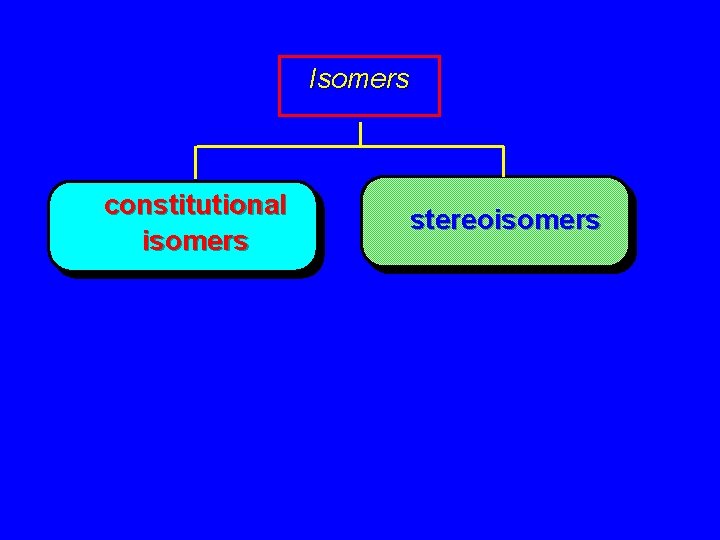
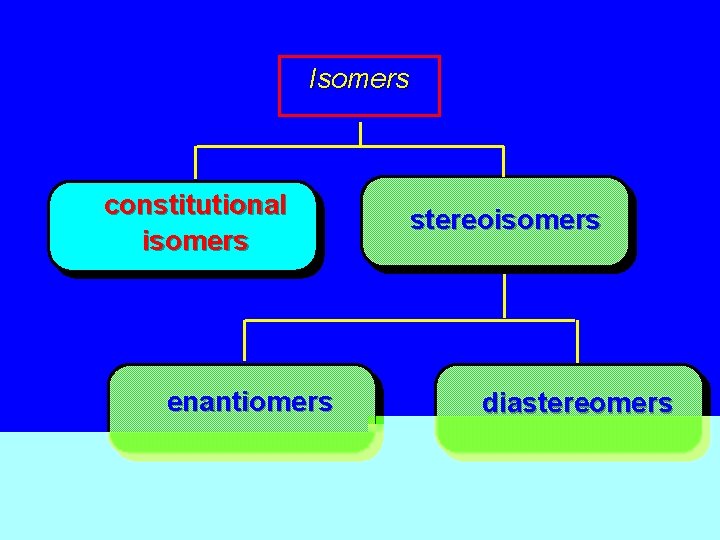
Isomers constitutional isomers stereoisomers
Isomers constitutional isomers enantiomers stereoisomers diastereomers
Chlorodifluoromethane is achiral
Chlorodifluoromethane is achiral The two structures are mirror images, but are not enantiomers, because they can be superposed on each other.
7. 2 The Stereogenic Center
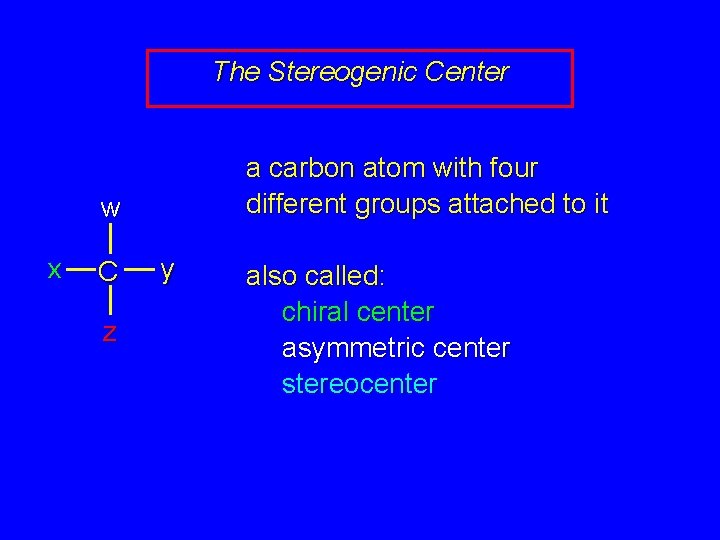
The Stereogenic Center a carbon atom with four different groups attached to it w x C z y also called: chiral center asymmetric center stereocenter
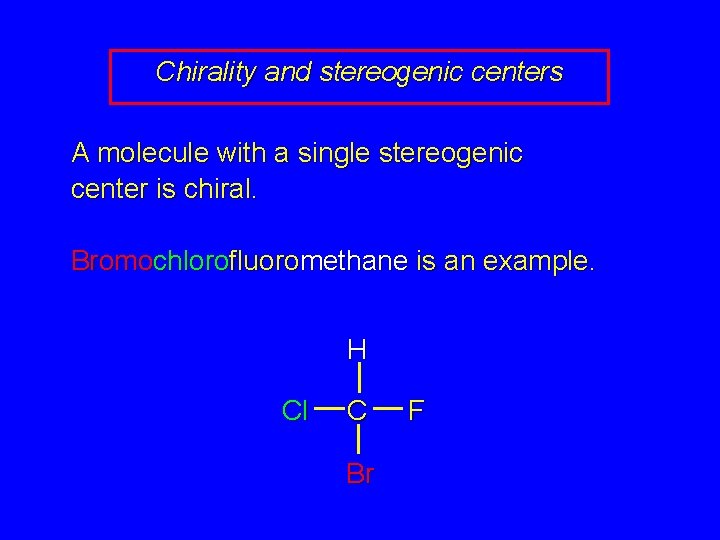
Chirality and stereogenic centers A molecule with a single stereogenic center is chiral. Bromochlorofluoromethane is an example. H Cl C Br F
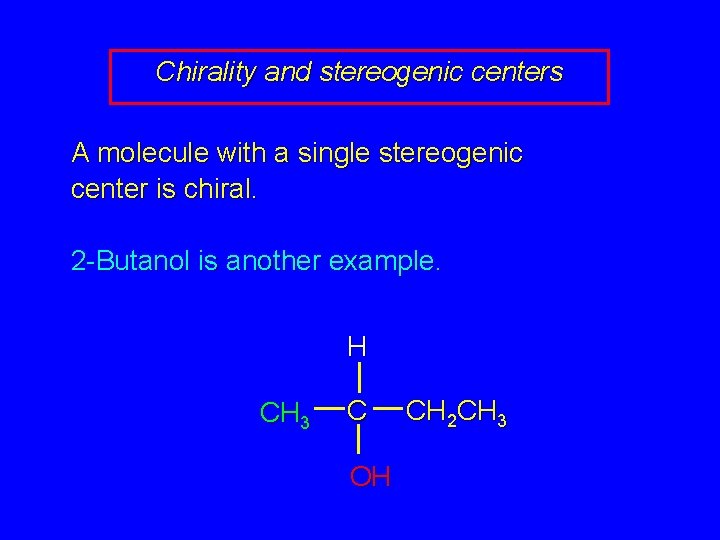
Chirality and stereogenic centers A molecule with a single stereogenic center is chiral. 2 -Butanol is another example. H CH 3 C OH CH 2 CH 3
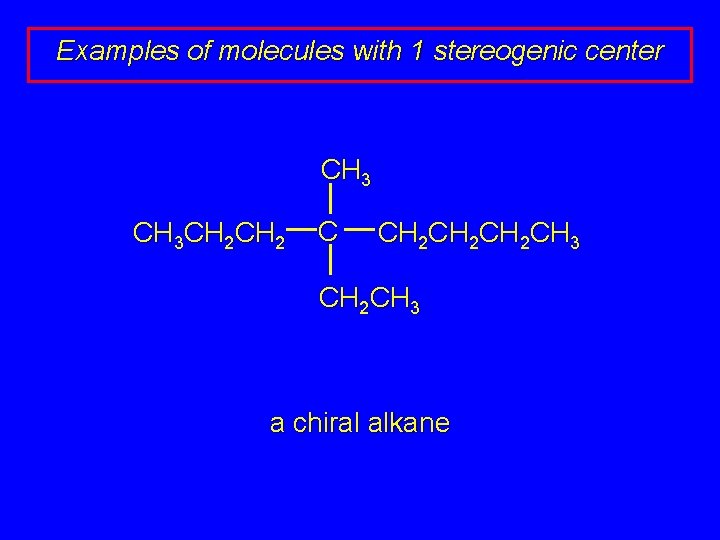
Examples of molecules with 1 stereogenic center CH 3 CH 2 C CH 2 CH 2 CH 3 a chiral alkane
Examples of molecules with 1 stereogenic center OH Linalool, a naturally occurring chiral alcohol
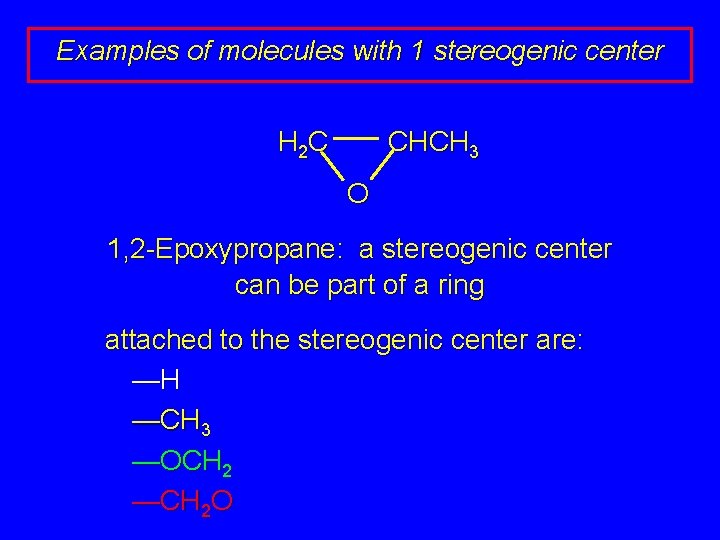
Examples of molecules with 1 stereogenic center H 2 C CHCH 3 O 1, 2 -Epoxypropane: a stereogenic center can be part of a ring attached to the stereogenic center are: —H —CH 3 —OCH 2 —CH 2 O
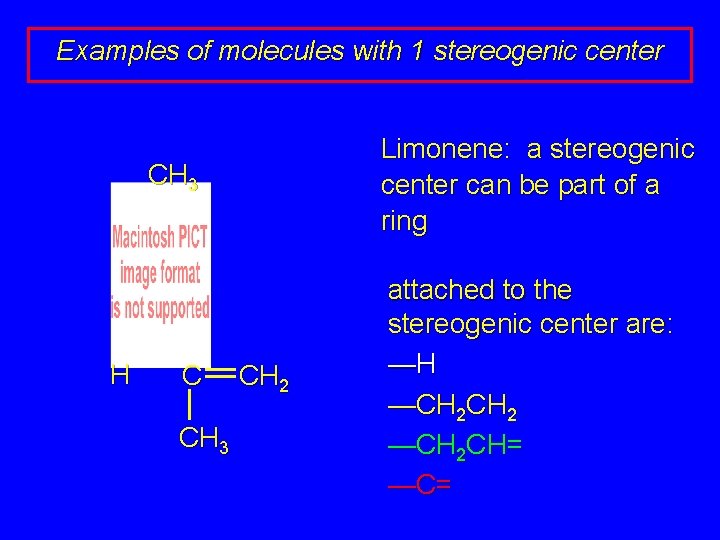
Examples of molecules with 1 stereogenic center Limonene: a stereogenic center can be part of a ring CH 3 H C CH 3 CH 2 attached to the stereogenic center are: —H —CH 2 CH= —C=
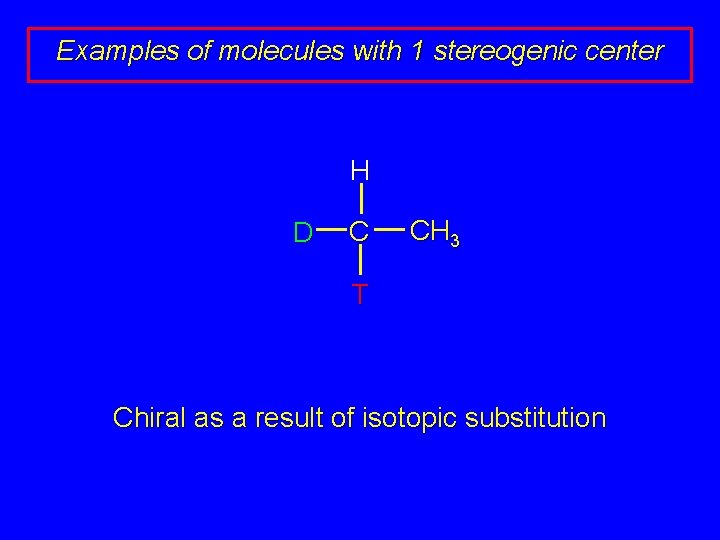
Examples of molecules with 1 stereogenic center H D C CH 3 T Chiral as a result of isotopic substitution
A molecule with a single stereogenic center must be chiral. But, a molecule with two or more stereogenic centers may be chiral or it may not (Sections 7. 10 -7. 13).
7. 3 Symmetry in Achiral Structures
Symmetry tests for achiral structures Any molecule with a plane of symmetry or a center of symmetry must be achiral.
Plane of symmetry A plane of symmetry bisects a molecule into two mirror image halves. Chlorodifluoromethane has a plane of symmetry.
Plane of symmetry A plane of symmetry bisects a molecule into two mirror image halves. Chlorodifluoromethane has a plane of symmetry.
Plane of symmetry A plane of symmetry bisects a molecule into two mirror image halves. 1 -Bromo-1 -chloro-2 -fluoroethene has a plane of symmetry.
Plane of symmetry A plane of symmetry bisects a molecule into two mirror image halves. 1 -Bromo-1 -chloro-2 -fluoroethene has a plane of symmetry.
Center of symmetry A point in the center of the molecule is a center of symmetry if a line drawn from it to some element, when extended an equal distance in the opposite direction, encounters an identical element.
Center of symmetry A point in the center of the molecule is a center of symmetry if a line drawn from it to any element, when extended an equal distance in the opposite direction, encounters an identical element.