
Chapter 7 Stereochemistry Stereochemistry Some objects are not

Chapter 7. Stereochemistry
Stereochemistry • Some objects are not the same as their mirror images (technically, they have no plane of symmetry) – A right-hand glove is different than a left-hand glove – The property is commonly called “handedness” • Organic molecules (including many drugs) have handedness that results from substitution patterns on sp 3 hybridized carbon
Enantiomers – Mirror Images • Molecules exist as three-dimensional objects • Some molecules are the same as their mirror image • Some molecules are different than their mirror image – These are stereoisomers called enantiomers
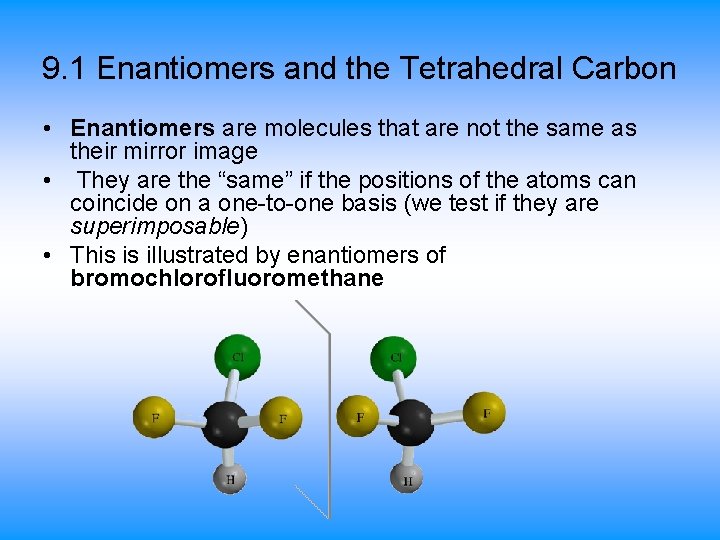
9. 1 Enantiomers and the Tetrahedral Carbon • Enantiomers are molecules that are not the same as their mirror image • They are the “same” if the positions of the atoms can coincide on a one-to-one basis (we test if they are superimposable) • This is illustrated by enantiomers of bromochlorofluoromethane
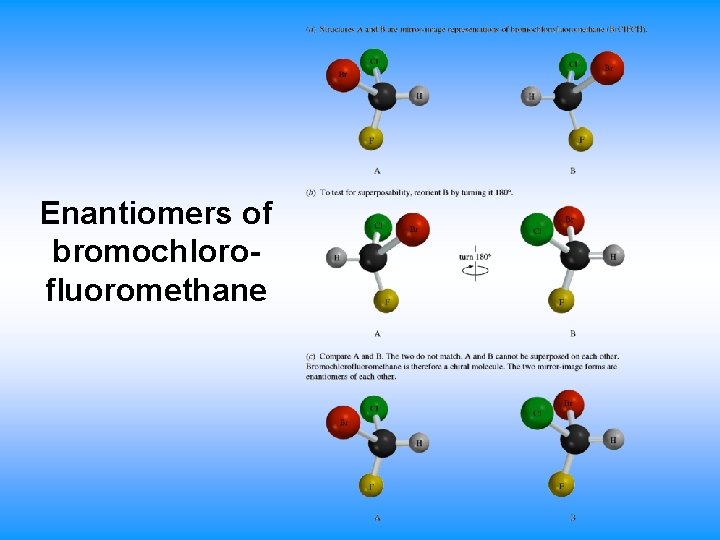
Enantiomers of bromochlorofluoromethane

9. 2 The Reason for Handedness: Chirality • Molecules that are not superimposable with their mirror images are chiral (have handedness) • A plane of symmetry divides an entire molecule into two pieces that are exact mirror images • A molecule with a plane of symmetry is the same as its mirror image and is said to be achiral (See Figure 9. 4 for examples)
Chirality • If an object has a plane of symmetry it is necessarily the same as its mirror image • The lack of a plane of symmetry is called “handedness”, chirality • Hands, gloves are prime examples of chiral object – They have a “left” and a “right” version
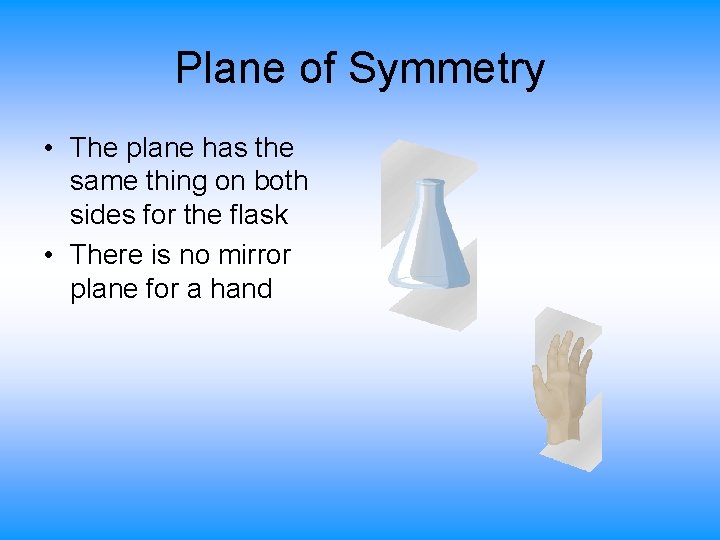
Plane of Symmetry • The plane has the same thing on both sides for the flask • There is no mirror plane for a hand
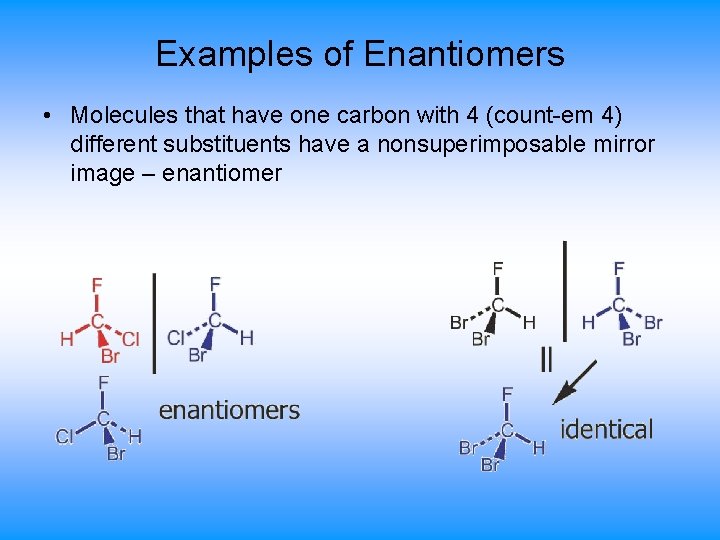
Examples of Enantiomers • Molecules that have one carbon with 4 (count-em 4) different substituents have a nonsuperimposable mirror image – enantiomer

Plane of symmetry in chlorodifluoromethane
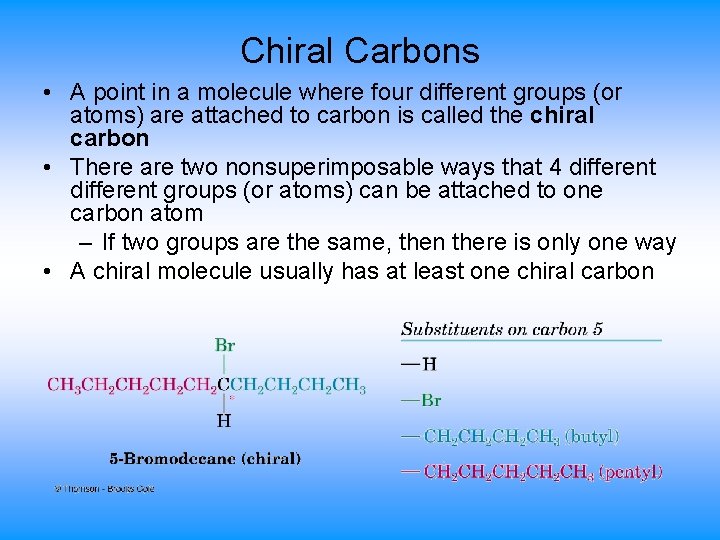
Chiral Carbons • A point in a molecule where four different groups (or atoms) are attached to carbon is called the chiral carbon • There are two nonsuperimposable ways that 4 different groups (or atoms) can be attached to one carbon atom – If two groups are the same, then there is only one way • A chiral molecule usually has at least one chiral carbon

Chirality Centers in Chiral Molecules • Groups are considered “different” if there is anystructural variation (if the groups could not be superimposed if detached, they are different) • In cyclic molecules, we compare by following in each direction in a ring

Locate all chiral carbons if any):
9. 3 Optical Activity • Light restricted to pass through a plane is planepolarized • Plane-polarized light that passes through solutions of achiral compounds remains in that plane • Solutions of chiral compounds rotate planepolarized light and the molecules are said to be optically active • Phenomenon discovered by Biot in the early 19 th century
Optical Activity • Light passes through a plane polarizer • Plane polarized light is rotated in solutions of optically active compounds • Measured with polarimeter • Rotation, in degrees, is [ ] • Clockwise rotation is called dextrorotatory • Anti-clockwise is levorotatory
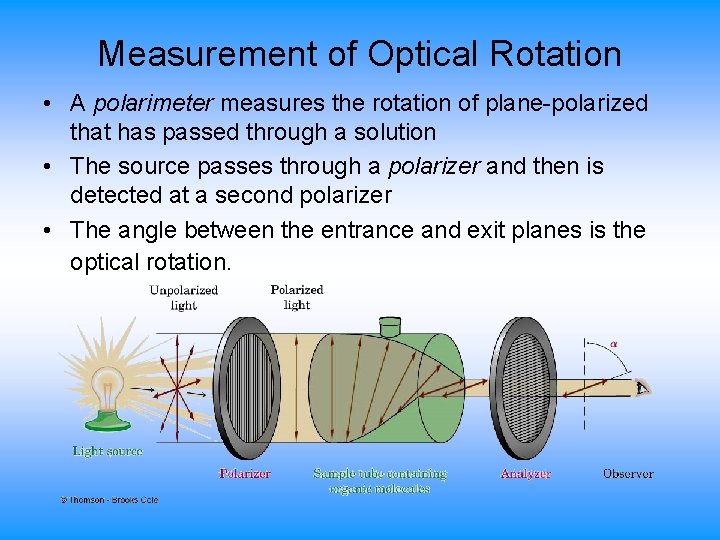
Measurement of Optical Rotation • A polarimeter measures the rotation of plane-polarized that has passed through a solution • The source passes through a polarizer and then is detected at a second polarizer • The angle between the entrance and exit planes is the optical rotation.
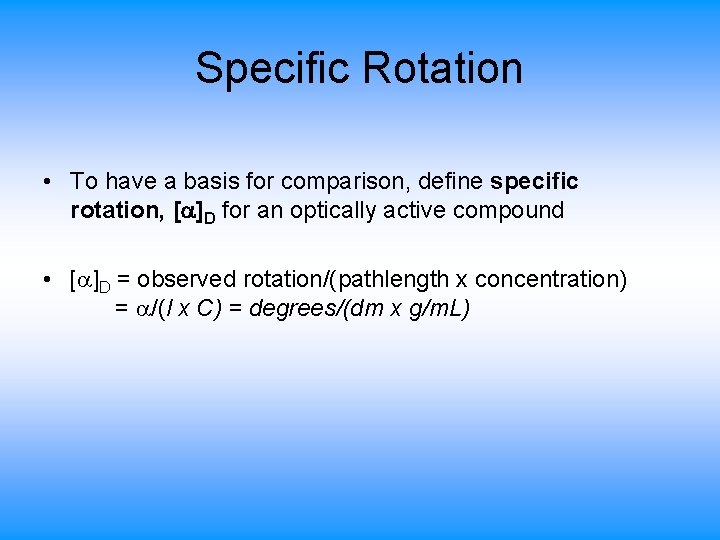
Specific Rotation • To have a basis for comparison, define specific rotation, [ ]D for an optically active compound • [ ]D = observed rotation/(pathlength x concentration) = /(l x C) = degrees/(dm x g/m. L)
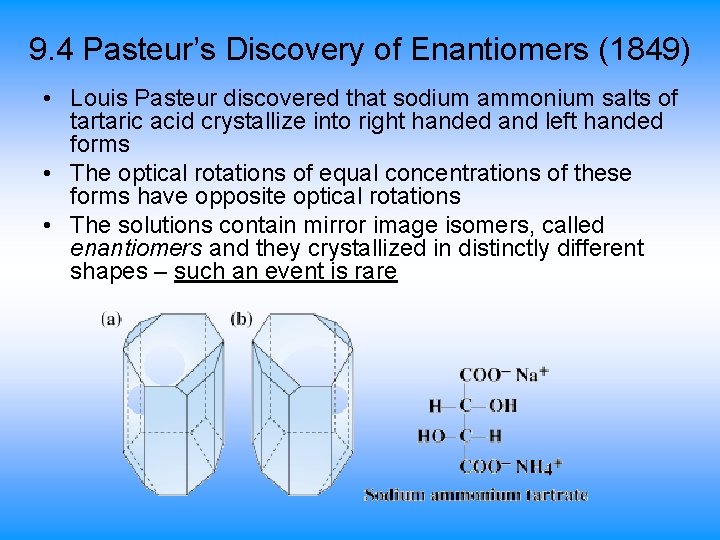
9. 4 Pasteur’s Discovery of Enantiomers (1849) • Louis Pasteur discovered that sodium ammonium salts of tartaric acid crystallize into right handed and left handed forms • The optical rotations of equal concentrations of these forms have opposite optical rotations • The solutions contain mirror image isomers, called enantiomers and they crystallized in distinctly different shapes – such an event is rare
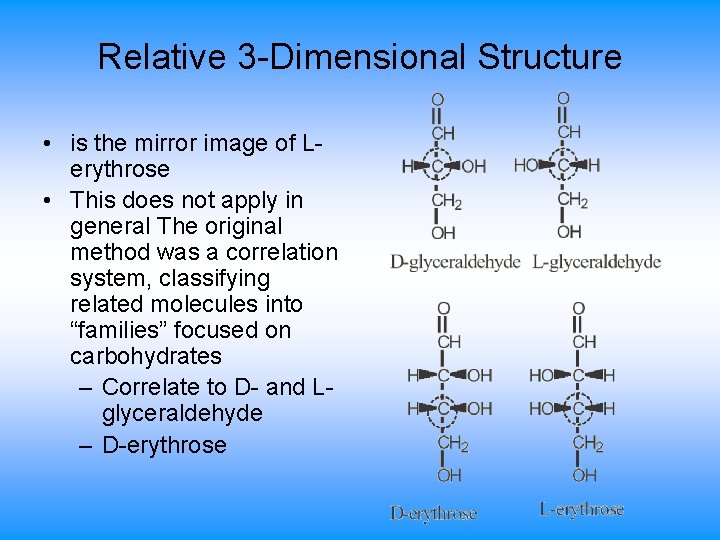
Relative 3 -Dimensional Structure • is the mirror image of Lerythrose • This does not apply in general The original method was a correlation system, classifying related molecules into “families” focused on carbohydrates – Correlate to D- and Lglyceraldehyde – D-erythrose

9. 5 Sequence Rules for Specification of Configuration • A general method applies to the configuration at each chiral carbon (instead of to the whole molecule) • The configuration is specified by the relative positions of all the groups with respect to each other at the chiral carbon • The groups are ranked in an established priority sequence and compared • The relationship of the groups in priority order in space determines the label applied to the configuration, according to a rule

Cahn-Ingold-Prelog Priority Rules
Sequence Rules (IUPAC) • Assign each group priority according to the Cahn. Ingold-Prelog scheme With the lowest priority group pointing away, look at remaining 3 groups in a plane • Clockwise is designated R (from Latin for “right”) • Counterclockwise is designated S (from Latin word for “left”)
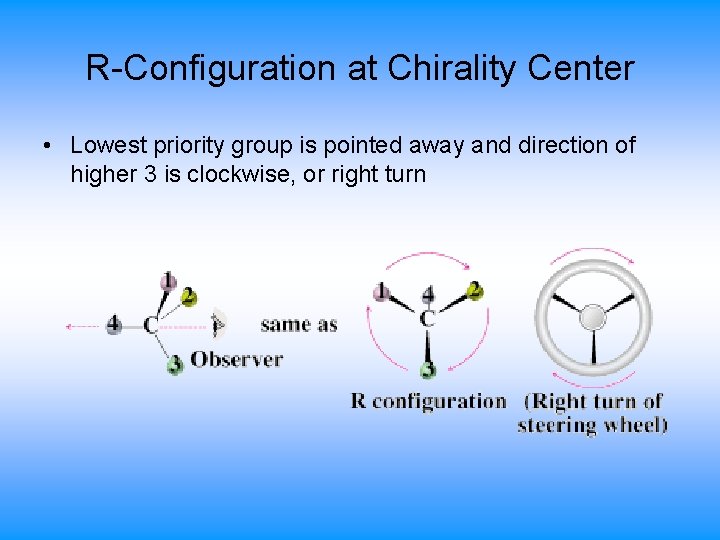
R-Configuration at Chirality Center • Lowest priority group is pointed away and direction of higher 3 is clockwise, or right turn
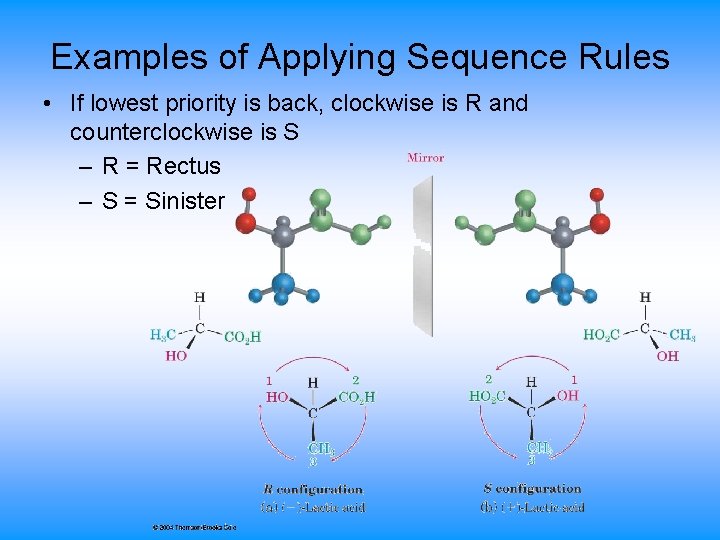
Examples of Applying Sequence Rules • If lowest priority is back, clockwise is R and counterclockwise is S – R = Rectus – S = Sinister
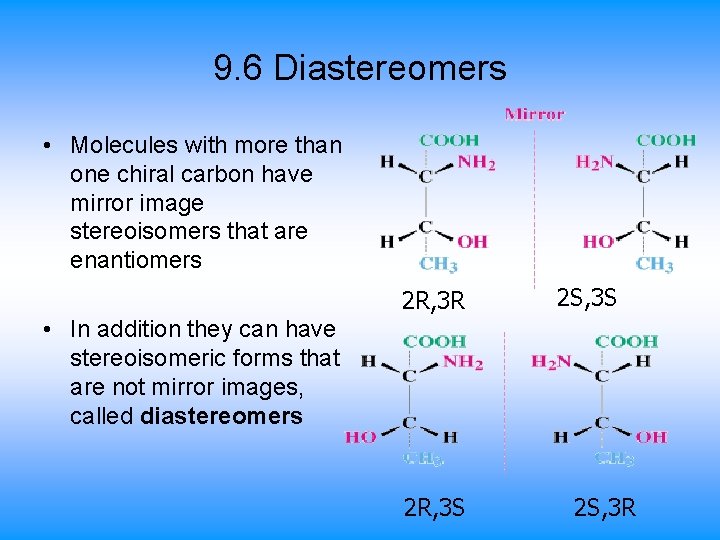
9. 6 Diastereomers • Molecules with more than one chiral carbon have mirror image stereoisomers that are enantiomers 2 R, 3 R 2 S, 3 S • In addition they can have stereoisomeric forms that are not mirror images, called diastereomers 2 R, 3 S 2 S, 3 R
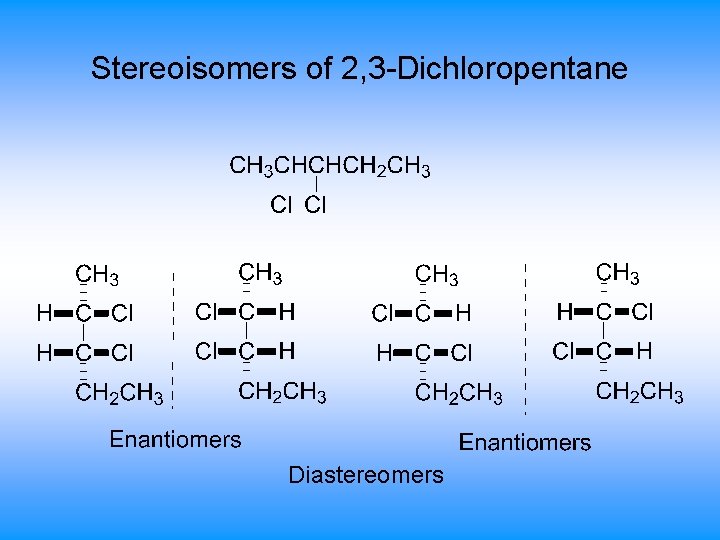
Stereoisomers of 2, 3 -Dichloropentane Diastereomers
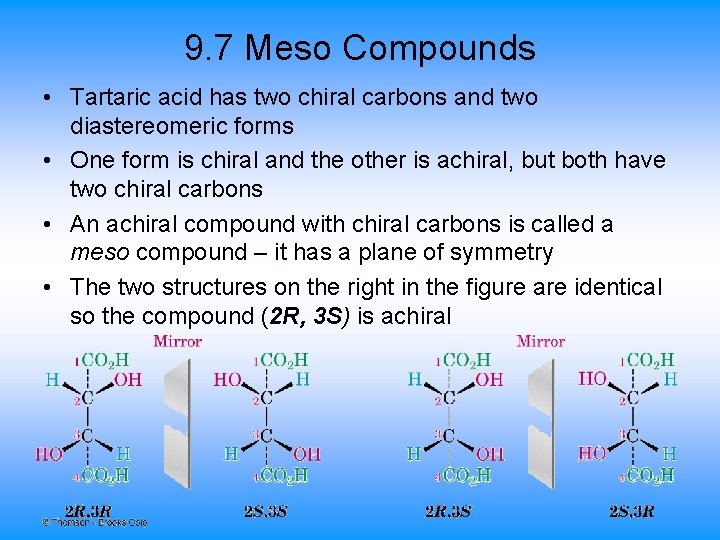
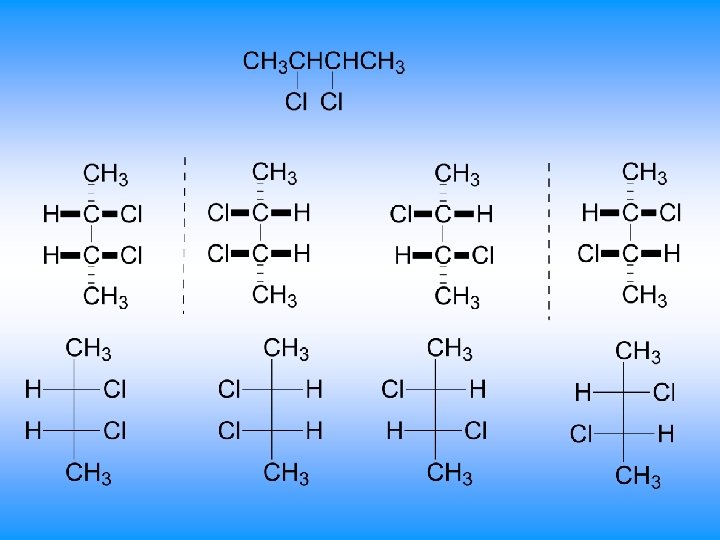
9. 7 Meso Compounds • Tartaric acid has two chiral carbons and two diastereomeric forms • One form is chiral and the other is achiral, but both have two chiral carbons • An achiral compound with chiral carbons is called a meso compound – it has a plane of symmetry • The two structures on the right in the figure are identical so the compound (2 R, 3 S) is achiral
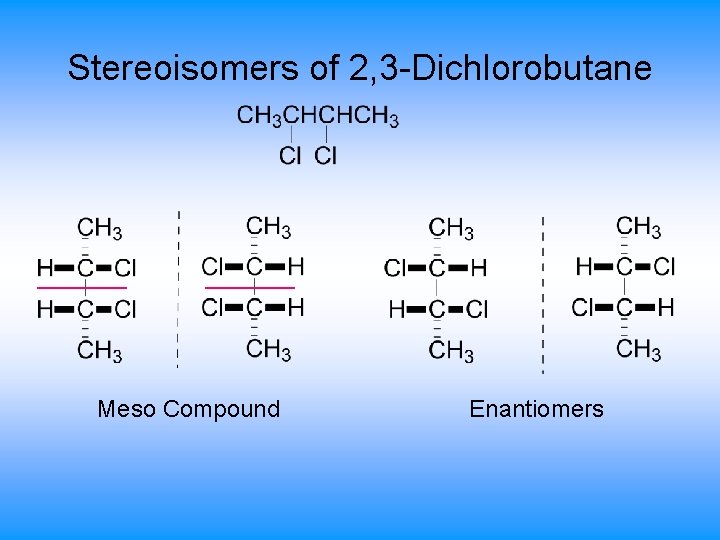
Stereoisomers of 2, 3 -Dichlorobutane _________ Meso Compound Enantiomers
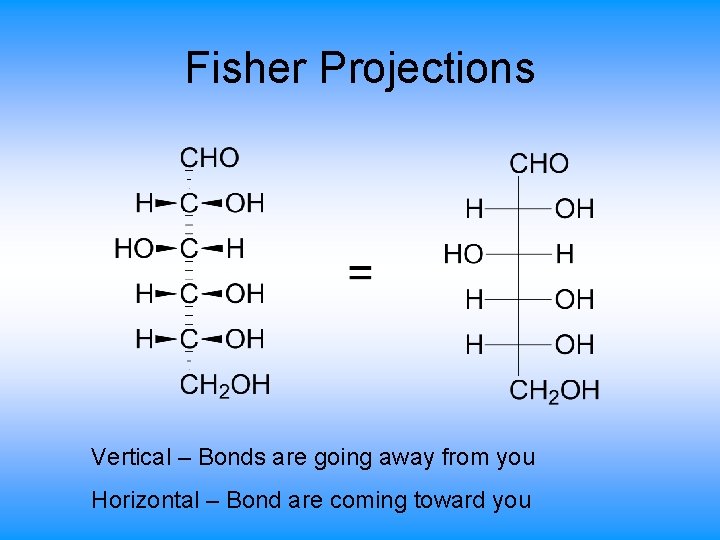
Fisher Projections Vertical – Bonds are going away from you Horizontal – Bond are coming toward you

Fischer projection formulas of the enantiomers of bromochlorofluoromethane

Cholesterol has eight chiral carbons
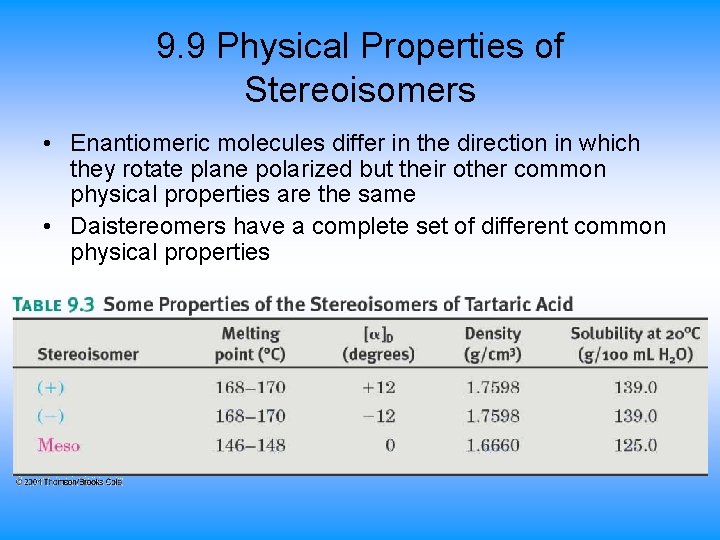
9. 9 Physical Properties of Stereoisomers • Enantiomeric molecules differ in the direction in which they rotate plane polarized but their other common physical properties are the same • Daistereomers have a complete set of different common physical properties
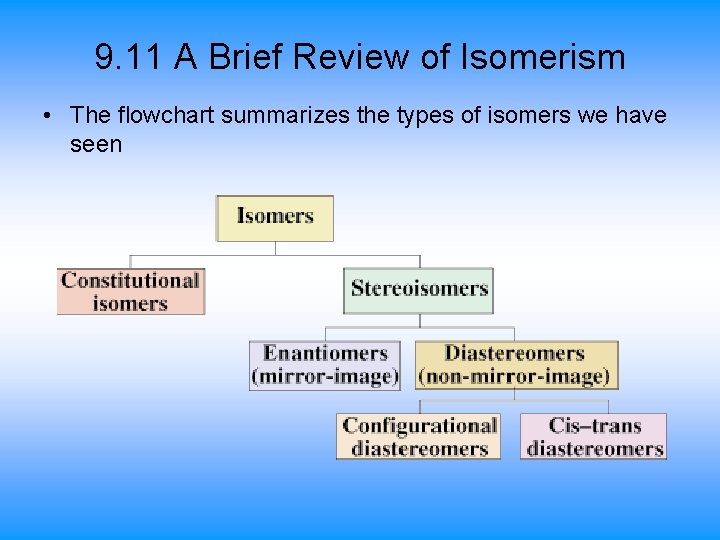
9. 11 A Brief Review of Isomerism • The flowchart summarizes the types of isomers we have seen
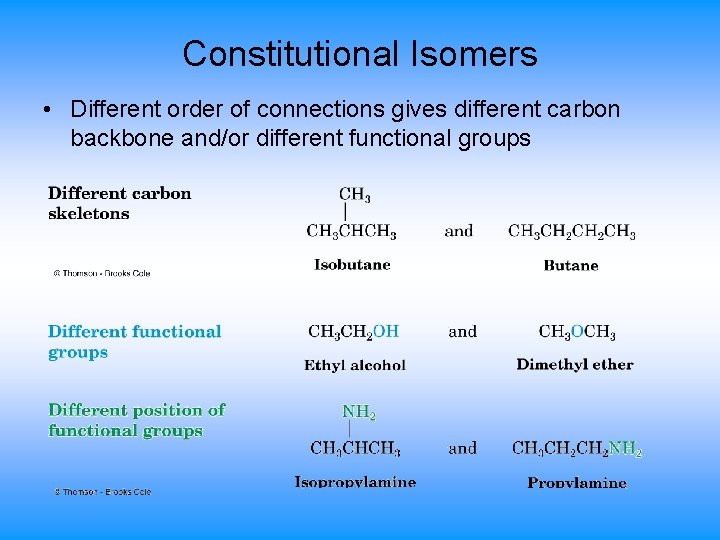
Constitutional Isomers • Different order of connections gives different carbon backbone and/or different functional groups

Stereoisomers • Same connections, different spatial arrangement of atoms – Enantiomers (nonsuperimposable mirror images) – Diastereomers (all other stereoisomers) • Includes cis, trans and configurational
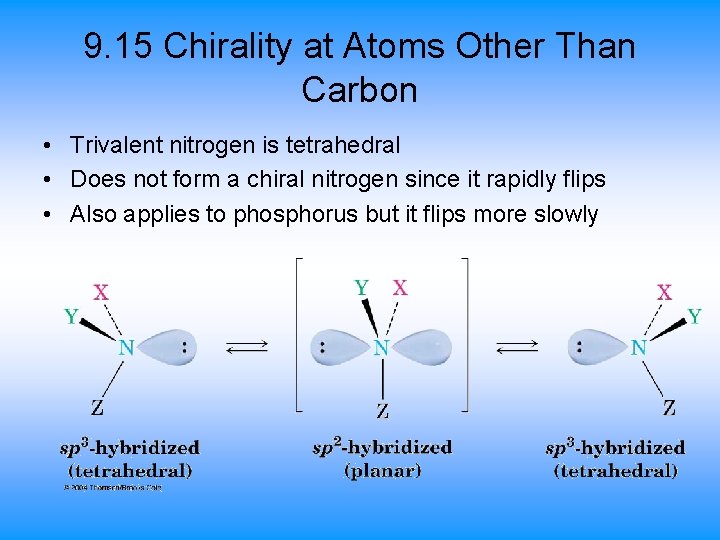
9. 15 Chirality at Atoms Other Than Carbon • Trivalent nitrogen is tetrahedral • Does not form a chiral nitrogen since it rapidly flips • Also applies to phosphorus but it flips more slowly
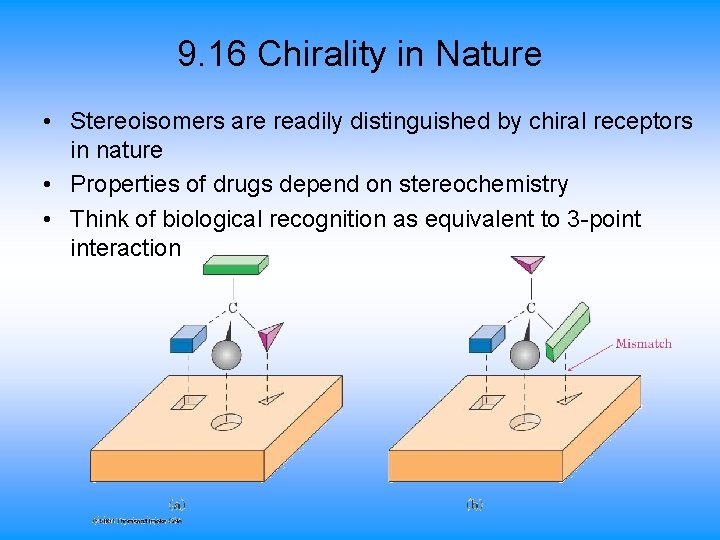
9. 16 Chirality in Nature • Stereoisomers are readily distinguished by chiral receptors in nature • Properties of drugs depend on stereochemistry • Think of biological recognition as equivalent to 3 -point interaction
- Slides: 38