Chapter 20 The Adolescent Elsevier items and derived

- Slides: 47
Chapter 20 The Adolescent Elsevier items and derived items © 2015, 2011, 2007, 2006 by Saunders, an imprint of Elsevier Inc.
Lesson 20. 1 Objectives 2. Discuss three major theoretical viewpoints on the personality development of adolescents. 3. Discuss two main challenges during the adolescent years to which the adolescent must adjust. 4. List major physical changes that occur during adolescence. 5. Identify two major developmental tasks of adolescence. Elsevier items and derived items © 2015, 2011, 2007, 2006 by Saunders, an imprint of Elsevier Inc. 2
Lesson 20. 1 Objectives (cont. ) 6. Describe menstruation to a 13 -year-old girl. 7. Describe Tanner’s stages of breast development. 8. List five life events that contribute to stress during adolescence. Elsevier items and derived items © 2015, 2011, 2007, 2006 by Saunders, an imprint of Elsevier Inc. 3
General Characteristics (pp. 450 -451) Appearance of secondary sex characteristics Ends with cessation of growth and emotional maturity Divided into early, middle, and late because of the changes that occur between 13 and 18 years of age Elsevier items and derived items © 2015, 2011, 2007, 2006 by Saunders, an imprint of Elsevier Inc. 4
General Characteristics (cont. ) (pp. 450 -451) Major tasks Ø Ø Establishing an identity Separating from family Initiating intimacy Developing career choices for economic independence Elsevier items and derived items © 2015, 2011, 2007, 2006 by Saunders, an imprint of Elsevier Inc. 5
General Characteristics (cont. ) (pp. 450 -451) Major challenges Ø Ø Ø Adjusting to rapid physical and physiological changes Maintaining privacy Coping with social stresses and pressures Maintaining open communications Developing positive health care practices and lifestyle choices Elsevier items and derived items © 2015, 2011, 2007, 2006 by Saunders, an imprint of Elsevier Inc. 6
General Characteristics (cont. ) (pp. 450 -451) Surge toward independence more pronounced Difficult for adolescent to get along with parents Bodies rapidly changing Experience intense sexual drives Conformity one of strongest needs of adolescents in society Elsevier items and derived items © 2015, 2011, 2007, 2006 by Saunders, an imprint of Elsevier Inc. 7
General Characteristics (cont. ) (pp. 450 -451) Erikson: intimacy stage Piaget: abstract reasoning Freud: genital stage Elsevier items and derived items © 2015, 2011, 2007, 2006 by Saunders, an imprint of Elsevier Inc. 8
Growth and Development Physical Development (p. 451) Adolescence begins in girls 10 -13 years of age Ø Ø Marked by rapid changes in structure and function of various body parts Distinguished by puberty • During childhood, boys and girls produce somewhat equal amounts of androgens and estrogen Ø Hypothalamus signals pituitary gland to stimulate other endocrine glands to secrete hormones Elsevier items and derived items © 2015, 2011, 2007, 2006 by Saunders, an imprint of Elsevier Inc. 9
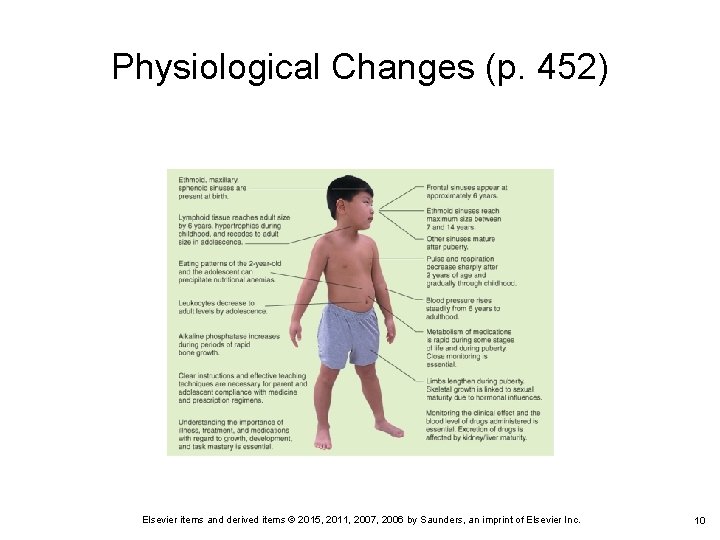
Physiological Changes (p. 452) Elsevier items and derived items © 2015, 2011, 2007, 2006 by Saunders, an imprint of Elsevier Inc. 10
Physical Development (cont. ) (p. 452) Age of puberty varies Occurs earlier in girls than boys Growth spurt occurs by 18 years Major cause of weight gain is due to increased skeletal mass Elsevier items and derived items © 2015, 2011, 2007, 2006 by Saunders, an imprint of Elsevier Inc. 11
Physical Development (cont. ) (p. 452) General appearance tends to be awkward Long-legged and gangling (asynchrony) because different body parts mature at different rates Sweat glands very active Oily skin and acne common Elsevier items and derived items © 2015, 2011, 2007, 2006 by Saunders, an imprint of Elsevier Inc. 12
Boys (p. 452) Puberty begins with hormonal changes between 10 and 13 years of age Hair begins to grow on face, chest, axillae, and pubic areas Shoulders widen, pectoral muscles enlarge, voice deepens Genitals increase in size, pigment changes occur, erection and nocturnal emissions Important to teach testicular self-examination Elsevier items and derived items © 2015, 2011, 2007, 2006 by Saunders, an imprint of Elsevier Inc. 13
Girls (p. 453) Pubertal changes occur 6 months to 2 years before they occur in boys Easily recognized in girls by onset of menstruation, called menarche Commonly occurs around 12 to 13 years Fat is deposited in hips, thighs, and breasts Energy balance, activity, and nutrition are important factors to evaluate when menstruation is delayed Elsevier items and derived items © 2015, 2011, 2007, 2006 by Saunders, an imprint of Elsevier Inc. 14
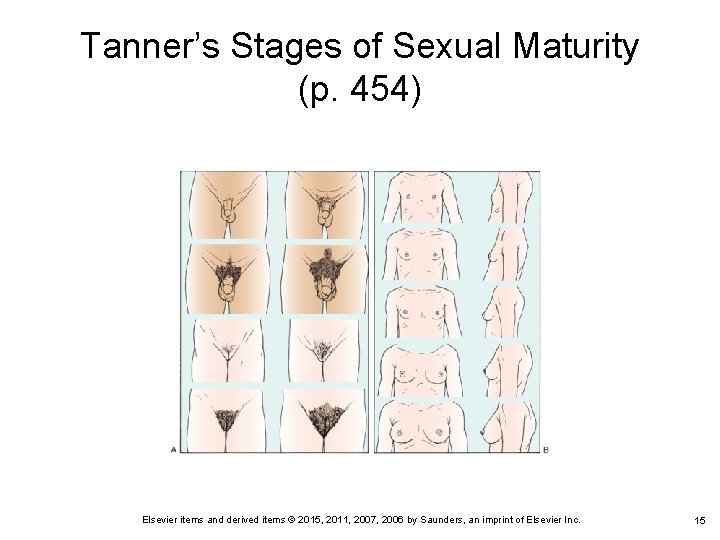
Tanner’s Stages of Sexual Maturity (p. 454) Elsevier items and derived items © 2015, 2011, 2007, 2006 by Saunders, an imprint of Elsevier Inc. 15
Psychosocial Development (p. 456) Sense of identity Ø Ø Fluctuates during adolescence Molded by demands from a variety of people Sense of intimacy Ø Ø Ø Closely entwined with resolving of a person’s sense of identity Period of trying and testing Need practice in making decisions Elsevier items and derived items © 2015, 2011, 2007, 2006 by Saunders, an imprint of Elsevier Inc. 16
Psychosocial Development (cont. ) (p. 456) Cultural and spiritual considerations Ø Ø Ø Good of family takes precedence over personal goals Focus on values and ideals of family Decide to either embrace or separate from family values and ideals Body image Ø Ø Ø Believe everyone is looking at them Take pride in their abilities Every effort is made to be like peers Elsevier items and derived items © 2015, 2011, 2007, 2006 by Saunders, an imprint of Elsevier Inc. 17
Lesson 20. 2 Objectives 9. Identify two ways in which a person’s cultural background might contribute to behavior. 10. Discuss the importance of peer groups, cliques, and best friends in the developmental process of an adolescent. 11. List a source for planning sex education programs for adolescents. Elsevier items and derived items © 2015, 2011, 2007, 2006 by Saunders, an imprint of Elsevier Inc. 18
Lesson 20. 2 Objectives (cont. ) 12. Summarize the nutritional requirements of the adolescent. 13. List three guidelines of importance for the adolescent participating in sports. 14. Discuss the common problems of adolescence and the nursing approach. Elsevier items and derived items © 2015, 2011, 2007, 2006 by Saunders, an imprint of Elsevier Inc. 19
Peer Relationships (p. 457) Help adolescents feel like they belong School assumes important role Belonging to a group is extremely important Cliques form Develops close personal relationship with one peer of the same sex Ø Ø Vitally important in helping adolescents define themselves Social norms and pressures exerted by peers may cause problems Elsevier items and derived items © 2015, 2011, 2007, 2006 by Saunders, an imprint of Elsevier Inc. 20
Career Plans (p. 458) To choose a career that is best-suited for them, they must first know themselves Parents should observe interests of their children and encourage them to take advantage of their talents School guidance counselor administers aptitude tests To be happy in career choice, adolescent must choose it of their own free will Elsevier items and derived items © 2015, 2011, 2007, 2006 by Saunders, an imprint of Elsevier Inc. 21
Responsibility (p. 458) Parents must encourage their children to take on new challenges Ø Ø Working Driving Must be taught value of money Ø Teach adolescent how to use and balance a checkbook Elsevier items and derived items © 2015, 2011, 2007, 2006 by Saunders, an imprint of Elsevier Inc. 22
Cognitive Development (p. 459) Piaget Ø Ø Development is systematic, sequential, and orderly Still in concrete phase of thinking By middle adolescence, ability to think abstractly has increased Stage of formal operations Elsevier items and derived items © 2015, 2011, 2007, 2006 by Saunders, an imprint of Elsevier Inc. 23
Cognitive Development (cont. ) (p. 459) Older adolescents can see situations from many viewpoints Abstract thinking emerges Nurse must focus on concrete issues and concerns when teaching early adolescents Able to sympathize and empathize Can understand their own values and actions Can understand accept differing values and actions from others Elsevier items and derived items © 2015, 2011, 2007, 2006 by Saunders, an imprint of Elsevier Inc. 24
Daydreams (p. 459) Most of this behavior is normal and natural for this age group Usually considered harmless Also a valuable safety valve for the expression of strong feelings Elsevier items and derived items © 2015, 2011, 2007, 2006 by Saunders, an imprint of Elsevier Inc. 25
Question 1 Daydreams assist the adolescent to: 1) 2) 3) 4) 5) improve school performance. try on different roles. communicate effectively. All of the above None of the above Elsevier items and derived items © 2015, 2011, 2007, 2006 by Saunders, an imprint of Elsevier Inc. 26
Sexual Behavior (p. 459) Must meet and become acquainted with members of opposite sex Dating Ø Ø Ø Groups Couples Single-couple Elsevier items and derived items © 2015, 2011, 2007, 2006 by Saunders, an imprint of Elsevier Inc. 27
Sexual Behavior (cont. ) (pp. 459 -460) Sexual experimentation often occurs as a response to peer pressure Can affect growth and development Unplanned pregnancy and STIs are two major complications of adolescent sexual interaction, because few use protection Elsevier items and derived items © 2015, 2011, 2007, 2006 by Saunders, an imprint of Elsevier Inc. 28
Sex Education (p. 460) Challenging for the adolescent Should be presented as age-appropriate Coping skills for dating and sexuality, pregnancy, and birth can be reviewed Abstinence and contraception are also discussed Decision-making is emphasized Elsevier items and derived items © 2015, 2011, 2007, 2006 by Saunders, an imprint of Elsevier Inc. 29
Sex Education (cont. ) (p. 460) Studies have shown that adolescents who obtain early sex education information from caring parents or well-informed adults do not have a higher rate of sexual activity Concerns about being different Ø Homosexuality Ø Sexual maturity not same as peers Behavior not uncommon in adolescence Experimentation is not a positive predictor of adult sexual preference Elsevier items and derived items © 2015, 2011, 2007, 2006 by Saunders, an imprint of Elsevier Inc. 30
Parenting the Adolescent (p. 461) Can be difficult for parents to cope with adolescents Some parents are unsure of their own opinions and may hesitate to exert authority Adolescents need to talk about their fears Need assistance in sorting out confused feelings Important to keep lines of communication open Elsevier items and derived items © 2015, 2011, 2007, 2006 by Saunders, an imprint of Elsevier Inc. 31
Health Promotion and Guidance Health Promotion: Effective Approaches to Problems (p. 462) Adolescent warning signs and need for intervention Spends time on the computer in the early hours of the morning Changes the screen on the computer when a parent enters the room Has pornographic material on the computer Makes frequent long-distance calls Elsevier items and derived items © 2015, 2011, 2007, 2006 by Saunders, an imprint of Elsevier Inc. 32
Nutrition (p. 462) Dietary deficiencies are more common Nutritional requirements are more strongly correlated with sexual maturity ratings than with age Skipped meals, more between-meal snacks, eats out more Elements most likely to be inadequately supplied are calcium, iron, vitamin B 12 Elsevier items and derived items © 2015, 2011, 2007, 2006 by Saunders, an imprint of Elsevier Inc. 33
Nutrition (cont. ) (pp. 462 -463) Vegetarian diet Ø High intake of grains, bran, and foods rich in oxalic acid can impair absorption of iron Sports and nutrition Ø Ø Athletes exhaust reserves of muscle glycogen Eating a slowly absorbed glucose source will prevent the development of chronic low muscle energy stores Caffeine and alcohol deplete body water and are should be avoided Anabolic steroids are detrimental to bone growth Elsevier items and derived items © 2015, 2011, 2007, 2006 by Saunders, an imprint of Elsevier Inc. 34
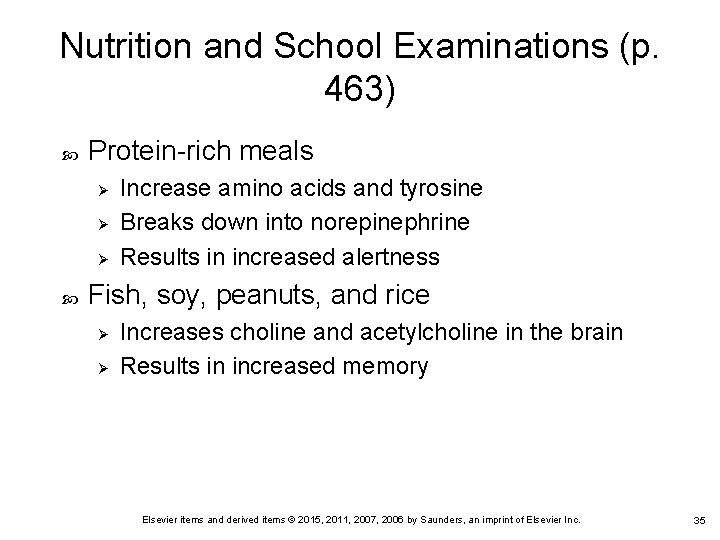
Nutrition and School Examinations (p. 463) Protein-rich meals Ø Ø Ø Increase amino acids and tyrosine Breaks down into norepinephrine Results in increased alertness Fish, soy, peanuts, and rice Ø Ø Increases choline and acetylcholine in the brain Results in increased memory Elsevier items and derived items © 2015, 2011, 2007, 2006 by Saunders, an imprint of Elsevier Inc. 35
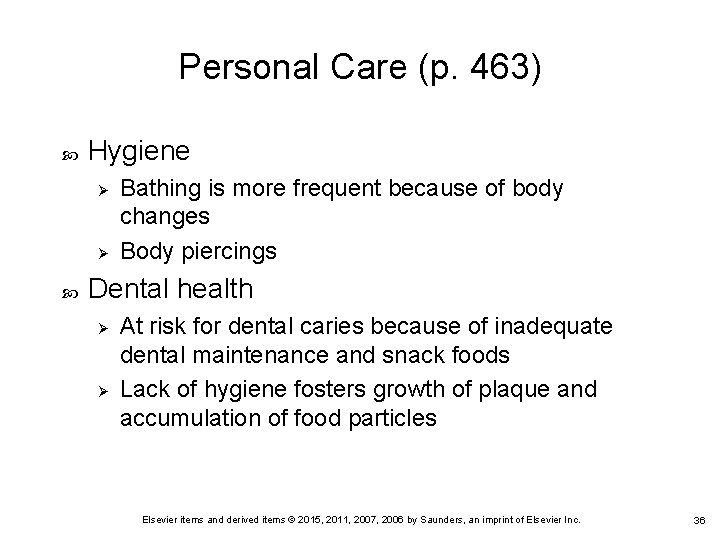
Personal Care (p. 463) Hygiene Ø Ø Bathing is more frequent because of body changes Body piercings Dental health Ø Ø At risk for dental caries because of inadequate dental maintenance and snack foods Lack of hygiene fosters growth of plaque and accumulation of food particles Elsevier items and derived items © 2015, 2011, 2007, 2006 by Saunders, an imprint of Elsevier Inc. 36
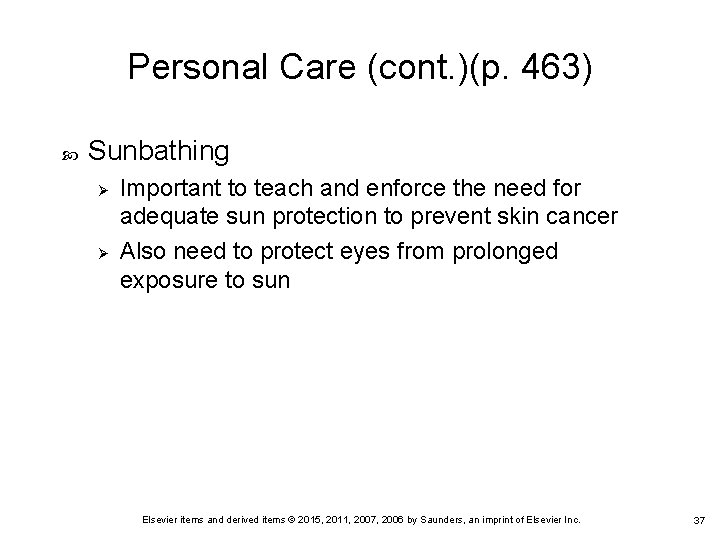
Personal Care (cont. )(p. 463) Sunbathing Ø Ø Important to teach and enforce the need for adequate sun protection to prevent skin cancer Also need to protect eyes from prolonged exposure to sun Elsevier items and derived items © 2015, 2011, 2007, 2006 by Saunders, an imprint of Elsevier Inc. 37
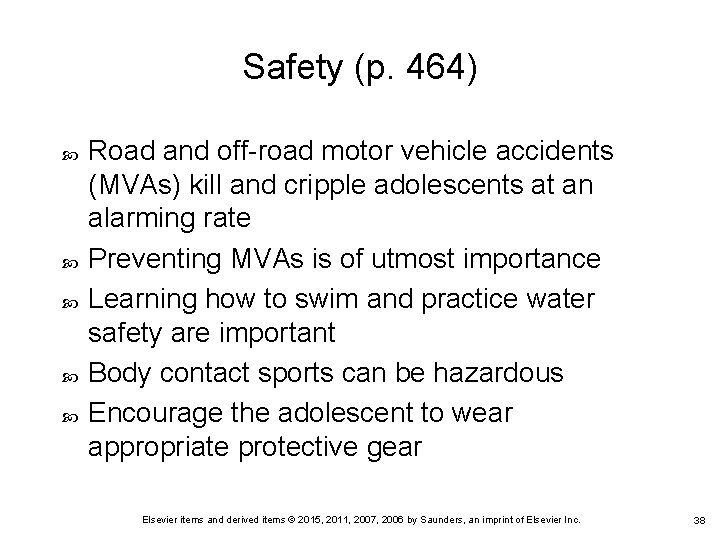
Safety (p. 464) Road and off-road motor vehicle accidents (MVAs) kill and cripple adolescents at an alarming rate Preventing MVAs is of utmost importance Learning how to swim and practice water safety are important Body contact sports can be hazardous Encourage the adolescent to wear appropriate protective gear Elsevier items and derived items © 2015, 2011, 2007, 2006 by Saunders, an imprint of Elsevier Inc. 38
Safety (cont. ) (p. 464) Female athlete triad Ø Nurse should assess for • Eating disorder • Amenorrhea • Osteoporosis Elsevier items and derived items © 2015, 2011, 2007, 2006 by Saunders, an imprint of Elsevier Inc. 39
Common Problems of Adolescence Drug Use (p. 465) Best weapon against drug addiction is education The need to conform, to be accepted, peer pressure, and the emotional depression that often occur are strong influences for drug experimentation and use Elsevier items and derived items © 2015, 2011, 2007, 2006 by Saunders, an imprint of Elsevier Inc. 40
Drug Use (cont. ) (p. 465) Adolescents are prone to mood swings as they adjust to the physical and psychological changes Nursing assessment for Ø Ø P—parents, peers, pot A—alcohol, automobiles C—cigarettes E—education If two or more of the PACE letters are problem areas, the adolescent may be at risk for drug abuse Appropriate referrals should be made Elsevier items and derived items © 2015, 2011, 2007, 2006 by Saunders, an imprint of Elsevier Inc. 41
Depression (p. 465) Drug use can precede the development of depression A change in school performance, appearance, or behavior can be a warning sign of depression A threat of suicide is a call for help that must be taken care of without delay Elsevier items and derived items © 2015, 2011, 2007, 2006 by Saunders, an imprint of Elsevier Inc. 42
Depression (cont. ) (p. 465) The school nurse can help by Ø Ø Ø Recognizing the depression Encouraging open communication Posting the numbers of available hotlines Identifying appropriate mechanisms Providing professional referrals Elsevier items and derived items © 2015, 2011, 2007, 2006 by Saunders, an imprint of Elsevier Inc. 43
Adolescent Pregnancy (p. 465) Occurs while the girl is still struggling to deal with developmental issues Some risk factors are Ø Ø Age at which the pregnancy occurs Nutritional intake Sexual activity Limited access to health care Elsevier items and derived items © 2015, 2011, 2007, 2006 by Saunders, an imprint of Elsevier Inc. 44
Adolescent Pregnancy (cont. ) (p. 465) Tasks of an unplanned pregnancy can be broken down into trimesters Ø Ø Ø First—confirmation of the pregnancy Second—focus on newborn as real Third—preparation for newborn and birth process Elsevier items and derived items © 2015, 2011, 2007, 2006 by Saunders, an imprint of Elsevier Inc. 45
The Nursing Approach to Adolescents (pp. 465 -468) Open lines of communication Enable them to feel at ease before initiating care or teaching Provide for privacy Ensure confidentiality and respect Adolescent hostility may be due to fear of unknown Rebellion may be an effort at grasping independence Guide parents concerning the need to listen, understand, and share with their adolescent Elsevier items and derived items © 2015, 2011, 2007, 2006 by Saunders, an imprint of Elsevier Inc. 46
The Nursing Approach to Adolescents (cont. ) (pp. 465 -468) Health care teaching should include Ø Ø Ø Ø Ø Nutrition Dental care Personal care Body piercing care Accident prevention Substance abuse Self-control Risk-taking behaviors Money and time management Use of open-ended questions Elsevier items and derived items © 2015, 2011, 2007, 2006 by Saunders, an imprint of Elsevier Inc. 47