
Adolescent Psychology Chapter 1 Today we will Cover

- Slides: 34
Adolescent Psychology Chapter 1
Today we will… Cover some history Talk a bit about periods of development Discuss a couple of developmental issues Talk over a few theories Touch on research methodology By the way…all of this is from chapter 1!
What is Adolescence? Adolescence: The period of transition from childhood to adulthood; it involves biological, cognitive, socioemotional changes. Preparation for adulthood From development of sexual functions to abstract thinking to independence
Historical Views on Adolescence Early Greek philosophers: a time of developing reason & self-determination Middle ages: no distinction made between children, adolescents, and adults 18 th Century French philosopher Rousseau: period between ages 15 -20, when selfishness is replaced by interest in others 20 th &21 st Centuries: scientific exploration of adolescence begins
Development of the Concept G. Stanley Hall’s Storm and Stress view (1904) Adolescence is a turbulent time charged with conflict & mood swings Development determined by heredity & environment Margaret Mead’s Sociocultural View (1928) No conflict is necessary, if culture provides smooth gradual transition Development determined by socio-cultural factors, not biology Inventionist View Concept of adolescence is a socio-historical creation Industrial Revolution, WWII, Great Depression
Past to Present “Those teenagers today…” The problem with stereotypes Adolescent Generalization Gap Adolescents are NOT a homogeneous group Generation gap bias Toward a more positive view of adolescence Positive Youth Development (2009) Competence Confidence Connection Character Caring/compassion
Adolescents in the U. S. & Around the World In the U. S…. Social context is changing… Social Policy is fragmented for adolescents in U. S. Around the world… Global youth culture Many traditions remain constant, so adolescents in different cultures have varying experiences Change vs. tradition
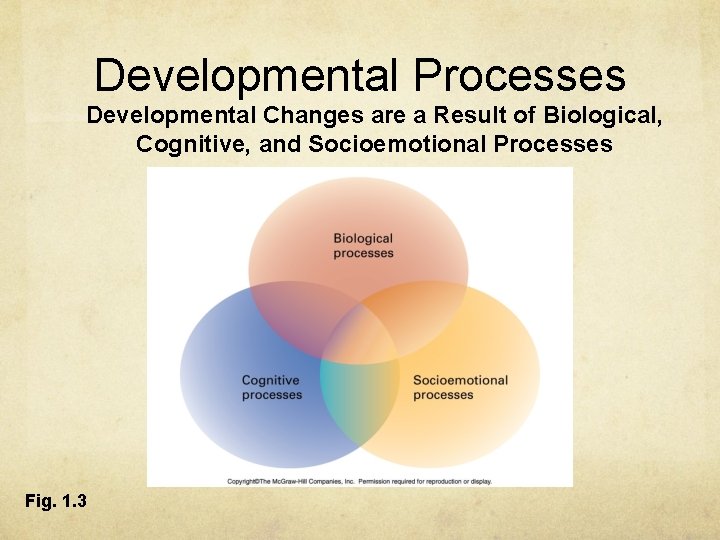
Development Defined Development: The pattern of change that begins at conception and continues throughout the lifespan. Includes both growth & decay. Processes & periods Biological, cognitive, &socio-emotional processes. Development is a direct result of the interaction between these 3 processes. Biological = Physical changes Cognitive = Changes in intelligence &thinking Socioemotional = Changes in emotions, personality, relationships & social context o Emerging fields (development cognitive neuroscience & social developmental neuroscience) exploring interconnectedness!!
Developmental Processes Developmental Changes are a Result of Biological, Cognitive, and Socioemotional Processes Fig. 1. 3
Terms to know continued… Contexts: Settings in which development occurs. These settings are influenced by historical, economic, social, & cultural factors. (e. g. socioeconomic, ethic, gender, age, peer groups, families, schools) How do you think various contexts influence development?
Periods of Development Childhood: Prenatal Infancy (birth-18/24 months) Early childhood (infancy – 5/6 years) Middle & late childhood (5/6 – 10/11) Adolescence: remember a combination of heredity, childhood & adolescent experiences contribute to the course of adolescent development. Early: Middle school/Junior High (puberty) Late: Career interests, dating, identity exploration are main tasks Adulthood: Early Middle (many of adolescent’s parents) Late
Adolescence The key task in adolescence is preparation for adulthood. This period begins at between 10 -13 & ends between 18 -22. Transition from childhood adolescence determined biologically Transition from adolescence adulthood determined by experiences & culture Emerging adulthood (18 -25) – experimentation & exploration 5 key features Changes occurring during this period range greatly. Development of sexual function, abstract thinking processes, independence, identity…
Developmental Issues: The Debates Nature vs. Nurture Determined by biological inheritance? Determined by environmental experiences? Continuity vs. Discontinuity Gradual & continuous? Discrete, abrupt, changes? Early vs. Later Experience
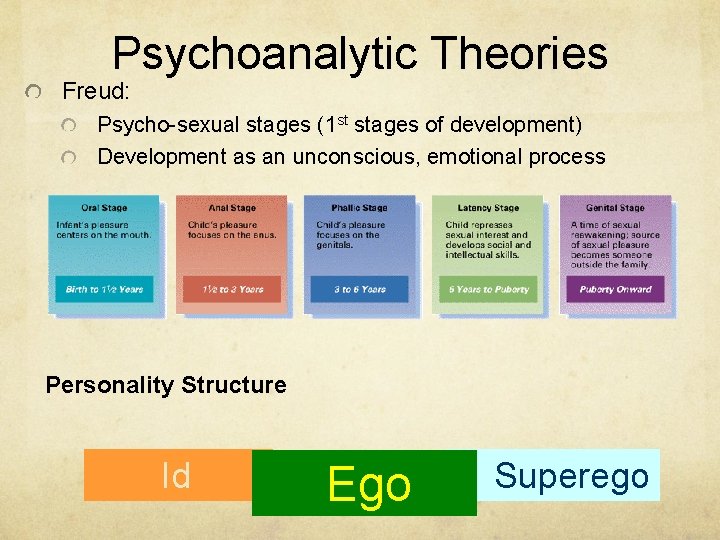
Psychoanalytic Theories Freud: Psycho-sexual stages (1 st stages of development) Development as an unconscious, emotional process Personality Structure Id Ego Superego
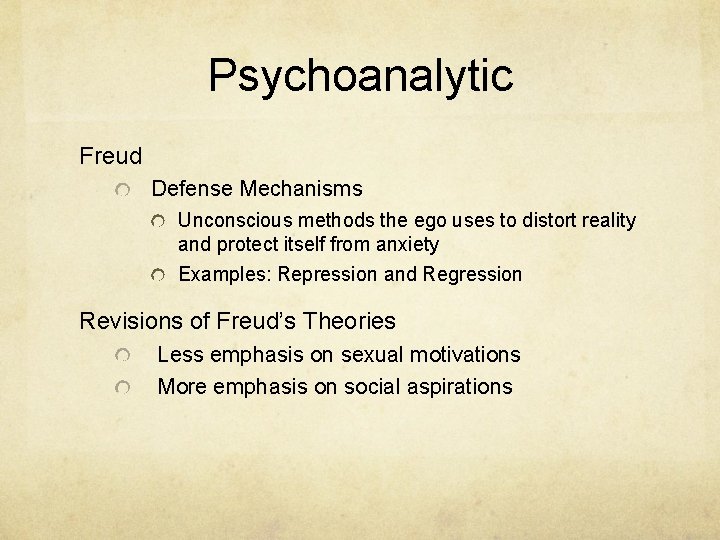
Psychoanalytic Freud Defense Mechanisms Unconscious methods the ego uses to distort reality and protect itself from anxiety Examples: Repression and Regression Revisions of Freud’s Theories Less emphasis on sexual motivations More emphasis on social aspirations
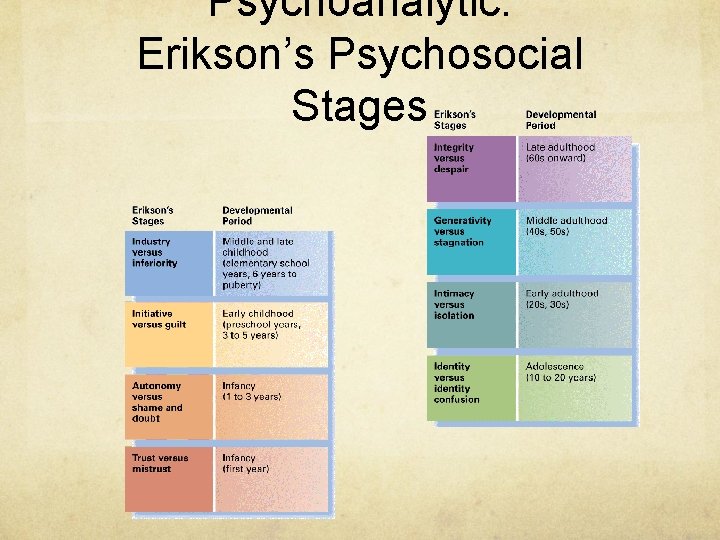
Psychoanalytic: Erikson’s Psychosocial Stages
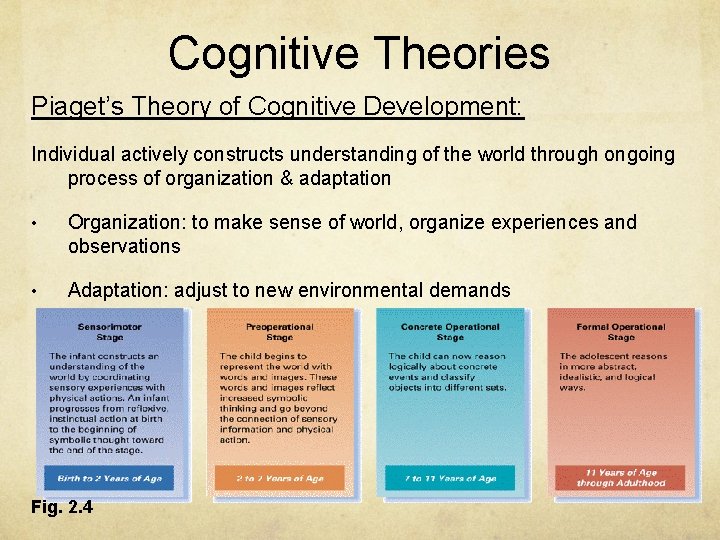
Cognitive Theories Piaget’s Theory of Cognitive Development: Individual actively constructs understanding of the world through ongoing process of organization & adaptation • Organization: to make sense of world, organize experiences and observations • Adaptation: adjust to new environmental demands Fig. 2. 4
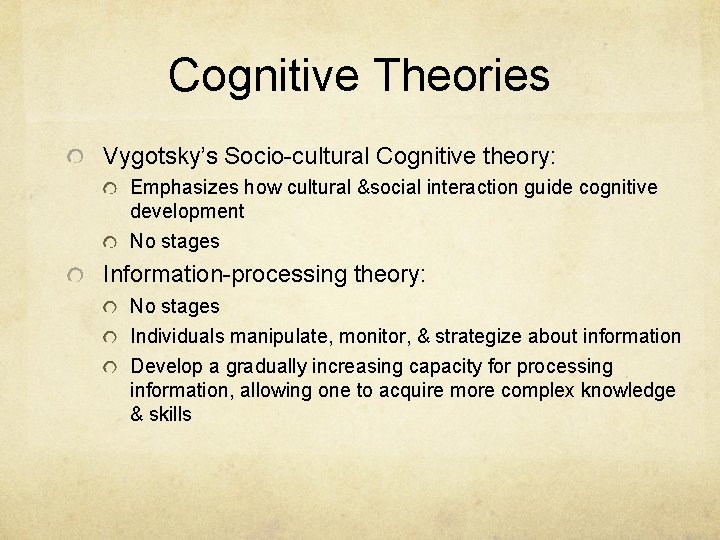
Cognitive Theories Vygotsky’s Socio-cultural Cognitive theory: Emphasizes how cultural &social interaction guide cognitive development No stages Information-processing theory: No stages Individuals manipulate, monitor, & strategize about information Develop a gradually increasing capacity for processing information, allowing one to acquire more complex knowledge & skills
Behavioral Skinner’s Operant Conditioning The scientific study of observable behavior responses and their environmental determinants Behavior is learned and often changes according to environmental experience
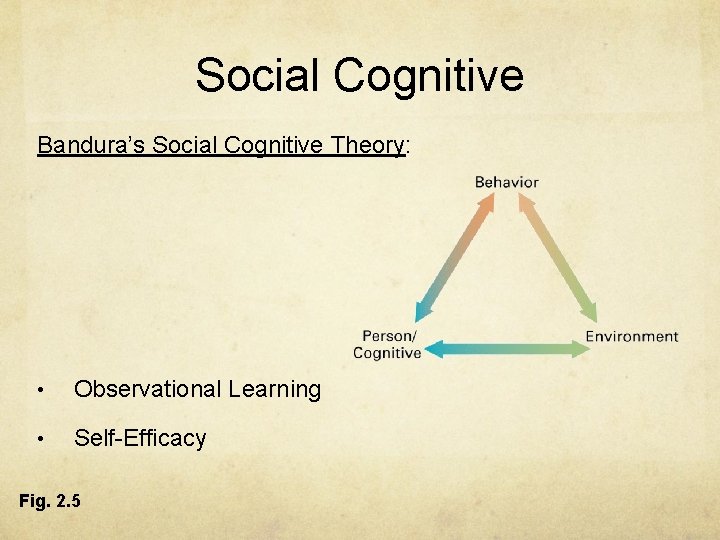
Social Cognitive Bandura’s Social Cognitive Theory: • Observational Learning • Self-Efficacy Fig. 2. 5
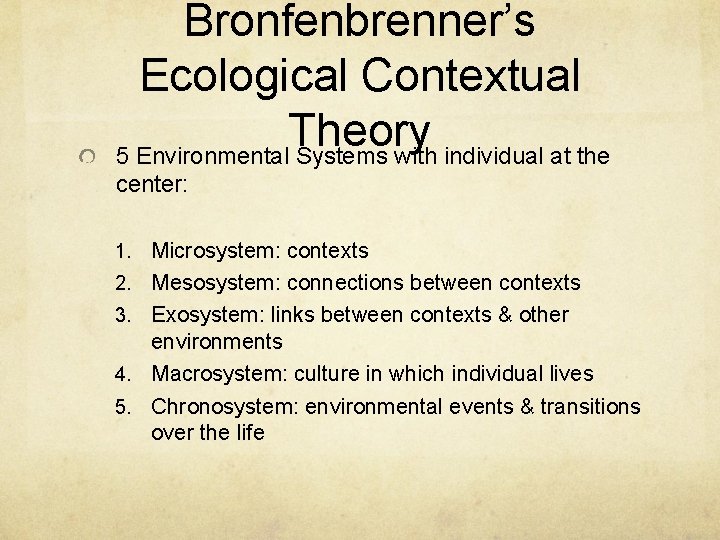
Bronfenbrenner’s Ecological Contextual Theory 5 Environmental Systems with individual at the center: 1. Microsystem: contexts 2. Mesosystem: connections between contexts 3. Exosystem: links between contexts & other environments 4. Macrosystem: culture in which individual lives 5. Chronosystem: environmental events & transitions over the life
The Scientific Method Conceptualize the problem Collect information (data) Analyze data Draw conclusions
Theory An interrelated, coherent set of ideas that helps to explain and make predictions
Hypothesis Specific assumptions and predictions that can be tested
Descriptive Research Observe and record behavior Observation Surveys and Interviews Standardized Tests Experience Sampling Physiological Measures Case Studies
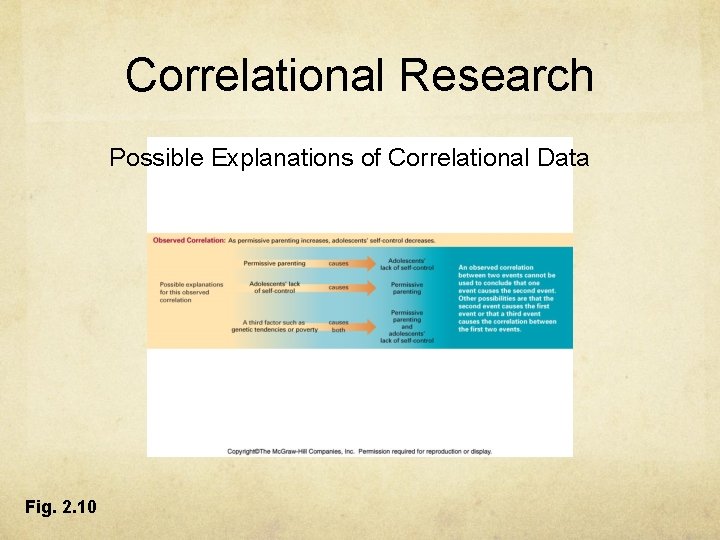
The Correlational Method Describes the strength of the relationship between two or more events or characteristics Correlation Coefficient +1. 00 to -1. 00 Negative vs. Positive Size of the number Correlation does not imply causation
Correlational Research Possible Explanations of Correlational Data Fig. 2. 10
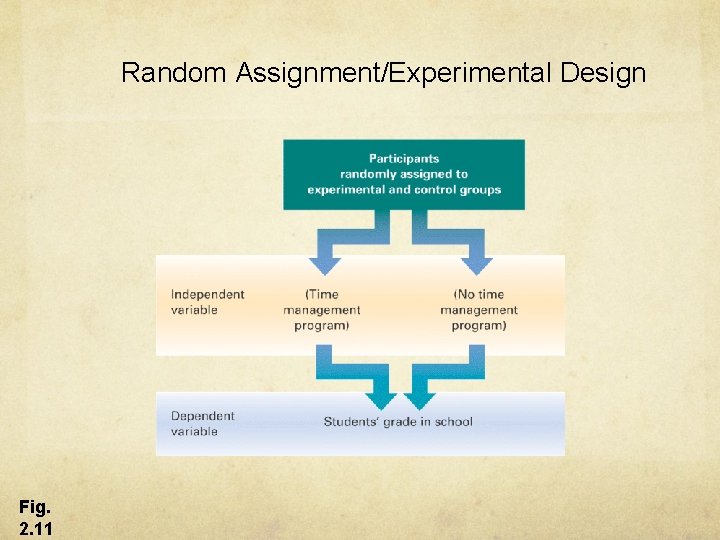
Random Assignment/Experimental Design Fig. 2. 11
Experimental Research Experiment is a carefully regulated procedure in which one or more factors believed to influence the behavior being studied are manipulated, while all other factors are held constant. IV = the factor that is manipulated (E. G. Peer tutoring) DV = the factor that is measured; it can change as the IV is manipulated (% correct on exams)
Time Span of Research Cross-sectional research Research that studies people all at one time Longitudinal research Research that studies the same people over a period of time, usually several years or more
The Field of Adolescent Development Research Journals Journal of Research on Adolescence Journal of Early Adolescence Journal of Youth and Adolescence Child Development
Research Challenges Conducting Ethical Research Gender Bias Culture and Ethnic Bias Ethnic Gloss
Being a Wise Consumer of Information Be cautious of what is reported in the popular media Recognize the tendency to over generalize a small or clinical sample Be aware that a single study usually is not the defining word Remember that causal conclusions cannot be drawn from correlational studies Always consider the source of the information and evaluate its credibility
Taking it to the Net Master the material in this chapter by visiting the Online Learning Center: http: //www. mhhe. com/santrocka 13 e • Please complete Self Assessment: Do I Have the Characteristics of an Emerging Adult, and bring results to class with you!