Approach to Adolescent Turmoil 9252020 1 Contents 1





- Slides: 64
Approach to Adolescent Turmoil 9/25/2020 1
Contents 1. Introduction 2. Adolescent development and Challenges – – – Physical Cognitive Emotional Social Behavioural 3. Risk factors and Protective factors 4. Take Home Points 2
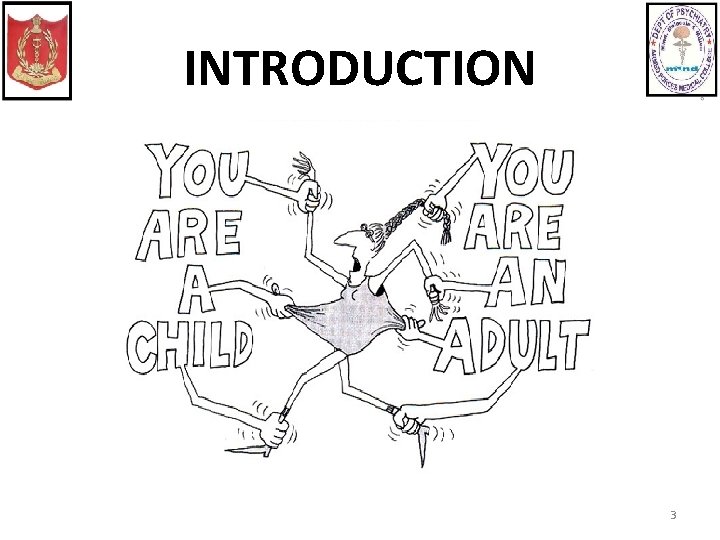
INTRODUCTION 3
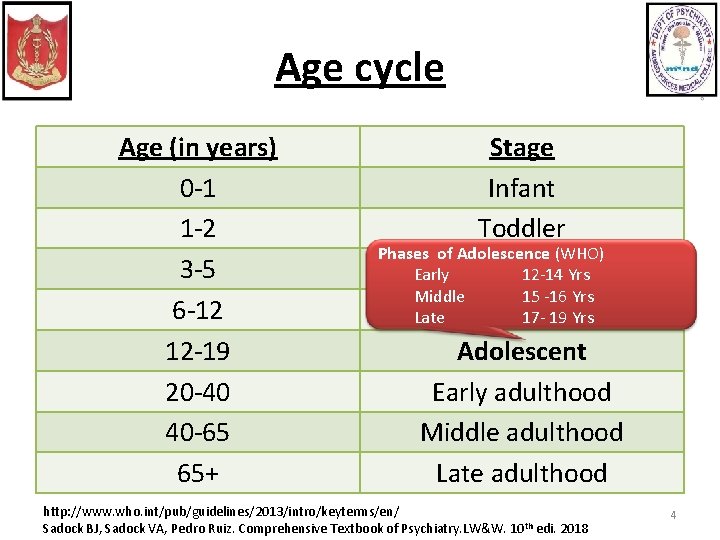
Age cycle Age (in years) 0 -1 1 -2 3 -5 6 -12 12 -19 20 -40 40 -65 65+ Stage Infant Toddler Phases of Adolescence (WHO) Early childhood Early 12 -14 Yrs Middle 15 -16 Yrs Late childhood 17 - 19 Yrs Adolescent Early adulthood Middle adulthood Late adulthood http: //www. who. int/pub/guidelines/2013/intro/keyterms/en/ Sadock BJ, Sadock VA, Pedro Ruiz. Comprehensive Textbook of Psychiatry. LW&W. 10 th edi. 2018 4
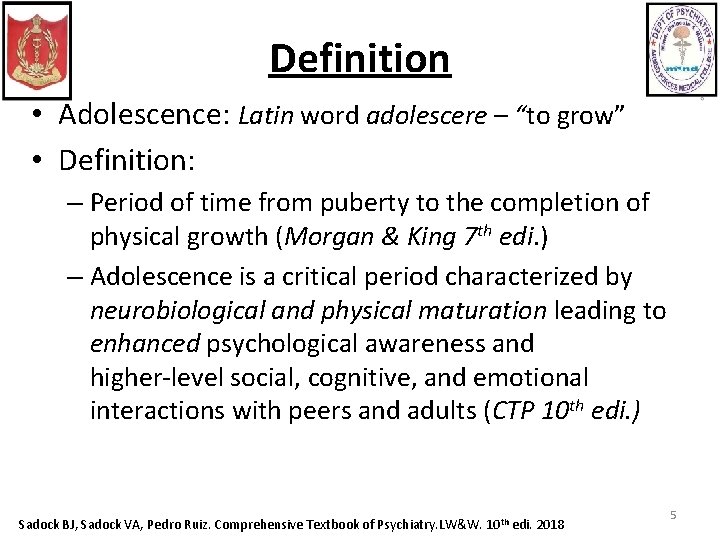
Definition • Adolescence: Latin word adolescere – “to grow” • Definition: – Period of time from puberty to the completion of physical growth (Morgan & King 7 th edi. ) – Adolescence is a critical period characterized by neurobiological and physical maturation leading to enhanced psychological awareness and higher-level social, cognitive, and emotional interactions with peers and adults (CTP 10 th edi. ) Sadock BJ, Sadock VA, Pedro Ruiz. Comprehensive Textbook of Psychiatry. LW&W. 10 th edi. 2018 5
Adolescent Turmoil 1. Adolescence - A time of hypersensitivity to both appetitive and aversive emotional experiences 2. Adolescents - most susceptible to mortality and morbidity due to behaviours directly related to emotional experiences 3. Period of both vulnerability and opportunity hinged on the power of affective systems to influence behaviour Dahl RE. Adolescent brain development: a period of vulnerabilities and opportunities. Keynote address. 6 Annals of the New York Academy of Sciences. 2004 Jun 1; 1021(1): 1 -22.
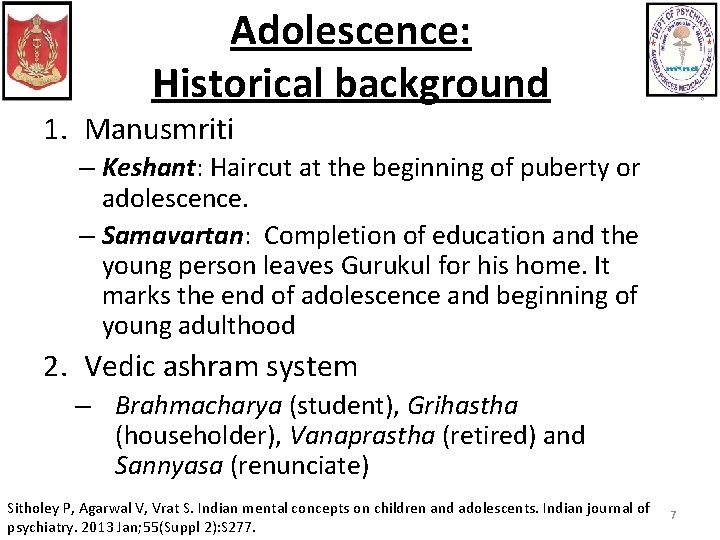
Adolescence: Historical background 1. Manusmriti – Keshant: Haircut at the beginning of puberty or adolescence. – Samavartan: Completion of education and the young person leaves Gurukul for his home. It marks the end of adolescence and beginning of young adulthood 2. Vedic ashram system – Brahmacharya (student), Grihastha (householder), Vanaprastha (retired) and Sannyasa (renunciate) Sitholey P, Agarwal V, Vrat S. Indian mental concepts on children and adolescents. Indian journal of psychiatry. 2013 Jan; 55(Suppl 2): S 277. 7
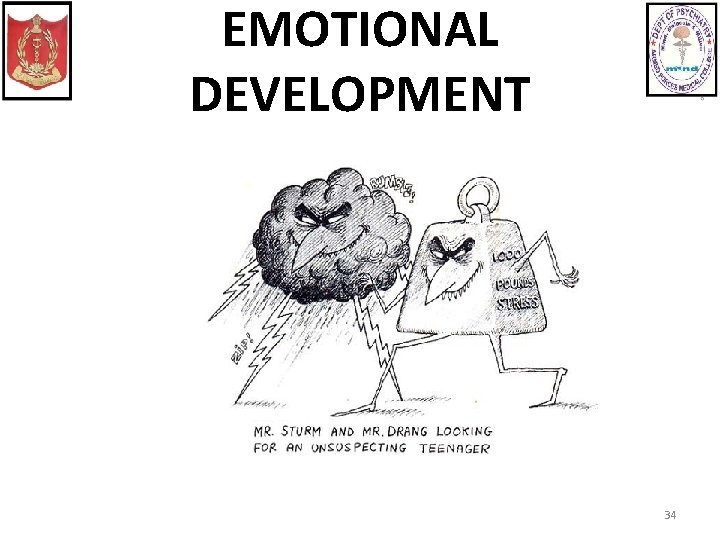
Adolescence: Historical background 3. G. Stanlay Hall (1844 -1924) – – Expansion of Darwin's concept of biological "evolution" into a psychological theory of recapitulation – Book -"Feelings and Psychic Evolution“ – A period of “Sturm und Drang" -Storm and Stress – “Never again does the peer group have such a strong influence over the person” – A new birth, "for the higher and more completely human traits are now born" Muuss RE. Theories of adolescence. Crown Publishing Group/Random House; 1988. 8
Adolescence: Historical background 3. Sigmund Freud – Psychoanalytical theory of adolescent development – Individual passes through the earlier experiences of mankind in his psychosexual development – Adolescence was a universal phenomenon and includes behavioural, social and emotional changes – Physiological changes are related to emotional changes - Increase in negative emotions Muuss RE. Theories of adolescence. Crown Publishing Group/Random House; 1988. 9
Adolescence: Historical background 4. Anna Freud – – Critical influence of Sexual maturation (sexual glands) on psychological sphere – Interaction results in the instinctual reawakening of the libidinal forces bring about psychological disequilibrium (between Ego&Id) – Conflict of Puberty endeavour to regain equilibrium Muuss RE. Theories of adolescence. Crown Publishing Group/Random House; 1988. 10
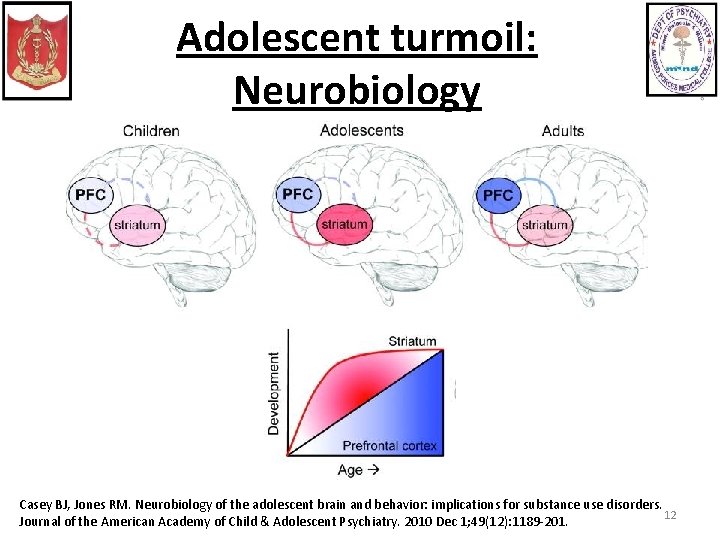
Adolescent turmoil: Neurobiology 1. Surge in gonadal hormones during adolescence – Male- Increased testosterone levels – • • Deviant peer group - Deviant behaviours and social dominance Non-deviant peer group - Increased leadership and social status – Female - Increased estradiol levels – • Heightened emotionality and increased risk-taking and substance use behaviours Guyer AE, Silk JS, Nelson EE. The neurobiology of the emotional adolescent: From the inside out. Neuroscience & Biobehavioral Reviews. 2016 Nov 1; 70: 74 -85. 11
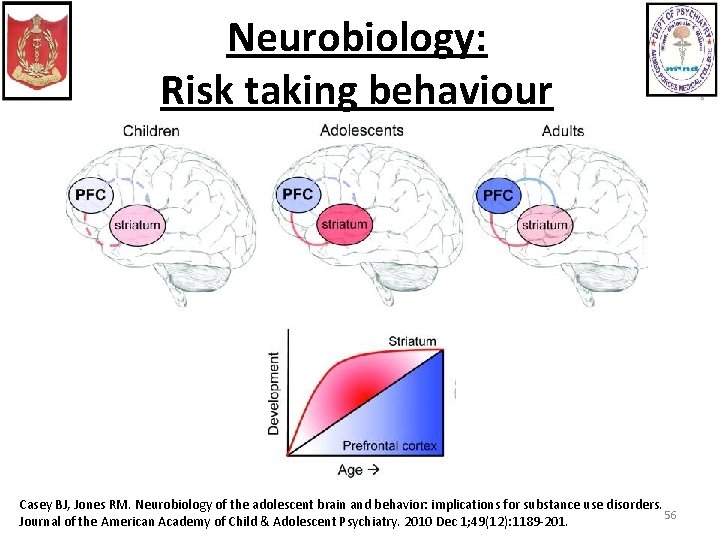
Adolescent turmoil: Neurobiology Casey BJ, Jones RM. Neurobiology of the adolescent brain and behavior: implications for substance use disorders. 12 Journal of the American Academy of Child & Adolescent Psychiatry. 2010 Dec 1; 49(12): 1189 -201.
ADOLESCENT DEVELOPMENT 13
Adolescent development • It encompasses: 1. 2. 3. 4. 5. Physical development Cognitive development Emotional development Social development Behavioural development • Changes in one area of development typically leads to, or occurs in conjunction with, changes in other areas Sadock BJ, Sadock VA, Pedro Ruiz. Comprehensive Textbook of Psychiatry. LW&W. 10 th edi. 2018 14
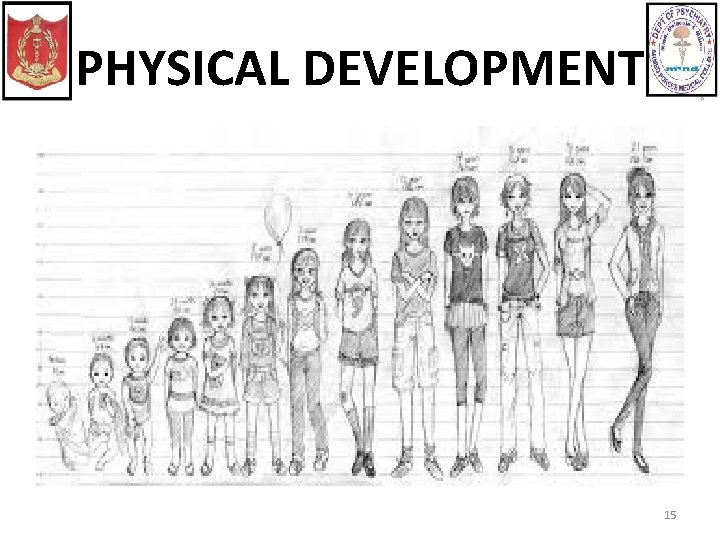
PHYSICAL DEVELOPMENT 15
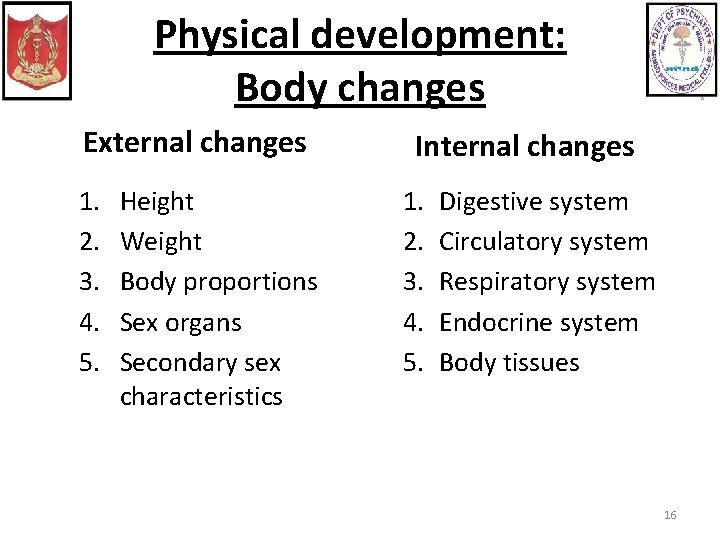
Physical development: Body changes External changes 1. 2. 3. 4. 5. Height Weight Body proportions Sex organs Secondary sex characteristics Internal changes 1. 2. 3. 4. 5. Digestive system Circulatory system Respiratory system Endocrine system Body tissues 16
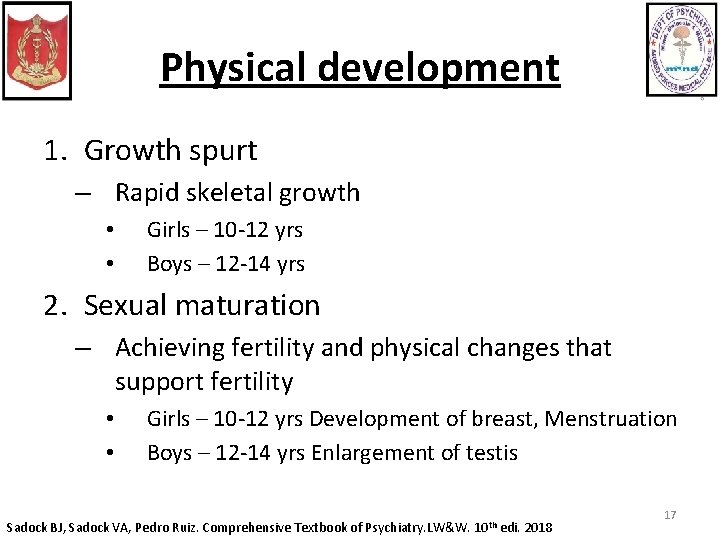
Physical development 1. Growth spurt – Rapid skeletal growth • • Girls – 10 -12 yrs Boys – 12 -14 yrs 2. Sexual maturation – Achieving fertility and physical changes that support fertility • • Girls – 10 -12 yrs Development of breast, Menstruation Boys – 12 -14 yrs Enlargement of testis Sadock BJ, Sadock VA, Pedro Ruiz. Comprehensive Textbook of Psychiatry. LW&W. 10 th edi. 2018 17
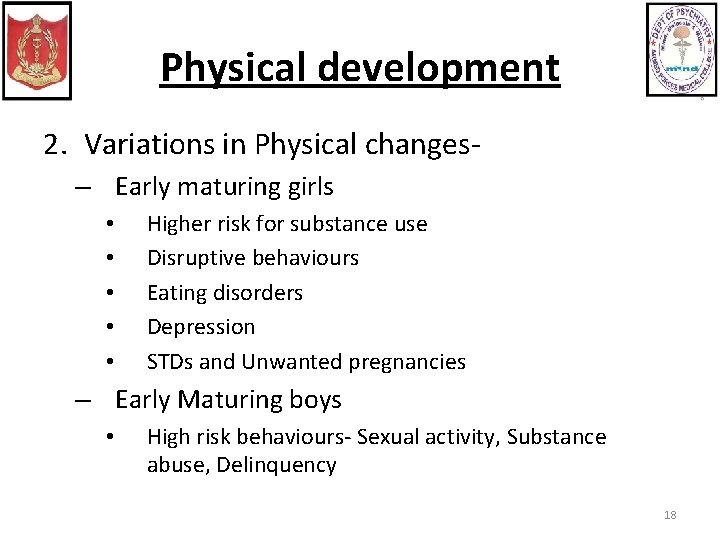
Physical development 2. Variations in Physical changes– Early maturing girls • • • Higher risk for substance use Disruptive behaviours Eating disorders Depression STDs and Unwanted pregnancies – Early Maturing boys • High risk behaviours- Sexual activity, Substance abuse, Delinquency 18
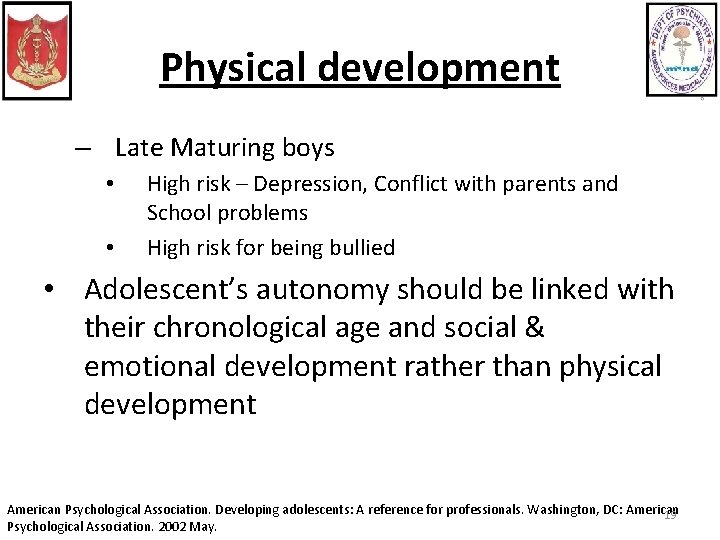
Physical development – Late Maturing boys • • High risk – Depression, Conflict with parents and School problems High risk for being bullied • Adolescent’s autonomy should be linked with their chronological age and social & emotional development rather than physical development American Psychological Association. Developing adolescents: A reference for professionals. Washington, DC: American 19 Psychological Association. 2002 May.
Physical development 3. Concerns about physical appearance – Paramount importance in adolescence – Comments by peers - More worrying 4. Physical activity and weight – Overweight adolescents – High risk for social discrimination, bullying, low self esteem, medical co-morbidities and depression – Multiple factors associated with increased weight American Psychological Association. Developing adolescents: A reference for professionals. Washington, DC: American 20 Psychological Association. 2002 May.
Physical development: Approach to turmoil Strategies during puberty – Educating children about puberty, depending on the curiosity and the maturity level of the child – Take comments about appearance seriously and spend time actively listening to such concerns – Make them talk about their feelings, fears, and stressors about the physical changes – Provide emotional support, knowledge and assurance about changes in the body American Psychological Association. Developing adolescents: A reference for professionals. Washington, DC: American 21 Psychological Association. 2002 May.
Physical development: Approach to turmoil Disordered eating – Preoccupied with their physical appearance begin to diet obsessively to achieve/maintain a thin body – Female> Male – Anorexia nervosa, Bullimia nervosa – Risk factors - Low self esteem, poor coping skills, childhood physical / sexual abuse, family history American Psychological Association. Developing adolescents: A reference for professionals. Washington, DC: American 22 Psychological Association. 2002 May.
Physical development: Approach to handle turmoil 7. Strategies to protect against developing eating disorder – Promoting the acceptance of a broad range of appearances – Promoting positive self-image and body image – Educating about the detrimental consequences of a negative focus on weight – Promoting a positive focus on sources of selfesteem American Psychological Association. Developing adolescents: A reference for professionals. Washington, DC: American 23 Psychological Association. 2002 May.
COGNITIVE DEVELOPMENT 24
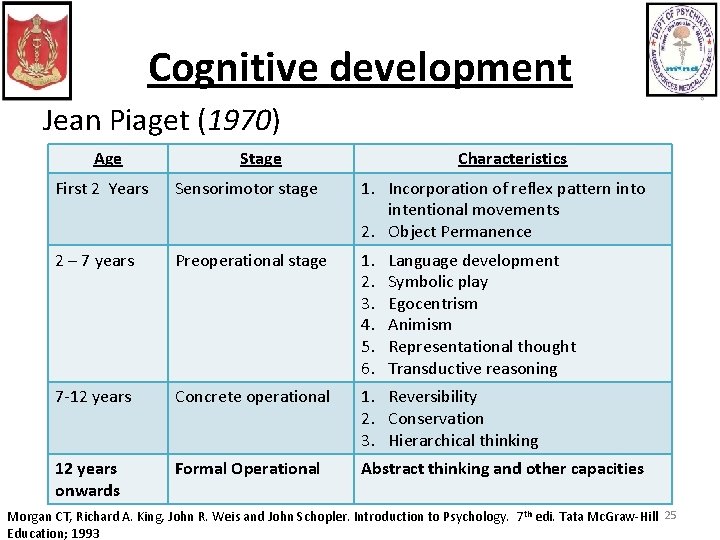
Cognitive development Jean Piaget (1970) Age Stage Characteristics First 2 Years Sensorimotor stage 1. Incorporation of reflex pattern into intentional movements 2. Object Permanence 2 – 7 years Preoperational stage 1. 2. 3. 4. 5. 6. 7 -12 years Concrete operational 1. Reversibility 2. Conservation 3. Hierarchical thinking 12 years onwards Formal Operational Abstract thinking and other capacities Language development Symbolic play Egocentrism Animism Representational thought Transductive reasoning Morgan CT, Richard A. King, John R. Weis and John Schopler. Introduction to Psychology. 7 th edi. Tata Mc. Graw-Hill 25 Education; 1993
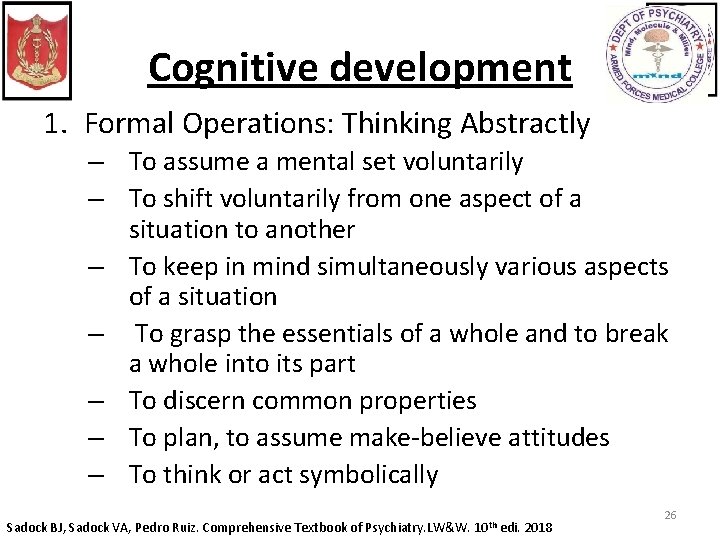
Cognitive development 1. Formal Operations: Thinking Abstractly – To assume a mental set voluntarily – To shift voluntarily from one aspect of a situation to another – To keep in mind simultaneously various aspects of a situation – To grasp the essentials of a whole and to break a whole into its part – To discern common properties – To plan, to assume make-believe attitudes – To think or act symbolically Sadock BJ, Sadock VA, Pedro Ruiz. Comprehensive Textbook of Psychiatry. LW&W. 10 th edi. 2018 26
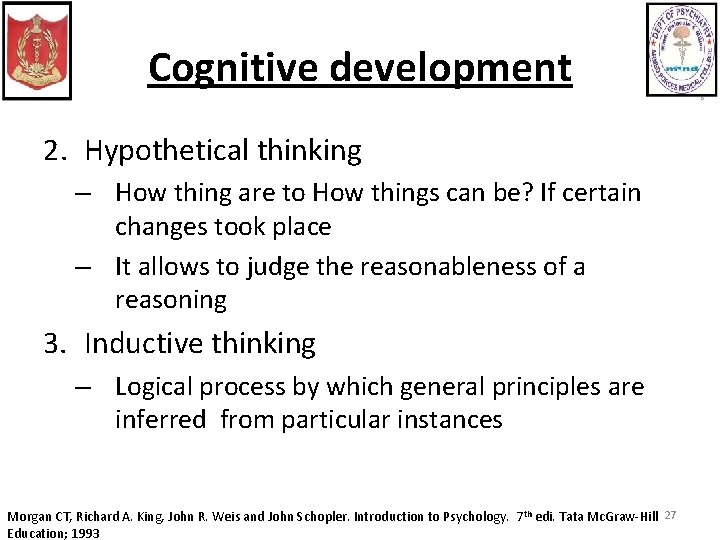
Cognitive development 2. Hypothetical thinking – How thing are to How things can be? If certain changes took place – It allows to judge the reasonableness of a reasoning 3. Inductive thinking – Logical process by which general principles are inferred from particular instances Morgan CT, Richard A. King, John R. Weis and John Schopler. Introduction to Psychology. 7 th edi. Tata Mc. Graw-Hill 27 Education; 1993
Cognitive development 4. Deductive thinking – Reasoning from abstract, general principles to specific hypothesis that follow from these principles 5. Interpropositional Logic – The capacity to judge whether or not statements are logically connected (Formal relationship) to one another (regardless of whether they are true or not) Morgan CT. Richard A. King, John R. Weis and John Schopler. Introduction to Psychology. 7 th edi. Tata Mc. Graw-Hill 28 Education; 1993
Cognitive development 5. Reflective Thinking – The process of evaluating and testing one’s own reasoning • • To be one’s own critic – to find errors or weak point To evaluate a process, idea or solution from the perspective of outsider – Makes one a experimenter, strategist, a problem solver Morgan C T, Richard A. King, John R. Weis and John Schopler. Introduction to Psychology. 7 th edi. Tata Mc. Graw-Hill 29 Education; 1993
Moral development: Theory • Lawrence Kohlberg (1976) – Studied the development of moral reasoning by asking people of various ages to resolve moral dilemmas • He focussed was not on what people said about the dilemma; instead, how they arrived at their decision! • Indl passes through stages of egocentric moral judgements to abstract moral principles American Psychological Association. Developing adolescents: A reference for professionals. Washington, DC: American 30 Psychological Association. 2002 May.
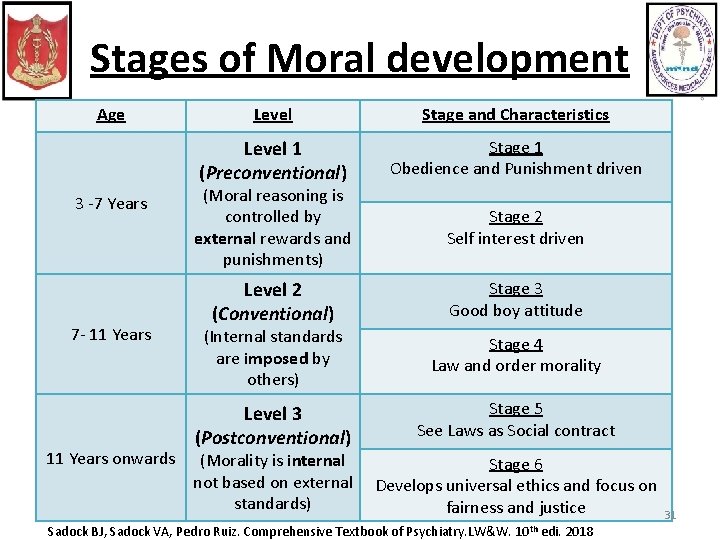
Stages of Moral development Age 3 -7 Years 7 - 11 Years onwards Level Stage and Characteristics Level 1 (Preconventional) Stage 1 Obedience and Punishment driven (Moral reasoning is controlled by external rewards and punishments) Stage 2 Self interest driven Level 2 (Conventional) Stage 3 Good boy attitude (Internal standards are imposed by others) Stage 4 Law and order morality Level 3 (Postconventional) Stage 5 See Laws as Social contract (Morality is internal not based on external standards) Stage 6 Develops universal ethics and focus on fairness and justice Sadock BJ, Sadock VA, Pedro Ruiz. Comprehensive Textbook of Psychiatry. LW&W. 10 th edi. 2018 31
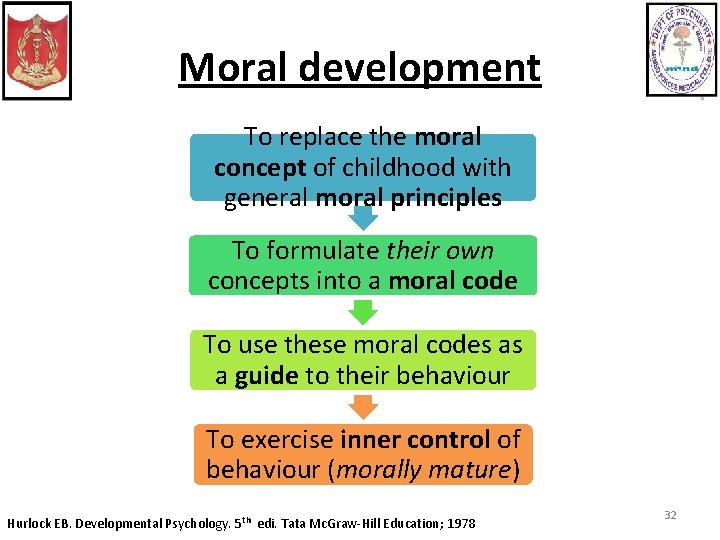
Moral development To replace the moral concept of childhood with general moral principles To formulate their own concepts into a moral code To use these moral codes as a guide to their behaviour To exercise inner control of behaviour (morally mature) Hurlock EB. Developmental Psychology. 5 th edi. Tata Mc. Graw-Hill Education; 1978 32
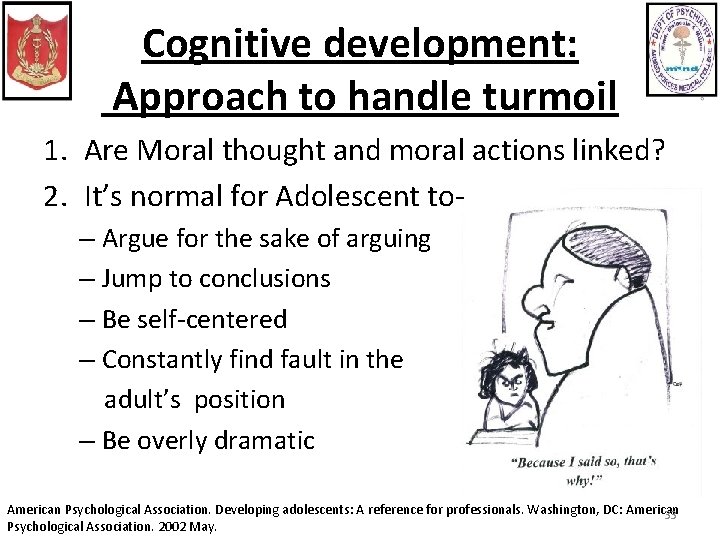
Cognitive development: Approach to handle turmoil 1. Are Moral thought and moral actions linked? 2. It’s normal for Adolescent to– Argue for the sake of arguing – Jump to conclusions – Be self-centered – Constantly find fault in the adult’s position – Be overly dramatic American Psychological Association. Developing adolescents: A reference for professionals. Washington, DC: American 33 Psychological Association. 2002 May.
EMOTIONAL DEVELOPMENT 34
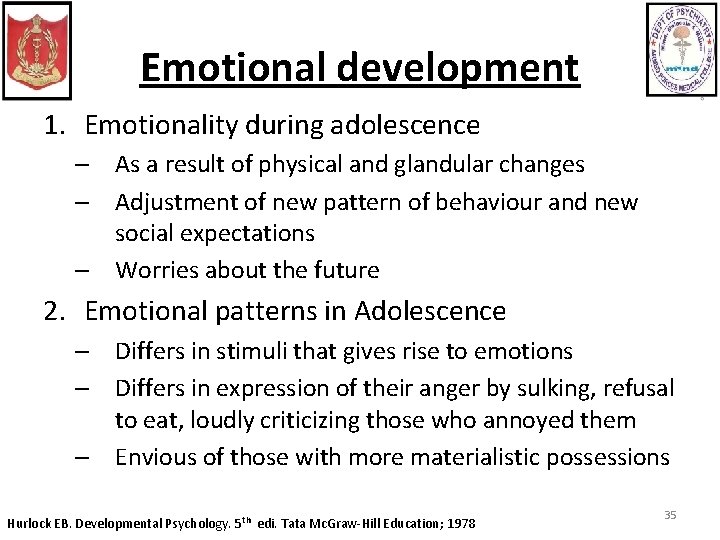
Emotional development 1. Emotionality during adolescence – As a result of physical and glandular changes – Adjustment of new pattern of behaviour and new social expectations – Worries about the future 2. Emotional patterns in Adolescence – Differs in stimuli that gives rise to emotions – Differs in expression of their anger by sulking, refusal to eat, loudly criticizing those who annoyed them – Envious of those with more materialistic possessions Hurlock EB. Developmental Psychology. 5 th edi. Tata Mc. Graw-Hill Education; 1978 35
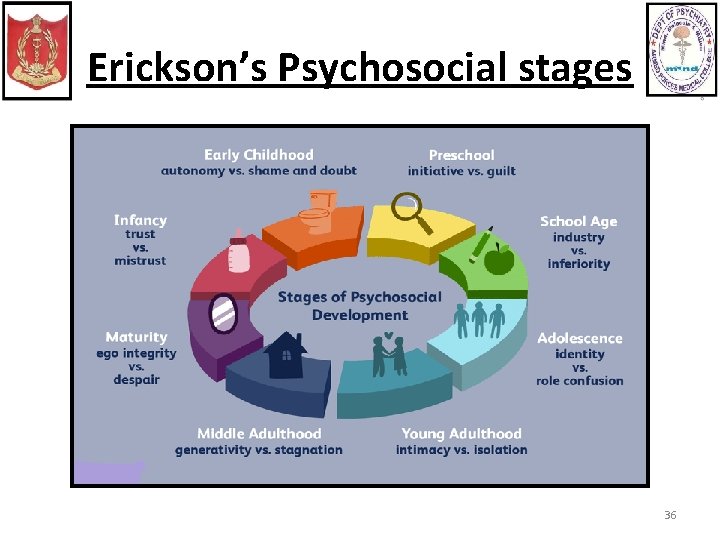
Erickson’s Psychosocial stages 36
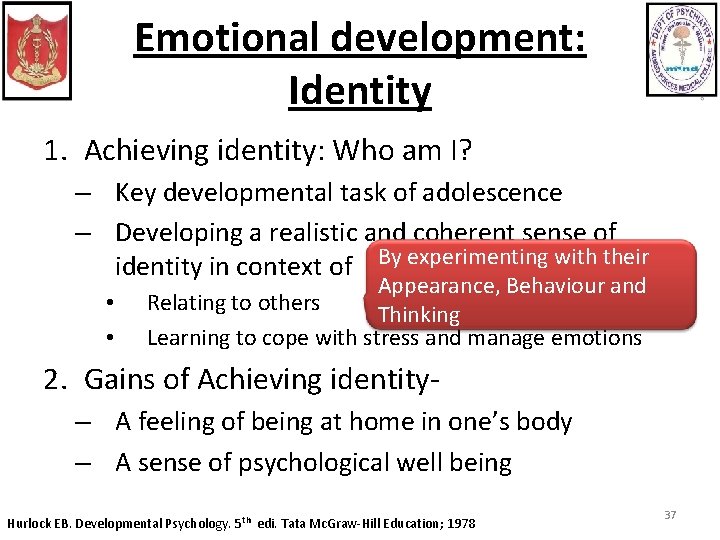
Emotional development: Identity 1. Achieving identity: Who am I? – Key developmental task of adolescence – Developing a realistic and coherent sense of identity in context of By experimenting with their • • Appearance, Behaviour and Relating to others Thinking Learning to cope with stress and manage emotions 2. Gains of Achieving identity– A feeling of being at home in one’s body – A sense of psychological well being Hurlock EB. Developmental Psychology. 5 th edi. Tata Mc. Graw-Hill Education; 1978 37
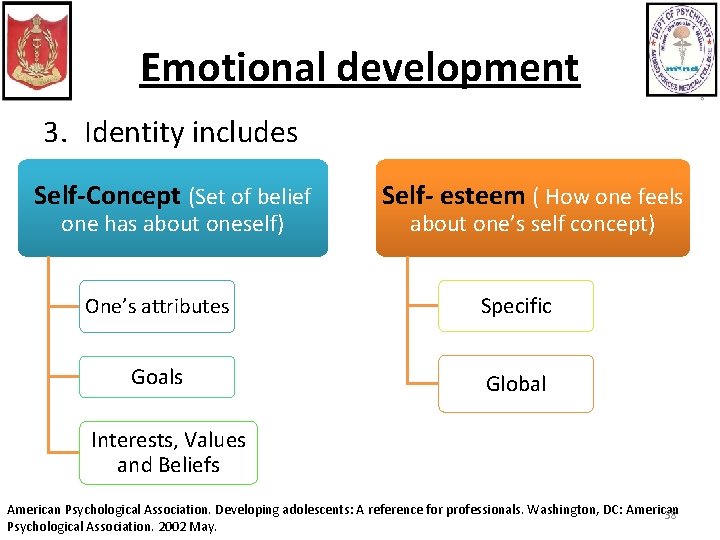
Emotional development 3. Identity includes Self-Concept (Set of belief one has about oneself) Self- esteem ( How one feels about one’s self concept) One’s attributes Specific Goals Global Interests, Values and Beliefs American Psychological Association. Developing adolescents: A reference for professionals. Washington, DC: American 38 Psychological Association. 2002 May.
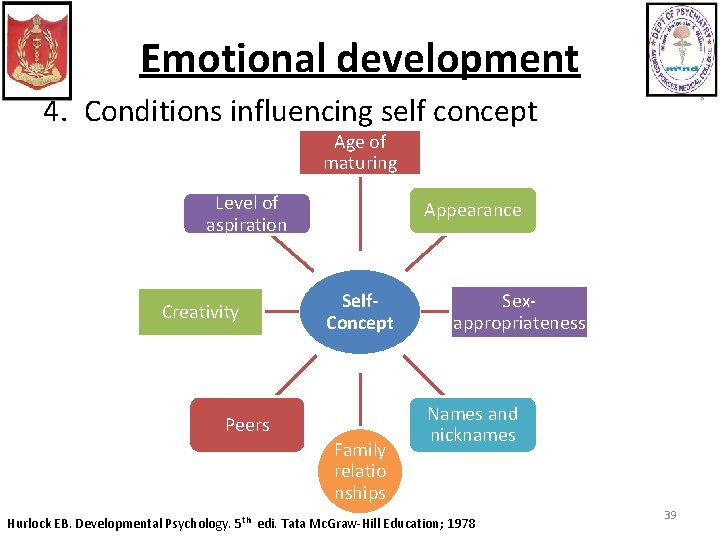
Emotional development 4. Conditions influencing self concept Age of maturing Level of aspiration Creativity Appearance Self. Concept Peers Family relatio nships Sexappropriateness Names and nicknames Hurlock EB. Developmental Psychology. 5 th edi. Tata Mc. Graw-Hill Education; 1978 39
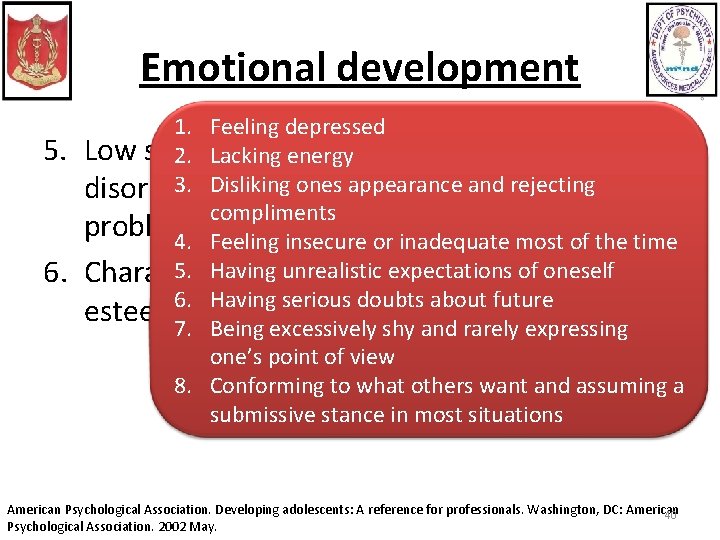
Emotional development 5. 6. 1. Feeling depressed Low self – Depression, Eating 2. esteem Lacking energy 3. Disliking ones appearance and rejecting disorders, Delinquency and Adjustment compliments problems 4. Feeling insecure or inadequate most of the time 5. Having unrealistic expectations oneself Characteristics identified with lowofself 6. Having serious doubts about future esteem 7. Being excessively shy and rarely expressing one’s point of view 8. Conforming to what others want and assuming a submissive stance in most situations American Psychological Association. Developing adolescents: A reference for professionals. Washington, DC: American 40 Psychological Association. 2002 May.
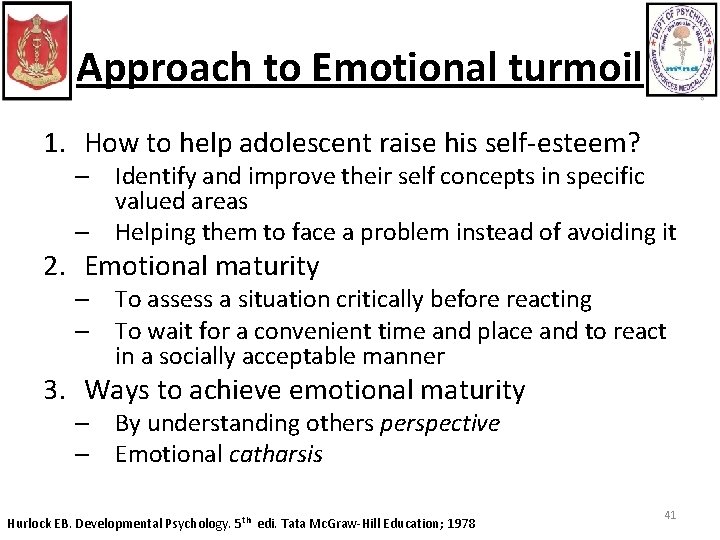
Approach to Emotional turmoil 1. How to help adolescent raise his self-esteem? – Identify and improve their self concepts in specific valued areas – Helping them to face a problem instead of avoiding it 2. Emotional maturity – To assess a situation critically before reacting – To wait for a convenient time and place and to react in a socially acceptable manner 3. Ways to achieve emotional maturity – By understanding others perspective – Emotional catharsis Hurlock EB. Developmental Psychology. 5 th edi. Tata Mc. Graw-Hill Education; 1978 41
Emotional development 2. Group differences in emotional development – Gender differences – Ethnic diversity – Lesbian, Gay, Bisexual, Transgender youth American Psychological Association. Developing adolescents: A reference for professionals. Washington, DC: American 42 Psychological Association. 2002 May.
SOCIAL DEVELOPMENT 43
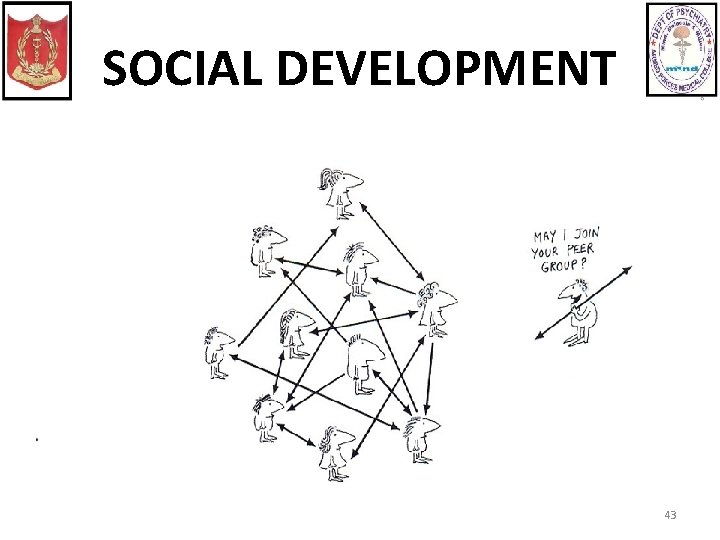
Social development: Peer relationship 1. Important functions sub served by peer groups– Provides a temporary reference point for a developing sense of identity – Contributes in development of moral judgement and values – Source of information about the world and about themselves – Source of popularity, status, prestige and acceptance American Psychological Association. Developing adolescents: A reference for professionals. Washington, DC: American 44 Psychological Association. 2002 May.
Social development: Peer relationship 2. Positive peer relationships – Positive psychosocial adjustment 3. Peer rejected teens – Negative behaviours 4. Structure of peer groups– Younger adolescents – Primary peer group – Middle adolescents - Mixed gender groups – Late adolescents – One-on-One relationships and romantic relationship Hurlock EB. Developmental Psychology. 5 th edi. Tata Mc. Graw-Hill Education; 1978 45
Social development: Peer relationship – Ethnic minority – Higher emphasis on peer groups throughout adolescence 5. Dating and sexual behaviours – Most pronounced change in social attitude – Radical shift in preference - From primary peer group to members of opposite sex – Cyberdating, Romantic relationships, Earlier sexual involvement, unnatural sexual practices Hurlock EB. Developmental Psychology. 5 th edi. Tata Mc. Graw-Hill Education; 1978 46
Social development: Peer relationship – Grief and sense of loss associated with the ending of romantic relationship – Adolescents in a relationship; with signs of physical or emotional abuse Hurlock EB. Developmental Psychology. 5 th edi. Tata Mc. Graw-Hill Education; 1978 47
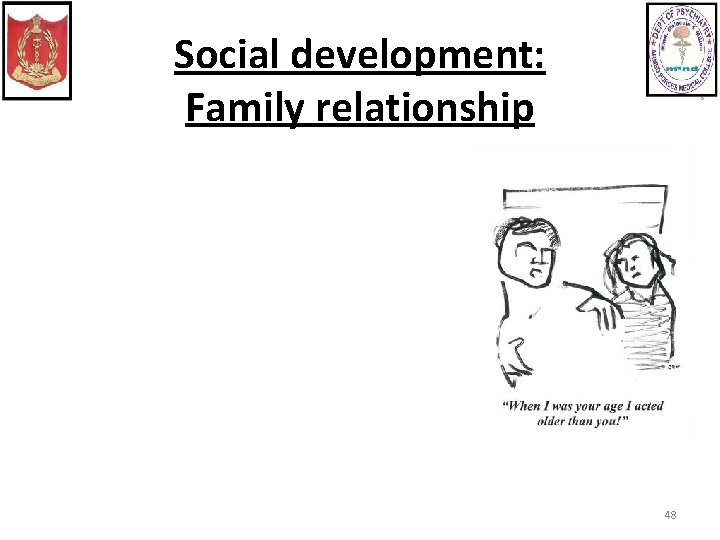
Social development: Family relationship 48
Social development: Family relationship • Parent –teen conflict – To gain independence from parents while learning new ways of staying connected to them – Spontaneous conflicts over day to day matters – Conflict over important issues – Tend to peek with younger adolescents – More distressing to parents than to adolescent American Psychological Association. Developing adolescents: A reference for professionals. Washington, DC: American 49 Psychological Association. 2002 May.
Approach to Family relationship turmoil 1. Encourage parents to modify parenting practices – Warm and involved – Provide firm guidelines and limits – Have appropriate developmental expectations 2. Level of parental supervision and monitoring to differ depending on the peer and neighbourhood environments Schmied V, Tully L. Effective strategies and interventions for adolescents in a child protection context: Literature review. 50 2009
Approach to Family relationship turmoil 3. New type of relating- Encourage the parents to stay involved 4. To educate parents not to take conflicts as rejection of their values or their parenting as failure Schmied V, Tully L. Effective strategies and interventions for adolescents in a child protection context: Literature review. 51 2009
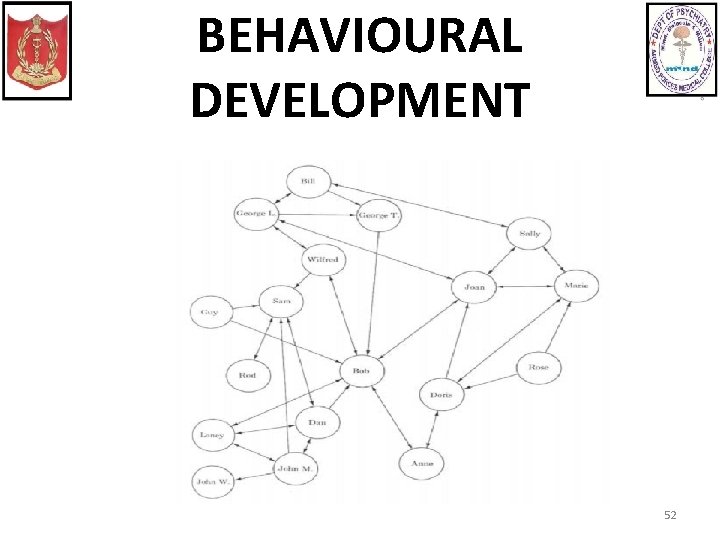
BEHAVIOURAL DEVELOPMENT 52
Behavioural development 1. Risk taking behaviours – – – Cigarette smoking Alcohol use Other substance use Weapon carrying, fighting and sexual violence Sexual intercourse Pregnancy 53
Behavioural development 2. Reasons for Adolescent risk taking: – Need for excitement, fun and novel intense sensations ---> Override the potential dangers of particular activity – Modelling adult behaviour – Adolescent try to shape their identities – Try out new decision making skills 54
Behavioural development – Develop realistic assessments of themselves, other people and the world – To win the approval of peers or to avoid peer rejection – More amount of unsupervised time 55
Neurobiology: Risk taking behaviour Casey BJ, Jones RM. Neurobiology of the adolescent brain and behavior: implications for substance use disorders. 56 Journal of the American Academy of Child & Adolescent Psychiatry. 2010 Dec 1; 49(12): 1189 -201.
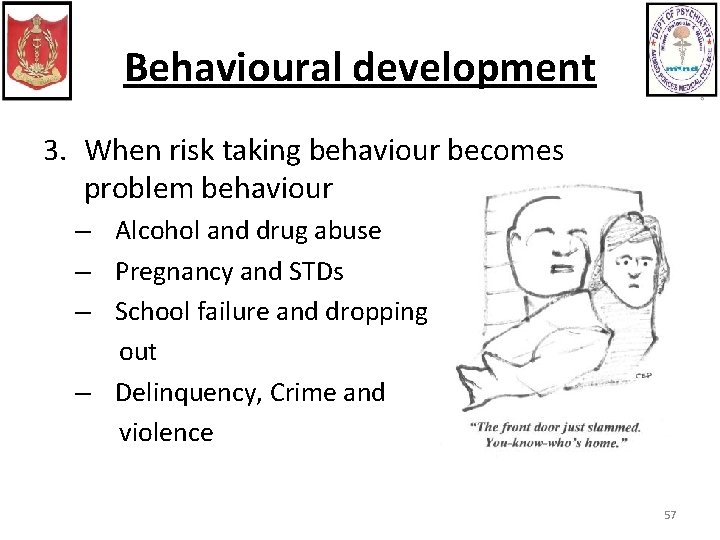
Behavioural development 3. When risk taking behaviour becomes problem behaviour – Alcohol and drug abuse – Pregnancy and STDs – School failure and dropping out – Delinquency, Crime and violence 57
RISK FACTORS & PROTECTIVE FACTORS 58
Risk factors 1. Individual – Personality variables – Developmental delay 2. Family – – Low SES Mental illness Family conflict Coercive parenting 3. Peer – Peer rejection – Deviant peer group 4. School – Academic failure – Low committment to school 5. Community – Neighbourhood – Poverty 59
Protective factors 1. A strong sense of connectedness to parents, family, school, community institutions, adults outside the family 2. Development and enhancement of academic and social competence 3. Involvement in extracurricular activities that create multiple friendship networks 4. Resilience 60
Take home points 61
References 1. 2. 3. 4. 5. 6. Hurlock EB. Developmental Psychology. Tata Mc. Graw-Hill Education; 1978. Sadock BJ, Sadock VA, Pedro Ruiz. Comprehensive Textbook of Psychiatry. LW&W. 10 th edi. 2018. American Psychological Association. Developing adolescents: A reference for professionals. Washington, DC: American Psychological Association. 2002 May. Morgan CT. Richard a. King, John R. Weis and John Schopler, “Introduction to Psychology” Tata Mc. Graw-Hill Education; 1993. Schmied V, Tully L. Effective strategies and interventions for adolescents in a child protection context: Literature review. 2009. Muuss RE. Theories of adolescence. Crown Publishing Group/Random House; 1988. 62
References 8. Dahl RE. Adolescent brain development: a period of vulnerabilities and opportunities. Keynote address. Annals of the New York Academy of Sciences. 2004 Jun 1; 1021(1): 1 -22. 9. http: //www. who. int/pub/guidelines/2013/intro/keyterms/en 10. Guyer AE, Silk JS, Nelson EE. The neurobiology of the emotional adolescent: From the inside out. Neuroscience & Biobehavioral Reviews. 2016 Nov 1; 70: 74 -85. 11. Sitholey P, Agarwal V, Vrat S. Indian mental concepts on children and adolescents. Indian journal of psychiatry. 2013 Jan; 55(Suppl 2): S 277. 12. Casey BJ, Jones RM. Neurobiology of the adolescent brain and behavior: implications for substance use disorders. Journal of the American Academy of Child & Adolescent Psychiatry. 2010 Dec 1; 49(12): 1189 -201. 63
THANK YOU 64