
Using Data to Improve HIV Care and Treatment





- Slides: 69
Using Data to Improve HIV Care and Treatment Data Quality and Data Dashboards 2017 U. S. Conference on AIDS HRSA Pathway Saturday, September 9, 2017 9: 00 – 11: 00 AM
Session Objectives • To discuss the importance of using data for improving retention in care and HIV-related health outcomes for people living with HIV (PLWH) • To describe successful strategies to improve data quality and examples/best practices of how to use high quality data to enhance the care and health outcomes for PLWH • To hear from RWHAP recipients, through an interactive session, about how they use their data, challenges to using data, and technical assistance needs around data utilization
Today’s Session • Using National-Level RWHAP Data to Inform Program Decision. Making and Priorities • HRSA HIV/AIDS Bureau – Stacy Cohen • Data Disconnect • Elmhurst Hospital Center, Ryan White HIV/AIDS Program (Part C) – Carlos Salama, MD • Data to Care • Mc. Auley Clinic, Mercy Health Saint Mary’s, Ryan White HIV/AIDS Program (Part C) – C. Ryan Tomlin, Pharm. D. , BCPS, AAHIVP • Using Data to Inform Decisions and Drive Performance • Nashville/Davidson County TGA, Ryan White HIV/AIDS Program (Part A) – Pam Sylakowski • Interactive feedback session: How do you use your data? • All participants
Using National-Level Ryan White HIV/AIDS Program Data to Inform Program Decision-Making and Priorities Stacy Cohen Branch Chief, Evaluation, Analysis, and Dissemination Branch Division of Policy and Data HIV/AIDS Bureau Health Resources and Services Administration
Outline • Overview • HRSA HIV/AIDS Bureau • Ryan White HIV/AIDS Program (RWHAP) • Demonstrating Effectiveness of Program Investments • National-level data • RWHAP client demographic data • RWHAP viral suppression • Using data to address gaps and disparities • Implementing Solutions • Identifying New Approaches to Improve Health Outcomes
Overview The Ryan White HIV/AIDS Program
HRSA HIV/AIDS Bureau Vision Optimal HIV/AIDS care and treatment for all. Mission Provide leadership and resources to assure access to and retention in high quality, integrated care, and treatment services for vulnerable people living with HIV/AIDS and their families. 7
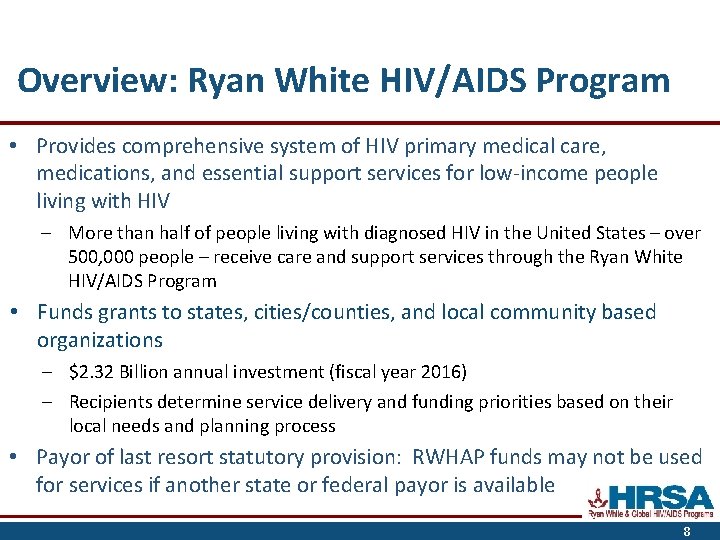
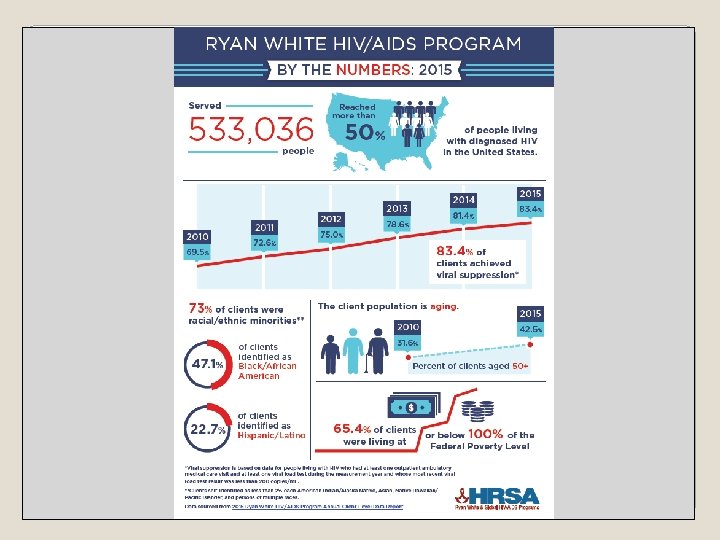
Overview: Ryan White HIV/AIDS Program • Provides comprehensive system of HIV primary medical care, medications, and essential support services for low-income people living with HIV ‒ More than half of people living with diagnosed HIV in the United States – over 500, 000 people – receive care and support services through the Ryan White HIV/AIDS Program • Funds grants to states, cities/counties, and local community based organizations ‒ $2. 32 Billion annual investment (fiscal year 2016) ‒ Recipients determine service delivery and funding priorities based on their local needs and planning process • Payor of last resort statutory provision: RWHAP funds may not be used for services if another state or federal payor is available 8
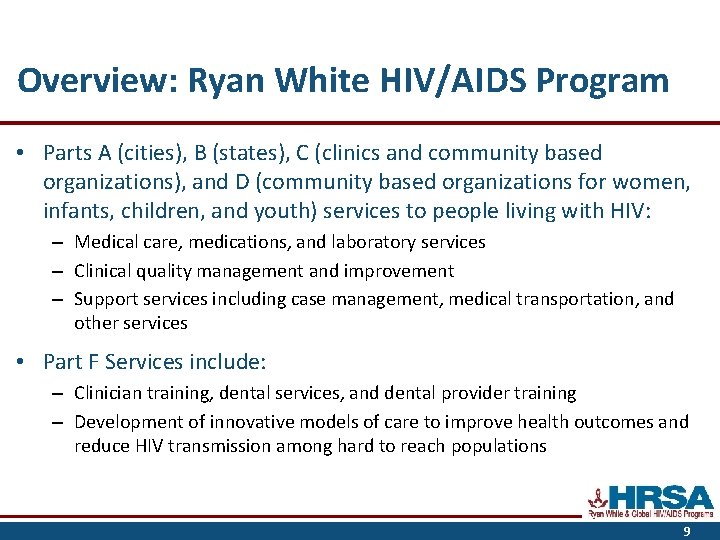
Overview: Ryan White HIV/AIDS Program • Parts A (cities), B (states), C (clinics and community based organizations), and D (community based organizations for women, infants, children, and youth) services to people living with HIV: – Medical care, medications, and laboratory services – Clinical quality management and improvement – Support services including case management, medical transportation, and other services • Part F Services include: – Clinician training, dental services, and dental provider training – Development of innovative models of care to improve health outcomes and reduce HIV transmission among hard to reach populations 9
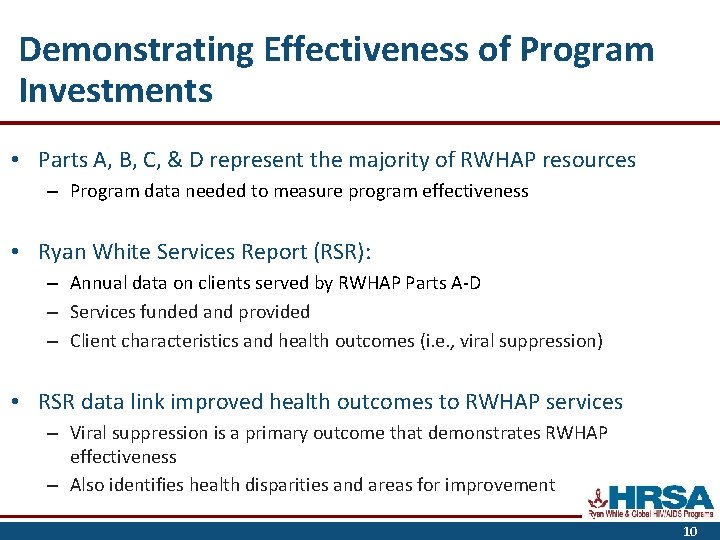
Demonstrating Effectiveness of Program Investments • Parts A, B, C, & D represent the majority of RWHAP resources – Program data needed to measure program effectiveness • Ryan White Services Report (RSR): – Annual data on clients served by RWHAP Parts A-D – Services funded and provided – Client characteristics and health outcomes (i. e. , viral suppression) • RSR data link improved health outcomes to RWHAP services – Viral suppression is a primary outcome that demonstrates RWHAP effectiveness – Also identifies health disparities and areas for improvement 10
National-Level Ryan White HIV/AIDS Program Data RWHAP client demographic and viral suppression data 11
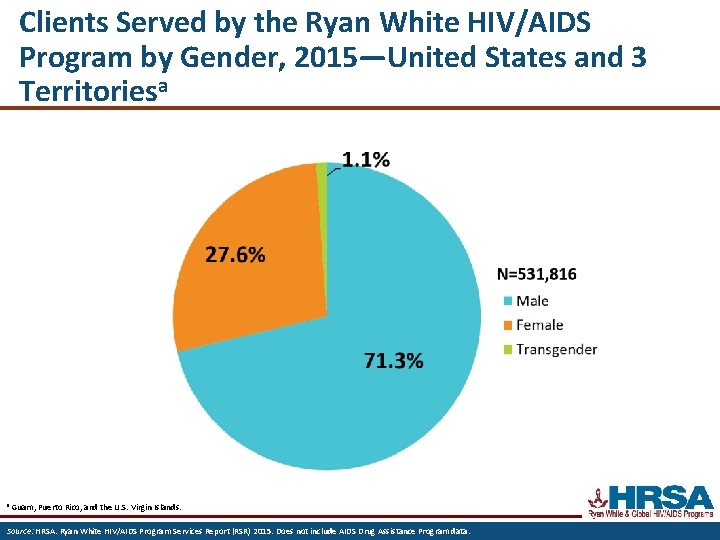
Clients Served by the Ryan White HIV/AIDS Program by Gender, 2015—United States and 3 Territoriesa a Guam, Puerto Rico, and the U. S. Virgin Islands. Source: HRSA. Ryan White HIV/AIDS Program Services Report (RSR) 2015. Does not include AIDS Drug Assistance Program data.
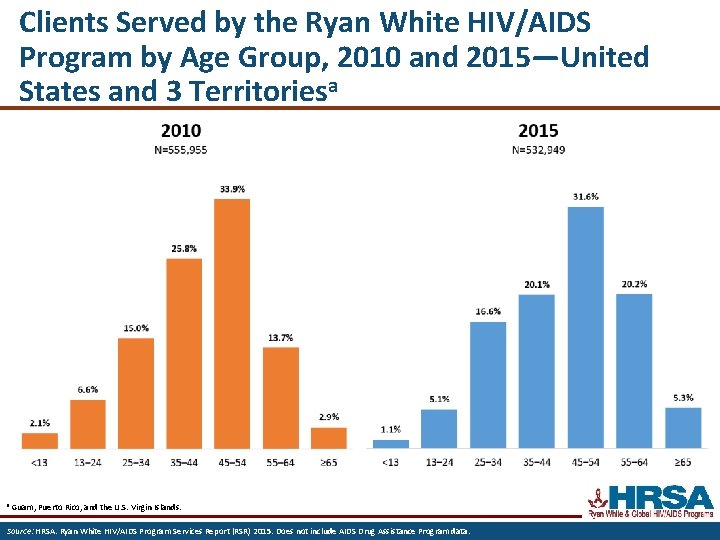
Clients Served by the Ryan White HIV/AIDS Program by Age Group, 2010 and 2015—United States and 3 Territoriesa a Guam, Puerto Rico, and the U. S. Virgin Islands. Source: HRSA. Ryan White HIV/AIDS Program Services Report (RSR) 2015. Does not include AIDS Drug Assistance Program data.
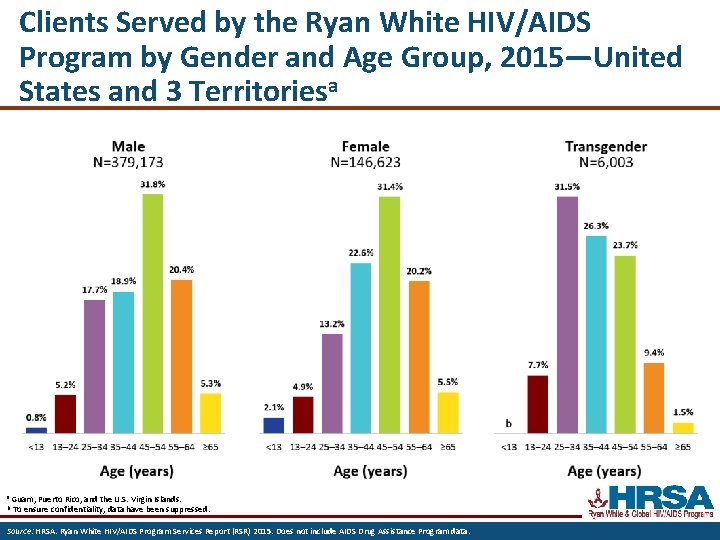
Clients Served by the Ryan White HIV/AIDS Program by Gender and Age Group, 2015—United States and 3 Territoriesa a Guam, b Puerto Rico, and the U. S. Virgin Islands. To ensure confidentiality, data have been suppressed. Source: HRSA. Ryan White HIV/AIDS Program Services Report (RSR) 2015. Does not include AIDS Drug Assistance Program data.
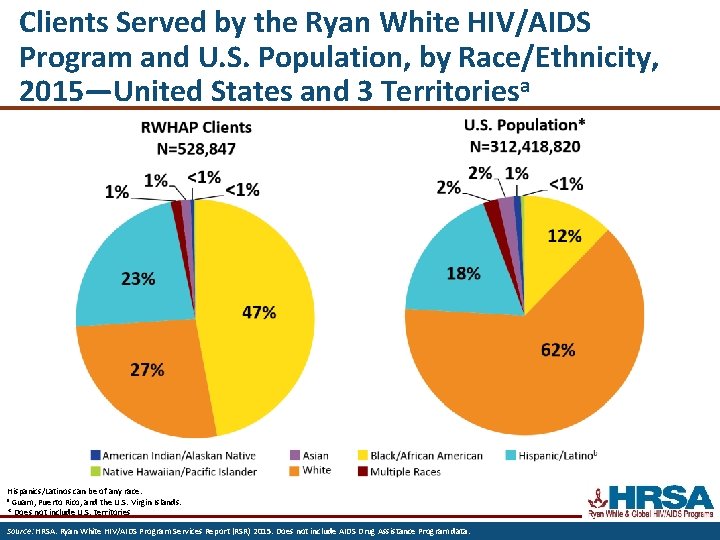
Clients Served by the Ryan White HIV/AIDS Program and U. S. Population, by Race/Ethnicity, 2015—United States and 3 Territoriesa Hispanics/Latinos can be of any race. a Guam, Puerto Rico, and the U. S. Virgin Islands. * Does not include U. S. territories Source: HRSA. Ryan White HIV/AIDS Program Services Report (RSR) 2015. Does not include AIDS Drug Assistance Program data.
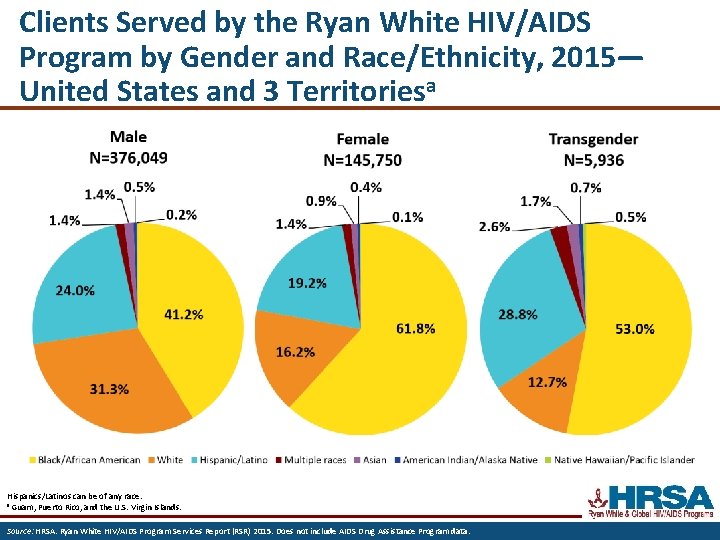
Clients Served by the Ryan White HIV/AIDS Program by Gender and Race/Ethnicity, 2015— United States and 3 Territoriesa Hispanics/Latinos can be of any race. a Guam, Puerto Rico, and the U. S. Virgin Islands. Source: HRSA. Ryan White HIV/AIDS Program Services Report (RSR) 2015. Does not include AIDS Drug Assistance Program data.
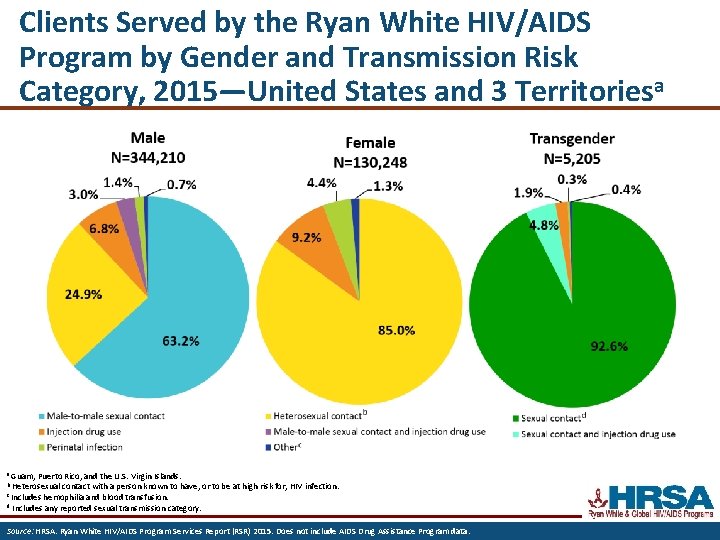
Clients Served by the Ryan White HIV/AIDS Program by Gender and Transmission Risk Category, 2015—United States and 3 Territoriesa a Guam, Puerto Rico, and the U. S. Virgin Islands. contact with a person known to have, or to be at high risk for, HIV infection. c Includes hemophilia and blood transfusion. d Includes any reported sexual transmission category. b Heterosexual Source: HRSA. Ryan White HIV/AIDS Program Services Report (RSR) 2015. Does not include AIDS Drug Assistance Program data.
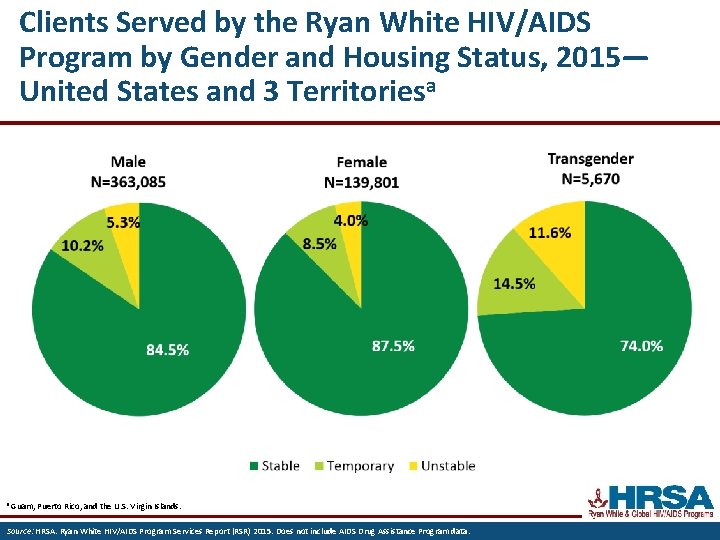
Clients Served by the Ryan White HIV/AIDS Program by Gender and Housing Status, 2015— United States and 3 Territoriesa a Guam, Puerto Rico, and the U. S. Virgin Islands. Source: HRSA. Ryan White HIV/AIDS Program Services Report (RSR) 2015. Does not include AIDS Drug Assistance Program data.
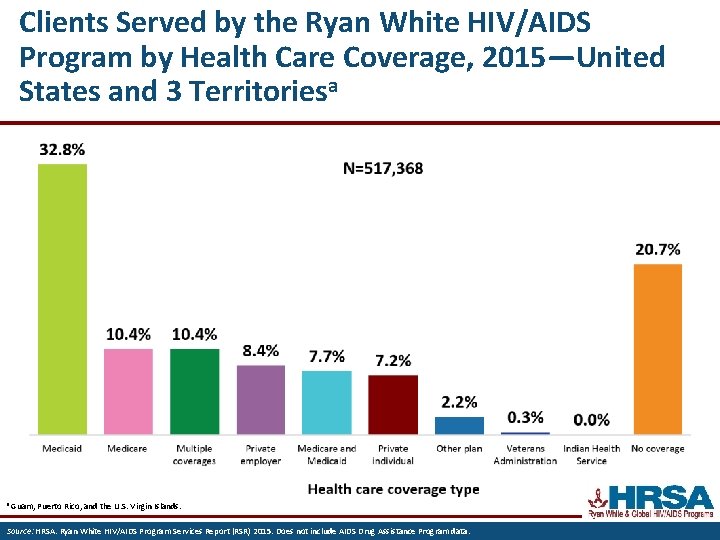
Clients Served by the Ryan White HIV/AIDS Program by Health Care Coverage, 2015—United States and 3 Territoriesa a Guam, Puerto Rico, and the U. S. Virgin Islands. Source: HRSA. Ryan White HIV/AIDS Program Services Report (RSR) 2015. Does not include AIDS Drug Assistance Program data.
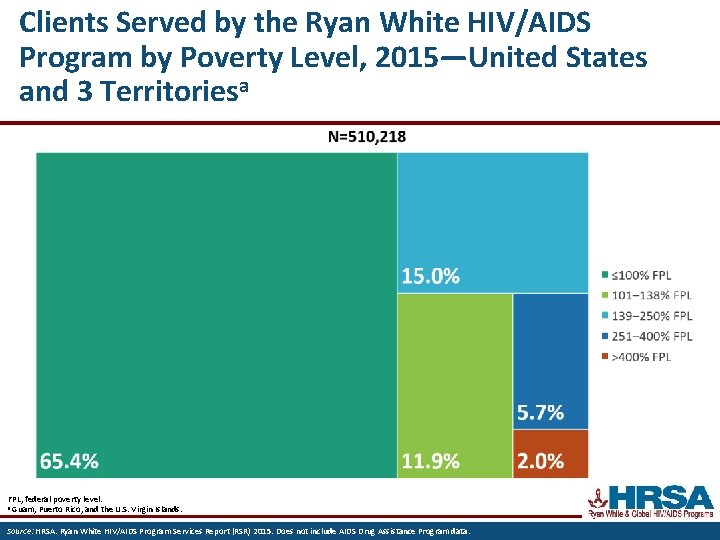
Clients Served by the Ryan White HIV/AIDS Program by Poverty Level, 2015—United States and 3 Territoriesa FPL, federal poverty level. a Guam, Puerto Rico, and the U. S. Virgin Islands. Source: HRSA. Ryan White HIV/AIDS Program Services Report (RSR) 2015. Does not include AIDS Drug Assistance Program data.
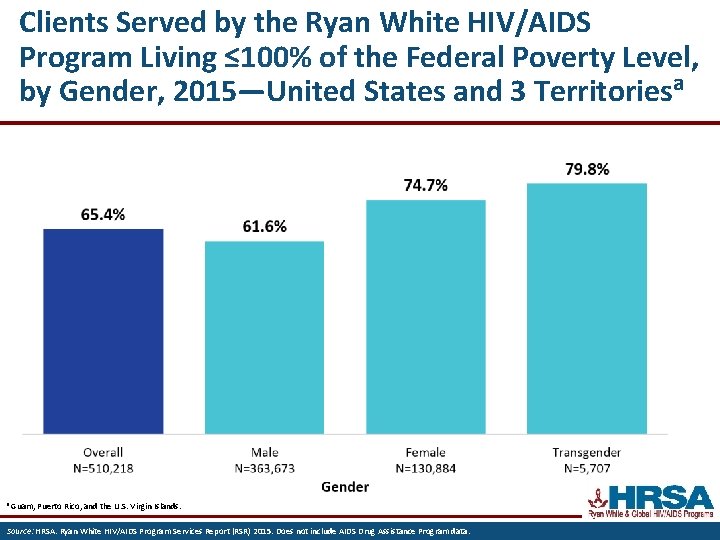
Clients Served by the Ryan White HIV/AIDS Program Living ≤ 100% of the Federal Poverty Level, by Gender, 2015—United States and 3 Territoriesa a Guam, Puerto Rico, and the U. S. Virgin Islands. Source: HRSA. Ryan White HIV/AIDS Program Services Report (RSR) 2015. Does not include AIDS Drug Assistance Program data.
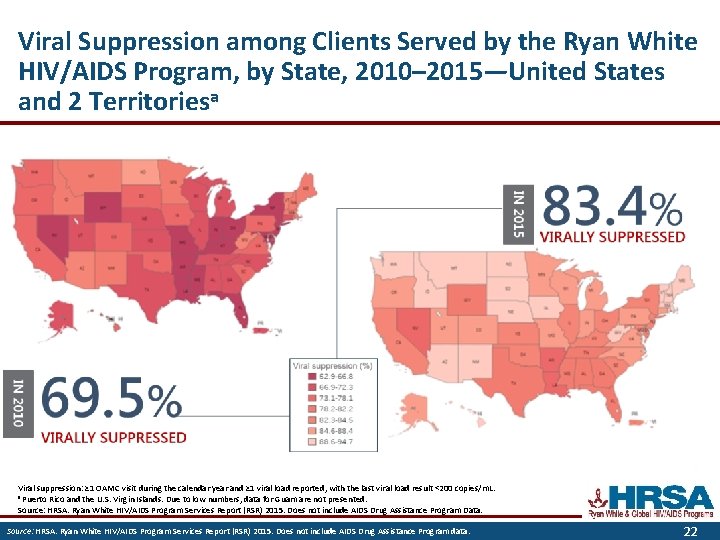
Viral Suppression among Clients Served by the Ryan White HIV/AIDS Program, by State, 2010– 2015—United States and 2 Territoriesa Viral suppression: ≥ 1 OAMC visit during the calendar year and ≥ 1 viral load reported, with the last viral load result <200 copies/m. L. a Puerto Rico and the U. S. Virgin Islands. Due to low numbers, data for Guam are not presented. Source: HRSA. Ryan White HIV/AIDS Program Services Report (RSR) 2015. Does not include AIDS Drug Assistance Program Data. Source: HRSA. Ryan White HIV/AIDS Program Services Report (RSR) 2015. Does not include AIDS Drug Assistance Program data. 22
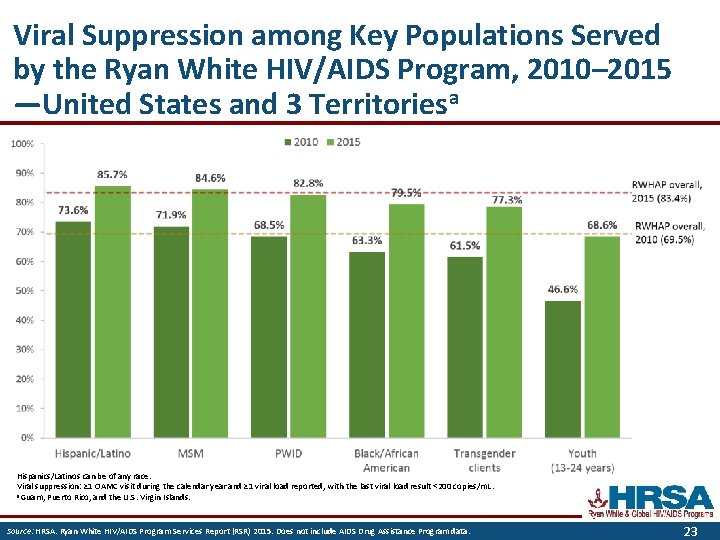
Viral Suppression among Key Populations Served by the Ryan White HIV/AIDS Program, 2010– 2015 —United States and 3 Territoriesa Hispanics/Latinos can be of any race. Viral suppression: ≥ 1 OAMC visit during the calendar year and ≥ 1 viral load reported, with the last viral load result <200 copies/m. L. a Guam, Puerto Rico, and the U. S. Virgin Islands. Source: HRSA. Ryan White HIV/AIDS Program Services Report (RSR) 2015. Does not include AIDS Drug Assistance Program data. 23
Using data to address gaps and disparities Implementing Solutions Identifying New Approaches to Improve Health Outcomes
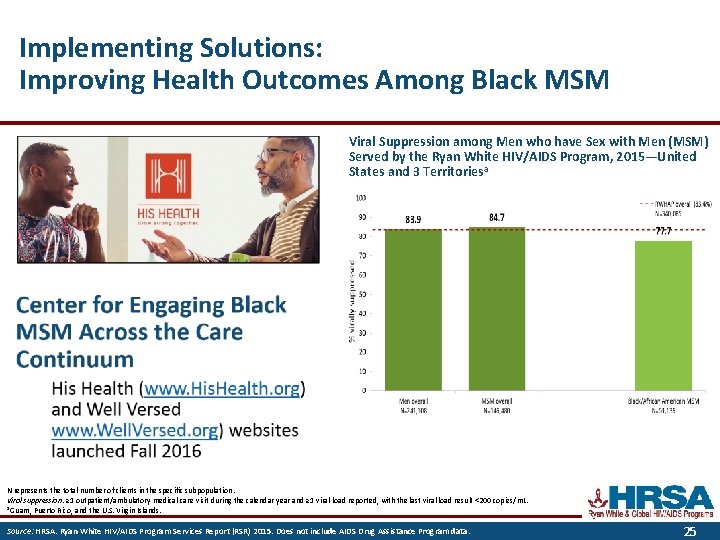
Implementing Solutions: Improving Health Outcomes Among Black MSM Viral Suppression among Men who have Sex with Men (MSM) Served by the Ryan White HIV/AIDS Program, 2015—United States and 3 Territoriesa N represents the total number of clients in the specific subpopulation. Viral suppression: ≥ 1 outpatient/ambulatory medical care visit during the calendar year and ≥ 1 viral load reported, with the last viral load result <200 copies/m. L. a Guam, Puerto Rico, and the U. S. Virgin Islands. Source: HRSA. Ryan White HIV/AIDS Program Services Report (RSR) 2015. Does not include AIDS Drug Assistance Program data. 25
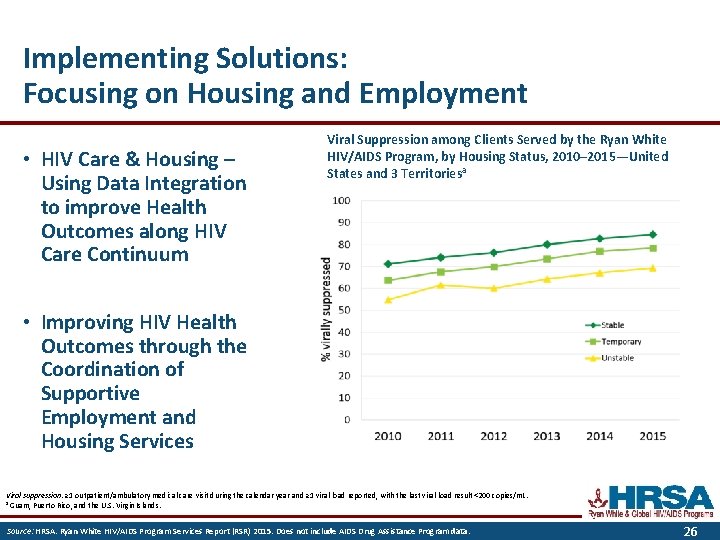
Implementing Solutions: Focusing on Housing and Employment • HIV Care & Housing – Using Data Integration to improve Health Outcomes along HIV Care Continuum Viral Suppression among Clients Served by the Ryan White HIV/AIDS Program, by Housing Status, 2010‒ 2015—United States and 3 Territoriesa • Improving HIV Health Outcomes through the Coordination of Supportive Employment and Housing Services Viral suppression: ≥ 1 outpatient/ambulatory medical care visit during the calendar year and ≥ 1 viral load reported, with the last viral load result <200 copies/m. L. a Guam, Puerto Rico, and the U. S. Virgin Islands. Source: HRSA. Ryan White HIV/AIDS Program Services Report (RSR) 2015. Does not include AIDS Drug Assistance Program data. 26
Identifying New Approaches to Improve Health Outcomes • Building Futures for Youth Living with HIV (evaluation study) – Use data to assess the current state of youth living with HIV aged 13 -24 receiving RWHAP-funded care. – Identify best practices to improve care and treatment for youth living with HIV • Overcome barriers to care, fill gaps in care, optimize health outcomes – Develop and provide technical assistance for youth-serving RWHAP providers 27
Identifying New Approaches to Improve Health Outcomes • Implementation Center for HIV Clinical Quality Improvement – Provide training and technical assistance to recipients aimed at improving patient health outcomes • Assessing client factors with detectable viral load (evaluation study) – Identify differences between PLWH who are virally suppressed and those who are not – Identify new strategies to achieve improved viral suppression 28
Identifying New Approaches to Improve Health Outcomes • Dissemination of Evidence-Informed Interventions to Improve Health Outcomes Along the HIV Care Continuum – Four evidence-informed care and treatment interventions for linkage and retention – Based on evidence informed interventions: Jail, Outreach, Buprenorphine, and Re-Engagement and Retention initiatives • Using Evidence Informed Interventions to Improve Health Outcomes among People Living with HIV – Improving HIV health outcomes for transgender women and black men who have sex with men – Integrating behavioral health with primary medical care for people living with HIV – Identifying and addressing trauma among people living with HIV 29
Summary • The Ryan White HIV/AIDS Program (RWHAP) provides HIV care, treatment, and support service to over 500, 000 people living with diagnosed HIV in the U. S. • People living with HIV (PLWH) receiving RWHAP services have better viral suppression outcomes than the national average – Lowers HIV transmission – Improves the lifespan of the PLWH • RWHAP utilizes data to develop innovative HIV care and treatment service delivery approaches in the U. S. CDC. HIV Surveillance Report Supplemental Report Volume 21, Number 4. Monitoring Selected National HIV Prevention and Care Objectives by Using HIV Surveillance Data, United States and 6 Dependent Areas, 2014. HRSA. Ryan White HIV/AIDS Program Annual Client-Level Data Report 2015. Does not include clients served by the AIDS Drug Assistance Program. 30
Thank you! Stacy Cohen Email: sgagne@hrsa. gov Web: www. hab. hrsa. gov Twitter: twitter. com/HRSAgov Facebook: facebook. com/HHS. HRSA 31
Data Disconnect Carlos Salama, M. D. Ryan White HIV/AIDS Program Parts C, D Elmhurst Hospital Center Elmhurst (Borough of Queens), N. Y. 32
Our Problem § Disconnect between: §Data collected for grants §Ability to use this data to enhance care for our patients § Extensive resources needed to collect data and send to city, state, and federal authorities §Each grant / agency has different reporting mechanisms, making it difficult and time consuming to synthesize data for decision making § Format of the data §Not optimal to help guide our program in decision making for future goals 33
Our Experience § AIRS and E-share: two programs that are used to report Ryan White HIV/AIDS Program (RWHAP) data §RWHAP Parts C/D are reported on AIRS §RWHAP Part A is reported to Public Health Solutions on E-share § Other grants (MCM, PEP, HDR) are also reported on E-share § Separate reporting to the NY AIDS Institute (HIVQual) requires uploading to their website. 34
Our Experience § Three separate databases that we must use to report similar data to different agencies § No communication with our previous EHR (quadramed) or current EHR (EPIC) § Database manager must find data on EPIC and manually enter into the programs in order to report § Significantly reduced ability of data manager to run reports and supply the data needed to help us improve patient care 35
Our Strategy Direct monthly reports from EPIC (EHR) § Reports provide physician-oriented data, including: §Demographics, risk factors, therapy, viral suppression, etc. §% virologic suppression; broken down by provider and other parameters §List of patients that are not suppressed to monitor provider success §Date of last appointment – sorting to over 6 months and then reaching out to those patients using a multidisciplinary approach of providers, nurses, adherence counselors, social workers and care-coordination navigators. § These data do not directly communicate with e-share or AIRS 36
Our Data Focus on two patient groups (over 8 months): § Patients that are not virologically suppressed §Every two months we run a report on VL suppression §Report is sorted by name and number of all patients with VL >200 copies §These charts are reviewed and patients are called in as needed to address elevated VL § Patients not seen / without VL in over 8 months §Pre-emptively identify patients before they are lost to follow up (defined at our clinic as not seen in >1 year) 37
Our Data – no VL over 8 months § 125 patients identified (out of 1305 patients, 9. 6%) §Put into place a multidisciplinary team (MD, RN, SW, MCM, Adherence/Pharm. D) to aggressively pursue patients and get back into care § 19 patients (15%) were not able to be found §Ultimately lost to follow up at 12 months § 106 patients (85%) were contacted § 3 patients were deceased § 7 patients had moved out of state or country § 10 patients were transferred to other institutions in NYC § 86 patients (81%) were successfully seen and re-integrated in our clinic § 88% of these patients were still virologically suppressed at time of return to clinic 38
Our Lessons Learned § Direct EHR data reports can have an immediate effect on patient retention §Systematic ability to track patients to ensure they are making appointments §Ability to target specific patients to pursue for follow-up § Multi-disciplinary team needed to make use of these data 39
Our Need § To ensure data hospitals are required to report is useful for improving patient care, different data systems must communicate § Software should be able to communicate with the large EMR programs, such as EPIC, Allscripts, etc. § More data support is needed § Many HIV programs are public hospitals with limited resources, making the hiring of many tech savvy computer specialists to upkeep reporting capabilities difficult § Grantors at the city, state, and federal level should work to standardize data reporting § Public hospitals receive funding from multiple entities which support operations of their clinics § For the data reported to each of these entities to be useful, standardization is needed 40
Our Need § Data reported should be readily available to programs § Programs could then rapidly disseminate information to providers and administrators to guide decision making § Providers should be able to independently look up data that is currently inaccessible to them § NYC provides clinics with HIV suppression dashboard that helps us compare ourselves to other programs 41
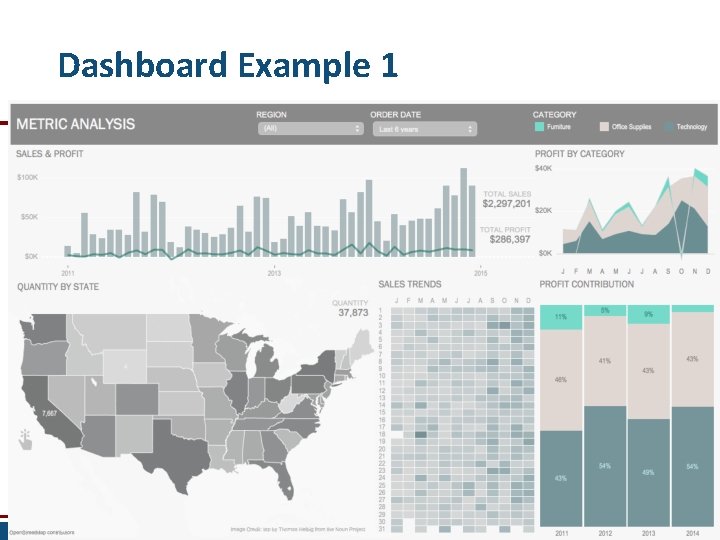
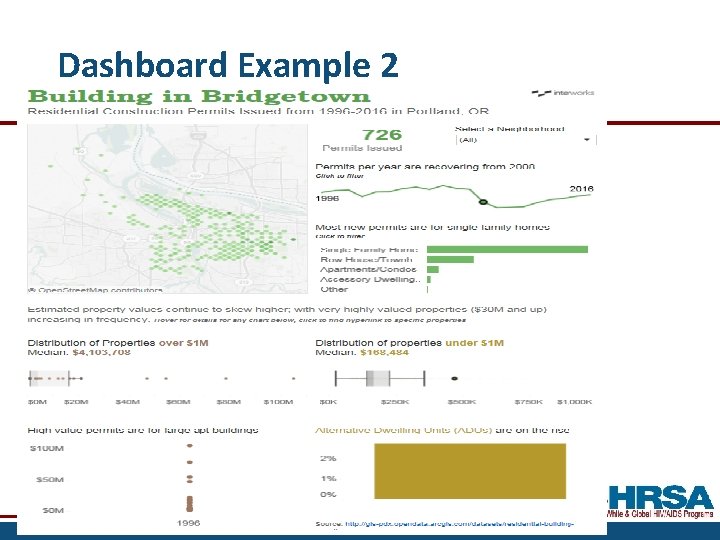
Our Need – A dashboard sounds good! § A data dashboard from HRSA would be useful if it could answer the following questions: §How are we doing as a clinic? As a provider? §What is our/my suppression rates? How do we/I compare to other institutions with similar demographics? §Are there specific groups that are struggling? Risk factor group, racial group, etc. §What are my patients’ vaccination rates? 42
Thank you! Carlos Salama, M. D. salamac@nychhc. org 718 -334 -2283 43
Mercy Health Saint Mary’s Data To Care C. Ryan Tomlin, Pharm. D. , BCPS, AAHIVP Ryan White HIV/AIDS Program Parts B, C, D Grand Rapids, Michigan
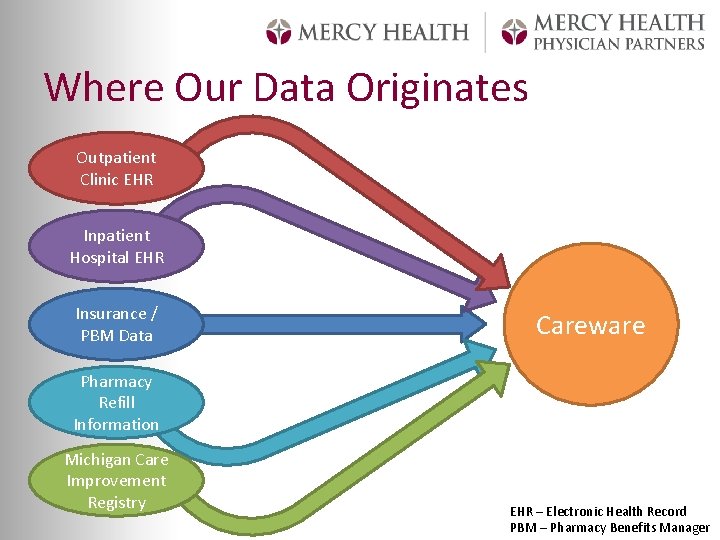
Where Our Data Originates Outpatient Clinic EHR Inpatient Hospital EHR Insurance / PBM Data Careware Pharmacy Refill Information Michigan Care Improvement Registry EHR – Electronic Health Record PBM – Pharmacy Benefits Manager
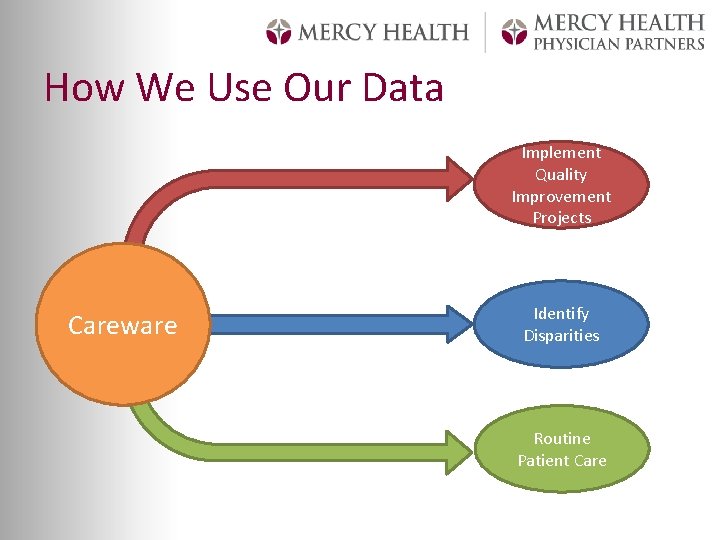
How We Use Our Data Implement Quality Improvement Projects Careware Identify Disparities Routine Patient Care
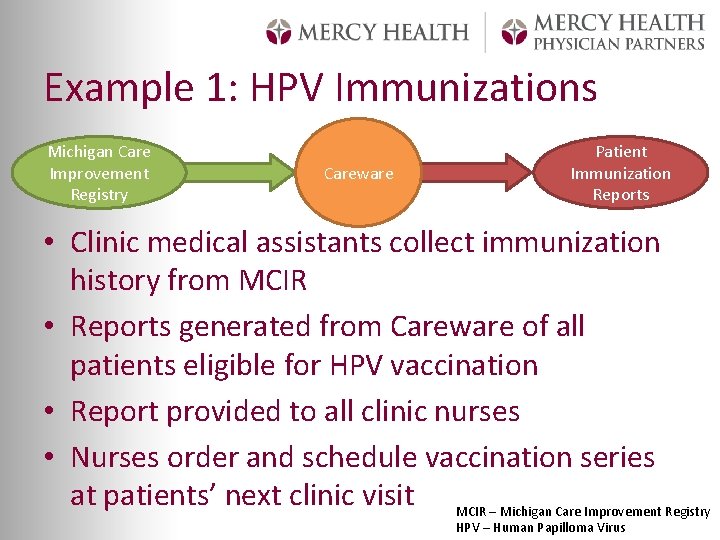
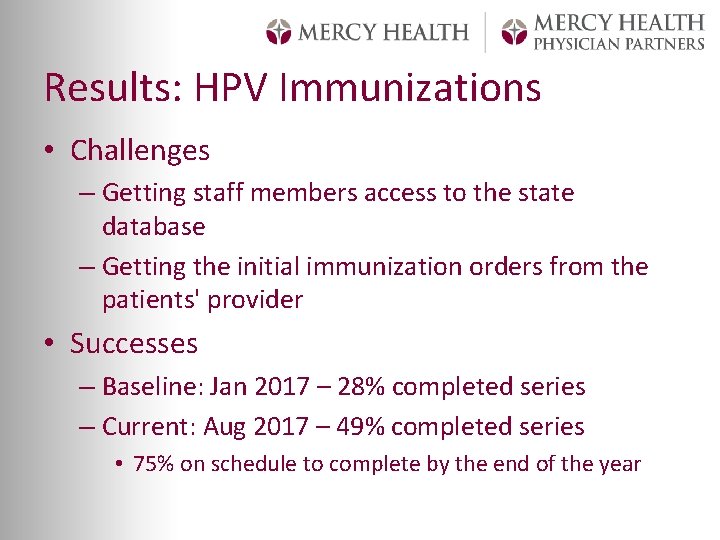
Example 1: HPV Immunizations Michigan Care Improvement Registry Careware Patient Immunization Reports • Clinic medical assistants collect immunization history from MCIR • Reports generated from Careware of all patients eligible for HPV vaccination • Report provided to all clinic nurses • Nurses order and schedule vaccination series at patients’ next clinic visit MCIR – Michigan Care Improvement Registry HPV – Human Papilloma Virus
Results: HPV Immunizations • Challenges – Getting staff members access to the state database – Getting the initial immunization orders from the patients' provider • Successes – Baseline: Jan 2017 – 28% completed series – Current: Aug 2017 – 49% completed series • 75% on schedule to complete by the end of the year
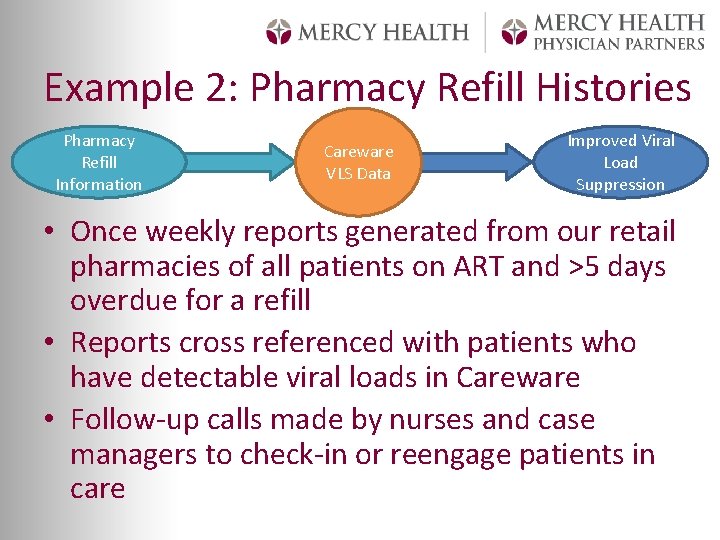
Example 2: Pharmacy Refill Histories Pharmacy Refill Information Careware VLS Data Improved Viral Load Suppression • Once weekly reports generated from our retail pharmacies of all patients on ART and >5 days overdue for a refill • Reports cross referenced with patients who have detectable viral loads in Careware • Follow-up calls made by nurses and case managers to check-in or reengage patients in care
Challenges: Pharmacy Refill Histories • Reports less accurate in patients who recently changed antiretroviral medications • Not every patient uses our health system’s retail pharmacies – Some refill info gained from PBM claims data – Manual calls made to pharmacies as needed for patients with detectable viral loads • Some gaps in refills are for legitimate reasons (example: short inpatient stay)
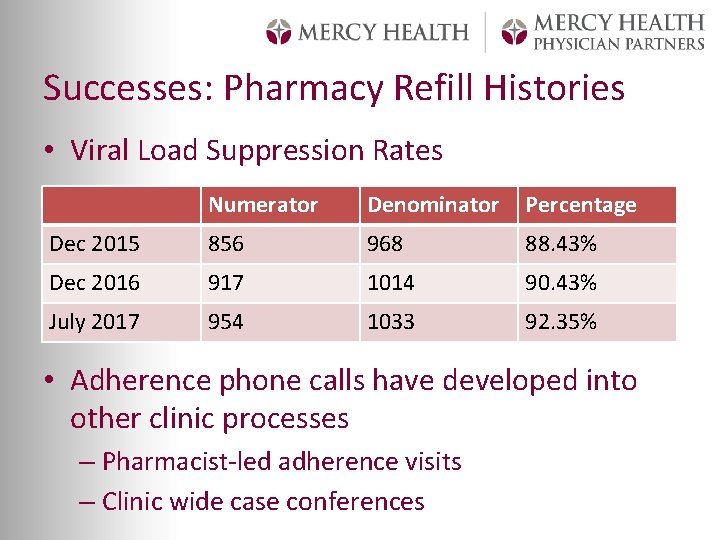
Successes: Pharmacy Refill Histories • Viral Load Suppression Rates Numerator Denominator Percentage Dec 2015 856 968 88. 43% Dec 2016 917 1014 90. 43% July 2017 954 1033 92. 35% • Adherence phone calls have developed into other clinic processes – Pharmacist-led adherence visits – Clinic wide case conferences
Thank you! C. Ryan Tomlin, Pharm. D. , BCPS, AAHIVP Charles. Tomlin@mercyhealth. com
Using Data to Inform Decisions & Drive Performance Pam Sylakowski Director Nashville TGA Ryan White HIV/AIDS Program Part A
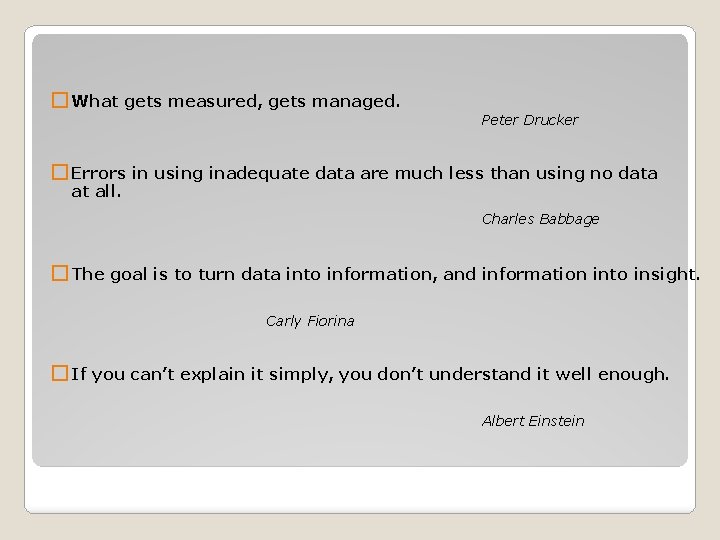
�What gets measured, gets managed. Peter Drucker �Errors in using inadequate data are much less than using no data at all. Charles Babbage �The goal is to turn data into information, and information into insight. Carly Fiorina �If you can’t explain it simply, you don’t understand it well enough. Albert Einstein
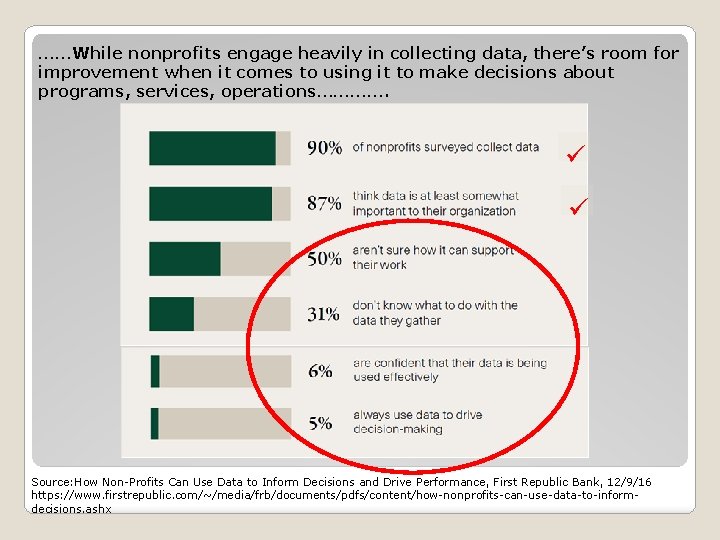
……While nonprofits engage heavily in collecting data, there’s room for improvement when it comes to using it to make decisions about programs, services, operations…………. Source: How Non-Profits Can Use Data to Inform Decisions and Drive Performance, First Republic Bank, 12/9/16 https: //www. firstrepublic. com/~/media/frb/documents/pdfs/content/how-nonprofits-can-use-data-to-informdecisions. ashx
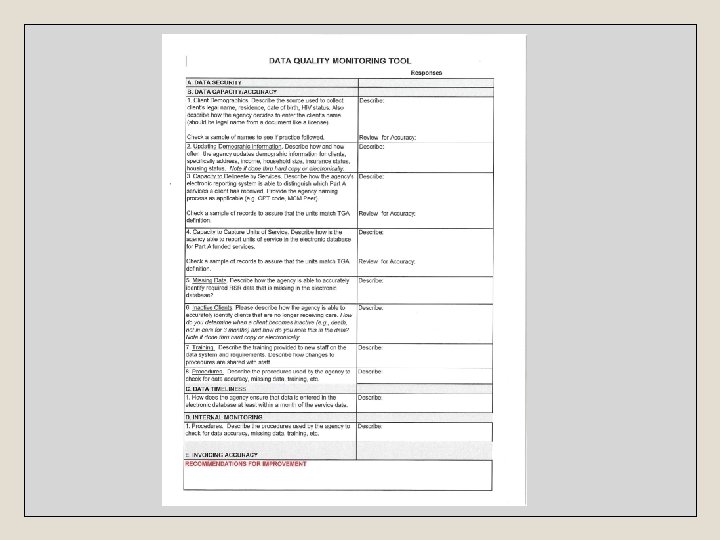
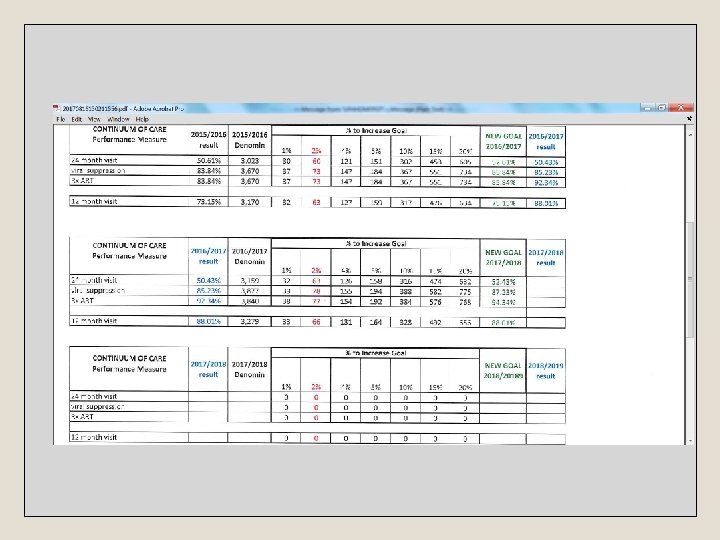
SUCCESSES As a local health department having direct access to e. HARS o Timely o Report Continuum of Care/Cascade measures (CDC as well as HRSA) o Quality check on viral load lab data between CAREWare & e. HARS Collaboration with TN Medicaid o Indirect access to information we do not have (e. g. , other health conditions persons with HIV disease have, information on retention to care and ART Rx for Medicaid enrollees) o State health department working with Medicaid to import viral load data into Medicaid data base o Episodes to Care Project – influence beyond Ryan White program, including private insurance https: //www. tn. gov/tenncare/topic/episodes -of-care Implemented “data monitoring” process to improve data quality o Developed a monitoring tool with key data quality items (how client names are entered, service naming, timeliness of entry) o Creates a formal conversation for importance of data quality & helps identify provider needs related to data collection (large & small providers)
CHALLENGES Create reports that are simple, usable & meaningful for the Recipient staff, Planning Council, providers, stakeholders, public o Use for decision making & to drive action Obtain more client level social indicator data (e. g. , employment) o Use to end the epidemic Strengthen QI activities o Use to respond to changing needs & issues and drive improvement Improve mechanisms for setting new local targets, with a focus on DOCUMENTING DISPARITIES and measuring change over time. o Use to monitor and drive improvement
�Numbers have an important story to tell. They rely on you to give them a clear and convincing voice. Stephen Few �Things get done only if the data we gather can inform and inspire those in a position to make [a] difference. Mike Schmoker �Patients are empowered by having access to their own health information, and then by owning their own data. Elizabeth Holmes
Interactive Session: How do you use your data? HIV/AIDS Bureau Health Resources and Services Administration
Concept To provide HAB Project Officers and Grant Recipients with a userfriendly interactive data tool What can data dashboards help recipients and POs to do? • Data quality • Review data quality • Identify and address issues with data quality • Using data to improve care and treatment services • Identify gaps in care in the jurisdiction • Identify disparities • Data-driven decision-making for policies and programs
Dashboard Example 1
Dashboard Example 2
Feedback Session: Key Questions • How do you use data in your work? What data elements are most useful? • What do you feel you need to make data more accessible and easier to use in your setting? • How, if at all, does the format affect the level of comfort you have with using the data? • In what ways would you like to be able to manipulate data to better meet your needs? • What kinds of support can be provided to you in terms of data utilization?