Chapter 15 Wave Motion Copyright 2009 Pearson Education

- Slides: 68
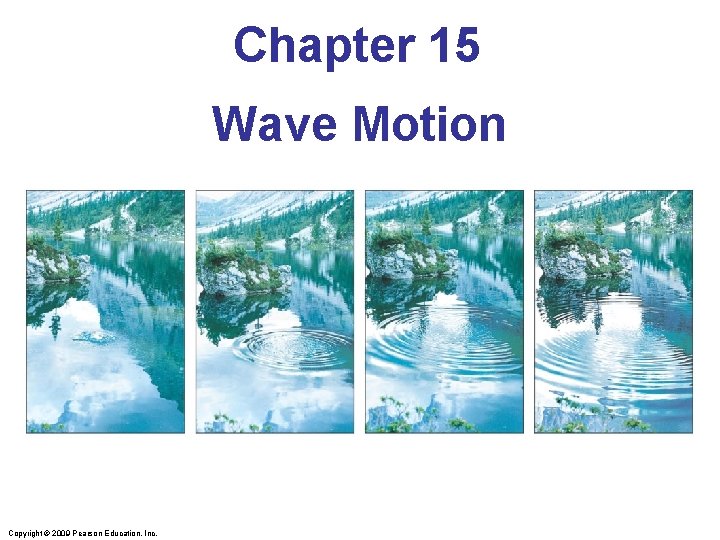
Chapter 15 Wave Motion Copyright © 2009 Pearson Education, Inc.
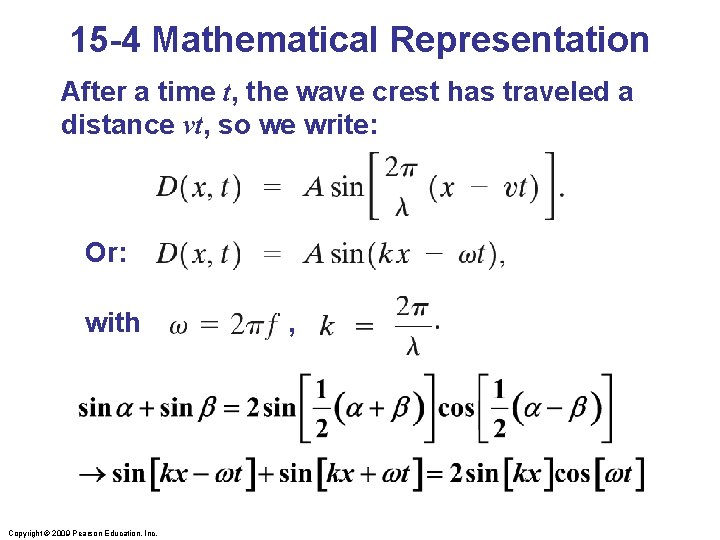
15 -4 Mathematical Representation After a time t, the wave crest has traveled a distance vt, so we write: Or: with Copyright © 2009 Pearson Education, Inc. ,
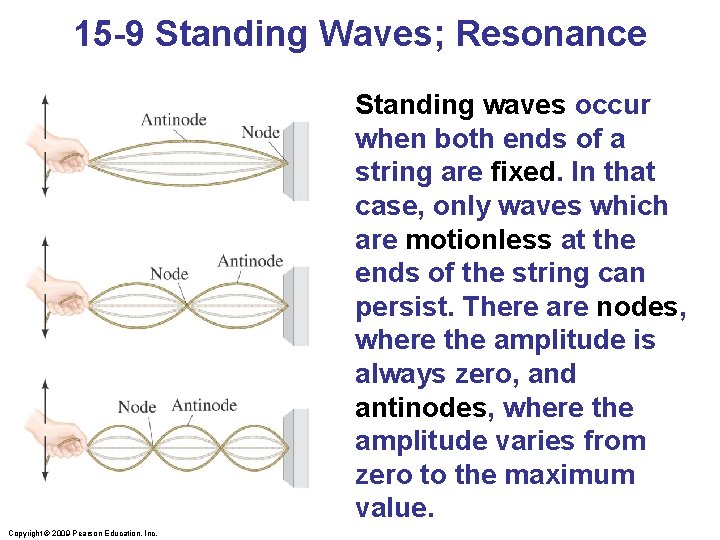
15 -9 Standing Waves; Resonance Standing waves occur when both ends of a string are fixed. In that case, only waves which are motionless at the ends of the string can persist. There are nodes, where the amplitude is always zero, and antinodes, where the amplitude varies from zero to the maximum value. Copyright © 2009 Pearson Education, Inc.
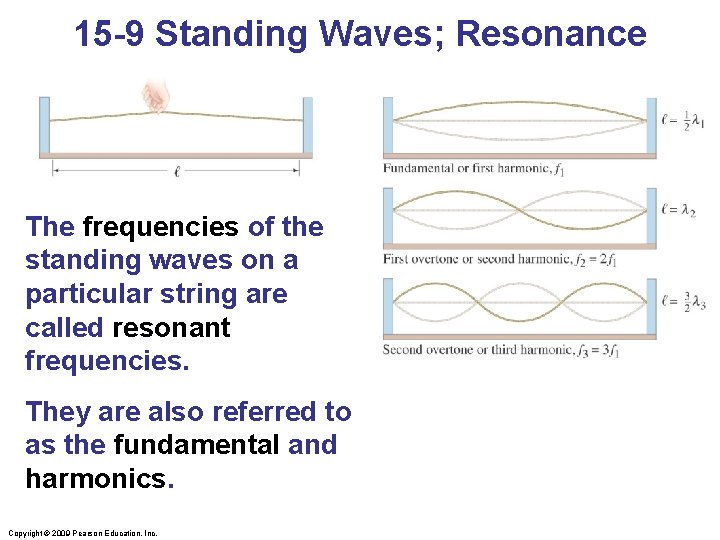
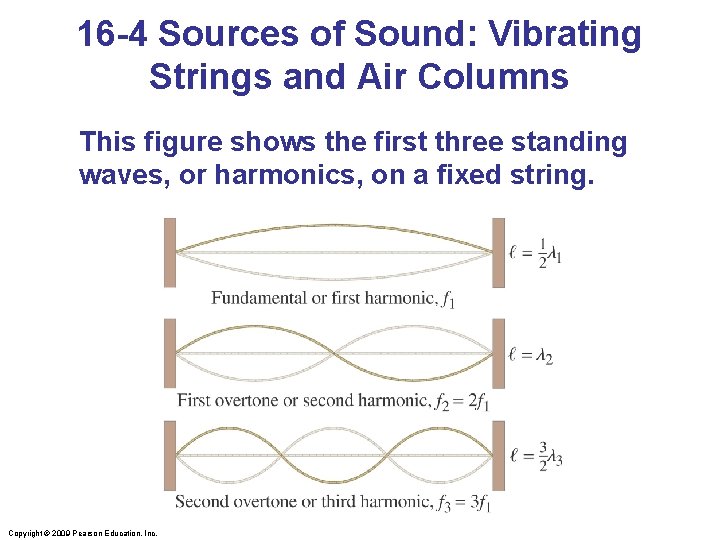
15 -9 Standing Waves; Resonance The frequencies of the standing waves on a particular string are called resonant frequencies. They are also referred to as the fundamental and harmonics. Copyright © 2009 Pearson Education, Inc.
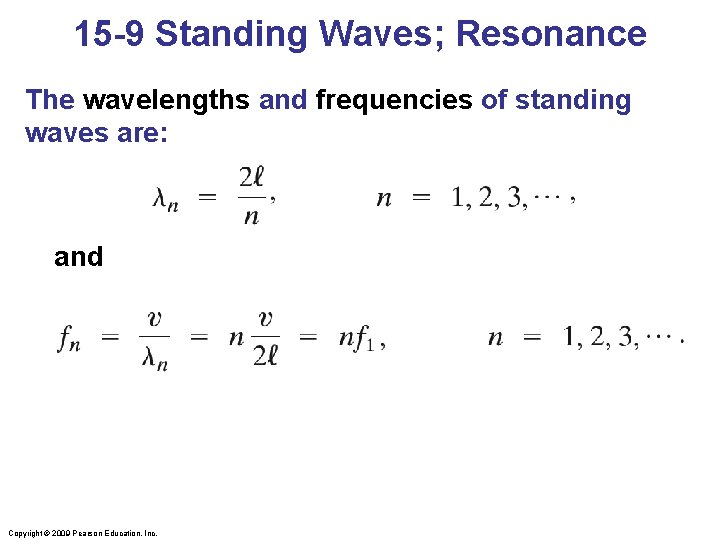
15 -9 Standing Waves; Resonance The wavelengths and frequencies of standing waves are: and Copyright © 2009 Pearson Education, Inc.
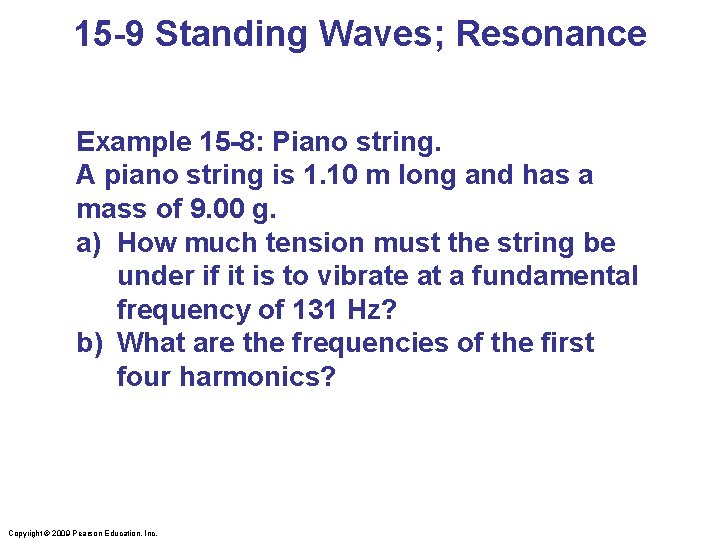
15 -9 Standing Waves; Resonance Example 15 -8: Piano string. A piano string is 1. 10 m long and has a mass of 9. 00 g. a) How much tension must the string be under if it is to vibrate at a fundamental frequency of 131 Hz? b) What are the frequencies of the first four harmonics? Copyright © 2009 Pearson Education, Inc.
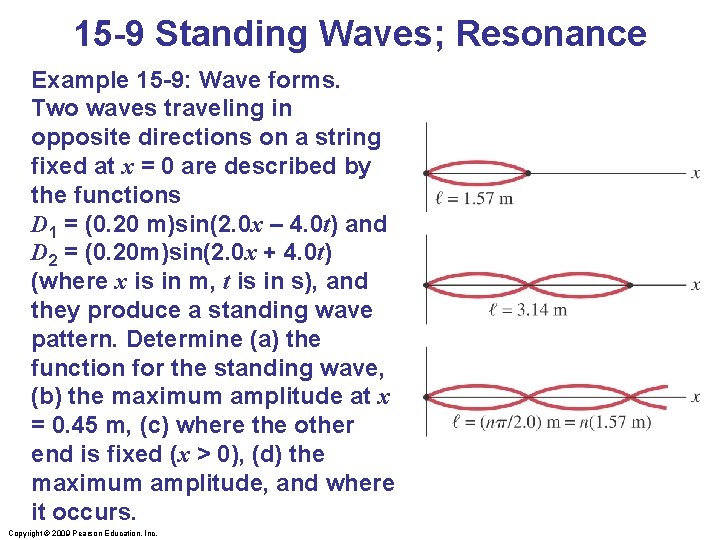
15 -9 Standing Waves; Resonance Example 15 -9: Wave forms. Two waves traveling in opposite directions on a string fixed at x = 0 are described by the functions D 1 = (0. 20 m)sin(2. 0 x – 4. 0 t) and D 2 = (0. 20 m)sin(2. 0 x + 4. 0 t) (where x is in m, t is in s), and they produce a standing wave pattern. Determine (a) the function for the standing wave, (b) the maximum amplitude at x = 0. 45 m, (c) where the other end is fixed (x > 0), (d) the maximum amplitude, and where it occurs. Copyright © 2009 Pearson Education, Inc.
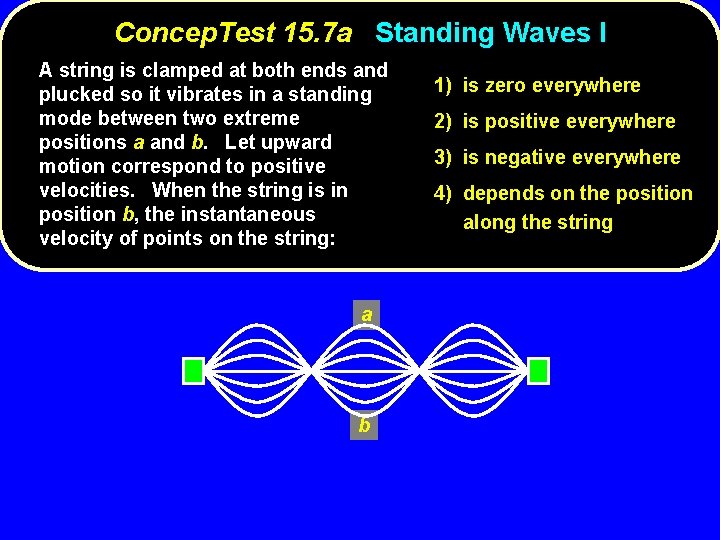
Concep. Test 15. 7 a Standing Waves I A string is clamped at both ends and plucked so it vibrates in a standing mode between two extreme positions a and b. Let upward motion correspond to positive velocities. When the string is in position b, the instantaneous velocity of points on the string: a b 1) is zero everywhere 2) is positive everywhere 3) is negative everywhere 4) depends on the position along the string
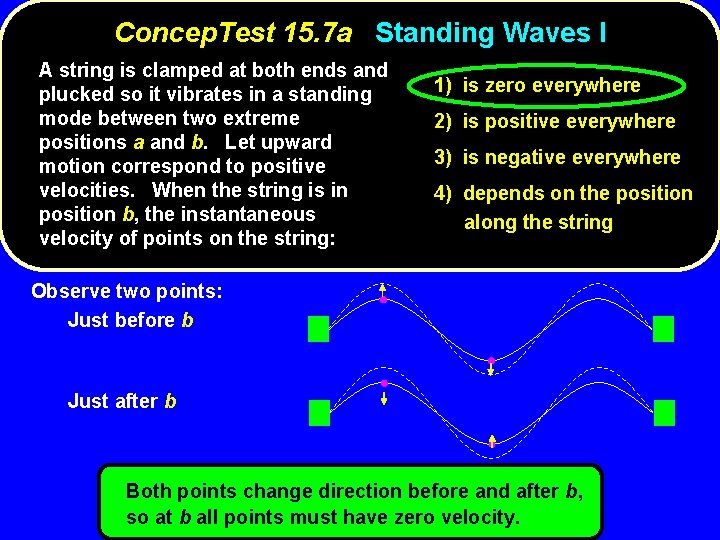
Concep. Test 15. 7 a Standing Waves I A string is clamped at both ends and plucked so it vibrates in a standing mode between two extreme positions a and b. Let upward motion correspond to positive velocities. When the string is in position b, the instantaneous velocity of points on the string: 1) is zero everywhere 2) is positive everywhere 3) is negative everywhere 4) depends on the position along the string Observe two points: Just before b Just after b Both points change direction before and after b, so at b all points must have zero velocity.
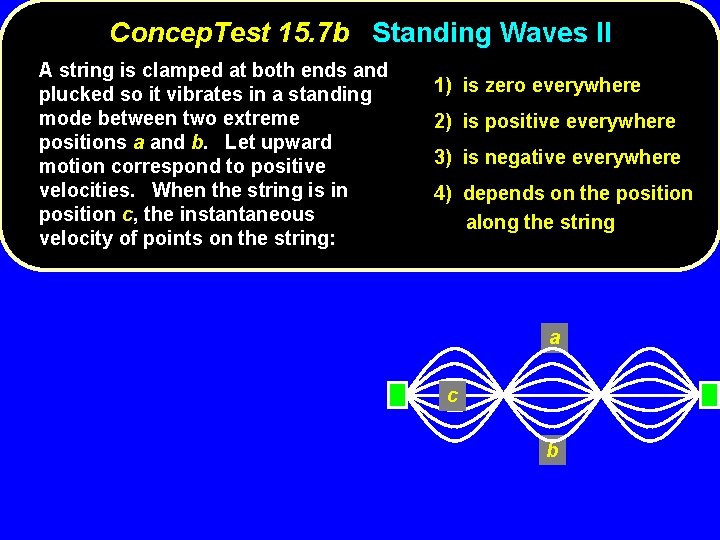
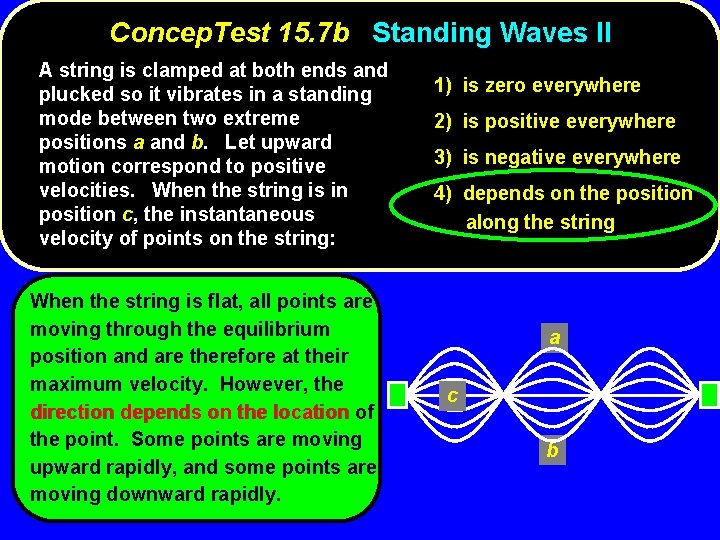
Concep. Test 15. 7 b Standing Waves II A string is clamped at both ends and plucked so it vibrates in a standing mode between two extreme positions a and b. Let upward motion correspond to positive velocities. When the string is in position c, the instantaneous velocity of points on the string: 1) is zero everywhere 2) is positive everywhere 3) is negative everywhere 4) depends on the position along the string a c b
Concep. Test 15. 7 b Standing Waves II A string is clamped at both ends and plucked so it vibrates in a standing mode between two extreme positions a and b. Let upward motion correspond to positive velocities. When the string is in position c, the instantaneous velocity of points on the string: When the string is flat, all points are moving through the equilibrium position and are therefore at their maximum velocity. However, the direction depends on the location of the point. Some points are moving upward rapidly, and some points are moving downward rapidly. 1) is zero everywhere 2) is positive everywhere 3) is negative everywhere 4) depends on the position along the string a c b
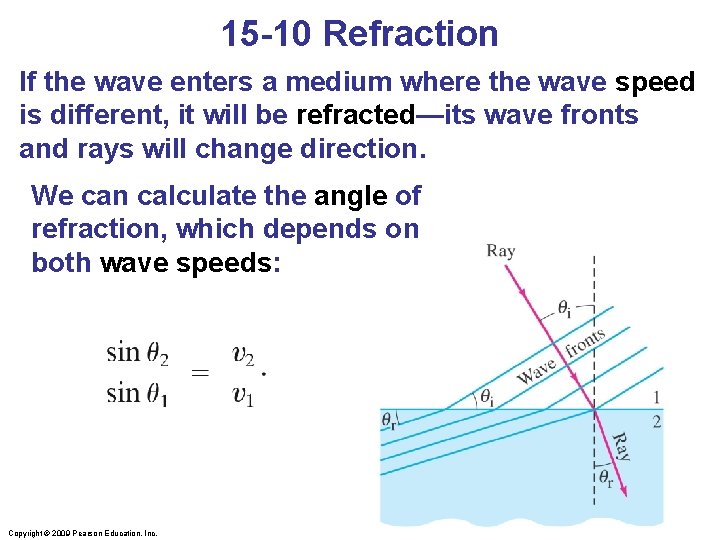
15 -10 Refraction If the wave enters a medium where the wave speed is different, it will be refracted—its wave fronts and rays will change direction. We can calculate the angle of refraction, which depends on both wave speeds: Copyright © 2009 Pearson Education, Inc.
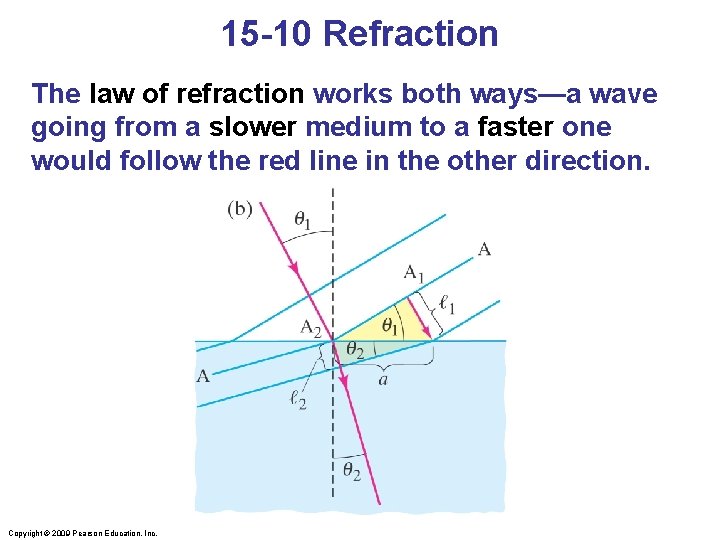
15 -10 Refraction The law of refraction works both ways—a wave going from a slower medium to a faster one would follow the red line in the other direction. Copyright © 2009 Pearson Education, Inc.
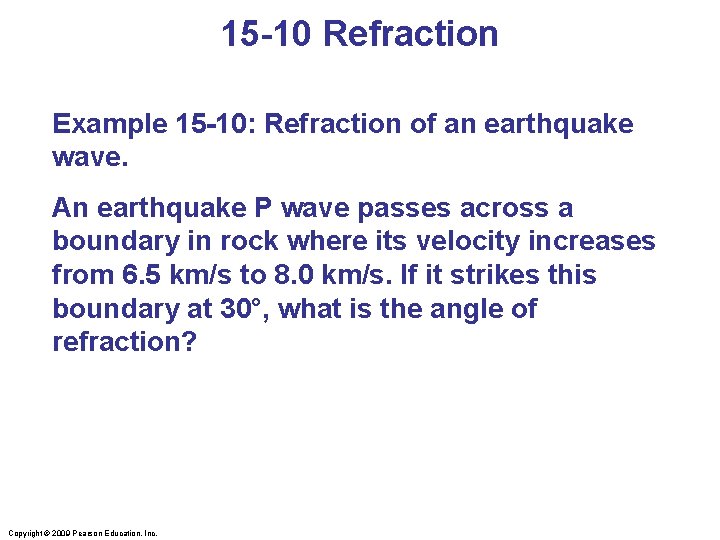
15 -10 Refraction Example 15 -10: Refraction of an earthquake wave. An earthquake P wave passes across a boundary in rock where its velocity increases from 6. 5 km/s to 8. 0 km/s. If it strikes this boundary at 30°, what is the angle of refraction? Copyright © 2009 Pearson Education, Inc.
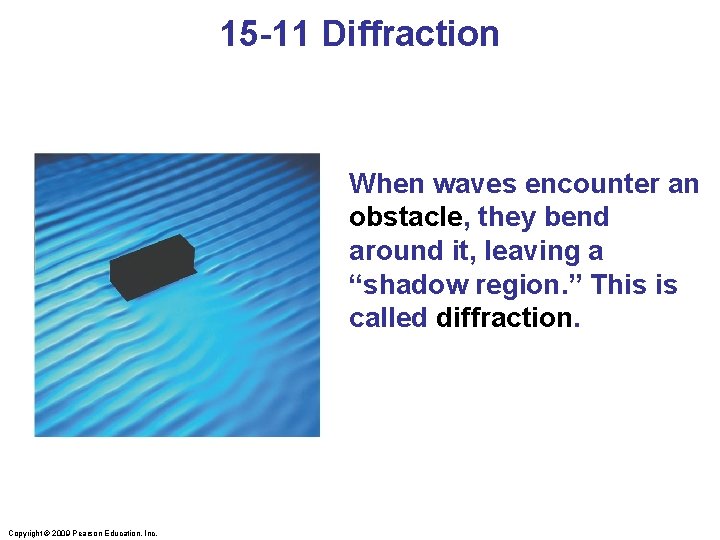
15 -11 Diffraction When waves encounter an obstacle, they bend around it, leaving a “shadow region. ” This is called diffraction. Copyright © 2009 Pearson Education, Inc.
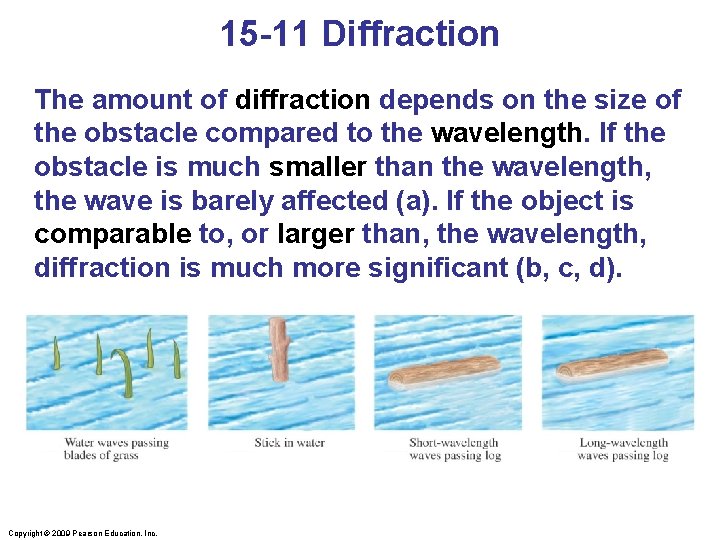
15 -11 Diffraction The amount of diffraction depends on the size of the obstacle compared to the wavelength. If the obstacle is much smaller than the wavelength, the wave is barely affected (a). If the object is comparable to, or larger than, the wavelength, diffraction is much more significant (b, c, d). Copyright © 2009 Pearson Education, Inc.
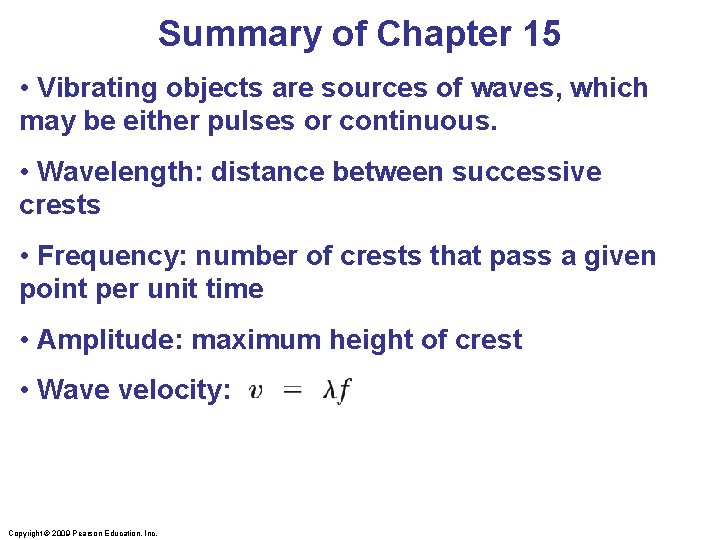
Summary of Chapter 15 • Vibrating objects are sources of waves, which may be either pulses or continuous. • Wavelength: distance between successive crests • Frequency: number of crests that pass a given point per unit time • Amplitude: maximum height of crest • Wave velocity: Copyright © 2009 Pearson Education, Inc.
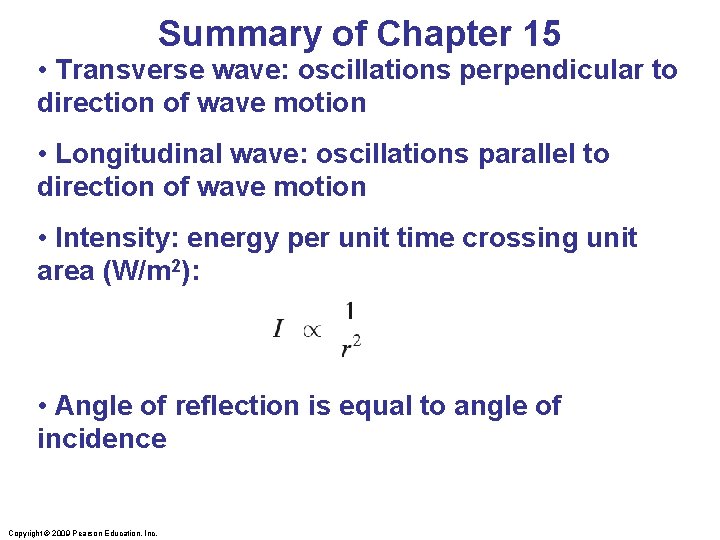
Summary of Chapter 15 • Transverse wave: oscillations perpendicular to direction of wave motion • Longitudinal wave: oscillations parallel to direction of wave motion • Intensity: energy per unit time crossing unit area (W/m 2): • Angle of reflection is equal to angle of incidence Copyright © 2009 Pearson Education, Inc.
Summary of Chapter 15 • When two waves pass through the same region of space, they interfere. Interference may be either constructive or destructive. • Standing waves can be produced on a string with both ends fixed. The waves that persist are at the resonant frequencies. • Nodes occur where there is no motion; antinodes where the amplitude is maximum. • Waves refract when entering a medium of different wave speed, and diffract around obstacles. Copyright © 2009 Pearson Education, Inc.
Chapter 16 Sound Copyright © 2009 Pearson Education, Inc.
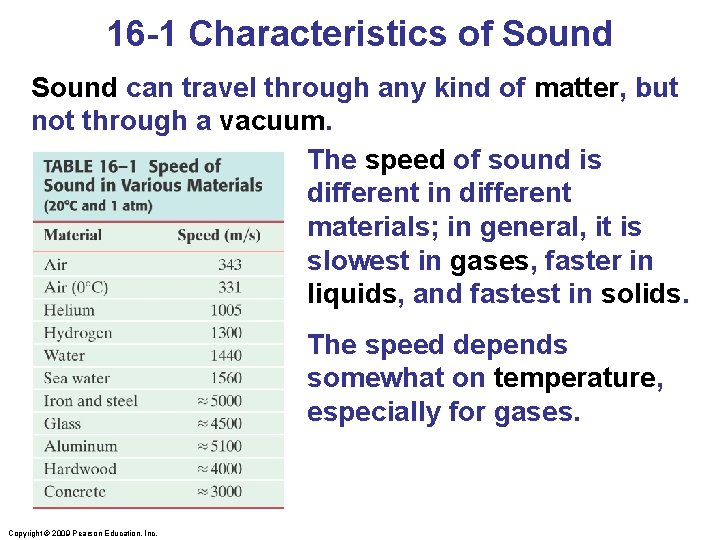
16 -1 Characteristics of Sound can travel through any kind of matter, but not through a vacuum. The speed of sound is different in different materials; in general, it is slowest in gases, faster in liquids, and fastest in solids. The speed depends somewhat on temperature, especially for gases. Copyright © 2009 Pearson Education, Inc.
16 -1 Characteristics of Sound Conceptual Example 16 -1: Distance from a lightning strike. A rule of thumb that tells how close lightning has struck is, “one mile for every five seconds before thunder is heard. ” Explain why this works, noting that the speed of light is so high (3 x 10⁸ m/s, almost a million times faster than sound) that the time for light to travel to us is negligible compared to the time for the sound. Copyright © 2009 Pearson Education, Inc.
16 -1 Characteristics of Sound Loudness: related to intensity of the sound wave Pitch: related to frequency Audible range: about 20 Hz to 20, 000 Hz; upper limit decreases with age Ultrasound: above 20, 000 Hz; see ultrasonic camera focusing in following example Infrasound: below 20 Hz Copyright © 2009 Pearson Education, Inc.
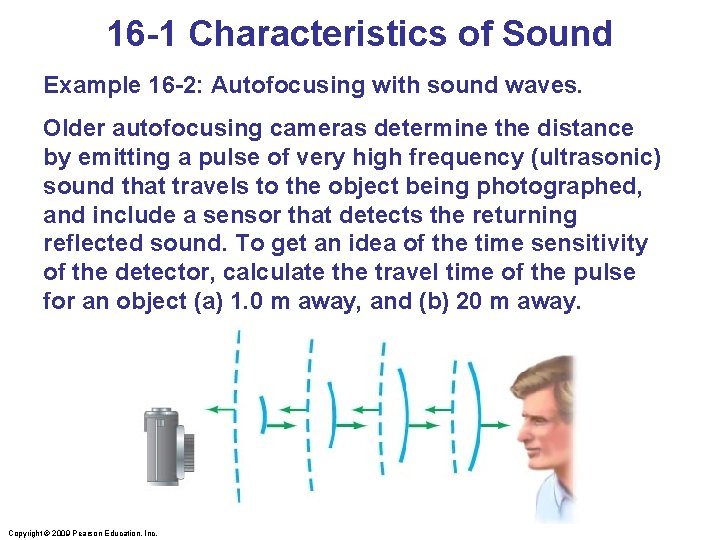
16 -1 Characteristics of Sound Example 16 -2: Autofocusing with sound waves. Older autofocusing cameras determine the distance by emitting a pulse of very high frequency (ultrasonic) sound that travels to the object being photographed, and include a sensor that detects the returning reflected sound. To get an idea of the time sensitivity of the detector, calculate the travel time of the pulse for an object (a) 1. 0 m away, and (b) 20 m away. Copyright © 2009 Pearson Education, Inc.
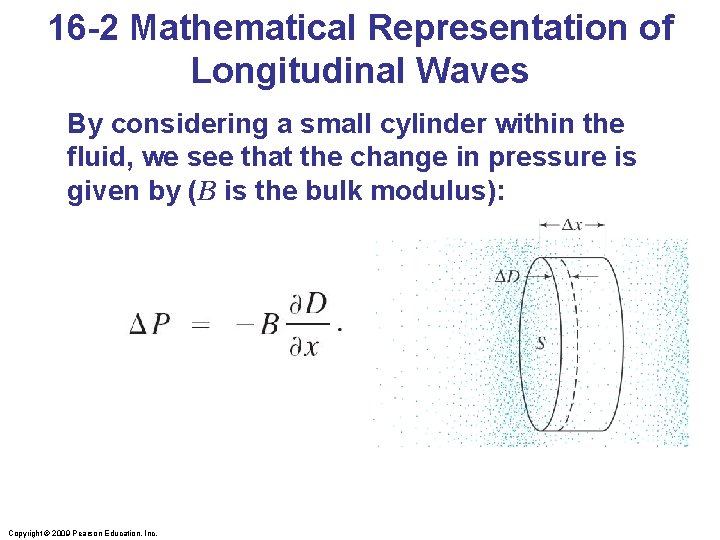
16 -2 Mathematical Representation of Longitudinal Waves By considering a small cylinder within the fluid, we see that the change in pressure is given by (B is the bulk modulus): Copyright © 2009 Pearson Education, Inc.
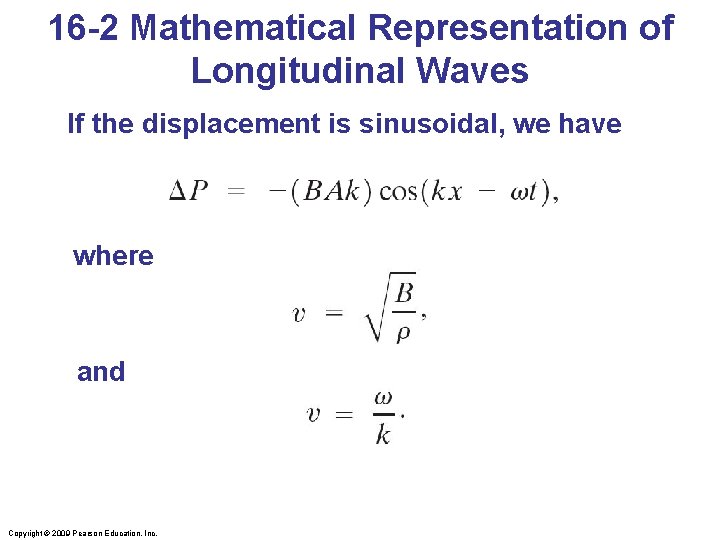
16 -2 Mathematical Representation of Longitudinal Waves If the displacement is sinusoidal, we have where and Copyright © 2009 Pearson Education, Inc.
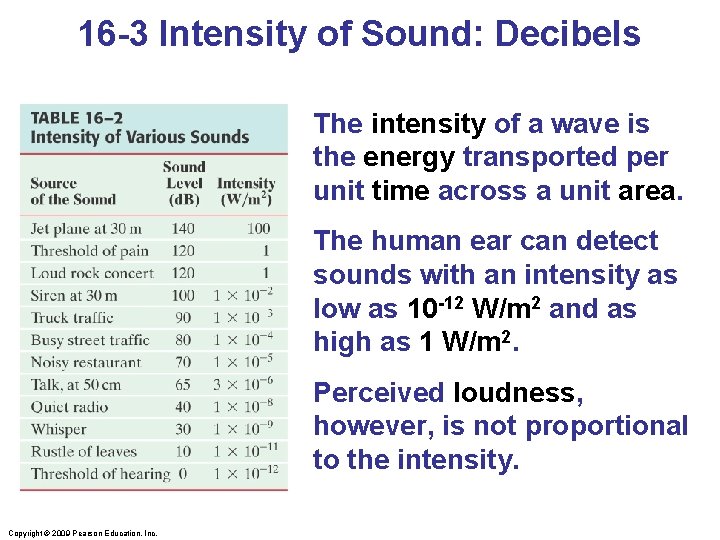
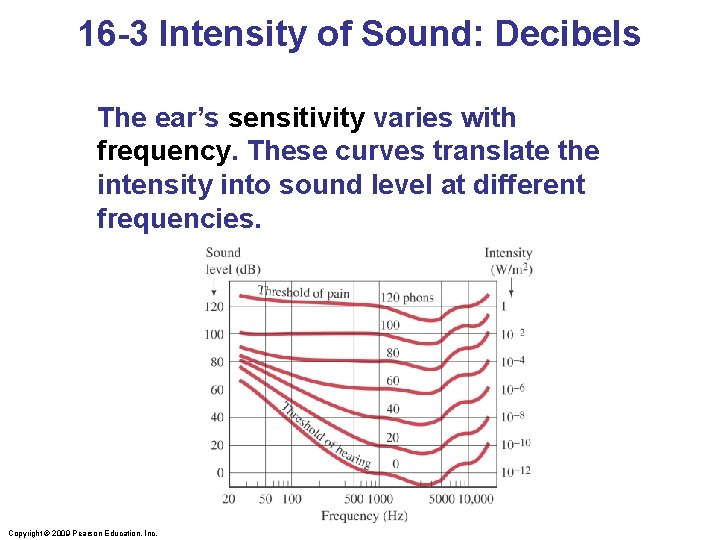
16 -3 Intensity of Sound: Decibels The intensity of a wave is the energy transported per unit time across a unit area. The human ear can detect sounds with an intensity as low as 10 -12 W/m 2 and as high as 1 W/m 2. Perceived loudness, however, is not proportional to the intensity. Copyright © 2009 Pearson Education, Inc.
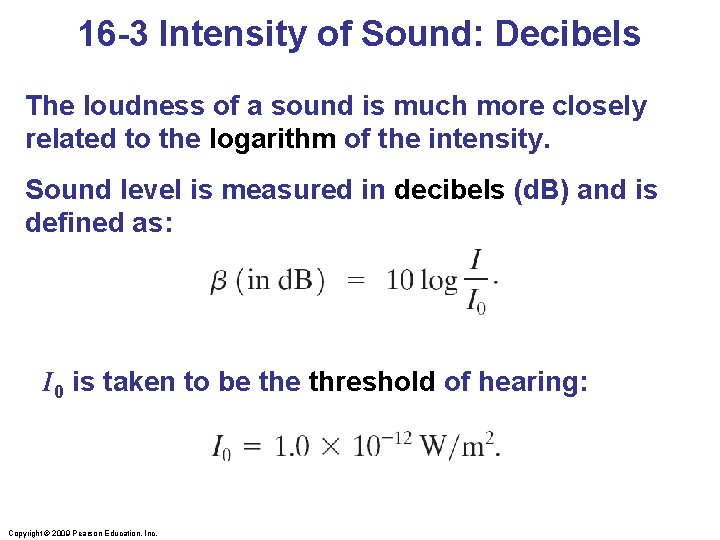
16 -3 Intensity of Sound: Decibels The loudness of a sound is much more closely related to the logarithm of the intensity. Sound level is measured in decibels (d. B) and is defined as: I 0 is taken to be threshold of hearing: Copyright © 2009 Pearson Education, Inc.
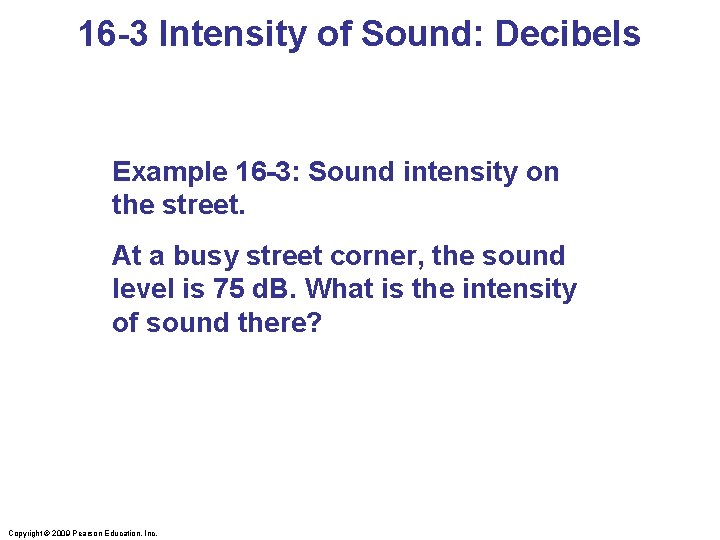
16 -3 Intensity of Sound: Decibels Example 16 -3: Sound intensity on the street. At a busy street corner, the sound level is 75 d. B. What is the intensity of sound there? Copyright © 2009 Pearson Education, Inc.
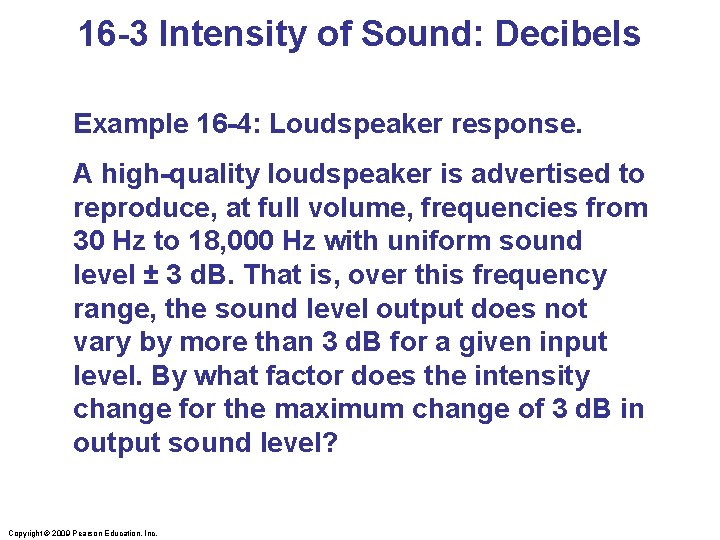
16 -3 Intensity of Sound: Decibels Example 16 -4: Loudspeaker response. A high-quality loudspeaker is advertised to reproduce, at full volume, frequencies from 30 Hz to 18, 000 Hz with uniform sound level ± 3 d. B. That is, over this frequency range, the sound level output does not vary by more than 3 d. B for a given input level. By what factor does the intensity change for the maximum change of 3 d. B in output sound level? Copyright © 2009 Pearson Education, Inc.
16 -3 Intensity of Sound: Decibels Conceptual Example 16 -5: Trumpet players. A trumpeter plays at a sound level of 75 d. B. Three equally loud trumpet players join in. What is the new sound level? Copyright © 2009 Pearson Education, Inc.
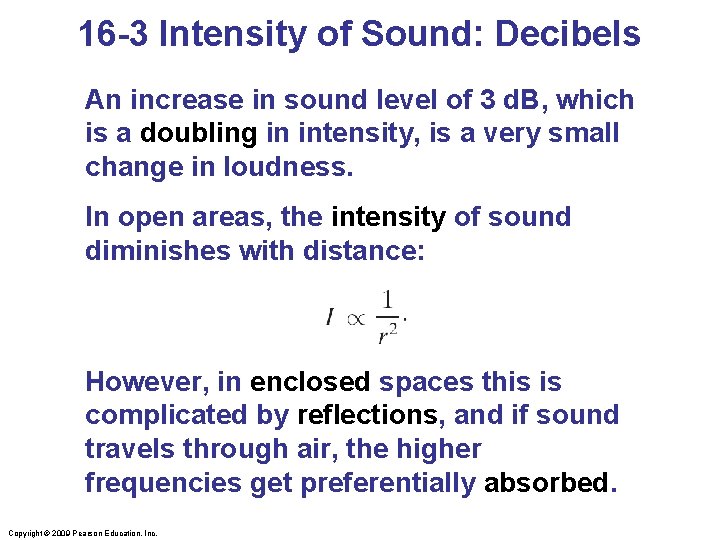
16 -3 Intensity of Sound: Decibels An increase in sound level of 3 d. B, which is a doubling in intensity, is a very small change in loudness. In open areas, the intensity of sound diminishes with distance: However, in enclosed spaces this is complicated by reflections, and if sound travels through air, the higher frequencies get preferentially absorbed. Copyright © 2009 Pearson Education, Inc.
16 -3 Intensity of Sound: Decibels Example 16 -7: How tiny the displacement is. (a) Calculate the displacement of air molecules for a sound having a frequency of 1000 Hz at the threshold of hearing. (b) Determine the maximum pressure variation in such a sound wave. Copyright © 2009 Pearson Education, Inc.
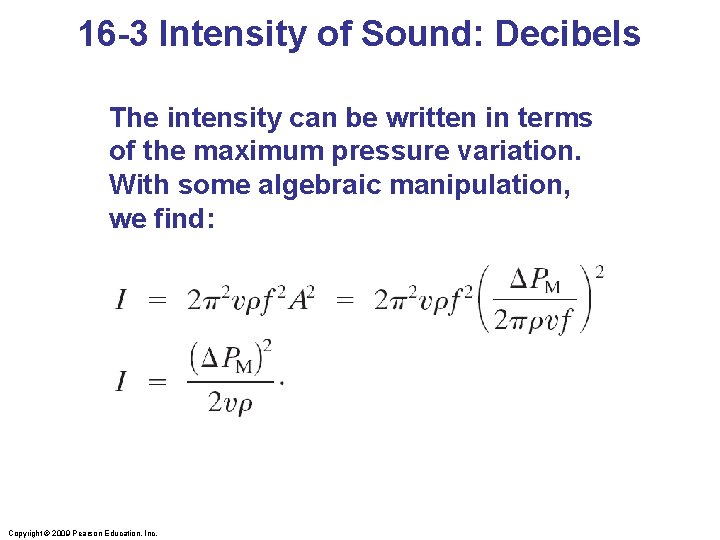
16 -3 Intensity of Sound: Decibels The intensity can be written in terms of the maximum pressure variation. With some algebraic manipulation, we find: Copyright © 2009 Pearson Education, Inc.
16 -3 Intensity of Sound: Decibels The ear’s sensitivity varies with frequency. These curves translate the intensity into sound level at different frequencies. Copyright © 2009 Pearson Education, Inc.
16 -4 Sources of Sound: Vibrating Strings and Air Columns Musical instruments produce sounds in various ways—vibrating strings, vibrating membranes, vibrating metal or wood shapes, vibrating air columns. The vibration may be started by plucking, striking, bowing, or blowing. The vibrations are transmitted to the air and then to our ears. Copyright © 2009 Pearson Education, Inc.
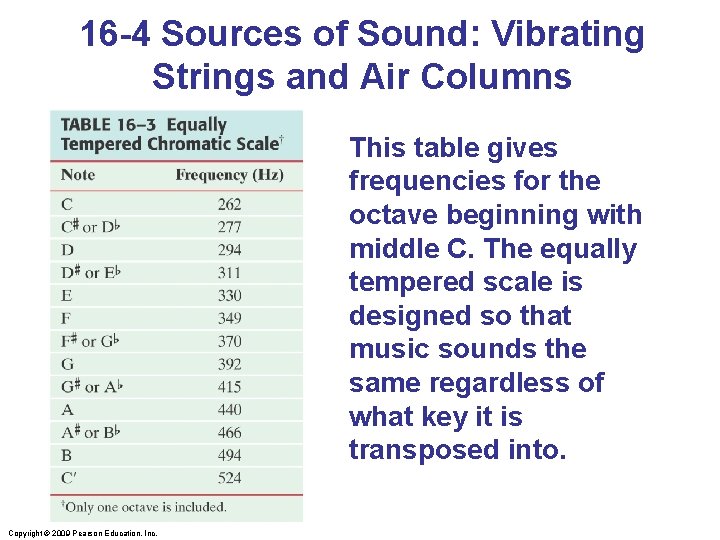
16 -4 Sources of Sound: Vibrating Strings and Air Columns This table gives frequencies for the octave beginning with middle C. The equally tempered scale is designed so that music sounds the same regardless of what key it is transposed into. Copyright © 2009 Pearson Education, Inc.
16 -4 Sources of Sound: Vibrating Strings and Air Columns This figure shows the first three standing waves, or harmonics, on a fixed string. Copyright © 2009 Pearson Education, Inc.
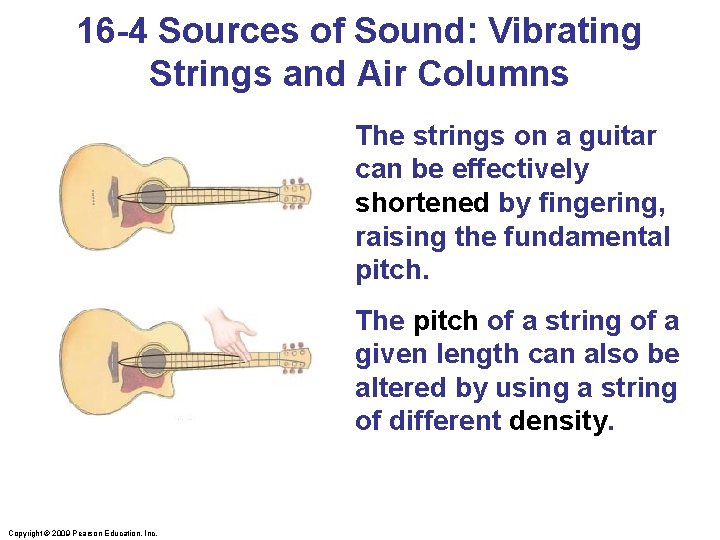
16 -4 Sources of Sound: Vibrating Strings and Air Columns The strings on a guitar can be effectively shortened by fingering, raising the fundamental pitch. The pitch of a string of a given length can also be altered by using a string of different density. Copyright © 2009 Pearson Education, Inc.
16 -4 Sources of Sound: Vibrating Strings and Air Columns Example 16 -8: Piano strings. The highest key on a piano corresponds to a frequency about 150 times that of the lowest key. If the string for the highest note is 5. 0 cm long, how long would the string for the lowest note have to be if it had the same mass per unit length and was under the same tension? Copyright © 2009 Pearson Education, Inc.
16 -4 Sources of Sound: Vibrating Strings and Air Columns Example 16 -9: Frequencies and wavelengths in the violin. A 0. 32 -m-long violin string is tuned to play A above middle C at 440 Hz. (a) What is the wavelength of the fundamental string vibration, and (b) What are the frequency and wavelength of the sound wave produced? (c) Why is there a difference? Copyright © 2009 Pearson Education, Inc.
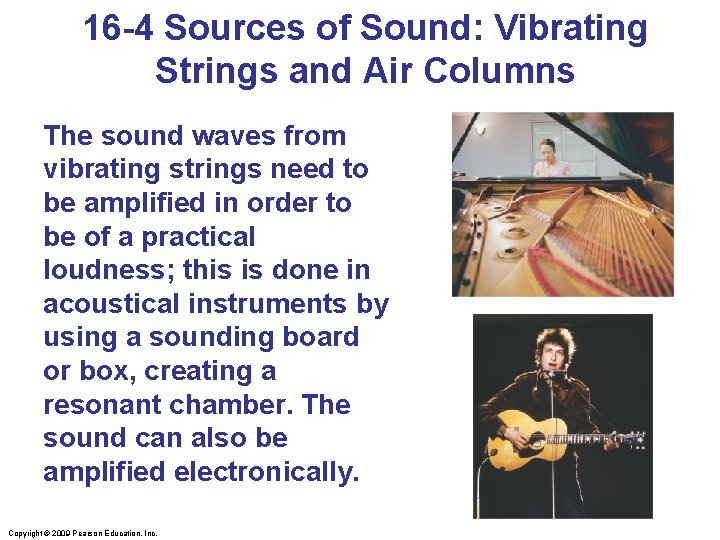
16 -4 Sources of Sound: Vibrating Strings and Air Columns The sound waves from vibrating strings need to be amplified in order to be of a practical loudness; this is done in acoustical instruments by using a sounding board or box, creating a resonant chamber. The sound can also be amplified electronically. Copyright © 2009 Pearson Education, Inc.
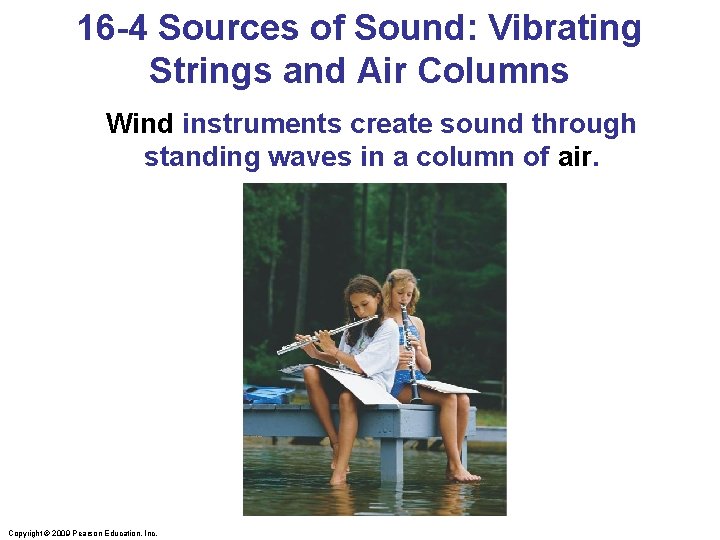
16 -4 Sources of Sound: Vibrating Strings and Air Columns Wind instruments create sound through standing waves in a column of air. Copyright © 2009 Pearson Education, Inc.
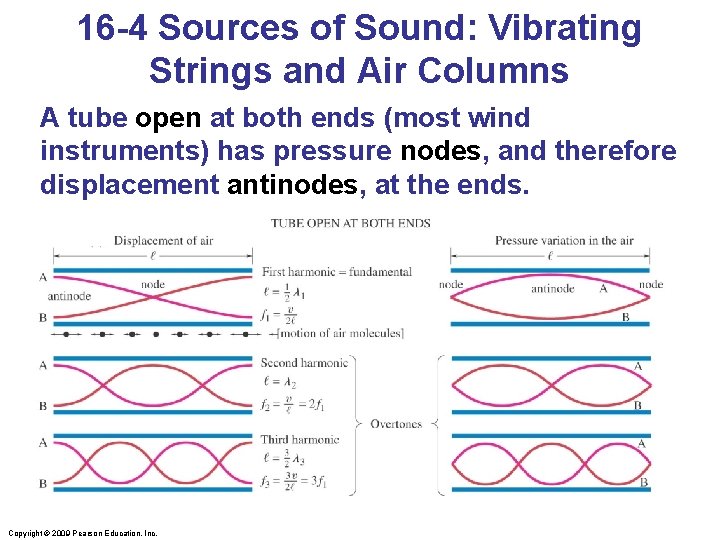
16 -4 Sources of Sound: Vibrating Strings and Air Columns A tube open at both ends (most wind instruments) has pressure nodes, and therefore displacement antinodes, at the ends. Copyright © 2009 Pearson Education, Inc.
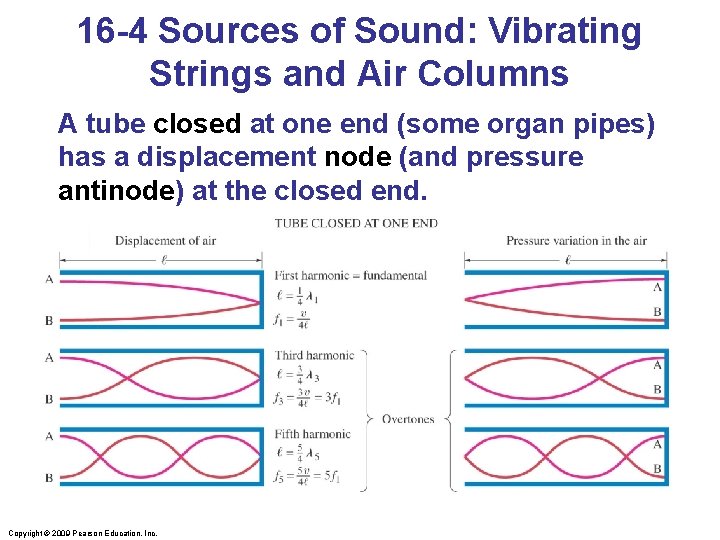
16 -4 Sources of Sound: Vibrating Strings and Air Columns A tube closed at one end (some organ pipes) has a displacement node (and pressure antinode) at the closed end. Copyright © 2009 Pearson Education, Inc.
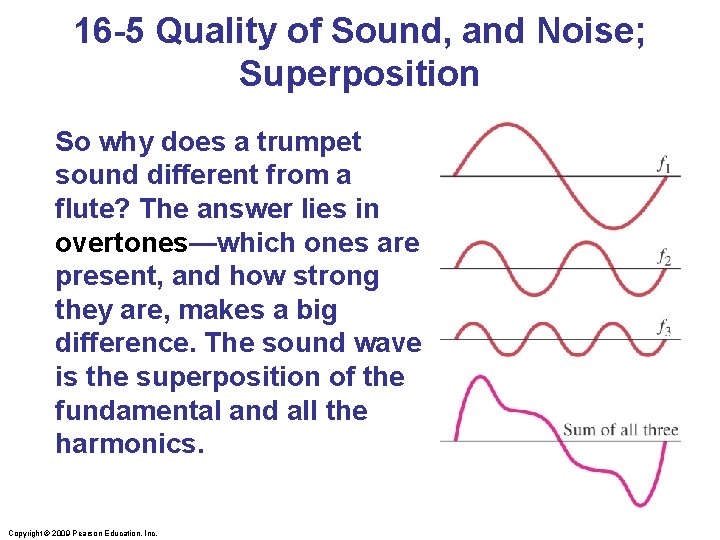
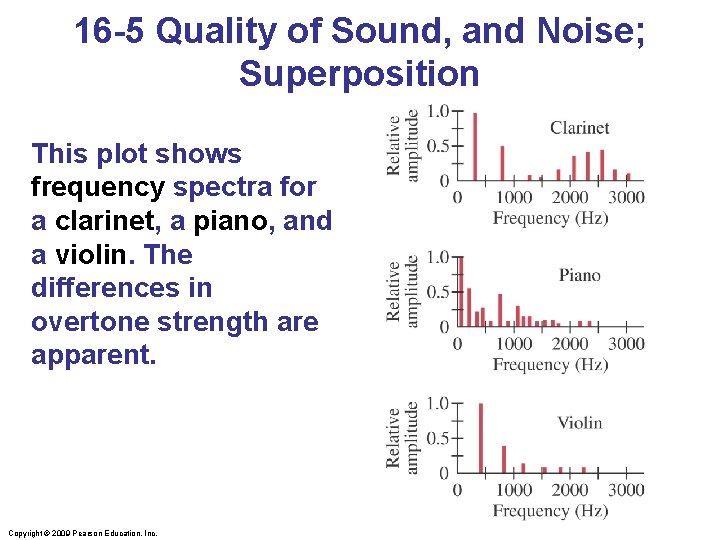
16 -5 Quality of Sound, and Noise; Superposition So why does a trumpet sound different from a flute? The answer lies in overtones—which ones are present, and how strong they are, makes a big difference. The sound wave is the superposition of the fundamental and all the harmonics. Copyright © 2009 Pearson Education, Inc.
16 -5 Quality of Sound, and Noise; Superposition This plot shows frequency spectra for a clarinet, a piano, and a violin. The differences in overtone strength are apparent. Copyright © 2009 Pearson Education, Inc.
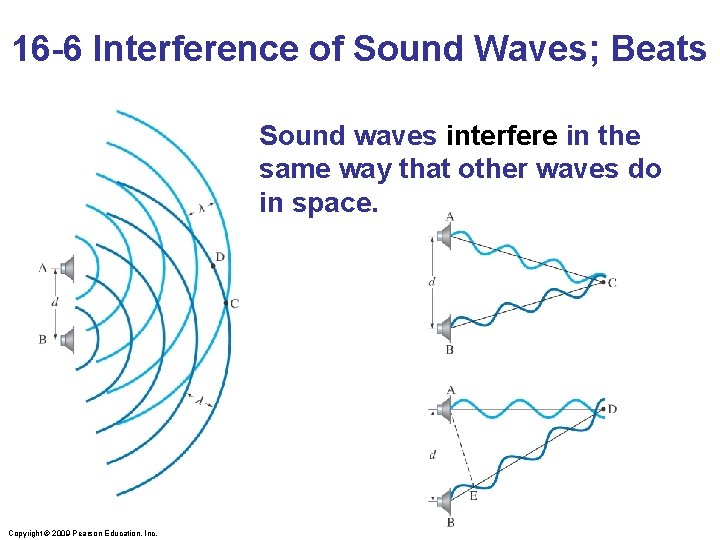
16 -6 Interference of Sound Waves; Beats Sound waves interfere in the same way that other waves do in space. Copyright © 2009 Pearson Education, Inc.
16 -6 Interference of Sound Waves; Beats Example 16 -12: Loudspeakers’ interference. Two loudspeakers are 1. 00 m apart. A person stands 4. 00 m from one speaker. How far must this person be from the second speaker to detect destructive interference when the speakers emit an 1150 -Hz sound? Assume the temperature is 20°C. Copyright © 2009 Pearson Education, Inc.
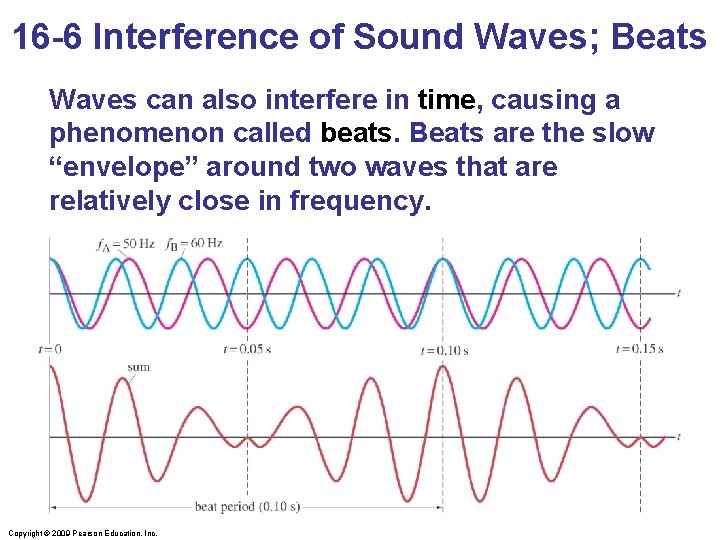
16 -6 Interference of Sound Waves; Beats Waves can also interfere in time, causing a phenomenon called beats. Beats are the slow “envelope” around two waves that are relatively close in frequency. Copyright © 2009 Pearson Education, Inc.
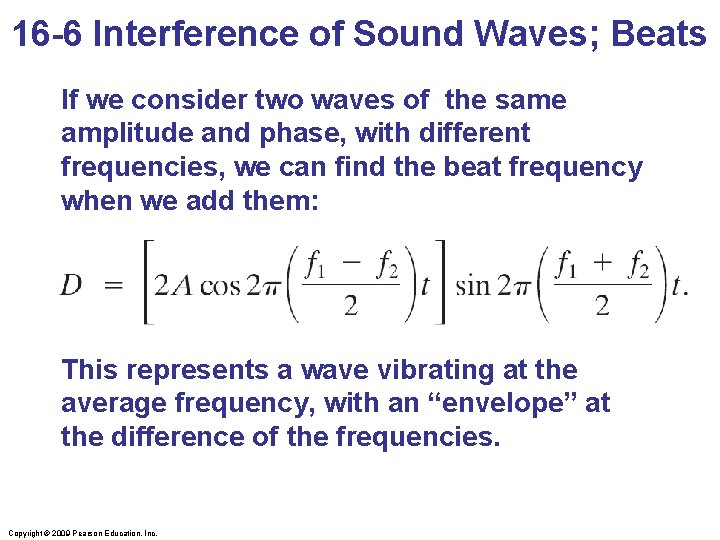
16 -6 Interference of Sound Waves; Beats If we consider two waves of the same amplitude and phase, with different frequencies, we can find the beat frequency when we add them: This represents a wave vibrating at the average frequency, with an “envelope” at the difference of the frequencies. Copyright © 2009 Pearson Education, Inc.
16 -6 Interference of Sound Waves; Beats Example 16 -13: Beats. A tuning fork produces a steady 400 -Hz tone. When this tuning fork is struck and held near a vibrating guitar string, twenty beats are counted in five seconds. What are the possible frequencies produced by the guitar string? Copyright © 2009 Pearson Education, Inc.
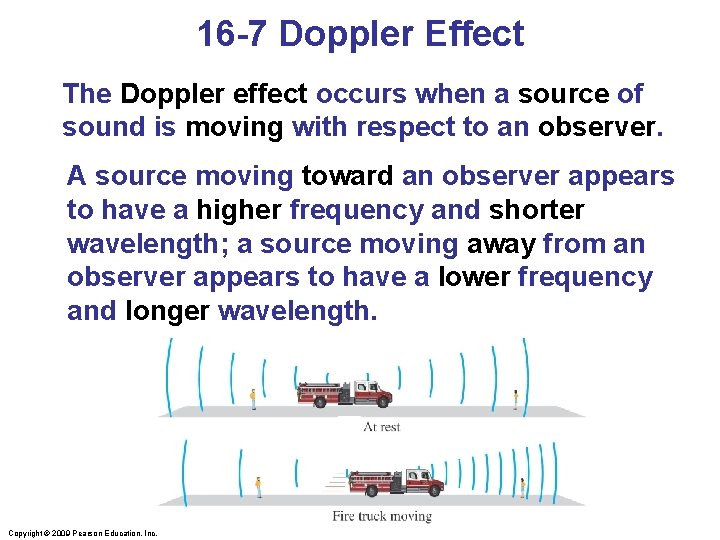
16 -7 Doppler Effect The Doppler effect occurs when a source of sound is moving with respect to an observer. A source moving toward an observer appears to have a higher frequency and shorter wavelength; a source moving away from an observer appears to have a lower frequency and longer wavelength. Copyright © 2009 Pearson Education, Inc.
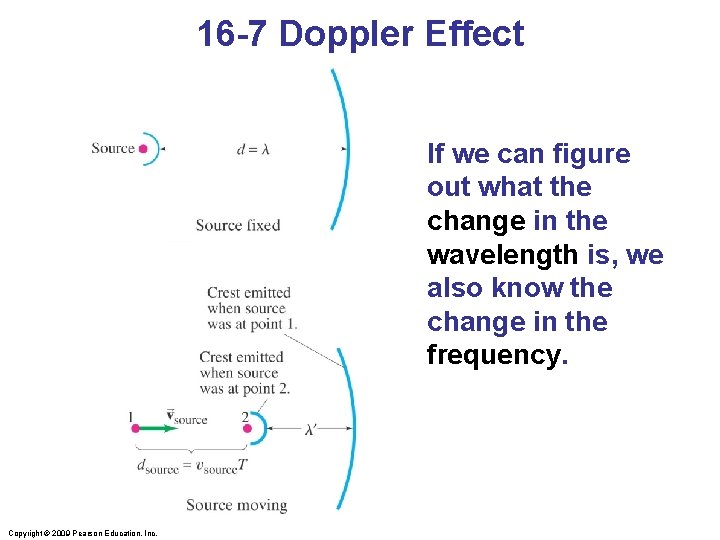
16 -7 Doppler Effect If we can figure out what the change in the wavelength is, we also know the change in the frequency. Copyright © 2009 Pearson Education, Inc.
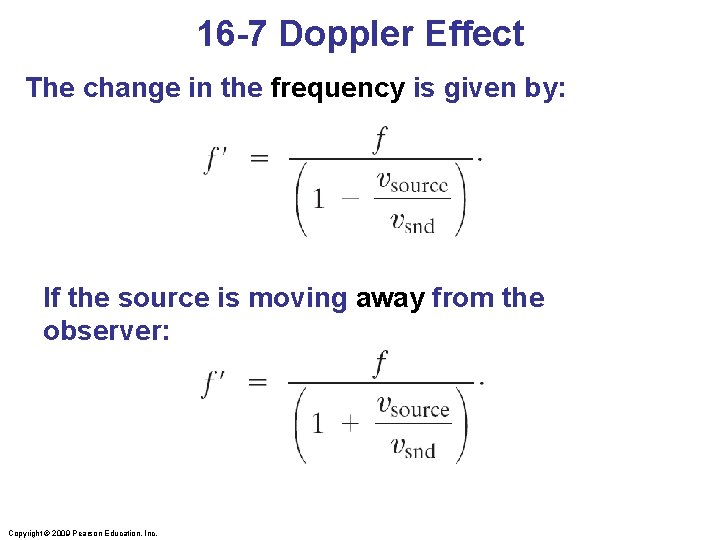
16 -7 Doppler Effect The change in the frequency is given by: If the source is moving away from the observer: Copyright © 2009 Pearson Education, Inc.
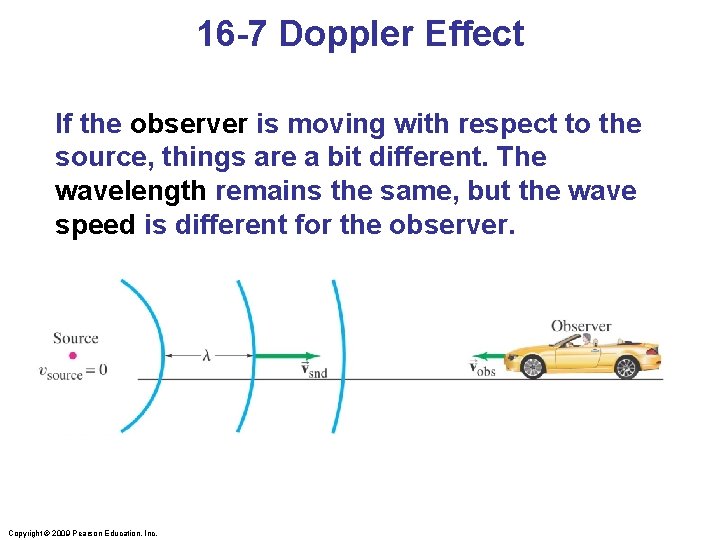
16 -7 Doppler Effect If the observer is moving with respect to the source, things are a bit different. The wavelength remains the same, but the wave speed is different for the observer. Copyright © 2009 Pearson Education, Inc.
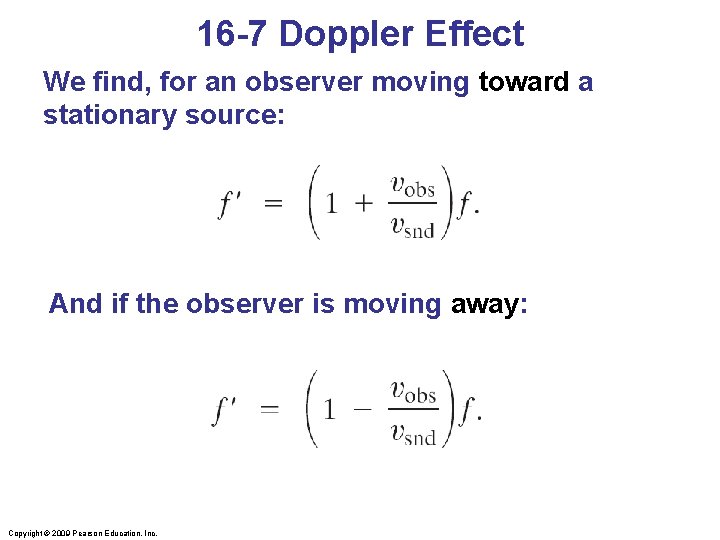
16 -7 Doppler Effect We find, for an observer moving toward a stationary source: And if the observer is moving away: Copyright © 2009 Pearson Education, Inc.
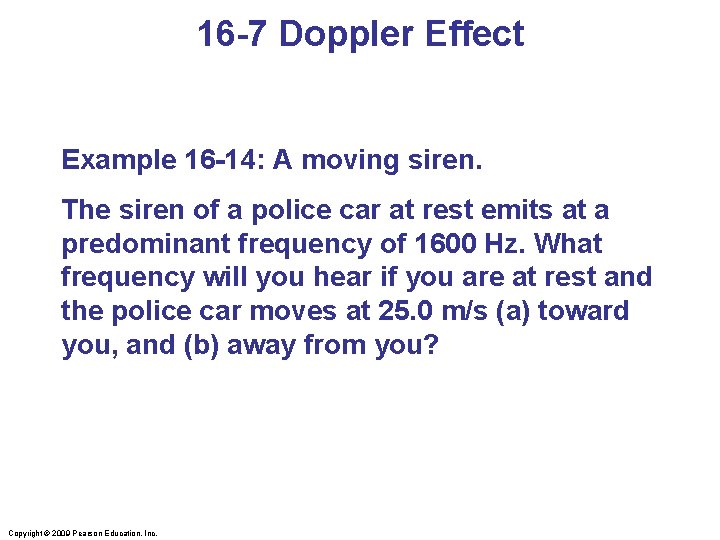
16 -7 Doppler Effect Example 16 -14: A moving siren. The siren of a police car at rest emits at a predominant frequency of 1600 Hz. What frequency will you hear if you are at rest and the police car moves at 25. 0 m/s (a) toward you, and (b) away from you? Copyright © 2009 Pearson Education, Inc.
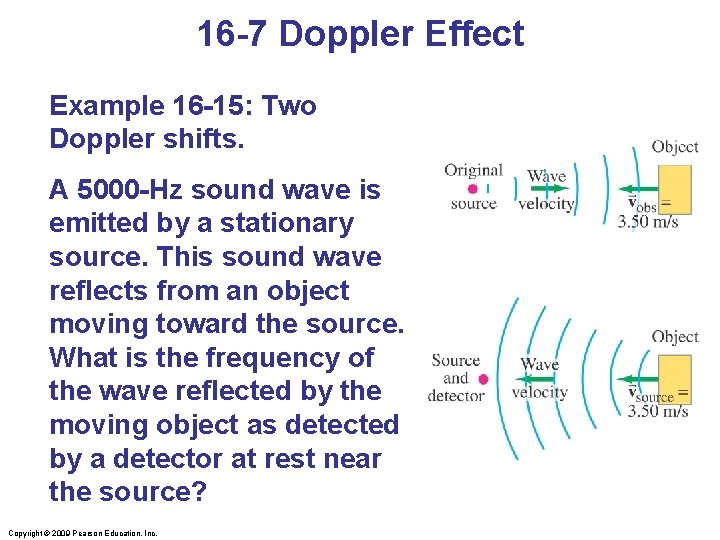
16 -7 Doppler Effect Example 16 -15: Two Doppler shifts. A 5000 -Hz sound wave is emitted by a stationary source. This sound wave reflects from an object moving toward the source. What is the frequency of the wave reflected by the moving object as detected by a detector at rest near the source? Copyright © 2009 Pearson Education, Inc.
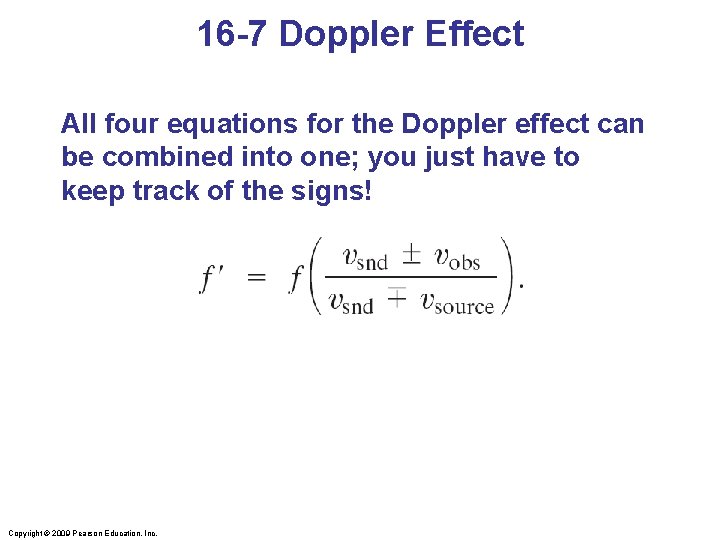
16 -7 Doppler Effect All four equations for the Doppler effect can be combined into one; you just have to keep track of the signs! Copyright © 2009 Pearson Education, Inc.
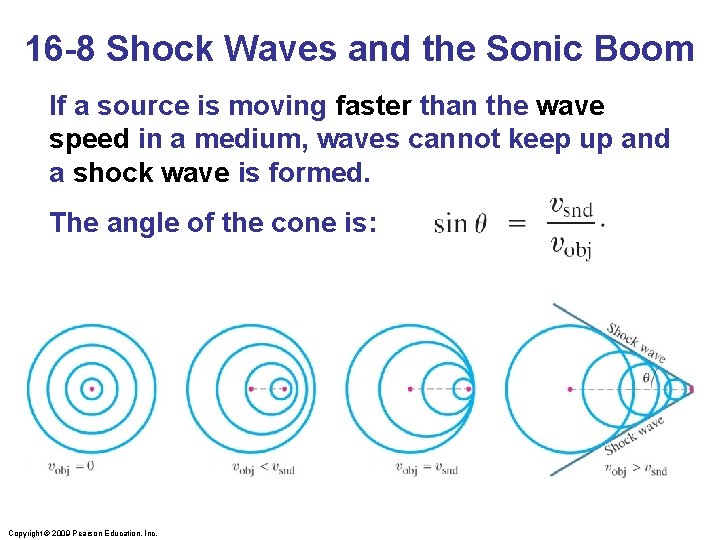
16 -8 Shock Waves and the Sonic Boom If a source is moving faster than the wave speed in a medium, waves cannot keep up and a shock wave is formed. The angle of the cone is: Copyright © 2009 Pearson Education, Inc.
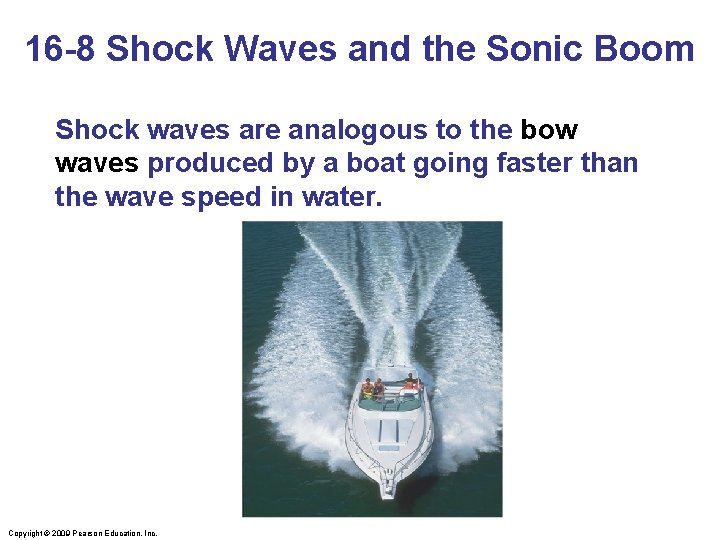
16 -8 Shock Waves and the Sonic Boom Shock waves are analogous to the bow waves produced by a boat going faster than the wave speed in water. Copyright © 2009 Pearson Education, Inc.
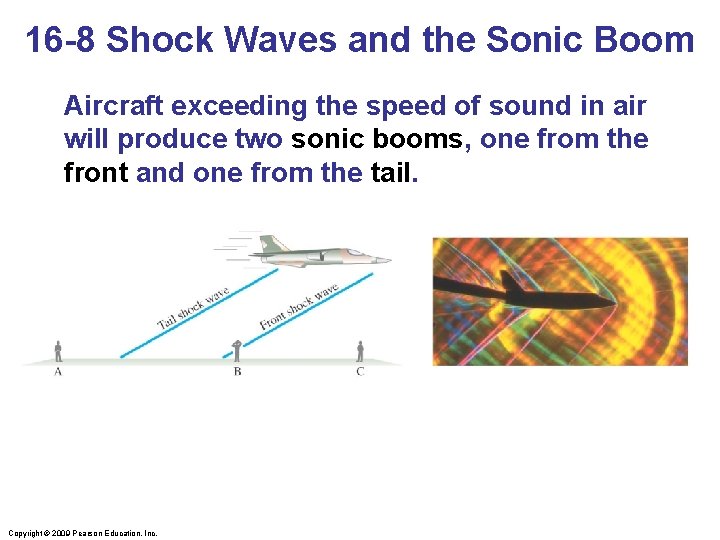
16 -8 Shock Waves and the Sonic Boom Aircraft exceeding the speed of sound in air will produce two sonic booms, one from the front and one from the tail. Copyright © 2009 Pearson Education, Inc.
16 -9 Applications: Sonar, Ultrasound, and Medical Imaging Sonar is used to locate objects underwater by measuring the time it takes a sound pulse to reflect back to the receiver. Similar techniques can be used to learn about the internal structure of the Earth. Sonar usually uses ultrasound waves, as the shorter wavelengths are less likely to be diffracted by obstacles. Copyright © 2009 Pearson Education, Inc.
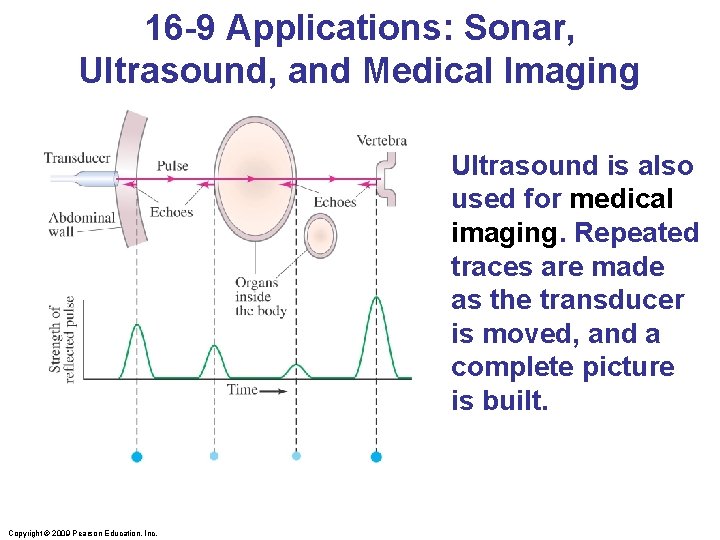
16 -9 Applications: Sonar, Ultrasound, and Medical Imaging Ultrasound is also used for medical imaging. Repeated traces are made as the transducer is moved, and a complete picture is built. Copyright © 2009 Pearson Education, Inc.
16 -9 Applications: Sonar, Ultrasound, and Medical Imaging This is an ultrasound image of a human fetus, showing great detail. Copyright © 2009 Pearson Education, Inc.
Summary of Chapter 16 • Sound is a longitudinal wave in a medium. • The pitch of the sound depends on the frequency. • The loudness of the sound depends on the intensity and also on the sensitivity of the ear. • The strings on stringed instruments produce a fundamental tone whose wavelength is twice the length of the string; there also various harmonics present. Copyright © 2009 Pearson Education, Inc.
Summary of Chapter 16 • Wind instruments have a vibrating column of air when played. If the tube is open, the fundamental is twice its length; if it is closed, the fundamental is four times the tube length. • Sound waves exhibit interference; if two sounds are at slightly different frequencies they produce beats. • The Doppler effect is the shift in frequency of a sound due to motion of the source or the observer. Copyright © 2009 Pearson Education, Inc.